Acta Aeronautica et Astronautica Sinica ›› 2026, Vol. 47 ›› Issue (3): 132185.doi: 10.7527/S1000-6893.2025.32185
• Fluid Mechanics and Flight Mechanics • Previous Articles
Xiang LI1, Junwei LI1,2( ), Qiang LI1,2, Pengwei WEI1, Chen CHEN3, Qingshan FU4
Received:2025-04-30
Revised:2025-05-19
Accepted:2025-07-21
Online:2025-07-31
Published:2025-07-31
Contact:
Junwei LI
E-mail:david78lee@bit.edu.cn
Supported by:CLC Number:
Xiang LI, Junwei LI, Qiang LI, Pengwei WEI, Chen CHEN, Qingshan FU. Influence of structure on two-phase flow in visual nozzle of solid rocket motor[J]. Acta Aeronautica et Astronautica Sinica, 2026, 47(3): 132185.
Fig.1
Overall layout of experimental system
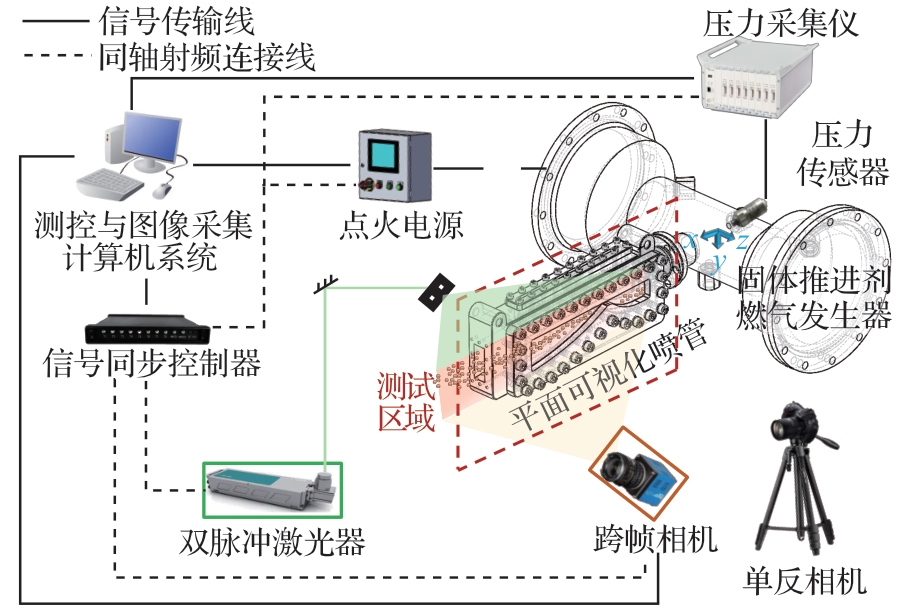
Fig.2
Schematic diagram of solid gas generator dimensions
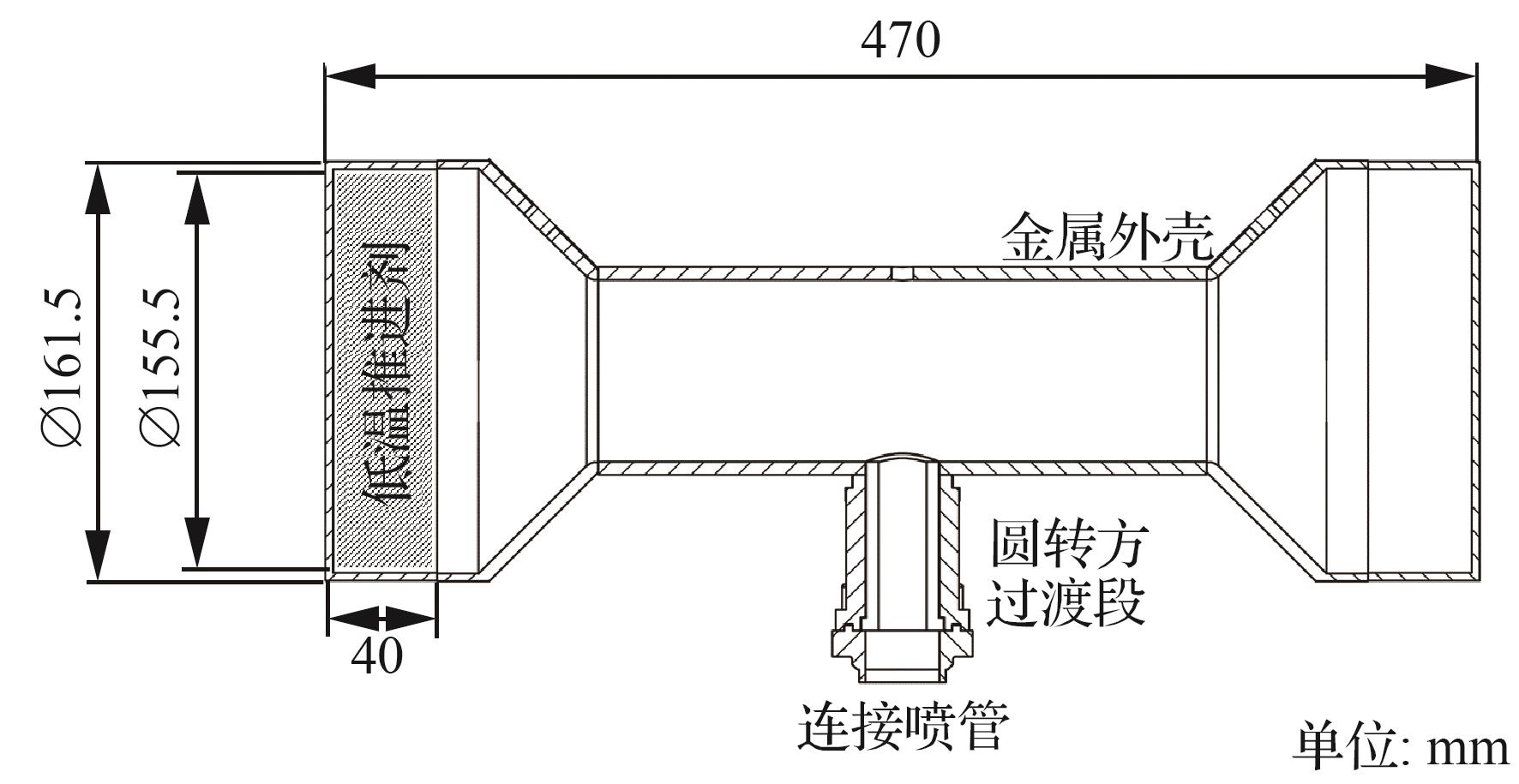
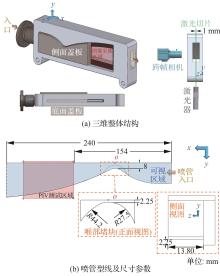
Fig.3
Visual nozzle
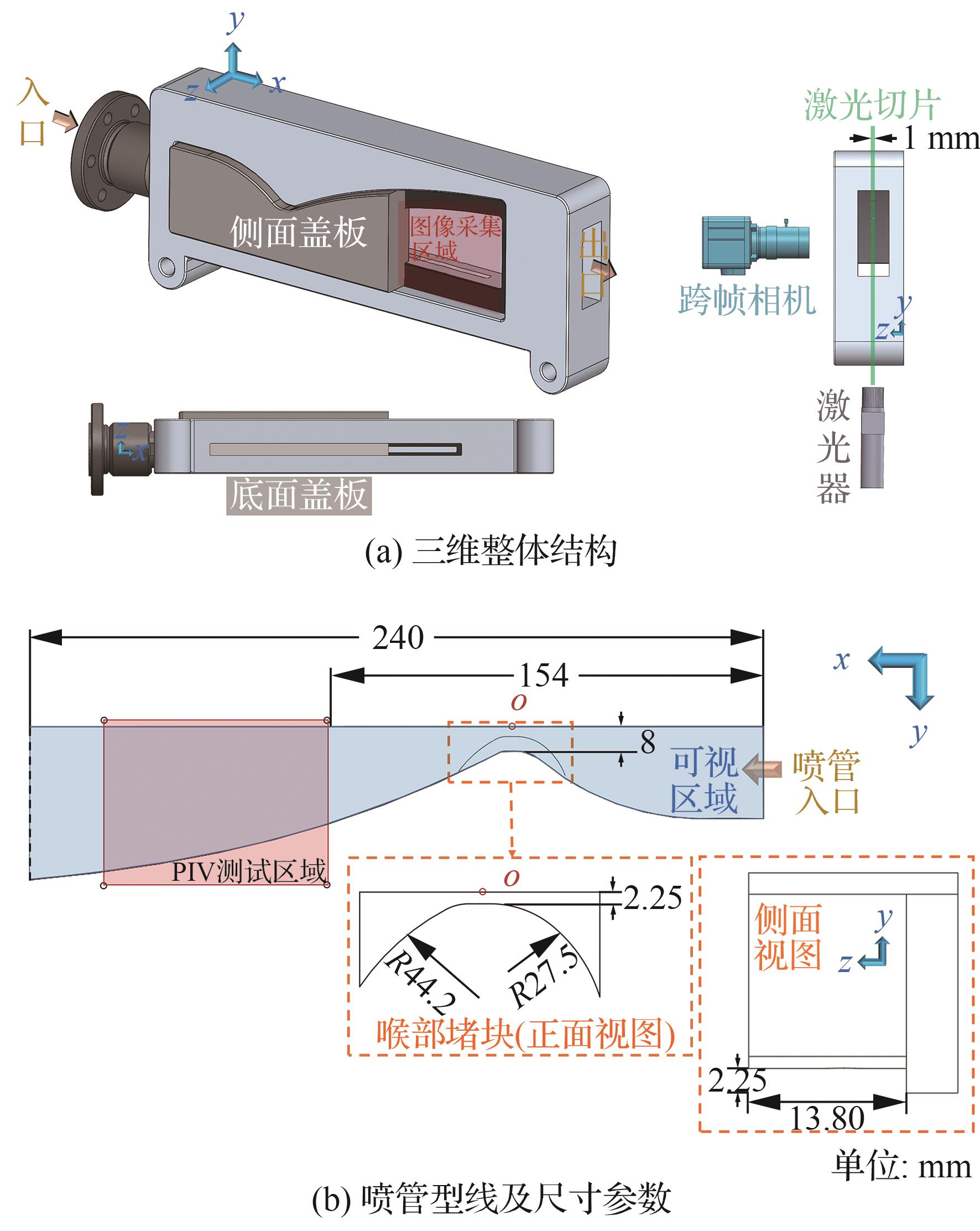
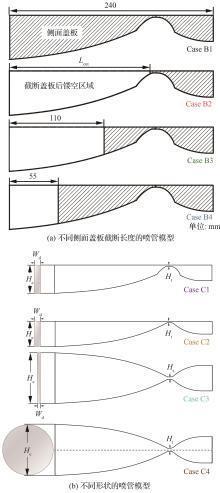
Fig.4
Nozzle simulation model
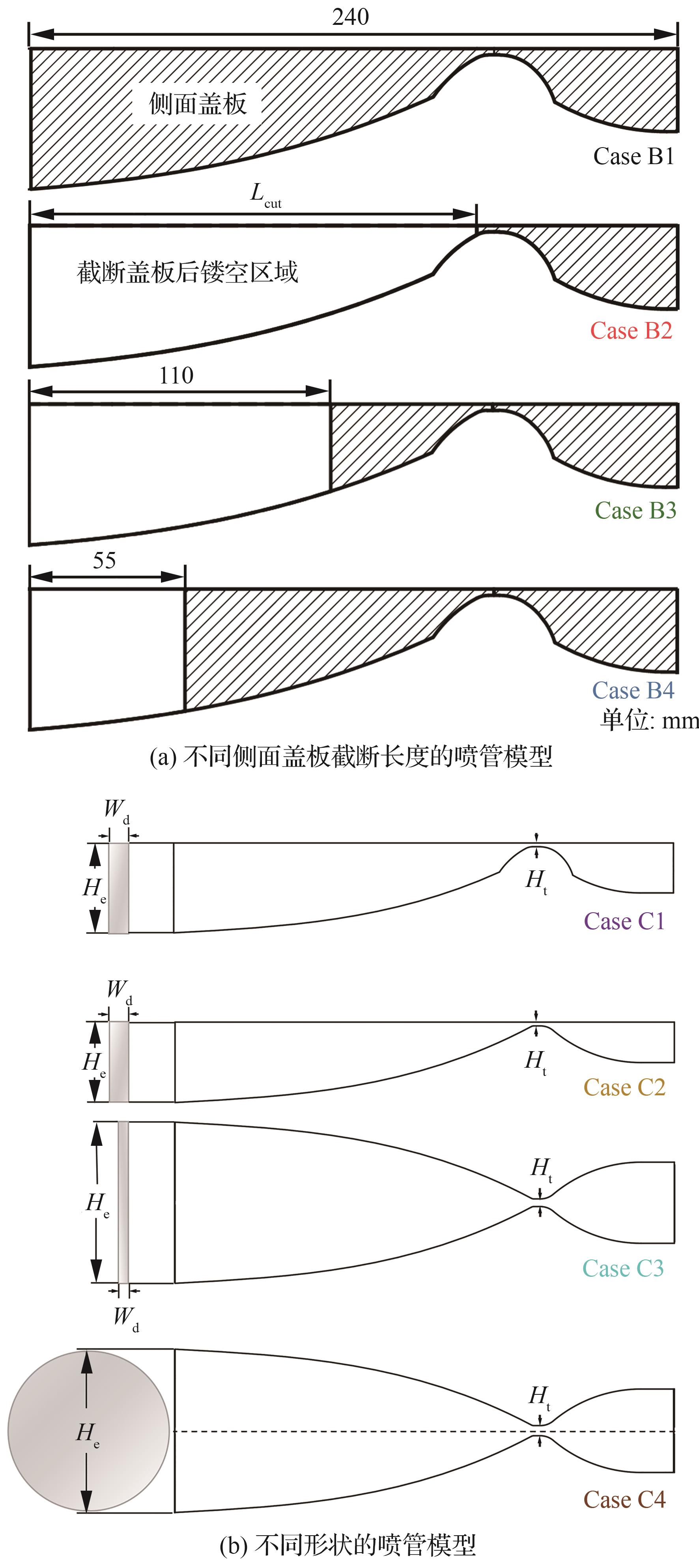
Table 1
Nozzle profile parameters
| 工况 | 喷管模型 | 喉道高度 | 喉道宽度 | 出口高度 | 流道宽度 | 面积比 | 截断长度 |
|---|---|---|---|---|---|---|---|
| A | 实验时采用的加堵块半边方形喷管 | 2.25 | 13.80 | 54.00 | 19.75 | 34.35 | 103 |
| B1 | 简化的加堵块半边方形喷管 | 2.25 | 13.80 | 54.00 | 13.80 | 24.00 | 0 |
| B2 | 160 | ||||||
| B3 | 110 | ||||||
| B4 | 55 | ||||||
| C1 | 加堵块的半边方形喷管 | 2.25 | 13.80 | 54.00 | 13.80 | 24.00 | |
| C2 | 不加堵块的半边方形喷管 | 2.25 | 13.80 | 48.22 | 13.80 | 21.43 | |
| C3 | 不加堵块的全尺寸方形喷管 | 4.50 | 6.90 | 96.44 | 6.90 | 21.43 | |
| C4 | 不加堵块的圆周喷管 | 6.29 | 98.23 | 243.89 | |||
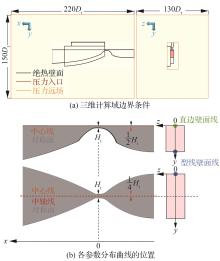
Fig.5
Boundary conditions and parameter distribution of simulation model
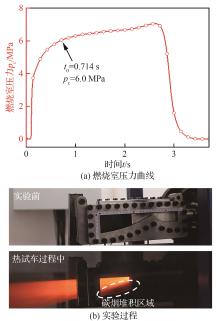
Fig.6
Pressure curve and experimental process
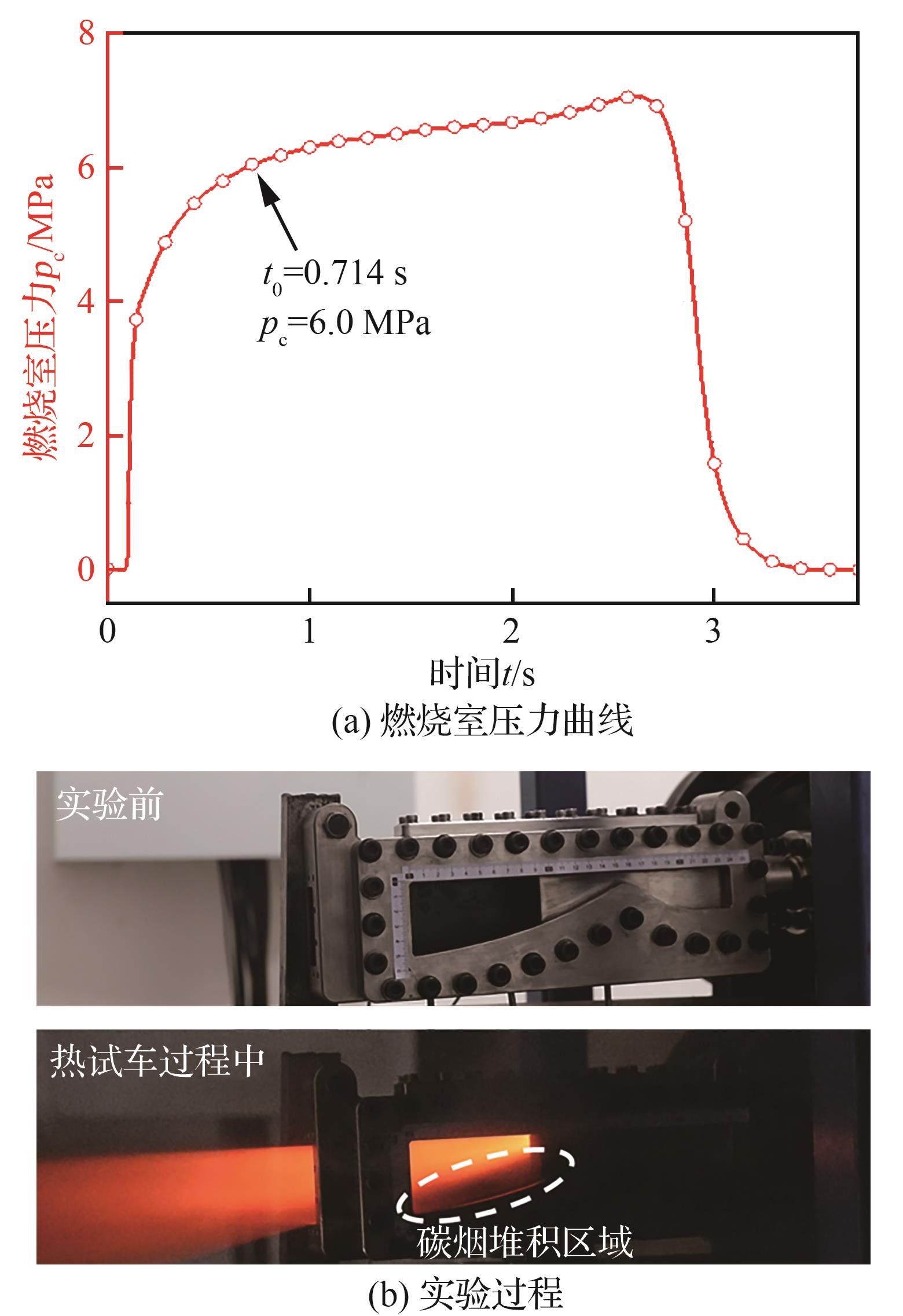
Fig.7
PIV original image and cross-correlation results
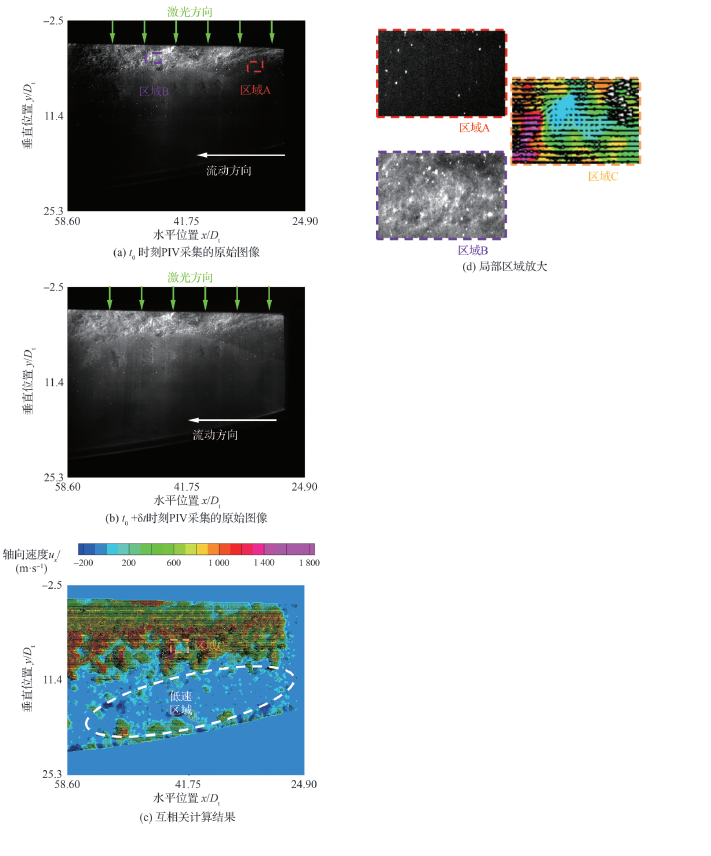
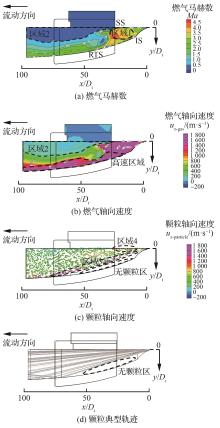
Fig.8
Flow field simulation results of Case A
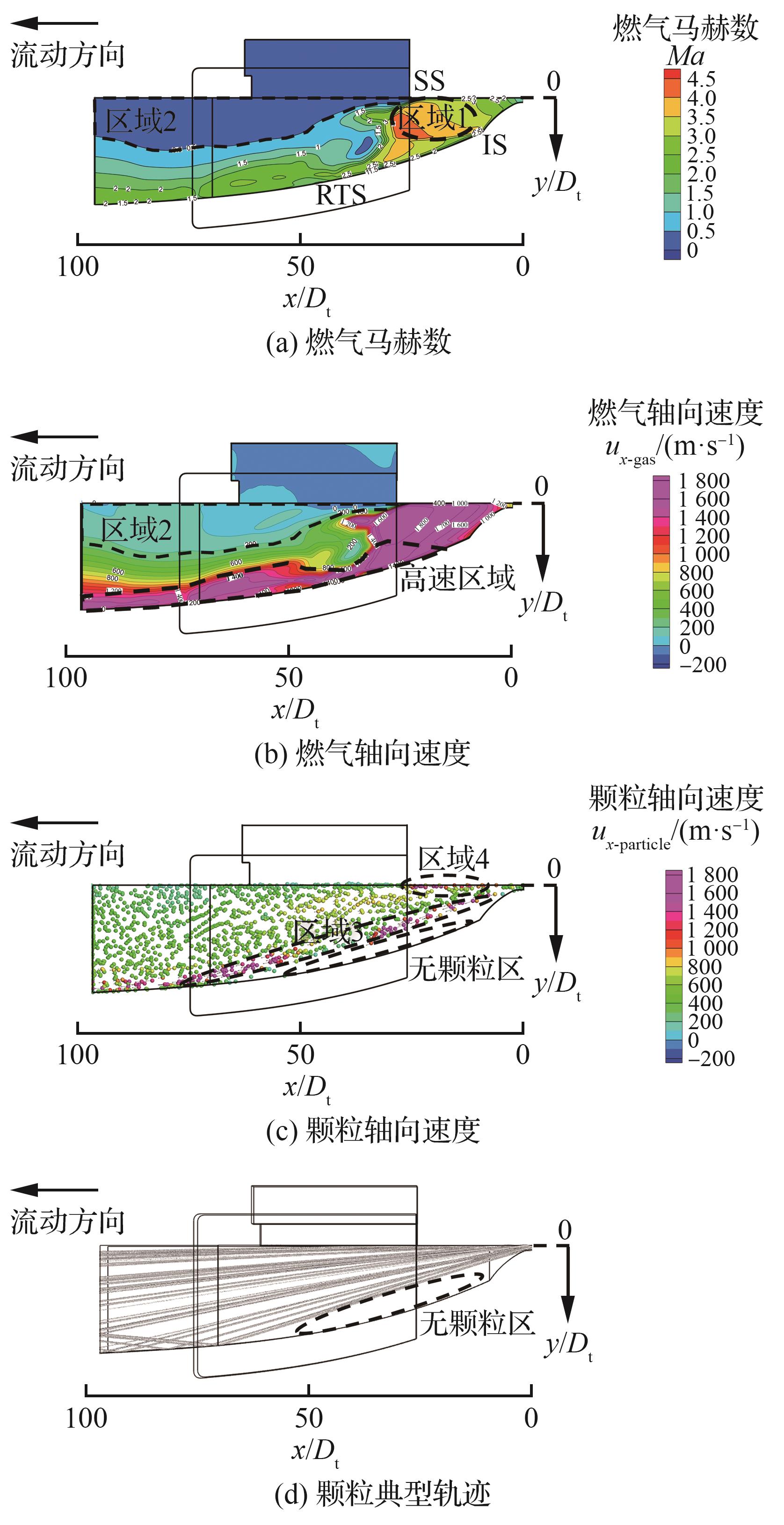
Fig.9
Comparison of flow field velocity experiment and simulation results
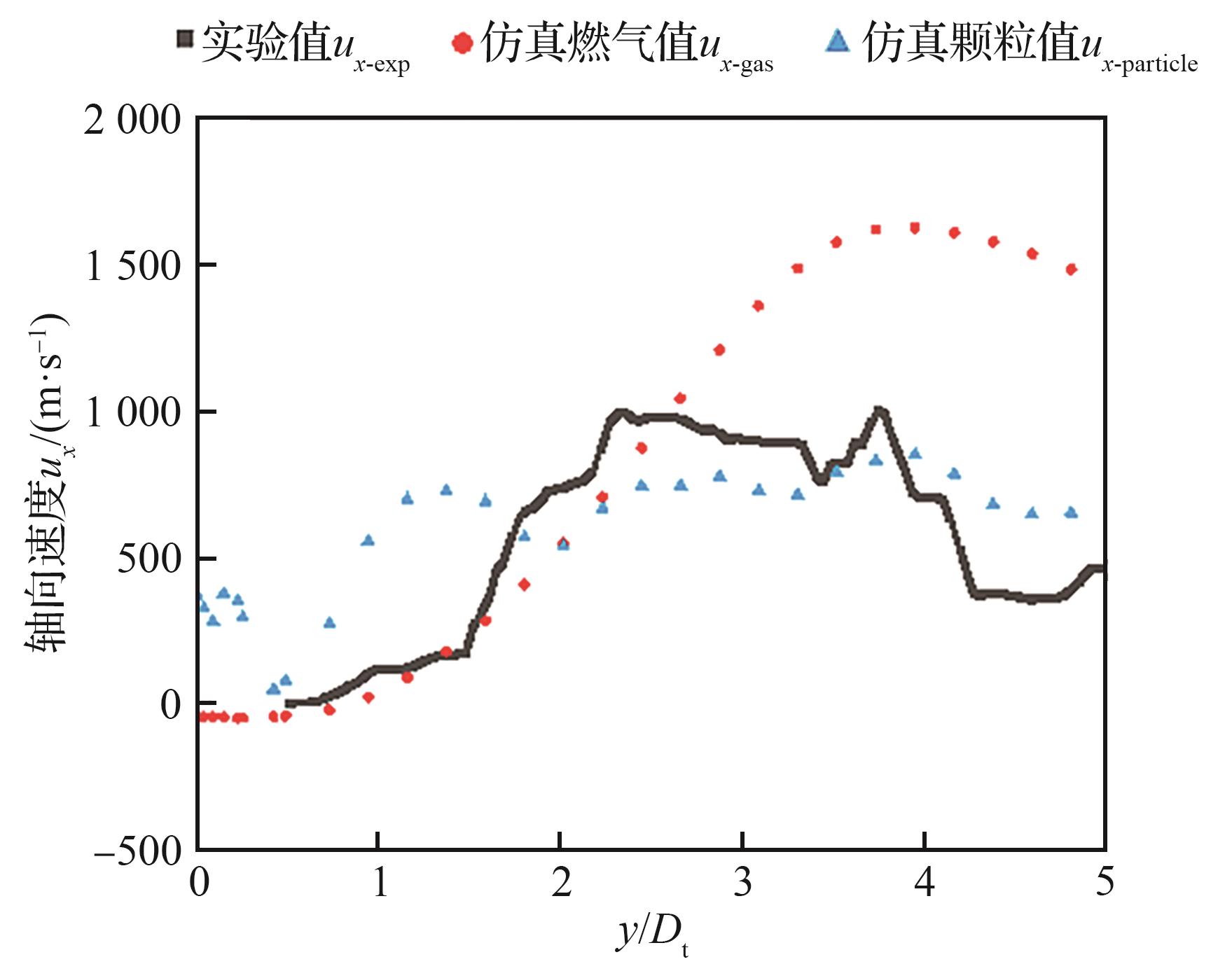
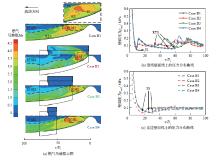
Fig.10
Effect of truncated length on axial expansion of gas
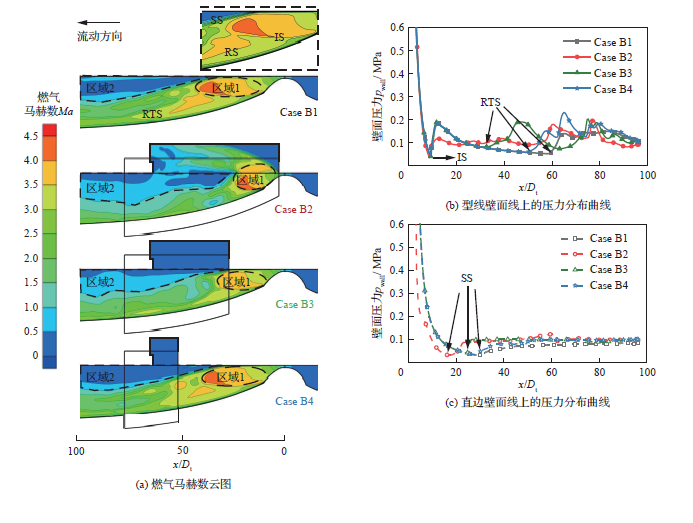
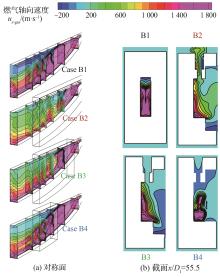
Fig.11
Axial velocity distribution of gas on yOz section of nozzle with different truncated lengths
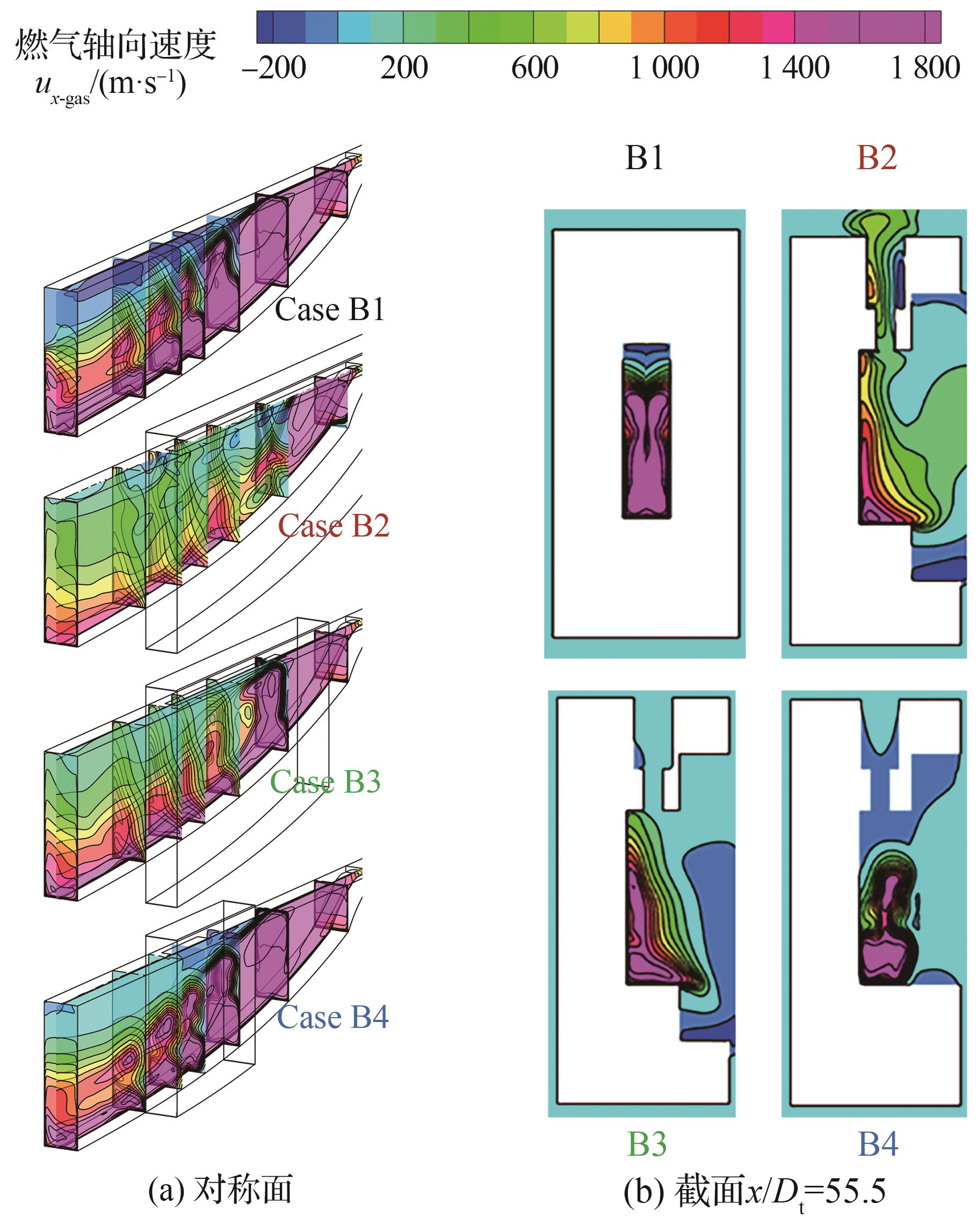
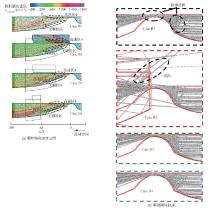
Fig.12
Particles distribution on symmetric plane of nozzles with different truncated lengths
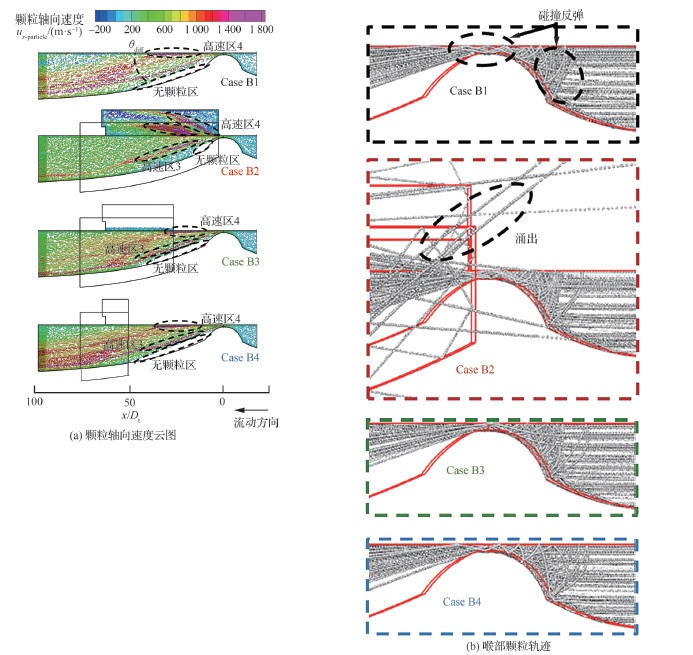
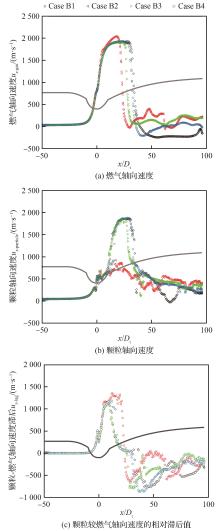
Fig.13
Axial velocity distribution curves of gas-particle on center line of nozzles with different truncated lengths
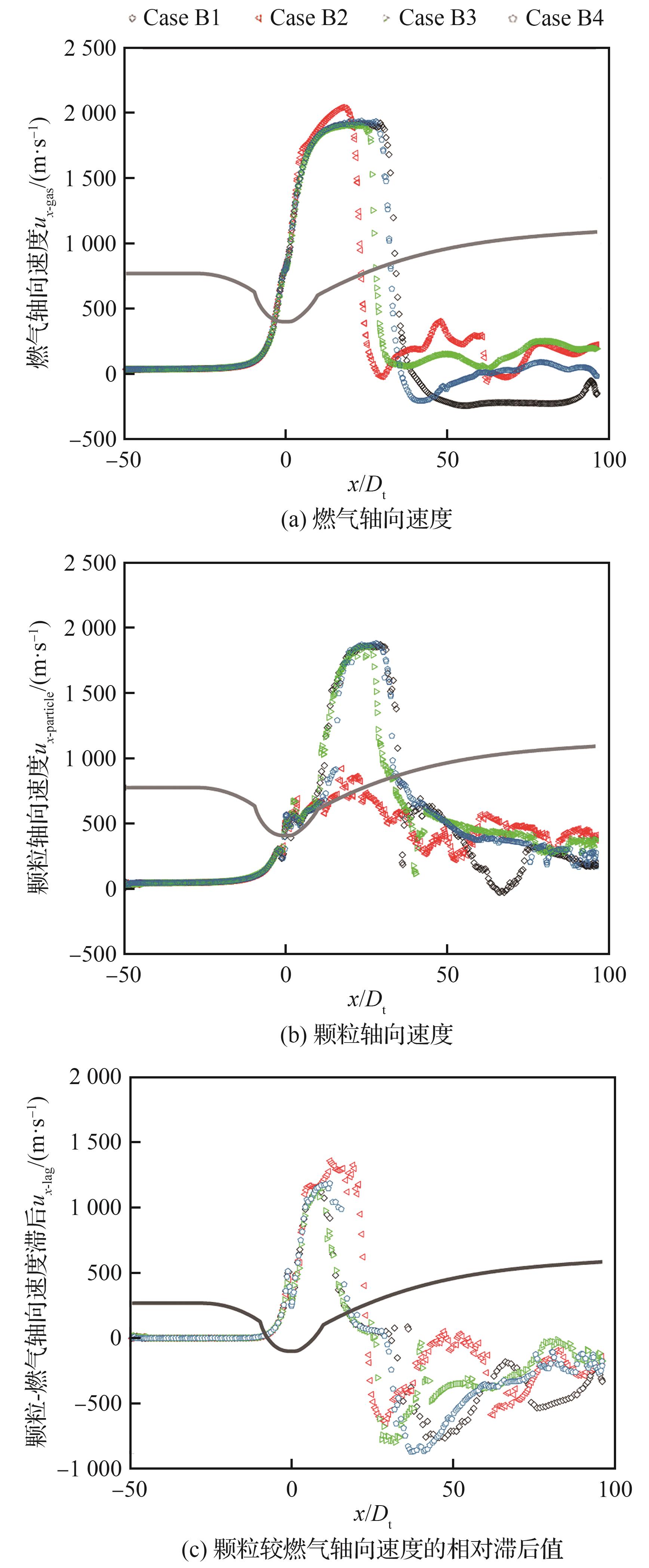
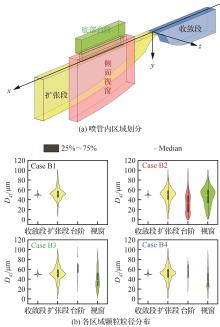
Fig.14
Particle size distribution in nozzles with different truncated lengths
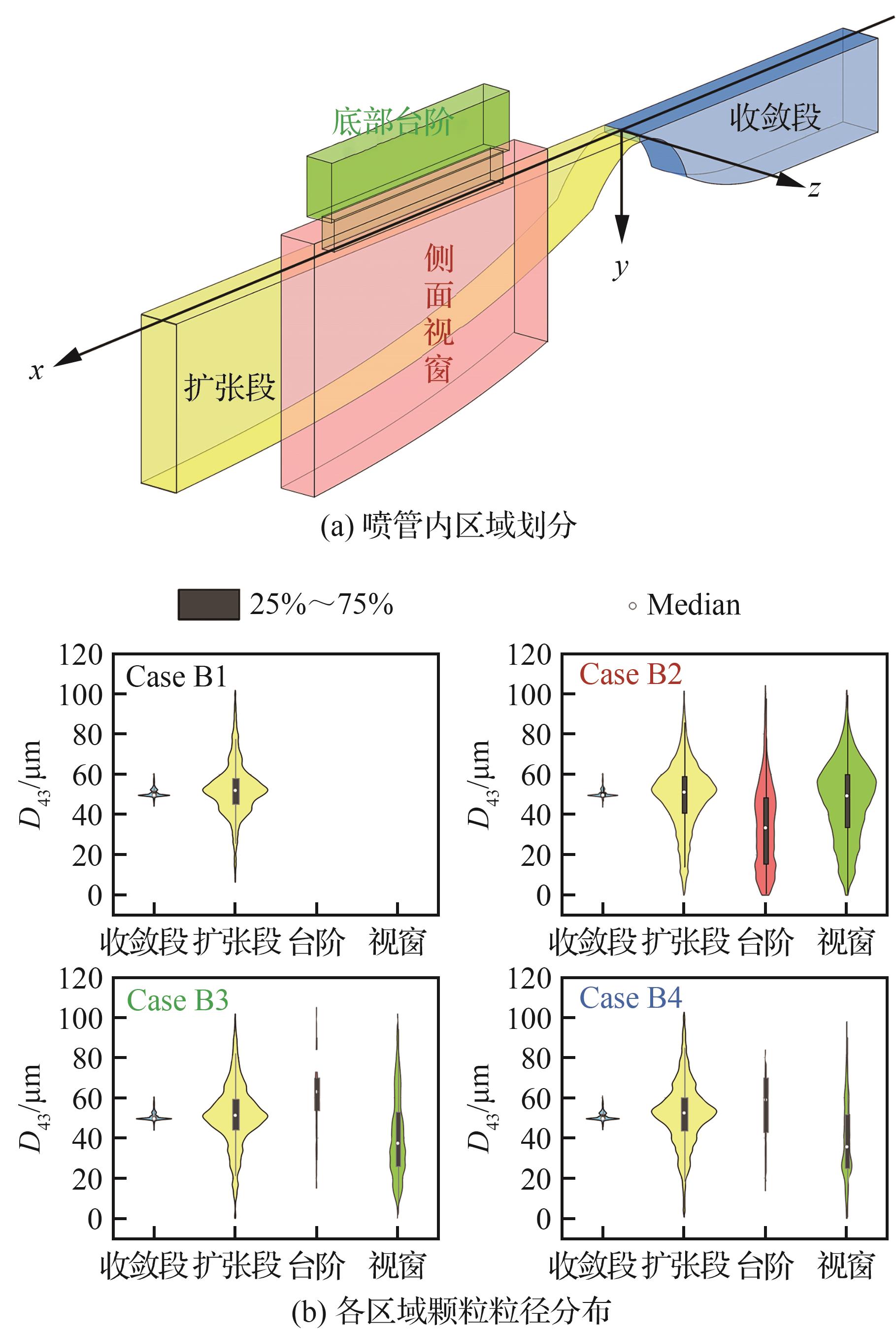
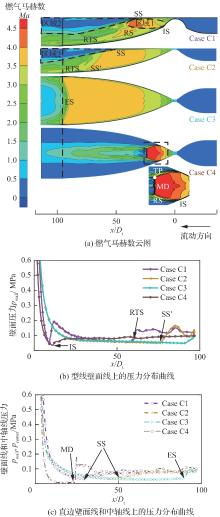
Fig.15
Effect of nozzle shape on axial expansion of gas
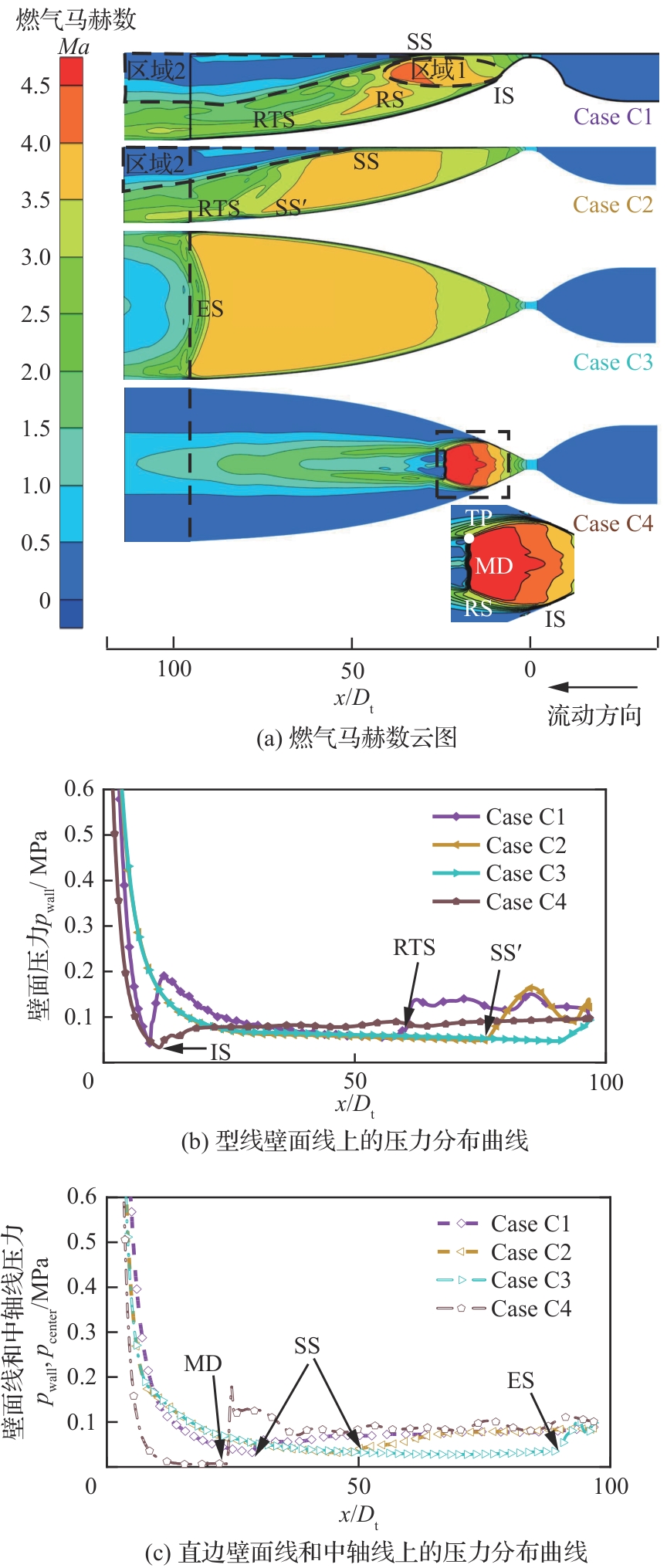
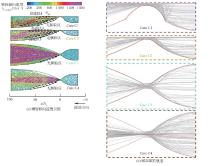
Fig.16
Particle distribution on symmetry plane of nozzles with different shapes
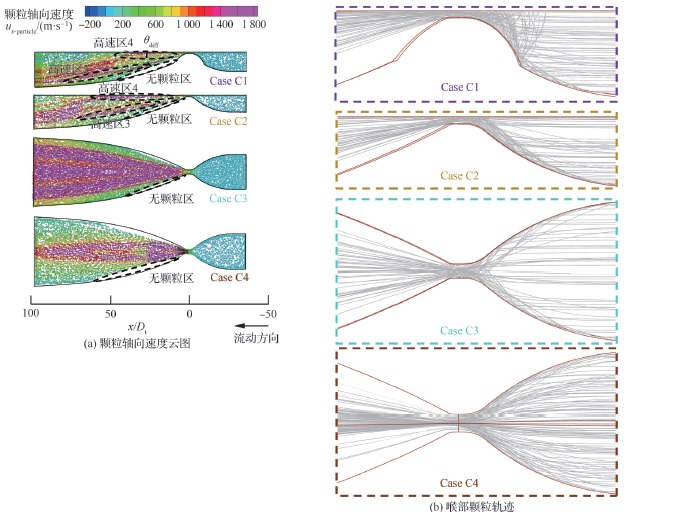
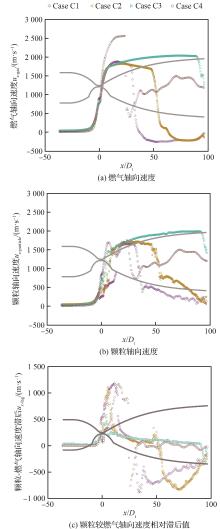
Fig.17
Axial velocity distribution curves of gas-particle on center line of nozzles with different shapes
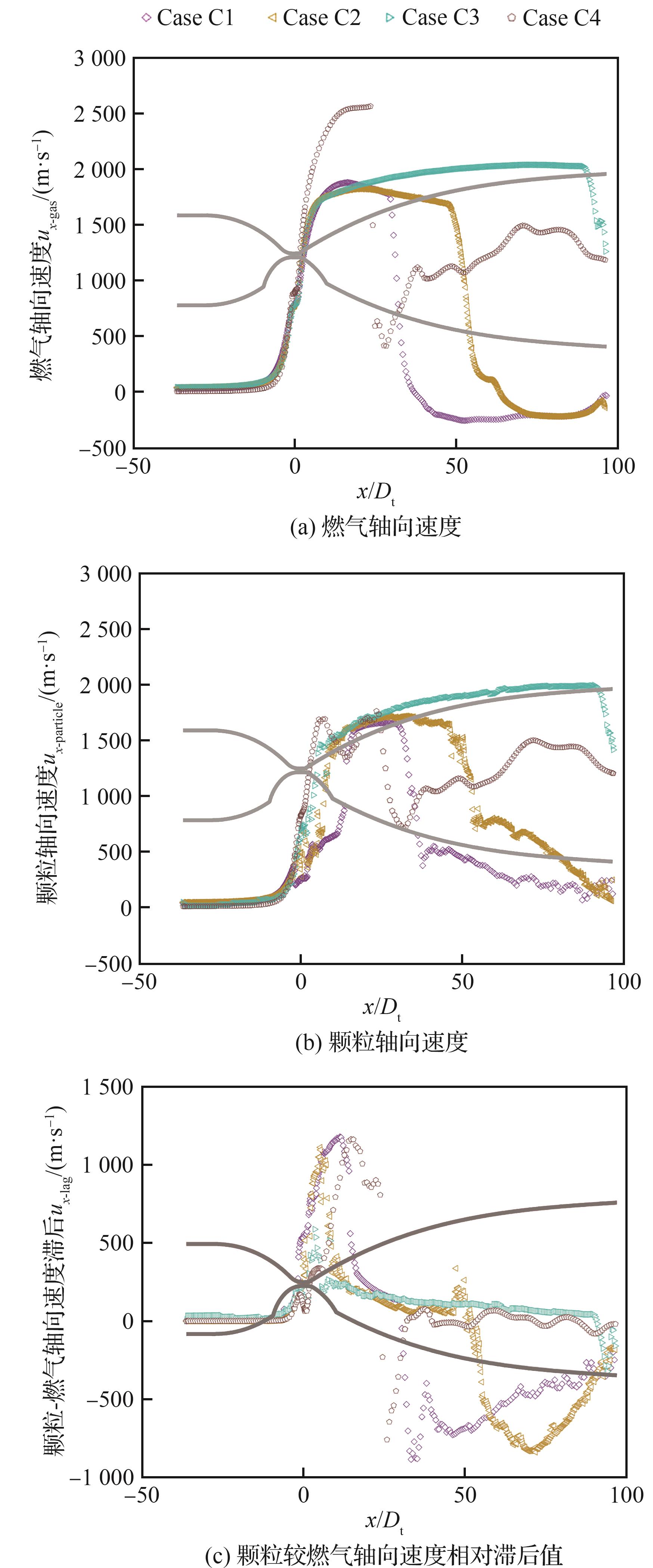
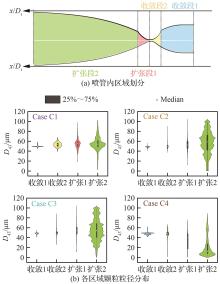
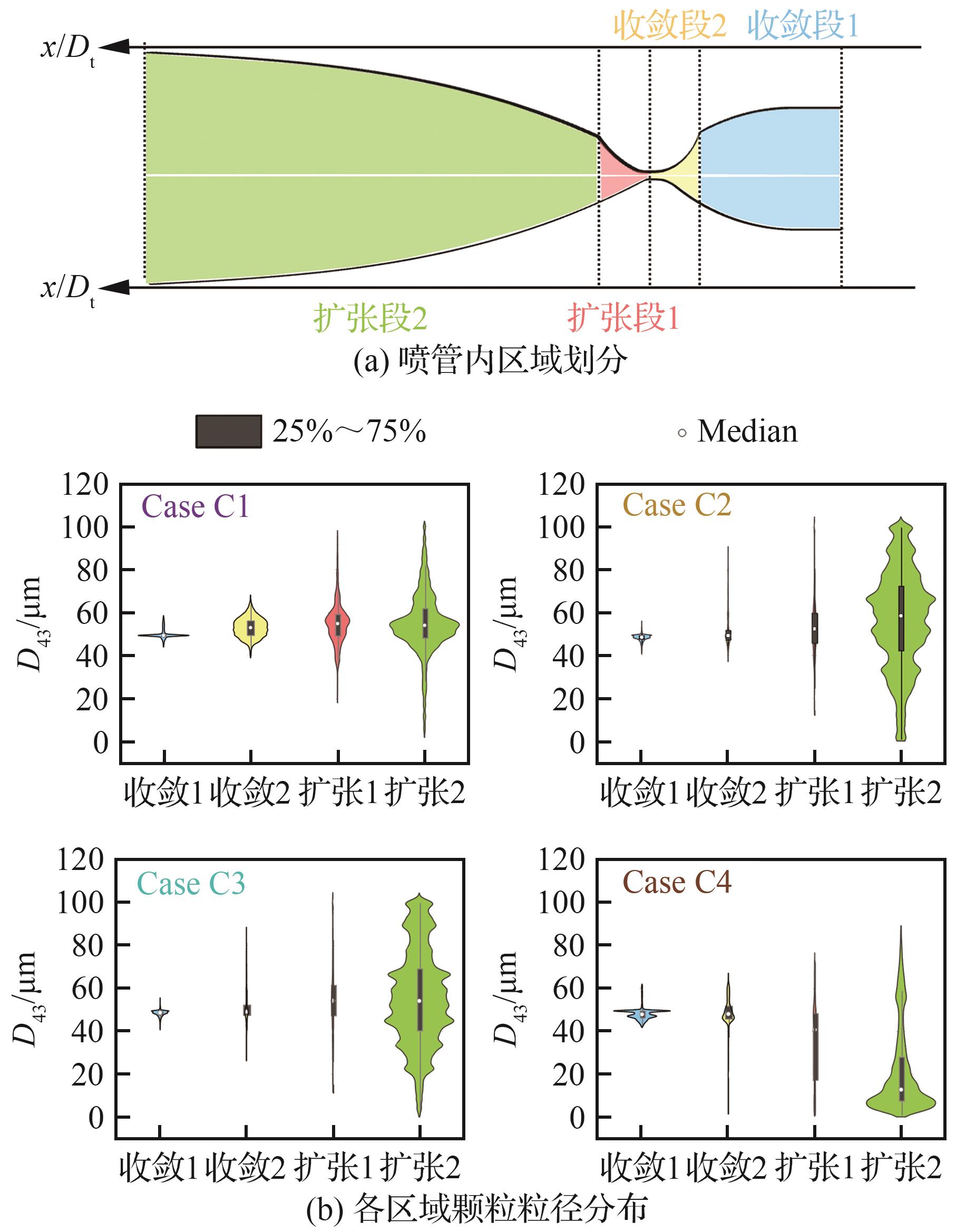
Fig.18
Particle size distribution in nozzles with different shapes
| [1] | MARBLE F E. Nozzle contours for minimum particle-lag loss[J]. AIAA Journal, 1963, 1(12): 2793-2801. |
| [2] | LANDSBAUM E M, SALINAS M P, LEARY J P. Specific impulse prediction of solid-propellant motors[J]. Journal of Spacecraft and Rockets, 1980, 17(5): 400-406. |
| [3] | COATS D, COLEGROVE P, DUNN S. A critical review of the SPP loss mechanisms[C]∥25th Joint Propulsion Conference. Reston: AIAA, 1989. |
| [4] | HERMSEN R W. Aluminum oxide particle size for solid rocket motor performance prediction[J]. Journal of Spacecraft and Rockets, 1981, 18(6): 483-490. |
| [5] | 陈林泉, 侯晓, 李岩芳, 等. 固体火箭发动机喷管效率计算[J]. 固体火箭技术, 2002, 25(4): 9-11. |
| CHEN L Q, HOU X, LI Y F, et al. Calculation of nozzle efficiency for solid rocket motor[J]. Journal of Solid Rocket Technology, 2002, 25(4): 9-11 (in Chinese). | |
| [6] | KUMAR N, BANSAL A. Modeling of turbulence, chemistry, and heat transfer of a rocket nozzle[J]. Acta Astronautica, 2024, 223: 495-504. |
| [7] | AKIKI M, MAJDALANI J. Compressible integral representation of rotational and axisymmetric rocket flow[J]. Journal of Fluid Mechanics, 2016, 809: 213-239. |
| [8] | RESTREPO J C, BOLAÑOS-ACOSTA A F, SIMÕES-MOREIRA J R. Condensation shock topologies in carbon dioxide and a non-condensable gas mixture in supersonic nozzles[J]. Physics of Fluids, 2024, 36(4): 046104. |
| [9] | ELIAS E, LELLOUCHE G S. Two-phase critical flow[J]. International Journal of Multiphase Flow, 1994, 20(S1): 91-168. |
| [10] | HUNTER S, CHERRY S, KLIEGEL J. Gas-particle nozzle flows with reaction and particle size change[C]∥19th Aerospace Sciences Meeting. Reston: AIAA, 1981. |
| [11] | VASENIN I M, NARIMANOV R K, GLAZUNOV A A, et al. Two-phase flows in the nozzles of solid rocket motors[J]. Journal of Propulsion and Power, 1995, 11(4): 583-592. |
| [12] | LOTH E, TYLER DASPIT J, JEONG M, et al. Supersonic and hypersonic drag coefficients for a sphere[J]. AIAA Journal, 2021, 59(8): 3261-3274. |
| [13] | CAPECELATRO J, WAGNER J L. Gas-particle dynamics in high-speed flows[J]. Annual Review of Fluid Mechanics, 2024, 56: 379-403. |
| [14] | YANG Q J, YANG S L, YU H S, et al. Impact of Laval nozzle structure on the flow characteristics of supersonic gas-solid two-phase flow[J]. Powder Technology, 2024, 439: 119657. |
| [15] | BRYKOV N, EMELYANOV V, TETERINA I, et al. Drag and heat transfer of metal and oxide agglomerates in flow of combustion products of solid propellant[J]. Acta Astronautica, 2023, 205: 319-331. |
| [16] | 于勇, 刘淑艳, 张世军, 等. 固体火箭发动机喷管气固两相流动的数值模拟[J]. 航空动力学报, 2009, 24(4): 931-937. |
| YU Y, LIU S Y, ZHANG S J, et al. Numerical simulation of gas-particle flow in nozzle of solid rocket motor[J]. Journal of Aerospace Power, 2009, 24(4): 931-937 (in Chinese). | |
| [17] | LI X, ZHANG H B, BAI B F. Particle-free zone of the two-phase flow in a convergent-divergent nozzle[J]. Powder Technology, 2021, 394: 1169-1177. |
| [18] | 穆旭, 田维平, 董新刚, 等. 固体火箭发动机喷管扩张段型面参数对其性能影响仿真分析[J]. 固体火箭技术, 2021, 44(2): 254-263. |
| MU X, TIAN W P, DONG X G, et al. Study on the effect of divergence contour parameters on performance of solid rocket motor nozzle[J]. Journal of Solid Rocket Technology, 2021, 44(2): 254-263 (in Chinese). | |
| [19] | GROSSI M, SERENO A, BIANCHI D, et al. Numerical simulation of multiphase flows in solid rocket motors nozzles[C]∥AIAA Aviation 2022 Forum. Reston: AIAA, 2022. |
| [20] | GROSSI M, SERENO A, BIANCHI D, et al. Multiphase effects on solid rocket nozzle performance[J]. Journal of Propulsion and Power, 2023, 39(6): 811-823. |
| [21] | 李泓瑾, 李军伟, 谢侃, 等. 两相流对固体火箭发动机塞式喷管性能的影响[J]. 航空学报, 2023, 44(16): 127890. |
| LI H J, LI J W, XIE K, et al. Effect of two-phase flow on performance of plug nozzle in solid rocket motor[J]. Acta Aeronautica et Astronautica Sinica, 2023, 44(16): 127890 (in Chinese). | |
| [22] | 黄浩, 丰志伟, 马立坤, 等. 颗粒参数对轴对称超声速气固两相流喷管性能的影响研究[J]. 推进技术, 2023, 44(8): 22010045. |
| HUANG H, FENG Z W, MA L K, et al. Effects of particle parameters on performance of axisymmetric supersonic gas-solid two-phase flow nozzle[J]. Journal of Propulsion Technology, 2023, 44(8): 22010045 (in Chinese). | |
| [23] | ADRIAN R J. Particle-imaging techniques for experimental fluid mechanics[J]. Annual Review of Fluid Mechanics, 1991, 23: 261-304. |
| [24] | RAFFEL M, WILLERT C E, WERELEY S T, et al. Particle image velocimetry: A practical guide[M]. Berlin, Heidelberg: Springer, 2007. |
| [25] | 徐惊雷. PIV技术在超及高超声速流场测量中的研究进展[J]. 力学进展, 2012, 42(1): 81-90. |
| XU J L. The development of the PIV experimental study of the super/hypersoinc flowfield[J]. Advances in Mechanics, 2012, 42(1): 81-90 (in Chinese). | |
| [26] | SAKAKIBARA K, YAMADA M, MIYAMOTO Y, et al. Measurement of the surrounding liquid motion of a single rising bubble using a Dual-Camera PIV system[J]. Flow Measurement and Instrumentation, 2007, 18(5-6): 211-215. |
| [27] | GESCHWINDNER C, WESTRUP K, DREIZLER A, et al. Pulse picking of a fiber laser enables velocimetry of biomass-laden jets at low and ultra-high repetition rates[J]. Proceedings of the Combustion Institute, 2023, 39(1): 1325-1335. |
| [28] | LIU T S, MERAT A, MAKHMALBAF M H M, et al. Comparison between optical flow and cross-correlation methods for extraction of velocity fields from particle images[J]. Experiments in Fluids, 2015, 56: 166. |
| [29] | SCARANO F, RIETHMULLER M L. Iterative multigrid approach in PIV image processing with discrete window offset[J]. Experiments in Fluids, 1999, 26(6): 513-523. |
| [30] | FORE L B. Reduction of peak-locking errors produced by Gaussian sub-pixel interpolation in cross-correlation digital particle image velocimetry[J]. Measurement Science and Technology, 2010, 21(3): 035402. |
| [31] | WESTERWEEL J. Efficient detection of spurious vectors in particle image velocimetry data[J]. Experiments in Fluids, 1994, 16: 236-247. |
| [32] | MENTER F R. Two-equation eddy-viscosity turbulence models for engineering applications[J]. AIAA Journal, 1994, 32(8): 1598-1605. |
| [33] | MENTER F R, RUMSEY C L. Assessment of two-equation turbulence models for transonic flows [C]∥25th AIAA Fluid Dynamics Conference. Reston: AIAA, 1994. |
| [34] | AGHA MIRJALILY S ALI. Calibration of the k-ω shear stress transport turbulence model for shock wave boundary layer interaction in a SERN using machine learning[J]. Engineering Analysis with Boundary Elements, 2023, 146: 96-104. |
| [35] | AGHA MIRJALILY S ALI. Lambda shock behaviors of elliptic supersonic jets; a numerical analysis with modification of RANS turbulence model[J]. Aerospace Science and Technology, 2021, 112: 106613. |
| [36] | MORSI S A, ALEXANDER A J. An investigation of particle trajectories in two-phase flow systems[J]. Journal of Fluid Mechanics, 1972, 55(2): 193-208. |
| [37] | ROE P L. Approximate Riemann solvers, parameter vectors, and difference schemes[J]. Journal of Computational Physics, 1997, 135(2): 250-258. |
| [38] | BURT J M, BOYD I D. Development of a two-way coupled model for two phase rarefied flows[C]∥42nd AIAA Aerospace Sciences Meeting and Exhibit. Reston: AIAA, 2004. |
| [39] | NGUYEN A V, FLETCHER C A J. Particle interaction with the wall surface in two-phase gas-solid particle flow[J]. International Journal of Multiphase Flow, 1999, 25(1): 139-154. |
| [40] | LOTH E, MARSHALL J S. Restitution coefficient models for collisions of airborne particles and drops[J]. Journal of Aerosol Science, 2023, 173: 106186. |
| [41] | SIRAVURI S, TABAKOFF W, GUNARAJ J A. Experimental investigation of particle rebound characteristics on turbomachinery leading edge geometry [C]∥Proceedings of the ASME 1999 International Gas Turbine and Aeroengine Congress and Exhibition. New York: ASME, 1999. |
| [1] | Baoshi YU, Yongjun LEI, Zhibin SHEN, Dapeng ZHANG. Review on analysis and control technology of curing residual stress in solid motor propellants [J]. Acta Aeronautica et Astronautica Sinica, 2025, 46(8): 31083-031083. |
| [2] | Chaolong LI, Zhixun XIA, Lei BAO, Xianzhong GAO, Zhengtao GUO, Guobin ZHANG, Likun MA, Zhenbing LUO, Shuai SHAO, Xiangyue HE. Research progress on combustion organization technology of scramjet fueled by solid propellant [J]. Acta Aeronautica et Astronautica Sinica, 2025, 46(18): 131752-131752. |
| [3] | Jia WEI, Baoshi YU, Dapeng ZHANG, Zhibin SHEN, Yongjun LEI. Generation and release mechanism of residual stress and strain in solid rocket motor propellant grain with pressure cure [J]. Acta Aeronautica et Astronautica Sinica, 2025, 46(16): 431661-431661. |
| [4] | Chunjie LI, Junwei LI, Zhongliang TIAN, Limin WANG, Hang YANG, Haoyu YAO. Influence of pintle ablation on internal ballistics of variable thrust solid motor [J]. Acta Aeronautica et Astronautica Sinica, 2025, 46(14): 131519-131519. |
| [5] | Ge WANG, Zhibang WANG, Fuqi WANG, Ben GUAN, Limin WANG, Haoran NING. Numerical study on quasi⁃one⁃dimensional internal ballistics of throttling segregated fuel⁃oxidizer systems [J]. Acta Aeronautica et Astronautica Sinica, 2024, 45(7): 129111-129111. |
| [6] | Shidi AI, Junwei LI, Zhongliang TIAN, Lei HAN, Ningfei WANG. Solid rocket motor pressure oscillations under lateral composite overloads [J]. Acta Aeronautica et Astronautica Sinica, 2024, 45(22): 130233-130233. |
| [7] | Wentao LI, Yunqin HE, Wenbo LI, Yiyi ZHANG, Guozhu LIANG. 3D grain reverse design and shape optimization for solid rocket motor [J]. Acta Aeronautica et Astronautica Sinica, 2024, 45(11): 529089-529089. |
| [8] | Ruyao WANG, Anchen SONG, Limin WANG, Deyou WANG, Junwei LI, Ningfei WANG. Plume velocity characteristics of pintle controlled solid rocket motor based on TDLAS technique [J]. Acta Aeronautica et Astronautica Sinica, 2023, 44(17): 128107-128107. |
| [9] | Hongjin LI, Junwei LI, Kan XIE, Xiang LI, Zheng YANG, Ningfei WANG. Effect of two-phase flow on performance of plug nozzle in solid rocket motor [J]. Acta Aeronautica et Astronautica Sinica, 2023, 44(16): 127890-127890. |
| [10] | Jianjun WU, Zejun HU, Zhicheng HE, Yu ZHANG, Yang OU, Zhengxue MA, Qinhui PENG, Yuxuan ZHONG. Research progress of electrically controlled solid propulsion technology [J]. Acta Aeronautica et Astronautica Sinica, 2023, 44(15): 528716-528716. |
| [11] | LI Yingkun, HAN Junli, CHEN Xiong, ZHOU Changsheng, GONG Lunkun. Numerical simulation of the ignition transient of dual pulse motor based on multi-physics coupling [J]. ACTA AERONAUTICAET ASTRONAUTICA SINICA, 2017, 38(4): 120409-120409. |
| [12] | YU Jiaquan, XU Jinsheng, CHEN Xiong, ZHOU Changsheng, JIA Deng, LI Hongwen. Rate-dependent property of propellant and inhibitor interface debonding [J]. ACTA AERONAUTICAET ASTRONAUTICA SINICA, 2015, 36(12): 3861-3867. |
| [13] | Xiong Wenbo;Liu Yu;Ren Junxue;Zhang Xiaoguang. Generalized Burning Surface Calculation of Three Dimensional Propellant Based on Element Method [J]. ACTA AERONAUTICAET ASTRONAUTICA SINICA, 2009, 30(7): 1176-1180. |
| [14] | Shi Feng;Yi Jing-hai;Xu Zhong. EXPERIMENTAL INVESTIGATION ON GAS-PARTICLE FLOW IN CASCADE BY HIGH SPEED PHOTOGRAPH [J]. ACTA AERONAUTICAET ASTRONAUTICA SINICA, 1993, 14(12): 636-638. |
| [15] | Wang Songbai. DISTRIBUTION OF THE PARTICLE DIAMETERS IN THE JET EXHAUST OF SOLID ROCKET MOTOR [J]. ACTA AERONAUTICAET ASTRONAUTICA SINICA, 1990, 11(12): 606-609. |
| Viewed | ||||||
|
Full text |
|
|||||
|
Abstract |
|
|||||
Address: No.238, Baiyan Buiding, Beisihuan Zhonglu Road, Haidian District, Beijing, China
Postal code : 100083
E-mail:hkxb@buaa.edu.cn
Total visits: 6658907 Today visits: 1341All copyright © editorial office of Chinese Journal of Aeronautics
All copyright © editorial office of Chinese Journal of Aeronautics
Total visits: 6658907 Today visits: 1341

 CJA
CJA
