Acta Aeronautica et Astronautica Sinica ›› 2026, Vol. 47 ›› Issue (5): 232453.doi: 10.7527/S1000-6893.2025.32453
• Solid Mechanics and Vehicle Conceptual Design • Previous Articles
Chaoyu CHENG, Dian XU, Chengjie GUO, Jinbao LI, Rui LI( )
)
Received:2025-06-20
Revised:2025-07-13
Accepted:2025-08-22
Online:2025-09-12
Published:2025-09-10
Contact:
Rui LI
E-mail:ruili@dlut.edu.cn
Supported by:CLC Number:
Chaoyu CHENG, Dian XU, Chengjie GUO, Jinbao LI, Rui LI. Free vibration solution of functionally graded plates with arbitrary quadrilateral cutouts based on symplectic superposition method and transfer learning[J]. Acta Aeronautica et Astronautica Sinica, 2026, 47(5): 232453.
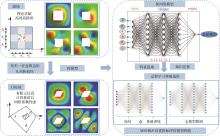
Fig.1
Schematic diagram of solution framework integrating symplectic superposition method with transfer learning technique
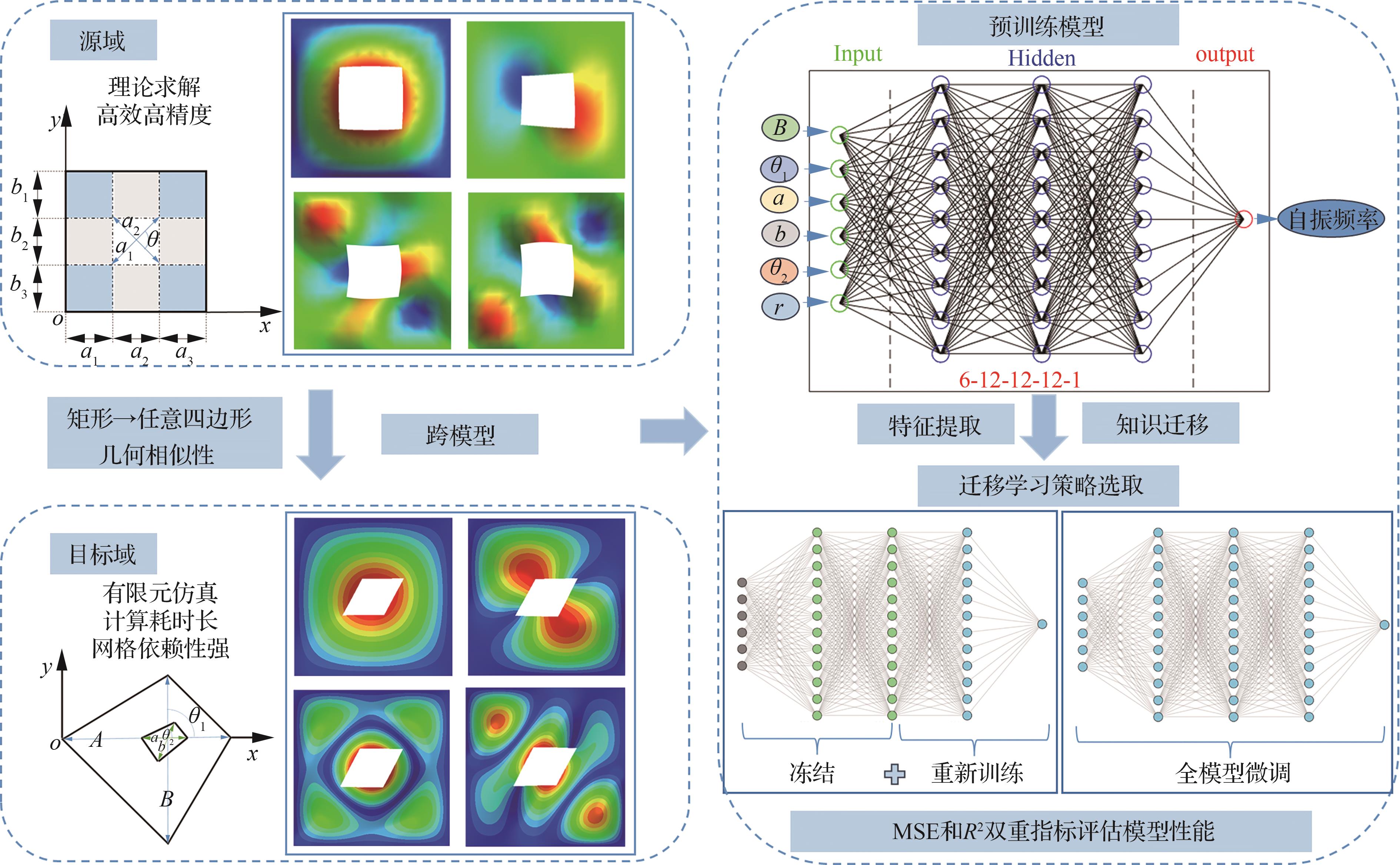
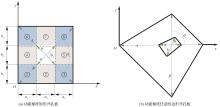
Fig.2
Illustration of geometric parameters for functionally graded perforated plate
Table 1
First ten-order non-dimensional frequency parameter, ωa2ρch/Dc, of functionally graded rectangular plates with rectangular cutouts
| 方法 | ωa2 | ||||||||||
|---|---|---|---|---|---|---|---|---|---|---|---|
| 模态1 | 模态2 | 模态3 | 模态4 | 模态5 | 模态6 | 模态7 | 模态8 | 模态9 | 模态10 | ||
| 0 | 本文 | 23.454 | 40.171 | 40.171 | 71.239 | 73.338 | 111.540 | 111.540 | 144.480 | 172.120 | 200.170 |
| 有限元 | 23.457 | 40.180 | 40.180 | 71.248 | 73.365 | 111.560 | 111.560 | 144.500 | 172.170 | 200.200 | |
| 文献[ | 23.418 | 39.994 | 39.994 | 72.218 | 72.945 | 111.572 | 111.572 | 144.945 | 172.870 | 201.263 | |
| 文献[ | 23.422 | 40.058 | 40.058 | 71.157 | 73.002 | 111.272 | 111.272 | 144.358 | 171.649 | 200.014 | |
| 0.5 | 本文 | 19.859 | 34.015 | 34.015 | 60.322 | 62.099 | 94.444 | 94.444 | 122.340 | 145.740 | 169.490 |
| 有限元 | 19.868 | 34.029 | 34.029 | 60.339 | 62.132 | 94.480 | 94.480 | 122.380 | 145.800 | 169.550 | |
| 1.0 | 本文 | 17.895 | 30.650 | 30.650 | 54.355 | 55.957 | 85.103 | 85.103 | 110.240 | 131.320 | 152.730 |
| 有限元 | 17.898 | 30.658 | 30.658 | 54.363 | 55.978 | 85.123 | 85.123 | 110.260 | 131.370 | 152.760 | |
| 10.0 | 本文 | 14.938 | 25.586 | 25.586 | 45.374 | 46.711 | 71.041 | 71.041 | 92.025 | 109.620 | 127.490 |
| 有限元 | 14.940 | 25.589 | 25.589 | 45.374 | 46.772 | 71.048 | 71.048 | 92.027 | 109.640 | 127.500 | |
Table 2
Material properties of functionally graded plates
| 材料 | 弹性模量/GPa | 密度/(kg∙m-3) | 泊松比 |
|---|---|---|---|
| 金属Al | 70 | 2 707 | 0.3 |
| 陶瓷Al2O3 | 380 | 3 800 | 0.3 |
| 陶瓷ZrO2 | 200 | 5 700 | 0.3 |
Table 3
Sampling spaces and step sizes for functionally graded plates with rectangular cutouts
| 几何参数 | 采样空间 | 采样步长 |
|---|---|---|
| B/m | ||
| [50,90] | 20 | |
| a/m | [0.04,2.20] | 0.08 |
| b/m | [0.04,2.20] | 0.08 |
| [ | 5 | |
| R | 0.5 |
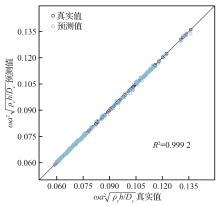
Fig.3
Performance evaluation of pre-trained model based on analytical solution dataset
Table 4
Sampling spaces and step sizes for functionally graded plates with arbitrary quadrilateral cutouts
| 组别 | 采样类别 | B/m | a/m | b/m | R | ||
|---|---|---|---|---|---|---|---|
| 1~7 | 采样空间 | A×[0.2,1.0] | [50,90] | [0.20,2.20] | a×[0.2,1.0] | [ | [0.3,0.5] |
| 1(12) | 采样步长 | 0.8 | 40 | 2.0 | 0.8 | 80 | 0.1 |
| 2(24) | 采样步长 | 0.8 | 40 | 2.0 | 0.8 | 80 | 0.1 |
| 3(48) | 采样步长 | 0.8 | 40 | 2.0 | 0.8 | 80 | 0.1 |
| 4(96) | 采样步长 | 0.8 | 40 | 0.8 | 0.8 | 80 | 0.1 |
| 5(144) | 采样步长 | 0.4 | 40 | 0.8 | 0.4 | 80 | 0.1 |
| 6(216) | 采样步长 | 0.4 | 40 | 0.8 | 0.4 | 40 | 0.1 |
| 7(324) | 采样步长 | 0.4 | 20 | 0.8 | 0.4 | 40 | 0.1 |
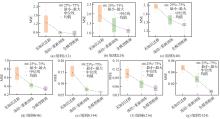
Fig.4
Boxplots of mean squared error for target domain data across seven groups under three strategies
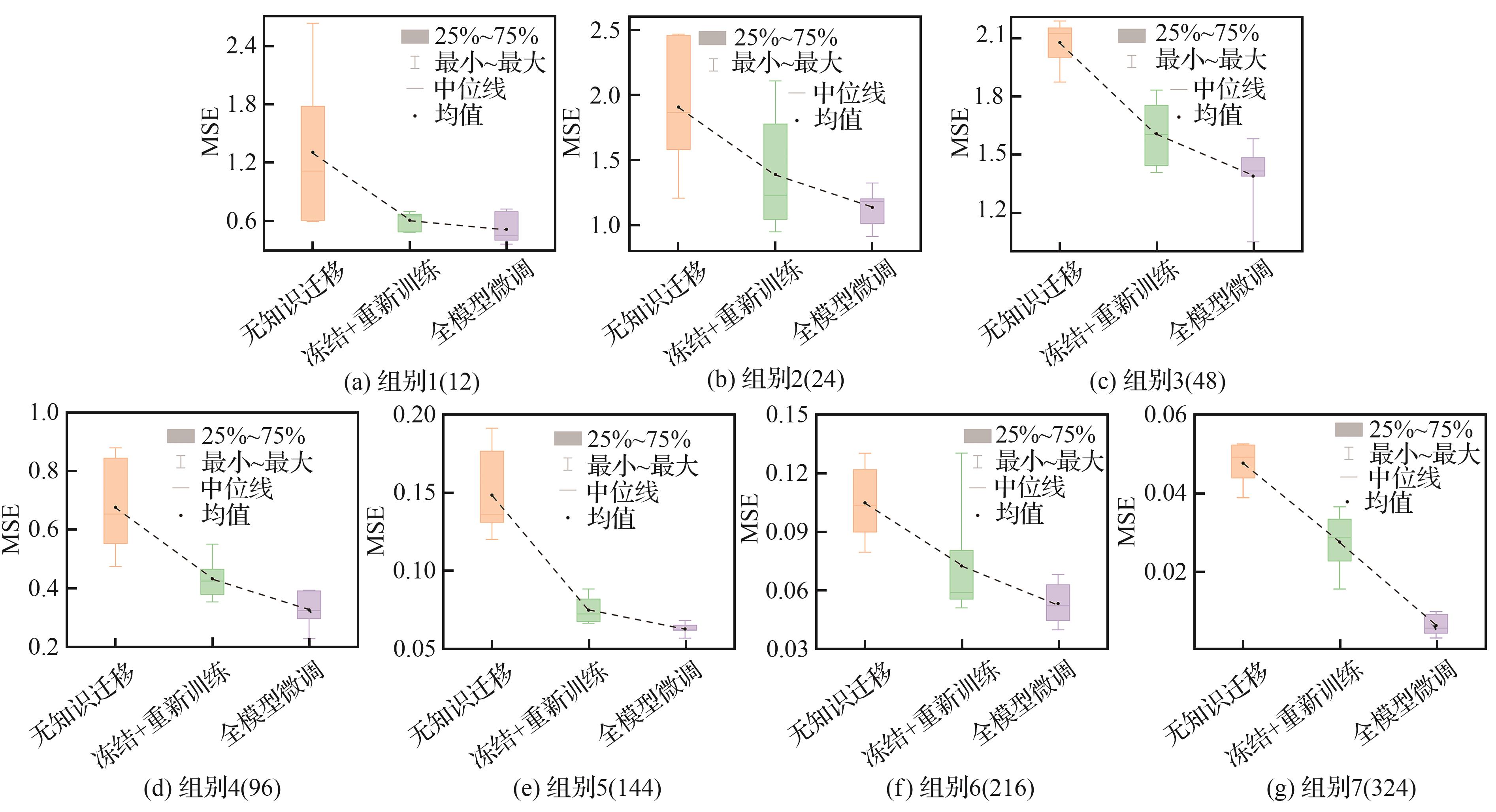
Fig.5
Coefficients of determination (R2) for seven groups under three learning strategies
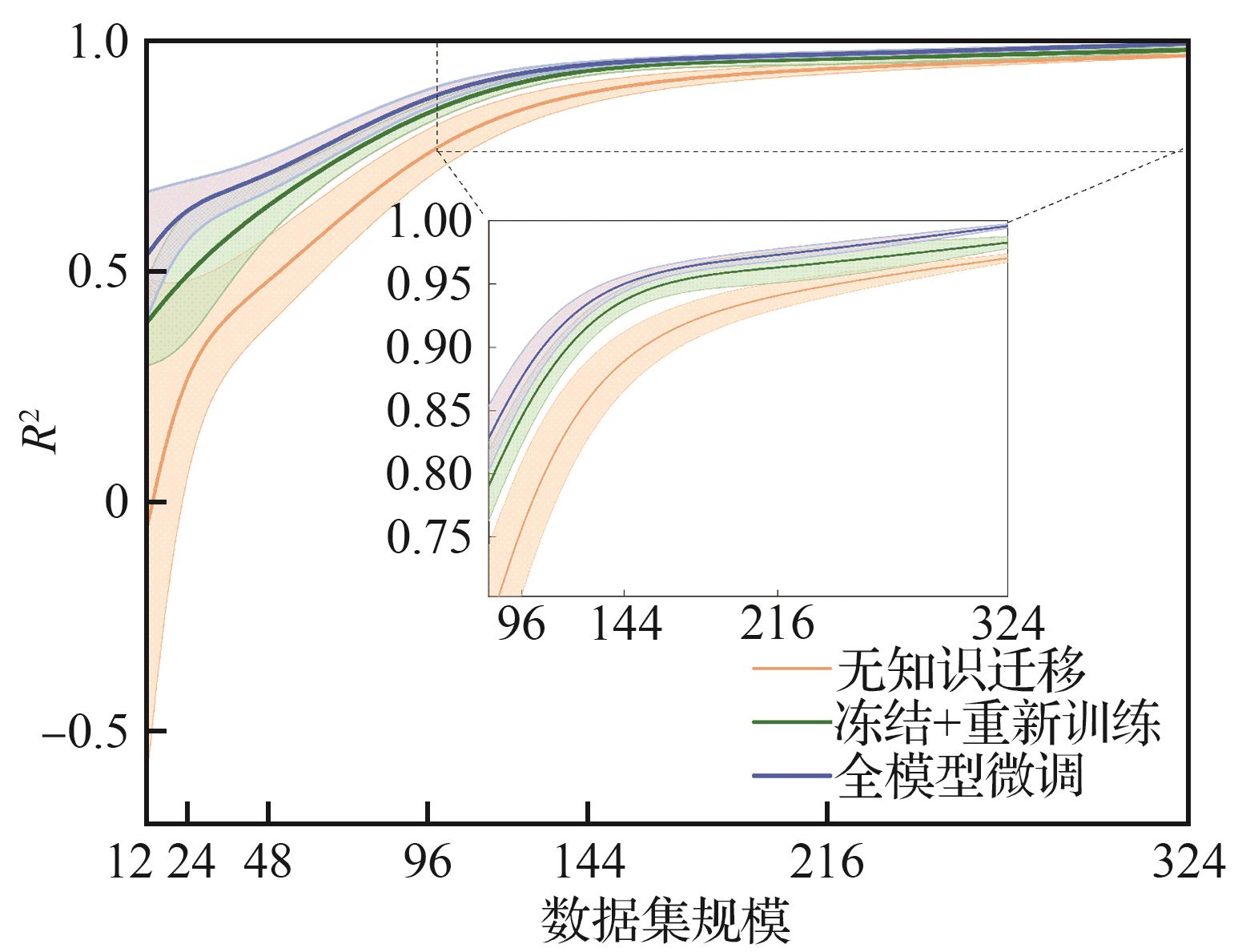
Table 5
Partial frequency results of functionally graded plates with arbitrary quadrilateral cutouts
| B/m | R | 自振频率/Hz | |||
|---|---|---|---|---|---|
| 有限元分析 | 全模型 微调 | 冻结+ 重新训练 | 无知识 迁移 | ||
| 0.3 | 0.720 84 | 0.716 59 | 0.826 16 | 0.762 17 | |
| 0.3 | 0.395 85 | 0.398 16 | 0.406 10 | 0.403 10 | |
| 0.3 | 0.510 36 | 0.510 02 | 0.507 18 | 0.509 91 | |
| 0.4 | 0.453 67 | 0.466 79 | 0.478 81 | 0.441 11 | |
| 0.4 | 0.459 03 | 0.462 43 | 0.463 67 | 0.464 25 | |
| 0.4 | 0.708 29 | 0.705 61 | 0.753 98 | 0.803 54 | |
| 0.3 | 0.132 53 | 0.134 06 | 0.130 16 | 0.125 83 | |
| 0.3 | 0.139 41 | 0.136 93 | 0.142 93 | 0.122 19 | |
| 0.3 | 0.128 09 | 0.126 11 | 0.134 07 | 0.147 36 | |
| 0.4 | 0.137 08 | 0.138 19 | 0.123 60 | 0.160 87 | |
| 0.4 | 0.104 96 | 0.101 31 | 0.111 44 | 0.080 67 | |
| 0.4 | 0.137 79 | 0.136 70 | 0.141 25 | 0.134 99 | |
| [1] | 黄炎, 雷勇军, 申慧君. 各向异性矩形板自由振动的一般解析解法[J]. 应用数学和力学, 2006, 27(4): 411-416. |
| HUANG Y, LEI Y J, SHEN H J. Free vibration of anisotropic rectangular plates by general analytical method[J]. Applied Mathematics and Mechanics, 2006, 27(4): 411-416 (in Chinese). | |
| [2] | 张继超, 钟心雨, 陈一鸣, 等. 基于Hamilton体系的功能梯度矩形板自由振动问题的解析解[J]. 应用数学和力学, 2024, 45(9): 1157-1171. |
| ZHANG J C, ZHONG X Y, CHEN Y M, et al. Hamiltonian system-based analytical solutions to free vibration problems of functionally graded rectangular plates[J]. Applied Mathematics and Mechanics, 2024, 45(9): 1157-1171 (in Chinese). | |
| [3] | 郝育新, 张伟. 四边简支FGM矩形板非线性振动中的内共振[J]. 振动与冲击, 2009, 28(6): 153-154, 187, 201-202. |
| HAO Y X, ZHANG W. Nonlinear vibration of functionally graded material plate under different internal resonances[J]. Journal of Vibration and Shock, 2009, 28(6): 153-154, 187, 201-202 (in Chinese). | |
| [4] | YANG Y S, XU D, CHU J K, et al. Analytic analysis of free vibration problem of the plate with a rectangular cutout using symplectic superposition method combined with domain decomposition technique[J]. Engineering Analysis with Boundary Elements, 2024, 167: 105890. |
| [5] | 陈一鸣. 求解含边裂纹矩形板屈曲和自由振动问题的有限积分变换方法[D]. 大连: 大连理工大学, 2024. |
| CHEN Y M. Finite integral transform method for solving buckling and free vibration problems of rectangular plates with edge cracks[D]. Dalian: Dalian University of Technology, 2024 (in Chinese). | |
| [6] | 杨雨诗. 求解异形板自由振动问题的辛—叠加方法[D]. 大连: 大连理工大学, 2020. |
| YANG Y S. Symplectic superposition method for the free vibration problems of irregular plates[D]. Dalian: Dalian University of Technology, 2020 (in Chinese). | |
| [7] | SINGH D, GUPTA A. Influence of geometric imperfections on the free vibrational response of the functionally graded material sandwich plates with circular cut-outs[J]. Materials Today: Proceedings, 2022, 62: 1496-1499. |
| [8] | SINGH D, GUPTA A. Vibration response of functionally graded material sandwich plates with elliptical cutouts and geometric imperfections under the mixed boundary conditions[J]. Science and Engineering of Composite Materials, 2023, 30: 20220160. |
| [9] | TURAN M, UZUN YAYLAC E, YAYLAC M. Free vibration and buckling of functionally graded porous beams using analytical, finite element, and artificial neural network methods[J]. Archive of Applied Mechanics, 2023, 93(4): 1351-1372. |
| [10] | PHAM Q H, NGUYEN P C, TRAN T T. Free vibration response of auxetic honeycomb sandwich plates using an improved higher-order ES-MITC3 element and artificial neural network[J]. Thin-Walled Structures, 2022, 175: 109203. |
| [11] | TRAN T T, NGUYEN P C, PHAM Q H. Vibration analysis of FGM plates in thermal environment resting on elastic foundation using ES-MITC3 element and prediction of ANN[J]. Case Studies in Thermal Engineering, 2021, 24: 100852. |
| [12] | DUONG H T, PHAN H C, TRAN T M, et al. Assessment of critical buckling load of functionally graded plates using artificial neural network modeling[J]. Neural Computing and Applications, 2021, 33(23): 16425-16437. |
| [13] | DEMIR E, SAYER M, CALLIOGLU H. An approach for predicting longitudinal free vibration of axially functionally graded bar by artificial neural network[J]. Proceedings of the Institution of Mechanical Engineers, Part C: Journal of Mechanical Engineering Science, 2023, 237(10): 2245-2255. |
| [14] | ZHANG D G, ZHOU Y H. A theoretical analysis of FGM thin plates based on physical neutral surface[J]. Computational Materials Science, 2008, 44(2): 716-720. |
| [15] | 仲政, 吴林志, 陈伟球. 功能梯度材料与结构的若干力学问题研究进展[J]. 力学进展, 2010, 40(5): 528-541. |
| ZHONG Z, WU L Z, CHEN W Q. Progress in the study on mechanics problems of functionally graded materials and structures[J]. Advances in Mechanics, 2010, 40(5): 528-541 (in Chinese). | |
| [16] | 刘华玲, 马俊, 张国祥. 基于深度学习的内容推荐算法研究综述[J]. 计算机工程, 2021, 47(7): 1-12. |
| LIU H L, MA J, ZHANG G X. Review of studies on deep learning-based content recommendation algorithms[J]. Computer Engineering, 2021, 47(7): 1-12 (in Chinese). | |
| [17] | 穆文全, 廖晓峰, 虞厥邦. 基于遗传算法和BP算法的多层感知机杂交训练算法[J]. 电子科学学刊, 1997, 19(2): 190-194. |
| MU W Q, LIAO X F, YU J B. A hybrid neural network training algorithm based on genetic algorithm and bp algorithm[J]. Journal of Electronics & Information Technology, 1997, 19(2): 190-194 (in Chinese). | |
| [18] | SHUFRIN I, EISENBERGER M. Semi-analytical modeling of cutouts in rectangular plates with variable thickness-free vibration analysis[J]. Applied Mathematical Modelling, 2016, 40(15/16): 6983-7000. |
| [19] | SONG Y Y. Free vibration of arbitrarily shaped plates with complex cutouts[J]. Thin-Walled Structures, 2023, 190: 110979. |
| [20] | QU T M, ZHAO J D, GUAN S H, et al. Data-driven multiscale modelling of granular materials via knowledge transfer and sharing[J]. International Journal of Plasticity, 2023, 171: 103786. |
| [21] | LIU X, ATHANASIOU C E, PADTURE N P, et al. Knowledge extraction and transfer in data-driven fracture mechanics[J]. PNAS, 2021, 118(23): e2104765118. |
| [22] | 蒋昂波, 王维维. ReLU激活函数优化研究[J]. 传感器与微系统, 2018, 37(2): 50-52. |
| JIANG A B, WANG W W. Research on optimization of ReLU activation function[J]. Transducer and Microsystem Technologies, 2018, 37(2): 50-52 (in Chinese). | |
| [23] | Abaqus. Analysis user’s guide V6. 13[R]. Paris:Dassault Systèmes Pawtucket, 2013. |
| [1] | Rongzu LI, Li LIU, Dun YANG. Optimal design of hydrogen-powered UAV based on multi-source domain fusion surrogate model [J]. Acta Aeronautica et Astronautica Sinica, 2025, 46(9): 630979-630979. |
| [2] | Yang JIAO, Yuting LU, Ba XU, Jian OUYANG. Transfer prediction of satellite traffic based on spatiotemporal correlation [J]. Acta Aeronautica et Astronautica Sinica, 2025, 46(4): 330938-330938. |
| [3] | Yutong WANG, Xiao LUO, Hongyang LIU, Chao SONG, Ying ZHAO, Zhu ZHOU. Sonic boom prediction of supersonic passenger aircraft based on multi-fidelity deep neural network [J]. Acta Aeronautica et Astronautica Sinica, 2025, 46(20): 531936-531936. |
| [4] | Pengfei WANG, Lifang ZENG, Xueming SHAO, Jun LI. Multi-source data fusion modeling method for aerodynamic load of aircraft wing based on pre-training and fine-tuning [J]. Acta Aeronautica et Astronautica Sinica, 2025, 46(19): 532297-532297. |
| [5] | Chengjie GUO, Dian XU, Jinbao LI, Chaoyu CHENG, Shuochang GUO, Rui LI. Stress characterization of high-temperature digital image correlation experiments based on a data fusion-knowledge transfer method [J]. Acta Aeronautica et Astronautica Sinica, 2025, 46(19): 531574-531574. |
| [6] | Zichao LIU, Jiang WANG, Peng WANG, Defu LIN, Zhichuan HE. Time-constrained multi-missile cooperative guidance law [J]. Acta Aeronautica et Astronautica Sinica, 2024, 45(S1): 730607-730607. |
| [7] | Jiang CUI, Fan ZHOU, Yongfan CHEN, Li YU, Zhuoran ZHANG. A technique for aerospace generator rectifier fault diagnosis based on GAMF-CNN [J]. Acta Aeronautica et Astronautica Sinica, 2024, 45(24): 330398-330398. |
| [8] | Biyao QIANG, Kaining SHI, Junxue REN, Yaoyao SHI. Instance transfer for tool remaining useful life prediction cross working conditions [J]. Acta Aeronautica et Astronautica Sinica, 2024, 45(13): 629038-629038. |
| [9] | Gongye YU, Weidong CAI, Minghui HU, Wencai LIU, Bo MA. Intelligent migration diagnosis of mechanical faults driven by hybrid fault mechanism and domain adaptation [J]. ACTA AERONAUTICAET ASTRONAUTICA SINICA, 2023, 44(2): 426800-426800. |
| [10] | Haowen LUO, Shaoming HE, Tianyu JIN, Zichao LIU. Impact-angle-constrained with time-minimum guidance algorithm based on transfer learning [J]. Acta Aeronautica et Astronautica Sinica, 2023, 44(19): 328400-328400. |
| [11] | Lianzi WANG, Ling WANG, Daiyin ZHU. An ISAR autofocus imaging algorithm based on FCN and transfer learing [J]. Acta Aeronautica et Astronautica Sinica, 2023, 44(17): 328172-328172. |
| [12] | WANG Yupeng, LYU Shuaishuai, YANG Yu, LI Jiaxin, WANG Yezi. Damage recognition of composite structures based on domain adaptive model [J]. ACTA AERONAUTICAET ASTRONAUTICA SINICA, 2022, 43(6): 526752-526752. |
| [13] | XING Yufeng, LI Gen, YUAN Ye. A review of closed-form analytical solution methods for eigenvalue problems of rectangular plates [J]. ACTA AERONAUTICAET ASTRONAUTICA SINICA, 2022, 43(10): 527333-527333. |
| [14] | JIANG Bo, QU Ruokun, LI Yandong, LI Chenglong. Object detection in UAV imagery based on deep learning: Review [J]. ACTA AERONAUTICAET ASTRONAUTICA SINICA, 2021, 42(4): 524519-524519. |
| [15] | XU Zhou, QU Changwen, HE Lingqi. SAR target super-resolution based on transfer learning [J]. ACTA AERONAUTICAET ASTRONAUTICA SINICA, 2015, 36(6): 1940-1952. |
| Viewed | ||||||
|
Full text |
|
|||||
|
Abstract |
|
|||||
Address: No.238, Baiyan Buiding, Beisihuan Zhonglu Road, Haidian District, Beijing, China
Postal code : 100083
E-mail:hkxb@buaa.edu.cn
Total visits: 6658907 Today visits: 1341All copyright © editorial office of Chinese Journal of Aeronautics
All copyright © editorial office of Chinese Journal of Aeronautics
Total visits: 6658907 Today visits: 1341

 CJA
CJA
