Acta Aeronautica et Astronautica Sinica ›› 2026, Vol. 47 ›› Issue (5): 432302.doi: 10.7527/S1000-6893.2025.32302
• Material Engineering and Mechanical Manufacturing • Previous Articles
Shihua ZHANG1, Kunying DING1( ), Zhongshen DONG2, Jianhai YU1, Yubo SUN1, Tao ZHANG1, Jiaxi YUAN1, Jintao LU1
Received:2025-05-27
Revised:2025-06-30
Accepted:2025-08-04
Online:2025-08-12
Published:2025-08-11
Contact:
Kunying DING
E-mail:dingkunying@126.com
Supported by:CLC Number:
Shihua ZHANG, Kunying DING, Zhongshen DONG, Jianhai YU, Yubo SUN, Tao ZHANG, Jiaxi YUAN, Jintao LU. Role of configurational entropy in enhancing CMAS corrosion resistance of rare-earth zirconates[J]. Acta Aeronautica et Astronautica Sinica, 2026, 47(5): 432302.

Table 1
Types of rare earth elements, average rare earth cationic radius, configurational entropy, and atomic size disorder of RExZO
| 样品 | 稀土元素类型 | 平均离子半径RA/nm | 构型熵ΔSmix/(J∙K-1) | 尺寸无序度δR |
|---|---|---|---|---|
| RE1ZO | Y | 1.019 | 0 | 0 |
| RE2ZO | Y,Ho | 1.017 | 0.69R | 0.002 |
| RE3ZO | Y,Ho,Dy | 1.020 | 1.10R | 0.004 |
| RE4ZO | Y,Ho,Dy,Er | 1.016 | 1.38R | 0.008 |
| RE5ZO | Y,Ho,Dy,Er,Gd | 1.024 | 1.61R | 0.016 |
| RE6ZO | Y,Ho,Dy,Er,Gd,Yb | 1.017 | 1.79R | 0.021 |
| RE7ZO | Y,Ho,Dy,Er,Gd,Yb,Tm | 1.014 | 1.95R | 0.021 |
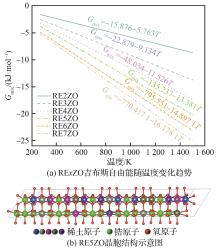
Fig.1
Temperature dependence of Gibbs free energy for RExZO and crystal structure model of RE5ZO
Table 2
Lattice parameters and density of RExZO
| 样品 | 平衡晶格常数/Å | 精修晶格常数/Å | 理论密度/(g∙cm-3) | 实际密度/(g∙cm-3) | 相对密度/% |
|---|---|---|---|---|---|
| RE1ZO | 5.214 | 5.208 | 5.748 | 4.976 | 85.2 |
| RE2ZO | 5.198 | 5.210 | 6.629 | 5.672 | 85.6 |
| RE3ZO | 5.203 | 5.218 | 6.875 | 5.911 | 86.0 |
| RE4ZO | 5.191 | 5.209 | 7.068 | 5.994 | 86.6 |
| RE5ZO | 5.209 | 5.232 | 7.057 | 5.990 | 85.4 |
| RE6ZO | 5.210 | 5.225 | 7.147 | 5.998 | 84.5 |
| RE7ZO | 5.198 | 5.215 | 7.221 | 6.264 | 86.8 |
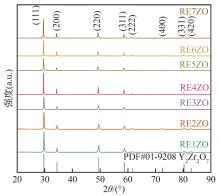
Fig.2
XRD patterns of RExZO ceramic powders
Fig.3
Morphology and elemental distributions of RExZO ceramic powder particles
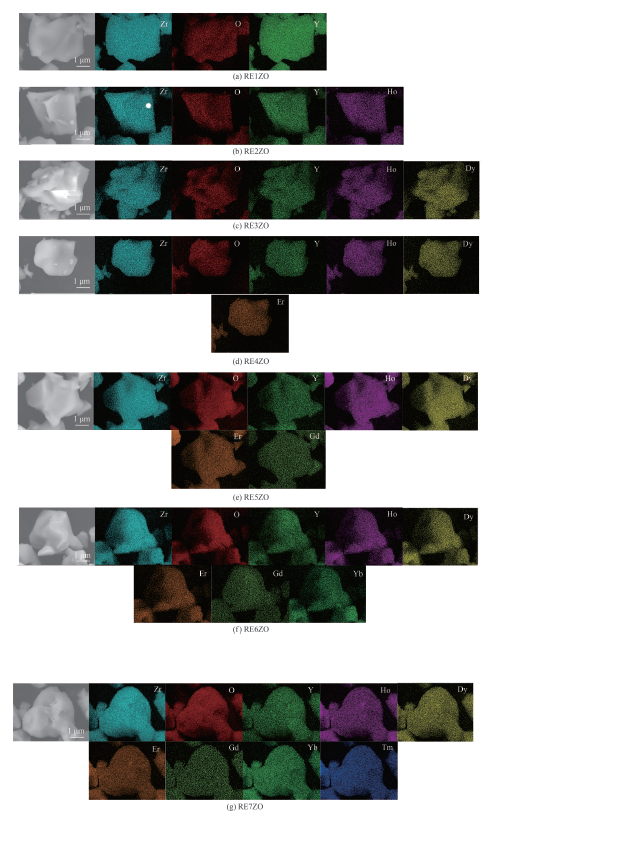
Fig.4
Cross-sectional morphologies of RExZO after molten CMAS corrosion at 1 300 ℃ for 5 h
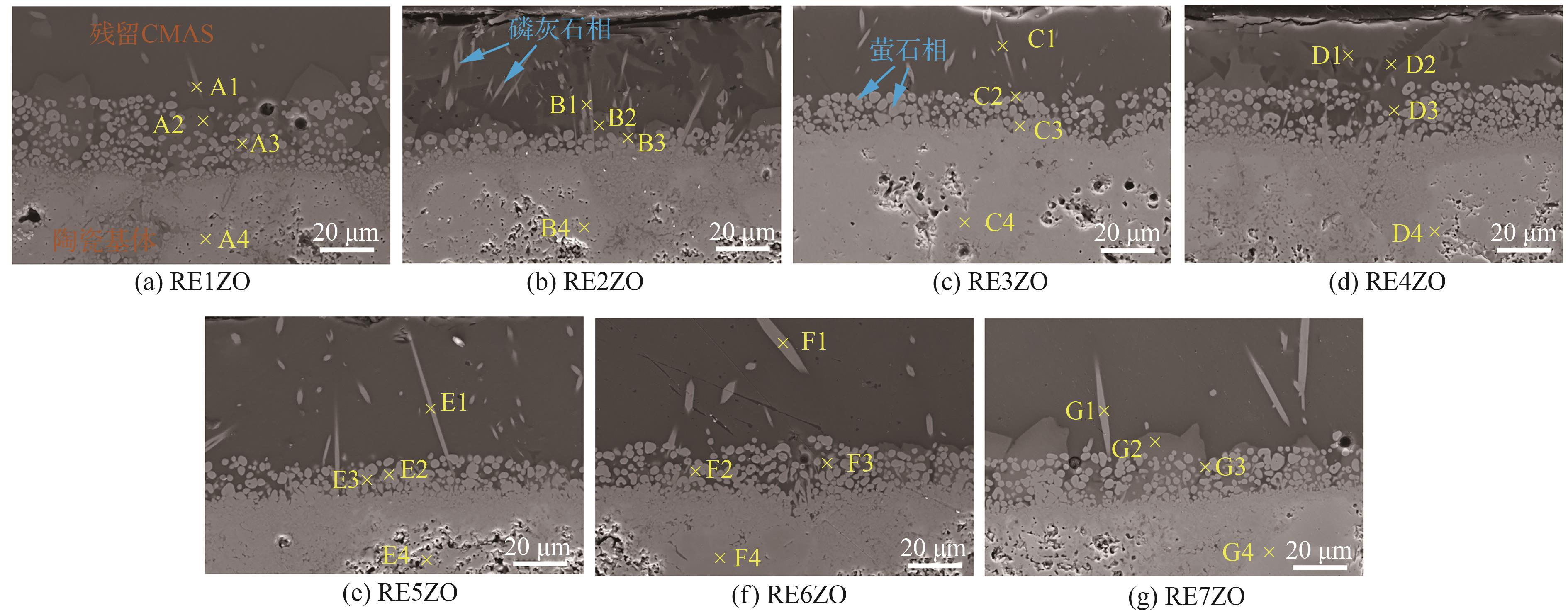
Table 3
EDS data of marked regions in Fig.4 and Fig.5
| 分类 | 样品 | 标记点 | 含量/% | |||||||
|---|---|---|---|---|---|---|---|---|---|---|
| RE | Zr | Ca | Si | Al | Mg | O | 相 | |||
| 低熵和中熵 | RE1ZO | A1 | 11.37 | 15.30 | 21.74 | 51.59 | Apatite | |||
| A2 | 4.19 | 14.7 | 20.02 | 5.79 | 6.09 | 49.20 | CMAS | |||
| A3 | 11.24 | 35.76 | 1.28 | 51.71 | Fluorite | |||||
| A4 | 22.62 | 20.04 | 57.34 | RE1ZO | ||||||
| RE2ZO | B1 | 14.50 | 13.23 | 22.55 | 49.73 | Apatite | ||||
| B2 | 3.84 | 14.58 | 20.67 | 7.27 | 5.93 | 47.71 | CMAS | |||
| B3 | 11.60 | 37.47 | 1.72 | 49.21 | Fluorite | |||||
| B4 | 20.83 | 19.71 | 59.46 | RE2ZO | ||||||
| RE3ZO | C1 | 5.65 | 13.67 | 22.03 | 58.66 | Apatite | ||||
| C2 | 6.92 | 31.62 | 3.14 | 58.32 | Fluorite | |||||
| C3 | 1.21 | 2.82 | 13.85 | 18.20 | 6.25 | 3.84 | 53.83 | CMAS | ||
| C4 | 18.83 | 19.51 | 61.66 | RE3ZO | ||||||
| RE4ZO | D1 | 13.06 | 11.88 | 22.54 | 52.51 | Apatite | ||||
| D2 | 19.74 | 18.62 | 4.56 | 6.71 | 50.37 | CMAS | ||||
| D3 | 10.36 | 34.40 | 1.41 | 53.82 | Fluorite | |||||
| D4 | 20.76 | 19.32 | 59.92 | RE4ZO | ||||||
| 高熵 | RE5ZO | E1 | 15.31 | 13.21 | 23.48 | 48.02 | Apatite | |||
| E2 | 11.39 | 36.83 | 1.23 | 50.55 | Fluorite | |||||
| E3 | 2.13 | 2.86 | 13.44 | 20.00 | 7.10 | 3.63 | 50.84 | CMAS | ||
| E4 | 21.42 | 27.69 | 50.89 | RE5ZO | ||||||
| RE6ZO | F1 | 17.02 | 11.73 | 20.80 | 50.44 | Apatite | ||||
| F2 | 11.14 | 34.37 | 1.45 | 53.03 | Fluorite | |||||
| F3 | 1.91 | 0.37 | 14.23 | 21.38 | 6.66 | 3.52 | 51.94 | CMAS | ||
| F4 | 22.64 | 23.50 | 53.86 | RE6ZO | ||||||
| RE7ZO | G1 | 17.25 | 11.23 | 21.51 | 50.01 | Apatite | ||||
| G2 | 4.39 | 13.56 | 19.94 | 5.42 | 6.39 | 50.29 | CMAS | |||
| G3 | 10.14 | 34.22 | 1.39 | 54.25 | Fluorite | |||||
| G4 | 22.51 | 24.38 | 53.11 | RE7ZO | ||||||
| 表面 | H1 | 9.50 | 27.88 | 25.48 | 37.14 | Apatite | ||||
| H2 | 5.42 | 24.36 | 25.85 | 44.36 | Apatite | |||||
Fig.5
Surface morphologies of RExZO after molten CMAS corrosion at 1 300 ℃ for 5 h
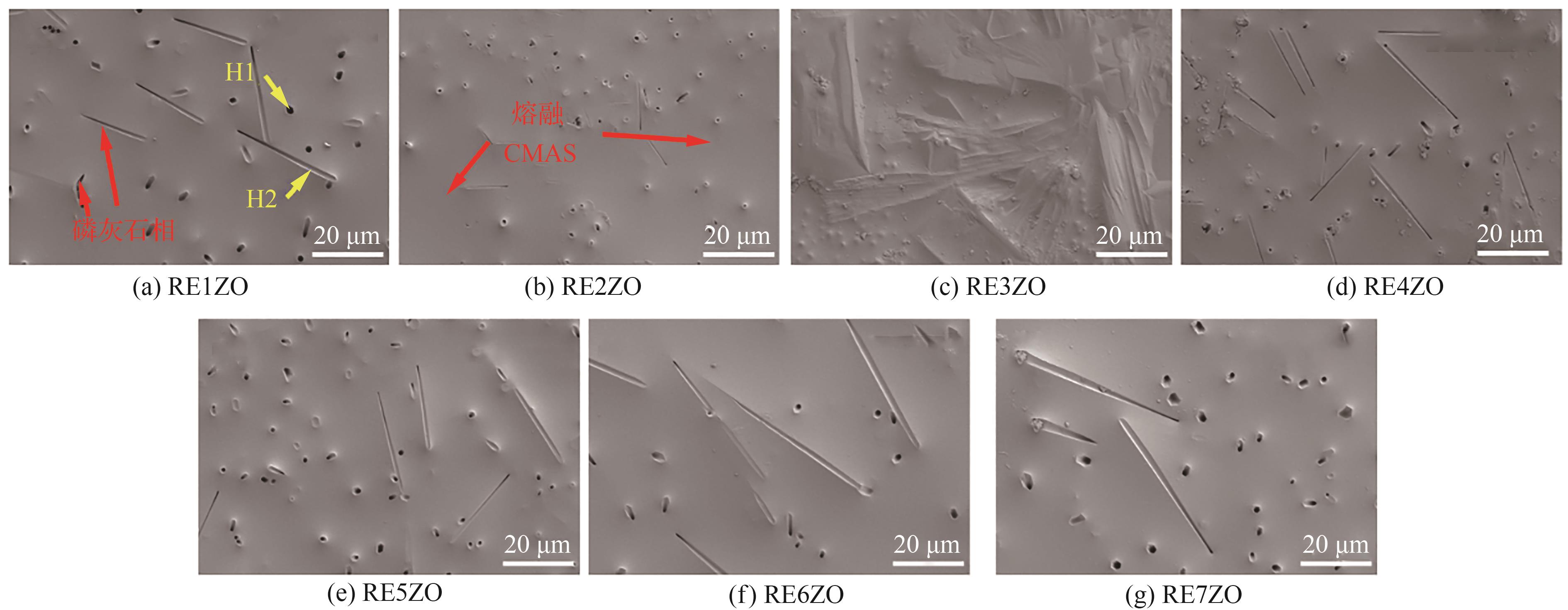
Fig.6
Cross-sectional morphologies and element distributions of cross-section of RE5ZO after molten CMAS corrosion at 1 300 ℃ for 5 h
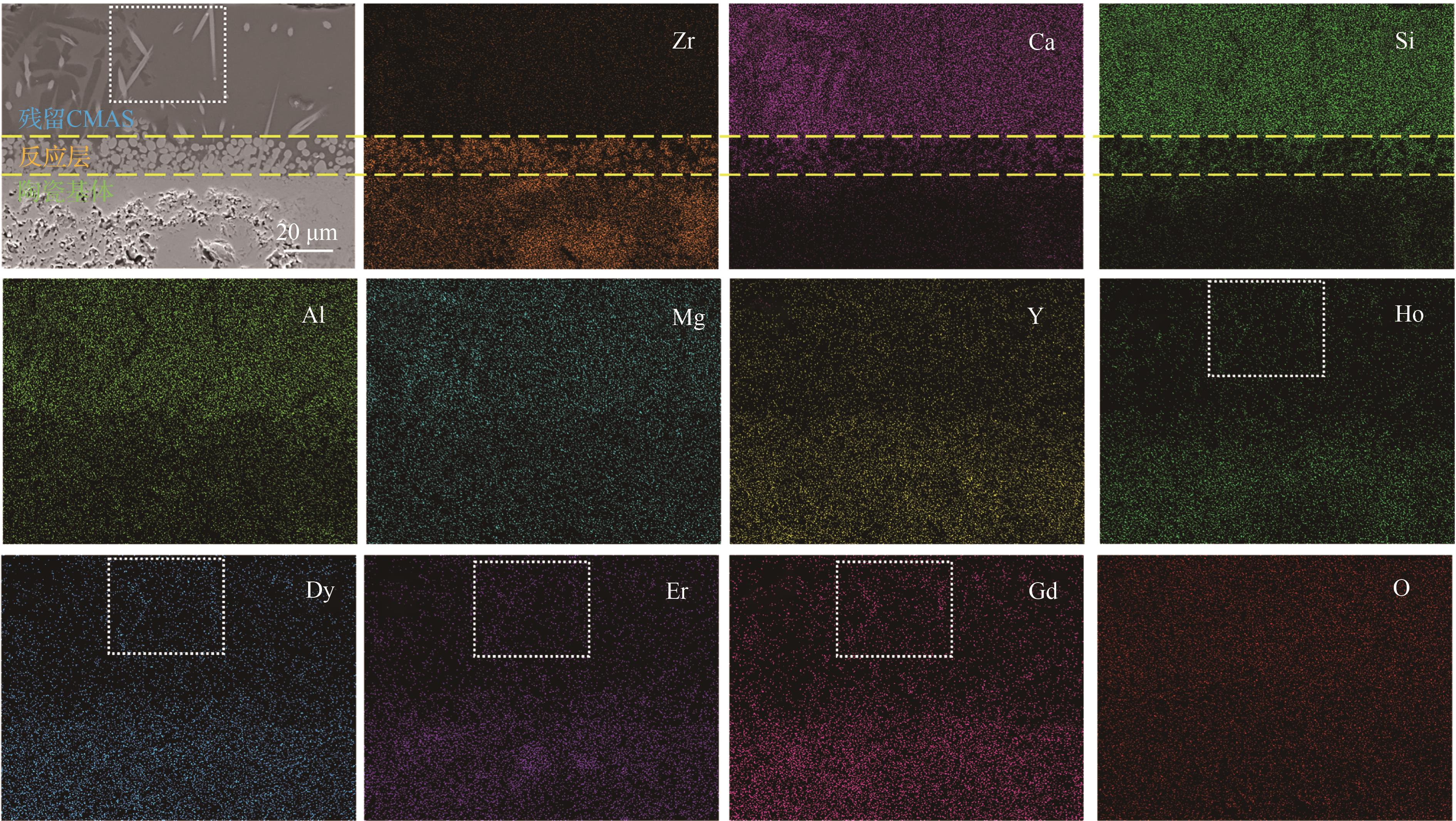
Fig.7
XRD patterns of RExZO/CMAS after annealing with CMAS at 1 300 ℃ for 5 h
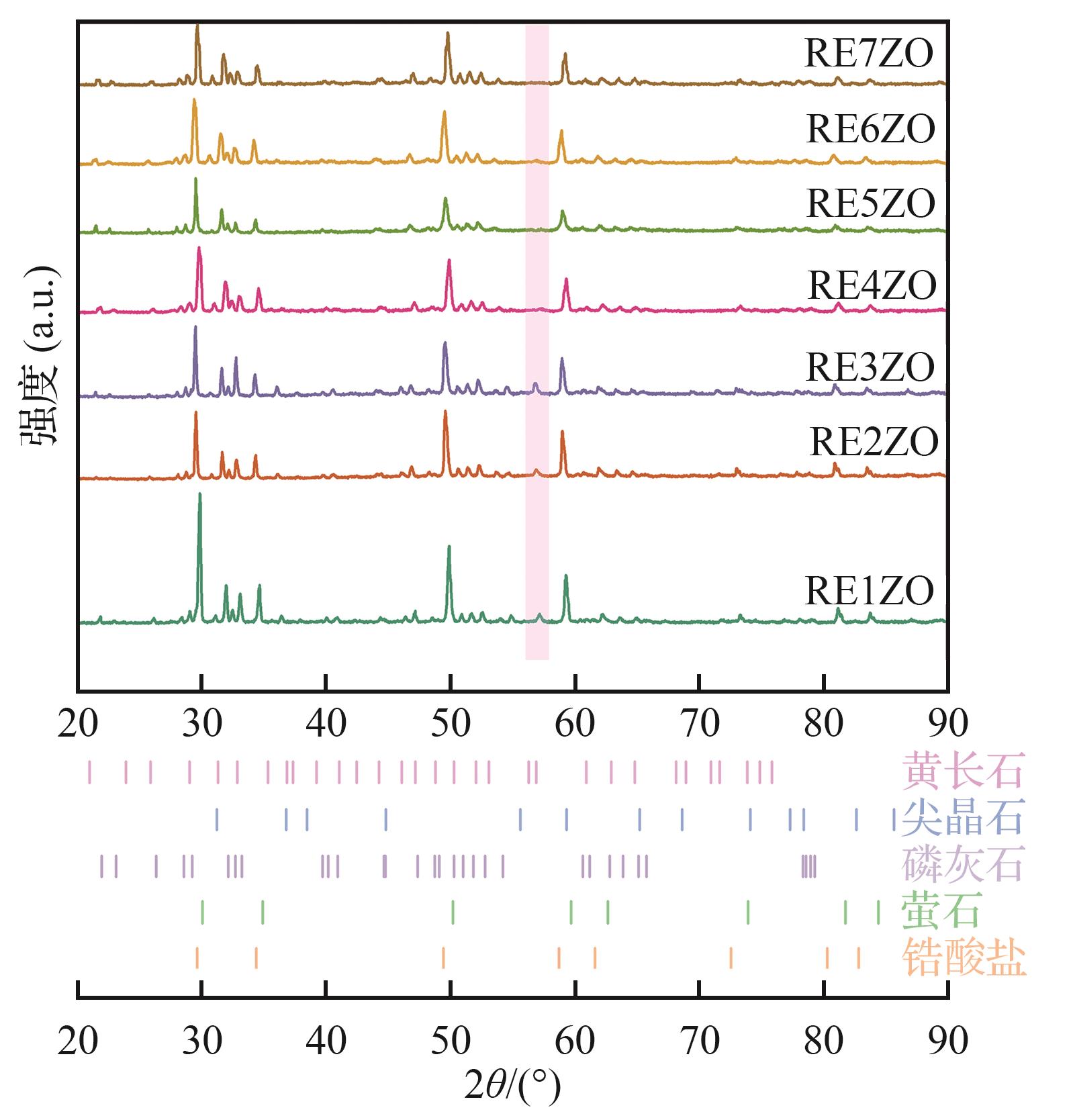
Fig.8
Cross-sectional morphologies and element distributions of cross-section of RExZO after CMAS corrosion at 1 300 ℃ for 30 h
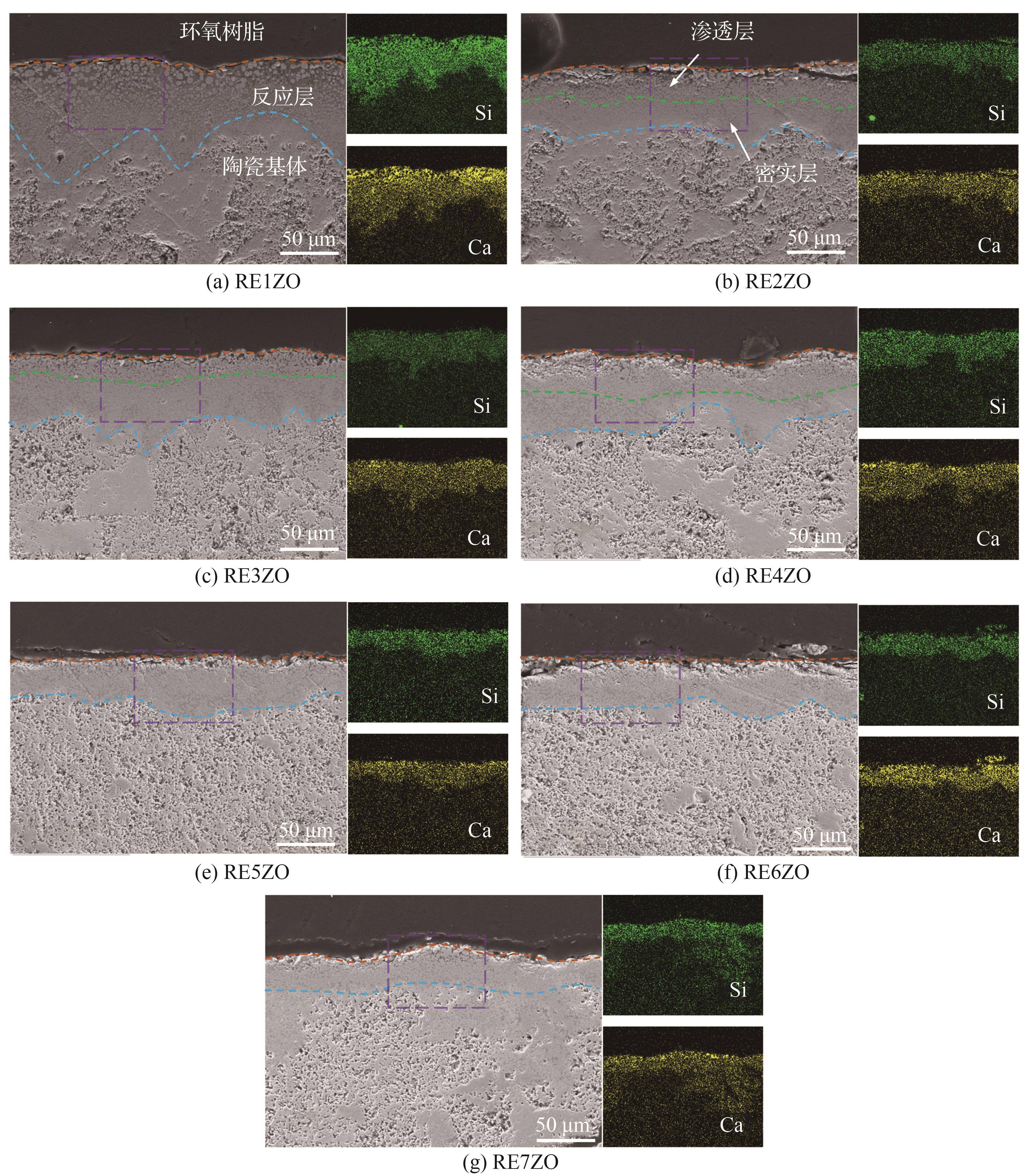
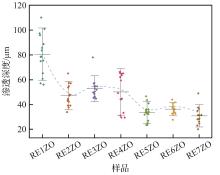
Fig.9
CMAS infiltration depth of RExZO
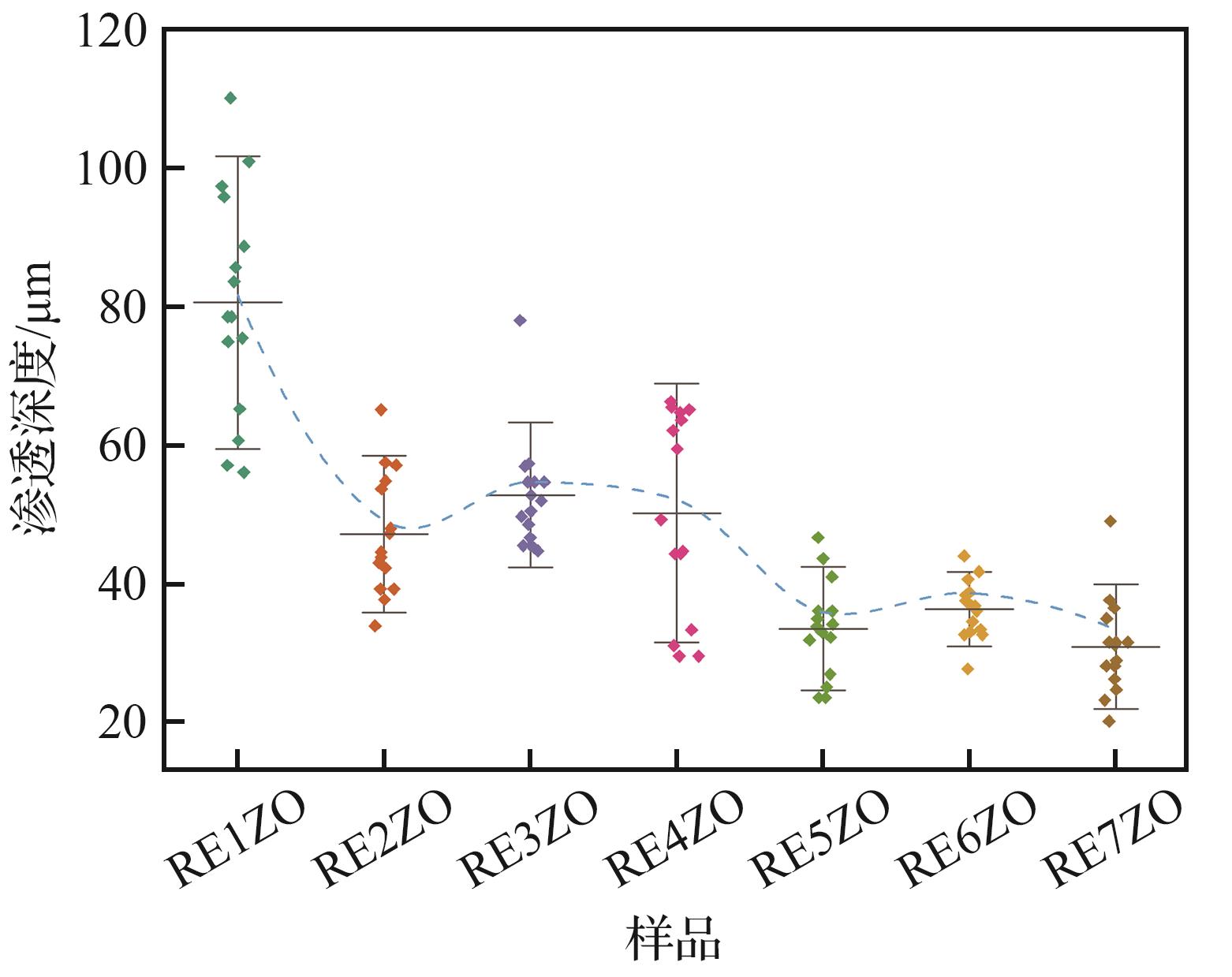
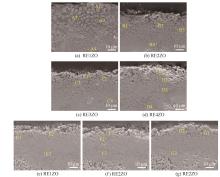
Fig.10
High-magnification cross-sectional morphology of RExZO after CMAS corrosion at 1 300 ℃ for 30 h (corresponding to selected area in Fig.8)
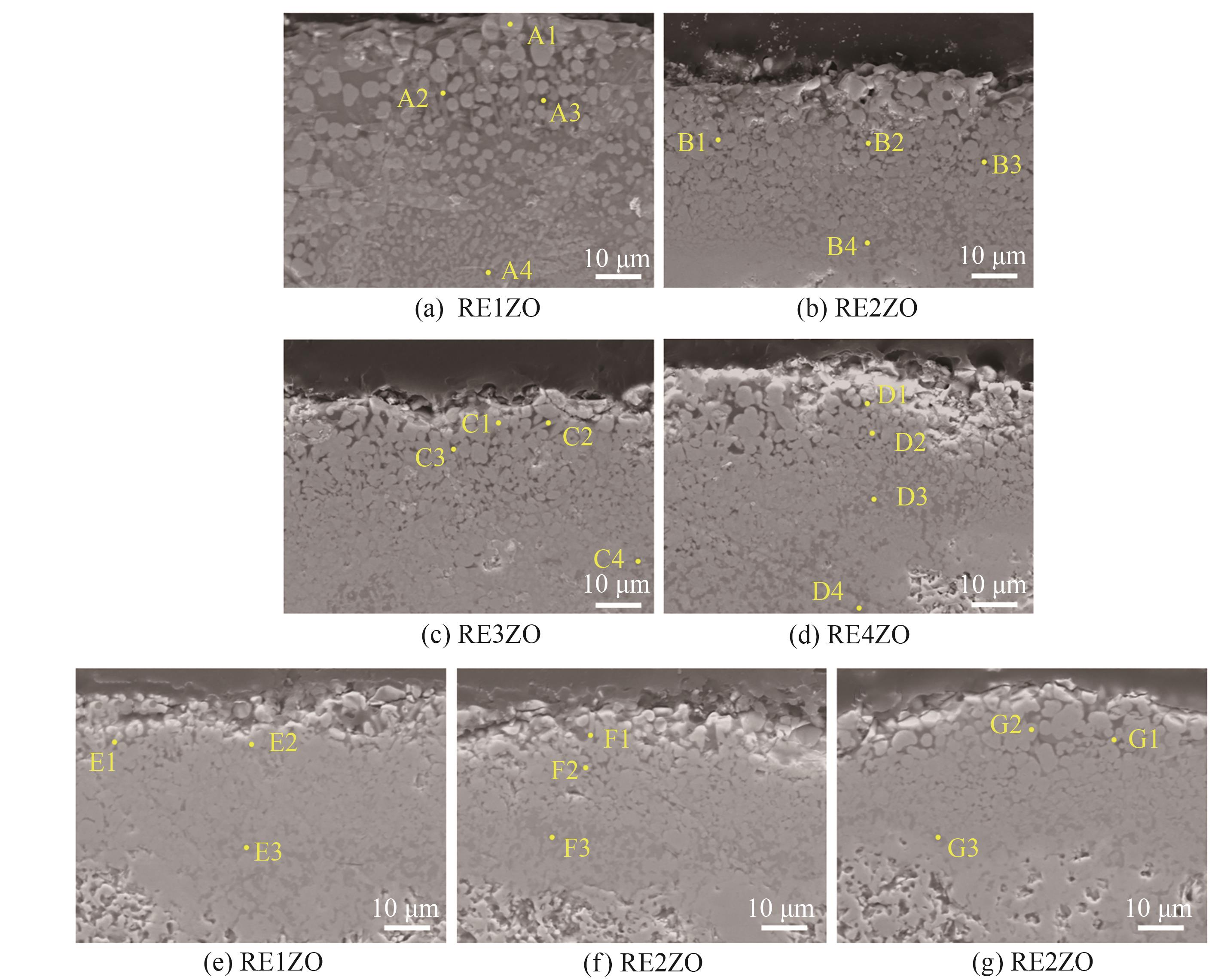
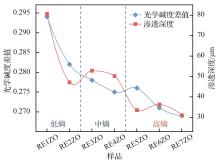
Fig.11
Theoretical optical basicity difference and infiltration depth of RExZO at 1 300 ℃ for 30 h of corrosion
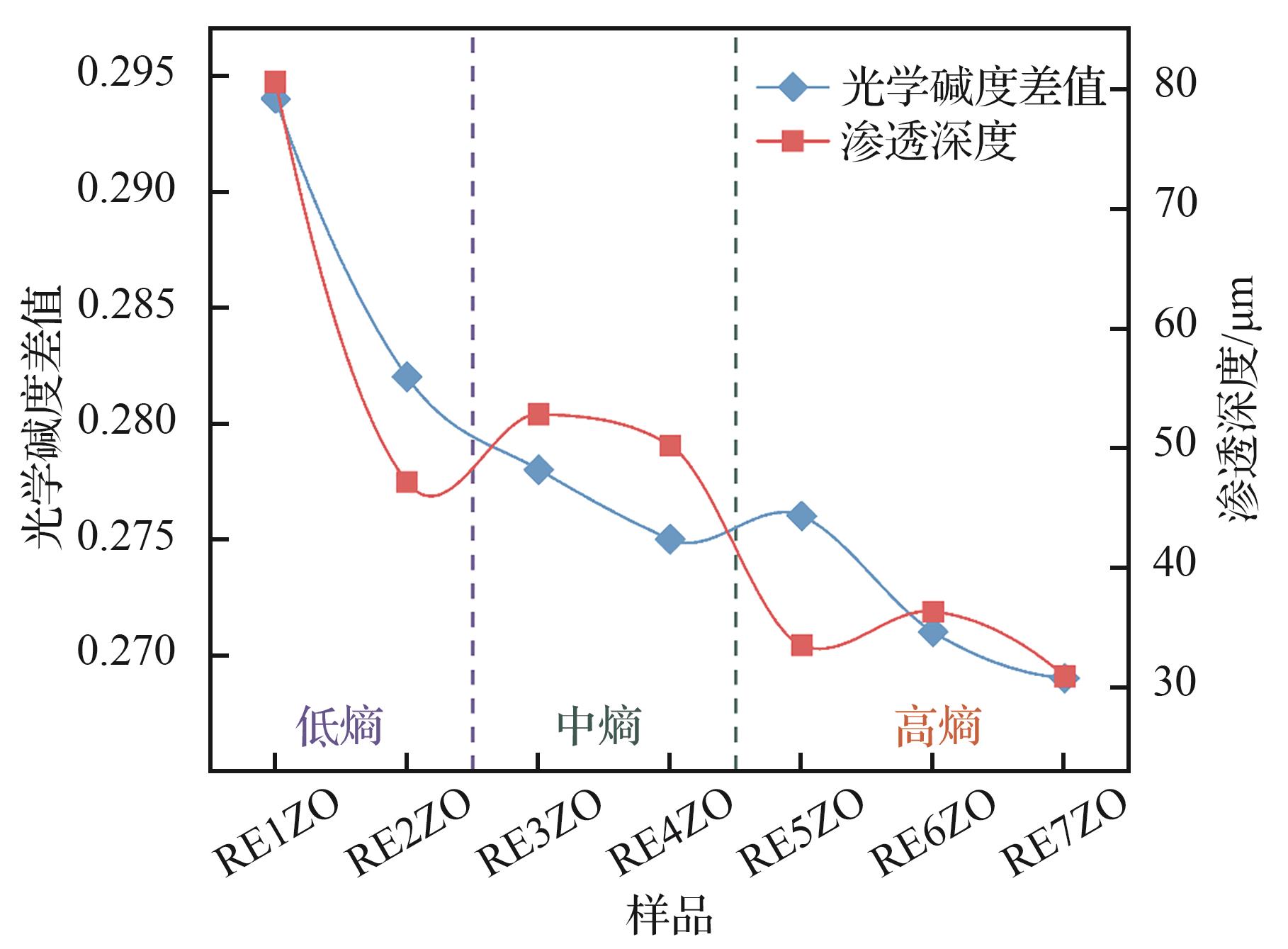
Table 4
EDS data of marked regions in Fig.10
| 样品 | 标记点 | 含量/% | ||||||
|---|---|---|---|---|---|---|---|---|
| RE | Zr | Ca | Si | Al | Mg | O | ||
| RE1ZO | A1 | 9.33 | 30.49 | 1.14 | 59.04 | |||
| A2 | 6.54 | 14.93 | 16.70 | 61.84 | ||||
| A3 | 11.86 | 21.23 | 3.49 | 63.41 | ||||
| A4 | 25.38 | 14.53 | 60.09 | |||||
| RE2ZO | B1 | 11.82 | 29.51 | 2.10 | 56.57 | |||
| B2 | 13.01 | 9.26 | 16.36 | 61.37 | ||||
| B3 | 14.32 | 7.51 | 18.85 | 59.32 | ||||
| B4 | 26.42 | 15.71 | 57.87 | |||||
| RE3ZO | C1 | 9.07 | 29.26 | 1.57 | 60.10 | |||
| C2 | 12.41 | 12.87 | 18.74 | 55.98 | ||||
| C3 | 14.61 | 4.19 | 15.07 | 66.13 | ||||
| C4 | 24.54 | 8.24 | 67.22 | |||||
| RE4ZO | D1 | 17.39 | 7.70 | 19.08 | 55.83 | |||
| D2 | 13.47 | 25.79 | 4.01 | 56.73 | ||||
| D3 | 9.49 | 14.63 | 3.37 | 72.51 | ||||
| D4 | 23.43 | 11.15 | 65.42 | |||||
| RE5ZO | E1 | 16.31 | 7.94 | 22.95 | 52.81 | |||
| E2 | 18.59 | 10.82 | 7.97 | 62.62 | ||||
| E3 | 27.67 | 7.56 | 64.77 | |||||
| RE6ZO | F1 | 15.29 | 8.38 | 18.79 | 57.54 | |||
| F2 | 13.87 | 28.07 | 3.44 | 54.61 | ||||
| F3 | 22.85 | 9.88 | 67.27 | |||||
| RE7ZO | G1 | 11.15 | 15.20 | 20.20 | 53.45 | |||
| G2 | 10.23 | 32.03 | 1.87 | 55.87 | ||||
| G3 | 12.94 | 22.18 | 64.88 | |||||
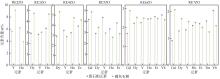
Fig.12
Content of rare earth elements in apatite and fluorite phases
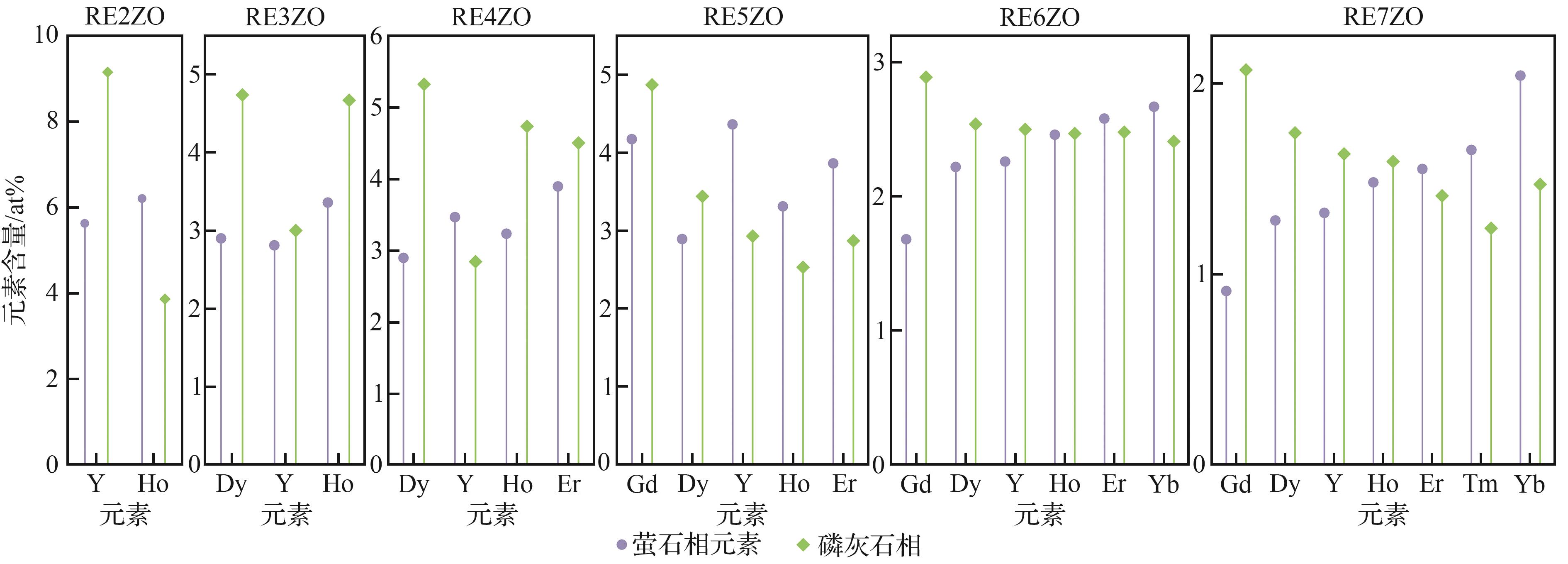
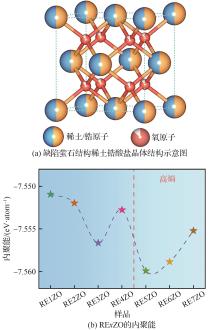
Fig.13
Schematic diagram of crystal structure and cohesive energies
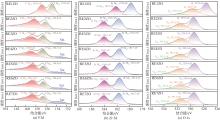
Fig.14
XPS high-resolution spectrum
Table 5
Oxygen species distribution in RExZO analyzed by XPS peak fitting
| 样品 | 吸附氧/% | 空位氧/% | 晶格氧/% | 空位氧/晶格氧 |
|---|---|---|---|---|
| RE1ZO | 6.4 | 38.8 | 54.8 | 0.71 |
| RE2ZO | 4.6 | 38.8 | 56.5 | 0.69 |
| RE3ZO | 1.4 | 39.0 | 59.6 | 0.65 |
| RE4ZO | 5.6 | 34.7 | 59.7 | 0.58 |
| RE5ZO | 4.8 | 34.9 | 60.3 | 0.58 |
| RE6ZO | 10.5 | 29.1 | 60.3 | 0.48 |
| RE7ZO | 10.6 | 32.1 | 57.3 | 0.56 |
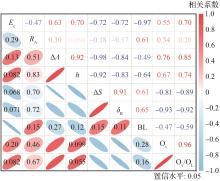
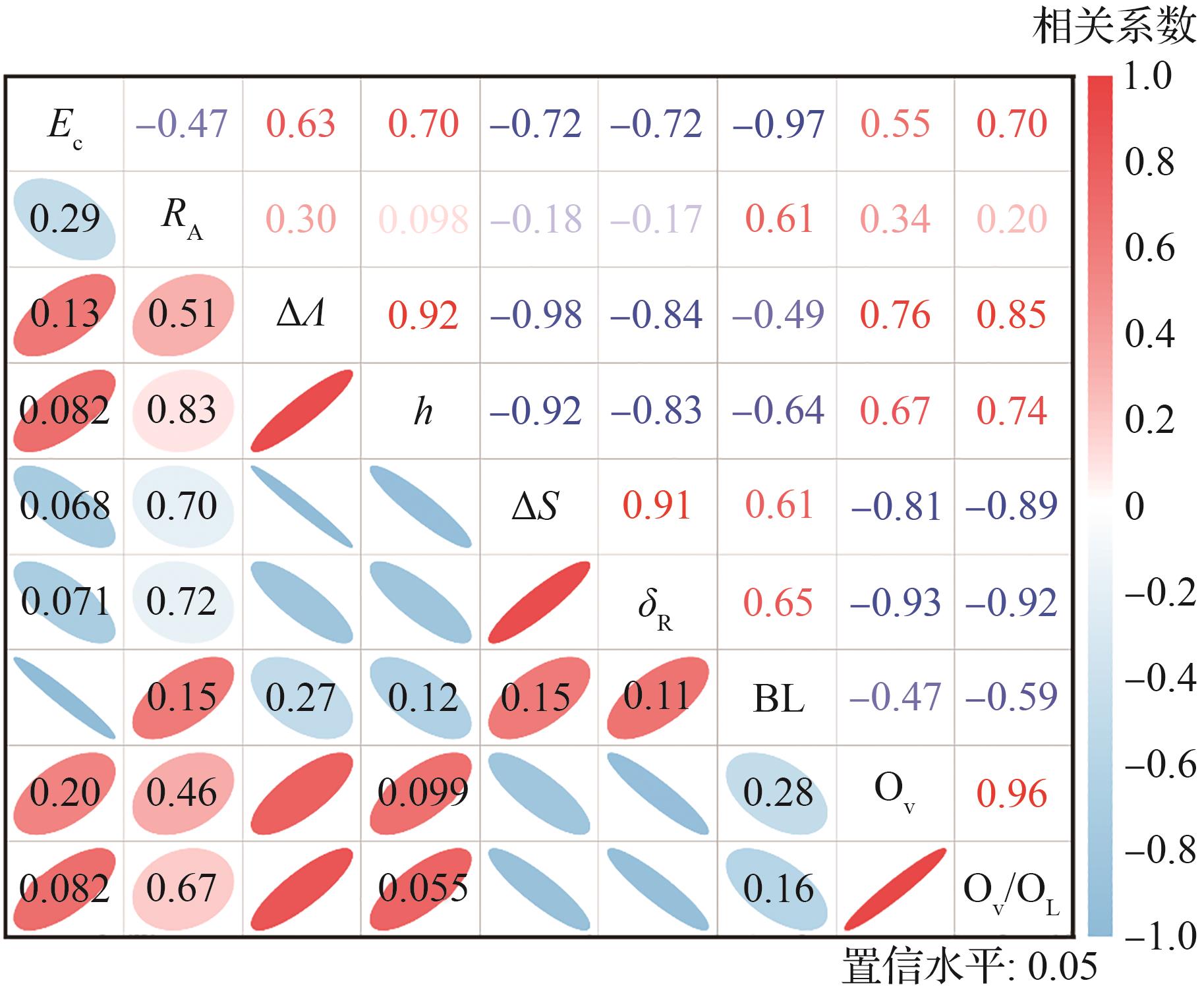
Fig.15
Correlation heatmap of key parameters of RExZO
| [1] | PADTURE P P, GELL M, JORDAN E H. Thermal barrier coatings for gas-turbine engine applications[J]. Science, 2002, 296(5566): 280-284. |
| [2] | HU X Y, XIE Y, LI F G, et al. Research progress on environmental corrosion resistance of thermal barrier coatings: a review[J]. Coatings, 2024, 14(10): 1341. |
| [3] | NIETO A, AGRAWAL R, BRAVO L, et al. Calcia-magnesia-alumina-silicate (CMAS) attack mechanisms and roadmap towards Sandphobic thermal and environmental barrier coatings[J]. International Materials Reviews, 2021, 66(7): 451-492. |
| [4] | OZGURLUK Y, DOLEKER K M, AHLATCI H, et al. Investigation of calcium-magnesium-alumino-silicate (CMAS) resistance and hot corrosion behavior of YSZ and La2Zr2O7/YSZ thermal barrier coatings (TBCs) produced with CGDS method[J]. Surface and Coatings Technology, 2021, 411: 126969. |
| [5] | SHAN X, CHEN W F, YANG L X, et al. Pore filling behavior of air plasma spray thermal barrier coatings under CMAS attack[J]. Corrosion Science, 2020, 167: 108478. |
| [6] | KRAUSE A R, GARCES H F, DWIVEDI G, et al. Calcia-magnesia-alumino-silicate (CMAS)-induced degradation and failure of air plasma sprayed yttria-stabilized zirconia thermal barrier coatings[J]. Acta Materialia, 2016, 105: 355-366. |
| [7] | IQBAL A, MOSKAL G. Recent development in advance ceramic materials and understanding the mechanisms of thermal barrier coatings degradation[J]. Archives of Computational Methods in Engineering, 2023, 30(8): 4855-4896. |
| [8] | DREXLER J M, ORTIZ A L, PADTURE N P. Composition effects of thermal barrier coating ceramics on their interaction with molten Ca-Mg-Al-silicate (CMAS) glass[J]. Acta Materialia, 2012, 60(15): 5437-5447. |
| [9] | ZHANG C G, FAN Y, ZHAO J L, et al. Corrosion resistance of nonstoichiometric gadolinium zirconate coatings against CaO-MgO-Al2O3-SiO2 silicate[J]. Journal of the European Ceramic Society, 2021, 41(6): 3687-3695. |
| [10] | WU Y, ZHI W B, LI Y, et al. Interactions between rare-earth zirconates (RE2Zr2O7) and CMAS silicate melts[J]. Corrosion Science, 2023, 224: 111526. |
| [11] | LI F, ZHOU L, LIU J X, et al. High-entropy pyrochlores with low thermal conductivity for thermal barrier coating materials[J]. Journal of Advanced Ceramics, 2019, 8(4): 576-582. |
| [12] | ZHAO Z F, XIANG H M, DAI F Z, et al. (La0.2Ce0.2Nd0.2Sm0.2Eu0.2)2Zr2O7: A novel high-entropy ceramic with low thermal conductivity and sluggish grain growth rate[J]. Journal of Materials Science & Technology, 2019, 35(11): 2647-2651. |
| [13] | ZHAO S T, WANG Z H, CAO J Y, et al. Study on high-entropy rare-earth zirconate ceramics for thermal barrier coatings: High-temperature phase stability, thermophysical and mechanical properties[J]. Journal of Alloys and Compounds, 2025, 1010: 178047. |
| [14] | YAN R X, LIANG W P, MIAO Q, et al. Mechanical, thermal and CMAS resistance properties of high-entropy (Gd0.2Y0.2Er0.2Tm0.2Yb0.2)2Zr2O7 ceramics[J]. Ceramics International, 2023, 49(12): 20729-20741. |
| [15] | LIN G Q, WANG Y L, YANG L X, et al. CMAS corrosion behavior of a novel high entropy (Nd0.2Gd0.2Y0.2Er0.2Yb0.2)2Zr2O7 thermal barrier coating materials[J]. Corrosion Science, 2023, 224: 111529. |
| [16] | DENG S X, HE G, YANG Z C, et al. Calcium-magnesium-alumina-silicate (CMAS) resistant high entropy ceramic (Y0.2Gd0.2Er0.2Yb0.2Lu0.2)2Zr2O7 for thermal barrier coatings[J]. Journal of Materials Science & Technology, 2022, 107: 259-265. |
| [17] | TIAN Y, ZHAO X Y, SUN Z P, et al. Improved thermal properties and CMAS corrosion resistance of high-entropy RE zirconates by tuning fluorite-pyrochlore structure[J]. Ceramics International, 2024, 50(11): 19182-19193. |
| [18] | YANG L X, GENG H J, GUAN Z, et al. The role of La and Nd in enhancing CMAS corrosion resistance of high-entropy (La, Nd, Tm, Yb, Lu)2Zr2O7 thermal barrier coating materials[J]. Journal of the European Ceramic Society, 2025, 45(12): 117466. |
| [19] | FAN W, LIU Y F, LV Z B, et al. Thermophysical and mechanical properties of dual-phase medium-and high-entropy rare-earth zirconate ceramics[J]. Ceramics International, 2023, 49(23): 38000-38006. |
| [20] | CHE J W, WANG X Z, LIU X Y, et al. Thermal transport property in pyrochlore-type and fluorite-type A2B2O7 oxides by molecular dynamics simulation[J]. International Journal of Heat and Mass Transfer, 2022, 182: 122038. |
| [21] | YANG H B, LIN G Q, BU H P, et al. Single-phase forming ability of high-entropy ceramics from a size disorder perspective: A case study of (La0.2Eu0.2Gd0.2Y0.2Yb0.2)2Zr2O7 [J]. Ceramics International, 2022, 48(5): 6956-6965. |
| [22] | LUO L R, YANG G J, REN G L, et al. Effect of multi-component at the A site on the phase and sintering resistance of high entropy rare earth zirconates[J]. Journal of the European Ceramic Society, 2024, 44(4): 2550-2559. |
| [23] | KRÄMER S, YANG J, LEVI C G, et al. Thermochemical interaction of thermal barrier coatings with molten CaO-MgO-Al2O3-SiO2 (CMAS) deposits[J]. Journal of the American Ceramic Society, 2006, 89(10): 3167-3175. |
| [24] | NAIR R B, BRABAZON D. Calcia magnesia alumino silicate (CMAS) corrosion attack on thermally sprayed thermal barrier coatings: A comprehensive review[J]. NPJ Materials Degradation, 2024, 8: 44. |
| [25] | KRESSE G, FURTHMÜLLER J. Efficient iterative schemes for ab initio total-energy calculations using a plane-wave basis set[J]. Physical Review B, 1996, 54(16): 11169-11186. |
| [26] | BLÖCHL P E. Projector augmented-wave method[J]. Physical Review B, 1994, 50(24): 17953-17979. |
| [27] | PERDEW J P, BURKE K, ERNZERHOF M. Generalized gradient approximation made simple[J]. Physical Review Letters, 1996, 77(18): 3865-3868. |
| [28] | VAN DE WALLE A, ASTA M, CEDER G. The alloy theoretic automated toolkit: a user guide[J]. Calphad, 2002, 26(4): 539-553. |
| [29] | MONKHORST H J, PACK J D. Special points for Brillouin-zone integrations[J]. Physical Review B, 1976, 13(12): 5188-5192. |
| [30] | WANG V, XU N, LIU J C, et al. VASPKIT: A user-friendly interface facilitating high-throughput computing and analysis using VASP code[J]. Computer Physics Communications, 2021, 267: 108033. |
| [31] | MIRACLE D B, SENKOV O N. A critical review of high entropy alloys and related concepts[J]. Acta Materialia, 2017, 122: 448-511. |
| [32] | WEI X, MA Y, HONG F Y, et al. Structure and properties of RE2HE2O7 thermal barrier ceramics designed with high-entropy at different sites[J]. Bulletin of Materials Science, 2024, 47(4): 274. |
| [33] | SUBRAMANIAN M A, ARAVAMUDAN G, SUBBA RAO G V. Oxide pyrochlores: A review[J]. Progress in Solid State Chemistry, 1983, 15(2): 55-143. |
| [34] | ZHOU M, ZHANG H, YANG G J, et al. Reaction mechanisms of (RE0.2Nd0.2Sm0.2Eu0.2Gd0.2)2Zr2O7 (RE= La or Yb) under CaO-MgO-Al2O3-SiO2 (CMAS) attack[J]. Journal of the European Ceramic Society, 2024, 44(6): 4055-4063. |
| [35] | WANG X B, HE Z Y, YANG X, et al. Corrosion resistance of high entropy rare earth zirconate ceramic to CMAS[J]. Ceramics International, 2025, 51(6): 8129-8137. |
| [36] | WANG Y H, MA Z, LIU L, et al. Reaction products of Sm2Zr2O7 with calcium-magnesium-aluminum-silicate (CMAS) and their evolution[J]. Journal of Advanced Ceramics, 2021, 10(6): 1389-1397. |
| [37] | XIANG H M, XING Y, DAI F Z, et al. High-entropy ceramics: Present status, challenges, and a look forward[J]. Journal of Advanced Ceramics, 2021, 10(3): 385-441. |
| [38] | DUFFY J A, INGRAM M D. An interpretation of glass chemistry in terms of the optical basicity concept[J]. Journal of Non-Crystalline Solids, 1976, 21(3): 373-410. |
| [39] | KRAUSE A R, SENTURK B S, GARCES H F, et al. 2ZrO2·Y2O3 thermal barrier coatings resistant to degradation by molten CMAS: Part I, optical basicity considerations and processing[J]. Journal of the American Ceramic Society, 2014, 97(12): 3943-3949. |
| [40] | KRÄMER S, YANG J, LEVI C G. Infiltration-inhibiting reaction of gadolinium zirconate thermal barrier coatings with CMAS melts[J]. Journal of the American Ceramic Society, 2008, 91(2): 576-583. |
| [41] | RISBUD A S, HELEAN K B, WILDING M C, et al. Enthalpies of formation of lanthanide oxyapatite phases[J]. Journal of Materials Research, 2001, 16(10): 2780-2783. |
| [42] | SU Q, ZHANG Y Q, LI G F, et al. Doped effect of Gd and Y elements on corrosion resistance of ZrO2 in CMAS melt: First-principles and experimental study[J]. Journal of the European Ceramic Society, 2021, 41(15): 7893-7901. |
| [43] | SHPATAKOVSKAYA G V. Binding energies in electron shells of rare-earth atoms[J]. Journal of Experimental and Theoretical Physics, 2020, 131(3): 385-393. |
| [44] | HINUMA Y, TOYAO T, KAMACHI T, et al. Density functional theory calculations of oxygen vacancy formation and subsequent molecular adsorption on oxide surfaces[J]. The Journal of Physical Chemistry C, 2018, 122(51): 29435-29444. |
| [1] | Qiuhua LI. Thermal coupling field analysis of thermal barrier coating structure based on Green’s function [J]. Acta Aeronautica et Astronautica Sinica, 2025, 46(22): 431764-431764. |
| [2] | Zhe WANG, Zhiping WANG, Kunying DING, Tao ZHANG, Yuanhang WANG. Reliability analysis of thermal barrier coatings on turbine guide vanes of a certain type of aero-engine [J]. Acta Aeronautica et Astronautica Sinica, 2024, 45(22): 430141-430141. |
| [3] | Yankuan LIU, Hang YUAN, Dinghe LI, Yujie FEI. Effect of thermal aging on mechanical properties of thermal barrier coatings interface and numerical calculation [J]. Acta Aeronautica et Astronautica Sinica, 2023, 44(20): 428507-428507. |
| [4] | LI Dingjun, YANG Liuyu, SUN Fan, JIANG Peng, CHEN Yiwen, WANG Tiejun. Effect of preheating temperature on formation of surface cracks in thermal barrier coating system [J]. ACTA AERONAUTICAET ASTRONAUTICA SINICA, 2022, 43(6): 526184-526184. |
| [5] | MA Yu'e, YANG Meng, SUN Wenbo. Cracking behavior of thermal barrier coating after thermal shock based on perdynamic theory [J]. ACTA AERONAUTICAET ASTRONAUTICA SINICA, 2022, 43(6): 526587-526587. |
| [6] | WANG Bin, WANG Haitao, WANG Yufeng, ZHANG Wenwu. Water-assisted laser scanning machining test of thermal barrier coating [J]. ACTA AERONAUTICAET ASTRONAUTICA SINICA, 2022, 43(4): 525353-525353. |
| [7] | XIA Kailong, HE Qing, ZHANG Yusheng. Measurement method of turbine blade film aperture based on infrared thermal imaging and shrinkage law [J]. ACTA AERONAUTICAET ASTRONAUTICA SINICA, 2022, 43(12): 426271-426271. |
| [8] | SHANG Yong, FENG Yang, LIU Qiaomu, WANG Junwu, YANG Huijun, RU Yi, ZHANG Heng, ZHAO Wenyue, PEI Yanling, LI Shusuo, GONG Shengkai. Research and application of large scientific facility on high-temperature structural materials and coatings of aero-engine [J]. ACTA AERONAUTICAET ASTRONAUTICA SINICA, 2022, 43(10): 527481-527481. |
| [9] | YANG Shanjie, YAN Xudong, GUO Hongbo. Failure mechanism and protection strategy of thermal barrier coatings under CMAS attack [J]. ACTA AERONAUTICAET ASTRONAUTICA SINICA, 2022, 43(10): 527613-527613. |
| [10] | YAO Yudong, AI Yanting, SONG Chun, GUAN Peng, TIAN Jing. Prediction of dangerous point of thermal barrier coating by biaxial stress state analysis [J]. ACTA AERONAUTICAET ASTRONAUTICA SINICA, 2022, 43(1): 424937-424937. |
| [11] | DONG Lihong, GUO Wei, WANG Haidou, XING Zhiguo, FENG Fuzhou, WANG Bozheng, GAO Zhifeng. Inspection of interface debonding in thermal barrier coatings using pulsed thermography [J]. ACTA AERONAUTICAET ASTRONAUTICA SINICA, 2019, 40(8): 422895-422895. |
| [12] | GUO Wei, DONG Lihong, WANG Huipeng, XU Binshi. Research progress of damage estimation for turbine blades based on infrared thermographic technology [J]. ACTA AERONAUTICAET ASTRONAUTICA SINICA, 2016, 37(2): 429-436. |
| [13] | GUO Hongbo, GONG Shengkai, XU Huibin. Research Progress on New High/ultra-high Temperature Thermal Barrier Coatings and Processing Technologies [J]. ACTA AERONAUTICAET ASTRONAUTICA SINICA, 2014, 35(10): 2722-2732. |
| [14] | HAO Weiwei, ZHENG Lei, GUO Hongbo, GONG Shengkai, XU Huibin. Microstructure and Thermo-physical Properties of Plasma Sprayed LaTi2Al9O19 Thermal Barrier Coatings [J]. ACTA AERONAUTICAET ASTRONAUTICA SINICA, 2013, 34(6): 1485-1492. |
| [15] | ZHAO Naiyi, PENG Hui, GUO Hongbo, GONG Shengkai. Influence of Substrate Curvature on the Bonding Strength of TBCs via Non-destructive Testing Research [J]. ACTA AERONAUTICAET ASTRONAUTICA SINICA, 2012, (6): 1125-1133. |
| Viewed | ||||||
|
Full text |
|
|||||
|
Abstract |
|
|||||
Address: No.238, Baiyan Buiding, Beisihuan Zhonglu Road, Haidian District, Beijing, China
Postal code : 100083
E-mail:hkxb@buaa.edu.cn
Total visits: 6658907 Today visits: 1341All copyright © editorial office of Chinese Journal of Aeronautics
All copyright © editorial office of Chinese Journal of Aeronautics
Total visits: 6658907 Today visits: 1341

 CJA
CJA
