Acta Aeronautica et Astronautica Sinica ›› 2025, Vol. 46 ›› Issue (21): 532364.doi: 10.7527/S1000-6893.2025.32364
• Special Issue: 60th Anniversary of Aircraft Strength Research Institute of China • Previous Articles
Hao QIN1, Qiang LIU1( ), Rong JIANG2, Yingdong SONG2, Qiang ZHANG3, Jiantao LIU3, Jian DENG1, Tianjian LU1
Received:2025-06-03
Revised:2025-06-17
Accepted:2025-07-07
Online:2025-07-28
Published:2025-07-15
Contact:
Qiang LIU
E-mail:liuqiang2015@nuaa.edu.cn
Supported by:CLC Number:
Hao QIN, Qiang LIU, Rong JIANG, Yingdong SONG, Qiang ZHANG, Jiantao LIU, Jian DENG, Tianjian LU. Dwell-fatigue crack growth behavior of FGH4108 alloy at high temperature[J]. Acta Aeronautica et Astronautica Sinica, 2025, 46(21): 532364.
Table 1
Chemical composition of fourth-generation powder superalloy FGH4108
| 化学成分 | 质量分数/% |
|---|---|
| Cr | 18.00 |
| Co | 12.00 |
| Mo | 3.00 |
| W | 3.00 |
| Al | 3.00 |
| Ti | 3.00 |
| Ta+Nb+Hf | 5.90 |
| C | 0.05 |
| B | 0.04 |
| Zr | 0.05 |
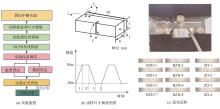
Fig.1
Experimental scheme of FGH4108 fatigue crack propagation
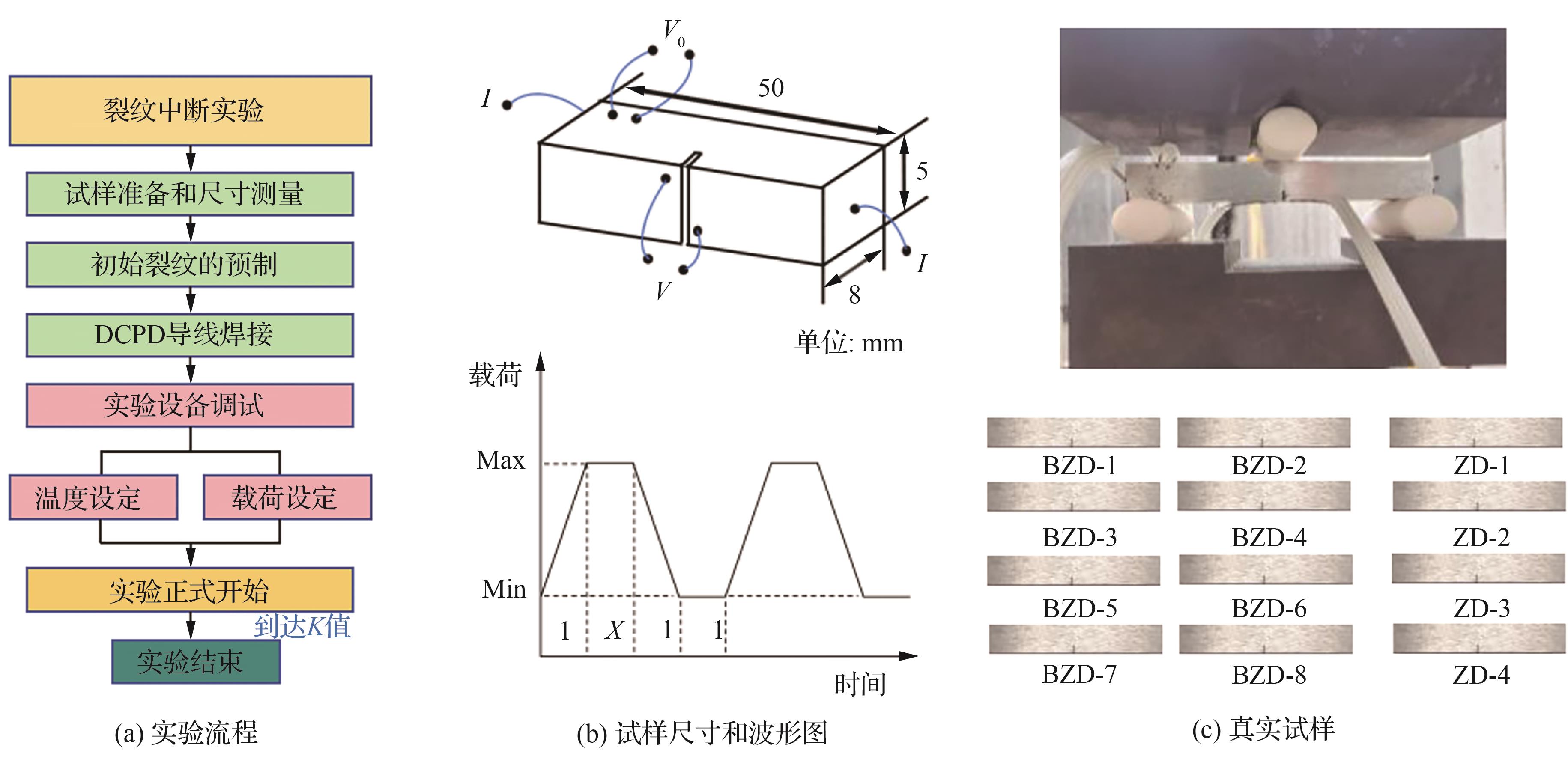
Table 2
Experimental loading condition
| T/℃ | 保载时间/s | 实验结束条件 |
|---|---|---|
| 650 | 1/90 | 断裂 |
| 700 | 1/90 | 断裂 |
| 750 | 1/90 | 断裂 |
| 800 | 1/90 | 断裂 |
| 700 | 1/90 | ΔK=30 MPa· |
| 750 | 90 | ΔK=30 MPa· |
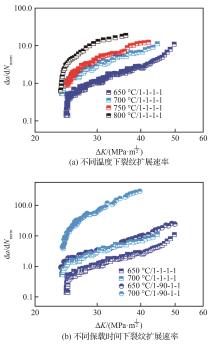
Fig.2
Crack growth rate under different experimental conditions
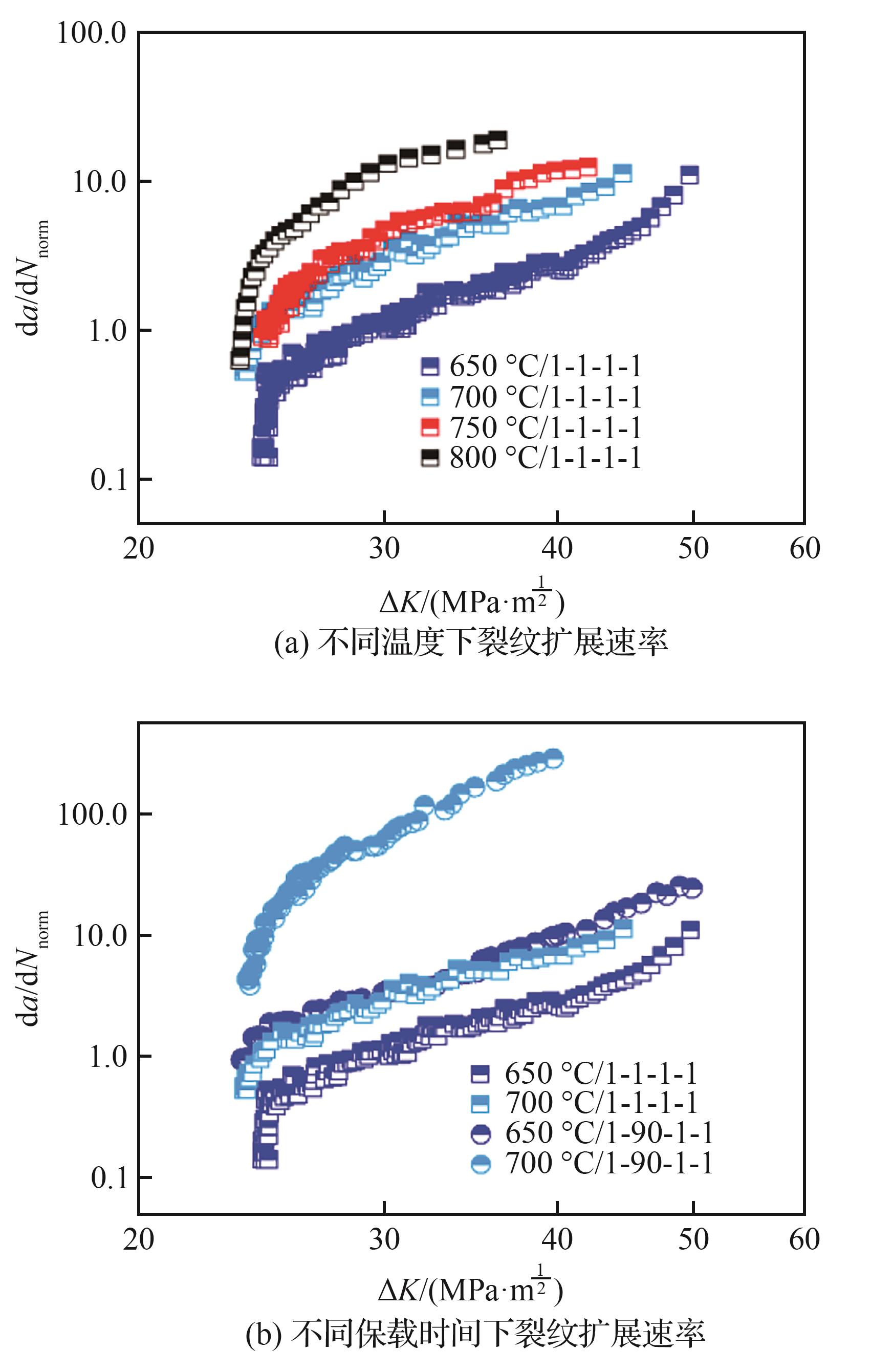
Fig.3
Fractography of FGH4108 alloy in different locations under different experimental conditions
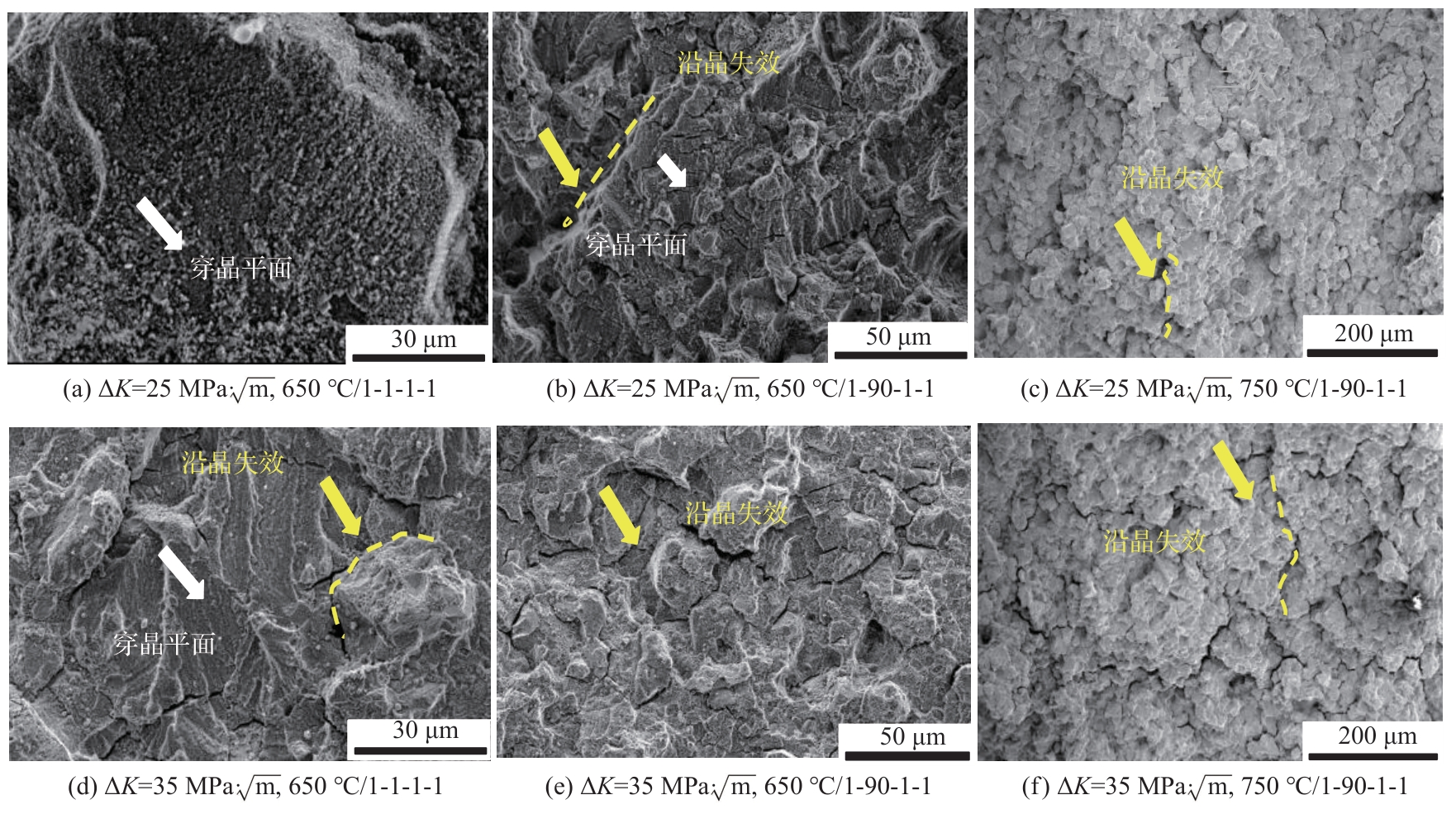
Fig. 4
EBSD characterization of FGH4108 crack tip at ΔK = 30 MPa·m
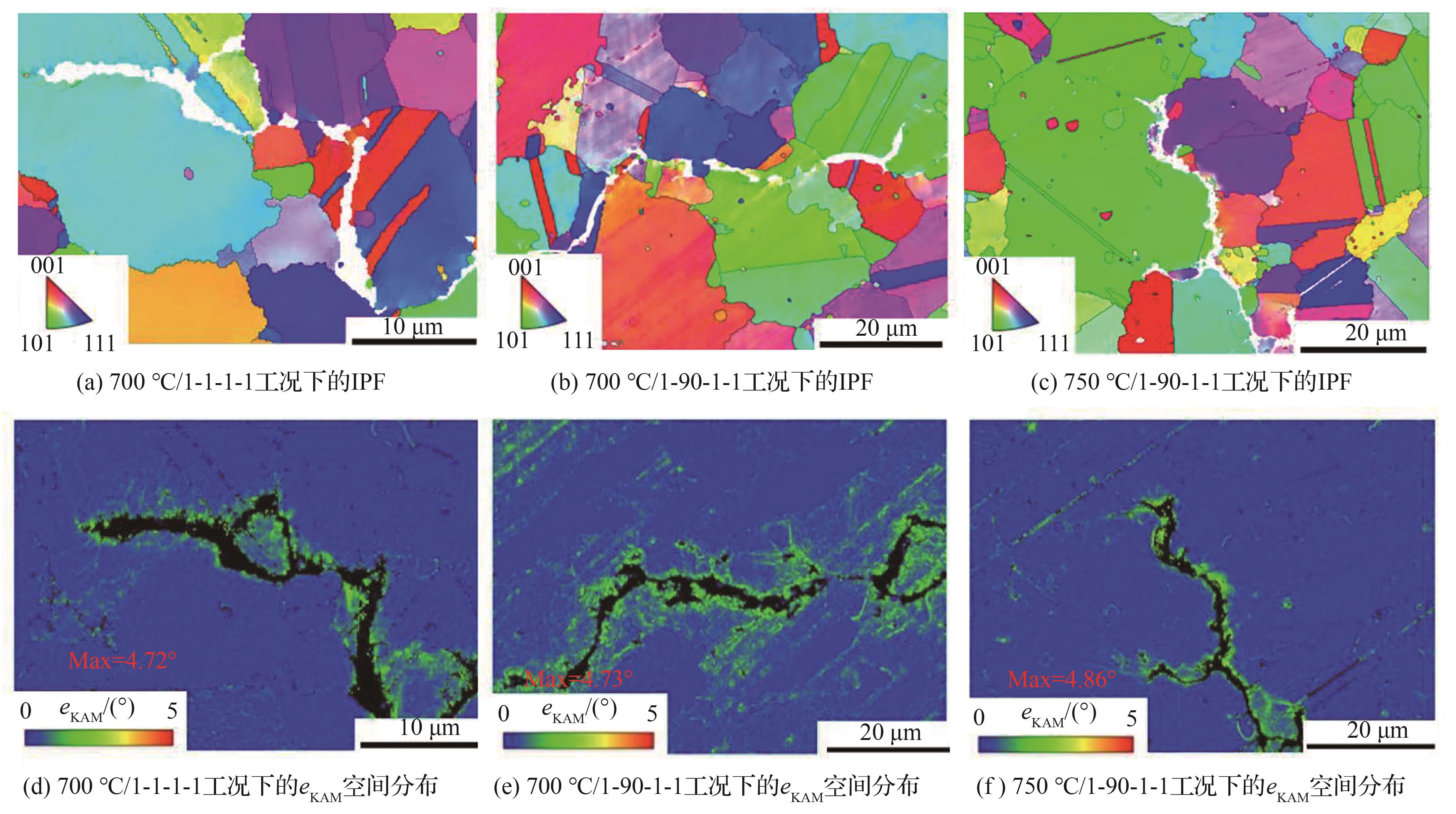
Fig.5
KAM distribution curves at crack tip region of FGH4108 alloy when ΔK =30 MPa·m
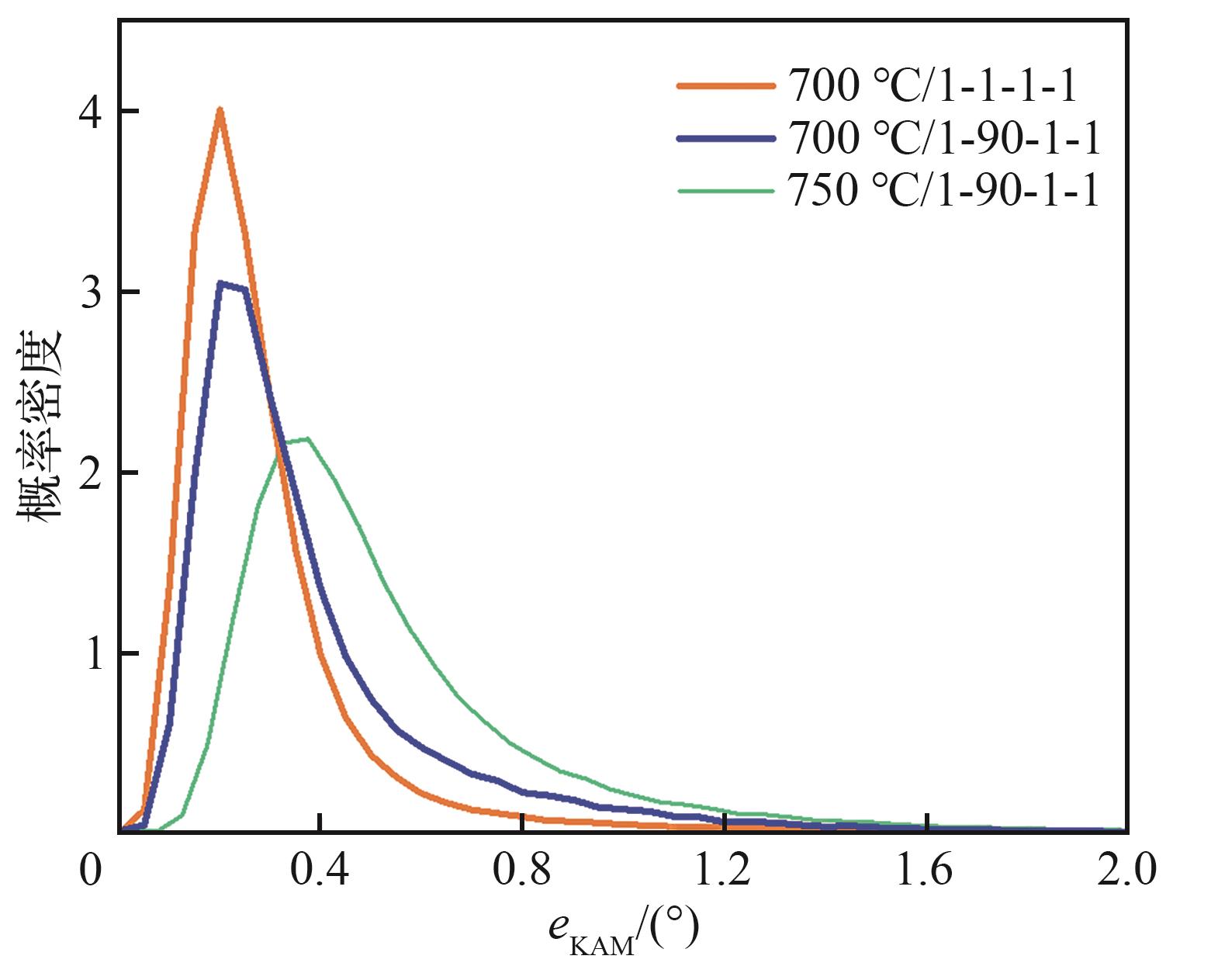

Fig.6
TEM-EPMA characterization results of FGH4108 crack tip specimen (ΔK=30 MPa·m)

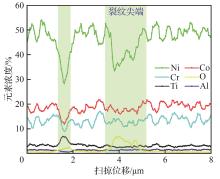
Fig.7
Line scan element composition diagram of crack tip under 700 ℃/1-1-1-1 (ΔK=30 MPa·m)

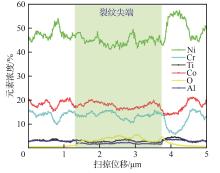
Fig.8
Line scan element composition diagram of crack tip under 750 ℃/1-1-1-1 (ΔK=30 MPa·m)

Table 3
Structural parameters of theoretical model
| T/℃ | E/GPa | σy/MPa | εf/% | D/μm |
|---|---|---|---|---|
| 650 | 185 | 921 | 9.5 | 30 |
| 700 | 170 | 899 | 7.9 | 30 |
| 750 | 150 | 892 | 7.5 | 30 |
| 800 | 140 | 885 | 7.0 | 30 |
Table 4
Correlated material parameters affected by grain size[26]
| 参数 | 数值 |
|---|---|
| γ | 0.31 |
| d0/nm | 2.6 |
| D0/μm | 1 |

Fig.9
Quantitative results of fatigue crack propagation rate of FGH4108 superalloy by 1 s dwell rate model at different temperatures

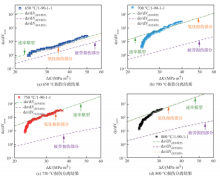
Fig.10
Quantitative results of fatigue crack propagation rate of FGH4108 superalloy by 90 s dwell rate model at different temperatures
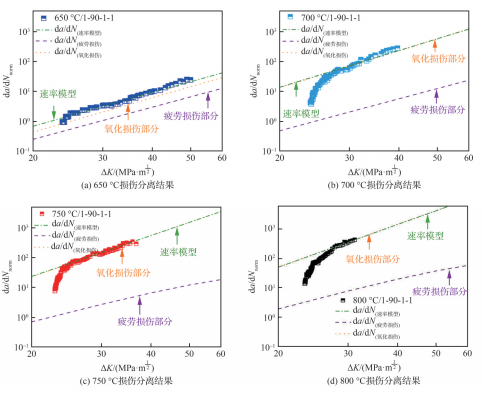
Table 5
Correlated parameters of oxidation damage
| T/℃ | kp | m2 |
|---|---|---|
| 650 | 2.80×10⁻¹¹ | 3.81 |
| 700 | 9.32×10⁻¹¹ | 4.48 |
| 750 | 1.84×10⁻¹⁰ | 4.56 |
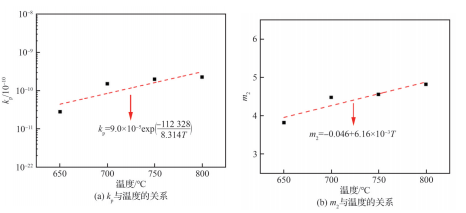
| 800 | 1.97×10⁻¹⁰ | 4.82 |
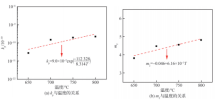
Fig.11
Temperature dependence of oxidative damage parameters of FGH4108 superalloy
| [1] | PINEAU A, ANTOLOVICH S D. High temperature fatigue of nickel-base superalloys-A review with special emphasis on deformation modes and oxidation[J]. Engineering Failure Analysis, 2009, 16(8): 2668-2697. |
| [2] | REED R C. The superalloys: fundamentals and applications[M]. Cambridge: Cambridge University Press, 2008. |
| [3] | 韩增祥. 温度对变形高温合金热疲劳性能的影响[J]. 燃气涡轮试验与研究, 2007, 20(4): 53-57. |
| HAN Z X. Effects of temperature on thermal fatigue properties of some wrought superalloys[J]. Gas Turbine Experiment and Research, 2007, 20(4): 53-57 (in Chinese). | |
| [4] | ZHONG Z H, GU Y F, YUAN Y, et al. Fatigue crack growth behavior of a newly developed Ni-Co-base superalloy TMW-2 at elevated temperatures[J]. Materials Science and Engineering: A, 2012, 552: 464-471. |
| [5] | LIU H, BAO R, ZHANG J Y, et al. A creep-fatigue crack growth model containing temperature and interactive effects[J]. International Journal of Fatigue, 2014, 59: 34-42. |
| [6] | WU C H, JIANG R, ZHANG L C, et al. Oxidation accelerated dwell fatigue crack growth mechanisms of a coarse grained PM Ni-based superalloy at elevated temperatures[J]. Corrosion Science, 2022, 209: 110702. |
| [7] | TELESMAN J, GABB T P, GHOSN L J, et al. Effect of notches on creep-fatigue behavior of a P/M nickel-based superalloy[J]. International Journal of Fatigue, 2016, 87: 311-325. |
| [8] | CHEN X, PETTIT R G, DUDZINSKI D, et al. On the role of crack tip creep deformation in hot compressive dwell fatigue crack growth acceleration in aluminum and nickel engine alloys[J]. International Journal of Fatigue, 2021, 145: 106082. |
| [9] | GABB T P, GAYDA J, TELESMAN J, et al. Factors influencing dwell fatigue life in notches of a powder metallurgy superalloy[J]. International Journal of Fatigue, 2013, 48: 55-67. |
| [10] | KIM D, JIANG R, REED P A S. Microstructural and oxidation effects on fatigue crack initiation mechanisms in a turbine disc alloy[J]. Journal of Materials Science, 2023, 58(4): 1869-1885. |
| [11] | BIKA D, MCMAHON C J. A model for dynamic embrittlement[J]. Acta Metallurgica et Materialia, 1995, 43(5): 1909-1916. |
| [12] | MOLINS R, HOCHSTETTER G, CHASSAIGNE J C, et al. Oxidation effects on the fatigue crack growth behaviour of alloy 718 at high temperature[J]. Acta Materialia, 1997, 45(2): 663-674. |
| [13] | VISKARI L, HÖRNQVIST M, MOORE K L, et al. Intergranular crack tip oxidation in a Ni-base superalloy[J]. Acta Materialia, 2013, 61(10): 3630-3639. |
| [14] | ZHANG X B, LIU C S, LU J Y, et al. Secondarily precipitated phases of a Ni-based superalloy during durable thermal treatment[J]. Journal of Northeastern University, 2005, 26(4): 355-358. |
| [15] | 侯杰, 董建新, 姚志浩. GH4169合金高温疲劳裂纹扩展的微观损伤机制[J]. 工程科学学报, 2018, 40(7): 822-832. |
| HOU J, DONG J X, YAO Z H. Microscopic damage mechanisms during fatigue crack propagation at high temperature in GH4169 superalloy[J]. Chinese Journal of Engineering, 2018, 40(7): 822-832 (in Chinese). | |
| [16] | MILLER C F, SIMMONS G W, WEI R P. Evidence for internal oxidation during oxygen enhanced crack growth in P/M Ni-based superalloys[J]. Scripta Materialia, 2003, 48(1): 103-108. |
| [17] | KITAGUCHI H S, LI H Y, EVANS H E, et al. Oxidation ahead of a crack tip in an advanced Ni-based superalloy[J]. Acta Materialia, 2013, 61(6): 1968-1981. |
| [18] | JIANG R, PROPRENTNER D, CALLISTI M, et al. Role of oxygen in enhanced fatigue cracking in a PM Ni-based superalloy: Stress assisted grain boundary oxidation or dynamic embrittlment [J]. Corrosion Science, 2018, 139: 141-154. |
| [19] | 万煜玮, 周斌, 胡绪腾, 等. 某镍基粉末合金高温疲劳裂纹扩展行为与模型研究[J]. 推进技术, 2023, 44(2): 262-271. |
| WAN Y W, ZHOU B, HU X T, et al. High temperature fatigue crack growth behavior and model of a nickel-based powder metallurgy superalloy[J]. Journal of Propulsion Technology, 2023, 44(2): 262-271 (in Chinese). | |
| [20] | EVANS J L, SAXENA A. Elevated temperature fatigue crack growth rate model for NI-BASE superalloys[J]. International Journal of Fracture, 2014, 185(1): 209-216. |
| [21] | CHRIST H J, WACKERMANN K, KRUPP U. Effect of dynamic embrittlement on high temperature fatigue crack propagation in IN718-experimental characterisation and mechanism-based modelling[J]. Materials at High Temperatures, 2016, 33(4/5): 528-535. |
| [22] | WANG R Z, ZHU S P, WANG J, et al. High temperature fatigue and creep-fatigue behaviors in a Ni-based superalloy: Damage mechanisms and life assessment[J]. International Journal of Fatigue, 2018, 118: 8-21. |
| [23] | HEIL M L. Crack growth in alloy 718 under thermal-mechanical cycling (fatigue, fracture, nickel, superalloy)[D]. Ohio: Air Force Institute of Technology, 1986. |
| [24] | 徐超, 佴启亮, 姚志浩, 等. 晶界氧化对GH4738高温合金疲劳裂纹扩展的作用[J]. 金属学报, 2017, 53(11): 1453-1460. |
| XU C, NAI Q L, YAO Z H, et al. Grain boundary oxidation effect of GH4738 superalloy on fatigue crack growth[J]. Acta Metallurgica Sinica, 2017, 53(11): 1453-1460 (in Chinese). | |
| [25] | VISKARI L, CAO Y, NORELL M, et al. Grain boundary microstructure and fatigue crack growth in Allvac 718Plus superalloy[J]. Materials Science and Engineering: A, 2011, 528(6): 2570-2580. |
| [26] | CHAN K S, ENRIGHT M P, MOODY J, et al. A microstructure-based time-dependent crack growth model for life and reliability prediction of turbopropulsion systems[J]. Metallurgical and Materials Transactions A, 2014, 45(1): 287-301. |
| [27] | MA L Z, CHANG K M. Identification of SAGBO-induced damage zone ahead of crack tip to characterize sustained loading crack growth in alloy 783[J]. Scripta Materialia, 2003, 48(9): 1271-1276. |
| [28] | ENCINAS-OROPESA A, DREW G L, HARDY M C, et al. Effects of oxidation and hot corrosion in a nickel disc alloy[C]∥Superalloys 2008 Eleventh International Symposium. US: TMS, 2008: 609-618. |
| [29] | CAO L Y, CHEN Y, SUN Y L, et al. Regional high temperature fatigue crack growth behavior of a microstructure-gradient nickel-based superalloy[J]. Materials Science and Engineering: A, 2024, 890: 145871. |
| [1] | Yaoying ZENG, Running WANG, Jiaqi HOU, Yulei ZHANG, Jiaping ZHANG, Hejun LI. Research progress of C/C composites resistant to extreme ablation environments [J]. Acta Aeronautica et Astronautica Sinica, 2025, 46(6): 531927-531927. |
| [2] | Xianzhao YANG, Gaowen LIU, Lingying GUO, Jiale MA, Aqiang LIN. Design of turbine high radius pre-swirl system with high temperature drop [J]. Acta Aeronautica et Astronautica Sinica, 2025, 46(2): 130672-130672. |
| [3] | Xiaoyong LIU, Mingfu WANG, Jianwen LIU, Xin REN, Xuan ZHANG. Review and prospect of research on scramjet [J]. Acta Aeronautica et Astronautica Sinica, 2024, 45(5): 529878-529878. |
| [4] | Ruida CHEN, Xiachao CHEN, Hongyu CHEN, Hui XU, Xin HONG. Ignition characteristics and exhaust experiment of 120 N engine at simulated high lunar temperature [J]. Acta Aeronautica et Astronautica Sinica, 2024, 45(11): 529112-529112. |
| [5] | Zhenyu WANG, Jizhen WANG, Jingyi YANG, Pengyuan HE, Chenghao PAN, Lingbo ZHOU, Cheng HE, Huan HE. Dynamics model updating of structures at high temperature based on novel particle swarm optimization algorithm [J]. ACTA AERONAUTICAET ASTRONAUTICA SINICA, 2023, 44(7): 226559-226559. |
| [6] | Jiahong NIU, Haonan JIA, Fajun YI, Zujun PENG, Wei CHEN. Low-pressure thermal stability and high-temperature electrical conductivity of dense amorphous SiCN [J]. ACTA AERONAUTICAET ASTRONAUTICA SINICA, 2022, 43(S2): 152-159. |
| [7] | Kai LUO, Qiu WANG, Jinping LI, Wei ZHAO. Magnetohydrodynamic flow control of double-cone under high temperature real gas effect [J]. ACTA AERONAUTICAET ASTRONAUTICA SINICA, 2022, 43(S2): 76-88. |
| [8] | FAN Yongsheng, YANG Xiaoguang, SHI Duoqi, TAN Long, HUANG Weiqing. Rafting-waste judgement of serviced turbine blades: quantitative characterization and threshold determination [J]. ACTA AERONAUTICAET ASTRONAUTICA SINICA, 2022, 43(9): 625100-625100. |
| [9] | WANG Changyu, XU Kejun, QIN Haiqin, MA Zhongyuan, XIE Jing, XIE Zhenbo. A generalized Bodner-Partom viscoplastic constitutive model [J]. ACTA AERONAUTICAET ASTRONAUTICA SINICA, 2022, 43(12): 426009-426009. |
| [10] | LAN Zeyu, YU Huan, XU Zhifeng, SHUAI Liang, HU Yinsheng. High temperature compressive properties and failure mechanism of Cf/Al composites with different braided structures [J]. ACTA AERONAUTICAET ASTRONAUTICA SINICA, 2021, 42(9): 424488-424488. |
| [11] | GUO Lei, GAO Yuan, XIN Hui. Laser modification parameters optimization and structural design of thermal barrier coatings [J]. ACTA AERONAUTICAET ASTRONAUTICA SINICA, 2021, 42(7): 424114-424114. |
| [12] | DING Mingsong, LIU Qingzong, JIANG Tao, DONG Weizhong, GAO Tiesuo, FU Yang'aoxiao. Simulation of magnetohydrodynamic heat shield system on reusable launch vehicles [J]. ACTA AERONAUTICAET ASTRONAUTICA SINICA, 2021, 42(7): 124501-124501. |
| [13] | XU Kejun, XIAO Yang, QIN Haiqin, JIA Mingming. Fatigue-creep life prediction based on cyclic strain characteristics [J]. ACTA AERONAUTICAET ASTRONAUTICA SINICA, 2021, 42(5): 524109-524109. |
| [14] | XIAO Yang, QIN Haiqin, XU Kejun, JIA Mingming, ZHANG Zhuzhu. Low cycle fatigue life prediction of FGH96 alloy based on modified SWT model [J]. ACTA AERONAUTICAET ASTRONAUTICA SINICA, 2021, 42(5): 524360-524360. |
| [15] | AI Bangcheng, CHEN Siyuan, HAN Haitao, HU Longfei, LU Qin, CHU Min, DENG Daiying, YU Jijun. Heat transfer limit characteristics of integrated dredging thermal protection structure [J]. ACTA AERONAUTICAET ASTRONAUTICA SINICA, 2021, 42(2): 623989-623989. |
| Viewed | ||||||
|
Full text |
|
|||||
|
Abstract |
|
|||||
Address: No.238, Baiyan Buiding, Beisihuan Zhonglu Road, Haidian District, Beijing, China
Postal code : 100083
E-mail:hkxb@buaa.edu.cn
Total visits: 6658907 Today visits: 1341All copyright © editorial office of Chinese Journal of Aeronautics
All copyright © editorial office of Chinese Journal of Aeronautics
Total visits: 6658907 Today visits: 1341

 CJA
CJA
