Acta Aeronautica et Astronautica Sinica ›› 2025, Vol. 46 ›› Issue (18): 431749.doi: 10.7527/S1000-6893.2025.31749
• Material Engineering and Mechanical Manufacturing • Previous Articles Next Articles
Dake TIAN1, Liyong ZHANG1, Yongbin WANG2, Jishou FANG2, Lu JIN3( ), Rongqiang LIU4
Received:2024-12-31
Revised:2025-02-06
Accepted:2025-05-26
Online:2025-09-25
Published:2025-06-27
Contact:
Lu JIN
E-mail:jinlu@sjzu.edu.cn
Supported by:CLC Number:
Dake TIAN, Liyong ZHANG, Yongbin WANG, Jishou FANG, Lu JIN, Rongqiang LIU. Design and analysis of hexagonal prism modular deployable membrane sunshield[J]. Acta Aeronautica et Astronautica Sinica, 2025, 46(18): 431749.

Table 1
Summary of key information of typical sunshield
| 遮光罩名称 | 研究机构 | 遮光罩构型 | 驱动方式 | 展开态参数/m |
|---|---|---|---|---|
| IXO遮光罩[ | 美国诺思罗普·格鲁曼公司 | 一维完整柱面 | 电机驱动 | 直径4 高度12 |
| MITAR遮光罩[ | 意大利航天局 | 一维完整柱面 | 弹性驱动 | 直径0.4 高度0.56 |
| SEDOBA遮光罩[ | 英国奎奈蒂克公司 | 一维局部柱面 | 电机+弹性驱动 | 直径3.9 高度4.6 |
| CDST遮光罩[ | 美国国家航空航天局 | 一维完整柱面 | 弹性驱动 | 直径0.2 高度1.2 |
| 充气遮光罩[ | 浙江大学 | 一维完整柱面 | 充气驱动 | 直径0.3 高度1.1 |
| 套筒式遮光罩[ | 中国科学院光电技术研究所 | 一维完整柱面 | 弹性驱动 | 直径0.28 高度0.6 |
| 二次展开遮光罩[ | 中国科学院长春光学精密 机械与物理研究所 | 一维局部柱面 | 电机驱动 | |
| 高分7号遮光罩[ | 北京空间机电研究所 | 一维局部柱面 | 弹性驱动 | 高度1.05 |
| Gaia遮光罩[ | 欧洲航天局 | 二维平面 | 弹性驱动 | 直径10.2 |
| Starshade遮光罩[ | 美国科罗拉多大学 | 二维平面 | 电机+弹性驱动 | 直径40 |
| JPL遮光罩[ | 美国喷气推进实验室 | 二维平面 | 电机驱动 | 直径5.5 |
| JWST遮光罩[ | 美国国家航空航天局联合 欧洲航天局 | 二维平面 | 电机驱动 | 长×宽:14.6×21.2 |
| 燃料遮光罩[ | 美国肯尼迪航天中心 | 三维锥面 | 充气驱动 | |
| ST-9遮光罩[ | 美国国家航空航天局 | 三维锥面 | 电机+弹性驱动 | 宽度4 |
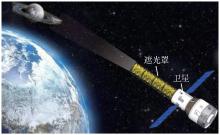
Fig.1
Working diagram of sunshield in orbit
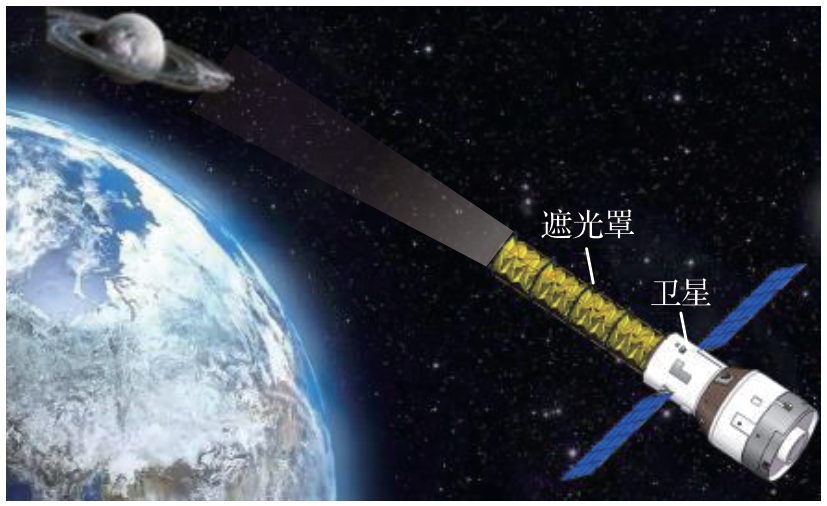
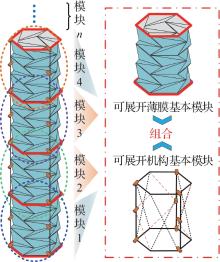
Fig.2
Configuration scheme of modular sunshield
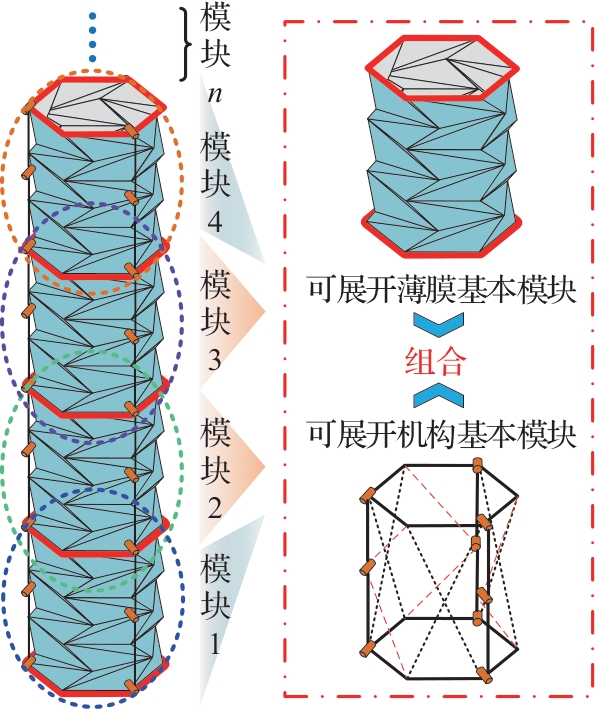
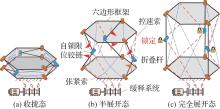
Fig.3
Principle schematic of deployable module
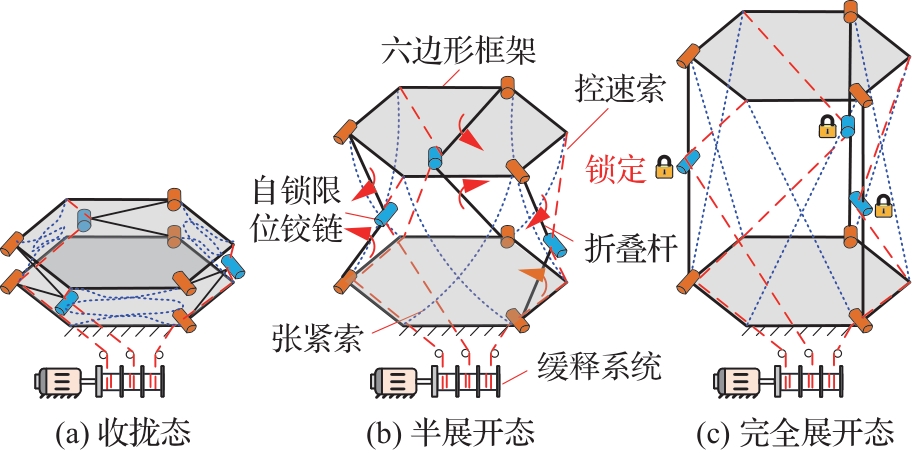
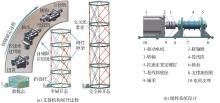
Fig.4
Multi-module rigid deployable support mechanism
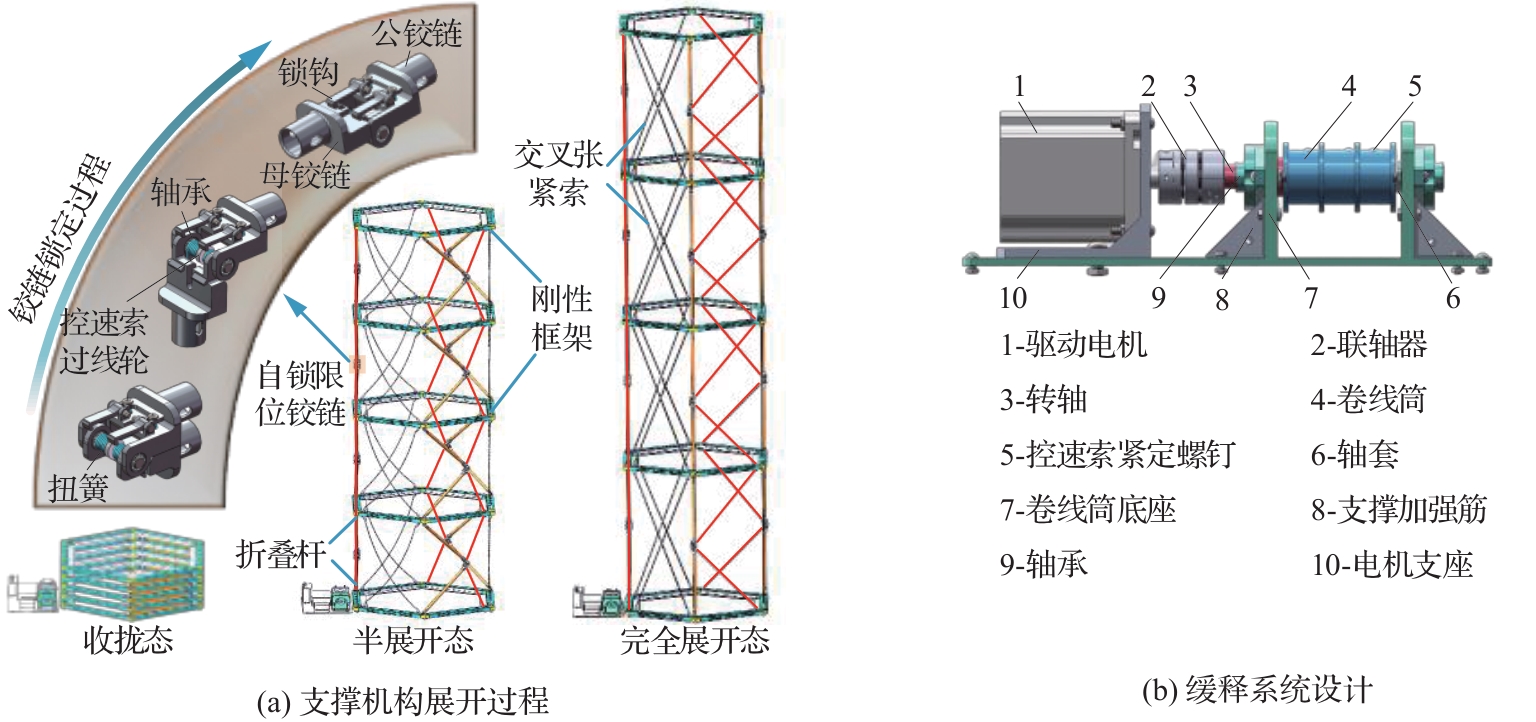
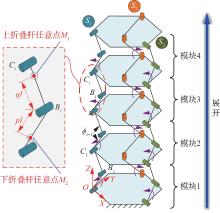
Fig.5
Motion state diagram of support mechanism
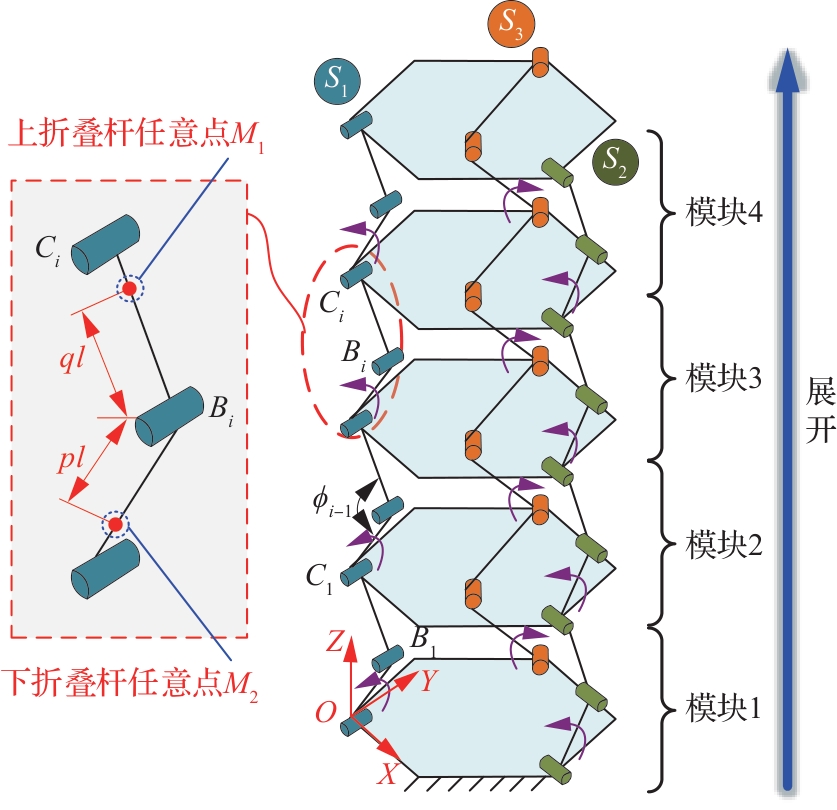
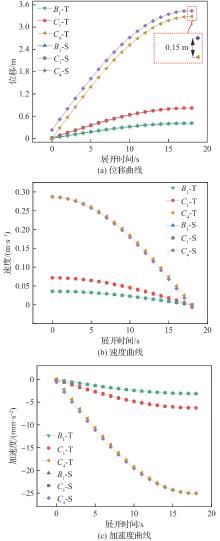
Fig.6
Comparison curves of kinematic characteristics of feature points
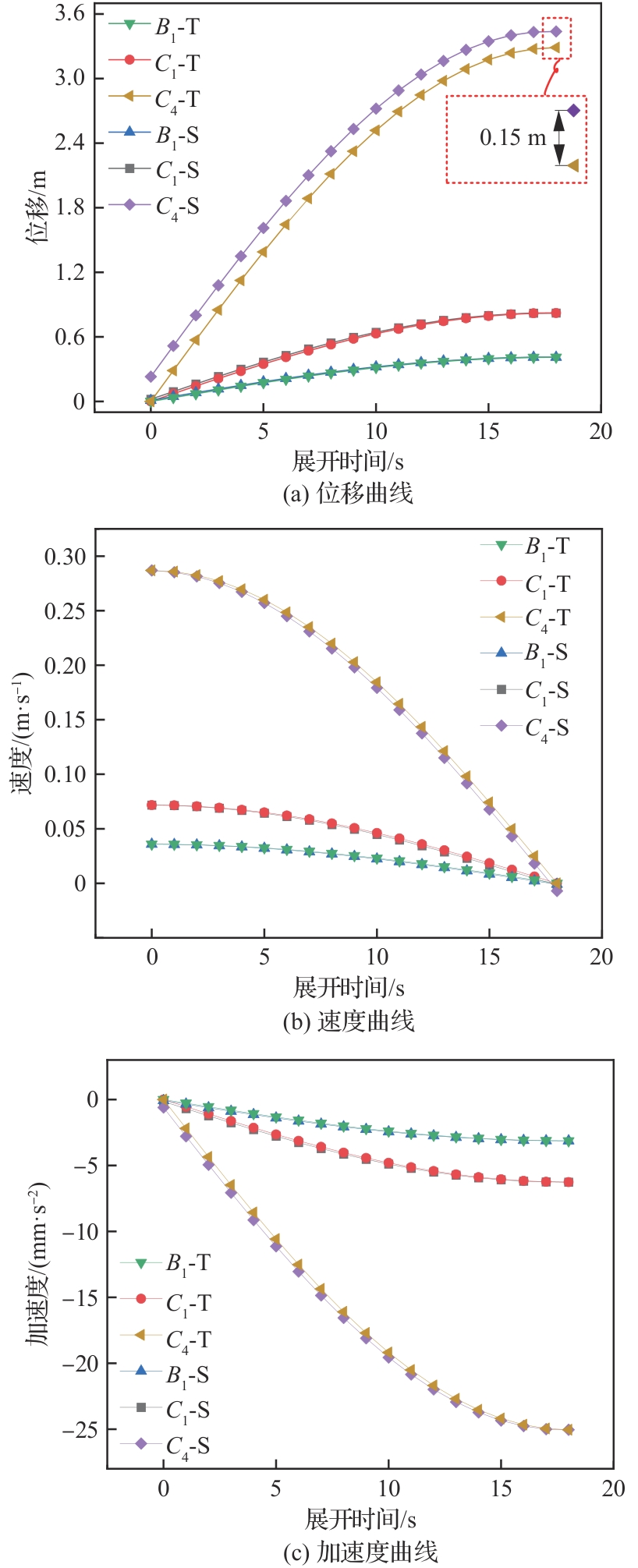
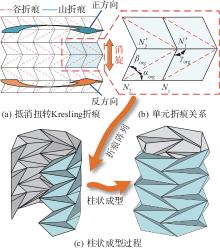
Fig.7
Crease pattern of Kresling
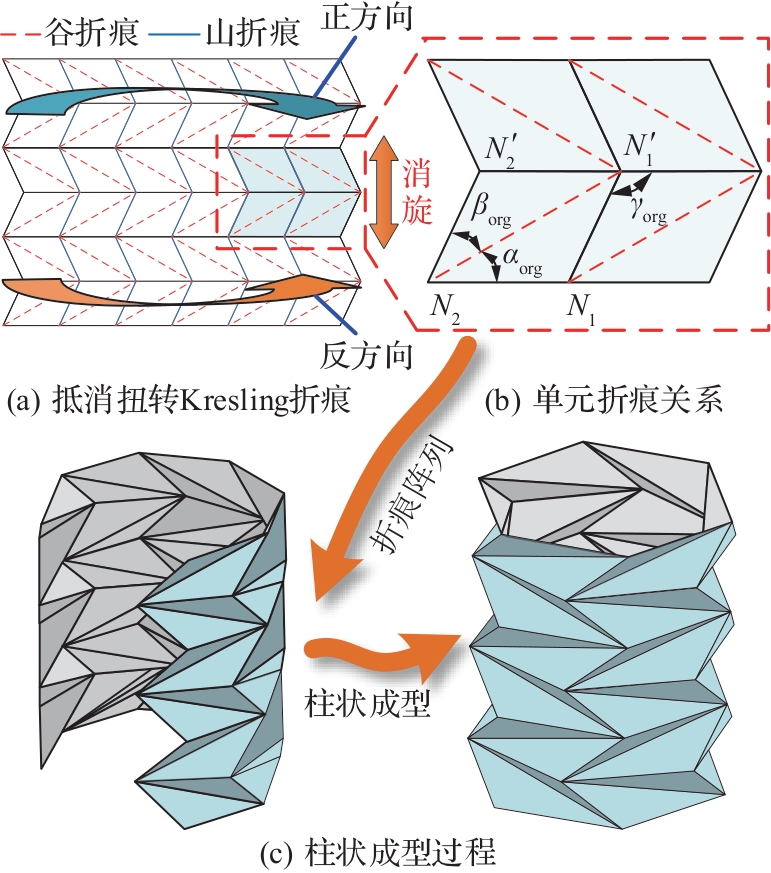
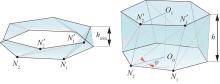
Fig.8
Space geometric relationship of Kresling crease
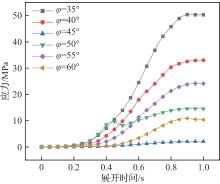
Fig.9
Analysis curves of influence of relative deflection angle on structural stress
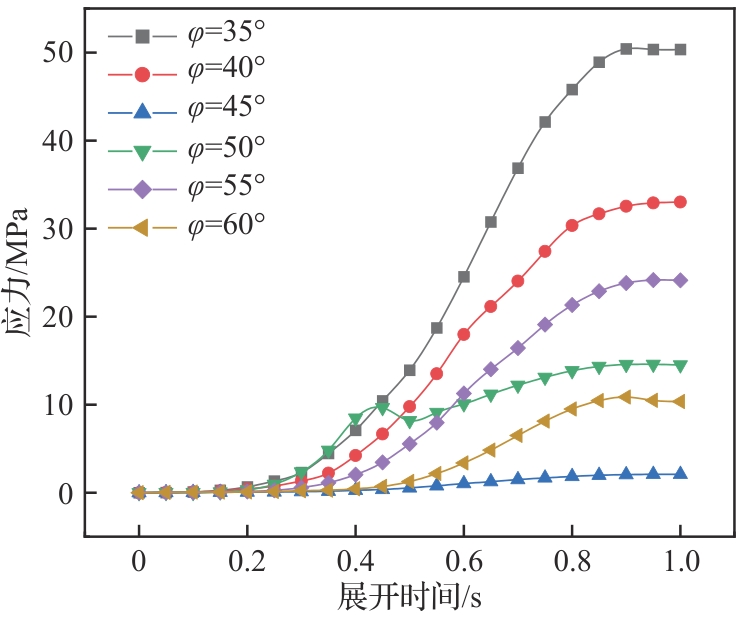
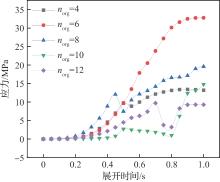
Fig.10
Analysis curves of influence of edge number on structural stress
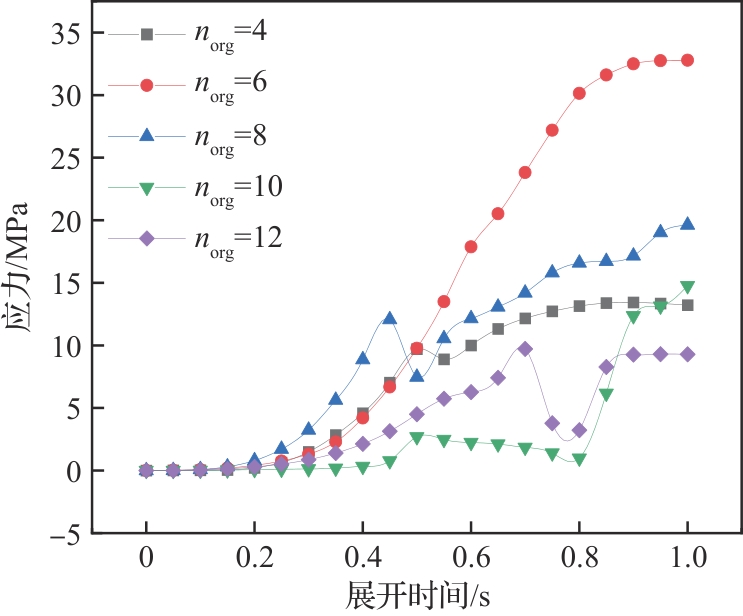
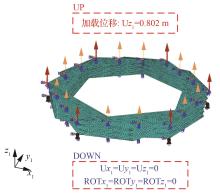
Fig.11
Finite element model of deployable membrane
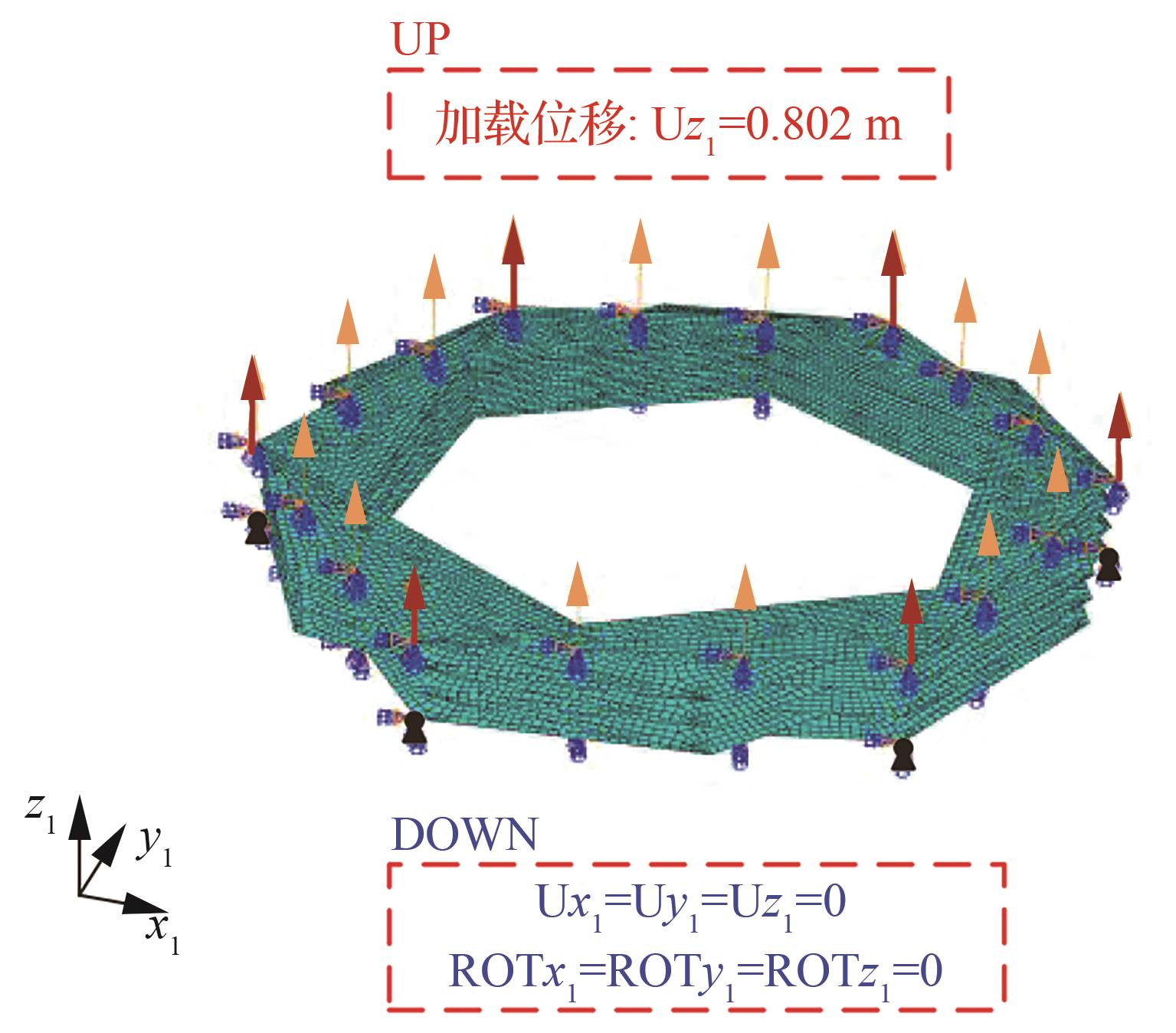
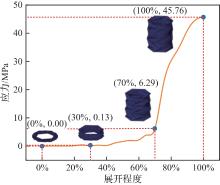
Fig.12
Stress variation curve of membrane deployable simulation process
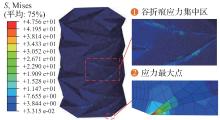
Fig.13
Fully deployed state stress distribution of membrane
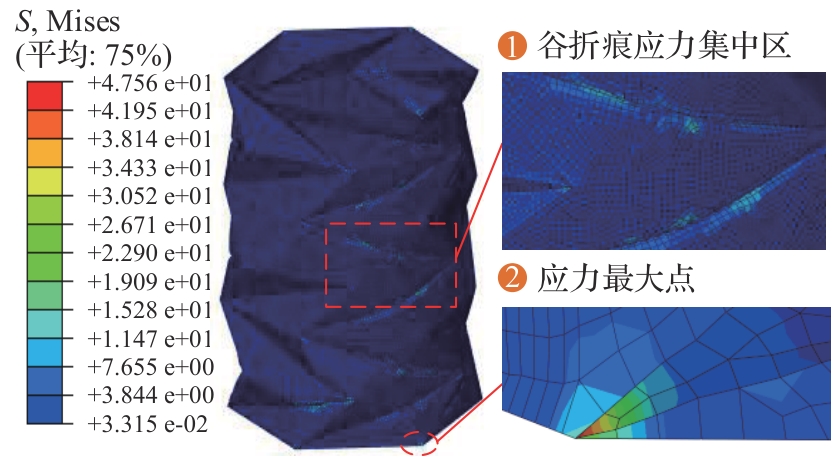
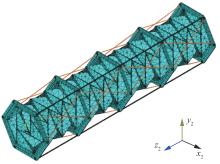
Fig.14
Finite element model of sunshield
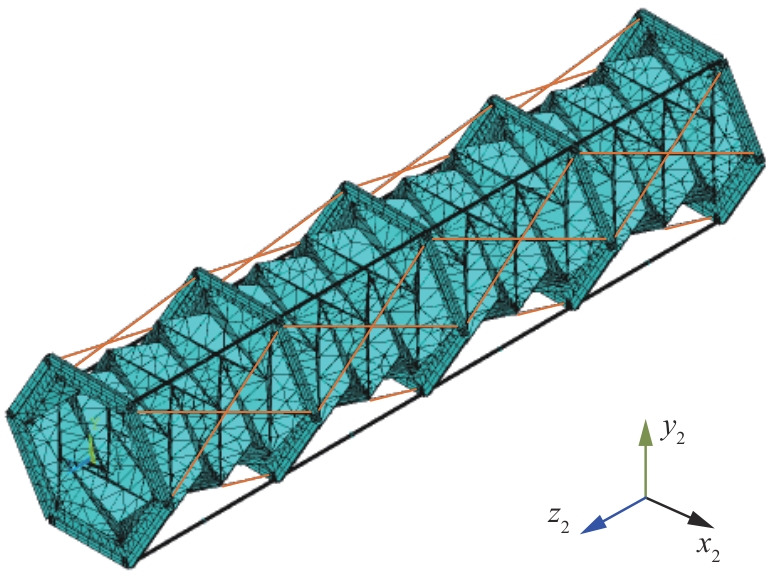
Table 2
Top eight-order natural frequencies of sunshield
| 阶数 | 固有频率/Hz | 振型描述 |
|---|---|---|
| 1 | 4.57 | 绕x2轴弯曲 |
| 2 | 8.07 | 绕z2轴扭转 |
| 3 | 14.86 | 绕y2轴弯曲 |
| 4 | 19.50 | 绕z2轴扭转 |
| 5 | 20.54 | 绕z2轴扭转 |
| 6 | 23.40 | 绕z2轴扭转 |
| 7 | 25.61 | 绕z2轴扭转 |
| 8 | 26.10 | 绕y2轴弯曲 |
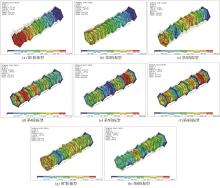
Fig.15
Vibrational modes of sunshield structures
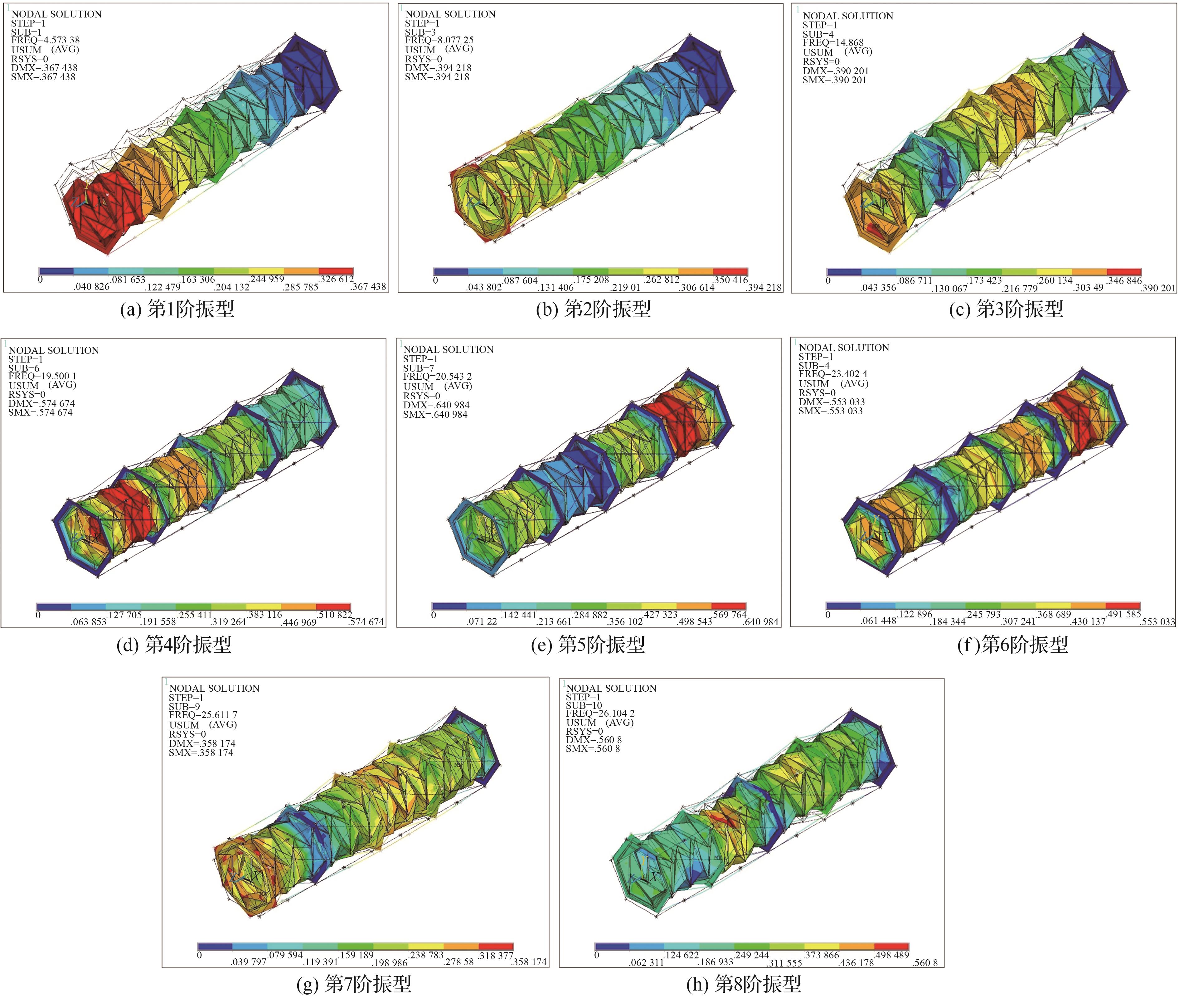
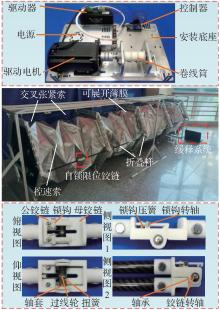
Fig.16
Sunshield prototype
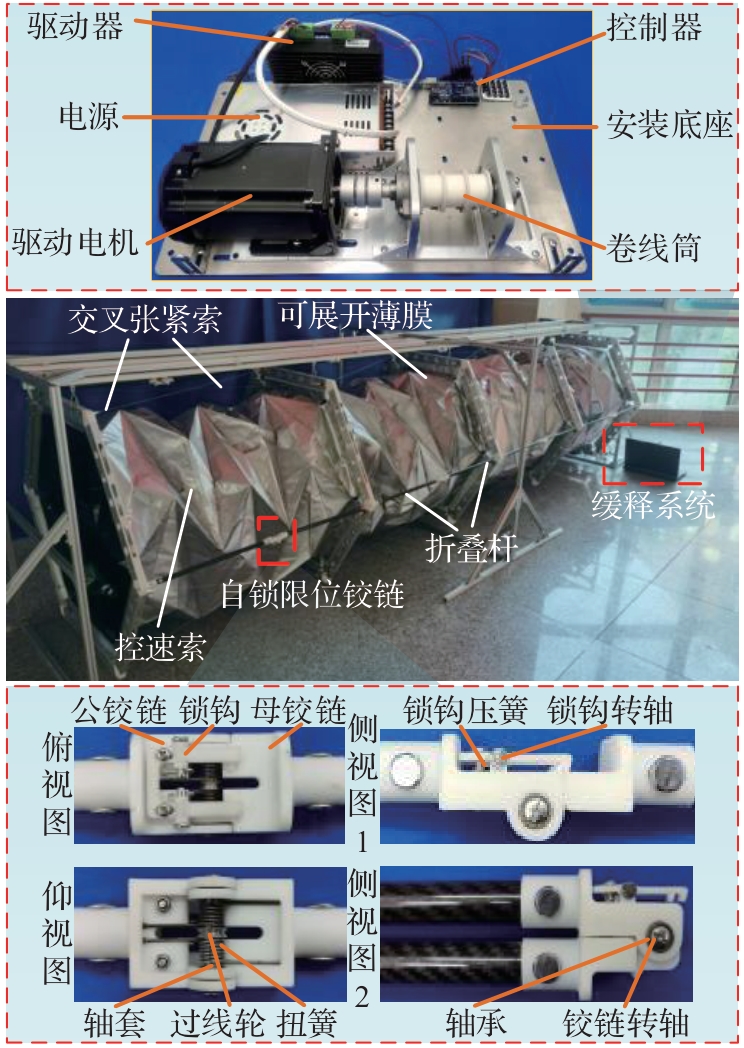
Table 3
Storage rate of typical cylindrical sunshield
| 遮光罩 | 展开态高度/m | 收纳率 |
|---|---|---|
| MITAR遮光罩[ | 0.56 | 4.0∶1 |
| SEDOBA遮光罩[ | 4.60 | 4.6∶1 |
| CDST遮光罩[ | 1.20 | 12.0∶1 |
| 充气遮光罩[ | 1.10 | 5.5∶1 |
| 三级套筒遮光罩[ | 0.60 | 2.3∶1 |
| 本研究遮光罩 | 3.51 | 11.7∶1 |
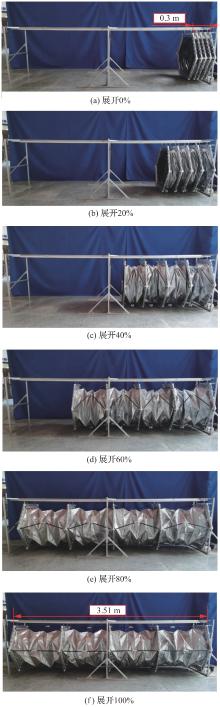
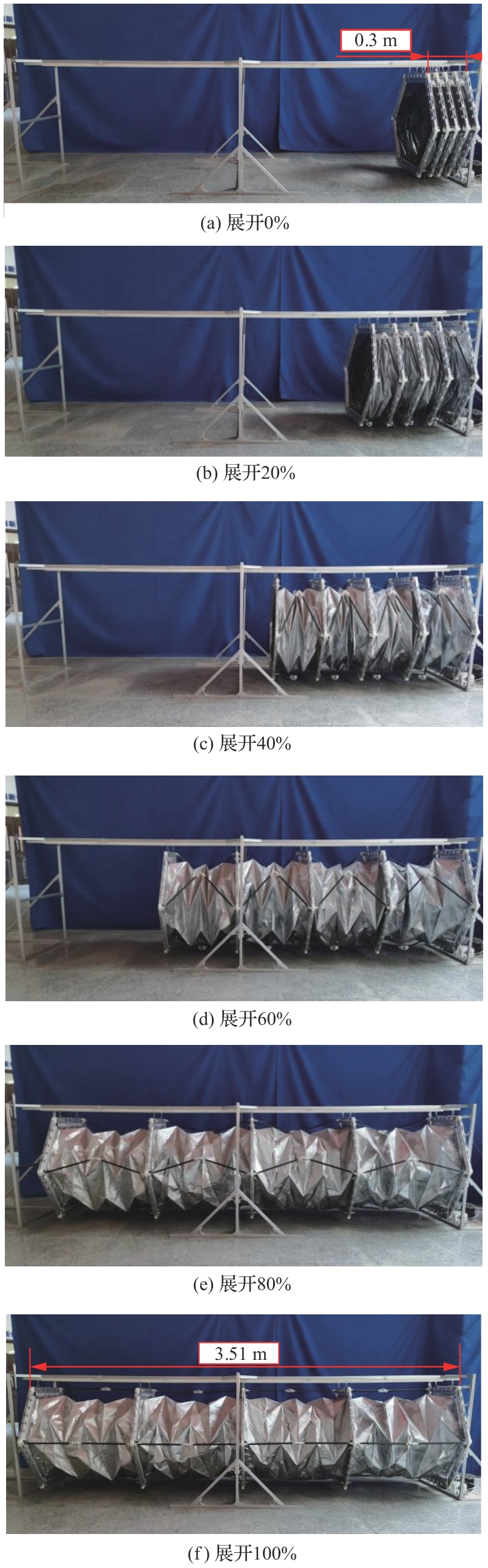
Fig.17
Deployment functional test of sunshield
| [1] | 中华人民共和国国务院新闻办公室. 2021中国的航天[EB/OL]. (2022-01-28)[2024-12-20]. . |
| The State Council Information Office of the People’s Republic of China. China’s space program: A 2021 perspective[EB/OL]. (2022-01-28)[2024-12-20]. (in Chinese). | |
| [2] | 田百义, 王大轶, 张相宇, 等. 太阳系边际探测飞行任务规划[J]. 宇航学报, 2021, 42(3): 284-294. |
| TIAN B Y, WANG D Y, ZHANG X Y, et al. Flight mission planning for solar system boundary exploration[J]. Journal of Astronautics, 2021, 42(3): 284-294 (in Chinese). | |
| [3] | 刘志全, 操安博, 林秋红. 航天器可展开薄膜遮光罩机械设计的发展与展望[J]. 宇航学报, 2022, 43(7): 839-852. |
| LIU Z Q, CAO A B, LIN Q H. Development and outlook of deployable membrane sunshield for spacecrafts[J]. Journal of Astronautics, 2022, 43(7): 839-852 (in Chinese). | |
| [4] | 刘付成, 朱东方. 考虑连接非线性的大型桁架天线分散协调控制[J]. 航空学报, 2021, 42(11): 139-149. |
| LIU F C, ZHU D F. Distributed coordinated control for large flexible truss antenna considering connection nonlinearity[J]. Acta Aeronautica et Astronautica Sinica, 2021, 42(11): 139-149 (in Chinese). | |
| [5] | 仝照远, 李萌, 崔程博, 等. 空间可展开薄膜遮光罩设计与分析[J]. 中国空间科学技术, 2021, 41(3): 82-88. |
| TONG Z Y, LI M, CUI C B, et al. Design and analysis of the configuration of deployable membrane sunshield[J]. Chinese Space Science and Technology, 2021, 41(3): 82-88 (in Chinese). | |
| [6] | 徐彦, 张超, 李鸿巍, 等. 展开式薄膜遮光罩设计及重复展开精度研究[J]. 中国空间科学技术, 2022, 42(4): 102-110. |
| XU Y, ZHANG C, LI H W, et al. Study on design and repetitive deployment precision of deployable membrane sunshields[J]. Chinese Space Science and Technology, 2022, 42(4): 102-110 (in Chinese). | |
| [7] | 林秋红, 张骞, 贾文文, 等. 大型空间薄膜遮阳罩折展构型设计与分析[J]. 机械工程学报, 2020, 56(5): 13-20. |
| LIN Q H, ZHANG Q, JIA W W, et al. Deployable configuration design and analysis of large space membrane sunshield structures[J]. Journal of Mechanical Engineering, 2020, 56(5): 13-20 (in Chinese). | |
| [8] | ROBINSON D W, MCCLELLAND R S. Mechanical overview of the International X-ray Observatory[C]∥2009 IEEE Aerospace Conference. 2009: 1-10. |
| [9] | WILSON L, PELLEGRINO S, DANNER R. Origami sunshield concepts for space telescopes[C]∥54th AIAA/ASME/ASCE/AHS/ASC Structures, Structural Dynamics, and Materials Conference. 2013: 1-12. |
| [10] | GARDI R, PICA G. Realization and preliminary tests on an innovative deployable structure for a high-resolution telescope for microsatellite[C]∥Sensors, Systems, and Next-Generation Satellites Ⅷ. 2004: 411-422. |
| [11] | PICA G, CIOFANIELLO L, MATTEI S, et al. High-resolution deployable telescope for satellite applications[C]∥Sensors, Systems, and Next-Generation Satellites Ⅶ. 2004: 531-538. |
| [12] | WARREN P A, SILVER M J, DOBSON B J. Lightweight optical barrel assembly structures for large deployable space telescopes[C]∥UV/Optical/IR Space Telescopes: Innovative Technologies and Concepts Ⅳ. 2009: 104-111. |
| [13] | AGASID E, ENNICO-SMITH K, RADEMACHER A. Collapsible space telescope(CST) for nanosatellite imaging and observation[C]∥27th Annual AIAA/USU Conference on Small Satellites. 2013: 1-5. |
| [14] | PEREIRA C, URGOITI E, PINTO I. The structure of the Gaia deployable sunshield assembly[C]∥12th European Conference on Spacecraft Structures, Materials and Environmental Testing. 2012: 1-6. |
| [15] | WEBB D, HIRSCH B, BACH V, et al. Starshade mechanical architecture & technology effort[C]∥3rd AIAA Spacecraft Structures Conference. 2016: 1-10. |
| [16] | SIGEL D, TREASE B P, THOMSON M W, et al. Application of origami in the starshade spacecraft blanket design[C]∥International Design Engineering Technical Conferences and Computers and Information in Engineering Conference. 2014: 1-8. |
| [17] | WILLIAMS R B, AGNES G, CRUMB D. Lightweight deployable sunshade concepts for passive cooling of space-based telescopes[C]∥49th AIAA/AS-ME/ASCE/AHS/ASC Structures, Structural Dynamics, and Materials Conference. 2008: 1-8. |
| [18] | GREENHOUSE M A. The JWST science instrument payload: mission context and status[C]∥Space Telescopes and Instrumentation 2016: Optical, Infrared, and Millimeter Wave. 2016: 20-32. |
| [19] | MICHAEL D, JOHN L, BERNARD K, et al. Design and development of an in-space deployable sun shield for the atlas centaur[C]∥AIAA Space 2008 Conference & Exposition. 2008: 1-11. |
| [20] | DIPIRRO M, TUTTLE J, MATTERN A, et al. Subscale cryo-thermal tests of a large 4-K space telescope[C]∥Millimeter and Submillimeter Detectors and Instrumentation for Astronomy Ⅲ. 2006: 112-122. |
| [21] | 曹旭, 江长虹, 冯昊, 等. “高分七号”卫星遥感相机可展开遮光罩的设计和实现[J]. 航天返回与遥感, 2020, 41(2): 67-77. |
| CAO X, JIANG C H, FENG H, et al. Design and implementation of the deployable sunshield on GF-7 satellite remote sensing camera[J]. Spacecraft Recovery & Remote Sensing, 2020, 41(2): 67-77 (in Chinese). | |
| [22] | 杜凯. 光学系统弹出式遮光罩研究[D]. 成都: 中国科学院大学, 2014: 15-48. |
| DU K. Self-deployable baffle in the optical system[D]. Chengdu: University of Chinese Academy of Sciences, 2014: 15-48 (in Chinese). | |
| [23] | KUANG Y, WANG S H, GAO Y, et al. Design and preliminary ground experiment for deployable sunshade structures of a modular space telescope[J]. Sensors, 2024, 24(7): 1-16. |
| [24] | 杜洋, 张祎, 段晓闻, 等. 土星系探测任务进展与展望[J]. 上海航天, 2024, 41(5): 69-78. |
| DU Y, ZHANG Y, DUAN X W, et al. Advances and prospect of saturnian system exploration missions[J]. Aerospace Shanghai, 2024, 41(5): 69-78 (in Chinese). | |
| [25] | TIAN D K, ZHANG J W, JIN L, et al. Design and research of a new multi-loop closed-chain morphing wing mechanism[J]. Mechanism and Machine Theory, 2024, 199: 105679. |
| [26] | TIAN D K, YANG X H, JIN L, et al. Design and analysis of a solid surface deployable antenna mechanism based on flasher rigid origami[J]. Thin-Walled Structures, 2024, 201: 112033. |
| [27] | 田大可, 高海明, 金路, 等. 多构型组合式模块化可展开天线机构设计与分析[J]. 机械工程学报, 2023, 59(13): 36-48. |
| TIAN D K, GAO H M, JIN L, et al. Design and analysis of multi-configuration modular deployable antenna mechanism[J]. Journal of Mechanical Engineering, 2023, 59(13): 36-48 (in Chinese). | |
| [28] | CAI J G, DENG X W, ZHOU Y, et al. Bistable behavior of the cylindrical origami structure with Kresling pattern[J]. Journal of Mechanical Design, 2015, 137(6): 061406. |
| [29] | CAI J G, DENG X W, ZHANG Y T, et al. Folding behavior of a foldable prismatic mast with Kresling origami pattern[J]. Journal of Mechanisms and Robotics, 2016, 8(3): 031004. |
| [30] | 张骞, 蔡建国, 丁一凡, 等. 薄膜反射面结构新型折展方案设计[J]. 航空学报, 2018, 39(S1): 60-68. |
| ZHANG Q, CAI J G, DING Y F, et al. Design of fold-development program for film reflective surface structures[J]. Acta Aeronautica et Astronautica Sinica, 2018, 39(S1): 60-68 (in Chinese). | |
| [31] | 史创, 郭宏伟, 刘荣强, 等. 双层环形可展开天线机构设计与力学分析[J]. 哈尔滨工业大学学报, 2017, 49(1): 14-20. |
| SHI C, GUO H W, LIU R Q, et al. Mechanism design and mechanical analysis of a double-layer loop deployable antenna[J]. Journal of Harbin Institute of Technology, 2017, 49(1): 14-20 (in Chinese). | |
| [32] | 曹鹏. 大型空间薄膜可展开天线结构创新设计[D]. 西安: 西安电子科技大学, 2018: 49-54. |
| CAO P. Innovative structure design of large space deployable membrane antenna[D]. Xi’an: Xidian University, 2018: 49-54 (in Chinese). | |
| [33] | JIN L, LI B H, TIAN D K, et al. Impact dynamic response of large aperture space deployable antenna supporting structures based on a dual-scale model[J]. Thin-Walled Structures, 2024, 195: 111432. |
| [34] | 戴宇航, 蒋松, 陈金宝, 等. 大型星载天线桁架式可折展机构的模态分析[J]. 上海航天, 2019, 36(1): 97-101. |
| DAI Y H, JIANG S, CHEN J B, et al. Modal analysis of truss deployment mechanism for large satellite antenna[J]. Aerospace Shanghai, 2019, 36(1): 97-101 (in Chinese). | |
| [35] | TIAN D K, GUO Z W, JIN L, et al. Design and mechanical characteristics of support structure for modular deployable antenna[J]. Transactions of Nanjing University of Aeronautics and Astronautics, 2023, 40(1): 80-97. |
| [36] | 匡也. 面向在轨组装空间望远镜遮光罩的折叠与展开技术研究[D]. 长春: 中国科学院大学, 2024: 92-103. |
| KUANG Y. Research on folding and unfolding technology of orbit assembling space telescope sunshade[D]. Changchun: University of Chinese Academy of Sciences, 2024: 92-103 (in Chinese). |
| [1] | Jihong ZHU, Yifei ZHANG, Yahui ZHANG, Jie HOU, Weihong ZHANG. Shape preserving design of aerospace structure: From geometric feature to energy channeling [J]. Acta Aeronautica et Astronautica Sinica, 2025, 46(6): 531833-531833. |
| [2] | Weihong ZHANG, Han ZHOU, Shaoying LI, Jihong ZHU, Lu ZHOU. Material⁃structure integrated design for high⁃performance aerospace thin⁃walled component [J]. ACTA AERONAUTICAET ASTRONAUTICA SINICA, 2023, 44(9): 627428-627428. |
| [3] | Yunwen FENG, Xinyi LIN, Xiaofeng XUE, Xiang YANG, Jiaqi LIU. Design of civil aircraft explosion-proof structure for high reliable one-way blasting [J]. Acta Aeronautica et Astronautica Sinica, 2023, 44(18): 228297-228297. |
| [4] | Xiangtao MA, Fayao WANG, Yingjie ZHU, Peng HAO, Bo WANG, Guanri LIU. Accelerated optimization design of stiffened cylindrical shell for imperfection tolerance [J]. ACTA AERONAUTICAET ASTRONAUTICA SINICA, 2023, 44(1): 226430-226430. |
| [5] | LI Dong, LI Pingqi. Technological breakthroughs of LM-5 and future developments of China's launch vehicle [J]. ACTA AERONAUTICAET ASTRONAUTICA SINICA, 2022, 43(10): 527269-527269. |
| [6] | GUO Lei, GAO Yuan, XIN Hui. Laser modification parameters optimization and structural design of thermal barrier coatings [J]. ACTA AERONAUTICAET ASTRONAUTICA SINICA, 2021, 42(7): 424114-424114. |
| [7] | LIU Weihui, LI Xiaohui, WEN Wen, ZHAO Jingchao, YAO Yan'an, LI Ruiming. Kinematics analysis of composite space capture systems based on 3RRS-Bricard [J]. ACTA AERONAUTICAET ASTRONAUTICA SINICA, 2021, 42(1): 523922-523922. |
| [8] | WANG Enmei, WU Shu'nan, WANG Xiaoming, WU Zhigang. Distributed vibration control for large satellite solar panels [J]. ACTA AERONAUTICAET ASTRONAUTICA SINICA, 2018, 39(1): 221479-221479. |
| [9] | QIN Youlei, CAO Yi, CHEN Hai, GE Shuyi, ZHOU Hui. Structural synthesis method of fully decoupled 3T2R parallel robotic manipulators [J]. ACTA AERONAUTICAET ASTRONAUTICA SINICA, 2016, 37(6): 1983-1991. |
| [10] | ZHANG Ming, LIU Wenbin, LI Chuang, NIE Hong. Optimization-driven design method of landing gear structure [J]. ACTA AERONAUTICAET ASTRONAUTICA SINICA, 2015, 36(3): 857-864. |
| [11] | ZHANG Lifeng, YAO Weixing, ZOU Jun. Equivalent multi-case optimization architecture for modular aircraft structures [J]. ACTA AERONAUTICAET ASTRONAUTICA SINICA, 2015, 36(3): 834-839. |
| [12] | WEN Liwei, LI Junfei, WANG Xianfeng, XIAO Jun. Adjustment Algorithm Based on Structural Design for Automated Tape Laying and Automated Fiber Placement [J]. ACTA AERONAUTICAET ASTRONAUTICA SINICA, 2013, 34(7): 1731-1739. |
| [13] | MA Yanhong, LU Hongwei, ZHU Haixiong, HONG Jie. Structural Stiffness Design and Experimental Evaluation of Elastic Ring-metal Rubber Damper [J]. ACTA AERONAUTICAET ASTRONAUTICA SINICA, 2013, 34(6): 1301-1308. |
| [14] | YU Zebin, LIU Zhengchong, CHEN Zhenhua, ZHANG Shihong, CHEN Wanhua. Structure Design and Research of 2 m Supersonic Wind Tunnel [J]. ACTA AERONAUTICAET ASTRONAUTICA SINICA, 2013, 34(2): 197-207. |
| [15] | Zhang Jikui;Li Zhengneng;Qiu Zhiping;Lei Jiafeng;Li Hongen;Yu Yang. Feasibility Study on Damage Tolerance Design of Titanium Alloys [J]. ACTA AERONAUTICAET ASTRONAUTICA SINICA, 2009, 30(4): 763-767. |
| Viewed | ||||||
|
Full text |
|
|||||
|
Abstract |
|
|||||
Address: No.238, Baiyan Buiding, Beisihuan Zhonglu Road, Haidian District, Beijing, China
Postal code : 100083
E-mail:hkxb@buaa.edu.cn
Total visits: 6658907 Today visits: 1341All copyright © editorial office of Chinese Journal of Aeronautics
All copyright © editorial office of Chinese Journal of Aeronautics
Total visits: 6658907 Today visits: 1341

 CJA
CJA
