Acta Aeronautica et Astronautica Sinica ›› 2025, Vol. 46 ›› Issue (18): 431812.doi: 10.7527/S1000-6893.2025.31812
• Material Engineering and Mechanical Manufacturing • Previous Articles
Shuang MENG1, Lianyu ZHENG1,2,3, Xiangrong ZHANG1, Zhibo ZHANG1, Yiwei WANG1,2,3( )
)
Received:2025-01-15
Revised:2025-02-10
Accepted:2025-03-11
Online:2025-09-25
Published:2025-05-13
Contact:
Yiwei WANG
E-mail:wangyiwei@buaa.edu.cn
Supported by:CLC Number:
Shuang MENG, Lianyu ZHENG, Xiangrong ZHANG, Zhibo ZHANG, Yiwei WANG. Corrective adjustment for reconfigurable assembly fixtures based on geometric constraints[J]. Acta Aeronautica et Astronautica Sinica, 2025, 46(18): 431812.
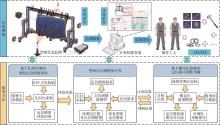
Fig.1
Overall framework for corrective adjustment of fixture
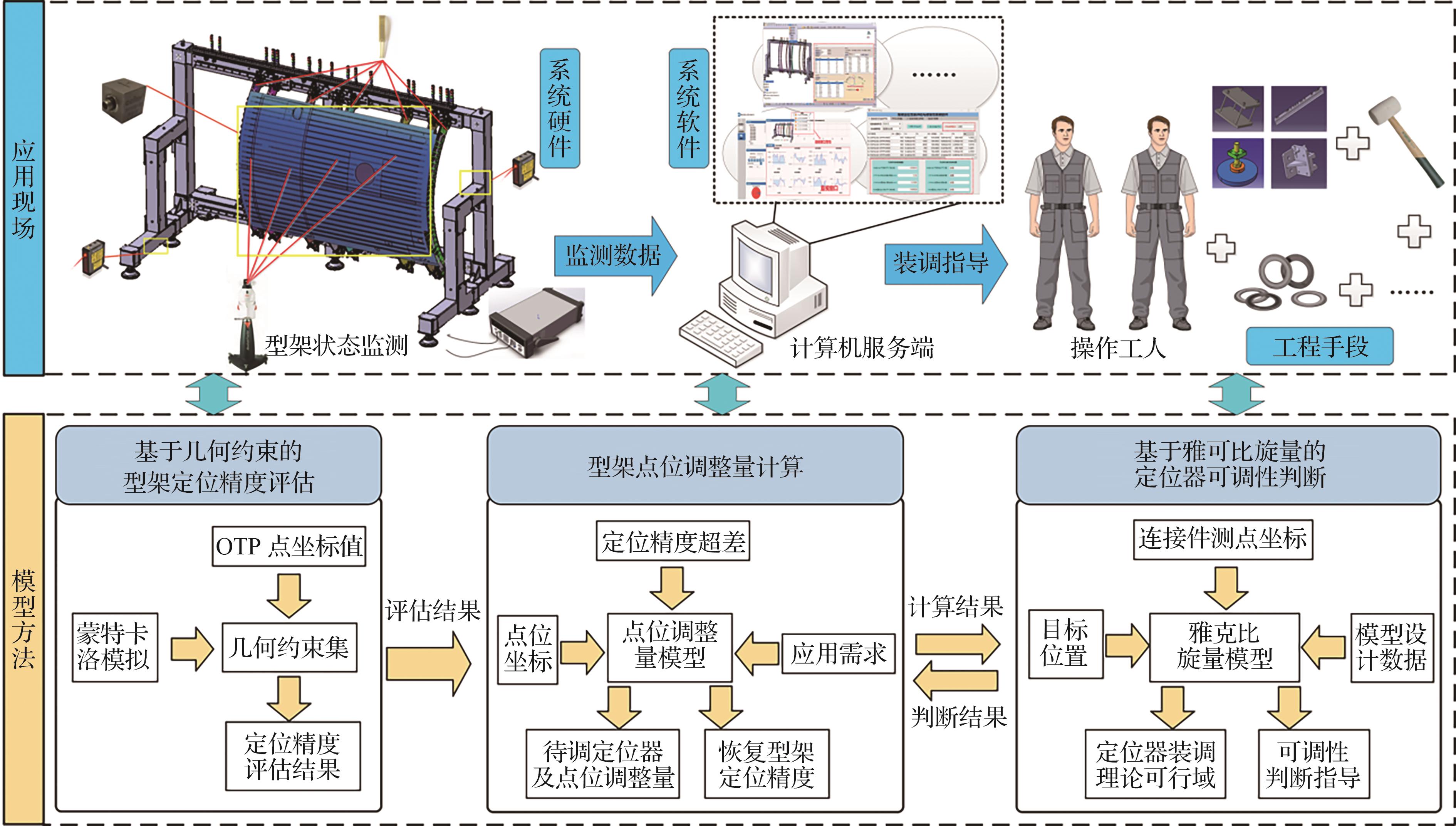
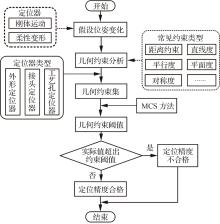
Fig.2
Evaluation process of fixture positioning accuracy based on geometric constraints
Fig.3
Geometric constraint set of fixture for ensuring positioning accuracy
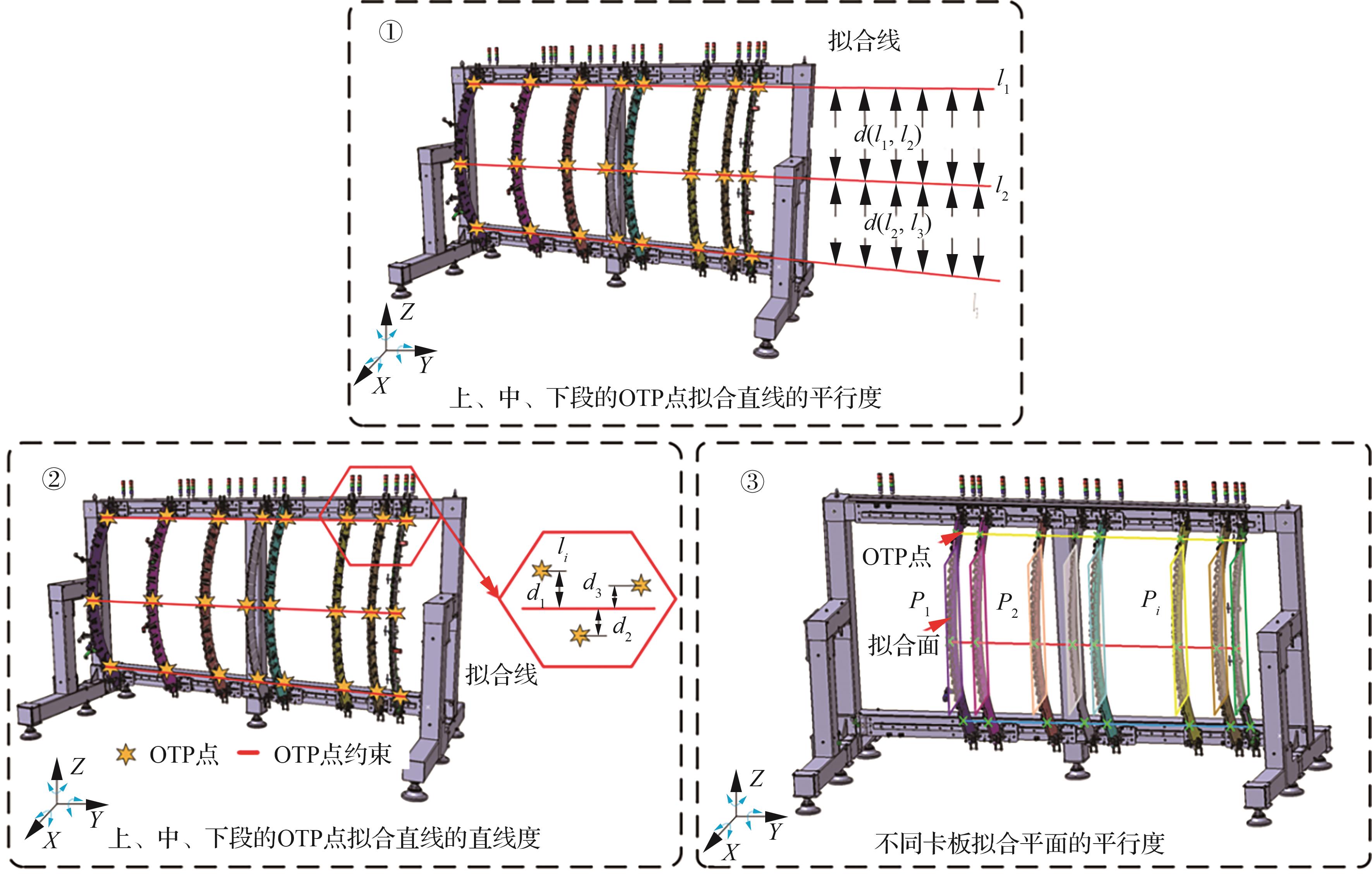

Table 1
Geometric constraints associated with different types of locators
| 定位器类型 | 定位方式 | 可能关联的几何约束 | 产品举例 |
|---|---|---|---|
| 工艺孔定位器 | 孔销配合定位 | 点点距离、直线度、平面度、对称度 | 平尾、机身框架 |
| 接头定位器 | 叉耳定位 | 点点距离、平面度 | 垂尾、机身对接 |
| 外形定位器 | 型面贴合定位 | 直线度、平行度、对称度、平面度 | 机身壁板、机翼壁板 |
Fig.4
Flow of method of minimum point displacement
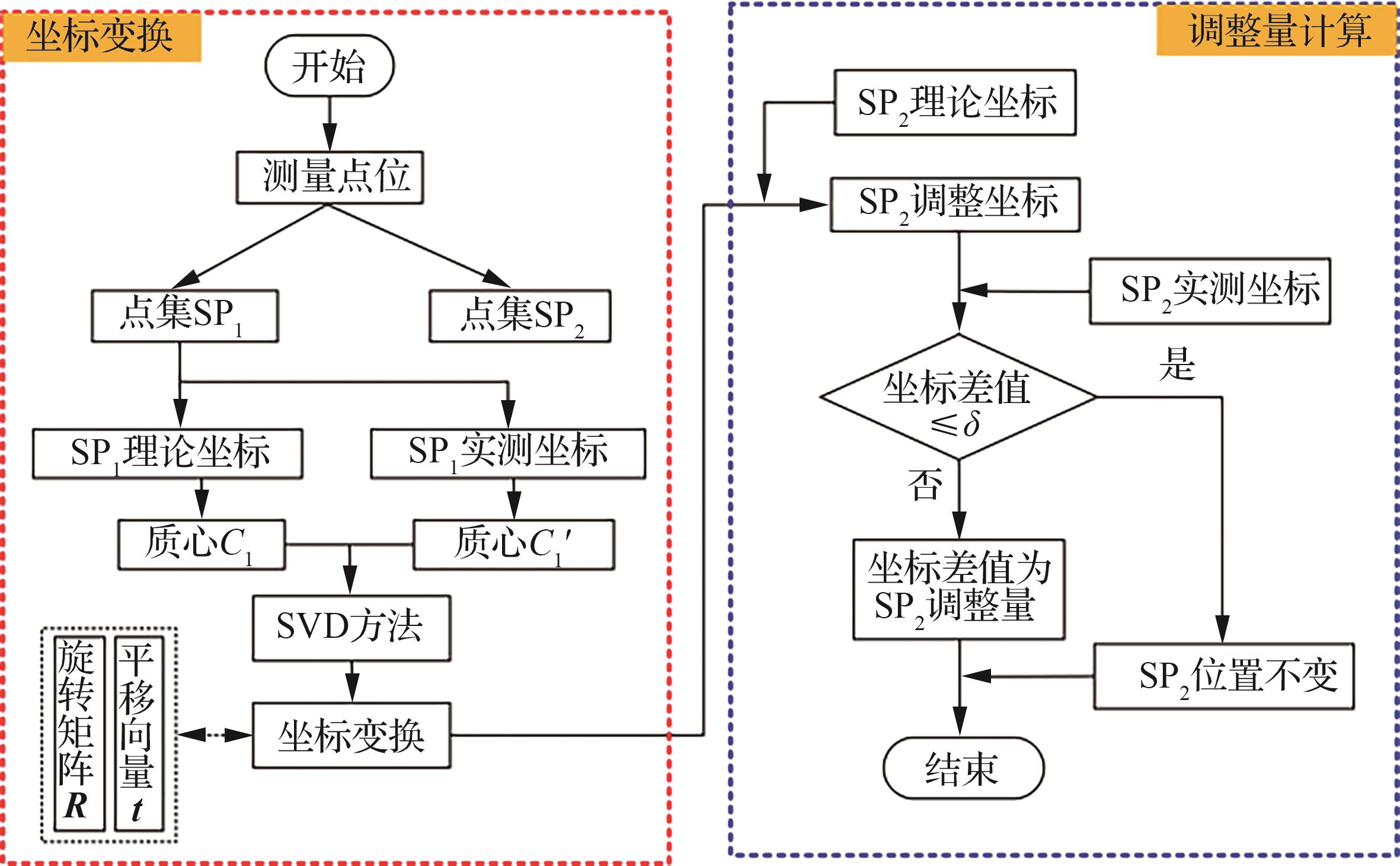
Fig.5
Schematic diagram of adjustment for key points
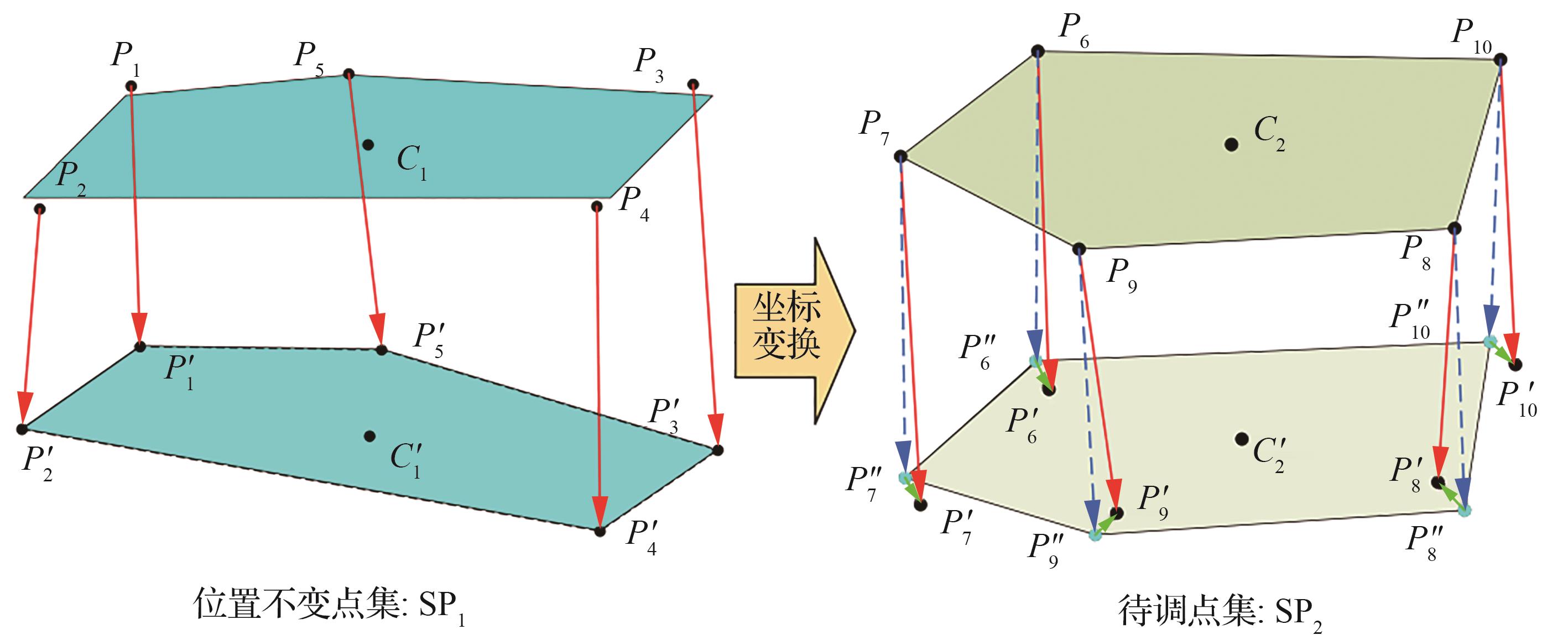
Fig.6
Minimum quantity method flowchart
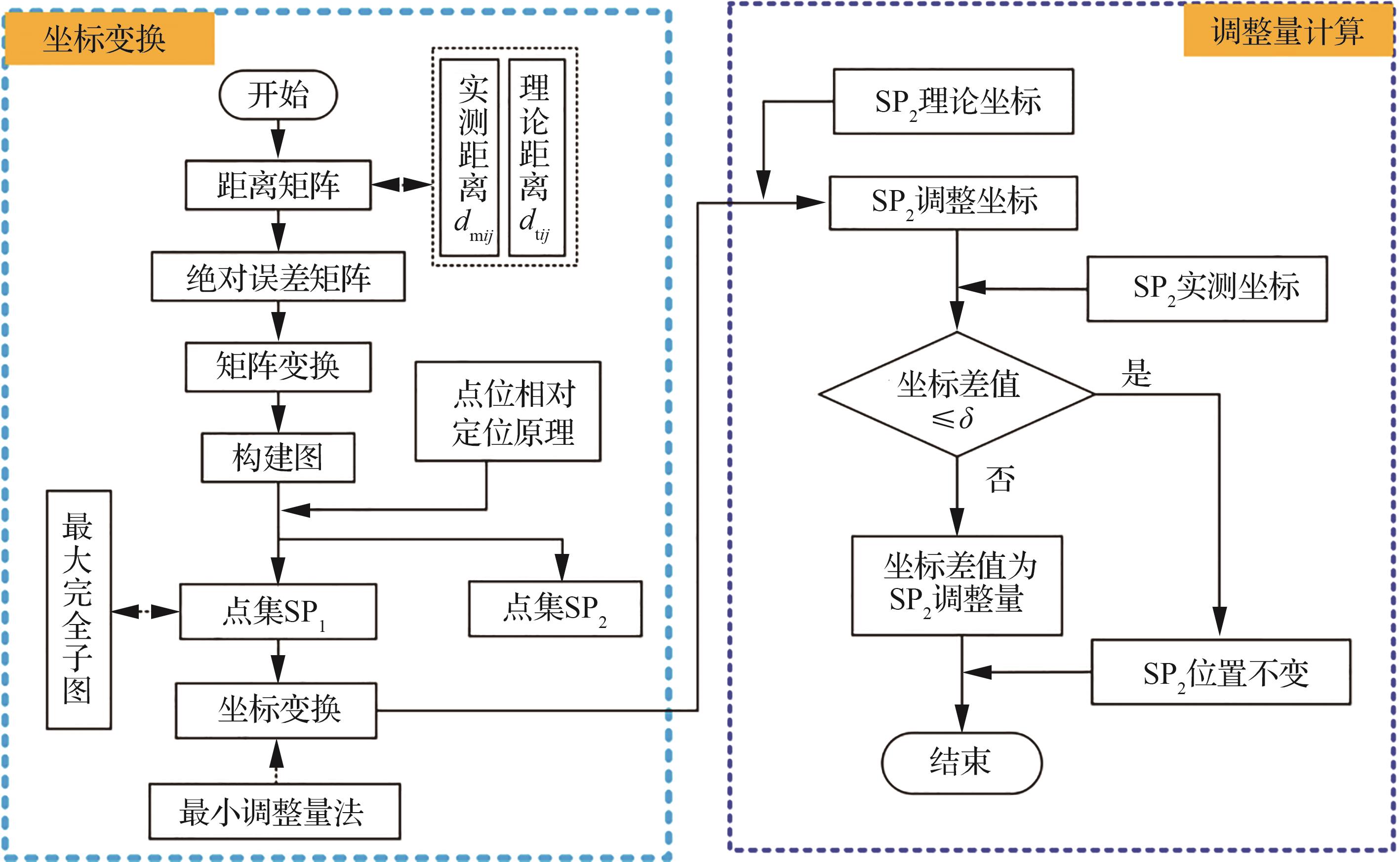
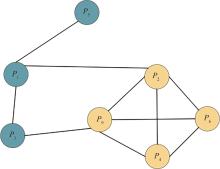
Fig.7
Schematic diagram of maximum complete subgraph
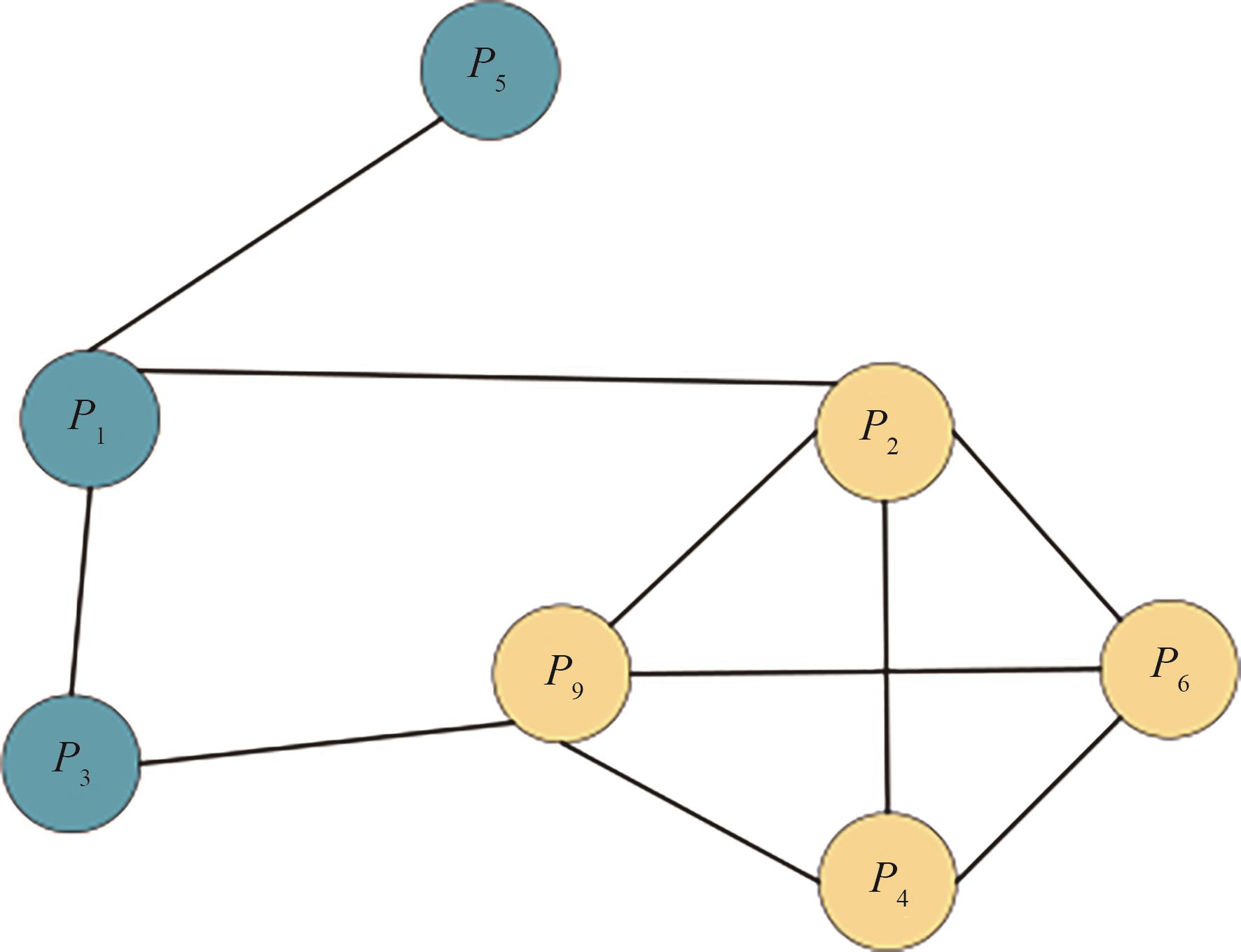
Fig.8
Principle of relative positioning of points
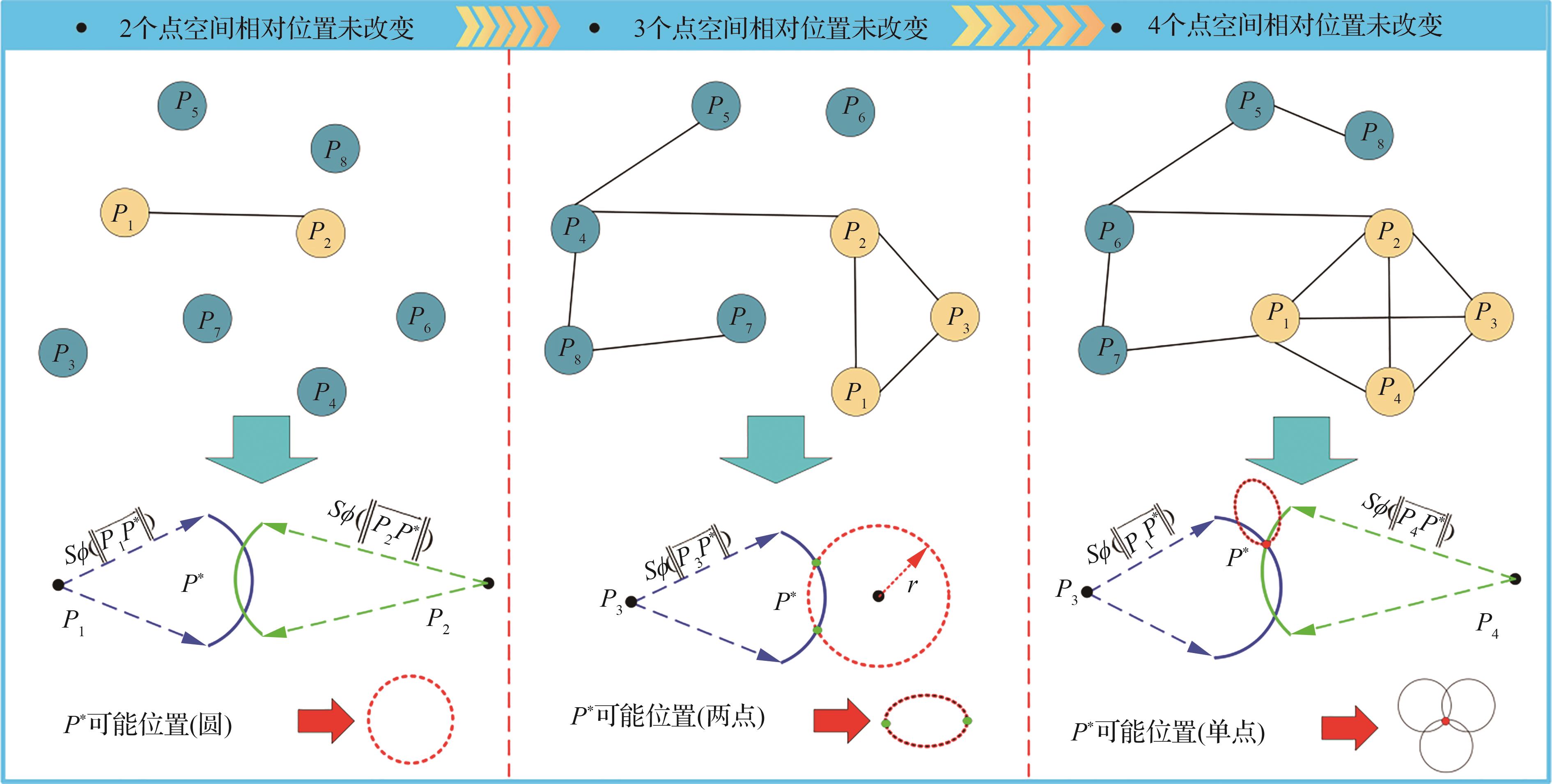
Table 2
Characteristics and application scenarios of point adjustment calculation methods
| 计算方法 | 优势 | 不足 | 应用场景 | |
|---|---|---|---|---|
| 点位绝对装调 | 计算简单 | 点位调整数量多,幅度大,要求定位器具有较高柔性 | 适用于新制造或使用时间较短的型架装调 | |
| 点位相对装调 | 最小位移法 | 调整幅度小,对定位器的柔性要求较低,易于工程实现 | 点位调整数量多,调整耗时长 | 适用于结构复杂、刚性稍差、易发生柔性变形的型架装调 |
| 最少数量法 | 关键点调整数量较少,减少调整工作量,误差引入减少 | 某些点位调整幅度可能较大,对定位器的柔性要求较高 | 适用于结构复杂、刚性较好、易发生整体刚性位移的型架装调 | |
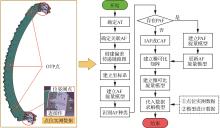
Fig.9
Analysis process of locator assembly deviation based on Jacobian Torsor model
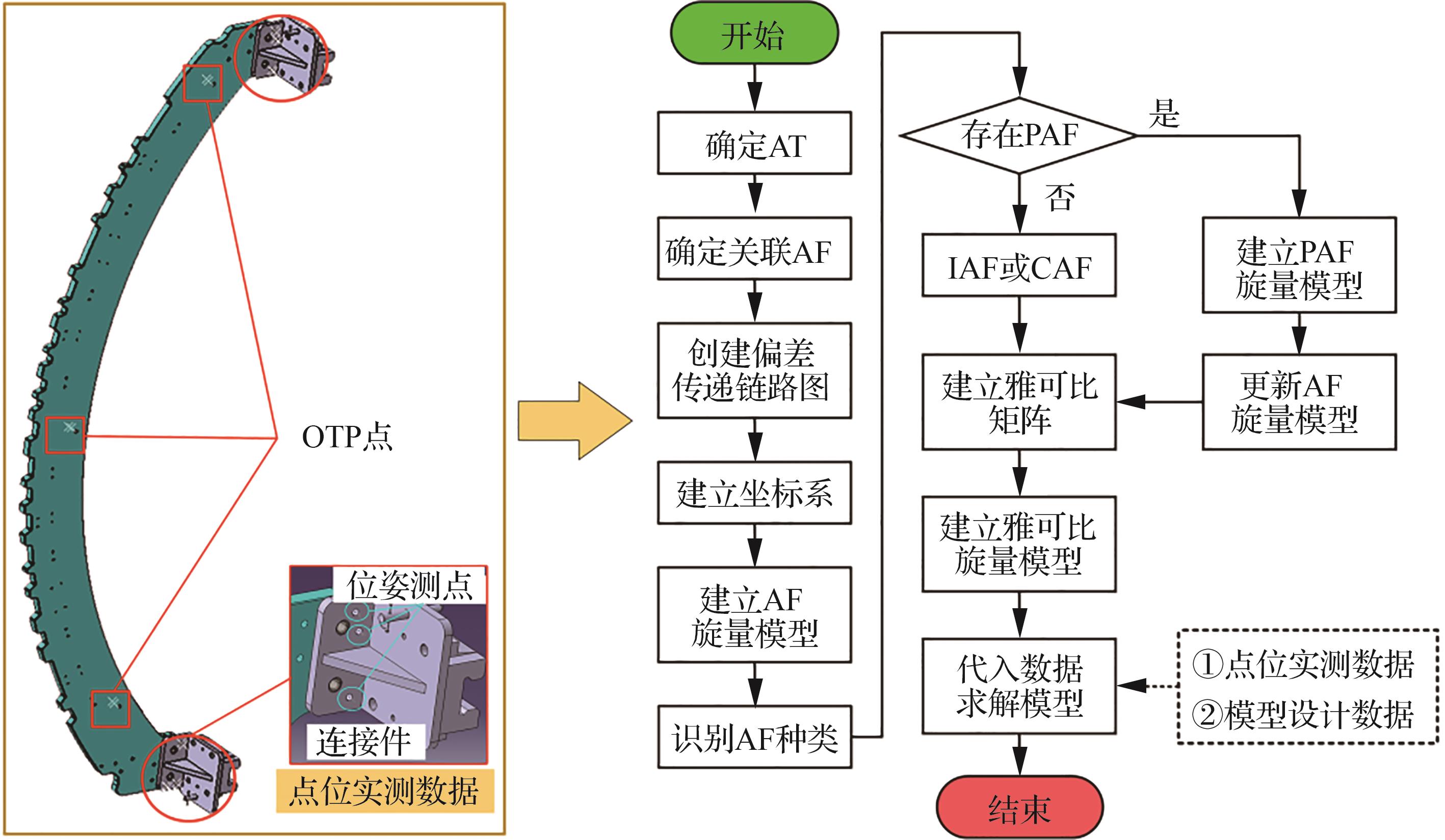
Table 3
Feature tolerances of associated parts and system establishment description
| AF/AT | 公差类型 | 公差值 | 关联零件 | 坐标系 | |
|---|---|---|---|---|---|
| 原点 | 方向 | ||||
| AT | -- | -- | 卡板 | OTP点 | 与工装坐标系一致 |
| IAF | 平面度 | ±0.05 | 卡板 | 卡板侧面 几何中心 | 与工装坐标系一致 |
| IAF | 位置度 | ±0.02 | 卡板 | OTP对应孔的几何中心 | 与工装坐标系一致 |
| PAF | 孔轴配合 | H7f7, [0, 0.021], [-0.02,-0.041] | 卡板、连接件、精制螺栓 | 卡板端部孔的几何中心 | 与连接件实际位姿关联 |
| 尺寸公差 | ±0.1 | 卡板 | 同上 | ||
| 垂直度 | ±0.015 | 连接件 | 连接件侧面的孔中心 | ||
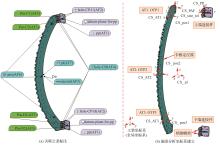
Fig.10
Tolerance marking and coordinate system establishment for deviation analysis
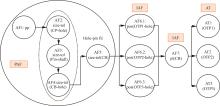
Fig.11
Transmission chain of locator assembly deviation
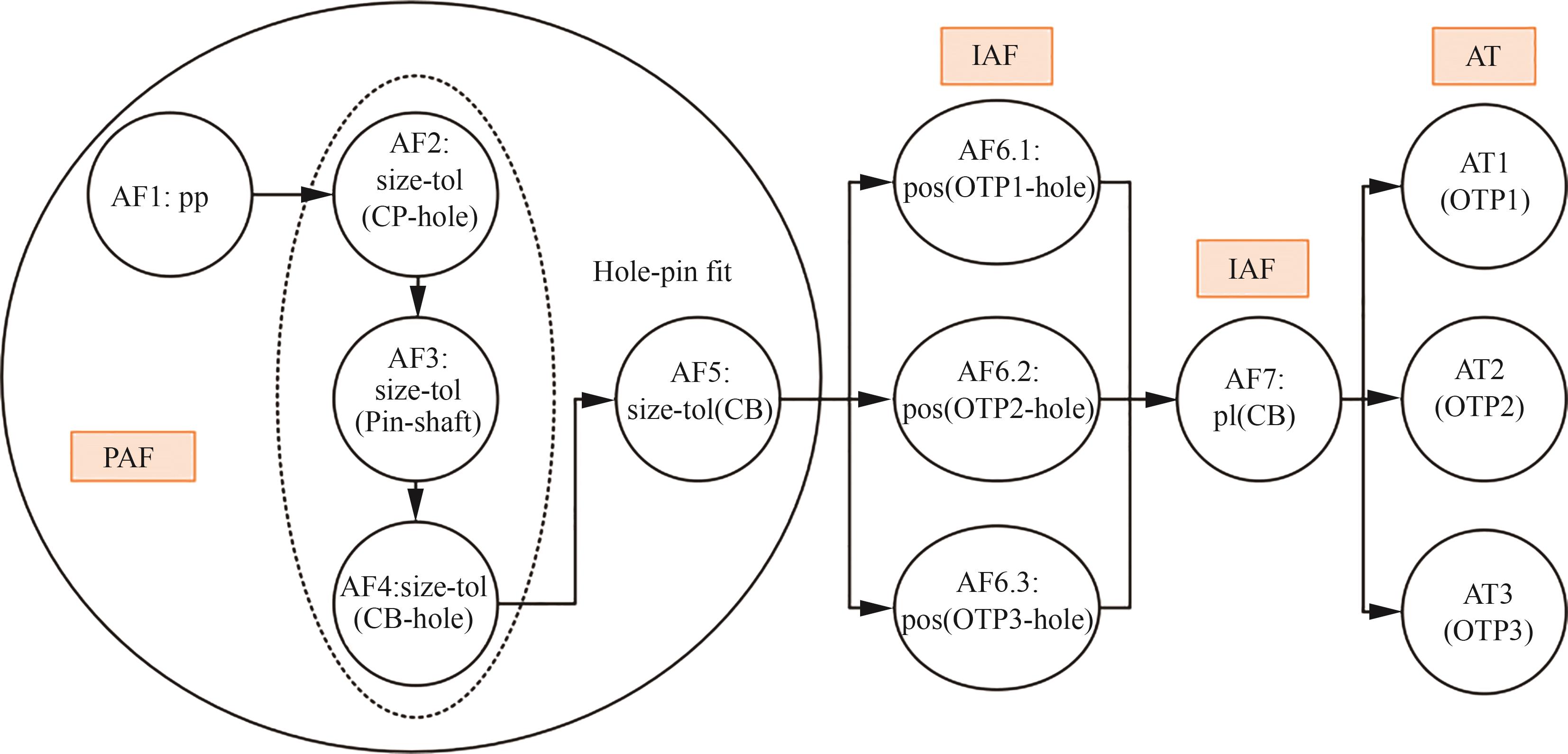
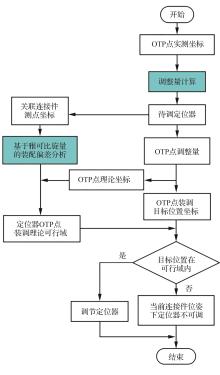
Fig.12
Auxiliary judgment process for locator adjustability
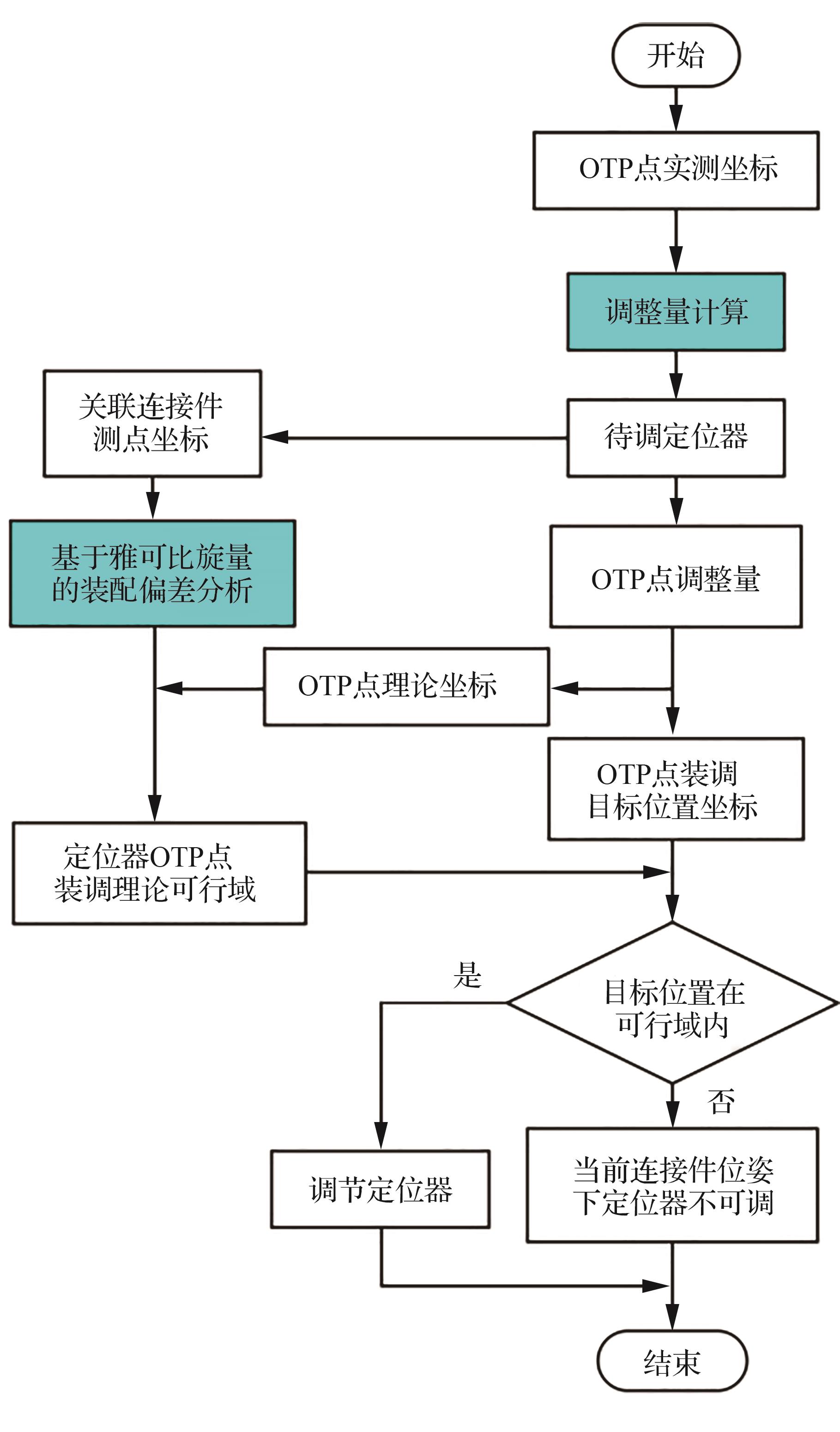
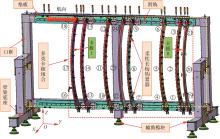
Fig.13
Reconfigurable assembly fixture for aircraft panels[34]
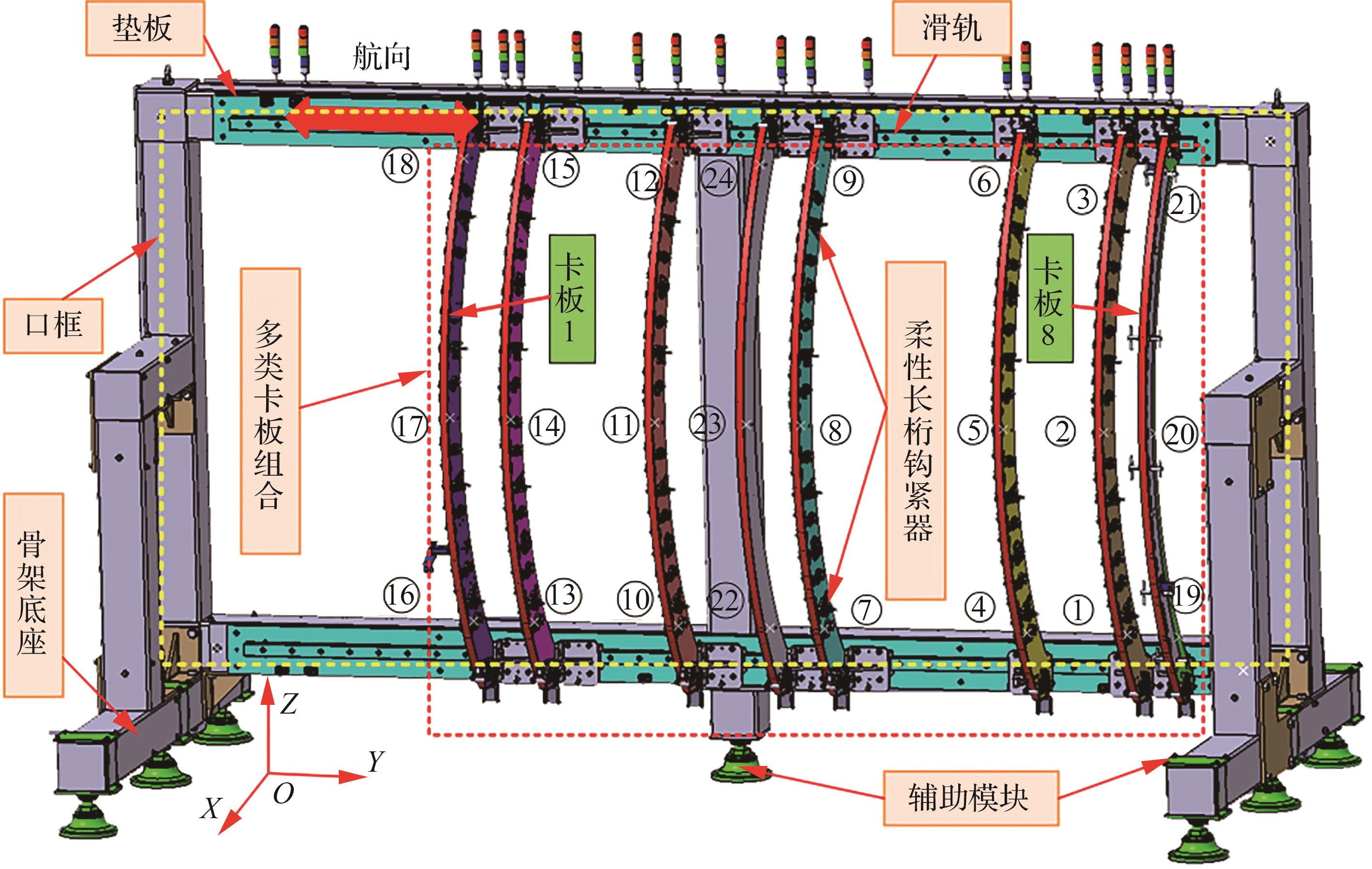
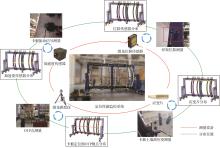
Fig.14
Monitoring scheme for positioning accuracy of reconfigurable assembly fixture
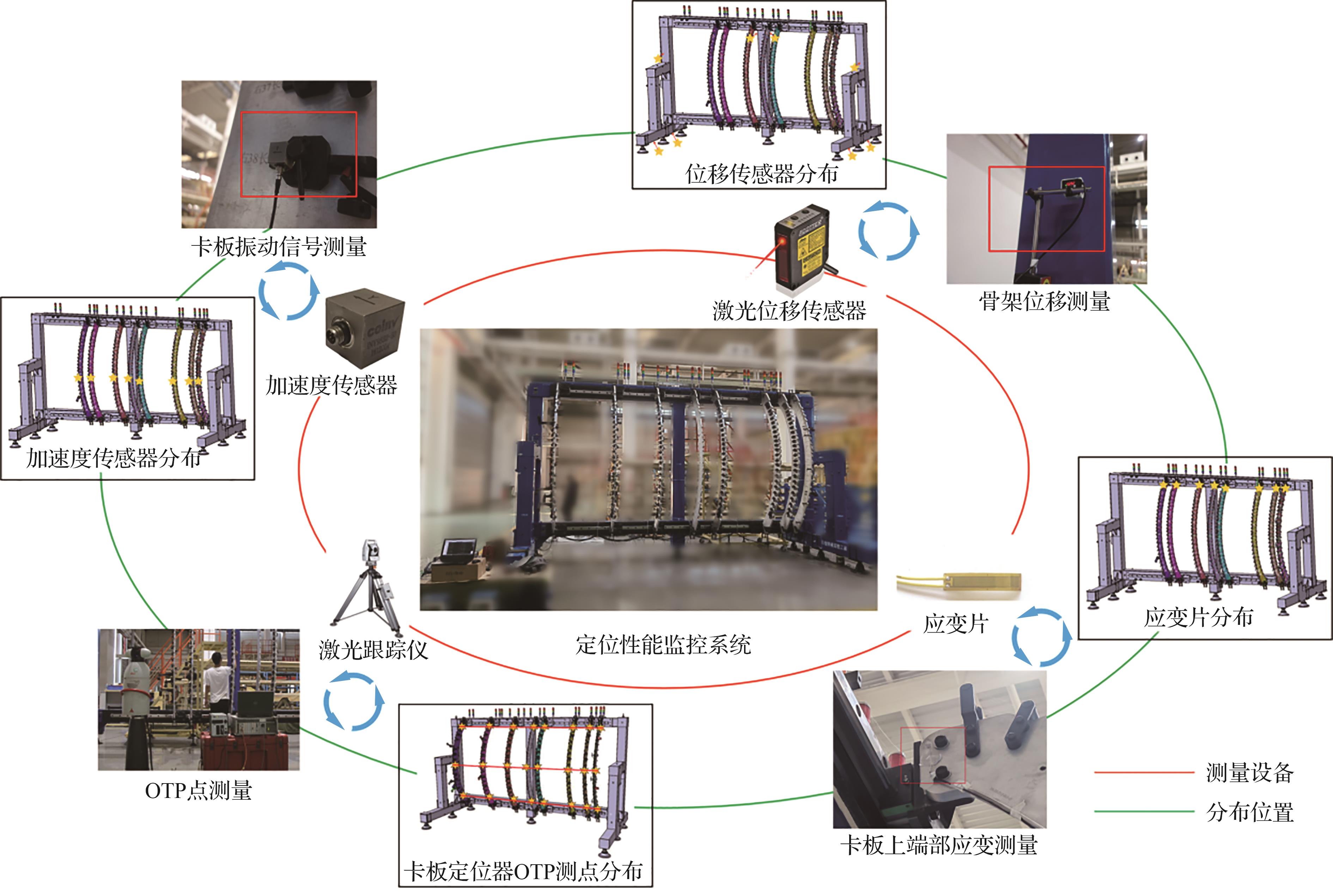
Fig.15
Corrective adjustment system for assembly fixture
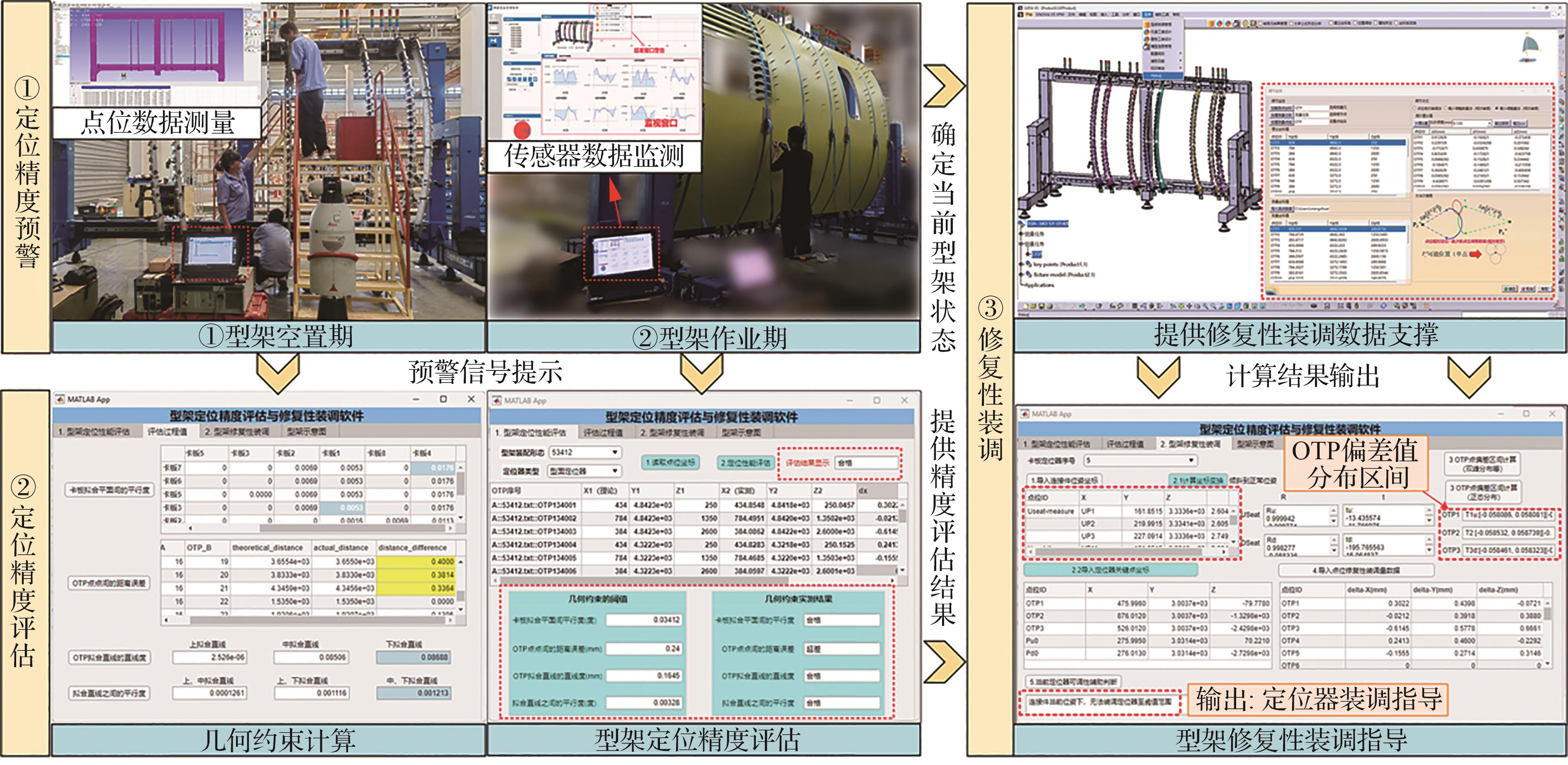
Table 4
Excerpts of measured data of OTP points (Measurement time: December 12, 2023)
OTP 序号 | 理论数据/mm | 实测数据/mm | Delta/mm | 长度/mm | ||||||
|---|---|---|---|---|---|---|---|---|---|---|
| x1 | y1 | z1 | x2 | y2 | z2 | Δx | Δy | Δz | D | |
| 1 | 434.000 0 | 4 842.300 0 | 250.000 0 | 433.984 2 | 4 842.246 0 | 249.945 3 | -0.015 8 | -0.054 0 | -0.054 7 | 0.078 5 |
| 2 | 784.000 0 | 4 842.300 0 | 1 350.000 0 | 784.049 7 | 4 842.176 0 | 1 350.073 | 0.049 7 | -0.124 5 | 0.073 1 | 0.152 7 |
| -- | -- | -- | -- | -- | -- | -- | -- | -- | -- | -- |
| 6 | 384.000 0 | 4 322.300 0 | 2 600.000 0 | 384.059 7 | 4 322.249 0 | 2 600.136 0 | 0.059 7 | -0.051 5 | 0.136 0 | 0.157 2 |
| 7 | 434.000 0 | 3 272.300 0 | 250.000 0 | 433.912 3 | 3 272.300 0 | 249.928 0 | -0.087 7 | -0.000 3 | -0.072 0 | 0.113 5 |
| 8 | 784.000 0 | 3 272.300 0 | 1 350.000 0 | 784.089 2 | 3 272.221 0 | 1 349.962 0 | 0.089 2 | -0.079 2 | -0.038 0 | 0.125 2 |
| 9 | 384.000 0 | 3 272.300 0 | 2 600.000 0 | 384.068 0 | 3 272.299 0 | 2 600.092 0 | 0.068 0 | -0.000 9 | 0.092 1 | 0.114 5 |
| 10 | 434.000 0 | 2 512.300 0 | 250.000 0 | 433.979 3 | 2 512.341 0 | 249.937 5 | -0.020 7 | 0.041 2 | -0.062 5 | 0.077 7 |
| 11 | 784.000 0 | 2 512.300 0 | 1 350.000 0 | 783.969 3 | 2 512.183 0 | 1 349.907 0 | -0.030 7 | -0.117 5 | -0.092 6 | 0.152 7 |
| 12 | 384.000 0 | 2 512.300 0 | 2 600.000 0 | 383.904 9 | 2 512.354 0 | 2 600.060 0 | -0.095 1 | 0.054 4 | 0.060 3 | 0.125 0 |
| -- | -- | -- | -- | -- | -- | -- | -- | -- | -- | -- |
| 23 | 784.000 0 | 2 987.300 0 | 1 350.000 0 | 783.942 6 | 2 987.243 0 | 1 349.905 0 | -0.057 4 | -0.057 3 | -0.095 1 | 0.125 0 |
| 24 | 384.000 0 | 2 987.300 0 | 2 600.000 0 | 384.062 8 | 2 987.260 0 | 2 600.080 0 | 0.062 8 | -0.040 3 | 0.079 7 | 0.109 2 |
Table 5
Process values of the first positioning accuracy evaluation
| 序号 | 几何约束项 | 单位 | 约束阈值 | 约束实际值的最大值 | 评估结果 |
|---|---|---|---|---|---|
| 1 | 卡板拟合平面间平行度 | 度 | 0.034 1 | 0.027 5 | 合格 |
| 2 | OTP拟合直线的直线度 | mm | 0.164 5 | 0.106 9 | 合格 |
| 3 | 拟合直线间的平行度 | 度 | 0.003 3 | 0.002 5 | 合格 |
Table 6
Excerpts of MEASURED DAta of OTP points (Measurement time: November 18, 2024)
OTP 序号 | 理论数据/mm | 实测数据/mm | Delta/mm | 长度/mm | ||||||
|---|---|---|---|---|---|---|---|---|---|---|
| x1 | y1 | z1 | x2 | y2 | z2 | Δx | Δy | Δz | D | |
| 1 | 434.000 0 | 4 842.300 0 | 250.000 0 | 435.157 0 | 4 842.202 8 | 249.973 6 | 1.157 0 | -0.097 2 | 0.343 1 | 1.210 7 |
| 2 | 784.000 0 | 4 842.300 0 | 1 350.000 0 | 784.473 9 | 4 842.363 0 | 1 350.548 1 | 0.473 9 | 0.063 0 | 0.633 3 | 0.793 5 |
| -- | -- | -- | -- | -- | -- | -- | -- | -- | -- | -- |
| 23 | 784.000 0 | 2 987.300 0 | 1 350.000 0 | 784.370 5 | 2 987.085 8 | 1 350.634 5 | 0.070 5 | -0.214 2 | 0.579 5 | 0.621 8 |
| 24 | 384.000 0 | 2 987.300 0 | 2 600.000 0 | 383.800 9 | 2 987.213 6 | 2 601.055 9 | -0.199 1 | -0.086 4 | 0.419 2 | 0.472 1 |
Table 7
Process values of the second positioning accuracy evaluation
| 序号 | 几何约束项 | 单位 | 约束阈值 | 约束实际值的最大值 | 评估结果 |
|---|---|---|---|---|---|
| 1 | 卡板拟合平面间平行度 | 度 | 0.034 1 | 0.252 9 | 超差 |
| 2 | OTP拟合直线的直线度 | mm | 0.164 5 | 0.608 6 | 超差 |
| 3 | 拟合直线间的平行度 | 度 | 0.003 3 | 0.023 9 | 超差 |
Table 8
Excerpts of position adjustment data for OTP Points
OTP 序号 | 实测坐标/mm | 目标位置坐标/mm | |||||||
|---|---|---|---|---|---|---|---|---|---|
| x1 | y1 | z1 | x2 | y2 | z2 | Δx | Δy | Δz | |
| 1 | 435.157 0 | 4 842.202 8 | 249.973 6 | 434.854 8 | 4 841.763 0 | 250.045 7 | 0.302 2 | 0.439 8 | -0.072 1 |
| 2 | 784.473 9 | 4 842.363 0 | 1 350.548 1 | 784.495 1 | 4 841.971 2 | 1 350.160 1 | -0.021 2 | 0.391 8 | 0.388 0 |
| -- | -- | -- | -- | -- | -- | -- | -- | -- | -- |
| 6 | 384.059 7 | 4 322.248 5 | 2 600.136 0 | 384.059 7 | 4 322.248 5 | 2 600.136 0 | 0.000 0 | 0.000 0 | 0.000 0 |
| -- | -- | -- | -- | -- | -- | -- | -- | -- | -- |
| 15 | 383.929 4 | 1 769.157 0 | 2 600.660 6 | 383.929 4 | 1 769.157 0 | 2 600.660 6 | 0.000 0 | 0.000 0 | 0.000 0 |
| -- | -- | -- | -- | -- | -- | -- | -- | -- | -- |
| 18 | 383.856 0 | 1 452.178 0 | 2 600.597 9 | 383.856 0 | 1 452.178 0 | 2 600.597 9 | 0.000 0 | 0.000 0 | 0.000 0 |
| -- | -- | -- | -- | -- | -- | -- | -- | -- | -- |
| 23 | 784.370 5 | 2 987.085 8 | 1 350.634 5 | 784.370 5 | 2 987.085 8 | 1 350.634 5 | 0.000 0 | 0.000 0 | 0.000 0 |
| 24 | 383.800 9 | 2 987.213 6 | 2 601.055 9 | 383.991 6 | 2 987.248 5 | 2 600.410 3 | -0.190 7 | -0.034 9 | 0.645 6 |
Table 9
Process values of the third positioning accuracy evaluation
| 序号 | 几何约束项 | 单位 | 约束阈值 | 约束实际 最值 | 评估结果 |
|---|---|---|---|---|---|
| 1 | 卡板拟合平面间 平行度 | 度 | 0.034 1 | 0.017 6 | 合格 |
| 2 | OTP拟合直线的 直线度 | mm | 0.164 5 | 0.086 9 | 合格 |
| 3 | 拟合直线间的 平行度 | 度 | 0.003 3 | 0.0012 | 合格 |
Fig.16
Annotation of dimensional parameters
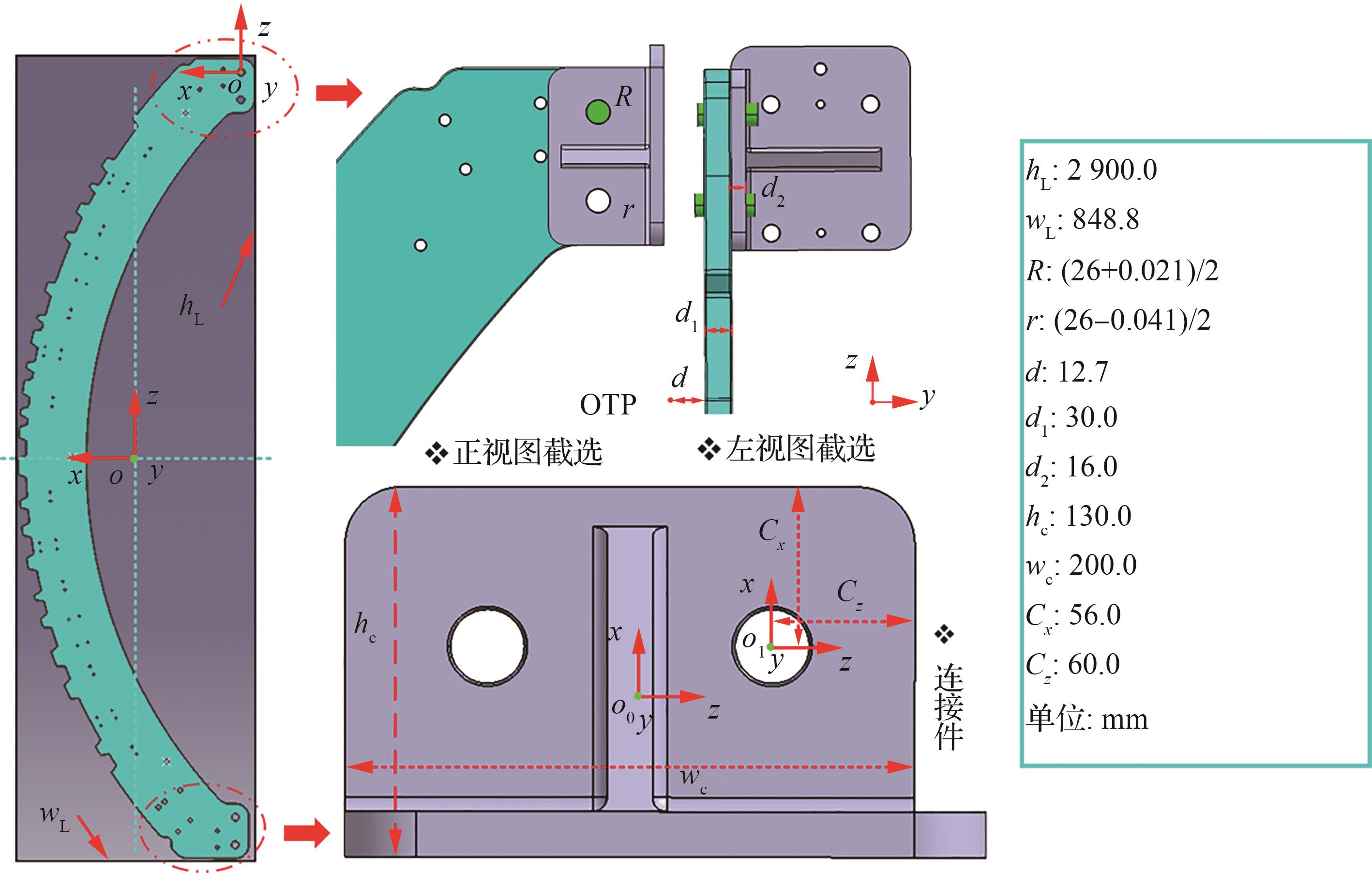
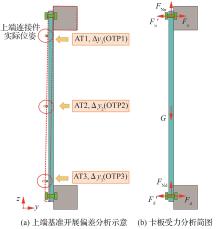
Fig.17
Illustrative diagram of contour board deviation analysis
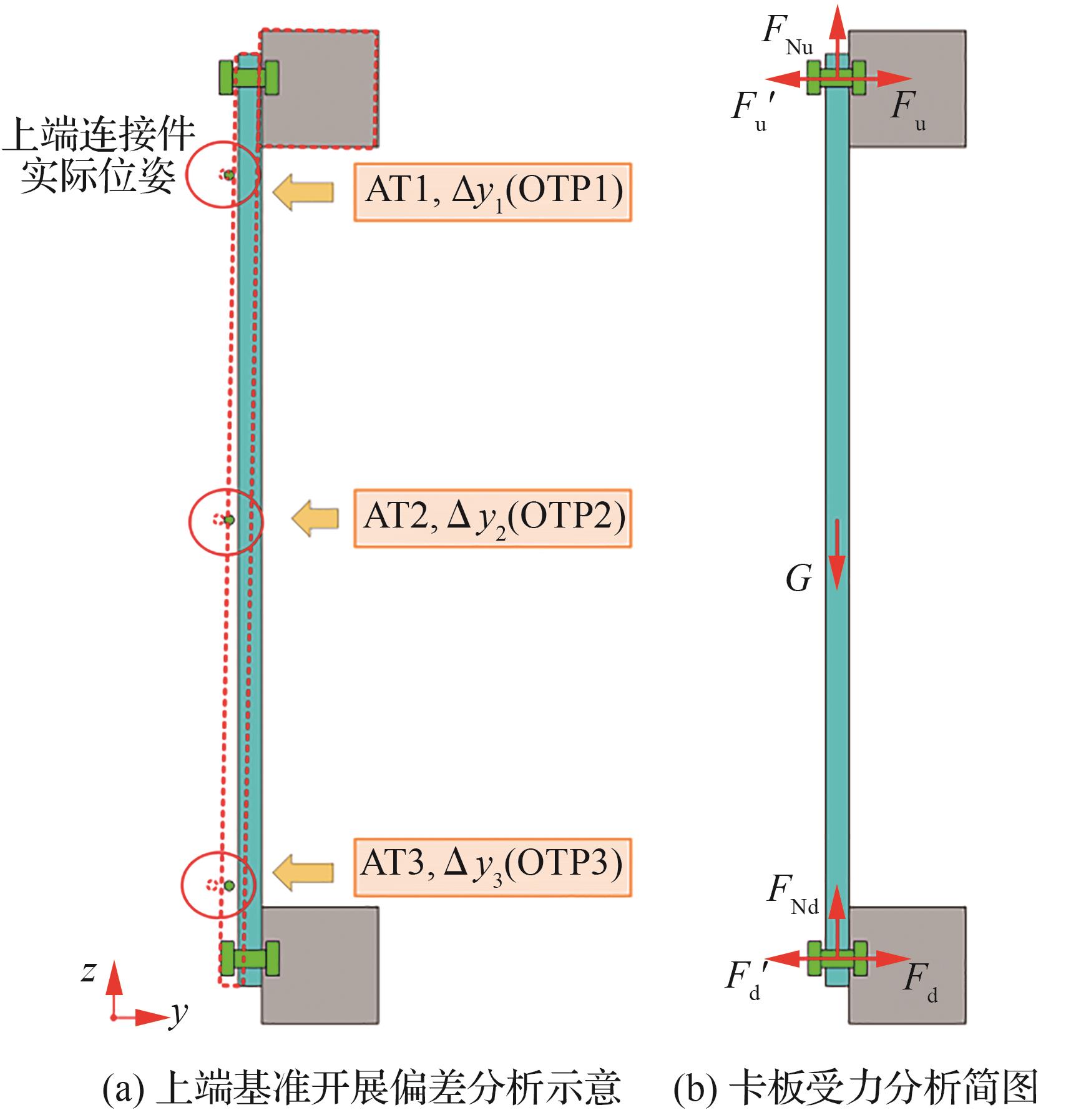
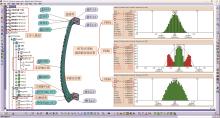
Fig.18
Simulation modeling of locator assembly deviation
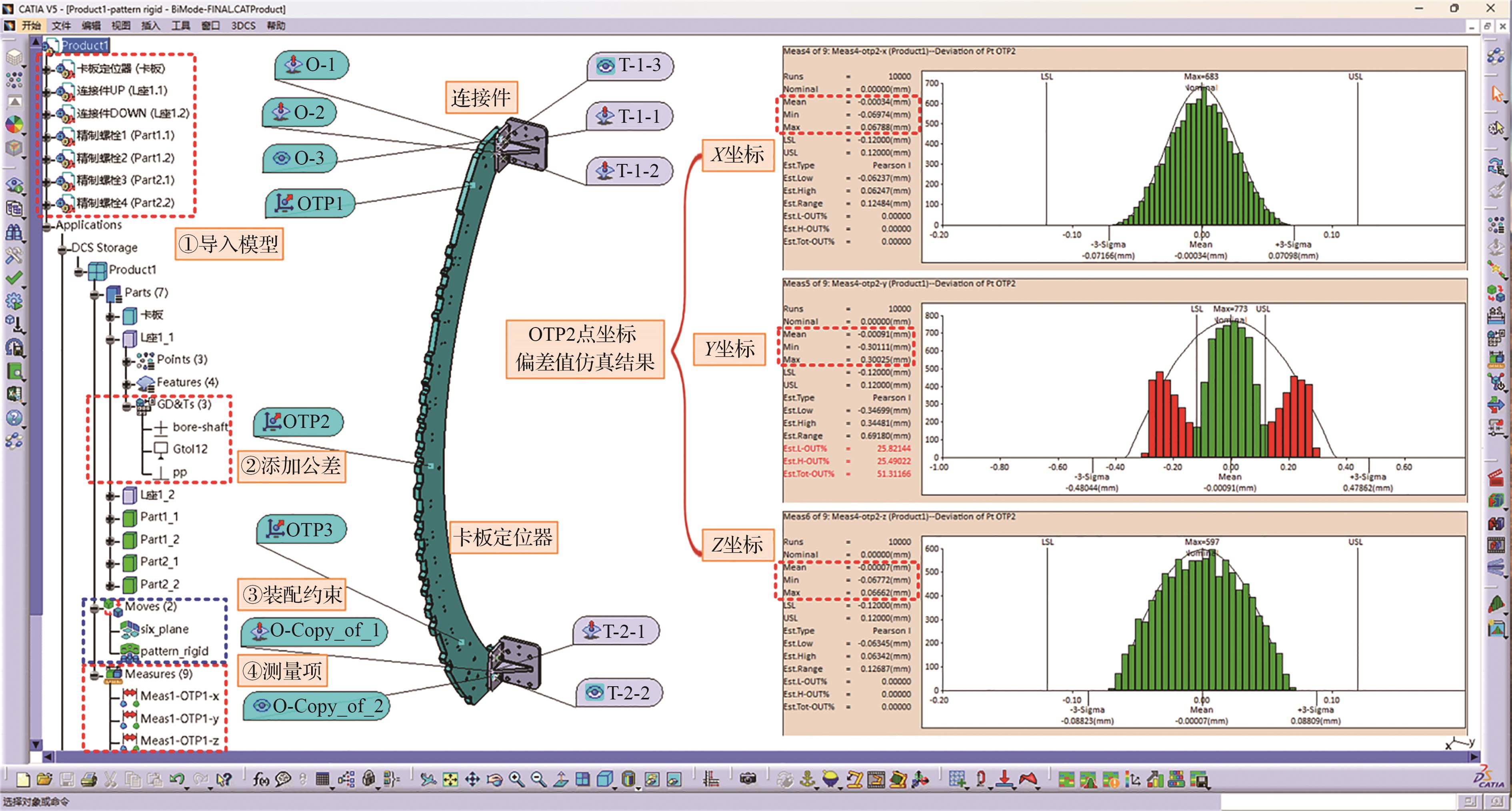
Table 10
Statistical value results of OTP points deviations
| AT对象 | 测量项 | 最小值/mm | 最大值/mm | ||||
|---|---|---|---|---|---|---|---|
| OTP1 | Δx | -0.070 0 | -0.066 8 | 4.51 | 0.069 0 | 0.066 8 | 3.22 |
| Δy | -0.187 1 | -0.192 1 | 2.65 | 0.186 4 | 0.192 1 | 3.03 | |
| Δz | -0.061 9 | -0.065 3 | 5.38 | 0.061 6 | 0.065 3 | 5.88 | |
| OTP2 | Δx | -0.069 7 | -0.066 8 | 4.19 | 0.067 9 | 0.066 8 | 1.57 |
| Δy | -0.301 1 | -0.307 3 | 2.05 | 0.300 3 | 0.307 3 | 2.35 | |
| Δz | -0.067 7 | -0.065 3 | 3.63 | 0.066 6 | 0.065 3 | 2.04 | |
| OTP3 | Δx | -0.069 5 | -0.066 8 | 3.86 | 0.068 1 | 0.066 8 | 1.93 |
| Δy | -0.199 0 | -0.208 3 | 4.71 | 0.198 2 | 0.208 3 | 5.12 | |
| Δz | -0.062 4 | -0.065 3 | 4.59 | 0.062 1 | 0.065 3 | 5.03 | |
Table 11
Coordinate deviations of OTP Points
| AT对象 | 测量项 | 区间成员判断 | ||||
|---|---|---|---|---|---|---|
| 最小值 | 最大值 | |||||
| OTP1 | Δx | -0.058 1 | 0.058 1 | -0.190 0 | 0.006 1 | 属于 |
| Δy | -0.139 8 | 0.141 2 | 0.107 8 | -0.051 5 | 属于 | |
| Δz | -0.056 1 | 0.056 5 | 0.502 7 | -0.150 4 | 不属于 | |
| OTP2 | Δx | -0.058 5 | 0.058 7 | -0.112 2 | 0.115 0 | 不属于 |
| Δy | -0.188 1 | 0.188 9 | 0.207 6 | -0.328 7 | 不属于 | |
| Δz | -0.056 6 | 0.056 4 | 0.018 3 | 0.580 3 | 不属于 | |
| OTP3 | Δx | -0.058 5 | 0.058 3 | -0.167 9 | 0.774 7 | 不属于 |
| Δy | -0.143 0 | 0.142 4 | 0.386 2 | -0.536 9 | 不属于 | |
| Δz | -0.056 4 | 0.056 7 | -0.421 7 | 0.820 3 | 不属于 | |
Table 12
Recorded time of methods
| 序号 | 技能水平 | 传统方法 | 所提方法 | 效率提升 |
|---|---|---|---|---|
| 平均用时 | 5 400 | 3 600 | 33.33% | |
| 1 | 熟练 | 4 620 | 3 480 | 24.68% |
| 2 | 非熟练 | 6 180 | 3 720 | 39.81% |
| [1] | 张宏博, 郑联语, 王艺玮. 基于模块服役状态的盒式连接可重构型架稳定性评估方法[J]. 航空学报, 2021, 42(9): 424180. |
| ZHANG H B, ZHENG L Y, WANG Y W. Stability evaluation method for box-joint reconfigurable jig based on module service state[J]. Acta Aeronautica et Astronautica Sinica, 2021, 42(9): 424180 (in Chinese). | |
| [2] | 何胜强. 大型飞机数字化装配技术与装备[M]. 北京: 航空工业出版社, 2013: 17-34. |
| HE S Q. Digital assembly technology and equipment for large aircraft[M]. Beijing: Aviation Industry Press, 2013: 17-34 (in Chinese). | |
| [3] | 刘振宇, 喻明让, 陈云, 等. 基于分层误差补偿的飞机柔性工装定位精度提高方法[J]. 机械设计与制造工程, 2023, 52(8): 77-81. |
| LIU Z Y, YU M R, CHEN Y, et al. A method for improving the positioning accuracy of aircraft flexible tooling based on layering error compensation[J]. Machine Design and Manufacturing Engineering, 2023, 52(8): 77-81 (in Chinese). | |
| [4] | 巴晓甫, 薛红前, 李西宁. 随位串联三坐标定位器定位精度建模与试验[J]. 航空学报, 2023, 44(19): 428469. |
| BA X F, XUE H Q, LI X N. Modeling and test of positioning accuracy for positioner with 3-axis randomly position connected in series[J]. Acta Aeronautica et Astronautica Sinica, 2023, 44(19): 428469 (in Chinese). | |
| [5] | 曹多明, 成英燕, 常春涛, 等. BDS不同卫星选择对相对定位精度的影响研究[J]. 测绘科学, 2022, 47(1): 15-23. |
| CAO D M, CHENG Y Y, CHANG C T, et al. Research on the influence of different BDS satellite selection on relative positioning accuracy[J]. Science of Surveying and Mapping, 2022, 47(1): 15-23 (in Chinese). | |
| [6] | 王军, 张华海. 卫星几何分布对GPS相对定位精度的影响[J]. 测绘科学, 2004, 29(2): 53-54. |
| WANG J, ZHANG H H. Effects of satellite geometric distributions on GPS relative positioning[J]. Science of Surveying and Mapping, 2004, 29(2): 53-54 (in Chinese). | |
| [7] | 梁青霄. 飞机装配工艺设计[M]. 西安: 西北工业大学出版社, 2022: 99-102. |
| LIANG Q X. Aircraft assembly process design[M]. Xi’an: Northwestern Polytechnical University Press, 2022: 99-102 (in Chinese). | |
| [8] | 吕川. 维修性设计分析与验证[M]. 北京: 国防工业出版社, 2012: 1-10. |
| LU C. Design, analysis and verification of maintainability[M]. Beijing: National Defense Industry Press, 2012: 1-10 (in Chinese). | |
| [9] | 郭飞燕, 刘检华, 肖庆东, 等. 数字化装配工装工作状态监测评估及适应性控制技术[J]. 航空学报, 2023, 44(16): 427914. |
| GUO F Y, LIU J H, XIAO Q D, et al. Monitoring and evaluation of working condition and adaptive control technology for digital assembly tooling[J]. Acta Aeronautica et Astronautica Sinica, 2023, 44(16): 427914 (in Chinese). | |
| [10] | 王巍, 陈泽宇. 基于激光跟踪仪的工装调装检测技术研究[J]. 机械工程师, 2020(3): 7-9, 13. |
| WANG W, CHEN Z Y. Research on tooling adjustment and detection technology based on laser tracker[J]. Mechanical Engineer, 2020(3): 7-9, 13 (in Chinese). | |
| [11] | MARTIN O C, MUELANER J E, WANG Z, et al. Metrology enhanced tooling for aerospace (META): A live fixturing, wing box assembly case study[C]∥7th International Conference on Digital Enterprise Technology. 2011. |
| [12] | LIANG B, LIU W, LIU K, et al. A displacement field perception method for component digital twin in aircraft assembly[J]. Sensors, 2020, 20(18): 5161. |
| [13] | JIA Z, LIANG B, LIU W, et al. 3D microdisplacement monitoring of large aircraft assembly with automated in situ calibration[J]. Engineering, 2022, 19: 105-116. |
| [14] | 刘巍, 陈启航, 梁冰, 等. 基于多源参量感知的航空工装定位器在线监测方法与系统研究[J]. 机械工程学报, 2023, 59(12): 162-172. |
| LIU W, CHEN Q H, LIANG B, et al. Research on online monitoring method and system of aircraft tooling positioner based on multi-source parametric perception[J]. Journal of Mechanical Engineering, 2023, 59(12): 162-172 (in Chinese). | |
| [15] | 李现坤, 雷沛, 曾德标, 等. 基于集成光纤传感器的工装状态监控技术研究[J]. 机床与液压, 2022, 50(20): 59-63. |
| LI X K, LEI P, ZENG D B, et al. Research on tooling status monitoring technology based on integrated optical fiber sensor[J]. Machine Tool & Hydraulics, 2022, 50(20): 59-63 (in Chinese). | |
| [16] | JIN J, HU J, LI C, et al. A digital twin system of reconfigurable tooling for monitoring and evaluating in aerospace assembly[J]. Journal of Manufacturing Systems, 2023, 68: 56-71. |
| [17] | 耿育科. 基于多场扰动的飞机装配工装目标精度机理探索[J]. 航空制造技术, 2022, 65(18): 14-22. |
| GENG Y K. Mechanism research on target accuracy of aircraft assembly tooling based on multi-factor disturbance[J]. Aeronautical Manufacturing Technology, 2022, 65(18): 14-22 (in Chinese). | |
| [18] | 余海东, 高畅, 赵勇, 等. 机械产品装配偏差分析方法研究进展与展望[J]. 机械工程学报, 2023, 59(9): 212-229. |
| YU H D, GAO C, ZHAO Y, et al. Progress and prospect on assembly deviation propagation of mechanical products[J]. Journal of Mechanical Engineering, 2023, 59(9): 212-229 (in Chinese). | |
| [19] | HAN W, DENG Q, LIN W, et al. Variation propagation modeling and analysis of automotive body outer cover panels assembly systems[J]. Assembly Automation, 2019, 39(2): 272-286. |
| [20] | LU Z Y. Assembly variation analysis of the aircraft panel in multi-stage assembly process with N-2-1 locating scheme[J]. Proceedings of the Institution of Mechanical Engineers, Part C. Journal of Mechanical Engineering Science, 2019, 233(19-20): 6754-6773. |
| [21] | LIU S C, HU S J. Variation simulation for deformable sheet metal assemblies using finite element methods[J]. Journal of Manufacturing Science & Engineering, 1997, 119(3): 368-374. |
| [22] | JANDAGHI SHAHI V, MASOUMI A. Integration of in-plane and out-of-plane dimensional variation in multi-station assembly process for automotive body assembly[J]. Proceedings of the Institution of Mechanical Engineers, Part D: Journal of Automobile Engineering, 2020, 234(6): 1690-1702. |
| [23] | 黄康, 徐锐, 陈奇. 小位移旋量和响应面法相结合的齿轮公差分析模型构建方法[J]. 西安交通大学学报, 2017, 51(9): 77-84. |
| HUANG K, XU R, CHEN Q. Gear tolerance modeling with small displacement torsor and response surface method[J]. Journal of Xi’an Jiaotong University, 2017, 51(9): 77-84 (in Chinese). | |
| [24] | CHEN H, JIN S, LI Z, et al. A solution of partial parallel connections for the unified Jacobian-Torsor model[J]. Mechanism and Machine Theory, 2015, 91: 39-49. |
| [25] | PENG Y, HAO L, HUANG X, et al. A pre-assembly analysis technology of aircraft components based on measured data[J]. Measurement Science and Technology, 2022, 33(7): 75005. |
| [26] | 陈帅, 郭飞燕, 孟月梅, 等. 融合实测数据的航空结构件修配量迭代寻优及评价方法[J]. 中国机械工程, 2022, 33(17): 2061-2070, 2078. |
| CHEN S, GUO F Y, MENG Y M, et al. Iterative optimization and evaluation method for repair quantity of aviation structural parts considering measured data[J]. China Mechanical Engineering, 2022, 33(17): 2061-2070, 2078 (in Chinese). | |
| [27] | 王鑫, 李兆宇, 王亮, 等. 基于3DCS的某型号导弹舱段装配容差分析[J]. 航天制造技术, 2020(4): 48-52, 70. |
| WANG X, LI Z Y, WANG L, et al. Tolerance analysis of missile cabin assembly based on 3DCS[J]. Aerospace Manufacturing Technology, 2020(4): 48-52, 70 (in Chinese). | |
| [28] | MENG S, ZHENG L Y, FAN W, et al. Intelligent layout optimization of reconfigurable flexible fixture for assembling multiple aircraft panels[J]. The International Journal of Advanced Manufacturing Technology, 2023, 126(3-4): 1261-1278. |
| [29] | 康永刚. 飞机装配工艺装备[M]. 西安: 西北工业大学出版社, 2024: 128-131. |
| KANG Y G. Aircraft assembly fixture[M]. Xi’an: Northwestern Polytechnical University Press, 2024: 128-131 (in Chinese). | |
| [30] | 赵西富, 崔海华, 张益华, 等. 面向投影增强现实跟踪定位器的稳定位姿估计与标定方法[J]. 航空学报, 2025, 46(8): 331072. |
| ZHAO X F, CUI H H, ZHANG Y H, et al. Stable pose estimation and calibration method for projected augmented reality tracking locator[J]. Acta Aeronautica et Astronautica Sinica, 2025 (in Chinese). | |
| [31] | 薛颂东, 李永豪, 赵红燕. 基于多粒度阅读器和图注意力网络的文档级事件抽取[J]. 计算机应用研究, 2024, 41(8): 2329-2335. |
| XUE S D, LI Y H, ZHAO H Y. Document level event extraction based on multi granularity readers and graph attention networks[J]. Application Research of Computers, 2024, 41(8): 2329-2335 (in Chinese). | |
| [32] | 孙威, 缪东晶, 李建双, 等. 多边法坐标测量系统中解算方式对测量精度的影响研究[J]. 计量学报, 2021, 42(5): 558-563. |
| SUN W, MOU D J, LI J S, et al. Study on the influence of the calculation method on the accuracy of the multilateral coordinate measurement system[J]. Acta Metrologica Sinica, 2021, 42(5): 558-563 (in Chinese). | |
| [33] | GHIE W, LAPERRIÈRE L, DESROCHERS A. Statistical tolerance analysis using the unified Jacobian-Torsor model[J]. International Journal of Production Research, 2009, 48(15): 4609-4630. |
| [34] | MENG S, FAN W, WANG X, et al. Intelligent design of reconfigurable flexible assembly fixture for aircraft panels based on smart composite jig model and knowledge graph[J]. Journal of Engineering Design, 2024, 36(5-6): 672-706. |
| [35] | 邢一新. 飞机装配几何量质量检测体系构建及关键技术[J]. 航空制造技术, 2021, 64(6): 24-31. |
| XING Y X. Research on establishment and key techniques of aircraft assembling geometric measurement system[J]. Aeronautical Manufacturing Technology, 2021, 64(6): 24-31 (in Chinese). | |
| [36] | 张宏博, 郑联语, 刘新玉, 等. 基于信息物理系统的可重构装配型架智能装调技术[J]. 计算机集成制造系统, 2019, 25(11): 2693-2709. |
| ZHANG H B, ZHENG L Y, LIU X Y, et al. Cyber-physical system based smart installing technology for reconfigurable assembly jig[J]. Computer Integrated Manufacturing Systems, 2019, 25(11): 2693-2709 (in Chinese). | |
| [37] | ZHANG X R, MENG S, WANG B B, et al. Integrated assembly, measurement, and adjustment method of reconfigurable flexible fixture for aircraft panels based on augmented reality and human-computer interaction[J]. Journal of Manufacturing Systems, 2025, 79: 117-133. |
| [1] | Wenqian PEI, Kaikai YU, Zengxu LIU, Qiyue NING, Jinglei XU. Two-stage expansion nozzle design method and numerical simulation [J]. Acta Aeronautica et Astronautica Sinica, 2025, 46(8): 631009-631009. |
| [2] | CHEN Yile, YU Kaikai, XU Jinglei. New design method for scramjet nozzles with strong geometric constraints [J]. ACTA AERONAUTICAET ASTRONAUTICA SINICA, 2021, 42(6): 124259-124259. |
| [3] | SHI Lei, YANG Guang, DING Guanghua, LIN Wenjun. Fine maintenance of an eroded fan rotor and related flow characteristics analysis [J]. ACTA AERONAUTICAET ASTRONAUTICA SINICA, 2020, 41(9): 423446-423446. |
| Viewed | ||||||
|
Full text |
|
|||||
|
Abstract |
|
|||||
Address: No.238, Baiyan Buiding, Beisihuan Zhonglu Road, Haidian District, Beijing, China
Postal code : 100083
E-mail:hkxb@buaa.edu.cn
Total visits: 6658907 Today visits: 1341All copyright © editorial office of Chinese Journal of Aeronautics
All copyright © editorial office of Chinese Journal of Aeronautics
Total visits: 6658907 Today visits: 1341

 CJA
CJA
