Acta Aeronautica et Astronautica Sinica ›› 2024, Vol. 45 ›› Issue (18): 129846.doi: 10.7527/S1000-6893.2024.29846
• Fluid Mechanics and Flight Mechanics • Previous Articles Next Articles
Wei ZHANG1,2, Xutao NIE2, Liwei OU2, Zhixun XIA1, Lei CHEN1( )
)
Received:2023-11-07
Revised:2023-12-11
Accepted:2024-02-01
Online:2024-09-25
Published:2024-02-23
Contact:
Lei CHEN
E-mail:chenl@nudt.edu.cn
Supported by:CLC Number:
Wei ZHANG, Xutao NIE, Liwei OU, Zhixun XIA, Lei CHEN. Frequency⁃weighted dynamic mode decomposition for trailing edge flapping airfoil flow[J]. Acta Aeronautica et Astronautica Sinica, 2024, 45(18): 129846.
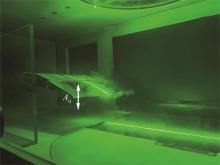
Fig.1
Morphing airfoil in wind tunnel for PIV test


Fig.2
DMD comparison region and reconstruction point M1

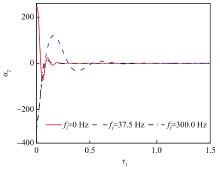
Fig.3
Comparison of 2nd modal coefficients using initial value ordering
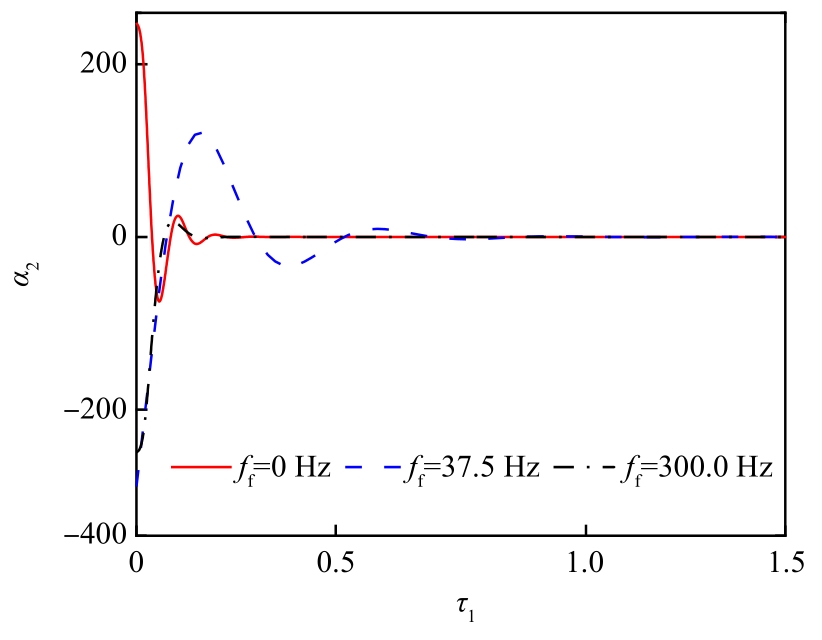
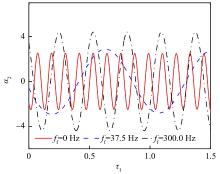
Fig.4
Comparison of 2nd modal coefficients using frequency weighted ordering
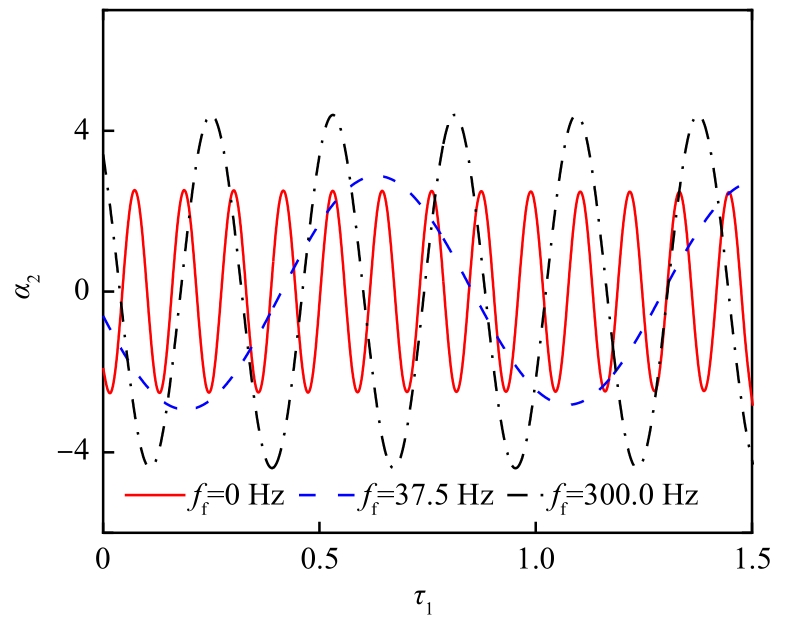

Table 1
Frequency of first ten modes (CFD, ff =37.5 Hz)
| 模态序号 | 模态频率/Hz | ||
|---|---|---|---|
| 模态范数法 | 初始值法 | 频率加权法 | |
| 2阶 | 222.2 | 222.2 | 37.0 |
| 4阶 | 172.8 | 938.3 | 395.1 |
| 6阶 | 395.1 | 395.1 | 234.6 |
| 8阶 | 37.0 | 172.8 | 49.4 |
| 10阶 | 234.6 | 234.6 | 74.1 |
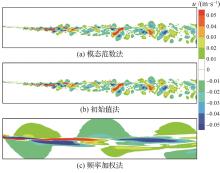
Fig.5
Comparison of 2nd modes of velocity u among different methods (CFD, ff =37.5 Hz)
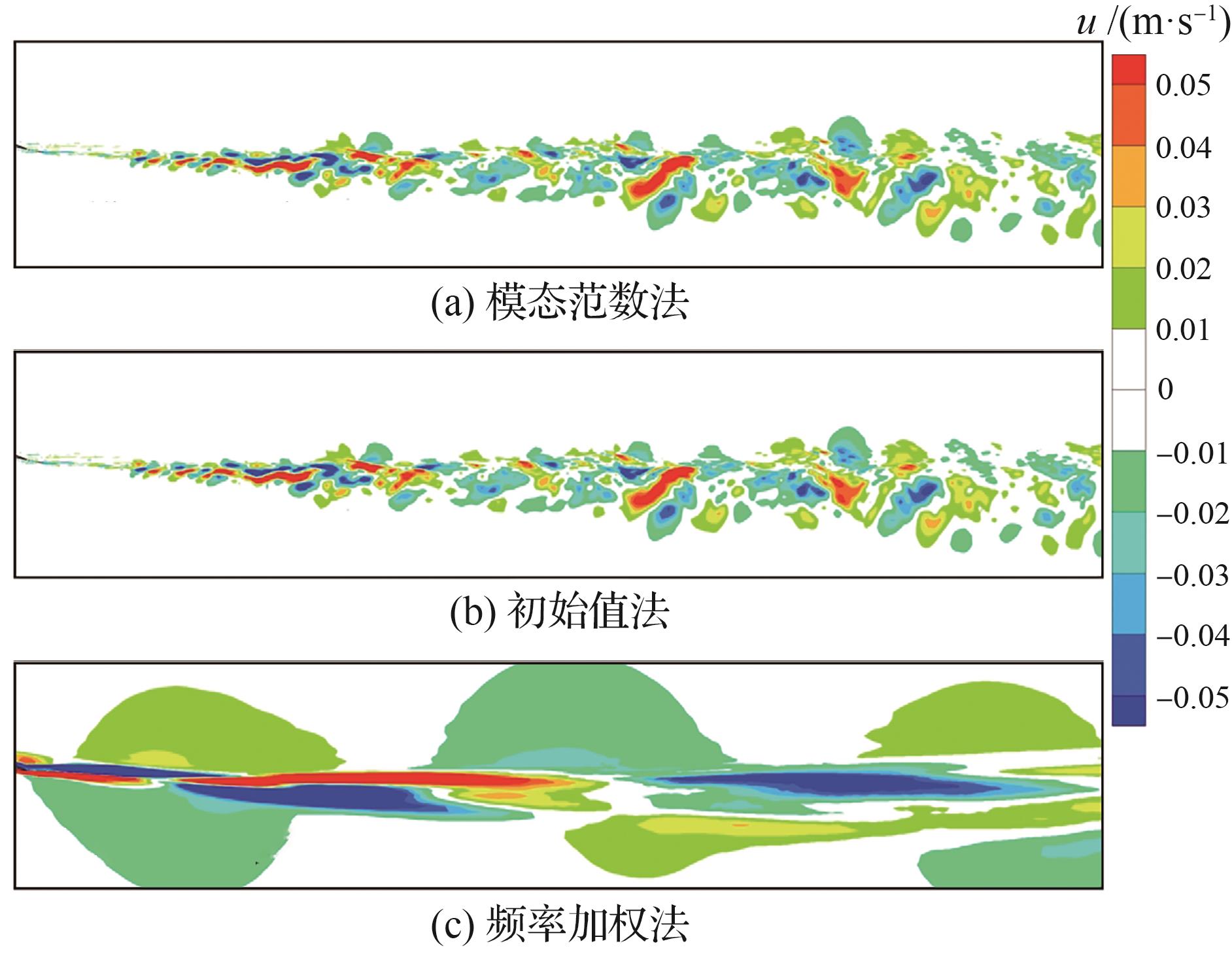
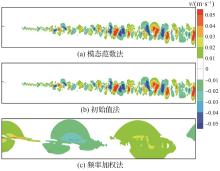
Fig.6
Comparison of 2nd modes of velocity v among different methods (CFD, ff =37.5 Hz)
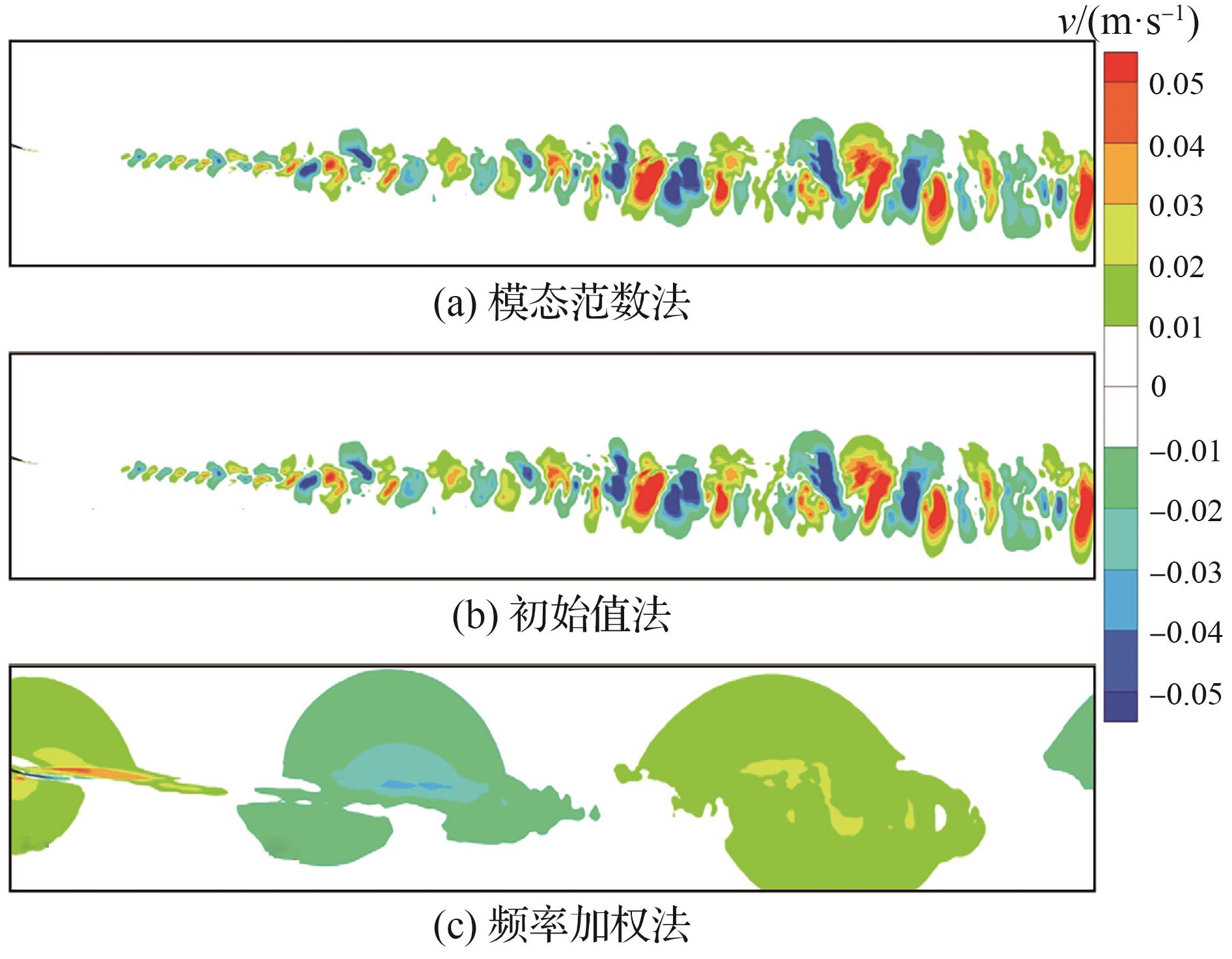
Table 2
Frequency of first ten modes (CFD, ff =300.0 Hz)
| 模态序号 | 模态频率/Hz | ||
|---|---|---|---|
| 模态范数法 | 初始值法 | 频率加权法 | |
| 2阶 | 296.3 | 345.7 | 296.3 |
| 4阶 | 345.7 | 1 395.1 | 604.9 |
| 6阶 | 604.9 | 2 481.5 | 284.0 |
| 8阶 | 1 395.1 | 2 370.4 | 308.6 |
| 10阶 | 2 493.8 | 1 395.1 | 901.2 |
Fig.7
Comparison of 2nd modes of velocity u among different methods (CFD, ff =300.0 Hz)
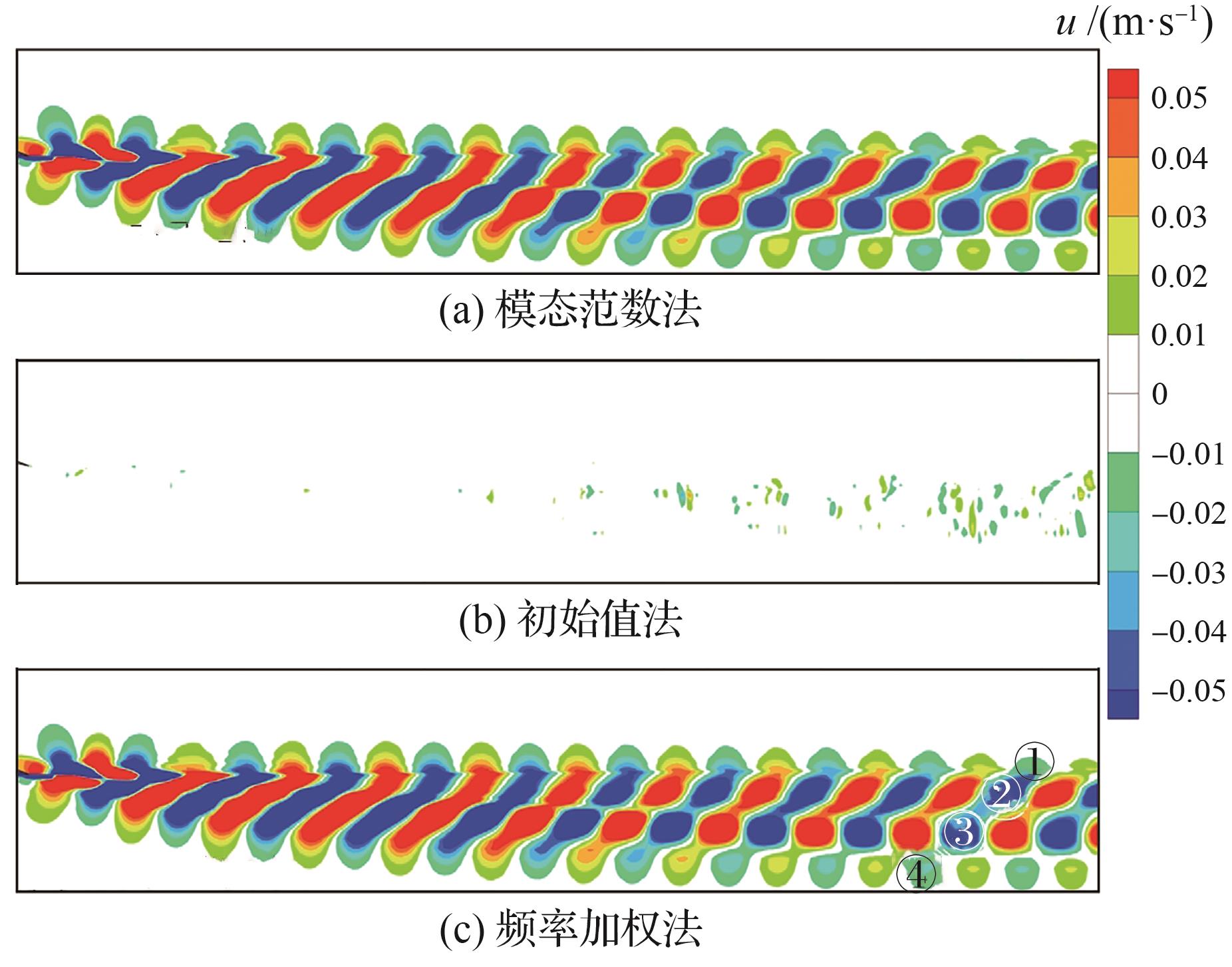
Fig.8
Comparison of 2nd modes of velocity v among different methods (CFD, ff =300.0 Hz)
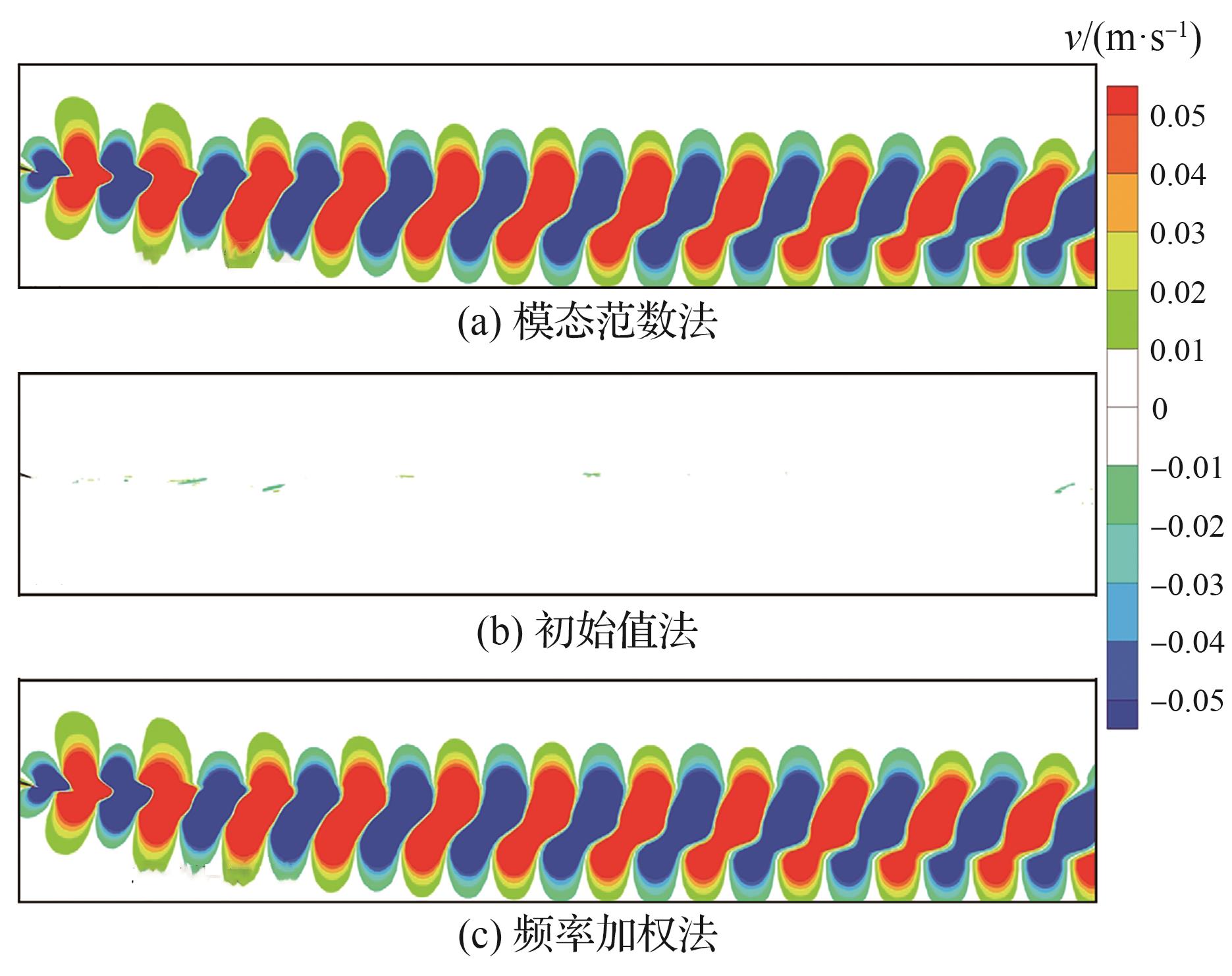
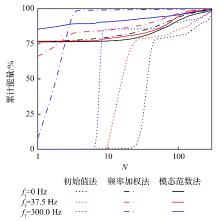
Fig.9
Variation of cumulative energy with modes for different ordering methods (CFD)
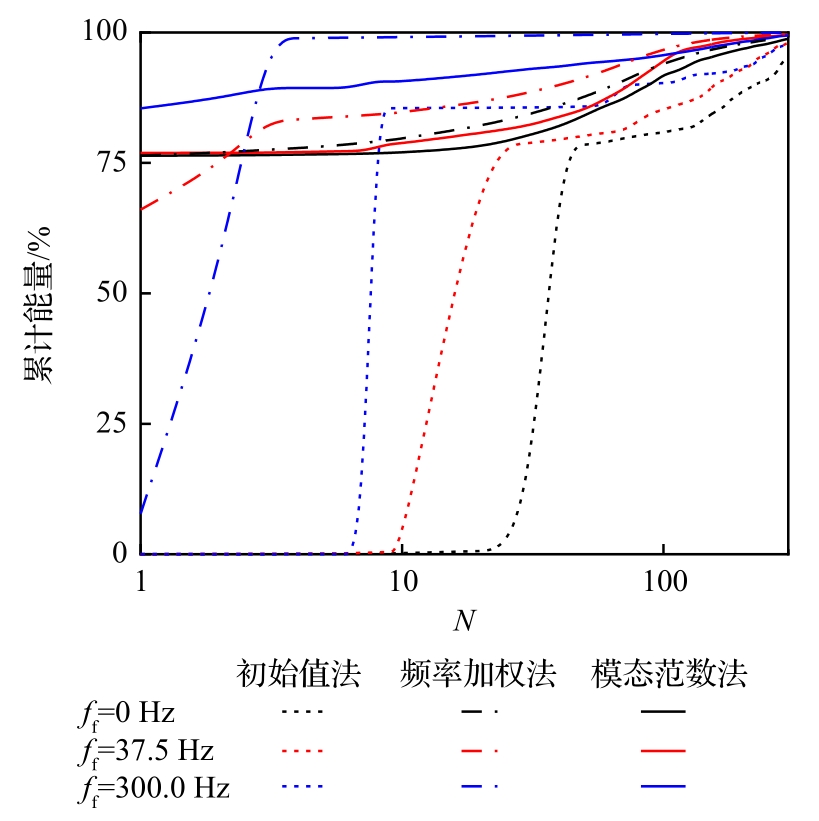
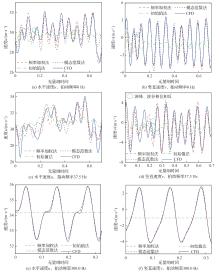
Fig.10
Comparison of velocity reconstruction among different methods
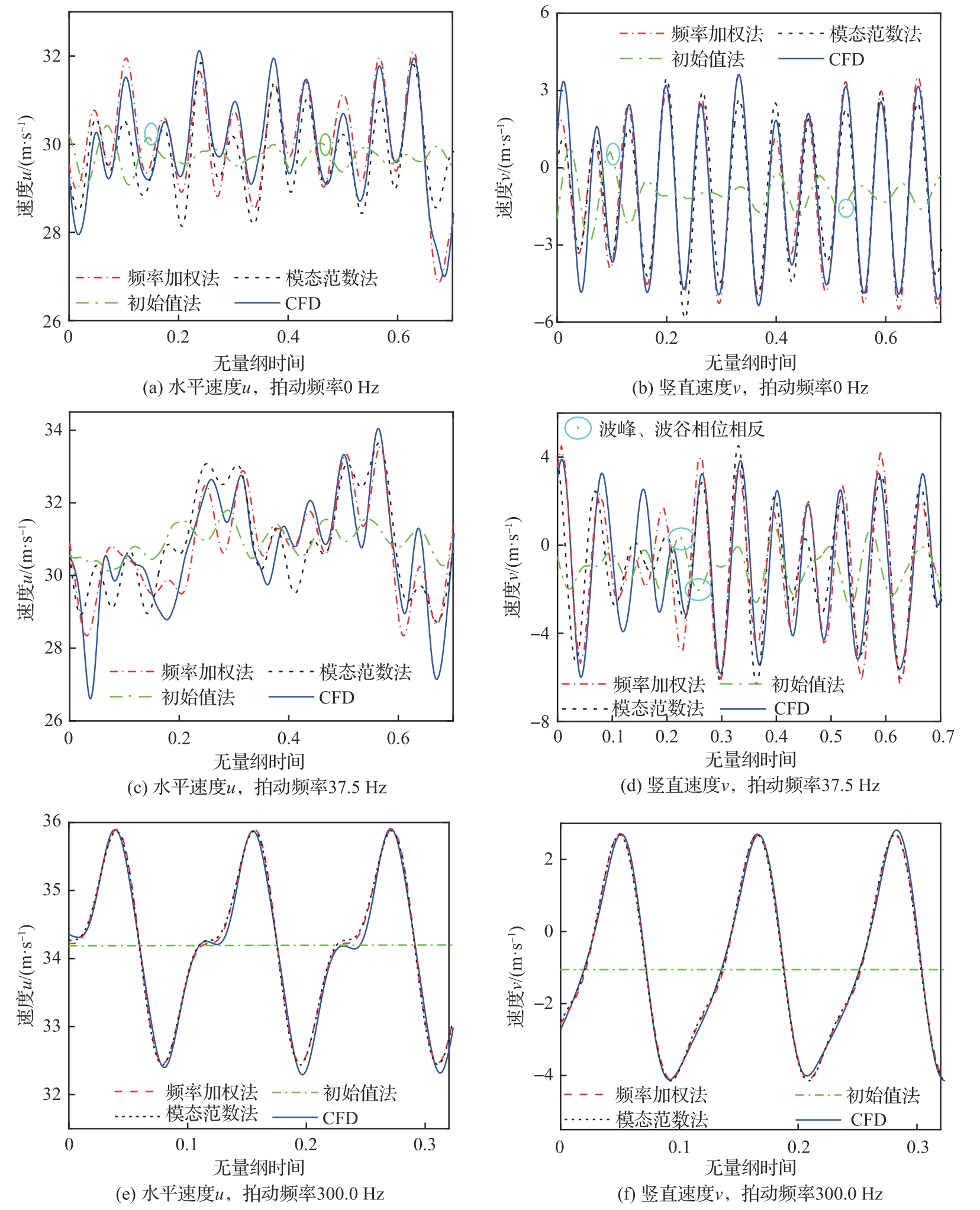
Table 3
Errors of different reconstruction approaches (CFD)
| ff /Hz | 重构 数量 | 误差/% | ||
|---|---|---|---|---|
| 初始值法 | 模态范数法 | 频率加权法 | ||
| 0 | 66 | 7.58 | 6.98 | 5.49 |
| 37.5 | 58 | 6.56 | 6.02 | 4.94 |
| 300.0 | 8 | 3.25 | 0.58 | 0.39 |
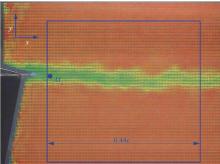
Fig.11
PIV area and modal analysis area
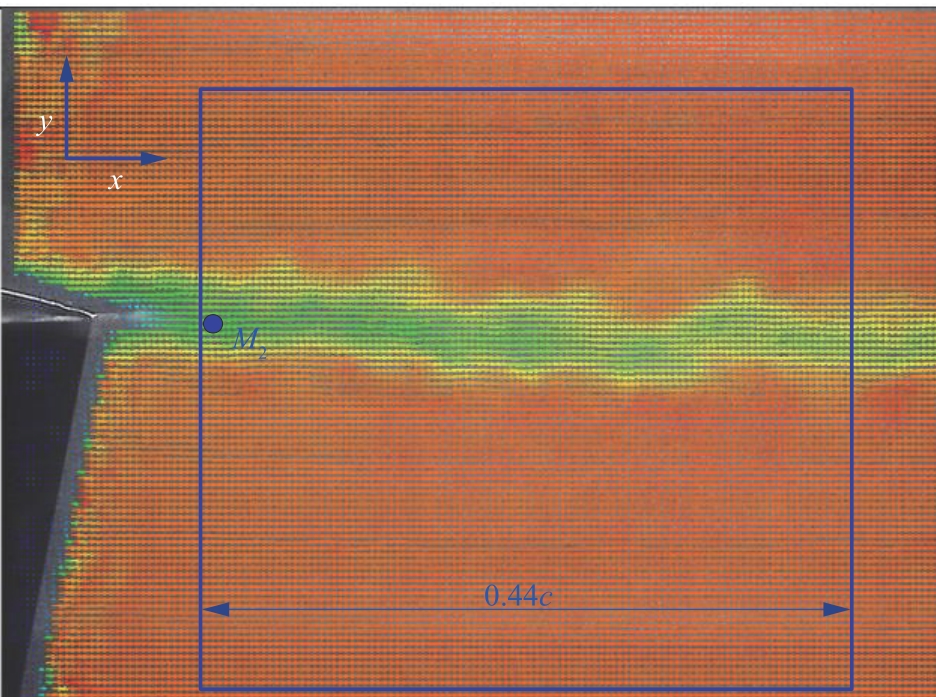
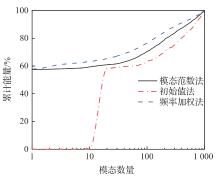
Fig.12
Variation of cumulative energy with modes for different ordering methods (experiment)
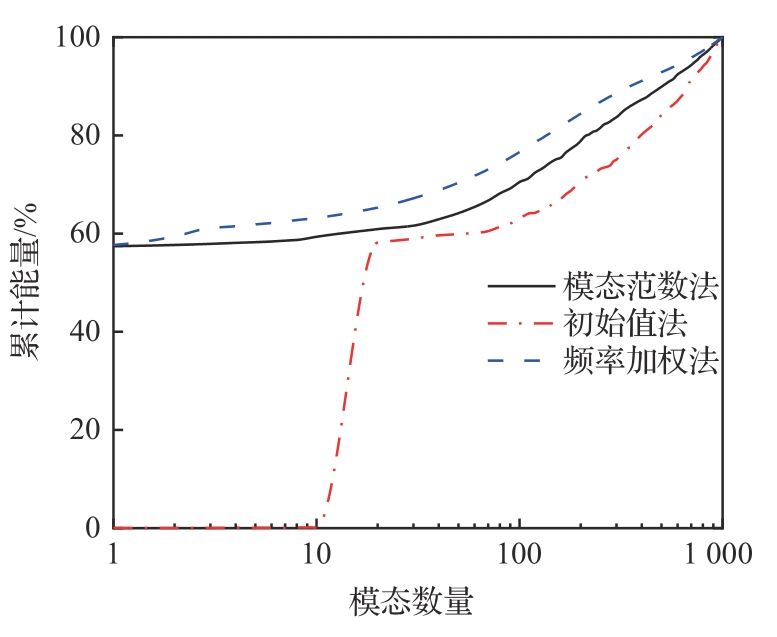
Table 4
Frequency of first ten modes (experiment,ff =37.5 Hz)
| 模态序号 | 模态频率/Hz | ||
|---|---|---|---|
| 模态范数法 | 初始值法 | 频率加权法 | |
| 2阶 | 140.1 | 1 461.5 | 35.0 |
| 4阶 | 205.2 | 1 301.3 | 40.0 |
| 6阶 | 120.1 | 2 047.1 | 50.0 |
| 8阶 | 35.0 | 2 437.4 | 10.0 |
| 10阶 | 445.5 | 1 846.9 | 130.1 |
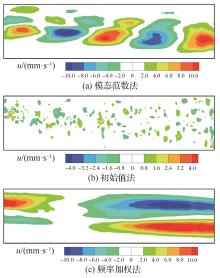
Fig.13
Comparison of 2nd modes of velocity u among different methods (experiment, ff =37.5 Hz)
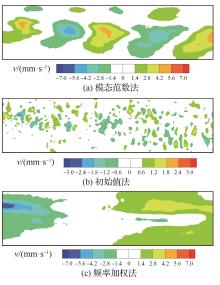
Fig.14
Comparison of 2nd modes of velocity v among different methods (experiment, ff =37.5 Hz)
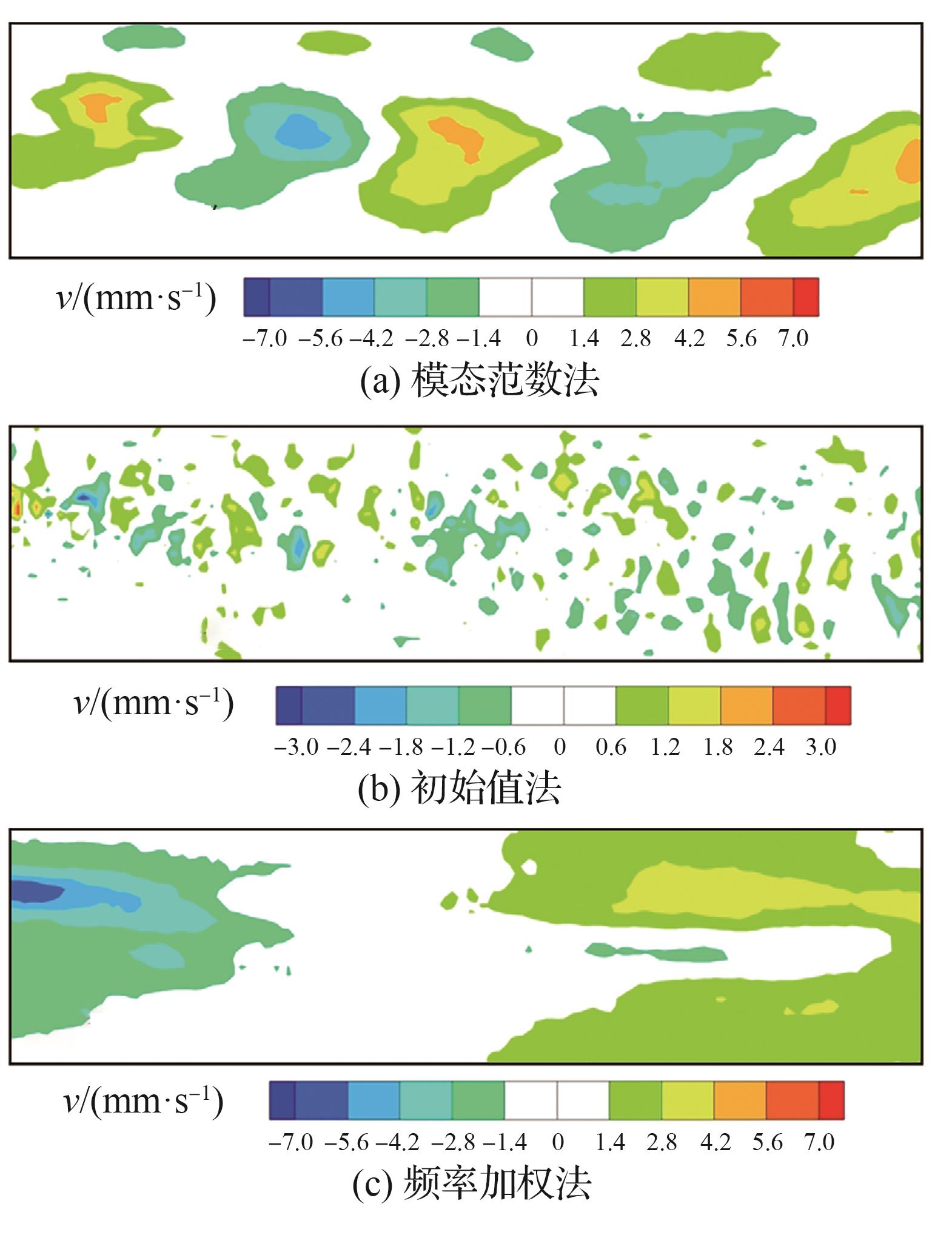
Table 5
Frequency of first ten modes (experiment, ff=300.0 Hz)
| 模态序号 | 模态频率/Hz | ||
|---|---|---|---|
| 模态范数法 | 初始值法 | 频率加权法 | |
| 2阶 | 65.1 | 2 492.5 | 300.3 |
| 4阶 | 250.3 | 415.4 | 295.3 |
| 6阶 | 155.2 | 215.2 | 290.3 |
| 8阶 | 305.3 | 265.3 | 305.3 |
| 10阶 | 415.4 | 265.3 | 315.3 |
Fig.15
Comparison of 2nd modes of velocity u among different methods (experiment, ff =300.0 Hz)
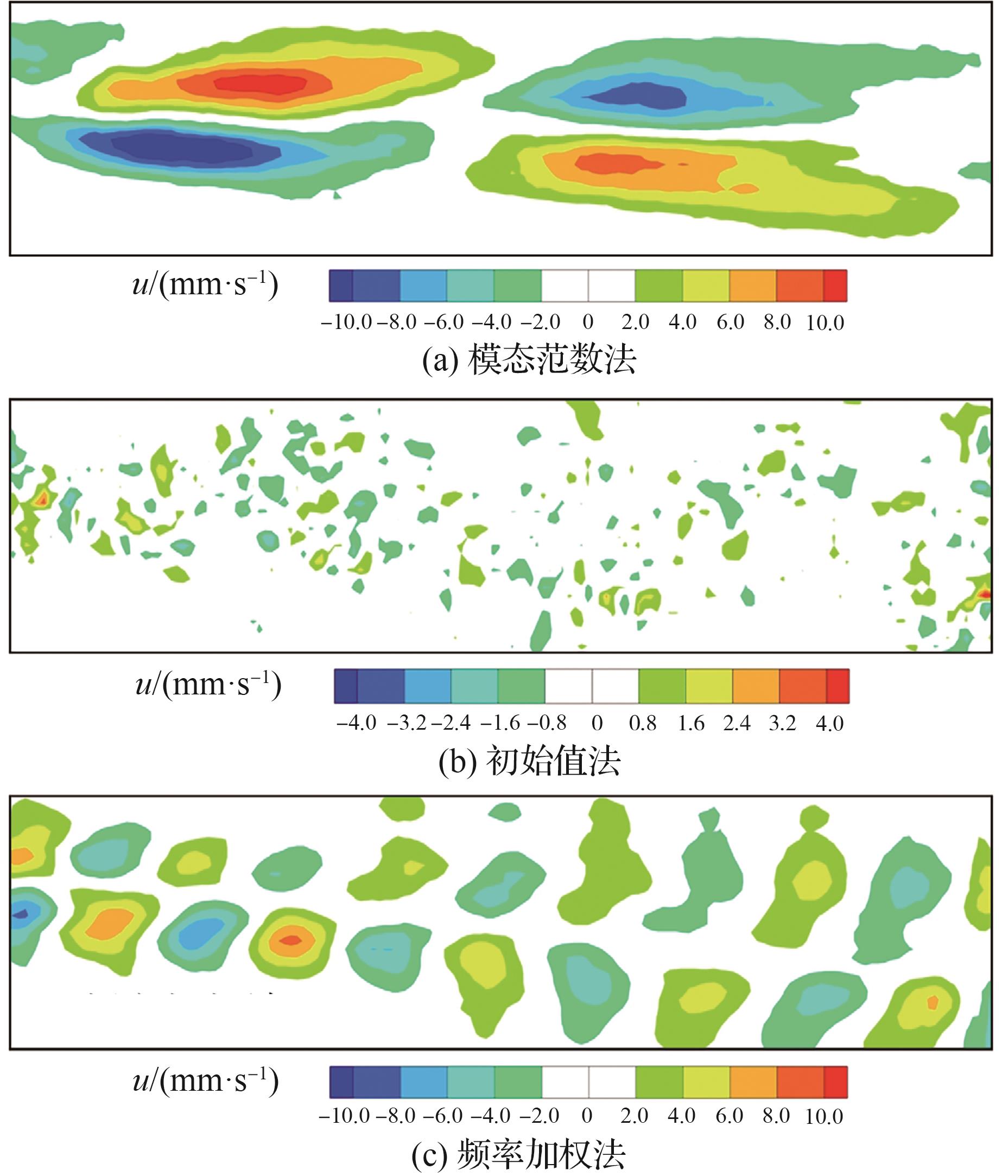
Fig.16
Comparison of 2nd modes of velocity v among different methods (experiment, ff =300.0 Hz)
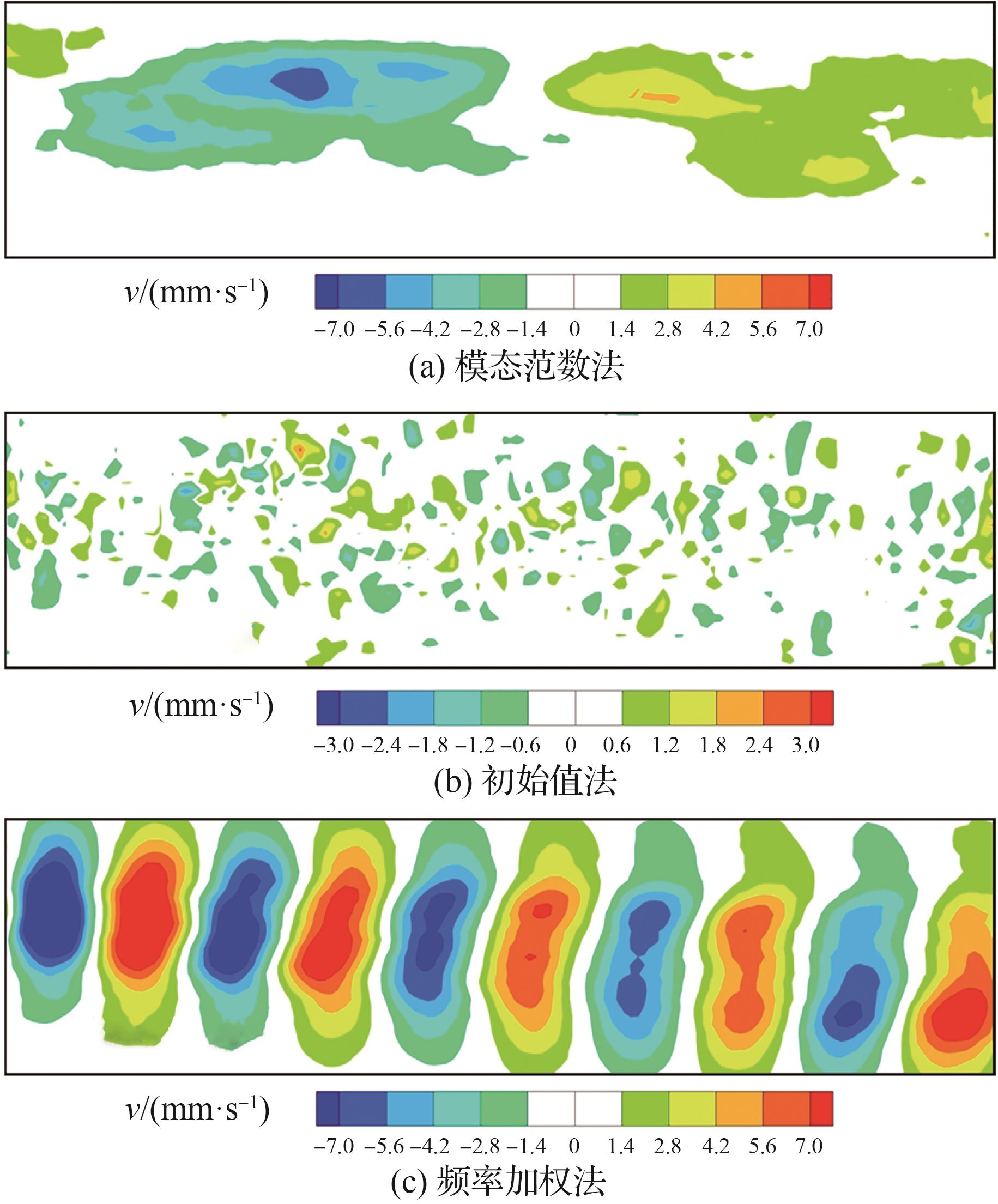
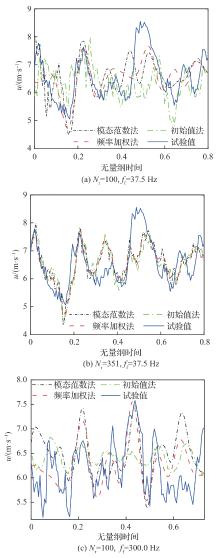
Fig.17
Comparison of reconstruction of velocity u among different methods
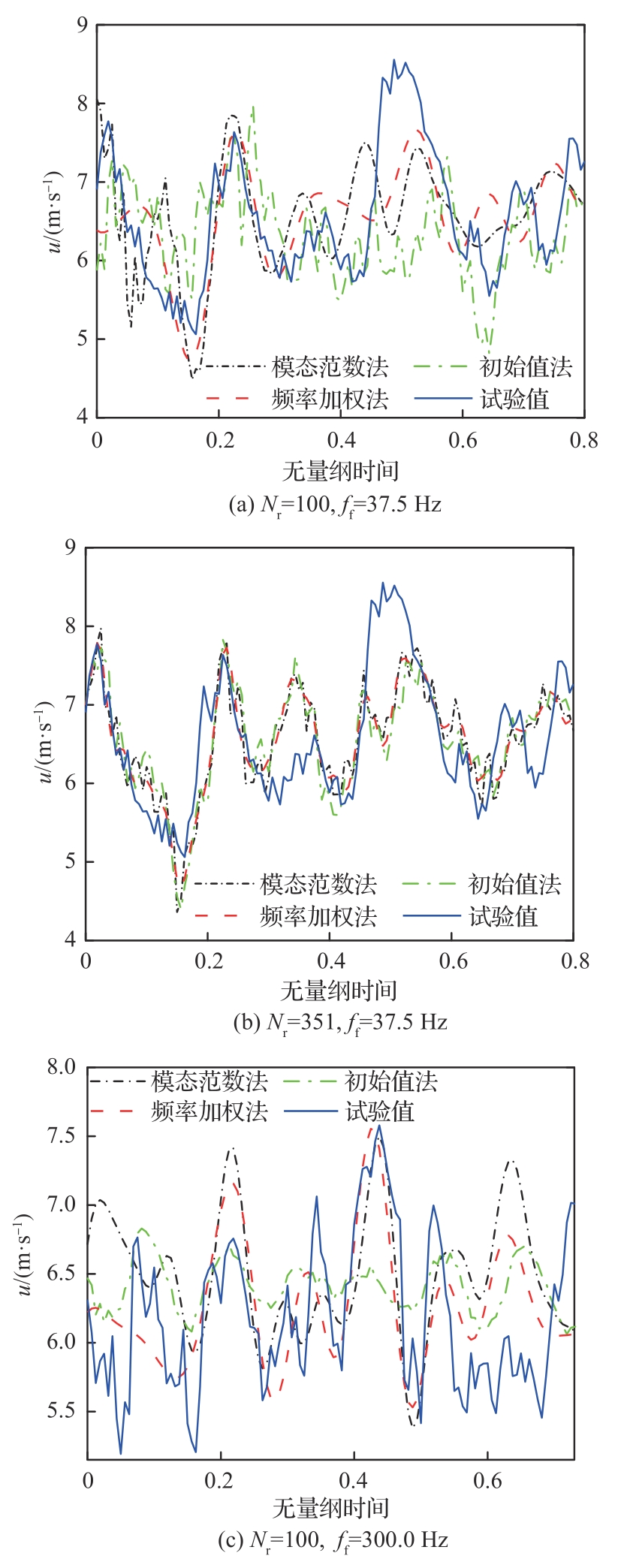
Table 6
Errors of different reconstruction approaches (experiment)
| ff /Hz | 重构数量 | 误差/% | ||
|---|---|---|---|---|
| 初始值法 | 模态范数法 | 频率加权法 | ||
| 37.5 | 100 | 11.35 | 13.68 | 9.91 |
| 37.5 | 351 | 9.25 | 9.96 | 9.00 |
| 300.0 | 100 | 10.56 | 8.77 | 7.56 |
| 1 | WIMPRESS J K. Aerodynamic technology applied to takeoff and landing[J]. Annals of the New York Academy of Sciences, 1968, 154(2): 962-981. |
| 2 | ANDERS S, III W S, WASHBURN A. Active flow control activities at NASA langley[C]∥ 2nd AIAA Flow Control Conference. Reston: AIAA, 2004: 2623. |
| 3 | SCOTT COLLIS S, JOSLIN R D, SEIFERT A, et al. Issues in active flow control: Theory, control, simulation, and experiment[J]. Progress in Aerospace Sciences, 2004, 40(4-5): 237-289. |
| 4 | KHAN S, GRIGORIE T L, BOTEZ R M, et al. Novel morphing wing actuator control-based Particle Swarm Optimisation[J]. The Aeronautical Journal, 2020, 124(1271): 55-75. |
| 5 | 寇家庆, 张伟伟. 动力学模态分解及其在流体力学中的应用[J]. 空气动力学学报, 2018, 36(2): 163-179. |
| KOU J Q, ZHANG W W. Dynamic mode decomposition and its applications in fluid dynamics[J]. Acta Aerodynamica Sinica, 2018, 36(2): 163-179 (in Chinese). | |
| 6 | NIU W, ZHANG Y F, CHEN H X, et al. Numerical study of a supercritical airfoil/wing with variable-camber technology[J]. Chinese Journal of Aeronautics, 2020, 33(7): 1850-1866. |
| 7 | CHU L L, LI Q, GU F, et al. Design, modeling, and control of morphing aircraft: A review[J]. Chinese Journal of Aeronautics, 2022, 35(5): 220-246. |
| 8 | HE X Y, LIU Y, CHEN Y X, et al. Wake of a bio-inspired flapping wing with morphing wingspan[J]. Acta Mechanica Sinica, 2023, 39(10): 323061. |
| 9 | 陈树生, 贾苜梁, 刘衍旭, 等. 变体飞行器变形方式及气动布局设计关键技术研究进展[J]. 航空学报, 2024, 45(6): 629595. |
| CHEN S S, JIA M L, LIU Y X, et al. Deformation modes and key technologies of aerodynamic layout design for morphing aircraft: Review[J]. Acta Aeronautica et Astronautica Sinica, 2024, 45(6): 629595 (in Chinese). | |
| 10 | 张桢锴, 贾思嘉, 宋晨, 等. 柔性变弯度后缘机翼的风洞试验模型优化设计[J]. 航空学报, 2022, 43(3): 226071. |
| ZHANG Z K, JIA S J, SONG C, et al. Optimum design of wind tunnel test model for compliant morphing trailing edge[J]. Acta Aeronautica et Astronautica Sinica, 2022, 43(3): 226071 (in Chinese). | |
| 11 | LI L, WANG W C, WU X J. A wind tunnel investigation of the unsteady aerodynamic characteristics of bionic flapping wings with three-dimensional complex motion[J]. AIP Advances, 2023, 13(5): 055116. |
| 12 | FU J J, HEFLER C, QIU H H, et al. Effects of aspect ratio on flapping wing aerodynamics in animal flight[J]. Acta Mechanica Sinica, 2014, 30(6): 776-786. |
| 13 | PECORA R. Morphing wing flaps for large civil aircraft: Evolution of a smart technology across the Clean Sky program[J]. Chinese Journal of Aeronautics, 2021, 34(7): 13-28. |
| 14 | WONG A, BIL C, MARINO M. Design and aerodynamic performance of a FishBAC morphing wing[C]∥ AIAA SCITECH 2022 Forum. Reston: AIAA, 2022: 1298. |
| 15 | WU J H, LI G, CHEN L, et al. Unsteady aerodynamic performance of a tandem flapping-fixed airfoil configuration at low Reynolds number[J]. Physics of Fluids, 2022, 34(11): 111907. |
| 16 | MENG X G, CHEN Z S, WANG D S, et al. Aerodynamic interference of three flapping wings in tandem configuration[J]. Physics of Fluids, 2023, 35(3): 031911. |
| 17 | 张进, 周雷, 曹博超. 强化学习方法在翼型拍动实验中的应用[J]. 空气动力学学报, 41(9): 20-29. |
| ZHANG J, ZHOU L, CAO B C. Application of reinforcement learn-ing method in flapping airfoil exper-iment[J]. Acta Aerodynamica Sinica, 2023, 41(9): 20-29 (in Chinese). | |
| 18 | TAIRA K, BRUNTON S L, DAWSON S T M, et al. Modal analysis of fluid flows: An overview[J]. AIAA Journal, 2017, 55(12): 4013-4041. |
| 19 | SCHMID P J. Application of the dynamic mode decomposition to experimental data[J]. Experiments in Fluids, 2011, 50(4): 1123-1130. |
| 20 | SCHMID P J, LI L, JUNIPER M P, et al. Applications of the dynamic mode decomposition[J]. Theoretical and Computational Fluid Dynamics, 2011, 25(1): 249-259. |
| 21 | 杨倩, 郭晓峰, 李芹, 等. 基于POD和代理模型的热气防冰性能预测方法[J]. 航空学报, 2023, 44(1): 626992. |
| YANG Q, GUO X F, LI Q, et al. Hot air anti-icing performance estimation method based on POD and surrogate model[J]. Acta Aeronautica et Astronautica Sinica, 2023, 44(1): 626992 (in Chinese). | |
| 22 | 可钊, 时永鑫, 张鹏, 等. 基于全局POD降阶模型的复杂薄壁结构减振优化[J]. 航空学报, 2023, 44(13): 227900. |
| KE Z, SHI Y X, ZHANG P, et al. Vibration reduction optimization of complex thin-walled structures based on global POD reduced-order model[J]. Acta Aeronautica et Astronautica Sinica, 2023, 44(13): 227900 (in Chinese). | |
| 23 | 韩忠华, 王绍楠, 韩莉, 等. 一种基于动模态分解的翼型流动转捩预测新方法[J]. 航空学报, 2017, 38(1): 120034. |
| HAN Z H, WANG S N, HAN L, et al. A novel method for automatic transition prediction of flows over airfoils based on dynamic mode decomposition[J]. Acta Aeronautica et Astronautica Sinica, 2017, 38(1): 120034 (in Chinese). | |
| 24 | DEEP D, SAHASRANAMAN A, SENTHILKUMAR S. POD analysis of the wake behind a circular cylinder with splitter plate[J]. European Journal of Mechanics - B, 2022, 93: 1-12. |
| 25 | MOHAN A T, GAITONDE D V. Analysis of airfoil stall control using dynamic mode decomposition[J]. Journal of Aircraft, 2017, 54(4): 1508-1520. |
| 26 | ZHANG Q S, LIU Y Z, WANG S F. The identification of coherent structures using proper orthogonal decomposition and dynamic mode decomposition[J]. Journal of Fluids and Structures, 2014, 49: 53-72. |
| 27 | NEUMANN P, DE ALMEIDA V B C, MOTTA V, et al. Dynamic mode decomposition analysis of plasma aeroelastic control of airfoils in cascade[J]. Journal of Fluids and Structures, 2020, 94: 102901. |
| 28 | 张扬, 张来平, 邓小刚, 等. 飞行器大攻角复杂流动的POD和DMD对比分析[J]. 气体物理, 2018, 3(5): 30-40. |
| ZHANG Y, ZHANG L P, DENG X G, et al. POD and DMD analysis of complex separation flows over a aircraft model at high angle of attack[J]. Physics of Gases, 2018, 3(5): 30-40 (in Chinese). | |
| 29 | IWATANI Y, ASADA H, KAWAI S. POD, DMD, and resolvent analysis of transonic airfoil buffet[C]∥ AIAA SCITECH 2022 Forum. Reston: AIAA, 2022: 0461. |
| 30 | 高传强, 张伟伟. 机翼跨声速抖振数值模拟及模态分析[J]. 航空学报, 2019, 40(7): 122597. |
| GAO C Q, ZHANG W W. Numerical simulation and modal analysis of transonic buffet flow over wings[J]. Acta Aeronautica et Astronautica Sinica, 2019, 40(7): 122597 (in Chinese). | |
| 31 | 寇家庆, 张伟伟, 高传强. 基于POD和DMD方法的跨声速抖振模态分析[J]. 航空学报, 2016, 37(9): 2679-2689. |
| KOU J Q, ZHANG W W, GAO C Q. Modal analysis of transonic buffet based on POD and DMD method[J]. Acta Aeronautica et Astronautica Sinica, 2016, 37(9): 2679-2689 (in Chinese). | |
| 32 | GAO C Q, ZHANG W W, LI X T, et al. Mechanism of frequency lock-in in transonic buffeting flow[J]. Journal of Fluid Mechanics, 2017, 818: 528-561. |
| 33 | ZHAO Y X, DAI Z X, TIAN Y, et al. Flow characteristics around airfoils near transonic buffet onset conditions[J]. Chinese Journal of Aeronautics, 2020, 33(5): 1405-1420. |
| 34 | DE CILLIS G, CHERUBINI S, SEMERARO O, et al. Stability and optimal forcing analysis of a wind turbine wake: comparison with POD[J]. Renewable Energy, 2022, 181: 765-785. |
| 35 | 李凯, 杨静媛, 高传强, 等. 基于POD和代理模型的静气动弹性分析方法[J]. 力学学报, 2023, 55(2): 299-308. |
| LI K, YANG J Y, GAO C Q, et al. Static aeroelastic analysis based on proper orthogonal decomposition and surrogate model[J]. Chinese Journal of Theoretical and Applied Mechanics, 2023, 55(2): 299-308 (in Chinese). | |
| 36 | LI S F, KEVREKIDIS P G, YANG J. Characterization of elastic topological states using dynamic mode decomposition[J]. Physical Review B, 2023, 107(18): 184308. |
| 37 | 谢庆墨, 陈亮, 张桂勇, 等. 基于动力学模态分解法的绕水翼非定常空化流场演化分析[J]. 力学学报, 2020, 52(4): 1045-1054. |
| XIE Q M, CHEN L, ZHANG G Y, et al. Analysis of unsteady cavitation flow over hydrofoil based on dynamic mode decomposition[J]. Chinese Journal of Theoretical and Applied Mechanics, 2020, 52(4): 1045-1054 (in Chinese). | |
| 38 | JOVANOVIĆ M R, SCHMID P J, NICHOLS J W. Sparsity-promoting dynamic mode decomposition[J]. Physics of Fluids, 2014, 26(2): M30.010. |
| 39 | TU J H, ROWLEY C W, LUCHTENBURG D M, et al. On dynamic mode decomposition: Theory and applications[J]. Journal of Computational Dynamics, 2014, 1(2): 391-421. |
| 40 | TOWNE A, SCHMIDT O T, COLONIUS T. Spectral proper orthogonal decomposition and its relationship to dynamic mode decomposition and resolvent analysis[J]. Journal of Fluid Mechanics, 2018, 847: 821-867. |
| 41 | SUN C, TIAN T, ZHU X C, et al. Input-output reduced-order modeling of unsteady flow over an airfoil at a high angle of attack based on dynamic mode decomposition with control[J]. International Journal of Heat and Fluid Flow, 2020, 86: 108727. |
| 42 | MOHAN A T, VISBAL M R, GAITONDE D V. Model reduction and analysis of deep dynamic stall on a plunging airfoil using dynamic mode decomposition[C]∥ 53rd AIAA Aerospace Sciences Meeting. Reston: AIAA, 2015: 1058. |
| 43 | MENON K, MITTAL R. Dynamic mode decomposition based analysis of flow over a sinusoidally pitching airfoil[J]. Journal of Fluids and Structures, 2020, 94: 102886. |
| 44 | ZHENG H Y, XIE F F, ZHENG Y, et al. Propulsion performance of a two-dimensional flapping airfoil with wake map and dynamic mode decomposition analysis[J]. Physical Review E, 2019, 99(6-1): 063109. |
| 45 | WANG C Y, LIU Y, XU D, et al. Aerodynamic performance of a bio-inspired flapping wing with local sweep morphing[J]. Physics of Fluids, 2022, 34(5): 051903. |
| 46 | NADERI M H, EIVAZI H, ESFAHANIAN V. New method for dynamic mode decomposition of flows over moving structures based on machine learning (hybrid dynamic mode decomposition)[J]. Physics of Fluids, 2019, 31(12): 127102. |
| 47 | TISSOT G, CORDIER L, BENARD N, et al. Model reduction using Dynamic Mode Decomposition[J]. Comptes Rendus Mecanique, 2014, 342(6-7): 410-416. |
| 48 | KOU J Q, ZHANG W W. An improved criterion to select dominant modes from dynamic mode decomposition[J]. European Journal of Mechanics, B/Fluids, 2017, 62: 109-129. |
| 49 | BISTRIAN D A, NAVON I M. The method of dynamic mode decomposition in shallow water and a swirling flow problem[J]. International Journal for Numerical Methods in Fluids, 2017, 83(1): 73-89. |
| 50 | ZHANG W, CHEN L, XIA Z X, et al. Numerical and experimental studies of a morphing airfoil with trailing edge high-frequency flapping[J]. Physics of Fluids, 2023, 35(12): 121904. |
| [1] | Shilin HU, Bingzhou CHEN, Wei KANG. Lift improvement mechanism of membrane airfoil using dynamic mode decomposition [J]. Acta Aeronautica et Astronautica Sinica, 2025, 46(2): 130618-130618. |
| [2] | Yiwei HUANG, Yibin GENG, Tianhe GAO, Xuanwei HU, Yuan WANG, Hongyan MA, Kuo TIAN. Digital twin driven high precision reconstruction method for full-field deformation of structure [J]. Acta Aeronautica et Astronautica Sinica, 2025, 46(19): 530967-530967. |
| [3] | Jialiang HU, Jiangpeng WU, Sixu HUO, Yidi GAO, Hua ZHENG. Modal parameter estimation based on reconstruction of digital twin sweep data in flutter flight test [J]. Acta Aeronautica et Astronautica Sinica, 2025, 46(19): 531602-531602. |
| [4] | Jie TIAN, Jinglei XU, Junfei ZHOU, Le CAI, Shun LIU. Experimental verification of PIV-based measurement for reconstructing thrust performance of supersonic nozzles [J]. Acta Aeronautica et Astronautica Sinica, 2025, 46(17): 131114-131114. |
| [5] | Limin GAO, Jun ZHANG, Bo OUYANG, Lei WANG. Binocular speckle-based 3D-PSP technique and its applications in compressor cascade [J]. Acta Aeronautica et Astronautica Sinica, 2025, 46(17): 131617-131617. |
| [6] | Jian ZHANG, Zhengyu ZHANG, Yang YANG, Fengxue QIAN, Xiaoxia LI, Caigang WANG, Jiajie LUO. Fast calculation method of Poisson equation source term for BOS measuring density field [J]. Acta Aeronautica et Astronautica Sinica, 2025, 46(17): 131713-131713. |
| [7] | Xiaotong TAN, Heyong XU. Flow feature and aero-optical effect for laser turret in transonic flow [J]. Acta Aeronautica et Astronautica Sinica, 2025, 46(14): 131493-131493. |
| [8] | Xiaochen LYU, Jingping SHI, Yongxi LYU, Gengnong LI. Flow angle reconstruction algorithm for MAGIC CARPET landing with sensor failure [J]. Acta Aeronautica et Astronautica Sinica, 2025, 46(13): 531159-531159. |
| [9] | Peikang ZHANG, Jifeng GUO, Peng YAN. Modeling and robust flight control of small-scale unmanned helicopter [J]. Acta Aeronautica et Astronautica Sinica, 2024, 45(S1): 730797-730797. |
| [10] | Shuai LIANG, Guangle GAO, Xiaolei QU, Yajun LI. Asymptotic control of hypersonic flight vehicle based on error accumulation factor [J]. Acta Aeronautica et Astronautica Sinica, 2024, 45(S1): 730745-730745. |
| [11] | Yueteng WU, Dun BA, Juan DU, Yunfei LI, Juntao CHANG. Compressor flow field reconstruction method based on deep attention networks [J]. Acta Aeronautica et Astronautica Sinica, 2024, 45(24): 630580-630580. |
| [12] | Baicheng JIN, Kuo TIAN, Lei HUANG. Parametric reconstruction method for topology optimization results of curved stiffened structures [J]. Acta Aeronautica et Astronautica Sinica, 2024, 45(24): 630586-630586. |
| [13] | Xu ZENG, Deshuang DENG, Hongjuan YANG, Zhengyan YANG, Shuyi MA, Lei YANG, Zhanjun WU. Research progress in low-velocity impact monitoring technology for aircraft structures [J]. Acta Aeronautica et Astronautica Sinica, 2024, 45(23): 30368-030368. |
| [14] | Yunxiang FAN, Huanan AI, Mingzhen WANG, Kai CAO, Xuejun LIU, Hongqiang LYU. Unsteady hydrodynamic load reconstruction of seaplane based on deep learning [J]. Acta Aeronautica et Astronautica Sinica, 2024, 45(20): 129882-129882. |
| [15] | Jiaxin WANG, Jianlin XUAN, Xiaojun YANG, Rui ZHENG. Research progress of flapping wing aircraft with multimodal motion ability [J]. Acta Aeronautica et Astronautica Sinica, 2024, 45(18): 29842-029842. |
| Viewed | ||||||
|
Full text |
|
|||||
|
Abstract |
|
|||||
Address: No.238, Baiyan Buiding, Beisihuan Zhonglu Road, Haidian District, Beijing, China
Postal code : 100083
E-mail:hkxb@buaa.edu.cn
Total visits: 6658907 Today visits: 1341All copyright © editorial office of Chinese Journal of Aeronautics
All copyright © editorial office of Chinese Journal of Aeronautics
Total visits: 6658907 Today visits: 1341

 CJA
CJA
