Acta Aeronautica et Astronautica Sinica ›› 2026, Vol. 47 ›› Issue (5): 132490.doi: 10.7527/S1000-6893.2025.32490
• Fluid Mechanics and Flight Mechanics • Previous Articles
Haipeng CHEN1, Haichuan YU1, Xiangyu GU1( ), Xinwei WANG1, Xiaojiu ZHANG1, Jun CHEN2
Received:2025-06-30
Revised:2025-11-10
Accepted:2025-11-13
Online:2025-11-21
Published:2025-11-20
Contact:
Xiangyu GU
E-mail:xiangyu_gu@outlook.com
Supported by:CLC Number:
Haipeng CHEN, Haichuan YU, Xiangyu GU, Xinwei WANG, Xiaojiu ZHANG, Jun CHEN. Aerodynamic design methods for cross-domain morphing aircraft oriented to online deformation[J]. Acta Aeronautica et Astronautica Sinica, 2026, 47(5): 132490.
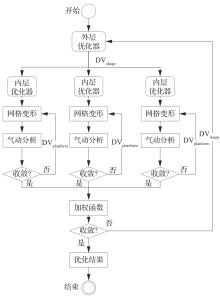
Fig.1
Aerodynamic optimization framework of a cross-domain morphing aircraft
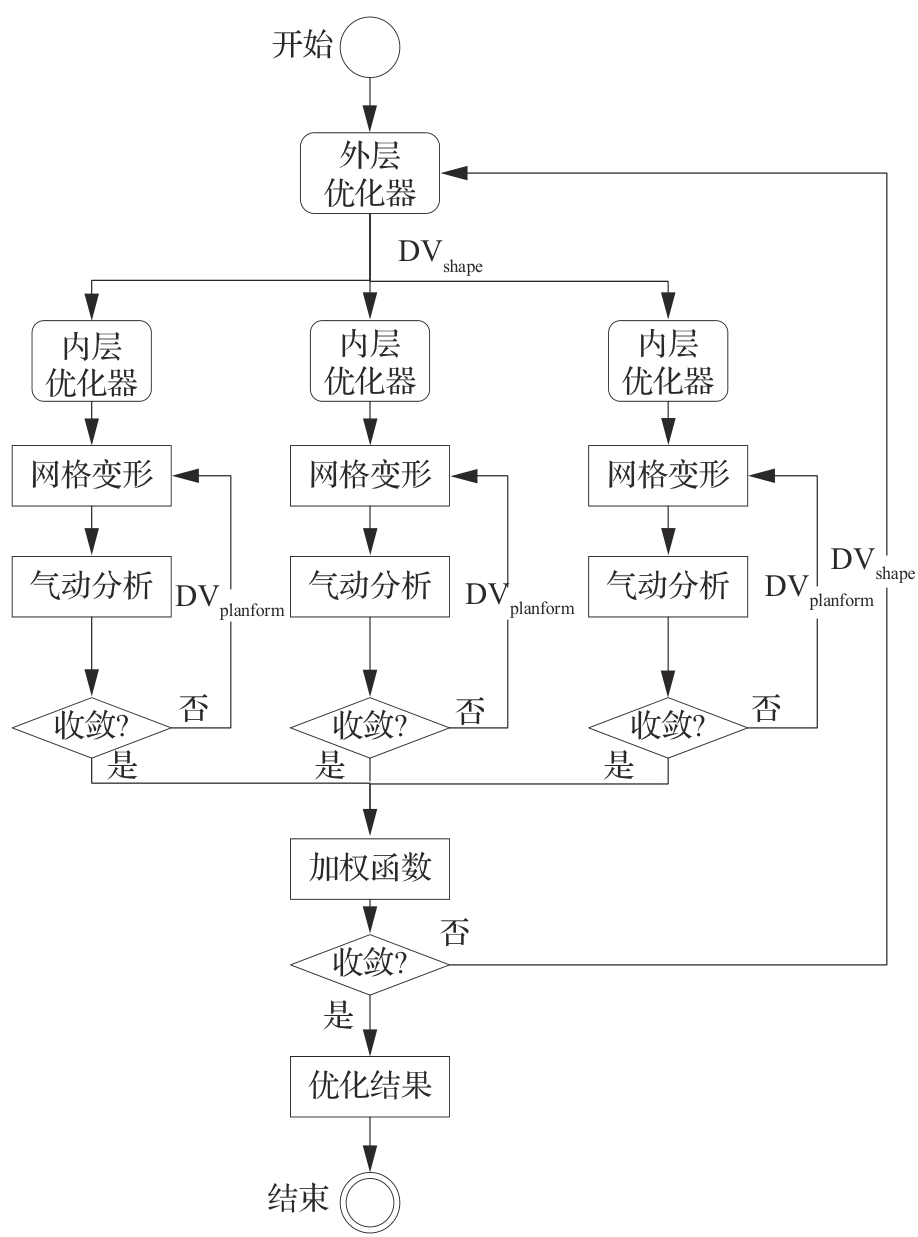
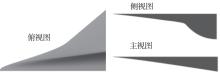
Fig.2
Schematic of baseline configuration for cross-domain aircraft

Table 1
Main parameters of baseline configuration for cross-domain aircraft
| 参数 | 数值 |
|---|---|
| 机身长度/m | 7.837 |
| 翼面半展长/m | 1.320 |
| 俯视投影面积/m2 | 14.740 |
| 前缘钝化半径/mm | 5 |
| 外翼后掠角/(°) | 50 |
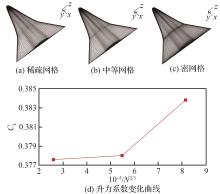
Fig.3
Grid independence study for low-speed condition
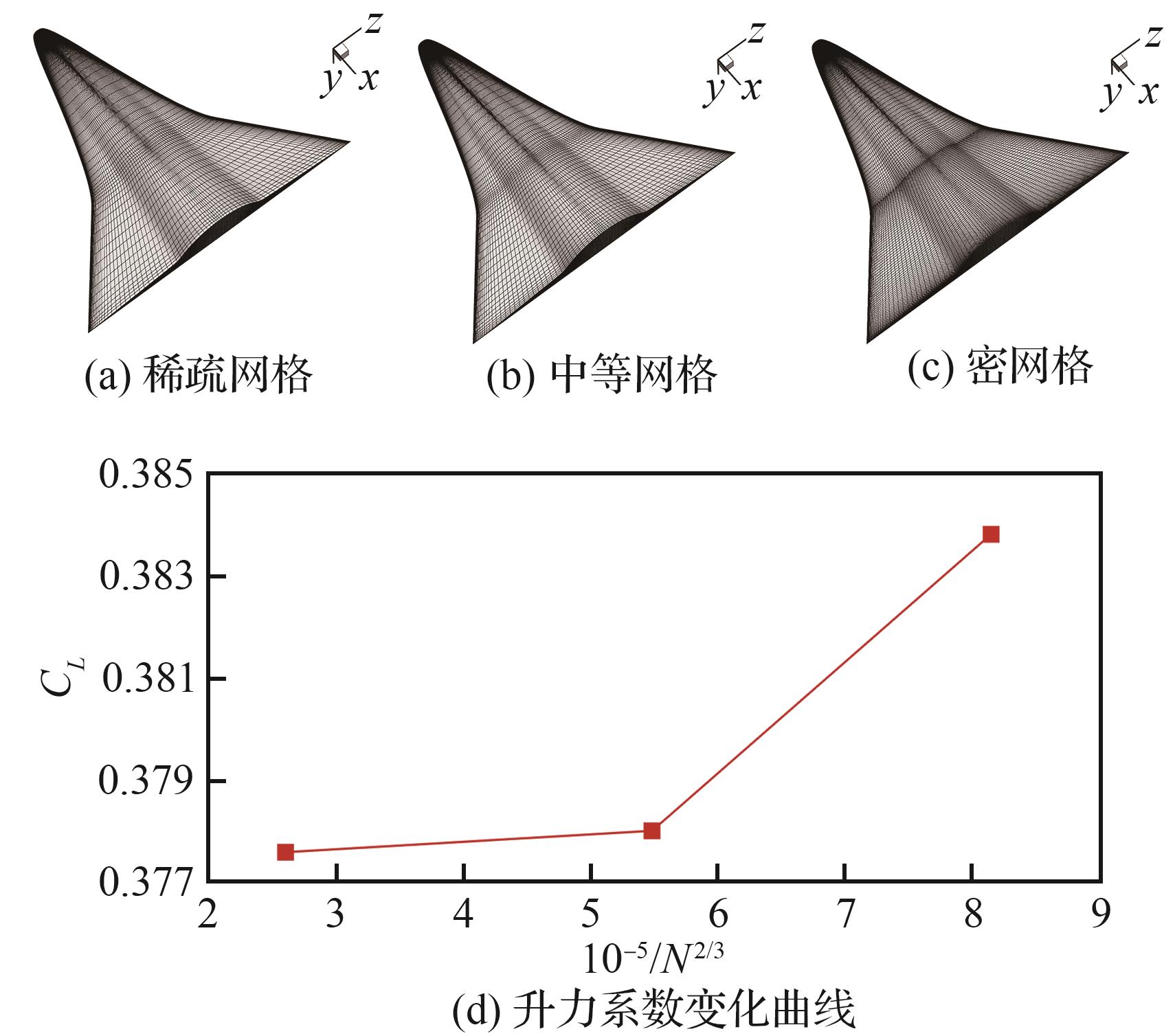
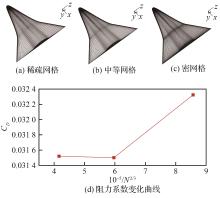
Fig.4
Grid independence study for high-speed condition
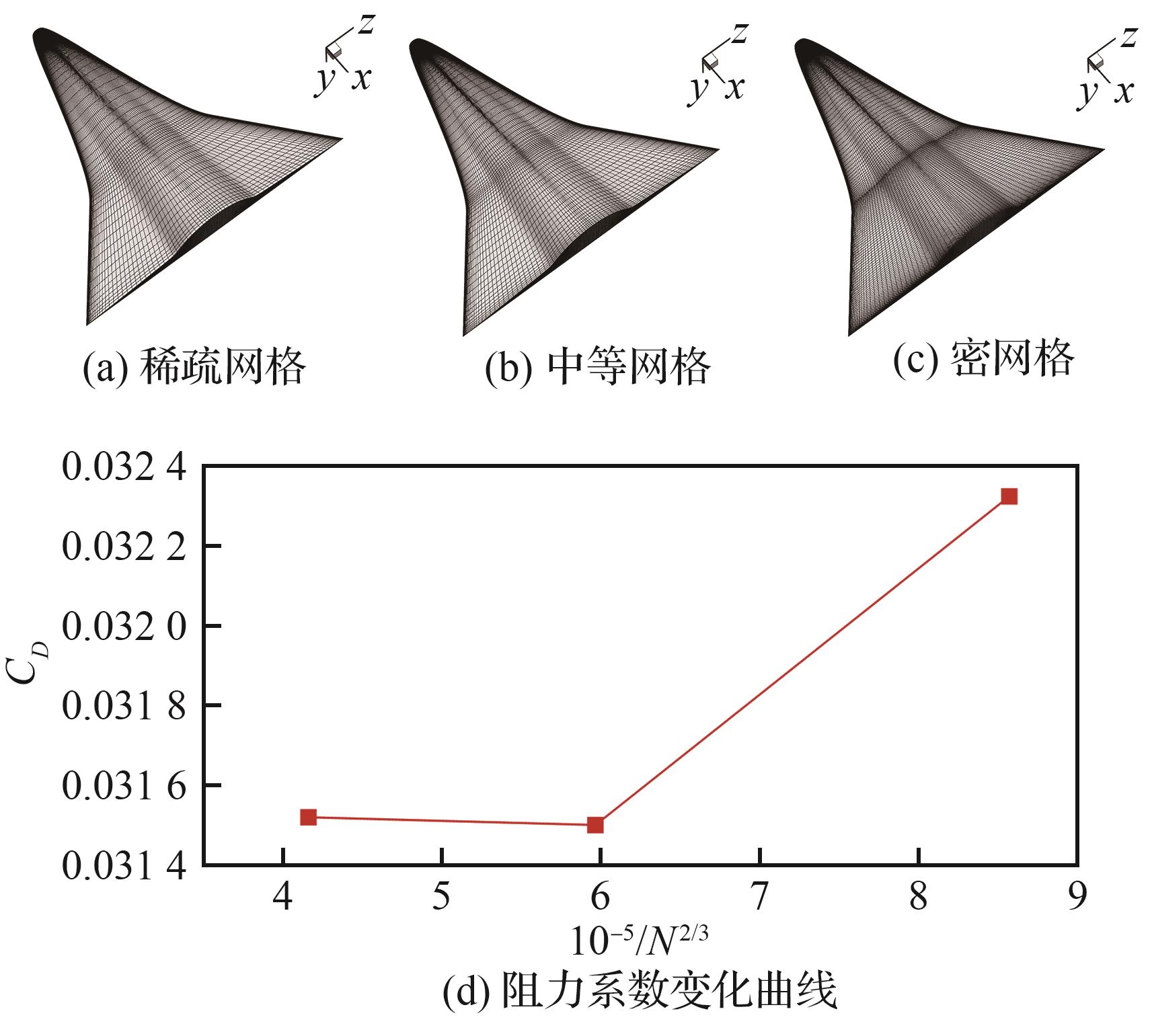
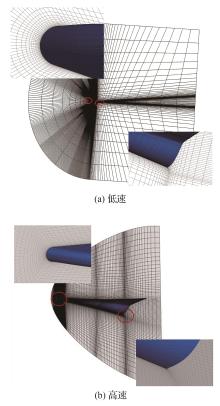
Fig.5
Structured meshes for low-speed and high-speed conditions
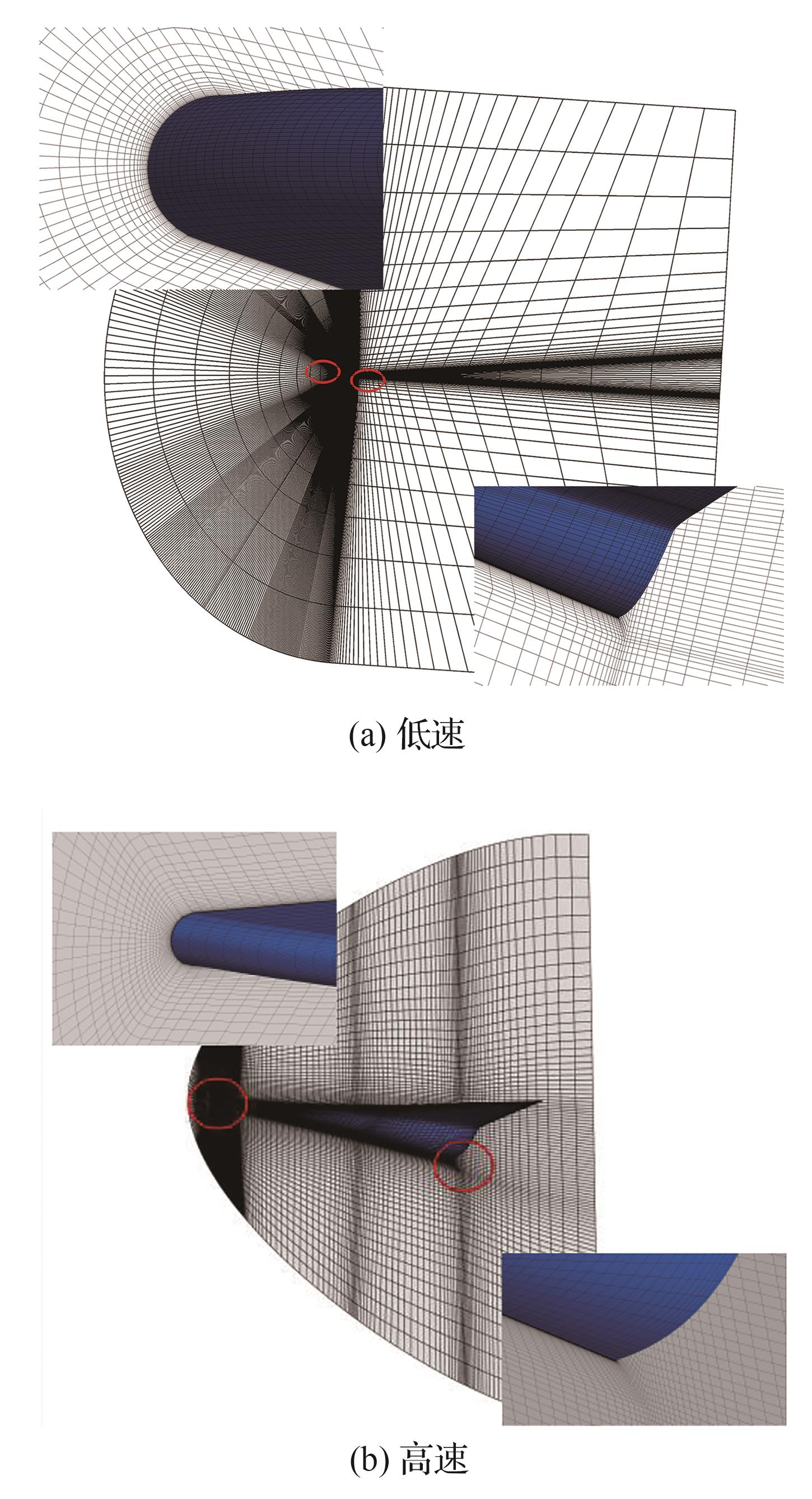
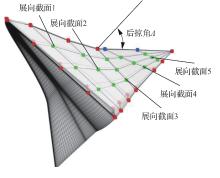
Fig.6
Design variables of cross-domain aircraft
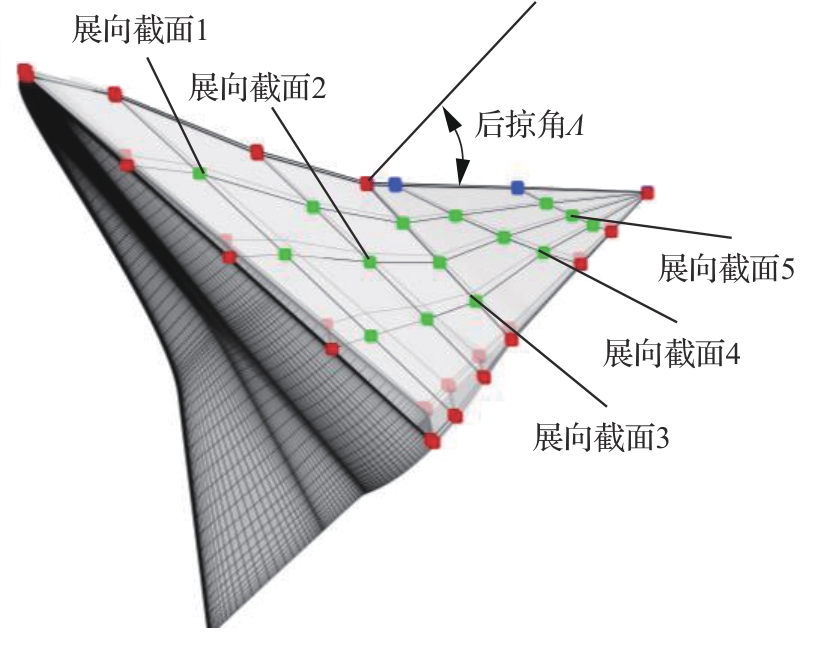
Table 2
Range of offline design variables
| 展向截面 | y方向位移/m | |
|---|---|---|
| 下界 | 上界 | |
| 1 | -0.20 | 0.05 |
| 2 | -0.20 | 0.05 |
| 3 | -0.12 | 0.02 |
| 4 | -0.08 | 0.02 |
| 5 | -0.06 | 0.02 |
Table 3
Design conditions and online variable bounds
| 设计点 | 设计状态 | ||||
|---|---|---|---|---|---|
| 下界 | 上界 | 下界 | 上界 | ||
| 1 | Ma=0.4, H=0 km,α=4° | -50 | -20 | -0 | 30 |
| 2 | Ma=6.0, H=30 km,α=4° | 0 | 20 | 50 | 70 |
| 3 | Ma=10.0, H=40 km,α=4° | 10 | 25 | 60 | 75 |
Table 4
Surrogate model accuracy on test set
| 马赫数 | 气动力 系数 | R² | 均方根误差/10-4 | 平均绝对 误差/10-4 |
|---|---|---|---|---|
| 0.4 | Cx | 0.998 9 | 0.66 | 0.50 |
| Cy | 0.999 8 | 5.26 | 4.11 | |
| Cmz | 0.999 7 | 4.20 | 3.23 | |
| 6.0 | Cx | 0.996 6 | 1.25 | 0.95 |
| Cy | 0.995 7 | 4.87 | 3.83 | |
| Cmz | 0.998 8 | 2.14 | 1.68 | |
| 10.0 | Cx | 0.994 0 | 1.07 | 0.83 |
| Cy | 0.997 0 | 2.67 | 1.90 | |
| Cmz | 0.997 3 | 2.18 | 1.58 |
Fig.7
Accuracy diagnostics for Cy surrogate model at Ma=0.4
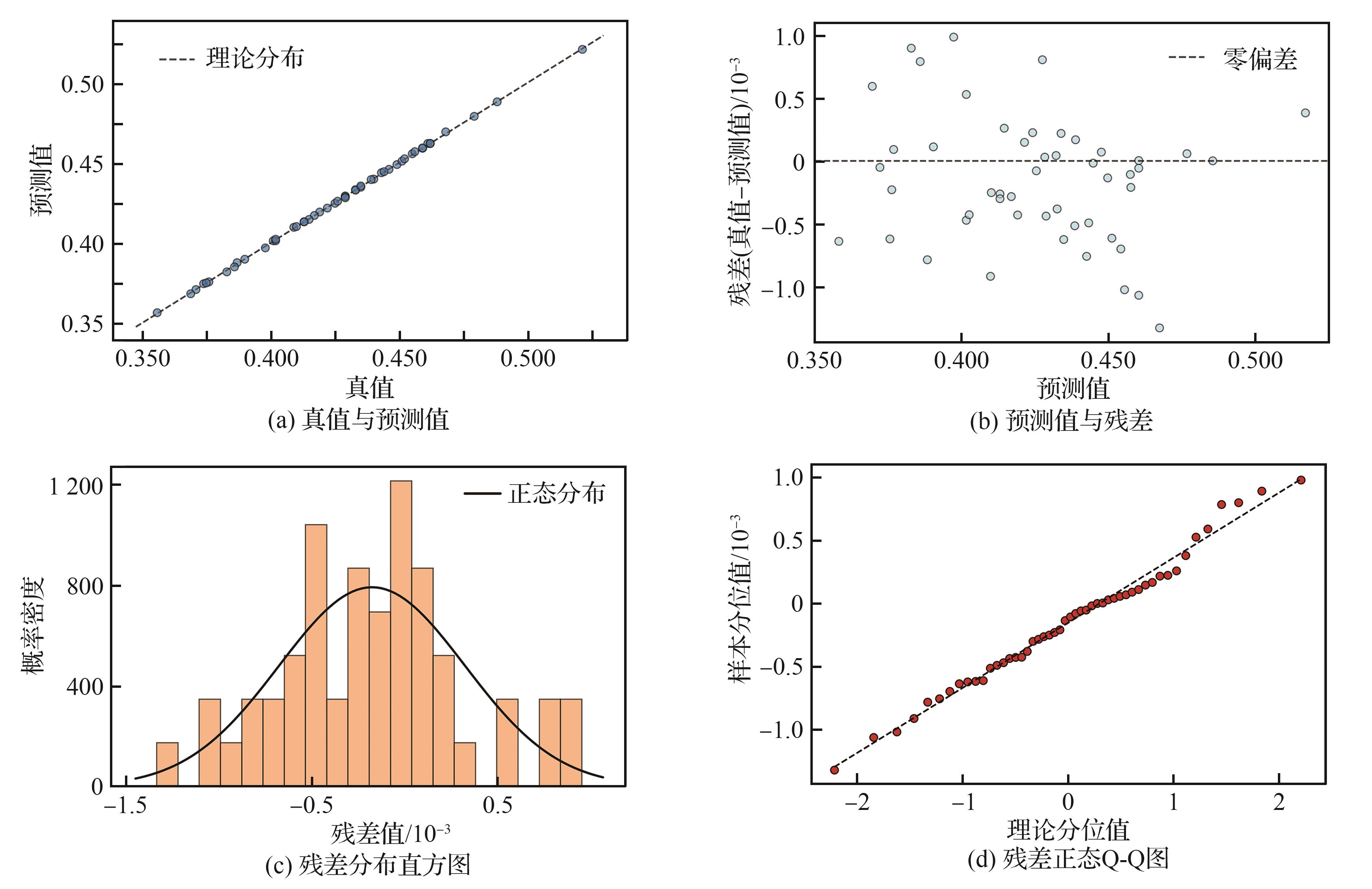
Table 5
Inner optimization problem under each design point
| 设计点 | 优化问题 |
|---|---|
| Ma=0.4, α=4° | 最大化:CL, Ma=0.4 遵循约束: KMa=0.4≥KMa=0.4,Ori |
| Ma=6.0,α=4° | 最大化:KMa=6.0 遵循约束: XCP,Ma=6.0-XCP,Ma=6.0,Ori<2% CL,Ma=6.0≥0.9CL, Ma=6.0,Ori |
| Ma=10.0,α=4° | 最大化:KMa=10.0 遵循约束: XCP,Ma=10.0-XCP,Ma=10.0,Ori<2% CL,Ma=10.0≥0.9CL,Ma=10.0, Ori |
Fig.8
Convergence process of optimization iteration
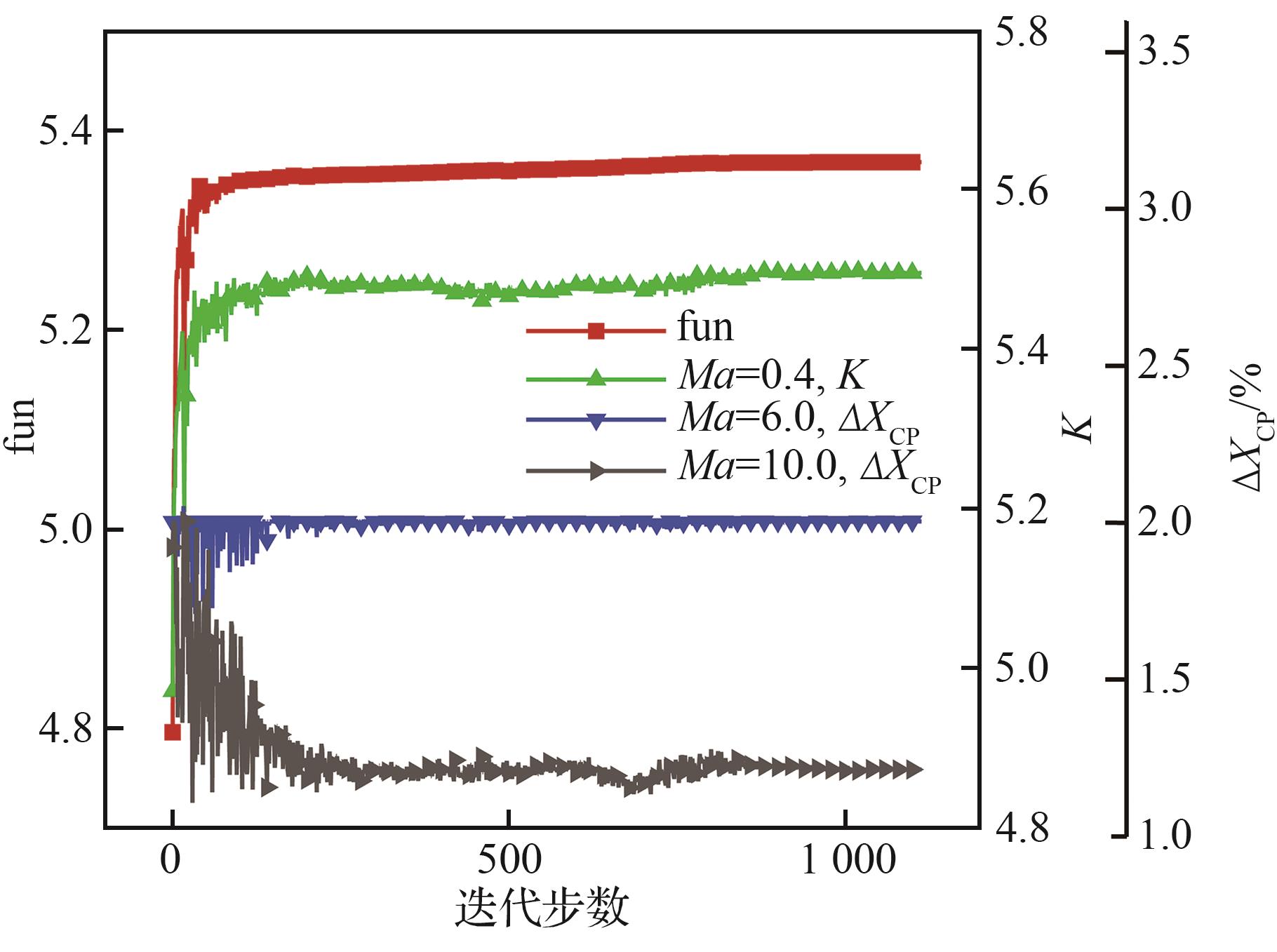
Fig.9
Convergence process of each design point
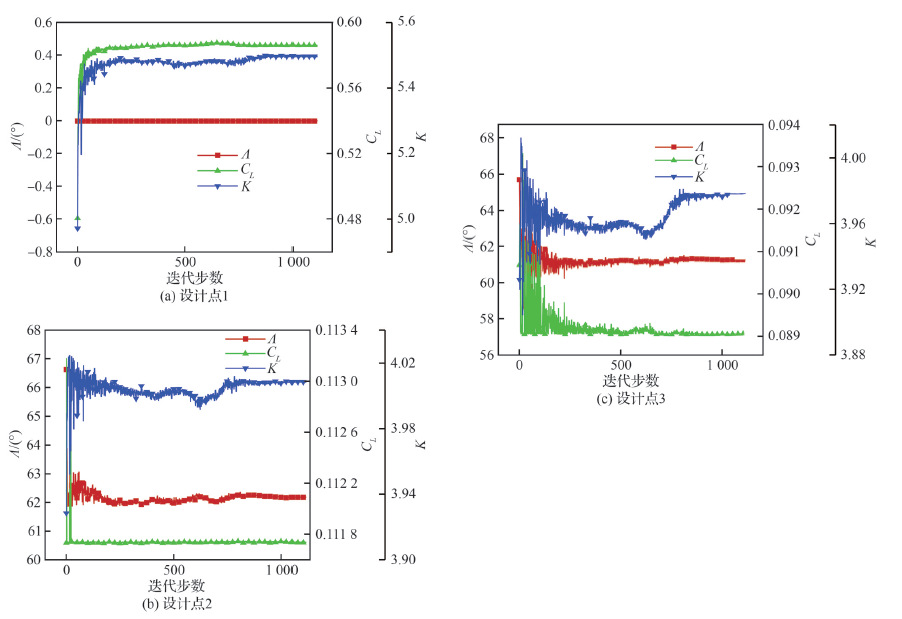
Table 6
Comparison of sweep angles of baseline and optimized configurations
| 工况 | Λ/(°) | ||
|---|---|---|---|
| Ma=0.4 | Ma=6.0 | Ma=10.0 | |
| Ori | 50 | 50 | 50 |
| 工况1 | 0 | 62.18 | 61.27 |
| 工况2 | 0 | 61.56 | 59.94 |
Fig.10
Comparison of baseline and optimized configurations
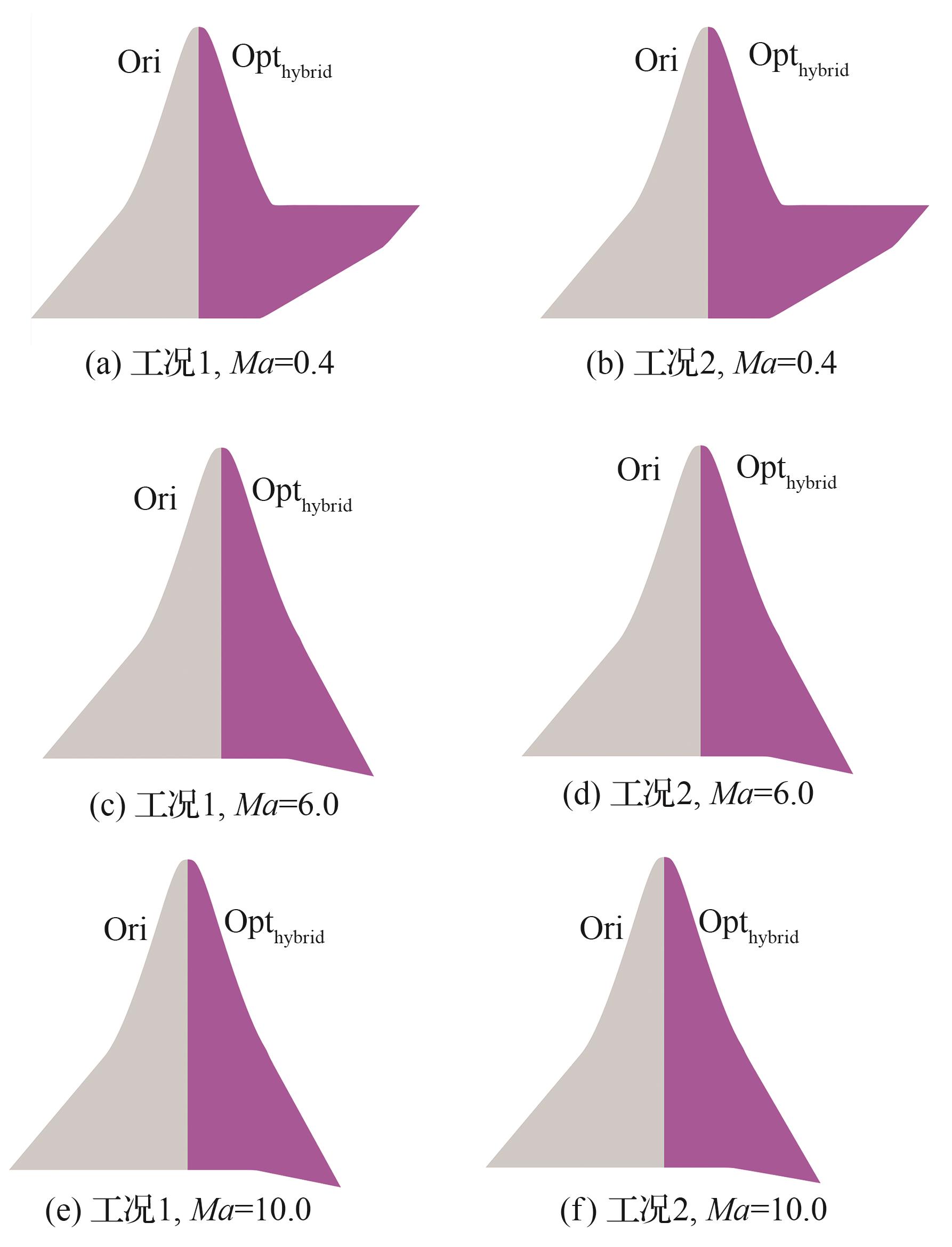
Table 7
Comparison of aerodynamic characteristics between baseline and optimized configurations
| 工况 | 构型 | Ma=0.4 | Ma=6.0 | Ma=10.0 | ||||||
|---|---|---|---|---|---|---|---|---|---|---|
| CL | CD | K | CL | K | XCP | CL | K | XCP | ||
| Ori | 0.378 0 | 0.078 2 | 4.832 3 | 0.124 1 | 3.942 0 | 0.703 4 | 0.098 9 | 3.905 8 | 0.703 3 | |
| 工况1 | Optsweep | 0.553 9 | 0.103 5 | 5.353 0 | 0.111 6 | 4.000 5 | 0.675 0 | 0.089 7 | 3.966 5 | 0.683 0 |
| Opthybrid | 0.586 0 | 0.106 7 | 5.495 8 | 0.111 9 | 4.008 4 | 0.684 1 | 0.090 1 | 3.971 3 | 0.691 2 | |
| 工况2 | Optsweep | 0.553 9 | 0.103 5 | 5.353 3 | 0.112 3 | 4.030 1 | 0.680 1 | 0.090 9 | 3.993 0 | 0.681 2 |
| Opthybrid | 0.592 9 | 0.106 9 | 5.544 8 | 0.112 2 | 3.987 9 | 0.700 1 | 0.090 5 | 3.942 4 | 0.703 4 | |
Table 8
Contribution analysis of sweep angle optimization and shape optimization
| 工况 | 马赫数 | 优化阶段 | ΔCL /% | ΔK/% | ΔXCP/% |
|---|---|---|---|---|---|
| 工况1 | 0.4 | 后掠角优化 | 46.53 | 10.78 | |
| 型面优化 | 8.49 | 2.96 | |||
| 双层优化 | 55.03 | 13.73 | |||
| 6.0 | 后掠角优化 | -10.07 | 1.48 | -2.84 | |
| 型面优化 | 0.24 | 0.2 | 0.91 | ||
| 双层优化 | -9.83 | 1.69 | -1.93 | ||
| 10.0 | 后掠角优化 | -9.30 | 1.55 | -2.03 | |
| 型面优化 | 0.40 | 0.12 | 0.82 | ||
| 双层优化 | -8.90 | 1.68 | -1.21 | ||
| 工况 2 | 0.4 | 后掠角优化 | 46.53 | 10.78 | |
| 型面优化 | 10.32 | 3.96 | |||
| 双层优化 | 56.85 | 14.74 | |||
| 6.0 | 后掠角优化 | -9.51 | 2.23 | -2.33 | |
| 型面优化 | -0.08 | -1.07 | 2.00 | ||
| 双层优化 | -9.59 | 1.16 | -0.33 | ||
| 10.0 | 后掠角优化 | -8.09 | 2.23 | -2.21 | |
| 型面优化 | -0.40 | -1.30 | 2.22 | ||
| 双层优化 | -8.49 | 0.94 | 0.01 |
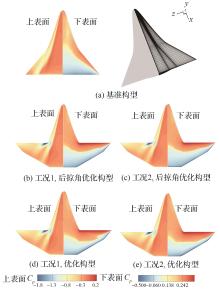
Fig.11
Comparison of Cp distribution between baseline and optimized configuration (Ma=0.4)
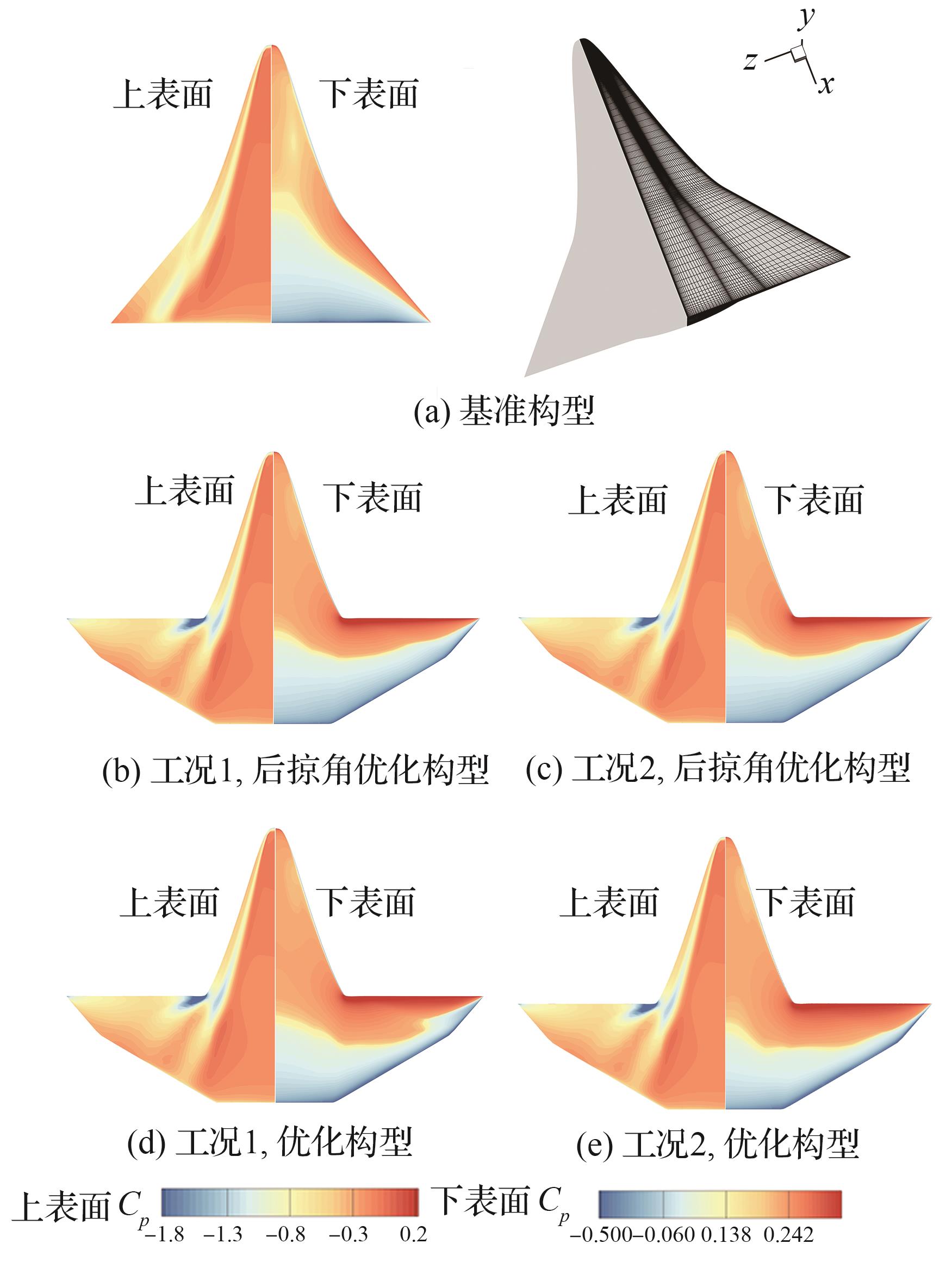
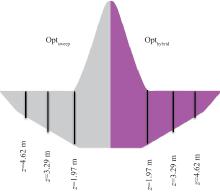
Fig.12
Spanwise station positions of each cross-section (Ma=0.4)
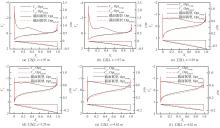
Fig.13
Comparison of Cp between Optsweep and Opthybrid for spanwise station positions of each cross-section (Ma=0.4)
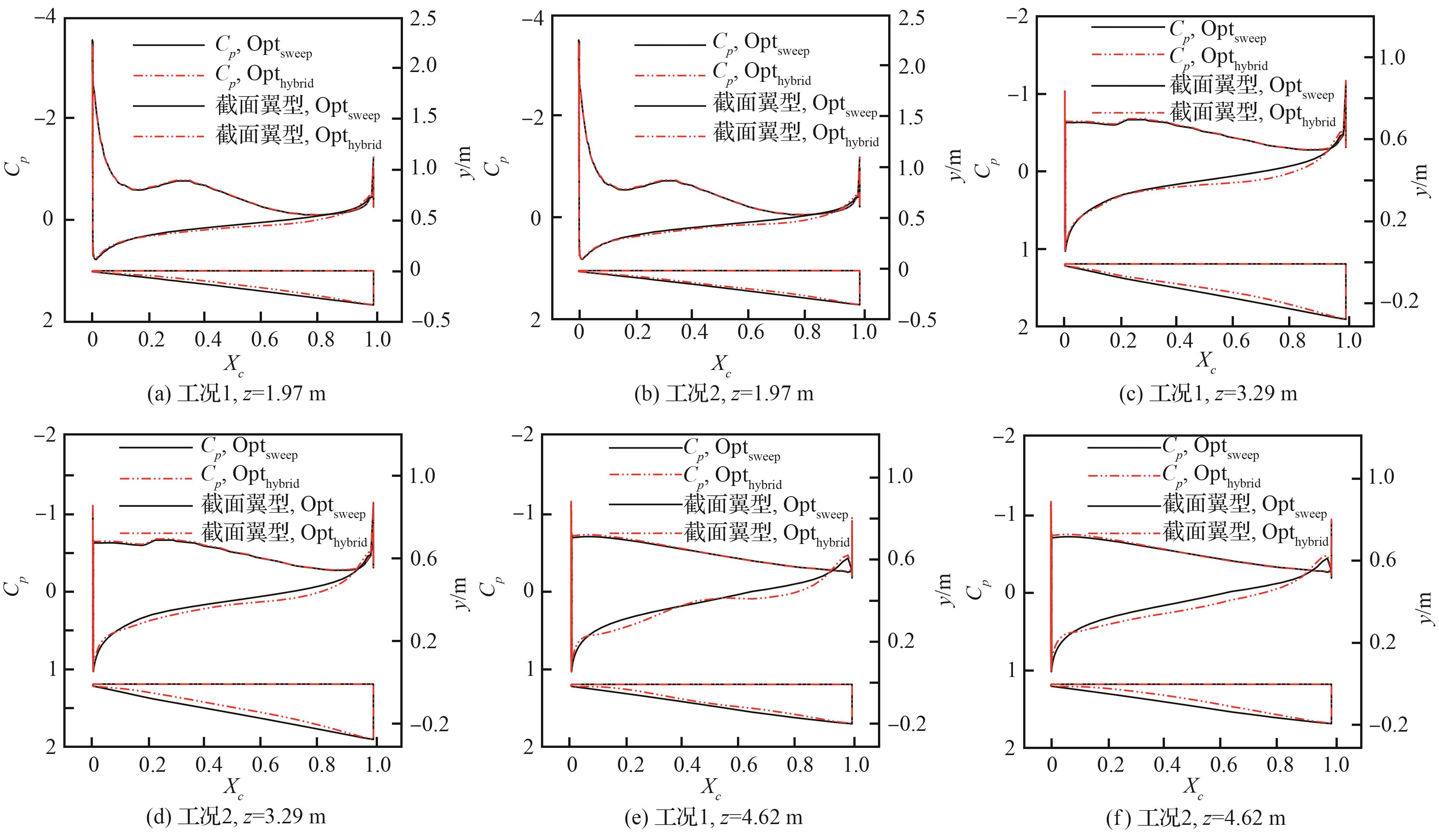
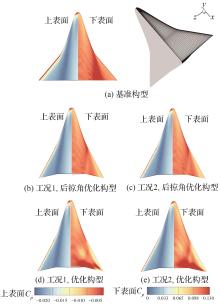
Fig.14
Comparison of Cp distribution between baseline and optimized configuration (Ma=6.0)
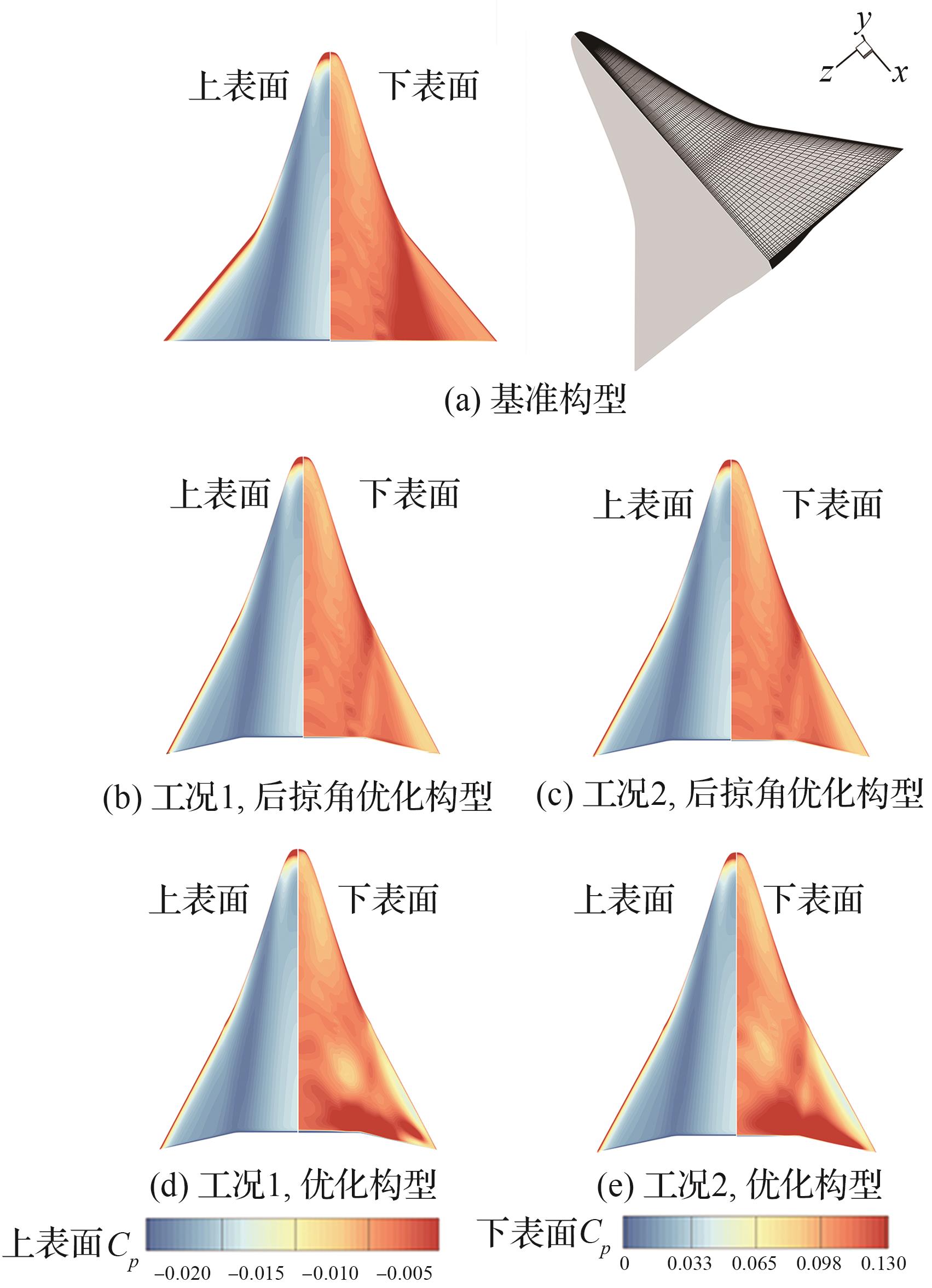
Fig.15
Spanwise station positions of each cross-section(Ma=6.0)
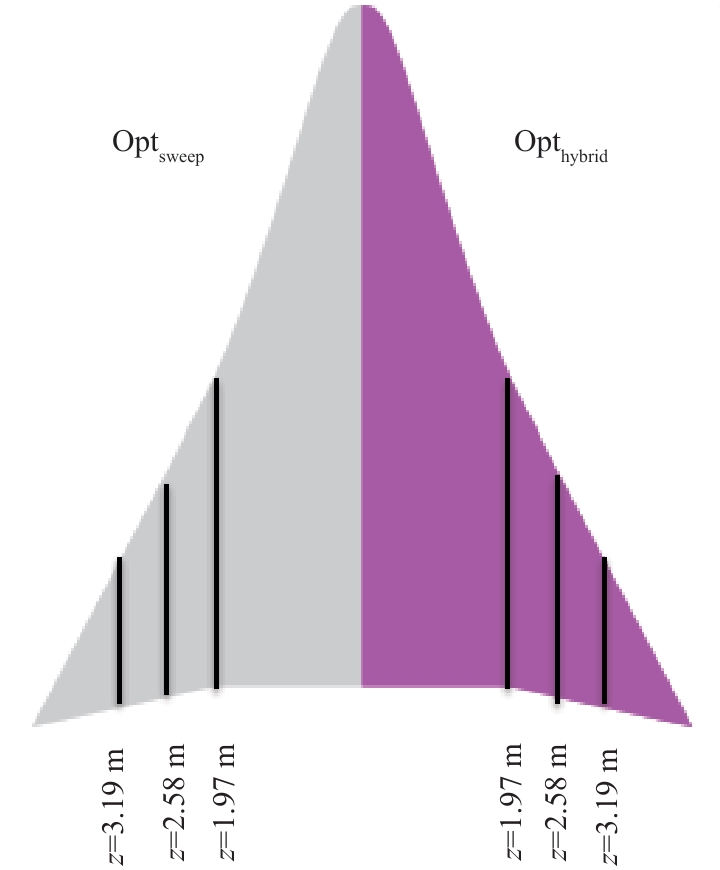
Fig.16
Comparison of Cp between Optsweep and Opthybrid for spanwise station positions of each cross-section (Ma=6.0)
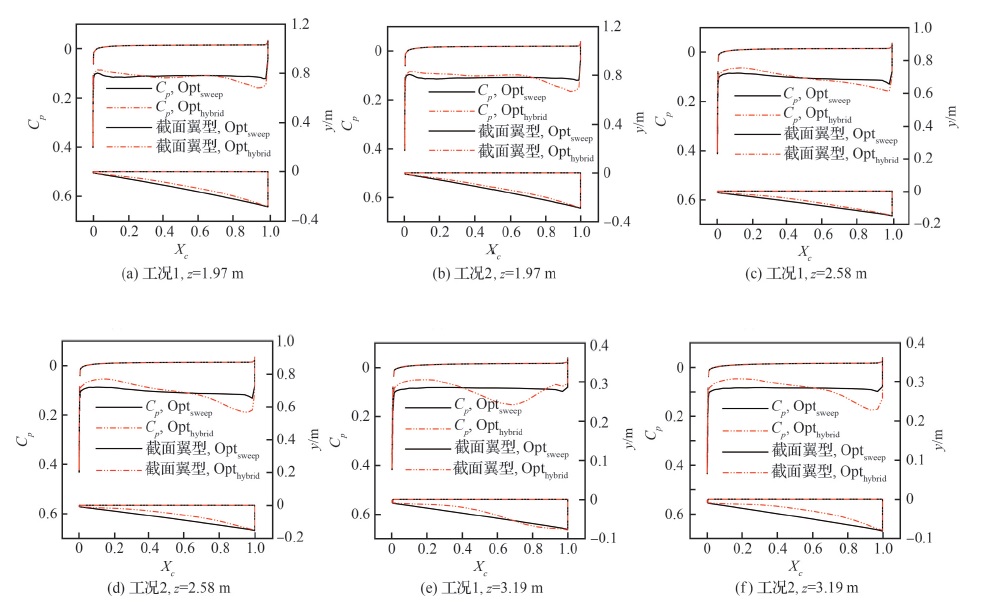
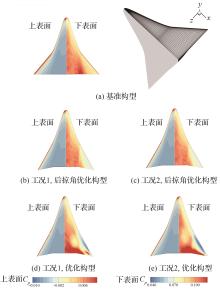
Fig.17
Comparison of Cp distribution between baseline and optimized configuration (Ma=10.0)
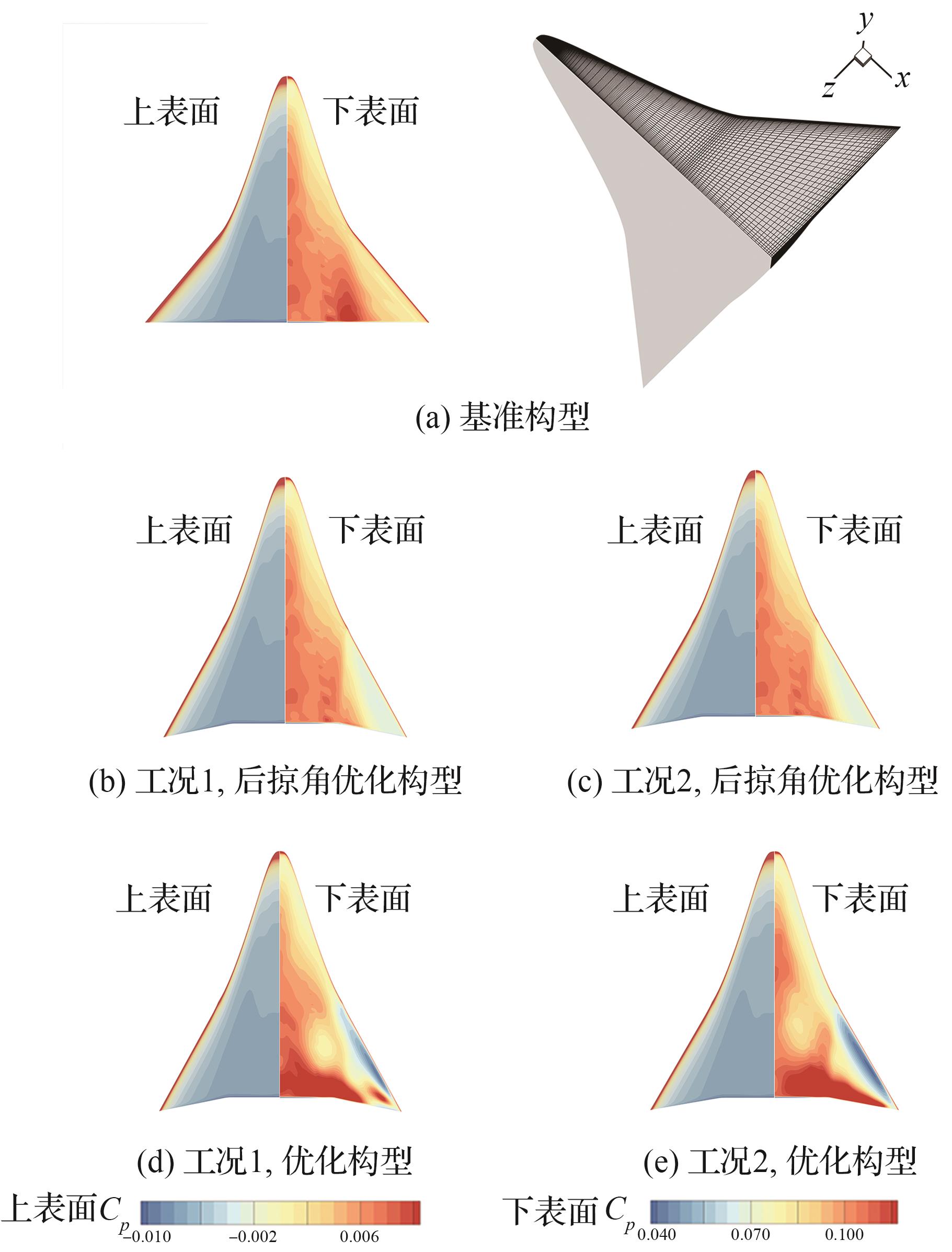
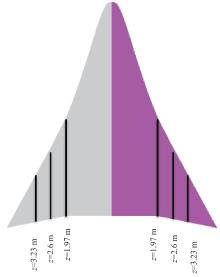
Fig.18
Spanwise station positions of each cross-section (Ma=10.0)
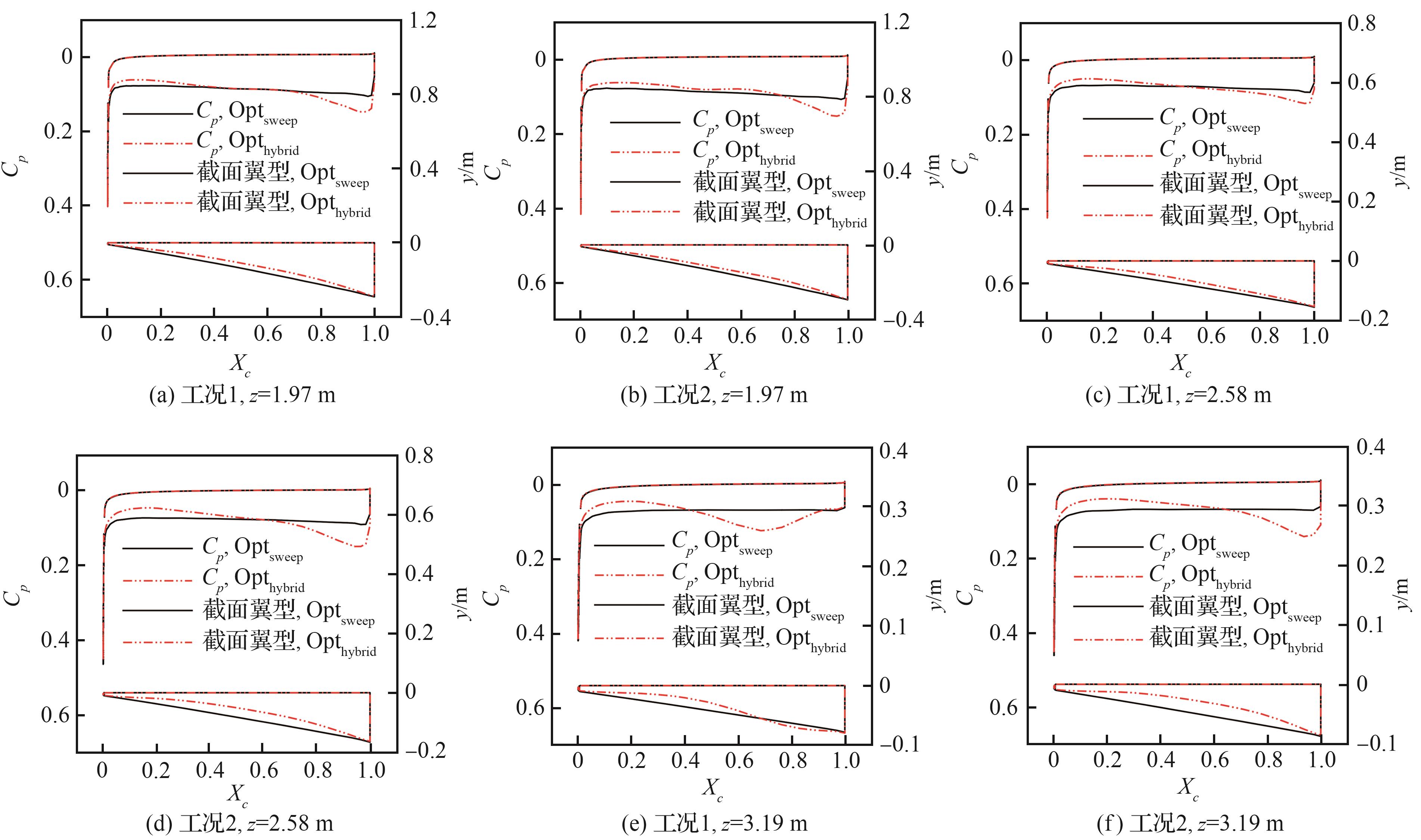
Fig.19
Comparison of Cp between Optsweep and Opthybrid for spanwise station positions of each cross-section (Ma=10.0)
| [1] | 朱继宏, 韩嘉诚, 谷小军, 等. 跨域飞行器结构与变构型设计技术进展与挑战[J]. 航空学报, 2025, 46(18): 431686. |
| ZHU J H, HAN J C, GU X J, et al. Advances and challenges in cross-domain vehicle structures and morphing configuration design technologies[J]. Acta Aeronautica et Astronautica Sinica, 2025, 46(18): 431686 (in Chinese). | |
| [2] | CHU L L, LI Q, GU F, et al. Design, modeling, and control of morphing aircraft: A review[J]. Chinese Journal of Aeronautics, 2022, 35(5): 220-246. |
| [3] | 陈树生, 贾苜梁, 刘衍旭, 等. 变体飞行器变形方式及气动布局设计关键技术研究进展[J]. 航空学报, 2024, 45(6): 629595. |
| CHEN S S, JIA M L, LIU Y X, et al. Deformation modes and key technologies of aerodynamic layout design for morphing aircraft: Review[J]. Acta Aeronautica et Astronautica Sinica, 2024, 45(6): 629595 (in Chinese). | |
| [4] | FENG C, CHEN S S, YUAN W, et al. A wide-speed-range aerodynamic configuration by adopting wave-riding-strake wing[J]. Acta Astronautica, 2023, 202: 442-452. |
| [5] | KULFAN B M. Universal parametric geometry representation method[J]. Journal of Aircraft, 2008, 45(1): 142-158. |
| [6] | 田洁华, 孙迪, 屈峰, 等. 基于CST-GAN的翼型参数化方法[J]. 航空学报, 2023, 44(18): 128280. |
| TIAN J H, SUN D, QU F, et al. Airfoil parameterization method based on CST-GAN[J]. Acta Aeronautica et Astronautica Sinica, 2023, 44(18): 128280 (in Chinese). | |
| [7] | PIEGL L, TILLER W. The NURBS book[M]. Heidelberg: Springer Berlin, 2012: 509-569. |
| [8] | SHENG C H, ALLEN C B. Efficient mesh deformation using radial basis functions on unstructured meshes[J]. AIAA Journal, 2012, 51(3): 707-720. |
| [9] | SELIM M M, KOOMULLIL R P. Mesh deformation approaches—A survey[J]. Journal of Physical Mathematics, 2016, 7(2): 1-9. |
| [10] | ZHAO Z, MA R, HE L, et al. An efficient large-scale mesh deformation method based on MPI/OpenMP hybrid parallel radial basis function interpolation[J]. Chinese Journal of Aeronautics, 2020, 33(5): 1392-1404. |
| [11] | GU X Y, CIAMPA P D, NAGEL B. An automated CFD analysis workflow in overall aircraft design applications[J]. CEAS Aeronautical Journal, 2018, 9(1): 3-13. |
| [12] | YOU K K, HA J H, LEE S C. An automated aerodynamic analysis system in missile based on open-source software[J]. International Journal of Aeronautical and Space Sciences, 2023, 24(3): 592-605. |
| [13] | 刘超宇, 屈峰, 孙迪, 等. 基于离散伴随的高超声速密切锥乘波体气动优化设计[J]. 航空学报, 2023, 44(4): 126664. |
| LIU C Y, QU F, SUN D, et al. Discretized adjoint based aerodynamic optimization design for hypersonic osculating-cone waverider[J]. Acta Aeronautica et Astronautica Sinica, 2023, 44(4): 126664 (in Chinese). | |
| [14] | DWIGHT R P, BREZILLON J. Effect of approximations of the discrete adjoint on gradient-based optimization[J]. AIAA Journal, 2006, 44(12): 3022-3031. |
| [15] | KENWAY G K W, MADER C A, HE P, et al. Effective adjoint approaches for computational fluid dynamics[J]. Progress in Aerospace Sciences, 2019, 110: 100542. |
| [16] | 高昌, 李正洲, 黄江涛, 等. 基于连续伴随方法的高超声速飞行器高精度气动优化[J]. 航空学报, 2021, 42(7): 124490. |
| GAO C, LI Z Z, HUANG J T, et al. High-accuracy aerodynamic optimization of hypersonic vehicles based on continuous adjoint[J]. Acta Aeronautica et Astronautica Sinica, 2021, 42(7): 124490 (in Chinese). | |
| [17] | 陈海昕, 邓凯文, 李润泽. 机器学习技术在气动优化中的应用[J]. 航空学报, 2019, 40(1): 522480. |
| CHEN H X, DENG K W, LI R Z. Utilization of machine learning technology in aerodynamic optimization[J]. Acta Aeronautica et Astronautica Sinica, 2019, 40(1): 522480 (in Chinese). | |
| [18] | HAN Z H, ZIMMERMANN R, GÖRTZ S. Alternative cokriging method for variable-fidelity surrogate modeling[J]. AIAA Journal, 2012, 50(5): 1205-1210. |
| [19] | GU X Y, CIAMPA P D, NAGEL B. High fidelity aerodynamic optimization in distributed overall aircraft design[C]∥17th AIAA/ISSMO Multidisciplinary Analysis and Optimization Conference. Reston: AIAA, 2016. |
| [20] | BROOKS T R, KENWAY G K W, MARTINS J R R A. Benchmark aerostructural models for the study of transonic aircraft wings[J]. AIAA Journal, 2018, 56(7): 2840-2855. |
| [21] | PHOENIX A A, MAXWELL J R, ROGERS R E. Mach 5-3.5 morphing waverider accuracy and aerodynamic performance evaluation[J]. Journal of Aircraft, 2019, 56(5): 2047-2061. |
| [22] | PHOENIX A A, ROGERS R E, MAXWELL J R, et al. Mach five to ten morphing waverider: Control point study[J]. Journal of Aircraft, 2018, 56(2): 493-504. |
| [23] | DAI P, YAN B B, HUANG W, et al. Design and aerodynamic performance analysis of a variable-sweep-wing morphing waverider[J]. Aerospace Science and Technology, 2020, 98: 105703. |
| [24] | ZHAO Z T, HUANG W, YAN B B, et al. Design and high speed aerodynamic performance analysis of vortex lift waverider with a wide-speed range[J]. Acta Astronautica, 2018, 151: 848-863. |
| [25] | 武宇飞, 龙腾, 史人赫, 等. 跨域变体飞行器气动力热非层次多模型融合降阶方法[J]. 航空学报, 2023, 44(21): 528259. |
| WU Y F, LONG T, SHI R H, et al. Non-hierarchical multi-model fusion order reduction based on aerodynamic and aerothermodynamic characteristics for cross-domain morphing aircraft[J]. Acta Aeronautica et Astronautica Sinica, 2023, 44(21): 528259 (in Chinese). | |
| [26] | FINCHAM J H S, FRISWELL M I. Aerodynamic optimisation of a camber morphing aerofoil[J]. Aerospace Science and Technology, 2015, 43: 245-255. |
| [27] | WOODS B K S, FRISWELL M I. Preliminary investigation of a fishbone active camber concept[C]∥ASME 2012 Conference on Smart Materials, Adaptive Structures and Intelligent Systems. New York: ASME, 2013. |
| [28] | DEXL F, HAUFFE A, WOLF K. Multidisciplinary multi-objective design optimization of an active morphing wing section[J]. Structural and Multidisciplinary Optimization, 2020, 62(5): 2423-2440. |
| [29] | LIU B, LIANG H, HAN Z H, et al. Surrogate-based aerodynamic shape optimization of a morphing wing considering a wide Mach-number range[J]. Aerospace Science and Technology, 2022, 124: 107557. |
| [30] | 陈树生, 冯聪, 张兆康, 等. 基于全局/梯度优化方法的宽速域乘波-机翼布局气动设计[J]. 航空学报, 2024, 45(6): 629596. |
| CHEN S S, FENG C, ZHANG Z K, et al. Aerodynamic design of wide-speed-range waverider-wing configuration based on global & gradient optimization method[J]. Acta Aeronautica et Astronautica Sinica, 2024, 45(6): 629596 (in Chinese). | |
| [31] | BOX M J. A new method of constrained optimization and a comparison with other methods[J]. The Computer Journal, 1965, 8(1): 42-52. |
| [32] | ROE P L. Approximate Riemann solvers, parameter vectors, and difference schemes[J]. Journal of Computational Physics, 1997, 135(2): 250-258. |
| [33] | CHEN R F, WANG Z J. Fast, block lower-upper symmetric Gauss-Seidel scheme for arbitrary grids[J]. AIAA Journal, 2000, 38: 2238-2245. |
| [34] | VENKATAKRISHNAN V. On the accuracy of limiters and convergence to steady state solutions[C]∥31st Aerospace Sciences Meeting. Reston: AIAA, 1993. |
| [35] | KERMANI M, PLETT E. Modified entropy correction formula for the Roe scheme[C]∥39th Aerospace Sciences Meeting and Exhibit. Reston: AIAA, 2001. |
| [36] | MENTER F R. Two-equation eddy-viscosity turbulence models for engineering applications[J]. AIAA Journal, 1994, 32(8): 1598-1605. |
| [37] | SEDERBERG T W, PARRY S R. Free-form deformation of solid geometric models[C]∥Proceedings of the 13th Annual Conference on Computer Graphics and Interactive Techniques. New York: ACM, 1986. |
| [38] | WITTEVEEN J, BIJL H. Explicit mesh deformation using inverse distance weighting interpolation[C]∥19th AIAA Computational Fluid Dynamics. Reston: AIAA, 2009. |
| [39] | SEEGER M. Gaussian processes for machine learning[J]. International Journal of Neural Systems, 2004, 14(02): 69-106. |
| [40] | KRIGE D G. A statistical approach to some basic mine valuation problems on the Witwatersrand[J]. Journal of the Southern African Institute of Mining and Metallurgy, 1951, 52(6): 119-139. |
| [41] | MCKAY M D, BECKMAN R J, CONOVER W J. A comparison of three methods for selecting values of input variables in the analysis of output from a computer code[J]. Technometrics, 2000, 42(1): 55-61. |
| [42] | LIU C Z, BAI P, WANG J F, et al. Osculating-cone waverider design by customizing the planform shape of leading edge[J]. Chinese Journal of Theoretical and Applied Mechanics, 2019, 51(4): 991-997. |
| [1] | Hao YUAN, Jiaqing KOU, Weiwei ZHANG. A resolvent-analysis-based optimization design method for airfoils at low Reynolds number [J]. Acta Aeronautica et Astronautica Sinica, 2026, 47(5): 132452-132452. |
| [2] | Jiaqi LIU, Rongqian CHEN, Jinhua LOU, Xu HAN, Hao WU, Yancheng YOU. Aerodynamic shape optimization of high-speed helicopter rotor airfoil based on deep learning [J]. Acta Aeronautica et Astronautica Sinica, 2024, 45(9): 529828-529828. |
| [3] | Wentao LI, Yunqin HE, Wenbo LI, Yiyi ZHANG, Guozhu LIANG. 3D grain reverse design and shape optimization for solid rocket motor [J]. Acta Aeronautica et Astronautica Sinica, 2024, 45(11): 529089-529089. |
| [4] | Jing YU, Anlin JIANG, Liang LIU, Xiaojun WU, Yewei GUI, Shenshen LIU. PCA aerodynamic geometry parametrization method [J]. Acta Aeronautica et Astronautica Sinica, 2024, 45(10): 129125-129125. |
| [5] | Yufei WU, Teng LONG, Renhe SHI, Yao ZHANG. Non⁃hierarchical multi⁃model fusion order reduction based on aerodynamic and aerothermodynamic characteristics for cross⁃domain morphing aircraft [J]. Acta Aeronautica et Astronautica Sinica, 2023, 44(21): 528259-528259. |
| [6] | YE Shuran, ZHANG Zhen, WANG Yiwei, HUANG Chenguang. Progress in deep convolutional neural network based flow field recognition and its applications [J]. ACTA AERONAUTICAET ASTRONAUTICA SINICA, 2021, 42(4): 524736-524736. |
| [7] | HAN Zhonghua, XU Chenzhou, QIAO Jianling, LIU Fei, CHI Jiangbo, MENG Guanyu, ZHANG Keshi, SONG Wenping. Recent progress of efficient global aerodynamic shape optimization using surrogate-based approach [J]. ACTA AERONAUTICAET ASTRONAUTICA SINICA, 2020, 41(5): 623344-623344. |
| [8] | WEI Qi, LI Chunna, GU Liangxian, GONG Chunlin. An efficient mesh deformation method based on radial basis functions and peak-selection method [J]. ACTA AERONAUTICAET ASTRONAUTICA SINICA, 2016, 37(7): 2156-2169. |
| [9] | TANG Jing, DENG Youqi, MA Mingsheng, LI Bin. Parameterization and grid deformation techniques for flying-wing aerodynamic optimization [J]. ACTA AERONAUTICAET ASTRONAUTICA SINICA, 2015, 36(5): 1480-1490. |
| [10] | ZHANG Ming, LIU Wenbin, LI Chuang, NIE Hong. Optimization-driven design method of landing gear structure [J]. ACTA AERONAUTICAET ASTRONAUTICA SINICA, 2015, 36(3): 857-864. |
| [11] | SUN Shiping, HU Jiantang, ZHANG Weihong. Shape optimization of openings on rotation shells based on super-elliptic function and sequential response surface method [J]. ACTA AERONAUTICAET ASTRONAUTICA SINICA, 2015, 36(11): 3595-3607. |
| [12] | LI Bin, TANG Jing, DENG Youqi, ZHANG Yaobing. Application of Parallel Multigrid Algorithm to Discrete Adjoint Optimization [J]. ACTA AERONAUTICAET ASTRONAUTICA SINICA, 2014, 35(8): 2091-2101. |
| [13] | LI Bin, DENG Youqi, TANG Jing, LV Hongying. Discrete Adjoint Optimization Method for 3D Unstructured Grid [J]. ACTA AERONAUTICAET ASTRONAUTICA SINICA, 2014, 35(3): 674-686. |
| [14] | GUAN Xiaohui, SONG Bifeng, LI Zhanke. Extended Far-field Composite Element Supersonic Wing-body Wave Drag Optimization Method [J]. ACTA AERONAUTICAET ASTRONAUTICA SINICA, 2013, 34(5): 1036-1045. |
| [15] | GUAN Xiaohui, SONG Bifeng, LI Zhanke. Comparative Study of Two Supersonic Wing-body Wave Drag Optimization Methods [J]. ACTA AERONAUTICAET ASTRONAUTICA SINICA, 2013, 34(11): 2510-2519. |
| Viewed | ||||||
|
Full text |
|
|||||
|
Abstract |
|
|||||
Address: No.238, Baiyan Buiding, Beisihuan Zhonglu Road, Haidian District, Beijing, China
Postal code : 100083
E-mail:hkxb@buaa.edu.cn
Total visits: 6658907 Today visits: 1341All copyright © editorial office of Chinese Journal of Aeronautics
All copyright © editorial office of Chinese Journal of Aeronautics
Total visits: 6658907 Today visits: 1341

 CJA
CJA
