Acta Aeronautica et Astronautica Sinica ›› 2026, Vol. 47 ›› Issue (5): 132462.doi: 10.7527/S1000-6893.2026.32462
• Fluid Mechanics and Flight Mechanics • Previous Articles
Qingzong LIU, Mingsong DING, Weizhong DONG( ), Wenhui KONG, Tao JIANG
Received:2025-06-24
Revised:2025-08-01
Accepted:2025-08-21
Online:2025-09-08
Published:2025-09-08
Contact:
Weizhong DONG
E-mail:dongwz1966@163.com
Supported by:CLC Number:
Qingzong LIU, Mingsong DING, Weizhong DONG, Wenhui KONG, Tao JIANG. Numerical computation on aerothermal environment with mass injection for high-speed aircraft[J]. Acta Aeronautica et Astronautica Sinica, 2026, 47(5): 132462.

Table 1
Chemical reaction model
| 序号 | 反应模型 | 序号 | 反应模型 |
|---|---|---|---|
| 1 | N2+M=N+N+M | 16 | CO+C=C2+O |
| 2 | O2+M=O+O+M | 17 | C+N2=CN+N |
| 3 | NO+M=N+O+M | 18 | CN+C=C2+N |
| 4 | CO2+M=CO+O+M | 19 | CO+N=CN+O |
| 5 | C2+M=C+C+M | 20 | CO+N=C+NO |
| 6 | CO+M=C+O+M | 21 | CO+CO=CO2+C |
| 7 | CN+M=C+N+M | 22 | CO+CO=C2+O2 |
| 8 | H2O+M=H+OH+M | 23 | NO+CO=CO2+N |
| 9 | H2+M=H+H+M | 24 | N2+O2=NO+NO |
| 10 | OH+M=O+H+M | 25 | CO+OH=CO2+H |
| 11 | NO+O=N+O2 | 26 | H2+OH=H2O+H |
| 12 | N2+O=NO+N | 27 | H+O2=OH+O |
| 13 | CO+O=O2+C | 28 | H2+O=OH+H |
| 14 | CN+O=NO+C | 29 | OH+OH=H2O+O |
| 15 | CO2+O=O2+CO |
Table 2
Physical-chemical data
| 物质 | Mi / (g·mol-1) | θV,m /K | gi,m | g0,i | g1,i | θei /K | ∆h |
|---|---|---|---|---|---|---|---|
| N2 | 28 | 3 395 | 1 | 1 | 3 | 72 250 | 0 |
| O2 | 32 | 2 239 | 1 | 3 | 2 | 11 390 | 0 |
| NO | 30 | 2 817 | 1 | 4 | 8 | 55 850 | 0.913 |
| CO2 | 44 | 1 903 945 3 329 | 1 2 1 | 1 1 1 | 2 2 2 | 66 200 66 200 66 200 | -3.94 -3.94 -3.94 |
| C2 | 24 | 2 362 | 1 | 6 | 6 | 27 800 | 8.30 |
| CO | 28 | 3 074 | 1 | 1 | 6 | 70 060 | -1.11 |
| CN | 26 | 2 976 | 1 | 2 | 4 | 13 300 | 4.39 |
| H2O | 18 | 2 295 5 264 5 404 | 1 1 1 | 2 2 2 | 2 2 2 | 77 420 77 420 77 420 | -2.42 -2.42 -2.42 |
| H2 | 2 | 6 326 | 1 | 1 | 1 | 131 940 | 0 |
| OH | 17 | 5 375 | 1 | 4 | 2 | 47 030 | 0.373 |
| C | 12 | 0 | 1 | 9 | 5 | 14 670 | 7.17 |
| H | 1 | 0 | 1 | 2 | 6 | 118 370 | 2.18 |
| N | 14 | 0 | 1 | 4 | 10 | 27 670 | 4.73 |
| O | 16 | 0 | 1 | 9 | 5 | 22 850 | 2.49 |
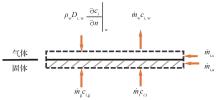
Fig.1
Schematic diagram of mass flux conservation at gas-solid interface
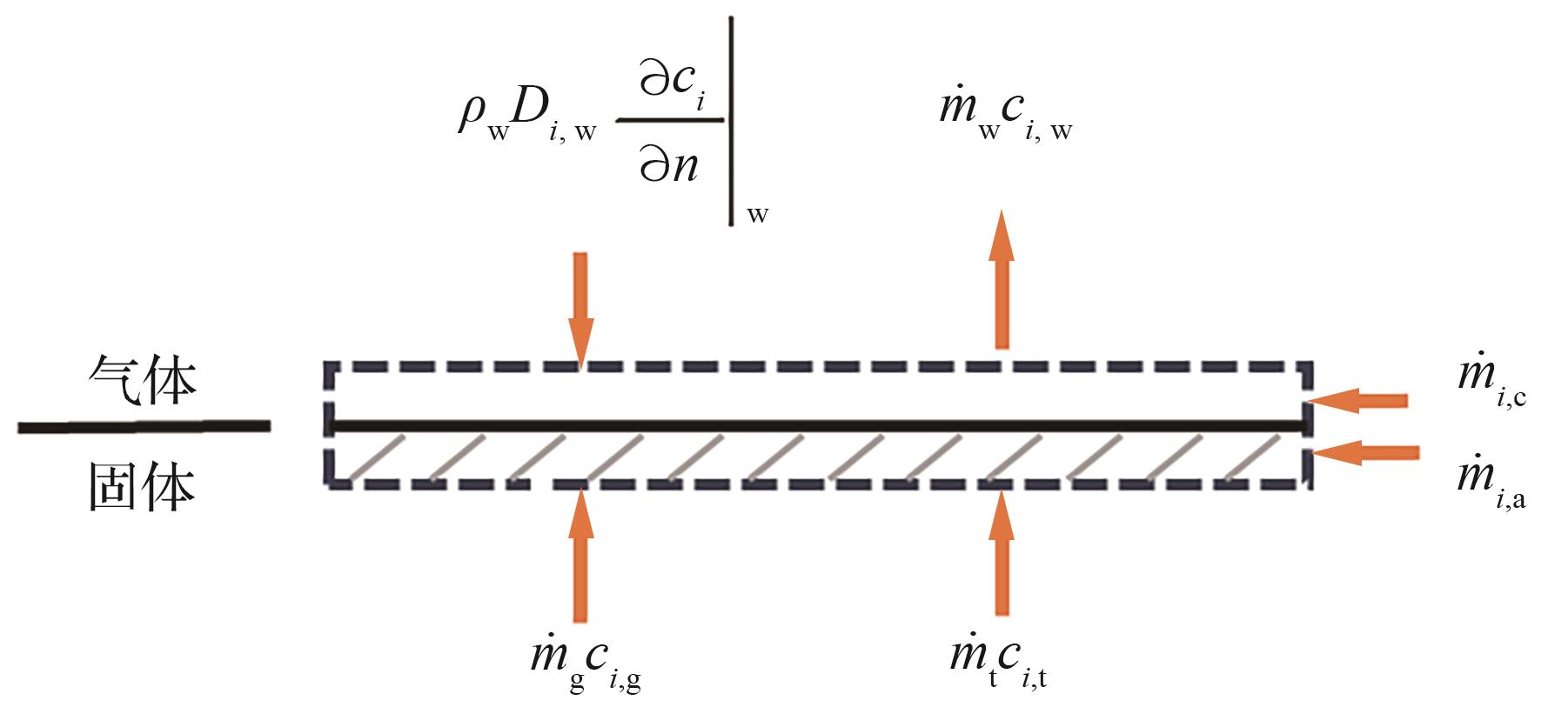
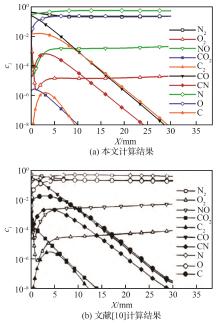
Fig.2
Comparison of mass fraction distribution along stagnation line for sphere
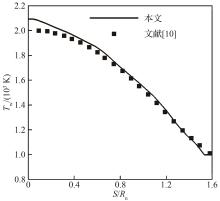
Fig.3
Comparison of surface temperature for sphere
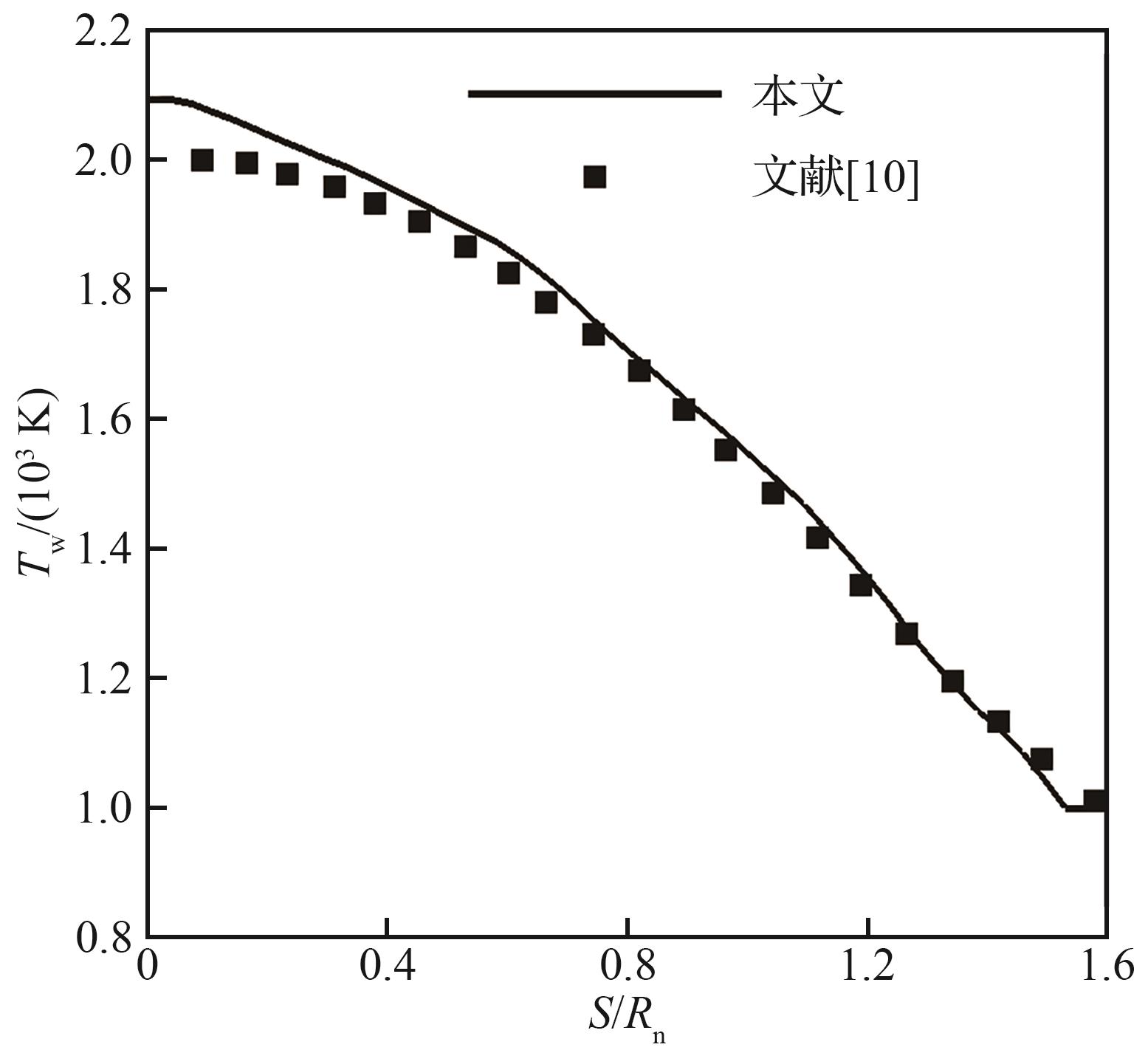
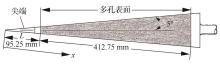
Fig.4
Cone model in Ames 3.5 ft wind tunnel[42]
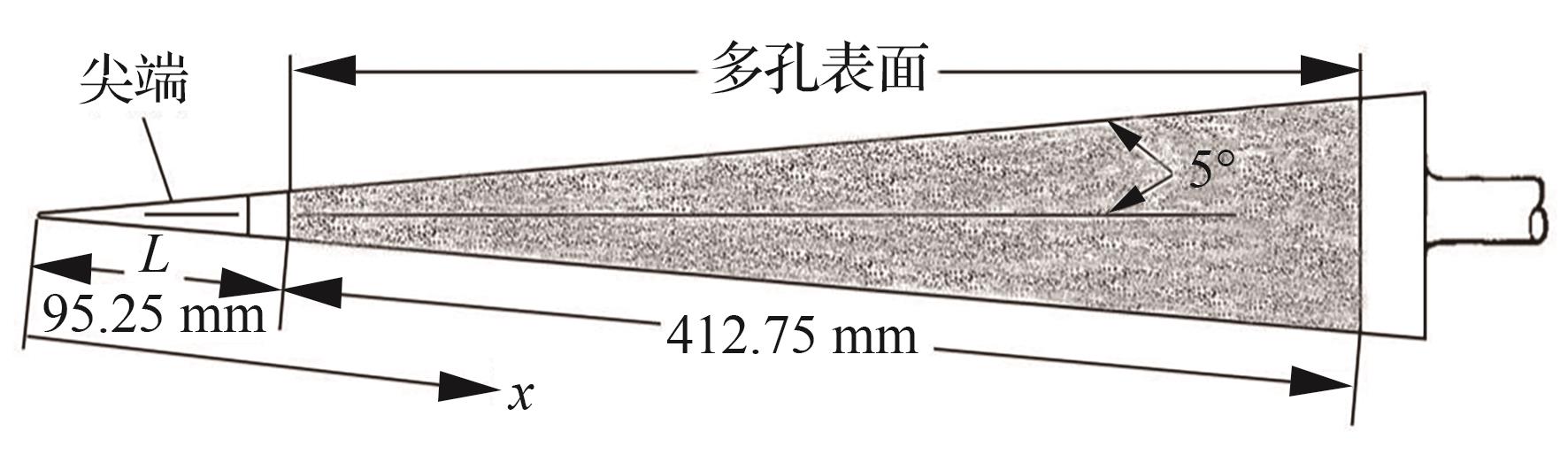
Fig.5
Comparison of calculated heat flux and experimental data for cone model
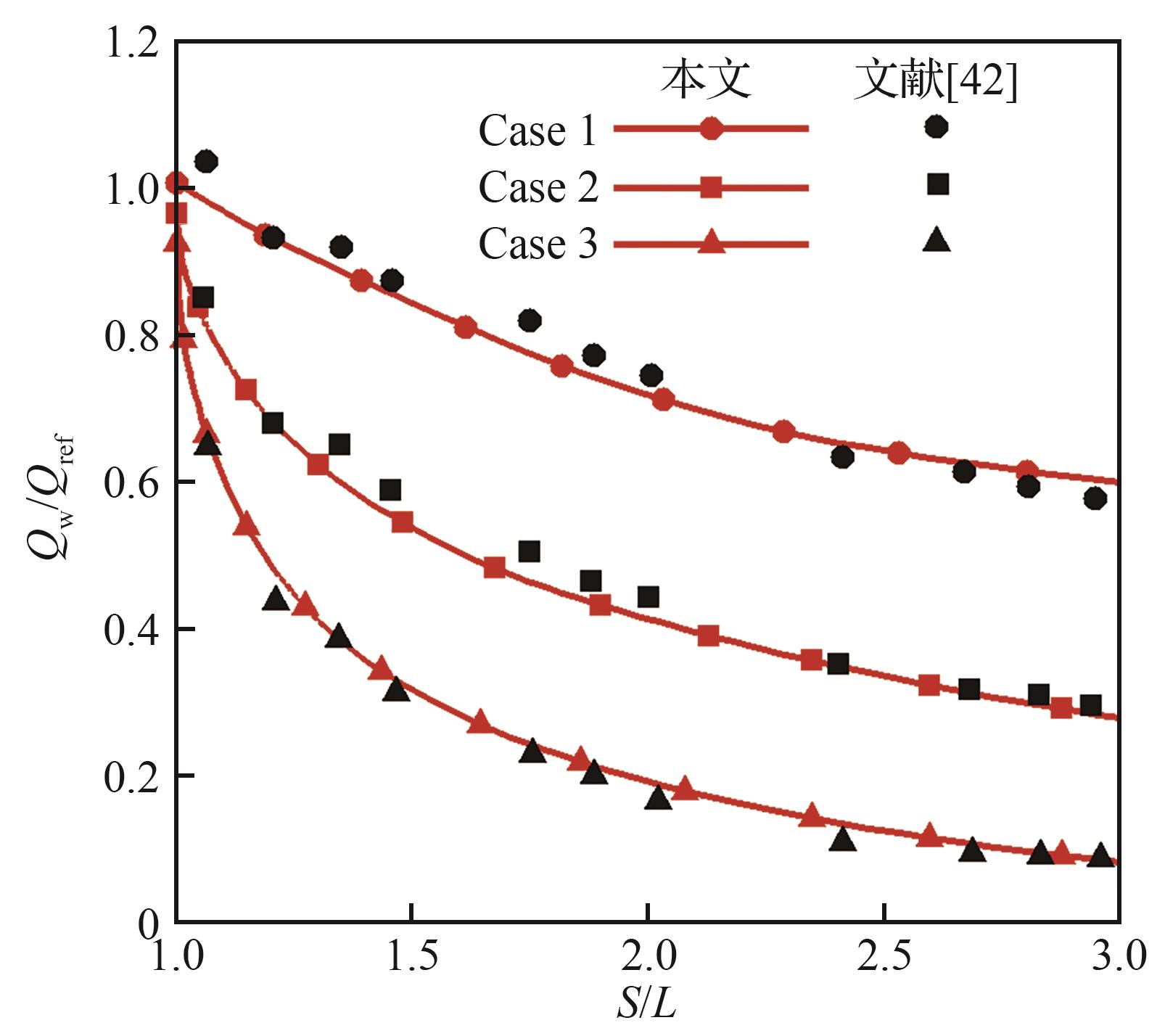
Fig.6
Schematic diagram of energy flux conservation at gas-solid interface in traditional wall conditions without mass injection
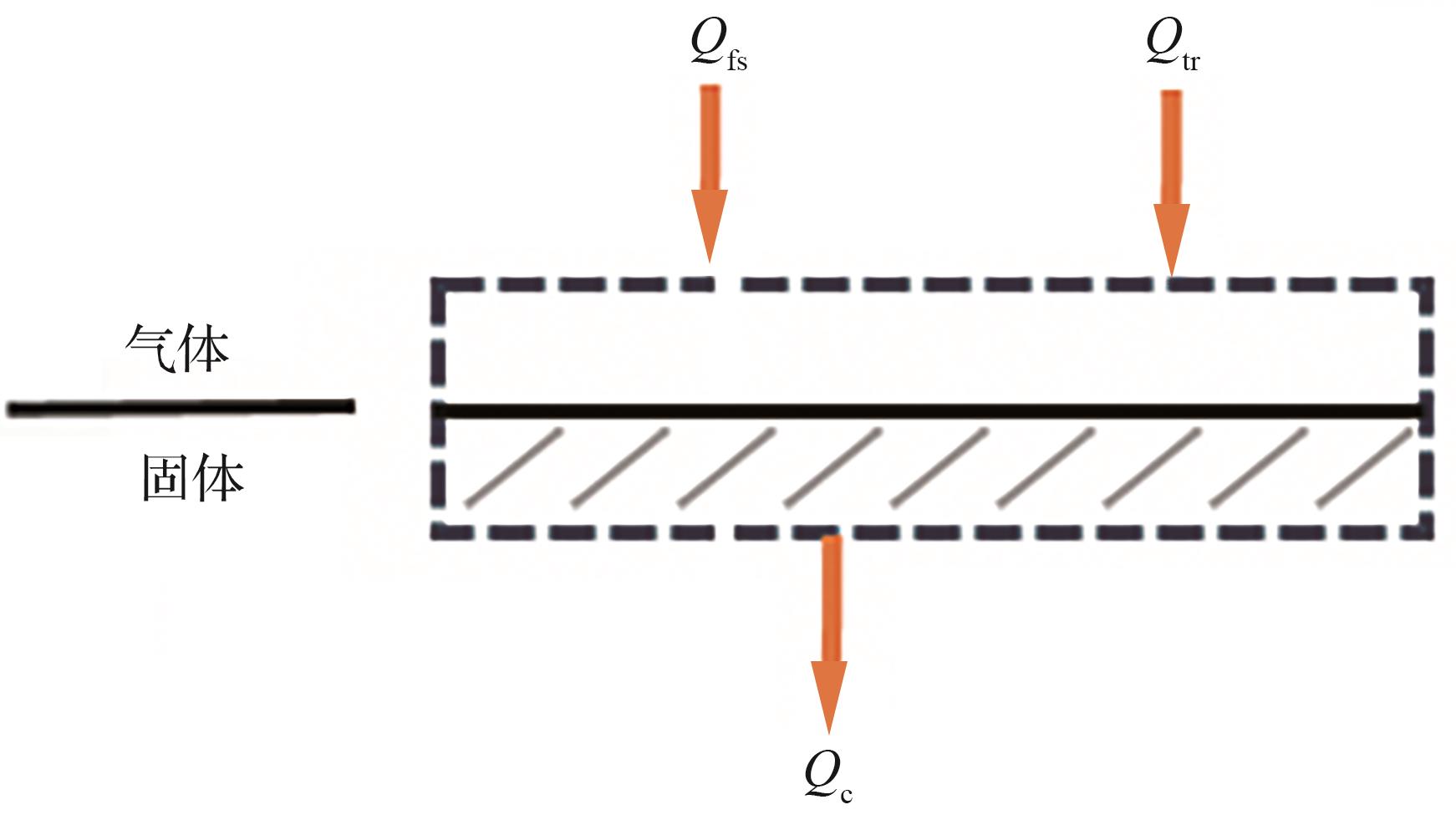
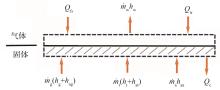
Fig.7
Schematic diagram of energy flux conservation at gas-solid interface considering comprehensive wall effects
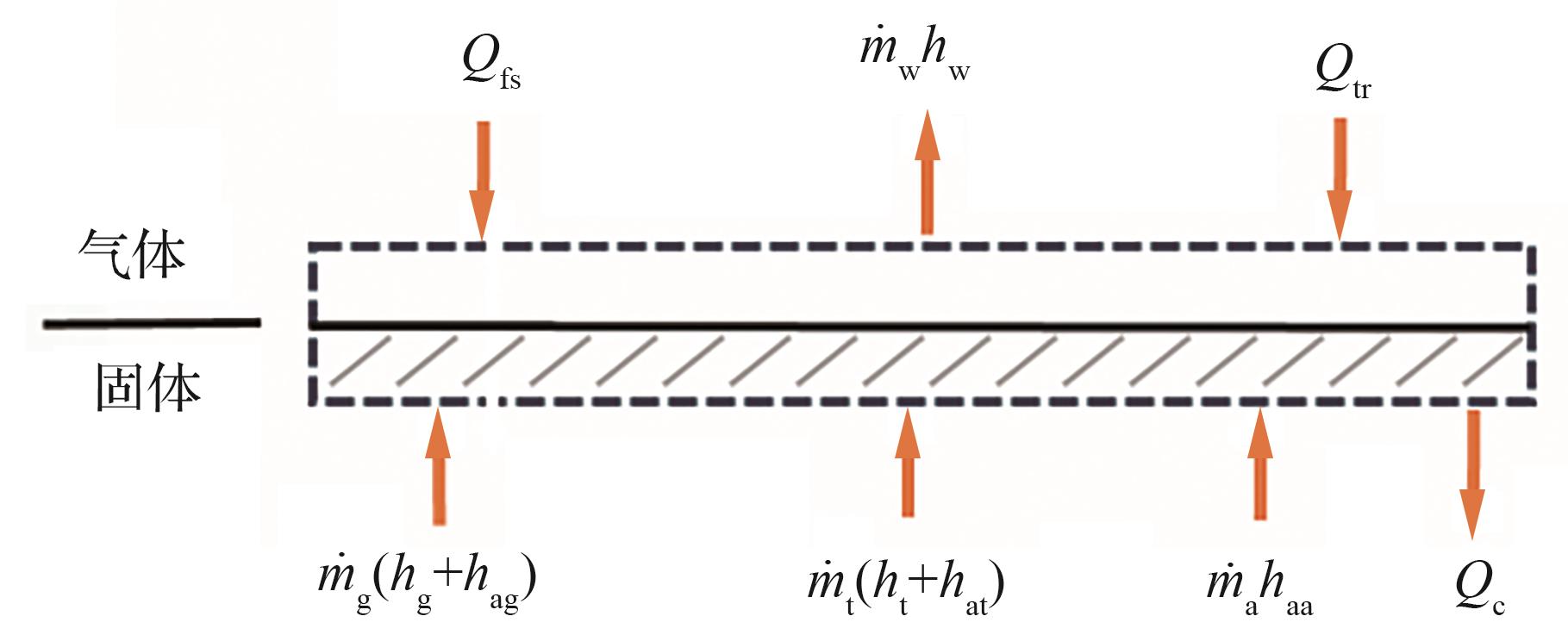
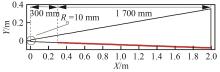
Fig.8
Schematic diagram of blunt wedge shape
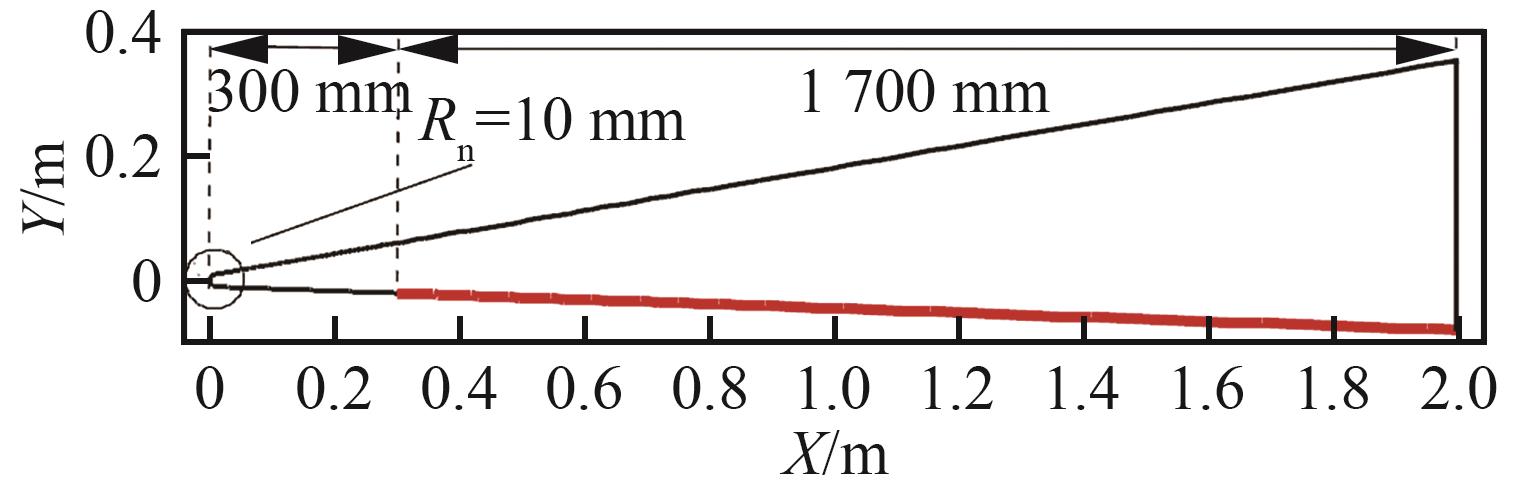
Table 3
Calculation conditions in special wall effect area of blunt wedge
| Case | 计算模型 | 特殊效应区域壁面条件 |
|---|---|---|
| 1 | 完全气体 | 无引射 |
| 2 | 完全气体 | 空气引射 |
| 3 | 真实气体 | 非催化、无引射 |
| 4 | 真实气体 | 非催化、二氧化碳引射 |
| 5 | 真实气体 | 非催化、空气引射 |
| 6 | 真实气体 | 非催化、水蒸气引射 |
| 7 | 真实气体 | 非催化、热解气体引射 |
| 8 | 真实气体 | 空气有限催化、无引射 |
| 9 | 真实气体 | 空气有限催化、水蒸气引射 |
| 10 | 真实气体 | 碳碳材料烧蚀、无主动引射 |
| 11 | 真实气体 | 碳碳材料烧蚀、水蒸气引射 |
Table 4
Components and physical chemistry properties of injection gas
| 参数 | 引射工质 | CO2 | Air | H2O | Gas |
|---|---|---|---|---|---|
组分质量 占比 | CO2 | 1 | 0 | 0 | 0.010 6 |
| N2 | 0 | 0.77 | 0 | 0 | |
| O2 | 0 | 0.23 | 0 | 0 | |
| H2O | 0 | 0 | 1 | 0.702 1 | |
| CO | 0 | 0 | 0 | 0.042 6 | |
| H2 | 0 | 0 | 0 | 0.244 7 | |
| 摩尔质量/(g·mol-1) | 44.00 | 28.83 | 18.00 | 6.13 | |
| 引射总焓/(106 J·kg-1) | -7.34 | 1.64 | -1.06 | -2.17 | |
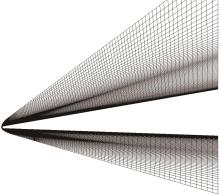
Fig.9
Calculation grid of blunt wedge
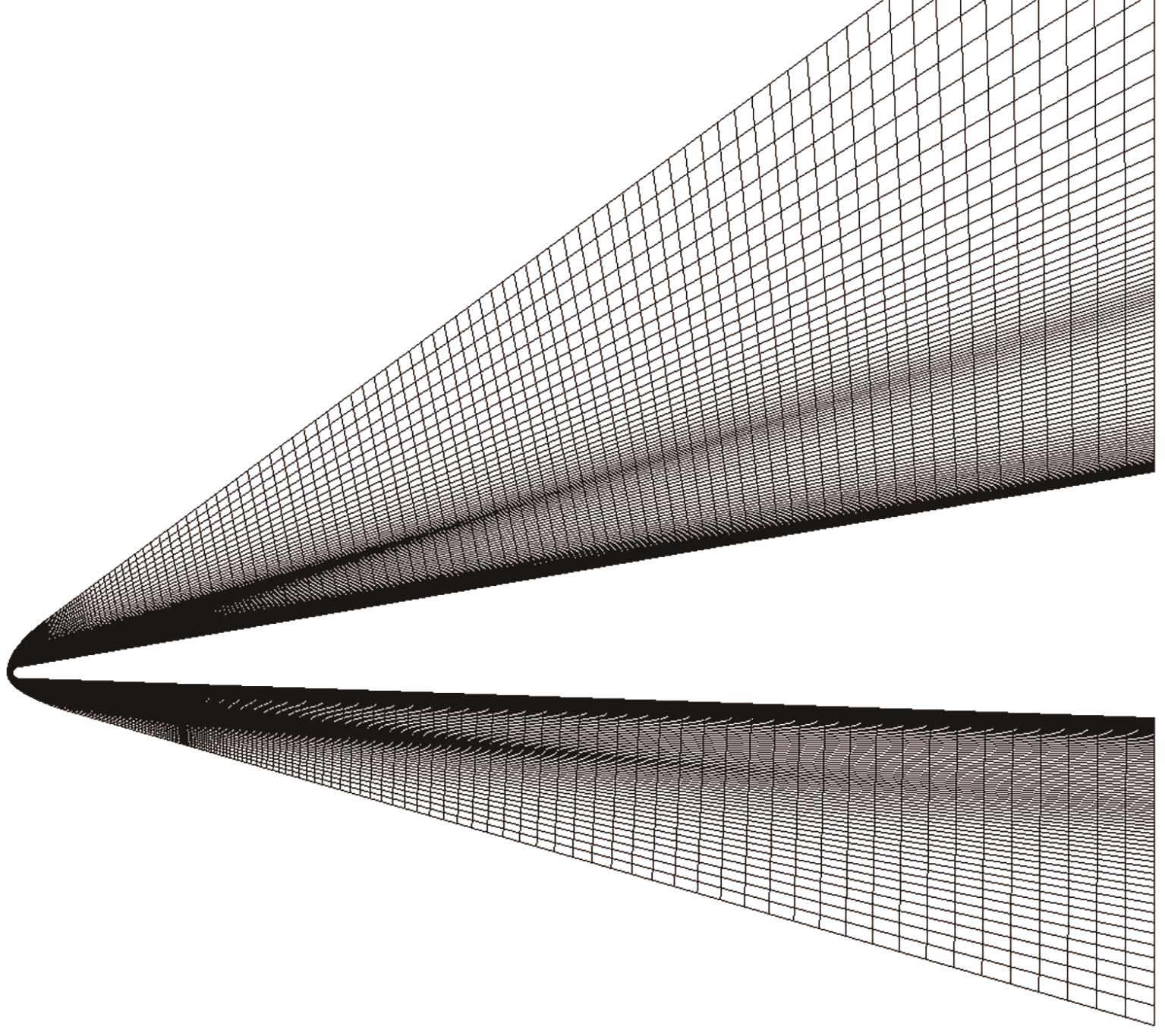
Table 5
Grid parameter setup
| 网格 | Nx ×Ny | ∆x/mm | ReGrid |
|---|---|---|---|
| Grid 1 | 201×56 | 0.20~0.67 | 17.00~55.00 |
| Grid 2 | 381×91 | 0.02~0.10 | 1.70~8.30 |
| Grid 3 | 381×96 | 0.01~0.05 | 0.83~4.10 |
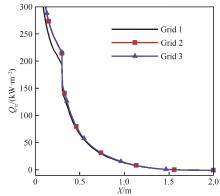
Fig.10
Heat flux distribution on wall calculated with different grids
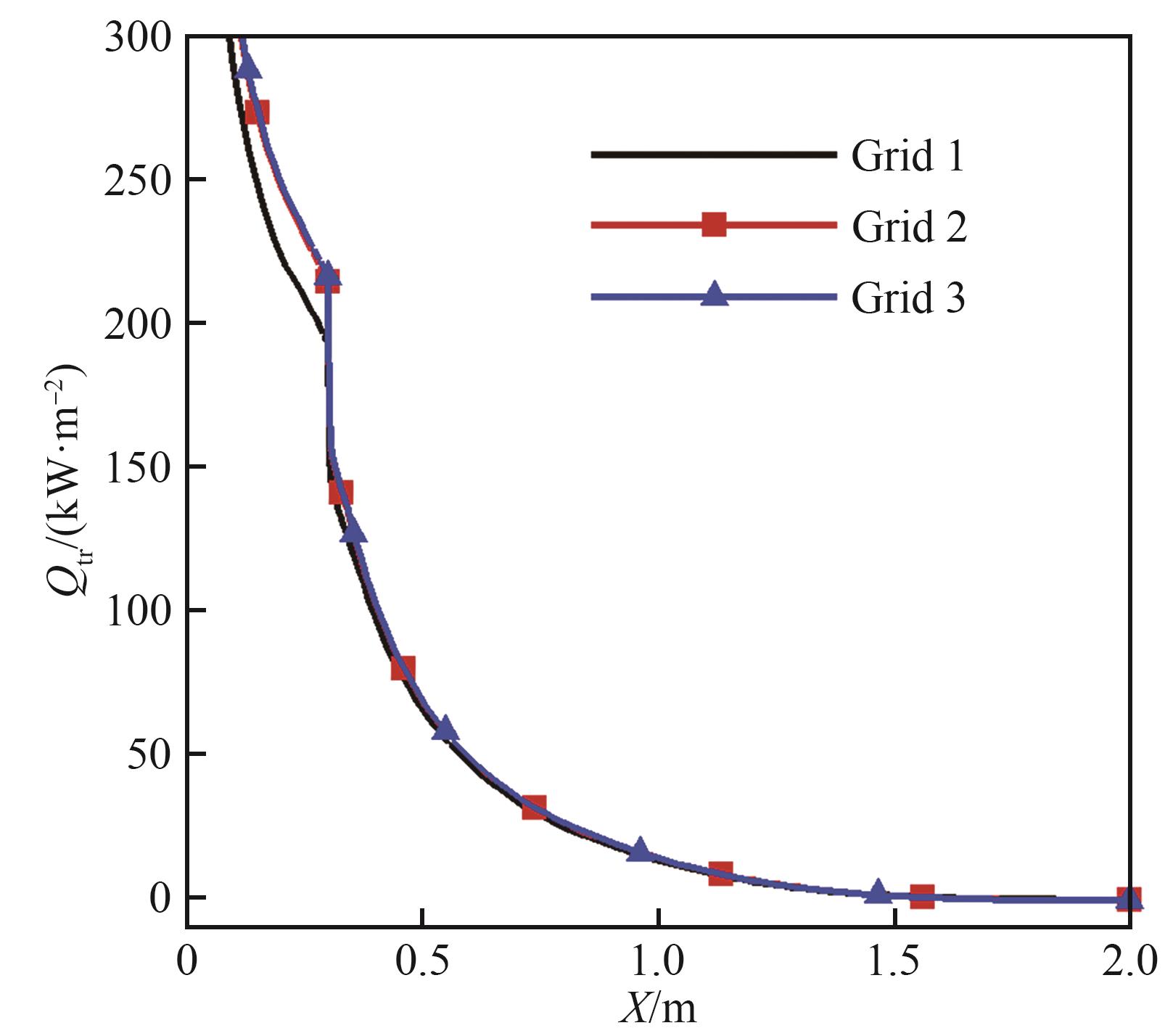
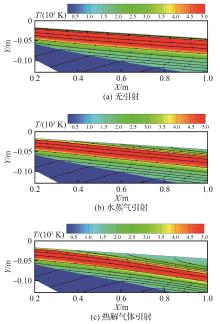
Fig.11
Contour of temperature and streamline distribution on plane of symmetry
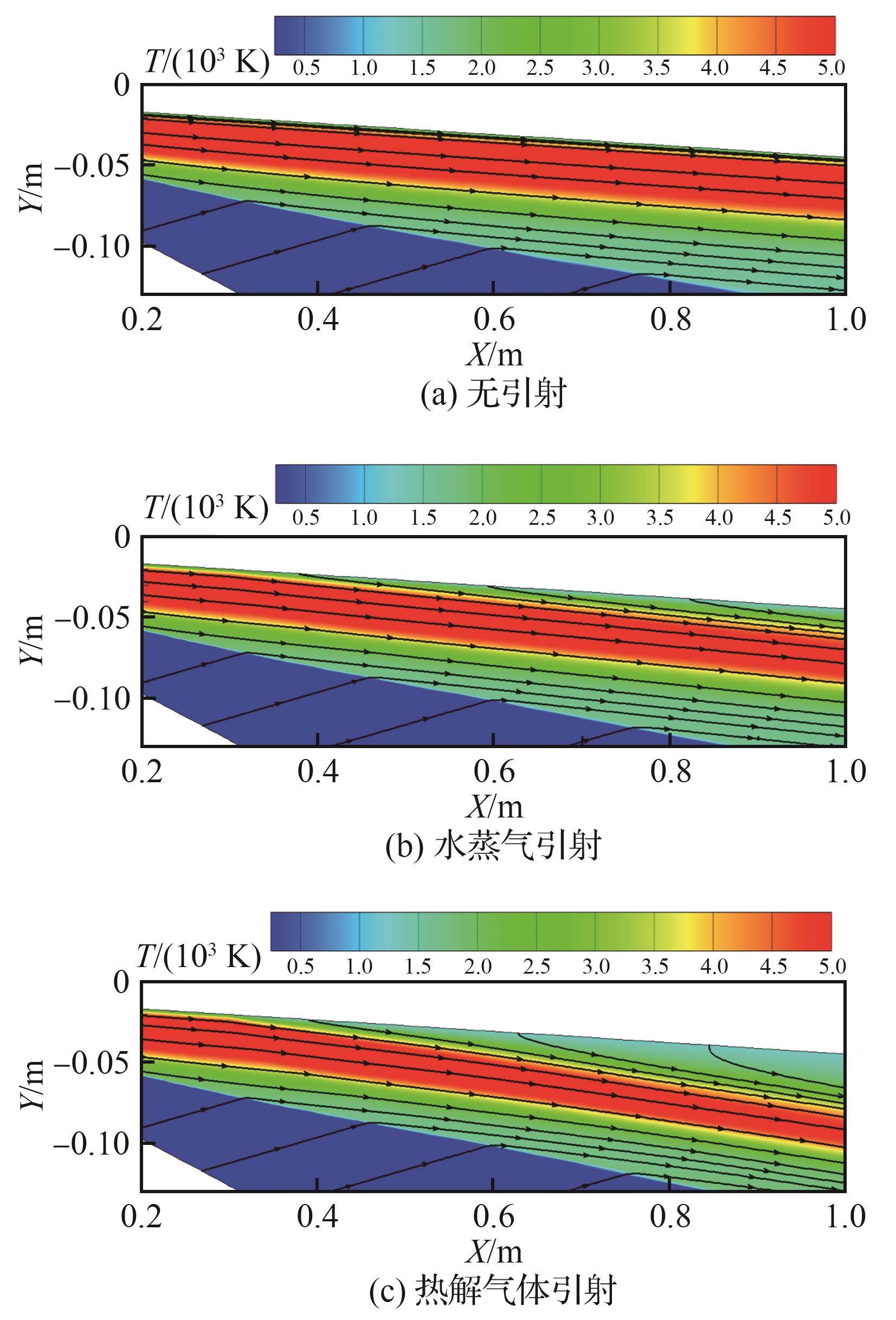
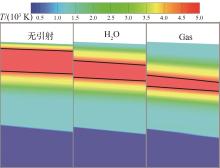
Fig.12
Location of high-temperature zone
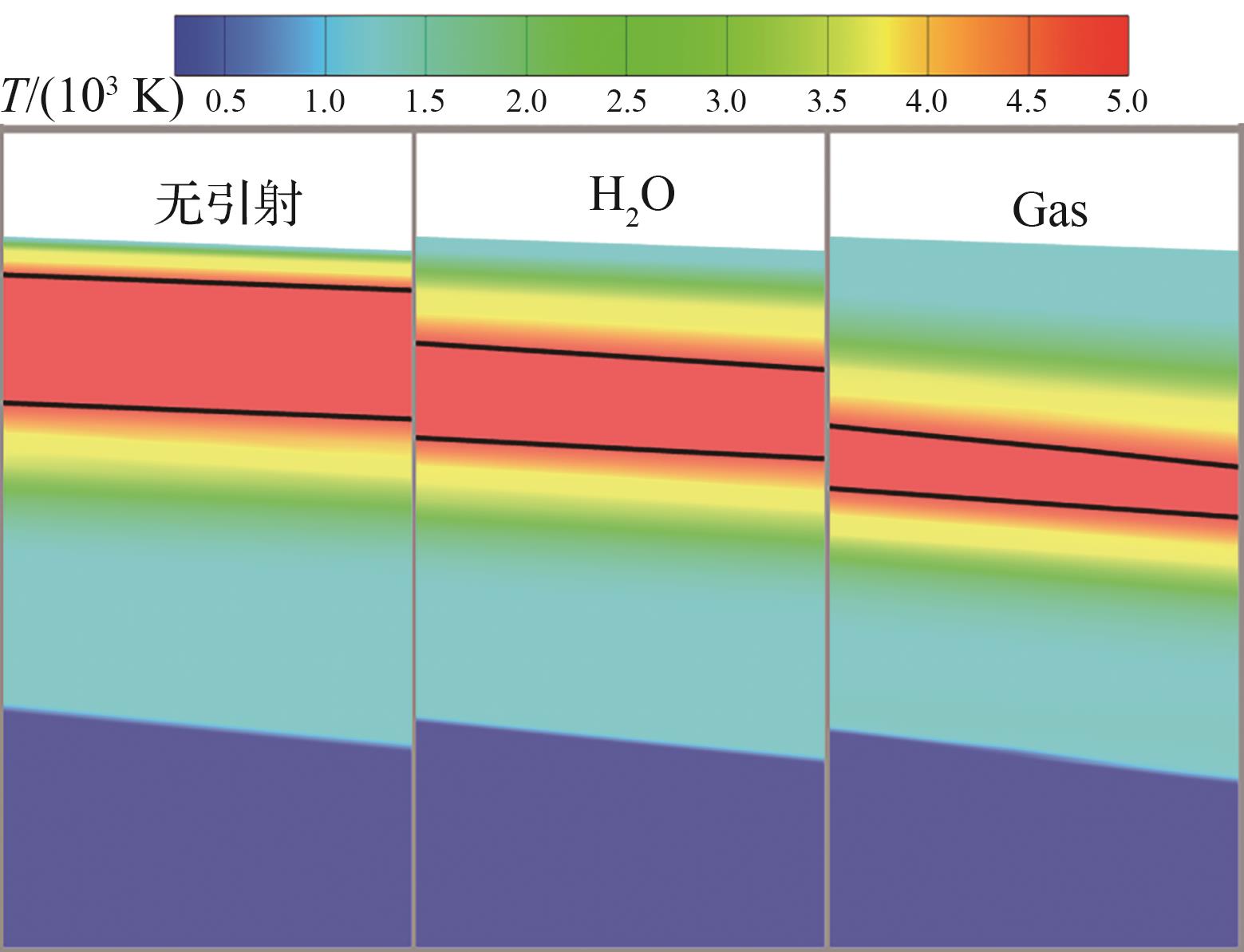
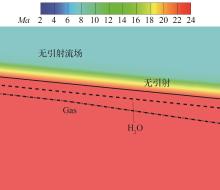
Fig.13
Location of detached shock layer
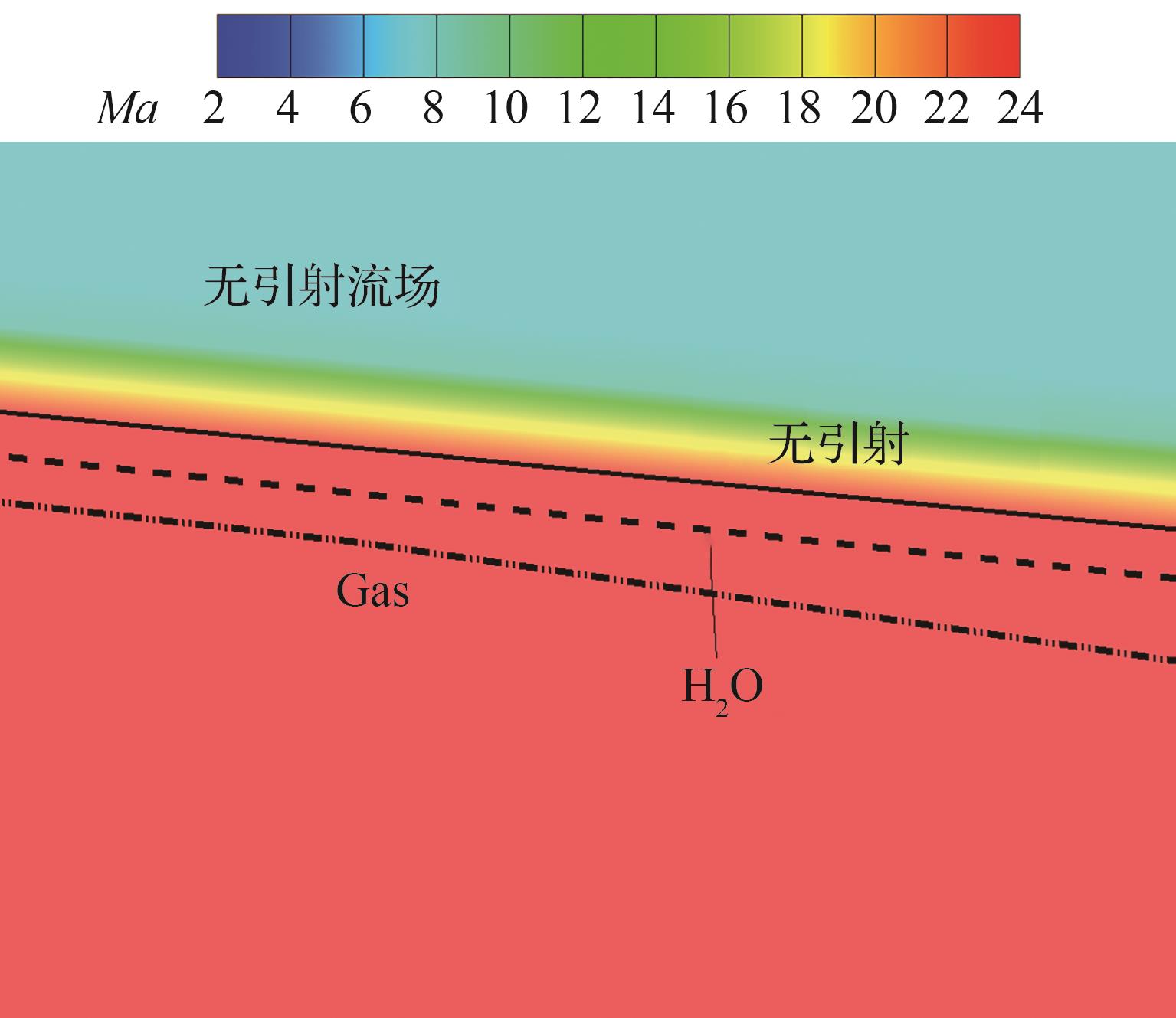
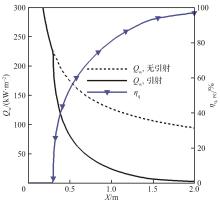
Fig.14
Heat flux and reduction efficiency distribution on wall for perfect gas
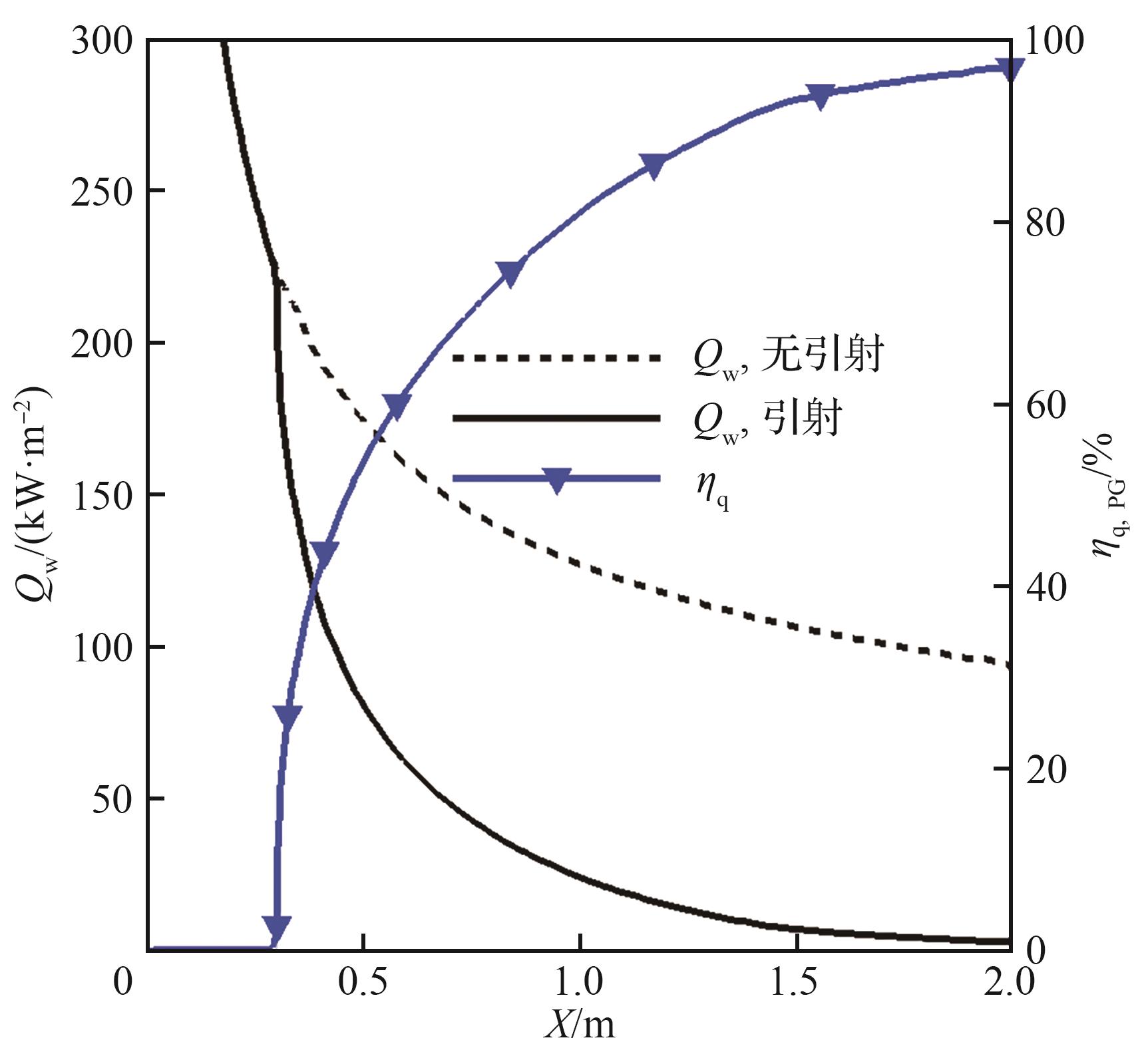
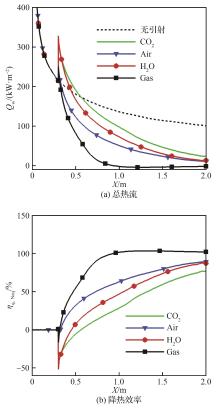
Fig.15
Heat flux and reduction efficiency distribution on wall for nonequilibrium gas model
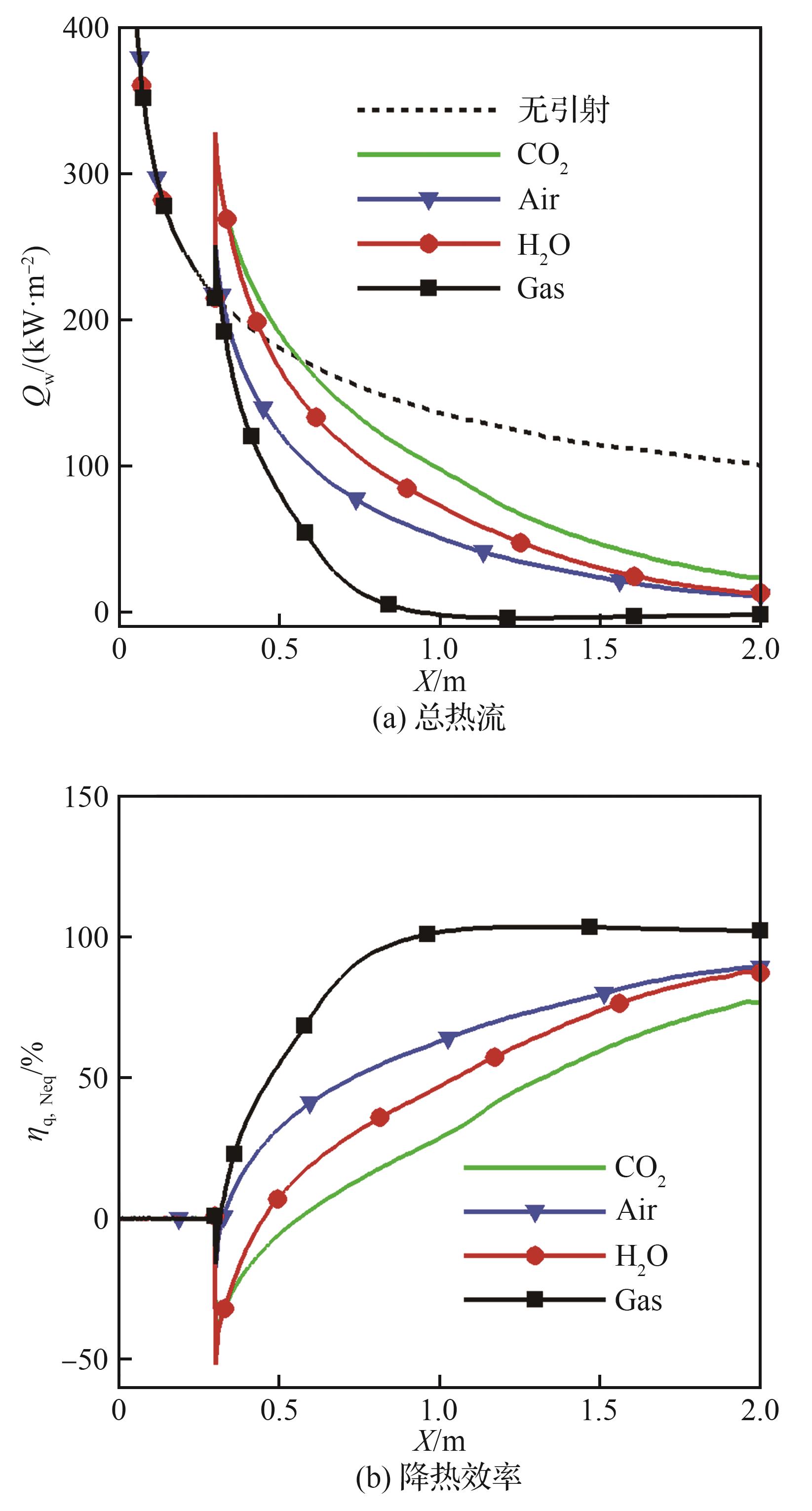
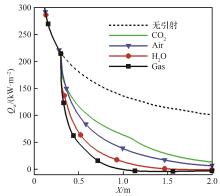
Fig.16
Conductive heat flux distribution on wall for nonequilibrium gas model
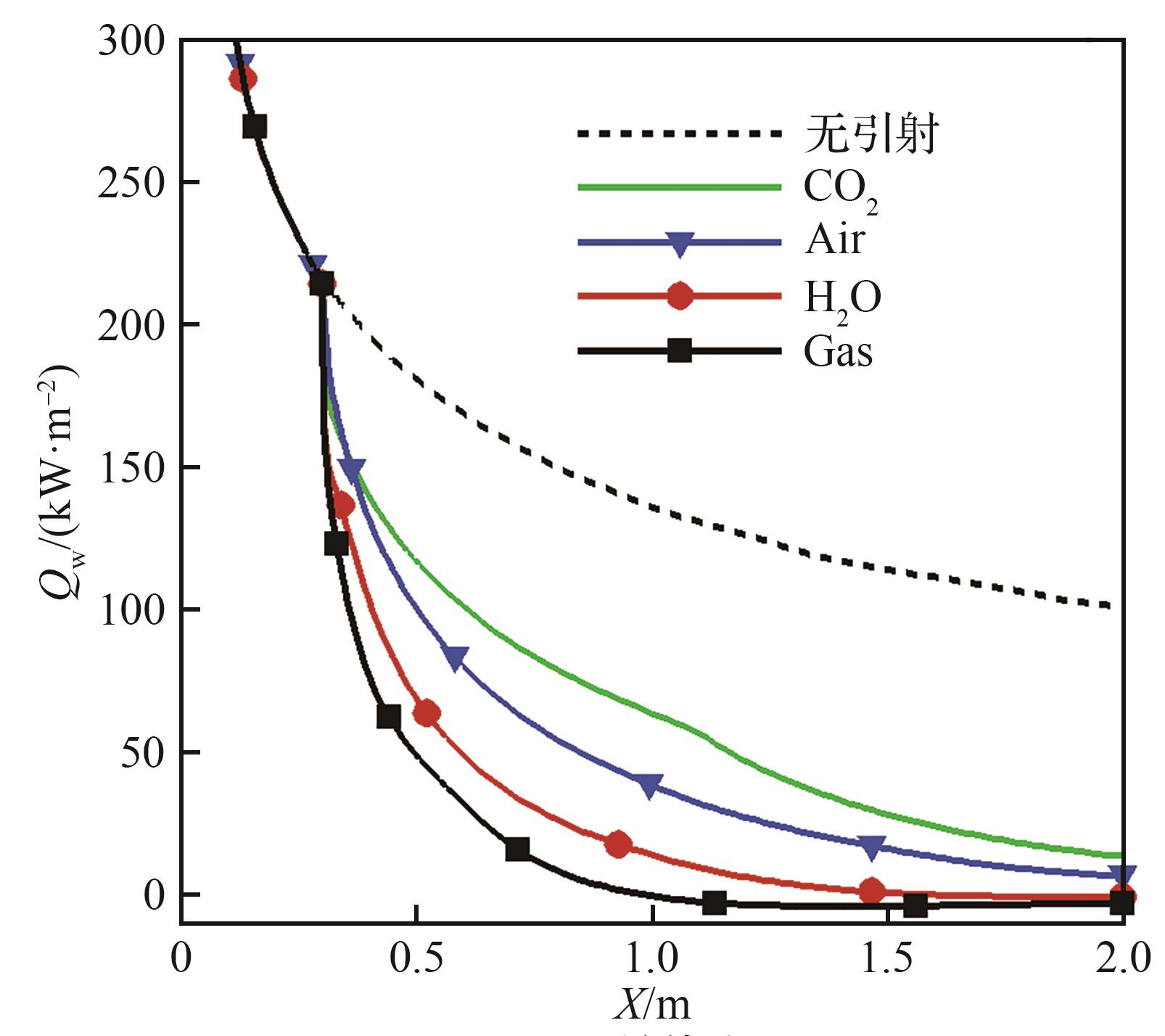
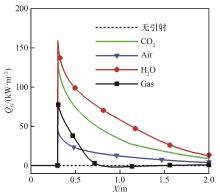
Fig.17
Component diffusive heat flux distribution on wall for nonequilibrium gas model
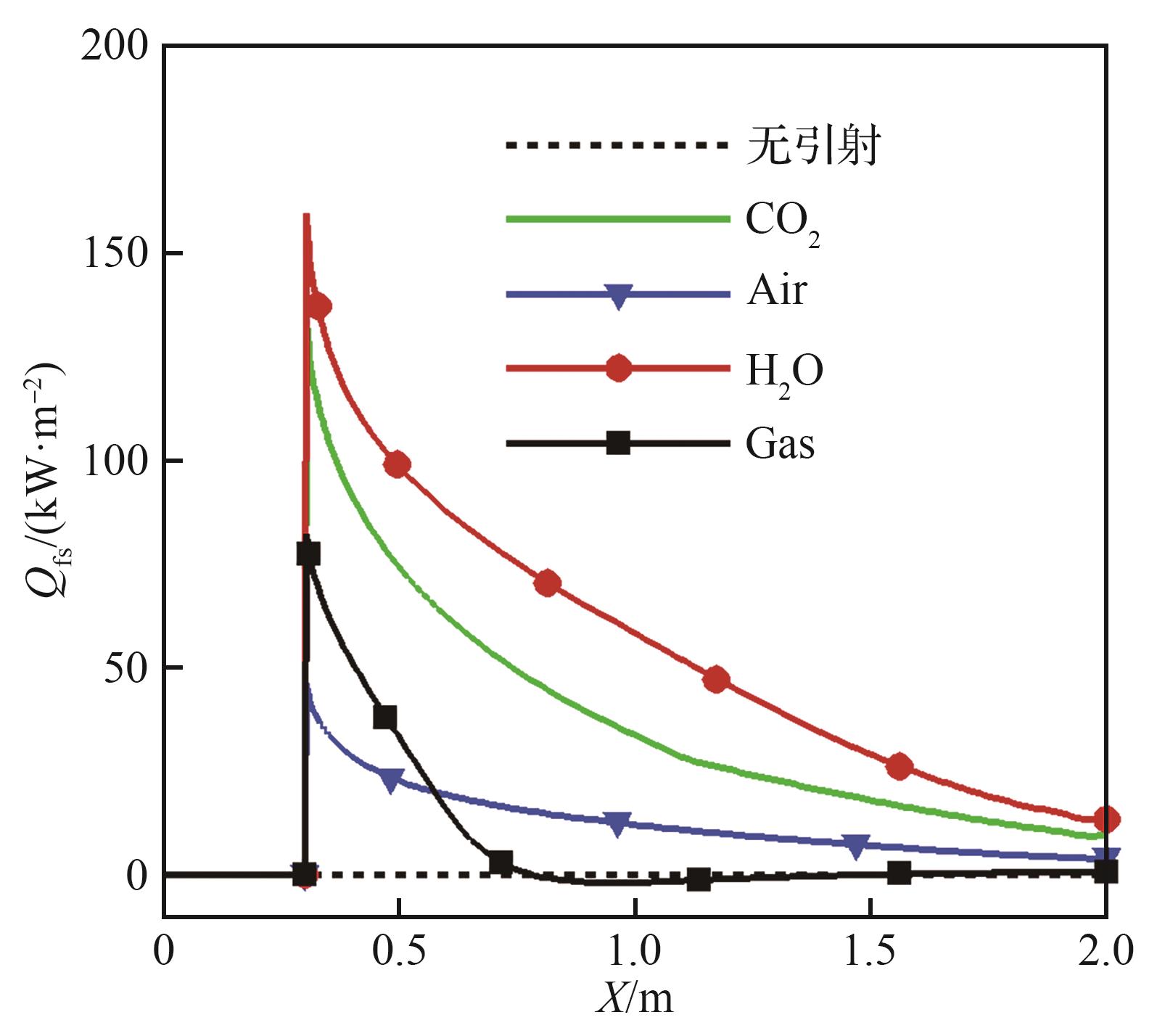
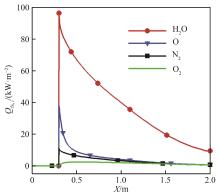
Fig.18
Diffusive heat flux of different gas components in mass injection condition
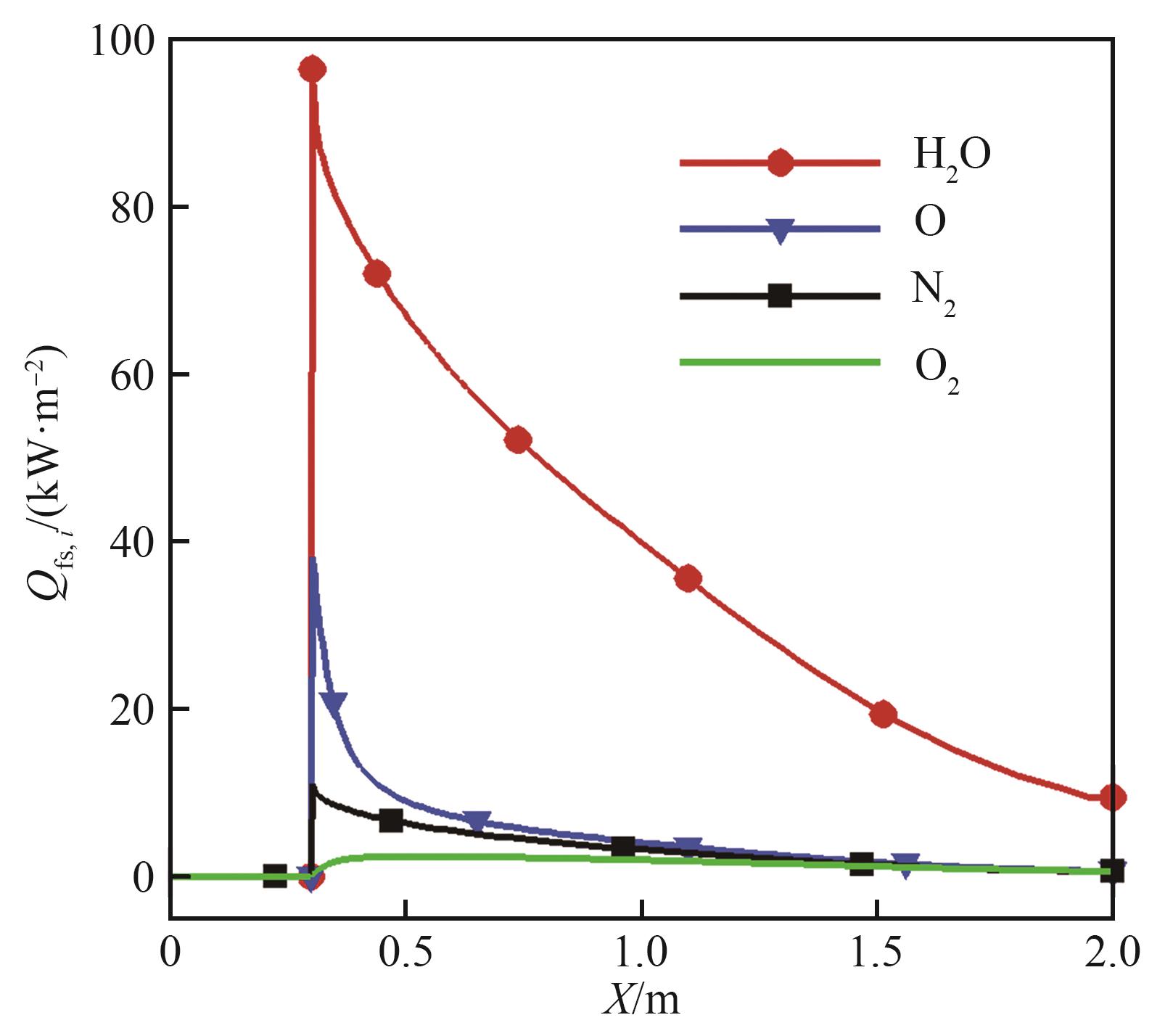
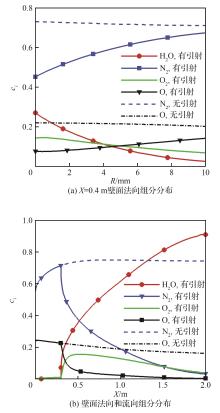
Fig.19
Mass fraction distribution in normal and flow direction of wall
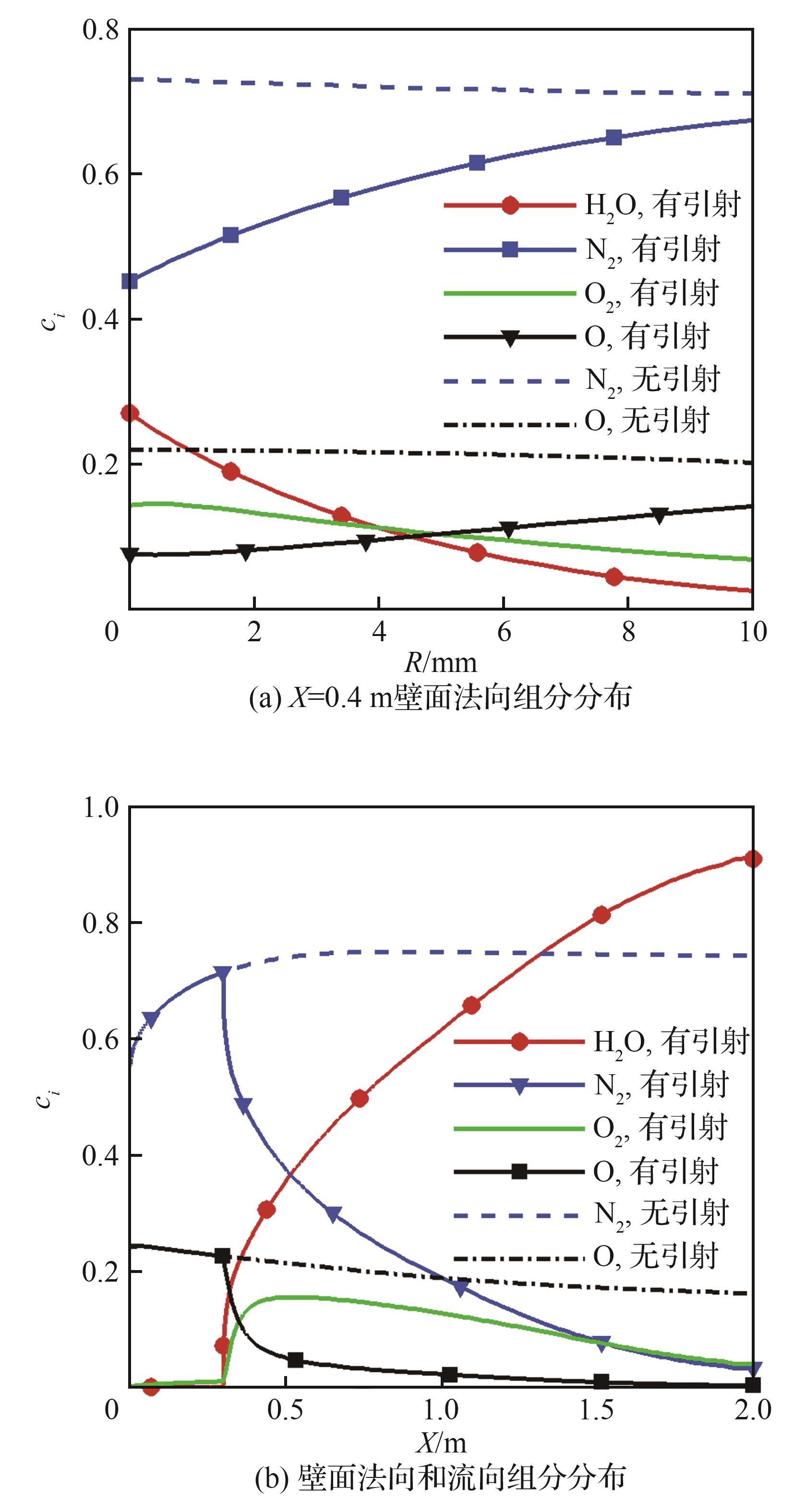
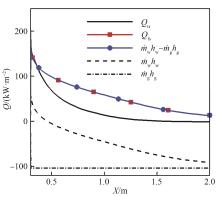
Fig.20
Energy transport caused by water vapor injection
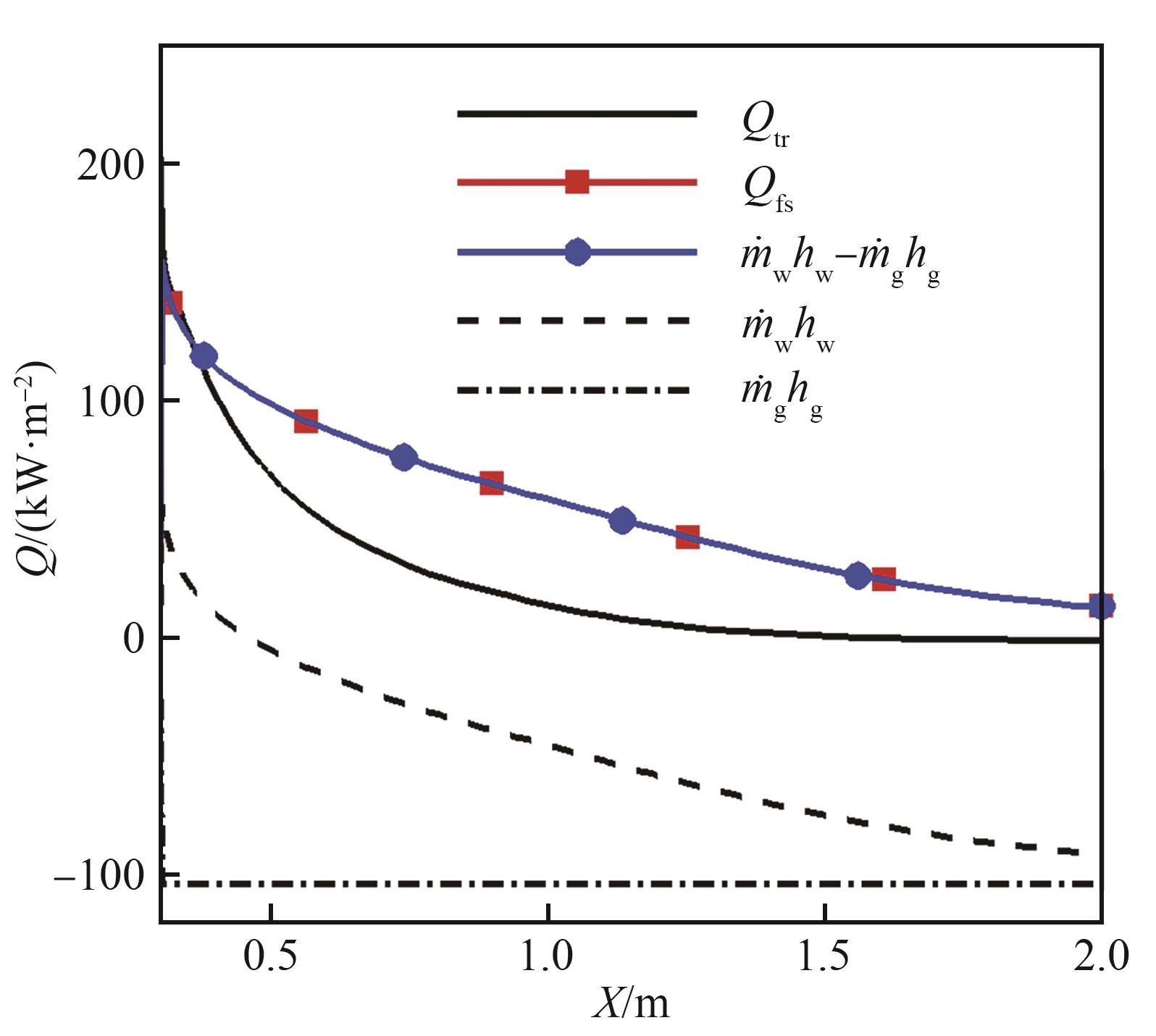
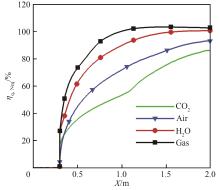
Fig.21
Heat reduction efficiency by corrected heat flux expression formula
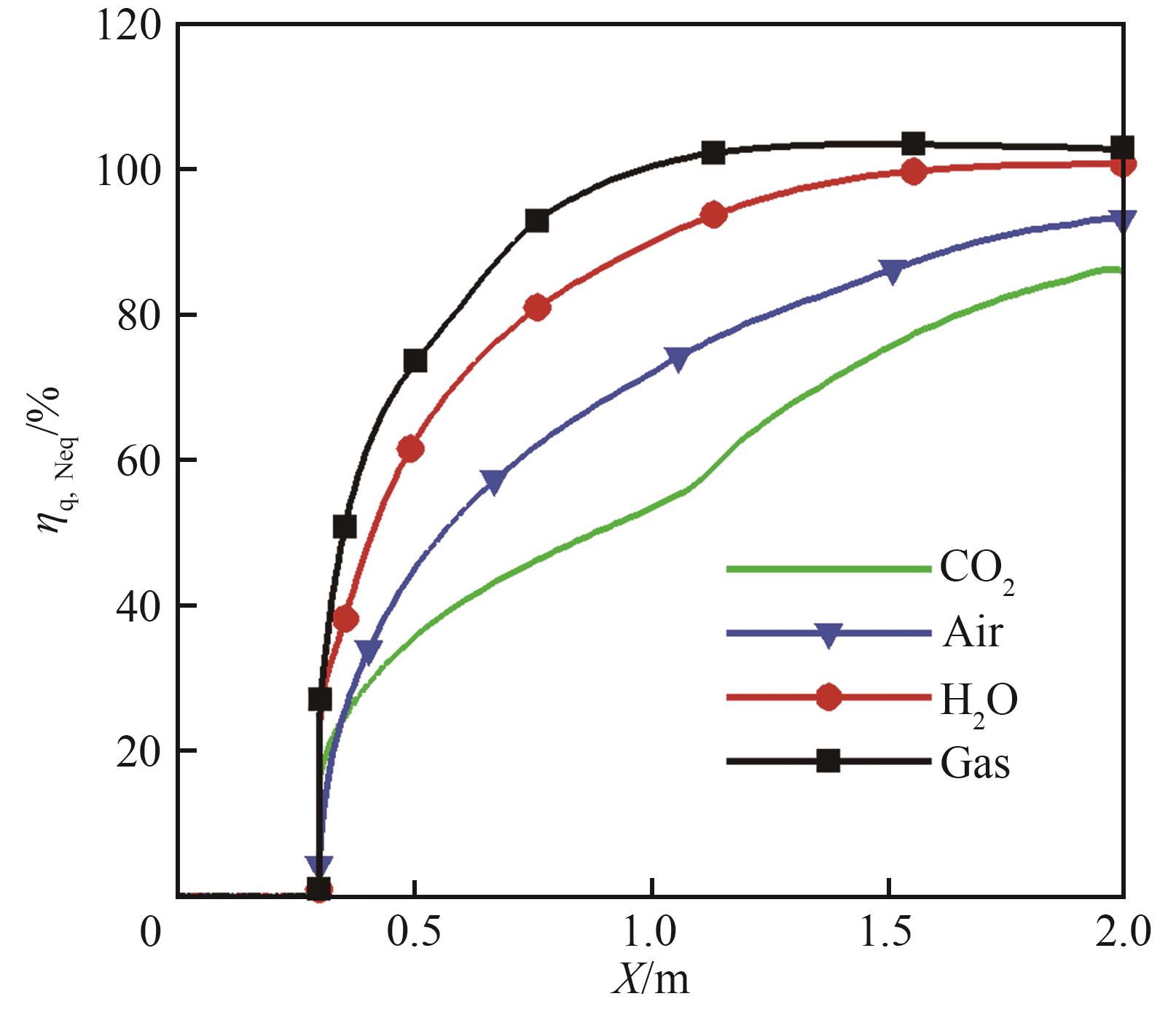
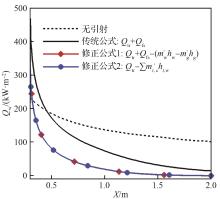
Fig.22
Heat flux by different expression methods in partially catalytic and active injection condition
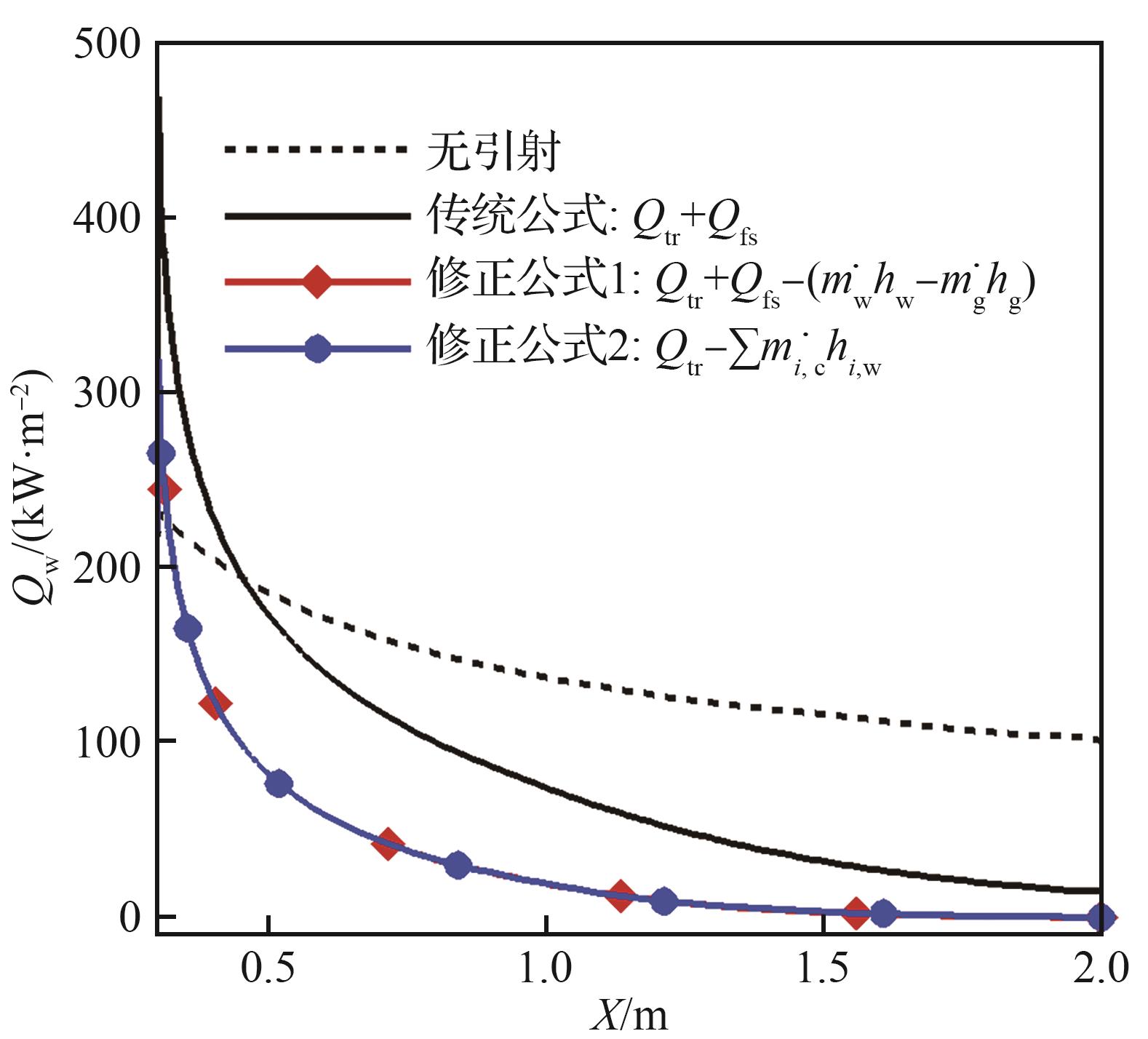
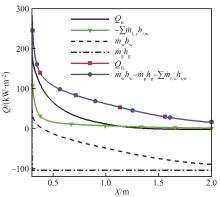
Fig.23
Heat flux components in partially catalytic and active injection condition
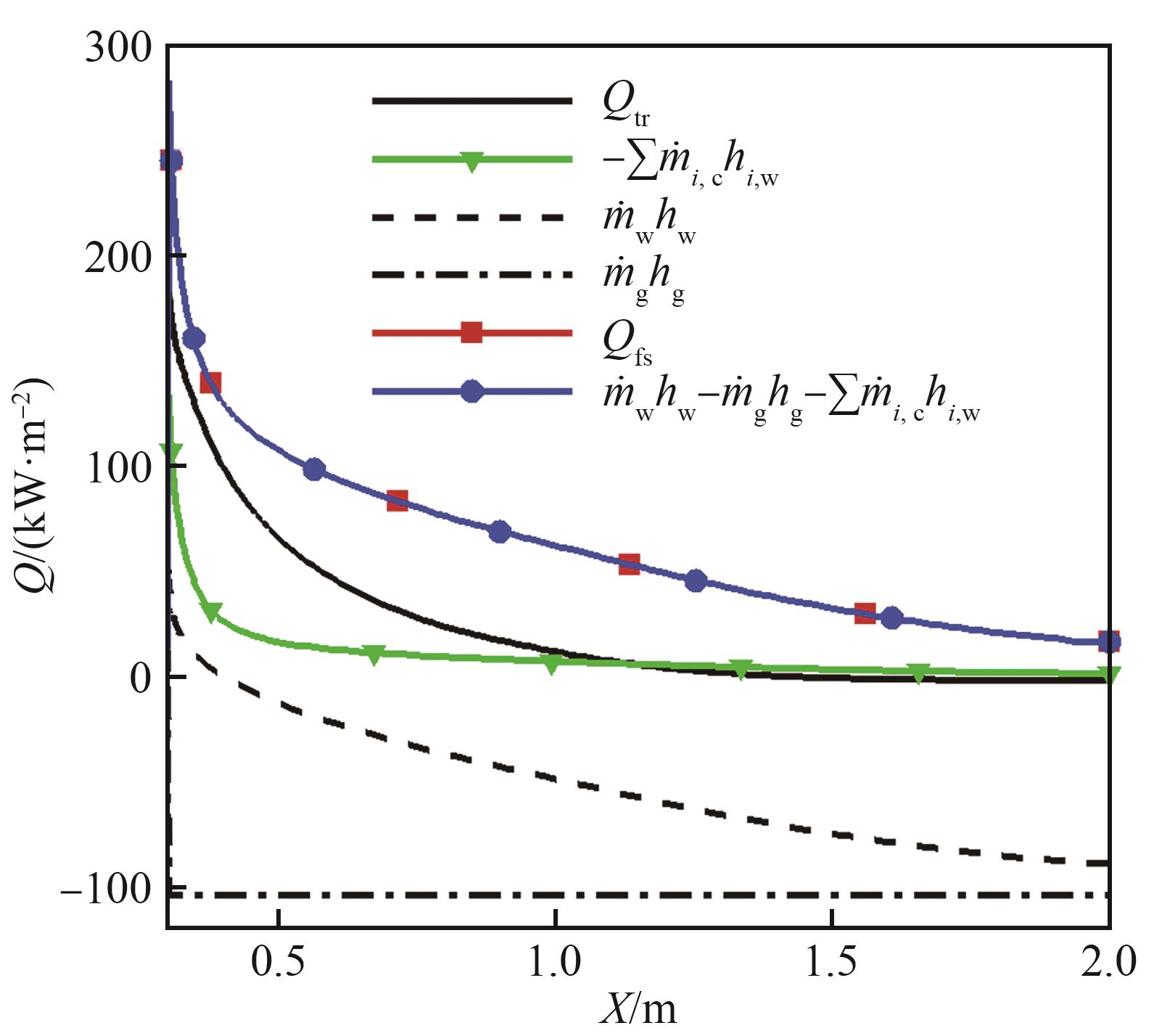
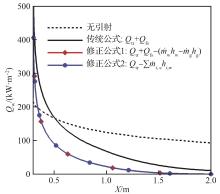
Fig.24
Heat flux by different expression methods in active and passive injection conditions
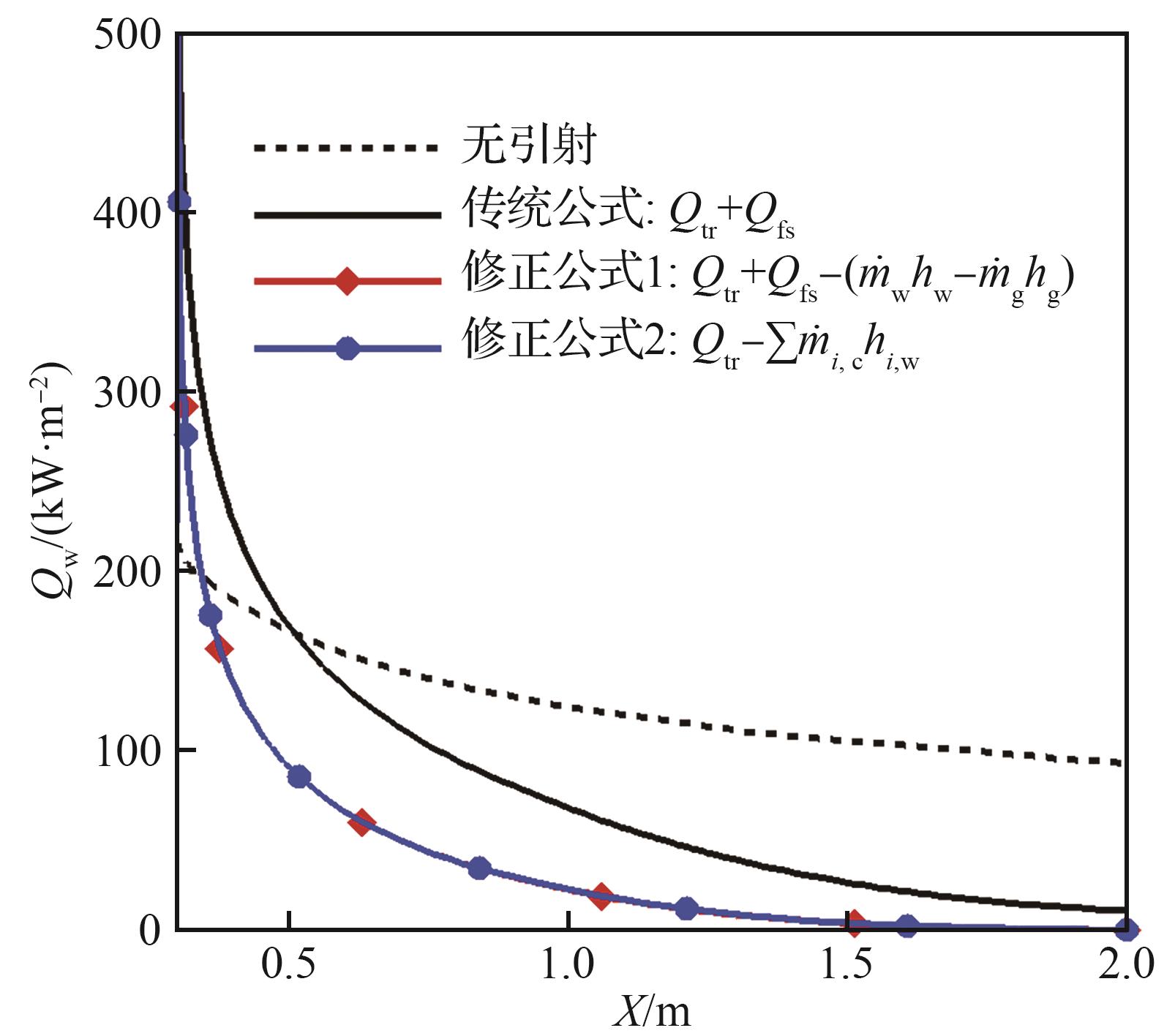
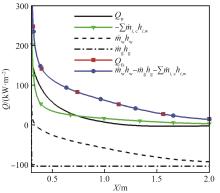
Fig.25
Heat flux components of wall in active and passive injection conditions
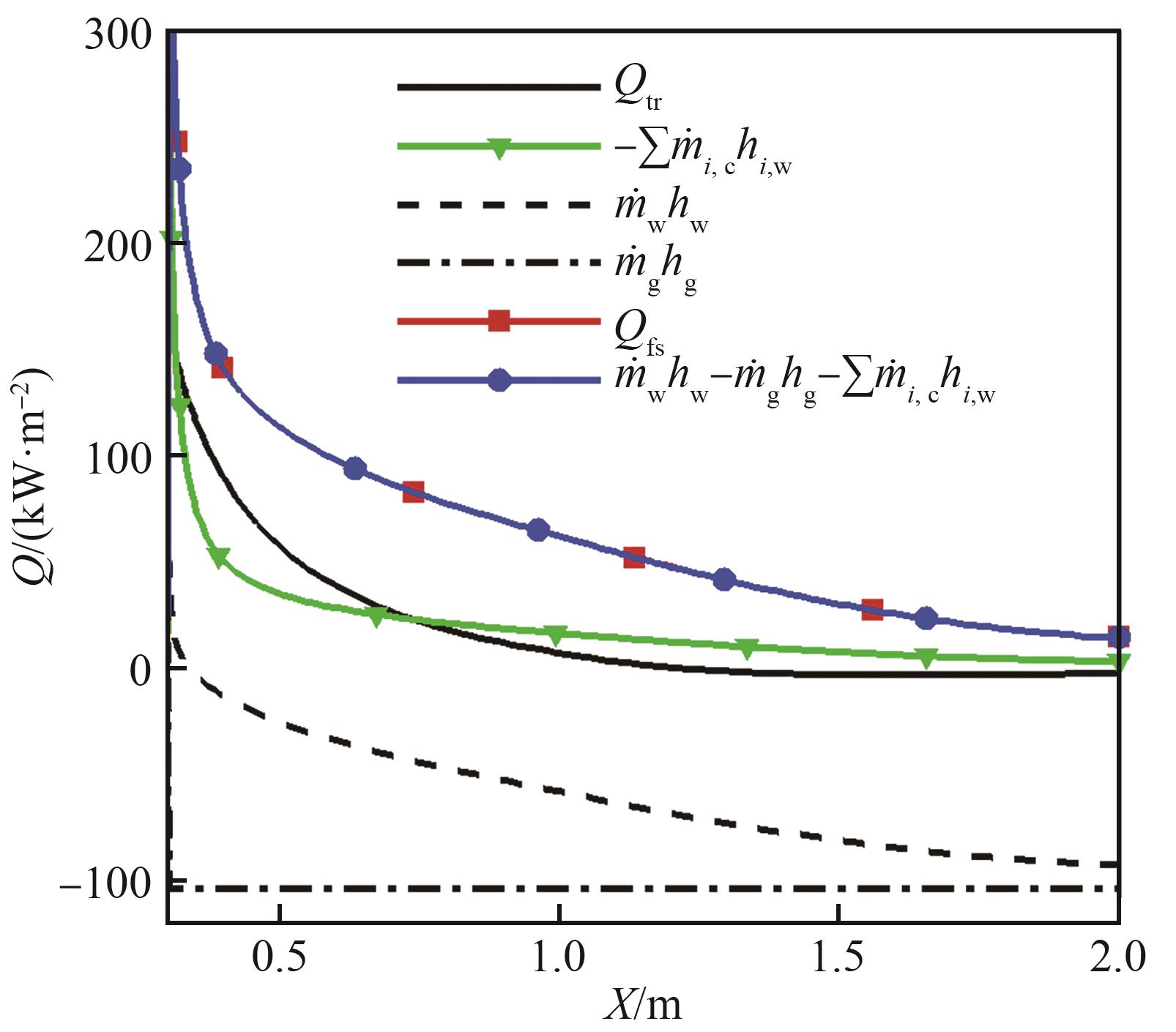
Table 6
Formation enthalpy of water vapor in different states
| 序号 | 引射量/(g·m-2·s-1) | 壁温/K | 液态水温升生成焓/(kW·m-2) | 汽化相变生成焓/(kW·m-2) | 水蒸气温升生成焓/(kW·m-2) |
|---|---|---|---|---|---|
| 1 | 1 | 1 500 | -0.31 | -2.27 | -2.37 |
| 2 | 5 | 1 500 | -1.57 | -11.35 | -11.83 |
| 3 | 10 | 1 500 | -3.14 | -22.70 | -23.66 |
| 4 | 10 | 1 000 | -3.14 | -22.70 | -13.16 |
| 5 | 10 | 500 | -3.14 | -22.70 | -2.66 |
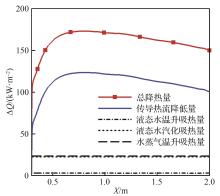
Fig.26
Heat reduction by active water vapor injection considering formation enthalpy
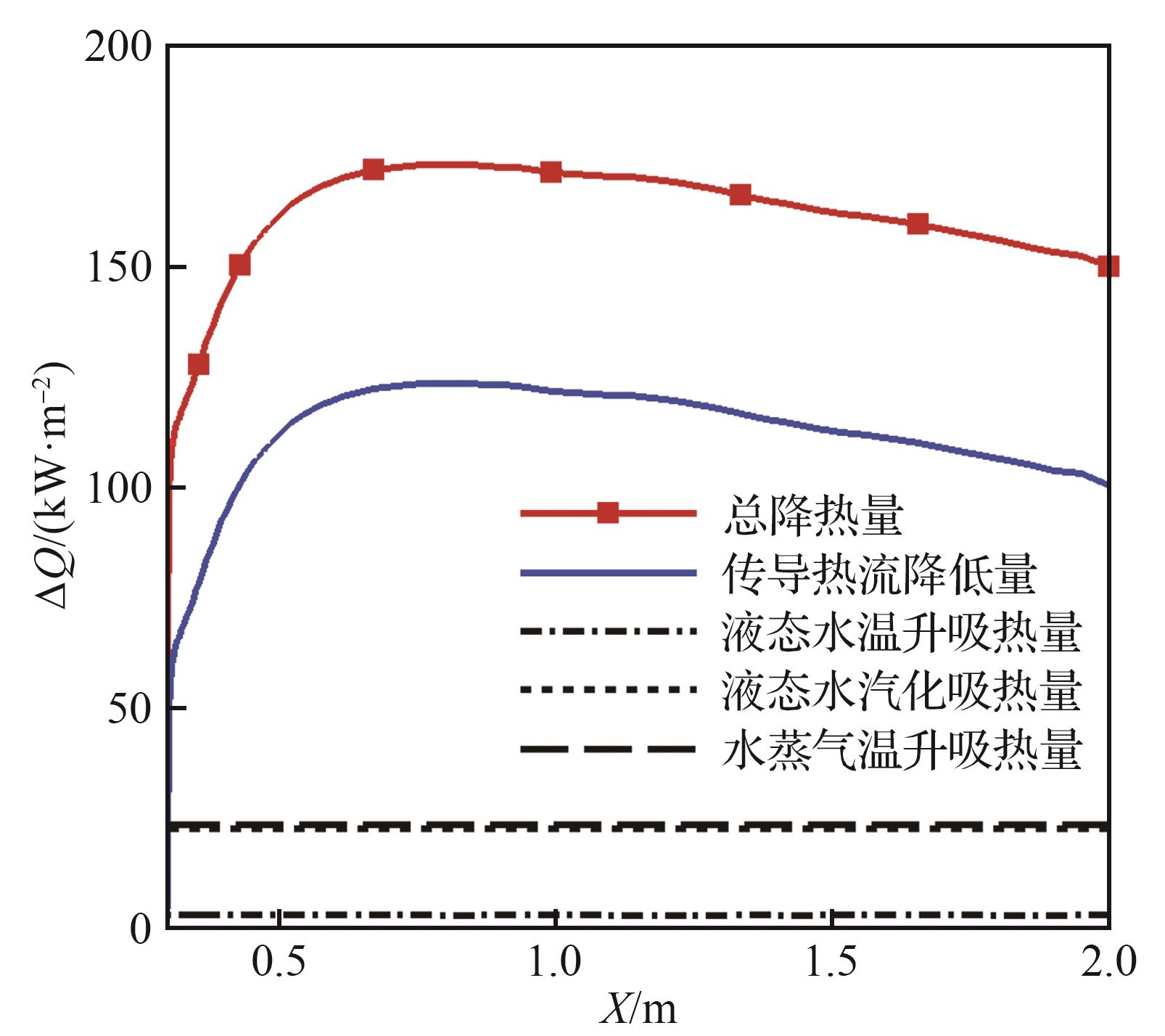
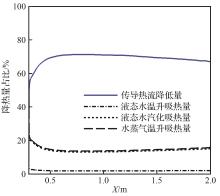
Fig.27
Proportion of heat reduction by water vapor injection considering formation enthalpy
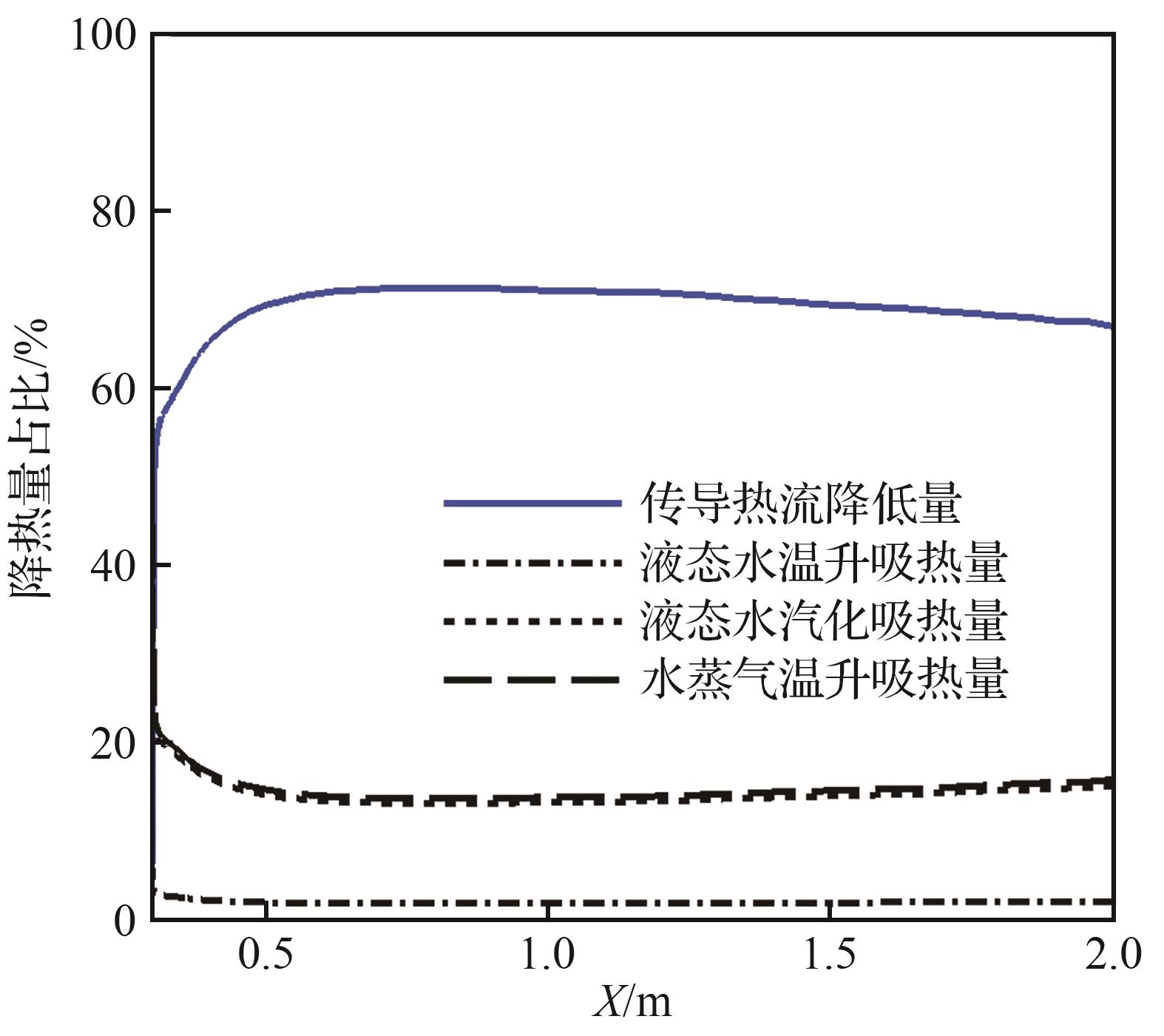
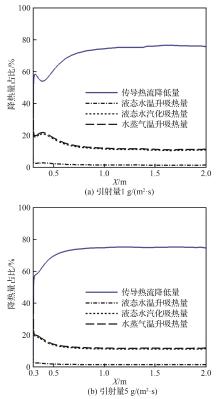
Fig.28
Proportion of heat reduction in different injection rate conditions
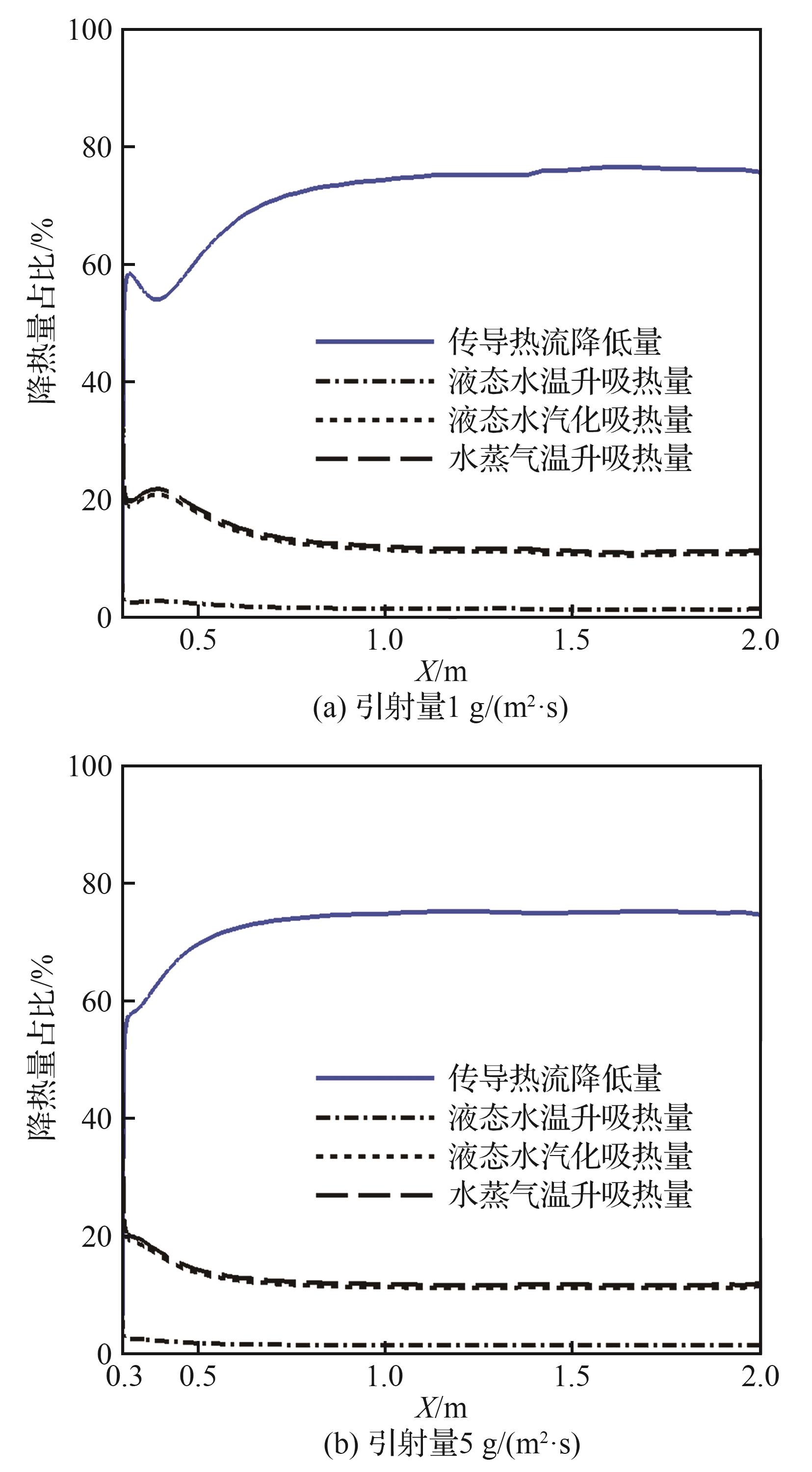
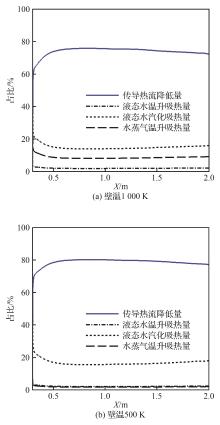
Fig.29
Proportion of injection heat reduction in different wall temperature conditions
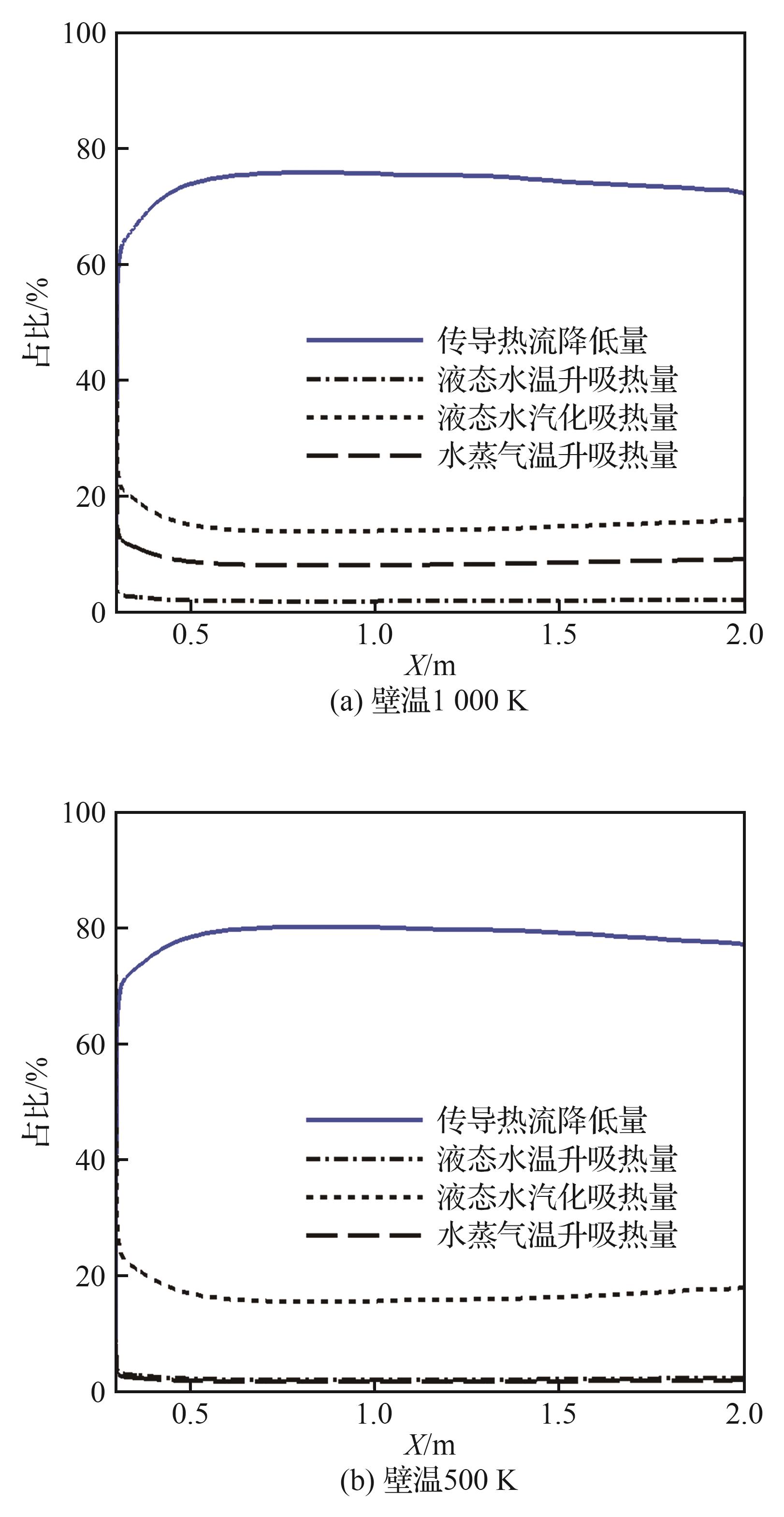
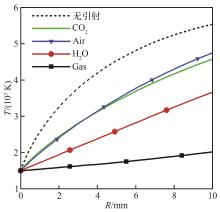
Fig.30
Temperature distribution along normal direction of wall at X = 0.8 m
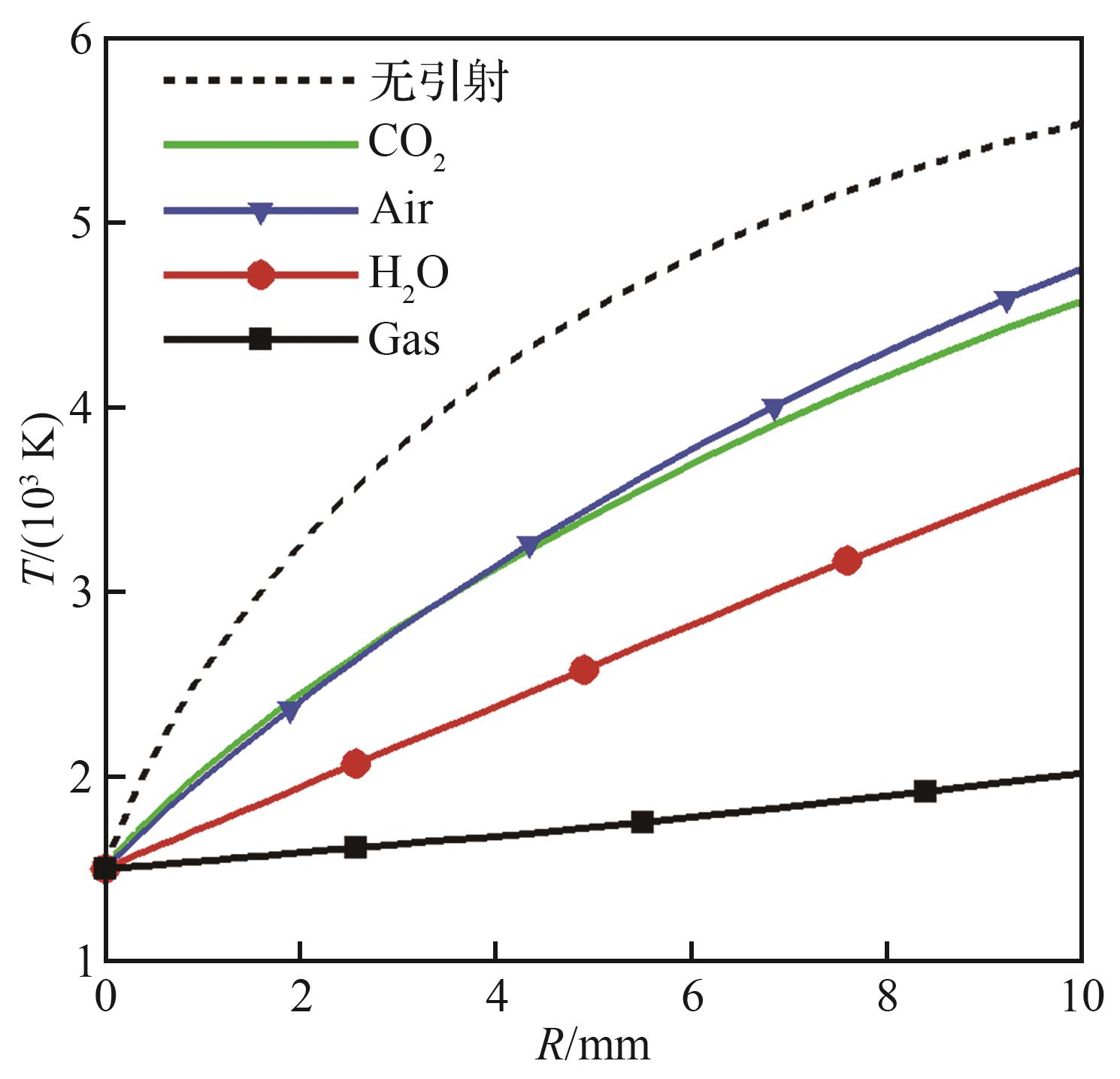
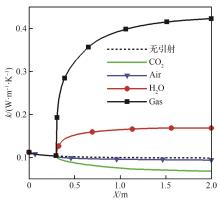
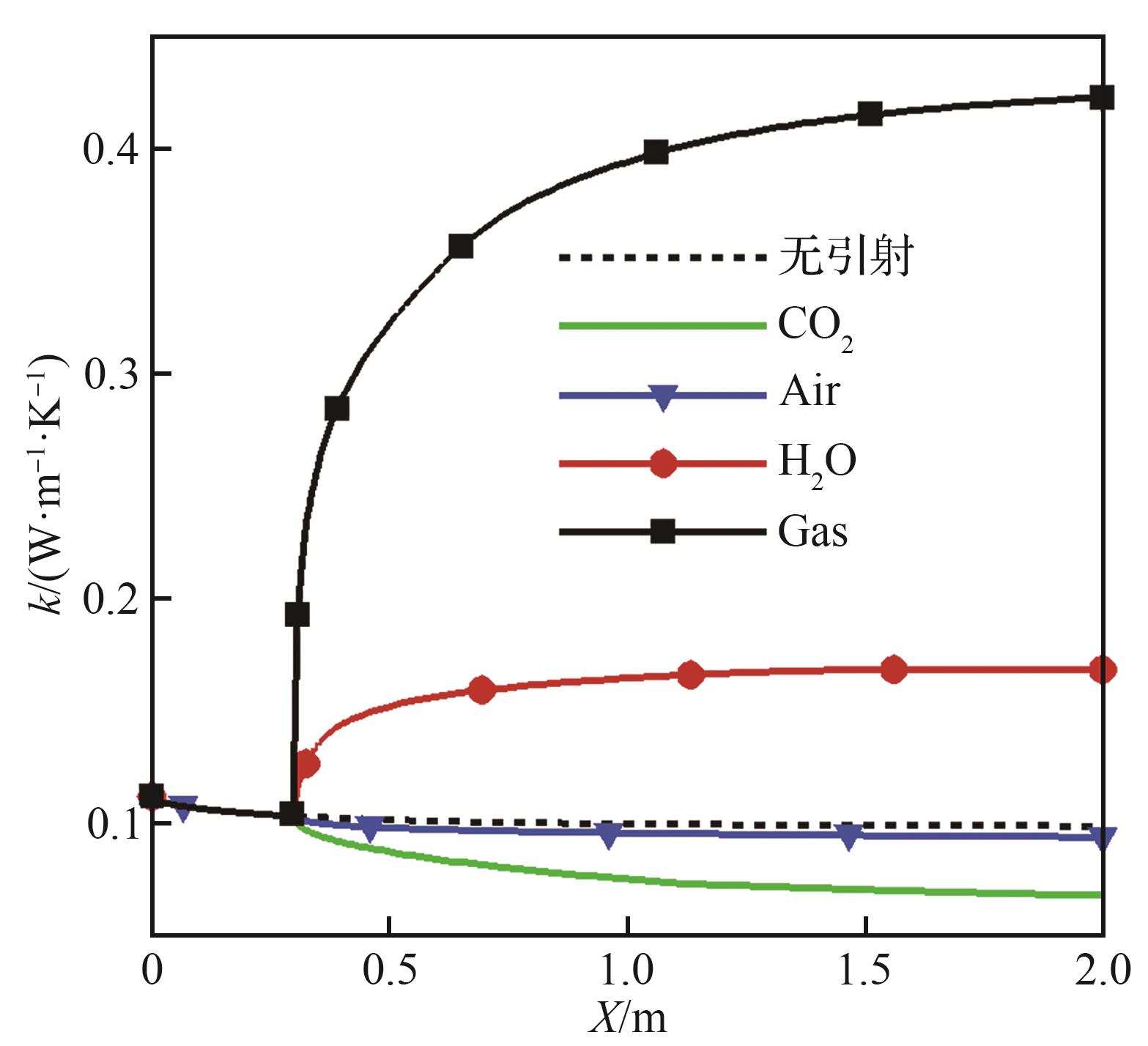
Fig.31
Thermal conductivity coefficient distribution along flow direction of wall
| [1] | 赵瑾, 孙向春, 张俊, 等. 热防护材料气固界面传热传质问题研究进展[J]. 航空学报, 2022, 43(10): 527577. |
| ZHAO J, SUN X C, ZHANG J, et al. Research advances on heat and mass transfer coupling effect at gas-solid interface for thermal protection materials[J]. Acta Aeronautica et Astronautica Sinica, 2022, 43(10): 527577 (in Chinese). | |
| [2] | 时圣波, 雷宝, 张云天, 等. 硅橡胶基防热涂层烧蚀和热响应特性预报方法[J]. 航空学报, 2023, 44(23): 428141. |
| SHI S B, LEI B, ZHANG Y T, et al. Prediction method of ablation and thermal response for a thermal protection coating with silicone rubber[J]. Acta Aeronautica et Astronautica Sinica, 2023, 44(23): 428141 (in Chinese). | |
| [3] | 叶致凡, 崔智亮, 邢浩运, 等. 酚醛树脂高温热解及质量引射机理模拟研究[J]. 空天技术, 2023(3): 71-78. |
| YE Z F, CUI Z L, XING H Y, et al. Reactive molecular dynamics simulation investigations on the thermal pyrolysis of phenolic resin and the blowing effect[J]. Aerospace Technology, 2023(3): 71-78 (in Chinese). | |
| [4] | 沈斌贤, 曾磊, 刘骁, 等. 高超声速飞行器主动质量引射热防护技术研究进展[J]. 空气动力学学报, 2022, 40(6): 1-13. |
| SHEN B X, ZENG L, LIU X, et al. Research progress of thermal protection technique by activemass injection for hypersonic vehicle[J]. Acta Aerodynamica Sinica, 2022, 40(6): 1-13 (in Chinese). | |
| [5] | 朱广生, 姚世勇, 段毅. 高速飞行器减阻降热流动控制技术研究进展及工程应用[J]. 航空学报, 2023, 44(15): 529049. |
| ZHU G S, YAO S Y, DUAN Y. Research progress and engineering application of flow control technology for drag and heat reduction of high-speed vehicles[J]. Acta Aeronautica et Astronautica Sinica, 2023, 44(15): 529049 (in Chinese). | |
| [6] | 朱广生, 段毅, 姚世勇, 等. 壁面质量引射对高速飞行器减阻降热影响的研究[J]. 空气动力学学报, 2023, 41(8): 59-70. |
| ZHU G S, DUAN Y, YAO S Y, et al. Effects of wall mass injection on drag and heat reduction characteristics of high-speed flight vehicles[J]. Acta Aerodynamica Sinica, 2023, 41(8): 59-70 (in Chinese). | |
| [7] | 胡文杰, 邱云龙, 邹昊, 等. 高速飞行器边界层质量引射降热减阻技术流量分区优化研究[J]. 力学学报, 2024, 56(6): 1688-1701. |
| HU W J, QIU Y L, ZOU H, et al. Optimization study of boundary layer mass injection flow rate by zonal divisions for heat and drag reduction of high-speed vehicles[J]. Chinese Journal of Theoretical and Applied Mechanics, 2024, 56(6): 1688-1701 (in Chinese). | |
| [8] | 李俊红, 陈智, 靳旭红, 等. 气体引射对临近空间升力体飞行器气动力热影响[J]. 空气动力学学报, 2024, 42(8): 1-9. |
| LI J H, CHEN Z, JIN X H, et al. Effects of gas ejection on aerodynamic force and heating of near-space lifting vehicles[J]. Acta Aerodynamica Sinica, 2024, 42(8): 1-9 (in Chinese). | |
| [9] | 张红军, 李海群, 康宏琳, 等. 气体引射对气动热影响的测热实验研究[J]. 气体物理, 2024, 9(6): 74-82. |
| ZHANG H J, LI H Q, KANG H L, et al. Experimental study on the influence of gas injection on aerodynamic heating[J]. Physics of Gases, 2024, 9(6): 74-82 (in Chinese). | |
| [10] | KEENAN J, CANDLER G. Simulation of ablation in Earth atmospheric entry[C]∥28th Thermophysics Conference. Reston: AIAA, 1993. |
| [11] | OLYNICK D, CHEN Y K, TAUBER M, et al. Forebody TPS sizing with radiation and ablation for the Stardust Sample Return Capsule[C]∥32nd Thermophysics Conference. Reston: AIAA, 1997. |
| [12] | 粟斯尧, 石义雷, 柳森, 等. 头部质量引射对气动加热影响数值研究[C]∥第十九届全国高超声速气动力/热学术交流会论文集. 厦门:中国空气动力学会高超声速专业委员会, 2020. |
| SU S Y, SHI Y L, LIU S, et al. Numerical study on the effect of head mass ejection on aerodynamic heating[C]∥Proceedings of the 19th National Hypersonic Aerodynamic/Thermal Symposium. Xiamen: Hypersonic Professional Committee of China Aerodynamics Association, 2020 (in Chinese). | |
| [13] | 樊宇翔, 赵瑞, 左政玄, 等. 气体引射效应对壁面热流和摩擦阻力的影响[J]. 航空学报, 2023, 44(21): 365-376. |
| FAN Y X, ZHAO R, ZUO Z X, et al. Influence of gas injection effect on wall heat flow and friction resistance[J]. Acta Aeronautica et Astronautica Sinica, 2023, 44(21): 365-376 (in Chinese). | |
| [14] | 张绪, 赵瑞, 李宇, 等. 引射气体组分对壁面热流和摩擦阻力的影响规律研究[J/OL]. 北京航空航天大学学报, 2024: 1-12. (2024-05-22)[2025-04-21]. . |
| ZHANG X, ZHAO R, LI Y, et al. Component of gas-injection effects on wall heat flux and skin-friction of vehicles[J/OL]. Journal of Beijing University of Aeronautics and Astronautics, 2024: 1-12. (2024-05-22)[2025-04-21]. (in Chinese). | |
| [15] | 董维中, 高铁锁, 丁明松, 等. 高超声速飞行器表面温度分布与气动热耦合数值研究[J]. 航空学报, 2015, 36(1): 311-324. |
| DONG W Z, GAO T S, DING M S, et al. Numerical study of coupled surface temperature distribution and aerodynamic heat for hypersonic vehicles[J]. Acta Aeronautica et Astronautica Sinica, 2015, 36(1): 311-324 (in Chinese). | |
| [16] | 董维中. 热化学非平衡效应对高超声速流动影响的数值计算与分析[D]. 北京: 北京航空航天大学, 1996. |
| DONG W Z. Numerical calculation and analysis of thermochemical nonequilibrium effect on hypersonic flow[D]. Beijing: Beihang University, 1996 (in Chinese). | |
| [17] | KIM K, KIM C, RHO O. Accurate computations of hypersonic flows using AUSMPW+ scheme and shock-aligned grid technique[C]∥29th AIAA, Fluid Dynamics Conference. Reston: AIAA, 1998. |
| [18] | YOON S, JAMESON A. Lower-upper symmetric-Gauss-seidel method for the Euler and navier-stokes equations[J]. AIAA Journal, 1988, 26(9): 1025-1026. |
| [19] | MITCHELTREE R, GNOFFO P. Wake flow about a MESUR Mars entry vehicle[C]∥6th Joint Thermophysics and Heat Transfer Conference. Reston: AIAA, 1994. |
| [20] | PARK C, JAFFE R L, PARTRIDGE H. Chemical-kinetic parameters of hyperbolic Earth entry[J]. Journal of Thermophysics and Heat Transfer, 2001, 15(1): 76-90. |
| [21] | CHEN Y K, HENLINE W D, STEWART D A, et al. Navier-Stokes solutions with surface catalysis for Martian atmospheric entry[J]. Journal of Spacecraft and Rockets, 1993, 30(1): 32-42. |
| [22] | BHUTTA B A, DAYWITT J E, RAHAIM J J, et al. A new technique for the computation of severe reentry environments[C]∥Proceedings of the 31st AIAA Thermophysics Conference. Reston: AIAA, 1996. |
| [23] | SURZHIKOV S, SHANG J. Kinetic models analysis for super-orbital aerophysics[C]∥46th AIAA Aerospace Sciences Meeting and Exhibit. Reston: AIAA, 2008. |
| [24] | TONG T, ABOU-ELLAIL M, LI Y. Mathematical modeling of catalytic-surface combustion of reacting flows[C]∥9th AIAA/ASME Joint Thermophysics and Heat Transfer Conference. Reston: AIAA, 2006. |
| [25] | KATTA V R, ROQUEMORE W M. Simulation of dynamic methane jet diffusion flames using finite rate chemistry models[J]. AIAA Journal, 1998, 36(11): 2044-2054. |
| [26] | MOORE C E . The spectra of hydrogen, deuterium, helium, lithium, beryllium, boron, carbon, nitrogen, oxygen, and fluorine[M]∥Atomic energy levels as derived from the analyses of optical spectra. Washington: Government Printing Office, 1948. |
| [27] | HERZBERG G. Molecular spectra and molecular struc-ture Ⅲ: Electronic spectra and electronic structure of polyatomic molecules[M]. Princeton: D. Van Nostrand Company Inc., 1966. |
| [28] | HERZBERG G. Molecular spectra and molecular structure Ⅰ: Spectra of diatomic molecules[M]. Princeton: D. Van Nostrand Company Inc., 1950. |
| [29] | MCBRIDE B J, ZEHE M J, GORDON S D. NASA Glenn coefficients for calculating thermodynamic properties of individual species: NASA-TP-2002-211556[R]. Hanover: NASA Center for Aerospace Information, 2002. |
| [30] | WILKE C R. A viscosity equation for gas mixtures[J]. The Journal of Chemical Physics, 1950, 18(4): 517-519. |
| [31] | GUPTA R N, YOS J M, THOMPSON R A, et al. A review of reaction rates and thermodynamic and transport properties for an 11-species air model for chemical and thermal nonequilibrium calcalation to 30 000 K: NASA-RP-1232[R]. Hampton: NASA Langley Research Center, 1990. |
| [32] | CANDLER G. Computation of thermo-chemical nonequilibrium Martian atmospheric entry flows[C]∥5th Joint Thermophysics and Heat Transfer Conference. Reston: AIAA, 1990. |
| [33] | GUPTA R, MOSS J, SUTTON K, et al. A viscous-shock-layer analysis of the Martian aerothermal environment[C]∥26th Thermophysics Conference. Reston: AIAA, 1991. |
| [34] | GUPTA R, LEE K P, MOOS J, et al. Viscous-shock-layer solutions with coupled radiation and ablation injection for earth entry[C]∥5th Joint Thermophysics and Heat Transfer Conference. Reston: AIAA, 1990. |
| [35] | VINCENTI W G, KRUGER C H. Introduction to physical gas dynamics[M]. New York: John Wiley & Sons, Inc. 1965: 51-58 |
| [36] | 丁明松, 董维中, 高铁锁, 等. 局部催化特性差异对气动热环境影响的计算分析[J]. 航空学报, 2018, 39(3): 121588. |
| DING M S, DONG W Z, GAO T S, et al. Computational analysis of influence of differences in local catalytic properties on aero-thermal environment[J]. Acta Aeronautica et Astronautica Sinica, 2018, 39(3): 121588 (in Chinese). | |
| [37] | 郑永康, 叶友达, 田浩, 等. 表面烧蚀对高超声速飞行器气动特性的影响研究[J]. 空天技术, 2024(2): 54-68. |
| ZHENG Y K, YE Y D, TIAN H, et al. The influence of surface ablation on aerodynamic characteristics of hypersonic vehicle[J]. Aerospace Technology, 2024(2): 54-68 (in Chinese). | |
| [38] | TIAN Y H, LIN G P, GUO J H. Analysis of mass diffusion theory and models for high-temperature multi-component gases[J]. International Journal of Heat and Mass Transfer, 2021, 181: 121994. |
| [39] | 尤其, 曾磊, 杨肖峰, 等. 质量引射对高速飞行器气动热的影响规律研究[J]. 工程热物理学报, 2024, 45(11): 3406-3414. |
| YOU Q, ZENG L, YANG X F, et al. Research on the influence of surface injection on the aerodynamic heating of high-speed aircraft[J]. Journal of Engineering Thermophysics, 2024, 45(11): 3406-3414 (in Chinese). | |
| [40] | THOMPSON R, GNOFFO P. Implementation of a blowing boundary condition in the LAURA code[C]∥46th AIAA Aerospace Sciences Meeting and Exhibit. Reston: AIAA, 2008. |
| [41] | MARTIN A, BOYD I D. Modeling of heat transfer attenuation by ablative gases during the stardust reentry[J]. Journal of Thermophysics and Heat Transfer, 2015, 29(3): 450-466. |
| [42] | MARVIN J G, AKIN C M. Combined effects of mass addition and nose bluntness on boundary-layer transition[J]. AIAA Journal, 1970, 8(5): 857-863. |
| [43] | 刘重晓, 王江峰. 滑移流区化学非平衡流中气动热环境的数值模拟[J]. 航空学报, 2023, 44(16): 127980. |
| LIU C X, WANG J F. Numerical simulation of aero-heating in slip flow regime with chemical non-equilibrium[J]. Acta Aeronautica et Astronautica Sinica, 2023, 44(16): 127980 (in Chinese). | |
| [44] | GOKCEN T. Effects of freestream nonequilibrium on convective heat transfer to a blunt body[J]. Journal of Thermophysics and Heat Transfer, 1996, 10(2): 234-241. |
| [45] | CABRERA J V, WEST T K. Assessment of Pioneer Venus entry heating with coupled radiation and ablation[C]∥AIAA Aviation Forum and Ascend 2024. Reston: AIAA, 2024. |
| [1] | Yanfang LIU, Hongyue WANG, Yujia E, Naiming QI. A new paradigm of intelligence-driven active mass ejection drag and heat reduction research for hypersonic vehicle boundary layer [J]. Acta Aeronautica et Astronautica Sinica, 2026, 47(2): 132171-132171. |
| [2] | Yaoying ZENG, Running WANG, Jiaqi HOU, Yulei ZHANG, Jiaping ZHANG, Hejun LI. Research progress of C/C composites resistant to extreme ablation environments [J]. Acta Aeronautica et Astronautica Sinica, 2025, 46(6): 531927-531927. |
| [3] | Bin LIANG, Junbo ZHAO, Zengliang FU, Jiajian ZHOU, Ping ZHOU, Shiyu ZHANG, Weiqi SUN. Effect of gas mass injection on pitching characteristics of blunt cone [J]. Acta Aeronautica et Astronautica Sinica, 2025, 46(3): 130822-130822. |
| [4] | Caichen WANG, Chao ZHANG, Xingkao CAI, Xiaofeng YANG, Guangming XIAO, Yanxia DU. Mesoscopic thermal response characteristics of CMC materials under high-speed flight conditions [J]. Acta Aeronautica et Astronautica Sinica, 2025, 46(3): 230620-230620. |
| [5] | Yu ZHANG, Dacheng LI, Xiaochuan LIU, Yulong LI. Damage effect of high-energy laser on 2A12 aluminum alloy under boundary preload [J]. Acta Aeronautica et Astronautica Sinica, 2025, 46(21): 532358-532358. |
| [6] | Qingyi LIU, Xu YANG, Yu ZHANG, Peng YAN, Yanfei CHEN, Chuliang YAN. Multi-physics coupling modeling of laser ablation process of carbon fiber woven composites [J]. Acta Aeronautica et Astronautica Sinica, 2025, 46(21): 532372-532372. |
| [7] | Xueliang LI, Chuangchuang LI, Yahan ZHANG, Wei SU, Jie WU. Effect of distributed ablation pattern on hypersonic boundary-layer instability with a flat plate [J]. Acta Aeronautica et Astronautica Sinica, 2025, 46(2): 130464-130464. |
| [8] | Chunjie LI, Junwei LI, Zhongliang TIAN, Limin WANG, Hang YANG, Haoyu YAO. Influence of pintle ablation on internal ballistics of variable thrust solid motor [J]. Acta Aeronautica et Astronautica Sinica, 2025, 46(14): 131519-131519. |
| [9] | Yi ZHANG, Binwen WANG, Jingtao WU, Linhua CONG, Hong CHEN, Shiping LI. Graphite-based simulation method of wide temperature range and rapidly time-varying aerothermal load [J]. Acta Aeronautica et Astronautica Sinica, 2024, 45(3): 228732-228732. |
| [10] | Zhiting GAO, Zhuang MA, Yanbo LIU. Effect of CVD-SiC array structure on ablation resistance of ZrB2/SiC coatings [J]. Acta Aeronautica et Astronautica Sinica, 2024, 45(3): 428842-428842. |
| [11] | Peng LI, Mingsong DING, Jianqiang CHEN, Qingzong LIU, Yang’aoxiao FU, Tao JIANG, Jie MEI, Yong XU. A new numerical calculation method of thermodynamic two-temperature model [J]. Acta Aeronautica et Astronautica Sinica, 2024, 45(22): 130287-130287. |
| [12] | You WU, Bing CHEN, Qingchun YANG, Xu XU. Effects of thermal nonequilibrium on hydrocarbon⁃fueled scramjets [J]. Acta Aeronautica et Astronautica Sinica, 2024, 45(11): 529399-529399. |
| [13] | Zhifan YE, Jin ZHAO, Zhihui LI, Xiangchun SUN, Dongsheng WEN. Multiscale coupling simulation method for thermal protection material ablation based on thermochemical interfacial reactive model [J]. Acta Aeronautica et Astronautica Sinica, 2023, 44(S2): 729469-729469. |
| [14] | Chongli MA, Jingyuan LIU. Effect of grid strategy on numerical simulation results of aerothermal heating loads over hypersonic blunt bodies [J]. ACTA AERONAUTICAET ASTRONAUTICA SINICA, 2023, 44(5): 126710-126710. |
| [15] | Shengbo SHI, Bao LEI, Yuntian ZHANG, Li HU, Maoyuan LI, Jun LIANG. Prediction method of ablation and thermal response for a thermal protection coating with silicone rubber [J]. Acta Aeronautica et Astronautica Sinica, 2023, 44(23): 428141-428141. |
| Viewed | ||||||
|
Full text |
|
|||||
|
Abstract |
|
|||||
Address: No.238, Baiyan Buiding, Beisihuan Zhonglu Road, Haidian District, Beijing, China
Postal code : 100083
E-mail:hkxb@buaa.edu.cn
Total visits: 6658907 Today visits: 1341All copyright © editorial office of Chinese Journal of Aeronautics
All copyright © editorial office of Chinese Journal of Aeronautics
Total visits: 6658907 Today visits: 1341

 CJA
CJA
