Acta Aeronautica et Astronautica Sinica ›› 2026, Vol. 47 ›› Issue (10): 532804.doi: 10.7527/S1000-6893.2025.32804
• Special Issue: Intelligent Processing and Analysis of Aerospace Remote Sensing Images • Previous Articles
Feiming WANG, Menglin LI, Yang QU, Bin PAN( )
)
Received:2025-09-19
Revised:2025-11-06
Accepted:2025-11-28
Online:2025-12-17
Published:2025-12-15
Contact:
Bin PAN
E-mail:panbin@nankai.edu.cn
Supported by:CLC Number:
Feiming WANG, Menglin LI, Yang QU, Bin PAN. Diffusion super-resolution of SAR images integrating wavelet guidance and structural enhancement[J]. Acta Aeronautica et Astronautica Sinica, 2026, 47(10): 532804.
Fig.1
Schematic diagram of overall framework of SharpSAR algorithm
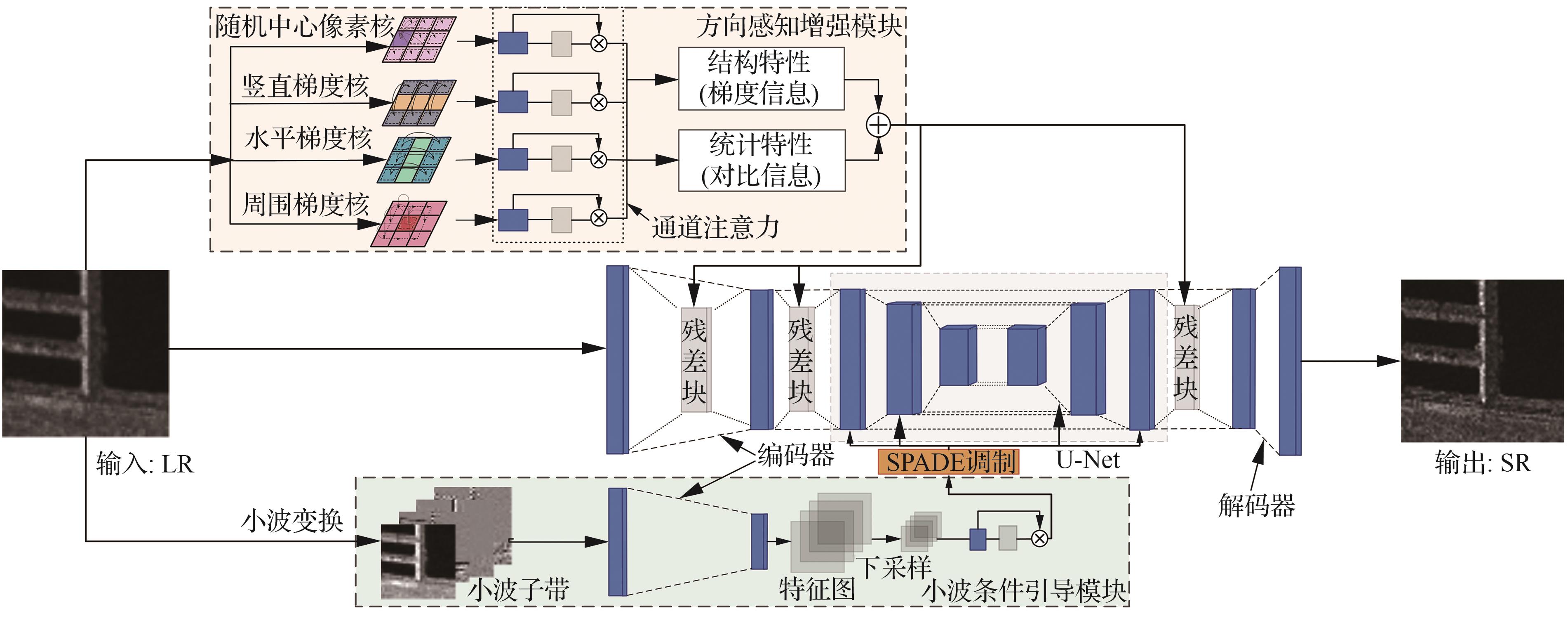
Fig.2
Flowchart of WG-SPADE module
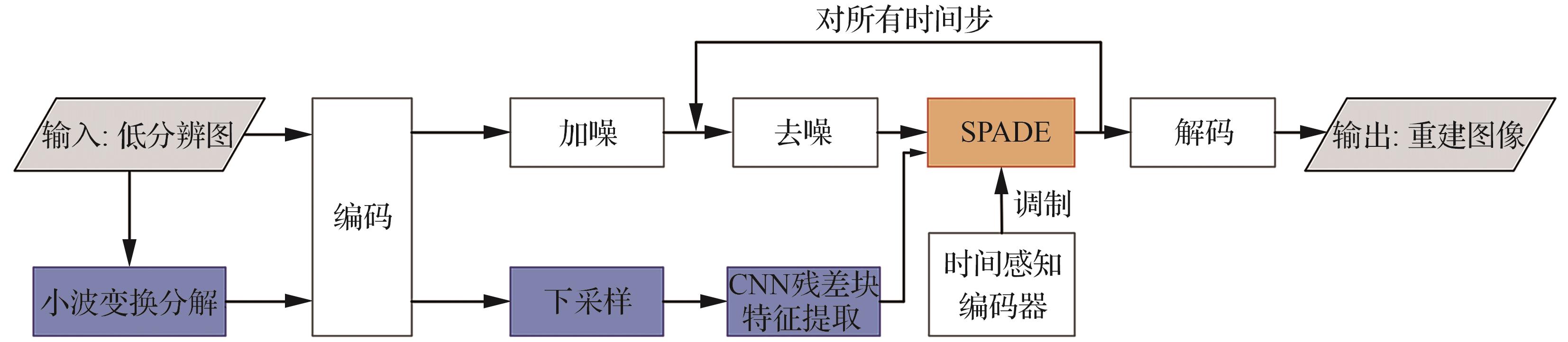
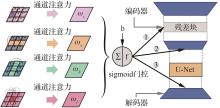
Fig.3
Illustration of direction-aware convolution module
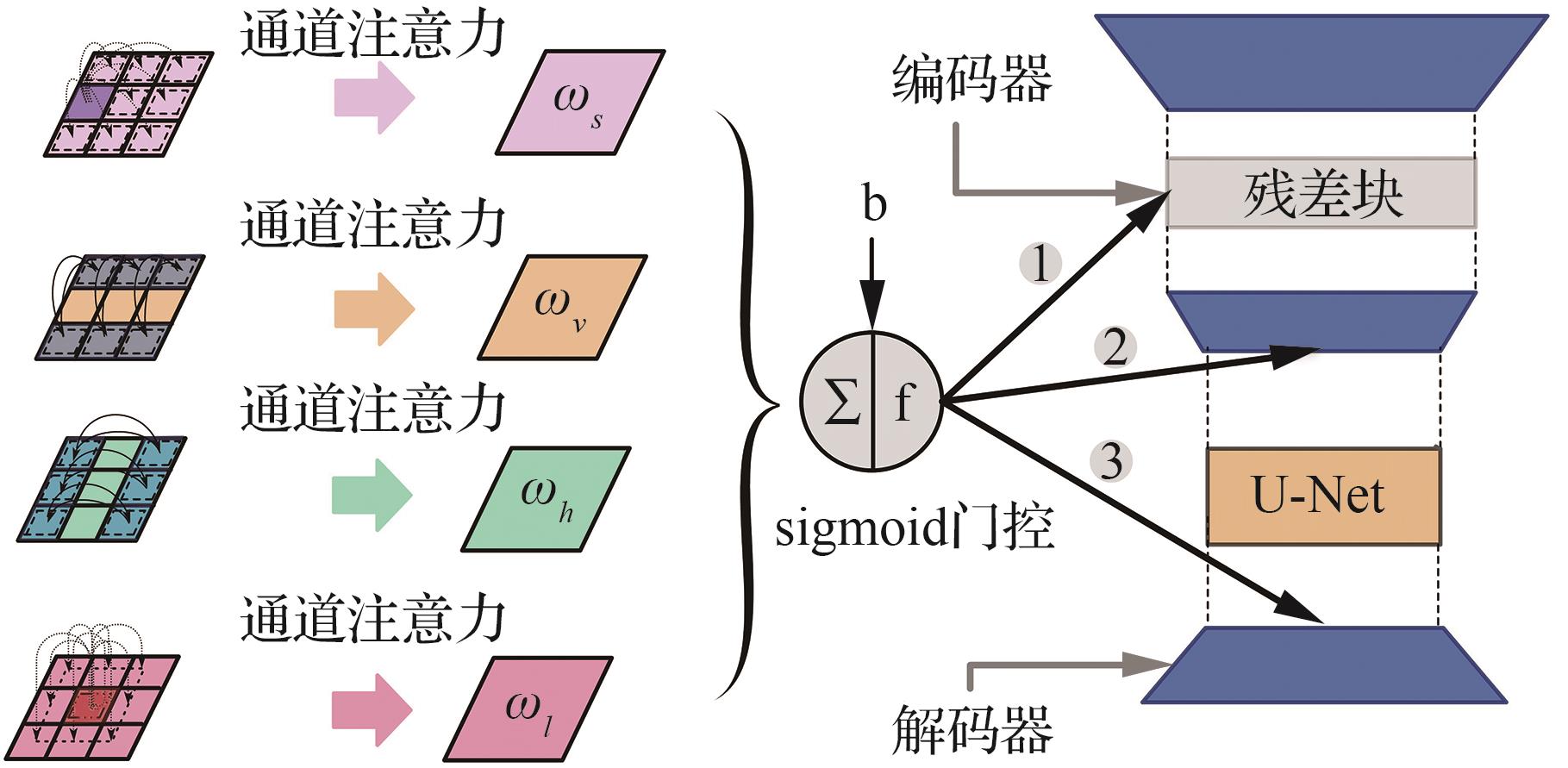
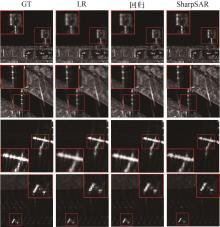
Fig.4
Super-resolution results of SharpSAR model
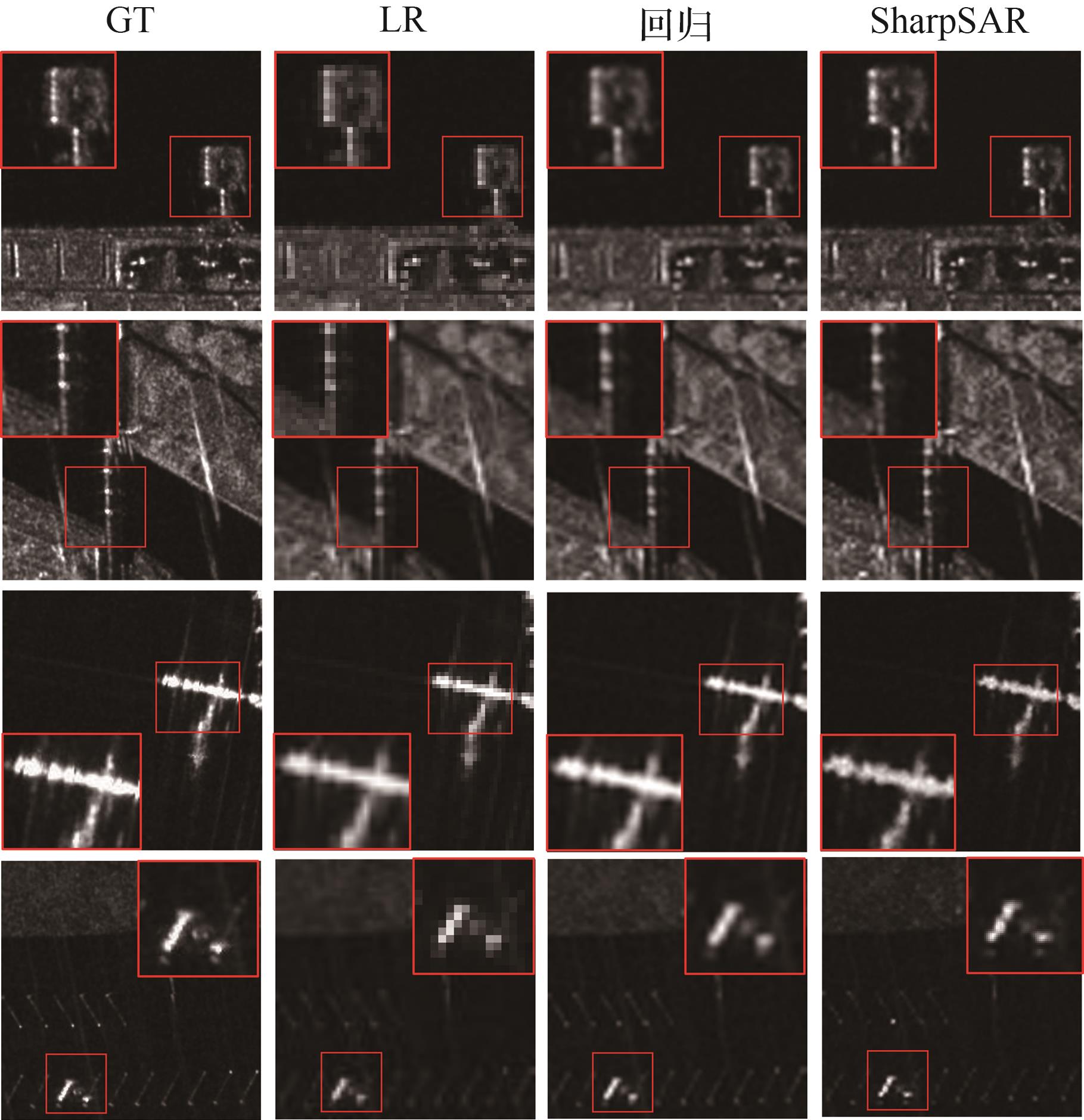
Fig.5
Variation of metrics during training process
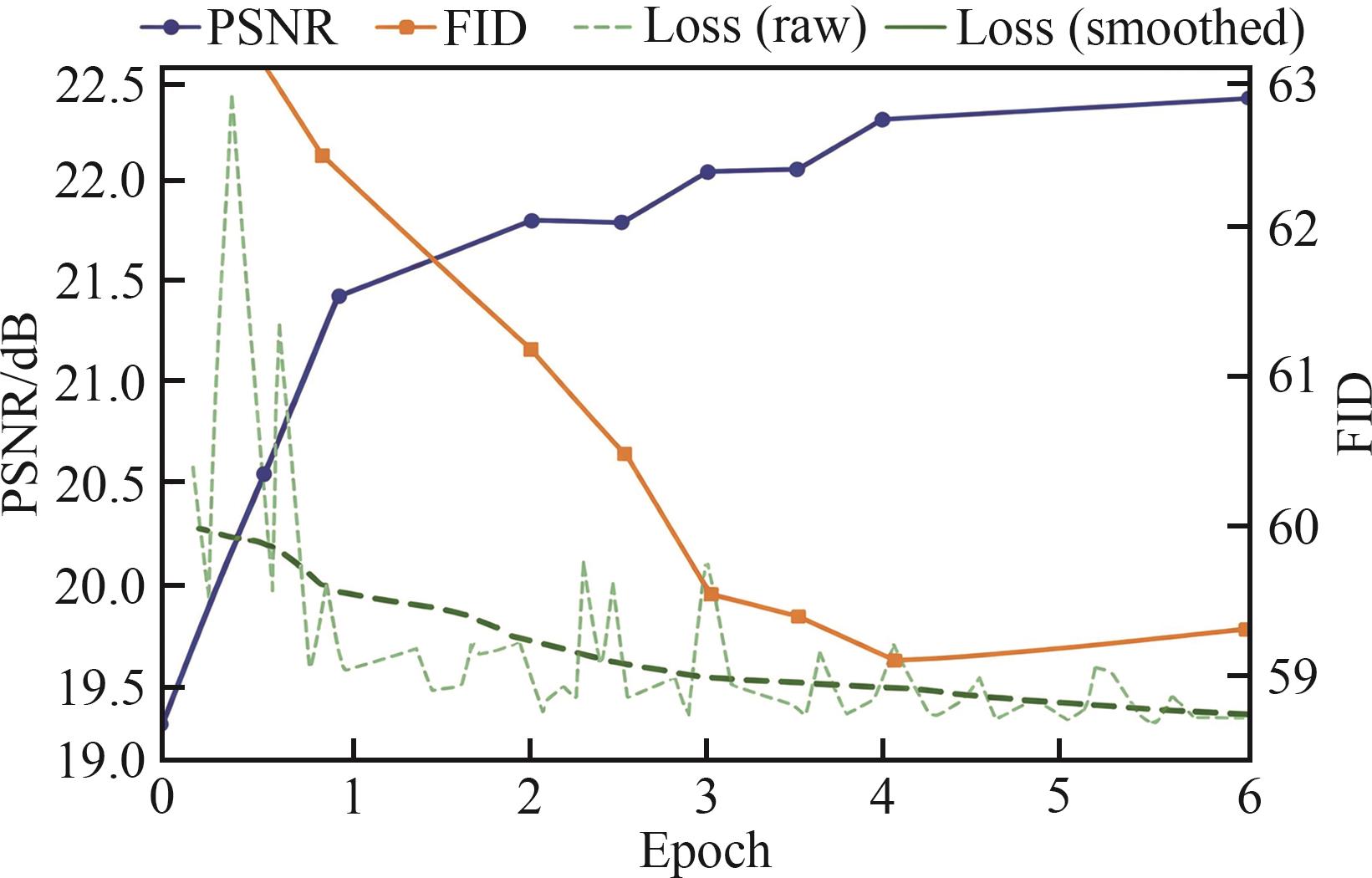

Table 1
Performance results of each model on SD and KOR datasets
| 数据集 | 指标 | SCSR | Real-ESRGAN | EDSR | SwinIR | SR3 | EDiffSR | LDM-SR | StableSR-Turbo | SharpSAR |
|---|---|---|---|---|---|---|---|---|---|---|
| SD | PSNR/dB↑ | 17.64 | 20.00 | 15.76 | 19.88 | 17.89 | 18.89 | |||
| SSIM↑ | 0.555 7 | 0.517 4 | 0.318 9 | 0.521 1 | 0.425 0 | 0.503 8 | ||||
| LPIPS↓ | 0.369 3 | 0.376 1 | 0.652 9 | 0.338 5 | 0.455 5 | 0.424 4 | ||||
| FID↓ | 637.46 | 138.12 | 143.57 | 144.10 | 262.74 | 140.39 | ||||
| EPI→1 | 0.400 8 | 0.366 6 | 0.052 7 | 1.956 0 | 0.330 0 | 0.347 7 | ||||
| KOR | PSNR/dB↑ | 16.37 | 20.00 | 13.54 | 20.95 | 19.01 | 20.24 | |||
| SSIM↑ | 0.504 2 | 0.517 4 | 0.189 5 | 0.470 8 | 0.430 6 | 0.497 6 | ||||
| LPIPS↓ | 0.450 1 | 0.376 1 | 0.888 4 | 0.399 3 | 0.404 6 | 0.381 1 | ||||
| FID↓ | 746.26 | 138.12 | 148.00 | 155.27 | 329.30 | 142.18 | ||||
| EPI→1 | 0.118 1 | 0.366 7 | 0.111 6 | 1.895 4 | 0.198 5 | 0.296 7 |
Fig.6
Super-resolution results from different models
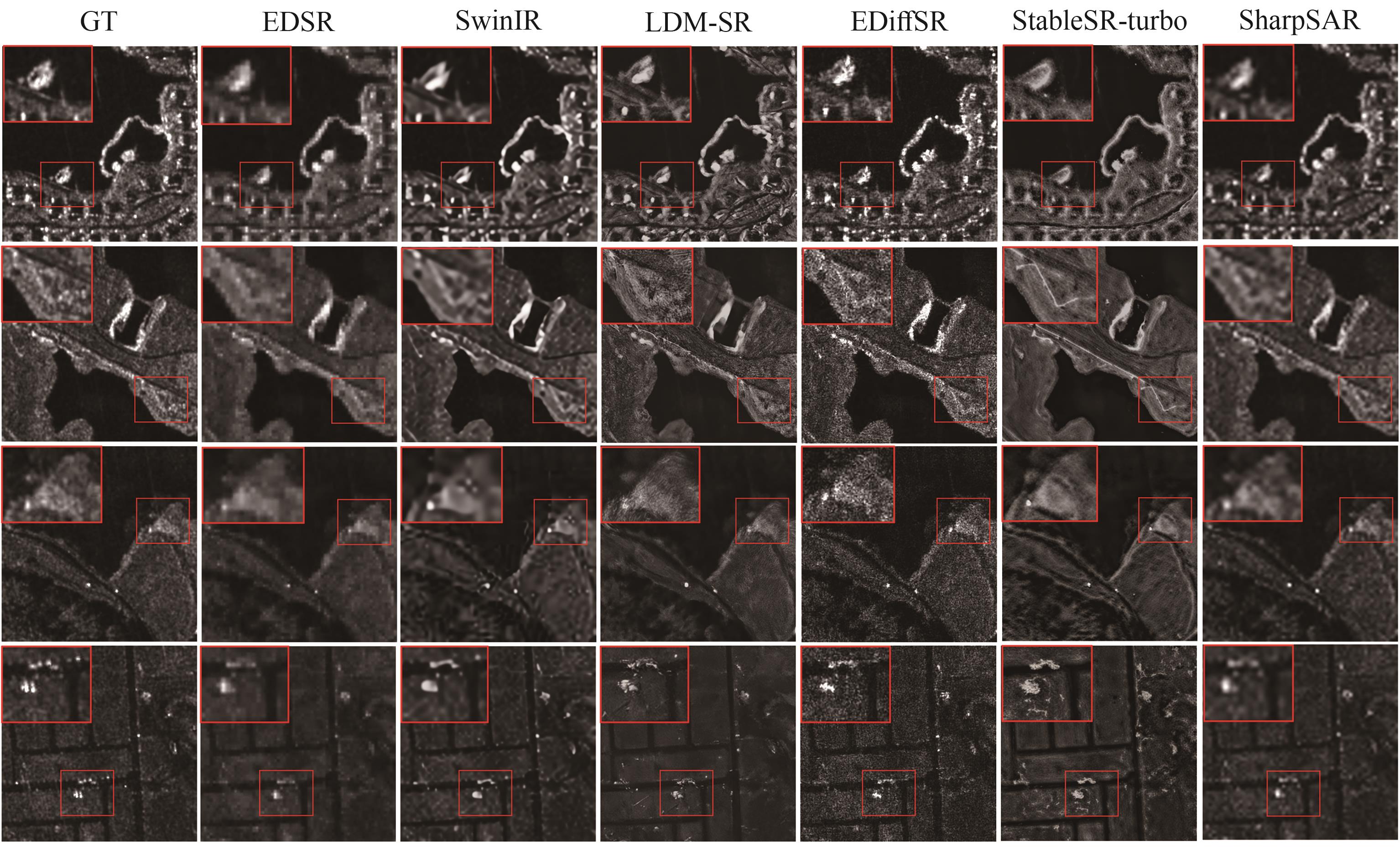
Table 2
Evaluation metrics for model architecture ablation experiment
| 方法 | PSNR/dB | SSIM | LPIPS | FID |
|---|---|---|---|---|
| 基线 | 20.490 9 | 0.572 3 | 0.452 7 | 103.993 6 |
| W | 22.039 6 | 0.684 4 | 0.239 6 | 109.806 2 |
| W+DAE | 22.366 4 | 0.712 5 | 0.260 6 | 61.685 4 |
Table 3
Degradation mode ablation (real degraded dataset)
| 指标 | SharpSAR | StableSR | Real-SharpSAR |
|---|---|---|---|
| PSNR/dB | 18.724 6 | 18.767 3 | 18.902 2 |
| SSIM | 0.496 8 | 0.432 1 | 0.507 4 |
| LPIPS↓ | 0.394 6 | 0.428 6 | 0.316 2 |
| FID↓ | 98.342 1 | 137.019 0 | 80.783 5 |
| EPI→1 | 0.441 2 | 0.215 0 | 0.611 6 |
Fig.7
Super-resolution performance of SharpSAR model on real degraded dataset
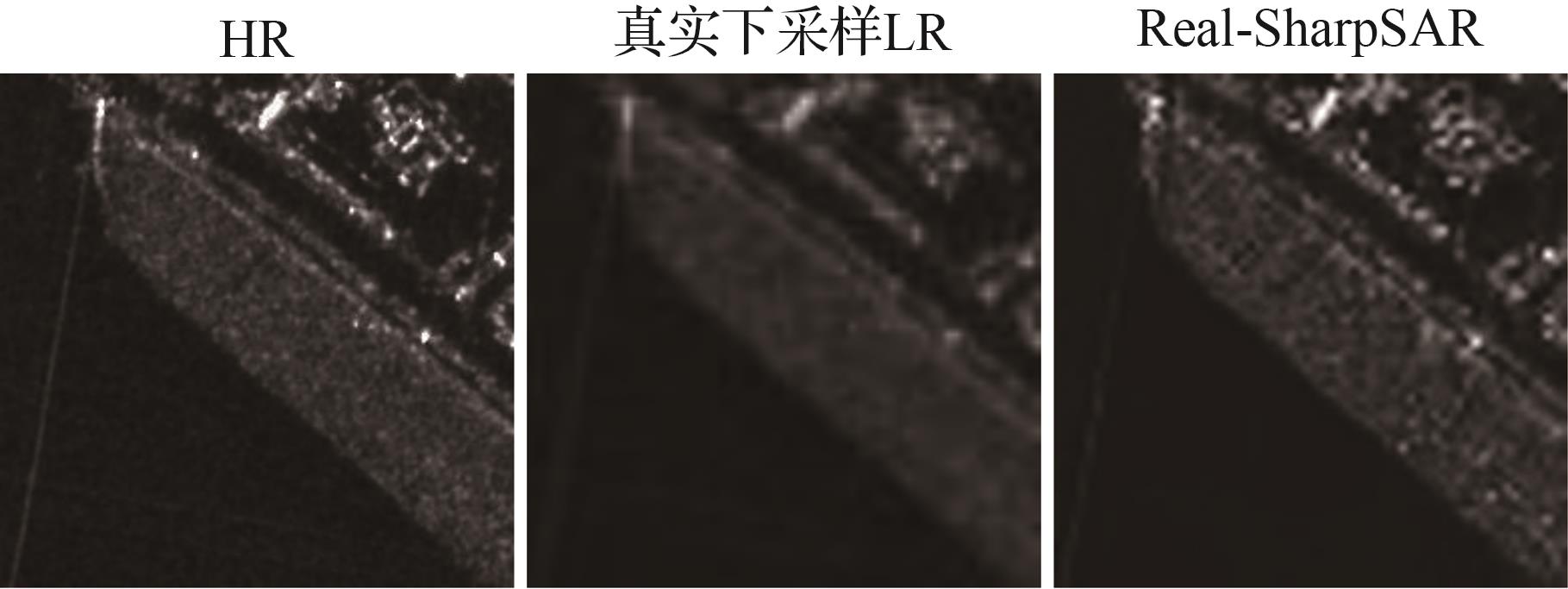
Table 4
Degradation intensity sensitivity analysis
| 指标 | 轻度(×2) | 中度(×4) | 重度(×8) |
|---|---|---|---|
| PSNR/dB | 22.29 | 22.29 | 22.28 |
| SSIM | 0.712 6 | 0.712 5 | 0.712 1 |
| LPIPS↓ | 0.260 2 | 0.260 6 | 0.261 1 |
| FID↓ | 61.47 | 61.68 | 61.75 |
| EPI→1 | 0.533 5 | 0.531 3 | 0.530 7 |
| [1] | ZHENG X, CUI H, XU C, et al. Dual Teacher: A semi-supervised co-training framework for cross-domain ship detection[J]. IEEE Transactions on Geoscience and Remote Sensing, 2023, 61: 1-12. |
| [2] | 连文慧. 模型驱动神经网络SAR成像特征重建[D]. 天津: 中国民航大学, 2024. |
| LIAN W H. Model-driven neural network for SAR imagery feature reconstruction[D]. Tianjin: Civil Aviation University of China, 2024 (in Chinese). | |
| [3] | XIE J, GAO F, ZHOU X, et al. Wavelet-based bi-dimensional aggregation network for SAR image change detection[J]. IEEE Geoscience and Remote Sensing Letters, 2024, 21: 1-5. |
| [4] | 张冰玉, 潘志刚, 姚锴, 等. 基于生成对抗网络的SAR解压缩图像重建算法[J]. 中国科学院大学学报(中英文), 2025, 42(5): 666-676. |
| ZHANG B Y, PAN Z G, YAO K, et al. SAR decompression image reconstruction algorithm based on generative adversarial network[J]. Journal of University of Chinese Academy of Sciences, 2025, 42(5): 666-676 (in Chinese). | |
| [5] | LI X, DING M, GU Y, et al. An end-to-end framework for joint denoising and classification of hyperspectral images[J]. IEEE Transactions on Neural Networks and Learning Systems, 2023, 34(7): 3269-3283. |
| [6] | WANG L, ZHENG M, DU W, et al. Super-resolution SAR image reconstruction via generative adversarial network[C]∥12th International Symposium on Antennas, Propagation and EM Theory (ISAPE 2018). Piscataway: IEEE Press, 2018: 1-4. |
| [7] | KANAKARAJ S, NAIR M S, KALADY S. Adaptive importance sampling unscented Kalman filter based SAR image super resolution[J]. Computers & Geosciences, 2019, 133: 104310. |
| [8] | 刘涛, 钱锋, 张葆. 遥感图像的MAP超分辨重建[J]. 液晶与显示, 2018, 33(10): 884-892. |
| LIU T, QIAN F, ZHANG B. MAP super-resolution reconstruction of remote sensing image[J]. Chinese Journal of Liquid Crystals and Displays, 2018, 33(10): 884-892 (in Chinese). | |
| [9] | 杨磊, 连文慧, 陈思佳, 等. 稀疏正则驱动的超分辨SAR图像重建[J]. 电讯技术, 2024, 64(9):1361-1369. |
| YANG L, LIAN W H, CHEN S J, et al. Super-resolution SAR image reconstruction based on sparse regularization driven mechanism[J]. Telecommunication Engineering, 2024, 64(9): 1361-1369 (in Chinese). | |
| [10] | 史振威, 雷森. 图像超分辨重建算法综述[J]. 数据采集与处理, 2020, 35(1): 1-20. |
| SHI Z W, LEI S. Review of image super-resolution reconstruction[J]. Journal of Data Acquisition and Processing, 2020, 35(1): 1-20 (in Chinese). | |
| [11] | LUO Z, YU J, LIU Z. The super-resolution reconstruction of SAR image based on the improved FSRCNN[J]. The Journal of Engineering, 2019, 2019(19): 5975-5978. |
| [12] | 罗宇轩, 吴高昌, 高明. 自适应卷积和轻量化Transformer的遥感图像超分辨网络[J]. 计算机工程与应用, 2025, 61(9): 263-276. |
| LUO Y X, WU G C, GAO M. Remote sensing image super-resolution network with adaptive convolution and lightweight transformer[J]. Computer Engineering and Applications, 2025, 61(9): 263-276 (in Chinese). | |
| [13] | DONG W, XU Y, QU J, et al. Learning multi-modal cross-scale deformable transformer network for unregistered hyperspectral image super-resolution[C]∥Proceedings of the AAAI Conference on Artificial Intelligence. Palo Alto: AAAI Press, 2024: 1573-1581. |
| [14] | 李永军, 陈锦智敏, 李孟军, 等. 基于生成对抗网络的图像超分辨重建算法研究[J]. 河南大学学报 (自然科学版), 2024, 54(4): 436-442. |
| LI Y J, CHEN J Z M, LI M J, et al. Research on super-resolution image reconstruction method based on generative adversarial networks[J]. Journal of Henan University (Natural Science), 2024, 54(4): 436-442 (in Chinese). | |
| [15] | 刘艳芳, 李春升, 杨威. 基于深度学习的SAR图像质量提升方法研究[J]. 上海航天(中英文), 2022, 39(3): 91-99. |
| LIU Y F, LI C S, YANG W. Research on SAR image quality improvement based on deep learning[J]. Aerospace Shanghai (Chinese & English), 2022, 39(3): 91-99 (in Chinese). | |
| [16] | HO J, JAIN A, ABBEEL P. Denoising diffusion probabilistic models[C]∥Proceedings of the 34th International Conference on Neural Information Processing Systems (NeurIPS 2020). Red Hook: Curran Associates Inc., 2020: 6840-6851. |
| [17] | 郭龙飞. 基于扩散模型的图像超分辨率综述[J]. 电视技术, 2025, 49(7): 222-225. |
| GUO L F. An overview of image super-resolution based on diffusion model[J]. Video Engineering, 2025, 49(7): 222-225 (in Chinese). | |
| [18] | SAHARIA C, HO J, CHAN W, et al. Image super-resolution via iterative refinement[J]. IEEE Transactions on Pattern Analysis and Machine Intelligence, 2023, 45(4): 4713-4726. |
| [19] | LI H, YANG Y, CHANG M, et al. SRDiff: Single image super-resolution with diffusion probabilistic models[J]. Neurocomputing, 2022, 479: 47-59. |
| [20] | ROMBACH R, BLATTMANN A, LORENZ D, et al. High-resolution image synthesis with latent diffusion models[C]∥Proceedings of the IEEE/CVF Conference on Computer Vision and Pattern Recognition (CVPR). Piscataway: IEEE Press, 2022: 10684-10695. |
| [21] | XIAO Y, YUAN Q, JIANG K, et al. EDiffSR: An efficient diffusion probabilistic model for remote sensing image super-resolution[J]. IEEE Transactions on Geoscience and Remote Sensing, 2024, 62: 1-14. |
| [22] | 邹承权, 黄江成, 孙正宝, 等. 遥感图像超分辨率重建方法: 综述与实验[J]. 遥感技术与应用, 2025, 40(4): 969-989. |
| ZOU C Q, HUANG J C, SUN Z B, et al. Super-resolution reconstruction methods for remote sensing images: A review and experiments[J]. Remote Sensing Technology and Application, 2025, 40(4): 969-989 (in Chinese). | |
| [23] | CHEN Z, ZHANG S, XIONG B. Super-resolving SAR images with diffusion models: A dual evaluation of metrics and applications[C]∥2024 IEEE 17th International Conference on Signal Processing (ICSP). Piscataway: IEEE Press, 2024: 340-346. |
| [24] | HUANG S, ZENG H, CHEN H, et al. Spatial and cluster structural prior-guided subspace clustering for hyperspectral image[J]. IEEE Transactions on Geoscience and Remote Sensing, 2024, 62: 1-15. |
| [25] | QIAN Y, CAI Q, PAN Y, et al. Boosting diffusion models with moving average sampling in frequency domain[C]∥2024 IEEE/CVF Conference on Computer Vision and Pattern Recognition (CVPR). Piscataway: IEEE Press, 2024: 8911-8920. |
| [26] | PENG L, CAO Y, PEI R J, et al. Efficient real-world image super-resolution via adaptive directional gradient convolution[DB/OL]. arXiv preprint: 2405.07023, 2024. |
| [27] | WANG J, YUE Z, ZHOU S, et al. Exploiting diffusion prior for real-world image super-resolution[J]. International Journal of Computer Vision, 2024, 132(12): 5929-5949. |
| [28] | 王晓曼, 陈艳平, 杨采薇, 等. 多方向梯度特征提取的嵌套命名实体识别方法[J]. 计算机应用, 2025, 45(11): 3547-3554. |
| WANG X M, CHEN Y P, YANG C W, et al. Nested named entity recognition method for multi-directional gradient feature extraction[J]. Journal of Computer Applications, 2025, 45(11): 3547-3554 (in Chinese). | |
| [29] | 袁姮, 霍欣燃, 姜文涛. 全息梯度差分卷积的图像分类网络[J]. 自动化学报, 2025, 51(9): 2106-2130. |
| YUAN H, HUO X R, JIANG W T. Image classification network of holographic gradient differential convolution[J]. Acta Automatica Sinica, 2025, 51(9): 2106-2130 (in Chinese). | |
| [30] | 孙巍, 王乾宙, 陈雪凌, 等. 真实场景下图像超分辨技术现状与趋势[J]. 中国图象图形学报, 2025, 30(6): 1576-1592. |
| SUN W, WANG Q Z, CHEN X L, et al. Development of real-world image super-resolution[J]. Journal of Image and Graphics, 2025, 30(6): 1576-1592 (in Chinese). | |
| [31] | 闫河, 巫茜. 劣质SAR图像退化模型研究[J]. 计算机工程与设计, 2010, 31(24): 5351-5354. |
| YAN H, WU Q. Research on low-quality SAR image degradation model[J]. Computer Engineering and Design, 2010, 31(24): 5351-5354 (in Chinese). | |
| [32] | SONG J, MENG C, ERMON S. Denoising diffusion implicit models[DB/OL]. arXiv preprint: 2010.02502, 2022. |
| [33] | REN B, MA S, HOU B, et al. A dual-stream high resolution network: Deep fusion of GF-2 and GF-3 data for land cover classification[J]. International Journal of Applied Earth Observation and Geoinformation, 2022, 112: 102896. |
| [34] | ICEYE. ICEYE synthetic aperture radar (SAR) sample data[EB/OL]. [2025-07-15]. . |
| [35] | LI X, ZHANG G, CUI H, et al. MCANet: A joint semantic segmentation framework of optical and SAR images for land use classification[J]. International Journal of Applied Earth Observation and Geoinformation, 2022, 106: 102638. |
| [36] | LI Y, LI X, LI W, et al. SAR Det-100K: Towards open-source benchmark and tool kit for large-scale SAR object detection[C]∥The Thirty-eighth Annual Conference on Neural Information Processing Systems (NeurIPS). Red Hook: Curran Associates Inc., 2024. |
| [37] | 吴樊, 张红, 王超, 等. SARBuD 1.0: 面向深度学习的GF-3精细模式SAR建筑数据集[J]. 遥感学报, 2022, 26(4): 620-631. |
| WU F, ZHANG H, WANG C, et al. SARBuD 1.0: A SAR building dataset based on GF-3 FSII imageries for built-up area extraction with deep learning method[J]. National Remote Sensing Bulletin, 2022, 26(4): 620-631 (in Chinese). | |
| [38] | BLAU Y, MICHAELI T. The perception-distortion trade-off[C]∥2018 IEEE/CVF Conference on Computer Vision and Pattern Recognition. Piscataway: IEEE Press, 2018: 6228-6237. |
| [39] | ZHANG R, ISOLA P, EFROS A A, et al. The unreasonable effectiveness of deep features as a perceptual metric[C]∥2018 IEEE/CVF Conference on Computer Vision and Pattern Recognition. Piscataway: IEEE Press, 2018: 586-595. |
| [40] | HEUSEL M, RAMSAUER H, UNTERTHINER T, et al. GANs trained by a two time-scale update rule converge to a local Nash equilibrium[C]∥Advances in Neural Information Processing Systems. Red Hook: Curran Associates, Inc., 2017: 6626-6637. |
| [41] | XU Z, FENG X, TIAN S, et al. Edge preserved low-rank SAR image despeckling via hierarchical prior knowledge regulation[J]. IEEE Transactions on Geoscience and Remote Sensing, 2023, 61: 5205317. |
| [42] | YANG J, WRIGHT J, HUANG T, et al. Image super-resolution as sparse representation of raw image patches [C]∥2008 IEEE Conference on Computer Vision and Pattern Recognition. Piscataway: IEEE Press, 2008: 1-8. |
| [43] | WANG X, XIE L, DONG C, et al. Real-ESRGAN: Training real-world blind super-resolution with pure synthetic data[C]∥2021 IEEE/CVF International Conference on Computer Vision Workshops (ICCVW). Piscataway: IEEE Press, 2021: 1905-1914. |
| [44] | LIM B, SON S, KIM H, et al. Enhanced deep residual networks for single image super-resolution[DB/OL]. arXiv preprint: 1707.02921, 2017. |
| [45] | LEPCHA D C, GOYAL B, DOGRA A, et al. Image super-resolution: A comprehensive review, recent trends, challenges and applications[J]. Information Fusion, 2023, 91: 230-260. |
| [1] | Yongkang ZHAO, Zuolong LIU, Xia FENG. FTCA-Transformer: A method for predicting flight off-block time [J]. Acta Aeronautica et Astronautica Sinica, 2026, 47(5): 332357-332357. |
| [2] | Shaohua DUAN, Chunjie ZHANG, Chuankai LIU, Xiaolong ZHENG, Jitao ZHANG. AFAR-Net: Autoregressive and feedback-driven adaptive rectangular convolution network for pansharpening [J]. Acta Aeronautica et Astronautica Sinica, 2026, 47(10): 532432-532432. |
| [3] | Guangyu LU, Bowen CHEN, Keyan CHEN, Zhengxia ZOU, Zhenwei SHI. Spaceborne remote sensing image object detection based on mixture of experts model [J]. Acta Aeronautica et Astronautica Sinica, 2026, 47(10): 532599-532599. |
| [4] | Xu TANG, Feng GU, Jingjing MA, Xiangrong ZHANG. Hyperspectral-LiDAR joint classification method based on vision-language pre-trained models [J]. Acta Aeronautica et Astronautica Sinica, 2026, 47(10): 139-158. |
| [5] | Fujie WU, Bowen WANG, Jingya QI, Mingzhi CAO, Yingjun SANG, Sheng LI, Yuzhen ZHANG, Qian CHEN, Chao ZUO. A review of airborne multi-aperture panoramic image compositing [J]. Acta Aeronautica et Astronautica Sinica, 2025, 46(3): 630505-630505. |
| [6] | Runmin CONG, Haoyan SUN, Yuxuan LUO, Hao FANG. Generalized few-shot segmentation for remote sensing image based on class relation mining [J]. Acta Aeronautica et Astronautica Sinica, 2025, 46(23): 631694-631694. |
| [7] | Tianqi FAN, Zhengxia ZOU, Zhenwei SHI. Typical remote sensing target detection with data synthesis based on reinforcement learning [J]. Acta Aeronautica et Astronautica Sinica, 2025, 46(23): 631955-631955. |
| [8] | Liangjin ZHAO, Haonan TONG, Ziyang YUAN, Yundu LI, Xiaodian ZHANG, Peirui CHENG. Interference management for UAV swarms: Fundamental mechanisms, techniques, and challenges [J]. Acta Aeronautica et Astronautica Sinica, 2025, 46(23): 632022-632022. |
| [9] | Fei WANG, Yong LIU, Jiawei YAO, Xuanlei ZHU, Xiaoqiang LU, Wenxing GUO, Xuetao ZHANG, Yu GUO. RS-AdaDiff: One-step remote sensing image super-resolution diffusion model with degradation-aware adaptive estimation [J]. Acta Aeronautica et Astronautica Sinica, 2025, 46(23): 632763-632763. |
| [10] | Bin SUN, Hang YOU, Wenbo LI, Xiangrui LIU, Jiayi MA. Dual-band payload image fusion and its applications in low-altitude remote sensing [J]. Acta Aeronautica et Astronautica Sinica, 2025, 46(11): 531343-531343. |
| [11] | Fanteng MENG, Yong QIN, Jing CUI, Yunpeng WU, Zicheng ZHANG, Shaowei WEI. Unknown risk detection in external environment of railroad using UAV images [J]. Acta Aeronautica et Astronautica Sinica, 2025, 46(11): 531262-531262. |
| [12] | Youtao XUE, Shaobo YAO, Yuxin YANG, Yi DUAN, Wenwen ZHAO, Haoge LI. Generalization of three-dimensional flight vehicle shape representation using generative models [J]. Acta Aeronautica et Astronautica Sinica, 2025, 46(10): 631511-631511. |
| [13] | Qichang ZHAO, Yiquan WU, Yubin YUAN. Progress of ship detection and recognition methods in optical remote sensing images [J]. Acta Aeronautica et Astronautica Sinica, 2024, 45(8): 29025-029025. |
| [14] | Ziling WANG, Zhenyu XIONG, Lucheng YANG, Ruining YANG, Linzhou HUANG. Spaceborne SAR ship target recognition network guided by AIS and optical remote sensing images [J]. Acta Aeronautica et Astronautica Sinica, 2024, 45(2): 328672-328672. |
| [15] | Yanfang LIU, Jiayu SHE, Qiufan YUAN, Rui ZHOU, Naiming QI. Real⁃time small target detection networks for UAV remote sensing [J]. Acta Aeronautica et Astronautica Sinica, 2024, 45(14): 630119-630119. |
| Viewed | ||||||
|
Full text |
|
|||||
|
Abstract |
|
|||||
Address: No.238, Baiyan Buiding, Beisihuan Zhonglu Road, Haidian District, Beijing, China
Postal code : 100083
E-mail:hkxb@buaa.edu.cn
Total visits: 6658907 Today visits: 1341All copyright © editorial office of Chinese Journal of Aeronautics
All copyright © editorial office of Chinese Journal of Aeronautics
Total visits: 6658907 Today visits: 1341

 CJA
CJA
