Acta Aeronautica et Astronautica Sinica ›› 2025, Vol. 46 ›› Issue (23): 632763.doi: 10.7527/S1000-6893.2025.32763
• special column • Previous Articles
Fei WANG1,2,3, Yong LIU1,2,3, Jiawei YAO1,2,3, Xuanlei ZHU1,2,3, Xiaoqiang LU4, Wenxing GUO1,2,3, Xuetao ZHANG1,2,3, Yu GUO1,2,3( )
)
Received:2025-09-06
Revised:2025-09-24
Accepted:2025-10-20
Online:2025-11-20
Published:2025-11-13
Contact:
Yu GUO
E-mail:yu.guo@xjtu.edu.cn
Supported by:CLC Number:
Fei WANG, Yong LIU, Jiawei YAO, Xuanlei ZHU, Xiaoqiang LU, Wenxing GUO, Xuetao ZHANG, Yu GUO. RS-AdaDiff: One-step remote sensing image super-resolution diffusion model with degradation-aware adaptive estimation[J]. Acta Aeronautica et Astronautica Sinica, 2025, 46(23): 632763.
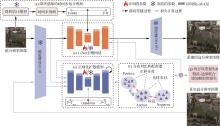
Fig.1
Overall framework of RS-AdaDiff mode
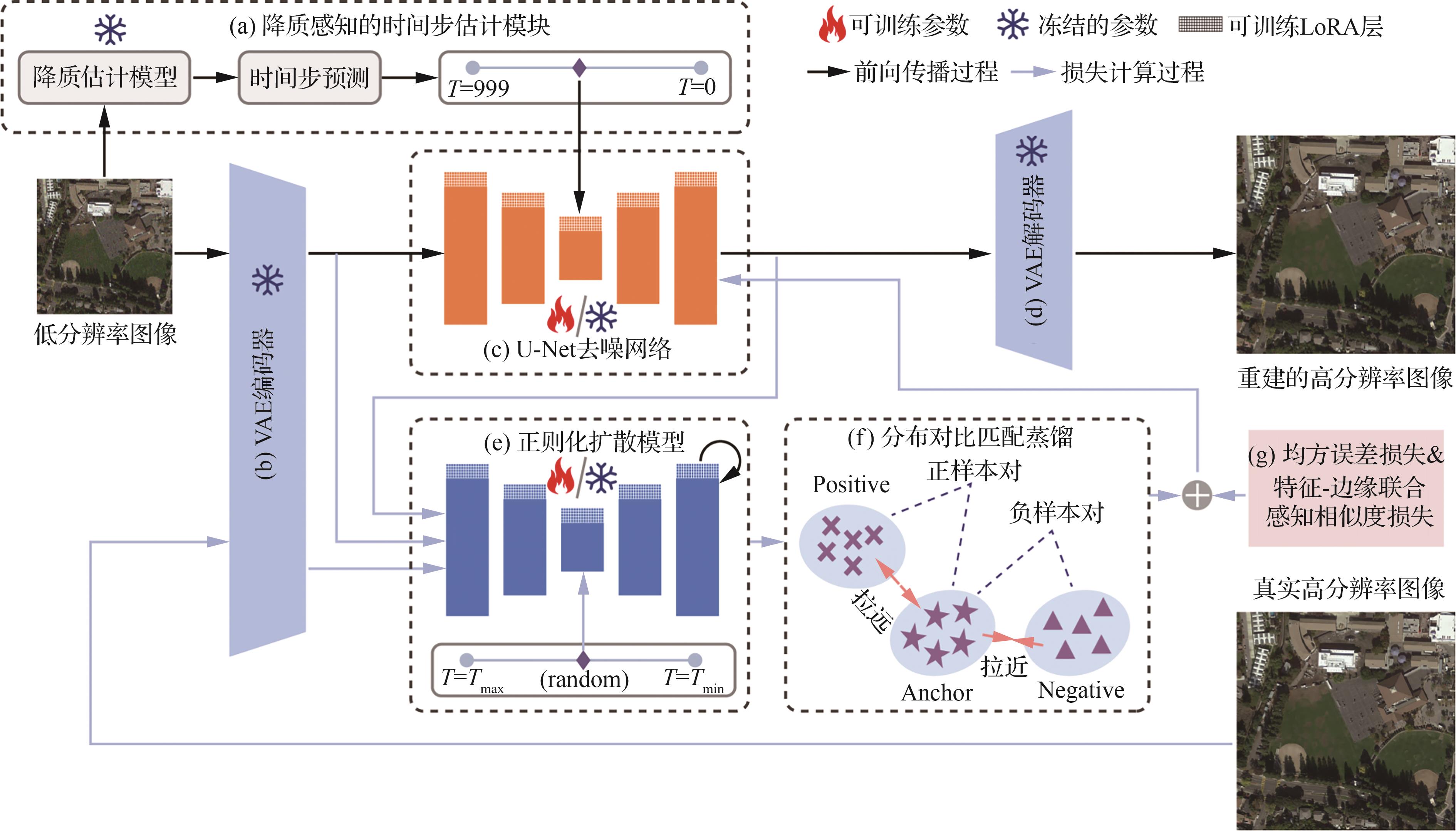
Fig.2
Visualization of predicted optimal timesteps
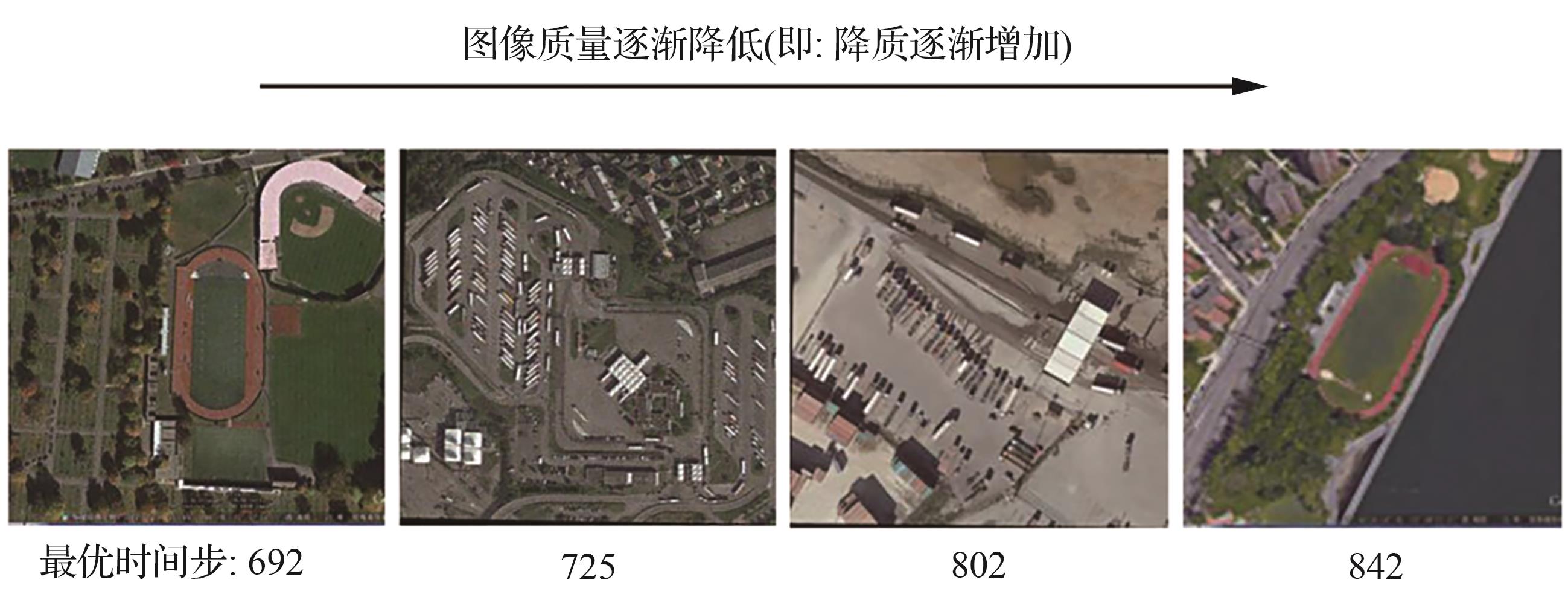
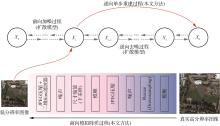
Fig.3
Sample degradation process and model single-step sampling strategy
Table 1
Training hyperparameter configuration
Table 2
Quantitative results of different methods on DOTA and RSOD datasets
| 数据集 | 指标 | Bicubic | SwinIR | HSENet | TransENet | TTST | EDiffSR | FastDiffSR | DiffBIR | RS-AdaDiff |
|---|---|---|---|---|---|---|---|---|---|---|
DOTA ×4 256→1 024 | PSNR↑ | 24.07 | 26.24 | 26.31 | 26.22 | 26.19 | 25.97 | 25.63 | 25.44 | |
| SSIM↑ | 0.484 5 | 0.613 7 | 0.609 4 | 0.618 1 | 0.595 2 | 0.586 7 | 0.549 5 | 0.598 5 | ||
| LPIPS↓ | 0.574 1 | 0.505 5 | 0.502 6 | 0.510 8 | 0.500 6 | 0.520 4 | 0.508 2 | 0.381 1 | ||
| MUSIQ↑ | 21.57 | 26.90 | 24.66 | 26.07 | 25.63 | 24.73 | 35.78 | 53.08 | ||
| CLIP-IQA↑ | 0.511 2 | 0.583 6 | 0.590 2 | 0.552 9 | 0.584 9 | 0.525 5 | 0.558 5 | 0.632 6 | ||
| MANIQA↑ | 0.194 6 | 0.204 7 | 0.192 0 | 0.188 0 | 0.198 8 | 0.146 2 | 0.184 7 | 0.342 9 | ||
RSOD ×4 256→1 024 | PSNR↑ | 25.10 | 26.62 | 26.46 | 26.65 | 26.59 | 25.71 | 26.02 | 25.77 | |
| SSIM↑ | 0.631 3 | 0.668 3 | 0.658 7 | 0.668 7 | 0.653 3 | 0.637 8 | 0.601 4 | 0.620 9 | ||
| LPIPS↓ | 0.507 3 | 0.467 5 | 0.470 8 | 0.464 9 | 0.480 1 | 0.472 5 | 0.477 8 | 0.385 5 | ||
| MUSIQ↑ | 20.87 | 23.27 | 22.25 | 23.51 | 22.39 | 22.41 | 23.57 | 55.18 | ||
| CLIP-IQA↑ | 0.591 2 | 0.643 5 | 0.649 6 | 0.625 9 | 0.626 6 | 0.636 4 | 0.649 9 | 0.697 8 | ||
| MANIQA↑ | 0.136 3 | 0.168 8 | 0.151 1 | 0.151 5 | 0.163 0 | 0.117 3 | 0.144 5 | 0.333 1 |
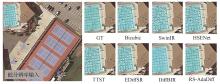
Fig.4
Visual comparison of different methods on DOTA dataset (models for 4× remote sensing image super-resolution)
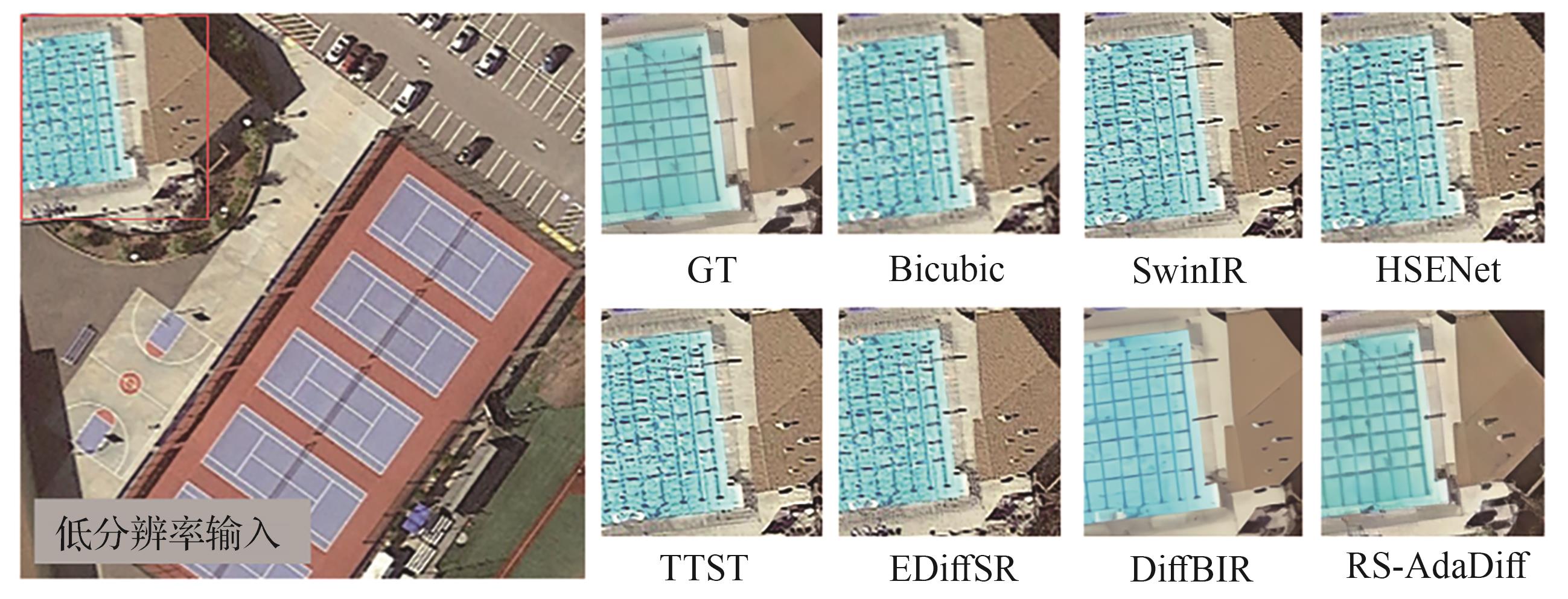
Fig.5
Visual comparison of different methods on RSOD dataset (models for 4× remote sensing image super-resolution)
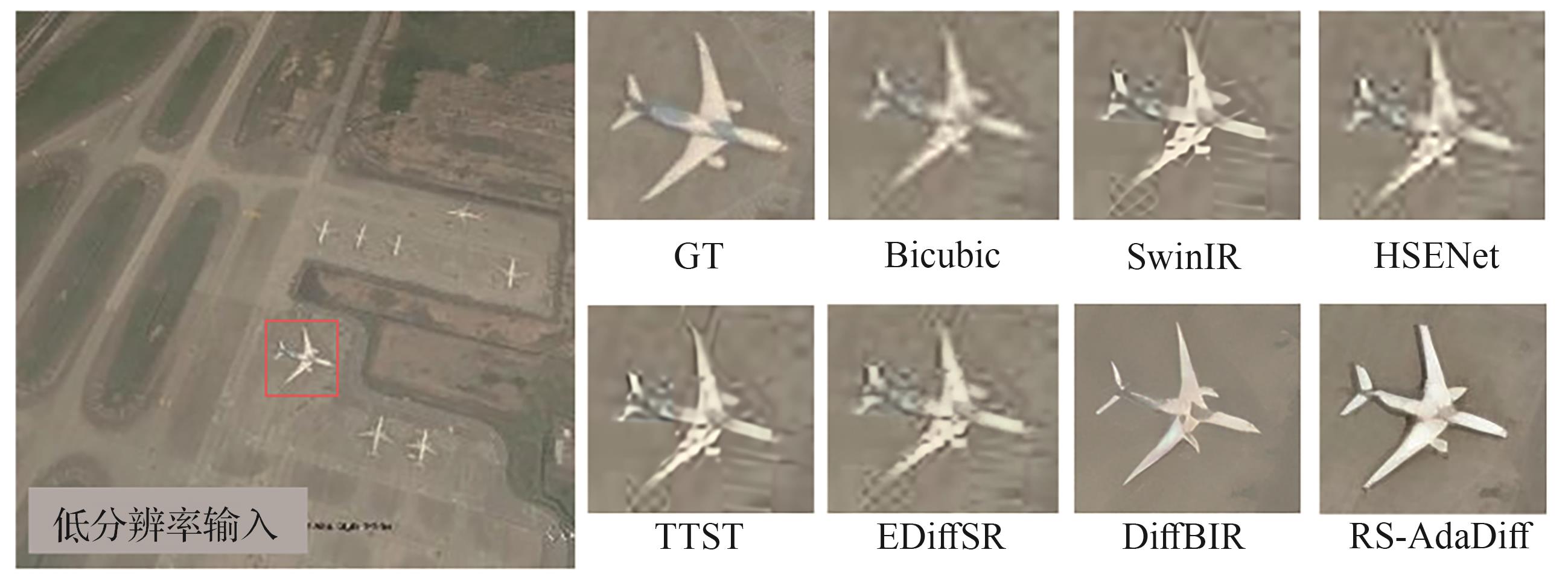
Table 3
Quantitative results of different methods on NWPU VHR-10 and Potsdam datasets
| 数据集 | 指标 | Bicubic | SwinIR | HSENet | TransENet | TTST | EDiffSR | FastDiffSR | DiffBIR | RS-AdaDiff |
|---|---|---|---|---|---|---|---|---|---|---|
NWPU VHR-10 ×4 512→2048 | MUSIQ↑ | 22.39 | 28.10 | 35.97 | 26.70 | 25.62 | 25.29 | 31.85 | 64.70 | |
| CLIP-IQA↑ | 0.723 4 | 0.769 2 | 0.664 7 | 0.796 2 | 0.713 5 | 0.773 0 | 0.761 3 | 0.725 8 | ||
| MANIQA↑ | 0.183 4 | 0.226 3 | 0.227 8 | 0.200 7 | 0.216 2 | 0.166 1 | 0.247 4 | 0.319 3 | ||
Potsdam ×4 512→2048 | MUSIQ↑ | 21.67 | 24.15 | 33.34 | 23.45 | 22.21 | 22.79 | 28.22 | 64.73 | |
| CLIP-IQA↑ | 0.714 7 | 0.494 5 | 0.770 9 | 0.728 0 | 0.727 6 | 0.748 9 | 0.564 2 | 0.777 5 | ||
| MANIQA↑ | 0.213 7 | 0.253 3 | 0.247 2 | 0.230 7 | 0.251 9 | 0.169 7 | 0.202 4 | 0.328 9 |
Fig.6
Visual comparison of different methods on Potsdam dataset (models for×4 remote sensing image super-resolution)
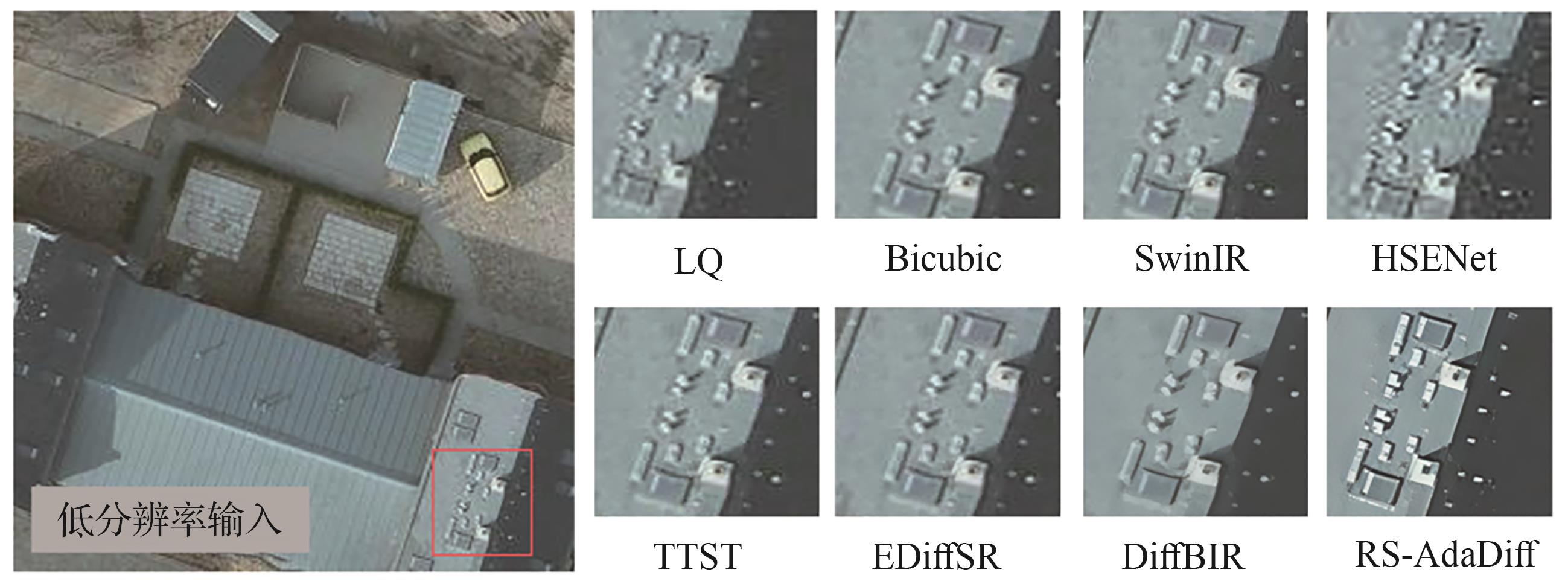
Fig.7
Visual comparison of different methods on NWPU VHR-10 dataset (models for ×4 remote sensing image super-resolution)
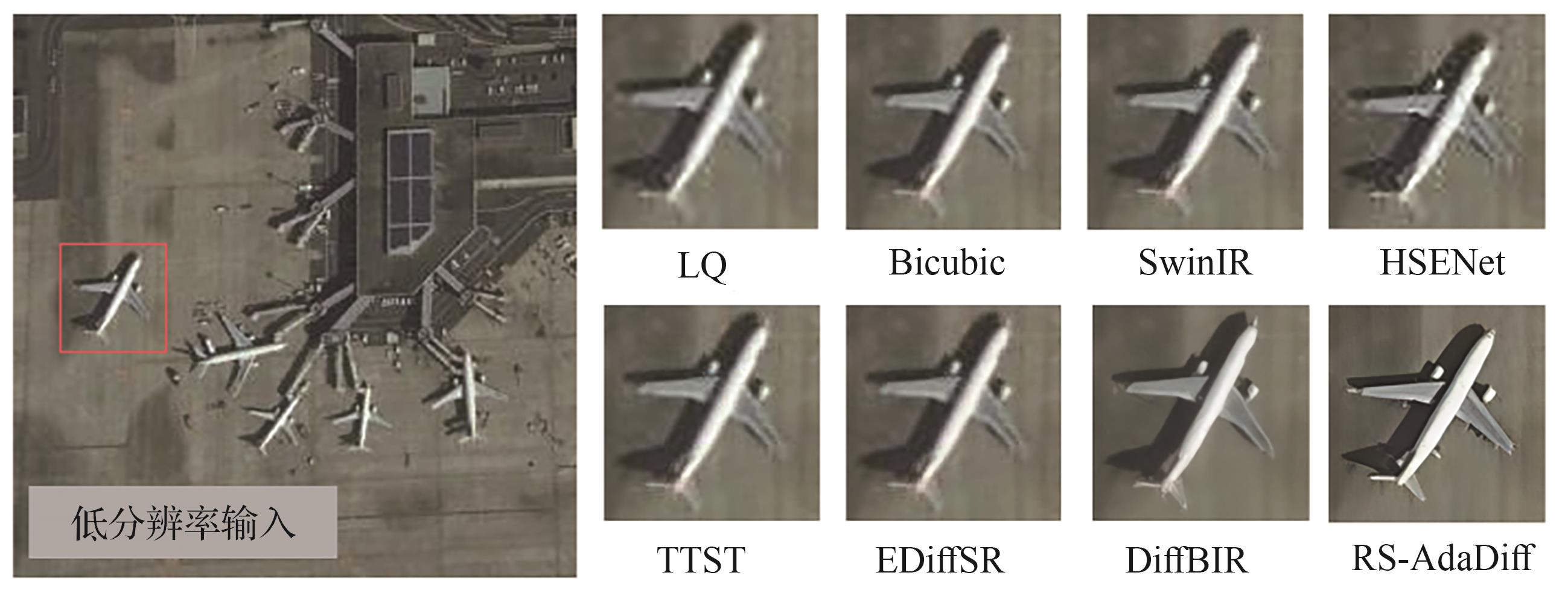
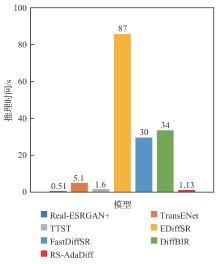
Fig.8
Comparison of inference time across different methods
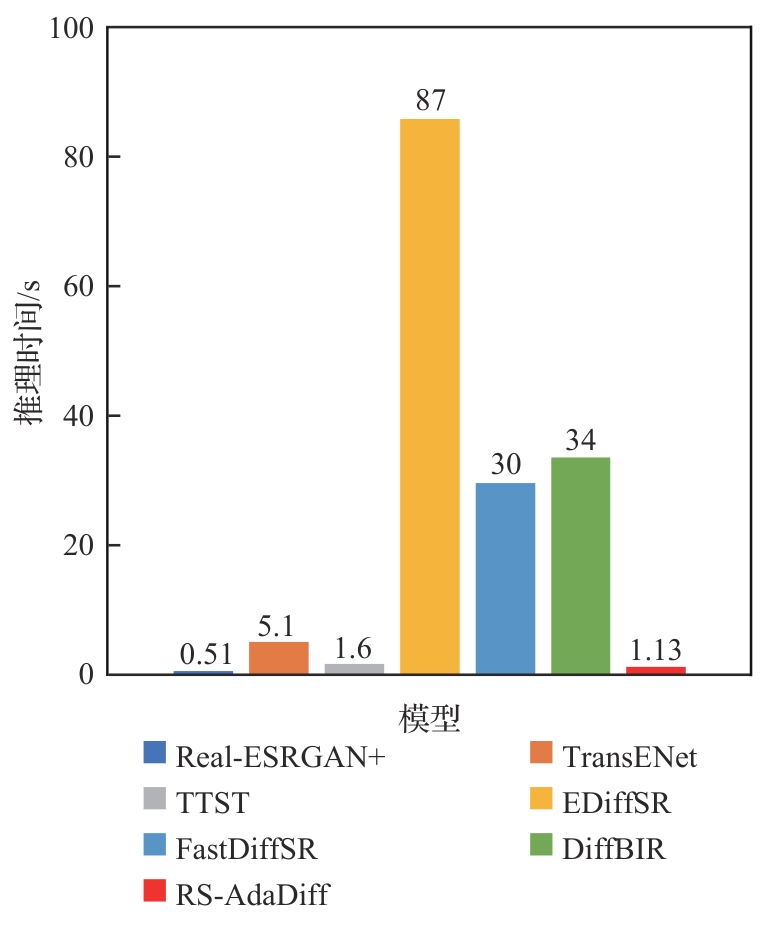
Table 4
Comparison of ablation study results
| 模块 | Baseline1 | Baseline2 | Baseline3 | RS-AdaDiff |
|---|---|---|---|---|
| DTE | × | √ | √ | √ |
| DCMD | × | × | √ | √ |
| FEJAS损失 | × | × | × | √ |
| MUSIQ↑ | 60.04 | 63.27 | 62.99 | 64.70 |
| MANIQA↑ | 0.291 0 | 0.318 3 | 0.327 6 | 0.319 3 |
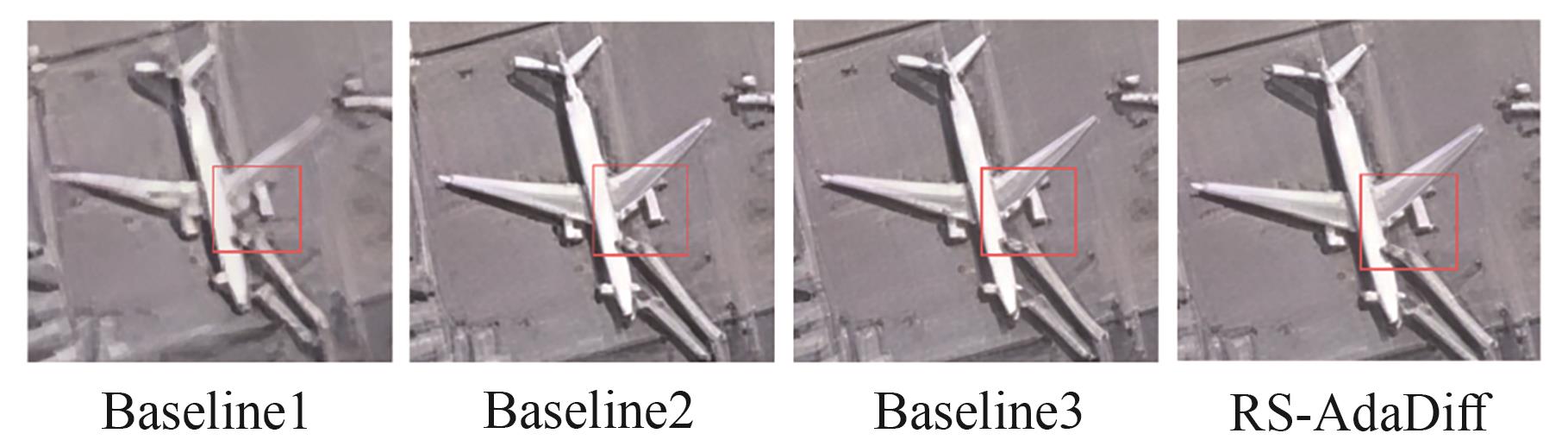
Fig.9
Ablation study visualization results
| [1] | BANDARA W G C, NAIR N G, PATEL V M. DDPM-CD: Remote sensing change detection using denoising diffusion probabilistic models[DB/OL]. arXiv preprint: 2206.11892, 2022. |
| [2] | 赵军利, 李向英, 陈占龙, 等. 基于遥感影像军事地质信息提取及应用研究现状[J]. 地质论评, 2025, 71(3): 848-866. |
| ZHAO J L, LI X Y, CHEN Z L, et al. Current research status on the extraction and application of military geological information based on remote sensing images[J]. Geological Review, 2025, 71(3): 848-866 (in Chinese). | |
| [3] | 秦杨, 黄孝森. 遥感技术在全域土地综合整治中的应用[J]. 智能建筑与智慧城市, 2025(5): 43-45. |
| QIN Y, HUANG X S. The application of remote sensing technology in the whole land comprehensive consolidation[J]. Intelligent Building & Smart City, 2025(5): 43-45 (in Chinese). | |
| [4] | 刘延芳, 佘佳宇, 袁秋帆, 等. 无人机遥感图像实时小目标检测方法[J]. 航空学报, 2024, 45(14): 630119. |
| LIU Y F, SHE J Y, YUAN Q F, et al. Real-time small target detection networks for UAV remote sensing[J]. Acta Aeronautica et Astronautica Sinica, 2024, 45(14): 630119 (in Chinese). | |
| [5] | 王子玲, 熊振宇, 杨璐铖, 等. AIS和光学遥感图像引导的星载SAR舰船目标识别网络[J]. 航空学报, 2024, 45(2): 328672. |
| WANG Z L, XIONG Z Y, YANG L C, et al. Spaceborne SAR ship target recognition network guided by AIS and optical remote sensing images[J]. Acta Aeronautica et Astronautica Sinica, 2024, 45(2): 328672 (in Chinese). | |
| [6] | LEI S, SHI Z W, ZOU Z X. Super-resolution for remote sensing images via local-global combined network[J]. IEEE Geoscience and Remote Sensing Letters, 2017, 14(8): 1243-1247. |
| [7] | LIM B, SON S, KIM H, et al. Enhanced deep residual networks for single image super-resolution[C]∥2017 IEEE Conference on Computer Vision and Pattern Recognition Workshops (CVPRW). Piscataway: IEEE Press, 2017: 1132-1140. |
| [8] | LI Y D, MAVROMATIS S, ZHANG F, et al. Single-image super-resolution for remote sensing images using a deep generative adversarial network with local and global attention mechanisms[J]. IEEE Transactions on Geoscience and Remote Sensing, 2021, 60: 3000224. |
| [9] | LEDIG C, THEIS L, HUSZÁR F, et al. Photo-realistic single image super-resolution using a generative adversarial network[C]∥2017 IEEE Conference on Computer Vision and Pattern Recognition (CVPR). Piscataway: IEEE Press, 2017: 105-114. |
| [10] | DHARIWAL P, NICHOL A. Diffusion models beat GANS on image synthesis[J]. Advances in Neural Information Processing Systems, 2021, 34, 8780-8794. |
| [11] | YANG L, LIU J, HONG S, et al. Improving diffusion-based image synthesis with context prediction[C]∥Proceedings of the 37th International Conference on Neural Information Processing Systems, 2024. |
| [12] | HU E J, SHEN Y, WALLIS P, et al. Lora: Low-rank adaptation of large language models[C]∥International Conference on Learning Representations 2022. |
| [13] | ZHANG S, YUAN Q Q, LI J, et al. Scene-adaptive remote sensing image super-resolution using a multiscale attention network[J]. IEEE Transactions on Geoscience and Remote Sensing, 2020, 58(7): 4764-4779. |
| [14] | PAN Z X, MA W, GUO J Y, et al. Super-resolution of single remote sensing image based on residual dense backprojection networks[J]. IEEE Transactions on Geoscience and Remote Sensing, 2019, 57(10): 7918-7933. |
| [15] | XIAO Y, SU X, YUAN Q Q, et al. Satellite video super-resolution via multiscale deformable convolution alignment and temporal grouping projection[J]. IEEE Transactions on Geoscience and Remote Sensing, 2021, 60: 5610819. |
| [16] | LIU Z, LIN Y T, CAO Y, et al. Swin transformer: Hierarchical vision transformer using shifted windows[C]∥Proceedings of the IEEE/CVF International Conference on Computer Vision. 2021: 10012-10022. |
| [17] | XU Y Y, LUO W, HU A N, et al. TE-SAGAN: An improved generative adversarial network for remote sensing super-resolution images[J]. Remote Sensing, 2022, 14(10): 2425. |
| [18] | HO J, JAIN A, ABBEEL P. Denoising diffusion probabilistic models[J]. Advances in neural information processing systems, 2020, 33: 6840-6851. |
| [19] | LIU J Z, YUAN Z Q, PAN Z Y, et al. Diffusion model with detail complement for super-resolution of remote sensing[J]. Remote Sensing, 2022, 14(19): 4834. |
| [20] | 付奕博, 谢东海, 王志博, 等. 基于条件控制扩散模型的遥感图像超分辨率增强算法[J]. 地球信息科学学报, 2024, 26(10): 2384-2393. |
| FU Y B, XIE D H, WANG Z B, et al. A super-resolution enhancement algorithm for remote sensing images using conditional controlled diffusion models[J]. Journal of Geo-Information Science, 2024, 26(10): 2384-2393 (in Chinese). | |
| [21] | HAN L T, ZHAO Y C, LV H Y, et al. Enhancing remote sensing image super-resolution with efficient hybrid conditional diffusion model[J]. Remote Sensing, 2023, 15(13): 3452. |
| [22] | XIAO Y, YUAN Q Q, JIANG K, et al. EDiffSR: An efficient diffusion probabilistic model for remote sensing image super-resolution[J]. IEEE Transactions on Geoscience and Remote Sensing, 2023, 62: 5601514. |
| [23] | ALI A M, BENJDIRA B, KOUBAA A, et al. TESR: Two-stage approach for enhancement and super-resolution of remote sensing images[J]. Remote Sensing, 2023, 15(9): 2346. |
| [24] | ROMBACH R, BLATTMANN A, LORENZ D, et al. High-resolution image synthesis with latent diffusion models[C]∥2022 IEEE/CVF Conference on Computer Vision and Pattern Recognition (CVPR). Piscataway: IEEE Press, 2022: 10674-10685. |
| [25] | LI X W, SUN A T, ZHAO M K, et al. Multi-intention oriented contrastive learning for sequential recommendation[C]∥Proceedings of the Sixteenth ACM International Conference on Web Search and Data Mining. New York: ACM, 2023: 411-419. |
| [26] | YE M, ZHANG X, YUEN P C, et al. Unsupervised embedding learning via invariant and spreading instance feature[C]∥2019 IEEE/CVF Conference on Computer Vision and Pattern Recognition (CVPR). Piscataway: IEEE Press, 2019: 6203-6212. |
| [27] | WU H Y, QU Y Y, LIN S H, et al. Contrastive learning for compact single image dehazing[C]∥2021 IEEE/CVF Conference on Computer Vision and Pattern Recognition (CVPR). Piscataway: IEEE Press, 2021: 10551-10560. |
| [28] | WANG Z, LU C, WANG Y, et al. Prolificdreamer: High-fidelity and diverse text-to-3D generation with variational score distillation[J]. Advances in Neural Information Processing Systems, 2023, 36: 8406-8441. |
| [29] | YIN T W, GHARBI M, ZHANG R, et al. One-step diffusion with distribution matching distillation[C]∥2024 IEEE/CVF Conference on Computer Vision and Pattern Recognition (CVPR). Piscataway: IEEE Press, 2024: 6613-6623. |
| [30] | POOLE B, JAIN A, BARRON J T, et al. Dreamfusion: Text-to-3d using 2D diffusion[J]. arXiv preprint: 2209.14988, 2022. |
| [31] | SIMONYAN K, ZISSERMAN A. Very deep convolutional networks for large-scale image recognition[J]. arXiv preprint: 1409.1556, 2014. |
| [32] | DING K Y, MA K D, WANG S Q, et al. Image quality assessment: Unifying structure and texture similarity[J]. IEEE Transactions on Pattern Analysis and Machine Intelligence, 2022, 44(5): 2567-2581. |
| [33] | LI J, CAO J, ZOU Z, et al. Unleashing the power of one-step diffusion based image super-resolution via a large-scale diffusion discriminator[DB/OL]. arXiv preprint: 2410.04224, 2024. |
| [34] | DING J, XUE N, XIA G S, et al. Object detection in aerial images: A large-scale benchmark and challenges[J]. IEEE Transactions on Pattern Analysis and Machine Intelligence, 2022, 44(11): 7778-7796. |
| [35] | XIA G S, HU J W, HU F, et al. AID: A benchmark data set for performance evaluation of aerial scene classification[J]. IEEE Transactions on Geoscience and Remote Sensing, 2017, 55(7): 3965-3981. |
| [36] | CHENG G, ZHOU P C, HAN J W. Learning rotation-invariant convolutional neural networks for object detection in VHR optical remote sensing images[J]. IEEE Transactions on Geoscience and Remote Sensing, 2016, 54(12): 7405-7415. |
| [37] | ROTTENSTEINER F, SOHN G, JUNG J, et al. The ISPRS benchmark on urban object classification and 3D building reconstruction[J]. ISPRS Annals of Photogrammetry, Remote Sensing and Spatial Information Sciences, 2012(3): 293-298. |
| [38] | LONG Y, GONG Y P, XIAO Z F, et al. Accurate object localization in remote sensing images based on convolutional neural networks[J]. IEEE Transactions on Geoscience and Remote Sensing, 2017, 55(5): 2486-2498. |
| [39] | WANG X T, XIE L B, DONG C, et al. Real-ESRGAN: Training real-world blind super-resolution with pure synthetic data[C]∥2021 IEEE/CVF International Conference on Computer Vision Workshops (ICCVW). Piscataway: IEEE Press, 2021: 1905-1914. |
| [40] | KINGMA DP. Adam: A method for stochastic optimization[DB/OL]. arXiv preprint: 1412.6980, 2014. |
| [41] | HEUSEL M, RAMSAUER H, UNTERTHINER T, et al. Gans trained by a two time-scale update rule converge to a local Nash equilibrium[J]. Advances in Neural Information Processing Systems, 2017, 30, 6626-6637. |
| [42] | ZHANG R, ISOLA P, EFROS A A, et al. The unreasonable effectiveness of deep features as a perceptual metric[C]∥2018 IEEE/CVF Conference on Computer Vision and Pattern Recognition. Piscataway: IEEE Press, 2018: 586-595. |
| [43] | MITTAL A, SOUNDARARAJAN R, BOVIK A C. Making a “completely blind” image quality analyzer[J]. IEEE Signal Processing Letters, 2013, 20(3): 209-212. |
| [44] | KE J J, WANG Q F, WANG Y L, et al. MUSIQ: Multi-scale image quality transformer[C]∥2021 IEEE/CVF International Conference on Computer Vision (ICCV). Piscataway: IEEE Press, 2021: 5128-5137. |
| [45] | WANG J Y, CHAN K C K, LOY C C. Exploring CLIP for assessing the look and feel of images[C]∥Proceedings of the AAAI Conference on Artificial Intelligence, 2023. |
| [46] | YANG S D, WU T H, SHI S W, et al. MANIQA: Multi-dimension attention network for No-reference image quality assessment[C]∥2022 IEEE/CVF Conference on Computer Vision and Pattern Recognition Workshops (CVPRW). Piscataway: IEEE Press, 2022: 1190-1199. |
| [47] | SAHARIA C, HO J, CHAN W, et al. Image super-resolution via iterative refinement[J]. IEEE Transactions on Pattern Analysis and Machine Intelligence, 2023, 45(4): 4713-4726. |
| [48] | ZHU C, LIU Y, HUANG S, et al. Taming a diffusion model to revitalize remote sensing image super-resolution[J]. Remote Sensing, 2025, 17(8): 1348. |
| [49] | WANG J, FAN Q, ZHANG Q, et al. Hero-SR: One-step diffusion for super-resolution with human perception priors[J]. arXiv preprint: 2412.07152, 2024. |
| [50] | SHI S W, BAI Q Y, CAO M D, et al. Region-adaptive deformable network for image quality assessment[C]∥2021 IEEE/CVF Conference on Computer Vision and Pattern Recognition Workshops (CVPRW). Piscataway: IEEE Press, 2021: 324-333. |
| [51] | LEI S, SHI Z W. Hybrid-scale self-similarity exploitation for remote sensing image super-resolution[J]. IEEE Transactions on Geoscience and Remote Sensing, 2021, 60: 5401410. |
| [52] | XIAO Y, YUAN Q Q, JIANG K, et al. TTST: A top-k token selective transformer for remote sensing image super-resolution[J]. IEEE Transactions on Image Processing, 2024, 33: 738-752. |
| [53] | LIANG J Y, CAO J Z, SUN G L, et al. SwinIR: image restoration using swin transformer[C]∥2021 IEEE/CVF International Conference on Computer Vision Workshops (ICCVW). Piscataway: IEEE Press, 2021: 1833-1844. |
| [54] | LEI S, SHI Z W, MO W J. Transformer-based multistage enhancement for remote sensing image super-resolution[J]. IEEE Transactions on Geoscience and Remote Sensing, 2021, 60: 5615611. |
| [55] | MENG F N, CHEN Y J, JING H Y, et al. A conditional diffusion model with fast sampling strategy for remote sensing image super-resolution[J]. IEEE Transactions on Geoscience and Remote Sensing, 2024, 62: 5408616. |
| [56] | LIN X Q, HE J W, CHEN Z Y, et al. DiffBIR: Toward blind image restoration withGenerative diffusion prior[C]∥Computer Vision-ECCV 2024. Cham: Springer, 2025: 430-448. |
| [1] | Jihong ZHU, Yifei ZHANG, Yahui ZHANG, Jie HOU, Weihong ZHANG. Shape preserving design of aerospace structure: From geometric feature to energy channeling [J]. Acta Aeronautica et Astronautica Sinica, 2025, 46(6): 531833-531833. |
| [2] | Zonglin JIANG, Guilai HAN, Yunpeng WANG, Yunfeng LIU, Chaokai YUAN, Changtong LUO, Chun WANG, Zongmin HU, Meikuan LIU. Theoretical bases and key technologies of JF-22 hypervelocity wind tunnel [J]. Acta Aeronautica et Astronautica Sinica, 2025, 46(5): 531130-531130. |
| [3] | Junxian SHEN, Yahui YANG, Shenfang YUAN. Simulation of piezoelectric guided wave propagation characteristics in multilayer heterogeneous structures for aerospace vehicles [J]. Acta Aeronautica et Astronautica Sinica, 2025, 46(21): 532366-532366. |
| [4] | Jiaxin LI, Shuaishuai LYU, Yezi WANG, Yu YANG, Ziyue LI. Transformer-based intelligent tracking method of aviation structure surface cracks [J]. Acta Aeronautica et Astronautica Sinica, 2025, 46(21): 532355-532355. |
| [5] | Lixin YANG, Yanbin LI, Qingguo FEI. Research progress and prospect of electromagnetic functional structure of aerospace vehicles [J]. Acta Aeronautica et Astronautica Sinica, 2025, 46(18): 331808-331808. |
| [6] | Guoqiang YU, Siyuan HAN, Xiguang GAO, Yingdong SONG. Application and development prospects of electrical impedance imaging in aerospace structural health monitoring [J]. Acta Aeronautica et Astronautica Sinica, 2025, 46(15): 231532-231532. |
| [7] | Jing WANG, Wei LIU, Hairun XIE, Miao ZHANG, Tuliang MA. Diffusion model-driven multi-objective generative design of supercritical airfoils [J]. Acta Aeronautica et Astronautica Sinica, 2025, 46(10): 631210-631210. |
| [8] | Ruitao ZHANG, Cong WANG, Jun TAO, Liyue WANG, Gang SUN. Airfoil parameterization method based on latent diffusion model [J]. Acta Aeronautica et Astronautica Sinica, 2025, 46(10): 631180-631180. |
| [9] | Youtao XUE, Shaobo YAO, Yuxin YANG, Yi DUAN, Wenwen ZHAO, Haoge LI. Generalization of three-dimensional flight vehicle shape representation using generative models [J]. Acta Aeronautica et Astronautica Sinica, 2025, 46(10): 631511-631511. |
| [10] | Yongxin SHI, Kuo TIAN, Bo WANG. Topology optimization of aerospace axisymmetric structures based on bidirectional density function [J]. Acta Aeronautica et Astronautica Sinica, 2024, 45(S1): 730585-730585. |
| [11] | Longxia XU, Ya LIU, Xiaohui LI. Applications of GNSS timing and time synchronization in infrastructures [J]. Acta Aeronautica et Astronautica Sinica, 2024, 45(S1): 730567-730567. |
| [12] | Weihong ZHANG, Changhong TANG. Lightweighting of aerospace and aeronautical equipment: Challenges and perspectives [J]. Acta Aeronautica et Astronautica Sinica, 2024, 45(5): 529965-529965. |
| [13] | Jiang CUI, Fan ZHOU, Yongfan CHEN, Li YU, Zhuoran ZHANG. A technique for aerospace generator rectifier fault diagnosis based on GAMF-CNN [J]. Acta Aeronautica et Astronautica Sinica, 2024, 45(24): 330398-330398. |
| [14] | Xingdong LUO, Zihao HOU, Keming WU, Zhen SHEN, Shenrong ZHANG. Separation safety analysis for Stargazer using electromagnetic propulsion system [J]. Acta Aeronautica et Astronautica Sinica, 2024, 45(24): 630481-630481. |
| [15] | Yunxiang FAN, Huanan AI, Mingzhen WANG, Kai CAO, Xuejun LIU, Hongqiang LYU. Unsteady hydrodynamic load reconstruction of seaplane based on deep learning [J]. Acta Aeronautica et Astronautica Sinica, 2024, 45(20): 129882-129882. |
| Viewed | ||||||
|
Full text |
|
|||||
|
Abstract |
|
|||||
Address: No.238, Baiyan Buiding, Beisihuan Zhonglu Road, Haidian District, Beijing, China
Postal code : 100083
E-mail:hkxb@buaa.edu.cn
Total visits: 6658907 Today visits: 1341All copyright © editorial office of Chinese Journal of Aeronautics
All copyright © editorial office of Chinese Journal of Aeronautics
Total visits: 6658907 Today visits: 1341

 CJA
CJA
