Acta Aeronautica et Astronautica Sinica ›› 2025, Vol. 46 ›› Issue (12): 131395.doi: 10.7527/S1000-6893.2025.31395
• Fluid Mechanics and Flight Mechanics • Previous Articles
Jinghan WEN1, Honglei JI1( ), Haoxuan DENG2, Chang WANG2
Received:2024-10-12
Revised:2024-12-02
Accepted:2025-01-22
Online:2025-02-17
Published:2025-02-10
Contact:
Honglei JI
E-mail:jhl@cqu.edu.cn
Supported by:CLC Number:
Jinghan WEN, Honglei JI, Haoxuan DENG, Chang WANG. Rotor vortex ring state inflow model suitable for flight mechanics analysis[J]. Acta Aeronautica et Astronautica Sinica, 2025, 46(12): 131395.

Fig.1
Diagram of rotor inflow velocity with climb rate


Fig.2
Relative velocity of rotor tip vortices


Fig.3
Vortex ring state inflow velocity model


Fig.4
Distribution of blade tip vortices in rotor vortex ring state


Fig.5
Rotor blade motion


Fig.6
Validation of rotor vortex ring state boundary


Fig.7
Vortex induced velocities at entry and exit points of rotor vortex ring state


Fig.8
Validation of rotor induced velocity in vortex ring state


Fig.9
Validation of rotor thrust and increment of torque coefficients in vortex ring state


Fig.10
Validation of rotor induced velocity in vortex ring state


Fig.11
Validation of rotor collective pitch for constant thrust coefficient in vortex ring state


Fig.12
Validation of increment of rotor torque coefficient for constant thrust coefficient in vortex ring state

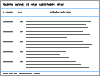
Table 1
Primary parameters of Dauphin helicopter
| 变量 | 数值 |
|---|---|
| 直升机总质量/kg | 3 500 |
| 旋翼拉力系数 | 0.05 |
| 旋翼实度 | 0.085 |
| 旋翼直径/m | 11.94 |
| 旋翼转速/(r·min-1) | 385 |
| 挥舞铰外伸量 | 0.038 3 |
| 桨叶负扭角/(°) | -10 |
| 桨叶洛克数 | 6.6 |
| 桨叶质量/kg | 42.3 |
| 桨叶惯性矩/(kg·m2) | 456 |
| 挥舞弹簧系数/(N·m·rad-1) | 8 100 |
| 挥舞调节系数 | 0.35 |
| 翼型升力线斜率/rad-1 | 5.73 |
| 翼型阻力系数 | 0.01 |

Fig.13
Validation of helicopter oblique descent flight(μ/λih≈0.2)


Fig.14
Validation of helicopter oblique descent flight(μ/λih≈0.55)

| [1] | 招启军, 徐国华, 王博. 直升机空气动力学[M]. 北京: 科学出版社, 2024. |
| ZHAO Q J, XU G H, WANG B. Helicopter aerodynamics[M]. Beijing: Science Press, 2024 (in Chinese). | |
| [2] | 王畅, 马帅, 黄志银, 等. 直升机涡环状态边界风洞试验研究[J]. 实验流体力学, 2023, 37(5): 76-92. |
| WANG C, MA S, HUANG Z Y, et al. A wind tunnel investigation of the helicopter vortex ring state boundary[J]. Journal of Experiments in Fluid Mechanics, 2023, 37(5): 76-92 (in Chinese). | |
| [3] | CASTLES W, GRAY R B. Empirical relation between induced velocity, thrust, and rate of descent of a helicopter rotor as determined by wind-tunnel tests on four model rotors: NACA-TN-2474[R]. Washington, D.C.: NACA, 1951. |
| [4] | MORT K W, YAGGY P F. Wind-tunnel tests of two VTOL propellers in descent: NASA-TN-D-1766[R]. Washington, D.C.: NASA, 1963. |
| [5] | TAGHIZAD A, JIMENEZ J, BINET L, et al. Experimental and theoretical investigations to develop a model of rotor aerodynamics adapted to steep descent[C]∥Proceedings of Annual Forum of the American Helicopter Society. Alexandria: American Helicopter Society, 2002. |
| [6] | 黄明其, 兰波, 何龙. 旋翼模型垂直下降状态气动特性风洞试验[J]. 哈尔滨工业大学学报, 2019, 51(4): 131-137. |
| HUANG M Q, LAN B, HE L. Wind tunnel test on aerodynamic characteristics of rotor model in vertical descent[J]. Journal of Harbin Institute of Technology, 2019, 51(4): 131-137 (in Chinese). | |
| [7] | 黄明其, 王亮权, 何龙, 等. 旋翼涡环状态气动特性和参数变化的风洞试验[J]. 航空动力学报, 2019, 34(11): 2305-2315. |
| HUANG M Q, WANG L Q, HE L, et al. Wind tunnel test of aerodynamic characteristics and parametric variation for rotor in vortex ring state[J]. Journal of Aerospace Power, 2019, 34(11): 2305-2315 (in Chinese). | |
| [8] | WOLKOVITCH J. Analytical prediction of vortex-ring boundaries for helicopters in steep descents[J]. Journal of the American Helicopter Society, 1972, 17(3): 13-19. |
| [9] | PETERS D A, CHEN S Y. Momentum theory, dynamic inflow, and the vortex-ring state[J]. Journal of the American Helicopter Society, 1982, 27(3): 18-24. |
| [10] | 辛宏, 高正. 直升机涡环状态速度边界的试验研究[J]. 南京航空航天大学学报, 1995, 27(4): 439-444. |
| XIN H, GAO Z. An experimental investigation on the boundary of helicopter vortex-ring state[J]. Journal of Nanjing University of Aeronautics & Astronautics, 1995, 27(4): 439-444 (in Chinese). | |
| [11] | XIN H, GAO Z. A prediction of the vortex-ring state boundary based on model tests[J]. Transactions of Nanjing University of Aeronautics and Astronautics, 1994, 11(2): 159-164. |
| [12] | VARNES D J. Development of a helicopter vortex ring state warning system through a moving map display computer[D]. Monterey: Naval Postgraduate School, 1999. |
| [13] | 陆洋, 高正, 黄文明, 等. 直升机涡环状态边界的飞行试验研究[J]. 南京航空航天大学学报, 2001, 33(5): 405-409. |
| LU Y, GAO Z, HUANG W M, et al. Flight test investigation of helicopter vortex-ring state boundary[J]. Journal of Nanjing University of Aeronautics & Astronautics, 2001, 33(5): 405-409 (in Chinese). | |
| [14] | LU Y, GAO Z. Practical boundary in helicopter vortex-ring state[J]. Transactions of Nanjing University of Aeronautics & Astronautics, 2003, 20(1): 6-11. |
| [15] | NEWMAN S, BROWN R, PERRY J, et al. Predicting the onset of wake breakdown for rotors in descending flight[J]. Journal of the American Helicopter Society, 2003, 48(1): 28-38. |
| [16] | WANG S C. Analytical approach to the induced flow of a helicopter rotor in vertical descent[J]. Journal of the American Helicopter Society, 1990, 35(1): 92-98. |
| [17] | PERRY F J, CHAN W Y F, SIMONS I A, et al. Modeling the mean flow through a rotor in axial flight including vortex ring conditions[J]. Journal of the American Helicopter Society, 2007, 52(3): 224-238. |
| [18] | JIMÉNEZ J, DESOPPER A, TAGHIZAD A, et al. Induced velocity model in steep descent and vortex-ring state prediction[C]∥27th European Rotorcraft Forum. 2001. |
| [19] | JIMÉNEZ J, TAGHIZAD A, ARNAUD A. Helicopter flight tests in steep descent: Vortex-ring state analysis and induced velocity models improvement[C]∥CEAS Aerospace Aerodynamics Research Conference. 2002: 388-400. |
| [20] | JOHNSON W. Model for vortex ring state influence on rotorcraft flight dynamics: AD-A526709[R]. Washington, D.C.: NASA, 2004. |
| [21] | RAND O. Technical note: A phenomenological modification for Glauert’s classical induced velocity equation[J]. Journal of the American Helicopter Society, 2006, 51(3): 279. |
| [22] | PETERS D A, HE C J. Modification of mass-flow parameter to allow smooth transition between helicopter and windmill states[J]. Journal of the American Helicopter Society, 2006, 51(3): 275-278. |
| [23] | CHEN C. Development of a simplified inflow model for a helicopter rotor in descent flight[D]. Atlanta: Georgia Institute of Technology, 2006. |
| [24] | CHEN C, PRASAD J V R. Simplified rotor inflow model for descent flight[J]. Journal of Aircraft, 2007, 44(3): 936-944. |
| [25] | BASSET P M, CHEN C, PRASAD J V R, et al. Prediction of vortex ring state boundary of a helicopter in descending flight by simulation[J]. Journal of the American Helicopter Society, 2008, 53(2): 139-151. |
| [26] | AHLIN G A, BROWN R E. Wake structure and kinematics in the vortex ring state[J]. Journal of the American Helicopter Society, 2009, 54(3): 32003. |
| [27] | LEISHMAN J G, BHAGWAT M J, ANANTHAN S. The vortex ring state as a spatially and temporally developing wake instability[J]. Journal of the American Helicopter Society, 2004, 49(2): 160-175. |
| [28] | MAKEEV P V, IGNATKIN Y M, SHOMOV A I. Numerical investigation of full scale coaxial main rotor aerodynamics in hover and vertical descent[J]. Chinese Journal of Aeronautics, 2021, 34(5): 666-683. |
| [29] | MAKEEV P, IGNATKIN Y, SHOMOV A. Numerical study of coaxial main rotor aerodynamics in steep descent[J]. Aerospace, 2022, 9(2): 61. |
| [30] | BRAND A, DREIER M, KISOR R, et al. The nature of vortex ring state[J]. Journal of the American Helicopter Society, 2011, 56(2): 22001. |
| [31] | VAN VYVE H. Simulation of a helicopter in vortex ring state through a coupled simulation of multi-body dynamics and aerodynamics[D]. Louvain-la-Neuve: UCLouvain (Catholic University of Louvain), 2019. |
| [32] | MARSHALL M, TANG E, CORNELIUS J, et al. Performance of the dragonfly lander’s coaxial rotor in vortex ring state: AIAA-2024-0247[R]. Reston: AIAA, 2024. |
| [33] | 李高华. 直升机旋翼涡环状态流场高分辨率数值模拟方法研究[D]. 上海: 上海交通大学, 2018. |
| LI G H. Study of high resolution numerical method for helicopter rotor in vortex ring state[D]. Shanghai: Shanghai Jiao Tong University, 2018 (in Chinese). | |
| [34] | 王军杰, 陈仁良, 王志瑾, 等. 倾转旋翼机涡环状态数值模拟及数学建模[J]. 哈尔滨工业大学学报, 2023, 55(4): 35-43. |
| WANG J J, CHEN R L, WANG Z J, et al. Numerical simulation and mathematical modeling of vortex ring state of tiltrotor aircraft[J]. Journal of Harbin Institute of Technology, 2023, 55(4): 35-43 (in Chinese). | |
| [35] | 孙钰锟, 王珑, 王同光, 等. 侧风下孤立尾桨的气动特性和抗侧风优化[J]. 航空学报, 2023, 44(10): 127454. |
| SUN Y K, WANG L, WANG T G, et al. Aerodynamic characteristics and crosswind counteraction of isolated tail rotor in crosswind environment[J]. Acta Aeronautica et Astronautica Sinica, 2023, 44(10): 127454 (in Chinese). | |
| [36] | WOOD T. Fifty years of industry perspective: 36th Alexander A. Nikolsky honorary lecture[J]. Journal of the American Helicopter Society, 2020, 65(2): 1-25. |
| [37] | LEISHMAN J G. Principles of helicopter aerodynamics[M]. 2nd ed. Cambridge: Cambridge University Press, 2006: 129. |
| [38] | HE C J. Development and application of a generalized dynamic wake theory for lifting rotors[D]. Atlanta: Georgia Institute of Technology, 1989. |
| [39] | 吉洪蕾, 苏俊杰, 陈仁良, 等. 适于直升机飞行仿真的高原大气紊流模型[J]. 航空学报, 2022, 43(7): 126564. |
| JI H L, SU J J, CHEN R L, et al. Highland atmospheric turbulence model for helicopter flight simulation[J]. Acta Aeronautica et Astronautica Sinica, 2022, 43(7): 126564 (in Chinese). | |
| [40] | 吉洪蕾, 赵辉, 陈仁良, 等. 基于直升机舰面起降动态仿真的风限图计算[J]. 航空学报, 2018, 39(11): 122156. |
| JI H L, ZHAO H, CHEN R L, et al. Wind-over-deck envelope calculation based on simulation of helicopter shipboard operations[J]. Acta Aeronautica et Astronautica Sinica, 2018, 39(11): 122156 (in Chinese). | |
| [41] | 孟万里. 直升机单台发动机失效后飞行轨迹优化研究与应用[D]. 南京: 南京航空航天大学, 2014. |
| MENG W L. Study and application of trajectory optimization for helicopter flight after one engine failure [D]. Nanjing: Nanjing University of Aeronautics and Astronautics, 2014 (in Chinese). |
| [1] | Jianfeng TAN, Yuze YAN, Weiguo ZHANG, Yakui LIU, Tianshuang SHAO. Analysis method of helicopter blade erosion in brownout condition [J]. Acta Aeronautica et Astronautica Sinica, 2025, 46(9): 431012-431012. |
| [2] | Dongfei ZHANG, Junhui GAO. High-precision numerical simulation of fan rotor-stator interaction pure tone [J]. Acta Aeronautica et Astronautica Sinica, 2025, 46(7): 130884-130884. |
| [3] | Yifan YANG, Xiao WANG. Enhanced hybrid vortex particle method for aerodynamic analysis of tiltrotor rotor/wing interactions [J]. Acta Aeronautica et Astronautica Sinica, 2025, 46(7): 131040-131040. |
| [4] | Zhengwu CHEN, Yubiao JIANG, Xiangyu LU, Qiangbin LI. Aerodynamic noise test of open rotor in wind tunnel [J]. Acta Aeronautica et Astronautica Sinica, 2025, 46(2): 130425-130425. |
| [5] | Yeping WANG, Honglei JI, Pan ZHOU, Yi YE. Fast analysis of aerodynamic interference for quad-tiltrotor based on vortex tube model [J]. Acta Aeronautica et Astronautica Sinica, 2025, 46(2): 130705-130705. |
| [6] | Ronghui CHENG, Zhishu ZHANG, Wenbo RUAN, Jianfeng WANG. Core key technologies of advanced aircraft engine [J]. Acta Aeronautica et Astronautica Sinica, 2025, 46(12): 31220-031220. |
| [7] | Zixu WANG, Pan LI, Junbiao SHEN, Zhenhua ZHU, Renliang CHEN. Dynamic conversion corridor of tiltrotor aircraft under accelerating and decelerating conditions [J]. Acta Aeronautica et Astronautica Sinica, 2025, 46(11): 531377-531377. |
| [8] | Yeping WANG, Honglei JI, Qingyu KANG, Haoxuan DENG, Chang WANG. Integration of multirotor aerodynamic interference in UAM flight dynamics model [J]. Acta Aeronautica et Astronautica Sinica, 2025, 46(11): 531280-531280. |
| [9] | Tao CHEN, Jian CHEN. Learning-observer-based resilient fault-tolerant control for quadrotor unmanned aerial vehicles [J]. Acta Aeronautica et Astronautica Sinica, 2025, 46(11): 531346-531346. |
| [10] | Yunxiang CHEN, Jianping ZHANG, Zhiyuan WANG, Xiang ZOU, Yifei ZHAO, Tingfeng LAI. Safety separation calculation model for multi-rotor drones in low-altitude airspace based on avoidance strategy [J]. Acta Aeronautica et Astronautica Sinica, 2025, 46(11): 531887-531887. |
| [11] | Peikang ZHANG, Jifeng GUO, Peng YAN. Modeling and robust flight control of small-scale unmanned helicopter [J]. Acta Aeronautica et Astronautica Sinica, 2024, 45(S1): 730797-730797. |
| [12] | Xiaolong ZHANG, Rong LI, Gaowei YAN, Shuyi XIAO, Guoqing LI. Fault estimation and fault tolerant control for small unmanned helicopters [J]. Acta Aeronautica et Astronautica Sinica, 2024, 45(S1): 730802-730802. |
| [13] | Jinchao MA, Yang LU, Liangquan WANG, Kuihui SONG. Active control test of tiltrotor near-field aeroacoustics based on higher harmonic control [J]. Acta Aeronautica et Astronautica Sinica, 2024, 45(9): 528602-528602. |
| [14] | Bo LI, Xiao WANG. Dynamic modeling and modal analysis of coaxial rotors/auxiliary propeller/drive train coupled system [J]. Acta Aeronautica et Astronautica Sinica, 2024, 45(9): 528945-528945. |
| [15] | Qi LIU, Yongjie SHI, Zhiyuan HU, Guohua XU. Parameter effects analysis on aerodynamic and aeroacoustic characteristics of coaxial rigid rotor [J]. Acta Aeronautica et Astronautica Sinica, 2024, 45(9): 528856-528856. |
| Viewed | ||||||
|
Full text |
|
|||||
|
Abstract |
|
|||||
Address: No.238, Baiyan Buiding, Beisihuan Zhonglu Road, Haidian District, Beijing, China
Postal code : 100083
E-mail:hkxb@buaa.edu.cn
Total visits: 6658907 Today visits: 1341All copyright © editorial office of Chinese Journal of Aeronautics
All copyright © editorial office of Chinese Journal of Aeronautics
Total visits: 6658907 Today visits: 1341

 CJA
CJA
