Acta Aeronautica et Astronautica Sinica ›› 2026, Vol. 47 ›› Issue (16): 133165.doi: 10.7527/S1000-6893.2026.33165
• Fluid Mechanics and Flight Mechanics • Previous Articles
Xinyuan YANG1, Ruofan QIU1( ), Dong MI2, Tao ZHOU1, Kang ZHOU1, Yancheng YOU1, Wei WEI2
Received:2025-12-01
Revised:2025-12-15
Accepted:2026-01-30
Online:2026-03-06
Published:2026-02-27
Contact:
Ruofan QIU
E-mail:rf_qiu@xmu.edu.cn
Supported by:CLC Number:
Xinyuan YANG, Ruofan QIU, Dong MI, Tao ZHOU, Kang ZHOU, Yancheng YOU, Wei WEI. Aerodynamic optimization method for aero-engine blades based on topology optimization[J]. Acta Aeronautica et Astronautica Sinica, 2026, 47(16): 133165.
Fig.1
Schematic diagram for topology optimization of compressible flow based on variable density
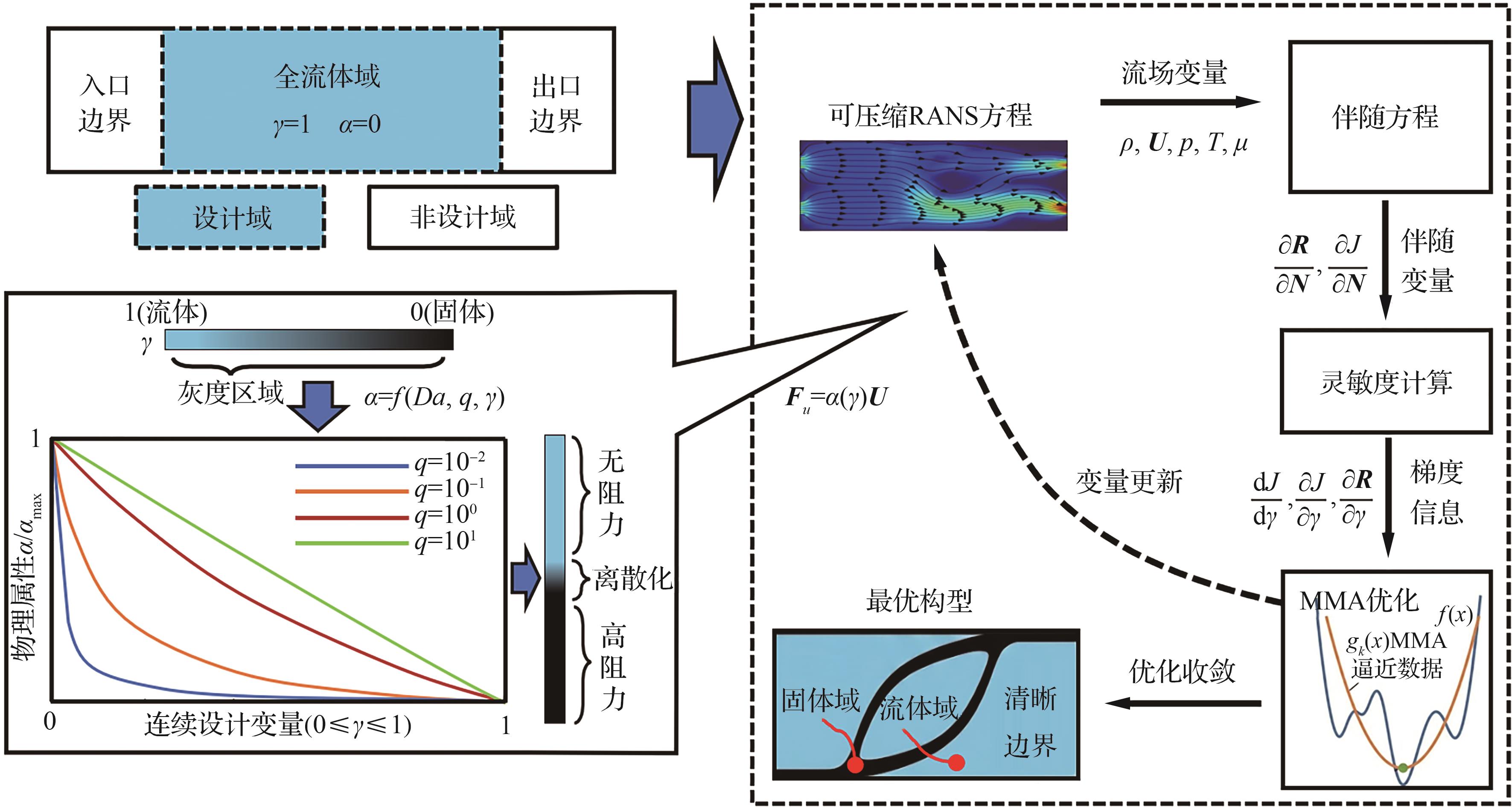
Fig.2
Design domain and boundary conditions for four-channel problem
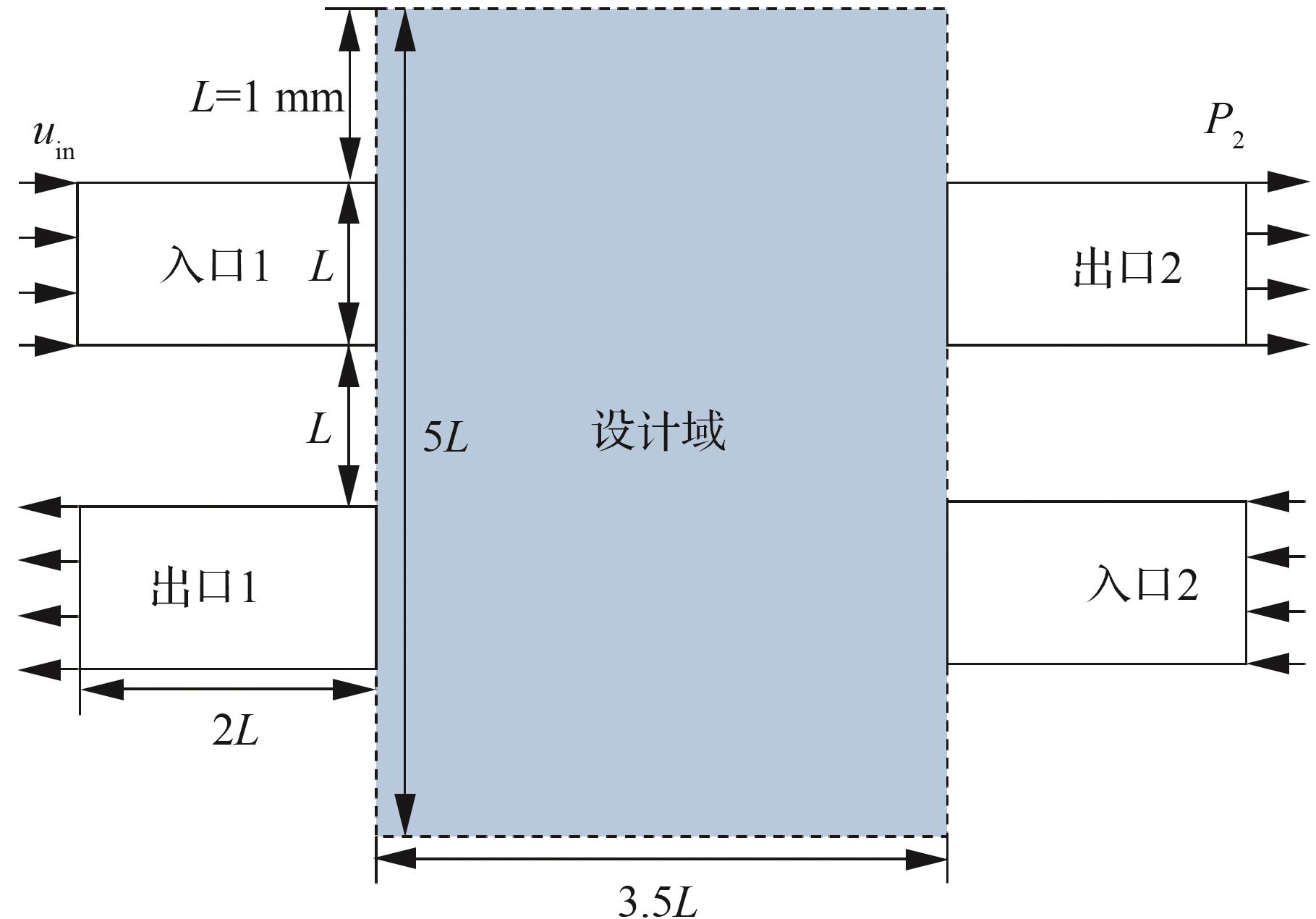
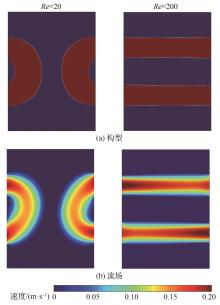
Fig.3
Comparison of topology optimization results for four-channel design domain
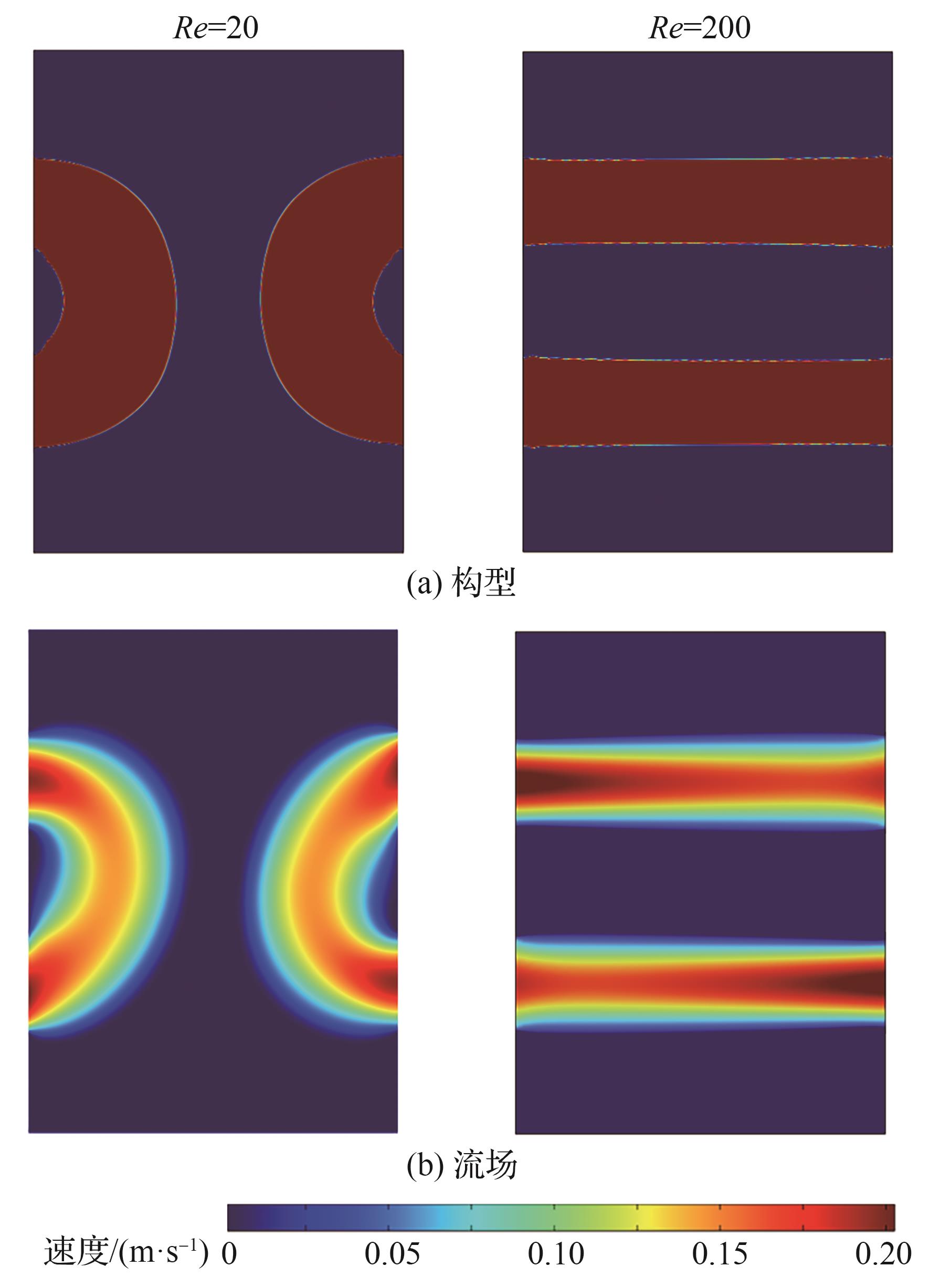
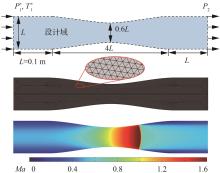
Fig.4
Design domain, mesh and initial flow field for shrink-expand channel
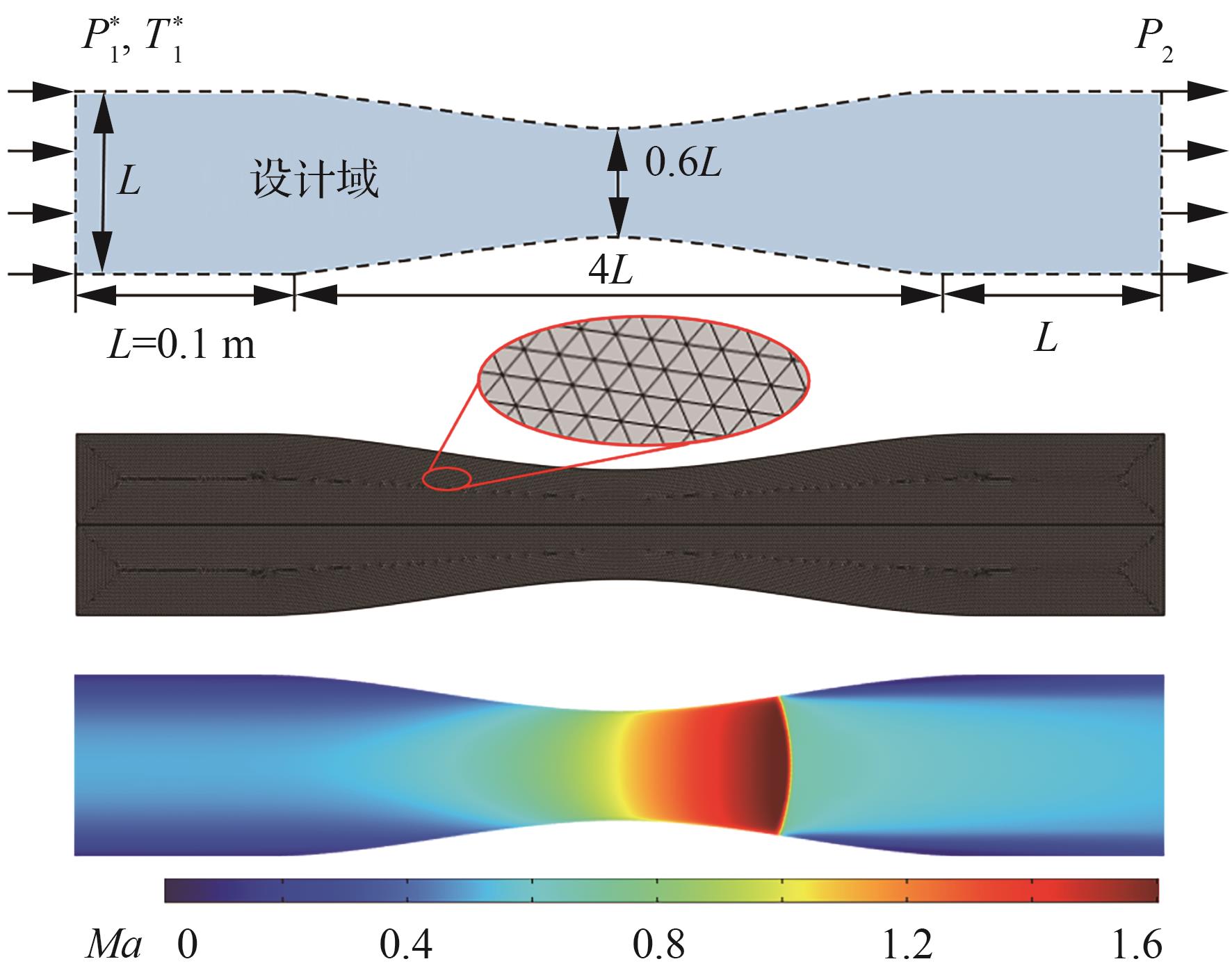
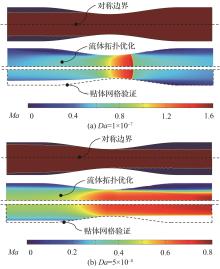
Fig.5
Topological optimized configuration and flow field for shrink-expand channel (objective is minimization of energy dissipation)
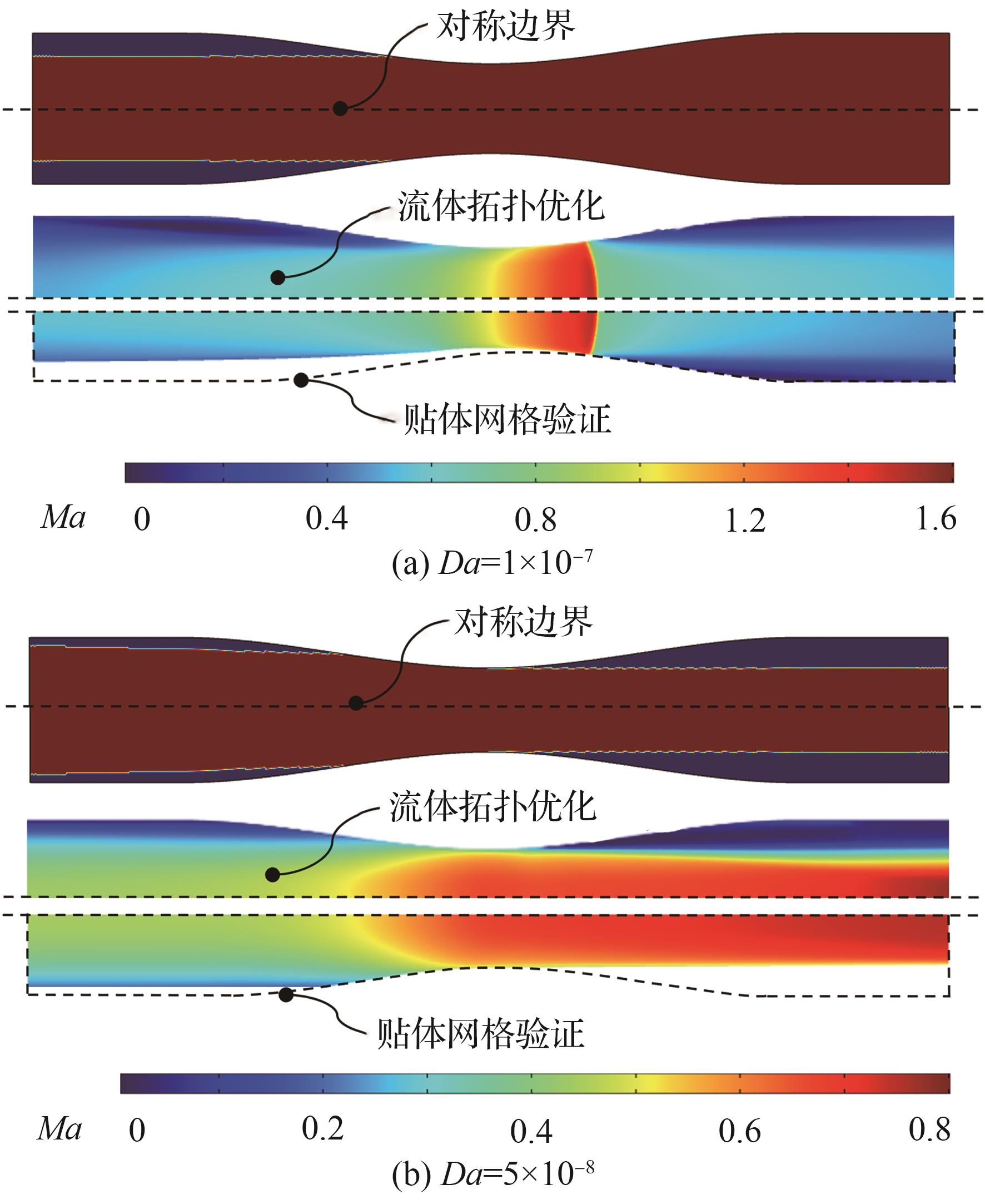
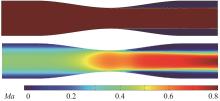
Fig.6
Topological optimized configuration and flow field for shrink-expand channel (objective is minimization of velocity decay)
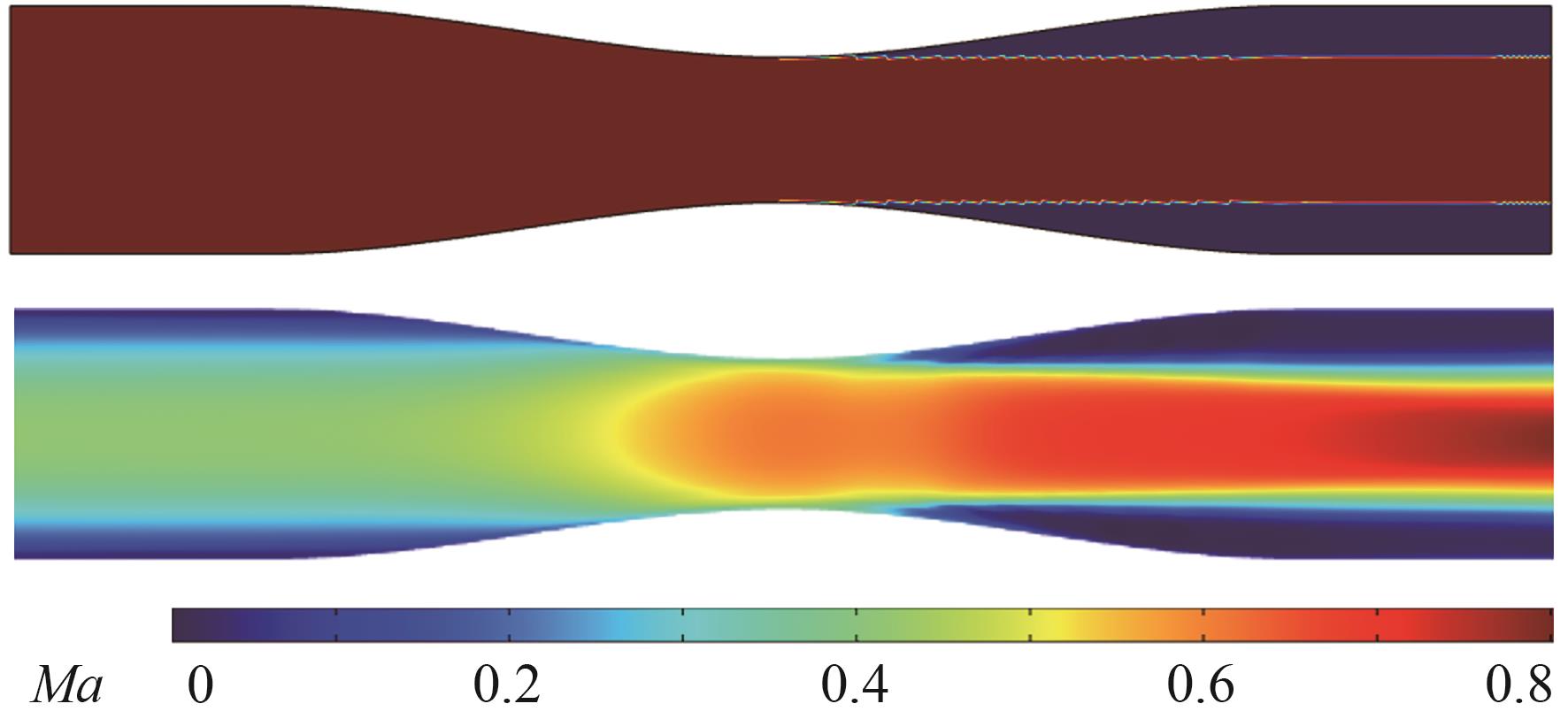
Table 1
Performance comparison before and after shrink-expand channel optimization
| 性能指标 | 优化前 | 优化后 |
|---|---|---|
| Ediss/(W·m-1) | 3.86×10³ | 3.60×10³ (Da=1×10⁻⁷) 2.17×10³ (Da=5×10⁻⁸) |
| 1.000 | 0.463 |
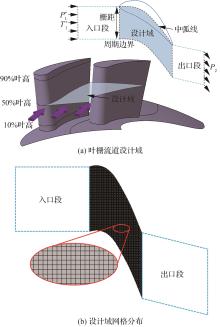
Fig.7
Schematic diagram and mesh of design domain for two-dimensional cascade flow channel
Table 2
Boundary conditions of design domain for topology optimization of stator cascade flow channel
| 位置 | 栅距/m | 弦长/m | 轴向弦长/m | 体积分数 | 进口角度/(°) |
|---|---|---|---|---|---|
| 10%叶高 | 0.059 43 | 0.076 40 | 0.049 82 | 0.359 | 0 |
| 50%叶高 | 0.063 97 | 0.080 88 | 0.049 71 | 0.338 | 0 |
| 90%叶高 | 0.068 50 | 0.085 37 | 0.049 61 | 0.317 | 0 |
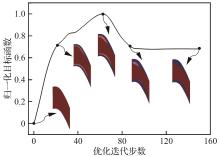
Fig.8
Convergence history of normalized objective function and evolution of topology configuration at 50% span
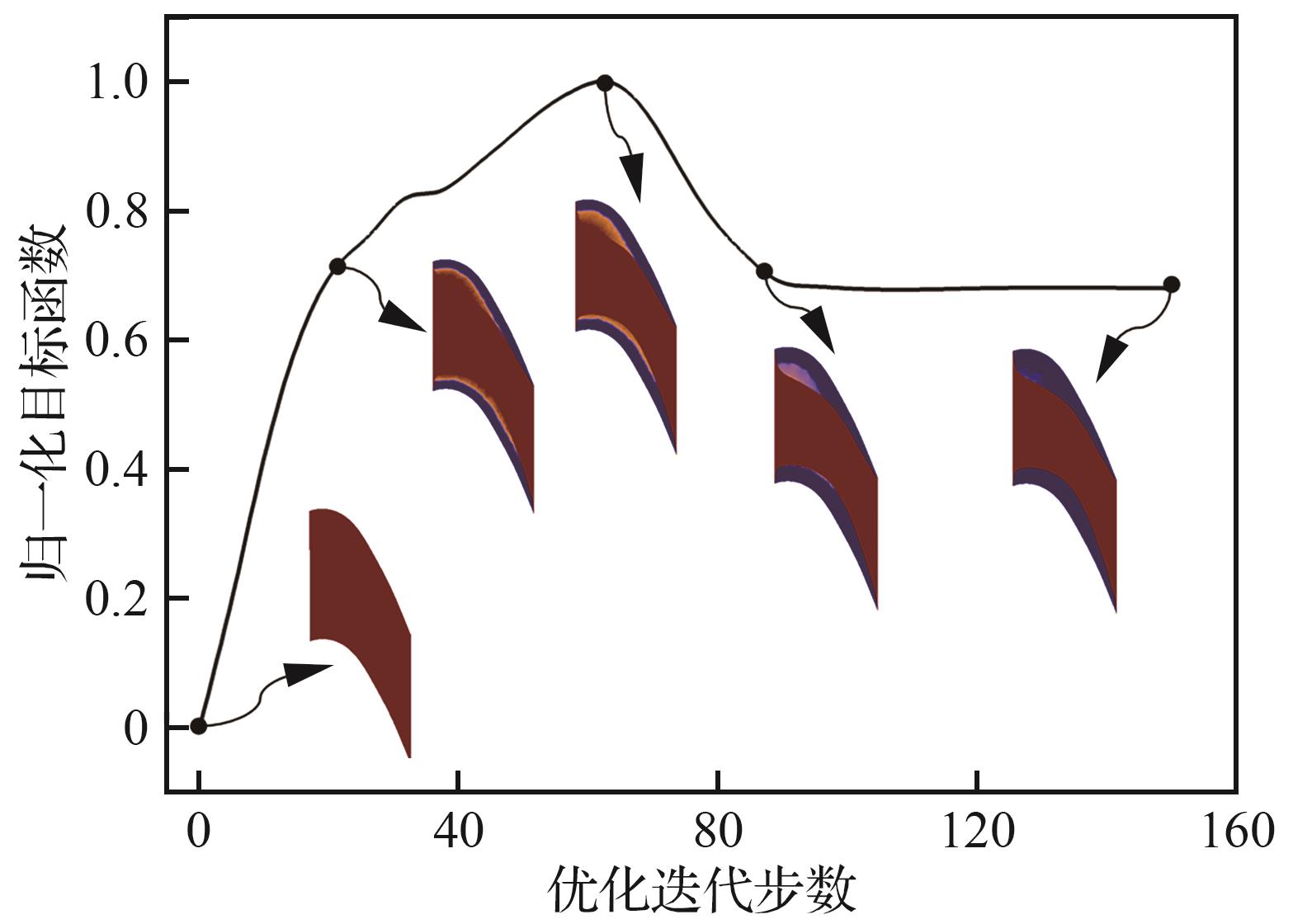
Fig.9
Comparison of entropy distribution before and after optimization in cascade flow channel at section of 50% span
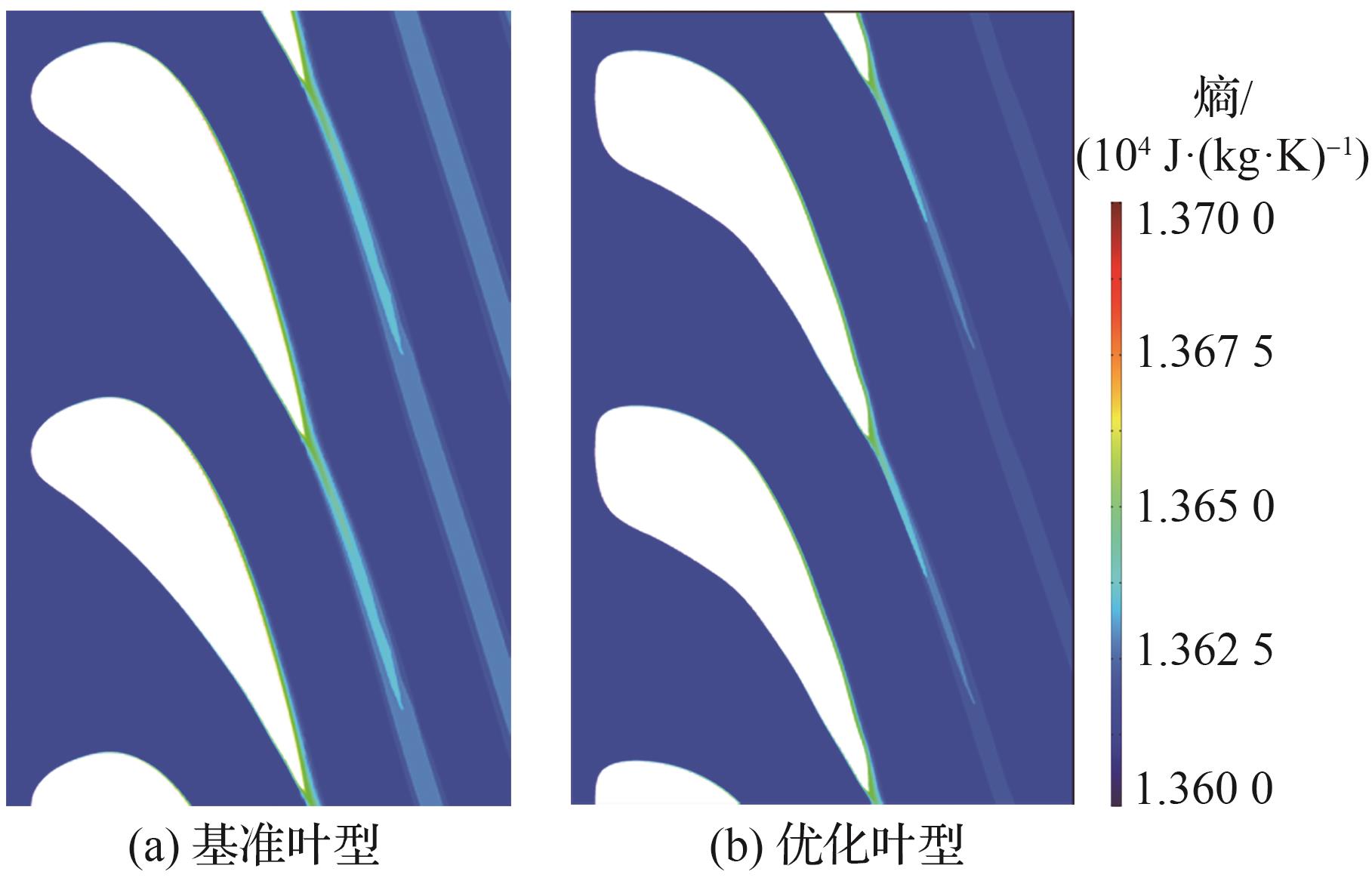
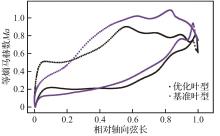
Fig.10
Isentropic Mach number of blade surface before and after optimization on cascade flow channel at 50% span
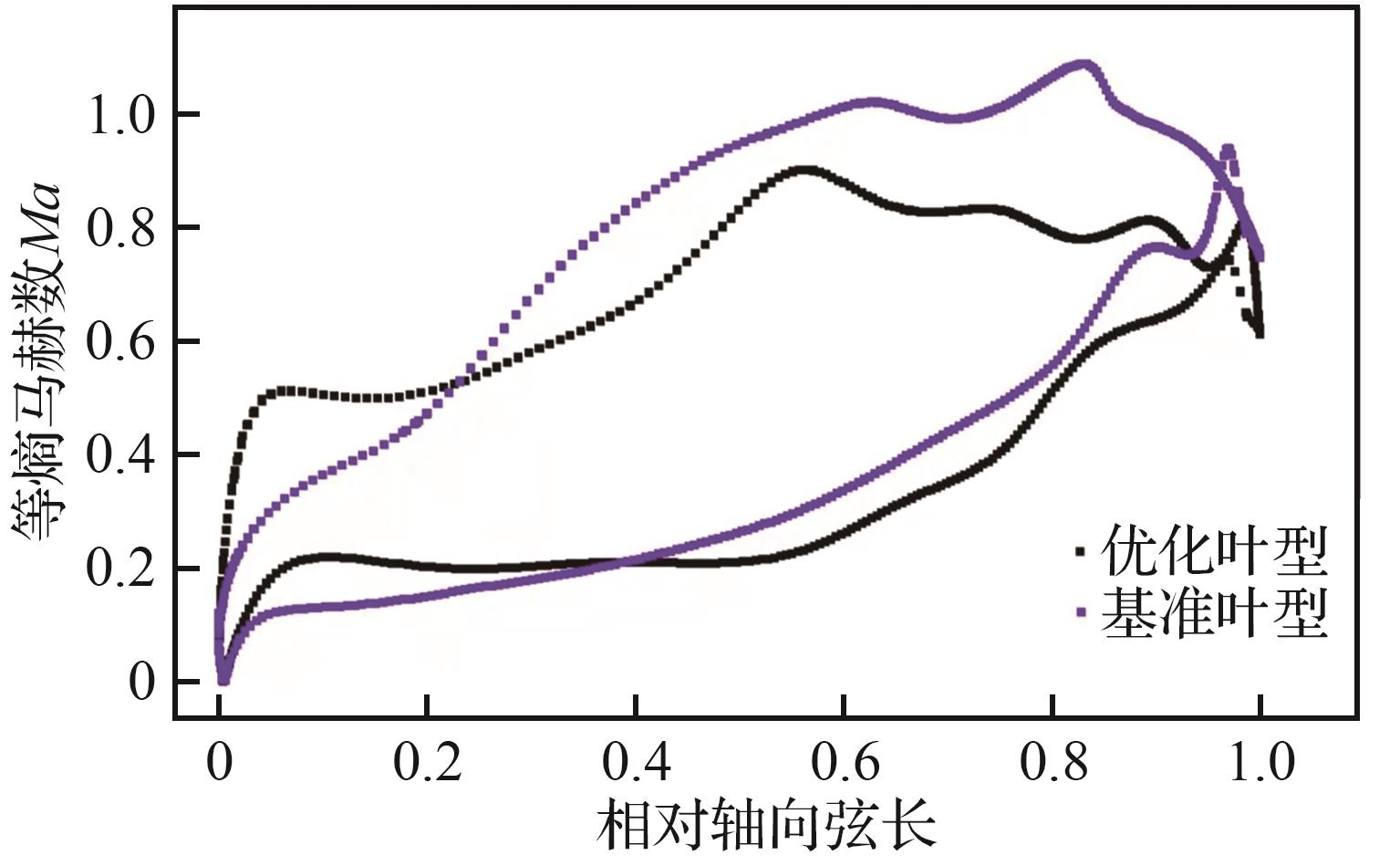
Fig.11
Convergence process of objective-configurations in design domain at 10% span and 90% span
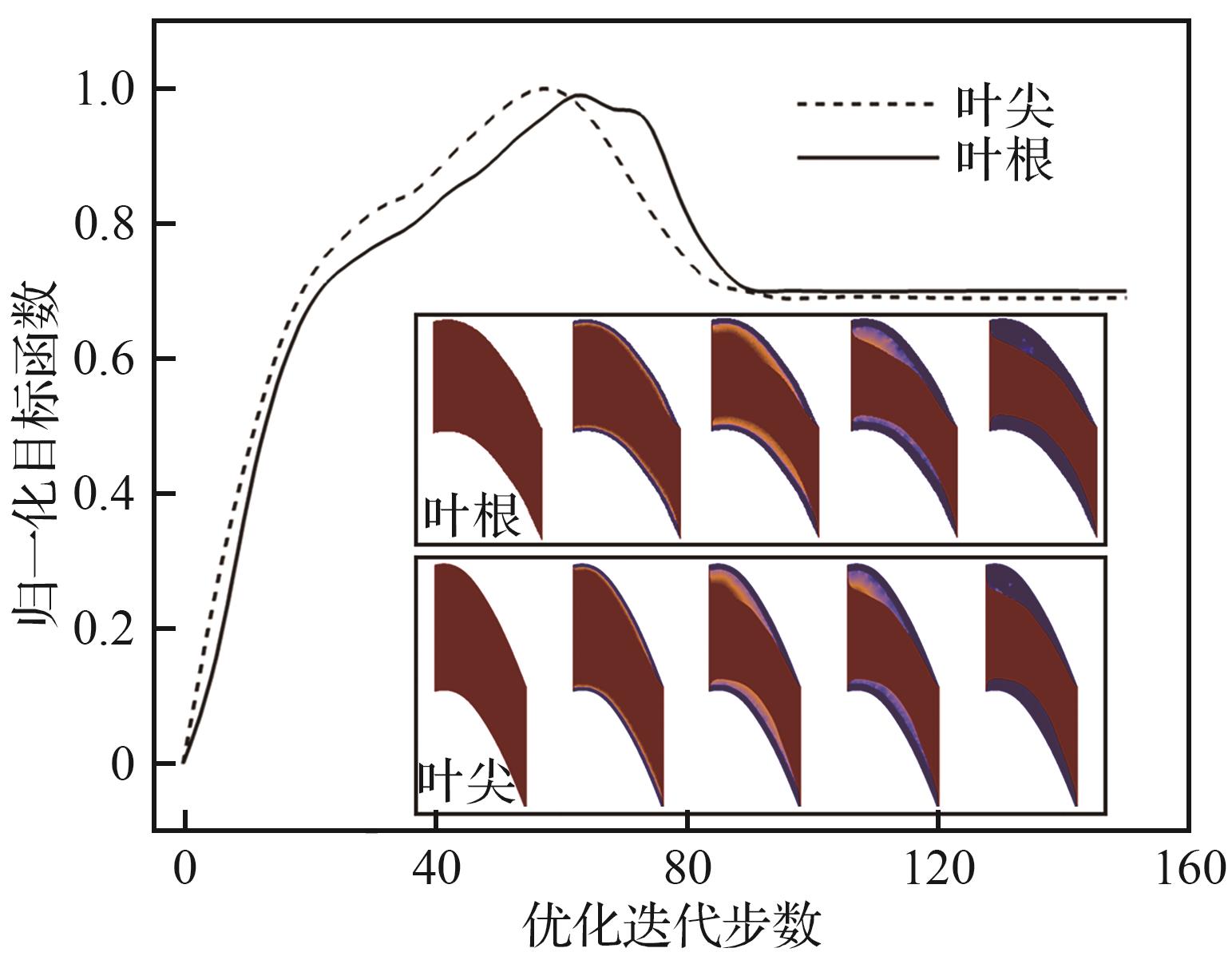
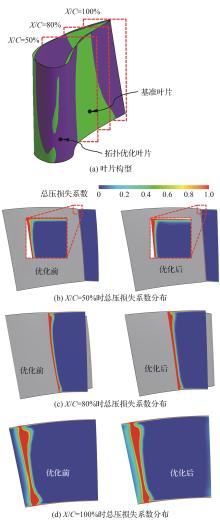
Fig.12
Comparison of stator before and after optimization
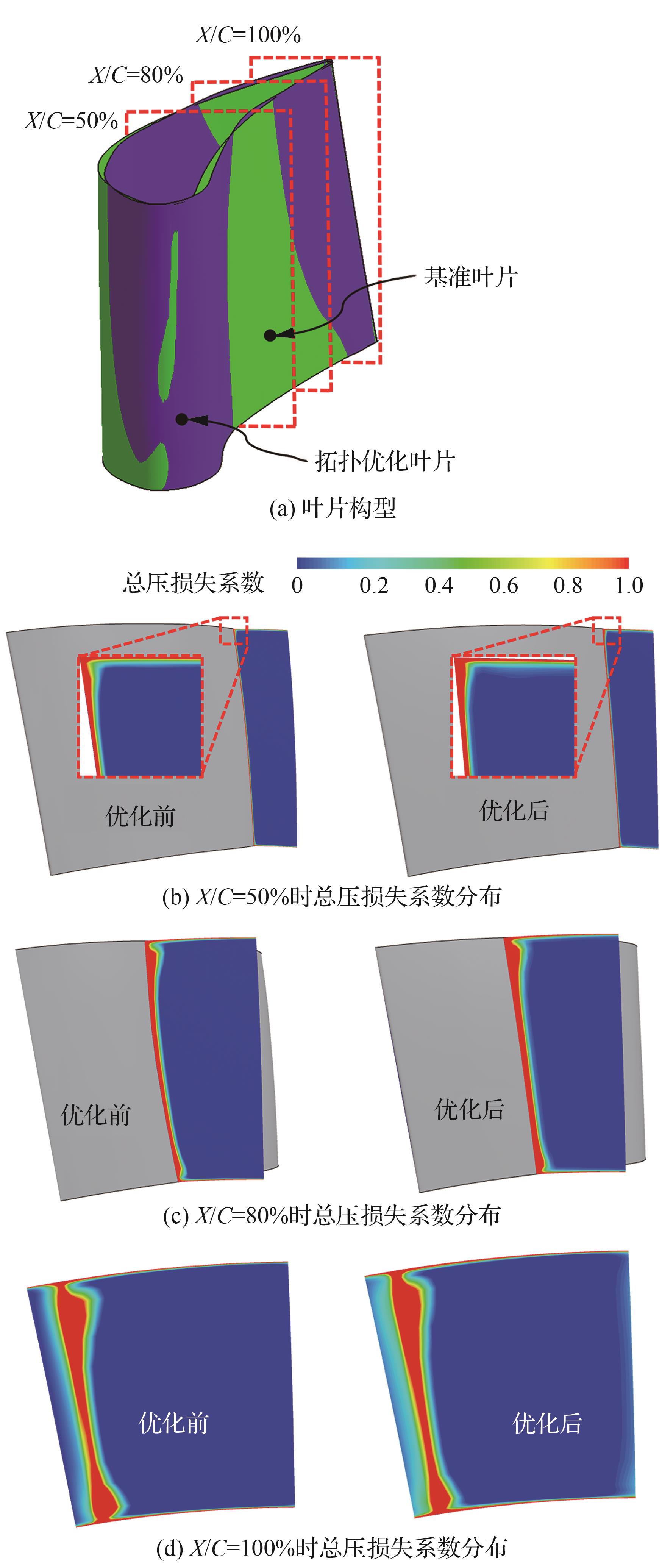
Table 3
Comparison of turbine performance indica-tors before and after blade topology optimization
| 性能指标 | 优化前 | 优化后 |
|---|---|---|
| 流量/(kg·s-1) | 11.086 | 11.298 |
| 落压比 | 1.379 | 1.365 |
| 等熵效率/% | 90.65 | 91.86 |
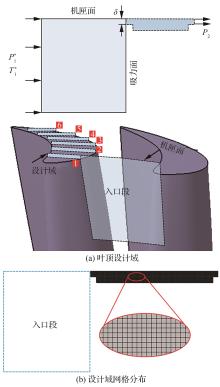
Fig.13
Schematic diagram and mesh of rotor blade tip design domain
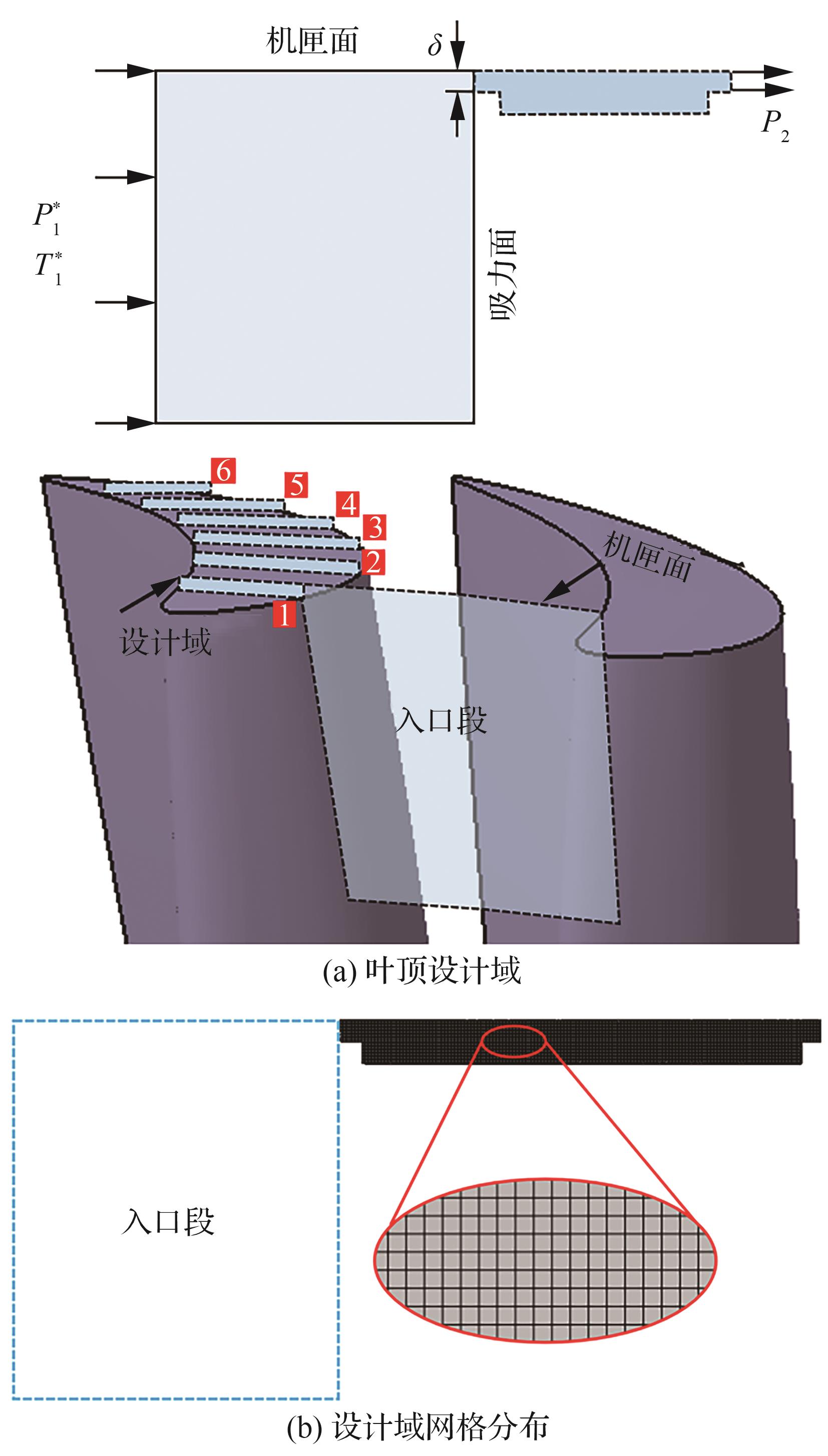
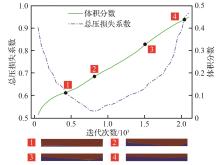
Fig.14
Distribution rules of total pressure loss coefficient-volume constraint at rotor blade tip Section 1
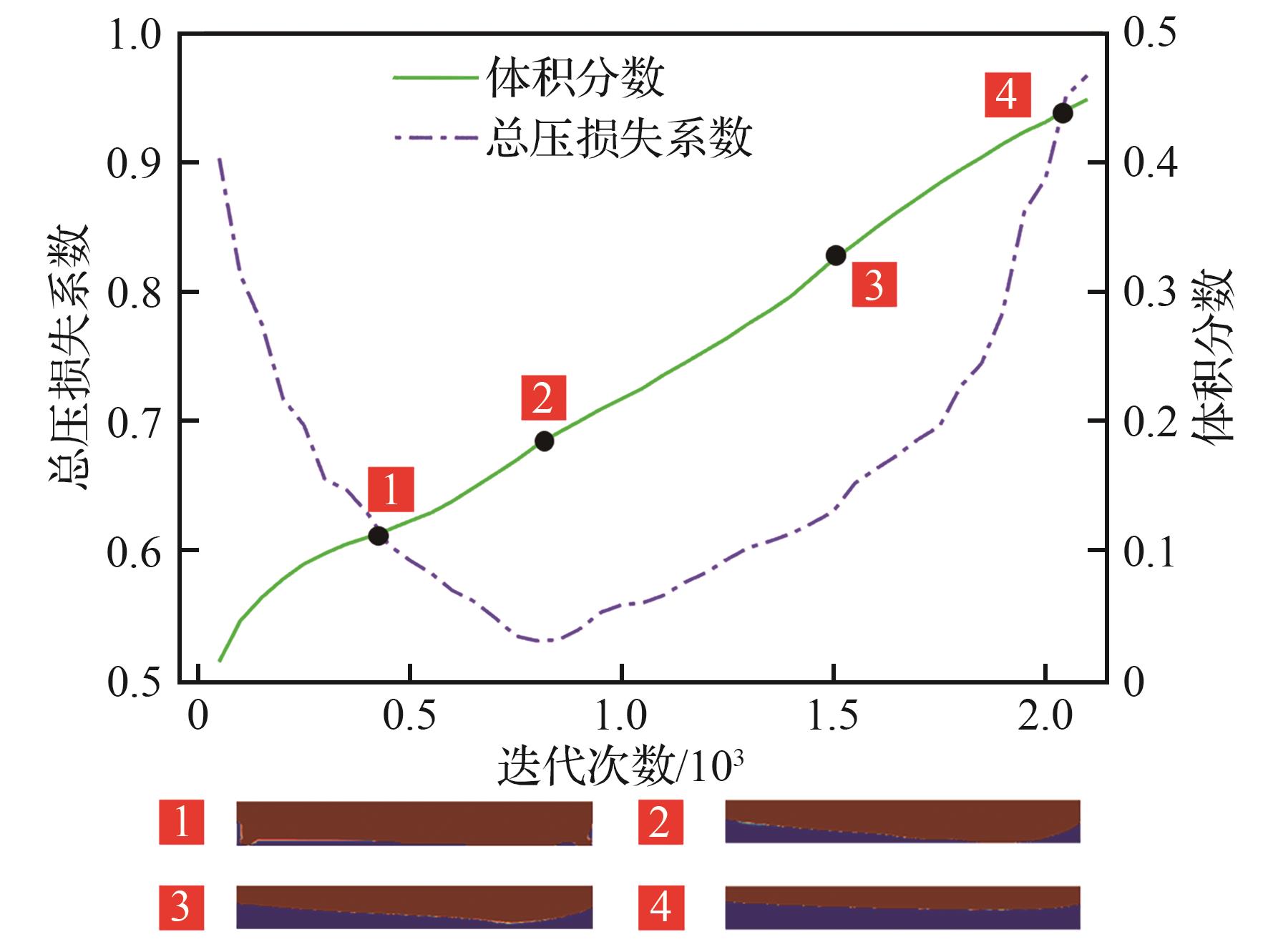
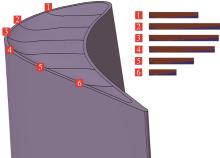
Fig.15
Curved blade tip configuration after topology optimization
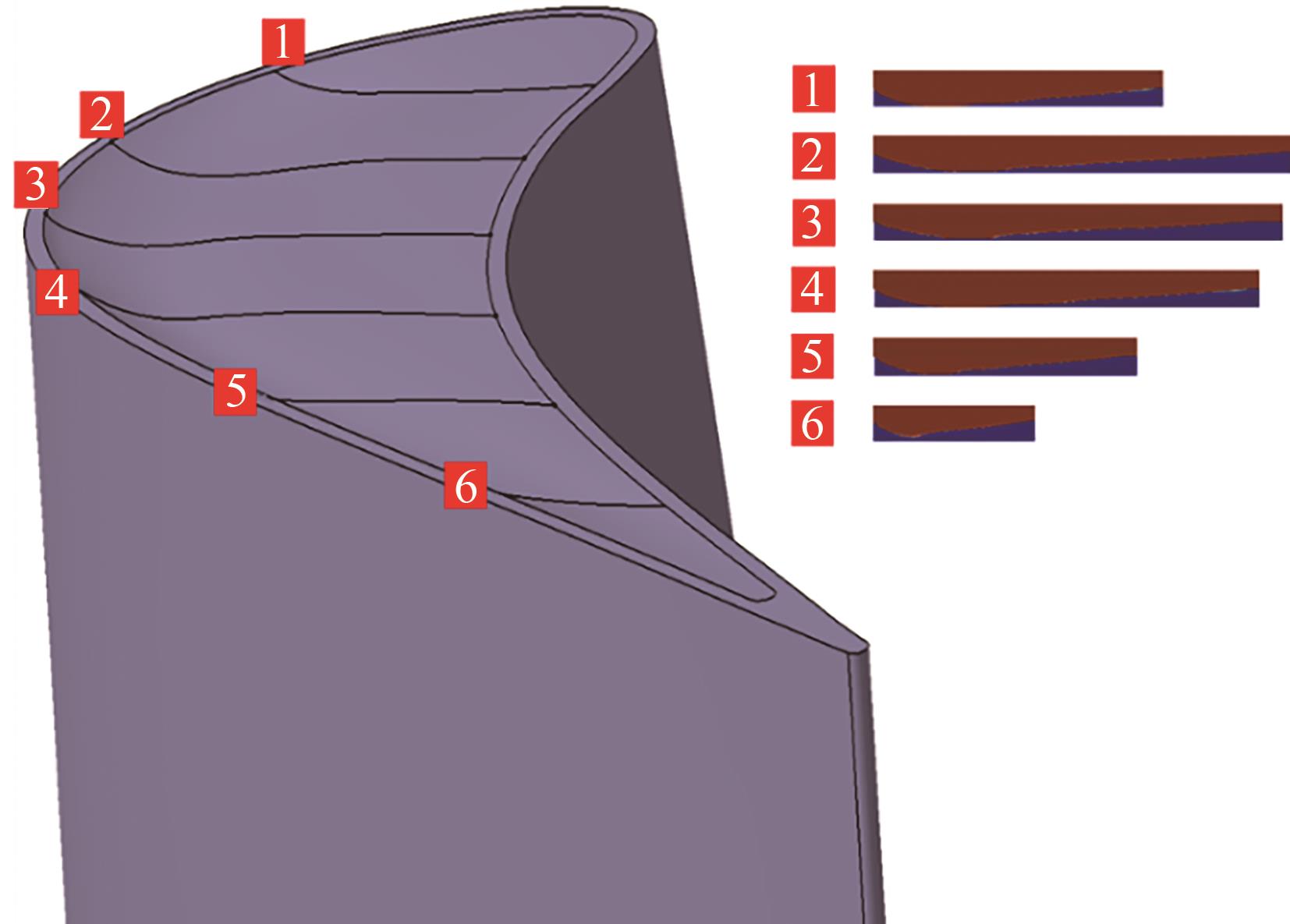
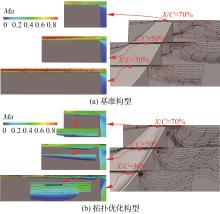
Fig.16
Comparison of tip flow fields at 30%, 50%, and 70% axial chord positions of rotor blade before and after optimization
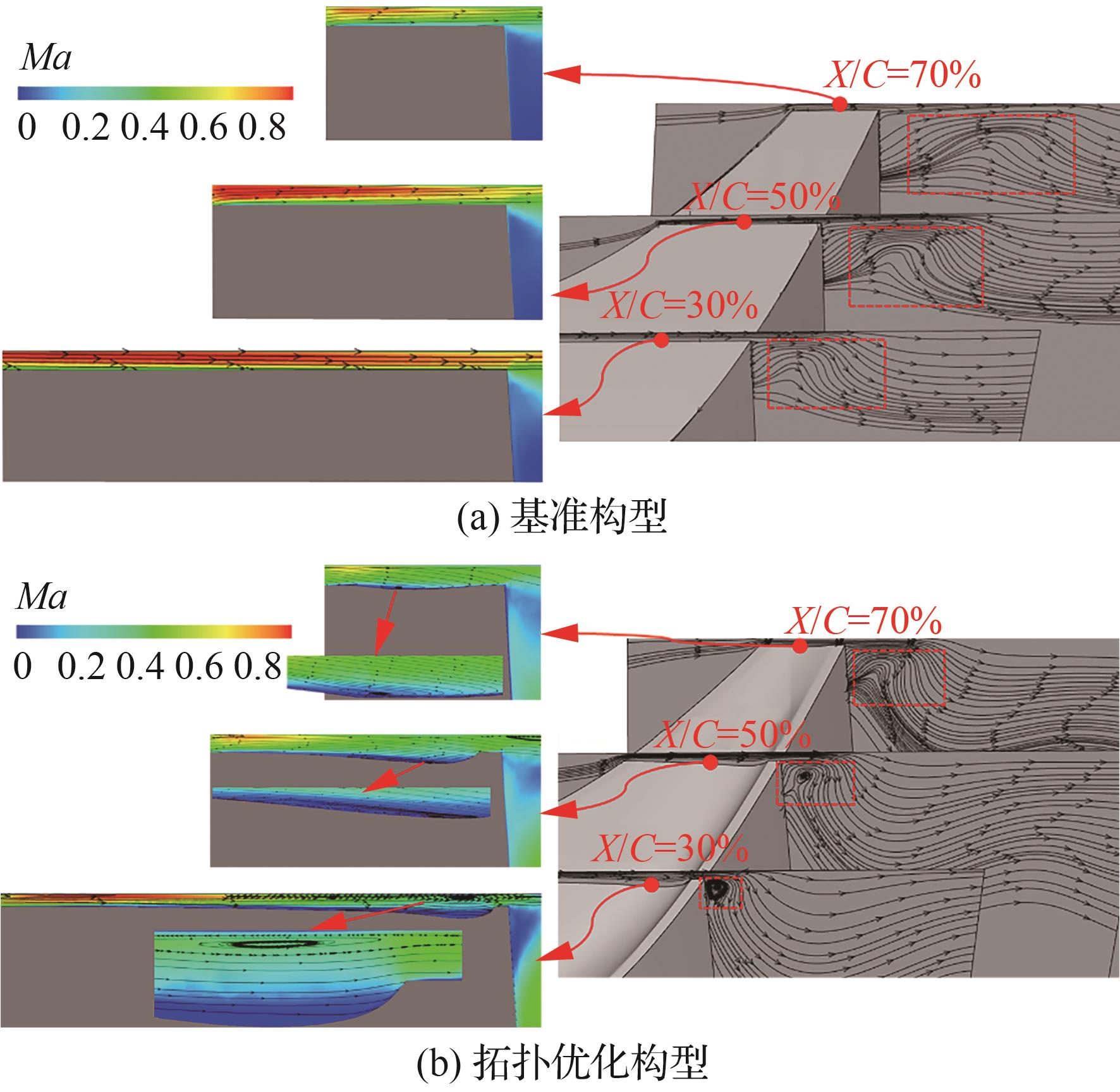
Fig.17
Schematic diagram of shape-topology para-meterized fluid topology optimization method
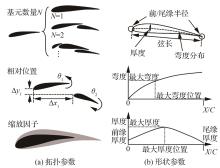
Fig.18
Shape-topology parameterization system
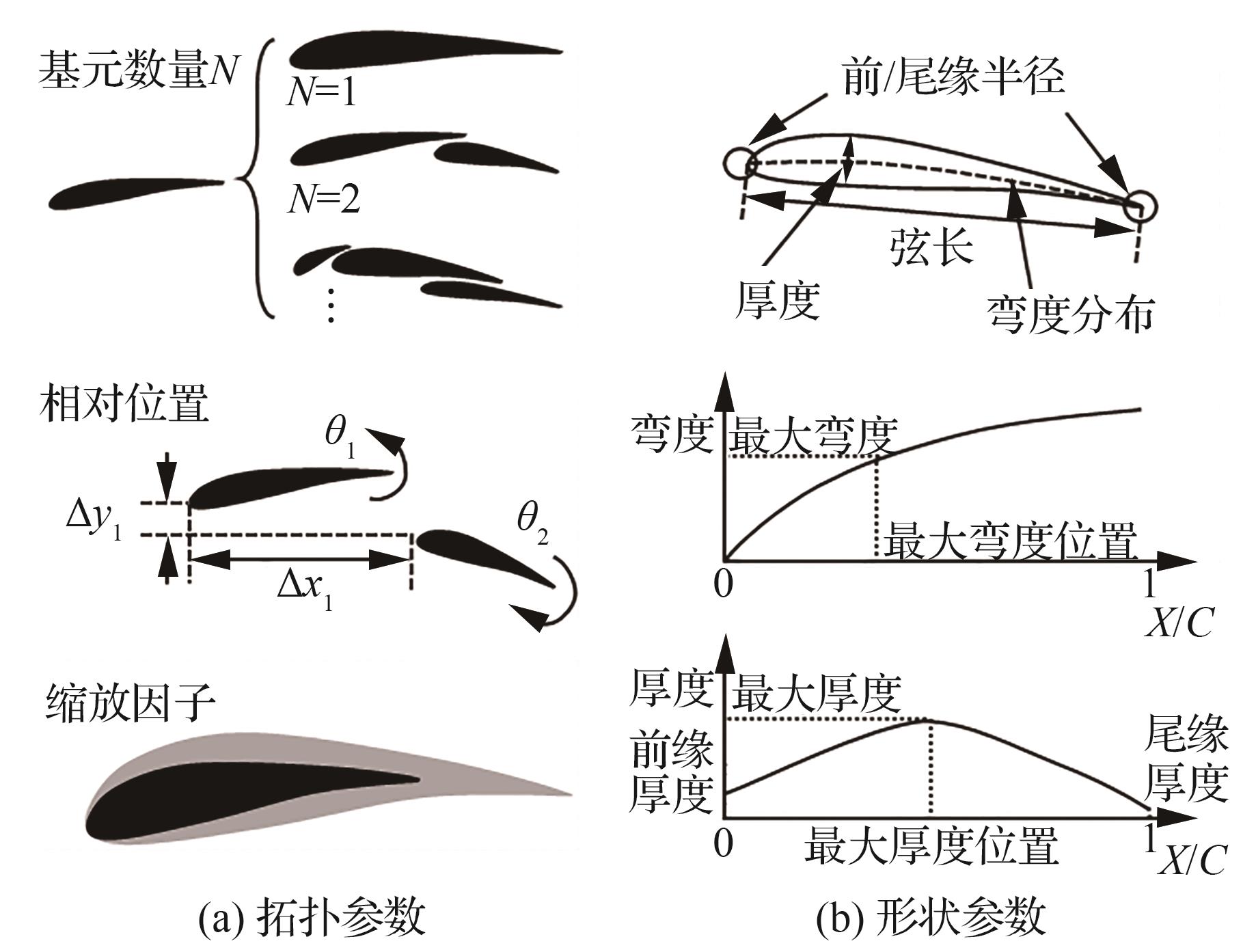
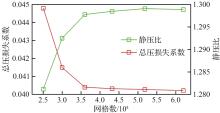
Fig.19
Computational performance at different grid numbers
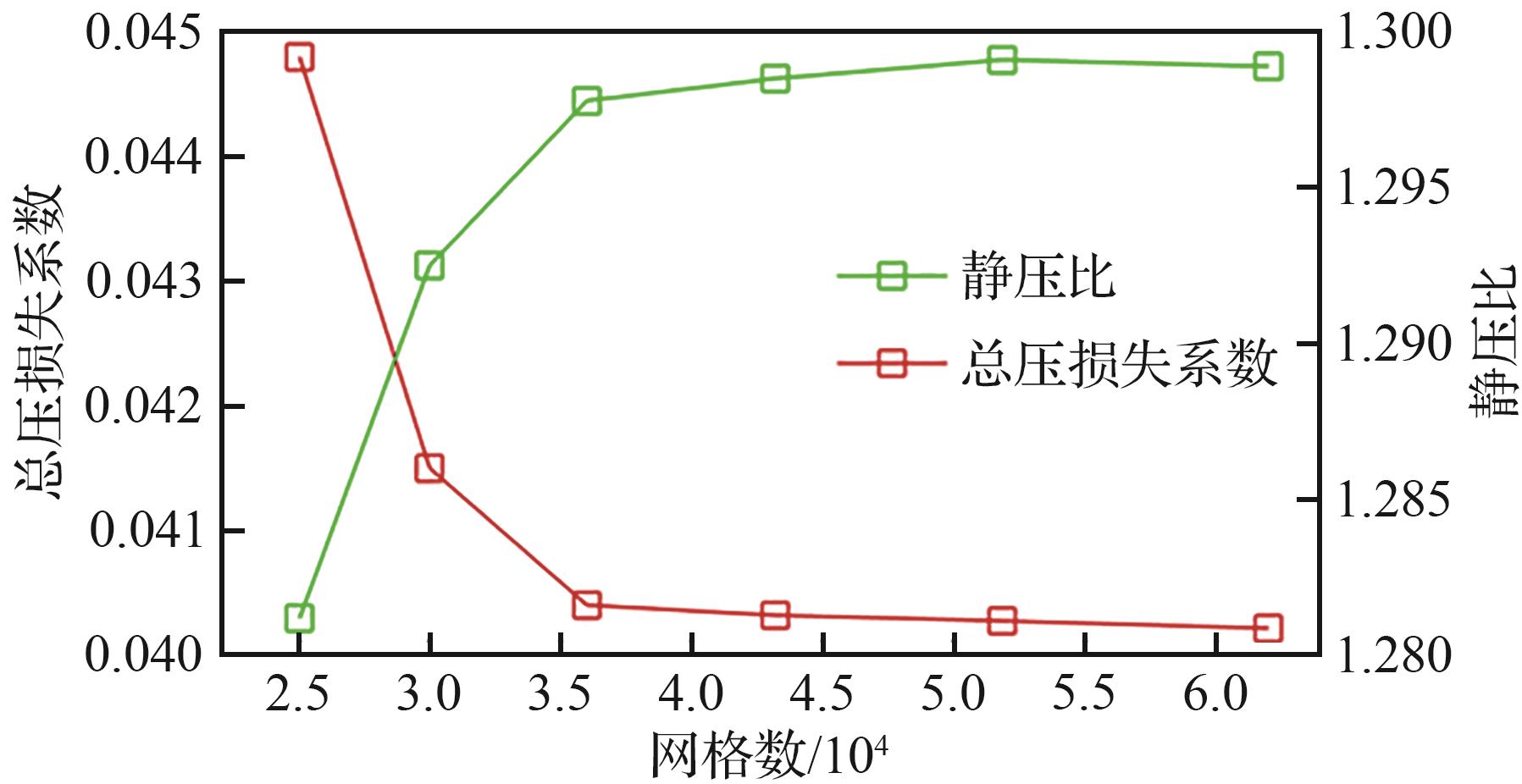
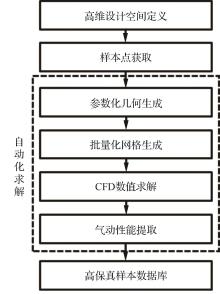
Fig.20
Workflow of sampling-data acquisition
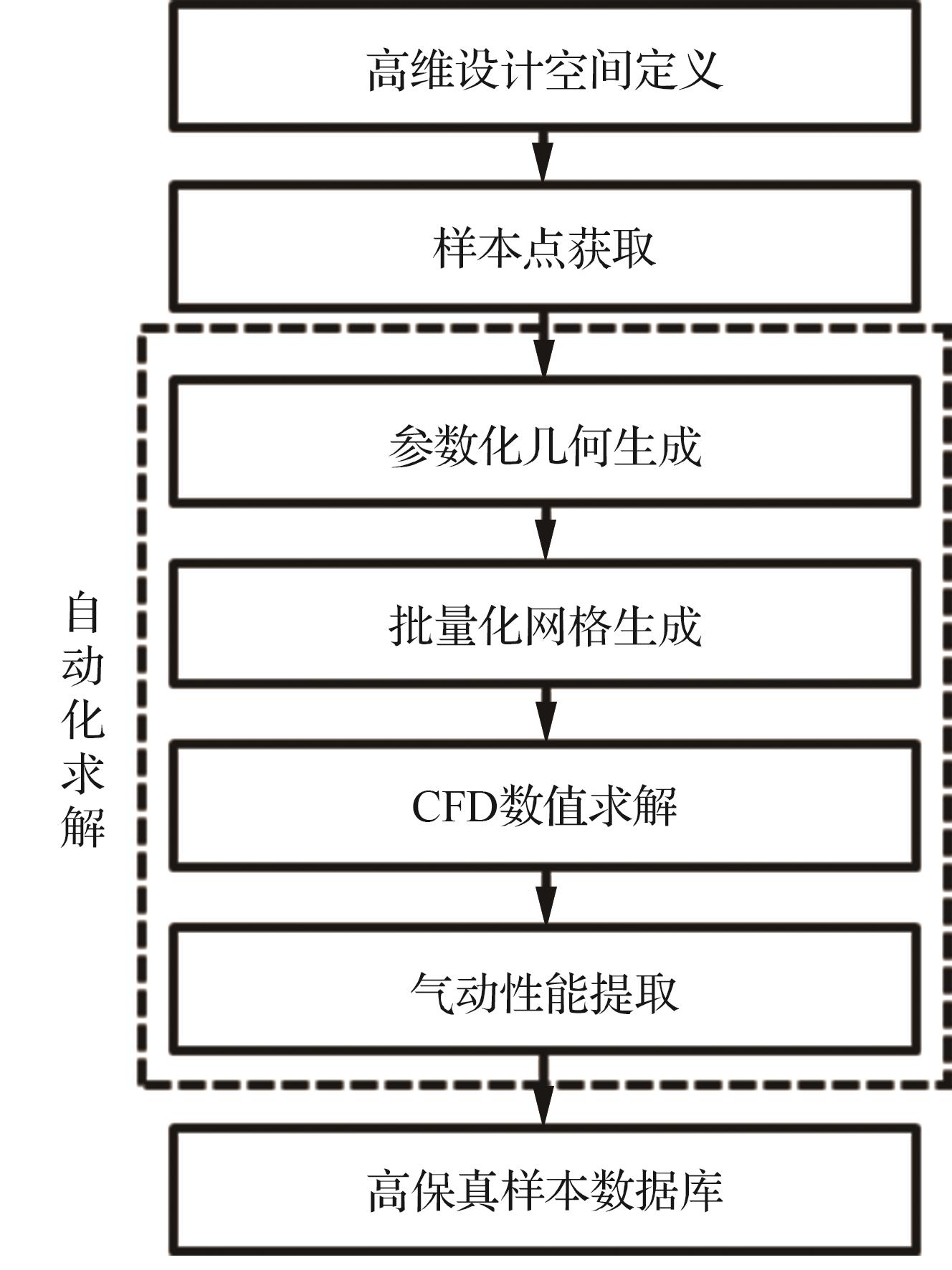
Fig.21
Multi-objective optimization flow based on deep surrogate model
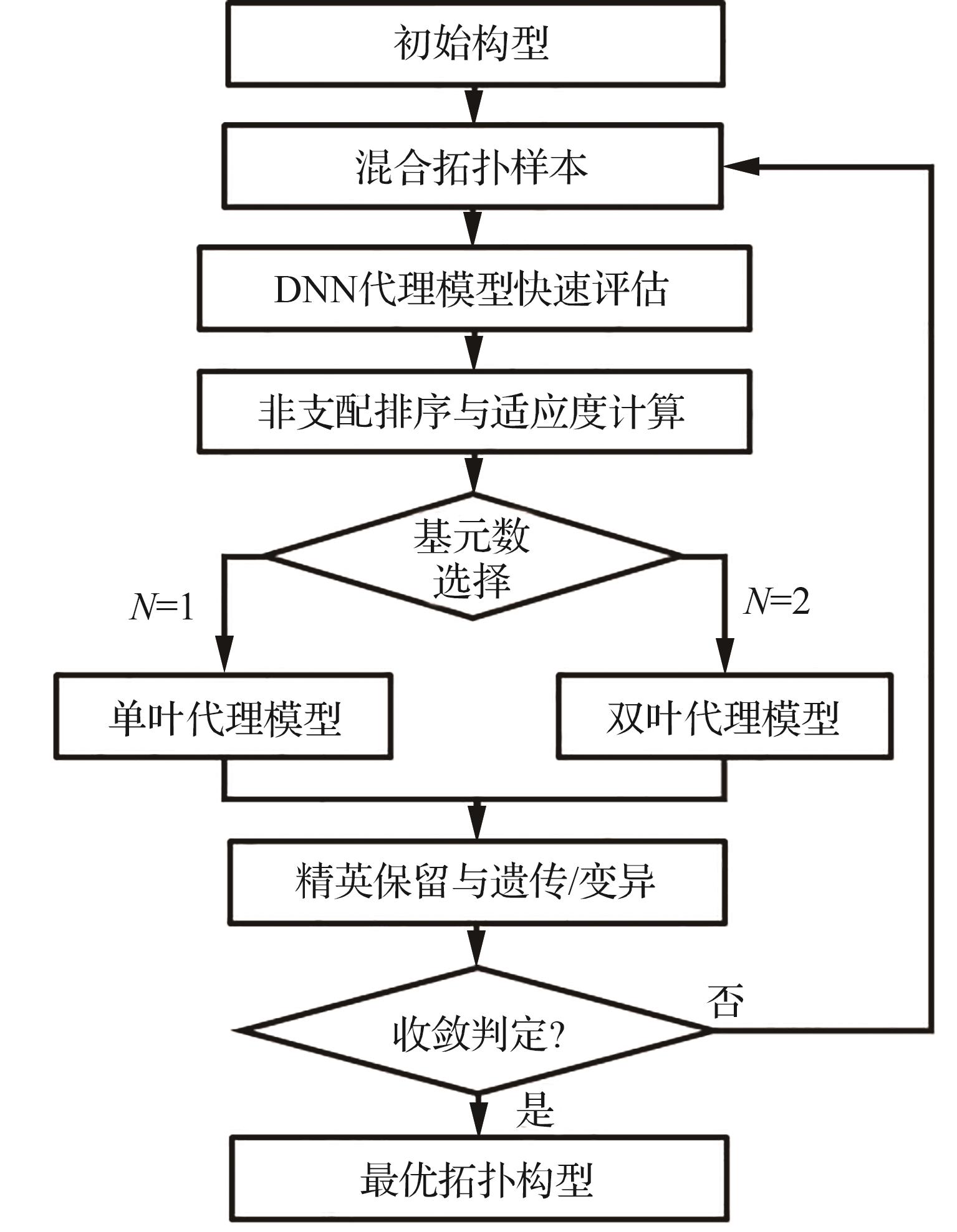
Table 4
Initial conditions for design scenarios
| 初始条件 | 数值 |
|---|---|
| 入口马赫数Ma | 0.7 |
| 弦长/m | 0.121 |
| 栅距/m | 0.054 |
| 转折角/(°) | 60 |
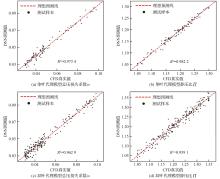
Fig.22
Performance comparison of DNN surrogate model in low speed-high-load scenario
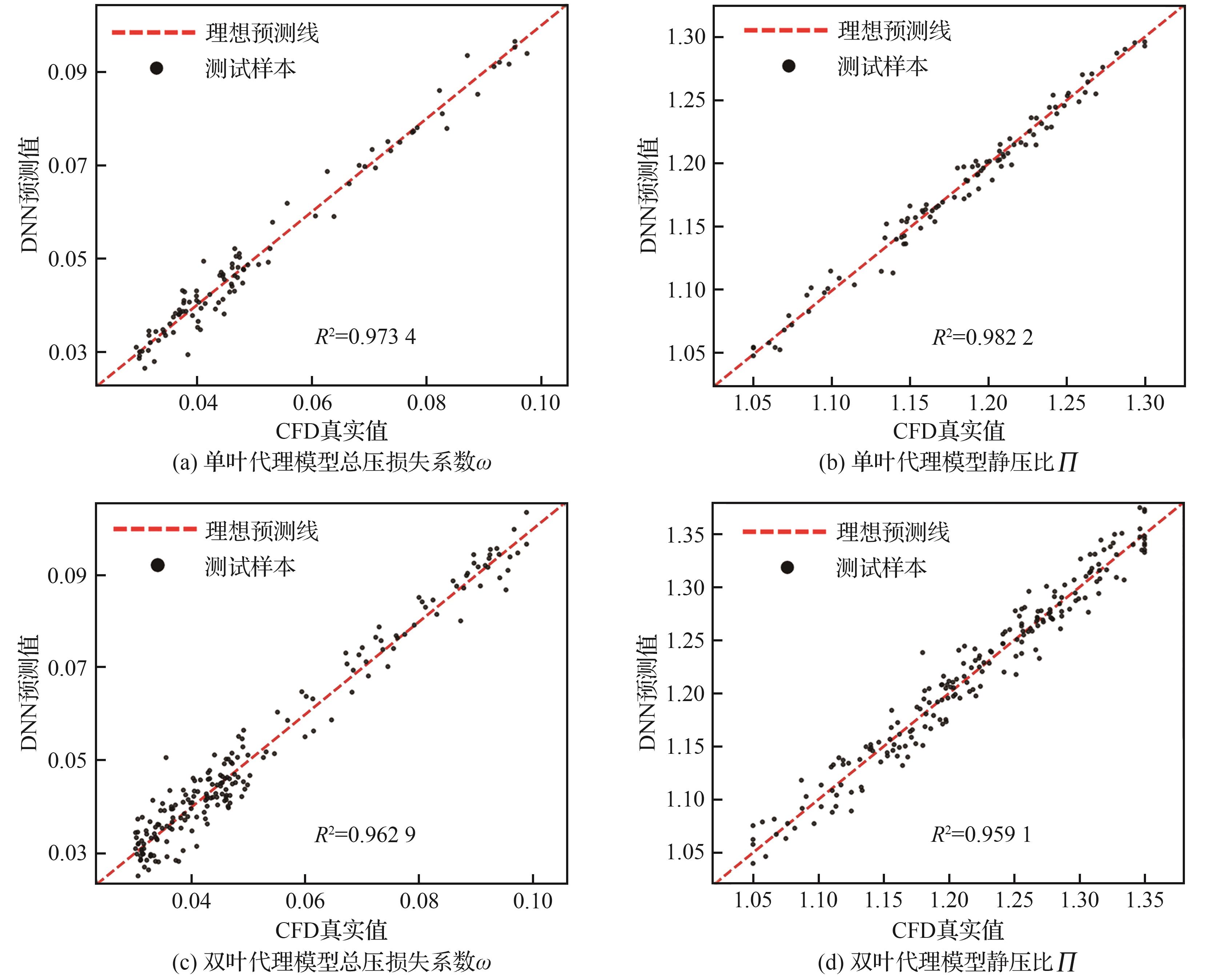
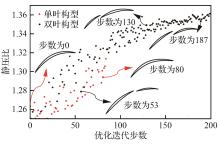
Fig.23
Static pressure ratio iteration and topology selection process
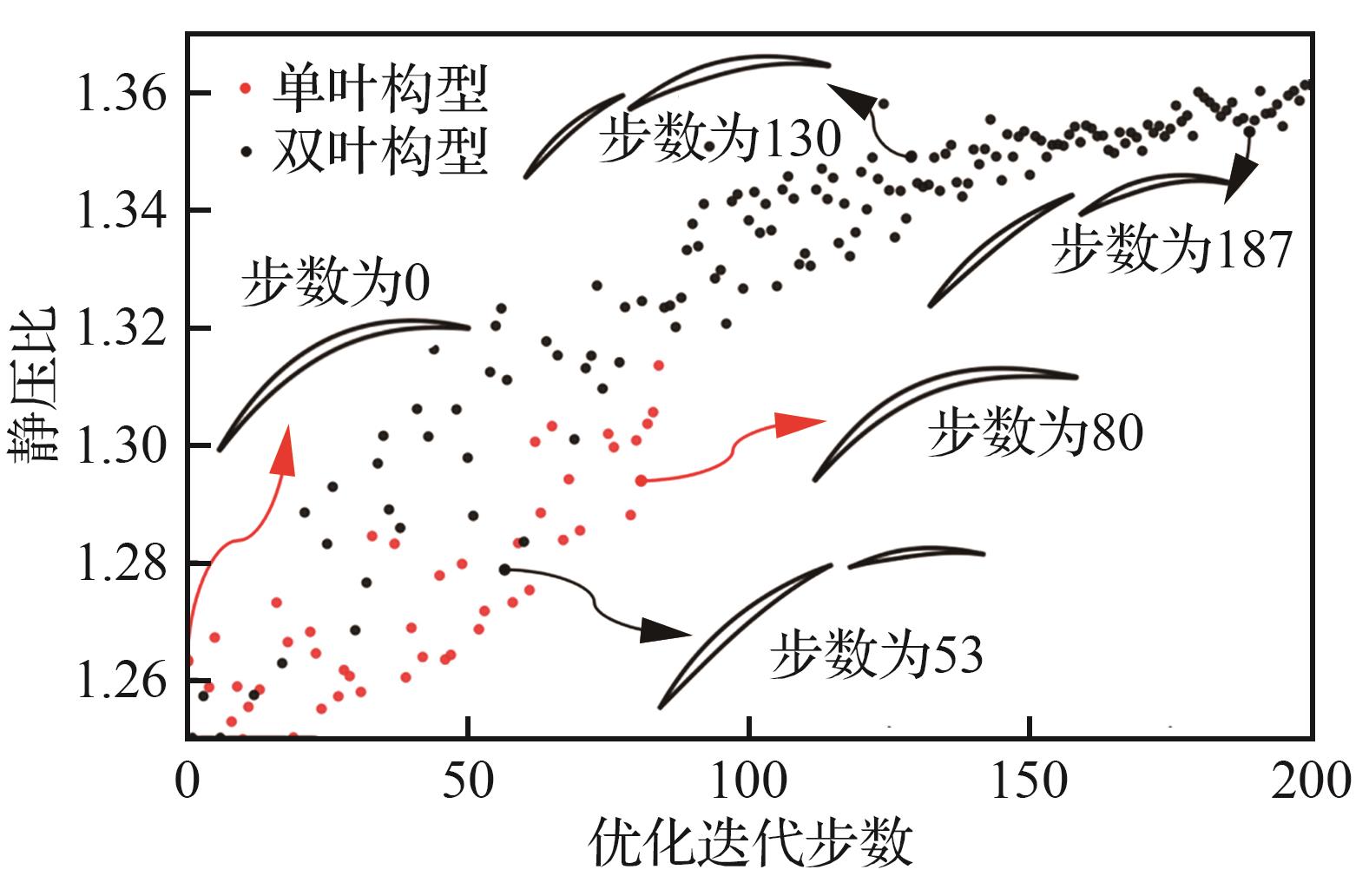
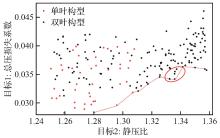
Fig.24
Non-dominated solution set distribution of total pressure loss coefficient-static pressure ratio
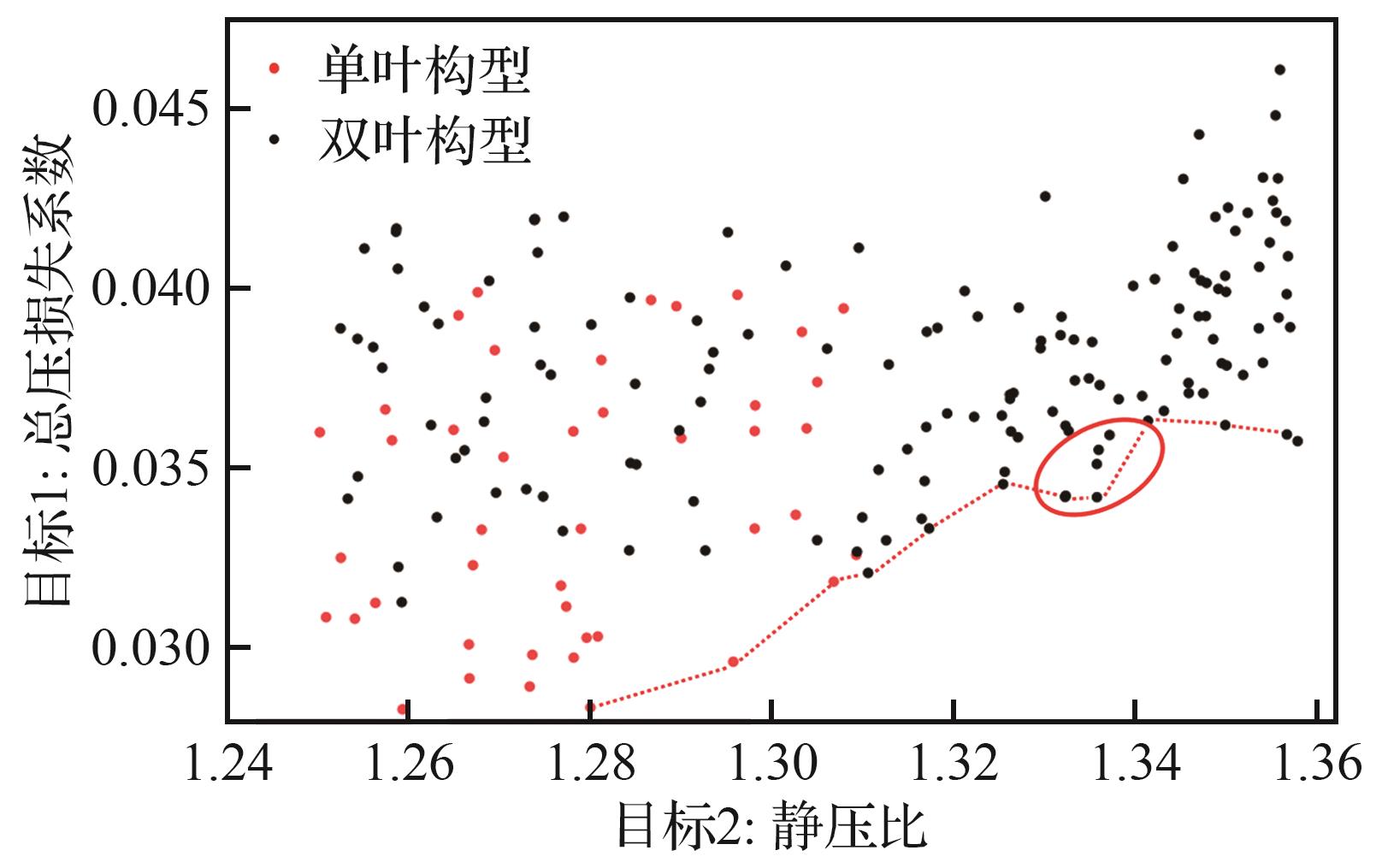
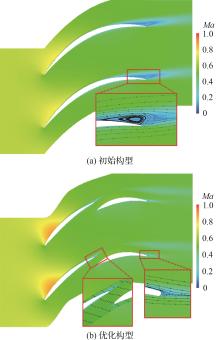
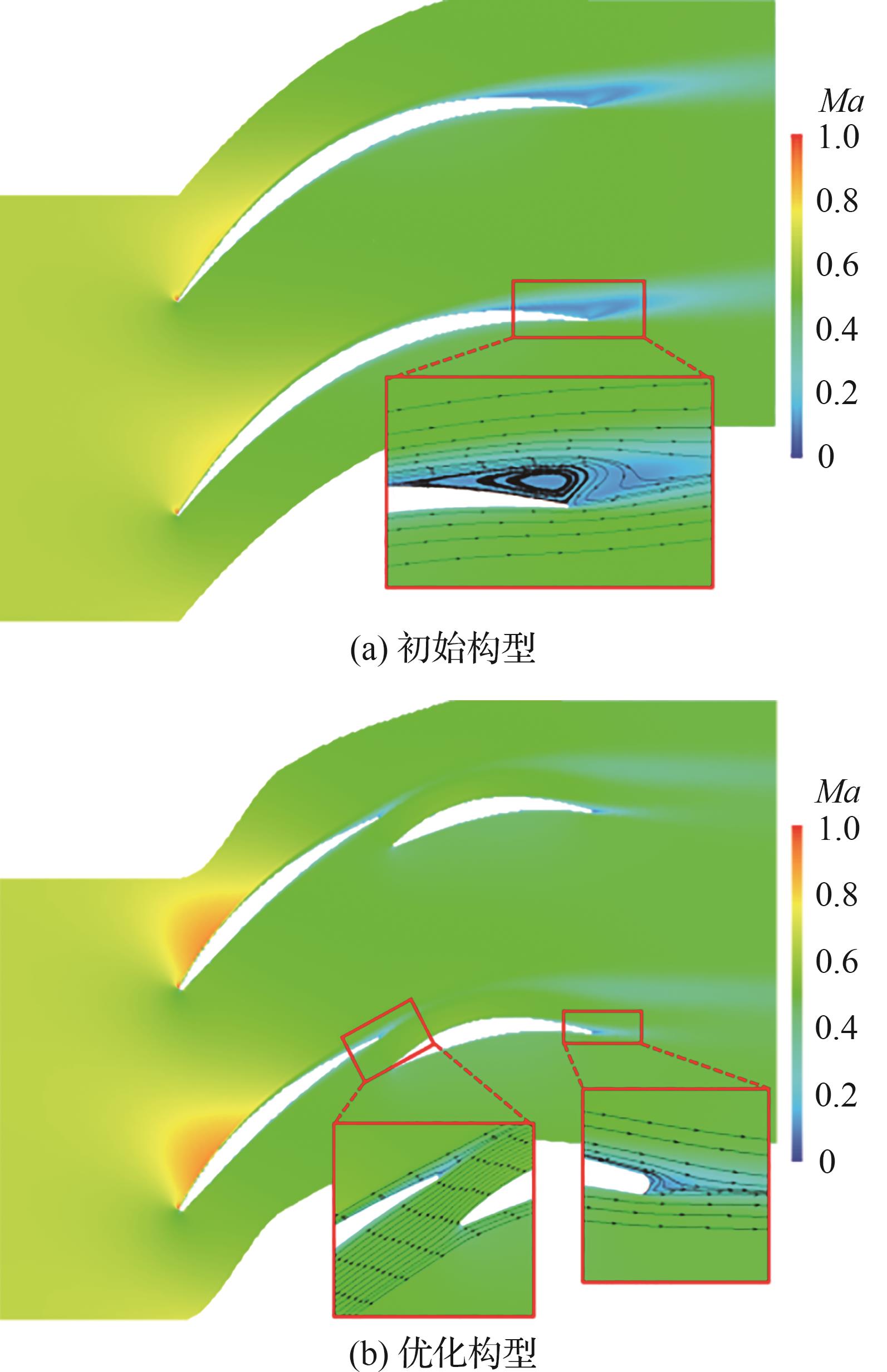
Fig.25
Comparison of flow fields for configurations before and after optimization
| [1] | BORRVALL T, PETERSSON J. Topology optimization of fluids in Stokes flow[J]. International Journal for Numerical Methods in Fluids, 2003, 41(1): 77-107. |
| [2] | GERSBORG-HANSEN A, SIGMUND O, HABER R B. Topology optimization of channel flow problems[J]. Structural and Multidisciplinary Optimization, 2005, 30(3): 181-192. |
| [3] | ALEXANDERSEN J, SIGMUND O, AAGE N. Large scale three-dimensional topology optimisation of heat sinks cooled by natural convection[J]. International Journal of Heat and Mass Transfer, 2016, 100: 876-891. |
| [4] | CHALLIS V J, GUEST J K. Level set topology optimization of fluids in Stokes flow[J]. International Journal for Numerical Methods in Engineering, 2009, 79(10): 1284-1308. |
| [5] | ZHOU S W, LI Q. A variational level set method for the topology optimization of steady-state Navier-Stokes flow[J]. Journal of Computational Physics, 2008, 227(24): 10178-10195. |
| [6] | DENG Y B, ZHANG P, LIU Y S, et al. Optimization of unsteady incompressible Navier-Stokes flows using variational level set method[J]. International Journal for Numerical Methods in Fluids, 2013, 71(12): 1475-1493. |
| [7] | GARCKE H, HECHT C, HINZE M, et al. Numerical approximation of phase field based shape and topology optimization for fluids[J]. SIAM Journal on Scientific Computing, 2015, 37(4): A1846-A1871. |
| [8] | DENG Y B, LIU Z Y, ZHANG P, et al. Topology optimization of unsteady incompressible Navier-Stokes flows[J]. Journal of Computational Physics, 2011, 230(17): 6688-6708. |
| [9] | KREISSL S, PINGEN G, MAUTE K. Topology optimization for unsteady flow[J]. International Journal for Numerical Methods in Engineering, 2011, 87(13): 1229-1253. |
| [10] | YOON G H. Topology optimization for turbulent flow with Spalart-Allmaras model[J]. Computer Methods in Applied Mechanics and Engineering, 2016, 303: 288-311. |
| [11] | DILGEN S B, DILGEN C B, FUHRMAN D R, et al. Density based topology optimization of turbulent flow heat transfer systems[J]. Structural and Multidisciplinary Optimization, 2018, 57(5): 1905-1918. |
| [12] | PADHY R K, SURESH K, CHANDRASEKHAR A. TOMAS: Topology optimization of multiscale fluid devices using variational autoencoders and super-shapes[DB/OL]. arXiv preprint: 2309.08435, 2023. |
| [13] | KOU C H, YIN Y H, ZHU M, et al. Efficient neural topology optimization via active learning for enhancing turbulent mass transfer in fluid channels[DB/OL]. arXiv preprint: 2503.03997, 2025. |
| [14] | SÁ L F N, OKUBO C M, SILVA E C N. Topology optimization of subsonic compressible flows[J]. Structural and Multidisciplinary Optimization, 2021, 64(1): 2903. |
| [15] | MAFFEI F S, NOGUEIRA DE SÁ L F, MOSCATELLI E, et al. Integer programming topology optimization for subsonic compressible flows with geometry trimming[J]. International Journal of Heat and Mass Transfer, 2023, 201: 123614. |
| [16] | GARCIA-RODRIGUEZ L F, ALONSO D H, SILVA E C N. Turbulence effects in the topology optimization of compressible subsonic flow[J]. International Journal for Numerical Methods in Fluids, 2025, 97(1): 44-68. |
| [17] | SÁ L F N, MAFFEI F S, RIBEIRO L N B S, et al. Topology optimization design of labyrinth seal-type devices considering subsonic compressible turbulent flow conditions[J]. Computers & Mathematics with Applications, 2024, 176: 306-323. |
| [18] | 张敏, 杨金广, 刘艳. 流体拓扑优化方法及其在叶轮机械中的应用[J]. 推进技术, 2021, 42(11): 2401-2416. |
| ZHANG M, YANG J G, LIU Y. Fluid topology optimization method and its application in turbomachinery[J]. Journal of Propulsion Technology, 2021, 42(11): 2401-2416 (in Chinese). | |
| [19] | 张敏. 涡轮动叶叶顶间隙泄漏控制及结构优化研究[D]. 大连: 大连理工大学, 2019. |
| ZHANG M. Study on clearance leakage control and structure optimization of turbine rotor blade tips[D]. Dalian: Dalian University of Technology, 2019 (in Chinese). | |
| [20] | ZHANG M, DU J, ZHANG H, et al. Fluid topology optimization of gas-turbine-related components[C]∥ 1st International Conference on Mechanical System Dynamics (ICMSD 2022). London: IET, 2022: 943-949. |
| [21] | 李信卿, 赵清海, 龙凯, 等. 考虑瞬态效应的周期性多材料传热结构拓扑优化[J]. 航空学报, 2022, 43(12): 506-518. |
| LI X Q, ZHAO Q H, LONG K, et al. Topology optimization of periodic multi-material heat conduction structures considering transient effects[J]. Acta Aeronautica et Astronautica Sinica, 2022, 43(12): 506-518 (in Chinese). | |
| [22] | SONG Z L, WANG J, TANG S K, et al. Dual-objective topology optimization design for latent heat storage systems using composite phase change materials[J]. Energy, 2025, 319: 135069. |
| [23] | ZHANG T, JING T T, QIN F, et al. Topology optimization of regenerative cooling channel in non-uniform thermal environment of hypersonic engine[J]. Applied Thermal Engineering, 2023, 219: 119384. |
| [24] | 李新磊, 吴坤, 赵林英, 等. 面向发动机再生冷却的流热耦合拓扑优化[J]. 力学学报, 2023, 55(11): 2661-2674. |
| LI X L, WU K, ZHAO L Y, et al. Topology optimization of coupled thermal-fluid problems for regenerative cooling engines[J]. Chinese Journal of Theoretical and Applied Mechanics, 2023, 55(11): 2661-2674 (in Chinese). | |
| [25] | YERANEE K, RAO Y, YANG L, et al. Enhanced thermal performance of a pin-fin cooling channel for gas turbine blade by density-based topology optimization[J]. International Journal of Thermal Sciences, 2022, 181: 107783. |
| [26] | YERANEE K, RAO Y, ZUO Q R, et al. Thermal performance enhancement for gas turbine blade trailing edge cooling with topology-optimized printable diamond TPMS lattice[J]. International Journal of Heat and Fluid Flow, 2024, 110: 109649. |
| [27] | SVANBERG K. The method of moving asymptotes: A new method for structural optimization[J]. International Journal for Numerical Methods in Engineering, 1987, 24(2): 359-373. |
| [28] | BEAR J. Dynamics of fluids in porous media[M]. Boston: Courier Corporation, 2013. |
| [29] | STOLPE M, SVANBERG K. An alternative interpolation scheme for minimum compliance topology optimization[J]. Structural and Multidisciplinary Optimization, 2001, 22(2): 116-124. |
| [30] | ZYMARIS A S, PAPADIMITRIOU D I, GIANNAKOGLOU K C, et al. Continuous adjoint approach to the Spalart-Allmaras turbulence model for incompressible flows[J]. Computers & Fluids, 2009, 38(8): 1528-1538. |
| [31] | STRELETS M. Detached eddy simulation of massively separated flows[C]∥ 39th Aerospace Sciences Meeting and Exhibit. Reston: AIAA, 2001. |
| [32] | BASSI F, CRIVELLINI A, REBAY S, et al. Discontinuous Galerkin solution of the Reynolds-averaged Navier-Stokes and k-ω turbulence model equations[J]. Computers & Fluids, 2005, 34(4/5): 507-540. |
| [33] | LANGTRY R B, MENTER F R. Correlation-based transition modeling for unstructured parallelized computational fluid dynamics codes[J]. AIAA Journal, 2009, 47(12): 2894-2906. |
| [34] | HOLKA Q, TOUBIANA E, CORTIAL J, et al. Density-based topology optimization of a surface cooler in turbulent flow using a continuous adjoint turbulence model[J]. Structural and Multidisciplinary Optimization, 2022, 65(8): 223. |
| [35] | 吴望一. 流体力学-上册[M]. 北京: 北京大学出版社, 1982. |
| WU W Y. Fluid mechanics-Volume Ⅰ[M]. Beijing: Peking University Press, 1982 (in Chinese). | |
| [36] | 彭泽琰. 航空燃气轮机原理[M]. 北京: 国防工业出版社, 2000. |
| PENG Z Y. Principle of aviation gas turbine[M]. Beijing: National Defense Industry Press, 2000 (in Chinese). | |
| [37] | MARCK G, NEMER M, HARION J L, et al. Topology optimization using the SIMP method for multiobjective conductive problems[J]. Numerical Heat Transfer, Part B: Fundamentals, 2012, 61(6): 439-470. |
| [38] | GALANOS N, PAPOUTSIS-KIACHAGIAS E M, GIANNAKOGLOU K C. The cut-cell method for the conjugate heat transfer topology optimization of turbulent flows using the “think discrete-do continuous” adjoint[J]. Energies, 2024, 17(8): 1817. |
| [39] | OLESEN L H, OKKELS F, BRUUS H. A high-level programming-language implementation of topology optimization applied to steady-state Navier-Stokes flow[J]. International Journal for Numerical Methods in Engineering, 2006, 65(7): 975-1001. |
| [40] | 吴仲华. 气体流过位于任意回转面上叶栅的解法和这种叶栅的设计方法[J]. 清华大学学报(自然科学版), 1956: 100-122, 313-314. |
| WU Z H. A theory of the direct and inverse problems of compressible flow past a cascade of arbitrary blade sections lying in a general surface of revolution in a turbomachine[J]. Journal of Tsinghua University (Science and Technology), 1956: 100-122, 313-314 (in Chinese). | |
| [41] | BEHR T. Control of rotor tip leakage and secondary flow by casing air injection in unshrouded axial turbines[D]. Zurich: Swiss Federal Institute of Technology Zurich, 2007. |
| [42] | 高杰, 郑群, 许天帮, 等. 涡轮间隙泄漏涡破碎对损失的影响[J]. 航空学报, 2014, 35(5): 1257-1264. |
| GAO J, ZHENG Q, XU T B, et al. Effect of tip leakage vortex breakdown on losses in turbines[J]. Acta Aeronautica et Astronautica Sinica, 2014, 35(5): 1257-1264 (in Chinese). | |
| [43] | 高杰, 郑群, 岳国强, 等. 燃气轮机涡轮叶顶间隙气热技术研究进展[J]. 航空学报, 2017, 38(9): 521019. |
| GAO J, ZHENG Q, YUE G Q, et al. Research progress on turbine blade tip aerodynamics and heat transfer technology for gas turbines[J]. Acta Aeronautica et Astronautica Sinica, 2017, 38(9): 521019 (in Chinese). | |
| [44] | MCKAY M D, BECKMAN R J, CONOVER W J. A comparison of three methods for selecting values of input variables in the analysis of output from a computer code[J]. Technometrics, 2000, 42(1): 55-61. |
| [45] | GOODFELLOW I, BENGIO Y, COURVILLE A. Deep learning[M]. Cambridge, Massachusetts: MIT Press, 2016. |
| [46] | DEB K, PRATAP A, AGARWAL S, et al. A fast and elitist multiobjective genetic algorithm: NSGA-Ⅱ[J]. IEEE Transactions on Evolutionary Computation, 2002, 6(2): 182-197. |
| [47] | WENNERSTROM A J. Design of highly loaded axial-flow fans and compressors[M]. Vermont: Concepts ETI, Inc., 2000. |
| [48] | 刘太秋, 季路成. 压气机气动设计方法演化[J]. 航空学报, 2026, 47(12): 132631. |
| LIU T Q, JI L C. Evolution of compressor aerodynamic design methods [J]. Acta Aeronautica et Astronautica Sinica, 2026, 47(12): 132631 (in Chinese). |
| [1] | Tielin MA, Biao JING, Chongwen JIANG, Nanxuan QIAO, Jingcheng FU, Jinwu XIANG. Configuration design and mission capability evaluation of a cross-speed-range waverider-integrated morphing wing [J]. Acta Aeronautica et Astronautica Sinica, 2026, 47(1): 632051-632051. |
| [2] | Xin XU, Liang LI, Jiaxiang LI, Jiachang JIANG, Yilin WEI. JPALS reference receivers topology design for ionospheric gradient monitoring [J]. Acta Aeronautica et Astronautica Sinica, 2025, 46(8): 331075-331075. |
| [3] | Chengpeng WANG, Chenguang HAO, Hao LI, Longsheng XUE, Yun JIAO, Siyu WU, Zhangyu MA, Ye YUAN, Weijun LI, Puchen HOU. Application of minimum entropy production principle to analysis of shock wave/boundary layer interactions [J]. Acta Aeronautica et Astronautica Sinica, 2025, 46(8): 631458-631458. |
| [4] | Feng QU, Qing WANG, Shaowen CHENG, Kaiqiang WANG. Aerodynamic shape optimization design of airframe/propulsion integrated hypersonic aircraft with aerodynamics/trajectory/ control coupling [J]. Acta Aeronautica et Astronautica Sinica, 2025, 46(4): 130874-130874. |
| [5] | Ruitao ZHANG, Cong WANG, Jun TAO, Liyue WANG, Gang SUN. Airfoil parameterization method based on latent diffusion model [J]. Acta Aeronautica et Astronautica Sinica, 2025, 46(10): 631180-631180. |
| [6] | Haifeng WANG, Kunpeng LIU, Hongxin JIANG, Chenxi DU. Aerodynamic optimization method of propeller multi⁃design points and variable pitch angle strategy [J]. Acta Aeronautica et Astronautica Sinica, 2024, 45(9): 528831-528831. |
| [7] | Pengbo SUN, Zhou ZHOU, Xu LI, Kelei WANG. Influence analysis and optimization of distribution-propulsion-wing parameters with target aerodynamic characteristics [J]. Acta Aeronautica et Astronautica Sinica, 2024, 45(6): 629368-629368. |
| [8] | Wei WANG, Hao WANG, Ai ZHOU, He FENG. Stepwise optimal design for shape and topology of variable camber wing [J]. Acta Aeronautica et Astronautica Sinica, 2024, 45(18): 129990-129990. |
| [9] | Ke ZHAO, Jun DENG, Jiangtao HUANG, Shusheng CHEN, Zhenghong GAO. Aerodynamic optimization design of high and low speed integration for flying wing layout [J]. Acta Aeronautica et Astronautica Sinica, 2024, 45(15): 129367-129367. |
| [10] | Youde XIONG, Chuangchuang LI, Zhenhui ZHANG, Jie WU. Measurement of freestream disturbance in hypersonic wind tunnel with hot-wire anemometer [J]. Acta Aeronautica et Astronautica Sinica, 2024, 45(10): 129042-129042. |
| [11] | Kailong XU, Zaigang LIU, Shengli JIANG, Xing WANG, Pan ZHANG. Treatment of boundary condition at multiple outlets with recirculating flow and specified flow ratios [J]. ACTA AERONAUTICAET ASTRONAUTICA SINICA, 2023, 44(5): 126830-126830. |
| [12] | Huan ZHAO, Zhenghong GAO, Lu XIA. Aerodynamic shape design optimization method based on novel high⁃dimensional surrogate model [J]. ACTA AERONAUTICAET ASTRONAUTICA SINICA, 2023, 44(5): 126924-126924. |
| [13] | Huangsheng WEI, Zhu HUANG, Guang XI. A dissipation control method based on amplitude and wavenumber [J]. ACTA AERONAUTICAET ASTRONAUTICA SINICA, 2023, 44(4): 126589-126589. |
| [14] | Chaoyu LIU, Feng QU, Di SUN, Chuanzhen LIU, Zhansen QIAN, Junqiang BAI. Discretized adjoint based aerodynamic optimization design for hypersonic osculating-cone waverider [J]. ACTA AERONAUTICAET ASTRONAUTICA SINICA, 2023, 44(4): 126664-126664. |
| [15] | Bo ZHU, Daxiong LIAO, Zhenhua CHEN, Jiming CHEN. Fine measurement for fluctuation mode and turbulence level in transonic flow [J]. ACTA AERONAUTICAET ASTRONAUTICA SINICA, 2023, 44(4): 126378-126378. |
| Viewed | ||||||
|
Full text |
|
|||||
|
Abstract |
|
|||||
Address: No.238, Baiyan Buiding, Beisihuan Zhonglu Road, Haidian District, Beijing, China
Postal code : 100083
E-mail:hkxb@buaa.edu.cn
Total visits: 6658907 Today visits: 1341All copyright © editorial office of Chinese Journal of Aeronautics
All copyright © editorial office of Chinese Journal of Aeronautics
Total visits: 6658907 Today visits: 1341

 CJA
CJA
