童金阳1, 寇家庆2,3,4( ), 张伟伟2,3,4
收稿日期:2025-09-08
修回日期:2025-12-08
接受日期:2025-12-25
出版日期:2026-01-12
发布日期:2026-01-09
通讯作者:
寇家庆
E-mail:jqkou@nwpu.edu.cn
基金资助:
Jinyang TONG1, Jiaqing KOU2,3,4(), Weiwei ZHANG2,3,4
Received:2025-09-08
Revised:2025-12-08
Accepted:2025-12-25
Online:2026-01-12
Published:2026-01-09
Contact:
Jiaqing KOU
E-mail:jqkou@nwpu.edu.cn
Supported by:摘要:
针对白箱气动力降阶模型的高效高精度构建,提出了一种基于非线性动力学稀疏识别(SINDy)的频域非定常气动力建模方法。该方法通过典型振幅频率下的飞行器简谐运动仿真数据,利用经典代数气动力模型架构设计候选函数库,并根据稀疏回归方法实现候选项的最优选择及参数辨识,从而自动构建稀疏结构的强可解释性气动力降阶模型。分别基于经典代数气动力模型与Theodorsen气动力建模理论,构建了全采样空间的统一模型(SINDyA)和变参数的局部气动力模型(SINDyB)。随后,以NACA64A010翼型和CHN-T1飞行器的跨声速俯仰运动这两类典型问题为研究对象,以升力和力矩系数为建模目标,验证了提出方法的有效性。结果表明:建立的模型仅需少数主导项就能兼顾气动力非线性与迟滞特性,其中SINDyB模型由于对系数进行局部插值,展现出更高的预测精度;由于力矩系数非线性更强,其预测难度显著高于升力系数;建立的模型在一定幅值和频率范围的激励下能准确预测气动力响应,但对于大幅高频工况,预测精度有所下降。研究验证了符号主义机器学习方法在构建高精度、可解释非定常气动力模型上的潜力,展现出此类模型的工程应用前景。
中图分类号:
童金阳, 寇家庆, 张伟伟. 飞行器非定常气动力稀疏识别建模方法[J]. 航空学报, 2026, 47(16): 132764.
Jinyang TONG, Jiaqing KOU, Weiwei ZHANG. Sparse identification modeling method for unsteady aerodynamics of aircraft[J]. Acta Aeronautica et Astronautica Sinica, 2026, 47(16): 132764.
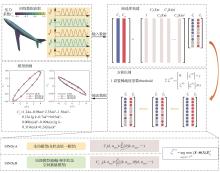
图 1
基于SINDy的非定常气动力建模方法示意图
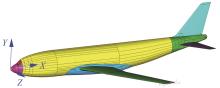
图 2
CHN-T1标模几何外形

表 1
几何参数
| 参数 | 数值 |
|---|---|
| 参考面积/ | 0.129 37 |
| 机翼半展长/ | 0.774 38 |
| 平均气动弦长/ | 0.193 7 |
| 力矩参考点/ | (0.660 87,0,0) |
表 2
CHN-T1标模的网格参数
| 网格 | 总网格量 | 第1层网格高度 | y+ |
|---|---|---|---|
| 粗网格 | 2 318 948 | 1.44×10⁻⁶ | 1.0 |
| 中等网格 | 5 952 147 | 1.00×10⁻⁶ | 0.6 |
| 细网格 | 17 249 562 | 6.93×10⁻⁷ | 0.4 |
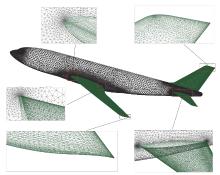
图 3
CHN-T1标模的粗网格分布
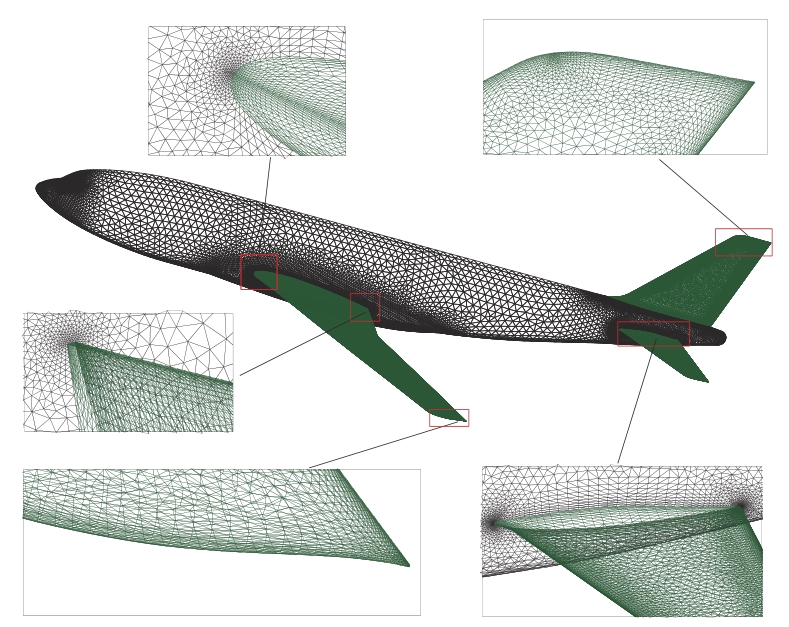
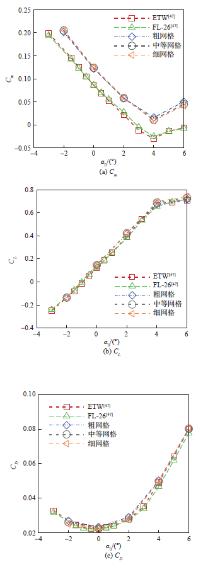
图 4
定常结果对照
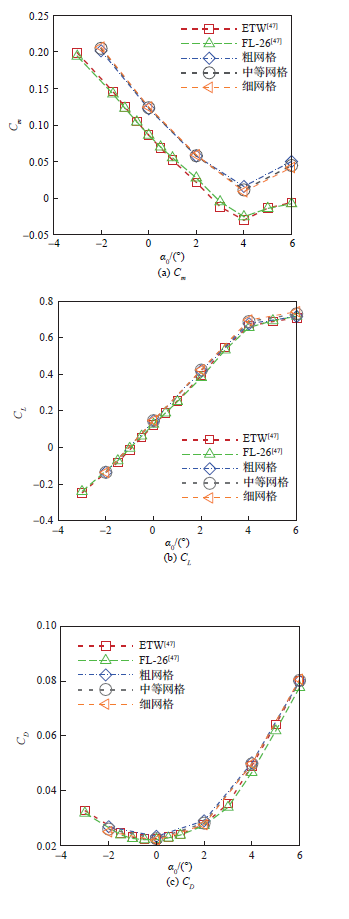
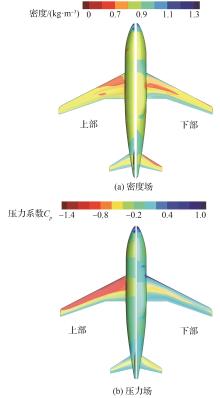
图 5
α0=4°时CHN-T1标模的流场
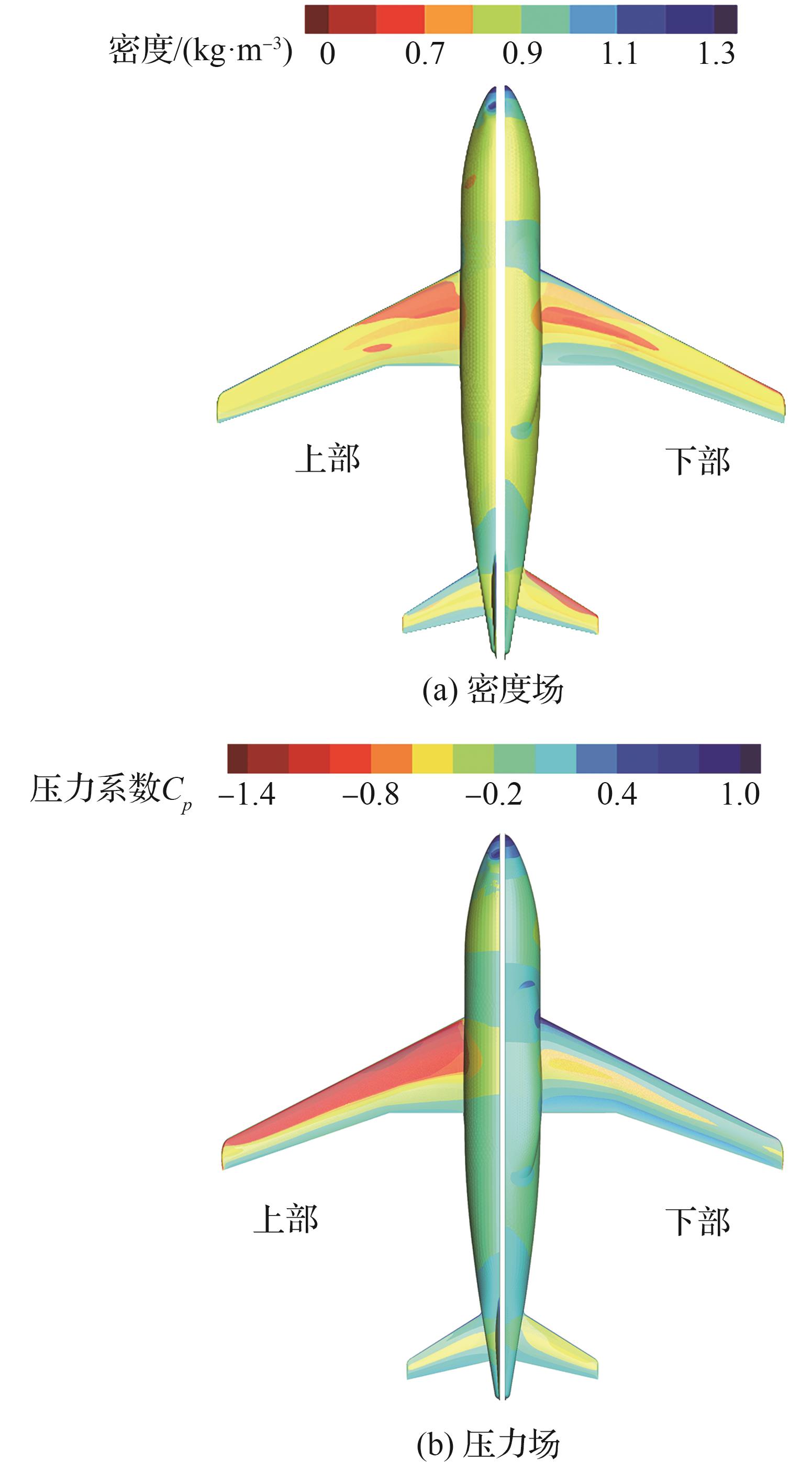
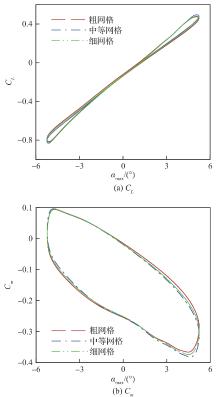
图 6
非定常结果对照
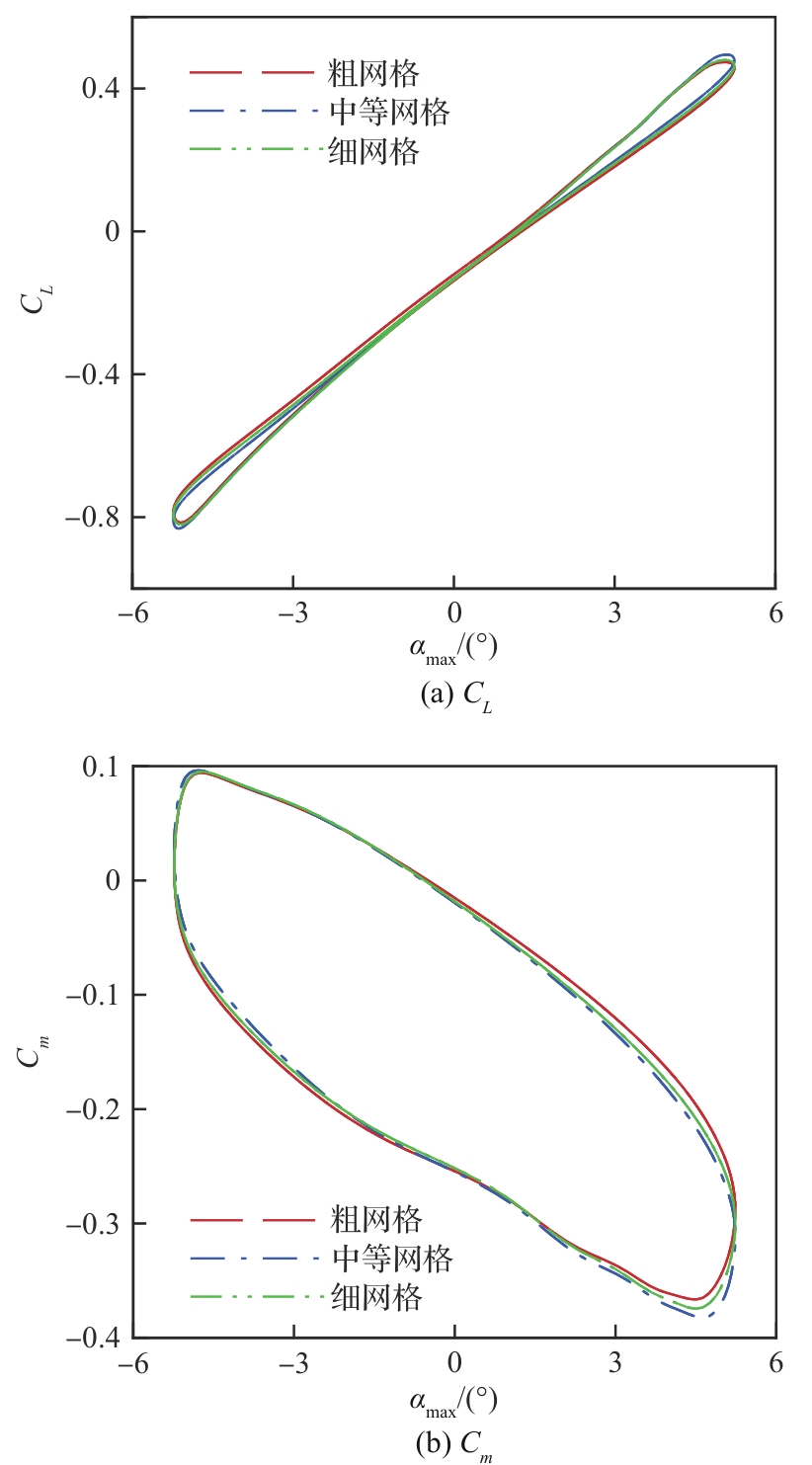
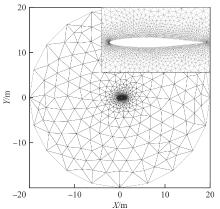
图 7
NACA64A010非结构网格
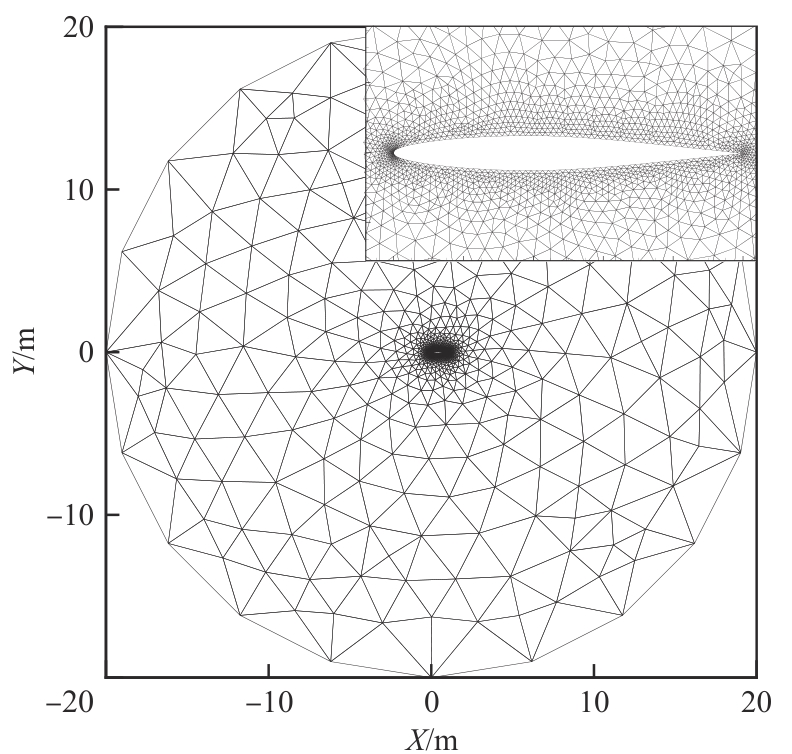
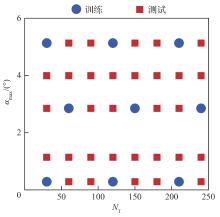
图 8
状态空间采样
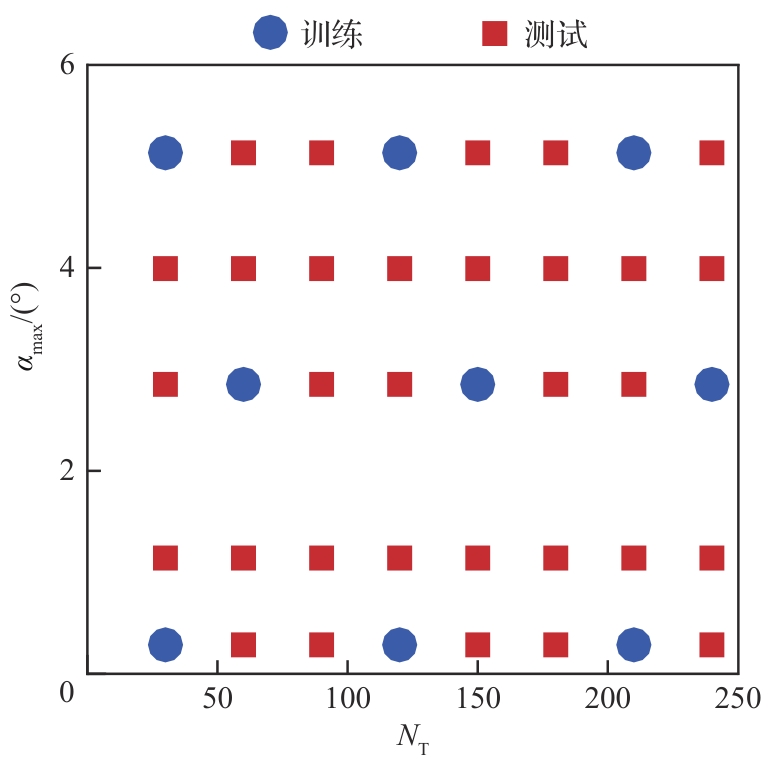
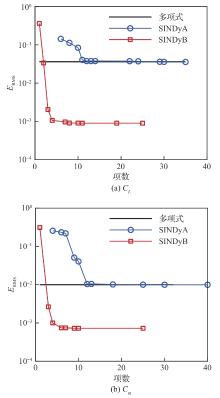
图 9
NACA 64A010翼型误差-项数关系
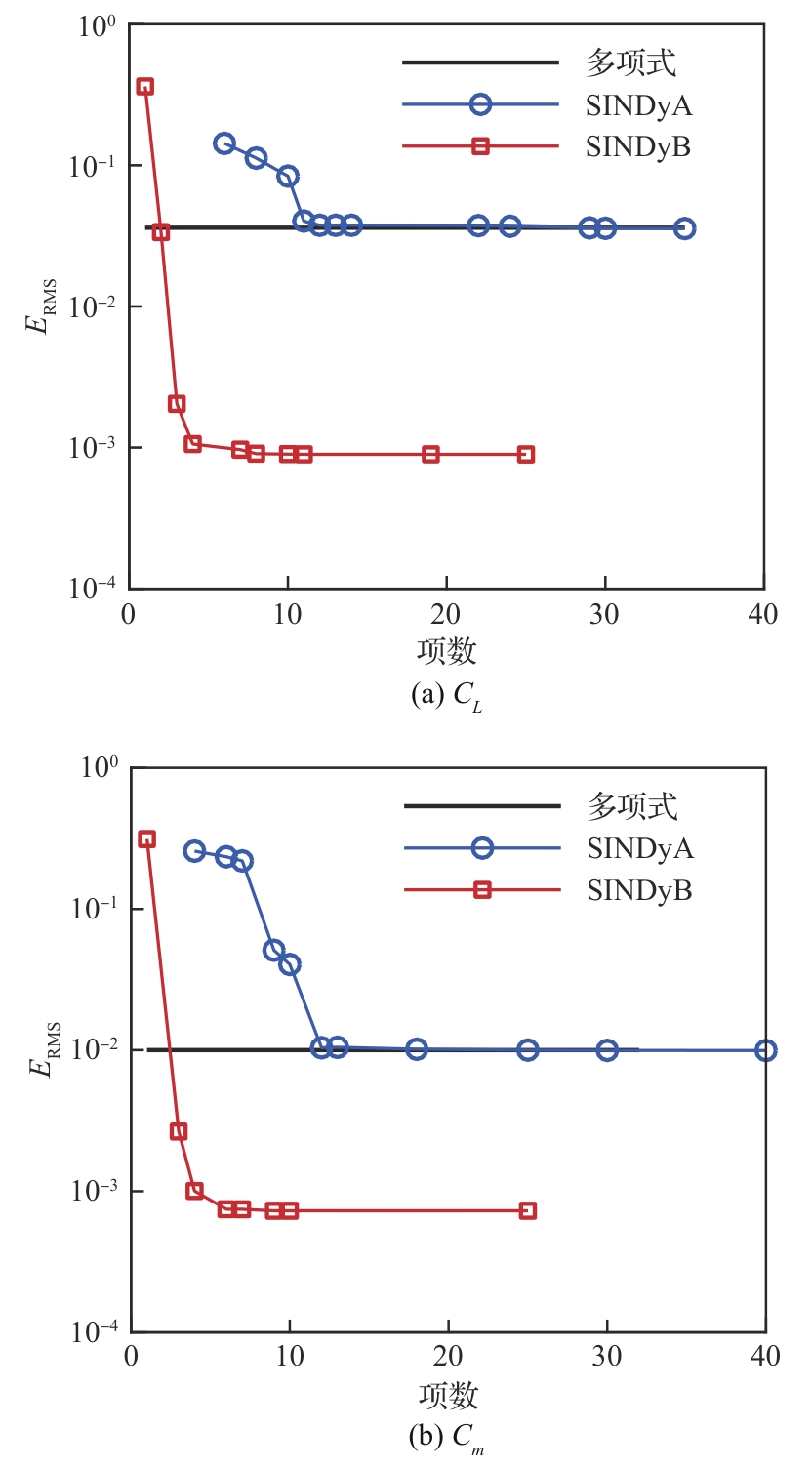
表 3
NACA 64A010翼型SINDyA模型中各项的系数
| 参数 | 系数 | |||||||||||
|---|---|---|---|---|---|---|---|---|---|---|---|---|
| CL | 1.487 | -1.327 | 1.714 | -0.884 | 0.685 | 0.894 | -0.577 | -0.385 | -1.162 | 2.246 | 0 | -1.367 |
| Cm | -1.577 | 1.519 | -1.762 | 0.811 | -0.772 | -1.261 | 0 | 0.791 | 0.462 | 1.688 | -1.849 | 0.53 |
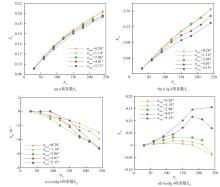
图 10
SINDyB模型中CL 的各项系数变化趋势
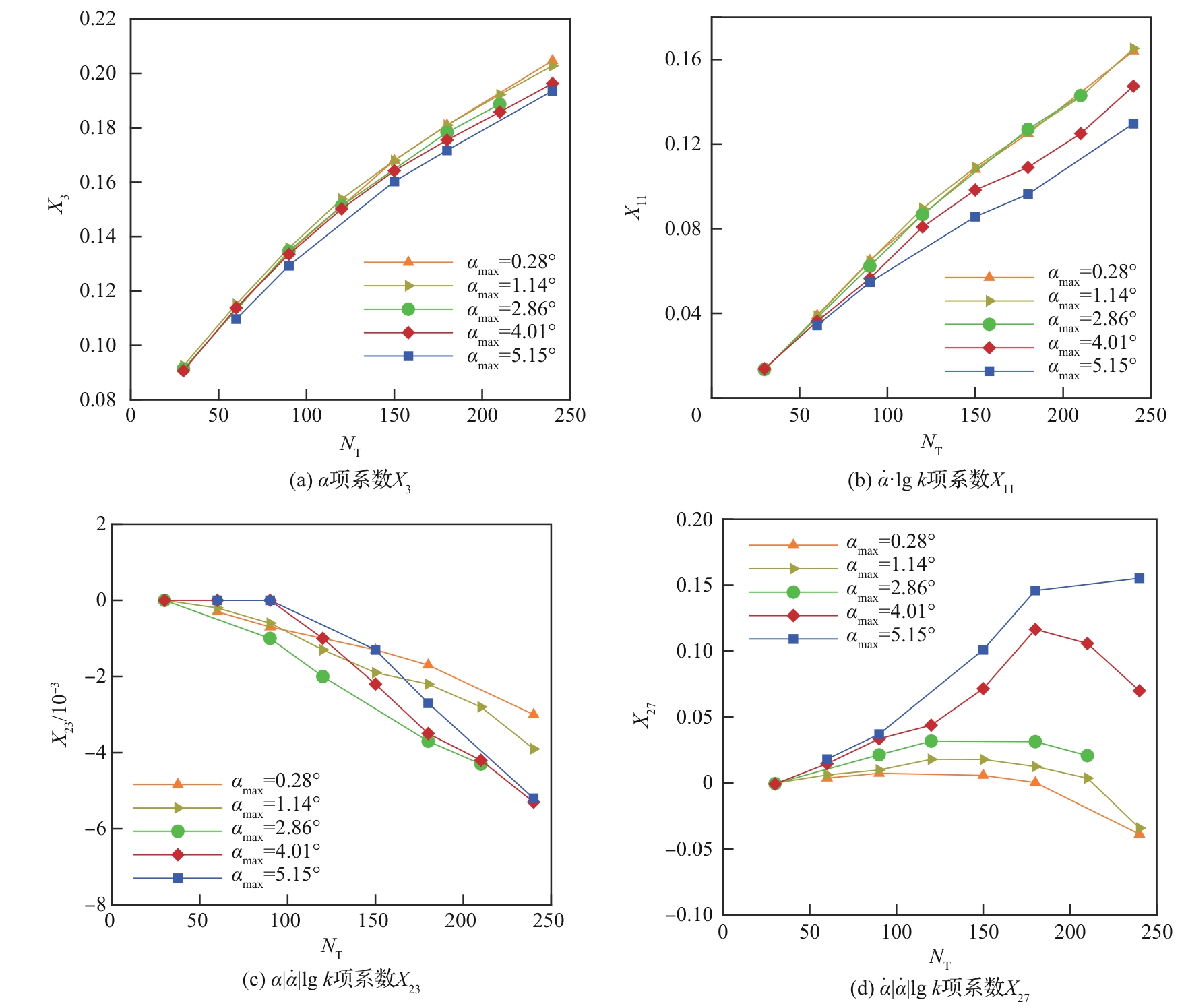
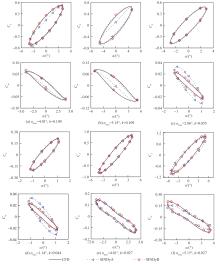
图 11
NACA 64A010翼型测试结果对比
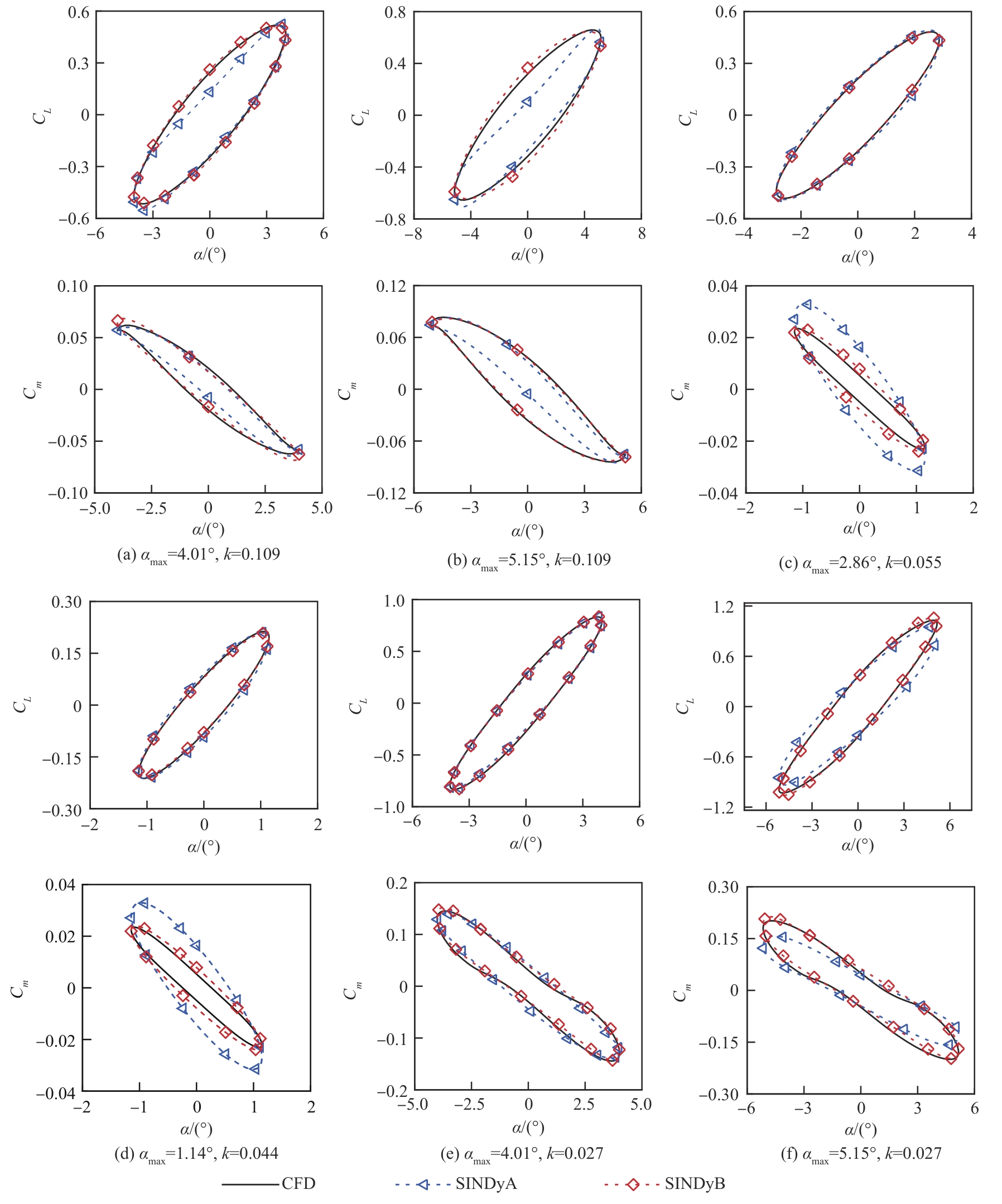
表 4
测试误差
| 模型 | ER/% | ERMS/10-3 | ||
|---|---|---|---|---|
| CL | Cm | CL | Cm | |
| SINDyA | 16.14 | 17.65 | 23.858 | 8.134 |
| SINDyB | 2.72 | 9.69 | 12.654 | 6.293 |
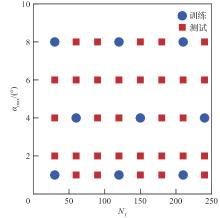
图 12
频域空间采样情况
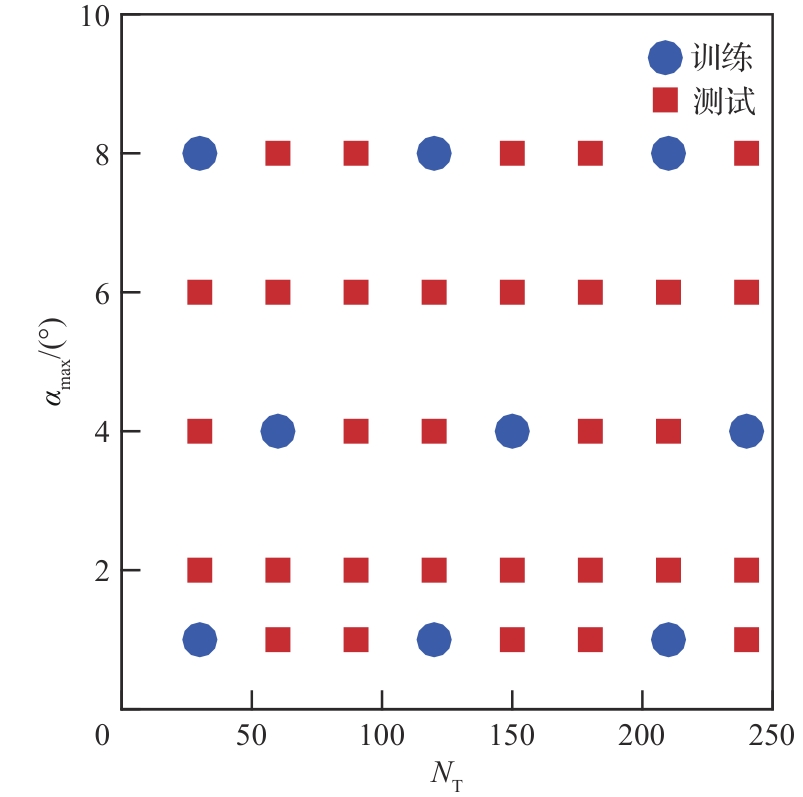
图 13
CHN-T1模型误差-项数关系
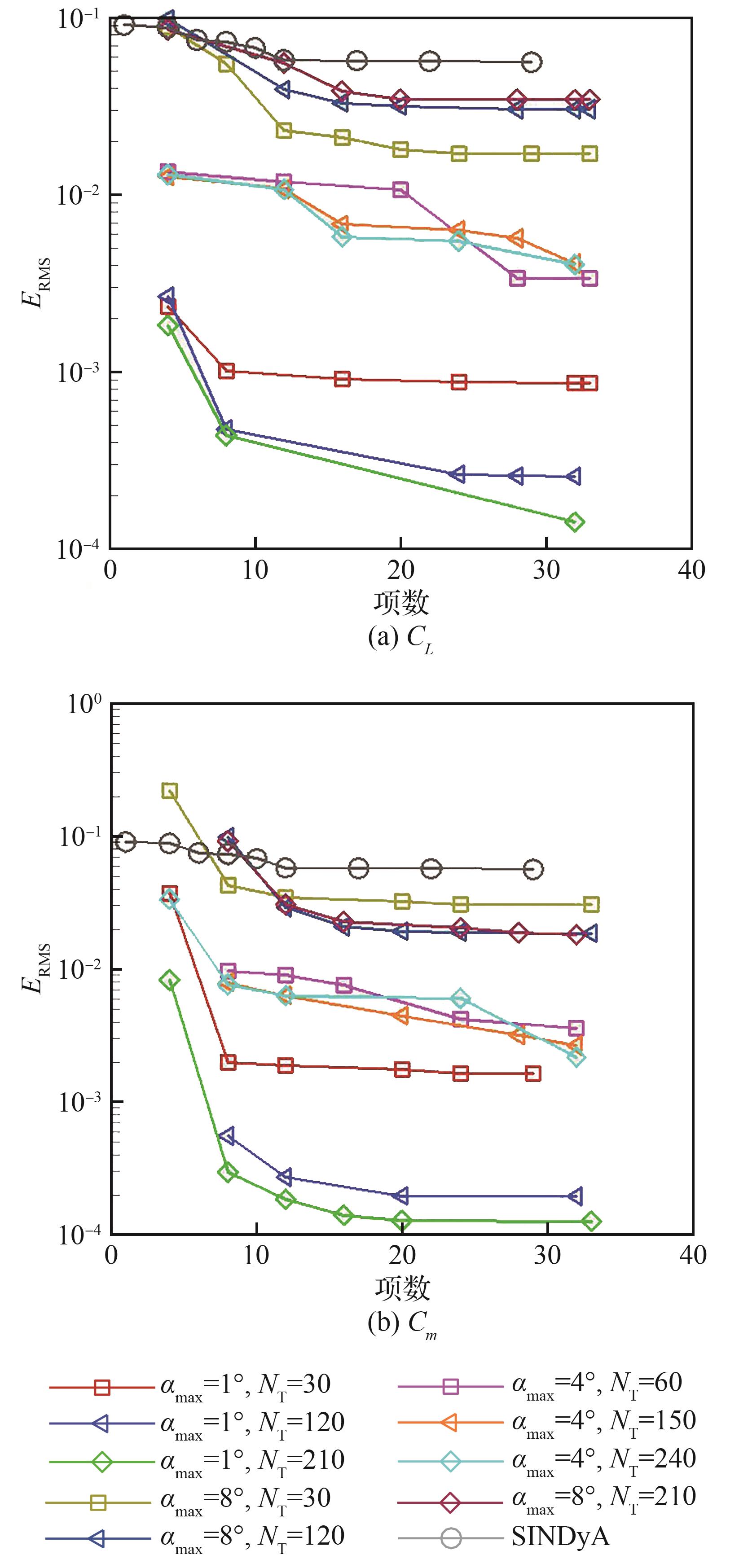
表 5
CHN-T1标模SINDyA模型中各项的系数
| 参数 | 系数 | |||||||||||
|---|---|---|---|---|---|---|---|---|---|---|---|---|
| CL | 1.244 | -0.981 | 2.348 | -1.556 | -0.119 | 0 | -0.697 | 0.653 | -0.008 | -0.094 | -0.319 | 0.242 |
| Cm | -0.995 | 1.753 | -4.041 | 2.575 | 0.380 | -2.706 | 6.169 | -3.875 | -0.815 | 0.811 | 0 | 0 |
表 6
SINDyB模型中的系数项数
| 工况 | 项数 | |
|---|---|---|
| CL | Cm | |
| 8 | 13 | |
| 7 | 7 | |
| 5 | 7 | |
| 11 | 10 | |
| 15 | 9 | |
| 14 | 12 | |
| 12 | 13 | |
| 16 | 15 | |
| 15 | 14 |
图 14
CHN-T1标模测试结果对比
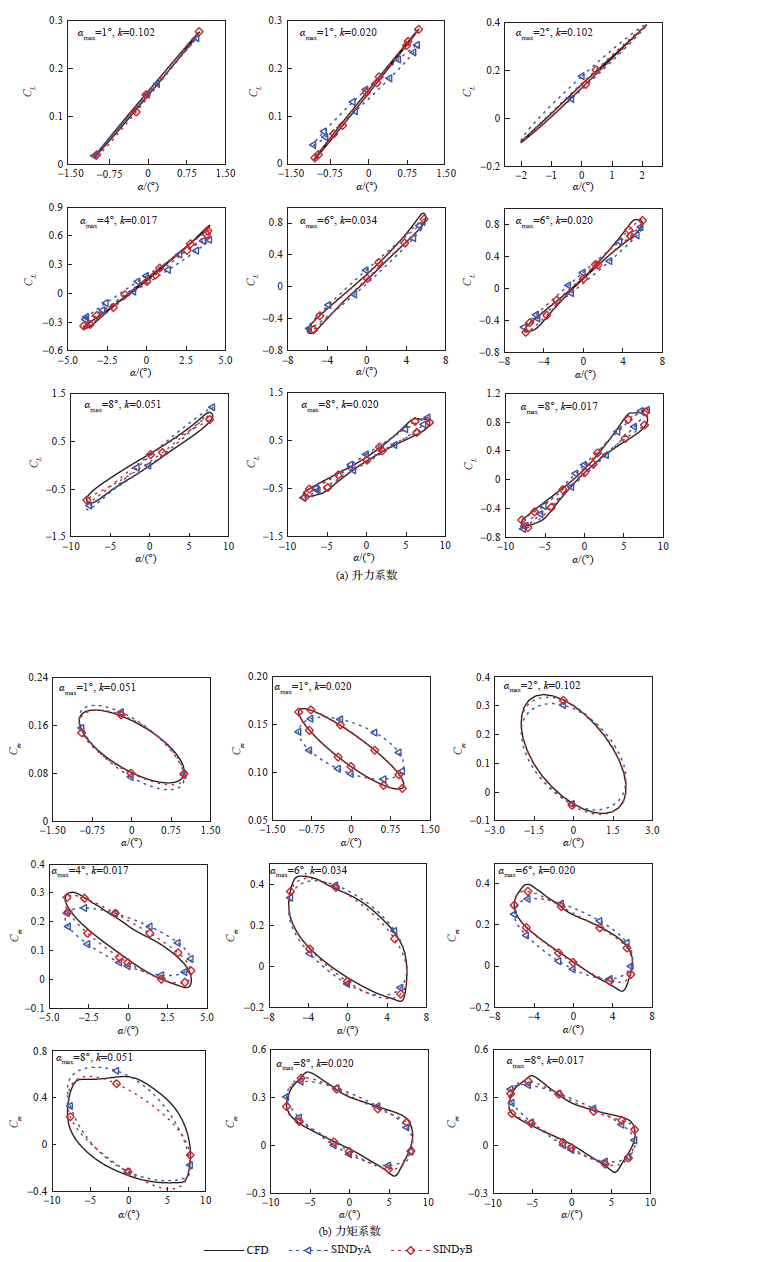
表 7
总体ERMS
| 模型 | CL 的ERMS | Cm 的ERMS |
|---|---|---|
| SINDyA | 0.108 9 | 0.284 7 |
| SINDyB | 0.047 7 | 0.221 0 |
图 15
测试信号ERMS热力图
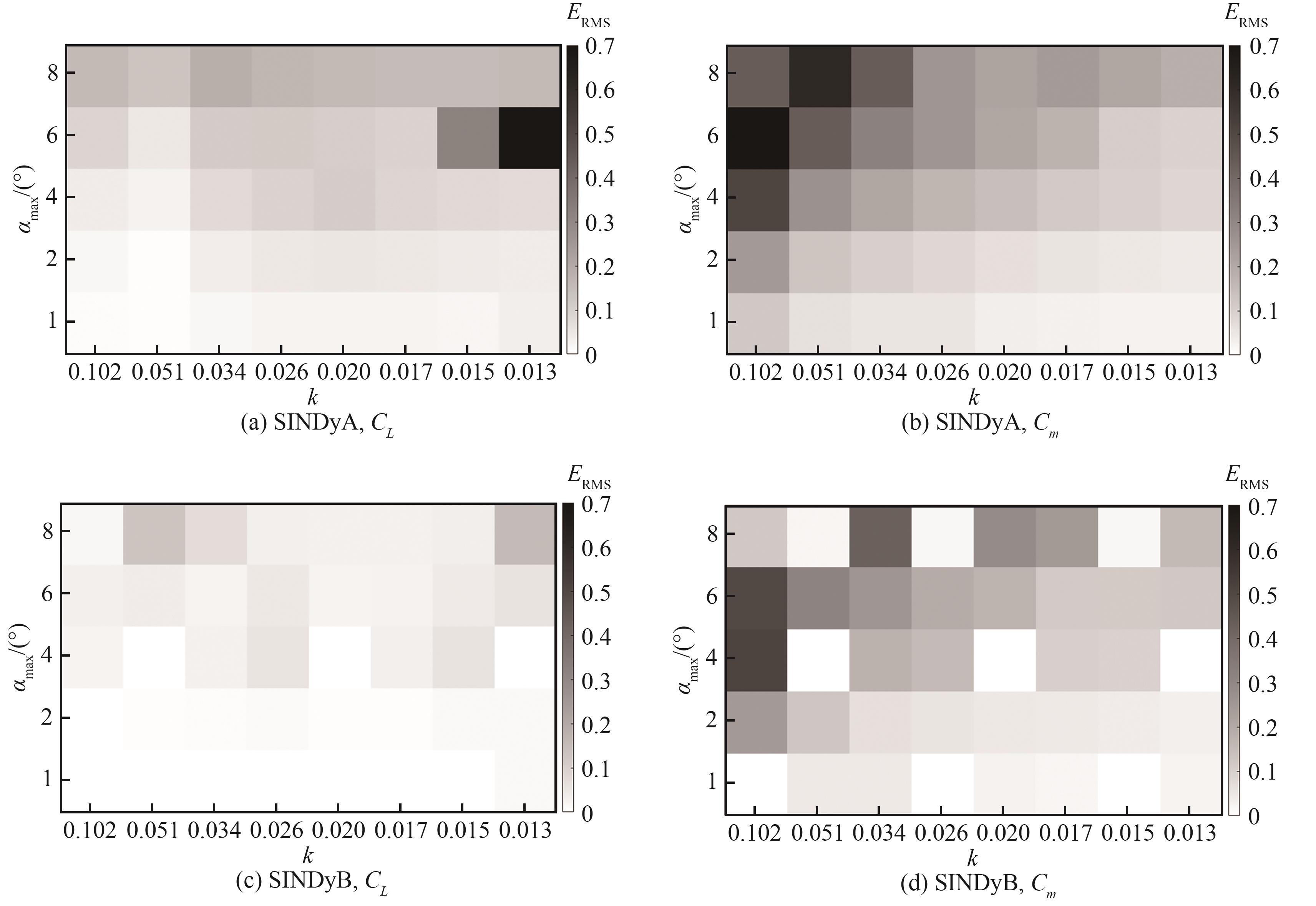
图 16
参数空间中不同规模训练集样本量
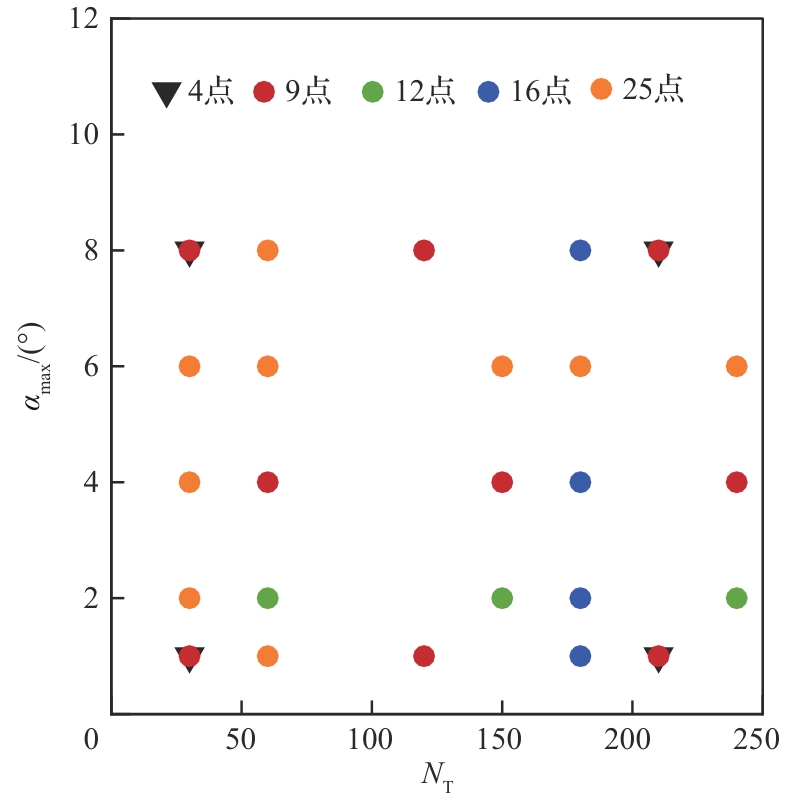
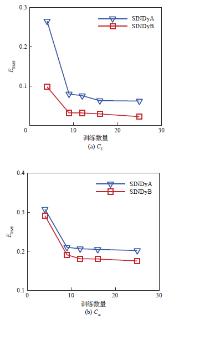
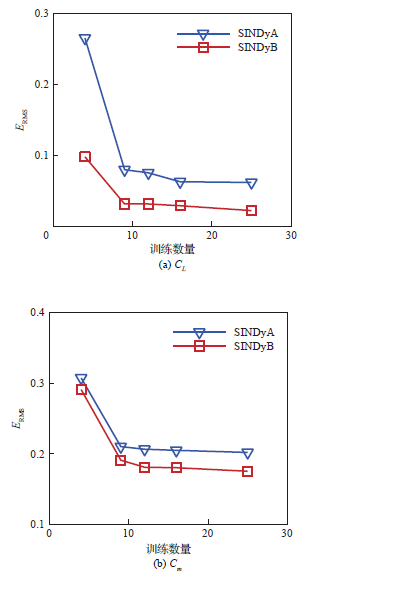
图 17
特定工况下误差随训练信号组数变化
| [1] | KOU J Q, ZHANG W W. Multi-fidelity modeling framework for nonlinear unsteady aerodynamics of airfoils[J]. Applied Mathematical Modelling, 2019, 76: 832-855. |
| [2] | 汪清, 钱炜祺, 丁娣. 飞机大迎角非定常气动力建模研究进展[J]. 航空学报, 2016, 37(8): 2331-2347. |
| WANG Q, QIAN W Q, DING D. A review of unsteady aerodynamic modeling of aircrafts at high angles of attack[J]. Acta Aeronautica et Astronautica Sinica, 2016, 37(8): 2331-2347 (in Chinese). | |
| [3] | LUCIA D J, BERAN P S, SILVA W A. Reduced-order modeling: New approaches for computational physics[J]. Progress in Aerospace Sciences, 2004, 40(1-2): 51-117. |
| [4] | GHOREYSHI M, JIRÁSEK A, CUMMINGS R M. Reduced order unsteady aerodynamic modeling for stability and control analysis using computational fluid dynamics[J]. Progress in Aerospace Sciences, 2014, 71: 167-217. |
| [5] | KOU J Q, ZHANG W W. Data-driven modeling for unsteady aerodynamics and aeroelasticity[J]. Progress in Aerospace Sciences, 2021, 125: 100725. |
| [6] | ABZUG M J, LARRABEE E E. Airplane stability and control[M]. Cambridge: Cambridge University Press, 2002. |
| [7] | GHOREYSHI M, CUMMINGS R M, RONCH A DA, et al. Transonic aerodynamic load modeling of X-31 aircraft pitching motions[J]. AIAA Journal, 2013, 51(10): 2447-2464. |
| [8] | THEODORSEN T. General theory of aerodynamic instability and the mechanism of flutter: NACA-TR-496[R]. Washington, D.C.: NASA, 1977. |
| [9] | MCALISTER K W, LAMBERT O, PETOT D. Application of the ONERA model of dynamic stall: NASA-TP-2399[R]. Washington, D.C.: NASA, 1984. |
| [10] | 张伟伟, 寇家庆, 刘溢浪. 智能赋能流体力学展望[J]. 航空学报, 2021, 42(4): 20-65. |
| ZHANG W W, KOU J Q, LIU Y L. Prospect of artificial intelligence empowered fluid mechanics[J]. Acta Aeronautica et Astronautica Sinica, 2021, 42(4): 524689 (in Chinese). | |
| [11] | CHEN G, ZUO Y T, SUN J, et al. Support-vector-machine-based reduced-order model for limit cycle oscillation prediction of nonlinear aeroelastic system[J]. Mathematical Problems in Engineering, 2012, 2012: 152123. |
| [12] | HUANG R, HU H Y, ZHAO Y H. Nonlinear reduced-order modeling for multiple-input/multiple-output aerodynamic systems[J]. AIAA Journal, 2014, 52(6): 1219-1231. |
| [13] | 寇家庆, 张伟伟, 叶正寅. 基于分层思路的动态非线性气动力建模方法[J]. 航空学报, 2015, 36(12): 3785-3797. |
| KOU J Q, ZHANG W W, YE Z Y. Dynamic nonlinear aerodynamics modeling method based on layered model[J]. Acta Aeronautica et Astronautica Sinica, 2015, 36(12): 3785-3797 (in Chinese). | |
| [14] | LI K, KOU J Q, ZHANG W W. Deep neural network for unsteady aerodynamic and aeroelastic modeling across multiple Mach numbers[J]. Nonlinear Dynamics, 2019, 96(3): 2157-2177. |
| [15] | MURDOCH W J, SINGH C, KUMBIER K, et al. Interpretable machine learning: Ddefinitions, methods, and applications[EB/OL]. arXiv preprint: 1901.04592, 2019. |
| [16] | LI R Z, ZHANG Y F, CHEN H X. Physically interpretable feature learning of supercritical airfoils based on variational autoencoders[J]. AIAA Journal, 2022, 60(11): 6168-6182. |
| [17] | LE CLAINCHE S, FERRER E, GIBSON S, et al. Improving aircraft performance using machine learning: A review[J]. Aerospace Science and Technology, 2023, 138: 108354. |
| [18] | ALI S, ABUHMED T, EL-SAPPAGH S, et al. Explainable artificial intelligence (XAI): What we know and what is left to attain trustworthy artificial intelligence[J]. Information Fusion, 2023, 99: 101805. |
| [19] | HASSIJA V, CHAMOLA V, MAHAPATRA A, et al. Interpreting black-box models: A review on explainable artificial intelligence[J]. Cognitive Computation, 2024, 16(1): 45-74. |
| [20] | YANG Z X, SHAN X L, YANG X I A, et al. Data-enabled discovery of specific and generalisable turbulence closures[J]. Journal of Fluid Mechanics, 2025, 1016: R1. |
| [21] | BRUNTON S L, PROCTOR J L, KUTZ J N. Discovering governing equations from data by sparse identification of nonlinear dynamical systems[J]. Proceedings of the National Academy of Sciences of the United States of America, 2016, 113(15): 3932-3937. |
| [22] | RUDY S, ALLA A, BRUNTON S L, et al. Data-driven identification of parametric partial differential equations[J]. SIAM Journal on Applied Dynamical Systems, 2019, 18(2): 643-660. |
| [23] | BRUNTON S L, KUTZ J N. Data-driven science and engineering[M]. 2nd ed. Cambridge: Cambridge University Press, 2022. |
| [24] | KAISER E, KUTZ J N, BRUNTON S L. Sparse identification of nonlinear dynamics for model predictive control in the low-data limit[J]. Proceedings of the Royal Society A: Mathematical, Physical and Engineering Sciences, 2018, 474(2219): 20180335. |
| [25] | DAWSON S T M, BRUNTON S L. Improved approximations to Wagner function using sparse identification of nonlinear dynamics[J]. AIAA Journal, 2022, 60(3): 1691-1707. |
| [26] | LELKES J, HORVÁTH D A, LENDVAI B, et al. Data-driven aerodynamic models for aeroelastic simulations[J]. Journal of Sound and Vibration, 2023, 564: 117847. |
| [27] | SUN C, TIAN T, ZHU X C, et al. Sparse identification of nonlinear unsteady aerodynamics of the oscillating airfoil[J]. Proceedings of the Institution of Mechanical Engineers, Part G: Journal of Aerospace Engineering, 2021, 235(7): 809-824. |
| [28] | 余永刚, 周铸, 黄江涛, 等. 单通道客机气动标模CHN-T1设计[J]. 空气动力学学报, 2018, 36(3): 505-513. |
| YU Y G, ZHOU Z, HUANG J T, et al. Aerodynamic design of a standard model CHN-T1 for single-aisle passenger aircraft[J]. Acta Aerodynamica Sinica, 2018, 36(3): 505-513 (in Chinese). | |
| [29] | LIMACHER E, MORTON C, WOOD D. Generalized derivation of the added-mass and circulatory forces for viscous flows[J]. Physical Review Fluids, 2018, 3: 014701. |
| [30] | GRAHAM M, LI J. Vortex shedding and induced forces in unsteady flow[J]. The Aeronautical Journal, 2024, 128(1328): 2149-2190. |
| [31] | CASSEL K W, CONLISK A T. Unsteady separation in vortex-induced boundary layers[J]. Philosophical Transactions of the Royal Society A: Mathematical, Physical and Engineering Sciences, 2014, 372(2020): 20130348. |
| [32] | XIA X, MOHSENI K. Unsteady aerodynamics and vortex-sheet formation of a two-dimensional airfoil[J]. Journal of Fluid Mechanics, 2017, 830: 439-478. |
| [33] | 张子军, 李怀璐, 赵彤, 等. 基于不确定性预测的气动力建模与主动采样[J]. 空气动力学学报, 2025, 43(1): 12-21. |
| ZHANG Z J, LI H L, ZHAO T, et al. Aerodynamic modeling and active sampling based on uncertainty prediction[J]. Acta Aerodynamica Sinica, 2025, 43(1): 12-21 (in Chinese). | |
| [34] | PINTELON R, SCHOUKENS J. System identification: A frequency domain approach[M]. 2nd ed. Hoboken: Wiley-IEEE Press, 2012. |
| [35] | CORDES U, KAMPERS G, MEIßNER T, et al. Note on the limitations of the theodorsen and Sears functions[J]. Journal of Fluid Mechanics, 2017, 811: R1. |
| [36] | LIN G F, LAN C, BRANDON J, et al. A generalized dynamic aerodynamic coefficient model for flight dynamics applications[C]∥22nd Atmospheric Flight Mechanics Conference. Reston: AIAA, 1997. |
| [37] | DONOHO D L. Compressed sensing[J]. IEEE Transactions on Information Theory, 2006, 52(4): 1289-1306. |
| [38] | CANDES E J, ROMBERG J, TAO T. Robust uncertainty principles: Exact signal reconstruction from highly incomplete frequency information[J]. IEEE Transactions on Information Theory, 2006, 52(2): 489-509. |
| [39] | MANGAN N M, KUTZ J N, BRUNTON S L, et al. Model selection for dynamical systems via sparse regression and information criteria[J]. Proceedings of the Royal Society A: Mathematical, Physical and Engineering Sciences, 2017, 473(2204): 20170009. |
| [40] | ZHANG L N, SCHAEFFER H. On the convergence of the SINDy algorithm[EB/OL]. arXiv preprint: 1805.06445, 2018. |
| [41] | CHIN S, LAN C E. Fourier functional analysis for unsteady aerodynamic modeling[J]. AIAA Journal, 1992, 30(9): 2259-2266. |
| [42] | SKUJINS T, CESNIK C E S. Reduced-order modeling of unsteady aerodynamics across multiple Mach regimes[J]. Journal of Aircraft, 2014, 51(6): 1681-1704. |
| [43] | 王运涛, 刘刚, 陈作斌. 第一届航空CFD可信度研讨会总结[J]. 空气动力学学报, 2019, 37(2): 246-261. |
| WANG Y T, LIU G, CHEN Z B. Summary of the first aeronautical computational fluid dynamics credibility workshop[J]. Acta Aerodynamica Sinica, 2019, 37(2): 246-261 (in Chinese). | |
| [44] | 张耀冰, 唐静, 陈江涛, 等. 基于非结构混合网格的CHN-T1标模气动特性预测[J]. 空气动力学学报, 2019, 37(2): 262-271. |
| ZHANG Y B, TANG J, CHEN J T, et al. Aerodynamic characteristics prediction of CHN-T1 standard model with unstructured grid[J]. Acta Aerodynamica Sinica, 2019, 37(2): 262-271 (in Chinese). | |
| [45] | 赵钟, 何磊, 何先耀. 风雷(PHengLEI)通用CFD软件设计[J]. 计算机工程与科学, 2020, 42(2): 210-219. |
| ZHAO Z, HE L, HE X Y. Design of general CFD software PHengLEI[J]. Computer Engineering and Science, 2020, 42(2): 210-219 (in Chinese). | |
| [46] | 赵钟, 张来平, 何磊, 等. 适用于任意网格的大规模并行CFD计算框架PHengLEI[J]. 计算机学报, 2019, 42(11): 2368-2383. |
| ZHAO Z, ZHANG L P, HE L, et al. PHengLEI: A large scale parallel CFD framework for arbitrary grids[J]. Chinese Journal of Computers, 2019, 42(11): 2368-2383 (in Chinese). | |
| [47] | 李强, 刘大伟, 许新, 等. CHN-T1标模2.4米风洞气动特性试验研究[J]. 空气动力学学报, 2019, 37(2): 337-344. |
| LI Q, LIU D W, XU X, et al. Experimental study of aerodynamic characterictics of CHN-T1 standard model in 2.4 m transonic wind tunnel[J]. Acta Aerodynamica Sinica, 2019, 37(2): 337-344 (in Chinese). | |
| [48] | KOU J Q, ZHANG W W. Reduced-order modeling for nonlinear aeroelasticity with varying Mach numbers[J]. Journal of Aerospace Engineering, 2018, 31(6): 04018105. |
| [49] | WANG X, KOU J Q, ZHANG W W. Unsteady aerodynamic prediction for iced airfoil based on multi-task learning[J]. Physics of Fluids, 2022, 34(8): 087117. |
| [50] | GAO C Q, ZHANG W W, LIU Y L, et al. Numerical study on the correlation of transonic single-degree-of-freedom flutter and buffet[J]. Science China Physics, Mechanics & Astronomy, 2015, 58(8): 84701. |
| [51] | 寇家庆, 张伟伟, 高传强. 基于POD和DMD方法的跨声速抖振模态分析[J]. 航空学报, 2016, 37(9): 2679-2689. |
| KOU J Q, ZHANG W W, GAO C Q. Modal analysis of transonic buffet based on POD and DMD method[J]. Acta Aeronautica et Astronautica Sinica, 2016, 37(9): 2679-2689 (in Chinese). | |
| [52] | KOU J Q, ZHANG W W. Layered reduced-order models for nonlinear aerodynamics and aeroelasticity[J]. Journal of Fluids and Structures, 2017, 68: 174-193. |
| [1] | 耿航, 孙玉, 苟轩, 蒋景飞, 陈凯, 顾杰. 基于双动态饱和机制的空天MEMS传感器时/空耦合误差智能检测与校正[J]. 航空学报, 2026, 47(S1): 733170-733170. |
| [2] | 张旭, 瓮哲, 赵卓林, 陈佳宁, 赵梓斌, 孙岩. 基于分层插值的翼型CFD压力系数修正方法[J]. 航空学报, 2026, 47(8): 132788-132788. |
| [3] | 何友, 刘瑜, 李耀文, 丁自然, 董凯, 崔亚奇, 张财生, 王学谦, 李徵, 郭晨. 多源信息融合发展及展望[J]. 航空学报, 2025, 46(6): 531672-531672. |
| [4] | 马诺, 卫社春, 孟军辉, 刘清洋, 雷宇声. 考虑减速伞作用的无人机内埋舱体分离流场特性与动力学[J]. 航空学报, 2025, 46(3): 130755-130755. |
| [5] | 黄蕾, 郭聪, 张小波, 孙良臣, 左迎荟, 王博, 田阔. 基于飞参-载荷-寿命数字孪生模型的飞机结构健康管理方法[J]. 航空学报, 2025, 46(21): 532382-532382. |
| [6] | 王彬文, 宋巧治, 陈浩宇. 飞翼布局飞行器体自由度颤振地面试验[J]. 航空学报, 2025, 46(21): 532758-532758. |
| [7] | 杨述明, 吴建军, 谢昌霖, 程玉强, 王彪. 数据驱动智能故障诊断技术在液体火箭发动机的应用与展望[J]. 航空学报, 2025, 46(15): 131427-131427. |
| [8] | 刘永平, 张朋, 曾开春, 余立, 寇西平. 基于Theodorsen理论的跨声速颤振非定常气动力建模[J]. 航空学报, 2025, 46(12): 231434-231434. |
| [9] | 丁梦龙, 李道春, 周尧明, 冯传宴, 邵浩原, 向锦武. eVTOL适坠性分析及优化[J]. 航空学报, 2025, 46(11): 531282-531282. |
| [10] | 安朝, 赵睿, 谢长川, 杨超. 大柔性机翼几何非线性结构降阶模型与气动弹性分析[J]. 航空学报, 2024, 45(S1): 730569-730569. |
| [11] | 刘琦, 史勇杰, 胡志远, 徐国华. 共轴刚性旋翼气动及噪声特性的参数影响分析[J]. 航空学报, 2024, 45(9): 528856-528856. |
| [12] | 崔壮壮, 原昕, 赵国庆, 井思梦, 招启军. 共轴刚性旋翼高速直升机前飞性能操纵策略影响[J]. 航空学报, 2024, 45(9): 529256-529256. |
| [13] | 杨华, 陈树生, 高正红, 姜权峰, 张伟. 基于贝叶斯框架的旋翼气动力数据融合[J]. 航空学报, 2024, 45(8): 128960-128960. |
| [14] | 张健, 李瑞田, 邓亮, 代喆, 刘杰, 徐传福. 面向多核CPU/众核GPU架构的非结构CFD共享内存并行计算技术[J]. 航空学报, 2024, 45(7): 128888-128888. |
| [15] | 祁浩天, 王亮权, 张卫国, 刘超凡, 濮天梅. 旋翼间距对共轴刚性旋翼气动噪声的影响[J]. 航空学报, 2024, 45(21): 130153-130153. |
| 阅读次数 | ||||||
|
全文 |
|
|||||
|
摘要 |
|
|||||
版权所有 © 航空学报编辑部
版权所有 © 2011航空学报杂志社
主管单位:中国科学技术协会 主办单位:中国航空学会 北京航空航天大学

 CJA
CJA
