骆俊衡, 郭庆阳, 王林, 刘冰, 李世斌( )
)
收稿日期:2026-01-09
修回日期:2026-02-05
接受日期:2026-03-09
出版日期:2026-03-30
发布日期:2026-03-23
通讯作者:
李世斌
E-mail:lishibin104@163.com
基金资助:
Junheng LUO, Qingyang GUO, Lin WANG, Bing LIU, Shibin LI()
Received:2026-01-09
Revised:2026-02-05
Accepted:2026-03-09
Online:2026-03-30
Published:2026-03-23
Contact:
Shibin LI
E-mail:lishibin104@163.com
Supported by:摘要:
高超声速流动中,激波/边界层干扰(SWBLI)引发的多尺度流动耦合效应会显著加剧飞行器热载荷管理难度。为此,针对空气舵提出一种横-逆双射流耦合主动控制方案,并采用数值模拟揭示其在复杂来流工况下对流场SWBLI及气动热环境的影响。结果表明,横-逆向双射流方案通过空间耦合布局可实现优于单射流的全局降热;在舵偏11°工况下,当横向射流布置于较远上游且逆向射流位于高位时,可构建大尺度分离区以隔绝高温主流,使前缘与平板热流峰值分别控制在3 200 kW·m-2与300 kW·m-2以下;在11°攻角下,所有双射流布局均能显著降低缝隙热流密度至300 kW·m-2以下,但前缘热流对射流位置敏感,需避免逆向射流超出横向射流低压尾迹区,以防诱发剧烈再附导致热流剧增。
中图分类号:
骆俊衡, 郭庆阳, 王林, 刘冰, 李世斌. 高速空气舵横-逆向双射流耦合流动控制及降热特性[J]. 航空学报, 2026, 47(13): 533348.
Junheng LUO, Qingyang GUO, Lin WANG, Bing LIU, Shibin LI. Coupled flow control and heat reduction characteristics of transverse-opposing dual-jets for high-speed air rudder[J]. Acta Aeronautica et Astronautica Sinica, 2026, 47(13): 533348.
图 1
横-逆向射流结合方案
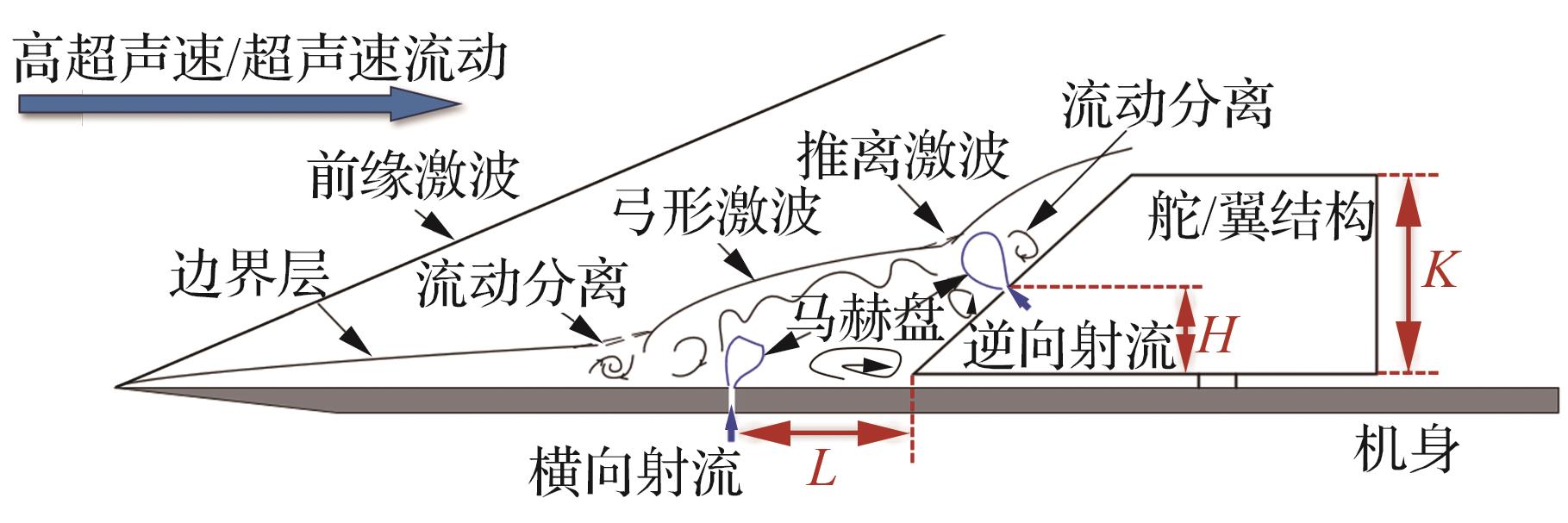
图 2
空气舵物理模型
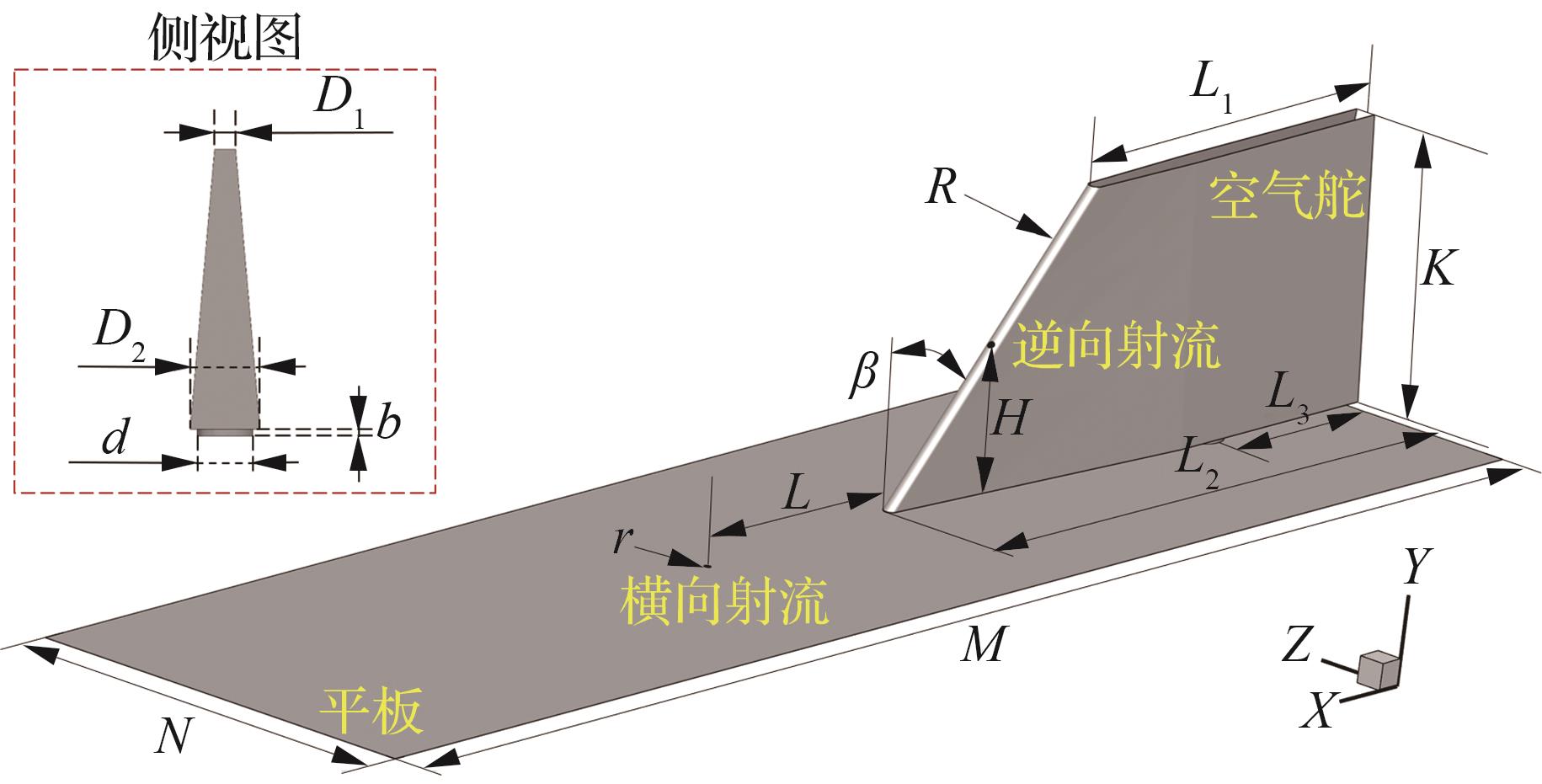

表1
空气舵几何参数
| 参数 | 数值 | |
|---|---|---|
| 顶面长度L1/mm | 120 | |
| 底面长度L2/mm | 200 | |
| 舵轴与后端水平距离L3/mm | 60 | |
| 顶部厚度D1/mm | 6 | |
| 舵体高度K/mm | 80 | |
| 舵轴直径d/mm | 16 | |
| 底部厚度D2/mm | 20 | |
| 前缘半径R/mm | 2 | |
| 舵轴高度b/mm | 2 | |
| 喷孔半径r/mm | 1 | |
| 逆向射流垂直高度H/mm | 20, 40 | |
| 横向射流水平距离L/mm | 80, 240 | |
| 后掠角β/(°) | 45 |
图 3
横-逆向射流方案计算网格
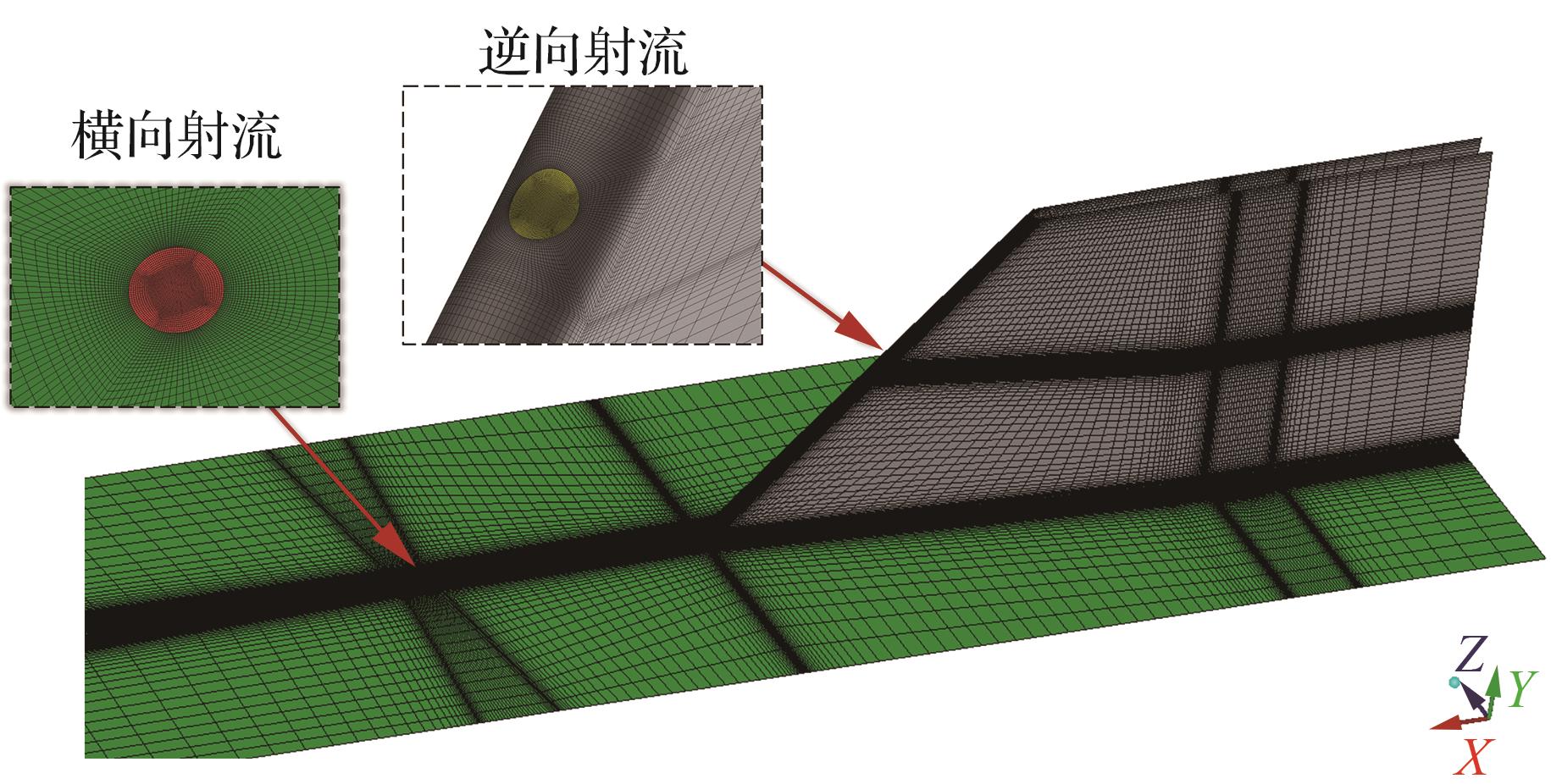
表2
自由来流参数
| 参数 | Ma∞ | P∞/Pa | T∞/K | ρ∞/(kg·m-3) |
|---|---|---|---|---|
| 数值 | 8 | 1 197.03 | 226.51 | 0.011 8 |
图 4
空气舵表面斯坦顿数的试验与数值结果对比
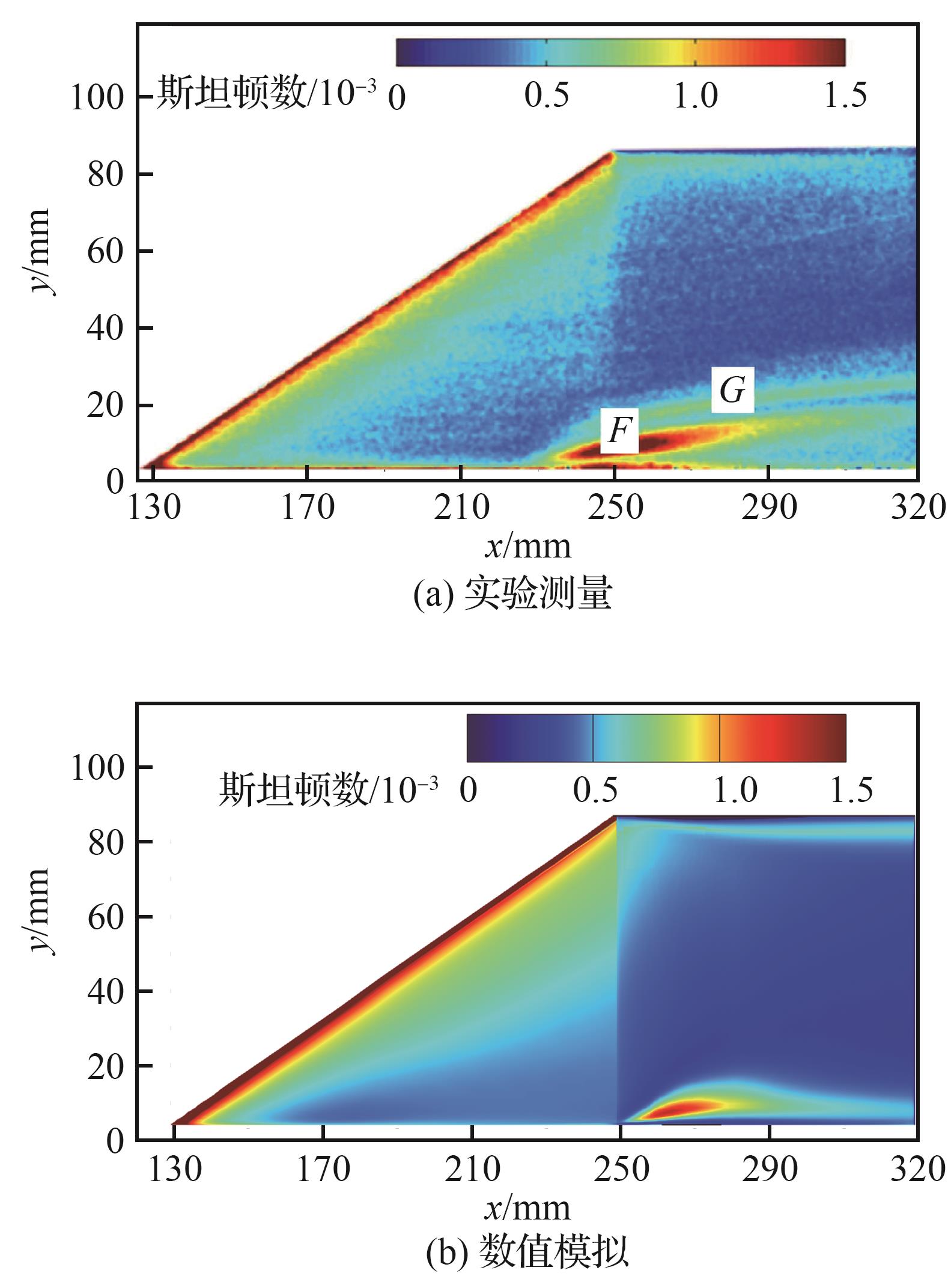
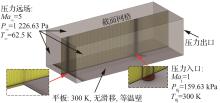
图 5
横向射流算例验证计算网格与边界条件
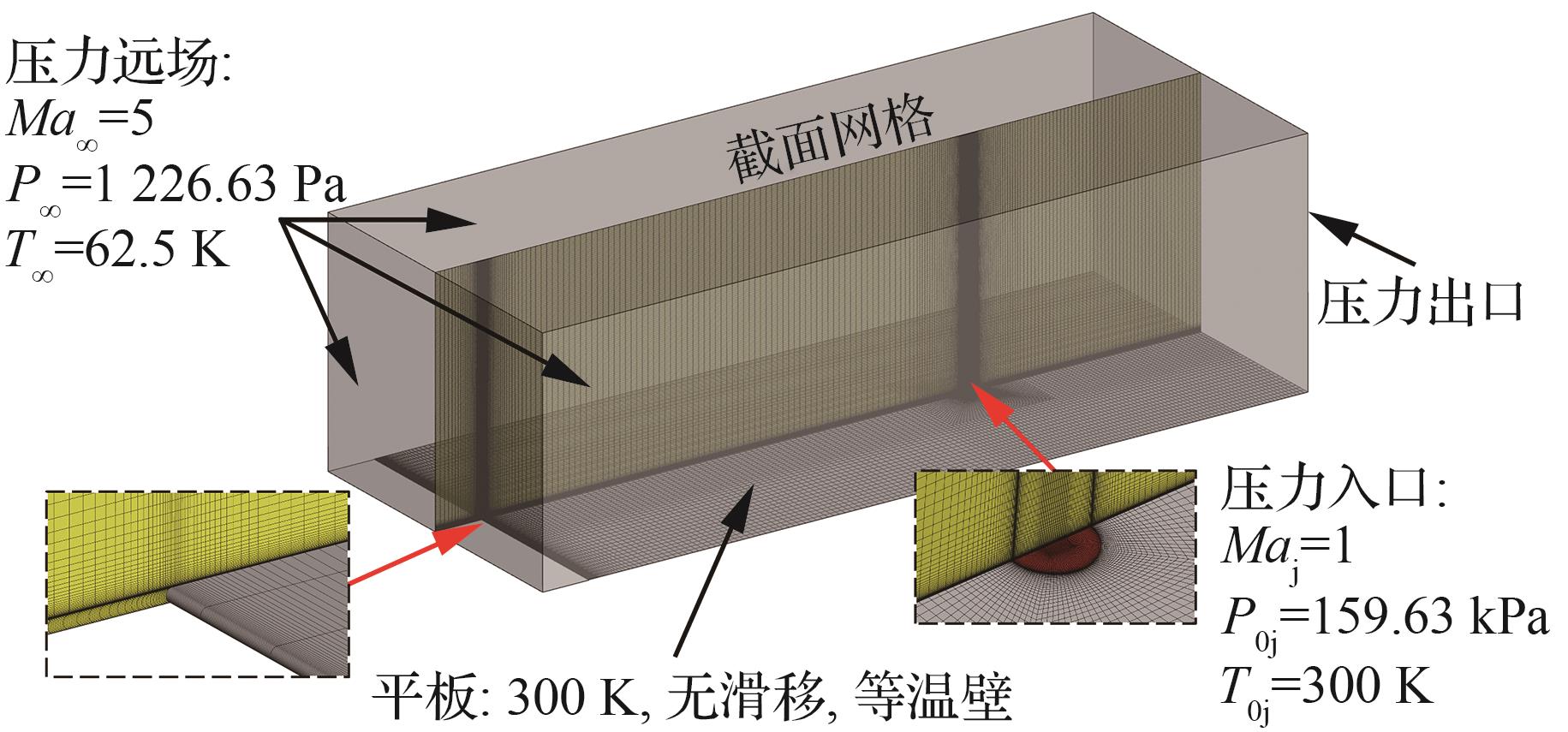
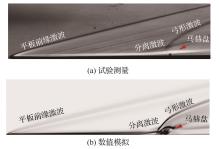
图 6
流场对称面的试验与数值纹影图对比
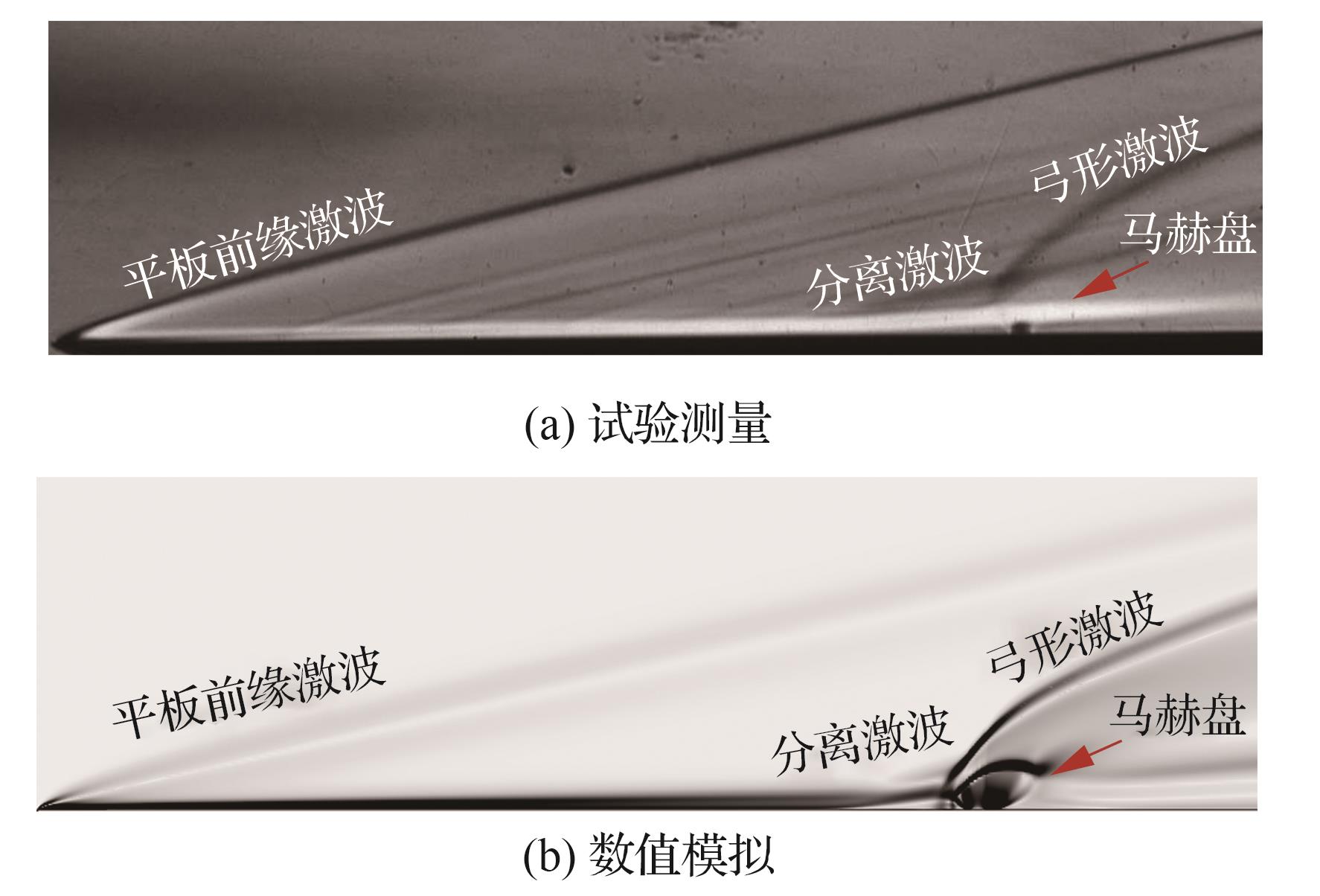
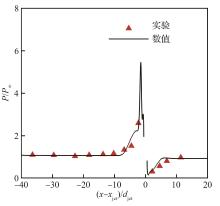
图 7
平板表面压力分布的试验与数值结果对比
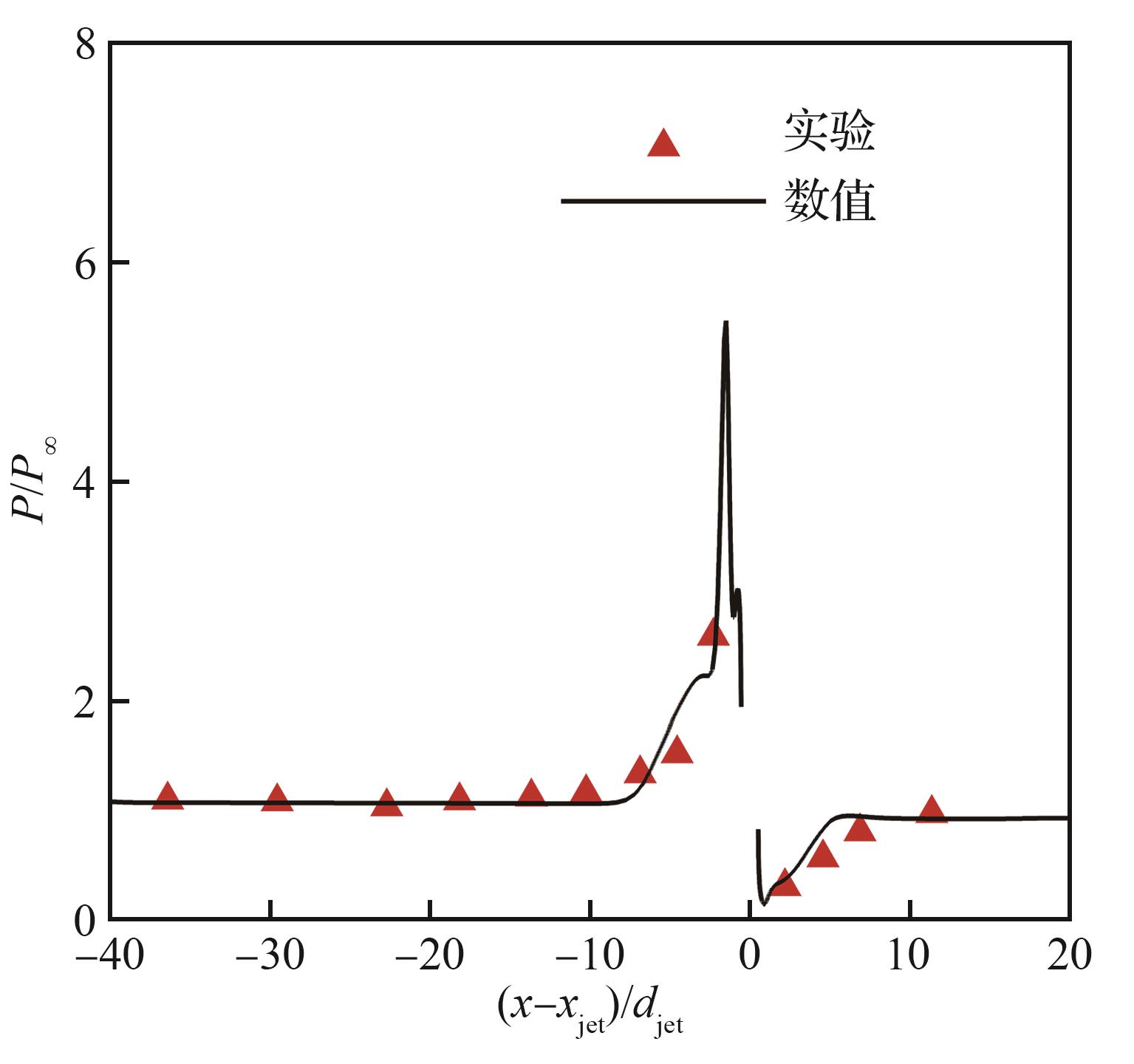
表3
射流参数
| 参数 | Maj | P0j/kPa | Pj/kPa | PR | T0j/K |
|---|---|---|---|---|---|
| 数值 | 1.0 | 3 505.84 | 1 852.08 | 0.3 | 300 |
图 8
模型几何参考线与坐标系定义
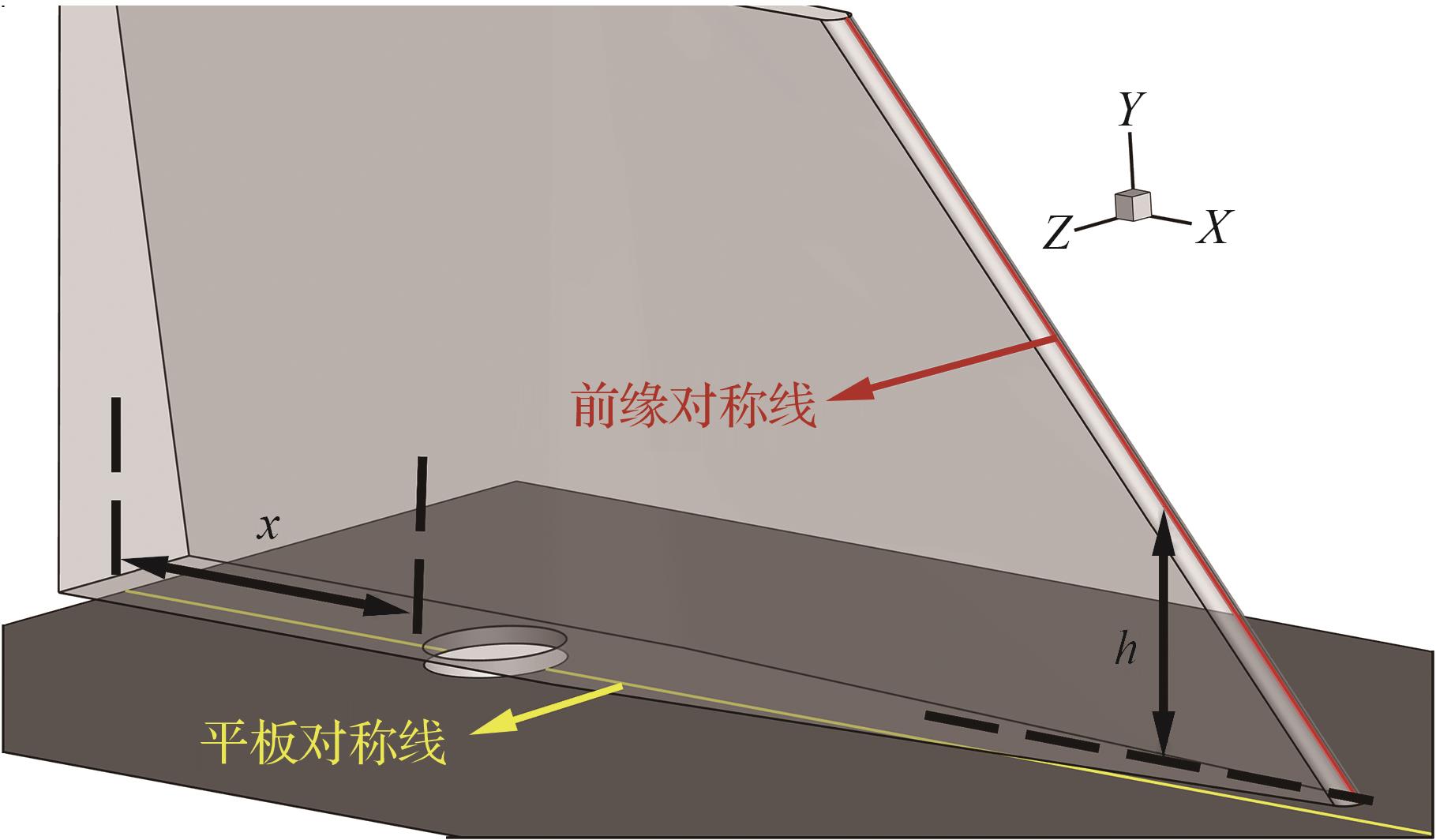
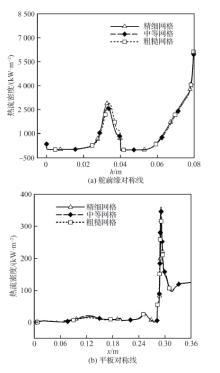
图 9
不同网格密度下的空气舵表面热流密度分布对比
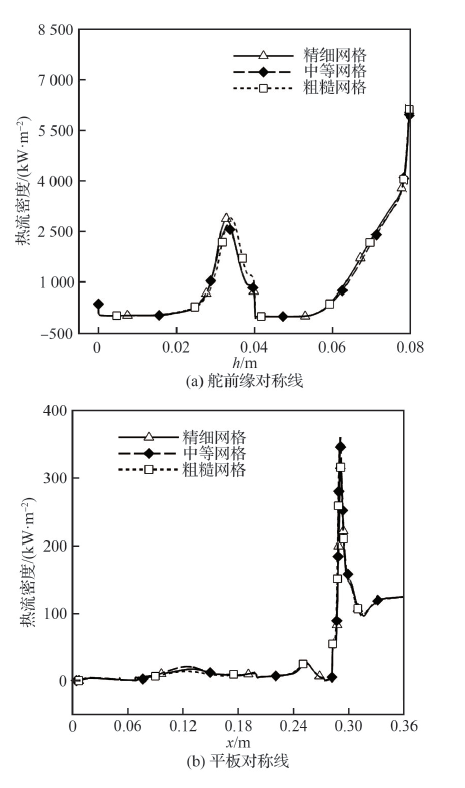
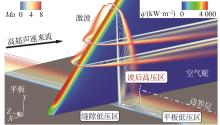
图 10
空气舵缝隙区域的SWBLI流场结构
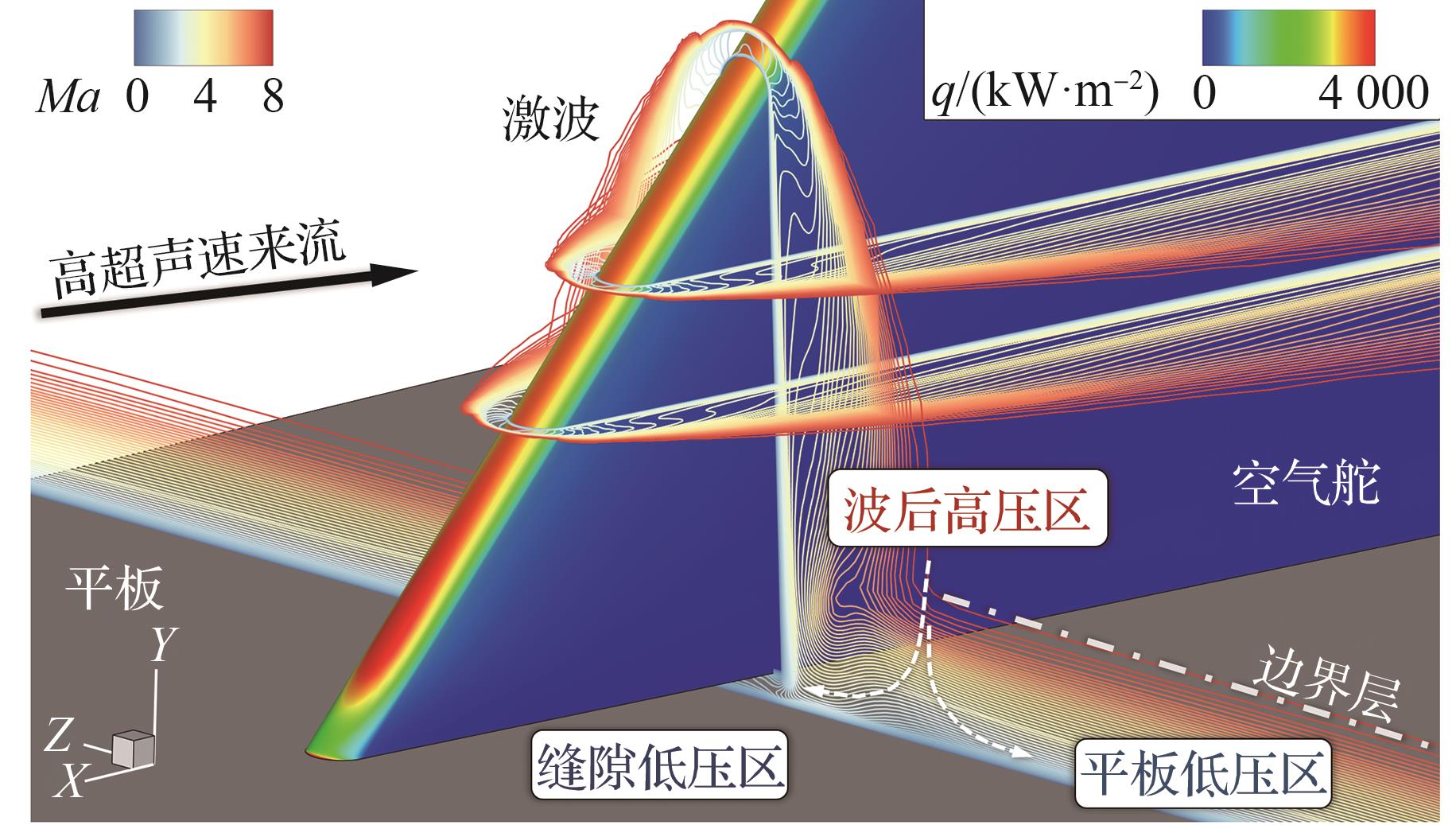
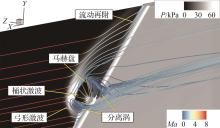
图 11
逆向射流作用下舵体周围流场结构
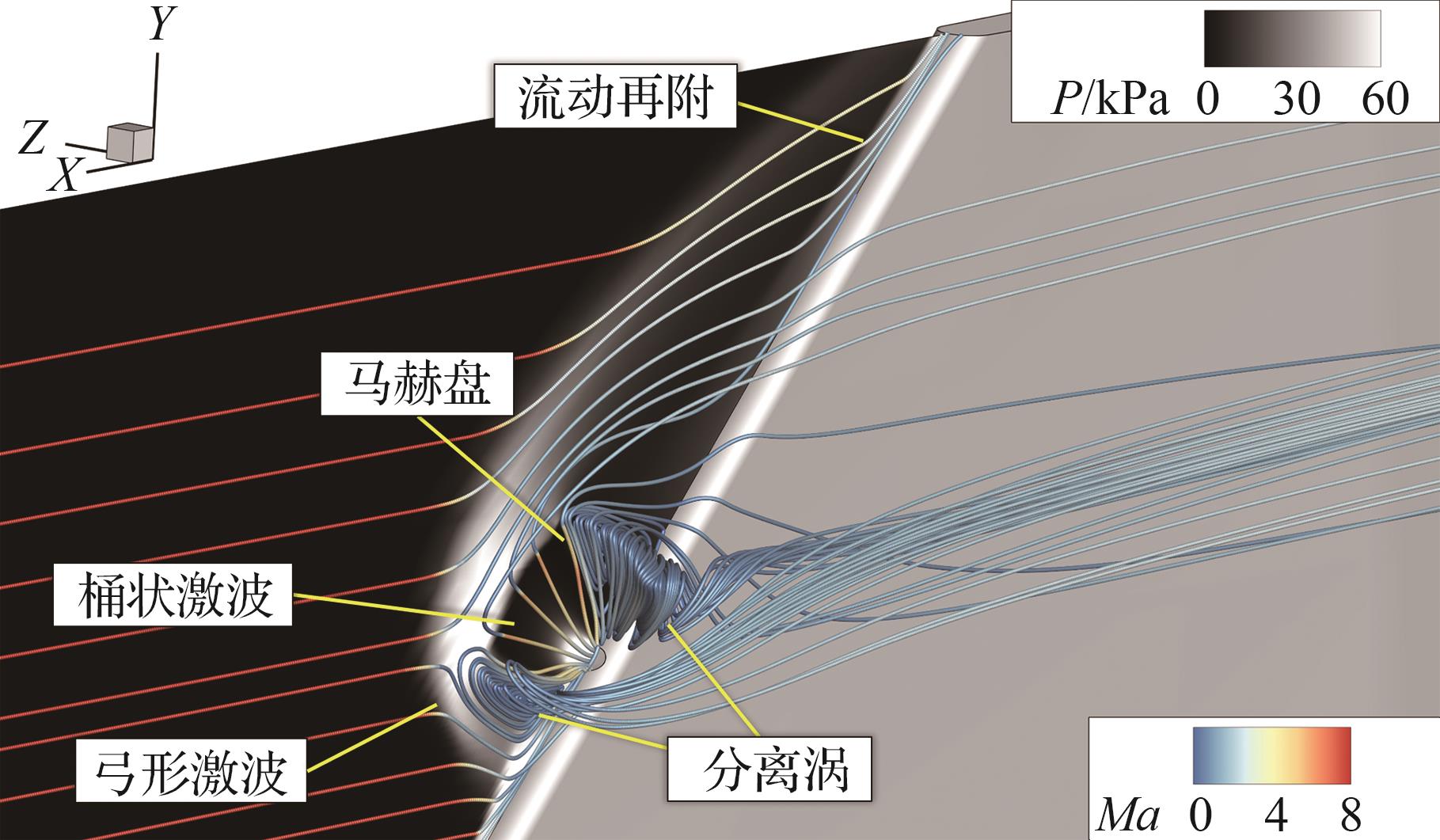
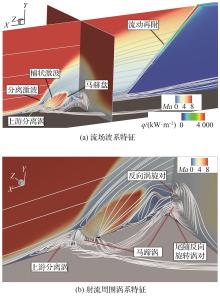
图 12
横向射流作用下舵体周围流场结构
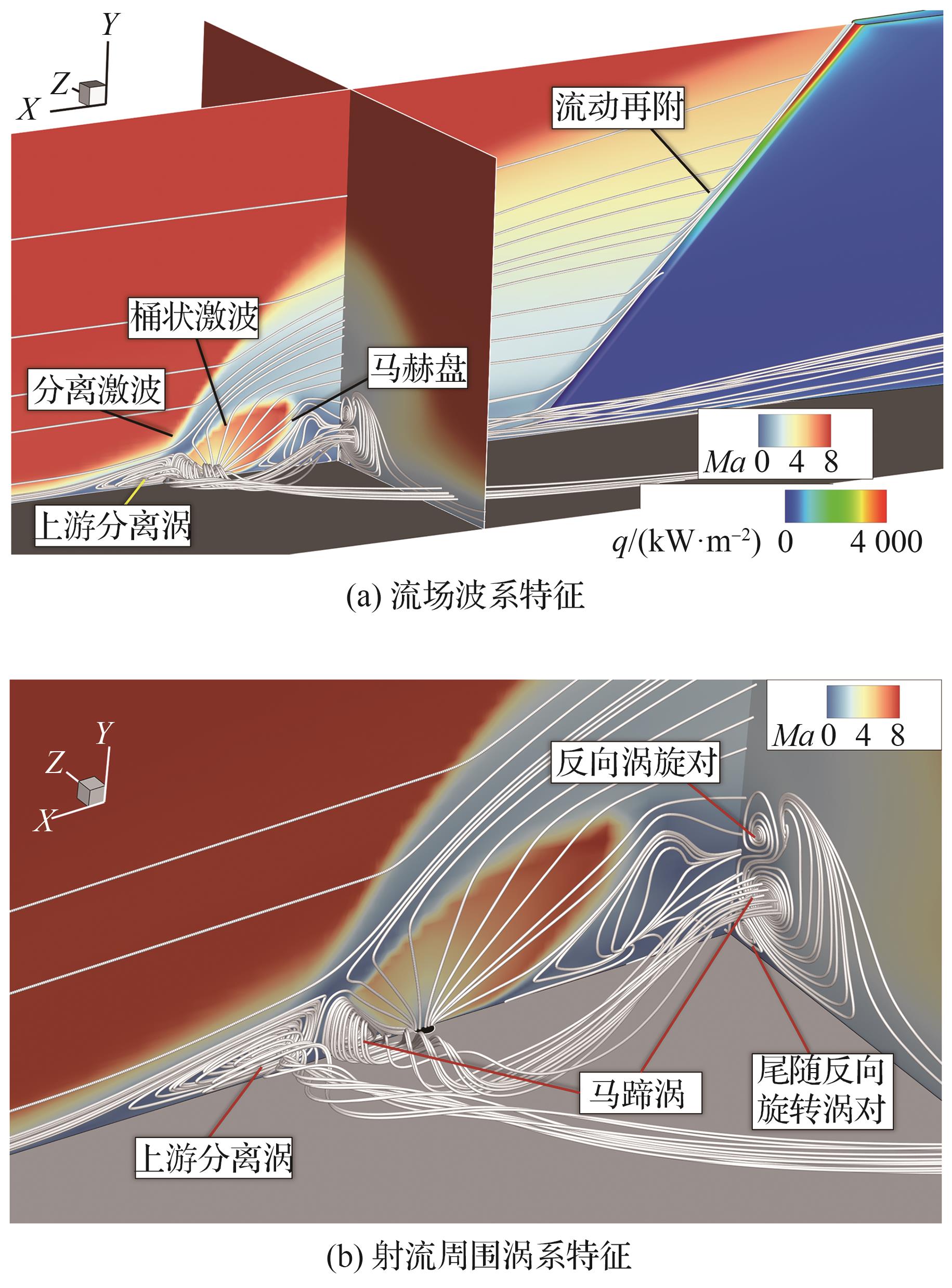
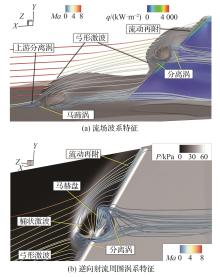
图 13
横-逆向双射流作用下舵体周围流场结构
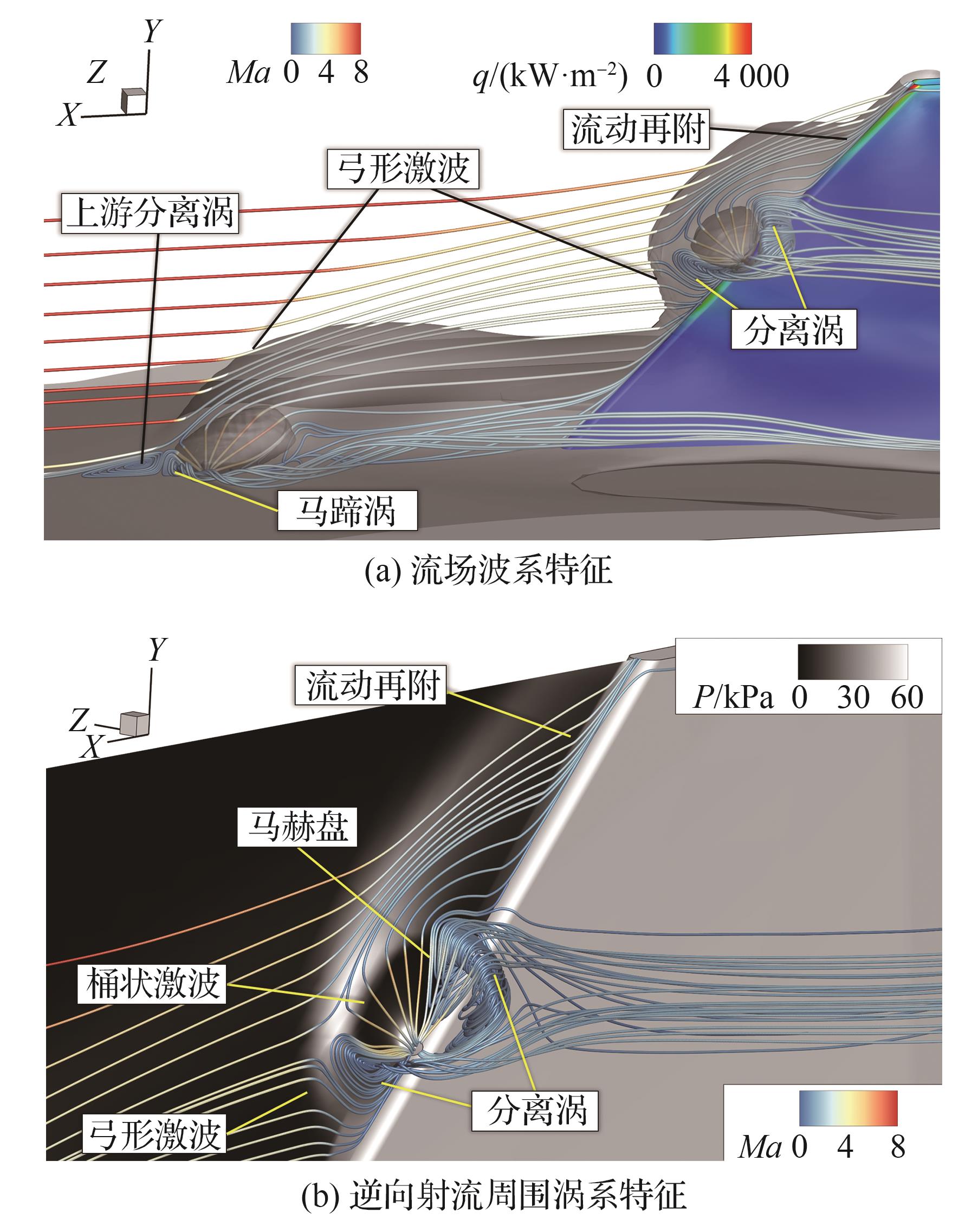
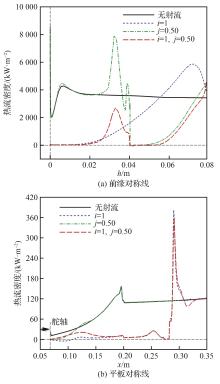
图 14
不同射流工况下壁面热流密度分布
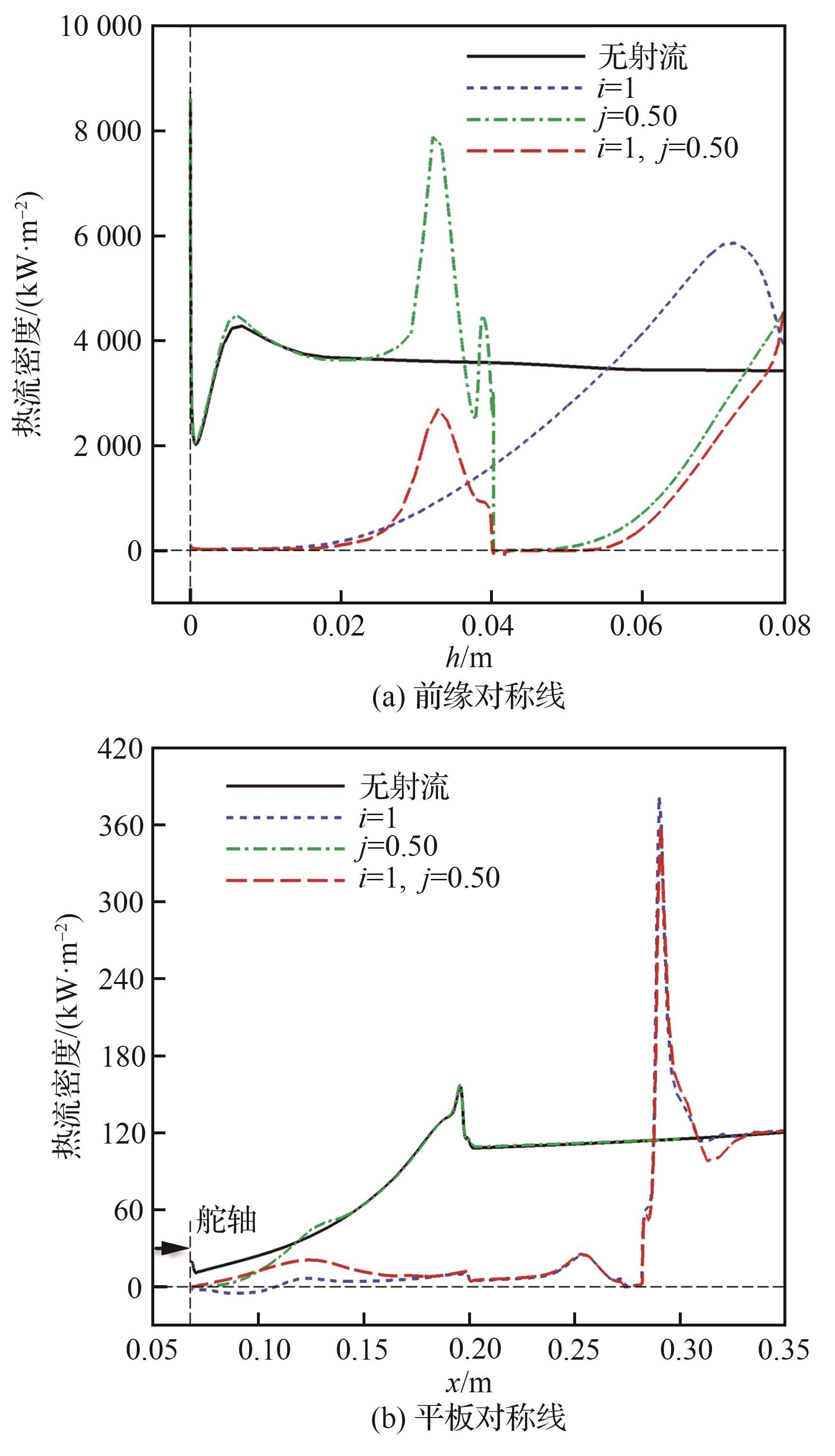
表4
双射流方案布局配置
| Case | i | j |
|---|---|---|
| Case 1 | 1 | 0.25 |
| Case 2 | 0.50 | |
| Case 3 | 3 | 0.25 |
| Case 4 | 0.50 |
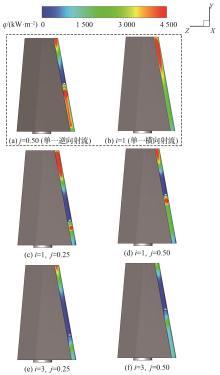
图 15
δ=11°时不同射流布局的前缘热流密度云图
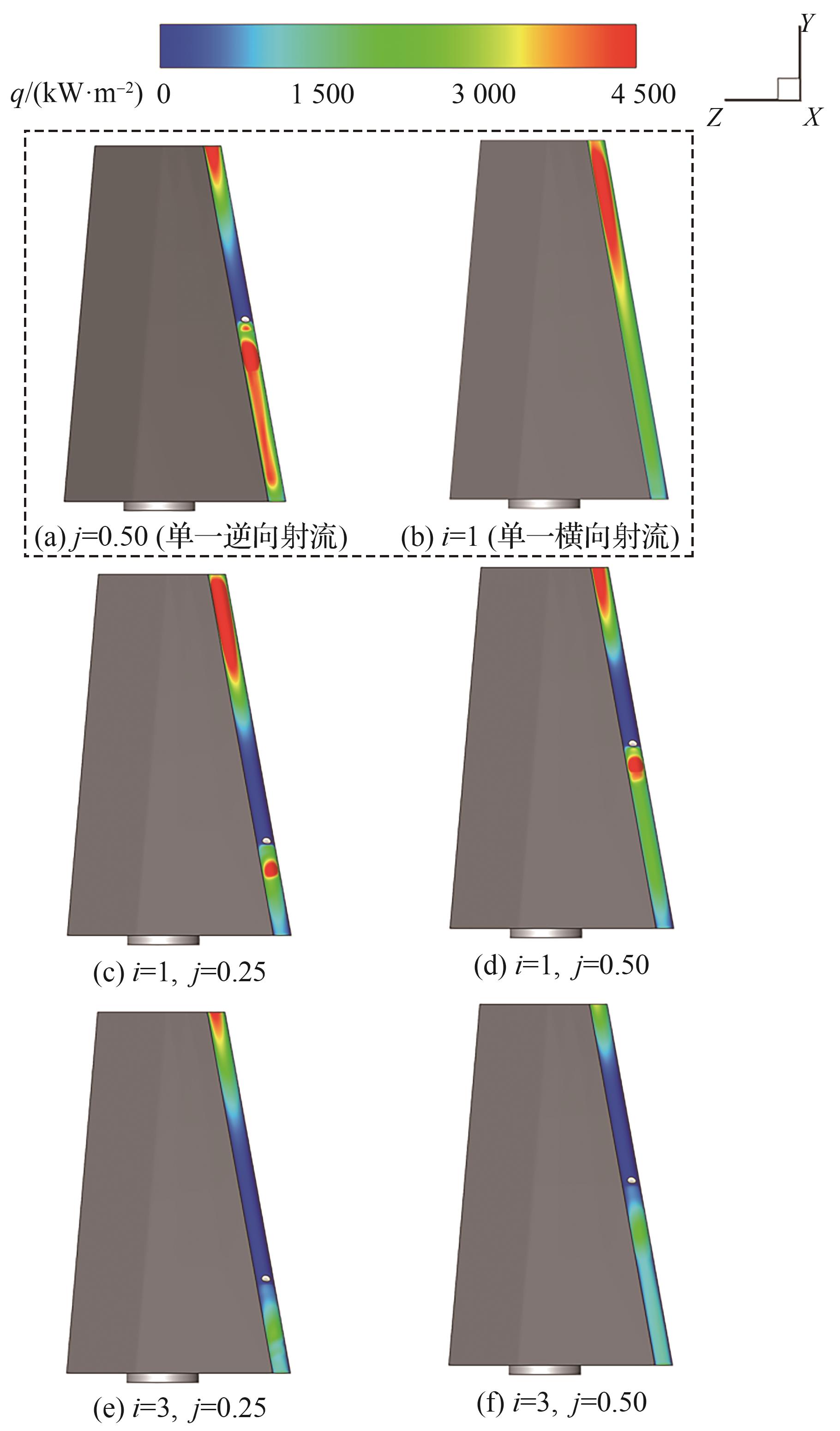
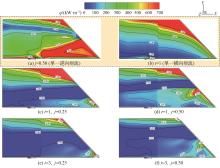
图 16
δ=11°时不同射流布局的迎风面热流密度云图
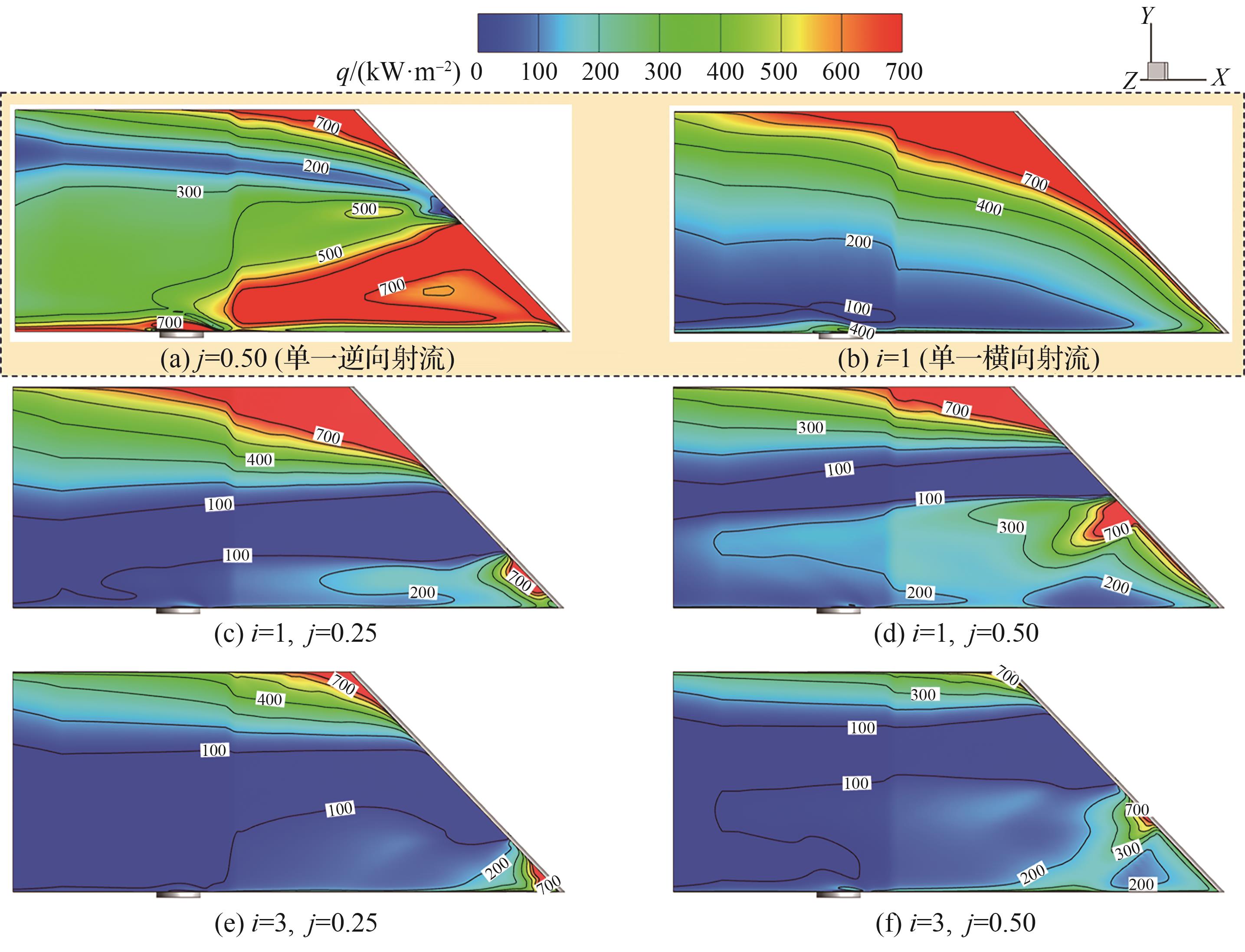
图 17
δ=11°时不同射流布局的Ma=3等值面压力分布及流场流线特征
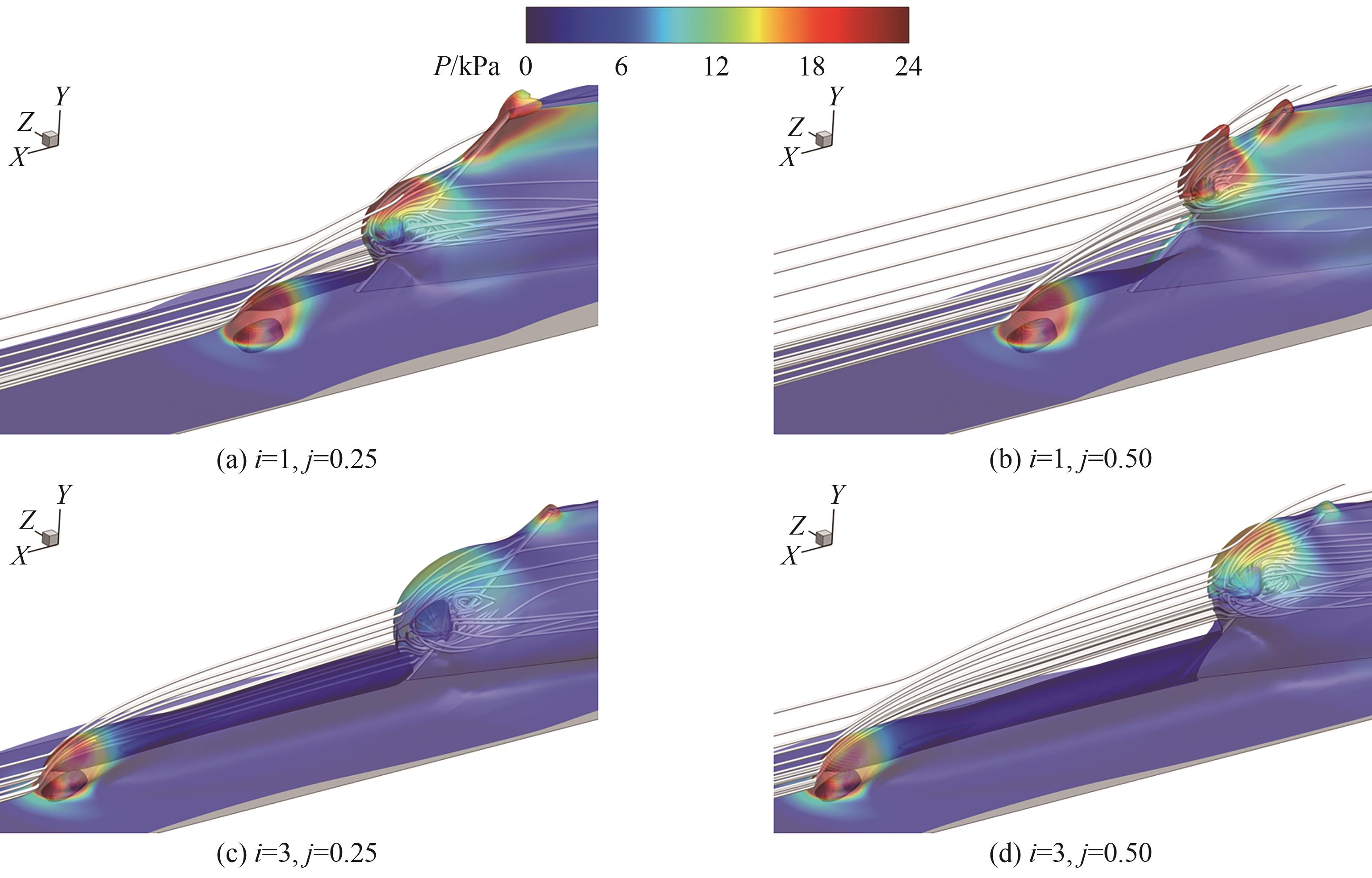
图 18
δ=11°时不同射流布局壁面热流密度分布曲线
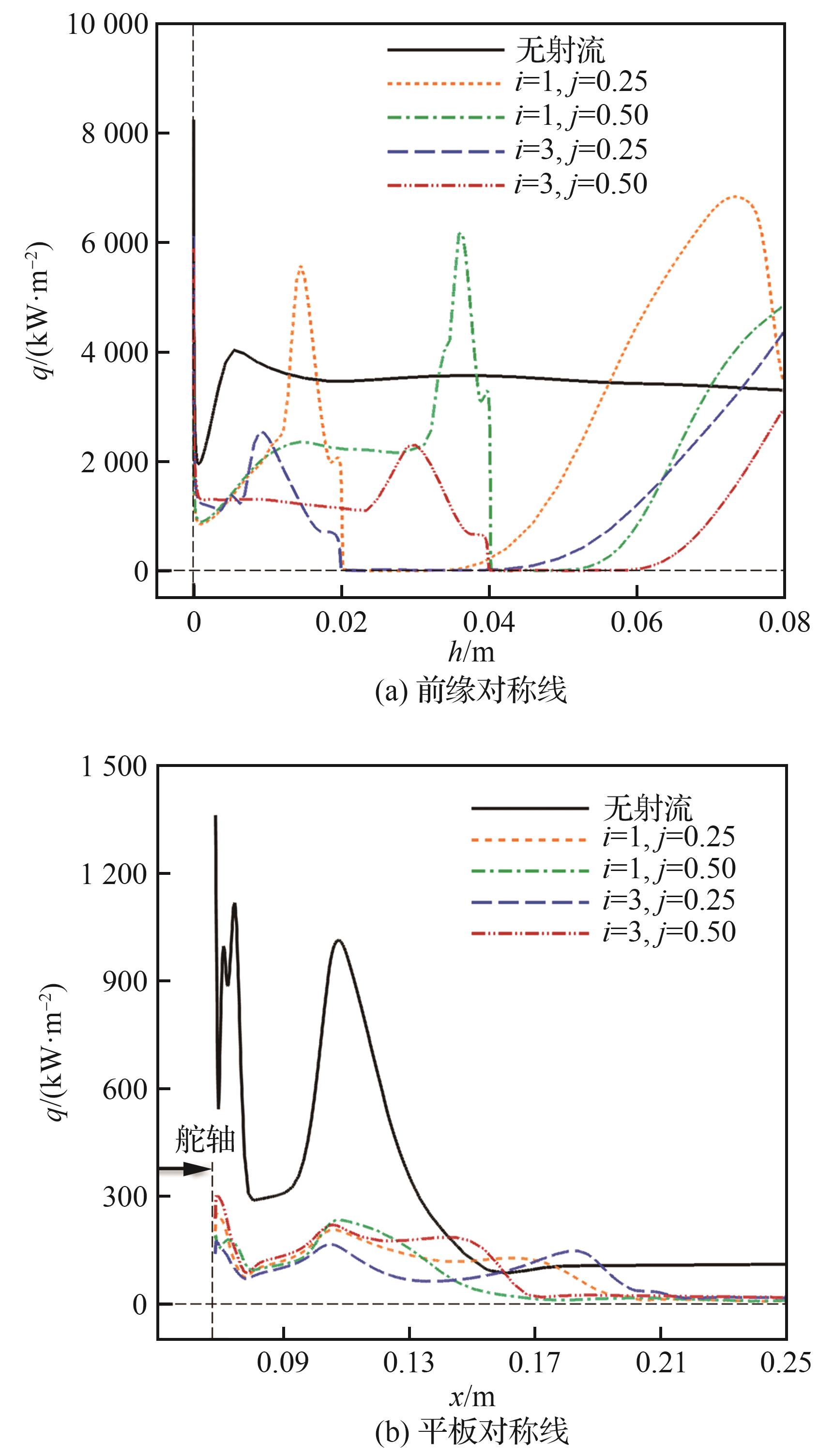
图 19
α=11°时有/无射流干扰的流场激波结构对比
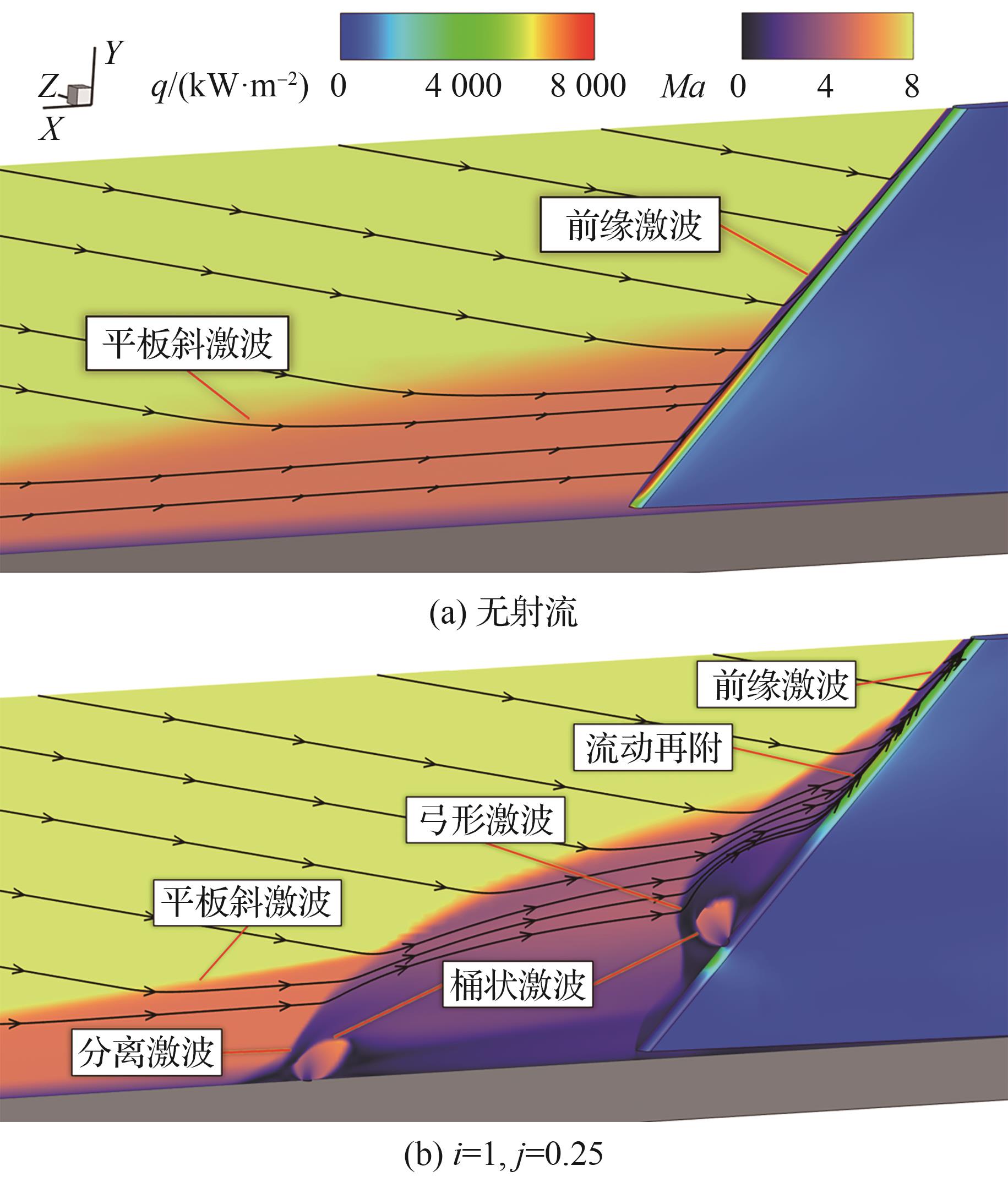
图 20
α=11°时不同射流布局的壁面热流密度云图
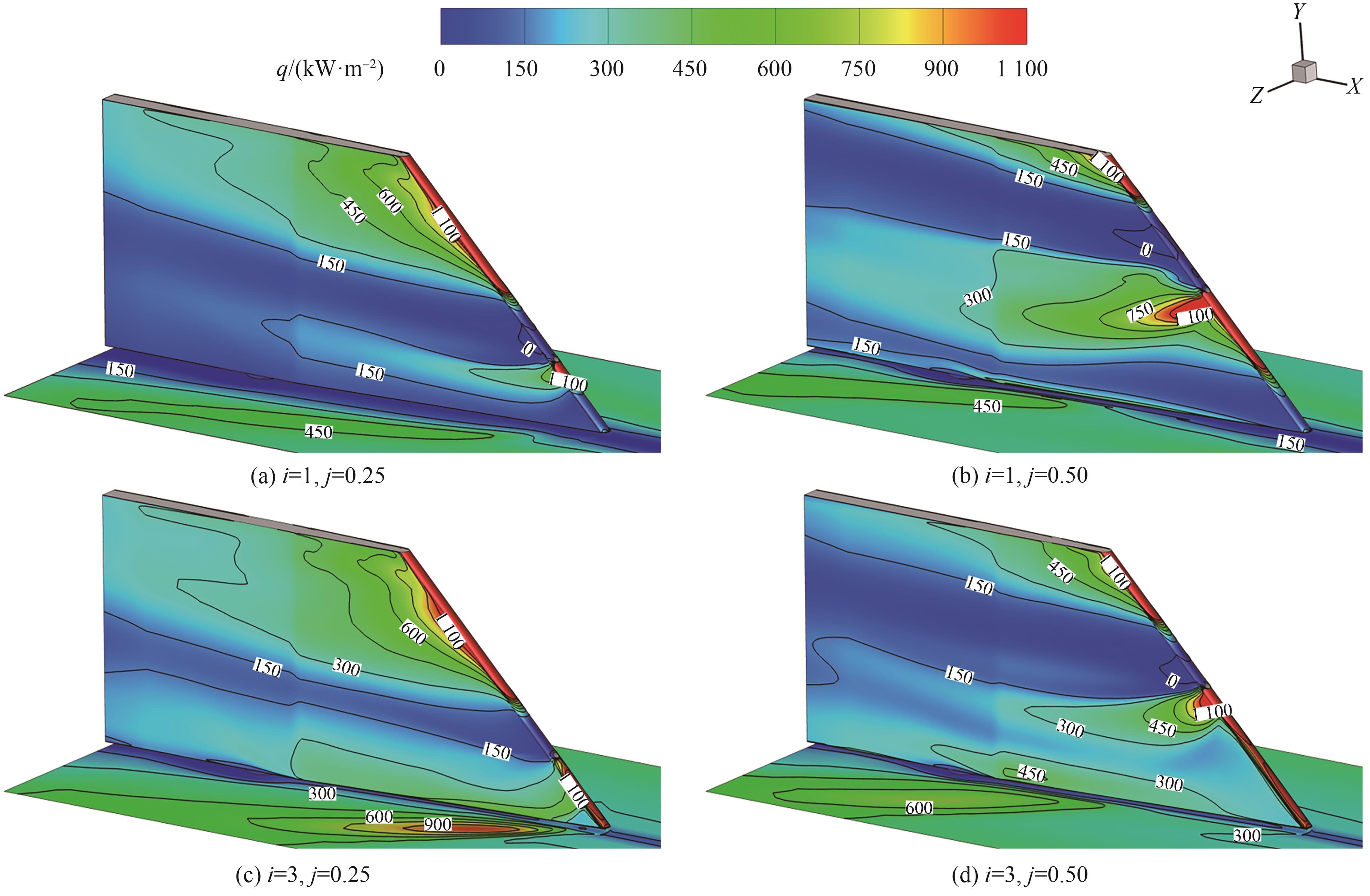
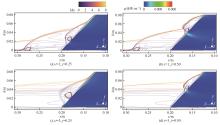
图 21
α=11°时不同射流布局下的对称面马赫数等值线
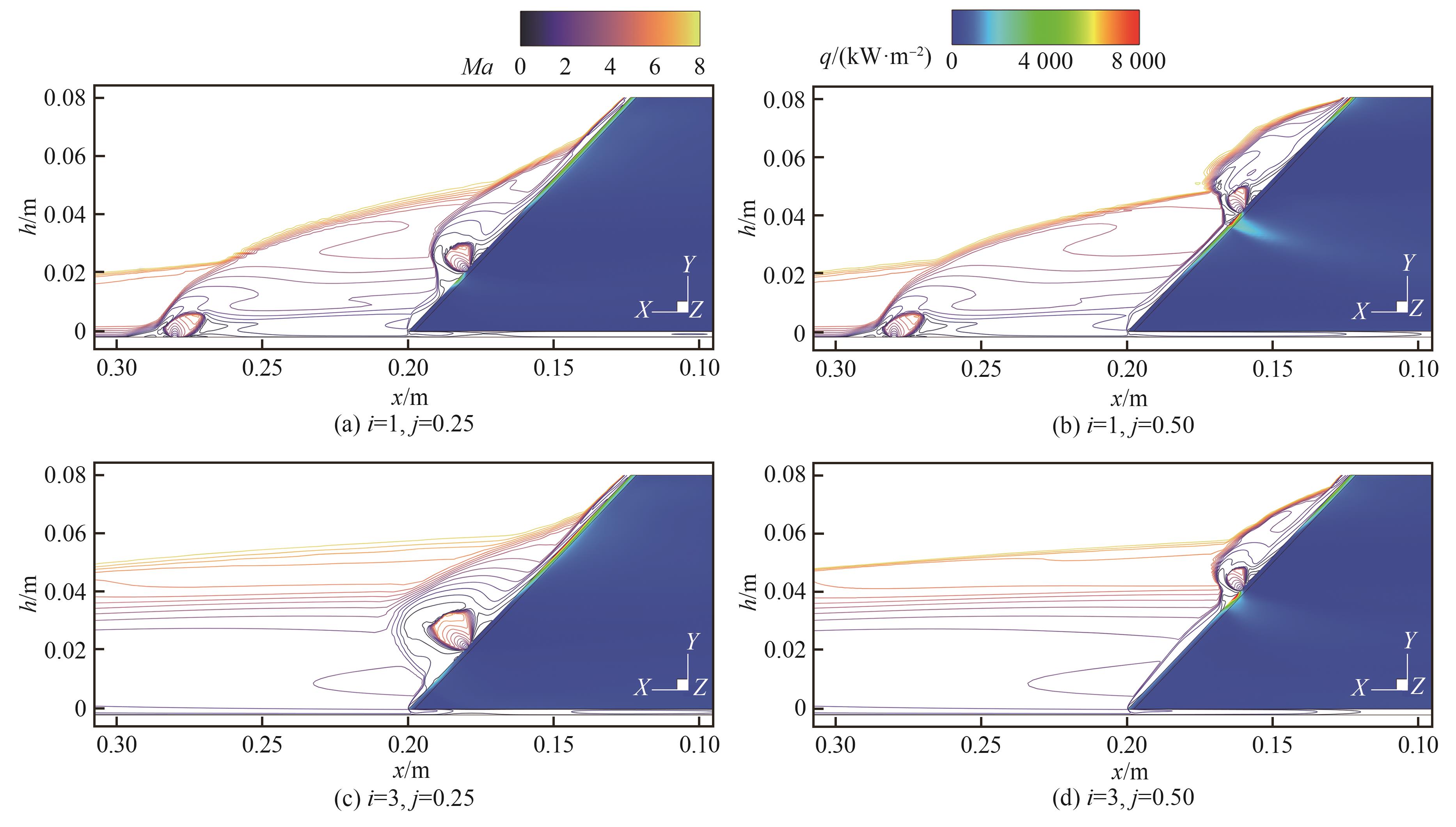
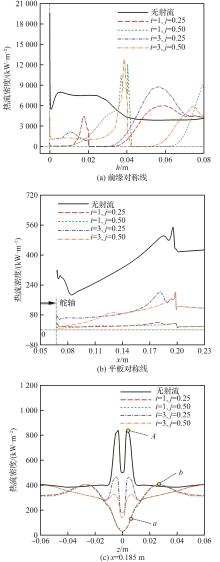
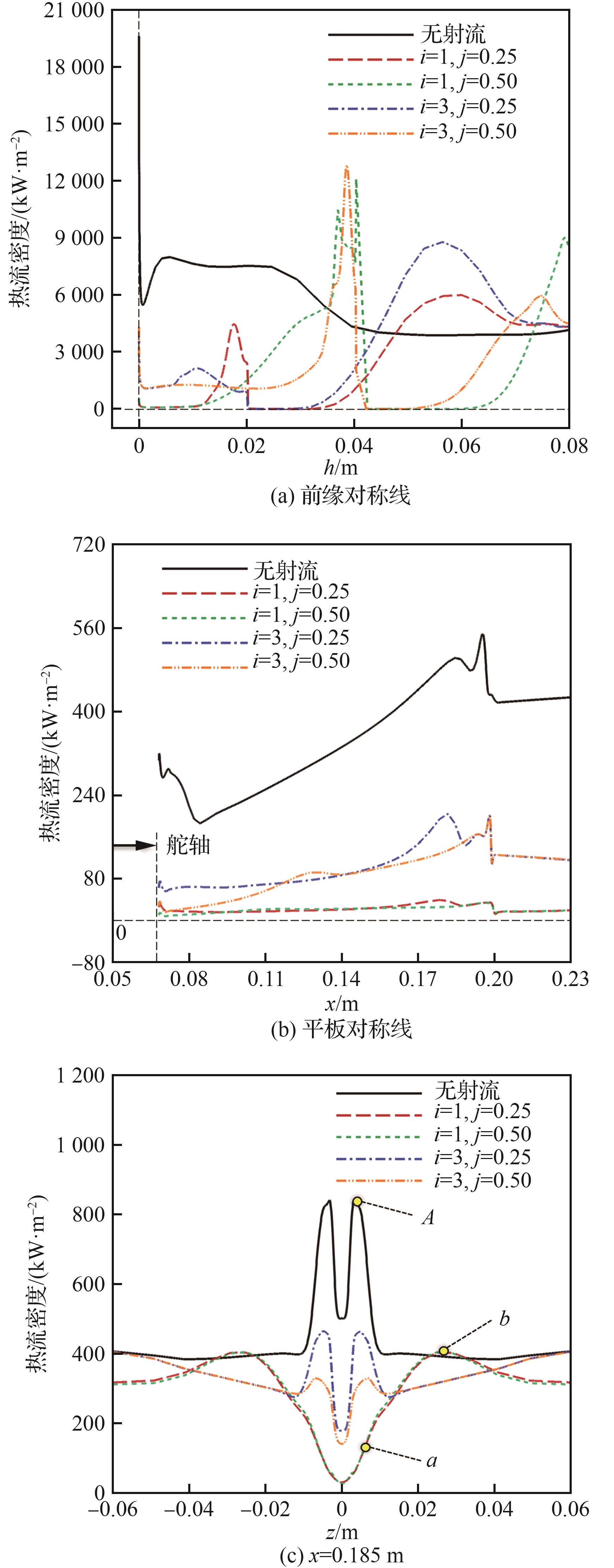
图 22
α=11°时不同射流布局的壁面热流密度分布曲线
| [1] | BABINSKY H, HARVEY J K. Shock wave-boundary-layer interactions[M]. Cambridge: Cambridge University Press, 2011: 203-221. |
| [2] | ZHANG F, YI S H, XU X W, et al. A swept fin-induced flow field with different height mounting gaps[J]. Chinese Journal of Aeronautics, 2021, 34(1): 148-162. |
| [3] | 吴宁宁, 康宏琳, 罗金玲. 高速飞行器翼舵缝隙激波风洞精细测热试验研究[J]. 空气动力学学报, 2019, 37(1): 133-139. |
| WU N N, KANG H L, LUO J L. Experimental study on fine thermal measurement of high-speed aircraft wing rudder gap in shock wave tunnel[J]. Acta Aerodynamica Sinica, 2019, 37(1): 133-139 (in Chinese). | |
| [4] | SETTLES G S, LU F K. Conical similarity of shock/boundary-layer interactions generated by swept and unswept fins[J]. AIAA Journal, 1985, 23(7): 1021-1027. |
| [5] | NGOH H, POGGIE J. Detached eddy simulation of blunt-fin-induced shock-wave/boundary-layer interaction[J]. AIAA Journal, 2022, 60(4): 2097-2114. |
| [6] | ZHANG F, YI S H, XU X W, et al. Flow structure and heat flux distribution of a backswept fin induced flow field at M = 6[J]. Fluid Dynamics, 2020, 55(5): 670-680. |
| [7] | LI Q, NIE L, ZHANG K L, et al. Experimental investigation on aero-heating of rudder shaft within laminar/turbulent hypersonic boundary layers[J]. Chinese Journal of Aeronautics, 2019, 32(5): 1215-1221. |
| [8] | LUO J H, LIU B, LI S B, et al. Research on flow field structure and thermal environment effect of air rudder gap[J]. Aerospace Science and Technology, 2025, 166: 110645. |
| [9] | ALVIANI R, FANO D, POGGIE J, et al. Aerodynamic heating in the gap between a missile body and a control fin[J]. Journal of Spacecraft and Rockets, 2022, 59(4): 1111-1124. |
| [10] | LIN M Y, YANG F, WANG C. Numerical investigation on the generation mechanism of aero-heating of rudder shaft from three-dimensional flow separation and vortices[J]. AIP Advances, 2022, 12(4): 045228. |
| [11] | DOLLING D S, RODI P E. Upstream influence and separation scales in fin-induced shock turbulent boundary-layer interaction[J]. Journal of Spacecraft and Rockets, 1988, 25(2): 102-108. |
| [12] | QUAN P C, YI S H, WU Y, et al. Experimental investigation on the effects of swept angles on blunt fin-induced flow[J]. AIAA Journal, 2015, 53(9): 2805-2810. |
| [13] | GANG D D, YI S H, ZHANG F, et al. Effects of sweep angles on turbulent separation behaviors induced by blunt fin[J]. Chinese Journal of Aeronautics, 2022, 35(3): 90-97. |
| [14] | 朱广生, 姚世勇, 段毅. 高速飞行器减阻降热流动控制技术研究进展及工程应用[J]. 航空学报, 2023, 44(15): 529049. |
| ZHU G S, YAO S Y, DUAN Y. Research progress and engineering application of flow control technology for drag and heat reduction of high-speed vehicles[J]. Acta Aeronautica et Astronautica Sinica, 2023, 44(15): 529049 (in Chinese). | |
| [15] | 张涵信, 黄洁, 高树椿. 带尖针杆的钝体粘性绕流的数值模拟[J]. 航空学报, 1994, 15(5): 519-525. |
| ZHANG H X, HUANG J, GAO S C. Numerical simulation of hypersonic flow over axisymmetric spiked body[J]. Acta Aeronautica et Astronautica Sinica, 1994, 15(5): 519-525 (in Chinese). | |
| [16] | 陆海波, 刘伟强. 高超声速飞行器鼻锥迎风凹腔结构防热效能研究[J]. 宇航学报, 2012, 33(8): 1013-1018. |
| LU H B, LIU W Q. Investigation on thermal protection efficiency of hypersonic vehicle nose with forward-facing cavity[J]. Journal of Astronautics, 2012, 33(8): 1013-1018 (in Chinese). | |
| [17] | HAYASHI K, ASO S, TANI Y. Experimental study on thermal protection system by opposing jet in supersonic flow[J]. Journal of Spacecraft and Rockets, 2006, 43(1): 233-235. |
| [18] | 王旺, 饶彩燕, 徐聪, 等. 激光能量沉积对超声速进气道流动的控制效果[J]. 航空学报, 2023, 44(S2): 729424. |
| WANG W, RAO C Y, XU C, et al. Control effect of laser energy deposition on supersonic inlet flow[J]. Acta Aeronautica et Astronautica Sinica, 2023, 44(S2): 729424 (in Chinese). | |
| [19] | HWANG D. Review of research into the concept of the microblowing technique for turbulent skin friction reduction[J]. Progress in Aerospace Sciences, 2004, 40(8): 559-575. |
| [20] | SCHNEIDER S P. Hypersonic boundary-layer transition with ablation and blowing[J]. Journal of Spacecraft and Rockets, 2010, 47(2): 225-237. |
| [21] | 郑星, 冯黎明, 张云天, 等. 超声速边界层燃烧减阻技术研究进展[J]. 固体火箭技术, 2021, 44(4): 438-447. |
| ZHENG X, FENG L M, ZHANG Y T, et al. Review of supersonic boundary layer combustion for skin friction drag reduction technology[J]. Journal of Solid Rocket Technology, 2021, 44(4): 438-447 (in Chinese). | |
| [22] | 向树红, 商圣飞, 沈自才, 等. 高超声速气膜冷却技术研究进展及发展方向[J]. 宇航材料工艺, 2020, 50(3): 1-10. |
| XIANG S H, SHANG S F, SHEN Z C, et al. Research progress and development direction of hypersonic film cooling technology[J]. Aerospace Materials & Technology, 2020, 50(3): 1-10 (in Chinese). | |
| [23] | SU H, WANG J H, HE F, et al. Numerical investigation on transpiration cooling with coolant phase change under hypersonic conditions[J]. International Journal of Heat and Mass Transfer, 2019, 129: 480-490. |
| [24] | 吴云, 李应红. 等离子体流动控制研究进展与展望[J]. 航空学报, 2015, 36(2): 381-405. |
| WU Y, LI Y H. Progress and outlook of plasma flow control[J]. Acta Aeronautica et Astronautica Sinica, 2015, 36(2): 381-405 (in Chinese). | |
| [25] | 周岩, 罗振兵, 王林, 等. 等离子体合成射流激励器及其流动控制技术研究进展[J]. 航空学报, 2022, 43(3): 025027. |
| ZHOU Y, LUO Z B, WANG L, et al. Plasma synthetic jet actuator for flow control: Review[J]. Acta Aeronautica et Astronautica Sinica, 2022, 43(3): 025027 (in Chinese). | |
| [26] | 吴云, 张志波, 朱益飞, 等. 等离子体燃烧调控研究进展与展望[J]. 航空学报, 2025, 46(5): 531879. |
| WU Y, ZHANG Z B, ZHU Y F, et al. Research progress and outlook of plasma combustion control[J]. Acta Aeronautica et Astronautica Sinica, 2025, 46(5): 531879 (in Chinese). | |
| [27] | 罗振兵, 王浩, 赵志杰. 合成双射流理论及其赋能航空技术进展[J]. 航空学报, 2025, 46(5): 531821. |
| LUO Z B, WANG H, ZHAO Z J. Theory of dual synthetic jets and its empowerment of advancements in aeronautical technology[J]. Acta Aeronautica et Astronautica Sinica, 2025, 46(5): 531821 (in Chinese). | |
| [28] | XIE W, LUO Z B, ZHOU Y, et al. Experimental study on plasma synthetic jet for drag reduction in hypersonic flow[J]. AIAA Journal, 2023, 61(3): 1428-1434. |
| [29] | 李珺, 王俊峰, 赵雅甜, 等. 面向非设计工况的激波针-喷流复合构型研究[J]. 航空学报, 2022, 43(9): 125949. |
| LI J, WANG J F, ZHAO Y T, et al. Research on combinational configuration of spike and multi-jets in off-design regimes[J]. Acta Aeronautica et Astronautica Sinica, 2022, 43(9): 125949 (in Chinese). | |
| [30] | 王俊峰, 李珺, 罗世彬. 双射流激波针在高超声速下的减阻降热特性[J]. 空气动力学学报, 2024, 42(2): 34-46. |
| WANG J F, LI J, LUO S B. Drag and heat reduction performance of a dual-jet spike configuration in hypersonic flow[J]. Acta Aerodynamica Sinica, 2024, 42(2): 34-46 (in Chinese). | |
| [31] | BIBI A, MAQSOOD A, SHERBAZ S, et al. Drag reduction of supersonic blunt bodies using opposing jet and nozzle geometric variations[J]. Aerospace Science and Technology, 2017, 69: 244-256. |
| [32] | SUDARSHAN B, RAO S M V, JAGADEESH G, et al. Effect of the axial cavity with an opposing high-pressure jet combination in a Mach 6 flow condition[J]. Acta Astronautica, 2021, 178: 335-348. |
| [33] | SHEN B X, YIN L, ZHANG X L, et al. Investigation on cooling effect with a combinational opposing jet and platelet transpiration concept in hypersonic flow[J]. Aerospace Science and Technology, 2019, 85: 399-408. |
| [34] | RONG Y S, WEI Y C, ZHAN R J. Research on thermal protection by opposing jet and transpiration for high speed vehicle[J]. Aerospace Science and Technology, 2016, 48: 322-327. |
| [35] | 李世斌. 逆向射流及其在高超声速飞行器中的减阻防热机理研究[D]. 长沙: 国防科学技术大学, 2017: 51-70. |
| LI S B. Mechanism investigation for drag and heat reduction of opposing jet on hypersonic vehicle[D]. Changsha: National University of Defense Technology, 2017: 51-70 (in Chinese). | |
| [36] | LI S L, LI S B, HUANG W, et al. Fluid-thermal-structural coupled investigation on rudder leading edge with porous opposing jet in high-speed flow[J]. Aerospace Science and Technology, 2024, 155: 109725. |
| [37] | 聂春生, 袁野, 马伟, 等. 主动引射气体参数对平板空气舵气动热影响[J]. 航空学报, 2022, 43(S2): 727736. |
| NIE C S, YUAN Y, MA W, et al. Effect of active ejection gas parameters on thermal environment of plate and air rudder[J]. Acta Aeronautica et Astronautica Sinica, 2022, 43(S2): 727736 (in Chinese). | |
| [38] | 曾品棚, 陈树生, 冯聪, 等. 侧向喷流对导弹方向舵局部气动热特性的影响[J]. 空气动力学学报, 2023, 41(9): 70-81. |
| ZENG P P, CHEN S S, FENG C, et al. Effect of lateral jet on local aerodynamic heating characteristics of missile rudders[J]. Acta Aerodynamica Sinica, 2023, 41(9): 70-81 (in Chinese). | |
| [39] | LUO J H, GUO Q Y, LIU B, et al. Influence of transverse jet on shock wave/boundary layer interaction and flow field of air rudder[J]. Physics of Fluids, 2025, 37(10): 106134. |
| [40] | ANAZADEHSAYED A, GERDROODBARY M B, AMINI Y, et al. Mixing augmentation of transverse hydrogen jet by injection of micro air jets in supersonic crossflow[J]. Acta Astronautica, 2017, 137: 403-414. |
| [41] | SUN X W, HUANG W, OU M, et al. A survey on numerical simulations of drag and heat reduction mechanism in supersonic/hypersonic flows[J]. Chinese Journal of Aeronautics, 2019, 32(4): 771-784. |
| [42] | MENTER F R. Two-equation eddy-viscosity turbulence models for engineering applications[J]. AIAA Journal, 1994, 32(8): 1598-1605. |
| [43] | PASHA A A, JUHANY K A. Numerical simulation of compression corner flows at Mach number 9[J]. Chinese Journal of Aeronautics, 2020, 33(6): 1611-1624. |
| [44] | ERDEM E, KONTIS K, SARAVANAN S. Penetration characteristics of air, carbon dioxide and helium transverse sonic jets in Mach 5 cross flow[J]. Sensors, 2014, 14(12): 23462-23489. |
| [1] | 罗振兵, 王春强, 郭芷妍, 龚建宇, 赵志杰. 基于无源合成双射流的百公斤级飞行器短距起降增升首飞验证[J]. 航空学报, 2026, 47(13): 533291-533291. |
| [2] | 杨天宇, 苏志, 梁华, 宗豪华, 吴云. 脉冲直流等离子体激励抑制流动分离试验[J]. 航空学报, 2026, 47(13): 533178-533178. |
| [3] | 王成鹏, 郝晨光, 李昊, 薛龙生, 焦运, 吴思雨, 马张煜, 袁野, 李伟俊, 侯普晨. 最小熵增准则在激波/边界层干扰分析中的应用[J]. 航空学报, 2025, 46(8): 631458-631458. |
| [4] | 罗振兵, 王浩, 赵志杰. 合成双射流理论及其赋能航空技术进展[J]. 航空学报, 2025, 46(5): 531821-531821. |
| [5] | 王宏宇, 王刚, 李涛, 超珍厚, 高峰. 基于脉冲放电能量沉积控制的横向射流掺混[J]. 航空学报, 2025, 46(14): 131520-131520. |
| [6] | 谢玮, 罗振兵, 周岩, 刘强, 吴建军, 董昊. 高超声速双楔激波干扰定常射流控制试验研究[J]. 航空学报, 2024, 45(7): 128813-128813. |
| [7] | 朱宇, 程健慧, 陈诚, 黄河峡, 谭慧俊. Bump进气道超声速稳定工作机制[J]. 航空学报, 2024, 45(24): 130408-130408. |
| [8] | 侯雁翔, 冯立好. 飞翼布局主动流动控制风洞虚拟飞行试验[J]. 航空学报, 2024, 45(24): 630636-630636. |
| [9] | 赖江, 范召林, 王乾, 董思卫, 童福林, 袁先旭. 高超声速有攻角锥裙直接数值模拟[J]. 航空学报, 2024, 45(2): 128610-128610. |
| [10] | 刘为佳, 李映坤, 陈雄, 李春雷. 基于流固耦合的激波/边界层干扰作用下壁板颤振特性[J]. 航空学报, 2023, 44(6): 127085-127085. |
| [11] | 王梦格, 何小明, 王娟娟, 张悦, 汪昆, 谭慧俊, 李留刚. 基于振荡式涡流发生器的激波/边界层干扰控制方法[J]. 航空学报, 2023, 44(20): 128503-128503. |
| [12] | 张刘, 黄勇, 陈辅政, 朱正龙, 郭天豪, 姜裕标, 周铸. 基于环量控制的无尾飞翼俯仰和滚转两轴无舵面姿态控制飞行试验[J]. 航空学报, 2023, 44(18): 128224-128224. |
| [13] | 田珊珊, 金亮, 杜兆波, 钟翔宇, 黄伟, 刘远洋. 基于鼓包的激波/边界层干扰控制研究进展[J]. 航空学报, 2023, 44(18): 28411-028411. |
| [14] | 李灿民, 黄河峡, 梁钢, 吕靖昊, 蔡佳, 谭慧俊. 基于后掠唇罩的入射激波/边界层干扰流动控制方法[J]. 航空学报, 2023, 44(16): 128091-128091. |
| [15] | 刘重晓, 王江峰. 滑移流区化学非平衡流中气动热环境的数值模拟[J]. 航空学报, 2023, 44(16): 127980-127980. |
| 阅读次数 | ||||||
|
全文 |
|
|||||
|
摘要 |
|
|||||
版权所有 © 航空学报编辑部
版权所有 © 2011航空学报杂志社
主管单位:中国科学技术协会 主办单位:中国航空学会 北京航空航天大学

 CJA
CJA
