郭润杰1, 鲁龙坤1,2( ), 周子康1, 王生楠1
收稿日期:2025-05-30
修回日期:2025-06-17
接受日期:2025-07-18
出版日期:2025-07-28
发布日期:2025-07-25
通讯作者:
鲁龙坤
E-mail:lulongkun@nwpu.edu.cn
基金资助:
Runjie GUO1, Longkun LU1,2(), Zikang ZHOU1, Shengnan WANG1
Received:2025-05-30
Revised:2025-06-17
Accepted:2025-07-18
Online:2025-07-28
Published:2025-07-25
Contact:
Longkun LU
E-mail:lulongkun@nwpu.edu.cn
Supported by:摘要:
内聚力模型(CZM)参数设置简便、数值稳定性高,并能有效模拟复杂裂纹扩展行为,在飞机金属薄壁结构的剩余强度评估中展现出重要价值。围绕CZM的牵引-分离定律(TSL),系统梳理了典型TSL曲线的几何特征、初始刚度、关键参数的物理意义,对比分析了不同TSL形状在金属延性断裂模拟中的适用性、差异性。在此基础上,综述了内聚参数的试验测量方法、数值反演技术,探讨了参数选取对有限元模拟精度的影响。此外,针对CZM的数值实现方式,分类阐述了二维内聚单元、壳单元、三维内聚单元3种建模策略,并对比了各自的优缺点。通过典型工程案例,验证了CZM在金属薄壁结构断裂模拟中的可行性与适用性。展望未来,为进一步提升内聚力模型在金属薄壁结构中的应用水平,亟需解决两大关键科学问题:不同TSL形状下内聚参数的定量关系、TSL参数与微观损伤的关联机制。
中图分类号:
郭润杰, 鲁龙坤, 周子康, 王生楠. 内聚力模型在飞机金属薄壁结构断裂模拟中的应用进展[J]. 航空学报, 2025, 46(21): 532330.
Runjie GUO, Longkun LU, Zikang ZHOU, Shengnan WANG. Progress in application of cohesive zone model in fracture simulation of aircraft metallic thin-walled structures[J]. Acta Aeronautica et Astronautica Sinica, 2025, 46(21): 532330.

图 1
内聚区模型示意图


图 2
早期牵引-分离定律
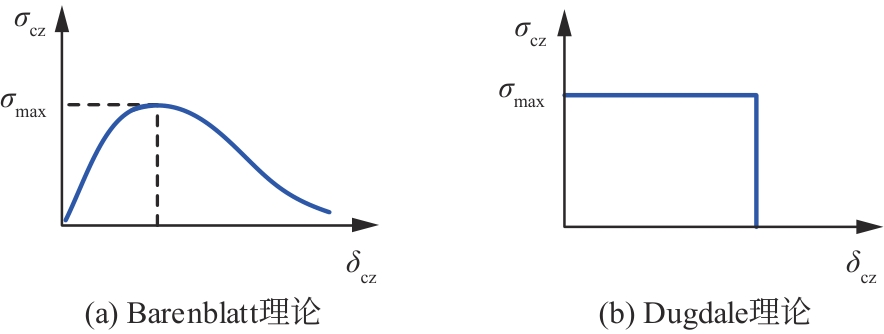

图 3
典型牵引-分离定律

图 4
初始刚度的影响[18]
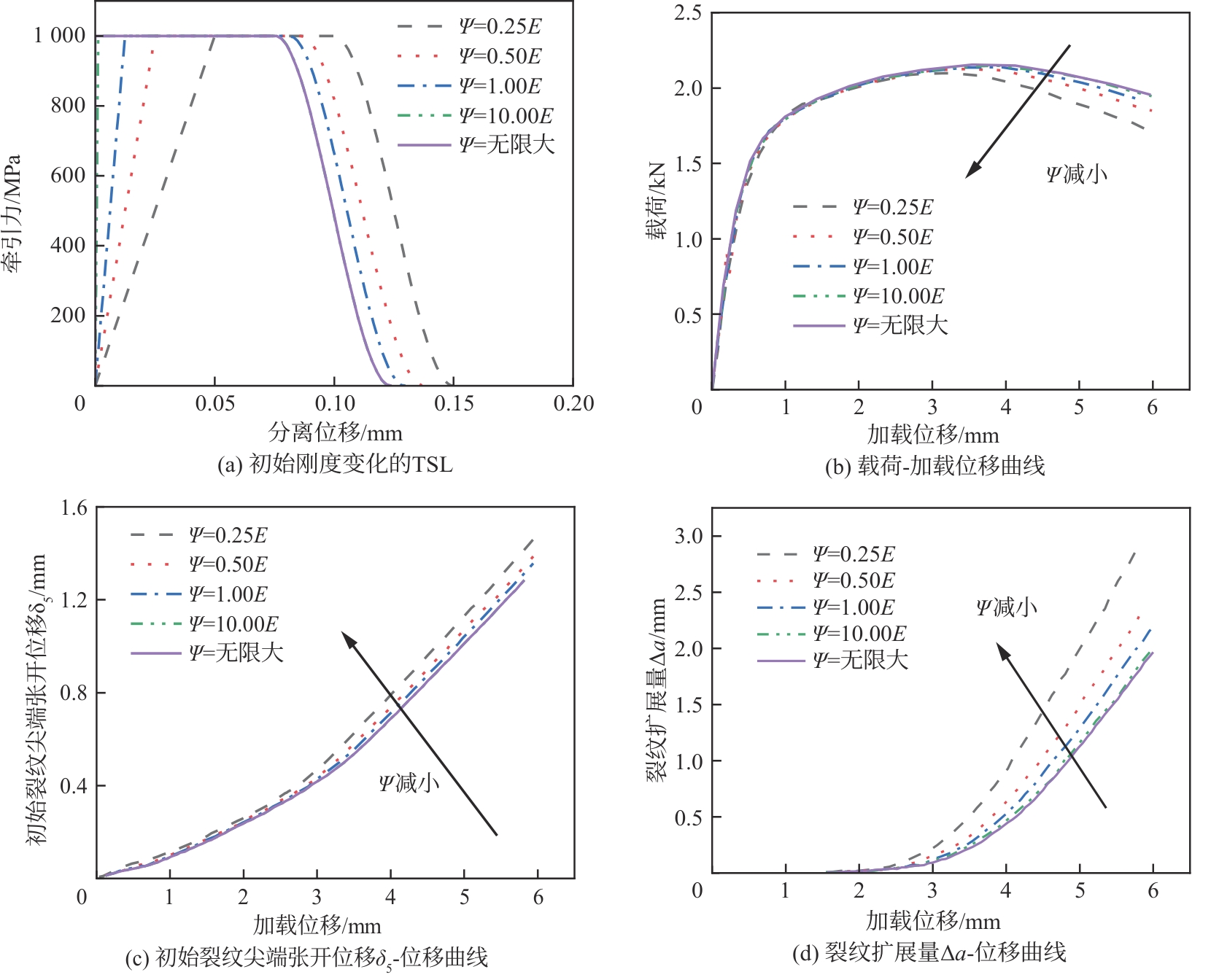
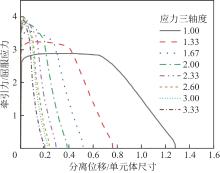
图 5
恒定应力三轴度下的归一化单元体应力-应变曲线[19]
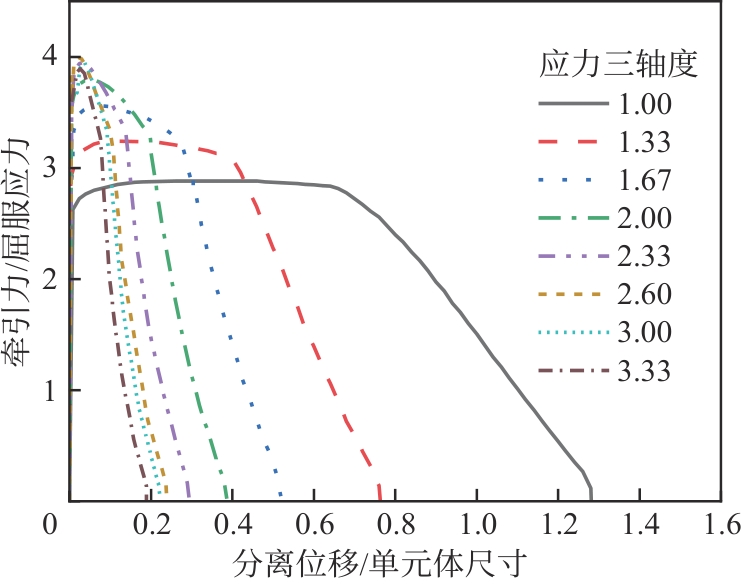
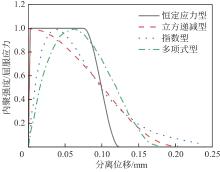
图 6
4种相同内聚参数的不同TSL[23]
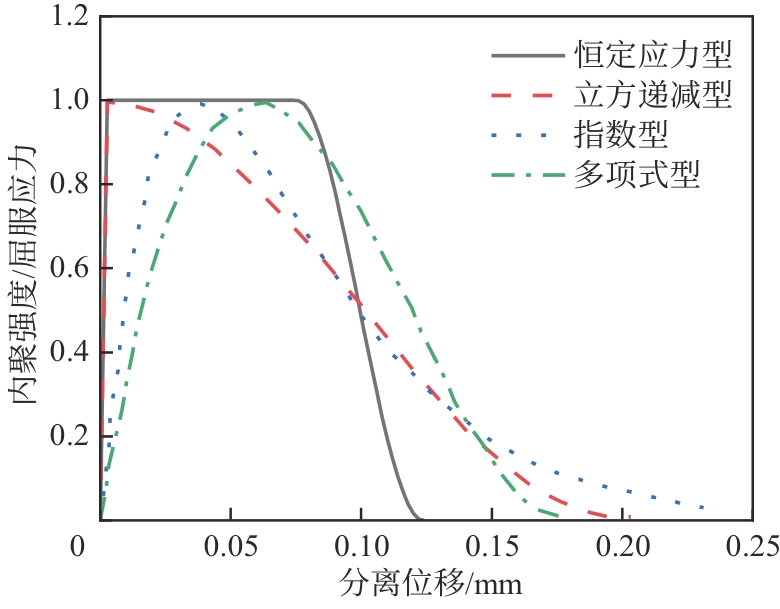
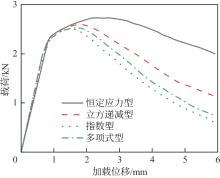
图 7
4种TSL模拟得到的载荷-加载位移曲线[23]
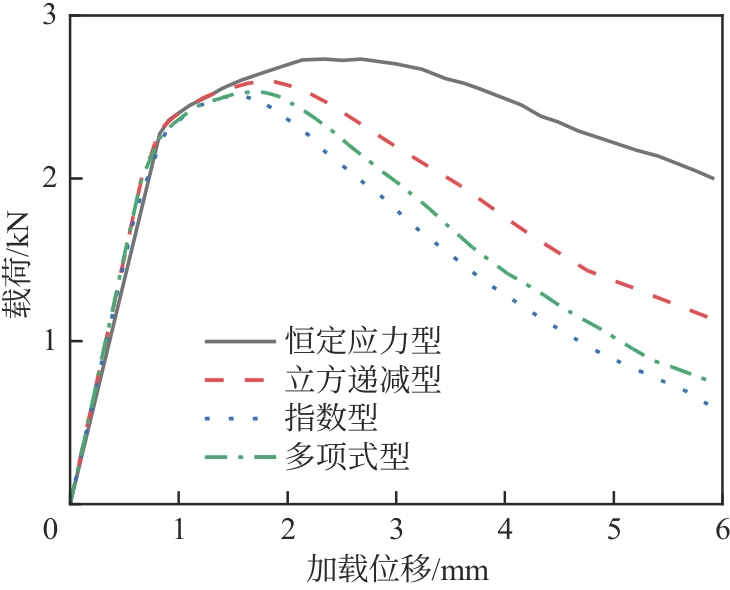
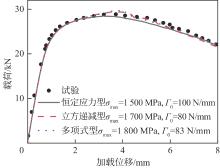
图 8
不同TSL形状模拟结果的相似性[24]
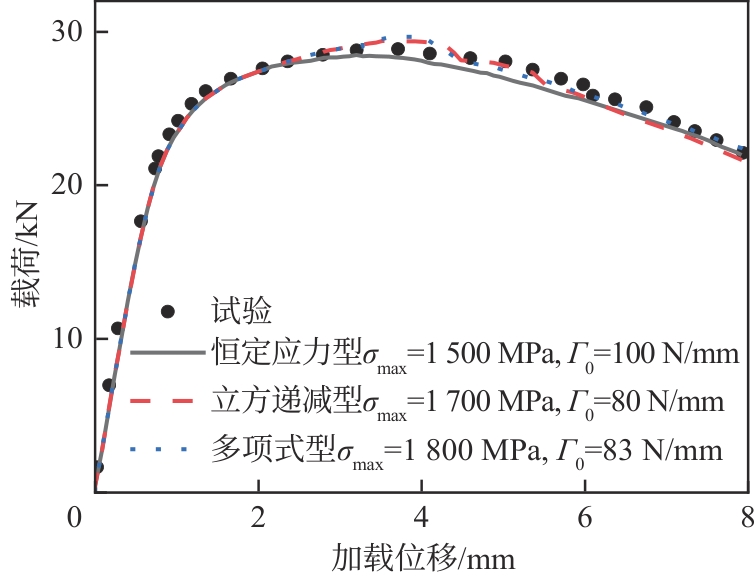
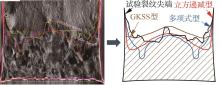
图 9
裂纹前沿的隧道效应[24]
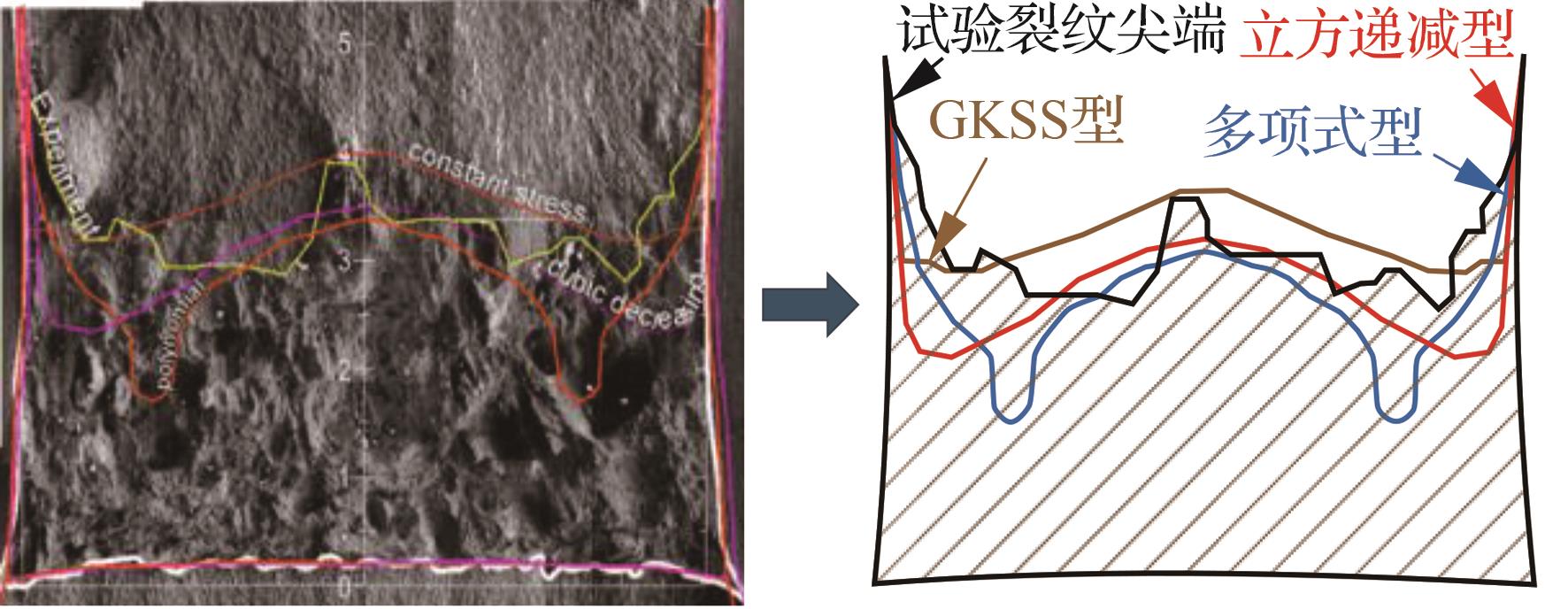

表 1
不同TSL形状的来源及适用性对比
| TSL形状 | 来源 | 优点 | 局限性 |
|---|---|---|---|
| 三角形 | 经验拟合 | 实现简单,收敛性好 | 不能反映平台段,无法描述延性屈服 |
| 梯形 | 经验拟合 | 物理意义接近延性断裂 | 转折点需光滑处理,可能不稳定 |
| GKSS型 | 对梯形TSL转折点进行平滑处理 | 收敛性好 | 物理上仅适用于韧性断裂 |
| 多项式型 | 基于界面空洞核化-聚合的势能函数 | 保证能量一致性,稳定性好 | 物理上不适宜使用于韧性断裂 |
| 指数型 | 基于原子势能曲线的指数衰减特性 | 保证能量一致性,稳定性好 | 物理上不适宜使用于韧性断裂 |
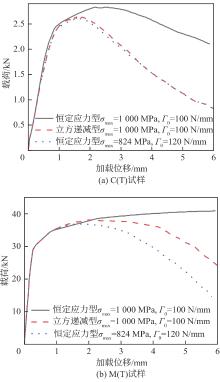
图 10
平面应变条件[24]
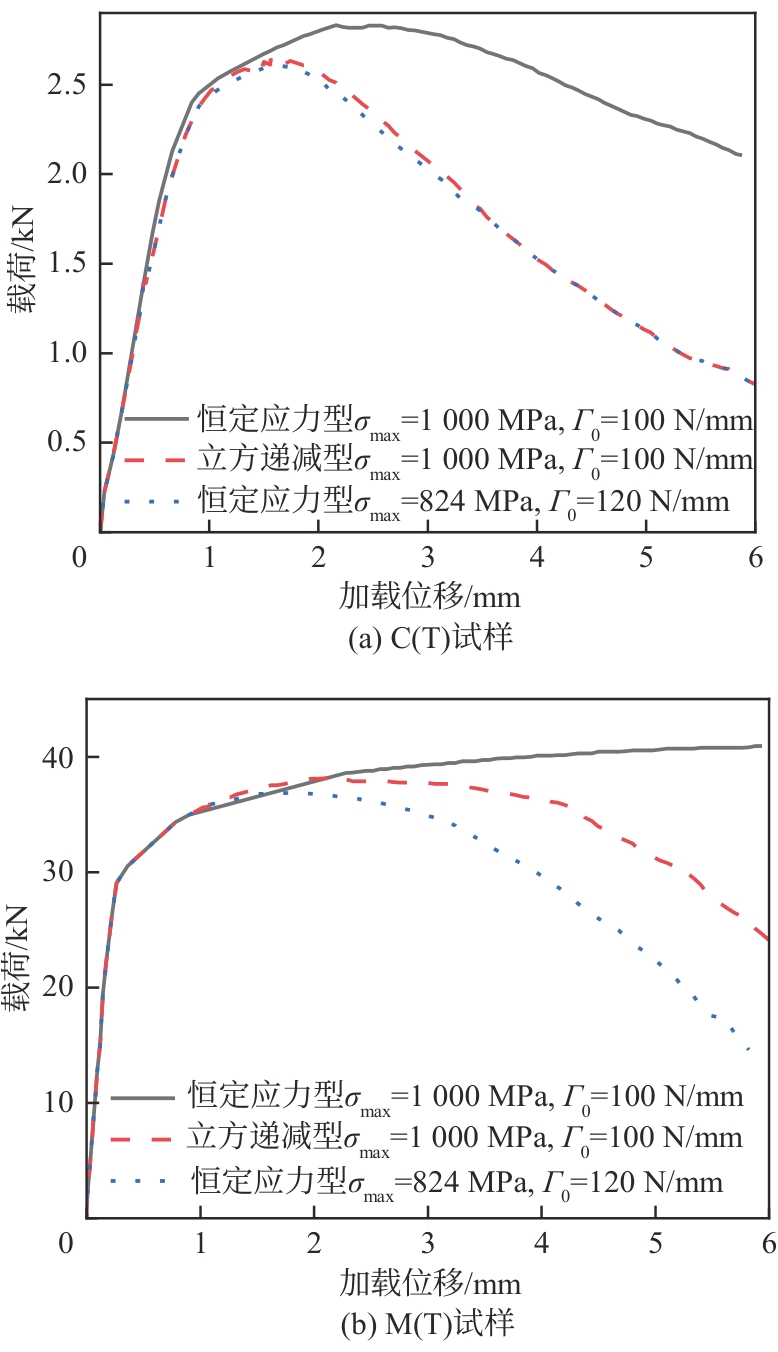

图 11
平面应力条件的参数标定 [24]

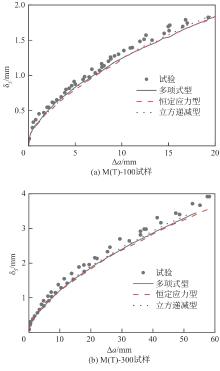
图 12
平面应力条件[24]
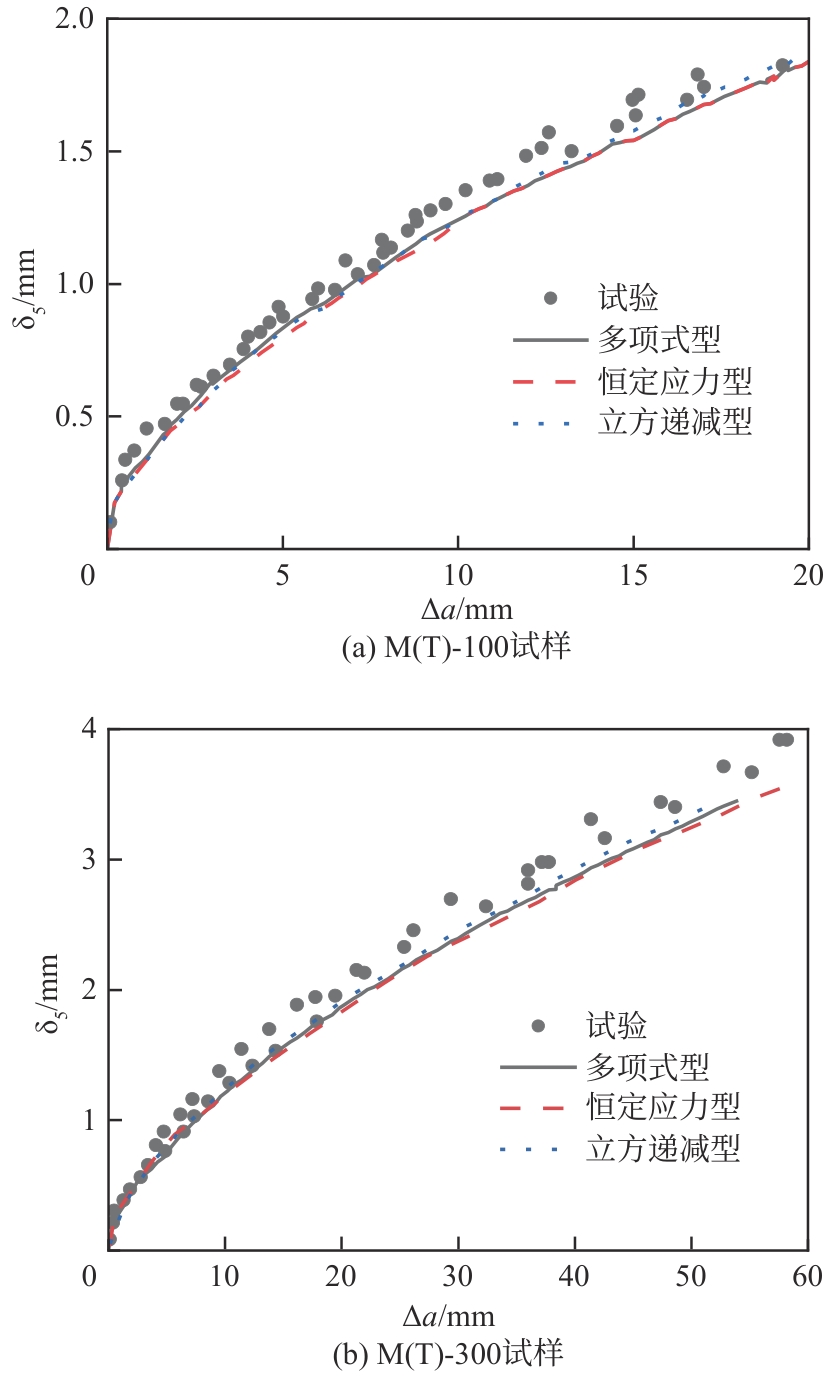
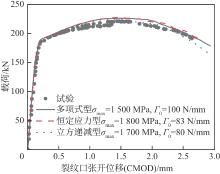
图 13
三维有限元的模拟结果[24]
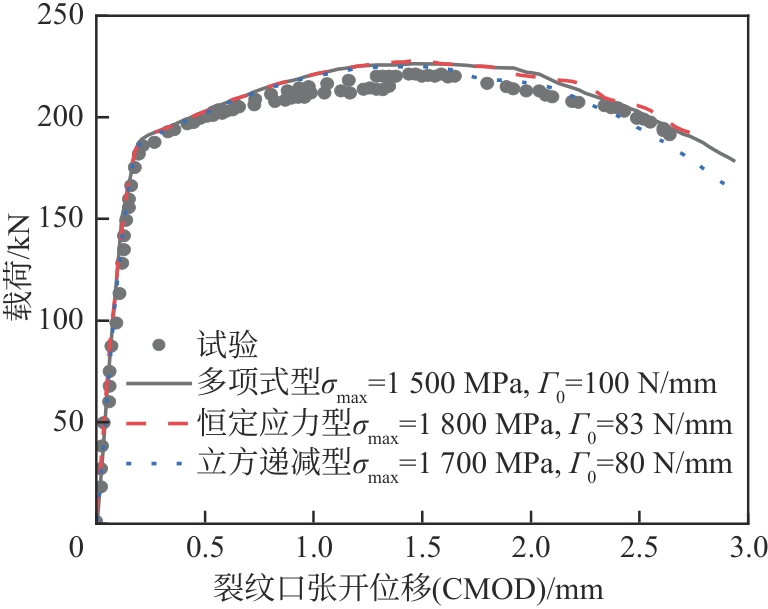
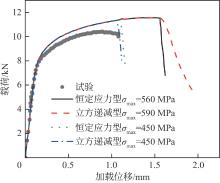
图 14
带缺口拉伸试样的试验与仿真结果[24]
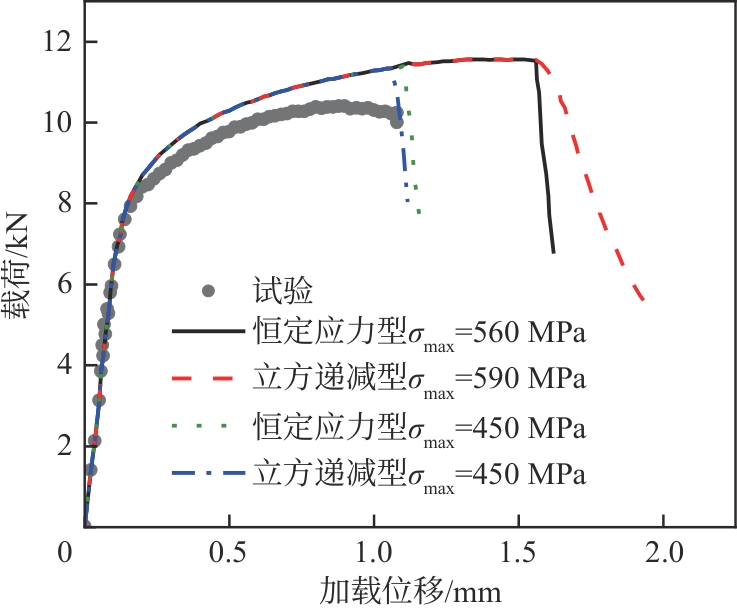
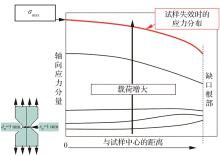
图 15
内聚强度的确定[25]
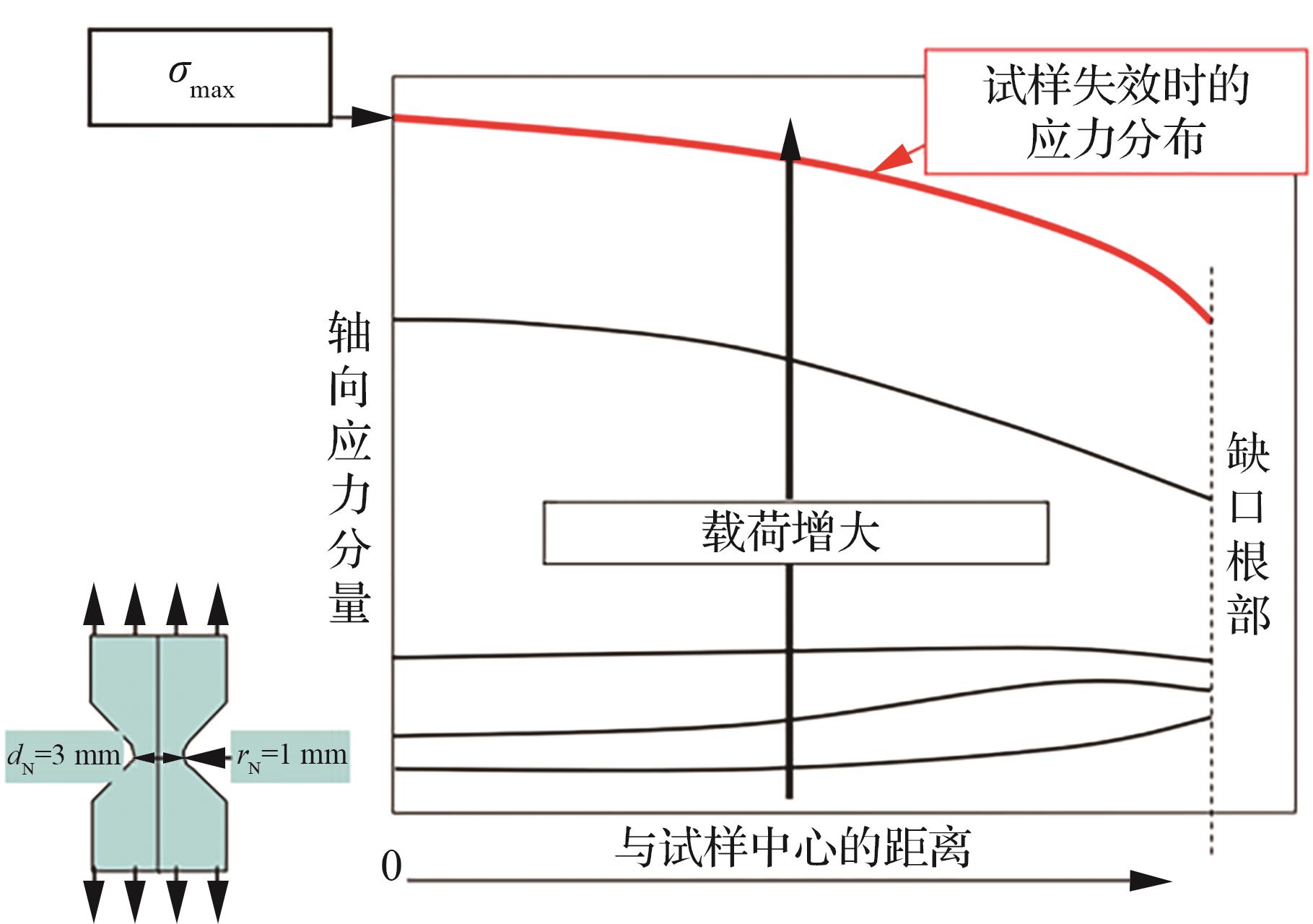
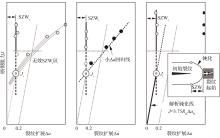
图 16
确定Ji的3种方法[25]
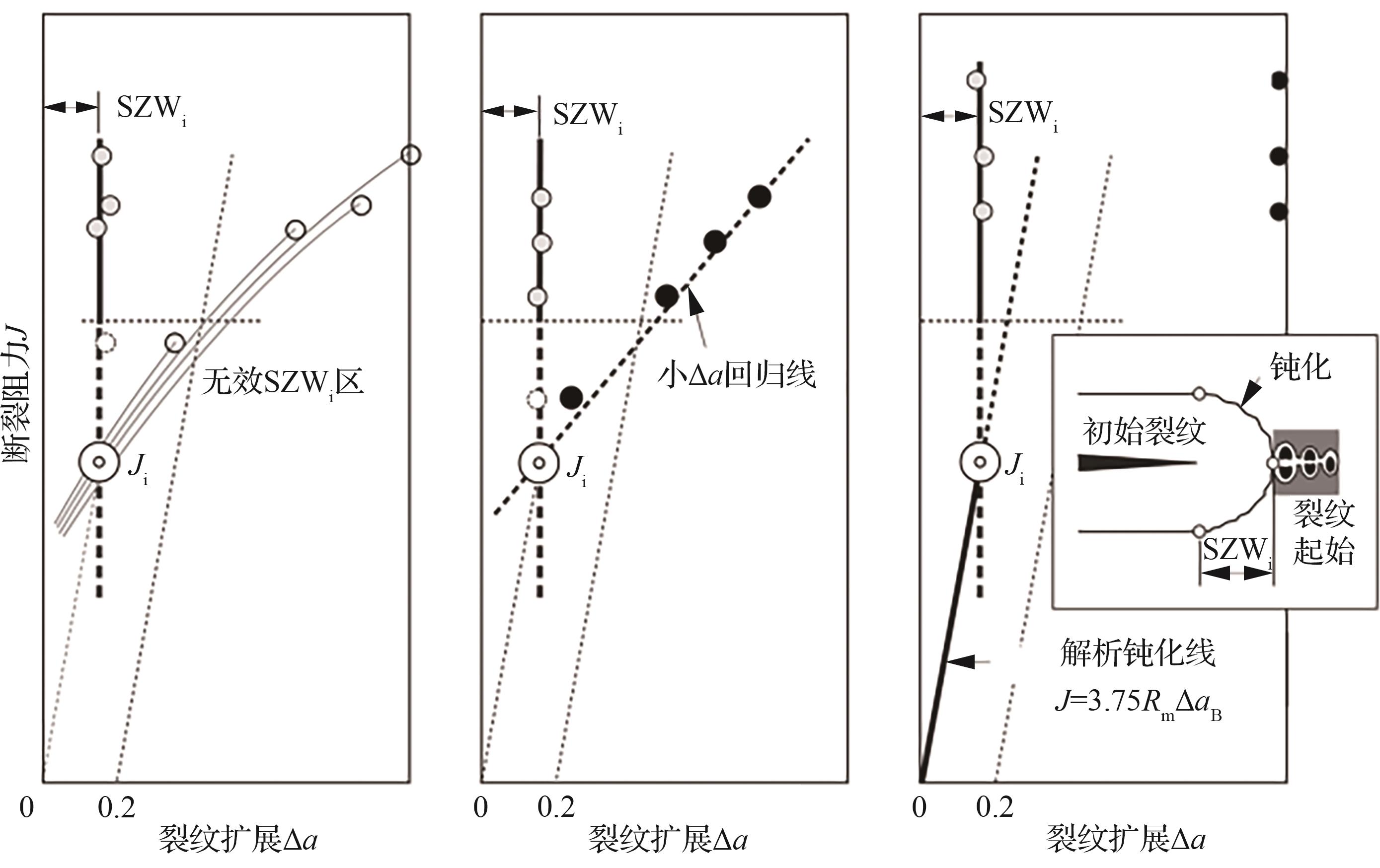

图 17
内聚参数对于R曲线的影响[25]
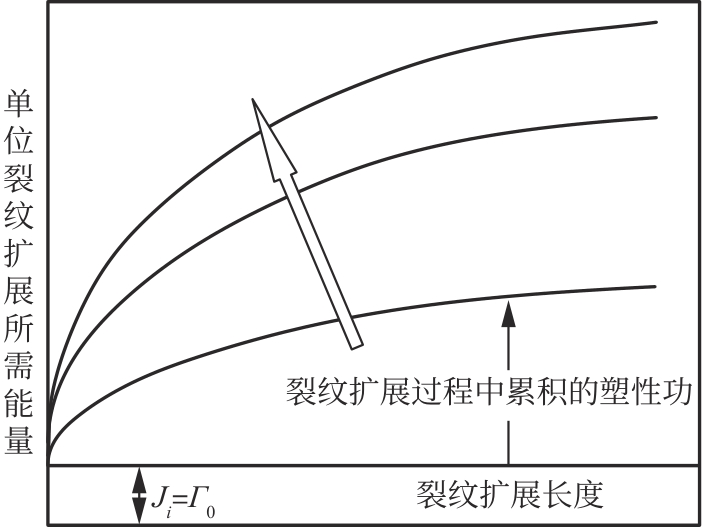
图 18
内聚参数对于载荷-裂纹扩展量曲线的影响[12]
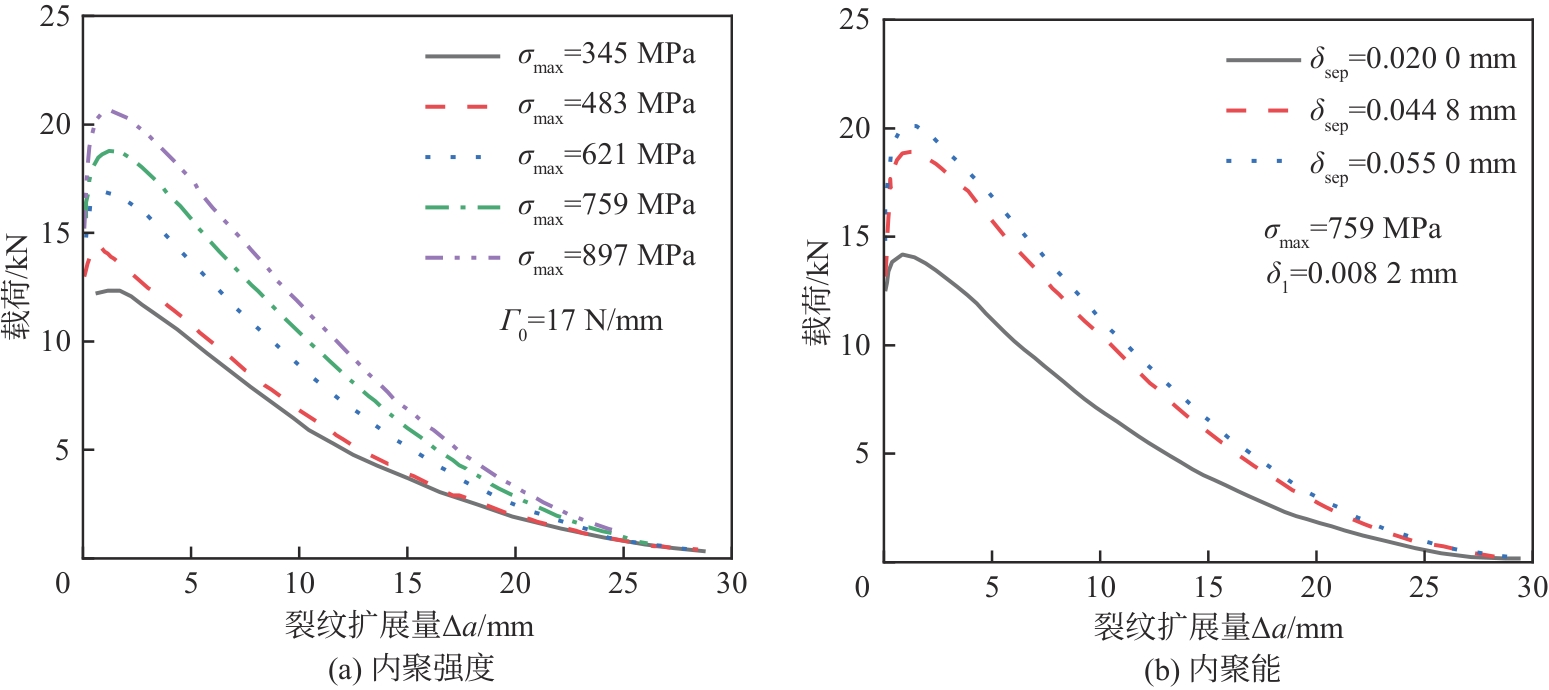
图 19
内聚参数对“隧道效应”的影响[12]
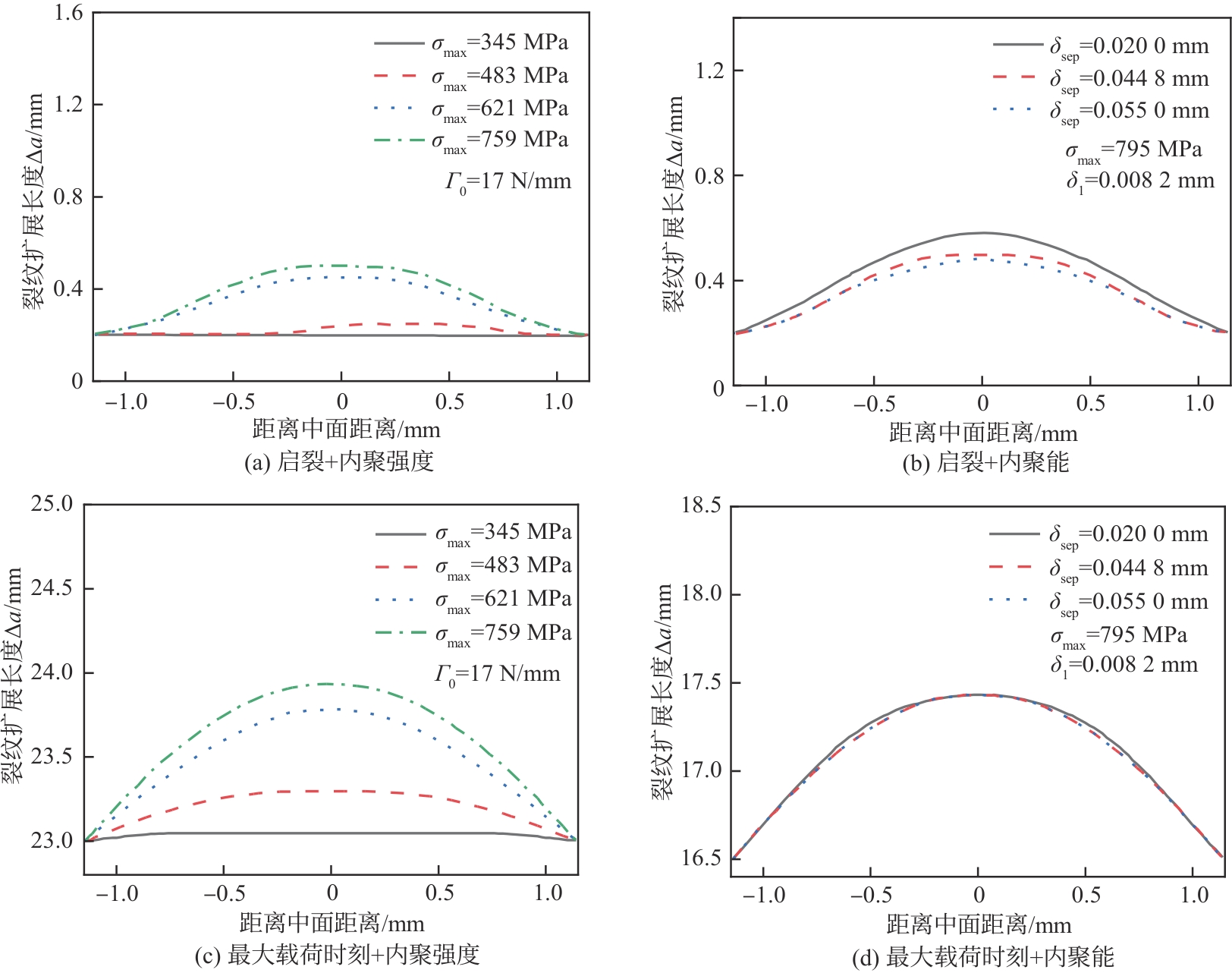

图 20
内聚能和内聚强度的反演法[29]


图 21
内聚单元[25]

图 22
从法向断裂到倾斜断裂的转变[9]
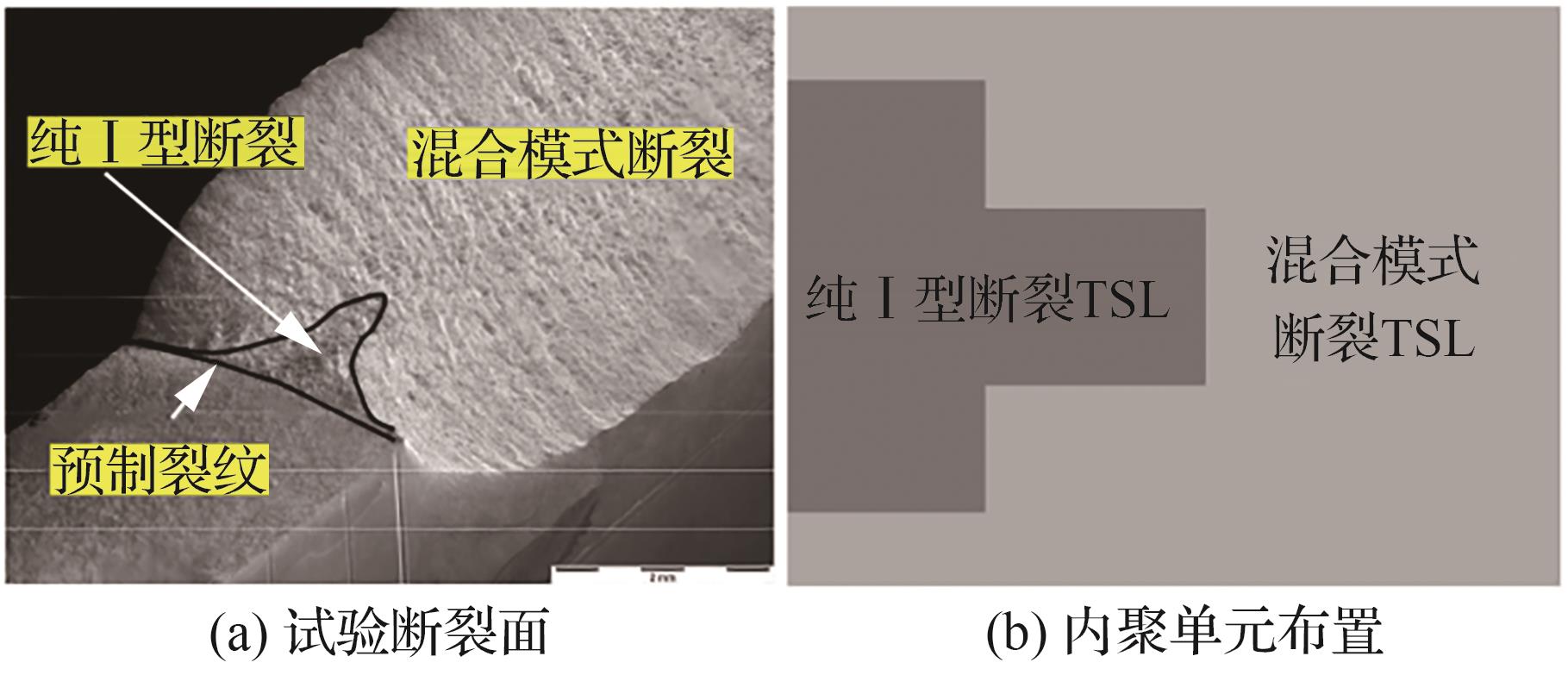

图 23
环向加强筋圆柱壳有限元模型[48]

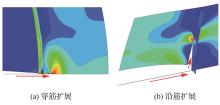
图 24
2种裂纹扩展模式[48]
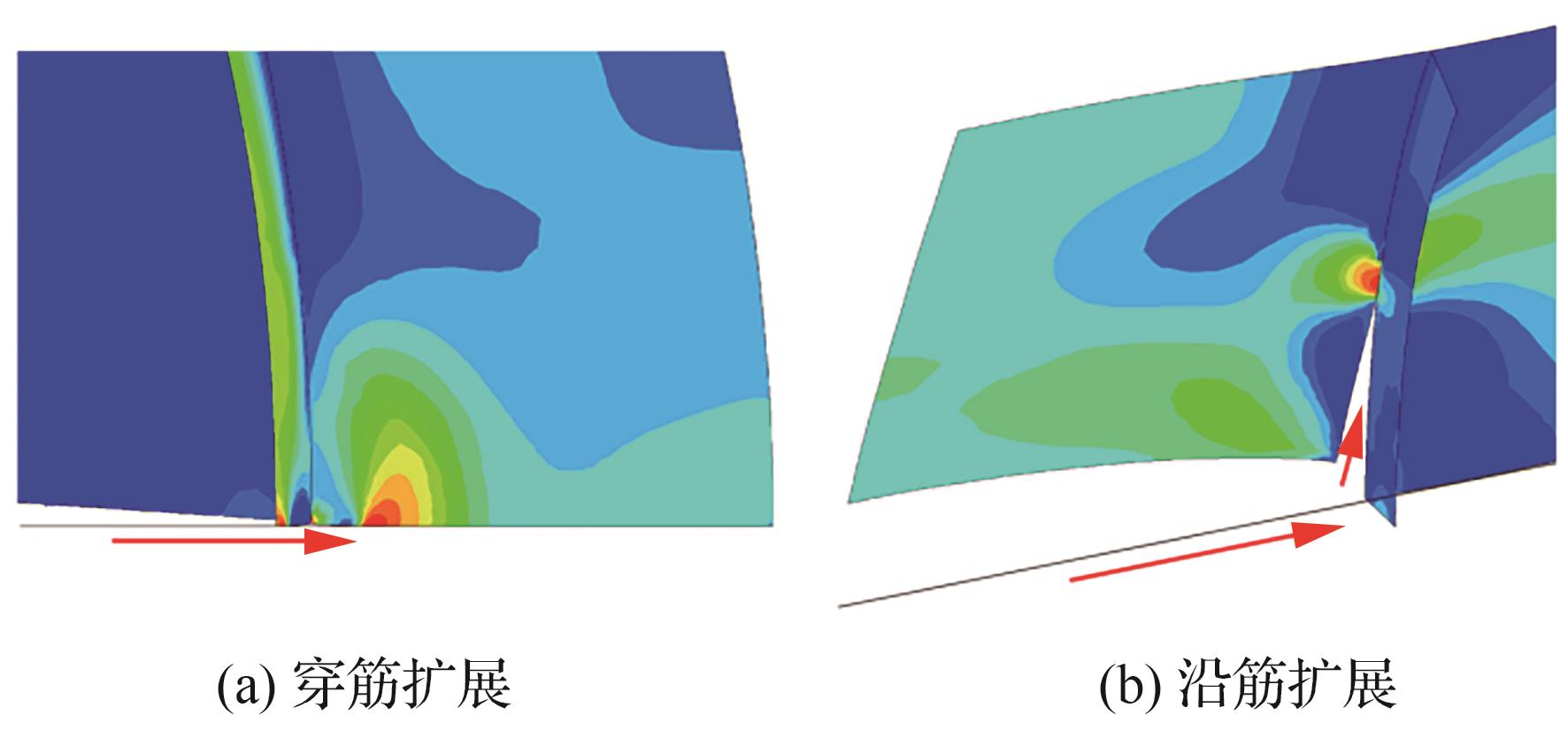
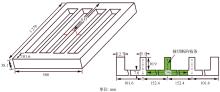
图 25
五筋条整体壁板示意图[5]
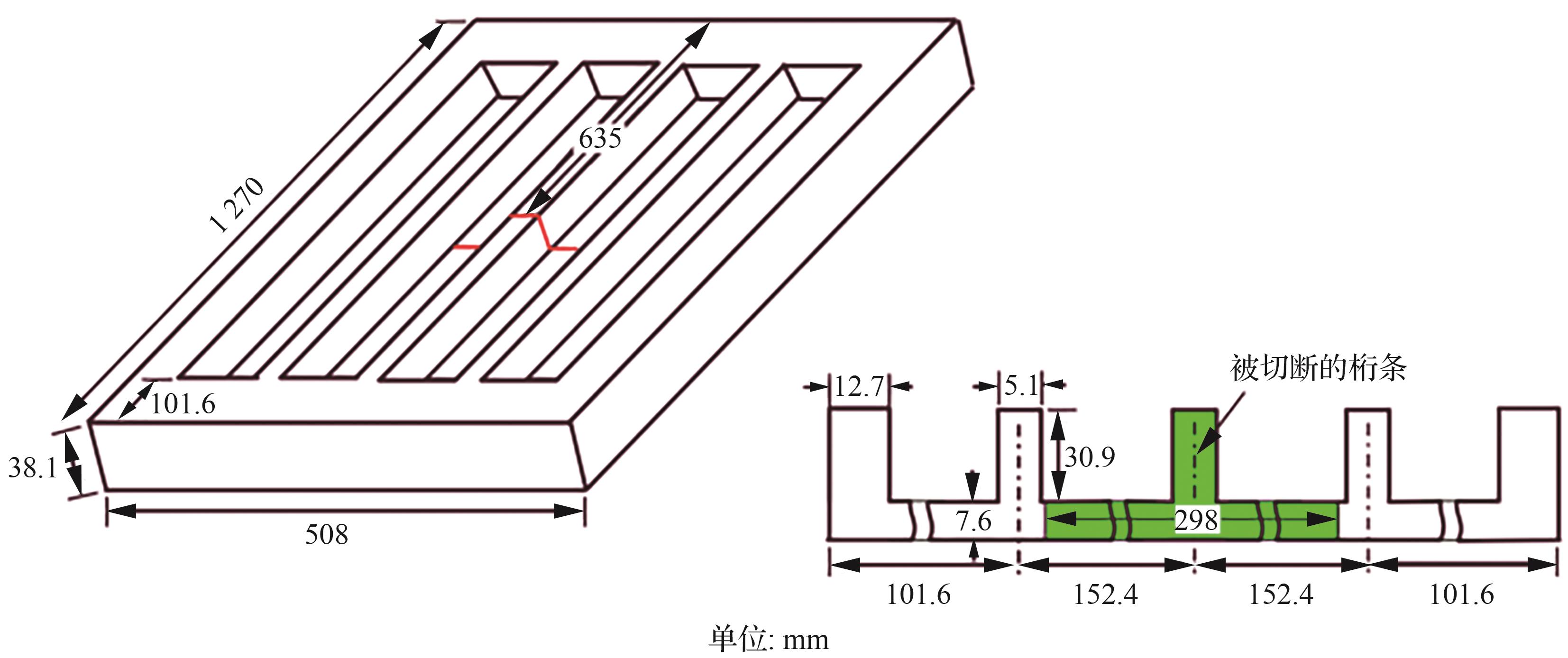
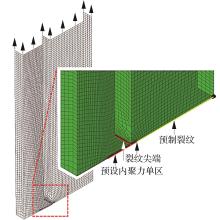
图 26
壳单元模型及预设的内聚单元[5]
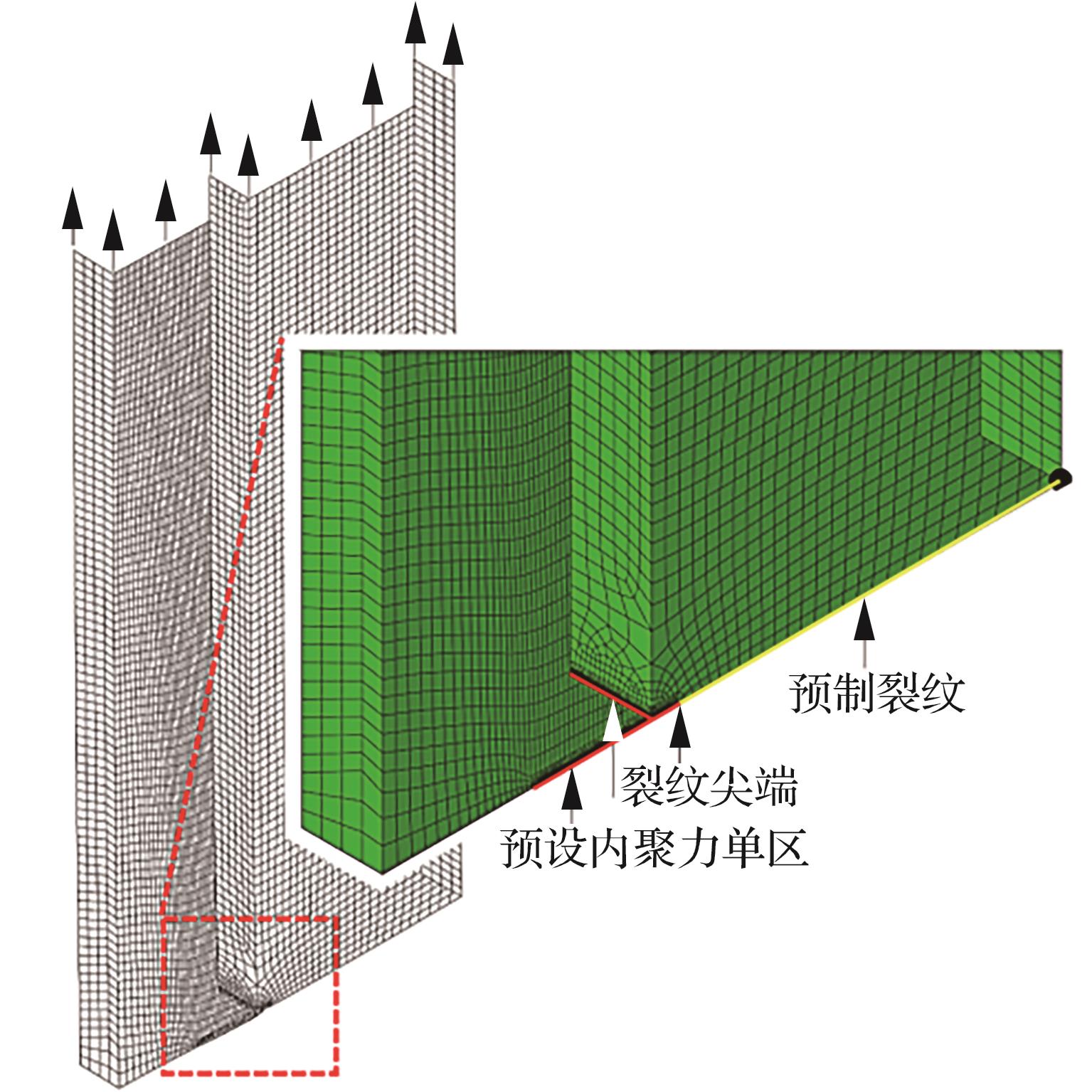
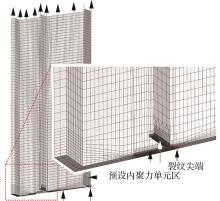
图 27
三维单元模型及预设的内聚单元[5]
图 28
2种模型预测结果与试验对比[5]
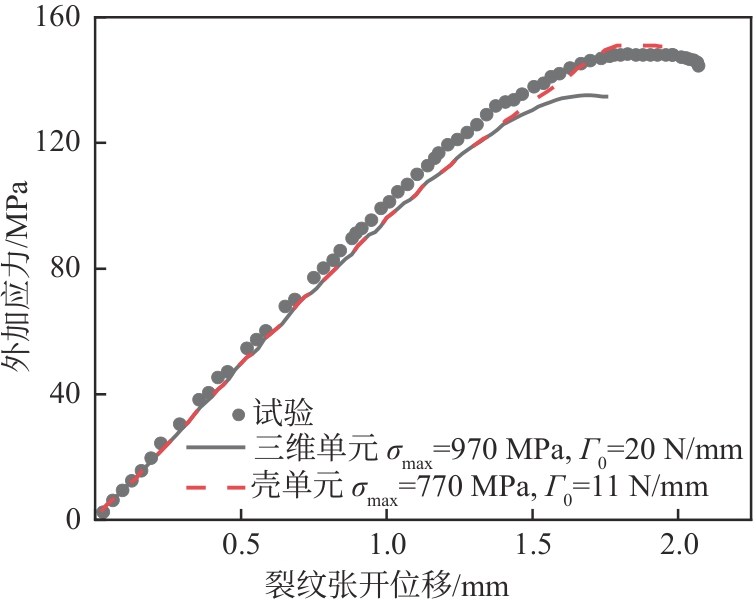

图 29
韧带在最大载荷下的正应力云图[5]

图 30
3种典型工况下的应力三轴度分布[5]
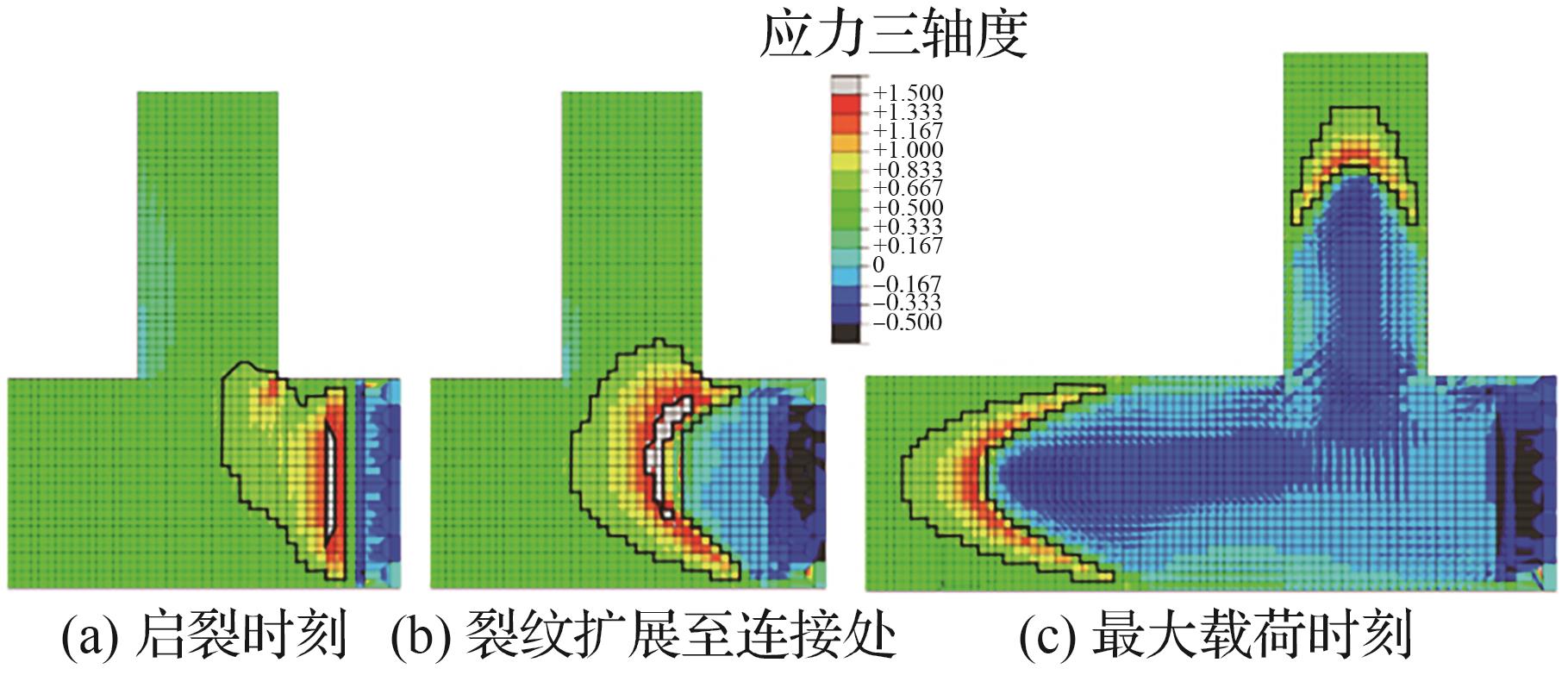

图 31
M(T)试样裂的应力三轴度云图[5]

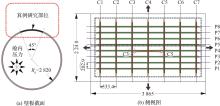
图 32
含双舱裂纹的机身结构[9]
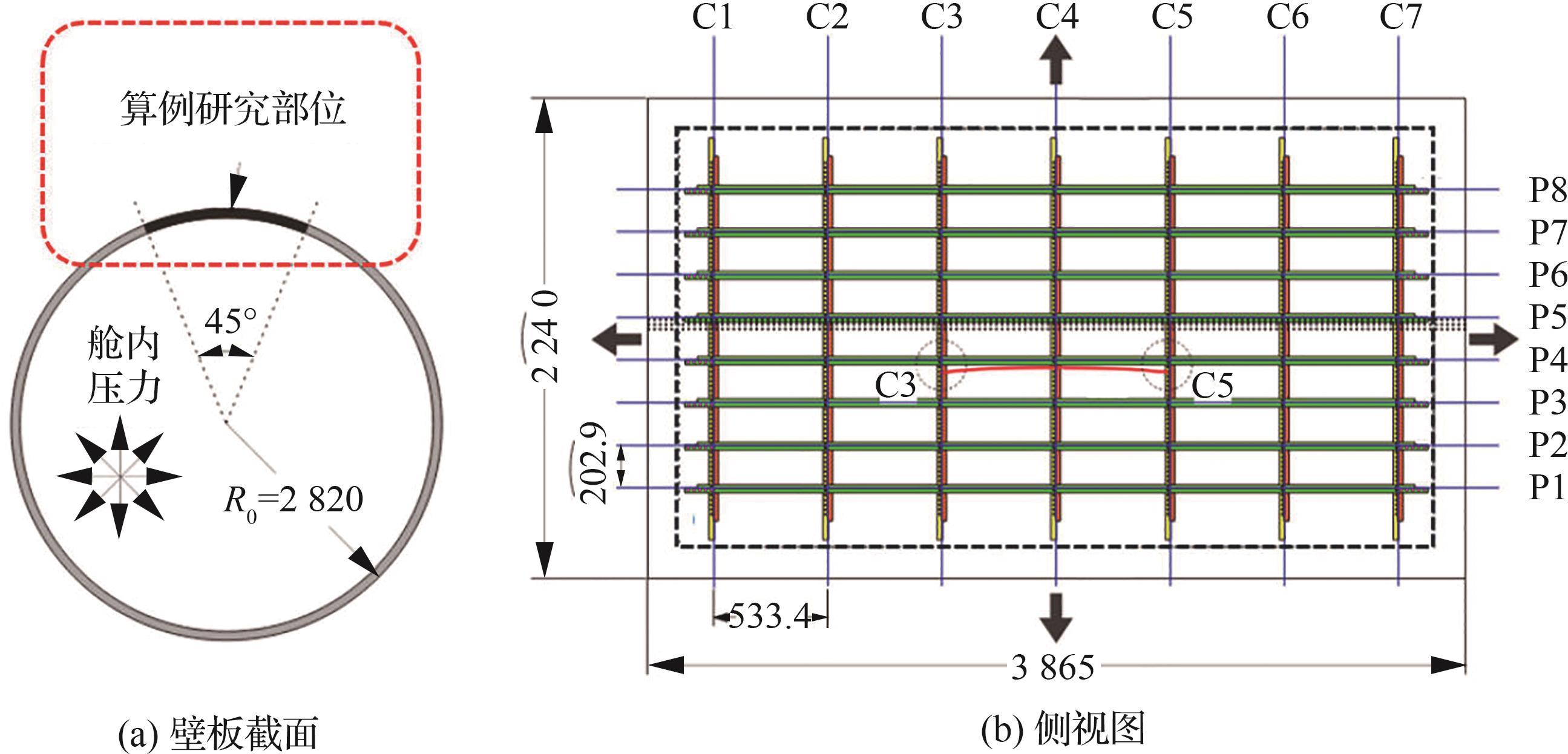
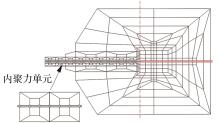
图 33
内聚单元的插入位置[9]
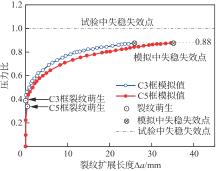
图 34
C3框与C5框处归一化压力-裂纹扩展曲线[9]
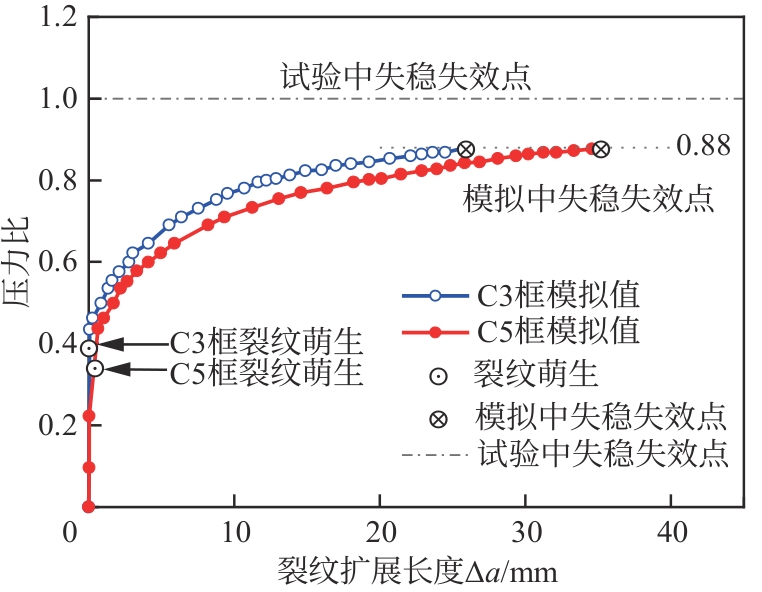
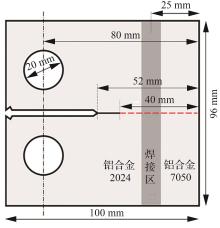
图 35
搅拌摩擦焊连接的异种铝合金C(T)试样[44]
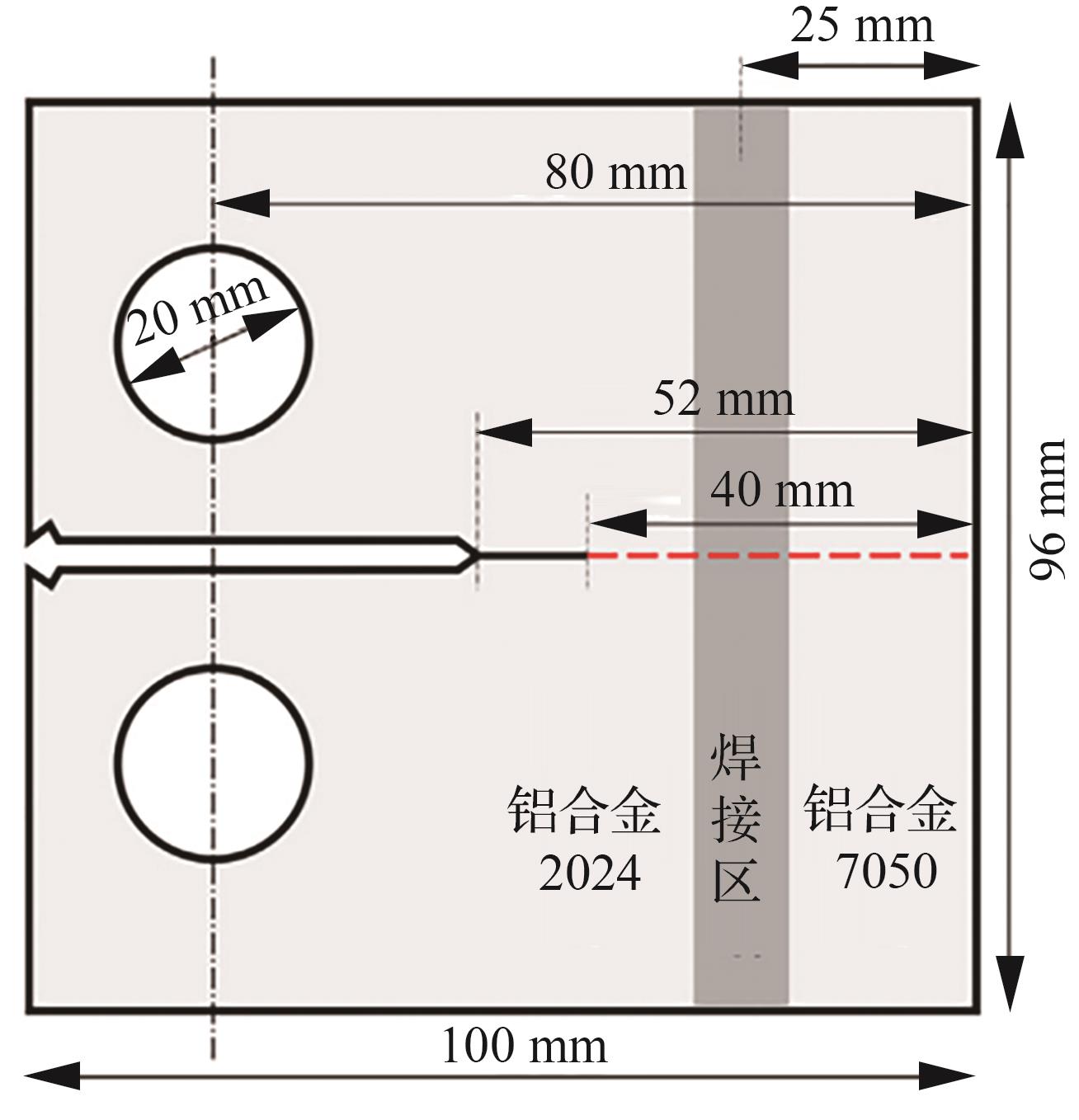
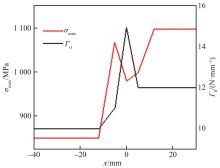
图 36
焊接区内聚参数变化[44]
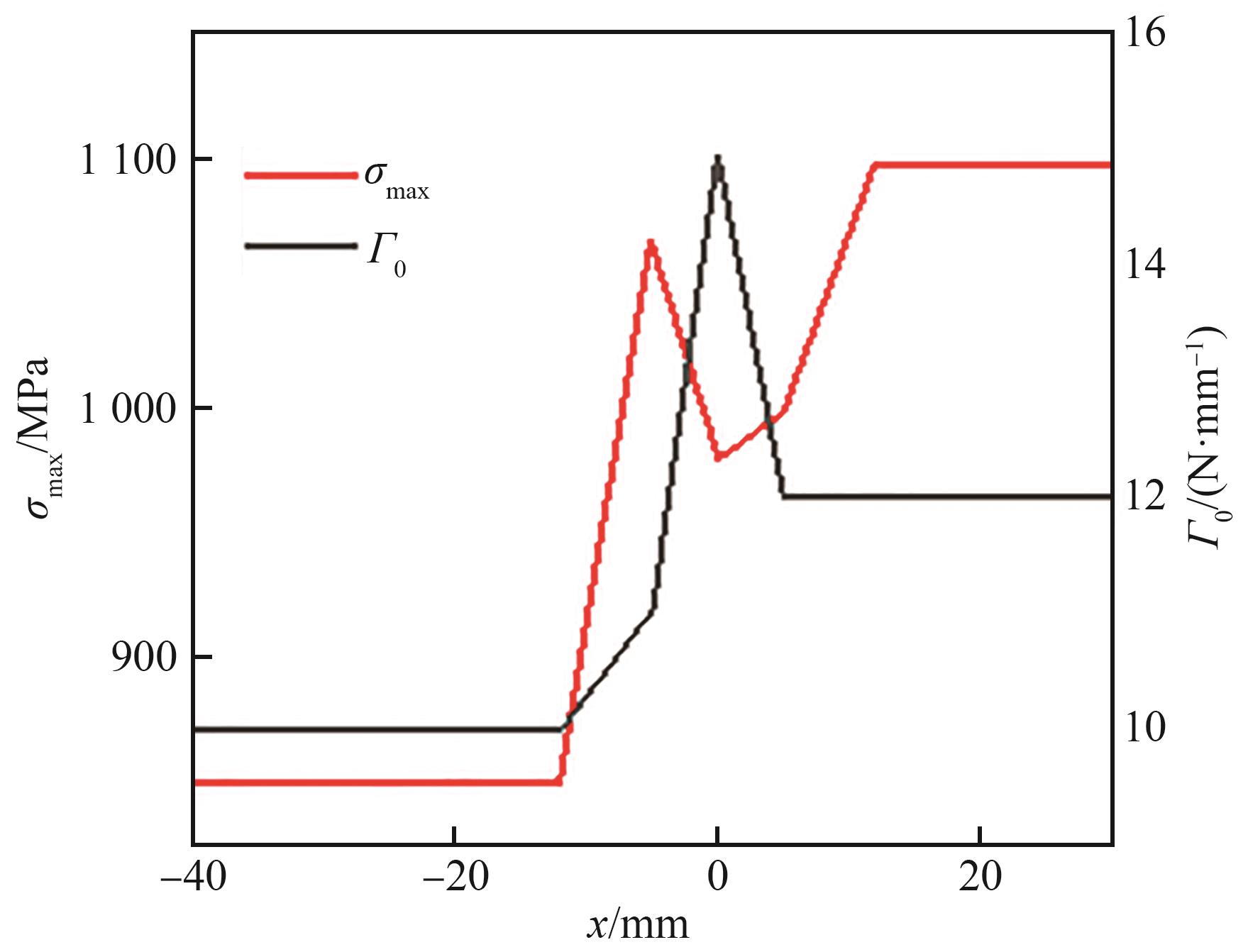
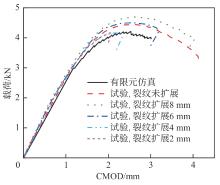
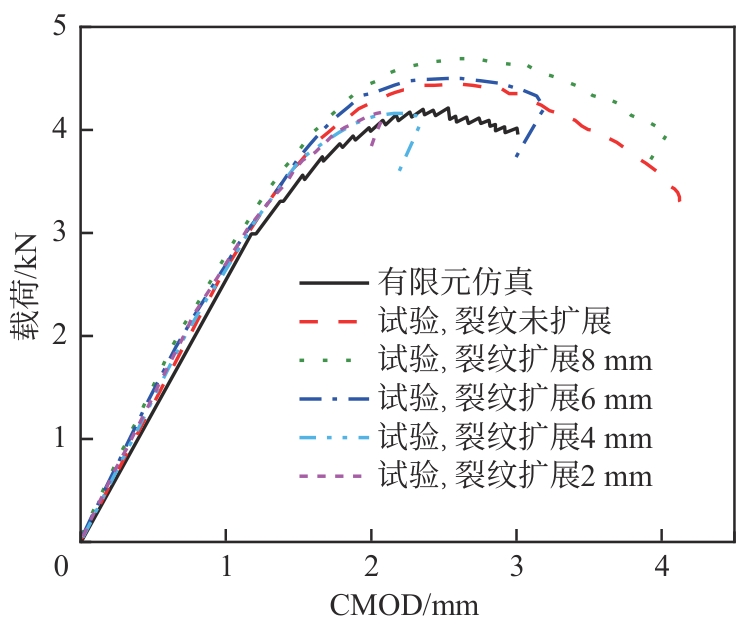
图 37
有限元模拟结果与多工况试验结果[44]
| [1] | 段佳桐, 隋福成, 刘汉海, 等. 弯曲载荷下薄壁结构疲劳裂纹扩展性能[J]. 航空学报, 2021, 42(5): 524326. |
| DUAN J T, SUI F C, LIU H H, et al. Fatigue crack growth performance of thin-walled structure under bending load[J]. Acta Aeronautica et Astronautica Sinica, 2021, 42(5): 524326 (in Chinese). | |
| [2] | 王彬文, 陈先民, 苏运来, 等. 中国航空工业疲劳与结构完整性研究进展与展望[J]. 航空学报, 2021, 42(5): 524651. |
| WANG B W, CHEN X M, SU Y L, et al. Research progress and prospect of fatigue and structural integrity for aeronautical industry in China[J]. Acta Aeronautica et Astronautica Sinica, 2021, 42(5): 524651 (in Chinese). | |
| [3] | LU L K, LIU Z L, ZHUANG Z. The physical meanings of two incremental-J-integral-based fracture criteria for crack growth in elastic-plastic materials[J]. Engineering Fracture Mechanics, 2022, 259: 108106. |
| [4] | 姚寅, 黄再兴. 基于原子内聚力与表面能等效的内聚裂纹模型[J]. 航空学报, 2010, 31(9): 1796-1801. |
| YAO Y, HUANG Z X. A surface-energy equivalent cohesive crack model based on atomic cohesive force[J]. Acta Aeronautica et Astronautica Sinica, 2010, 31(9): 1796-1801 (in Chinese). | |
| [5] | SCHEIDER I, BROCKS W. Residual strength prediction of a complex structure using crack extension analyses[J]. Engineering Fracture Mechanics, 2009, 76(1): 149-163. |
| [6] | WOELKE P B, SHIELDS M D, HUTCHINSON J W. Cohesive zone modeling and calibration for mode I tearing of large ductile plates[J]. Engineering Fracture Mechanics, 2015, 147: 293-305. |
| [7] | SCHEIDER I, BROCKS W. Cohesive elements for thin-walled structures[J]. Computational Materials Science, 2006, 37(1-2): 101-109. |
| [8] | LI W Z, SIEGMUND T. An analysis of crack growth in thin-sheet metal via a cohesive zone model[J]. Engineering Fracture Mechanics, 2002, 69(18): 2073-2093. |
| [9] | CORNEC A, SCHÖNFELD W, SCHWALBE K H, et al. Application of the cohesive model for predicting the residual strength of a large scale fuselage structure with a two-bay crack[J]. Engineering Failure Analysis, 2009, 16(8): 2541-2558. |
| [10] | BARENBLATT G I. The mathematical theory of equilibrium cracks in brittle fracture[J]. Advances in Applied Mechanics, 1962, 7: 55-129. |
| [11] | DUGDALE D S. Yielding of steel sheets containing slits[J]. Journal of the Mechanics and Physics of Solids, 1960, 8(2): 100-104. |
| [12] | CHEN X, DENG X M, SUTTON M A. Simulation of stable tearing crack growth events using the cohesive zone model approach[J]. Engineering Fracture Mechanics, 2013, 99: 223-238. |
| [13] | NEEDLEMAN A. An analysis of decohesion along an imperfect interface[J]. International Journal of Fracture, 1990, 42(1): 21-40. |
| [14] | TVERGAARD V, HUTCHINSON J W. The relation between crack growth resistance and fracture process parameters in elastic-plastic solids[J]. Journal of the Mechanics and Physics of Solids, 1992, 40(6): 1377-1397. |
| [15] | CORNEC A, SCHEIDER I, SCHWALBE K H. On the practical application of the cohesive model[J]. Engineering Fracture Mechanics, 2003, 70(14): 1963-1987. |
| [16] | ROYCHOWDHURY S, ARUN ROY Y DAS, DODDS R H. Ductile tearing in thin aluminum panels: experiments and analyses using large-displacement, 3-D surface cohesive elements[J]. Engineering Fracture Mechanics, 2002, 69(8): 983-1002. |
| [17] | SCHEIDER I, BROCKS W. Simulation of cup–cone fracture using the cohesive model[J]. Engineering Fracture Mechanics, 2003, 70(14): 1943-1961. |
| [18] | YUAN H, LI X. Effects of the cohesive law on ductile crack propagation simulation by using cohesive zone models[J]. Engineering Fracture Mechanics, 2014, 126: 1-11. |
| [19] | SCHEIDER I. Derivation of separation laws for cohesive models in the course of ductile fracture[J]. Engineering Fracture Mechanics, 2009, 76(10): 1450-1459. |
| [20] | ANVARI M, SCHEIDER I, THAULOW C. Simulation of dynamic ductile crack growth using strain-rate and triaxiality-dependent cohesive elements[J]. Engineering Fracture Mechanics, 2006, 73(15): 2210-2228. |
| [21] | CHEN C R, KOLEDNIK O, HEERENS J, et al. Three-dimensional modeling of ductile crack growth: Cohesive zone parameters and crack tip triaxiality[J]. Engineering Fracture Mechanics, 2005, 72(13): 2072-2094. |
| [22] | VANAPALLI V T, DUTTA B K, CHATTOPADHYAY J, et al. Stress triaxiality based transferability of cohesive zone parameters[J]. Engineering Fracture Mechanics, 2020, 224: 106789. |
| [23] | SCHEIDER I, BROCKS W. The effect of the traction separation law on the results of cohesive zone crack propagation analyses[J]. Key Engineering Materials, 2003, 251-252: 313-318. |
| [24] | SCHEIDER I, BROCKS W. Effect of cohesive law and triaxiality dependence of cohesive parameters in ductile tearing[C]∥GDOUTOS E E. Fracture of Nano and Engineering Materials and Structures: Proceedings of the 16th European Conference of Fracture. Dordrecht: Springer, 2006: 1-7. |
| [25] | SCHWALBE K H, SCHEIDER I, CORNEC A. Guidelines for applying cohesive models to the damage behaviour of engineering materials and structures[M]. Berlin, Heidelberg: Springer, 2013. |
| [26] | YUAN H, LIN G Y, CORNEC A. Verification of a cohesive zone model for ductile fracture[J]. Journal of Engineering Materials and Technology, 1996, 118(2): 192-200. |
| [27] | SIEGMUND T, BROCKS W, HEERENS J, et al. Modeling of crack growth in thin sheet aluminum[C]∥ Recent Advances in Solids and Structures. New York: American Society of Mechanical Engineers, 1999: 15-22. |
| [28] | SHET C, CHANDRA N. Analysis of energy balance when using cohesive zone models to simulate fracture processes[J]. Journal of Engineering Materials and Technology, 2002, 124(4): 440-450. |
| [29] | ZHANG S, XUE H, WANG S, et al. A new method to determine cohesive parameters of elastic-plastic materials based on elastic component of J-integral[J]. Engineering Fracture Mechanics, 2025, 315: 110793. |
| [30] | ASTM International. : Standard test method for measurement of fracture toughness [S]. West Conshohocken: ASTM International, 2023. |
| [31] | Metallic materials-Unified method of test for the determination of quasistatic fracture toughness: [S]. International Organization for Standardization, 2002. |
| [32] | European Structural Integrity Society. ESIS recommendations for determining the fracture resistance of ductile materials: ESIS P1-92 [S]. Delf: European Structural Integrity Society, 1992. |
| [33] | SCHWALBE K H, HEERENS J, ZERBST U, et al. EFAM GTP 02-The GKSS procedure for determining the fracture behaviour of materials: 2002/24[R]. Geesthacht: GKSS Research Centre, 2002. |
| [34] | TAO C C, ZHANG C, JI H L, et al. Reconstruction and prediction of Mode-I cohesive law using artificial neural network[J]. Composites Science and Technology, 2024, 256: 110755. |
| [35] | PEREIRA F, DOURADO N, MORAIS J J L, et al. A new method for the identification of cohesive laws under pure loading modes[J]. Engineering Fracture Mechanics, 2022, 271: 108594. |
| [36] | 王彬文, 段世慧, 聂小华, 等. 航空结构分析CAE软件发展现状与未来挑战[J]. 航空学报, 2022, 43(6): 527272. |
| WANG B W, DUAN S H, NIE X H, et al. Development situation and future challenges of CAE software used in aeronautical structural analysis[J]. Acta Aeronautica et Astronautica Sinica, 2022, 43(6): 527272 (in Chinese). | |
| [37] | ROY Y A, DODDS R H. Simulation of ductile crack growth in thin aluminum panels using 3-D surface cohesive elements[J]. International Journal of Fracture, 2001, 110(1): 21-45. |
| [38] | SIEGMUND T, BROCKS W. Prediction of the work of separation and implications to modeling[J]. International Journal of Fracture, 1999, 99(1): 97-116. |
| [39] | ZAVATTIERI P D. Modeling of crack propagation in thin-walled structures using a cohesive model for shell elements[J]. Journal of Applied Mechanics, 2006, 73(6): 948-958. |
| [40] | BANERJEE A, MANIVASAGAM R. Triaxiality dependent cohesive zone model[J]. Engineering Fracture Mechanics, 2009, 76(12): 1761-1770. |
| [41] | SCHEIDER I, SCHÖDEL M. Simulation of crack growth in Al panels under biaxial loading[J]. Advanced Engineering Materials, 2006, 8(5): 410-414. |
| [42] | CHEN C R, KOLEDNIK O, SCHEIDER I, et al. On the determination of the cohesive zone parameters for the modeling of micro-ductile crack growth in thick specimens[J]. International Journal of Fracture, 2003, 120(3): 517-536. |
| [43] | BROCKS W, FALKENBERG R, SCHEIDER I. Coupling aspects in the simulation of hydrogen-induced stress-corrosion cracking[J]. Procedia IUTAM, 2012, 3: 11-24. |
| [44] | SCHEIDER I, BARBINI A, DOS SANTOS J F. Numerical residual strength prediction of stationary shoulder friction stir welding structures[J]. Engineering Fracture Mechanics, 2020, 230: 107010. |
| [45] | XU W, WAAS A M. Multiple solutions in cohesive zone models of fracture[J]. Engineering Fracture Mechanics, 2017, 177: 104-122. |
| [46] | 鲁龙坤. 弹塑性材料中裂纹尖端张开角的作用机理研究[D]. 西安: 西北工业大学, 2019: 99-112. |
| LU L K. The mechanism research of crack tip opening angle in elastic plastic materials [D]. Xi’an: Northwestern Polytechnical University, 2019: 99-112 (in Chinese). | |
| [47] | LU L K. A quantitative description of the influence of plastic dissipation on crack growth behaviors[J]. Engineering Fracture Mechanics, 2024, 305: 110197. |
| [48] | BROCKS W, SCHEIDER I, SCHÖDEL M. Simulation of crack extension in shell structures and prediction of residual strength[J]. Archive of Applied Mechanics, 2006, 76(11): 655-665. |
| [49] | 庄茁, 王恒, 宁宇, 等. 壳体断裂力学统一计算理论与飞行器结构设计[J]. 工程力学, 2023, 40(2): 1-7. |
| ZHUANG Z, WANG H, NING Y, et al. Unified computational theory of fracture mechanics in shell and aircraft structural design[J]. Engineering Mechanics, 2023, 40(2): 1-7. | |
| [50] | 孟亮, 杨金沅, 杨智威, 等. 典型飞机壁板结构的抗屈曲优化设计与试验验证[J]. 航空学报, 2024, 45(5): 529679. |
| MENG L, YANG J Y, YANG Z W, et al. Buckling-resisting optimization design of typical aircraft panel and test validation[J]. Acta Aeronautica et Astronautica Sinica, 2024, 45(5): 529679 (in Chinese). | |
| [51] | 王彬文, 陈向明, 邓凡臣, 等. 飞机壁板复杂载荷试验技术[J]. 航空学报, 2022, 43(3): 024987. |
| WANG B W, CHEN X M, DENG F C, et al. Complex load test technology for aircraft panels: Review[J]. Acta Aeronautica et Astronautica Sinica, 2022, 43(3): 024987 (in Chinese). | |
| [52] | ZERBST U, HEINIMANN M, DONNE C D, et al. Fracture and damage mechanics modelling of thin-walled structures—An overview[J]. Engineering Fracture Mechanics, 2009, 76(1): 5-43. |
| [53] | LU L K, LIU Z L, WANG T, et al. An analytical model of fracture process zone to explain why crack-tip opening angle works[J]. Engineering Fracture Mechanics, 2020, 233: 107054. |
| [54] | LU L K, LIU Z L, CUI Y N, et al. Driving force on line fracture process zone and fracture parameters suitable for elastic–plastic materials[J]. International Journal of Solids and Structures, 2021, 217-218: 15-26. |
| [1] | 郑建军, 王孟孟, 牧彬, 魏莎. 基于弹性阻尼的全机疲劳试验约束点动态载荷抑制方法[J]. 航空学报, 2025, 46(21): 532283-532283. |
| [2] | 施英杰, 刘斌超, 鲁嵩嵩, 陈亮, 尚海, 鲍蕊. 融合试验-仿真标定数据的机翼应变载荷关系神经网络模型[J]. 航空学报, 2025, 46(19): 530921-530921. |
| [3] | 代定强, 周轩, 董雷霆, 孙侠生. 数字工程与数字孪生在航空疲劳与结构完整性领域的研究进展与展望[J]. 航空学报, 2025, 46(19): 531022-531022. |
| [4] | 聂祥樊, 李阳, 王亚洲, 万全红, 何卫锋. 飞机结构激光冲击强化研究进展与展望[J]. 航空学报, 2023, 44(24): 28595-028595. |
| [5] | 贺小帆, 朱俊贤. 军用飞机结构耐久性严重谱编制与应用研究进展[J]. 航空学报, 2022, 43(12): 25070-025070. |
| [6] | 高鑫, 李仁政, 王斌利, 李卫东, 赵中刚. 飞机结构件轮廓特征加工自动分区算法[J]. 航空学报, 2021, 42(7): 625346-625346. |
| [7] | 崔德刚, 鲍蕊, 张睿, 刘斌超, 欧阳天. 飞机结构疲劳与结构完整性发展综述[J]. 航空学报, 2021, 42(5): 524394-524394. |
| [8] | 王鑫涛, 杜星. 飞机结构强度试验应急载荷限定系统[J]. 航空学报, 2020, 41(2): 223332-223332. |
| [9] | 熊青春, 王家序, 周青华. 融合机床精度与工艺参数的铣削误差预测模型[J]. 航空学报, 2018, 39(8): 421713-421713. |
| [10] | 舒展, 彭啸, 李发飞, 徐强. 基于探针试验的预浸料黏性内聚力模型[J]. 航空学报, 2018, 39(2): 421416-421416. |
| [11] | 王燕礼, 朱有利, 曹强, 张小辉. 孔挤压强化技术研究进展与展望[J]. 航空学报, 2018, 39(2): 21336-021336. |
| [12] | 彭啸, 舒展, 都涛, 徐强. 面向铺放工艺的预浸料剥离仿真与试验验证[J]. 航空学报, 2018, 39(12): 422246-422246. |
| [13] | 张腾, 何宇廷, 谭申刚, 王新波, 张胜. 用于飞机结构选材的系列材料性能指标及其应用[J]. 航空学报, 2016, 37(10): 3170-3177. |
| [14] | 贺小帆, 董颖豪, 李玉海, 刘文珽. 综合考虑载荷谱和结构特性分散的概率断裂力学方法[J]. 航空学报, 2015, 36(4): 1142-1149. |
| [15] | 郎利辉, 杨希英, 刘康宁, 蔡高参, 郭禅. 一种韧性断裂准则中材料常数的计算模型及其应用[J]. 航空学报, 2015, 36(2): 672-679. |
| 阅读次数 | ||||||
|
全文 |
|
|||||
|
摘要 |
|
|||||
版权所有 © 航空学报编辑部
版权所有 © 2011航空学报杂志社
主管单位:中国科学技术协会 主办单位:中国航空学会 北京航空航天大学

 CJA
CJA
