孔武斌1,2( ), 刘迪1,2, 范兴纲1,2, 裴雪军1,2, 郝圣桥1,2,3, 崔颖4, 马前容4, 李大伟1,2, 方海洋1,2, 俞珏1,3, 程颐1,3, 陈文娟1,5, 罗飞腾1,5
收稿日期:2024-05-16
修回日期:2024-06-05
接受日期:2024-08-05
出版日期:2024-08-21
发布日期:2024-08-20
通讯作者:
孔武斌
E-mail:wubinkong@126.com
基金资助:
Wubin KONG1,2(), Di LIU1,2, Xinggang FAN1,2, Xuejun PEI1,2, Shengqiao HAO1,2,3, Ying CUI4, Qianrong MA4, Dawei LI1,2, Haiyang FANG1,2, Jue YU1,3, Yi CHENG1,3, Wenjuan CHEN1,5, Feiteng LUO1,5
Received:2024-05-16
Revised:2024-06-05
Accepted:2024-08-05
Online:2024-08-21
Published:2024-08-20
Contact:
Wubin KONG
E-mail:wubinkong@126.com
Supported by:摘要:
航空发动机引入多电技术作为其新特征,优化了系统多元能量架构,显著提升了系统可维护性和可靠性,是目前多电航空研究领域的核心组成部分。随着发电系统从百千瓦级跃升至兆瓦级,高功率、高集成度的多节点配电系统以及包括大功率泵类作动类等装置在内的用电系统共同构成了复杂的多电控制系统。针对该系统具有多节点、动静态变化叠加的特性,以及面临不同应用环境下的挑战,结合电气化基础,首先对航空发动机多电控制系统进行了源-网-荷架构的划分,并详细阐述了源、网、荷系统的基本概念、组成特点和挑战。然后,对源-网-荷一体化系统进行了提炼,综合分析了轻量化高可靠电机技术、电能变换拓扑与电机驱动控制、多节点微网组网与控制研究以及电磁兼容建模分析与抑制方法等4个关键技术的研究现状。最后,对源-网-荷系统发展趋势和多位一体的架构布局进行了总结和展望,以促进航空发动机多电控制系统加快发展。
中图分类号:
孔武斌, 刘迪, 范兴纲, 裴雪军, 郝圣桥, 崔颖, 马前容, 李大伟, 方海洋, 俞珏, 程颐, 陈文娟, 罗飞腾. 航空发动机多电控制系统源-网-荷架构与关键技术[J]. 航空学报, 2025, 46(2): 30689.
Wubin KONG, Di LIU, Xinggang FAN, Xuejun PEI, Shengqiao HAO, Ying CUI, Qianrong MA, Dawei LI, Haiyang FANG, Jue YU, Yi CHENG, Wenjuan CHEN, Feiteng LUO. Source-grid-load architecture and key technologies of aero-engine multi-electrical control system[J]. Acta Aeronautica et Astronautica Sinica, 2025, 46(2): 30689.
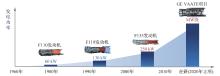
图 1
发动机发电功率变化
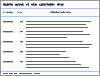
表1
B787 用电负载总结[7]
| 用电系统 | 电压等级 | 用电功率/kW |
|---|---|---|
| 环控增压系统 | 270 VDC | 320 |
| 液压系统 | 270 VDC | 40 |
| 冷却装置 | 270 VDC | 40 |
| 环控风扇 | 270 VDC | 32 |
| 防冰系统 | 230 VAC | 60 |
| 厨房 | 230 VAC | 120 |
| 燃油泵 | 230 VAC | 32 |
| 前货舱 | 230 VAC | 60 |
| 综合通讯系统ICS | 115 VAC | 40 |
| 各种交流负载 | 115 VAC | 140 |
| 飞控系统 | 28 VDC | 14 |
| 各种直流负载 | 28 VDC | 20 |
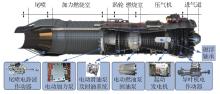
图 2
多电发动机主要组成
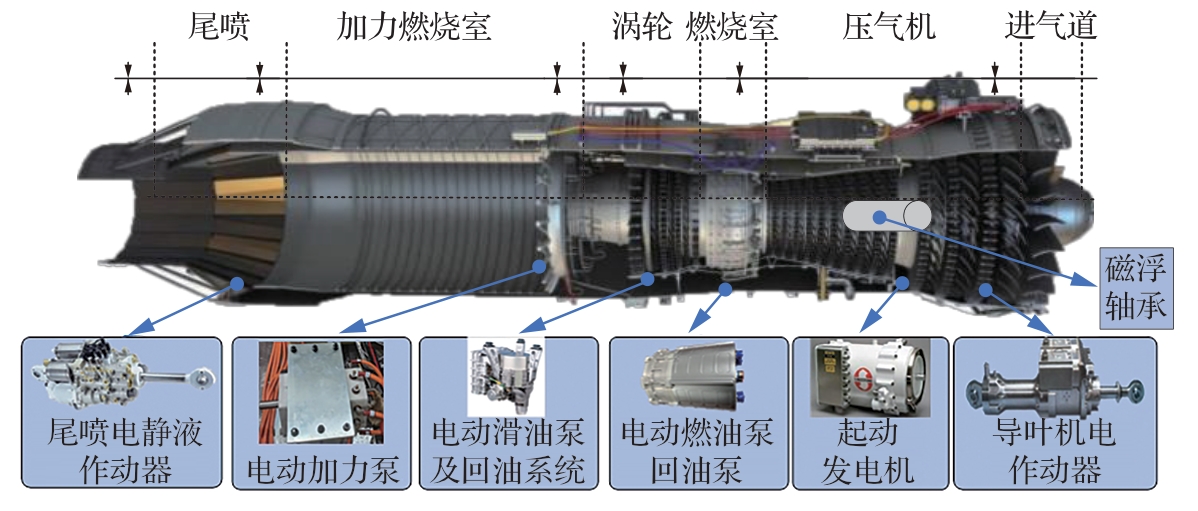
图 3
源-网-荷系统组成
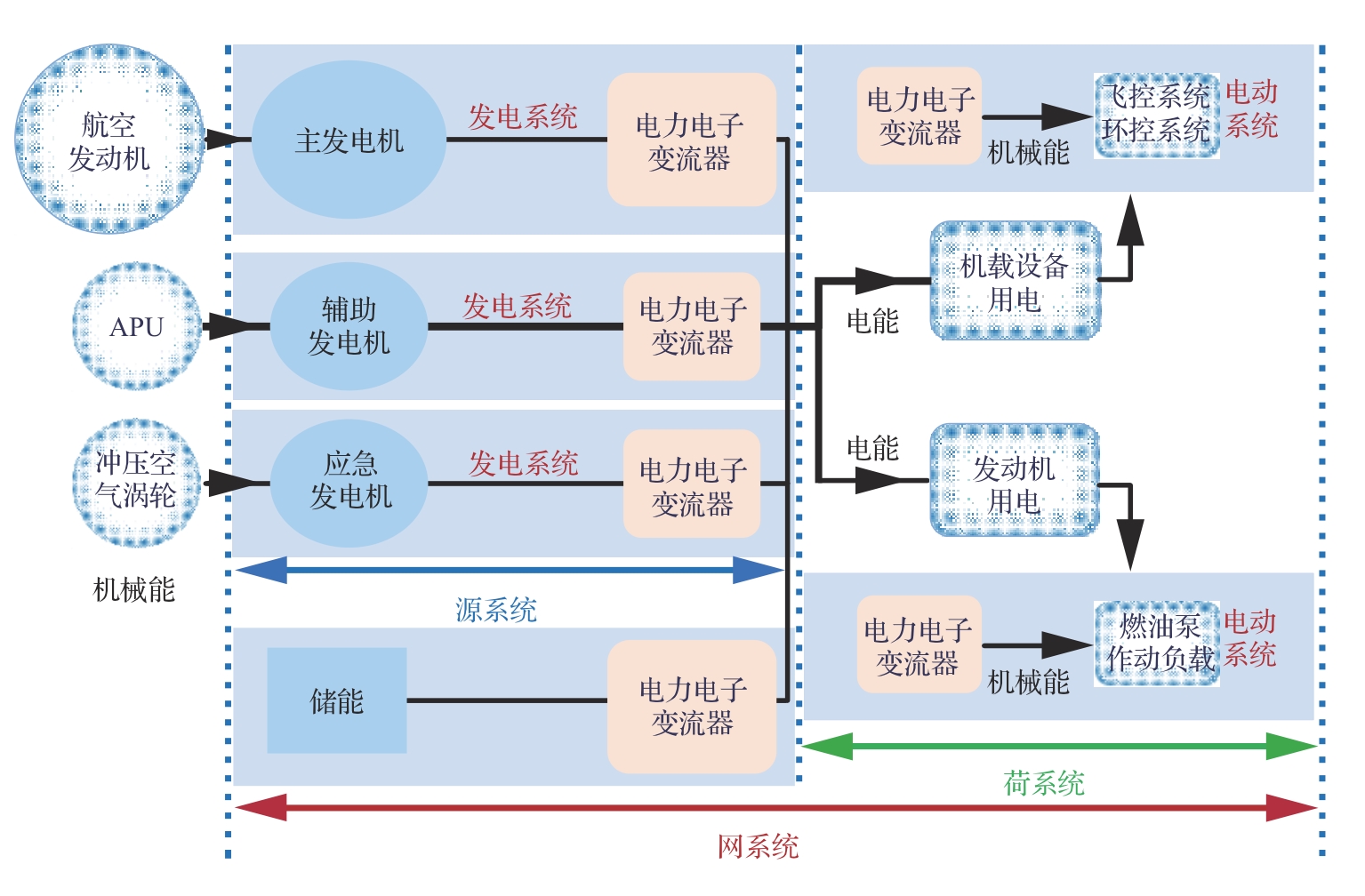
图 4
机载发电演变
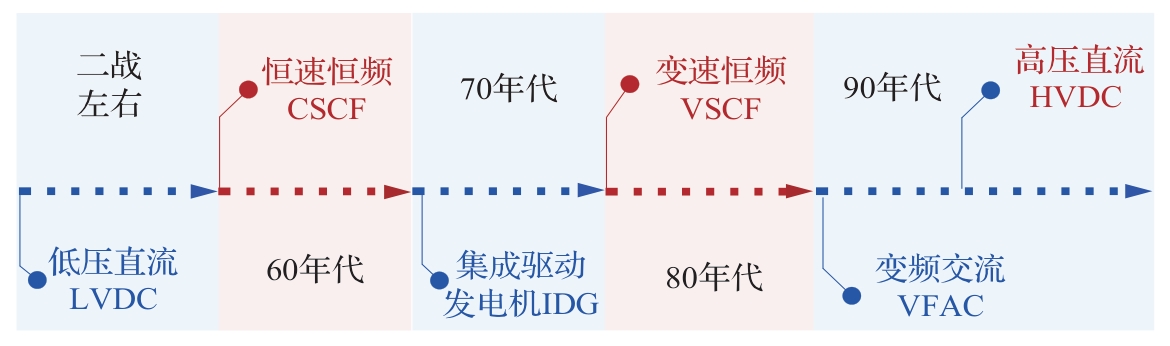
图 5
某型涡扇发动机温度分布[15]
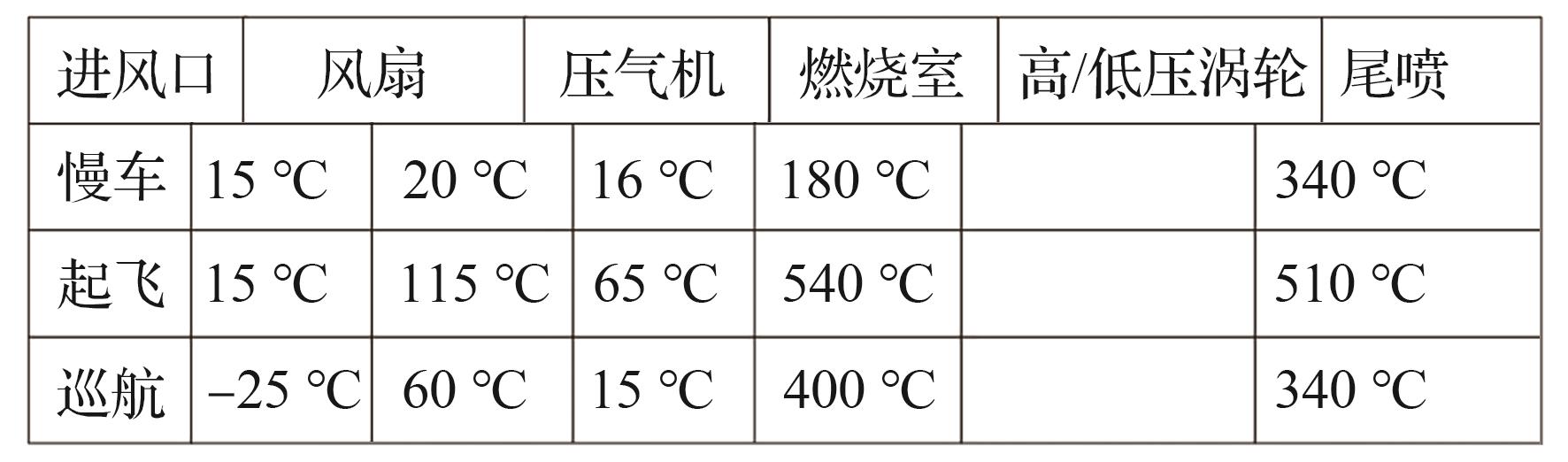
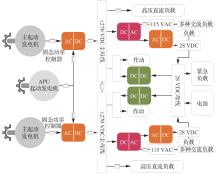
图 6
高压直流±270 VDC供电系统[31-34]
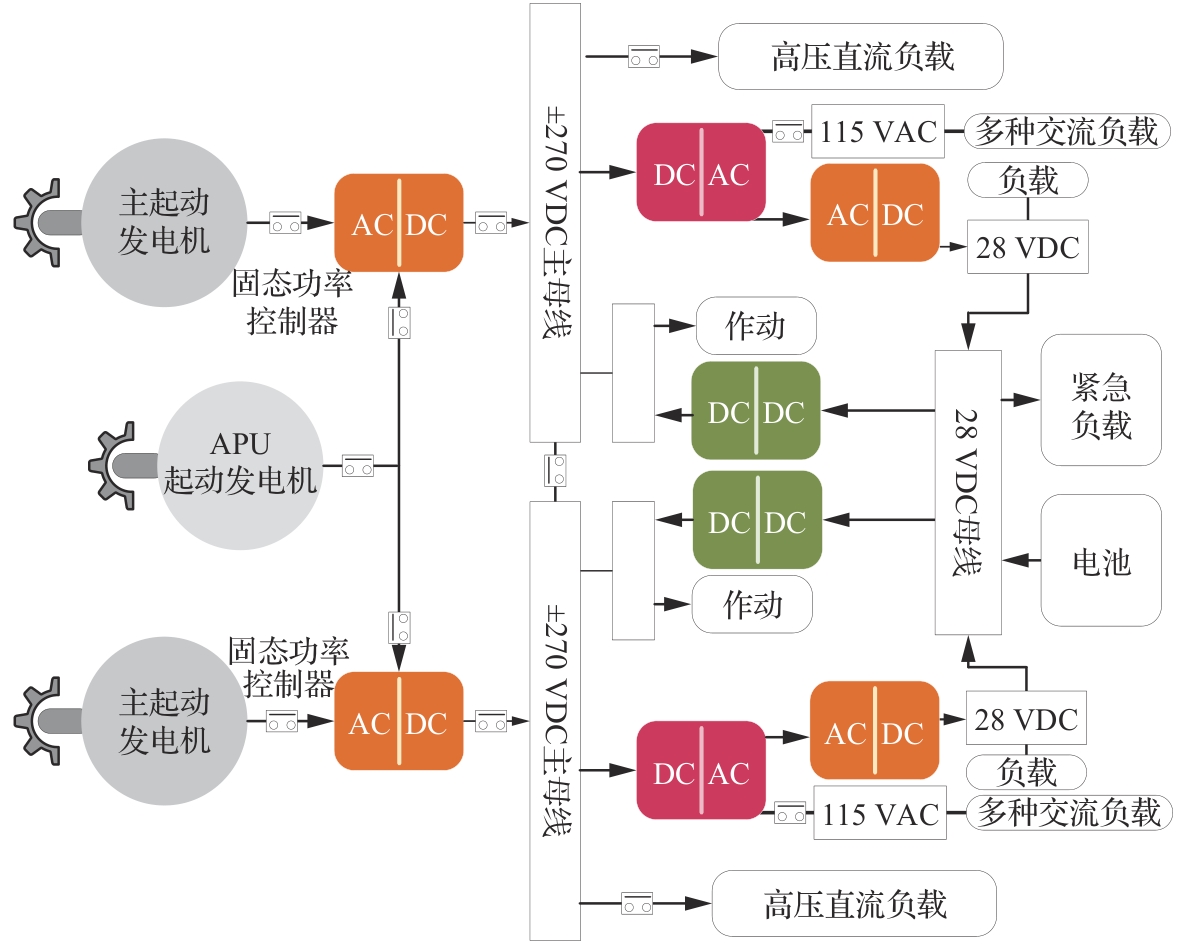
图 7
电静液作动器系统
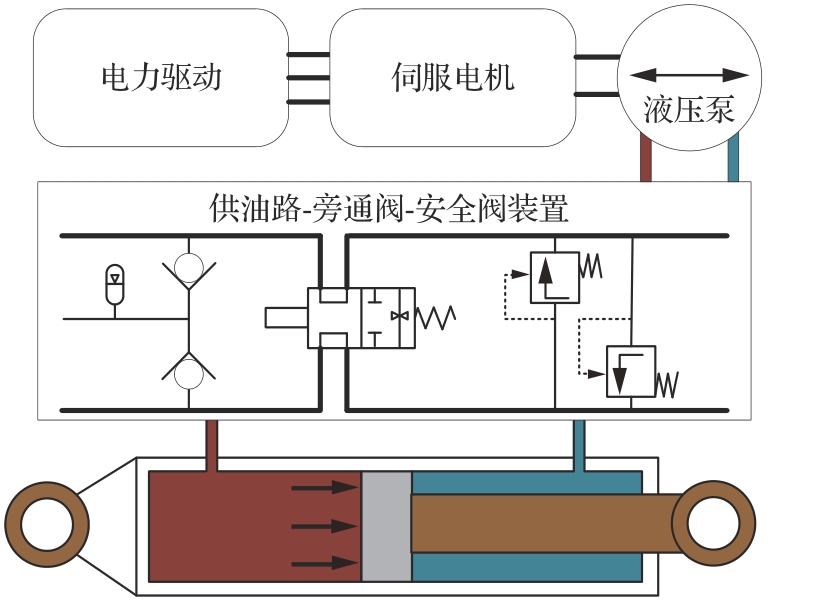
图 8
源-网-荷系统关键技术
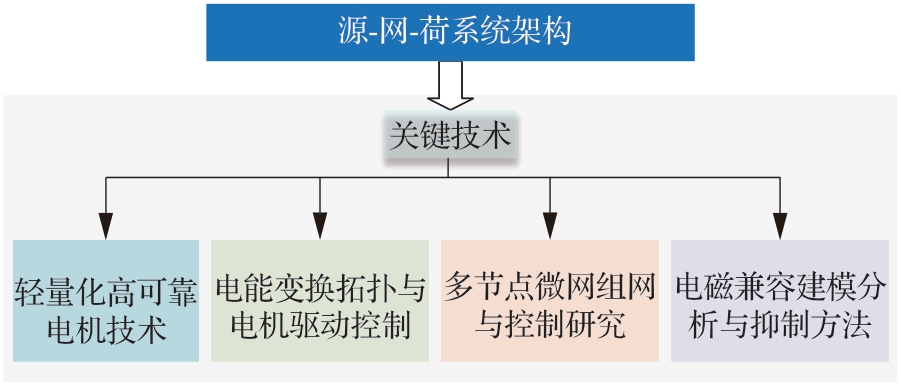
表2
电机数据总结[73]
| 电机类型 | 研究单位/公司 | 功率/kW | 功率密度/(kW·kg-1) | 冷却方式 | 效率/% |
|---|---|---|---|---|---|
| EMRAX 348 | EMRAX | 210 | 5.1 | 风冷水冷 | 95 |
| SP260-DA | Siemens | 260 | 5.9 | 油冷 | 95 |
| Magni 650-EPU | Magnix | 560 | 2.8 | ||
| Air cooled PM | Illinois Univ. | 1 000 | 13 | 96 | |
| HEMM | NASA | 1 400 | 16 | 96 | |
| SP2000D | Siemens | 2 000 | 7.7 | 水冷 | |
| IM | Ohio Unv. | 2 700 | 13 | 96 |
图 9
诺丁汉发卡绕组喷油冷却实验
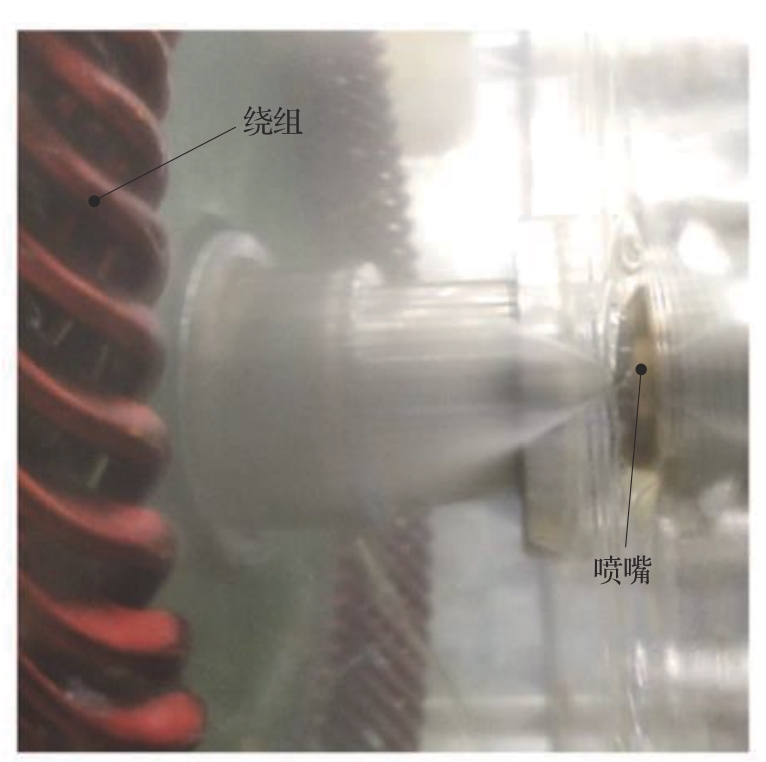
图 10
定转子全浸油冷却结构[82]
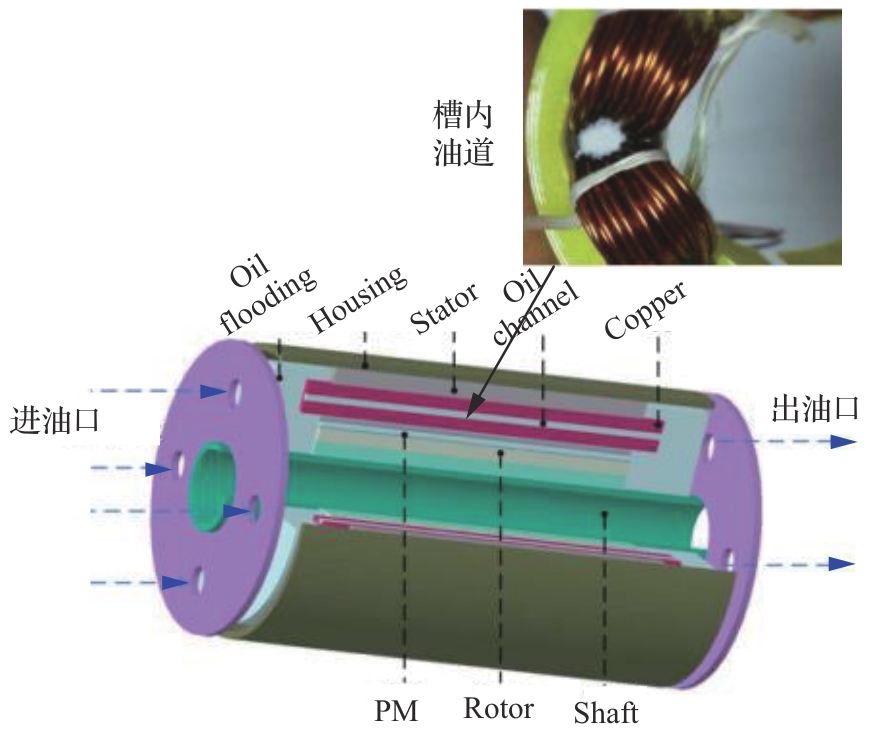
图 11
定子浸油冷却结构示意图[83]
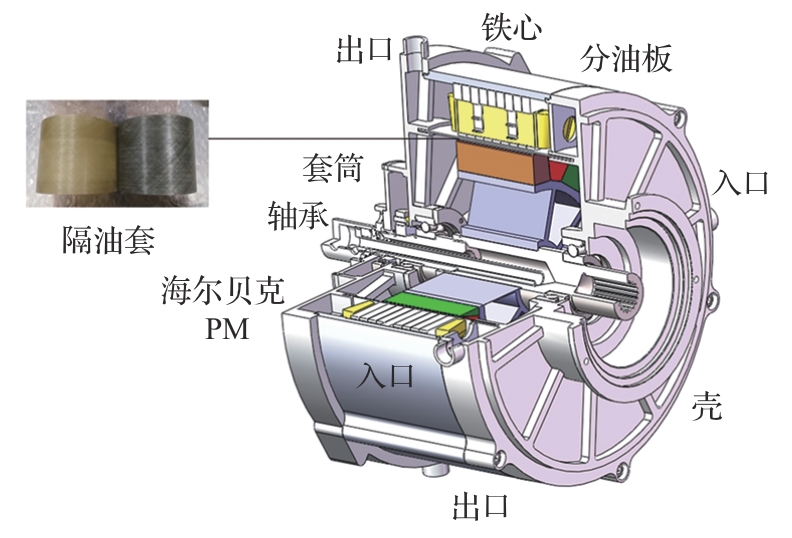
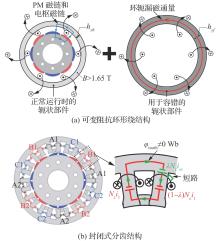
图 12
环形绕组永磁容错电机
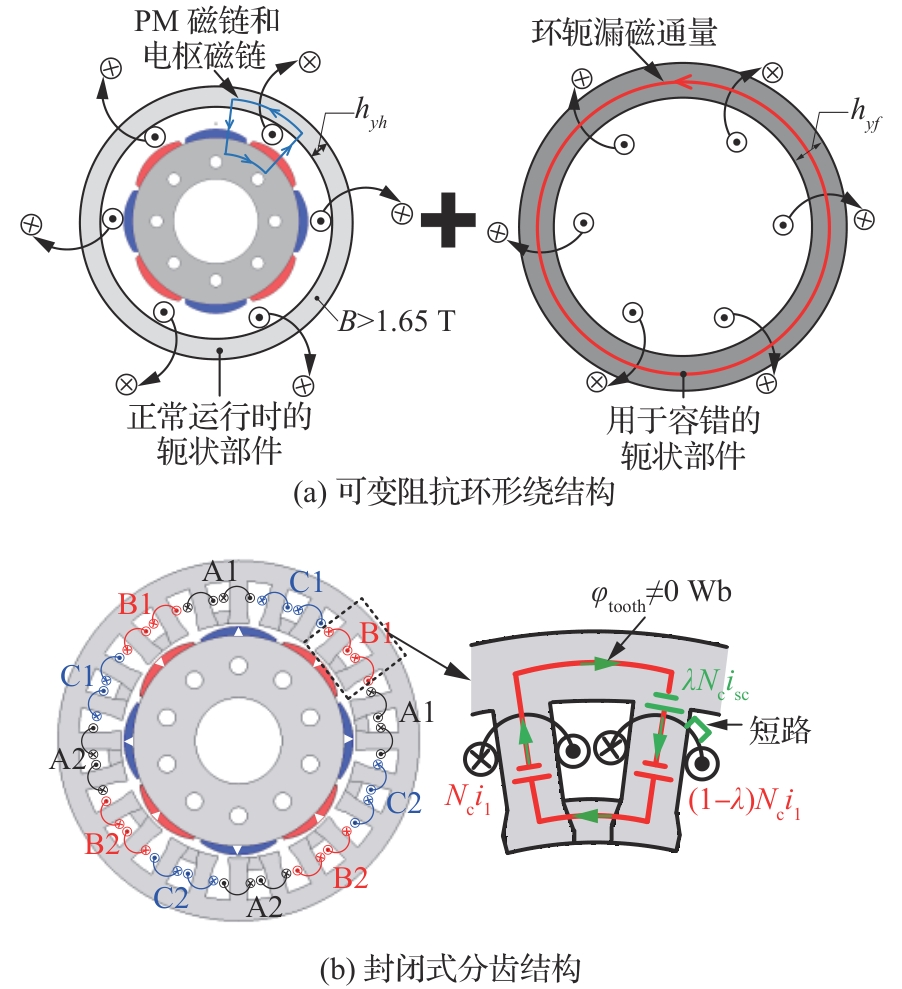
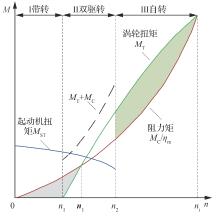
图 13
典型发动机起动过程[138]
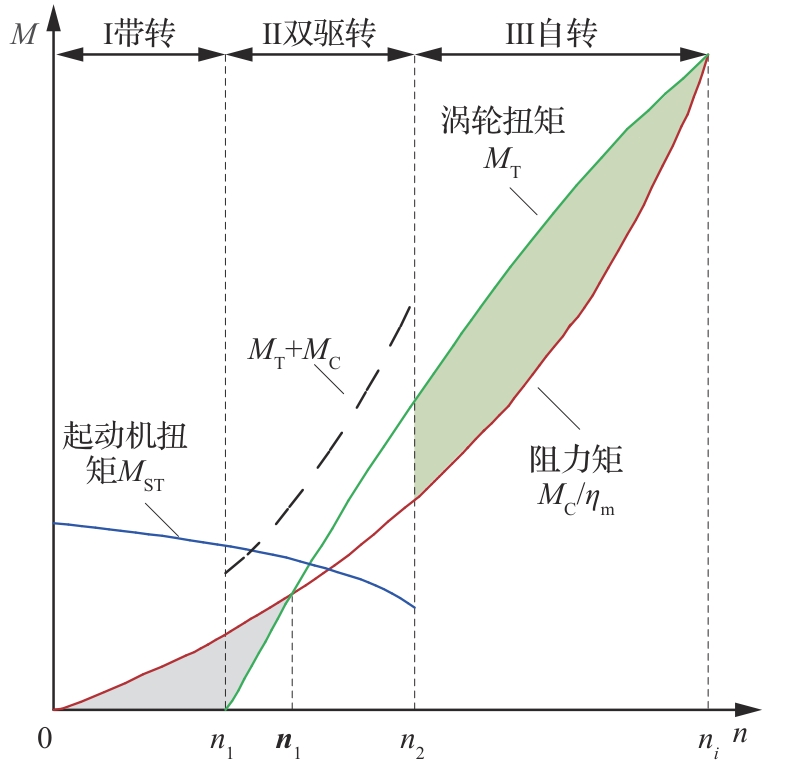
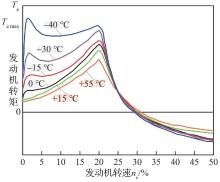
图 14
不同温度下发动机转矩曲线[142]
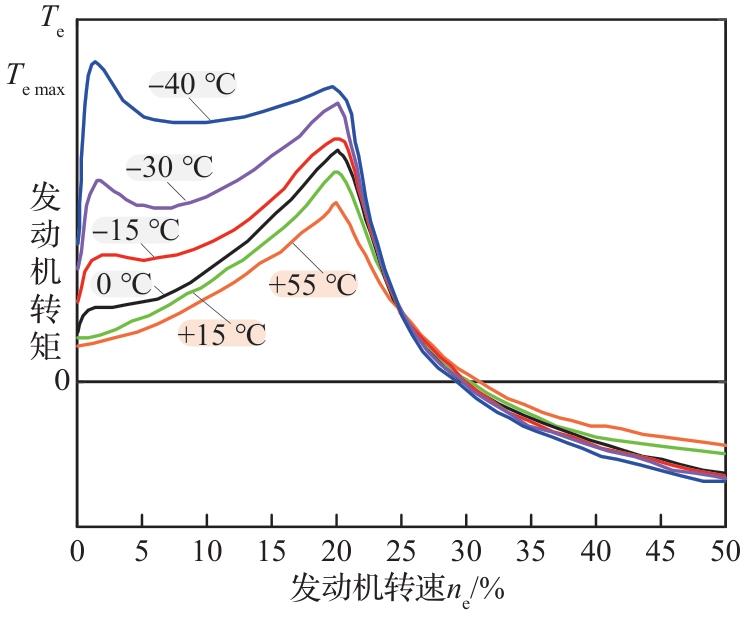
图 15
日本IHI公司燃油系统台架试验[155]
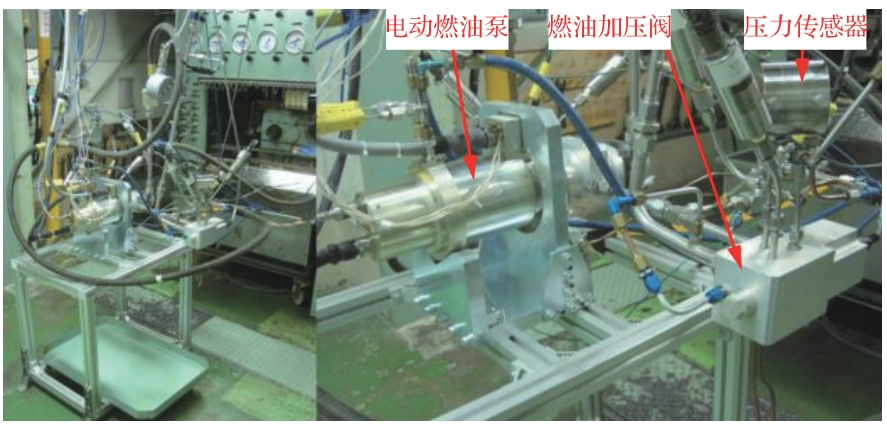
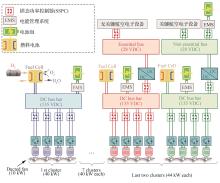
图 16
法国航空实验室ONERA提出的模块化架构[174]
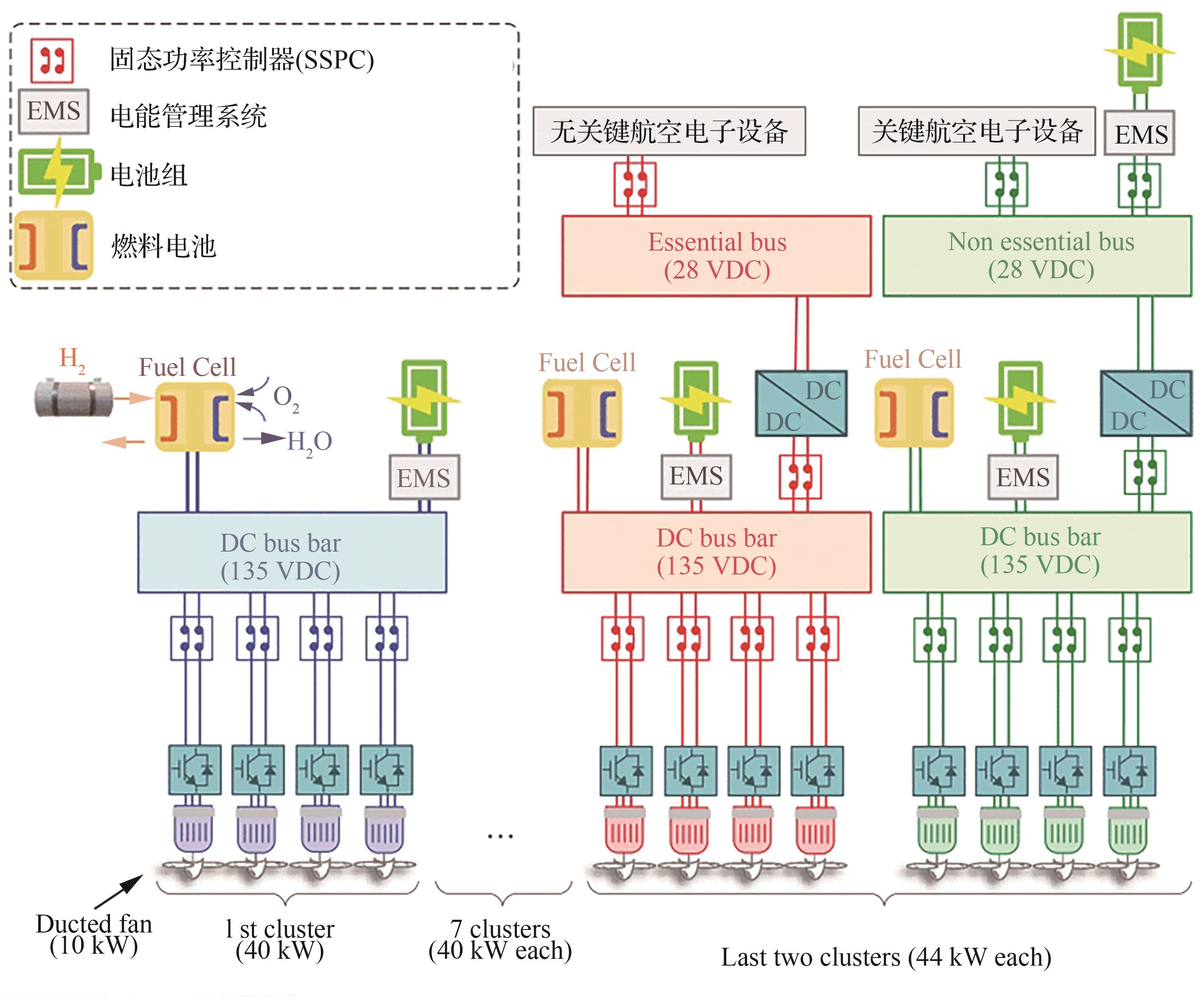
表3
小型MEA电机驱动数量[176]
| 子系统 | 电机驱动数量 | 最大功率/kW | 总功率/kW |
|---|---|---|---|
| 飞控系统 | 28 | 50 | 80 |
| 环控系统 | 10 | 10 | 40 |
| 滑行系统 | 20 | 5 | 30 |
| 气动系统 | 2 | 15 | 30 |
| 起动发电机 | 6 | 125 | 125/通道 |
| 燃油泵 | 10 | 9 | 35 |
| 其他 | 10 | 1 | 20 |
图 17
分布式耗散和集中耗散
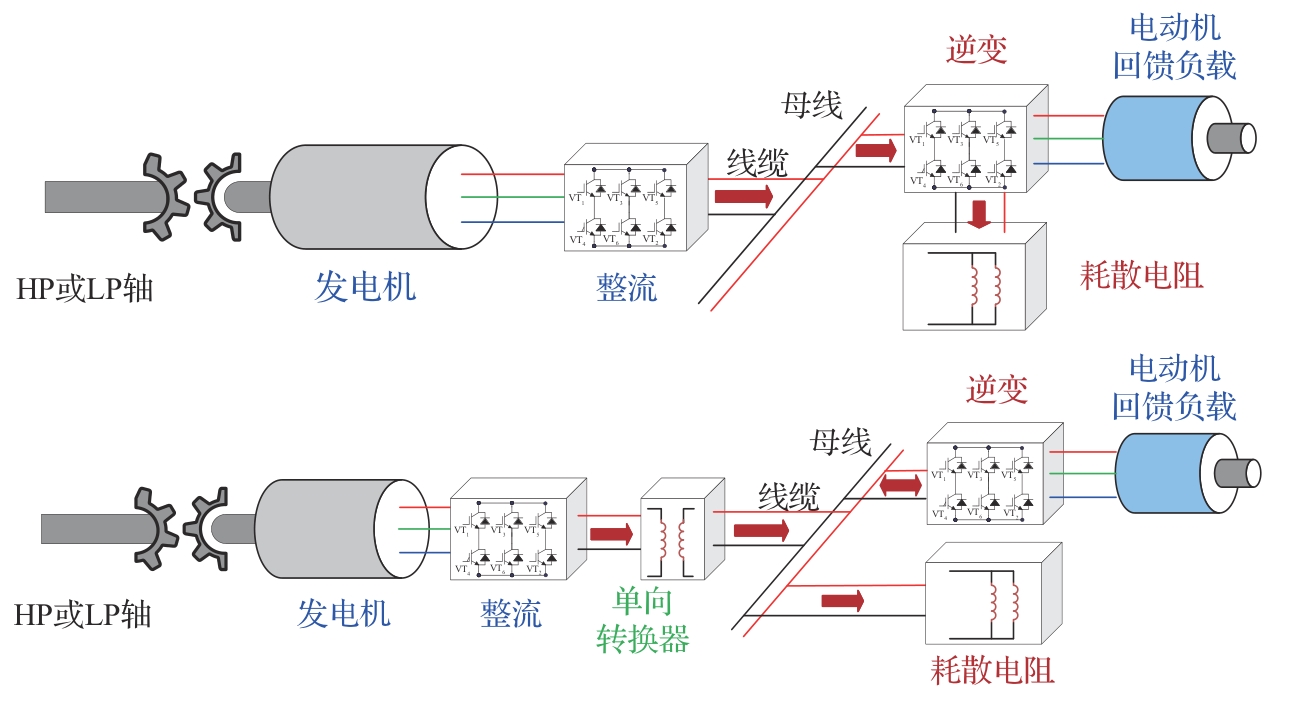
图 18
DC-AC变换器共、差模噪声传导路径
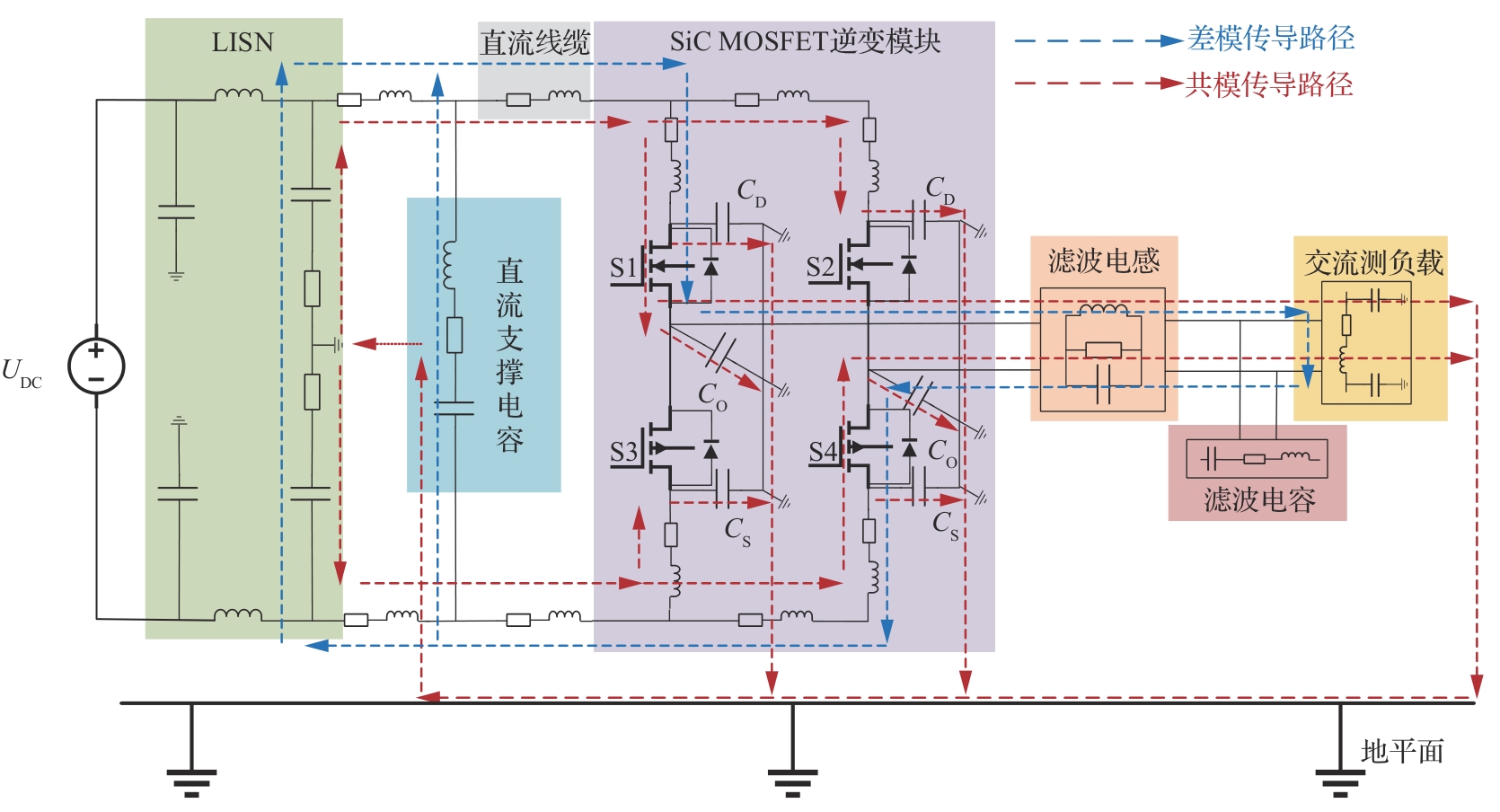
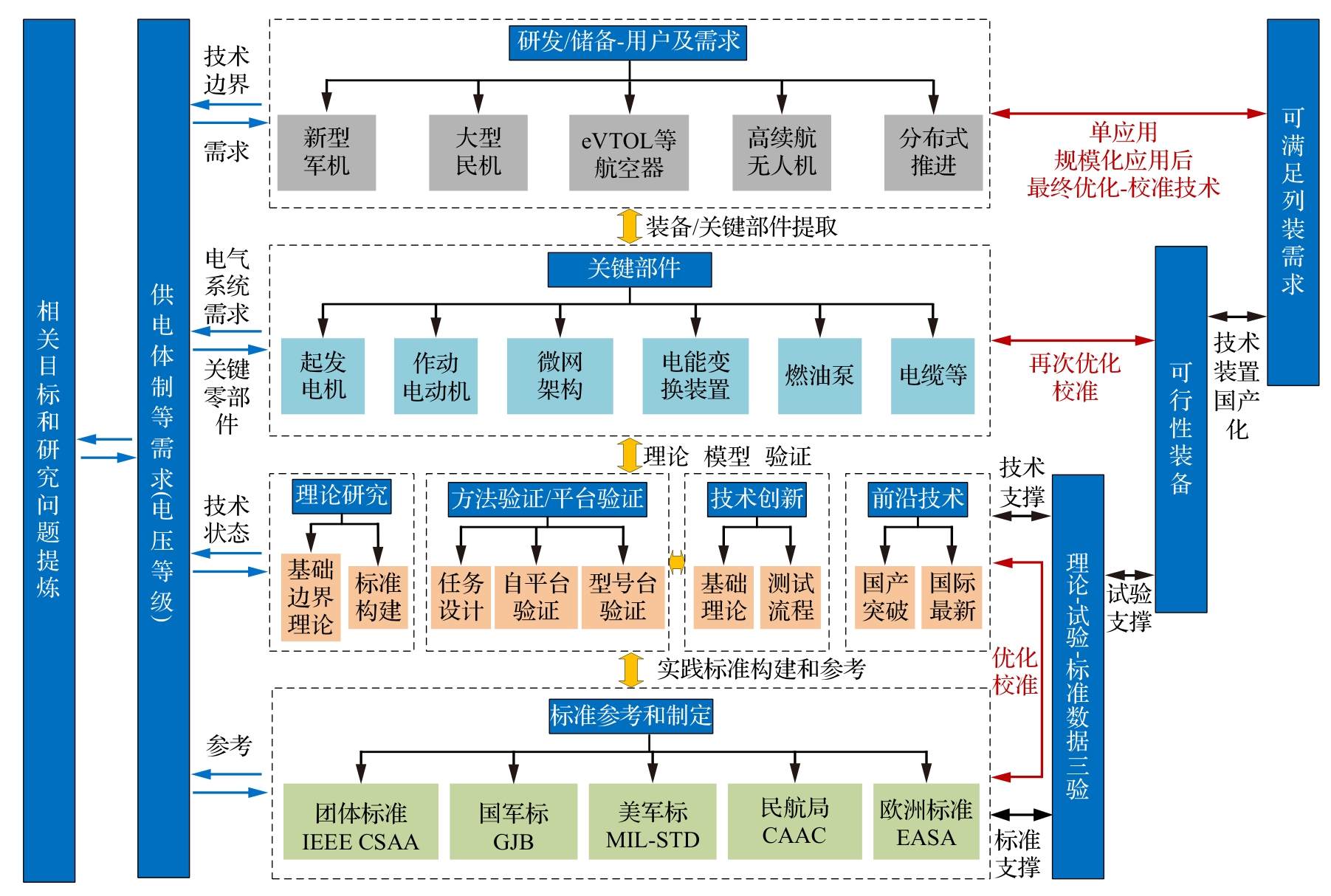
图 19
多电化技术体系
| 1 | WINBLADE R. The all-electric airplane: What is it?[J]. IEEE Transactions on Aerospace and Electronic Systems, 1984, AES-20(3): 211-212. |
| 2 | SPITZER C R. The all-electric aircraft: A systems view and proposed NASA research programs[J]. IEEE Transactions on Aerospace and Electronic Systems, 1984, AES-20(3): 261-266. |
| 3 | ENGELLAND J D. The evolving revolutionary all-electric airplane[J]. IEEE Transactions on Aerospace and Electronic Systems, 1984, AES-20(3): 217-220. |
| 4 | 孙侠生, 程文渊, 穆作栋, 等. 电动飞机发展白皮书[J]. 航空科学技术, 2019, 30(11): 1-7. |
| SUN X S, CHENG W Y, MU Z D, et al . White paper on the development of electric aircraft[J]. Aeronautical Science & Technology, 2019, 30(11): 1-7 (in Chinese). | |
| 5 | 晏武英. 美国新一代国家级军用航空动力预研计划分析[J]. 航空动力, 2018(2): 35-39. |
| YAN W Y. Analysis of U.S. New generation military aeronautical propulsion research program[J]. Aerospace Power, 2018(2): 35-39 (in Chinese). | |
| 6 | KUMAR A. Critical points in the More Electric Aircraft (MEA) converter-machine chain [D]. Bologna: Università Di Bologna, 2020. |
| 7 | SALEHPOUR M J, RADMANESH H, HOSSEINI ROSTAMI S M, et al. Effect of load priority modeling on the size of fuel cell as an emergency power unit in a more-electric aircraft[J]. Applied Sciences, 2019, 9(16): 3241. |
| 8 | JANSEN R, BOWMAN C, JANKOVSKY A, et al. Overview of NASA electrified aircraft propulsion (EAP) research for large subsonic transports[C]∥Proceedings of the 53rd AIAA/SAE/ASEE Joint Propulsion Conference. Reston: AIAA, 2017. |
| 9 | BUTICCHI G, WHEELER P, BOROYEVICH D. The more-electric aircraft and beyond[J]. Proceedings of the IEEE, 2023, 111(4): 356-370. |
| 10 | ABDELGHANY E, ALSAYED A, FOUAD M, et al. Effect of film cooling of HP and IP turbines on performance of triple spool turbofan engines[C]∥Proceedings of the 10th International Energy Conversion Engineering Conference. Reston: AIAA, 2012. |
| 11 | SARLIOGLU B, MORRIS C T. More electric aircraft: Review, challenges, and opportunities for commercial transport aircraft[J]. IEEE Transactions on Transportation Electrification, 2015, 1(1): 54-64. |
| 12 | ROSERO J A, ORTEGA J A, ALDABAS E, et al. Moving towards a more electric aircraft[J]. IEEE Aerospace and Electronic Systems Magazine, 2007, 22(3): 3-9. |
| 13 | MADONNA V, GIANGRANDE P, GALEA M. Electrical power generation in aircraft: Review, challenges, and opportunities[J]. IEEE Transactions on Transportation Electrification, 2018, 4(3): 646-659. |
| 14 | 王戈一. 磁悬浮多电发动机的研究[J]. 燃气涡轮试验与研究, 2007, 20(4): 15-18, 35. |
| WANG G Y. Study of a more-electric engine with active magnetic bearings[J]. Gas Turbine Experiment and Research, 2007, 20(4): 15-18, 35 (in Chinese). | |
| 15 | 秦海鸿, 严仰光. 多电飞机的电气系统[M]. 北京: 北京航空航天大学出版社, 2016. |
| QIN H H, YAN Y G. Power system for more electric aircraft[M]. Beijing: Beijing University of Aeronautics & Astronautics Press, 2016 (in Chinese). | |
| 16 | BUTICCHI G, BOZHKO S, LISERRE M, et al. On-board microgrids for the more electric aircraft—technology review[J]. IEEE Transactions on Industrial Electronics, 2019, 66(7): 5588-5599. |
| 17 | 张卓然, 许彦武, 于立. 多电飞机高压直流并联供电系统发展现状与关键技术[J]. 航空学报, 2021, 42(6): 624069. |
| ZHANG Z R, XU Y W, YU L, et al. Parallel HVDC electric power system for more electric aircraft: State of the art And key technologies[J]. Acta Aeronautica et Astronautica Sinica, 2021, 42(6): 624069 (in Chinese). | |
| 18 | 王莉, 戴泽华, 杨善水, 等. 电气化飞机电力系统智能化设计研究综述[J]. 航空学报, 2019, 40(2): 522405. |
| WANG L, DAI Z H, YANG S S, et al. Review of intelligent design of electrified aircraft power system[J]. Acta Aeronautica et Astronautica Sinica, 2019, 40(2): 5224050 (in Chinese). | |
| 19 | RAJASHEKARA K. Parallel between more electric aircraft and electric hybrid vehicle power conversion technologies[J]. IEEE Electrification Magazine, 2014, 2(2): 50-60. |
| 20 | ROBOAM X, SARENI B, DE ANDRADE A. More electricity in the air: Toward optimized electrical networks embedded in more-electrical aircraft[J]. IEEE Industrial Electronics Magazine, 2012, 6(4): 6-17. |
| 21 | WIEGAND C. F-35 air vehicle technology overview[C]∥ Proceedings of the 2018 Aviation Technology, Integration, and Operations Conference. Reston: AIAA, 2018. |
| 22 | HOCKMEYER I O. The generation and regulation of electric power in aircraft: A survey of design features of generators and their control[J]. Journal of the Institution of Electrical Engineers - Part II: Power Engineering, 1946, 93(31): 2-14. |
| 23 | 张卓然, 于立, 李进才, 等. 飞机电气化背景下的先进航空电机系统[J]. 南京航空航天大学学报, 2017, 49(5): 622-634. |
| ZHANG Z R, YU L, LI J C, et al. Aircraft electrification and key technologies of advanced aircraft electrical machinesystems[J]. Journalof Nanjing University of Aeronautics & Astronautics, 2017, 49(5): 622-634 (in Chinese). | |
| 24 | BOICE W K, LEVOY L G. Basic considerations in selection of electric systems for large aircraft[J]. Transactions of the American Institute of Electrical Engineers, 1944, 63(6): 279-287. |
| 25 | AMRHEIN M, RACZKOWSKI B, PITEL G, et al. Standardized electrical power quality analysis in accordance with MIL-STD-704[J]. SAE International Journal of Aerospace, 2010, 3(1): 124-136. |
| 26 | SECUNDE R, MACOSKO R, REPAS D S. Integrated engine-generator concept for aircraft electric secondary power[R]. Washington, D.C.: NASA, 1972. |
| 27 | ANDRADE L, TENNING C. Design of Boeing 777 electric system[J]. IEEE Aerospace and Electronic Systems Magazine, 1992, 7(7): 4-11. |
| 28 | ABDEL-HAFEZ A. Power generation and distribution system for a more electric aircraft - a review[M]∥Recent advances in aircraft technology, 2012: 289-308. |
| 29 | 孙莉. 多电航空发动机关键技术在某型航空发动机上的初步应用[C]∥2015年第二届中国航空科学技术大会. 北京: 国防工业出版社, 2015: 6. |
| SUN L. The preliminary application of MEE technology to the engine[C]∥Proceedings of the 2015 Second China Aviation Science and Technology Conference. Beijing: National Defense Industry Press, 2015: 6 (in Chinese). | |
| 30 | ABDEL-FADIL R, EID A, ABDEL-SALAM M. Electrical distribution power systems of modern civil aircrafts[C]∥2nd International Conference on Energy Systems and Technologies, 2013: 201-210. |
| 31 | 李永东, 章玄, 许烈. 多电飞机高压直流供电系统稳定性研究综述[J]. 电源学报, 2017, 15(2): 2-11. |
| LI Y D, ZHANG X, XU L. A survey on stability analysis for HVDC power system in MEA[J]. Journal of Power Supply, 2017,15(2): 2-11 (in Chinese). | |
| 32 | 张卓然, 许彦武, 姚一鸣, 等. 多电飞机电力系统及其关键技术[J]. 南京航空航天大学学报, 2022, 54(5): 969-984. |
| ZHANG Z R, XU Y W, YAO Y M, et al. Electic power system and key technologies of more electric aircraft[J]. Journal of Nanjing University of Aeronautics & Astronautics, 2022, 54(5): 969-984 (in Chinese). | |
| 33 | PATNAIK B, KUMAR S, GAWRE S. Recent advances in converters and storage technologies for more electric aircrafts: A review[J]. IEEE Journal on Miniaturization for Air and Space Systems, 2022, 3(3): 78-87. |
| 34 | CHEN J W, WANG C J, CHEN J. Investigation on the selection of electric power system architecture for future more electric aircraft[J]. IEEE Transactions on Transportation Electrification, 2018, 4(2): 563-576. |
| 35 | FARRUGIA D, APAP M, MICALLEF A, et al. Analysis of polygon connected ATRU for the more-electric aircraft[C]∥2020 IEEE 20th Mediterranean Electrotechnical Conference ( MELECON). Piscataway: IEEE Press, 2020: 136-140. |
| 36 | CHEN J W, WANG C J, CHEN J. Investigation on the selection of a more suitable power system architecture for future more electric aircraft from the prospective of system stability[C]∥2017 IEEE 26th International Symposium on Industrial Electronics (ISIE). Piscataway: IEEE Press, 2017: 1861-1867. |
| 37 | Aerospace International Group. Wiring aerospace vehicle: AS50881 [S]. 2006. |
| 38 | CHRISTOU I, NELMS A, HUSBAND M, et al. Choice of optimal voltage for more electric aircraft wiring systems[J]. IET Electrical Systems in Transportation, 2011, 1(1): 24-30. |
| 39 | COTTON I, NELMS A, HUSBAND M. Defining safe operating voltages for aerospace electrical systems[C]∥ 2007 Electrical Insulation Conference and Electrical Manufacturing Expo. Piscataway: IEEE Press, 2007: 67-71. |
| 40 | COTTON I, NELMS A, HUSBAND M. Higher voltage aircraft power systems[J]. IEEE Aerospace and Electronic Systems Magazine, 2008, 23(2): 25-32. |
| 41 | EMERSIC C, LOWNDES R, COTTON I, et al. The effects of pressure and temperature on partial discharge degradation of silicone conformai coatings[J]. IEEE Transactions on Dielectrics and Electrical Insulation, 2017, 24(5): 2986-2994. |
| 42 | EMERSIC C, LOWNDES R, COTTON I, et al. Degradation of conformal coatings on printed circuit boards due to partial discharge[J]. IEEE Transactions on Dielectrics and Electrical Insulation, 2016, 23(4): 2232-2240. |
| 43 | NYA B H, BROMBACH J, SCHULZ D. Benefits of higher voltage levels in aircraft electrical power systems[C]∥2012 Electrical Systems for Aircraft, Railway and Ship Propulsion. Piscataway: IEEE Press, 2012: 1-5. |
| 44 | BROMBACH J, LÜCKEN A, NYA B, et al. Comparison of different electrical HVDC-architectures for aircraft application[C]∥2012 Electrical Systems for Aircraft, Railway and Ship Propulsion. Piscataway: IEEE Press, 2012: 1-6. |
| 45 | TARIQ M, MASWOOD A I, GAJANAYAKE C J, et al. Modeling and integration of a lithium-ion battery energy storage system with the more electric aircraft 270 V DC power distribution architecture[J]. IEEE Access, 2018, 6: 41785-41802. |
| 46 | 程龙. 基于混合储能系统的多电飞机功率脉动平抑技术研究[D]. 南京: 南京航空航天大学, 2020. |
| CHENG L. Research on power pulsation suppression technology of multi-electric aircraft based on hybrid energy storage system[D]. Nanjing: Nanjing University of Aeronautics and Astronautics, 2020 (in Chinese). | |
| 47 | RACZKOWSKI B C, LOOP B, AMRHEIN M, et al. Large displacement stability by design for robust aircraft electric power systems[C]∥SAE 2012 Power Systems Conference. Warrendale: SAE International, 2012. |
| 48 | 刘畅, 卓建坤, 赵东明, 等. 利用储能系统实现可再生能源微电网灵活安全运行的研究综述[J]. 中国电机工程学报, 2020, 40(1): 1-18. |
| LIU C, ZHUO J K, ZHAO D M, et al. A review on the utilization of energy storage system for the flexible and safe operation of renewable energy microgrids[J]. Proceedings of the CSEE, 2020, 40(1): 1-18 (in Chinese). | |
| 49 | MORIOKA N, OYORI H. Fuel pump system configuration for the more electric engine[C]∥Aerospace Technology Conference & Exposition. Warrendale: SAE International, 2011. |
| 50 | DONG C F, QIAN Y P, ZHANG Y J, et al. A review of thermal designs for improving power density in electrical machines[J]. IEEE Transactions on Transportation Electrification, 2020, 6(4): 1386-1400. |
| 51 | 李子鑫. 航空燃油泵用永磁同步电机无位置传感器控制技术研究[D]. 武汉: 华中科技大学, 2022. |
| LI Z X. Research on position sensorless control strategy based on permanent magnet synchronous motor for aviation fuel pump[D]. Wuhan: Huazhong University of Science and Technology, 2022 (in Chinese). | |
| 52 | ATKINSON G J, MECROW B C, JACK A G, et al. The analysis of losses in high-power fault-tolerant machines for aerospace applications[J]. IEEE Transactions on Industry Applications, 2006, 42(5): 1162-1170. |
| 53 | MECROW B, ATKINSON D, JACK A, et al. The need for fault tolerance in an aeroengine electric fuel control system[C]∥IEE Colloquium, 1999. |
| 54 | CHEN X Y, DENG Z Q, PENG J J, et al. Comparison of two different fault-tolerant switched reluctance machines for fuel pump drive in aircraft[C]∥2009 IEEE 6th International Power Electronics and Motion Control Conference. Piscataway: IEEE Press, 2009: 2086-2090. |
| 55 | BEHBAHANI A R, SEMEGA K J. Control strategy for electro-mechanical actuators versus hydraulic actuation systems for aerospace applications[C]∥SAE Technical Paper Series. Warrendale: SAE International, 2010. |
| 56 | 夏泽斌. 飞机EMA/EHA作动器的多学科协同设计优化[D]. 大连: 大连理工大学, 2018. |
| XIA Z B. Multidisciplinary collaborative design optimization of aircraft EMA/EHA actuator[D].Dalian: Dalian University of Technology, 2018 (in Chinese). | |
| 57 | SINNETT M. Boeing 787 no-bleed systems: Saving fuel and enhancing operational efficiencies[J]. AERO Quarterly, 2007, 7: 6-11. |
| 58 | 付尧明, 任善全, 闫锋. 电反推系统适航分析[J]. 航空动力, 2020(6): 52-54. |
| FU X M, REN S Q, YAN F. Airworthiness analysis of electric thrust reverser system[J]. Aerospace Power, 2020(6): 52-54 (in Chinese). | |
| 59 | ISMAIL M A A, BALABAN E, SPANGENBERG H. Fault detection and classification for flight control electromechanical actuators[C]∥2016 IEEE Aerospace Conference. Piscataway: IEEE Press, 2016: 1-10. |
| 60 | YIN Z Y, HU N Q, CHEN J G, et al. A review of fault diagnosis, prognosis and health management for aircraft electromechanical actuators[J]. IET Electric Power Applications, 2022, 16(11): 1249-1272. |
| 61 | CHIRICO A, KOLODZIEJ J R. Fault detection and isolation for electro-mechanical actuators using a data-driven Bayesian classification[J]. SAE International Journal of Aerospace, 2012, 5(2): 494-502. |
| 62 | BAYBUTT M, NANDURI S, KALGREN P W, et al. Seeded fault testing and in-situ analysis of critical electronic components in EMA power circuitry[C]∥2008 IEEE Aerospace Conference. Piscataway: IEEE Press, 2008: 1-12. |
| 63 | BENNETT J W. Fault tolerant electromechanical actuators for aircraft[D]. Newcastle: Newcastle University, 2010. |
| 64 | GIANGRANDE P, GALASSINI A, PAPADOPOULOS S, et al. Considerations on the development of an electric drive for a secondary flight control electromechanical actuator[J]. IEEE Transactions on Industry Applications, 2019, 55(4): 3544-3554. |
| 65 | 马伟明, 王东, 程思为, 等. 高性能电机系统的共性基础科学问题与技术发展前沿[J]. 中国电机工程学报, 2016, 36(8): 2025-2035. |
| MA W M, WANG D, CHENG S W, et al. Common basic scientific problems and development of leading-edge technology of high performance motor system[J]. Proceedings of the CSEE, 2016, 36(8): 2025-2035 (in Chinese). | |
| 66 | 郑自伟, 何苗. 航空油泵用无刷直流电机驱动器过流保护技术研究[J]. 电工技术, 2020(20): 146-147, 154. |
| ZHENG Z W, HE M. Research on overcurrent protection technology of BLDC motor driver for aviation fuel pump[J]. Electric Engineering, 2020(20): 146-147, 154 (in Chinese). | |
| 67 | 方淳. 跨海拔机载绞车无刷直流电机温升与损耗抑制技术研究[D]. 西安: 西北工业大学, 2018. |
| FANG C. Temperature rise & loss suppression of brushless DC motor for helicopter rescue hoist at multi-elevations[D]. Xi’an: Northwestern Polytechnical University, 2018 (in Chinese). | |
| 68 | MECROW B C, JACK A G, ATKINSON D J, et al. Design and testing of a four-phase fault-tolerant permanent-magnet machine for an engine fuel pump[J]. IEEE Transactions on Energy Conversion, 2004, 19(4): 671-678. |
| 69 | NØLAND J K, LEANDRO M, SUUL J A, et al. High-power machines and starter-generator topologies for more electric aircraft: A technology outlook[J]. IEEE Access, 2020, 8: 130104-130123. |
| 70 | BU F F, LIU H Z, HUANG W X, et al. Induction-machine-based starter/generator systems: Techniques, developments, and advances[J]. IEEE Industrial Electronics Magazine, 2020, 14(1): 4-19. |
| 71 | 于立. 多电发动机高速双凸极起动发电机系统关键技术研究[D]. 南京: 南京航空航天大学, 2019. |
| YU L. Research on key technologies of high-speed doubly salient starter/generator system for more electric engine application[D].Nanjing: Nanjing University of Aeronautics and Astronautics, 2019 (in Chinese). | |
| 72 | ZHANG Z R, HUANG J, JIANG Y Y, et al. Overview and analysis of PM starter/generator for aircraft electrical power systems[J]. CES Transactions on Electrical Machines and Systems, 2017, 1(2): 117-131. |
| 73 | SALEM K ABU, PALAIA G, QUARTA A A. Review of hybrid-electric aircraft technologies and designs: Critical analysis and novel solutions[J]. Progress in Aerospace Sciences, 2023, 141: 100924. |
| 74 | 唐勇斌, 郝晓宇, 揭军, 等. 耐高温永磁电机发展现状与关键技术[J]. 导航定位与授时, 2016, 3(2): 65-70. |
| TANG Y B, HAO X Y, JIE J, et al. Development and key technology of heat-resisting permanent magnet motors[J]. Navigation Positioning and Timing, 2016, 3(2): 65-70 (in Chinese). | |
| 75 | 梁得亮, 褚帅君, 贾少锋, 等. 高温高速永磁电机关键技术研究综述[J]. 西安交通大学学报, 2022, 56(10): 31-48. |
| LIANG D L, CHU S J, JIA S F, et al. Overview of re-search on key technology of high-temperature and high speed permanent magnet machine[J]. Journal of Xian Jiaotong University, 2022, 56(10): 31-48 (in Chinese). | |
| 76 | 杜斌, 张铭霞, 李伶, 等. 耐高温陶瓷绝缘电磁线[J]. 硅酸盐通报, 2013, 32(10): 2051-2056. |
| DU B, ZHANG M X, LI L, et al. Introduction of super heat resistant ceramic insulated magnet wire[J]. Bulletin of the Chinese Ceramic Society, 2013, 32(10): 2051-2056 (in Chinese). | |
| 77 | 马林泉, 赵成龙, 熊雪梅, 等. 我国耐高温非纤维素绝缘纸的现状和发展动向[J]. 绝缘材料, 2021, 54(12):15-21. |
| MA L Q, ZHAO C L, XIONG X M, et al. Status and development trends of high-temperature resistant non-cellulose insulating papers in China[J]. Insulating Materials, 2021, 54(12): 15-21 (in Chinese). | |
| 78 | ZOUZOU N, DANG T T, DUCHESNE S, et al. Modeling and experimental characterization of nickel-coated copper wires for the design of extremely high-temperature electrical machines[J]. IEEE Transactions on Magnetics, 2020, 56(3): 6100209. |
| 79 | 卓亮, 孙鲁, 施道龙, 等. 考虑温度变化的高温高速永磁电机转子涡流损耗半解析模型及实验验证[J]. 中国电机工程学报, 2021, 41(24): 8305-8314. |
| ZHUO L, SUN L, SHI D L, et al. Semi-analytical model and experimental verification of rotor eddy current loss of high temperature high speed permanent magnet machine considering temperature change[J]. Proceedings of the CSEE, 2021, 41(24): 8305-8314 (in Chinese). | |
| 80 | CANDERS W R, HOFFMANN J, HENKE M. Cooling technologies for high power density electrical machines for aviation applications[J]. Energies, 2019, 12(23): 4579. |
| 81 | SHAMS GHAHFAROKHI P, PODGORNOVS A, KALLASTE A, et al. The oil spray cooling system of automotive traction motors: The state of the art[J]. IEEE Transactions on Transportation Electrification, 2023, 9(1): 428-451. |
| 82 | ZHANG F Y, GERADA D, XU Z Y, et al. Improved thermal modeling and experimental validation of oil-flooded high-performance machines with slot-channel cooling[J]. IEEE Transactions on Transportation Electrification, 2022, 8(1): 312-324. |
| 83 | WANG R Y, FAN X G, LI D W, et al. Convective heat transfer characteristics on end-winding of stator immersed oil-cooled electrical machines for aerospace applications[J]. IEEE Transactions on Transportation Electrification, 2022, 8(4): 4265-4278. |
| 84 | YANG Y Y, BILGIN B, KASPRZAK M, et al. Thermal management of electric machines[J]. IET Electrical Systems in Transportation, 2017, 7(2): 104-116. |
| 85 | POPESCU M, STATON D A, BOGLIETTI A, et al. Modern heat extraction systems for power traction machines-a review[J]. IEEE Transactions on Industry Applications, 2016, 52(3): 2167-2175. |
| 86 | NATEGH S, BARBER D, BOGLIETTI A, et al. A study on thermal effects of different potting strategies in traction motors[C]∥2018 IEEE International Conference on Electrical Systems for Aircraft, Railway, Ship Propulsion and Road Vehicles & International Transportation Electrification Conference (ESARS-ITEC). Piscataway: IEEE Press, 2018: 1-6. |
| 87 | KULAN M C, BAKER N J. Development of a thermal equivalent circuit to quantify the effect of thermal paste on heat flow through a permanent magnet alternator[J]. IEEE Transactions on Industry Applications, 2019, 55(2): 1261-1271. |
| 88 | POLIKARPOVA M, PONOMAREV P, LINDH P, et al. Hybrid cooling method of axial-flux permanent-magnet machines for vehicle applications[J]. IEEE Transactions on Industrial Electronics, 2015, 62(12): 7382-7390. |
| 89 | POLIKARPOVA M, LINDH P M, TAPIA J A, et al. Application of potting material for a 100 kW radial flux PMSM[C]∥2014 International Conference on Electrical Machines (ICEM). Piscataway: IEEE Press, 2014: 2146-2151. |
| 90 | LI H D, KLONTZ K W, FERRELL V E, et al. Thermal models and electrical machine performance improvement using encapsulation material[J]. IEEE Transactions on Industry Applications, 2017, 53(2): 1063-1069. |
| 91 | LI L Y, ZHANG J P, ZHANG C M, et al. Research on electromagnetic and thermal issue of high-efficiency and high-power-density outer-rotor motor[J]. IEEE Transactions on Applied Superconductivity, 2016, 26(4): 5204805. |
| 92 | MUELLER M A, BURCHELL J, CHONG Y C, et al. Improving the thermal performance of rotary and linear air-cored permanent magnet machines for direct drive wind and wave energy applications[J]. IEEE Transactions on Energy Conversion, 2019, 34(2): 773-781. |
| 93 | 陈中帅. 电机导热散热节能技术及应用研究[D]. 上海: 东华大学, 2016. |
| CHEN Z S. Study on the energy-saving technology for motors based on heat conduction and dissipation and its applications[D]. Shanghai: Donghua University, 2016 (in Chinese). | |
| 94 | ZHAO H, ZHANG X C, LI J, et al. Research on the effect of heat pipe inclination angle on temperature distribution in electrical machines[J]. IEEE Transactions on Industry Applications, 2023, 59(6): 6745-6755. |
| 95 | WANG S N, LI Y H, LI Y Z, et al. Transient cooling effect analyses for a permanent-magnet synchronous motor with phase-change-material packaging[J]. Applied Thermal Engineering, 2016, 109: 251-260. |
| 96 | WANG S N, LI Y H, LI Y Z, et al. Conception and experimental investigation of a hybrid temperature control method using phase change material for permanent magnet synchronous motors[J]. Experimental Thermal and Fluid Science, 2017, 81: 9-20. |
| 97 | XIONG B, GU G B, RUAN L, et al. Study on overload performance enhancement of motor based on heat storage of phase change paraffin[C]∥2017 20th International Conference on Electrical Machines and Systems (ICEMS). Piscataway: IEEE Press, 2017: 1-4. |
| 98 | AYAT S, SERGHINE C, KLONOWSKI T, et al. The use of phase change material for the cooling of electric machine windings formed with hollow conductors[C]∥ 2019 IEEE International Electric Machines & Drives Conference (IEMDC). Piscataway: IEEE Press, 2019: 1195-1201. |
| 99 | AYAT S, DAGUSÉ B, KHAZAKA R. Design considerations of windings formed with hollow conductors cooled with phase change material[C]∥2019 IEEE Energy Conversion Congress and Exposition (ECCE). Piscataway: IEEE Press, 2019: 5652-5658. |
| 100 | CAO W P, MECROW B C, ATKINSON G J, et al. Overview of electric motor technologies used for more electric aircraft (MEA)[J]. IEEE Transactions on Industrial Electronics, 2012, 59(9): 3523-3531. |
| 101 | BARCARO M, BIANCHI N, MAGNUSSEN F. Configurations of fractional-slot IPM motors with dual three-phase winding[C]∥2009 IEEE International Electric Machines and Drives Conference. Piscataway: IEEE Press, 2009: 936-942. |
| 102 | EL-REFAIE A M, SHAH M R, HUH K K. High power-density fault-tolerant PM generator for safety critical applications[C]∥2013 International Electric Machines & Drives Conference. Piscataway: IEEE Press, 2013: 30-39. |
| 103 | PAPINI L, RAMINOSOA T, GERADA D, et al. A high-speed permanent-magnet machine for fault-tolerant drivetrains[J]. IEEE Transactions on Industrial Electronics, 2014, 61(6): 3071-3080. |
| 104 | KOU B Q, CAO H C, LI W L. Analysis of losses in high speed slotless PM synchronous motor integrated the added leakage inductance[C]∥Proceedings of the 2015 International Conference on Power Electronics and Energy Engineering. Paris: Atlantis Press, 2015: 36-40. |
| 105 | DA Y, SHI X D, KRISHNAMURTHY M. A new approach to fault diagnostics for permanent magnet synchronous machines using electromagnetic signature analysis[J]. IEEE Transactions on Power Electronics, 2013, 28(8): 4104-4112. |
| 106 | LI R, FANG H Y, LI D W, et al. A search coil design method of PMSM for detection of inter-turn short-circuit fault[J]. IEEE Transactions on Industrial Electronics, 2024, 71(4): 3964-3974. |
| 107 | Securaplane start power unit [EB/OL]. (2022-12-01)[2024-05-10]. . |
| 108 | NAWAWI A, TONG C F, YIN S, et al. Design and demonstration of high power density inverter for aircraft applications[J]. IEEE Transactions on Industry Applications, 2017, 53(2): 1168-1176. |
| 109 | WANG D, HEMMING S, YANG Y H, et al. Multilevel inverters for electric aircraft applications: Current status and future trends[J]. IEEE Transactions on Transportation Electrification, 2024, 10(2): 3258-3282. |
| 110 | ZHANG D, HE J B, PAN D. A megawatt-scale medium-voltage high-efficiency high power density “SiC Si” hybrid three-level ANPC inverter for aircraft hybrid-electric propulsion systems[J]. IEEE Transactions on Industry Applications, 2019, 55(6): 5971-5980. |
| 111 | CHEN R, NIU J, REN R, et al. A cryo-genically-cooled MW inverter for electric aircraft propulsion[C]∥2020 AIAA/IEEE Electric Aircraft Technologies Symposium (EATS). Piscataway: IEEE Press, 2020: 1-10. |
| 112 | MISRA A K. Technical challenges and barriers affecting turbo-electric and hybrid electric aircraft propulsion: GRC-E-DAA-TN48472[R]. Work of the US Government, 2017. |
| 113 | KOURO S, MALINOWSKI M, GOPAKUMAR K, et al. Recent advances and industrial applications of multilevel converters[J]. IEEE Transactions on Industrial Electronics, 2010, 57(8): 2553-2580. |
| 114 | FRIEDLI T, KOLAR J W. Milestones in matrix converter research[J]. IEEJ Journal of Industry Applications, 2012, 1(1): 2-14. |
| 115 | LEI J X, ZHOU B, WEI J D, et al. Aircraft starter/generator system based on indirect matrix converter[C]∥ IECON 2014 - 40th Annual Conference of the IEEE Industrial Electronics Society. Piscataway: IEEE Press, 2014: 4840-4846. |
| 116 | FRIEDLI T, KOLAR J W, RODRIGUEZ J, et al. Comparative evaluation of three-phase AC-AC matrix converter and voltage DC-link back-to-back converter systems[J]. IEEE Transactions on Industrial Electronics, 2012, 59(12): 4487-4510. |
| 117 | CHUB A, VINNIKOV D, BLAABJERG F, et al. A review of galvanically isolated impedance-source DC-DC converters[J]. IEEE Transactions on Power Electronics, 2016, 31(4): 2808-2828. |
| 118 | NAAYAGI R T, FORSYTH A J. Bidirectional DC-DC converter for aircraft electric energy storage systems[C]∥5th IET International Conference on Power Electronics, Machines and Drives (PEMD 2010). Institution of Engineering and Technology, 2010: 1-6. |
| 119 | KARANAYIL B, CIOBOTARU M, AGELIDIS V G. Power flow management of isolated multiport converter for more electric aircraft[J]. IEEE Transactions on Power Electronics, 2017, 32(7): 5850-5861. |
| 120 | FALCONES S, AYYANAR R, MAO X L. A DC–DC multiport-converter-based solid-state transformer integrating distributed generation and storage[J]. IEEE Transactions on Power Electronics, 2013, 28(5): 2192-2203. |
| 121 | WARNCKE M, FAHLBUSCH S, HOFFMANN K F. DC/DC-converter for fuel cell integration in more electric aircraft applications[C]∥2017 19th European Conference on Power Electronics and Applications (EPE’17 ECCE Europe). Piscataway: IEEE Press, 2017: P.1-P.10. |
| 122 | MENZI D, YU Z Y, HUBER J, et al. Comparative evaluation of ultra-lightweight buck-boost DC-DC converter topologies for future eVTOL aircraft[C]∥2022 IEEE 23rd Workshop on Control and Modeling for Power Electronics (COMPEL). Piscataway: IEEE Press, 2022: 1-8. |
| 123 | MENZI D, IMPERIALI L, BÜRGISSER E, et al. Ultra-lightweight high-efficiency buck-boost DC-DC converters for future eVTOL aircraft with hybrid power supply[J/OL]. IEEE Transactions on Transportation Electrification, (2024-03-07) [2024-05-10]. . |
| 124 | HE J B, TORREY D. Recent advances of power electronics applications in more electric aircrafts[C]∥Proceedings of the 2018 AIAA/IEEE Electric Aircraft Technologies Symposium. Reston: AIAA, 2018. |
| 125 | BOLOTNIKOV A, LOSEE P, PERMUY A, et al. Overview of 1.2kV-2.2kV SiC MOSFETs targeted for industrial power conversion applications[C]∥2015 IEEE Applied Power Electronics Conference and Exposition (APEC). Piscataway: IEEE Press, 2015: 2445-2452. |
| 126 | ZHANG D, HE J, SHUTTEN M, et al. NASA project report for Phase-II[R]. Washington, D.C.: NASA, 2017. |
| 127 | ROMANO G, FAYYAZ A, RICCIO M, et al. A comprehensive study of short-circuit ruggedness of silicon carbide power MOSFETs[J]. IEEE Journal of Emerging and Selected Topics in Power Electronics, 2016, 4(3): 978-987. |
| 128 | MILLÁN J, GODIGNON P, PERPIÑÀ X, et al. A survey of wide bandgap power semiconductor devices[J]. IEEE Transactions on Power Electronics, 2014, 29(5): 2155-2163. |
| 129 | AKTURK A, WILKINS R, MCGARRITY J, et al. Single event effects in Si and SiC power MOSFETs due to terrestrial neutrons[J]. IEEE Transactions on Nuclear Science, 2017, 64(1): 529-535. |
| 130 | AKTURK A, MCGARRITY J M, GOLDSMAN N, et al. Terrestrial neutron-induced failures in silicon carbide power MOSFETs and diodes[J]. IEEE Transactions on Nuclear Science, 2018, 65(6): 1248-1254. |
| 131 | ZHANG Z Y, GUI H D, REN R, et al. Characterization of wide bandgap device for cryogenically-cooled power electronics in aircraft applications[C]∥Proceedings of the 2018 AIAA/IEEE Electric Aircraft Technologies Symposium. Reston: AIAA, 2018. |
| 132 | GUI H D, CHEN R R, NIU J H, et al. Review of power electronics components at cryogenic temperatures[J]. IEEE Transactions on Power Electronics, 2020, 35(5): 5144-5156. |
| 133 | ABDELMALIK A A, NYSVEEN A, LUNDGAARD L. Influence of fast rise voltage and pressure on partial discharges in liquid embedded power electronics[J]. IEEE Transactions on Dielectrics and Electrical Insulation, 2015, 22(5): 2770-2779. |
| 134 | YOU H Y, WEI Z, HU B X, et al. Partial discharge behaviors in power modules under square pulses with ultrafast dv/dt [J]. IEEE Transactions on Power Electronics, 2021, 36(3): 2611-2620. |
| 135 | CONG Y Z, ADINA N, WEI Z, et al. Submodule design of a 2 kV 1 MW integrated modular motor drive for aviation applications[C]∥2021 IEEE 8th Workshop on Wide Bandgap Power Devices and Applications (WiPDA). Piscataway: IEEE Press, 2021: 345-350. |
| 136 | MOIR I, SEABRIDGE A, JUKES M. Electrical systems[J]. Civil Avionics Systems, 2013: 235-290. |
| 137 | GEMIN P, KUPISZEWSKI T, RADUN A, et al. Architecture, voltage, and components for a turboe-lectric distributed propulsion electric grid (AVC-TeDP)[R]. Washington, D. C.: NASA, 2015. |
| 138 | 邢洋, 郭海红, 王军, 等. 涡扇发动机换装大功率起动机起动性能分析[J]. 燃气涡轮试验与研究, 2020, 33(6): 40-44. |
| XING Y, GUO H H, WANG J, et al. Starting performance of a turbofan engine changing high-power starter[J]. Gas Turbine Experiment and Research, 2020,33(6): 40-44 (in Chinese). | |
| 139 | 陈强, 卓亮. 航空航天燃气涡轮发动机用起/发电机技术及发展趋势[J]. 飞航导弹, 2017(12): 80-88. |
| CHEN Q, ZHUO L. Aerospace gas turbine engine/generator technology and development trends[J]. Aerodynamic Missile Journal, 2017(12): 80-88 (in Chinese). | |
| 140 | 刘伟, 黄开明, 王旭, 等. 低温对涡轴发动机起动性能影响的试验与分析[J]. 航空动力学报, 2019, 34(6): 1282-1289. |
| LIU W, HUANG K M, WANG X, et al. Test and analysis on influences of low temperature on starting performance of turboshaft engine[J]. Journal of Aerospace Power, 2019, 34(6): 1282-1289 (in Chinese). | |
| 141 | 朴英. 航空燃气涡轮发动机起动性能分析[J]. 航空动力学报, 2003, 18(6): 777-782. |
| PIAO Y. An analysis of the starting characteristics of aeroengine[J]. Journal of Aerospace Power, 2003, 18(6): 777-782 (in Chinese). | |
| 142 | BOZHKO S, RASHED M, HILL C I, et al. Flux-weakening control of electric starter–generator based on permanent-magnet machine[J]. IEEE Transactions on Transportation Electrification, 2017, 3(4): 864-877. |
| 143 | 航空涡轮螺桨和涡轮轴发动机通用规范: [S]. 北京: 中国标准出版社, 2018: 90. |
| General specification for aerospace turboprop and turboshaft engines: [S]. Beijing: Standards Press of China, 2018: 90. | |
| 144 | LOMINAC J K, BOYTOS J F. Aeropropulsion environmental test facility[C]∥Proceedings of ASME 1998 International Gas Turbine and Aeroengine Congress and Exhibition, 2014 |
| 145 | 李大为, 李家瑞, 李锋, 等. 航空发动机高原起动性能改善措施[J]. 航空发动机, 2020, 46(2): 47-50. |
| LI D W, LI J R, LI F, et al. Improvement measures of aeroengine starting performance in plateau[J]. Aeroengine, 2020, 46(2): 47-50 (in Chinese). | |
| 146 | PROVOST M J. The more electric aero-engine: A general overview from an engine manufacturer[C]∥International Conference on Power Electronics Machines and Drives, 2002: 246-251. |
| 147 | MITCHAM A J. Permanent magnet generator options for the more electric aircraft[C]∥International Conference on Power Electronics Machines and Drives, 2002: 241-245. |
| 148 | QIAO G, LIU G, SHI Z H, et al. A review of electromechanical actuators for More/All Electric aircraft systems[J]. Proceedings of the Institution of Mechanical Engineers, Part C: Journal of Mechanical Engineering Science, 2018, 232(22): 4128-4151. |
| 149 | HUANG L G, YU T, JIAO Z X, et al. Research on power matching and energy optimal control of active load-sensitive electro-hydrostatic actuator[J]. IEEE Access, 2020, 9: 51121-51133. |
| 150 | LI Z H, SHANG Y X, JIAO Z X, et al. Analysis of the dynamic performance of an electro-hydrostatic actuator and improvement methods[J]. Chinese Journal of Aeronautics, 2018, 31(12): 2312-2320. |
| 151 | ALLE N, HIREMATH S S, MAKARAM S, et al. Review on electro hydrostatic actuator for flight control[J]. International Journal of Fluid Power, 2016, 17(2): 125-145. |
| 152 | 郭宏, 邢伟. 机电作动系统发展[J]. 航空学报, 2007, 28(3): 620-627. |
| HONG G, WEI X. Development of electromechanical actuators[J]. Acta Aeronautica et Astronautica Sinica, 2007, 28(3): 620-627 (in Chinese). | |
| 153 | LI J, FU Y L, ZHANG G Y, et al. Research on fast response and high accuracy control of an airborne brushless DC motor[C]∥2004 IEEE International Conference on Robotics and Biomimetics. Piscataway: IEEE Press, 2004: 807-810. |
| 154 | LI J, FU Y L, WANG Z L, et al. Research on fast response and high accuracy control of an airborne electro hydrostatic actuation system[C]∥2004 International Conference on Intelligent Mechatronics and Automation, 2004. Proceedings. Piscataway: IEEE Press, 2005: 428-432. |
| 155 | MORIOKA N, OYORI H, GONDA Y, et al. Development of the electric fuel system for the more electric engine[C]∥Proceedings of ASME Turbo Expo 2014: Turbine Technical Conference and Exposition, 2014. |
| 156 | GUREVICH O, GULIENKO A, SCHUROVSKIY U. Demonstration systems of the 《Electric》 gas turbine engine[C]∥29 th Congress ICAS, 2014. |
| 157 | GAO F, BOZHKO S. Modeling and impedance analysis of a single DC bus-based multiple-source multiple-load electrical power system[J]. IEEE Transactions on Transportation Electrification, 2016, 2(3): 335-346. |
| 158 | MARTÍNEZ G, LALANNE F R, SÁNCHEZ-GUARDAMINO I, et al. Novel modular device for a decentralised electric power system architecture for more electric aircraft[J]. IEEE Access, 2022, 10: 19356-19364. |
| 159 | BUTICCHI G, COSTA L F, LISERRE M. Multi-port DC/DC converter for the electrical power distribution system of the more electric aircraft[J]. Mathematics and Computers in Simulation, 2019, 158: 387-402. |
| 160 | XU Y W, ZHANG Z R, LI J C, et al. Architecture analysis and optimization of high voltage DC parallel electric power system for more electric aircraft[C]∥2016 IEEE International Conference on Aircraft Utility Systems (AUS). Piscataway: IEEE Press, 2016: 244-249. |
| 161 | FLETCHER S D A, NORMAN P, GALLOWAY S, et al. Impact of engine certification standards on the design requirements of more-electric engine electrical system architectures[J]. SAE International Journal of Aerospace, 2014, 7(1): 24-34. |
| 162 | ZHANG Q Y, NORMAN P, BURT G. Design rules to establish a credible More-Electric Engine baseline power architecture concept[J]. IET Electrical Systems in Transportation, 2023, 13(2): e12076. |
| 163 | FARD M T, HE J B, HUANG H, et al. Aircraft distributed electric propulsion technologies—a review[J]. IEEE Transactions on Transportation Electrification, 2022, 8(4): 4067-4090. |
| 164 | LODER D C, BOLLMAN A, ARMSTRONG M J. Turbo-electric distributed aircraft propulsion: Microgrid architecture and evaluation for ECO-150[C]∥2018 IEEE Transportation Electrification Conference and Expo (ITEC). Piscataway: IEEE Press, 2018: 550-557. |
| 165 | SCHMOLLGRUBER P, ATINAULT O, CAFARELLI I, et al. Multidisciplinary exploration of DRAGON: An ONERA hybrid electric distributed propulsion concept[C]∥Proceedings of the AIAA Scitech 2019 Forum. Reston: AIAA, 2019. |
| 166 | DANIEL J P. Fly-by-wireless-airbus end-user viewpoint[C]∥NASA/CANEUS. Washington, D.C.:NASA, 2007. |
| 167 | COTTON I, GARDNER R, SCHWEICKART D, et al. Design considerations for higher electrical power system voltages in aerospace vehicles[C]∥2016 IEEE International Power Modulator and High Voltage Conference (IPMHVC). Piscataway: IEEE Press, 2016: 57-61. |
| 168 | 曹建国. 航空发动机仿真技术研究现状、挑战和展望[J]. 推进技术, 2018, 39(5): 961-970. |
| CAO J G. Status, challenges and perspectives of aero-engine simulation technology[J]. Journal of Propulsion Technology, 2018, 39(5): 961-970 (in Chinese). | |
| 169 | GUDDANTI B, CHOI J, ILLINDALA M S, et al. Effect of endogenous failure events on the survivability of turboelectric distributed propulsion system[J]. IEEE Transactions on Industry Applications, 2022, 58(1): 224-232. |
| 170 | THIELMANN A, SAUER A, ISEN-MANN R, et al. Technology roadmap energy storage for electric mobility 2030[J]. Fraunhofer ISI, 2012. |
| 171 | TASHIE-LEWIS B C, NNABUIFE S G. Hydrogen production, distribution, storage and power conversion in a hydrogen economy - A technology review[J]. Chemical Engineering Journal Advances, 2021, 8: 100172. |
| 172 | DAI Z H, WANG L, YANG S S. Fuel cell based auxiliary power unit in more electric aircraft[C]∥2017 IEEE Transportation Electrification Conference and Expo, Asia-Pacific (ITEC Asia-Pacific). Piscataway: IEEE Press, 2017: 1-6. |
| 173 | COLLINS J M, MCLARTY D. All-electric commercial aviation with solid oxide fuel cell-gas turbine-battery hybrids[J]. Applied Energy, 2020, 265: 114787. |
| 174 | HERMETZ J, RIDEL M, DOLL C. Distributed electric propulsion for small business aircraft a con-cept-plane for key-technologies investiga-tions[C]∥ICAS 2016. 2016. |
| 175 | Airbus’ high-voltage battery technology prepares for EcoPulse flight test and beyond[EB/OL]. (2022-08-01)[2024-05-10]. . |
| 176 | WEIMER J A. The role of electric machines and drives in the more electric aircraft[C]∥IEEE International Electric Machines and Drives Conference, 2003. IEMDC’03. Piscataway: IEEE Press, 2003: 11-15. |
| 177 | WHEELER P, CLARE J, BOZHKO S, et al. Regeneration in aircraft electrical power systems?[C]∥SAE Technical Paper Series. Warrendale: SAE International, 2008. |
| 178 | WHEELER P, TRENTIN A, BOZHKO S, et al. Regeneration of energy onto an aircraft electrical power system from an electro-mechanical actuator[C]∥2012 Electrical Systems for Aircraft, Railway and Ship Propulsion. Piscataway: IEEE Press, 2012: 1-6. |
| 179 | WU T X, ZUMBERGE J, WOLFF M. On regenerative power management in more electric aircraft (MEA) power system[C]∥Proceedings of the 2011 IEEE National Aerospace and Electronics Conference (NAECON). Piscataway: IEEE Press, 2011: 211-214. |
| 180 | ZHANG H, SAUDEMONT C, ROBYNS B, et al. Comparison of different DC voltage supervision strategies in a local power distribution system of more electric aircraft[J]. Mathematics and Computers in Simulation, 2010, 81(2): 263-276. |
| 181 | RAJASHEKARA K, JIA Y J. An induction generator based auxiliary power unit for power generation and management system for more electric aircraft[C]∥2016 IEEE Energy Conversion Congress and Exposition (ECCE). Piscataway: IEEE Press, 2016: 1-7. |
| 182 | BARELLI L, BIDINI G, OTTAVIANO P A, et al. Coupling hybrid energy storage system to regenerative actuators in a more electric aircraft: dynamic performance analysis and CO2 emissions assessment concerning the italian regional aviation scenario[J]. Journal of Energy Storage, 2022, 45: 103776. |
| 183 | XU Y W, ZHANG Z R. Regenerated energy absorption methods for more electric aircraft starter/generator system[J]. IEEE Transactions on Power Electronics, 2023, 38(6): 7525-7534. |
| 184 | RE F. Viability and state of the art of environmentally friendly aircraft taxiing systems[C]∥2012 Electrical Systems for Aircraft, Railway and Ship Propulsion. Piscataway: IEEE Press, 2012: 1-6. |
| 185 | KELCH F, YANG Y Y, BILGIN B, et al. Investigation and design of an axial flux permanent magnet machine for a commercial midsize aircraft electric taxiing system[J]. IET Electrical Systems in Transportation, 2018, 8(1): 52-60. |
| 186 | LUKIC M, GIANGRANDE P, HEBALA A, et al. Review, challenges, and future developments of electric taxiing systems[J]. IEEE Transactions on Transportation Electrification, 2019, 5(4): 1441-1457. |
| 187 | HEINRICH M T E, KELCH F, MAGNE P, et al. Regenerative braking capability analysis of an electric taxiing system for a single aisle midsize aircraft[J]. IEEE Transactions on Transportation Electrification, 2015, 1(3): 298-307. |
| 188 | HEINRICH M T E, KELCH F, MAGNE P, et al. Investigation of regenerative braking on the energy consumption of an electric taxiing system for a single aisle midsize aircraft[C]∥IECON 2014 - 40th Annual Conference of the IEEE Industrial Electronics Society. Piscataway: IEEE Press, 2014: 3023-3029. |
| 189 | ZHANG H, SAUDEMONT C, ROBYNS B, et al. Comparison of technical features between a more electric aircraft and a hybrid electric vehicle[C]∥2008 IEEE vehicle power and propulsion conference. IEEE, 2008: 1-6. |
| 190 | RICCOBONO A, SANTI E. Comprehensive review of stability criteria for DC power distribution systems[J]. IEEE Transactions on Industry Applications, 2014, 50(5): 3525-3535. |
| 191 | AREERAK K N, WU T, BOZHKO S V, et al. Aircraft power system stability study including effect of voltage control and actuators dynamic[J]. IEEE Transactions on Aerospace and Electronic Systems, 2011, 47(4): 2574-2589. |
| 192 | EBRAHIMI H, EL-KISHKY H. A novel Generalized State-Space Averaging (GSSA) model for advanced aircraft electric power systems[J]. Energy Conversion and Management, 2015, 89: 507-524. |
| 193 | HAN L Q, WANG J B, HOWE D. Small-signal stability studies of a 270 V DC more-electric aircraft power system[C]∥3rd IET International Conference on Power Electronics, Machines and Drives (PEMD 2006), 2006. |
| 194 | YANG J J, YAN H, GU C Y, et al. Modeling and stability enhancement of a permanent magnet synchronous generator based DC system for more electric aircraft[J]. IEEE Transactions on Industrial Electronics, 2022, 69(3): 2511-2520. |
| 195 | CHE Y B, LIU X K, YANG Z G. Large signal stability analysis of aircraft electric power system based on averaged-value model[C]∥2015 6th International Conference on Power Electronics Systems and Applications (PESA). Piscataway: IEEE Press, 2015: 1-5. |
| 196 | XU Q W, WANG P, CHEN J W, et al. A module-based approach for stability analysis of complex more-electric aircraft power system[J]. IEEE Transactions on Transportation Electrification, 2017, 3(4): 901-919. |
| 197 | WANG S, RUAN X B, HE Y Y, et al. Small-signal impedance modeling and analysis of variable-frequency AC three-stage generator for more electric aircraft[J]. IEEE Transactions on Power Electronics, 2023, 38(1): 206-216. |
| 198 | ZHANG C X, RUAN X B, HE Y Y, et al. Modular modeling and bus-port impedance analysis of DC three-stage generator for more electric aircraft[J]. IEEE Transactions on Power Electronics, 2023, 38(12): 15579-15588. |
| 199 | GAO F, ZHENG X C, BOZHKO S, et al. Modal analysis of a PMSG-based DC electrical power system in the more electric aircraft using eigenvalues sensitivity[J]. IEEE Transactions on Transportation Electrification, 2015, 1(1): 65-76. |
| 200 | GAO F, BOZHKO S, ASHER G, et al. An improved voltage compensation approach in a droop-controlled DC power system for the more electric aircraft[J]. IEEE Transactions on Power Electronics, 2016, 31(10): 7369-7383. |
| 201 | HUSSAINI H, YANG T, BAI G, et al. Artificial intelligence-based hierarchical control design for current sharing and voltage restoration in DC microgrid of the more electric aircraft[J]. IEEE Transactions on Transportation Electrification, 2024, 10(1): 566-582. |
| 202 | SUYAPAN A, AREERAK K, BOZHKO S, et al. Adaptive stabilization of a permanent magnet synchronous generator-based DC electrical power system in more electric aircraft[J]. IEEE Transactions on Transportation Electrification, 2021, 7(4): 2965-2975. |
| 203 | GAO F, BOZHKO S, COSTABEBER A, et al. Control design and voltage stability analysis of a droop-controlled electrical power system for more electric aircraft[J]. IEEE Transactions on Industrial Electronics, 2017, 64(12): 9271-9281. |
| 204 | XU Z X, QI Y, GUERRERO J M, et al. Stability-oriented impedance modeling, analysis, and shaping for power supply system in more-electric aircraft: A review[J/OL]. IEEE Transactions on Transportation Electrification, (2024-02-23) [2024-05-10].. |
| 205 | SUMSUROOAH S, ODAVIC M, BOZHKO S, et al. Robust stability analysis of a DC/DC buck converter under multiple parametric uncertainties[J]. IEEE Transactions on Power Electronics, 2018, 33(6): 5426-5441. |
| 206 | RECALDE A A, ATKIN J A, BOZHKO S V. Optimal design and synthesis of MEA power system architectures considering reliability specifications[J]. IEEE Transactions on Transportation Electrification, 2020, 6(4): 1801-1818. |
| 207 | XIANG Y X, PEI X J, ZHOU W, et al. A fast and precise method for modeling EMI source in two-level three-phase converter[J]. IEEE Transactions on Power Electronics, 2019, 34(11): 10650-10664. |
| 208 | BARZKAR A, FAN B R, SONG H, et al. Modeling of conducted EMI emissions in 10 kV SiC MOSFET based power electronics building blocks[C]∥2023 IEEE Energy Conversion Congress and Exposition (ECCE). Piscataway: IEEE Press, 2023: 2967-2974. |
| 209 | 张寅. 航空发动机电子控制器PCB布局电磁兼容性设计研究[D]. 南京: 南京航空航天大学, 2012. |
| ZHANG Y. Research on the electromagnetic compatibility design technology of the electronic controller’s pcb used in aero-engine[D].Nanjing: Nanjing University of Aeronautics and Astronautics, 2012 (in Chinese). | |
| 210 | LEUCHTER J. Practical experience with EMI of radio-communication system versus power electronics based on the SiC[C]∥PCIM Europe 2017; International Exhibition and Conference for Power Electronics, Intelligent Motion, Renewable Energy and Energy Management, 2017: 1-7. |
| 211 | 黄国权. 数字式起动控制器及其电磁兼容研究[D]. 哈尔滨: 哈尔滨工业大学, 2019. |
| HUANG G Q. Research on digital start controller and electromagnetic compatibility[D]. Harbin: Harbin Institute of Technology, 2019 (in Chinese). | |
| 212 | ROTGERINK J L, SCHIPPERS H, LEFERINK F. Low-frequency analysis of multiconductor transmission lines for crosstalk design rules[J]. IEEE Transactions on Electromagnetic Compatibility, 2019, 61(5): 1612-1620. |
| 213 | ZHU H B, LAI J S, HEFNER A R, et al. Modeling-based examination of conducted EMI emissions from hard- and soft-switching PWM inverters[C]∥Conference Record of the 1999 IEEE Industry Applications Conference. Thirty-Forth IAS Annual Meeting (Cat. No.99CH36370). Piscataway: IEEE Press, 1999: 1879-1886. |
| 214 | ZHOU P, PEI X J, ZHANG K, et al. Improved EMI behavioral modeling method of three-phase inverter based on the noise-source phase alignment[J]. IEEE Transactions on Power Electronics, 2022, 37(8): 9333-9344. |
| 215 | 徐鸣, 尹珑翔, 刘子龙. 舰载机发动机电磁兼容优化设计[J]. 航空动力, 2020(5): 45-47. |
| XU M, YIN L X, LIU Z L. Optimization design of electromagnetic compatibility of carrier aircraft engine[J]. Aerospace Power, 2020(5): 45-47 (in Chinese). | |
| 216 | 陈晋吉. 飞机电磁兼容预测仿真研究[D]. 西安: 西安电子科技大学, 2013. |
| CHEN J J. Simulation study on electromagnetic compatibility predic-tion of aircrafts[D]. Xi’an: Xidian University, 2013 (in Chinese). | |
| 217 | 苏东林, 王冰切, 金德琨, 等. 电子战特种飞机电磁兼容预设计技术[J]. 北京航空航天大学学报, 2006, 32(10): 1241-1245. |
| SU D L, WANG B Q, JIN D K, et al. EMC pre-design technologies on EW special aircraft[J]. Journal of Beijing University of Aeronautics and Astronautics, 2006, 32(10): 1241-1245 (in Chinese). | |
| 218 | 苏东林, 雷军, 刘焱, 等. 一种大型复杂电子信息系统电磁兼容顶层量化设计新方法[J]. 遥测遥控, 2008, 29(4): 1-8. |
| SU D L, LEI J, LIU Y, et al. A novel method of top-level EMC design technology for large and complex electronic information systems[J]. Journal of Telemetry, Tracking and Command, 2008, 29(4): 1-8 (in Chinese). | |
| 219 | MARTZLOFF F, LEEDY T F. Electrical fast-transient tests: Applications and limitations[J]. IEEE Transactions on Industry Applications, 1990, 26(1): 151-159. |
| 220 | BUZDUGAN M I, BALAN H. A brief review of transient electromagnetic immunity testing[C]∥2019 International IEEE Conference and Workshop in Óbuda on Electrical and Power Engineering (CANDO-EPE). Piscataway: IEEE Press, 2019: 127-132. |
| 221 | ZHOU P, PEI X J, CHEN Q C, et al. EMI behavioral model based CM noise prediction method for DC power system considering multi-noise coupling[J]. IEEE Transactions on Power Electronics, 2023, 38(4): 4658-4667. |
| 222 | MA Q Y, CUI X, HU R, et al. Electromagnetic transient interference measurement system of UHV fixed series capacitors at high potential and EMI characterization[C]∥International Symposium on Electromagnetic Compatibility - EMC EUROPE. Piscataway: IEEE Press, 2012: 1-6. |
| 223 | NARAYANASAMY B, LUO F. A survey of active EMI filters for conducted EMI noise reduction in power electronic converters[J]. IEEE Transactions on Electromagnetic Compatibility, 2019, 61(6): 2040-2049. |
| 224 | XIANG Y X, PEI X J, WANG M J, et al. An improved H8 topology for common-mode voltage reduction[J]. IEEE Transactions on Power Electronics, 2019, 34(6): 5352-5361. |
| 225 | TALLAM R M, KERKMAN R J, LEGGATE D, et al. Common-mode voltage reduction PWM algorithm for AC drives[J]. IEEE Transactions on Industry Applications, 2010, 46(5): 1959-1969. |
| 226 | HOU C C, SHIH C C, CHENG P T, et al. Common-mode voltage reduction pulsewidth modulation techniques for three-phase grid-connected converters[J]. IEEE Transactions on Power Electronics, 2013, 28(4): 1971-1979. |
| 227 | ZHANG X N, LUO F, DONG D, et al. CM noise containment in a DC-fed motor drive system using DM filter[C]∥2012 Twenty-Seventh Annual IEEE Applied Power Electronics Conference and Exposition (APEC). Piscataway: IEEE Press, 2012: 1808-1813. |
| 228 | XING L, SUN J. Conducted common-mode EMI reduction by impedance balancing[J]. IEEE Transactions on Power Electronics, 2012, 27(3): 1084-1089. |
| 229 | YANG L, ZHAO H, WANG S, et al. Common-mode EMI noise analysis and reduction for AC-DC-AC systems with paralleled power modules[J]. IEEE Transactions on Power Electronics, 2020, 35(7): 6989-7000. |
| 230 | 裴雪军, 张凯, 康勇, 等. 基于EMI滤波器的逆变器传导电磁干扰的抑制[J]. 电气传动, 2007, 37(12): 35-38. |
| PEI X J, ZHANG K, KANG Y, et al. Suppression of EMI conducted in PWM inverter based on EMI filter[J]. Electric Drive, 2007, 37(12): 35-38 (in Chinese). | |
| 231 | OGASAWARA S, AYANO H, AKAGI H. An active circuit for cancellation of common-mode voltage generated by a PWM inverter[C]∥PESC97. Record 28th Annual IEEE Power Electronics Specialists Conference. Formerly Power Conditioning Specialists Conference 1970-71. Power Processing and Electronic Specialists Conference. Piscataway: IEEE Press, 1972: 1547-1553. |
| 232 | DI PIAZZA M C, TINE G, VITALE G. An improved active common-mode voltage compensation device for induction motor drives[J]. IEEE Transactions on Industrial Electronics, 2008, 55(4): 1823-1834. |
| 233 | GOSWAMI R, WANG S. Modeling and stability analysis of active differential-mode EMI filters for AC/DC power converters[J]. IEEE Transactions on Power Electronics, 2018, 33(12): 10277-10291. |
| 234 | WANG S, MAILLET Y Y, WANG F, et al. Investigation of hybrid EMI filters for common-mode EMI suppression in a motor drive system[J]. IEEE Transactions on Power Electronics, 2010, 25(4): 1034-1045. |
| 235 | 陈晓威. 功率变换器EMI有源抑制技术研究[D]. 福州: 福州大学, 2017. |
| CHEN X Y. Research on EMI active suppression technology for power converter[D]. Fuzhou: Fuzhou University, 2017 (in Chinese). | |
| 236 | 工业和信息化部, 科学技术部, 财政部, 等. 绿色航空制造业发展纲要(2023-2035年)[EB/OL]. , 2023-10-1. |
| Ministry of Industry and Information Technology, Ministry of Science and Technology, Ministry of Finance, et al. Development outline of green aviation manufacturing industry[EB/OL]. , 2023-10-1 (in Chinese). | |
| 237 | 张志国. 航空发动机高空模拟试验设施建设与发展思考[J]. 燃气涡轮试验与研究, 2022, 35(3): 56-62. |
| ZHANG Z G. Consideration for construction and development of aero-engine altitude simulation test facility[J]. Gas Turbine Experiment and Research, 2022, 35(3): 56-62 (in Chinese). | |
| 238 | LIOU M F, GRONSTAL D, KIM H J, et al. Aerodynamic design of the hybrid wing body with nacelle: N3-X propulsion-airframe configuration[C]∥Proceedings of the 34th AIAA Applied Aerodynamics Conference. Reston: AIAA, 2016. |
| 239 | BERTON J J, HALLER W J. A noise and emissions assessment of the N3-X transport[C]∥Proceedings of the 52nd Aerospace Sciences Meeting. Reston: AIAA, 2014. |
| 240 | BARZKAR A, GHASSEMI M. Components of electrical power systems in more and all-electric aircraft: a review[C]∥IEEE Transactions on Transportation Electrification. Piscataway: IEEE Press, 2022: 4037-4053. |
| [1] | 黄维康, 张卓然, 达兴亚, 袁培博, 高华敏. 高速对转涵道风扇双驱动电机的热特性[J]. 航空学报, 2024, 45(8): 129048-129048. |
| [2] | 郝振洋, 孙枫涛, 季志豪, 景新元, 曹鑫. 一种适用于航空发电机系统的闭环I/f控制方法[J]. 航空学报, 2024, 45(3): 328678-328678. |
| [3] | 马瑞卿, 陈鹏. 永磁同步电机初始位置辨识方法研究与进展[J]. 航空学报, 2024, 45(3): 28776-028776. |
| [4] | 崔江, 周凡, 陈永凡, 于立, 张卓然. 一种基于GAMF-CNN的航空发电机整流器故障诊断技术[J]. 航空学报, 2024, 45(24): 330398-330398. |
| [5] | 王婷, 周浩轩, 张晓斌, 李伟林, 曹文平. 航空起动/发电机中旋转整流器故障分析与诊断方法综述[J]. 航空学报, 2024, 45(23): 30405-030405. |
| [6] | 高帅, 韩勤锴, 褚福磊. 航空发动机数字孪生驱动的高精度摩擦电轴承传感器[J]. 航空学报, 2024, 45(21): 629516-629516. |
| [7] | 杨顺, 张帆, 张伟, 师君, 张晓玲. 基于干涉仪阵列的无人机非合作辐射点定位方法[J]. 航空学报, 2024, 45(17): 530192-530192. |
| [8] | 和阳, 李旺旺, 吉敬华, 赵文祥, 朱纪洪. 基于幅相自适应注入的伺服电机无传感器控制[J]. 航空学报, 2024, 45(15): 630211-630211. |
| [9] | 吕定翀, 赵守军, 曾思, 付剑, 胡心童, 刘会祥, 苗克非, 付永领. 高性能伺服电机泵关键技术及挑战[J]. 航空学报, 2024, 45(15): 630225-630225. |
| [10] | 郝振洋, 张凤婷, 杨健, 曹鑫. 并行独立控制策略下消振电力作动器系统[J]. 航空学报, 2024, 45(13): 329573-329573. |
| [11] | 李洁, 黄文新, 蔡一鸣, 王思远, 高宇飞, 蒋雪峰. 基于DFPMM的位置传感器故障诊断与容错控制[J]. 航空学报, 2024, 45(10): 329307-329307. |
| [12] | 朱衍波, 王志鹏, 郭凯, 淡志强. L波段数字航空通信系统技术发展现状与挑战[J]. 航空学报, 2024, 45(10): 29161-029161. |
| [13] | 宋东彬, 闫炬壮, 杨文将, 白明亮, 刘汝婧, 王少鹏, 刘宇, 田爱梅. 面向电动航空的高温超导电机技术研究发展[J]. 航空学报, 2023, 44(9): 27469-027469. |
| [14] | 冯雅婷, 张辉. 基于车尾风能回收的气动减阻装置[J]. 航空学报, 2022, 43(S2): 180-191. |
| [15] | 苏宁, 黄文新. 电推进飞机定子双绕组感应发电机并联系统[J]. 航空学报, 2022, 43(8): 325409-325409. |
| 阅读次数 | ||||||
|
全文 |
|
|||||
|
摘要 |
|
|||||
版权所有 © 航空学报编辑部
版权所有 © 2011航空学报杂志社
主管单位:中国科学技术协会 主办单位:中国航空学会 北京航空航天大学

 CJA
CJA
