Acta Aeronautica et Astronautica Sinica ›› 2026, Vol. 47 ›› Issue (4): 232349.doi: 10.7527/S1000-6893.2025.32349
• Solid Mechanics and Vehicle Conceptual Design • Previous Articles
Haolei MOU1, Jia ZHANG2, Zhenyu FENG1( ), Chunyu BAI3
Received:2025-05-30
Revised:2025-07-03
Accepted:2025-07-28
Online:2025-07-31
Published:2025-07-30
Contact:
Zhenyu FENG
E-mail:caucstructure@163.com
Supported by:CLC Number:
Haolei MOU, Jia ZHANG, Zhenyu FENG, Chunyu BAI. Prediction of axial crushing response for CFRP thin-walled C-columns based on WOA-BP-LSTM autoencoder[J]. Acta Aeronautica et Astronautica Sinica, 2026, 47(4): 232349.
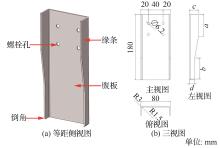
Fig.1
Schematic diagram of CFRP thin-walled C-columns with variable cross-section

Table 1
Material mechanical properties of USN15000
| 参数 | 数值 |
|---|---|
| 密度/(t·mm-3) | 1.5×10⁻⁹ |
| 轴向弹性模量/MPa | 134 000 |
| 横向弹性模量/MPa | 9 000 |
| 泊松比ν12 | 0.3 |
| 12方向剪切模量/MPa | 4 300 |
| 13方向剪切模量/MPa | 4 300 |
| 23方向剪切模量/MPa | 4 300 |
| 轴向拉伸失效应力/MPa | 2 158 |
| 轴向压缩失效应力/MPa | 1 000 |
| 横向拉伸失效应力/MPa | 42 |
| 横向压缩失效应力/MPa | 172 |
| 轴向剪切失效应力/MPa | 75 |
| 横向剪切失效应力/MPa | 75 |
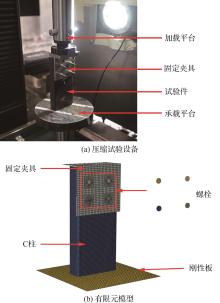
Fig.2
Crushing test and finite element model of C-column
Fig.3
Comparison of [±45/90/02/90/02]s C-column axial crushing test and simulation results
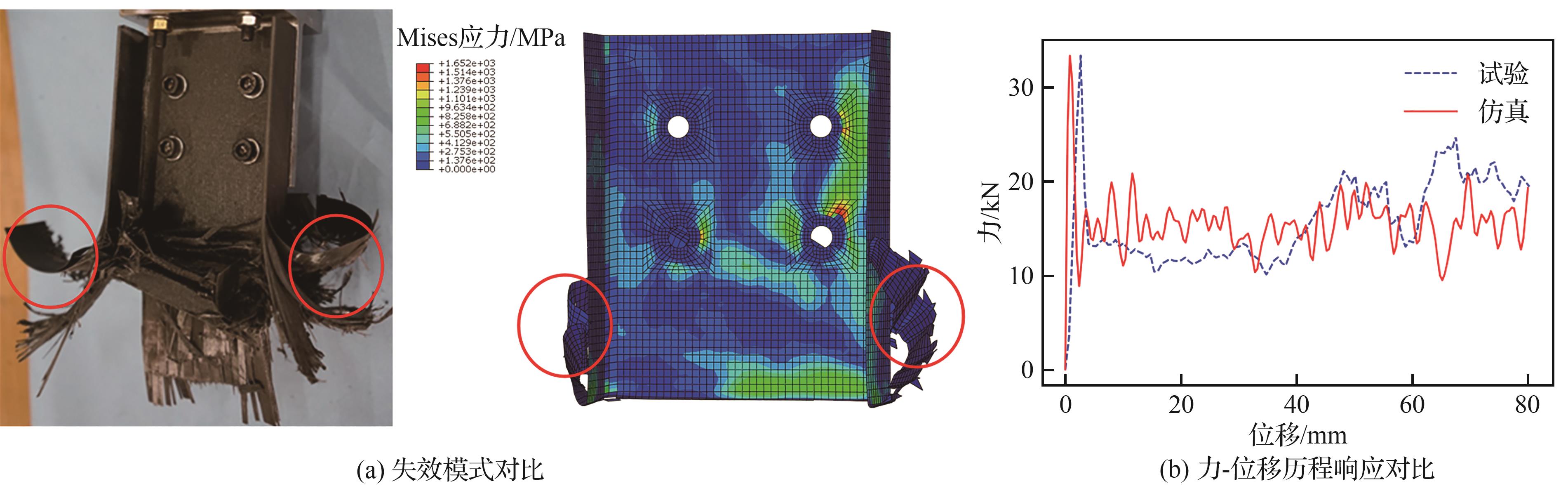
Fig.4
Comparison of [0/90]4 s C-column axial crushing test and simulation results
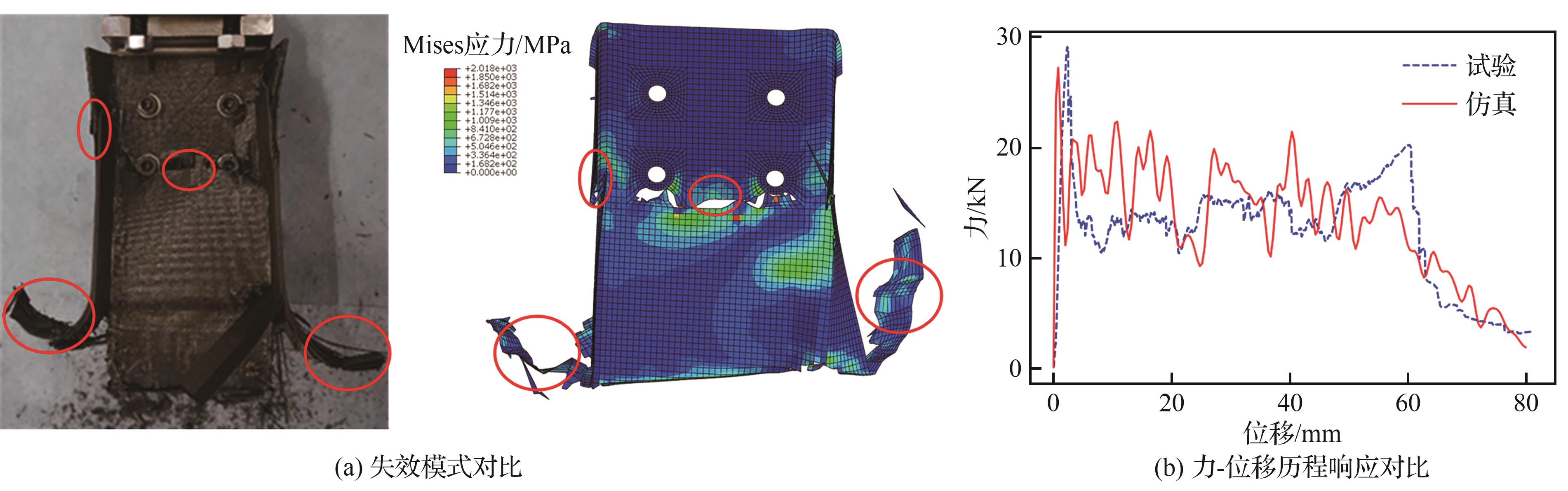
Table 2
Comparison of axial crushing response evaluation indicators
| 铺层方式 | IPCF/kN | EA/J | SEA/(kJ·kg-1) | MCF/kN | |
|---|---|---|---|---|---|
| [±45/90/02/90/02]s | 试验 | 33.27 | 1 256.39 | 15.67 | 38.35 |
| 仿真 | 33.26 | 1 236.53 | 15.43 | 37.18 | |
| 误差/% | 0.03 | 1.58 | 1.53 | 3.05 | |
| [0/90]4 s | 试验 | 28.96 | 993.14 | 12.36 | 30.10 |
| 仿真 | 26.12 | 1 074.58 | 13.37 | 32.31 | |
| 误差/% | 9.81 | 8.20 | 8.17 | 7.34 | |
Table 3
Simulation matrix of CFRP thin-walled C-columns with variable cross-section
| a/mm | b/mm | c/mm | d/mm |
|---|---|---|---|
| 0,20,40,60,80 | 0,20,40,60,80 | 10 | 10 |
| 15 | 15,10 | ||
| 20 | 20,15,10 | ||
| 25 | 25,20,15,10 | ||
| 30 | 30,25,20,15,10 | ||
| 35 | 35,30,25,20,15,10 | ||
| 40 | 40,35,30,25,20,15,10 |
Fig.5
LSTM network structure diagram
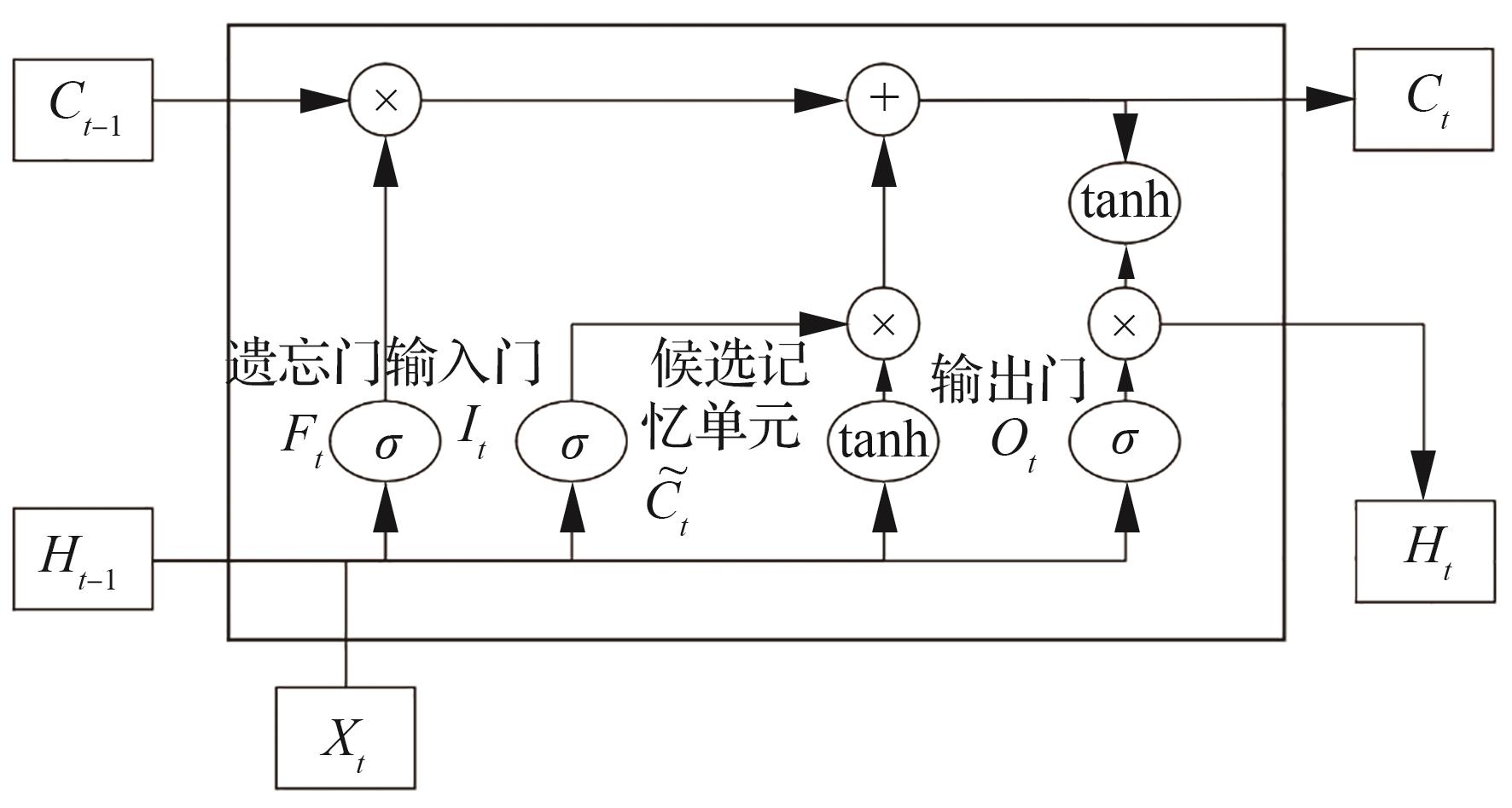
Fig.6
Framework for reconstructing force-displacement responses based on LSTM autoencoder
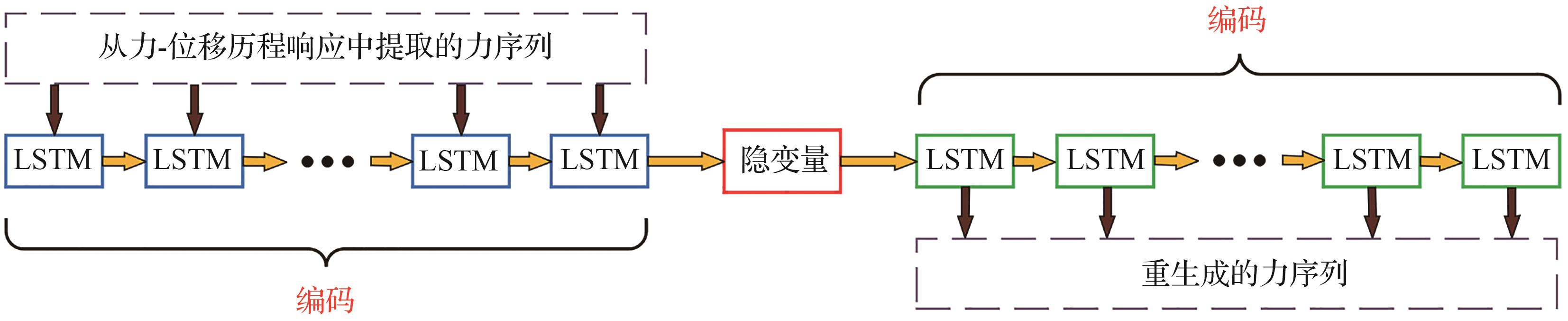
Fig.7
Comparison between actual and reconstructed force-displacement responses for 12 random samples in test set
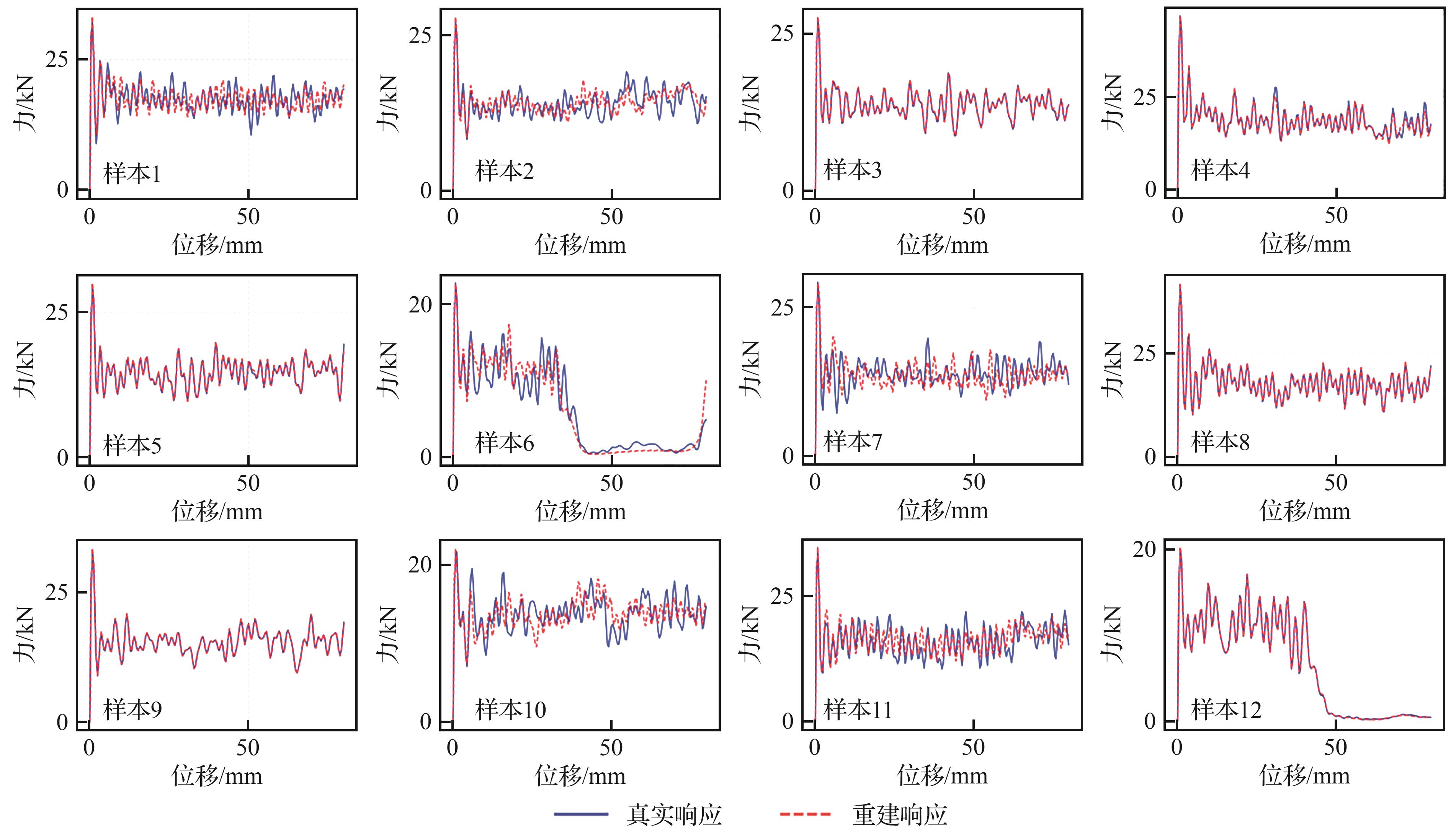
Table 4
Comparison between actual and reconstructed IPCF and EA values for 12 random samples in test set
| 样本 | IPCF/kN | EA/J | ||||
|---|---|---|---|---|---|---|
| 真实值 | 重建值 | 误差/% | 真实值 | 重建值 | 误差/% | |
| 1 | 32.75 | 33.00 | 0.77 | 1 396.33 | 1 388.91 | 0.53 |
| 2 | 27.08 | 27.82 | 2.72 | 1 124.41 | 1 133.20 | 0.78 |
| 3 | 27.51 | 27.62 | 0.42 | 1 092.41 | 1 098.68 | 0.57 |
| 4 | 46.61 | 46.64 | 0.06 | 1 505.54 | 1 488.62 | 1.12 |
| 5 | 29.70 | 29.94 | 0.81 | 1 162.46 | 1 171.61 | 0.79 |
| 6 | 22.85 | 22.68 | 0.73 | 478.99 | 474.58 | 0.92 |
| 7 | 29.29 | 29.15 | 0.49 | 1 122.19 | 1 096.37 | 2.30 |
| 8 | 41.95 | 42.19 | 0.57 | 1 430.47 | 1 434.60 | 0.29 |
| 9 | 33.26 | 33.48 | 0.68 | 1 237.73 | 1 241.88 | 0.34 |
| 10 | 21.58 | 21.99 | 1.89 | 1 097.71 | 1 094.41 | 0.30 |
| 11 | 34.65 | 34.69 | 0.13 | 1 286.87 | 1 311.65 | 1.93 |
| 12 | 20.23 | 20.31 | 0.35 | 511.62 | 509.47 | 0.42 |
Fig.8
BP neural network architecture
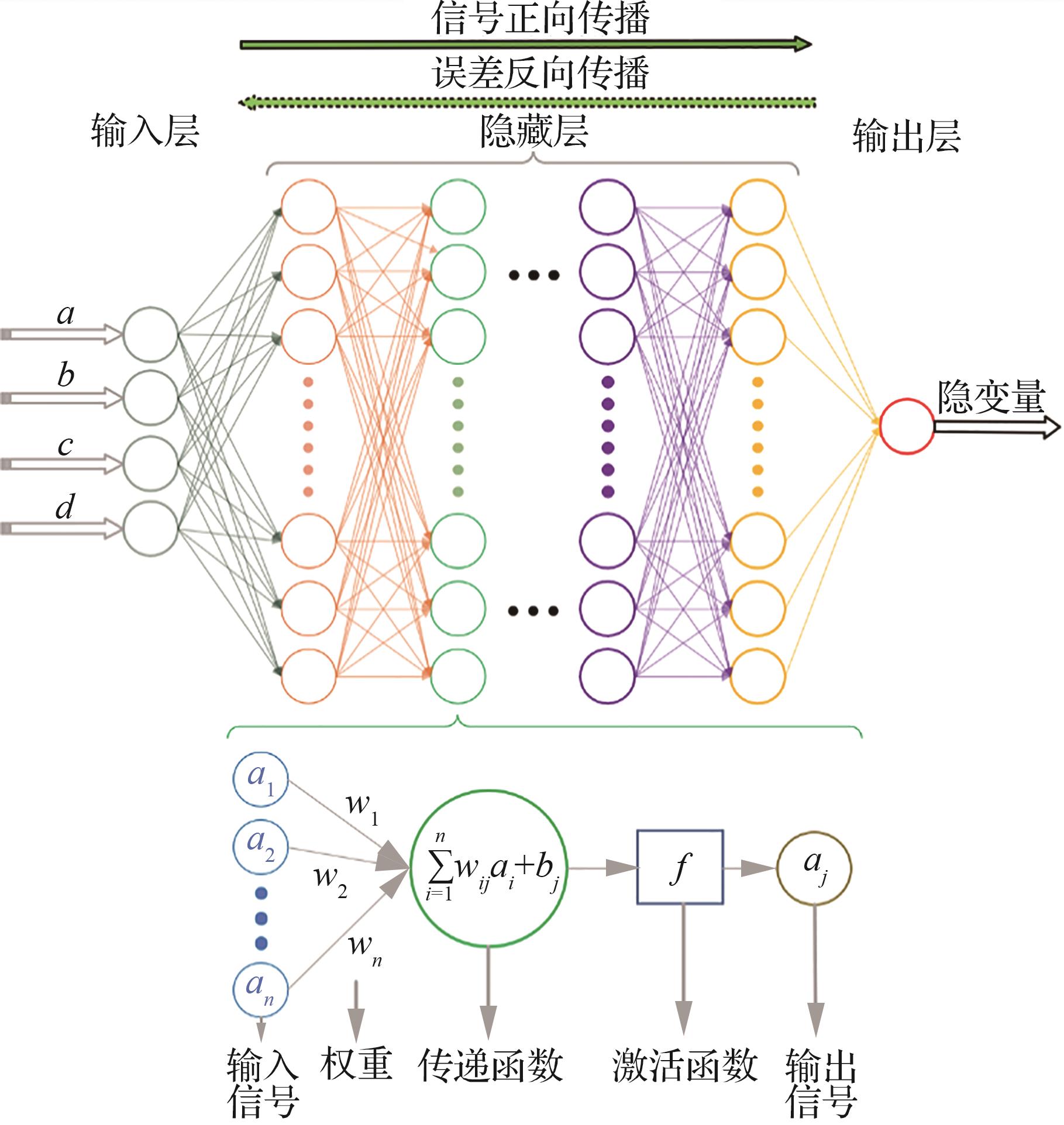
Fig.9
Comparison of performance metrics between BP-LSTM autoencoder and WOA-BP-LSTM autoencoder model
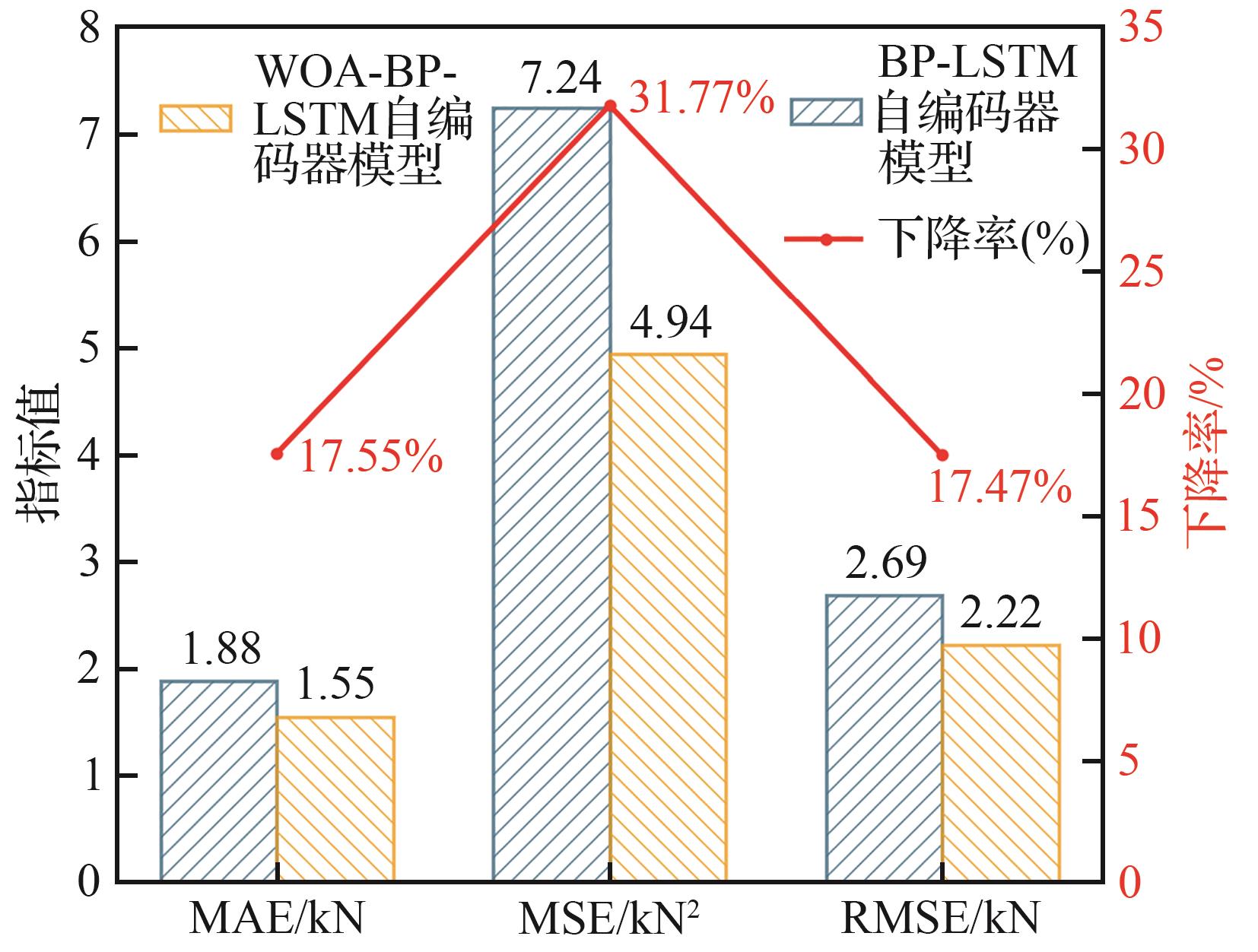
Fig.10
Comparison between actual and predicted force-displacement responses for 12 random samples in test set
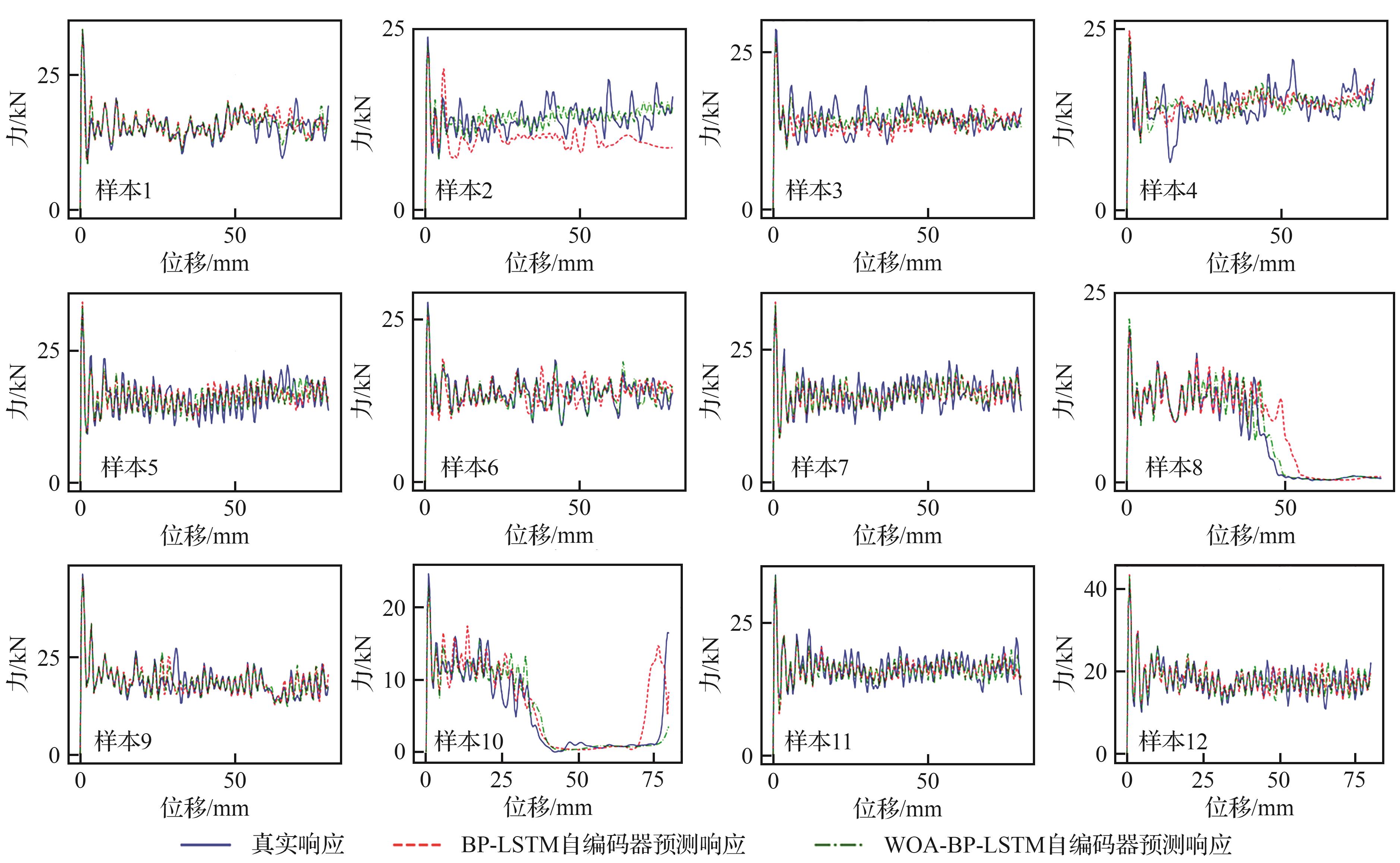
Table 5
Comparison between actual and predicted IPCF and EA values for 12 random samples in test set
| 样本 | IPCF/kN | EA/J | ||||||||
|---|---|---|---|---|---|---|---|---|---|---|
| 真实值 | BP-LSTM自编码器预测值 | 误差/% | WOA-BP-LSTM自编码器预测值 | 误差/% | 真实值 | BP-LSTM自编码器预测值 | 误差/% | WOA-BP-LSTM自编码器预测值 | 误差/% | |
| 1 | 33.26 | 33.53 | 0.83 | 33.52 | 0.80 | 1 237.73 | 1 278.03 | 3.26 | 1 256.6 | 1.53 |
| 2 | 23.89 | 22.31 | 6.61 | 22.88 | 4.21 | 1 009.58 | 808.18 | 19.95 | 1 021.43 | 1.17 |
| 3 | 28.66 | 26.60 | 7.16 | 27.17 | 5.18 | 1 154.32 | 1 120.60 | 2.92 | 1 143.83 | 0.91 |
| 4 | 22.94 | 24.68 | 7.60 | 23.71 | 3.34 | 1 157.65 | 1 172.38 | 1.27 | 1 154.17 | 0.30 |
| 5 | 33.04 | 34.31 | 3.84 | 33.55 | 1.56 | 1 289.85 | 1 306.47 | 1.29 | 1 299.45 | 0.74 |
| 6 | 27.51 | 26.31 | 4.36 | 26.81 | 2.54 | 1 092.41 | 1 099.62 | 0.66 | 1 090.98 | 0.13 |
| 7 | 33.05 | 33.94 | 2.70 | 33.54 | 1.47 | 1 341.59 | 1 332.72 | 0.66 | 1 342.94 | 0.10 |
| 8 | 20.23 | 20.15 | 0.43 | 21.76 | 7.53 | 511.62 | 586.77 | 14.69 | 534.66 | 4.50 |
| 9 | 46.61 | 45.49 | 2.42 | 45.68 | 2.02 | 1 505.54 | 1 511.12 | 0.37 | 1 509.78 | 0.28 |
| 10 | 24.68 | 22.47 | 8.97 | 22.99 | 6.86 | 450.82 | 526.26 | 16.73 | 453.79 | 0.66 |
| 11 | 34.07 | 33.69 | 1.10 | 33.86 | 0.61 | 1 323.26 | 1 310.19 | 0.99 | 1 302.55 | 1.56 |
| 12 | 41.95 | 43.45 | 3.56 | 43.02 | 2.53 | 1 430.47 | 1 438.79 | 0.58 | 1 435.12 | 0.32 |
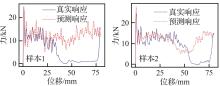
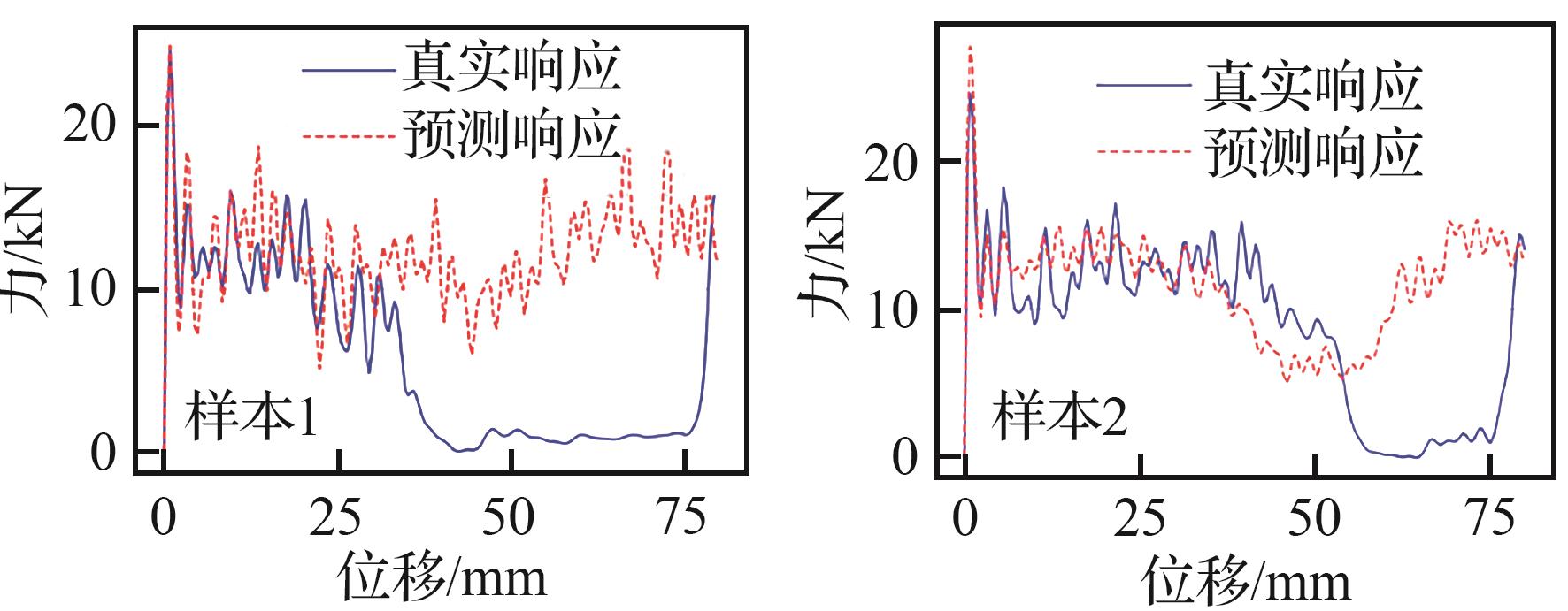
Fig.11
Comparison between actual and predicted force-displacement responses for 2 samples in BP neural network test set
| [1] | ABRAMOWICZ W. Thin-walled structures as impact energy absorbers[J]. Thin-Walled Structures, 2003, 41(2-3): 91-107. |
| [2] | BAROUTAJI A, SAJJIA M, OLABI A G. On the crashworthiness performance of thin-walled energy absorbers: Recent advances and future developments[J]. Thin-Walled Structures, 2017, 118: 137-163. |
| [3] | JACOB G C, FELLERS J F, SIMUNOVIC S, et al. Energy absorption in polymer composites for automotive crashworthiness[J]. Journal of Composite Materials, 2002, 36(7): 813-850. |
| [4] | GUIDA M, MARULO F, ABRATE S. Advances in crash dynamics for aircraft safety[J]. Progress in Aerospace Sciences, 2018, 98: 106-123. |
| [5] | MOU H L, XIE J, FENG Z Y, et al. Review on the crashworthiness design and evaluation of fuselage structure for occupant survivability[J]. Progress in Aerospace Sciences, 2024, 148: 101001. |
| [6] | MAMALIS A G, ROBINSON M, MANOLAKOS D E, et al. Crashworthy capability of composite material structures[J]. Composite Structures, 1997, 37(2): 109-134. |
| [7] | HULL D. A unified approach to progressive crushing of fibre-reinforced composite tubes[J]. Composites Science and Technology, 1991, 40(4): 377-421. |
| [8] | PALANIVELU S, VAN PAEPEGEM W, DEGRIECK J, et al. Parametric study of crushing parameters and failure patterns of pultruded composite tubes using cohesive elements and seam, Part Ⅰ: Central delamination and triggering modelling[J]. Polymer Testing, 2010, 29(6): 729-741. |
| [9] | LIU X C, BAI C Y, XI X L, et al. Impact response and crashworthy design of composite fuselage structures: An overview[J]. Progress in Aerospace Sciences, 2024, 148: 101002. |
| [10] | MOU H L, XIE J, LIU Y, et al. Impact test and numerical simulation of typical sub-cargo fuselage section of civil aircraft[J]. Aerospace Science and Technology, 2020, 107: 106305. |
| [11] | MOU H L, XIE J, FENG Z Y. Research status and future development of crashworthiness of civil aircraft fuselage structures: An overview[J]. Progress in Aerospace Sciences, 2020, 119: 100644. |
| [12] | CHIU L N S, FALZON B G, RUAN D, et al. Crush responses of composite cylinder under quasi-static and dynamic loading[J]. Composite Structures, 2015, 131: 90-98. |
| [13] | XIN Z B, DUAN Y G, ZHOU J, et al. Effect of tailored plies on the energy absorption capability of square CFRP tubes with discontinuous fibers[J]. Composite Structures, 2019, 209: 150-159. |
| [14] | WANG Y F, FENG J S, WU J H, et al. Effects of fiber orientation and wall thickness on energy absorption characteristics of carbon-reinforced composite tubes under different loading conditions[J]. Composite Structures, 2016, 153: 356-368. |
| [15] | LIU X, BELKASSEM B, JONET A, et al. Experimental investigation of energy absorption behaviour of circular carbon/epoxy composite tubes under quasi-static and dynamic crush loading[J]. Composite Structures, 2019, 227: 111266. |
| [16] | MCGREGOR C, VAZIRI R, POURSARTIP A, et al. Axial crushing of triaxially braided composite tubes at quasi-static and dynamic rates[J]. Composite Structures, 2016, 157: 197-206. |
| [17] | ZHANG J F, WANG L M, PENG D M, et al. Crashworthiness optimization of a sandwich tube filled with CFRP sinusoidal corrugated board[J]. Aerospace Science and Technology, 2023, 132: 108065. |
| [18] | SIROMANI D. Crashworthy design and analysis of aircraft structures[D]. Philadelphia: Drexel University, 2013. |
| [19] | LV R, REN Y R. Improving the crashworthiness of carbon fiber-reinforced composite channel section structure through controllable failure mechanisms[J]. Aerospace Science and Technology, 2023, 141: 108582. |
| [20] | RICCIO A, RAIMONDO A, DI CAPRIO F, et al. Experimental and numerical investigation on the crashworthiness of a composite fuselage sub-floor support system[J]. Composites Part B: Engineering, 2018, 150: 93-103. |
| [21] | RICCIO A, SAPUTO S, SELLITTO A, et al. On the crashworthiness behaviour of a composite fuselage Sub-floor component[J]. Composite Structures, 2020, 234: 111662. |
| [22] | FERABOLI P, SPETZLER M. Design of energy-absorbing CFRP stanchions for the cargo floor structure of transport category airplanes[C]∥JAMS 2013 Technical Review Meeting. 2013. |
| [23] | 汪洋, 吴志斌, 刘富. 复合材料货舱地板立柱压溃响应试验[J]. 复合材料学报, 2020, 37(9): 2200-2206. |
| WANG Y, WU Z B, LIU F. Crush experiment of composite cargo floor stanchions[J]. Acta Materiae Compositae Sinica, 2020, 37(9): 2200-2206 (in Chinese). | |
| [24] | 牟浩蕾, 刘兴炎, 刘冰, 等. 不同缘条宽度复合材料C型柱轴向压缩吸能特性[J]. 航空材料学报, 2023, 43(6): 107-116. |
| MOU H L, LIU X Y, LIU B, et al. Energy-absorption characteristics of composite C-channels with different flange widths under axial compression[J]. Journal of Aeronautical Materials, 2023, 43(6): 107-116 (in Chinese). | |
| [25] | 解江, 宋山山, 宋东方, 等. 复合材料C型柱轴压失效分析的层合壳建模方法[J]. 航空学报, 2019, 40(2): 522395. |
| XIE J, SONG S S, SONG D F, et al. Stacked shell modeling method for failure analysis of composite C-channels subject to axial compression[J]. Acta Aeronautica et Astronautica Sinica, 2019, 40(2): 522395 (in Chinese). | |
| [26] | FENG Z Y, XIE J, SONG S S, et al. The failure mechanism and energy-absorbing characteristics of composite thin-walled C-channels subject to low-speed axial compression[J]. Journal of Composite Materials, 2019, 53(16): 2249-2259. |
| [27] | 解江, 宋山山, 牟浩蕾, 等. 典型螺栓连接CFRP薄壁C型柱轴压失效行为: 试验及数值模拟[J]. 复合材料学报, 2021, 38(10): 3361-3372. |
| XIE J, SONG S S, MOU H L, et al. Axial compression failure behavior of typical bolted CFRP thin-walled C-channels: Experimental and numerical simulation[J]. Acta Materiae Compositae Sinica, 2021, 38(10): 3361-3372 (in Chinese). | |
| [28] | OSTLER D, BLESSING E, PERL M. A building block approach for crashworthiness testing of composites[C]∥JAMS 2019 Technical Review Meeting. 2019. |
| [29] | REINER J, VAZIRI R, ZOBEIRY N. Machine learning assisted characterisation and simulation of compressive damage in composite laminates[J]. Composite Structures, 2021, 273: 114290. |
| [30] | SHIROLKAR N, PATWARDHAN P, RAHMAN A, et al. Investigating the efficacy of machine learning tools in modeling the continuous stabilization and carbonization process and predicting carbon fiber properties[J]. Carbon, 2021, 174: 605-616. |
| [31] | YANG Z Z, YU C H, BUEHLER M J. Deep learning model to predict complex stress and strain fields in hierarchical composites[J]. Science Advances, 2021, 7(15): eabd7416. |
| [32] | ZHANG Z, ZHANG K, ZHANG G, et al. Low-velocity impact simulation of carbon fiber reinforced composite laminate using IFF-criterion based on BP-ANN[J]. Aerospace Science and Technology, 2024, 148: 109095. |
| [33] | 杨智春, 杨特. 动载荷识别物理嵌入式神经网络模型与方法[J]. 航空学报, 2025, 46(5): 531450. |
| YANG Z C, YANG T. Physical embedded neural network model and method for dynamic load identification[J]. Acta Aeronautica et Astronautica Sinica, 2025, 46(5): 531450 (in Chinese). | |
| [34] | 樊云翔, 艾化楠, 王明振, 等. 基于深度学习的水上飞机非定常水载荷重构[J]. 航空学报, 2024, 45(20): 129882. |
| FAN Y X, AI H N, WANG M Z, et al. Unsteady hydrodynamic load reconstruction of seaplane based on deep learning[J]. Acta Aeronautica et Astronautica Sinica, 2024, 45(20): 129882 (in Chinese). | |
| [35] | ASHFAQ KHAN M, KIM Y. Cardiac arrhythmia disease classification using LSTM deep learning approach[J]. Computers, Materials & Continua, 2021, 67(1): 427-443. |
| [36] | ZHANG B, ZHANG S H, LI W H. Bearing performance degradation assessment using long short-term memory recurrent network[J]. Computers in Industry, 2019, 106: 14-29. |
| [37] | SHAHID F, ZAMEER A, MUNEEB M. A novel genetic LSTM model for wind power forecast[J]. Energy, 2021, 223: 120069. |
| [38] | PARK P, DI MARCO P, SHIN H, et al. Fault detection and diagnosis using combined autoencoder and long short-term memory network[J]. Sensors, 2019, 19(21): 4612. |
| [39] | XU T, XU P, YANG C X, et al. An LSTM-stacked autoencoder multisource response prediction and constraint optimization for scaled expansion tubes[J]. Applied Soft Computing, 2024, 153: 111285. |
| [40] | MIRJALILI S, LEWIS A. The whale optimization algorithm[J]. Advances in Engineering Software, 2016, 95: 51-67. |
| [41] | WANG B R, GAO D Y, GU H Y, et al. Guided wave based composite structural fatigue damage monitoring utilizing the WOA-BP neural network[J]. Computers, Materials & Continua, 2025, 83(1): 455-473. |
| [42] | JIANG J Q, XU G B, WANG H Z, et al. High-accuracy road surface condition detection through multi-sensor information fusion based on WOA-BP neural network[J]. Sensors and Actuators A: Physical, 2024, 378: 115829. |
| [43] | GAO Z T, JIN Y H, ZHANG Y, et al. Static EIS multi-frequency feature points combined with WOA-BP neural network for Li-ion battery SOH estimation[J]. Measurement, 2025, 253: 117780. |
| [44] | HOCHREITER S, SCHMIDHUBER J. Long short-term memory[J]. Neural Computation, 1997, 9(8): 1735-1780. |
| [45] | SRIVASTAVA N, MANSIMOV E, SALAKHUDINOV R. Unsupervised learning of video representations using lstms[DB/OL]. arXiv preprint :1502.04681, 2015. |
| [1] | Lixiong ZHENG, Zhe CHEN, Xin WANG, Qijun ZHAO. Prediction of whirl flutter boundary for tiltrotor aircraft based on BPNN with adaptive data [J]. Acta Aeronautica et Astronautica Sinica, 2025, 46(S1): 732159-732159. |
| [2] | Yubin LU, Xiaohua NIE, Zhen WU. A residual stiffness prediction approach for carbon fiber reinforced composite materials based on interpretable machine learning algorithms [J]. Acta Aeronautica et Astronautica Sinica, 2025, 46(21): 532249-532249. |
| [3] | Fei MA, Qiong ZHANG, Peijun LAI, Yidi YUE. BP neural network⁃based quantitative classification model for safety in experimental flight training [J]. Acta Aeronautica et Astronautica Sinica, 2024, 45(5): 529957-529957. |
| [4] | Xiaoyu CHENG, Peng HAN, Wei HE, Peng ZHANG, Xiaoxia HAN, Yingmei LI, You CAO. A new flywheel health status assessment model based on explicable belief rule base [J]. Acta Aeronautica et Astronautica Sinica, 2023, 44(S1): 172-184. |
| [5] | Yiming LIANG, Guangning LI, Min XU. Method for numerical virtual flight with intelligent control based on machine learning [J]. Acta Aeronautica et Astronautica Sinica, 2023, 44(17): 128098-81280986. |
| [6] | DONG Zhenyi, LIN Li, LEI Mingkai, MA Zhiyuan. Ultrasonic quantitative characterization of pore distribution uniformity of seal coating based on BPNN [J]. ACTA AERONAUTICAET ASTRONAUTICA SINICA, 2022, 43(5): 425294-425294. |
| [7] | LUO Junting, ZHAO Jingqi, YANG Zheyi, LIU Weipeng, ZHANG Chunxiang. Microstructure prediction of multi-directional forging of TA15 alloy based on secondary development of Deform and BP neural network [J]. ACTA AERONAUTICAET ASTRONAUTICA SINICA, 2021, 42(12): 424693-424693. |
| [8] | WU Kun, TAN Shaochang. Path planning of UAVs based on improved whale optimization algorithm [J]. ACTA AERONAUTICAET ASTRONAUTICA SINICA, 2020, 41(S2): 724286-724286. |
| [9] | XIONG Qingchun, WANG Jiaxu, ZHOU Qinghua. Prediction model of machining errors based on precision and process parameters of machine tools [J]. ACTA AERONAUTICAET ASTRONAUTICA SINICA, 2018, 39(8): 421713-421713. |
| [10] | YAO Yusheng, XU Kaijun. Quality assessment of flight training based on BP neural network [J]. ACTA AERONAUTICAET ASTRONAUTICA SINICA, 2017, 38(S1): 721513-721513. |
| [11] | CHEN Yonggang, LUO Xiaoli. Nonlinear Dynamic Assessment Model of Airline Fleet Equipment Reliability [J]. ACTA AERONAUTICAET ASTRONAUTICA SINICA, 2013, 34(1): 104-111. |
| [12] | HUANG Jiangtao, GAO Zhenghong, BAI Junqiang, ZHAO Ke, LI Jing, XU Fang. Study of Robust Winglet Design Based on Arbitrary Space Shape FFD Technique [J]. ACTA AERONAUTICAET ASTRONAUTICA SINICA, 2013, 34(1): 37-45. |
| [13] | Meng Wengong;Ma Dongli;Chu Liang. Wing Aerodynamic Robustness Optimization Based on Neural Network Response Surface [J]. ACTA AERONAUTICAET ASTRONAUTICA SINICA, 2010, 31(6): 1134-1140. |
| [14] | Zhang Wei;Li Xiaoyang;Jiang Tongmin;Huang Lingcai. Life-prediction of Multi-stress Accelerated Life Testing Based onBP Algorithm of Artificial Neural Network [J]. ACTA AERONAUTICAET ASTRONAUTICA SINICA, 2009, 30(9): 1691-1696. |
| [15] | HUANG Jin;LIANG Yan;CHENG Yong-mei;PAN Quan;HU Jin-wen. Automatic Target Recognition Method Based on Sequential Images [J]. ACTA AERONAUTICAET ASTRONAUTICA SINICA, 2006, 27(1): 87-93. |
| Viewed | ||||||
|
Full text |
|
|||||
|
Abstract |
|
|||||
Address: No.238, Baiyan Buiding, Beisihuan Zhonglu Road, Haidian District, Beijing, China
Postal code : 100083
E-mail:hkxb@buaa.edu.cn
Total visits: 6658907 Today visits: 1341All copyright © editorial office of Chinese Journal of Aeronautics
All copyright © editorial office of Chinese Journal of Aeronautics
Total visits: 6658907 Today visits: 1341

 CJA
CJA
