Acta Aeronautica et Astronautica Sinica ›› 2026, Vol. 47 ›› Issue (2): 332170.doi: 10.7527/S1000-6893.2025.32170
• Electronics and Electrical Engineering and Control • Previous Articles Next Articles
Xiangyu LIU1, Gang WANG1, Siyuan WANG1( ), Zhuowen CHEN2
Received:2025-04-27
Revised:2025-05-15
Accepted:2025-06-12
Online:2025-06-30
Published:2025-06-27
Contact:
Siyuan WANG
E-mail:982268878@qq.com
Supported by:CLC Number:
Xiangyu LIU, Gang WANG, Siyuan WANG, Zhuowen CHEN. A data-knowledge dual-driven method for formation target intention recognition[J]. Acta Aeronautica et Astronautica Sinica, 2026, 47(2): 332170.

Table 1
Detailed description of formation target intention space
| 编队目标意图空间 | 描述 |
|---|---|
| 进攻扫荡(Attack and Sweep,AS) | 任务特性:编队对于我方保卫目标具有较强的攻击性和威胁性,对保卫要地的接近速率会更快,飞行方向会更倾向保卫要地,且距离一般不断减小 运动特性:编队目标速度较大,可以快速获得空间优势并进行扫荡搜索,既可以提高导弹的 初速,使得飞机能够在保证打击成功的前提下获得更大的安全距离,又可以提高攻击的突然性以及导弹的拦截难度 机动特性:主要通过改变自身高度从而获得进攻方面的优势,在进入攻击阶段时,通常采用 爬升/俯冲的机动行为 结构特性:编队内具有攻击意图的成员数量大于某一阈值,则更倾向于是进攻扫荡编队 |
| 侦察预警(Reconnaissance and Early warning,RE) | 任务特性:对应的任务主要是侦察、监视和预警,对我方保卫要地没有明显攻击性,飞行方向 不具有目的性,一般处于盘旋或是一定区域内缓慢飞行,接近速率较小 运动特性:在进行侦察、监视和预警任务时所处的高度较高 机动特性:通常采用盘旋机动,可以持续对一片区域进行侦察、监视和预警 结构特性:编队内具有侦察和监视意图的成员数量大于某一阈值,则更倾向于是侦察预警编队 |
| 干扰压制(Interference and Suppression,IS) | 任务特性:对应于电子干扰或巡逻任务,目的地一般是雷达或其他保卫要地,接近速率较大 运动特性:垂直高度基本不变,在水平面内进行运动 机动特性:通常采用具有周期性的S形机动,无爬升或俯冲等攻击性的机动 结构特性:编队内具有干扰意图的成员数量大于某一阈值,则更倾向于是干扰压制编队 |
Fig.1
Intentional characteristics of formation targets
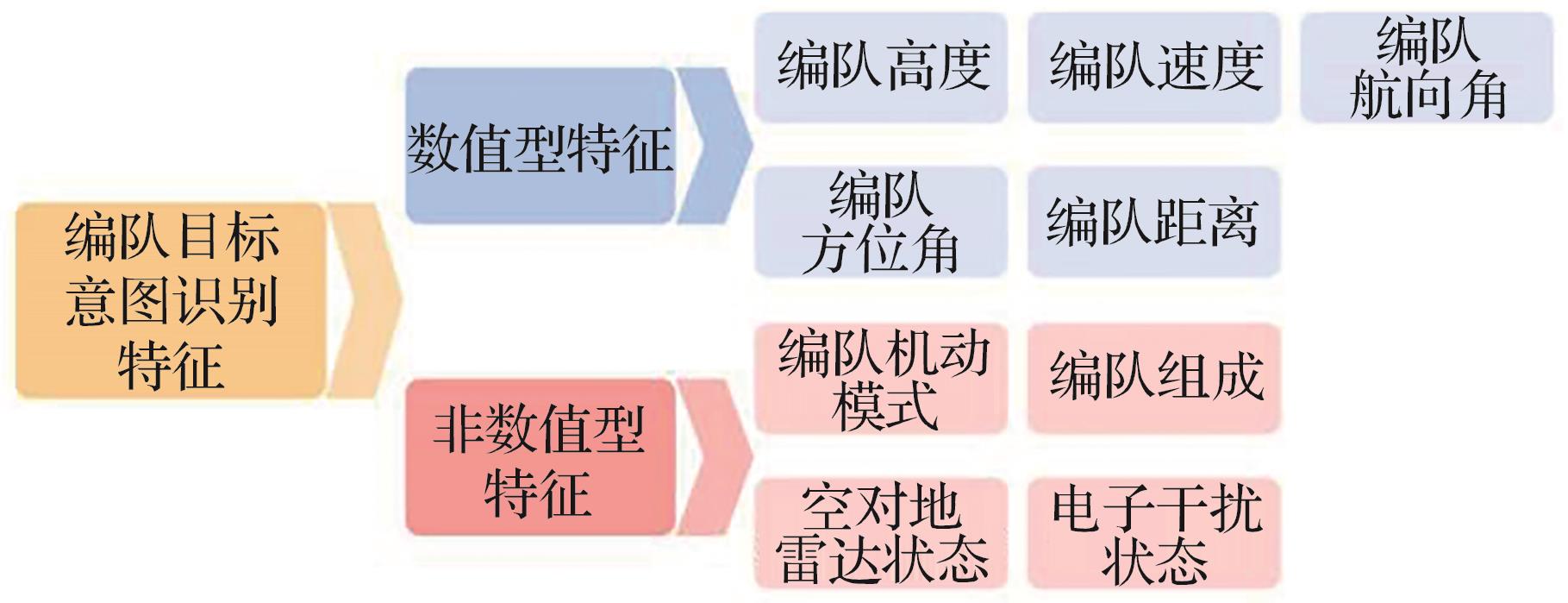
Table 2
Detailed description of formation target intention features
| 编队目标意图特征 | 描述 |
|---|---|
| 编队高度Fh/ km | 编队目标的飞行高度 |
| 编队速度Fv/ (m·s-1) | 编队目标的飞行速度 |
| 编队航向角Fha/(°) | 地球北极方向到编队目标飞行方向之间的角度 |
| 编队方位角Fa/(°) | 编队目标飞行方向与保卫要地之间的角度 |
| 编队距离Fd/ km | 编队目标与保卫要地之间的距离 |
| 编队机动模式Fmm | 编队目标在一定时间内采取的机动方式 |
| 编队组成Fc | 编队中具有某种单目标意图的飞机数量占比是否超过阈值 |
| 空对地雷达状态Ars | 编队目标的空对地雷达是否开启 |
| 电子干扰状态Eis | 编队目标的电子干扰装置是否开启 |
Fig.2
Dual data-knowledge driven framework for formation target intention recognition
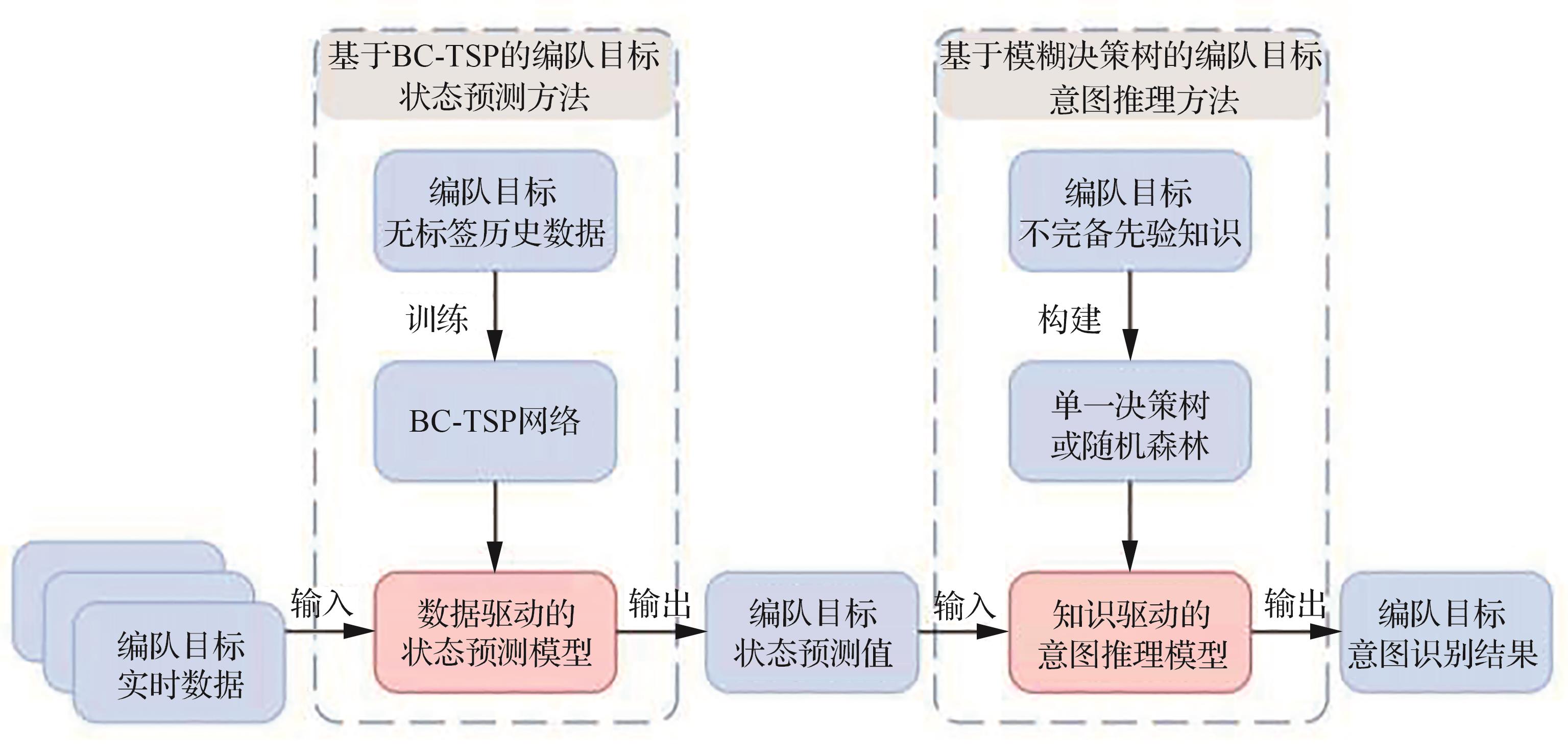
Fig.3
Framework of BC-TSP method
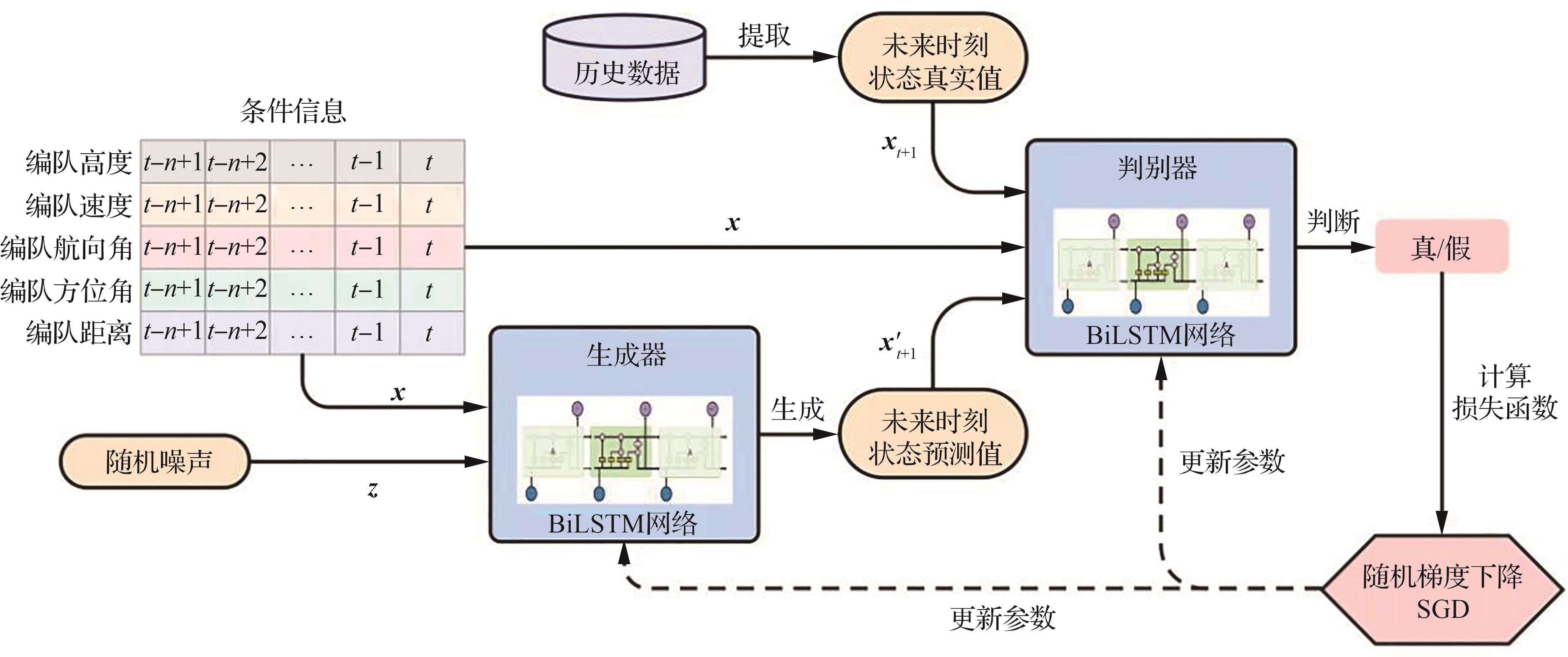
Fig.4
Training process and long-term prediction of BC-TSP network
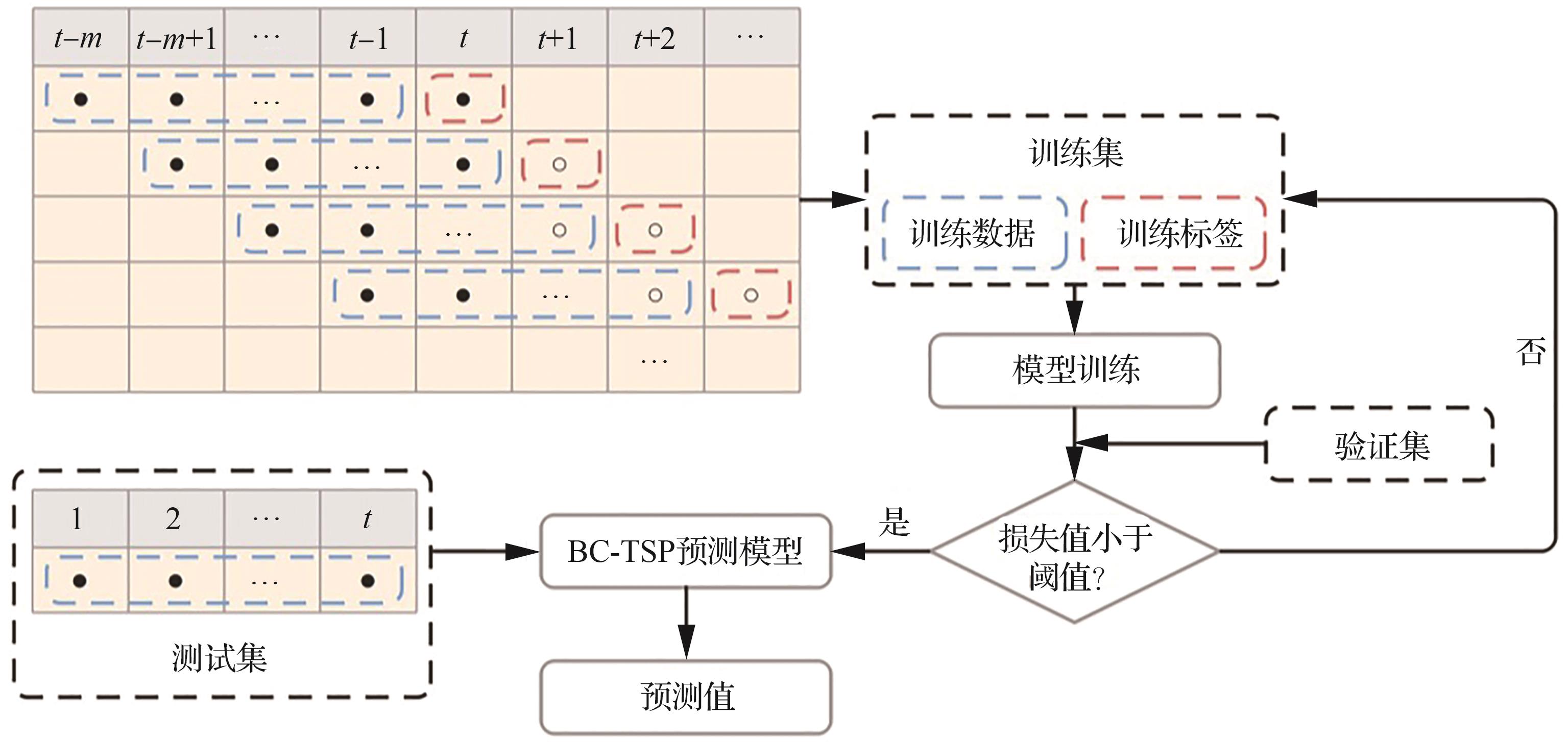
Fig.5
Process of predicting future state information
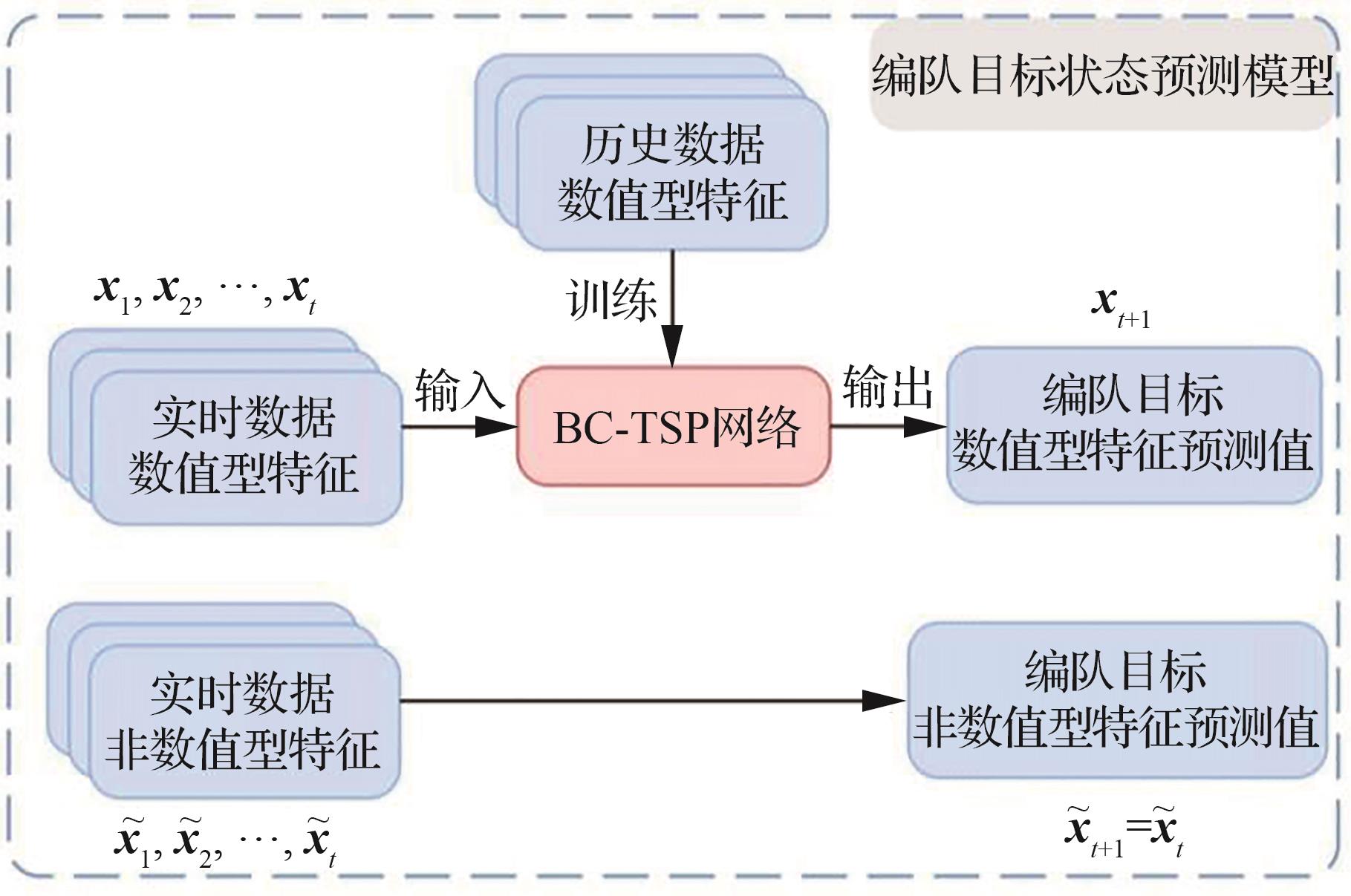
Table 3
Network architecture of generator and discriminator
| 网络 | 结构 |
|---|---|
| BC-TSP的生成器 | 第1层:Input, 第2层:Reshape, (None,10, 5) 第3层:Input, 第4层:Multiply, (None, 10, 5) 第5层:BiLSTM, (LSTM(10, 5)), (None, 20, 5) 第6层:Dense, (None, 5) 第7层:Output, |
| BC-TSP的判别器 | 第1层:Input, 第2层:Input, 第3层:Concatenate, (None, 11, 5) 第4层:BiLSTM, (LSTM(11, 5)), (None, 22, 5) 第5层:Dense, (None, 5) 第6层:Input, 第7层:Concatenate, (None, 11, 5) 第8层:BiLSTM, (LSTM(11, 5)), (None, 22, 5) 第9层:Dense, (None, 5) 第10层:Concatenate, (None, 2, 5) 第11层:Dense, (None, 5) 第12层:Dense, activation=’sigmoid’, (None, 1) 第13层:Output, Real/Fake |
Table 4
Comparative experimental results of different prediction methods
| 方法 | 平均绝对误差MAE | 均方根误差RMSE | 决定系数R2 |
|---|---|---|---|
| ARIMA | 0.249 | 0.416 | 0.874 9 |
| BP | 0.159 | 0.273 | 0.912 1 |
| RNN | 0.137 | 0.231 | 0.942 7 |
| LSTM | 0.096 | 0.167 | 0.964 5 |
| Transformer | 0.085 | 0.140 | 0.965 7 |
| BC-TSP | 0.083 | 0.139 | 0.975 3 |
Fig.6
Comparative experimental results of different prediction methods
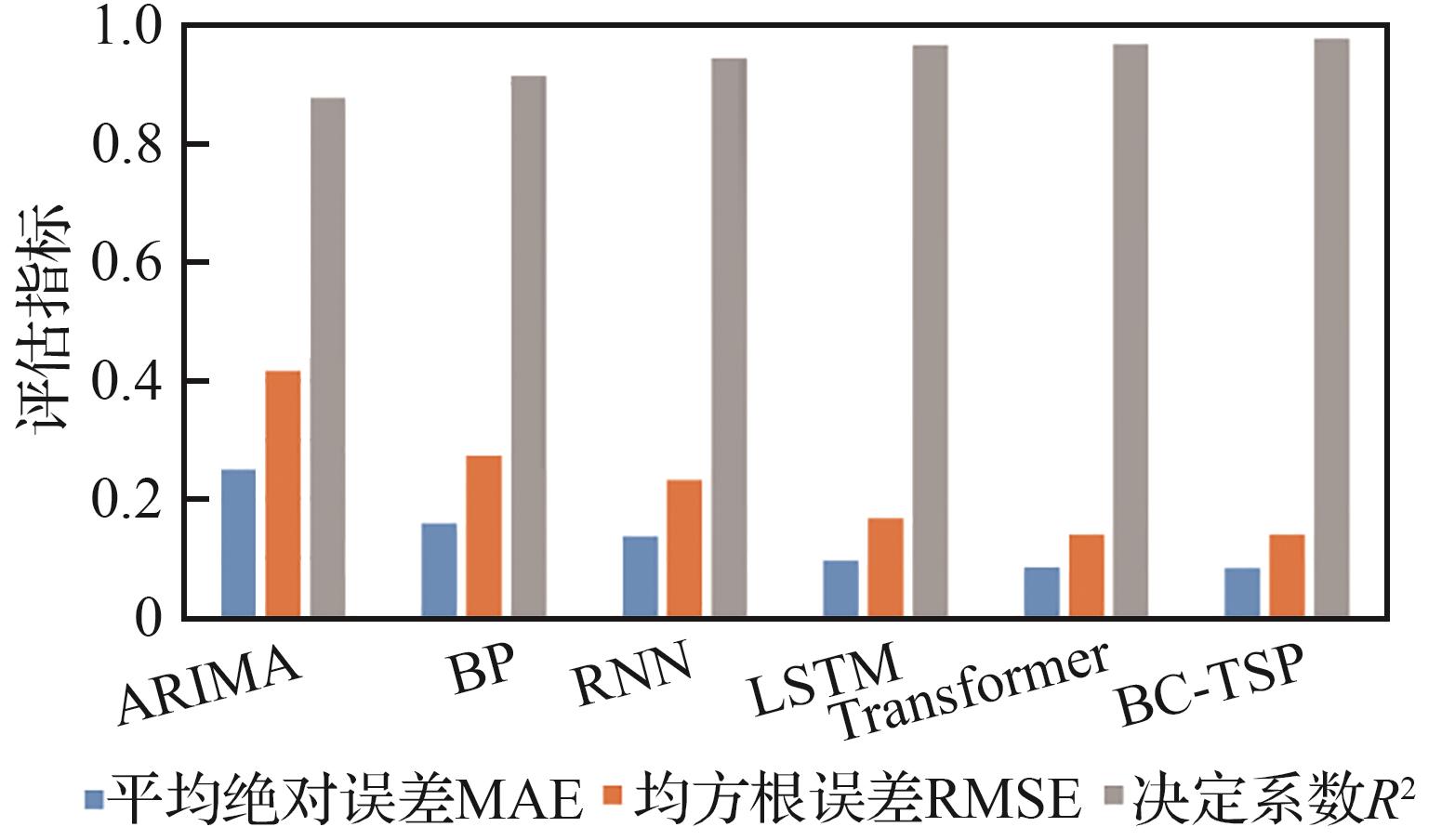
Table 5
Ablation experimental setup and comparative experimental results
| 模型序号 | 模型结构 | 对比结果 | ||||
|---|---|---|---|---|---|---|
| 双向长短时记忆网络(BiLSTM) | 长短时记忆网络(LSTM) | 条件生成对抗网络(CGAN) | 平均绝对误差MAE | 均方根误差RMSE | 决定系数R2 | |
| Ⅰ(BiLSTM) | √ | 0.094 | 0.164 | 0.965 5 | ||
| Ⅱ(LSTM-CGAN) | √ | √ | 0.091 | 0.160 | 0.965 6 | |
| Ⅲ(BC-TSP) | √ | √ | 0.083 | 0.139 | 0.975 3 | |
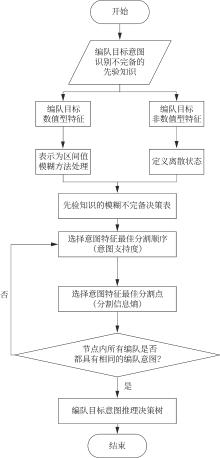
Fig.7
Generation methodology of formation target intention inference decision tree
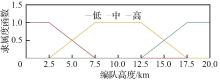
Fig.8
Fuzzy membership function of formation altitude
Fig.9
Fuzzy membership function for formation speed
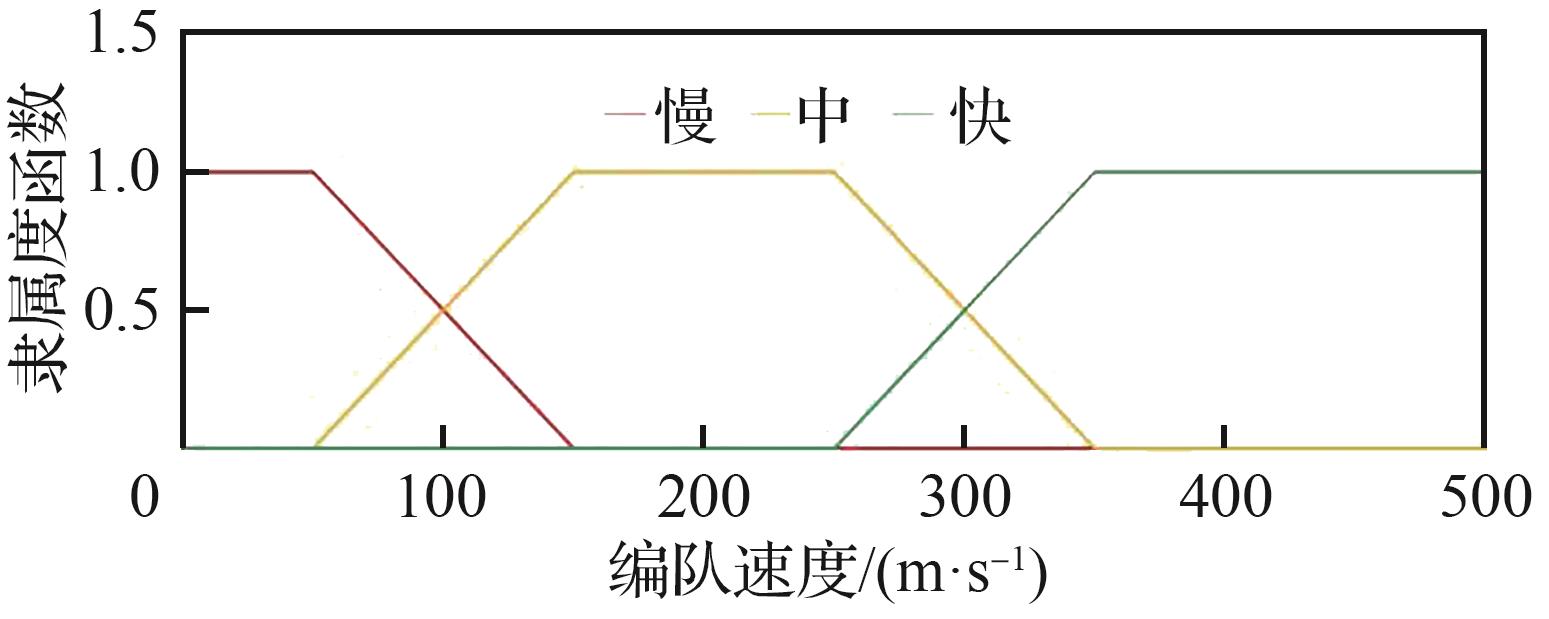
Fig.10
Fuzzy membership function for formation heading angle
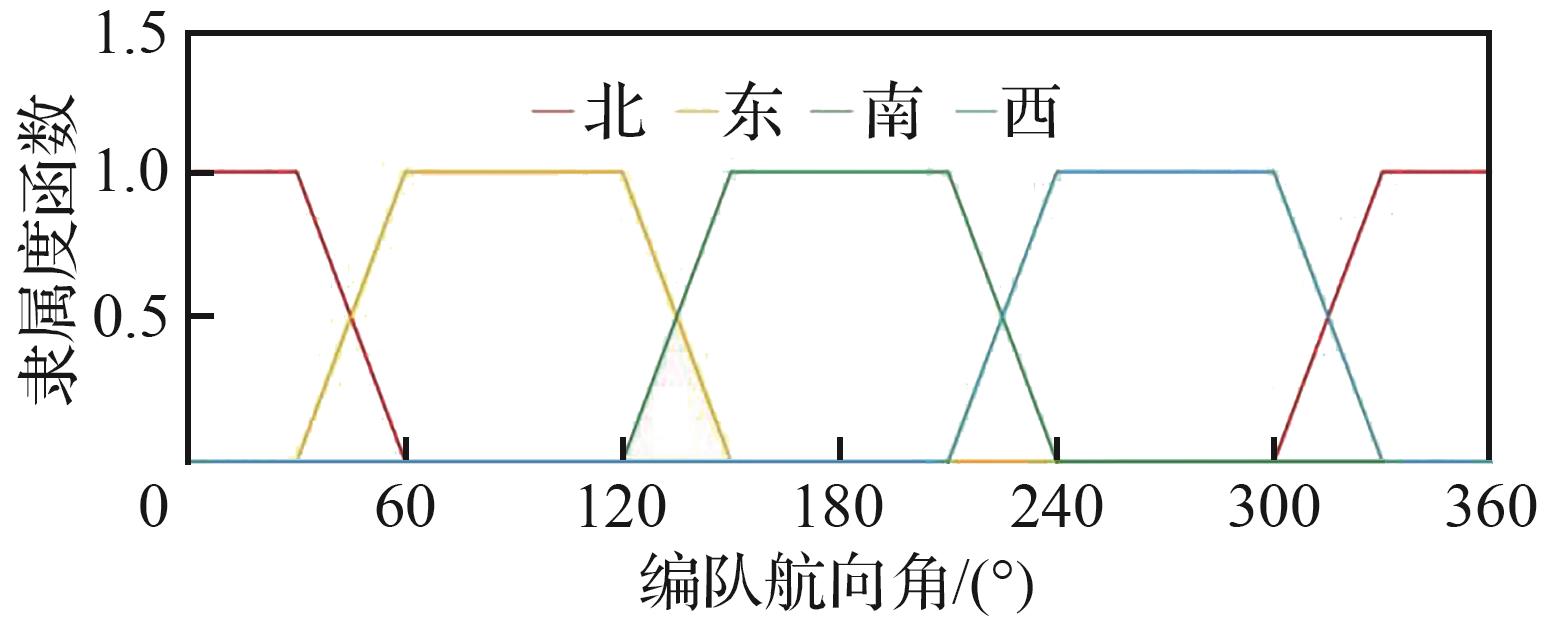
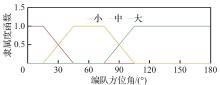
Fig.11
Fuzzy membership function of formation azimuth angle
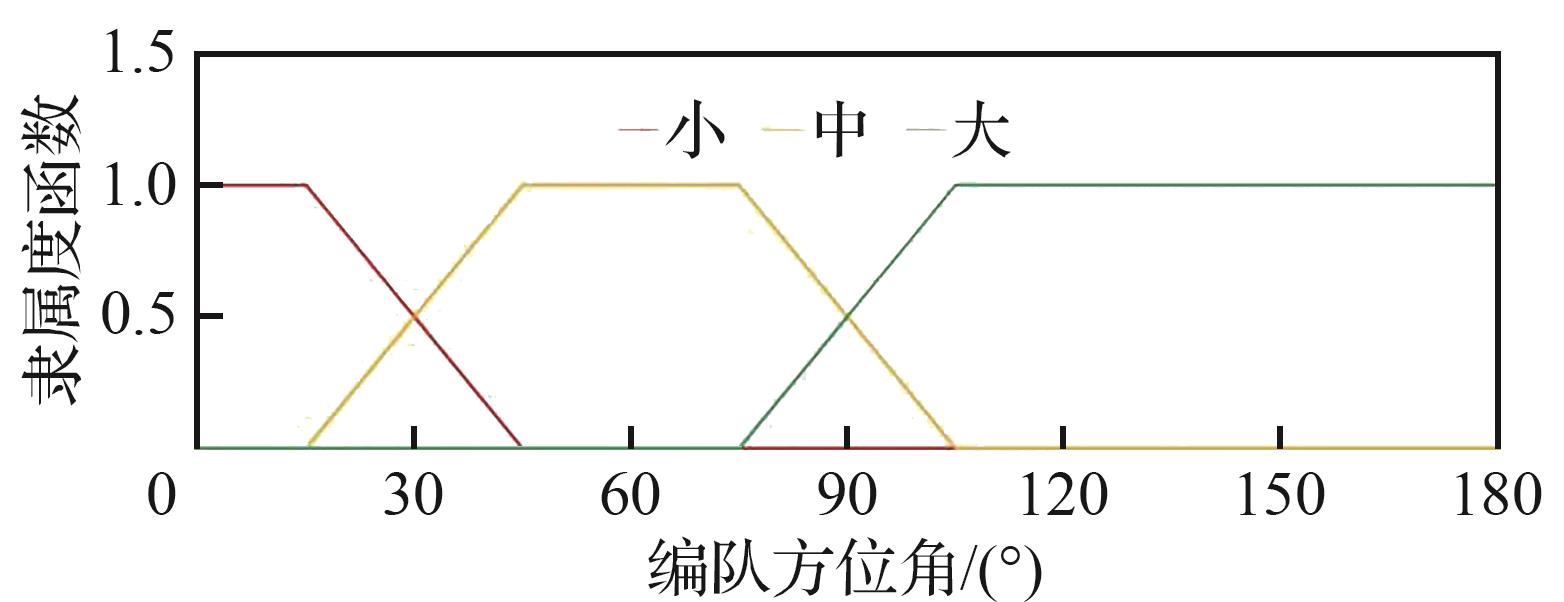
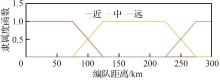
Fig.12
Fuzzy membership function for formation distance
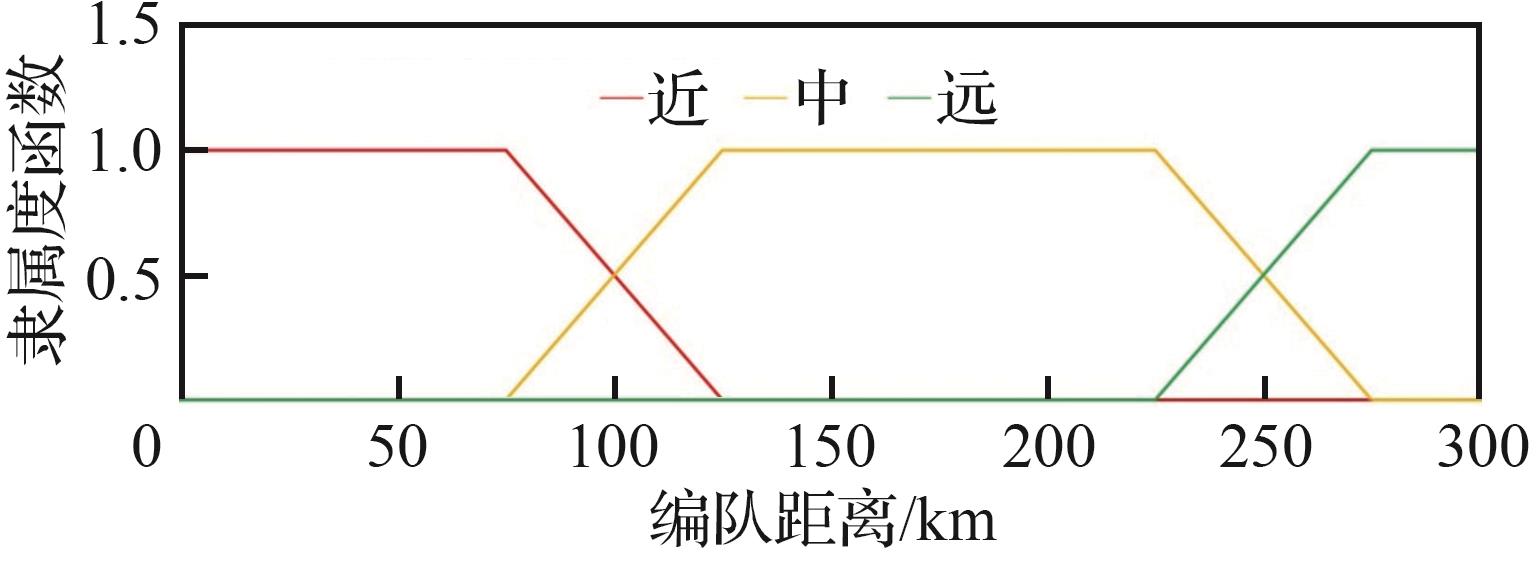
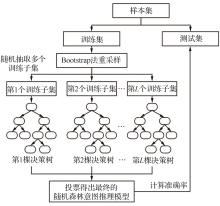
Fig.13
Modeling process of intent inference via random forest
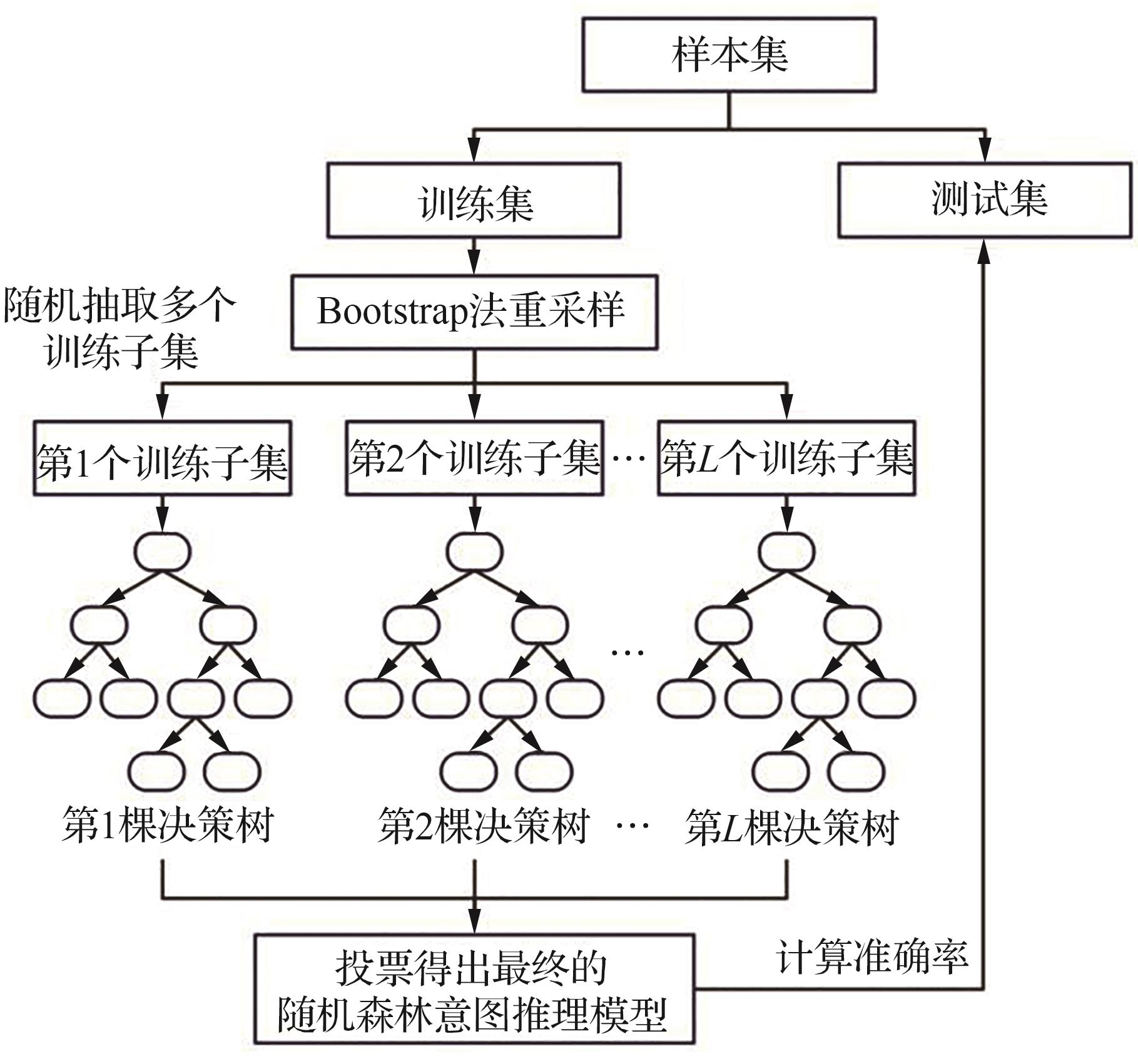
Table 6
Real-time data information of a formation target
| 时刻 | 编队高度/km | 编队速度/(m·s-1) | 编队航向角/(°) | 编队方位角/(°) | 编队距离/km | 编队机动模式 | 编队组成 | 空对地雷达工作状态 | 电子干扰状态 |
|---|---|---|---|---|---|---|---|---|---|
| 1 | 6.4 | 257 | 278 | 37 | 115 | 1 | 0 | 0 | 0 |
| 2 | 6.7 | 272 | 293 | 38 | 113 | 1 | 0 | 0 | 0 |
| 3 | 8.8 | 288 | 286 | 41 | 109 | 1 | 0 | 0 | 0 |
| 4 | 11.6 | 316 | 291 | 32 | 104 | 1 | 0 | 1 | 0 |
| 5 | 12.1 | 327 | 304 | 29 | 98 | 1 | 1 | 1 | 0 |
| 6 | 9.4 | 293 | 308 | 24 | 87 | 1 | 1 | 1 | 0 |
| 7 | 6.1 | 297 | 314 | 24 | 77 | 1 | 1 | 1 | 0 |
| 8 | 5.0 | 318 | 329 | 19 | 65 | 1 | 1 | 1 | 0 |
| 9 | 4.9 | 327 | 334 | 14 | 51 | 1 | 1 | 1 | 0 |
| 10 | 4.3 | 333 | 347 | 10 | 37 | 1 | 1 | 1 | 0 |
Table 7
State prediction results of a formation target
| 时刻 | 编队高度/km | 编队速度/(m·s-1) | 编队航向角/(°) | 编队方位角/(°) | 编队距离/km | 编队机动模式 | 编队 组成 | 空对地雷达工作状态 | 电子干扰状态 |
|---|---|---|---|---|---|---|---|---|---|
| 11 | 3.84 | 336.8 | 352.4 | 7.1 | 26.7 | 1 | 1 | 1 | 0 |
Table 8
Fuzzy decision values for formation target state prediction
| 时刻 | 编队高度Fh | 编队速度Fv | 编队航向角Fha | 编队方位角Fa | 编队距离Fd | 编队机动模式Fmm | 编队组成Fc | 空对地雷达工作状态Ars | 电子干扰状态Eis |
|---|---|---|---|---|---|---|---|---|---|
| 11 | Low | Fast | North | Small | Near | 1 | 1 | 1 | 0 |
Table 9
Incomplete prior knowledge information of formation targets
| 编队编号 | 编队意图 | 编队高度/km | 编队速度/(m·s-1) | 编队航向角/(°) | 编队方位角/(°) | 编队距离/km | 编队机动模式 | 编队组成 | 空对地雷达工作状态 | 电子干扰状态 |
|---|---|---|---|---|---|---|---|---|---|---|
| 1 | AS | [7.5,8.5] | [330,360] | [352,358] | * | [ | 1 | 1 | 0 | 0 |
| 2 | AS | [3.0,4.0] | [310,340] | * | [ | [120,134] | 0 | * | 1 | 0 |
| 3 | AS | * | [220,250] | [230,245] | [24,30] | * | 1 | 0 | 1 | 0 |
| 4 | AS | [11.2,13.2] | * | [354,359] | [35,42] | [ | 1 | 1 | 1 | * |
| 5 | AS | [4.5,5.0] | [300,330] | [48,74] | [ | [37,68] | * | 1 | 1 | 1 |
| 6 | AS | [3.9,4.8] | [275,295] | * | [ | [151,175] | 1 | 0 | * | * |
| 7 | AS | [8.0,9.0] | [350,360] | [0,15] | * | * | 0 | 1 | 0 | 0 |
| 8 | AS | * | * | [271,286] | [54,74] | [64,86] | 1 | * | 1 | 0 |
| 9 | RE | [12.5,13.5] | [150,170] | [] | [34,42] | [102,113] | * | 0 | 1 | 1 |
| 10 | RE | [16.2,17.3] | [90,100] | [96,125] | [ | [176,196] | * | 2 | 1 | 0 |
| 11 | RE | * | [300,320] | * | [58,81] | [54,65] | 2 | 0 | * | 0 |
| 12 | RE | [15.0,16.0] | [210,230] | [315,324] | [74,80] | * | 0 | 2 | 0 | 0 |
| 13 | RE | [3.5,4.5] | [95,105] | [231,239] | * | [256,274] | 2 | 2 | * | * |
| 14 | RE | [6.5,8.3] | [310,320] | [98,115] | [ | [45,59] | 2 | * | 1 | 0 |
| 15 | IS | [19.5,20.4] | [285,305] | [120,134] | [42,53] | [260,267] | 2 | 0 | * | * |
| 16 | IS | [17.3,18.3] | * | * | [98,125] | * | 3 | 3 | 1 | 1 |
| 17 | IS | * | [90,105] | [295,314] | [64,75] | [285,310] | * | 0 | 1 | 0 |
| 18 | IS | [19.6,21.0] | * | [ | * | [254,264] | 3 | 3 | 1 | 1 |
| 19 | IS | [13.6,14.9] | [240,250] | [189,193] | [ | [224,260] | 3 | * | 1 | 1 |
| 20 | IS | [16.4,19.3] | [80,110] | [146,174] | [93,105] | [287,296] | 0 | 0 | 0 | * |
Table 10
Fuzzy-incomplete decision of a priori knowledge
| 编队编号 | 编队意图 | 编队高度Fh | 编队速度Fv | 编队航向角Fha | 编队方位角Fa | 编队距离Fd | 编队机动模式Fmm | 编队组成Fc | 空对地雷达工作状态Ars | 电子干扰状态Eis |
|---|---|---|---|---|---|---|---|---|---|---|
| 1 | AS | Medium | Fast | North | * | Near | 1 | 1 | 0 | 0 |
| 2 | AS | Low | Fast | * | Small | Medium | 0 | * | 1 | 0 |
| 3 | AS | * | Medium | West | Small | * | 1 | 0 | 1 | 0 |
| 4 | AS | Medium | * | North | Medium | Near | 1 | 1 | 1 | * |
| 5 | AS | Low | Fast | East | Small | Near | * | 1 | 1 | 1 |
| 6 | AS | Low | Medium | * | Small | Medium | 1 | 0 | * | * |
| 7 | AS | Medium | Fast | North | * | * | 0 | 1 | 0 | 0 |
| 8 | AS | * | * | West | Medium | Near | 1 | * | 1 | 0 |
| 9 | RE | Medium | Medium | North | Medium | Medium | * | 0 | 1 | 1 |
| 10 | RE | High | Slow | East | Small | Medium | * | 2 | 1 | 0 |
| 11 | RE | * | Fast | * | Medium | Near | 2 | 0 | * | 0 |
| 12 | RE | High | Medium | North | Medium | * | 0 | 2 | 0 | 0 |
| 13 | RE | Low | Slow | West | * | Far | 2 | 2 | * | * |
| 14 | RE | Medium | Fast | East | Small | Near | 2 | * | 1 | 0 |
| 15 | IS | High | Medium | East | Medium | Far | 2 | 0 | * | * |
| 16 | IS | High | * | * | Large | * | 3 | 3 | 1 | 1 |
| 17 | IS | * | Slow | West | Medium | Far | * | 0 | 1 | 0 |
| 18 | IS | High | * | North | * | Far | 3 | 3 | 1 | 1 |
| 19 | IS | Medium | Medium | South | Small | Medium | 3 | * | 1 | 1 |
| 20 | IS | High | Slow | South | Large | Far | 0 | 0 | 0 | * |
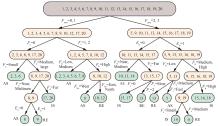
Fig.14
Decision tree for formation target intent inference
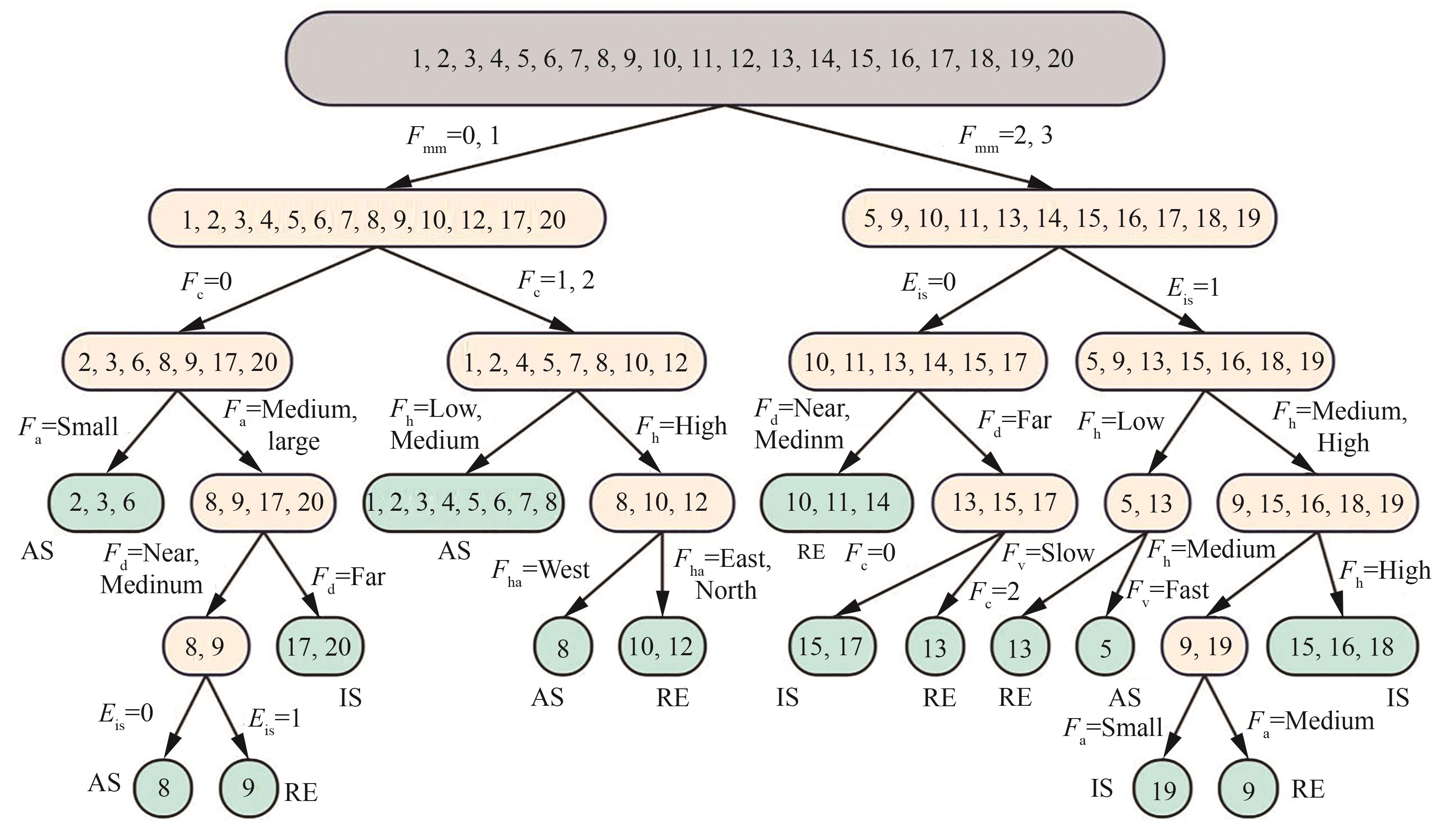
Table 11
Experimental results of intention inference with random forest
| 编队目标意图分类 | 样本 总数 | 决策树数量 | 正确识别数量 | 错误识别数量 | 准确率/% |
|---|---|---|---|---|---|
| 进攻扫荡 | 456 | 441 | 15 | 96.7 | |
| 447 | 9 | 98.0 | |||
| 442 | 14 | 96.9 | |||
| 444 | 12 | 97.4 | |||
| 447 | 9 | 98.0 | |||
| 侦察预警 | 283 | 270 | 13 | 95.4 | |
| 279 | 4 | 98.6 | |||
| 280 | 3 | 99.0 | |||
| 277 | 6 | 97.9 | |||
| 279 | 4 | 98.6 | |||
| 干扰压制 | 261 | 253 | 8 | 96.9 | |
| 255 | 6 | 97.7 | |||
| 255 | 6 | 97.7 | |||
| 259 | 2 | 99.2 | |||
| 253 | 8 | 96.9 | |||
| 总计 | 1 000 | 964 | 36 | 96.4 | |
| 981 | 19 | 98.1 | |||
| 977 | 23 | 97.7 | |||
| 980 | 20 | 98.0 | |||
| 979 | 21 | 97.9 |
Table 12
Comparative analysis of random forest versus single decision tree methodology
| 意图推理方法 | 样本总数 | 准确率/% | 耗时/s |
|---|---|---|---|
| 随机森林方法 | 50 | 80.0 | 0.5 |
| 100 | 90.0 | 0.9 | |
| 500 | 95.0 | 1.9 | |
| 1 000 | 96.5 | 3.6 | |
| 2 000 | 97.5 | 8.6 | |
| 5 000 | 98.1 | 11.4 | |
| 单一决策树方法 | 50 | 90.0 | 0.7 |
| 100 | 90.0 | 1.1 | |
| 500 | 94.0 | 7.5 | |
| 1 000 | 94.5 | 11.8 | |
| 2 000 | 95.3 | 15.6 | |
| 5 000 | 96.5 | 23.7 |
| [1] | 张会霞, 梁彦, 马超雄,等. 数据和知识驱动的空战目标集群类型综合识别[J]. 航空学报 2023, 44(8): 327266. |
| ZHANG H X, LIANG Y, MA C X, et al. Data- and knowledge-driven comprehensive identification of air combat target cluster types[J]. Journal of Aeronautics: 2023, 44(8): 327266 (in Chinese). | |
| [2] | 饶佳人, 孙世庆, 李婷婷. 基于规则的空中作战编队识别[J]. 指挥信息系统与技术, 2021, 12(3): 19-22, 29. |
| RAO J R, SUN S Q, LI T T. Rule-based air combat formation recognition[J]. Command Information Systems and Technology, 2021, 12(3): 19-22, 29 (in Chinese). | |
| [3] | 乔殿峰, 梁彦, 马超雄, 等. 多域作战下的群目标意图识别与预测[J]. 系统工程与电子技术, 2022, 44(11): 3403-3412. |
| QIAO D F, LIANG Y, MA C X, et al. Group target intent recognition and prediction under multi-domain operations[J]. Systems Engineering and Electronics, 2022, 44(11): 3403-3412 (in Chinese). | |
| [4] | 杨雨田, 杨杰, 李建国. 基于EMEBN的空中目标战术意图识别方法[J]. 火力与指挥控制, 2022, 47(5): 163-170. |
| YANG Y T, YANG J, LI J G. Tactical intent recognition method for air targets based on EMEBN[J]. Firepower and Command and Control, 2022, 47(5): 163-170 (in Chinese). | |
| [5] | MENG G L, ZHAO R N, WANG B, et al.Target tactical intention recognition in multiaircraft cooperative air combat[J].International Journal of Aerospace Engineering, 2021(5): 1-18. |
| [6] | 马钰棠, 孙鹏, 张杰勇, 等. 样本不平衡下的空中群组意图识别方法[J]. 系统工程与电子技术, 2022, 44(12): 3747-3755. |
| MA Y T, SUN P, ZHANG J Yet al. An airborne cluster intent recognition method under sample imbalance[J]. Systems Engineering and Electronics, 2022, 44(12): 3747-3755 (in Chinese). | |
| [7] | 苟先太, 吴南方. 基于GRU-Attention神经网络的空中群组态势识别方法[J]. 计算机与现代化, 2019(10): 11-16, 33. |
| GOU X T, WU N F. An airborne swarm posture recognition method based on GRU-Attention neural network[J]. Computer and Modernization, 2019(10): 11-16, 33 (in Chinese). | |
| [8] | 蒲志强, 易建强, 刘振 等. 知识和数据协同驱动的群体智能决策方法研究综述[J]. 自动化学报, 2022, 48(3): 627-643. |
| PU Z Q, YI J Q, LIU Zet al. A review of research on group intelligent decision-making methods driven by knowledge and data synergy[J]. Journal of Automation, 2022, 48(3): 627-643 (in Chinese). | |
| [9] | 李洋军, 黄琦龙, 杨力, 等. 数据和知识双驱动的空中集群目标作战意图识别[J]. 兵工学报, 2025, 46(2): 135-144. |
| LI Y J, HUANG Q L, YANG L, et al. Data- and knowledge-driven combat intent recognition of airborne cluster targets[J]. Journal of Military Engineering, 2025, Vol. 46(2): 135-144 (in Chinese). | |
| [10] | 刘建伟, 谢浩杰, 罗雄麟. 生成对抗网络在各领域应用研究进展[J]. 自动化学报, 2020, 46(12): 2500-2536. |
| LIU J W, XIE H J, LO X L. Research progress of generative adversarial networks applied in various fields[J]. Journal of Automation, 2020, 46(12): 2500-2536 (in Chinese). | |
| [11] | RADFORD A, METZ L, CHINTALA S. Unsupervised representation learning with deep convolutional generative adversarial networks[DB/OL]. arXiv preprint: 1511.06434, 2015. |
| [12] | ARJOVSKY M, BOTTOU L. Towards principled methods for training generative adversarial networks[DB/OL]. arXiv preprint: 1701.04862, 2017. |
| [13] | HOCHREITER S, SCHMIDHUBER J. Long short-term memory[J]. Neural computation, 1997, 9(8): 1735-1780. |
| [14] | 刘钻东, 陈谋, 吴庆宪 等. 非完备信息下无人机空战目标意图预测[J]. 中国科学: 信息科学, 2020, 50(5): 704-717. |
| LIU Z D, CHEN M, WU Q Xet al. Prediction of target intent for unmanned aerial combat under incomplete information[J]. Science in China: Information Science, 2020, 50(5): 704-717 (in Chinese). | |
| [15] | MIRZA M, OSINDERO S. Conditional generative adversarial nets[J]. Computer Science, 2014: 2672-2680. |
| [16] | ZHOU T, CHEN M, WANG Y, et al. Information entropy-based intention prediction of aerial targets under uncertain and incomplete information[J]. Entropy, 2020, 22(3): 279. |
| [17] | WANG L, LI S. Tactical intention recognition of aerial target based on XGBoost decision tree[J]. Journal of Measurement Science and Instrumentation, 2018, 9(2): 148-152. |
| [18] | 刘敏, 郎荣玲, 曹永斌. 随机森林中树的数量[J]. 计算机工程与应用, 2015, 51(5): 126-131. |
| LIU M, LANG R L, CAO Y B. The number of trees in random forest[J]. Computer Engineering and Applications, 2015, 51(5): 126-131 (in Chinese). | |
| [19] | 陈浩, 任卿龙, 滑艺 等. 基于模糊神经网络的海面目标战术意图识别[J]. 系统工程与电子技术, 2016, 38(8): 1847-1853. |
| CHEN H, REN Q L, GUA Y et al. Fuzzy neural network-based tactical intent recognition of sea surface targets[J]. Systems Engineering and Electronics Technology, 2016, 38(8): 1847-1853 (in Chinese). | |
| [20] | 施伟, 冯旸赫, 程光权 等. 基于深度强化学习的多机协同空战方法研究[J]. 自动化学报, 2021, 47(7): 1610-1623. |
| SHI W, FENG Y H, CHENG G Qet al. Deep reinforcement learning based multi-aircraft cooperative air combat method[J]. Journal of Automation, 2021, 47(7): 1610-1623 (in Chinese). | |
| [21] | 强立, 杨凡德, 施令. 空间态势认知产品生成及关键技术研究[J]. 指挥控制与仿真, 2018, 40(3): 5-9, 13. |
| QIANG L, YANG D F, SHI L. Research on spatial situational awareness product generation and key technologies[J]. Command Control and Simulation, 2018, 40(03): 5-9, 13 (in Chinese). |
| [1] | Yanfang LIU, Hongyue WANG, Yujia E, Naiming QI. A new paradigm of intelligence-driven active mass ejection drag and heat reduction research for hypersonic vehicle boundary layer [J]. Acta Aeronautica et Astronautica Sinica, 2026, 47(2): 132171-132171. |
| [2] | Yuequn LUO, Dali DING, Mulai TAN, Yidong LIU, Huan ZHOU. A review of autonomous maneuver decision methods for unmanned combat aerial vehicle [J]. Acta Aeronautica et Astronautica Sinica, 2025, 46(7): 30877-030877. |
| [3] | Guanghui WU, Jing WANG, Hairun XIE, Tuliang MA, Qiang MIAO, Jixin XIANG, Miao ZHANG. Data and knowledge-enabled intelligent aerodynamic design for civil aircraft [J]. Acta Aeronautica et Astronautica Sinica, 2025, 46(5): 531485-531485. |
| [4] | Shuming YANG, Jianjun WU, Changlin XIE, Yuqiang CHENG, Biao WANG. Application issues of data-driven intelligent fault diagnosis technologies for liquid rocket engines [J]. Acta Aeronautica et Astronautica Sinica, 2025, 46(15): 131427-131427. |
| [5] | Haotian ZHAO, Shi QIU, Ming LIU, Qichao GAI, Xibin CAO. Degradation evaluation method for communication satellite traveling wave tubes based on full life cycle data [J]. Acta Aeronautica et Astronautica Sinica, 2025, 46(12): 331376-331376. |
| [6] | Yu ZENG, Hongbo WANG, Chengyue LIAN, Yixin YANG, Dapeng XIONG, Mingbo SUN, Weidong LIU. Applicability analysis of two improved methods of SST turbulence model [J]. Acta Aeronautica et Astronautica Sinica, 2024, 45(S1): 730574-730574. |
| [7] | Qi WANG, Long WU, Zhen LIU, Jianxia LIU, Liang XIA. Topology optimization design of thermoelastic multi-configuration gradient lattice structures [J]. Acta Aeronautica et Astronautica Sinica, 2024, 45(23): 230367-230367. |
| [8] | Lizhuo DONG, Siqi ZHANG, Zhao ZHANG, Baohai WU. Prediction method of blade machining deformation driven by mechanism⁃data hybrid [J]. Acta Aeronautica et Astronautica Sinica, 2024, 45(13): 629037-629037. |
| [9] | Ximing CUI, Zhipeng QIU, Jia WEI, Chi ZHANG, Kai SONG, Zhe LI, Shupeng WANG. Data-driven method for characterization of structural steel surface stress of magnetic Barkhausen noise [J]. ACTA AERONAUTICAET ASTRONAUTICA SINICA, 2023, 44(8): 427237-427237. |
| [10] | JIANG Lijian, ZHAO Wenwen, CHEN Weifang, YAO Shaobo. Data-driven rarefied nonlinear constitutive relations based on rotation invariants [J]. ACTA AERONAUTICAET ASTRONAUTICA SINICA, 2022, 43(12): 126256-126256. |
| [11] | LI Tingwei, ZHANG Mang, ZHAO Wenwen, CHEN Weifang, JIANG Lijian. Machine learning method for correction of rarefied nonlinear constitutive relations [J]. ACTA AERONAUTICAET ASTRONAUTICA SINICA, 2021, 42(4): 524386-524386. |
| [12] | YU Min, LUO Jianjun, WANG Mingming. Real-time motion prediction of space tumbling targets based on machine learning [J]. ACTA AERONAUTICAET ASTRONAUTICA SINICA, 2021, 42(2): 324149-324149. |
| [13] | ZHANG Yizhi, CHENG Cheng, FAN Yitong, LI Gaohua, LI Weipeng. Data-driven correction of turbulence model with physics knowledge constrains in channel flow [J]. ACTA AERONAUTICAET ASTRONAUTICA SINICA, 2020, 41(3): 123282-123282. |
| [14] | WU Heng, LI Benwei, ZHANG Yun, YANG Xinyi. Dynamic model identification of starting process of a turbo-shaft engine based on QPSO-ELM [J]. ACTA AERONAUTICAET ASTRONAUTICA SINICA, 2018, 39(11): 322251-322261. |
| [15] | Wang Yi;Zhou Xingshe;Han Zhaoxuan. STUDY AND DESIGN OF EXECUTIVE SOFTWARE FOR DISTRIBUTED REAL-TIME CONTROL SYSTEMS [J]. ACTA AERONAUTICAET ASTRONAUTICA SINICA, 1990, 11(8): 348-353. |
| Viewed | ||||||
|
Full text |
|
|||||
|
Abstract |
|
|||||
Address: No.238, Baiyan Buiding, Beisihuan Zhonglu Road, Haidian District, Beijing, China
Postal code : 100083
E-mail:hkxb@buaa.edu.cn
Total visits: 6658907 Today visits: 1341All copyright © editorial office of Chinese Journal of Aeronautics
All copyright © editorial office of Chinese Journal of Aeronautics
Total visits: 6658907 Today visits: 1341

 CJA
CJA
