Acta Aeronautica et Astronautica Sinica ›› 2025, Vol. 46 ›› Issue (24): 132072.doi: 10.7527/S1000-6893.2025.32072
• Fluid Mechanics and Flight Mechanics • Previous Articles
Yong LIANG1,2, Weiguo ZHANG1,2( ), Binghui CHE1,2, Honggang YUAN1,2, Chunhua WEI1,2, Ningmeng YANG1,2
Received:2025-04-03
Revised:2025-05-04
Accepted:2025-05-30
Online:2025-06-23
Published:2025-06-20
Contact:
Weiguo ZHANG
E-mail:zwglxy@163.com
Supported by:CLC Number:
Yong LIANG, Weiguo ZHANG, Binghui CHE, Honggang YUAN, Chunhua WEI, Ningmeng YANG. Wind tunnel tests of aeroacoustic characteristic for helicopter aircraft model[J]. Acta Aeronautica et Astronautica Sinica, 2025, 46(24): 132072.
Fig.1
Helicopter test model
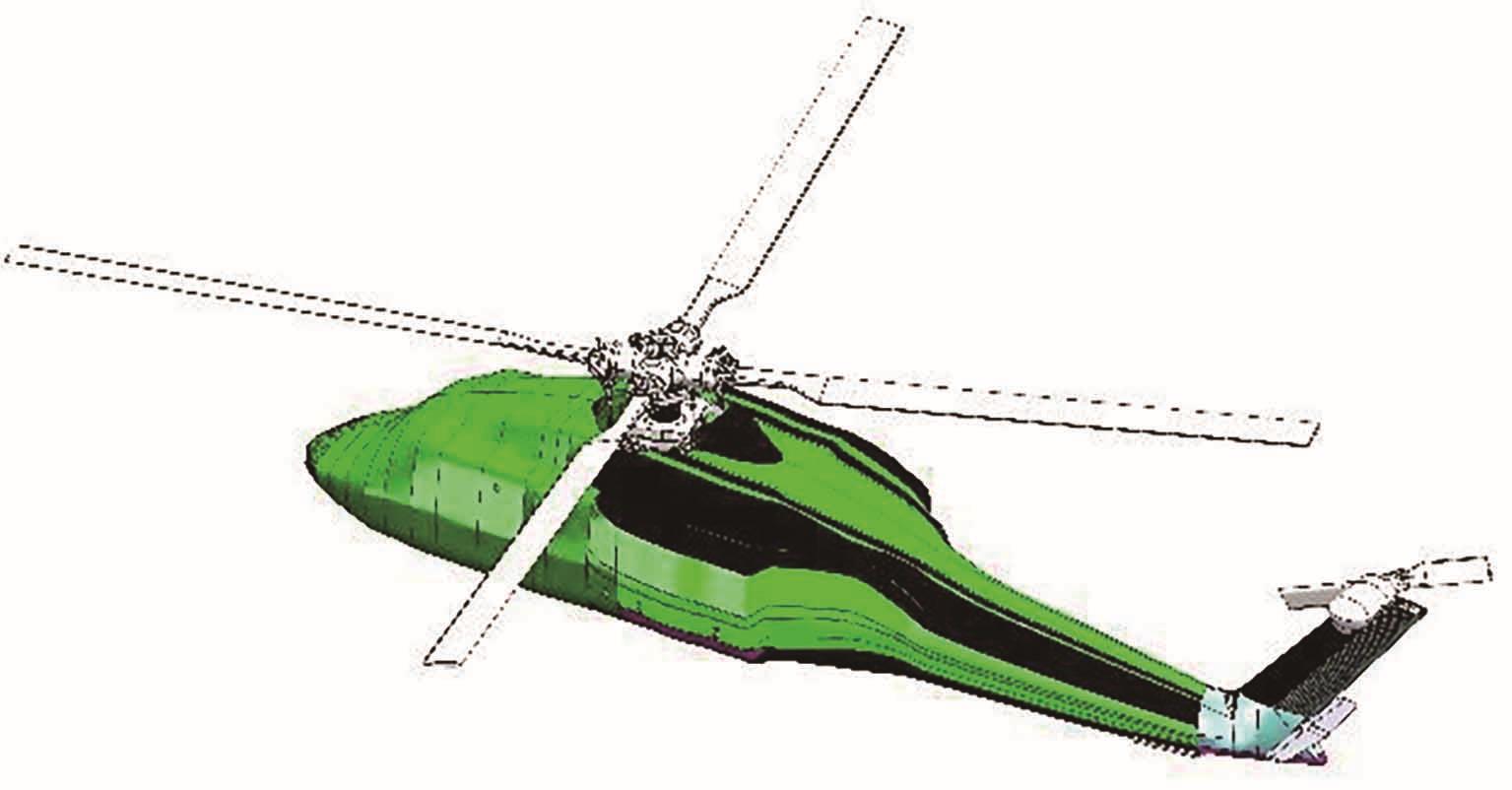
Fig.2
Installation method for helicopter full-scale aeroacoustic testing system
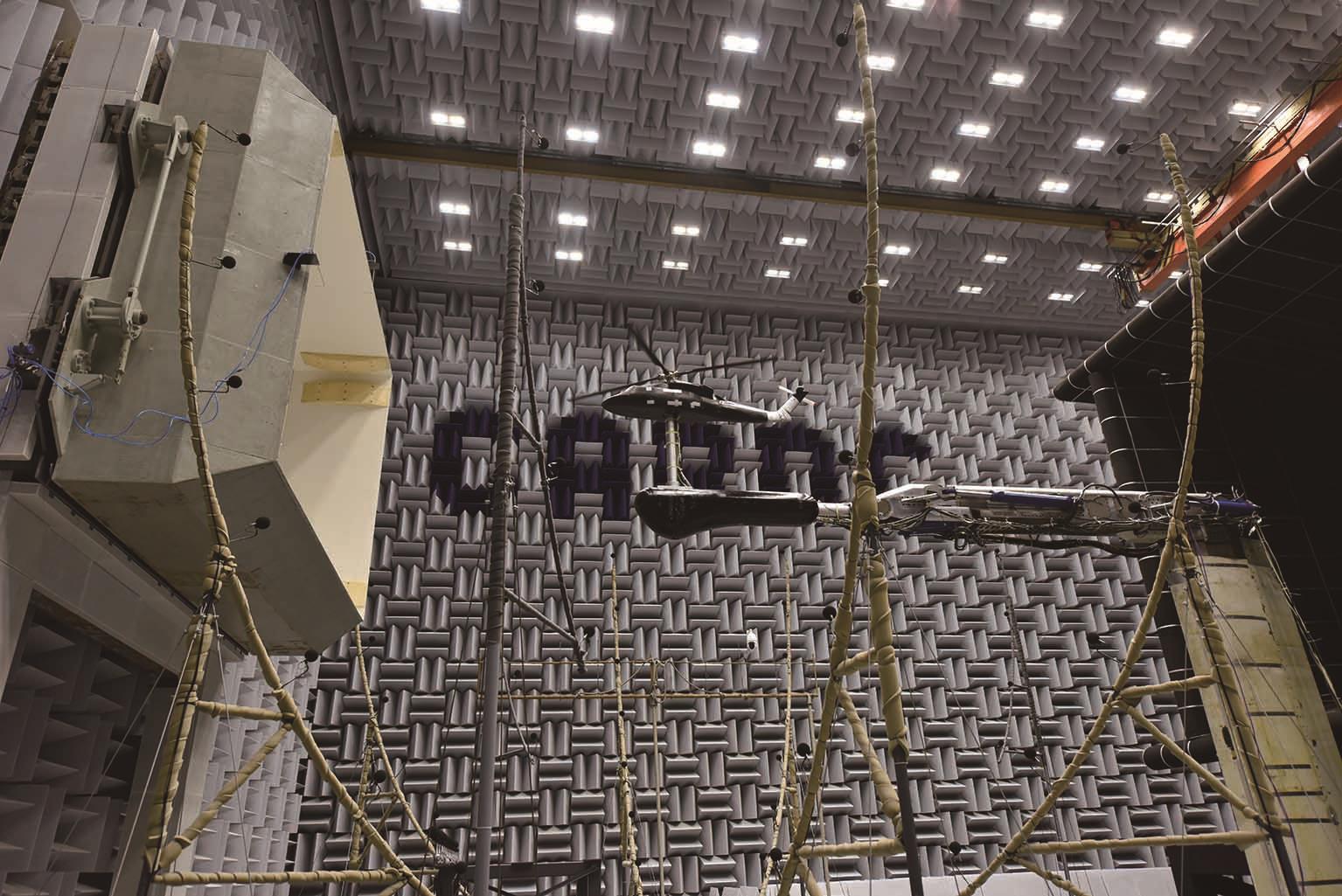
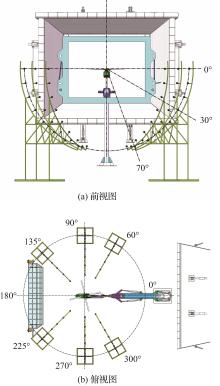
Fig.3
Location of microphone
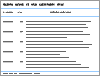
Table 1
Test parameters
| 试验状态 | 试验参数 |
|---|---|
| 悬停 | 总距 |
| 前飞 | 前进比 |
| 升力系数CL =0.006,0.008,0.010,0.012 | |
| 轴倾角αs=-6°,-2°,2°,3°,5° |
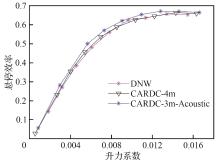
Fig.4
Comparison of performance data from different wind tunnels
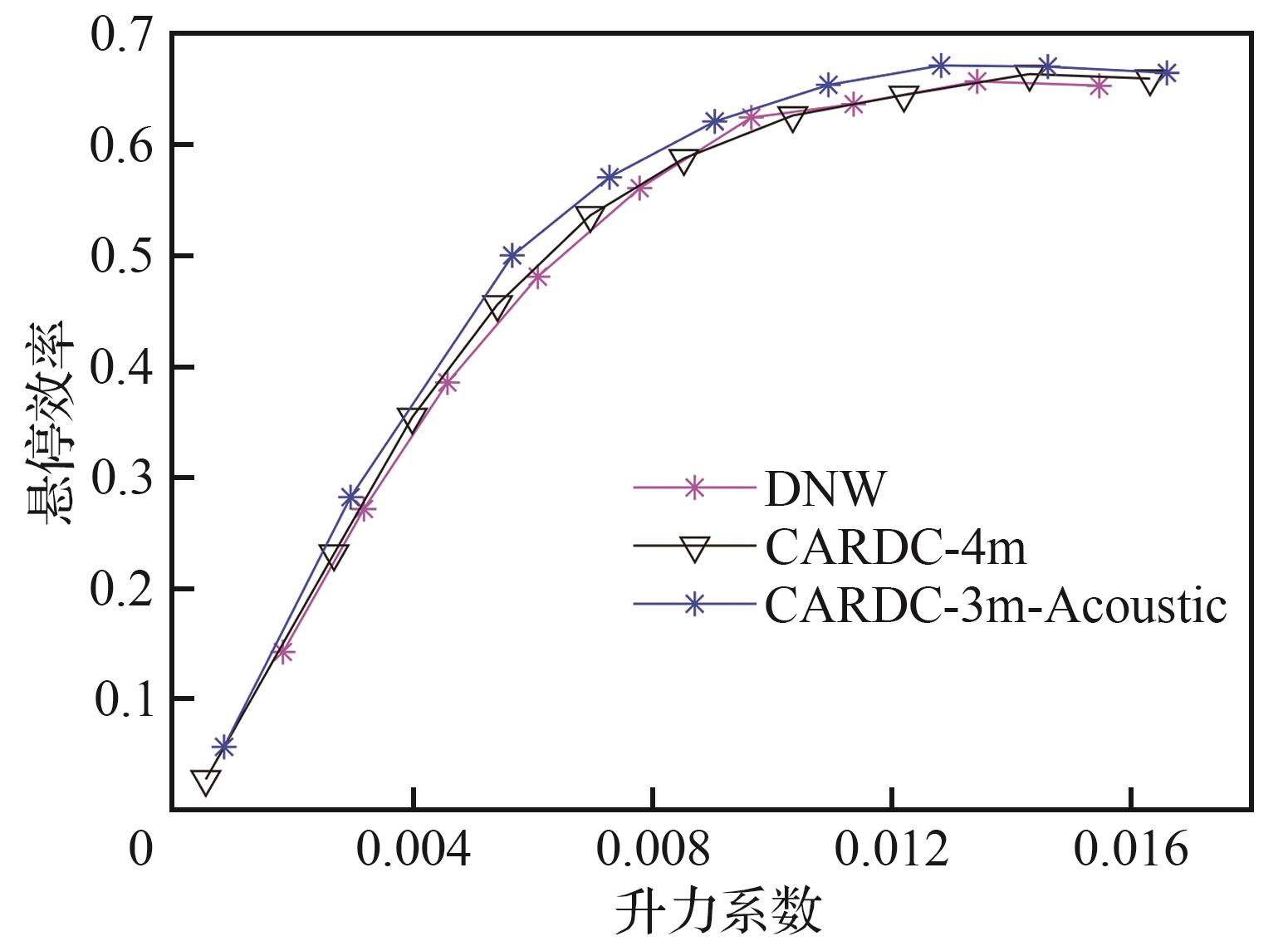
Fig.5
Spectrum comparison between wind tunnel background noise and test configurations
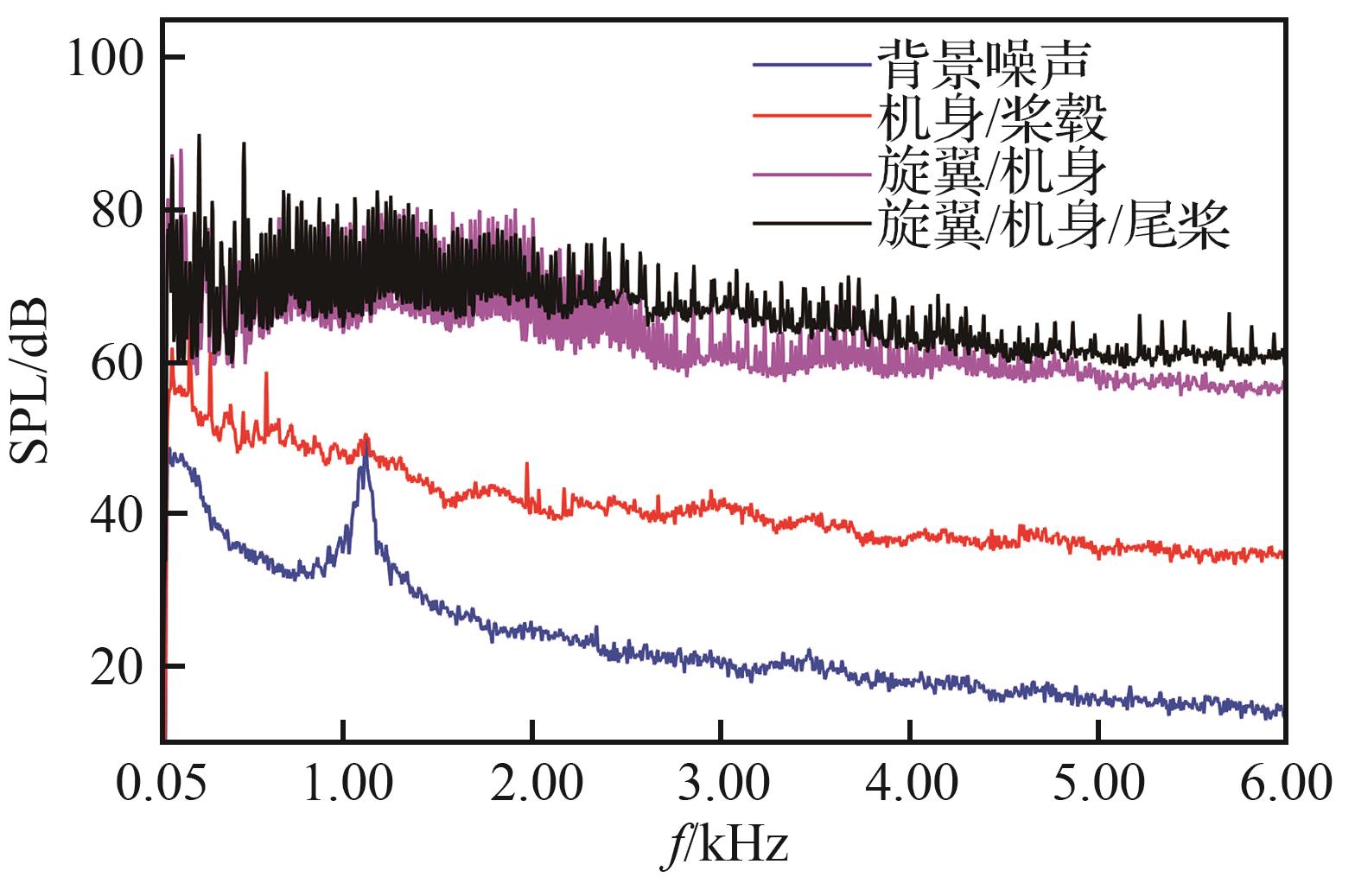

Fig.6
OASPL comparison between wind tunnel background noise and test configurations
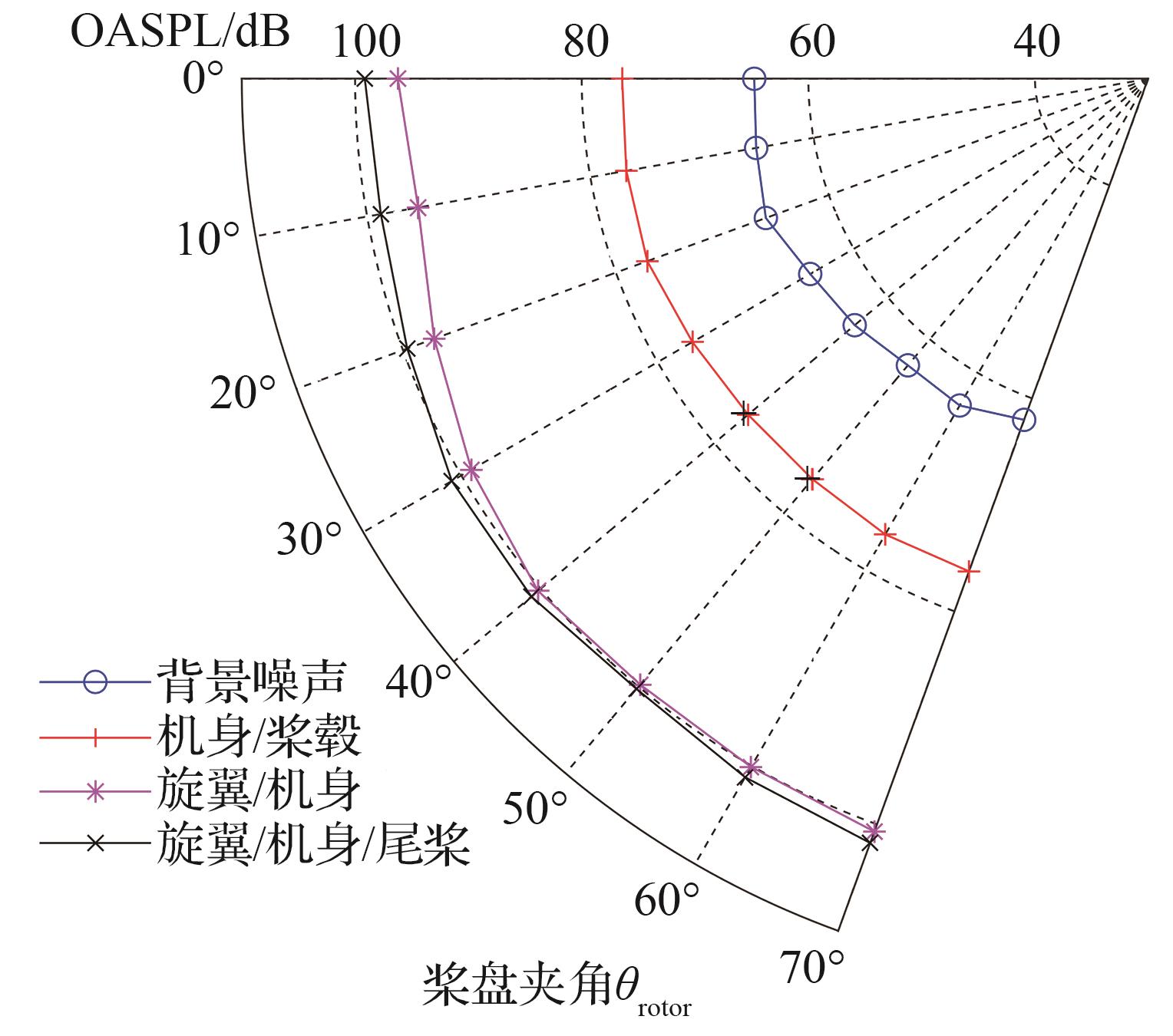
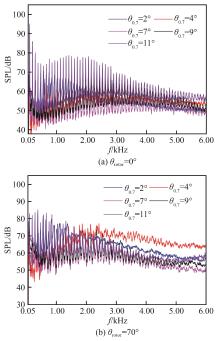
Fig.7
Hovering acoustic spectrum of main rotor/fuselage configuration

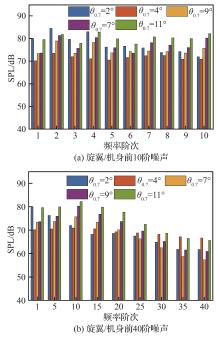
Fig.8
Variation of peak noise of main rotor/fuselage configuration hovering acoustic spectrum with frequency order


Fig.9
Effect of lift coefficient on noise spectrum of main rotor/fuselage configuration in forward flight(φ=135°,θrotor=40°)
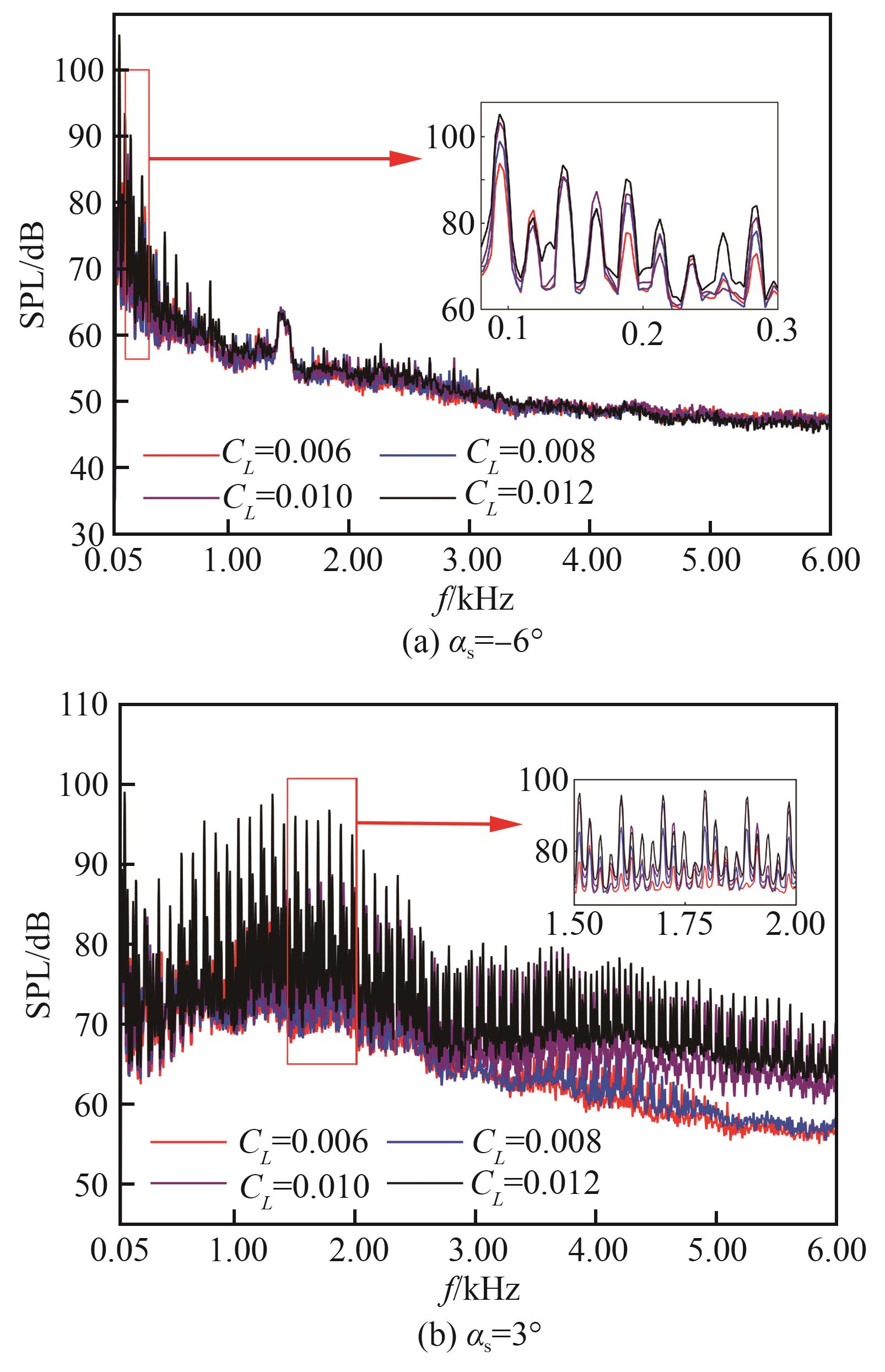
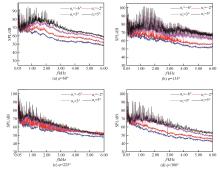
Fig.10
Effect of shaft tilt angle on noise spectrum of main rotor/fuselage configuration

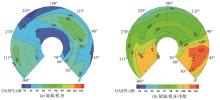
Fig.11
Noise radiation characteristics comparison in hovering flight (θ0.7=8°)
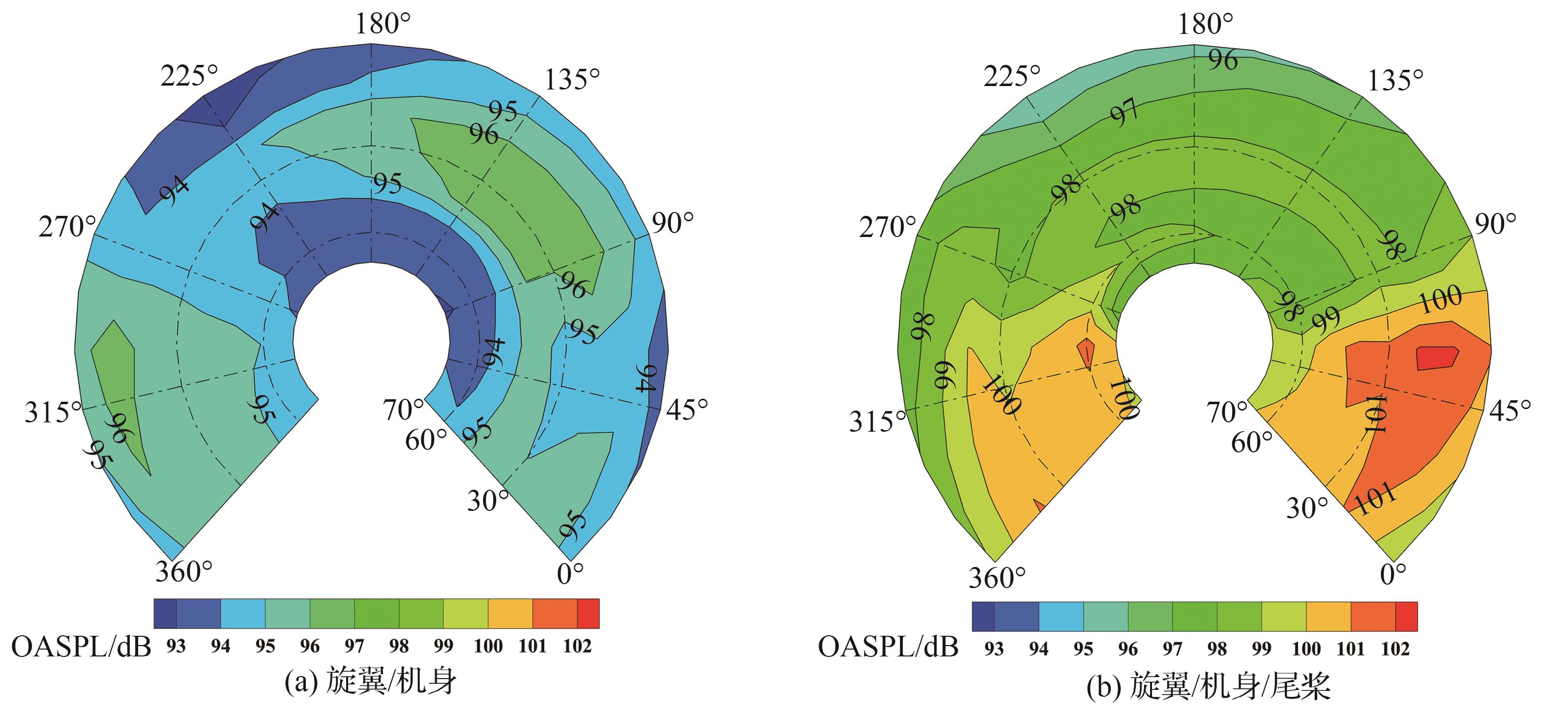
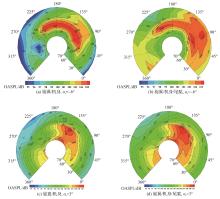
Fig.12
Noise radiation characteristics comparison in forward flight

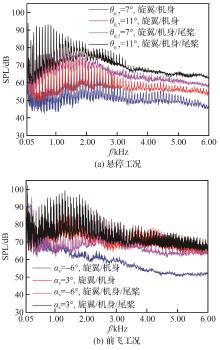
Fig.13
Effect of tail rotor on noise spectrum(φ=135°,θrotor=30°)


Fig.14
Noise spectrum characteristics of main rotor/fuselage/tail rotor configuration in hovering state
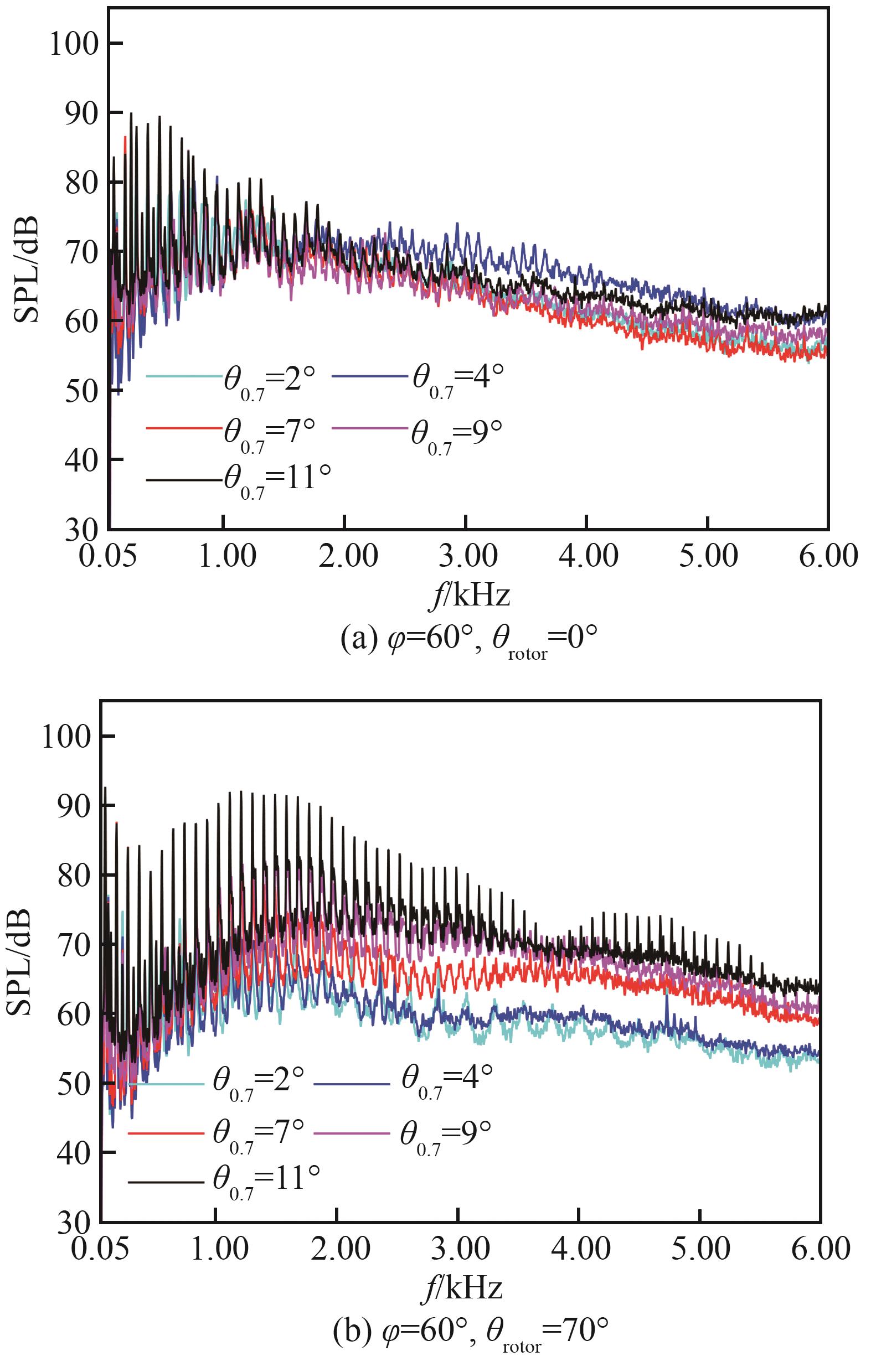
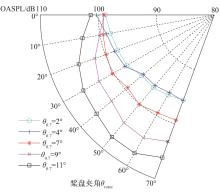
Fig.15
Effect of collective pitch angle on OASPL of main rotor/fuselage/tail rotor configuration in hovering state (φ=135°)
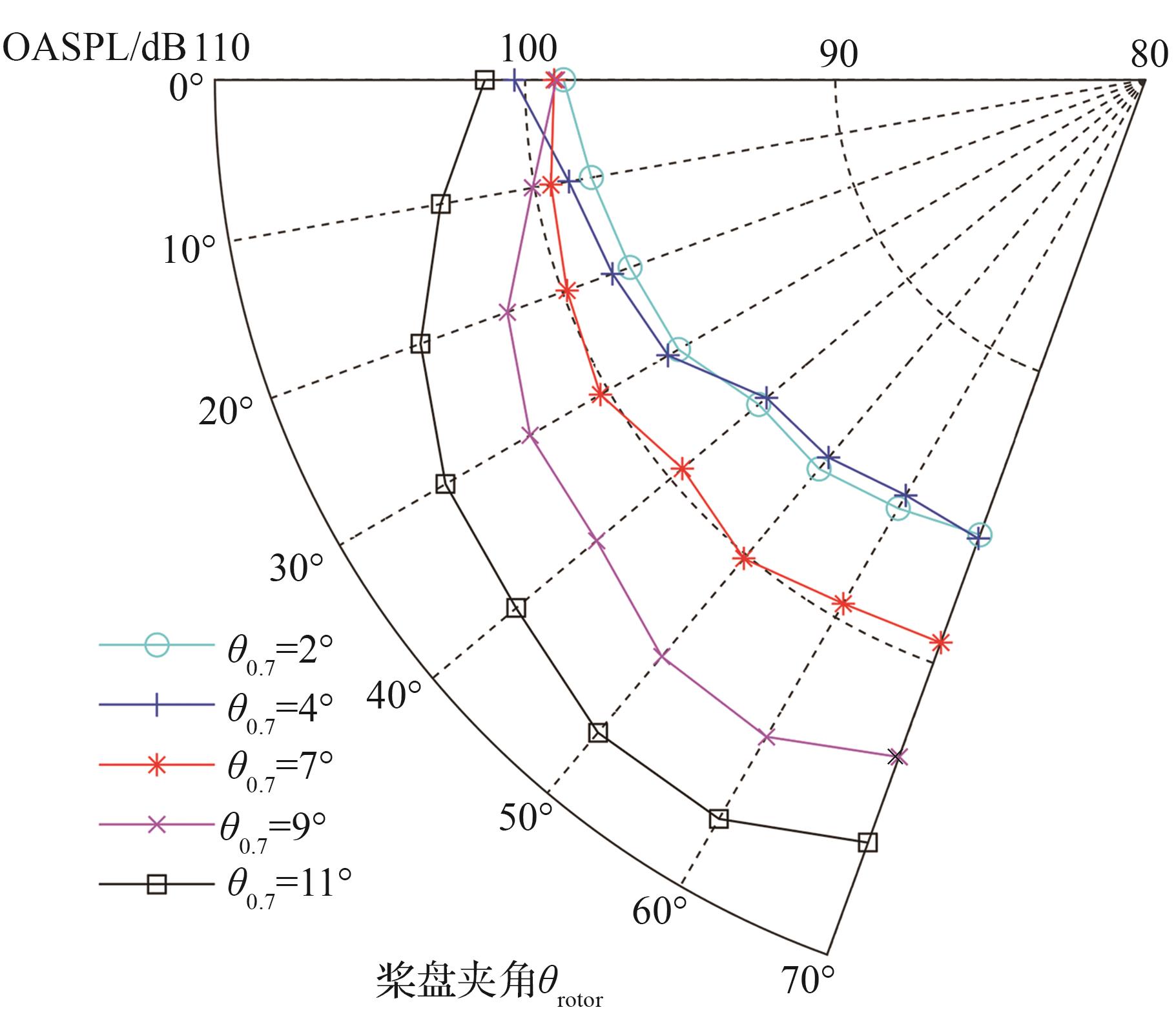
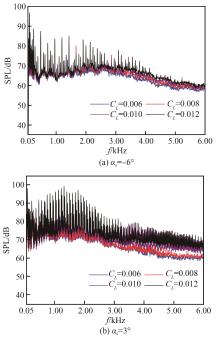
Fig.16
Effect of lift coefficient on noise spectrum of main rotor/fuselage/tail rotor configuration in forward flight

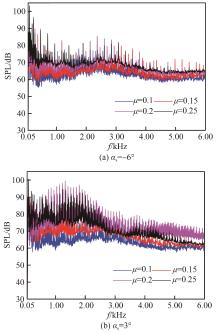
Fig.17
Effect of advance ratio on noise spectrum of main rotor/fuselage/tail rotor configuration in forward flight (φ=135°,θrotor=30°)
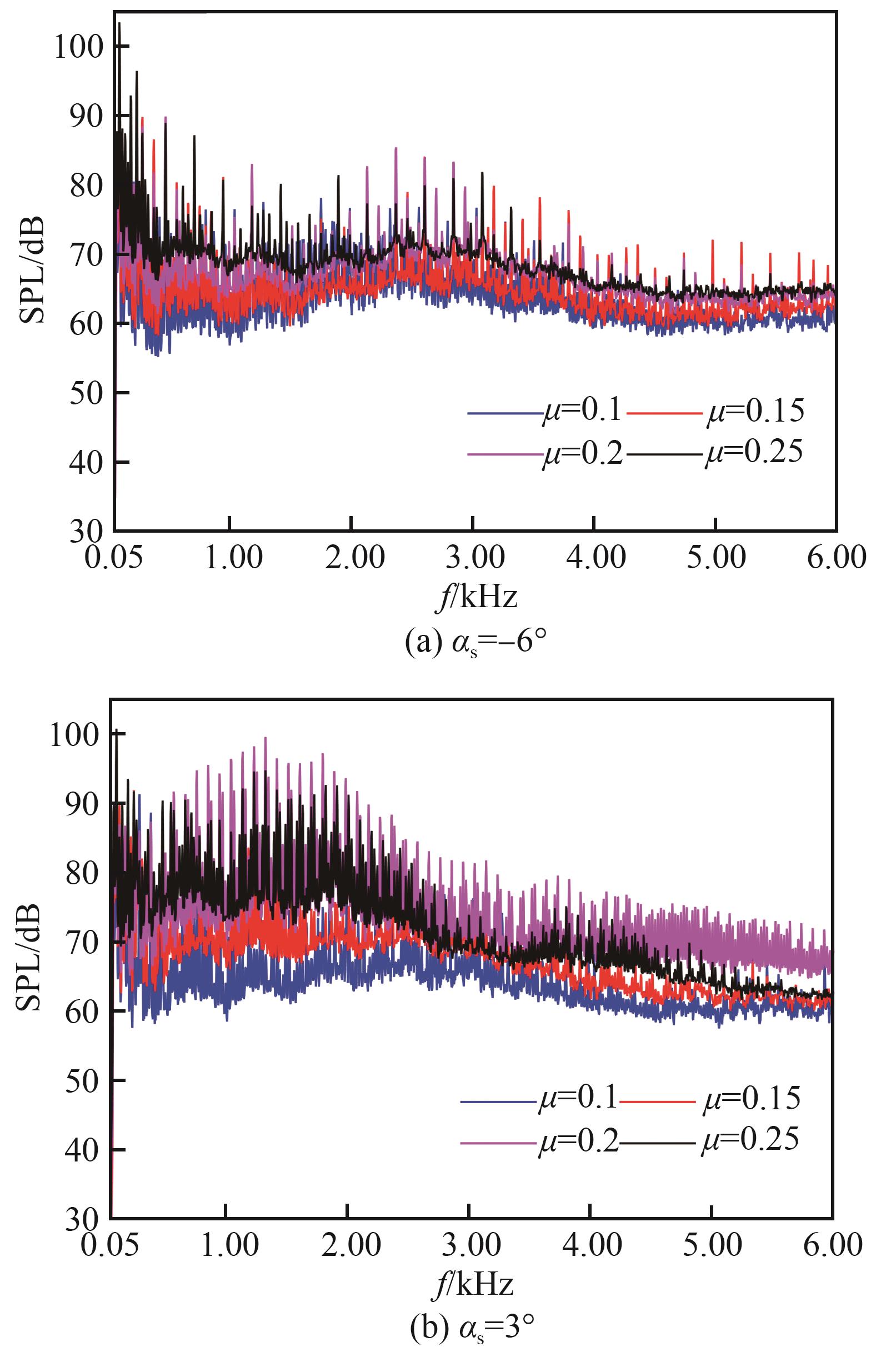
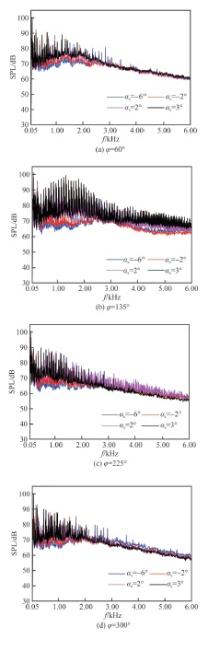
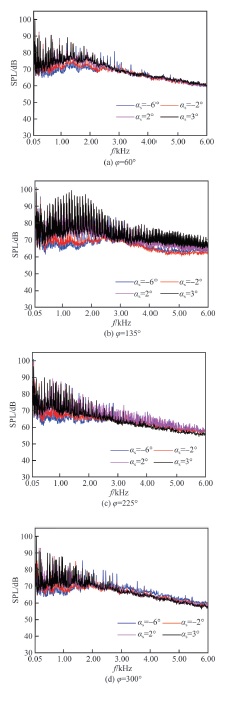
Fig.18
Effect of shaft tilt angle on noise spectrum of main rotor/fuselage/tail rotor configuration
| [1] | SCHMITZ F H. The challenges and possibilities of a truly quiet helicopter[J]. Journal of the American Helicopter Society,2016, 61(4): 1-33. |
| [2] | HELLER H. Into the physics of rotor aeroacoustics:Highlights of recent European helicopter noise research[C]∥Fifth International Congress on Sound and Vibration. 1997. |
| [3] | WILSON J C. A general rotor model system for wind-tunnel investigations[J]. Journal of Aircraft, 1977, 14(7): 639-643. |
| [4] | KELLEY H L. Aerodynamic performance of a 0.27-scale model of an AH-64 helicopter with baseline and alternate rotor blade sets: NASA-TM-4201[R]. Washington, D.C.: NASA, 1990. |
| [5] | STRAUB F K, JOHNSTON R A, HEAD R E, et al. Design and development of a dynamically scaled model AH-64 main rotor[C]∥Aircraft Design Systems and Operations Meeting. Reston: AIAA, 1984. |
| [6] | WELLER W H. Experimental investigation of effects of blade tip geometry on loads and performance for an articulated rotor system: NASA-TP-1303[R]. Washington, D.C.: NASA, 1979. |
| [7] | SCHEIMAN J M, HOAD D R. Investigation of blade impulsive noise on a scaled fully articulated rotor system: NASA-TM-X-3528[R]. Washington, D.C.: NASA, 1977. |
| [8] | MARTIN R M, BURLEY C L, ELLIOTT J W. Acoustic test of a model rotor and tail rotor: Results for the isolated rotors and combined configuration: NASA-TM-101550 [R]. Washington, D.C.: NASA, 1989. |
| [9] | NORMAN T R, SHINODA P M, KITAPLIOGLU C, et al. Low-speed wind tunnel investigation of a full-scale UH-60 rotor system[C]∥American Helicopter Society 58th Annual Forum. Alexandria: American Helicopter Society, 2002. |
| [10] | RUSSELL C R. Shake test results and dynamic calibration efforts for the large rotor test apparatus[C]∥Decennial AHS Aeromechanics Specialists Euro Conference. Alexandria: American Helicopter Society, 2014. |
| [11] | SHINODA P M. Full-scale S-76 rotor performance and loads at low speeds in the NASA Ames 80-by 120-foot wind tunnel: NASA-TM-110379[R]. Washington, D.C.: NASA, 1996. |
| [12] | PETERSON R L. Full-scale hingeless rotor performance and loads: NASA-TM-110356[R]. Washington, D.C.: NASA, 1995. |
| [13] | STRAUB F K, ANAND V R, BIRCHETTE T S, et al. SMART rotor development and wind-tunnel test[C]∥35th European Rotorcraft Forum. Hamburg: German Aerospace Society, 2009. |
| [14] | STRAUB F K, ANAND V R, BIRCHETTE T S. SMART rotor wind tunnel test report: NASA/CR-2015-219075[R]. Washington, D.C.: NASA, 2015. |
| [15] | STRAUB F K, ANAND V R, LAU B H, et al. Wind tunnel test of the SMART active flap rotor[J]. Journal of the American Helicopter Society, 2018, 63(1): 1-16. |
| [16] | JACKLIN S A, LAU B H, NGUYEN K Q, et al. Full-scale wind tunnel test of the McDonnell Douglas five-bladed advanced bearingless rotor: Performance, stability, loads, control power, vibration, and HHC data[C]∥Alexandria: American Helicopter Society, 1994. |
| [17] | SEIDEL M, MAARSINGH R. Test capabilities of the Germ-Dutch wind tunnel DNW for rotors, Helicopters and V/STOL aircraft[C]∥Fifth European rotorcraft and Powered Lift Aircraft Forum. 1979. |
| [18] | VAN DITSHUIZEN J C A. Helicopter model noise testing at DNW status and prospects[C]∥Thirteenth European Rotorcraft Forum. 1987. |
| [19] | LANGER H, BRAUN G, JUNKER B, et al. Helicopter rotor test rig (RoTest) in DNW: Application and results[R]. Amsterdam: DNW, 1989. |
| [20] | YU Y H, GMELIN B, HELLER H, et al. HHC aeroacoustics rotor test at the DNW: The joint German/French/US HART project[C]∥Proceedings of the 20th European Rotorcraft Forum. 1994. |
| [21] | SPLETTSTOESSER W R, KUBE R, SEELHORST U, et al. Higher harmonic control aeroacustic rotor test (HART): Test documentation and representative results[R]. Braunschweig: DLR, 1996. |
| [22] | SPLETTSTOESSER W R, KUBE R, WAGNER W, et al. Key results from a higher harmonic control aeroacoustic rotor test (HART)[J]. Journal of the American Helicopter Society, 1997, 42(1): 58-78. |
| [23] | RACHAPROLU J S, GREENWOOD E. Helicopter noise source separation using an order tracking filter[J]. Journal of the American Helicopter Society, 2024, 69(1): 1-9. |
| [24] | OLSMAN W F J. Method for the extraction of helicopter main and tail rotor noise[J]. Journal of Aircraft, 2017, 55(2): 805-816. |
| [25] | VISINTAINER J A, BURLEY C L, MARCOLINI M A, et al. Acoustic predictions using measured pressures from a model rotor in the DNW[J]. Journal of the American Helicopter Society, 1993, 38(3): 35-44. |
| [26] | RAFFEL M, BAUKNECHT A, RAMASAMY M, et al. Contributions of particle image velocimetry to helicopter aerodynamics[J]. AIAA Journal, 2017, 55(9): 2859-2874. |
| [27] | 王伟琪, 陈希, 招启军. 地效环境下悬停状态直升机旋翼桨/涡干扰噪声特性[J]. 航空学报, 2024, 45(12): 129196. |
| WANG W Q, CHEN X, ZHAO Q J. Hovering helicopter rotor blade/vortex interaction noise characteristics in ground effect environment[J]. Acta Aeronautica et Astronautica Sinica, 2024, 45(12): 129196 (in Chinese). | |
| [28] | 史勇杰, 徐国华. 飞行参数对旋翼桨-涡干扰噪声特性的影响机理研究[J]. 航空学报, 2013, 34(11): 2520-2528. |
| SHI Y J, XU G H. Research on the influence of flight parameters on helicopter rotor BVI noise characteristics[J]. Acta Aeronautica et Astronautica Sinica, 2013, 34(11): 2520-2528 (in Chinese). | |
| [29] | 王亮权, 徐国华, 史勇杰, 等. 高阶谐波控制对旋翼桨-涡干扰载荷和噪声的影响[J]. 航空学报, 2017, 38(7): 520847. |
| WANG L Q, XU G H, SHI Y J, et al. Influence of higher harmonic control on airload and acoustics of rotor blade-vortex interaction[J]. Acta Aeronautica et Astronautica Sinica, 2017, 38(7): 520847 (in Chinese). | |
| [30] | 韩少强, 宋文萍, 韩忠华, 等. 高速共轴刚性旋翼非定常流动高精度数值模拟[J]. 航空学报, 2024, 45(9): 529064. |
| HAN S Q, SONG W P, HAN Z H, et al. High-accuracy numerical-simulation of unsteady flow over high-speed coaxial rigid rotors[J]. Acta Aeronautica et Astronautica Sinica, 2024, 45(9): 529064 (in Chinese). | |
| [31] | 祁浩天, 王亮权, 张卫国, 等. 旋翼间距对共轴刚性旋翼气动噪声的影响[J]. 航空学报, 2024, 45(21): 130153. |
| QI H T, WANG L Q, ZHANG W G, et al. Effect of rotor spacing on aerodynamic noise of rigid coaxial rotor[J]. Acta Aeronautica et Astronautica Sinica, 2024, 45(21): 130153 (in Chinese). | |
| [32] | 刘琦, 史勇杰, 胡志远, 等. 共轴刚性旋翼气动及噪声特性的参数影响分析[J]. 航空学报, 2024, 45(9): 528856. |
| LIU Q, SHI Y J, HU Z Y, et al. Parameter effects analysis on aerodynamic and aeroacoustic characteristics of coaxial rigid rotor[J]. Acta Aeronautica et Astronautica Sinica, 2024, 45(9): 528856 (in Chinese). | |
| [33] | 马锦超, 陆洋, 王亮权, 等. 基于高阶谐波控制的倾转旋翼近场气动噪声主动控制试验[J]. 航空学报, 2024, 45(9): 528602. |
| MA J C, LU Y, WANG L Q, et al. Active control test of tiltrotor near-field aeroacoustics based on higher harmonic control[J]. Acta Aeronautica et Astronautica Sinica, 2024, 45(9): 528602 (in Chinese). | |
| [34] | 刘向楠, 刘少腾, 周国成, 等. 旋翼桨-涡干扰噪声特性风洞试验研究[J]. 实验流体力学, 2023, 37(3): 84-91. |
| LIU X N, LIU S T, ZHOU G C, et al. Wind tunnel test research on the characteristics of rotor blade-vortex interaction noise[J]. Journal of Experiments in Fluid Mechanics, 2023, 37(3): 84-91 (in Chinese). | |
| [35] | 丁存伟, 周国成, 陈宝, 等. 直升机涵道尾桨气动噪声特性风洞试验研究[J]. 实验流体力学, 2023, 37(3): 107-112. |
| DING C W, ZHOU G C, CHEN B, et al. Experimental study on aerodynamic noise characteristics of helicopter ducted tail rotor[J]. Journal of Experiments in Fluid Mechanics, 2023, 37(3): 107-112 (in Chinese). | |
| [36] | LANGER H J, PETERSON R L, MAIER T H. An experimental evaluation of wind tunnel wall correction methods for helicopter performance[C]∥American Helicopter Society 52nd Annual Forum. Alexandria: American Helicopter Society, 1996. |
| [37] | 孙正荣. BO-105旋翼模型第二期8米×6米风洞对比试验[J]. 气动实验与测量控制, 1995, 9(1): 46-51. |
| SUN Z R. Experiments of BO-105 rotor model in 8 m×6 m wind tunnel of CARDC for the second data comparisons[J]. Journal of Experiments in Fluid Mechanics, 1995, 9(1): 46-51 (in Chinese). |
| [1] | Tao ZHANG, Pan LI, Zixu WANG, Zhenhua ZHU. Design of reward functions for helicopter attitude control in reinforcement learning [J]. Acta Aeronautica et Astronautica Sinica, 2025, 46(S1): 732184-732184. |
| [2] | Jianfeng TAN, Yuze YAN, Weiguo ZHANG, Yakui LIU, Tianshuang SHAO. Analysis method of helicopter blade erosion in brownout condition [J]. Acta Aeronautica et Astronautica Sinica, 2025, 46(9): 431012-431012. |
| [3] | Kelei WANG, Zhou ZHOU, Minghao LI. Research and experimental validation of loose coupling design method for propulsion wing unit [J]. Acta Aeronautica et Astronautica Sinica, 2025, 46(9): 212-229. |
| [4] | Lixiang WEI, Jinglei XU, Kuangshi CHEN, Shuai HUANG, Jianhui GE, Guangtao SONG. Scheme design and performance study of adjustable vector nozzle for wide-range hypersonic aircraft [J]. Acta Aeronautica et Astronautica Sinica, 2025, 46(8): 631086-631086. |
| [5] | Xian YI, Jinghao REN, Qingren LAI, Yu LIU, Qiang WANG. Icing characteristics of full-scale multi-element configurations of large aircraft: Computation and experiment [J]. Acta Aeronautica et Astronautica Sinica, 2025, 46(5): 531575-531575. |
| [6] | Zhiqiang WAN, Shanshan ZHANG, Xiaozhe WANG, Liang MA, Ao XU, Zhigang WU, Chao YANG. Maneuver load analysis and alleviation technology of flexible aircraft: Review [J]. Acta Aeronautica et Astronautica Sinica, 2025, 46(3): 30279-030279. |
| [7] | Bin LIANG, Junbo ZHAO, Zengliang FU, Jiajian ZHOU, Ping ZHOU, Shiyu ZHANG, Weiqi SUN. Effect of gas mass injection on pitching characteristics of blunt cone [J]. Acta Aeronautica et Astronautica Sinica, 2025, 46(3): 130822-130822. |
| [8] | Junqiang WU, Zhi WEI, Yang LIU, Min ZHONG, Fujun YANG, Yonggang YU. Civil aircraft standard model system and construction of aerodynamic subject database [J]. Acta Aeronautica et Astronautica Sinica, 2025, 46(24): 132030-132030. |
| [9] | Luofeng WANG, Renliang CHEN, Rui FENG. Cross-medium rigid-flexible coupled modeling and trim analysis of helicopter mine-clearing system [J]. Acta Aeronautica et Astronautica Sinica, 2025, 46(22): 231900-231900. |
| [10] | Wei WANG, Junfu LI, Fengxue QIAN, Yuting TAN, Yan ZHAO, Bowen ZHAO, Qing CHEN, Ke SONG. Wind tunnel test of low sonic boom high efficiency layout for supersonic civil aircraft [J]. Acta Aeronautica et Astronautica Sinica, 2025, 46(20): 531941-531941. |
| [11] | Hui ZHANG, Junqiang AI, Kun QIN, Xiangxi TANG, Jun JI. Wind tunnel test for thrust characteristics of supersonic ejector exhaust system [J]. Acta Aeronautica et Astronautica Sinica, 2025, 46(20): 531934-531934. |
| [12] | Zhengwu CHEN, Yubiao JIANG, Xiangyu LU, Qiangbin LI. Aerodynamic noise test of open rotor in wind tunnel [J]. Acta Aeronautica et Astronautica Sinica, 2025, 46(2): 130425-130425. |
| [13] | Xueliang LI, Chuangchuang LI, Yahan ZHANG, Wei SU, Jie WU. Effect of distributed ablation pattern on hypersonic boundary-layer instability with a flat plate [J]. Acta Aeronautica et Astronautica Sinica, 2025, 46(2): 130464-130464. |
| [14] | Ming CAI, Limin GAO, Ruiyu LI, Bo OUYANG, Bo LIU. Establishment of standard model of linear cascade wind tunnel for subsonic compressor [J]. Acta Aeronautica et Astronautica Sinica, 2025, 46(2): 130547-130547. |
| [15] | Ruiyu LI, Ming CAI, Bo OUYANG, Limin GAO, Bo LIU, Baojie LIU. Standard cascade test for typical high-load and large turning angle compressor arfoils [J]. Acta Aeronautica et Astronautica Sinica, 2025, 46(16): 131651-131651. |
| Viewed | ||||||
|
Full text |
|
|||||
|
Abstract |
|
|||||
Address: No.238, Baiyan Buiding, Beisihuan Zhonglu Road, Haidian District, Beijing, China
Postal code : 100083
E-mail:hkxb@buaa.edu.cn
Total visits: 6658907 Today visits: 1341All copyright © editorial office of Chinese Journal of Aeronautics
All copyright © editorial office of Chinese Journal of Aeronautics
Total visits: 6658907 Today visits: 1341

 CJA
CJA
