Acta Aeronautica et Astronautica Sinica ›› 2025, Vol. 46 ›› Issue (11): 531482.doi: 10.7527/S1000-6893.2025.31482
• Reviews • Previous Articles
Xuejun ZHANG1,2, Chenglong LI1,3( ), Zhiyuan ZHANG3, Yuan ZHENG4
Received:2024-11-01
Revised:2024-12-18
Accepted:2025-01-20
Online:2025-02-13
Published:1900-01-01
Contact:
Chenglong LI
E-mail:lcl@cafuc.edu.cn
Supported by:CLC Number:
Xuejun ZHANG, Chenglong LI, Zhiyuan ZHANG, Yuan ZHENG. Constructing in-time risk management capabilities for low-altitude aviation systems: Concepts, technologies, and challenges[J]. Acta Aeronautica et Astronautica Sinica, 2025, 46(11): 531482.
Fig.1
Diagram of low-altitude operation scenario and hazards
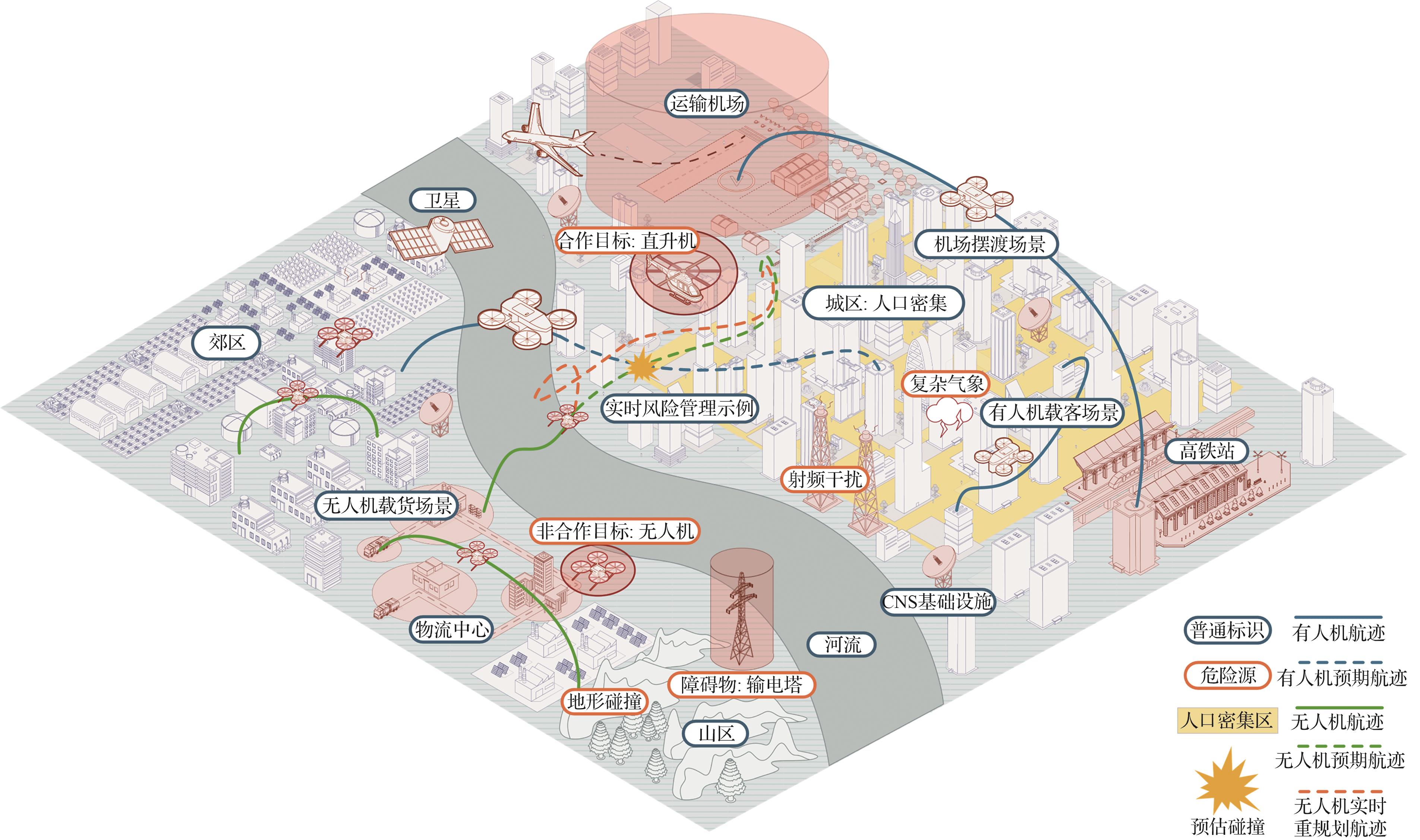
Fig.2
Low-altitude risk factors
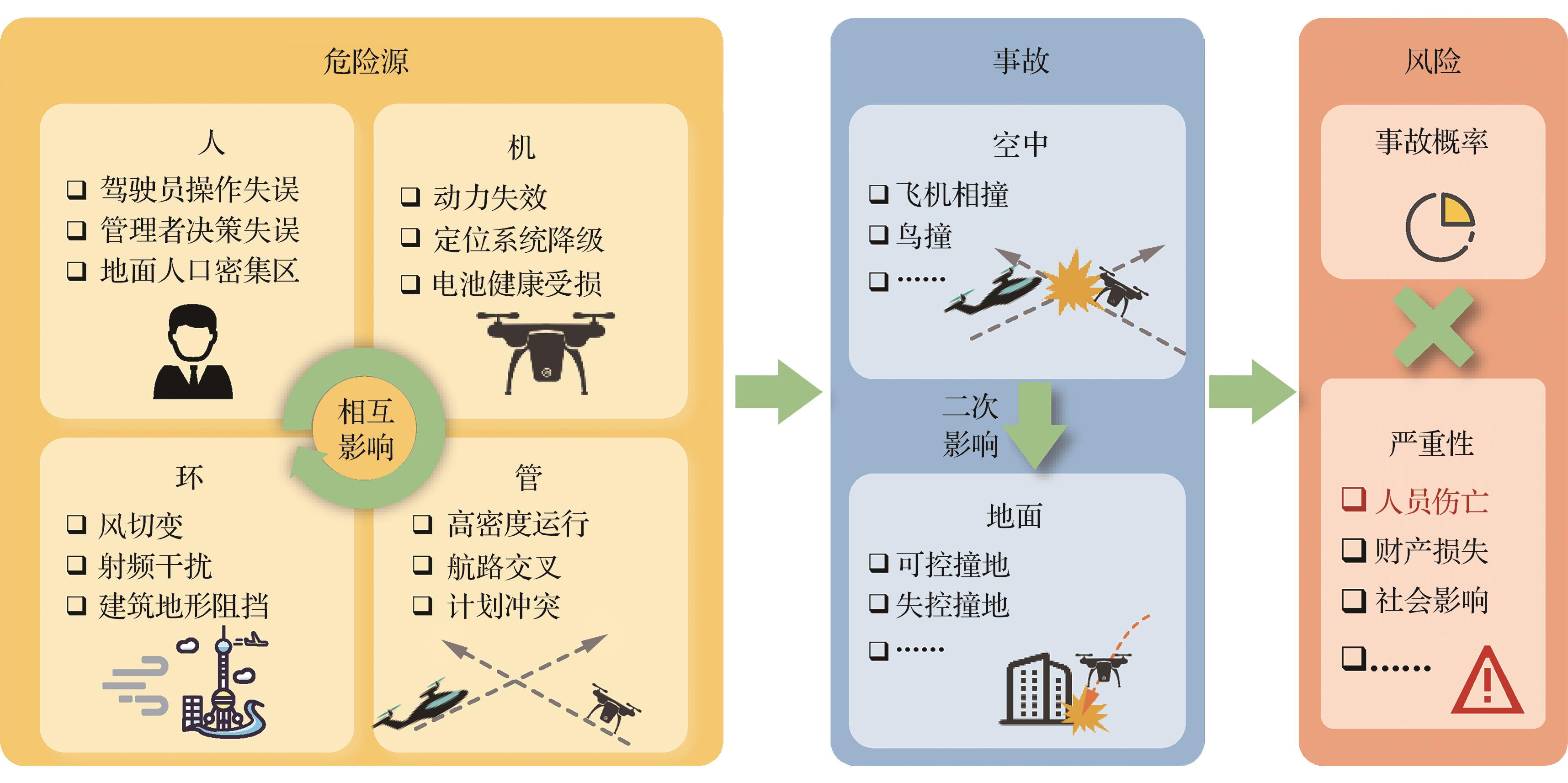

Table 1
ICAO safety risk matrix[18]
安全风险 概率 | 严重性 | |||||
|---|---|---|---|---|---|---|
| 灾难性A | 危险B | 严重C | 较小D | 可忽略不计E | ||
| 频繁 | 5 | 5A | 5B | 5C | 5D | 5E |
| 偶发 | 4 | 4A | 4B | 4C | 4D | 4E |
| 很小 | 3 | 3A | 3B | 3C | 3D | 3E |
| 不可能 | 2 | 2A | 2B | 2C | 2D | 2E |
| 极不可能 | 1 | 1A | 1B | 1C | 1D | 1E |
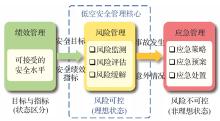
Fig.3
Basic content of low-altitude safety management
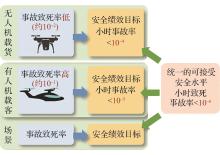
Fig.4
Uniform acceptable level of safety[27-29]
Fig.5
Scenario-oriented classification management
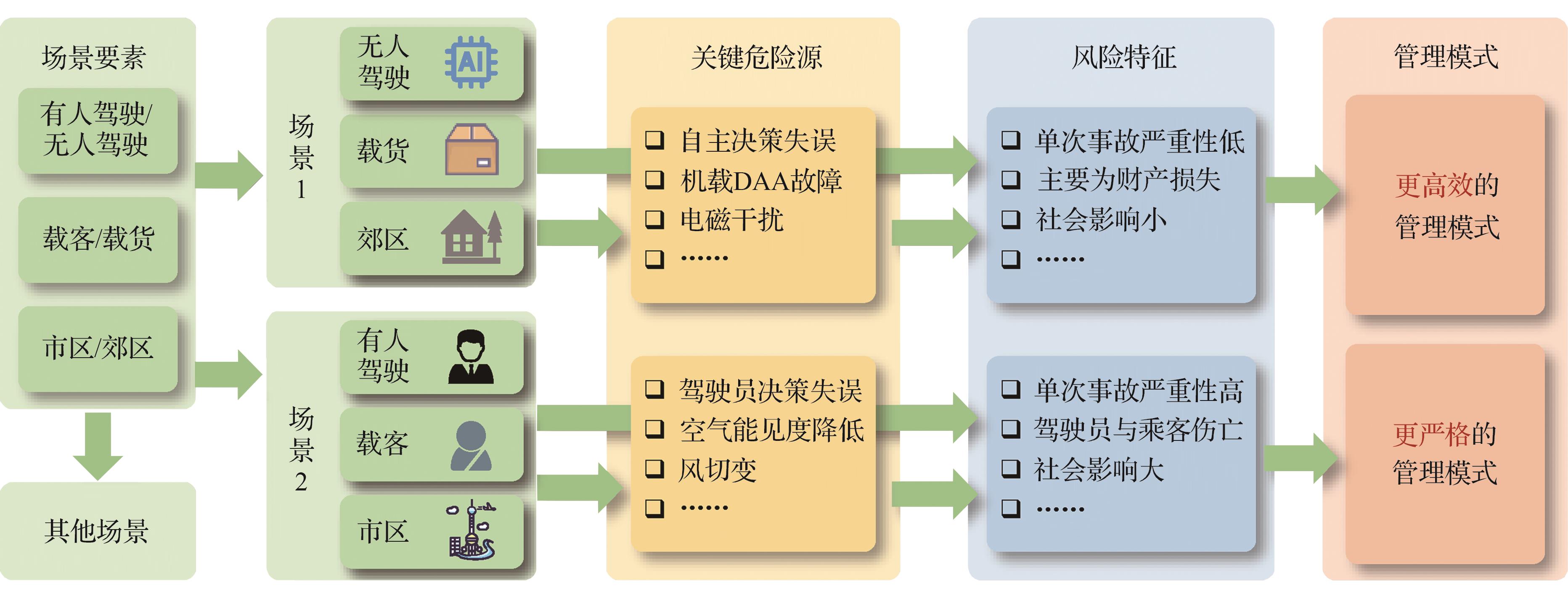
Fig.6
Layered risk management
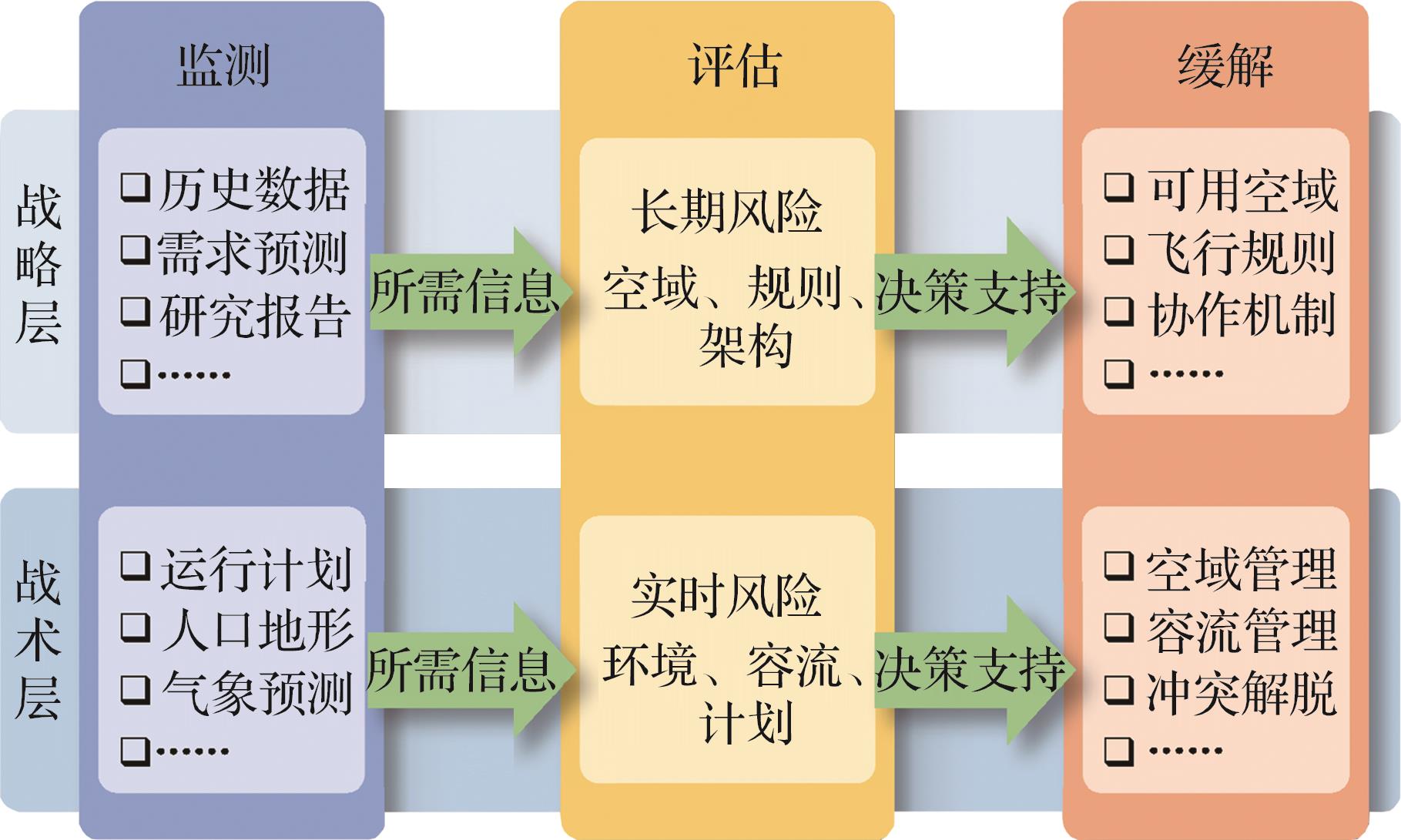
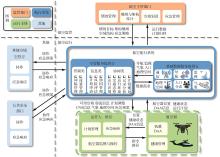
Fig.7
Role and architecture low-altitude risk management
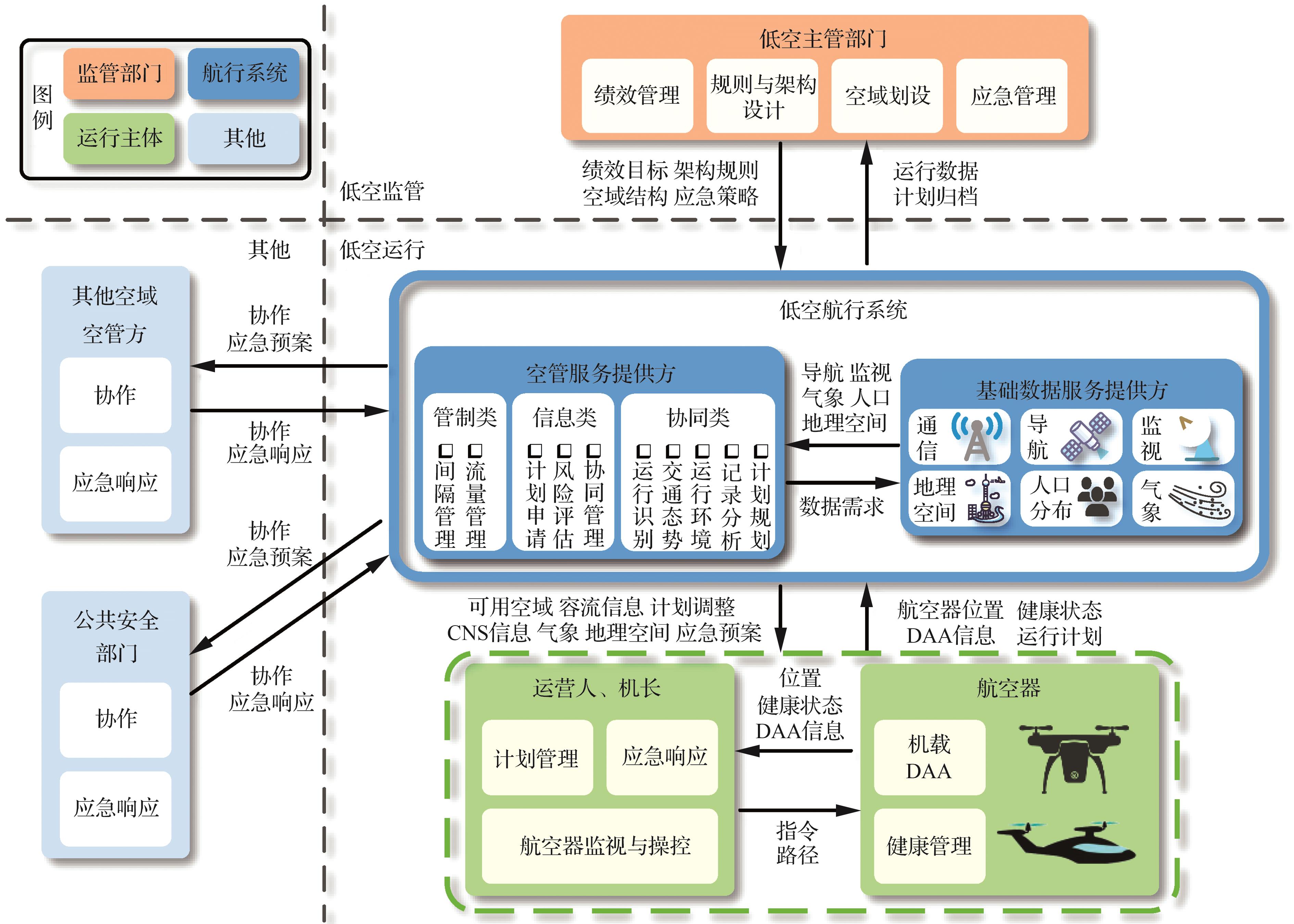
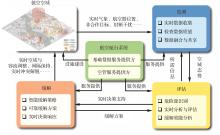
Fig.8
Basic framework of low-altitude in-time risk management
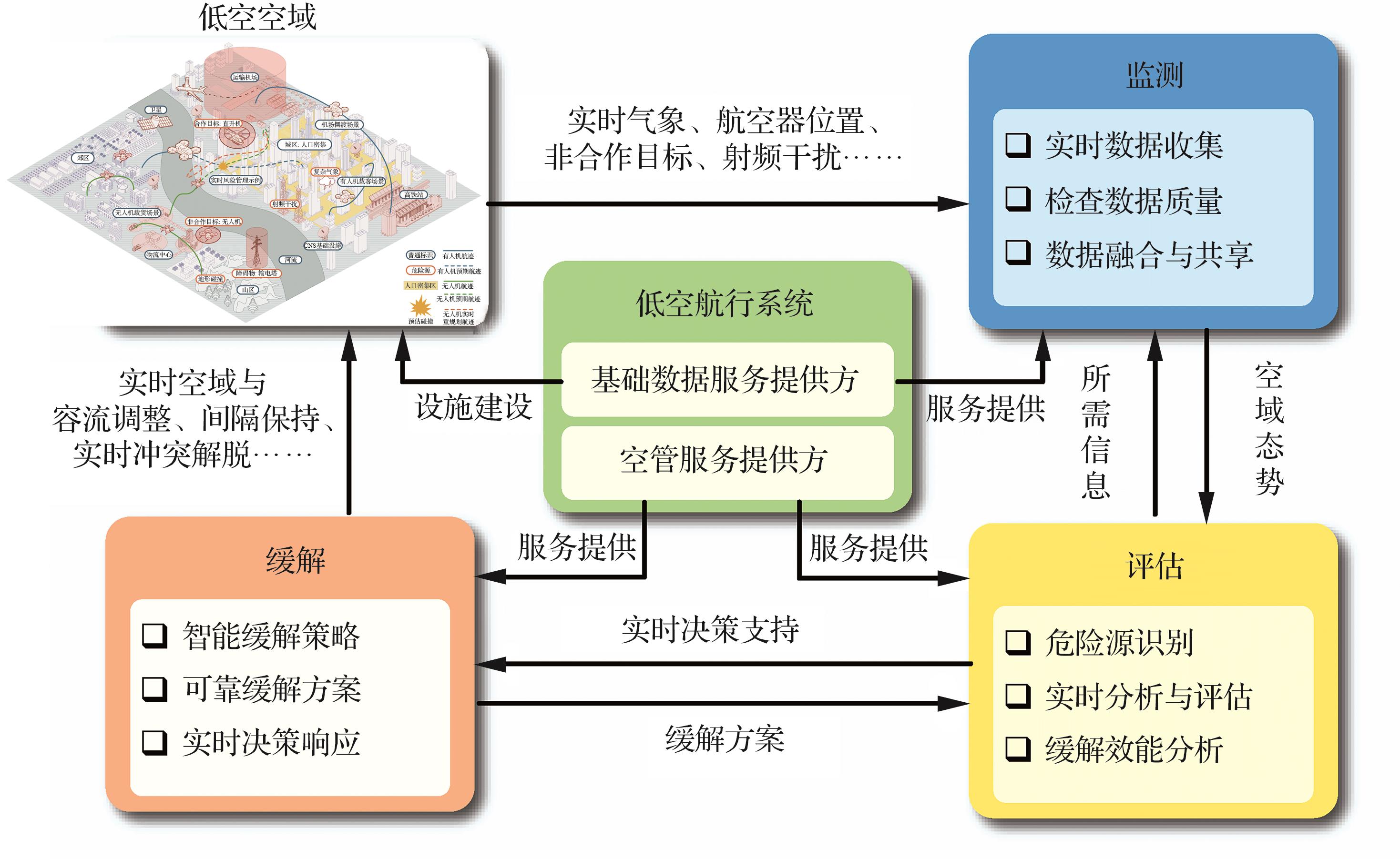
Table 2
Evolution of risk management capability of aviation system
| 阶段 | 开始年份 | 关键基础设施 | 管理方式 | 风险管理能力 |
|---|---|---|---|---|
| 1 | 1930 | 无线电通信 | 程序管制 | 估计当前和计划的航空器位置; 以人为中心的监测、评估、缓解 |
| 2 | 1950 | 二次雷达 | 雷达管制 | 知道航空器的当前位置,估计航空器的计划位置; 以人为中心的监测、评估、缓解 |
| 3 | 1980 | 通信、导航卫星 | 航迹管理 | 知道并共享航空器的当前和计划位置; 自动化的态势监测与告警服务 |
| 4 | 2010 | 天空地一体化CNS系统 | 基于性能的协作管理 | 集成的态势监测;基于性能的风险评估; 预测性的风险缓解 |
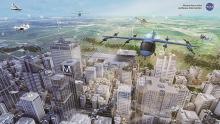
Fig.9
Vision of high-density integration operation of manned and unmanned aircraft[41]
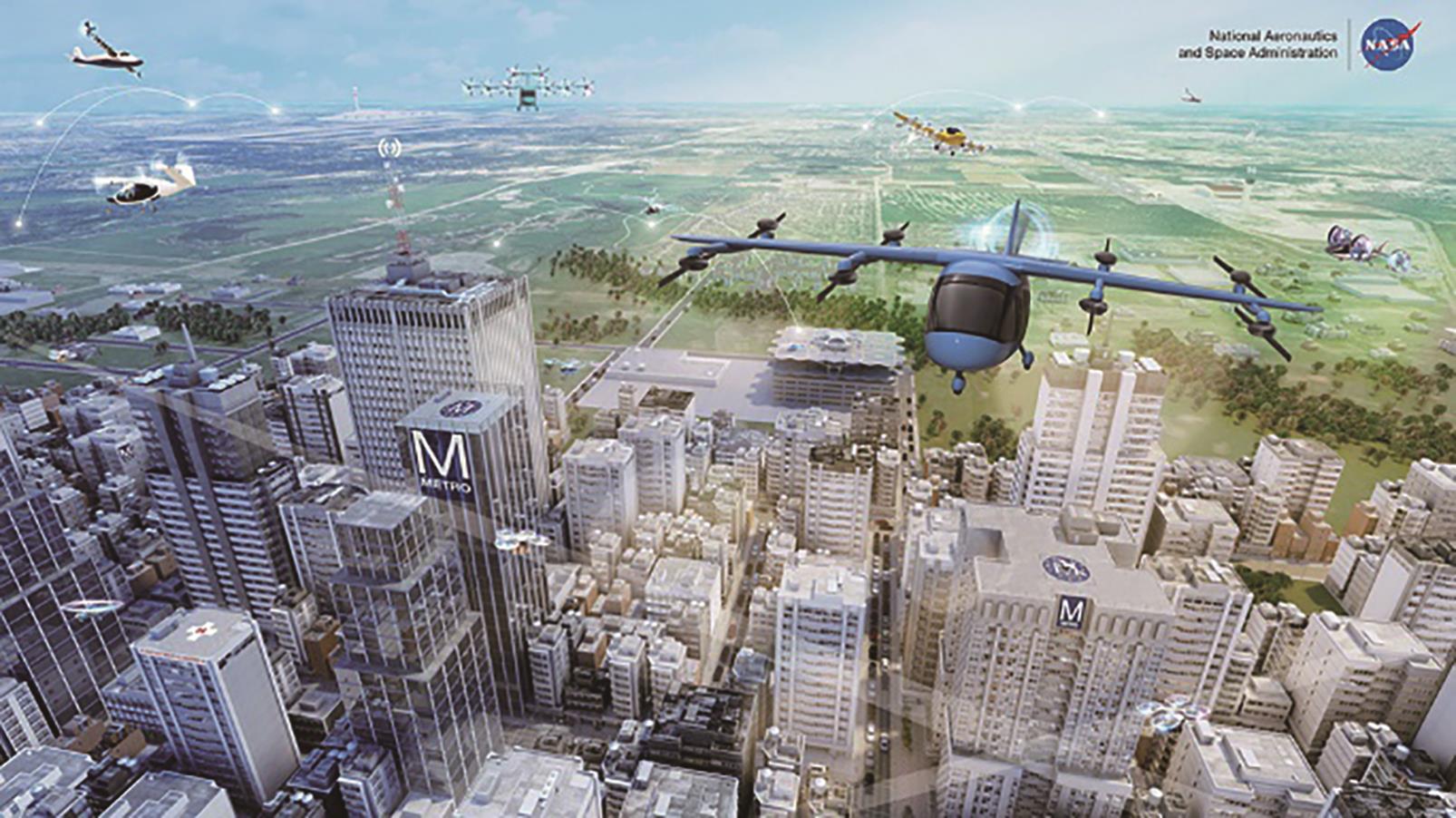
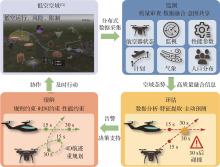
Fig.10
In-time risk management diagram of low-altitude aviation system
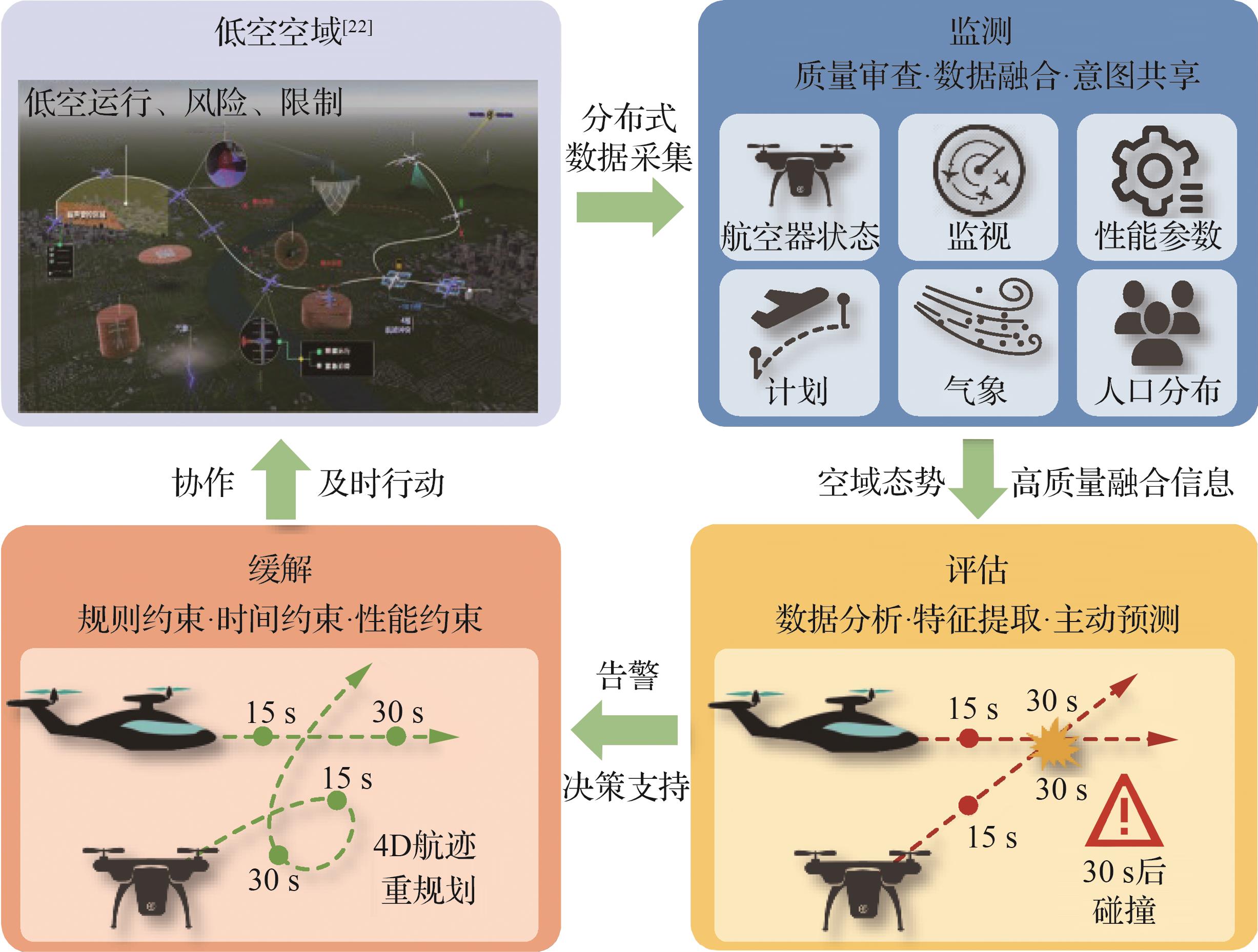
Table 3
Relevant research projects for law-altitude CNS
| 项目/研究 | 开始年份 | 主要内容及应用示范 | 局限性 | 技术成熟度 |
|---|---|---|---|---|
| Reliable and secure Surveillance, Communications And Navigation (RSCAN) | 2016 | 开发了集成多种技术的可靠安全CNS架构,并从技术适用性及实施情况进行了全面分析[ | 通信时延较高、射频干扰影响显著,GNSS在高干扰或遮挡区域精度下降,多无人机易出现信息拥堵和延迟问题 | 实际环境验证 |
| Reliable, Secure, and Scalable CNS Options for UAM | 2019 | 为UAM中等成熟度下的运行提供可靠、安全和可拓展的CNS选项,推荐5G、LEO卫星、多传感器融合和高精度GNSS增强为核心技术选项[ | 通信带宽受限、城市信号衰减严重以及多技术融合的标准化问题仍需进一步解决 | 技术概念 |
| DroC2om | 2017 | 开发了蜂窝-卫星组合通信网络架构,并在丹麦进行多场景的飞行测试,场景涵盖城市和郊区[ | 双网络连接显著提升了可靠性,但随着无人机飞行高度增加,信号干扰问题仍然存在 | 实际环境验证 |
| Integrated Common Altitude Reference system for U-Space (ICARUS) | 2020 | 基于卫星导航数据、实时地理信息、气象数据等为无人机提供高度参考服务[ | 在技术误差、实时性与计算能力等方面仍存在不足 | 实际环境验证 |
| The Clear Air Situation for uaS (CLASS) | 2020 | 基于卫星定位的合作监视与基于地面雷达和机器学习分类的非合作监视技术,结合数据融合技术整合多源数据以构建精准的空中态势图[ | 在高密度场景扩展性、数据可靠性和标准化方面仍面临显著挑战 | 实际环境验证 |
| 低空智联网 | 2021 | 基于地面网络、空中平台组成的近地空间以及低轨卫星网络,实现“人-机-物”三元融合智能互联。在长江南京段进行了低空运行典型场景应用示范,集通信、导航、监视、气象于一体,实现航空大数据分析和智能化辅助决策[ | 存在频谱资源干扰与紧缺、网络资源安全融合困难等关键问题 | 实际环境验证 |
| 北斗低空综合应用示范 | 2023 | 在湖南建成中国首个覆盖全省的低空空域监视网,增强了低空500 m以下通用航空器及无人机的监视通信能力[ | 尚未涉及高密度运行场景与城市内复杂电磁干扰背景下的运行场景 | 实际环境验证 |
Fig.11
Framework of URAF
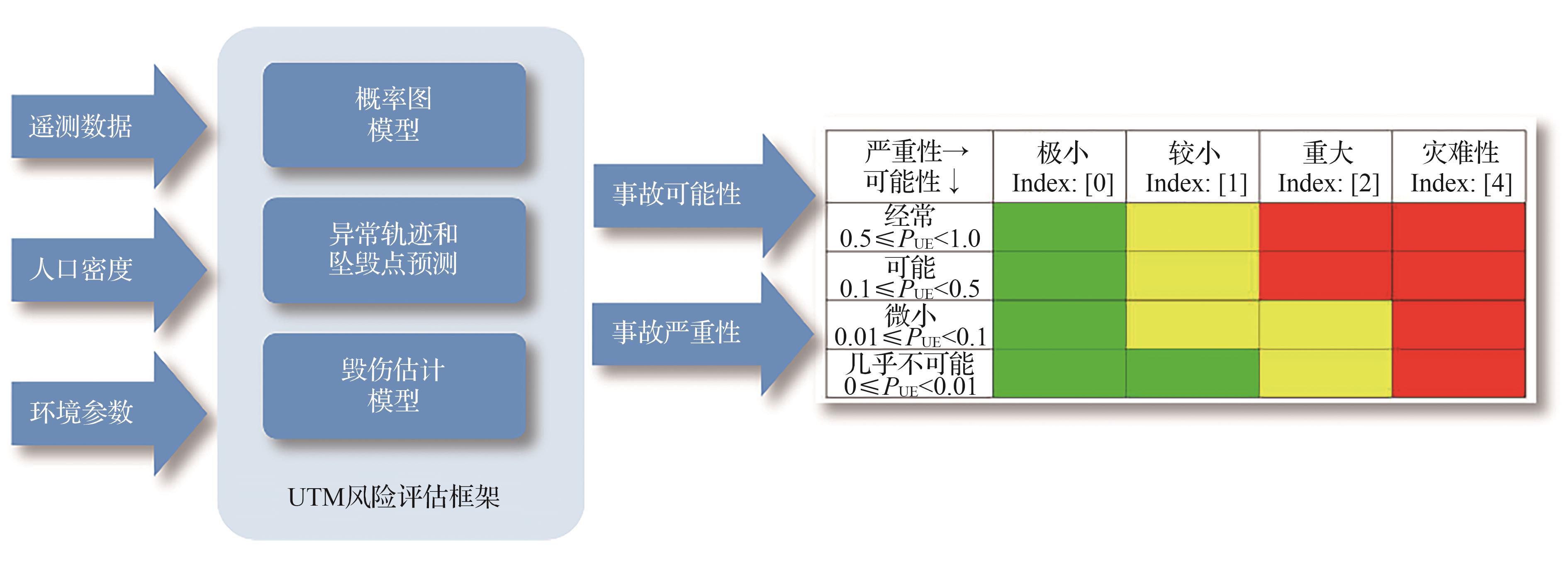
Table 4
Relevant research for risk assessment framework
| 框架/项目 | 研究机构 | 开始年份 | 主要内容 | 局限性 | 技术成熟度 |
|---|---|---|---|---|---|
| Specific Operations Risk Assessment (SORA) | Joint Authorities for Rulemaking on Unmanned Systems (JARUS) | 2016 | 运行前从对地和对空两方面定性评估无人机低空运行对其他相关第三方所造成的风险[ | 仅对运行前的场景作定性评估,不涉及评估运行计划,目前尚未发布定量评估方法 | 实际系统成功运行 |
| UTM Risk Assessment Framework (URAF) | NASA | 2017 | 结合定量与定性实时评估无人机运行造成地面人员伤亡的风险,包含概率图模型、异常情况轨迹与碰撞点预测模型以及毁伤估计模型[ | 仅评估无人机运行对地面公众伤亡风险,未涉及对空中有人机的风险 | 模拟环境验证 |
| U-space Air and Ground Risk modEls Enhancement (U-AGREE) | SESAR | 2024 | 使用定量方法对 SORA 改进,并结合安全、安保、隐私和环境等方面可能负面影响提出一个综合风险模型[ | 尚处于起步阶段,未有具体成果 | 技术概念 |
Table 5
Relevant research for low-altitude risk assessment technology
| 风险类型 | 文献 | 年份 | 研究内容 | 主要内容 | 局限性 | 技术成熟度 |
|---|---|---|---|---|---|---|
| 空中碰撞风险 | [ | 2022 | 无人机相撞 | 提出一种基于速度随机分布的碰撞风险评估模型,分析碰撞风险与小型无人机密度的关系 | 仅评估2架无人机之间的碰撞风险,评估模型对评估情形和无人机数量不具有普适性 | 模拟仿真验证 |
| [ | 2022 | 无人机相撞 | 基于CNS性能生成风险保护区域,积分重合风险保护区域得到碰撞概率 | 需要进一步扩展分析框架以更全面地包含通信性能和相对动态的影响 | 模拟仿真验证 | |
| [ | 2022 | 无人机与 障碍物碰撞 | 讨论了在无人机空气动力学仿真中引入和模拟外部风特性的方法;模拟研究了稳态风和阵风对无人机轨迹偏差的影响 | 未充分考虑城市峡谷等局部风效应及无人机性能对碰撞风险的影响 | 模拟仿真验证 | |
| [ | 2023 | 无人机与 有人机相撞 | 基于概率密度函数,得到无人机入侵有人机终端区风险热力图 | 本方法得到的是碰撞风险的上限,偏向保守 | 实际数据仿真验证 | |
| [ | 2024 | 无人机相撞 | 基于运行意图重合部分计算碰撞概率 | 运行意图大小固定,未考虑无人机性能的影响 | 模拟仿真验证 | |
| 地面碰撞风险 | [ | 2021 | 人员伤亡 | 基于蒙特卡洛仿真、建立个人风险与社会风险模型,综合评估无人机对地风险 | 现有模型未充分涵盖非技术性风险及其对整体风险水平的影响 | 模拟仿真验证 |
| [ | 2022 | 无人机 系统失效 | 基于贝叶斯网络的模型,分析物流无人机失效致因概率;分别计算了不同工况下的地面碰撞事故概率和中间事件概率 | 基于已有数据的统计模型,模型对数据数量与质量的敏感 | 实际数据仿真验证 | |
| [ | 2022 | 人员伤亡 | 融合动力学模型和深度神经网络模型评估 | 模型的验证场景单一,通用性尚需通过多场景应用验证 | 实际数据仿真验证 | |
| [ | 2022 | 人员伤亡 | 基于数据驱动分析人口密度时空特征对地面人口风险的关系 | 数据驱动方法对数据数量与质量的敏感;未考虑无人机之间的碰撞导致的坠落风险 | 实际数据仿真验证 | |
| [ | 2022 | 无人机物流 | 建立由物流无人机和货物分离坠地造成的地面人员伤亡计算模型、经济损失计算模型,综合损失建立风险评估矩阵 | 固定无人机坠地概率,模型较为理想化 | 实际数据仿真验证 | |
| [ | 2024 | 无人机坠地 | 基于卫星图像中的高分辨率数据与K-Means聚类方法提取城市地面特征,并采用多层方法评估无人机运行的风险分布 | 高分辨率风险地图对存储和计算资源要求较高 | 实际数据仿真验证 | |
| 总体风险 | [ | 2024 | 危险源识别 | 基于数据驱动分析事故,建立贝叶斯网络模型揭示风险因素与无人机事故发生概率及其严重程度之间的关系 | 数据驱动方法对数据数量与质量的敏感 | 实际数据仿真验证 |
| [ | 2024 | 危险源识别 | 利用模糊贝叶斯网络识别和评估低空无人机运行的关键风险因素 | 依赖专家知识和模糊集方法,可能导致结果的主观性和不确定性 | 技术概念 |
Table 6
Relevant research for low-altitude separation management and deconfliction
| 类型 | 方法 | 文献 | 年份 | 技术特点/主要贡献 | 技术成熟度 |
|---|---|---|---|---|---|
合作目标 协作式 冲突解脱 | 最优化 | [ | 2020 | 针对协同系统在三维空间内的实时避障问题,建立三维机动障碍的模型,设定系统遇障时的通行法则,选择飞行模式,进而确定最佳的避障平面及航迹 | 模拟仿真验证 |
| [ | 2022 | 利用混合整数线性规划,在给定的时间窗口内最小化所有航空器的总飞行时间 | 模拟仿真验证 | ||
| [ | 2022 | 通过最小化控制代价来生成平滑、高效的轨迹,保证轨迹的动态可行性和空间-时间的最优性;实际场景验证表明,该方法满足实时避撞、群体协同等多种任务需求,但在高密度环境中,计算复杂度可能仍会成为瓶颈 | 实际场景验证 | ||
| [ | 2024 | 面向无人机“群体”构建了无人机飞行计划多类型冲突协同推演模型,建立了基于多元策略自适应配置的无人机飞行计划优化调配模型 | 模拟仿真验证 | ||
| 强化学习 | [ | 2022 | 整合航空器性能,采用低空空域组织的多分辨率结构、用于速度剖面生成的高斯混合模型(GMM)和动态间隔标准,以支持高效的UAM运行 | 模拟仿真验证 | |
| [ | 2022 | 基于图神经网络,构建和协作式多智能体强化学习冲突解脱算法 | 模拟仿真验证 | ||
| [ | 2023 | 采用多智能体异步优势演员-评论家(MAA3C)框架,考虑了风场等不确定性 | 模拟仿真验证 | ||
| 博弈论 | [ | 2022 | 开发了一个基于博弈论的框架,采用分层粒子群优化算法为多架无人机生成高效可行的飞行路径,获得全局最优解 | 模拟仿真验证 | |
| [ | 2024 | 提出了一种新的无人机避碰决策架构,将多智能体避撞问题转化为一个重复的二人标准形博弈,并设计了支付函数来捕获可行行动的安全性和效率 | 模拟仿真验证 | ||
| 复杂网络 | [ | 2019 | 碰撞方法包括关键节点选择和碰撞方向选择两步,具体为基于节点收缩方法来选取需要优先进行机动的关键无人机,再根据目标函数来改变高度 | 模拟仿真验证 | |
非合作目标 避撞 | 最优化 | [ | 2020 | 提出了一种完整的“教学-重复-重规划”框架,使用滑动窗口的局部重新规划方法,实时调整飞行轨迹以避开动态障碍物;实际场景验证了该方法在动态环境下的轨迹平滑性和避障性能 | 实际场景验证 |
| [ | 2024 | 提出了一种结合扩展卡尔曼滤波器的线性模型预测控制算法,实现了城市空中交通环境中对动态障碍物的实时避障与轨迹优化 | 模拟仿真验证 | ||
| [ | 2024 | 提出了一种基于多指标动态优先级的单边避碰机制与基于拥堵权值地图的Lazy Theta*算法,构建了“路径重规划+起点等待”的局部冲突组合规避策略 | 模拟仿真验证 | ||
| 强化学习 | [ | 2020 | 提出来一个去中心化的按需避撞框架,系统地将强化学习与协作模型预测控制相结合 | 模拟仿真验证 | |
| [ | 2023 | 基于D3QN模型,在奖励中引入预计到达时间(ETA)约束,提高准时率,避免二次冲突 | 模拟仿真验证 | ||
| 在线规划 | [ | 2021 | 将UAM避撞表述为马尔可夫决策过程,并使用在线算法蒙特卡洛树搜索来解决 | 模拟仿真验证 |
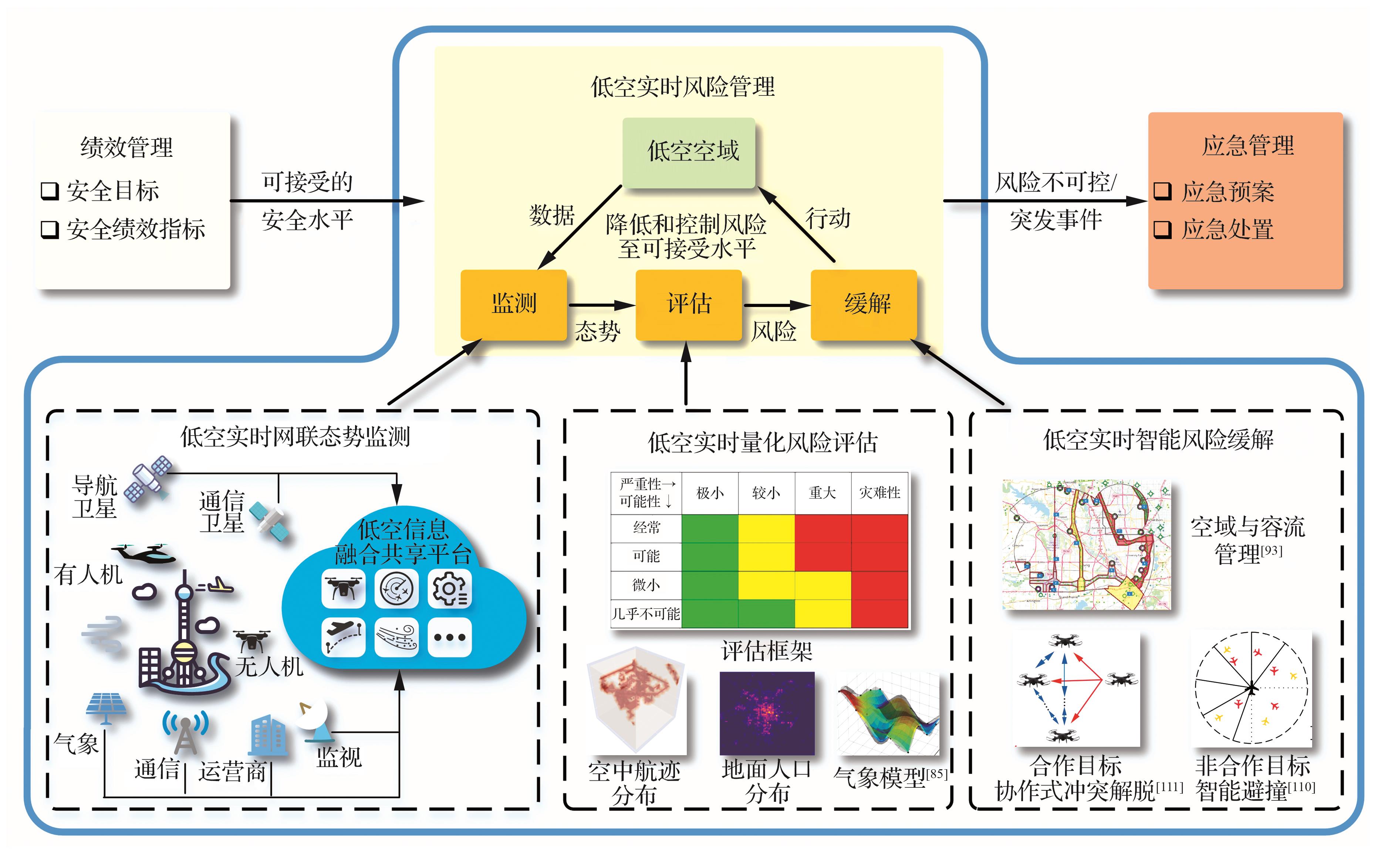
Fig.12
Key technologies for future in-time risk management
| [1] | KOPARDEKAR P, RIOS J, PREVOT T, et al. Unmanned aircraft system traffic management (UTM) concept of operations[C]∥AIAA Aviation Forum and Exposition. 2016. |
| [2] | FAA. Unmanned Aircraft System (UAS) Traffic Management (UTM) Concept of Operations V1.0[EB/OL]. (2018-05-23)[2025-03-12]. . |
| [3] | FAA. Unmanned Aircraft System (UAS) Traffic Management (UTM) Concept of Operations V2.0[EB/OL]. (2020-03-02)[2025-03-12]. . |
| [4] | FAA. NextGen Concept of Operations for Urban Air Mobility (UAM) V1.0[EB/OL]. (2020-06-26)[2025-03-12]. . |
| [5] | FAA. Urban Air Mobility (UAM) Concept of Operations V2.0[EB/OL]. (2023-04-26)[2025-03-12]. . |
| [6] | HILL B P, DECARME D, METCALFE M, et al. UAM vision concept of operations (ConOps) UAM maturity level (UML) 4: NASA/TM-20205011091[R]. Washington, D.C.: NASA, 2021. |
| [7] | PATTERSON M D, ISAACSON D R, MENDONCA N L, et al. An initial concept for intermediate-state, passenger-carrying urban air mobility operations[C]∥AIAA Scitech 2021 Forum. Reston: AIAA, 2021. |
| [8] | National Academies of Sciences, Engineering, and Medicine. Advanced aerial mobility: A national blueprint[M]. Washington, D.C.: National Academies Press, 2020: 25646. |
| [9] | FAA. Advanced Air Mobility (AAM) Implementation Plan [EB/OL]. (2023-07-18)[2025-03-12]. . |
| [10] | SESAR. U-space Blueprint [EB/OL]. (2017-06-09) [2025-03-12]. . |
| [11] | SESAR. U-space concept of operations (conops) fourth edition[EB/OL]. (2017-06-09)[2025-03-12]. . |
| [12] | BARRADO C, BOYERO M, BRUCCULERI L, et al. U-space concept of operations: A key enabler for opening airspace to emerging low-altitude operations[J]. Aerospace, 2020, 7(3): 24. |
| [13] | EASA. Acceptable level of safety performance (AloSP) implementation guidance within the European union framework[EB/OL]. (2021-05-31)[2025-03-12]. . |
| [14] | BRITTON T. How to define acceptable level of safety (ALoS) in aviation SMS[EB/OL]. (2023-09-13)[2024-07-21]. . |
| [15] | SKYBRARY. Acceptable level of safety | SKYbrary aviation safety[EB/OL]. (2024-07-17)[2024-07-21]. . |
| [16] | 全权, 李刚, 柏艺琴, 等. 低空无人机交通管理概览与建议[J]. 航空学报, 2020, 41(1): 023238. |
| QUAN Q, LI G, BAI Y Q, et al. Low altitude UAV traffic management: An introductory overview and proposal[J]. Acta Aeronautica et Astronautica Sinica, 2020, 41(1): 023238 (in Chinese). | |
| [17] | 国务院办公厅. 关于促进通用航空业发展的指导意见[Z]. 北京: 国务院办公厅, 2016. |
| General Office of the State Council. Guidance on promoting the development of general aviation industry[Z]. Beijing: General Office of the State Council, 2016 (in Chinese). | |
| [18] | ICAO. Safety management manual fourth edition: Doc 9859[R]. Montréal: ICAO, 2018. |
| [19] | 中国交通新闻网. 以改革创新为动力推动低空经济高质量发展[EB/OL]. (2024-07-29)[2025-01-30]. . |
| China Transportation News Network. Driving high-quality development of the low-altitude economy with reform and innovation[EB/OL]. (2024-07-29)[2025-01-30]. (in Chinese). | |
| [20] | 全国人民代表大会. 中华人民共和国安全生产法[Z]. 北京: 全国人民代表大会常务委员会, 2021. |
| National People’s Congress. Law of the people’s repub-lic of China on production safety[Z]. Beijing: Standing Committee of the National People’s Congress, 2021 (in Chinese). | |
| [21] | FAA. Safety risk management policy(FAA Order 8040.4C )[Z]. Washington, D.C.: FAA, 2023. |
| [22] | ELLIS K K, KROIS P, KOELLING J H, et al. Defining services, functions, and capabilities for an advanced air mobility (AAM) in-time aviation safety management system (IASMS)[C]∥AIAA Aviation 2021 Forum. Reston: AIAA, 2021. |
| [23] | ELLIS K, KROIS P, MAH R, et al. An approach for identifying IASMS services, functions, and capabilities from data sources[C]∥2021 IEEE/AIAA 40th Digital Avionics Systems Conference (DASC). Piscataway: IEEE Press, 2021. |
| [24] | YOUNG S D, QUACH C, GOEBEL K, et al. In-time safety assurance systems for emerging autonomous flight operations[C]∥2018 IEEE/AIAA 37th Digital Avionics Systems Conference (DASC). Piscataway: IEEE Press, 2018. |
| [25] | MBAYE S, JONES G, INFELD S I, et al. A model-based systems engineering evaluation of the evolution to an in-time aviation safety management system[C]∥AIAA Aviation 2022 Forum. Reston: AIAA, 2022. |
| [26] | YOUNG S, ANCEL E, MOORE A, et al. Architecture and information requirements to assess and predict flight safety risks during highly autonomous urban flight operations: NASA/TM-2020-220440[R]. Washington, D.C.: NASA, 2020. |
| [27] | 中国民用航空局. 2023年民航行业发展统计公报[EB/OL]. (2024-05-31) [2025-03-12]. . |
| The Civil Aviation Administration of China. 2023 civil aviation industry development statistical bulletin [EB/OL]. (2024-05-31) [2025-03-12]. (in Chinese). | |
| [28] | IATA. 2023 IATA annual safety report [Z]. Geneva: IATA, 2024. |
| [29] | Joint Authorities for Rulemaking of Unmanned Systems. Safety assessment of remotely piloted aircraft systems: AMC RPAS.1309[EB/OL]. (2015-11-01) [2024-09-29]. . |
| [30] | GALOTTI V P. The future air navigation system (FANS): Communications, navigation, surveillance-air traffic management (CNS/ATM)[M]. London: Routledge, 2019. |
| [31] | 罗云飞. 新航行系统的广播式自动相关监视技术研究[D]. 成都: 电子科技大学, 2011. |
| LUO Y F. Research on broadcast automatic correlation monitoring technology of new navigation system[D]. Chengdu: University of Electronic Science and Technology of China, 2011 (in Chinese). | |
| [32] | 朱衍波. 空天地一体的民航空事系统发展与展望[Z]. 北京: 中国民航报社, 2023. |
| ZHU Y B. Development and outlook of integrated air-ground-space civil aviation system[Z]. Beijing: CAAC News, 2023 (in Chinese). | |
| [33] | 中国电子科技集团有限公司. 中国电科:2024年低空航行系统白皮书[EB/OL].(2024-08-29)[2025-03-12]. . |
| China Electronics Technology Group Corporation. CETC: Low altitude flight system white paper 2024[EB/OL]. (2024-08-29)[2025-03-12]. (in Chinese). | |
| [34] | 牛文生. 基于天地一体化信息网络的智能航空客运系统[J]. 航空学报, 2019, 40(1): 522415. |
| NIU W S. Intelligent air passenger transportation system utilizing integrated space-ground information network[J]. Acta Aeronautica et Astronautica Sinica, 2019, 40(1): 522415 (in Chinese). | |
| [35] | 张学军, 谭元晧, 李雪缘, 等. 星基ADS-B系统及关键技术发展综述[J]. 北京航空航天大学学报, 2022, 48(9): 1589-1604. |
| ZHANG X J, TAN Y H, LI X Y, et al. A review of development of space-based ADS-B system and its key technologies[J]. Journal of Beijing University of Aeronautics and Astronautics, 2022, 48(9): 1589-1604 (in Chinese). | |
| [36] | 朱永文, 陈志杰, 蒲钒, 等. 数字化空域系统发展研究[J]. 中国工程科学, 2021, 23(3): 135-143. |
| ZHU Y W, CHEN Z J, PU F, et al. Development of digital airspace system[J]. Strategic Study of CAE, 2021, 23(3): 135-143 (in Chinese). | |
| [37] | 朱永文, 陈志杰, 蒲钒, 等. 空中交通智能化管理的科学与技术问题研究[J]. 中国工程科学, 2023, 25(5): 174-184. |
| ZHU Y W, CHEN Z J, PU F, et al. Scientific and technological issues for the intelligent management of air traffic[J]. Strategic Study of CAE, 2023, 25(5): 174-184 (in Chinese). | |
| [38] | BOLI T, RAVENHILL P. SESAR: The past, present, and future of European air traffic management research[J]. Engineering, 2021, 7(4): 448-451. |
| [39] | POST J. The next generation air transportation system of the United States: Vision, accomplishments, and future directions[J]. Engineering, 2021, 7(4): 427-430. |
| [40] | TIAN Y, WAN L L, CHEN C H, et al. Safety assessment method of performance-based navigation airspace planning[J]. Journal of Traffic and Transportation Engineering (English Edition), 2015, 2(5): 338-345. |
| [41] | WHITING T. NASA Releases New Concept Image for Advanced Air Mobility [EB/OL]. (2021-03-29)[2025-03-26]. . |
| [42] | PONCHAK D S, TEMPLIN F L, SHEFFIELD G, et al. Reliable and secure surveillance, communications and navigation (RSCAN) for unmanned air systems (UAS) in controlled airspace[C]∥2018 IEEE Aerospace Conference. Piscataway: IEEE Press, 2018. |
| [43] | PONCHAK D S, TEMPLIN F L, SHEFFIELD G, et al. An implementation analysis of communications, navigation, and surveillance (CNS) Technologies for unmanned air systems (UAS)[CL]∥2018 IEEE/AIAA 37th Digital Avionics Systems Conference (DASC). Piscataway: IEEE Press, 2018. |
| [44] | PONCHAK D S, TEMPLIN F L, SHEFFIELD G, et al. Advancing the standards for unmanned air system communications, navigation and surveillance[C]∥2019 IEEE Aerospace Conference. Piscataway: IEEE Press, 2019. |
| [45] | MARTIN L, WOLTER C, JOBE K, et al. TCL3 UTM (UAS traffic management) flight tests, airspace operations laboratory (AOL) report: NASA/TM-2019-220347[R]. Washington, D.C.: NASA, 2019. |
| [46] | STOUFFER V L, COTTON W B, DEANGELIS R A, et al. Reliable, secure, and scalable communications, navigation, and surveillance (CNS) options for urban air mobility (UAM): NASA/TM-20205006661[R]. Washington, D.C.: NASA, 2020. |
| [47] | WIGARD J, KOVáCS I Z, CLERGEAUD M. D3.3-Insights from simulation experiments on combined cellular satellite UAS communication: H2020-SESAR-2016-1[R]. Brussel: SESAR, 2019. |
| [48] | SØRENSEN T B, AMORIM R, LOPEZ M. SESAR 2020-763601-D5.2 Report of first drone flight campaign: H2020-SESAR-2016-1[R]. Brussel: SESAR, 2020. |
| [49] | AMORIM R, NGUYEN H, WIGARD J, et al. Measured uplink interference caused by aerial vehicles in LTE cellular networks[J]. IEEE Wireless Communications Letters, 2018, 7(6): 958-961. |
| [50] | LOPEZ M, SORENSEN T B, MOGENSEN P, et al. Shadow fading spatial correlation analysis for aerial vehicles: Ray tracing vs. measurements[C]∥2019 IEEE 90th Vehicular Technology Conference (VTC2019-Fall). Piscataway: IEEE Press, 2019. |
| [51] | BUCUR M, SORENSEN T, AMORIM R, et al. Validation of large-scale propagation characteristics for UAVs within urban environment[C]∥2019 IEEE 90th Vehicular Technology Conference (VTC2019-Fall). Piscataway: IEEE Press, 2019. |
| [52] | DE AMORIM R M, WIGARD J, KOVACS I Z, et al. Enabling cellular communication for aerial vehicles: Providing reliability for future applications[J]. IEEE Vehicular Technology Magazine, 2020, 15(2): 129-135. |
| [53] | AMORIM R, KOVáCS I Z, WIGARD J, et al. Forecasting spectrum demand for UAVs served by dedicated allocation in cellular networks[C]∥2019 IEEE Wireless Communications and Networking Conference Workshop (WCNCW). Piscataway: IEEE Press, 2019: 1-6. |
| [54] | NGUYEN H C, AMORIM R, WIGARD J, et al. How to ensure reliable connectivity for aerial vehicles over cellular networks[J]. IEEE Access, 2018, 6: 12304-12317. |
| [55] | ORSINI C, D’AGOSTINO A, IANNI M, et al. ICARUS Concept Definition: State-Of-The-Art, Requirements, Gap Analysis: H2020-SESAR-2019-2[R]. Brussel: SESAR, 2020. |
| [56] | ORSINI C, D’AGOSTINO A, TOMASELLO F, et al. Design and architecture of the ICARUS system & services: H2020-SESAR-2019-2[R]. Brussel: SESAR, 2020. |
| [57] | MENNELLA A, LUISI G, GAGLIARDE G. ICARUS D5.2-Cockpit Simulator Architecture: H2020-SESAR-2019-2[R]. Brussel: SESAR, 2021. |
| [58] | TERPESSI C, ONATE M, ORSINI C. ICARUS final project results report: H2020-SESAR-2015-1[R]. Brussel: SESAR, 2022. |
| [59] | PIOT A, JAHANGIR M, CISEK K. SESAR 2020- 763719-conclusion and recommendations: H2020-SESAR-2016-1[R]. Brussel: SESAR, 2019. |
| [60] | JAHANGIR M, BAKER C J. CLASS U-space drone test flight results for non-cooperative surveillance using an L-band 3-D staring radar[C]∥2019 20th International Radar Symposium (IRS). Piscataway: IEEE Press, 2019: 1-11. |
| [61] | CISEK K, BREKKE E, JAHANGIR M, et al. Track-to-track data fusion for unmanned traffic management system[C]∥2019 IEEE Aerospace Conference. Piscataway: IEEE Press, 2019. |
| [62] | SIM J, JAHANGIR M, FIORANELLI F, et al. Effective ground-truthing of supervised machine learning for drone classification[C]∥2019 International Radar Conference (RADAR). Piscataway: IEEE Press, 2019. |
| [63] | 樊邦奎, 李云, 张瑞雨. 浅析低空智联网与无人机产业应用[J]. 地理科学进展, 2021, 40(9): 1441-1450. |
| FAN B K, LI Y, ZHANG R Y. Initial analysis of low-altitude Internet of intelligences(IOI) and the applications of unmanned aerial vehicle industry[J]. Progress in Geography, 2021, 40(9): 1441-1450 (in Chinese). | |
| [64] | 吴启晖, 董超, 贾子晔, 等. 低空智联网组网与控制理论方法[J]. 航空学报, 2024, 45(3): 028809. |
| WU Q H, DONG C, JIA Z Y, et al. Networking and control mechanism for low-altitude intelligent networks[J]. Acta Aeronautica et Astronautica Sinica, 2024, 45(3): 028809 (in Chinese). | |
| [65] | 吴启晖. 面向低空经济的低空智联网[EB/OL]. (2024-06-28)[2024-10-21]. . |
| WU Q H. Low-altitude intelligent network for the low-altitude economy[EB/OL]. (2024-06-28)[2024-10-21]. (in Chinese). | |
| [66] | 吴媚, 宛俊余. 湖南建成全国首个覆盖全省低空空域监视网[N/OL]. 湖南日报, (2023-05-19)[2024-10-21] https:∥. |
| WU M, WAN J Y. Hunan established the nation’s first province-wide low-altitude airspace surveillance network [N/OL]. DailyHunan, (2023-05-19)[2024-10-21]. https:∥ (in Chinese). | |
| [67] | 湖南省通用航空发展有限公司. 北斗低空 闪耀三湘[N/OL]. 湖南机场报, (2023-12-06)[2024-10-21]. https:∥ |
| HUNAN GENERAL AVIATION DEVELOPMENT CO., LTD. BeiDou shines in low-altitude across Hunan [N/OL]. Hunan Airport Journal, (2023-12-06)[2024-10-21]. https:∥ (in Chinese). | |
| [68] | NG H K. Collaborative weather research and development for urban air mobility[C]∥FPAW 2022 Spring Meeting, 2022. |
| [69] | BONIN T, JONES J, ENEA G, et al. Development of a weather capability for the urban air mobility airspace research roadmap[C]∥2023 Integrated Communication, Navigation and Surveillance Conference (ICNS). 2023. |
| [70] | CHAO H, MAHESHWARI A, DELAURENTIS D, et al. Weather impact assessment for urban aerial trips in metropolitan areas[C]∥AIAA Aviation 2021 Forum. Reston: AIAA, 2021. |
| [71] | PENSADO E A, PIEIRO G V, ESTéVEZ P D, et al. Towards enhancing the safety of advanced air mobility: automatic 3D inter-urban modelling for improved weather monitoring[J]. ISPRS Annals of the Photogrammetry, Remote Sensing and Spatial Information Sciences, 2024, X-4/W5-2024: 1-7. |
| [72] | EASA. Specific Operations Risk Assessment (SORA) | EASA[EB/OL]. (2024-07-10)[2024-07-21]. . |
| [73] | JARUS. JARUS guidelines on Specific Operations Risk Assessment (SORA) V2.5[EB/OL].(2024-05-13)[2025-03-12]. . |
| [74] | ANCEL E, CAPRISTAN F M, FOSTER J V, et al. real-time risk assessment framework for unmanned aircraft system (UAS) traffic management (UTM) [C]∥17th AIAA Aviation Technology, Integration, and Operations Conference. Reston: AIAA, 2017. |
| [75] | ANCEL E, HELSEL T, HEINICH C M. Ground risk assessment service provider (GRASP) development effort as a supplemental data service provider (SDSP) for urban unmanned aircraft system (UAS) operations[C]∥2019 IEEE/AIAA 38th Digital Avionics Systems Conference (DASC). Piscataway: IEEE Press, 2019. |
| [76] | ANCEL E, CAPRISTAN F M, FOSTER J V, et al. In-time non-participant casualty risk assessment to support onboard decision making for autonomous unmanned aircraft[C]∥AIAA Aviation 2019 Forum. AIAA, 2019. |
| [77] | SESAR. SESAR Joint Undertaking | U-space Air and Ground Risk modEls Enhancement-U-AGREE[EB/OL]. (2024-09-01)[2024-09-24]. . |
| [78] | Commission European. U-space air and ground risk modEls enhancement[EB/OL]. (2024-07-08)[2025-01-02]. . |
| [79] | OH S, YOON Y. Data-driven risk analysis of unmanned aircraft system operations considering spatiotemporal characteristics of population distribution[J]. Transportation Research Interdisciplinary Perspectives, 2022, 16: 100732. |
| [80] | 王莉莉, 阳杰. 基于速度随机分布的低空空域小型无人机碰撞风险评估模型[J]. 交通信息与安全, 2022, 40(4): 64-70. |
| WANG L L, YANG J. A collision risk model for small UAVs based on velocity random distribution in low-altitude airspace[J]. Journal of Transport Information and Safety, 2022, 40(4): 64-70 (in Chinese). | |
| [81] | XUE M, KUO V H. A method of compliance for achieving target collision risk in UTM operations: NASA/TM-20240003151[R]. Washington, D.C.: NASA, 2024. |
| [82] | BLOM H A P, JIANG C P, GRIMME W B A, et al. Third party risk modelling of Unmanned Aircraft System operations, with application to parcel delivery service[J]. Reliability Engineering & System Safety, 2021, 214: 107788. |
| [83] | 钟罡, 励瑾, 张晓玮, 等. 物流无人机对地风险评估方法研究[J]. 交通运输系统工程与信息, 2022, 22(4): 246-254. |
| ZHONG G, LI J, ZHANG X W, et al. A risk assessment method of logistics drones on ground[J]. Journal of Transportation Systems Engineering and Information Technology, 2022, 22(4): 246-254 (in Chinese). | |
| [84] | BIJJAHALLI S, GARDI A, PONGSAKORNSATHIEN N, et al. A unified airspace risk management framework for UAS operations[J]. Drones, 2022, 6(7): 184. |
| [85] | BANERJEE P, CORBETTA M, JARVIS K. Probability of obstacle collision for UAVs in presence of wind[C]∥AIAA Aviation 2022 Forum. Reston: AIAA, 2022. |
| [86] | ZHANG N, LIU H, LOW K H. UAV Collision risk assessment in terminal restricted area by heatmap Representation[C]∥AIAA Scitech 2023 Forum. Reston: AIAA, 2023. |
| [87] | JIAO Q Y, LIU Y S, ZHENG Z G, et al. Ground risk assessment for unmanned aircraft systems based on dynamic model[J]. Drones, 2022, 6(11): 324. |
| [88] | ZHOU S Y, LIU Y, ZHANG X J, et al. Risk assessment and distribution estimation for UAV operations with accurate ground feature extraction based on a multi-layer method in urban areas[J]. Drones, 2024, 8(8): 399. |
| [89] | SUN X T, HU Y, QIN Y C, et al. Risk assessment of unmanned aerial vehicle accidents based on data-driven Bayesian networks[J]. Reliability Engineering & System Safety, 2024, 248: 110185. |
| [90] | 耿增显, 陈俊宇. 基于模糊贝叶斯网络的低空无人机运行风险评估[J]. 中国安全科学学报, 2024, 34(8): 53-60. |
| GENG Z X, CHEN J Y. Risk assessment of low-altitude unmanned aerial vehicle operation based on fuzzy Bayesian network[J]. China Safety Science Journal, 2024, 34(8): 53-60 (in Chinese). | |
| [91] | HAN P, YANG X Y, ZHAO Y F, et al. Quantitative ground risk assessment for urban logistical unmanned aerial vehicle (UAV) based on Bayesian network[J]. Sustainability, 2022, 14(9): 5733. |
| [92] | JANG D S, IPPOLITO C A, SANKARARAMAN S, et al. Concepts of airspace structures and system analysis for UAS traffic flows for urban areas[C]∥AIAA Information Systems-AIAA Infotech@ Aerospace. Reston: AIAA, 2017. |
| [93] | CHENG A W, WITZBERGER K E, ISAACSON D R, et al. National campaign (NC)-1 strategic conflict management simulation (X4) final report: NASA/TM-2022-0018159[R]. Washington, D.C.: NASA, 2022. |
| [94] | ISAACSON D, CHENG A, WITZBERGER K. National campaign (NC)-1 strategic conflict management simulation (X4) community based rules: NASA/TM—2022-0015823[R]. Washington, D.C.: NASA, 2022. |
| [95] | SESAR. SESAR Joint undertaking | DACUS-demand and capacity optimisation in U-space[EB/OL]. 2020 [2024-12-23]. . |
| [96] | ESCALONILLA P S, JANISCH D, FORSTER C, et al. Towards a continuous demand and capacity balancing process for U-space[C]∥Proceedings of the SESAR Innovation Days 2020, 2020. |
| [97] | JANISCH D, SANCHEZ-ESCALONILLA P, JIMENEZ M. UAV collision risk as part of u-space demand and capacity balancing[C]∥Proceedings of the SESAR Innovation Days 2021, 2021. |
| [98] | BüDDEFELD M, CROOK I, EDUARDO TEOMITZI H, et al. A drone operation plan model to support the effect of uncertainty in advanced u-space capacity planning process[J]. Journal of Physics: Conference Series, 2023, 2526(1): 012091. |
| [99] | 李樾, 韩维, 陈清阳, 等. 基于改进的速度障碍法的有人/无人机协同系统三维实时避障方法[J]. 西北工业大学学报, 2020, 38(2): 309-318. |
| LI Y, HAN W, CHEN Q Y, et al. Real-time obstacle avoidance for manned/unmanned aircraft cooperative system based on improved velocity obstacle method[J]. Journal of Northwestern Polytechnical University, 2020, 38(2): 309-318 (in Chinese). | |
| [100] | BEREZIAT D, CAFIERI S, VIDOSAVLJEVIC A. Metropolis Ⅱ: Centralised and strategical separation management of UAS in urban environment[C]∥12th SESAR innovation days. SESAR, 2022. |
| [101] | ZHOU X, WEN X Y, WANG Z P, et al. Swarm of micro flying robots in the wild[J]. Science Robotics, 2022, 7(66): eabm5954. |
| [102] | 谢华, 韩斯特, 尹嘉男, 等. 城市低空无人机飞行计划协同推演与优化调配方法[J]. 航空学报, 2024, 45(19): 330018. |
| XIE H, HAN S T, YIN J N, et al. Cooperative deduction and optimal allocation method for urban low-altitude UAV flight plan[J]. Acta Aeronautica et Astronautica Sinica, 2024, 45(19): 330018 (in Chinese). | |
| [103] | GAO F, WANG L Q, ZHOU B Y, et al. Teach-repeat-replan: A complete and robust system for aggressive flight in complex environments[J]. IEEE Transactions on Robotics, 2020, 36(5): 1526-1545. |
| [104] | KIM N, KIM I, SUK J, et al. Model predictive collision avoidance and in-flight trajectory optimization considering UAM operation corridor[C]∥2024 International Conference on Control, Automation and Diagnosis (ICCAD). 2024. |
| [105] | 王祝, 张梦通, 张振鹏, 等. 基于多指标动态优先级的无人机协同路径规划[J]. 航空学报, 2024, 45(4): 328816. |
| WANG Z, ZHANG M T, ZHANG Z P, et al. Multi-UAV cooperative path planning based on multi-index dynamic priority[J]. Acta Aeronautica et Astronautica Sinica, 2024, 45(4): 328816 (in Chinese). | |
| [106] | HUANG C, PETRUNIN I, TSOURDOS A. Strategic conflict management for performance-based urban air mobility operations with multi-agent reinforcement learning[C]∥2022 International Conference on Unmanned Aircraft Systems (ICUAS), 2022. |
| [107] | ISUFAJ R, OMERI M, PIERA M A. Multi-UAV conflict resolution with graph convolutional reinforcement learning[J]. Applied Sciences, 2022, 12(2): 610. |
| [108] | HUANG C, PETRUNIN I, TSOURDOS A. Strategic conflict management using recurrent multi-agent reinforcement learning for urban air mobility operations considering uncertainties[J]. Journal of Intelligent & Robotic Systems, 2023, 107(2): 20. |
| [109] | JANG K, PANT Y V, RODIONOVA A, et al. Learning-to-Fly RL: Reinforcement learning-based collision avoidance for scalable urban air mobility[C]∥2020 AIAA/IEEE 39th Digital Avionics Systems Conference (DASC), 2020. |
| [110] | LI C L, GU W Y, ZHENG Y, et al. An ETA-based tactical conflict resolution method for air logistics transportation[J]. Drones, 2023, 7(5): 334. |
| [111] | VAN NGUYEN L, PHUNG M D, HA Q P. Game theory-based optimal cooperative path planning for multiple UAVs[J]. IEEE Access, 2022, 10: 108034-108045. |
| [112] | DENIZ M, ZHAO L, WAN Y, et al. Game-theoretic decision-making and payoff design for UAV collision avoidance in a three-dimensional airspace[J]. Unmanned Systems, 2024, 12(3): 499-509. |
| [113] | HUANG Y, TANG J, LAO S Y. Cooperative multi-UAV collision avoidance based on a complex network[J]. Applied Sciences, 2019, 9(19): 3943. |
| [114] | YANG X X, WEI P. Autonomous free flight operations in urban air mobility with computational guidance and collision avoidance[J]. IEEE Transactions on Intelligent Transportation Systems, 2021, 22(9): 5962-5975. |
| [115] | GHEORGHISOR I, CHEN A, GLOBUS L, et al. Reliable 4G/5G-based communications in the national airspace: A UAS C2 use case[C]∥2020 Integrated Communications Navigation and Surveillance Conference (ICNS). 2020. |
| [116] | SHRESTHA R, BAJRACHARYA R, KIM S. 6G enabled unmanned aerial vehicle traffic management: A perspective[J]. IEEE Access, 2021, 9: 91119-91136. |
| [117] | JEPSEN J H, MADER A R, ANDREASEN T D, et al. Investigating the applicability of LTE-M for network identification of unmanned aerial systems in U-space[C]∥2023 International Conference on Unmanned Aircraft Systems (ICUAS), 2023. |
| [118] | NAEEM F, GOLLNICK V, SCHMITT C. 5G-enabled architectural imperatives and guidance for urban air mobility: Enhancing communication, navigation, and surveillance[C]∥AIAA Aviation Forum and Ascend 2024. Reston: AIAA, 2024. |
| [119] | 曹正阳, 张冰, 白屹轩, 等. GNSS/INS/VNS组合定位信息融合的多无人机协同导航方法[J]. 兵工学报, 2023, 44(S2): 157-166. |
| CAO Z Y, ZHANG B, BAI Y X, et al. Multi-UAV cooperative navigation method based on GNSS/INS/VNS combined positioning information fusion[J]. Acta Armamentarii, 2023, 44(S2): 157-166 (in Chinese). | |
| [120] | BIJJAHALLI S, SABATINI R, GARDI A. Advances in intelligent and autonomous navigation systems for small UAS[J]. Progress in Aerospace Sciences, 2020, 115: 100617. |
| [121] | YE S, WAN Z, ZENG L, et al. A vision-based navigation method for eVTOL final approach in urban air mobility(UAM)[C]∥2020 4th CAA International Conference on Vehicular Control and Intelligence (CVCI), 2020. |
| [122] | KRAMMER C, SCHERER S, MISHRA C, et al. Concept for a vision-augmented automatic landing system for VTOL aircraft[C]∥AIAA Aviation 2021 Forum. Reston: AIAA, 2021. |
| [123] | MICCIO E, VENERUSO P, OPROMOLLA R, et al. Vision-aided navigation for UAM approach to vertiports with multiple landing pads[C]∥2024 International Conference on Unmanned Aircraft Systems (ICUAS). 2024. |
| [124] | 中国民用航空局. 民用微轻小型无人驾驶航空器运行识别最低性能要求(试行)[EB/OL]. (2024-01-16 )[2025-03-12]. https:∥. |
| The Civil Aviation Administration of China. Minimum performance requirements for operation identification of civil micro-light small unmanned aerial vehicles (Trial)[EB/OL].(2024-01-16)[2025-03-12]. (in Chinese). | |
| [125] | BI K F, XIE L X, ZHANG H H, et al. Accurate medium-range global weather forecasting with 3D neural networks[J]. Nature, 2023, 619(7970): 533-538. |
| [126] | BLASCH E, RAZ A K, SABATINI R, et al. Information fusion as an autonomy enabler for UAS traffic management (UTM)[C]∥Proceedings of the AIAA scitech forum. Reston: AIAA, 2021. |
| [127] | JOHNSON M G, JUNG Y C, SZATKOWSKI G N, et al. Digital information platform (DIP) overview[C]∥NASA DIP RFI with airlines for america (A4A). Washington, D.C.: NASA, 2021. |
| [128] | 顾文勇. 基于可解释机器学习的无人机避撞决策研究[D]. 广汉: 中国民用航空飞行学院, 2024. |
| GU W Y. Research on UAV collision avoidance decision based on interpretable machine learning[D]. Guanghan: Civil Aviation Flight University of China, 2024 (in Chinese). |
| [1] | Jin YANG, Xu HANG, Yanjun WANG. Safety risk assessment of UAVs operations in airport controlled airspace [J]. Acta Aeronautica et Astronautica Sinica, 2025, 46(11): 531276-531276. |
| [2] | Gang ZHONG, Junming HUA, Sen DU, Yupu LIU, Hao LIU, Honghai ZHANG. Urban low-altitude flight plan optimal scheduling based on complex network [J]. Acta Aeronautica et Astronautica Sinica, 2025, 46(11): 531479-531479. |
| [3] | Chuanyan FENG, Shuang LIU, Xiaoru WANYAN, Menglong DING, Daochun LI, Yaoming ZHOU. Research progress on key technologies for human factors design of unmanned aircraft systems [J]. Acta Aeronautica et Astronautica Sinica, 2025, 46(11): 531213-531213. |
| [4] | Yuhan LI, Shuguang ZHANG, Yibing WU. Handling qualities assessing of SVO-based eVTOL aircraft through EMG and eye data [J]. Acta Aeronautica et Astronautica Sinica, 2025, 46(11): 531315-531315. |
| [5] | Xinglong WANG, Youjie WANG. Safety interval evaluation for multi-aircraft eVTOL in urban low altitude [J]. Acta Aeronautica et Astronautica Sinica, 2025, 46(1): 330604-330604. |
| [6] | Xiaohan LIAO, Wenqiu QU, Chenchen XU, Hongbo HE, Junwei WANG, Weibo SHI. A review of urban air mobility and its new infrastructure low⁃altitude public routes [J]. Acta Aeronautica et Astronautica Sinica, 2023, 44(24): 28521-028521-. |
| [7] | ZHANG Honghai, ZOU Yiyuan, ZHANG Qiqian, LIU Hao. Future urban air mobility management: Review [J]. ACTA AERONAUTICAET ASTRONAUTICA SINICA, 2021, 42(7): 24638-024638. |
| [8] | LI Anti, LI Chenglong, WU Dingjie, WEI Peng. Collision avoidance decision method for UAVs in random search combined with jump point guidance [J]. ACTA AERONAUTICAET ASTRONAUTICA SINICA, 2020, 41(8): 323726-323726. |
| [9] | QUAN Quan, LI Gang, BAI Yiqin, FU Rao, LI Mengxin, KE Chenxu, CAI Kaiyuan. Low altitude UAV traffic management:An introductory overview and proposal [J]. ACTA AERONAUTICAET ASTRONAUTICA SINICA, 2020, 41(1): 23238-023238. |
| Viewed | ||||||
|
Full text |
|
|||||
|
Abstract |
|
|||||
Address: No.238, Baiyan Buiding, Beisihuan Zhonglu Road, Haidian District, Beijing, China
Postal code : 100083
E-mail:hkxb@buaa.edu.cn
Total visits: 6658907 Today visits: 1341All copyright © editorial office of Chinese Journal of Aeronautics
All copyright © editorial office of Chinese Journal of Aeronautics
Total visits: 6658907 Today visits: 1341

 CJA
CJA
