Acta Aeronautica et Astronautica Sinica ›› 2025, Vol. 46 ›› Issue (2): 130732.doi: 10.7527/S1000-6893.2024.30732
• Fluid Mechanics and Flight Mechanics • Previous Articles
Dong LI1,2, Yining ZHANG2, Wenhui LING2, Guozhu LIANG1( ), Hao MENG2
Received:2024-05-24
Revised:2024-06-17
Accepted:2024-07-11
Online:2024-07-24
Published:2024-07-23
Contact:
Guozhu LIANG
E-mail:lgz@buaa.edu.cn
Supported by:CLC Number:
Dong LI, Yining ZHANG, Wenhui LING, Guozhu LIANG, Hao MENG. Inlet flow characteristics analysis of air-breathing rotating detonation engine[J]. Acta Aeronautica et Astronautica Sinica, 2025, 46(2): 130732.
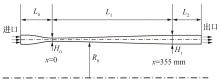
Fig.1
Inlet model diagram
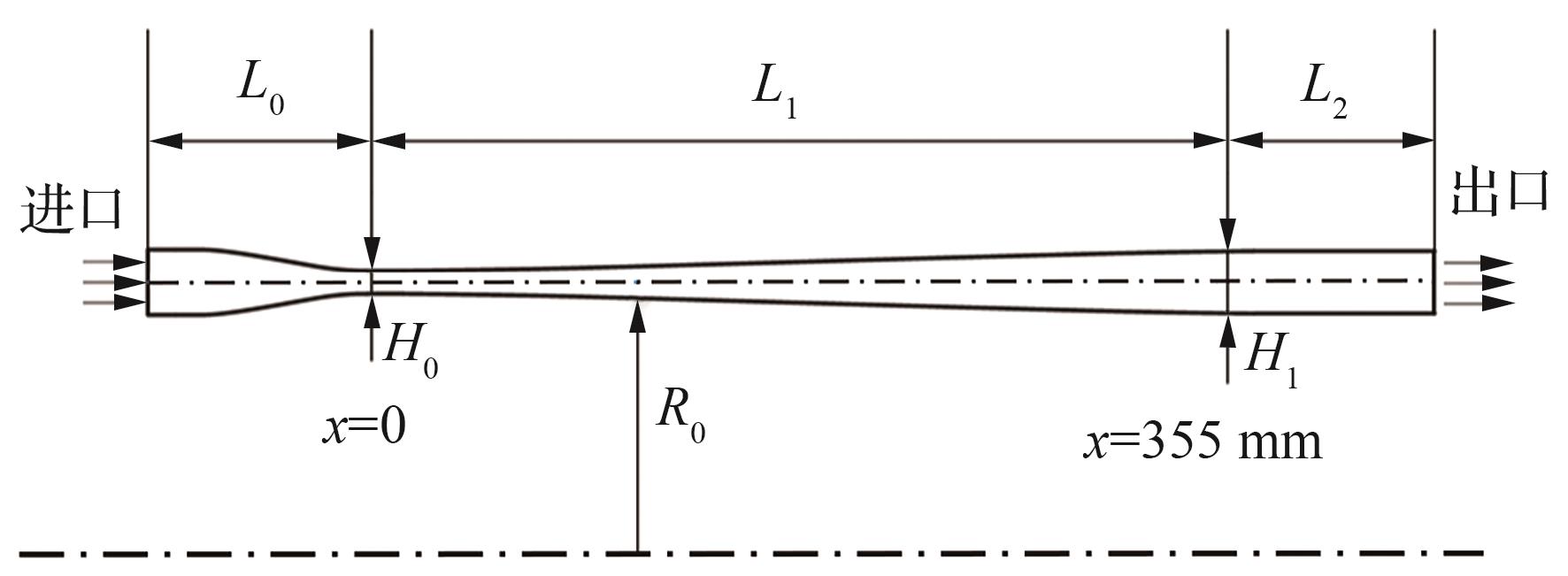
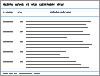
Table 1
Key geometric dimensions
| 参数 | H0/R0 | H1/R0 | L0/R0 | L1/R0 | L2/R0 |
|---|---|---|---|---|---|
| 数值 | 0.06 | 0.18 | 0.6 | 3.55 | 0.5 |
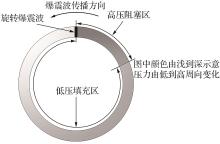
Fig.2
Schematic diagram of flow partition in outlet section of inlet
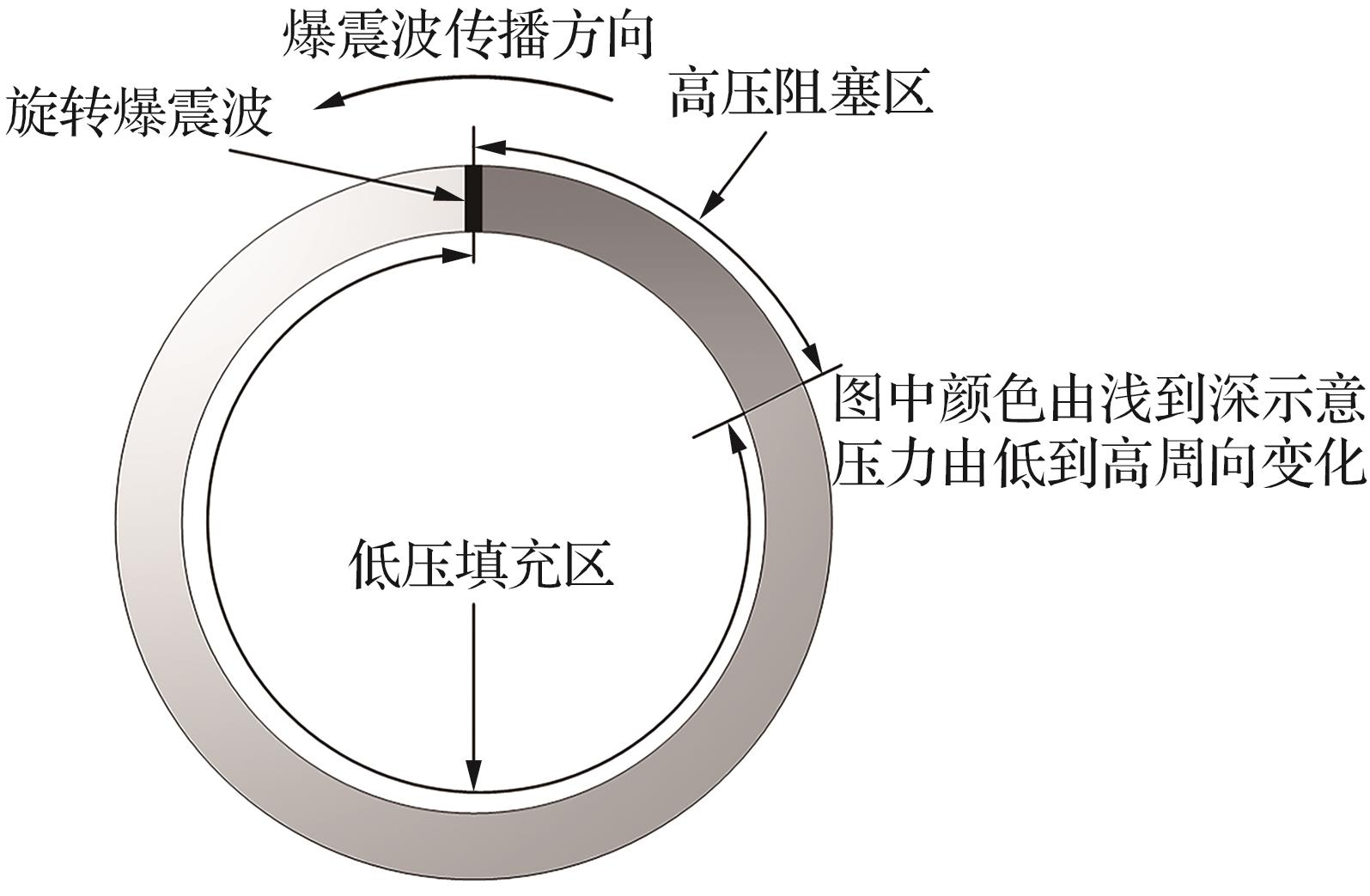
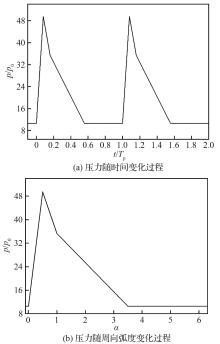
Fig.3
Change curves of given pressure in outlet section of inlet
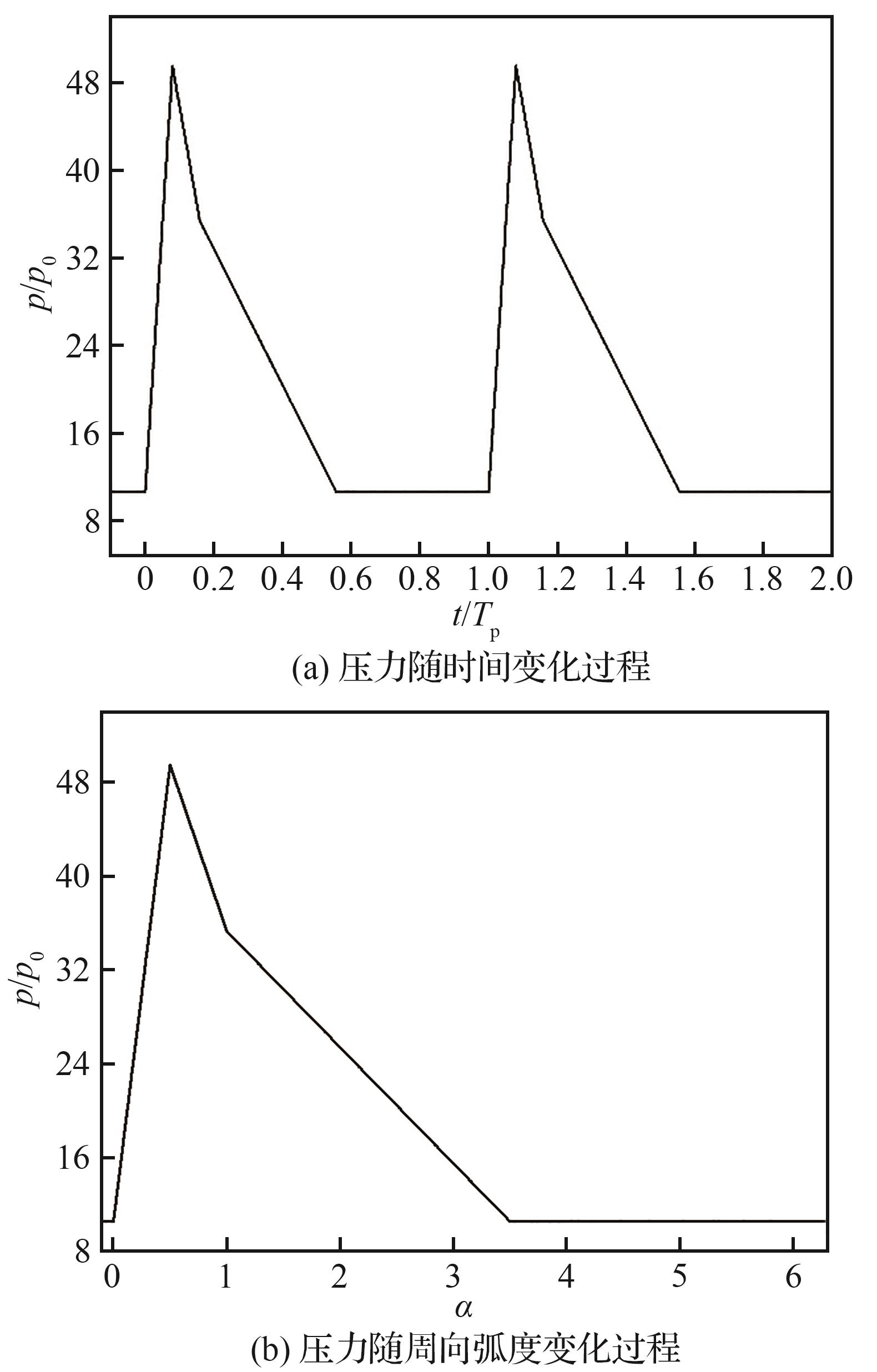
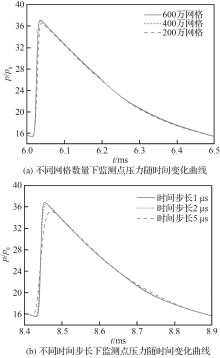
Fig.4
Verification of grid and time step independence
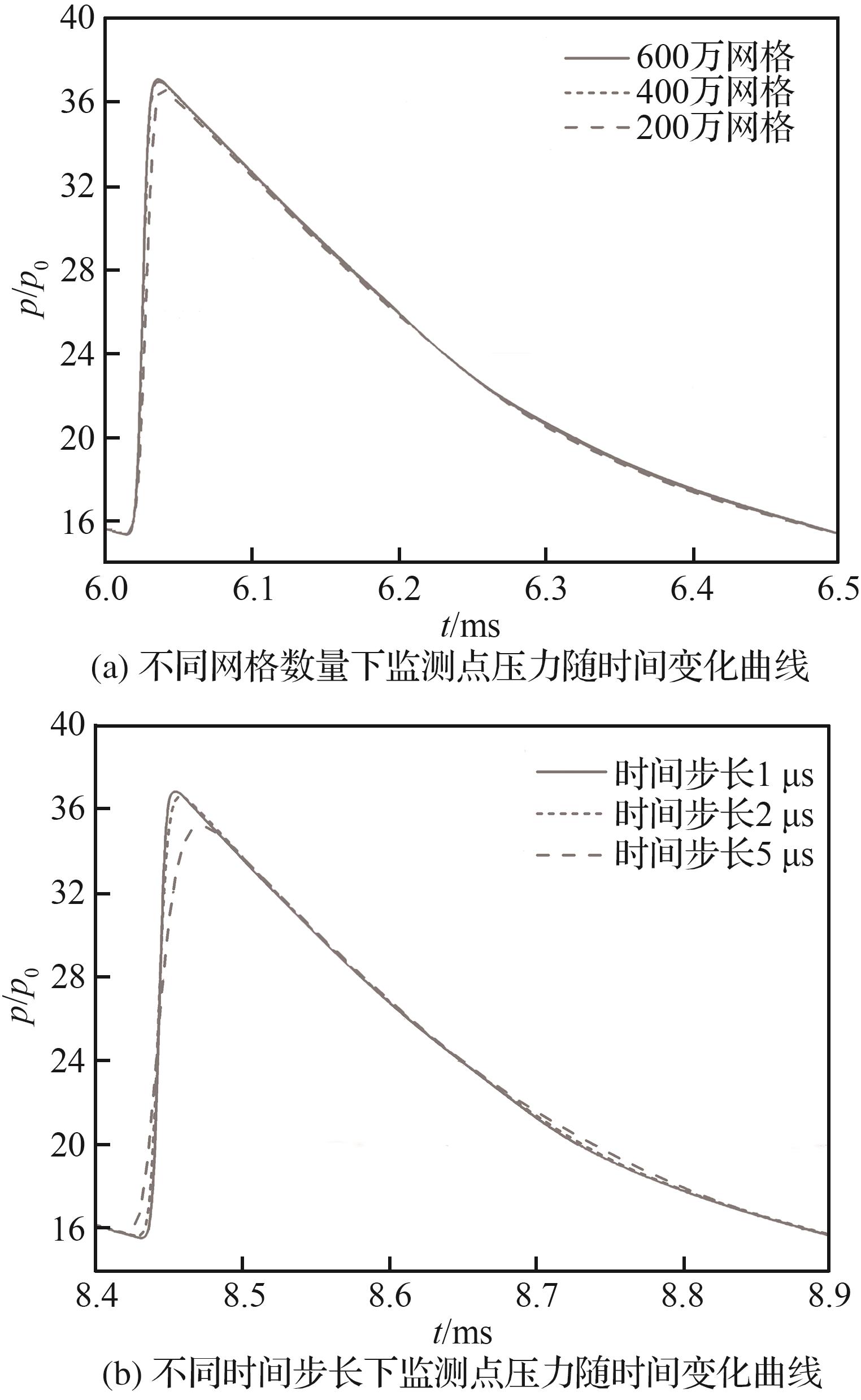
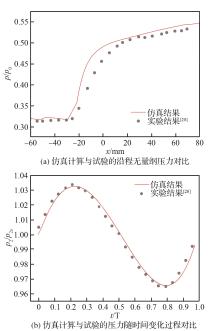
Fig.5
Verification of calculation method
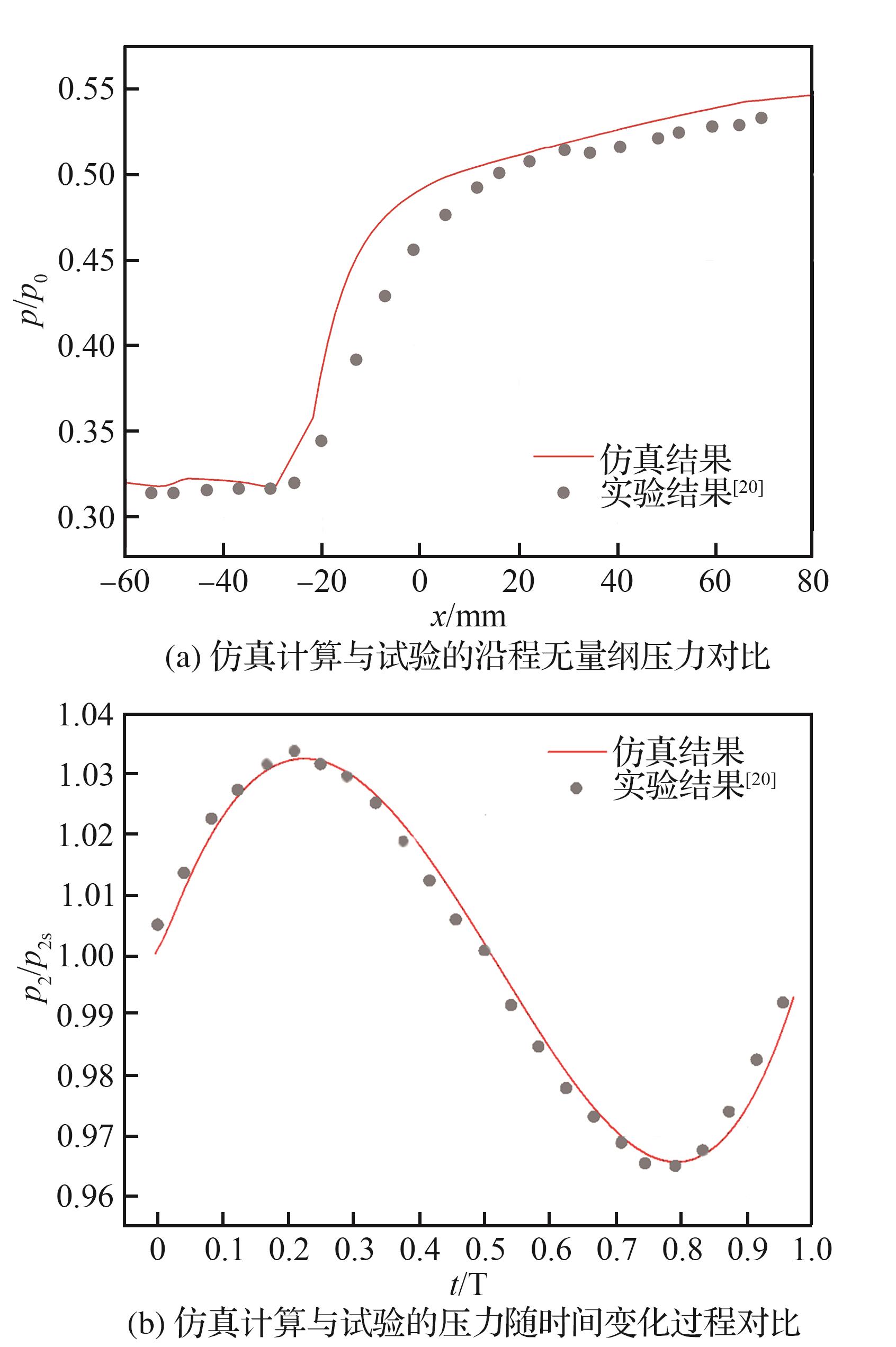
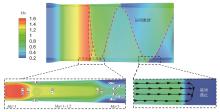
Fig.6
Mach number nephogram at time t=14 ms
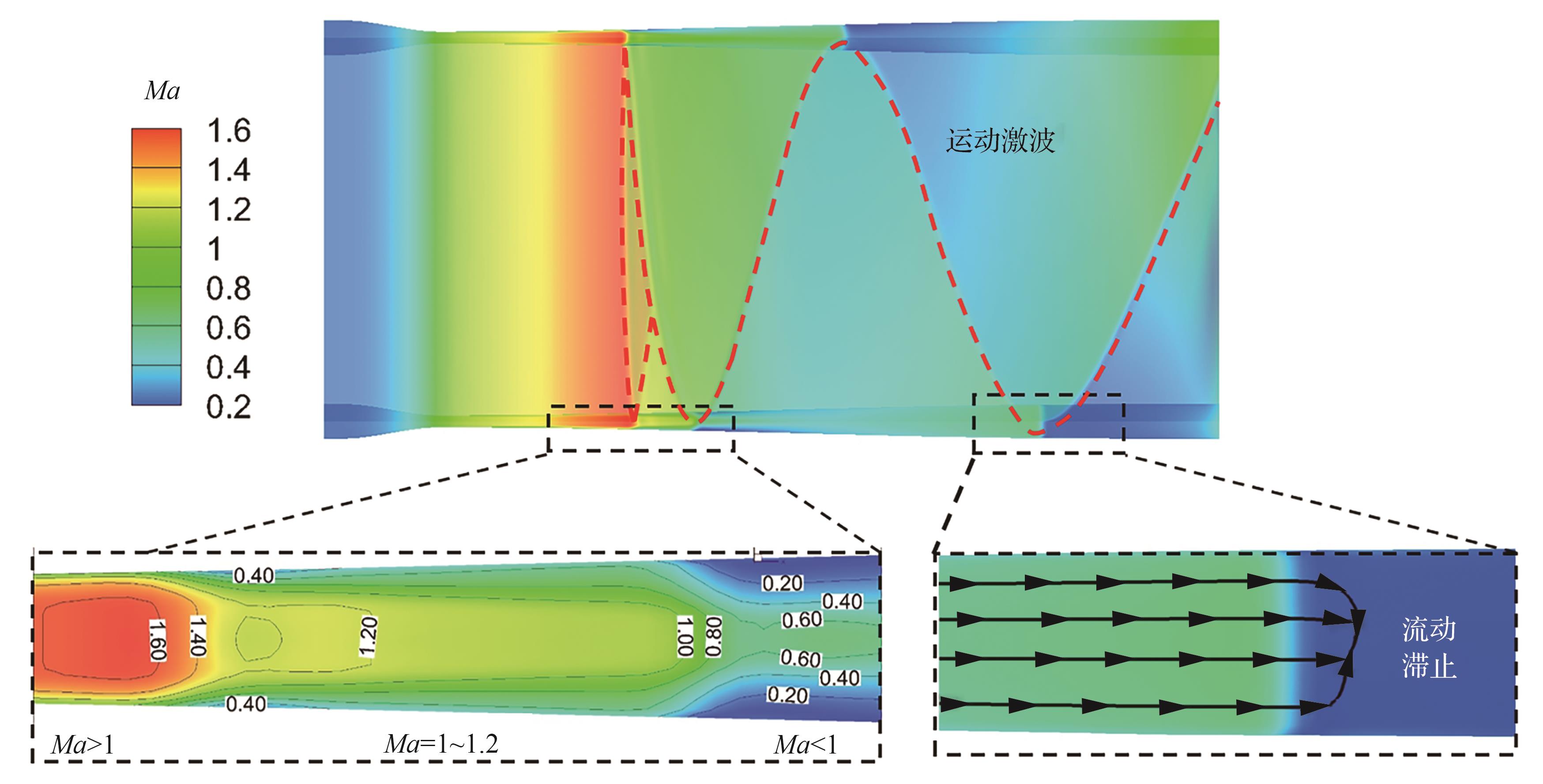
Fig.7
Variation process of pressure at monitoring points on inner and outer walls
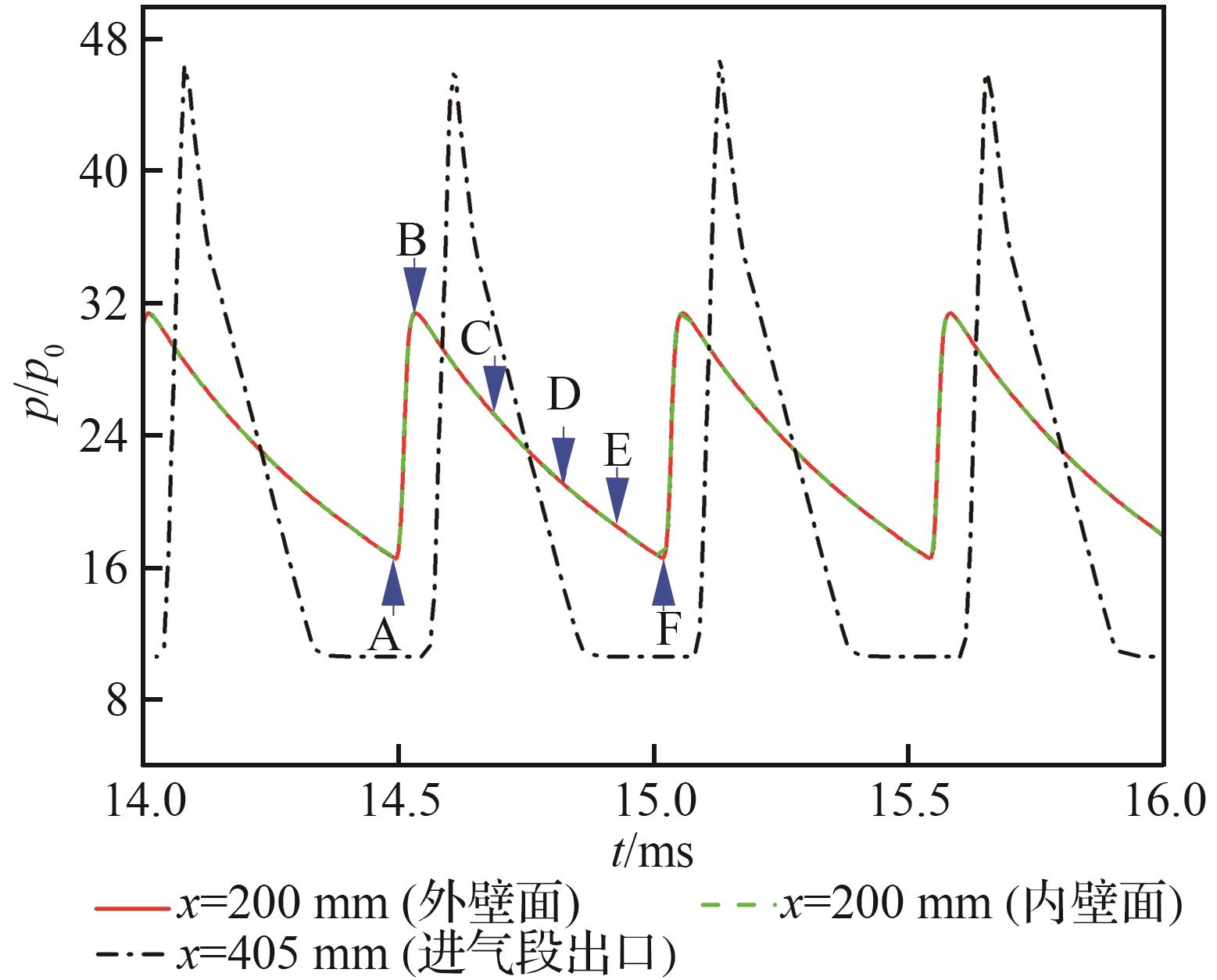
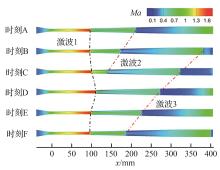
Fig.8
Mach number nephogram at different time in longitudinal section of inlet
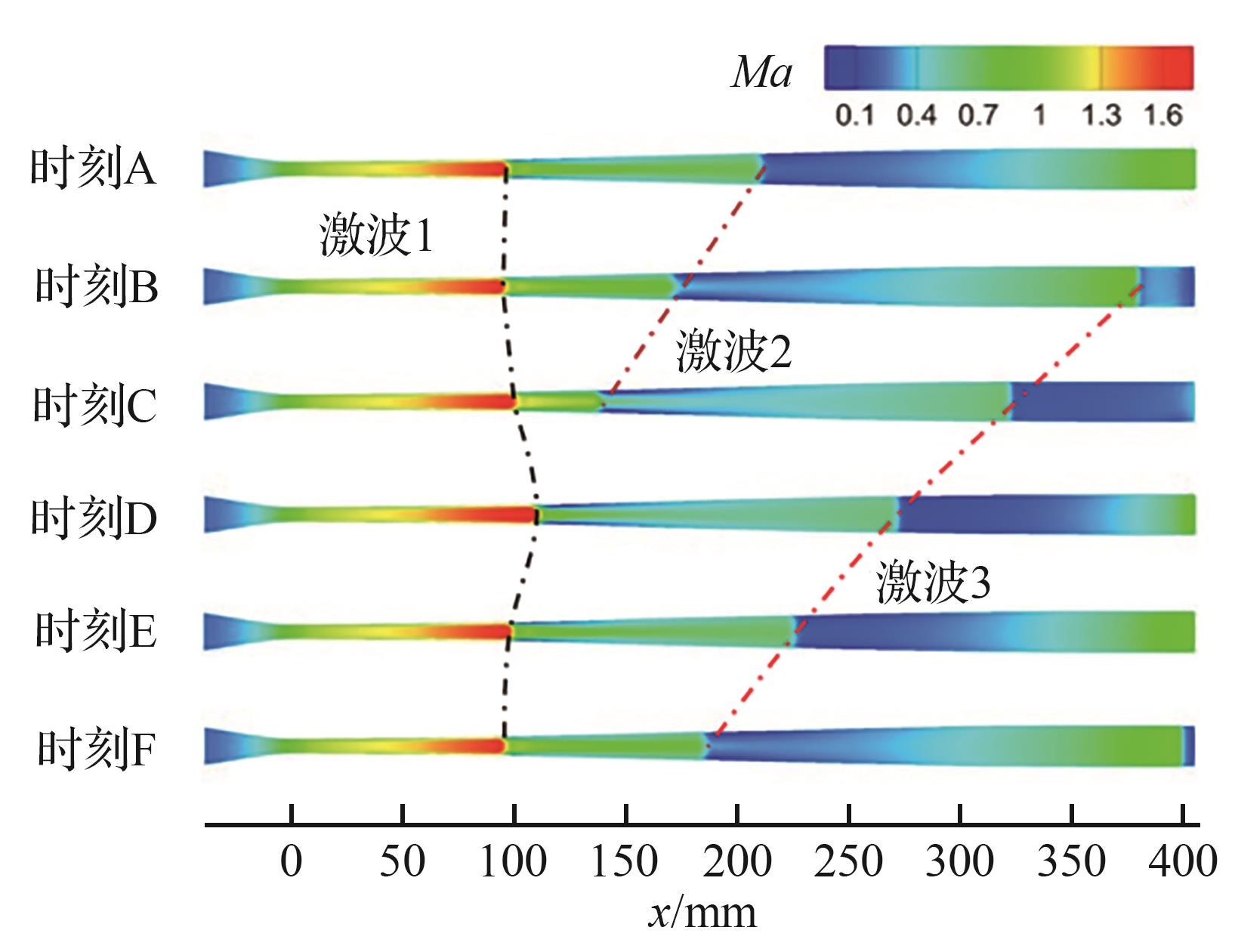
Fig.9
Mach number variations along centerline in longitudinal section at different time
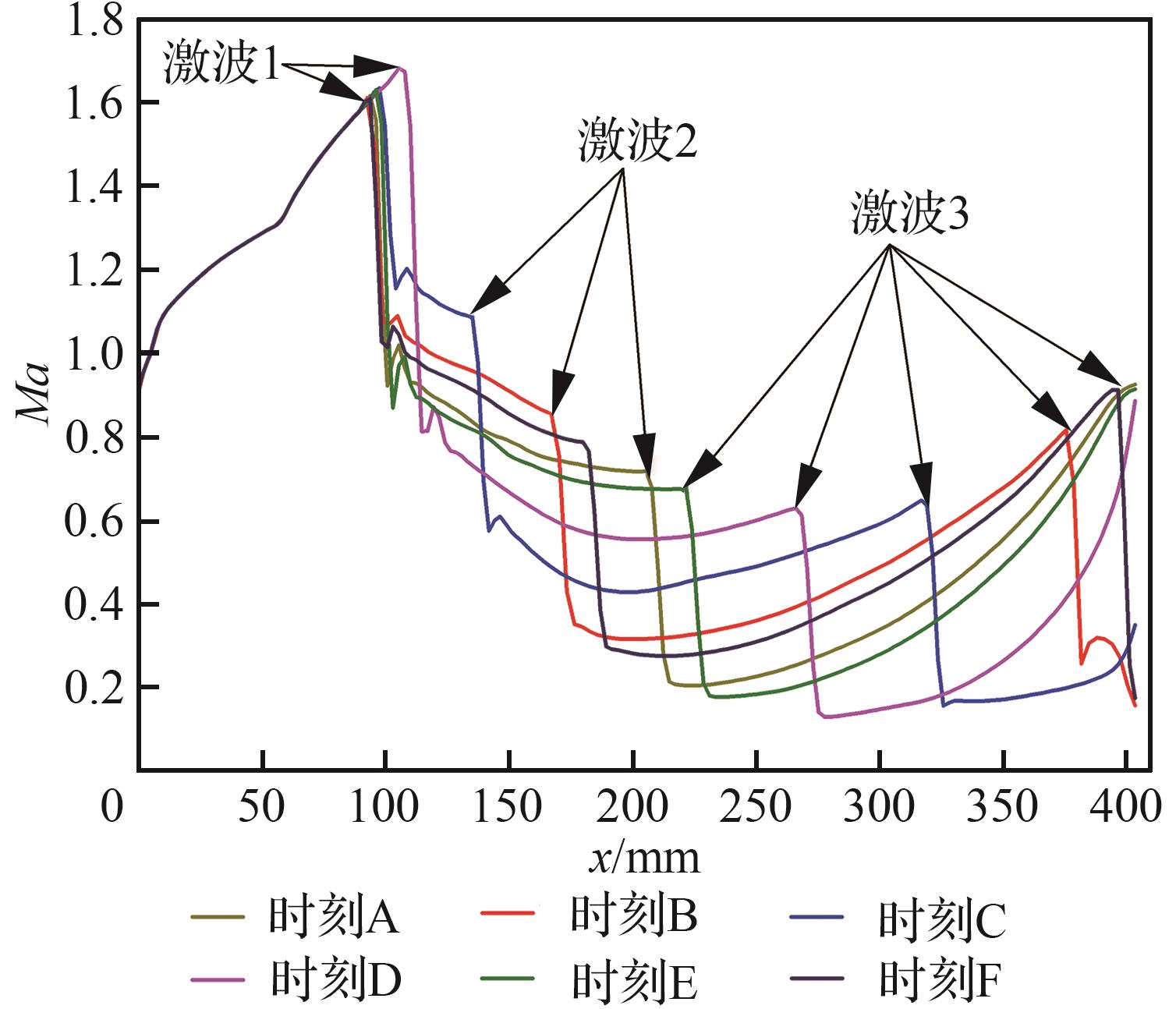
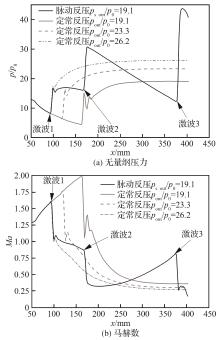
Fig.10
Parameters variations along centerlines in longitudinal section in conditions of steady and unsteady (time F) backpressure
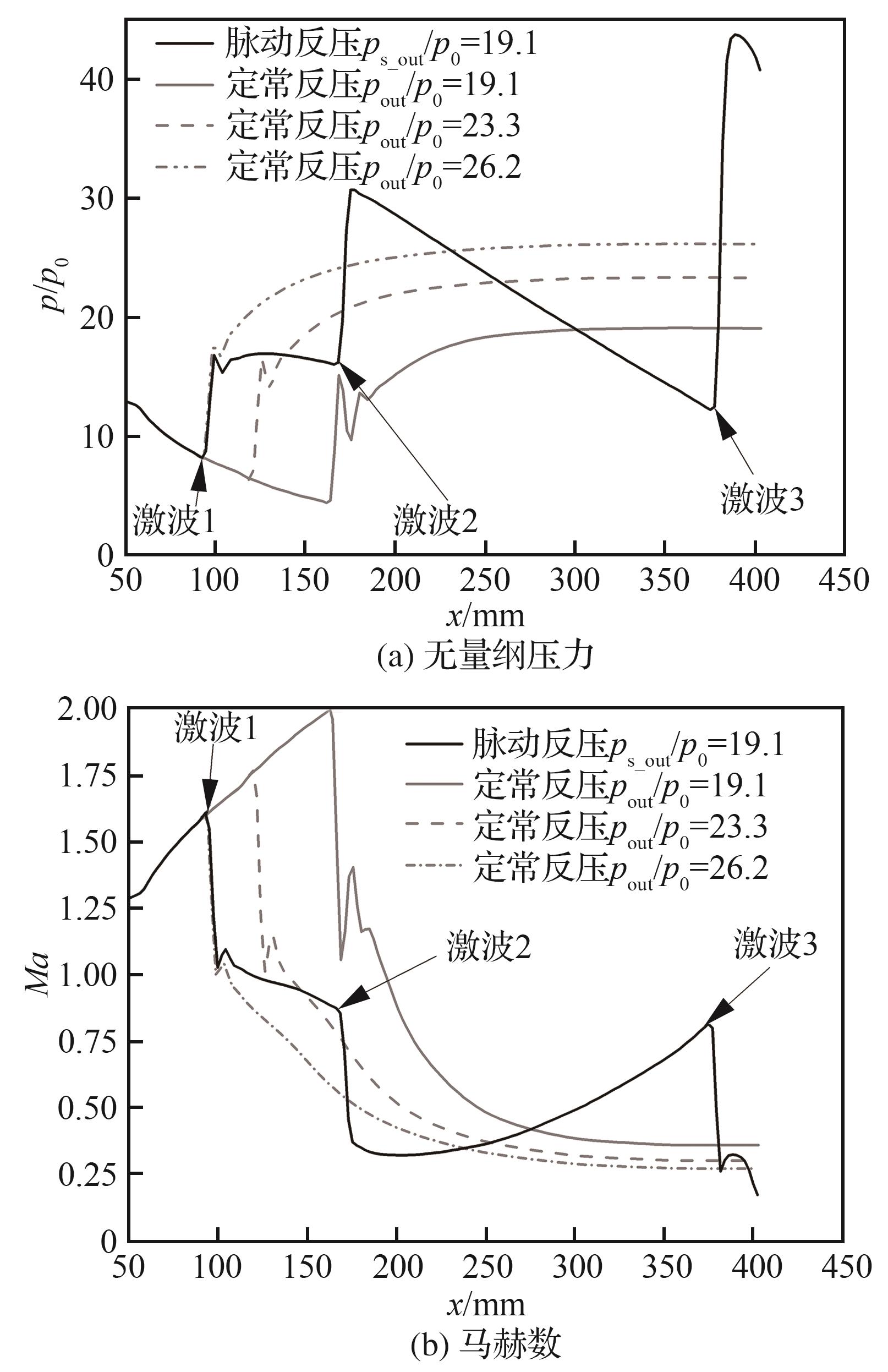
Fig.11
Pressure variations with time at different axial locations
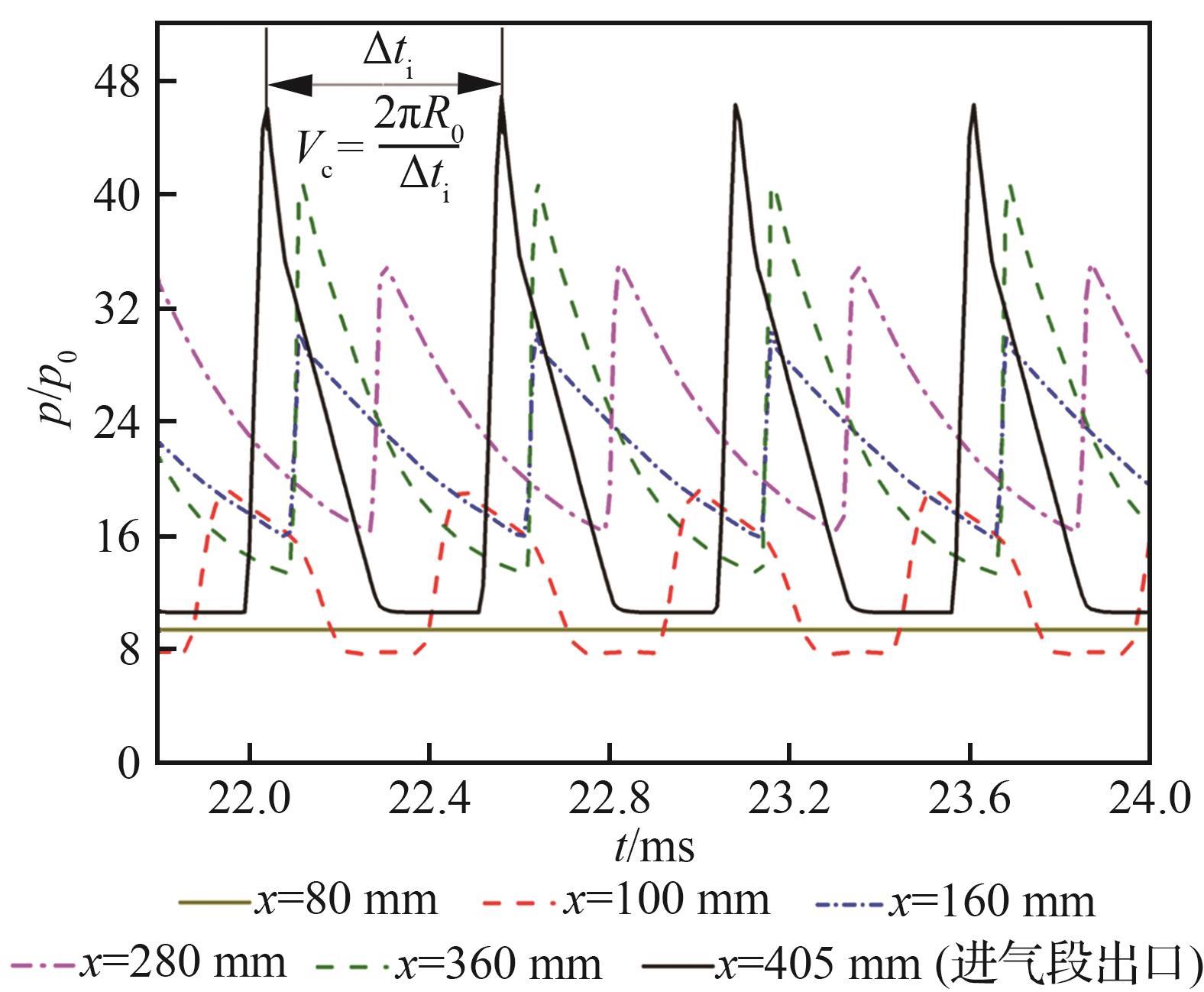
Fig.12
Pressure nephogram of two-dimensional splicing surfaces by translating
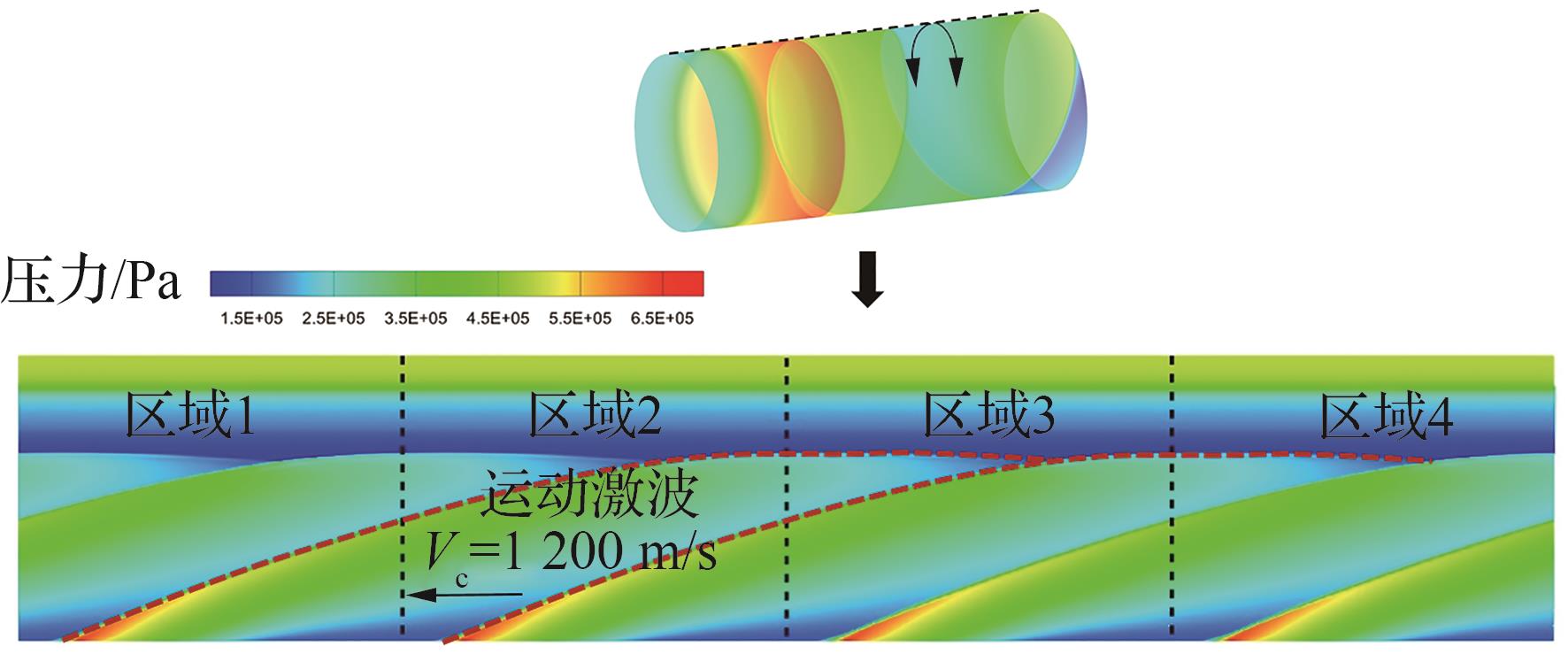
Fig.13
Moving shock wave configuration and axial propagation velocity at different axial locations
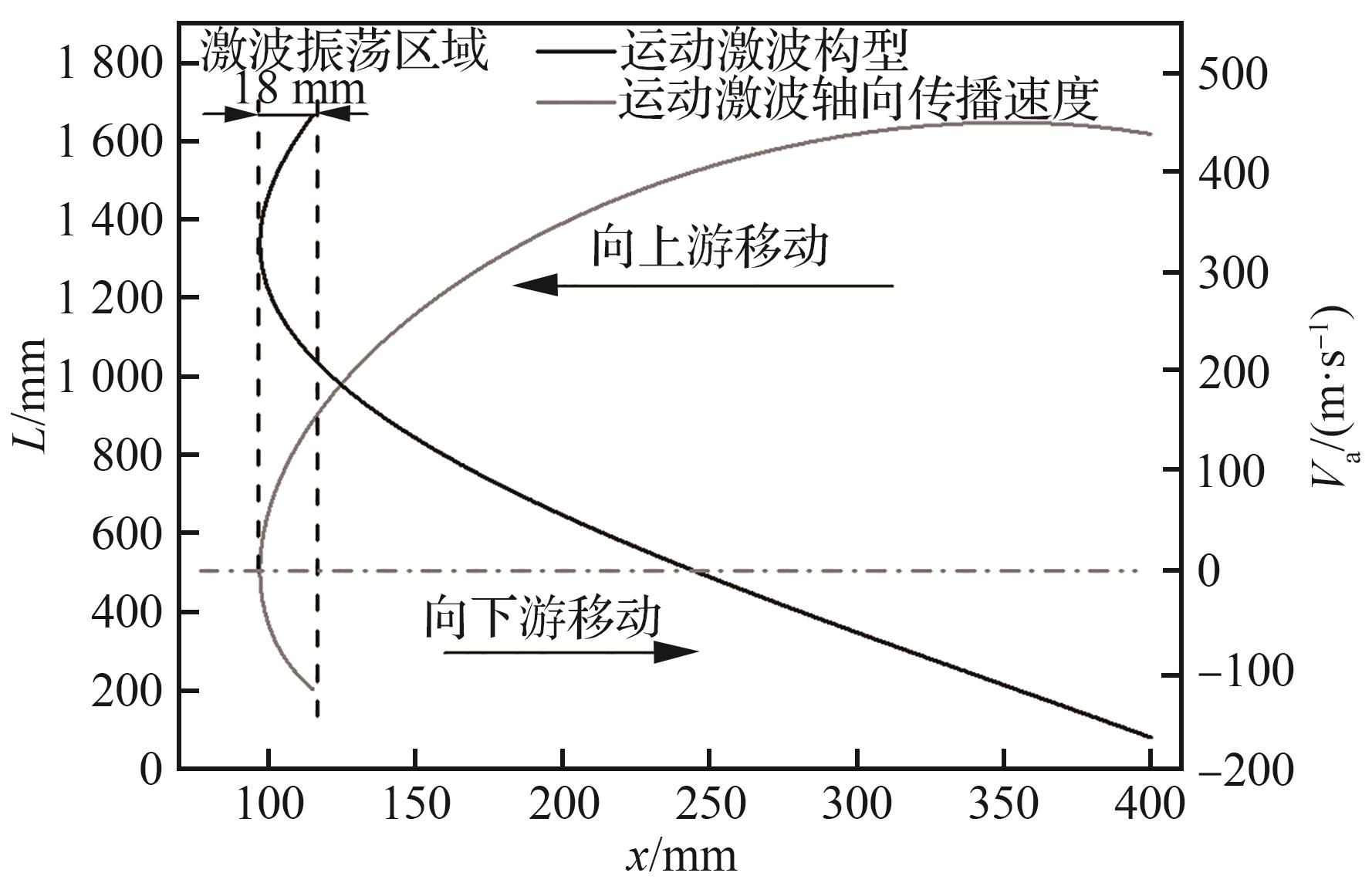
Fig.14
Axial velocity nephogram of two-dimensional plane and typical streamlines
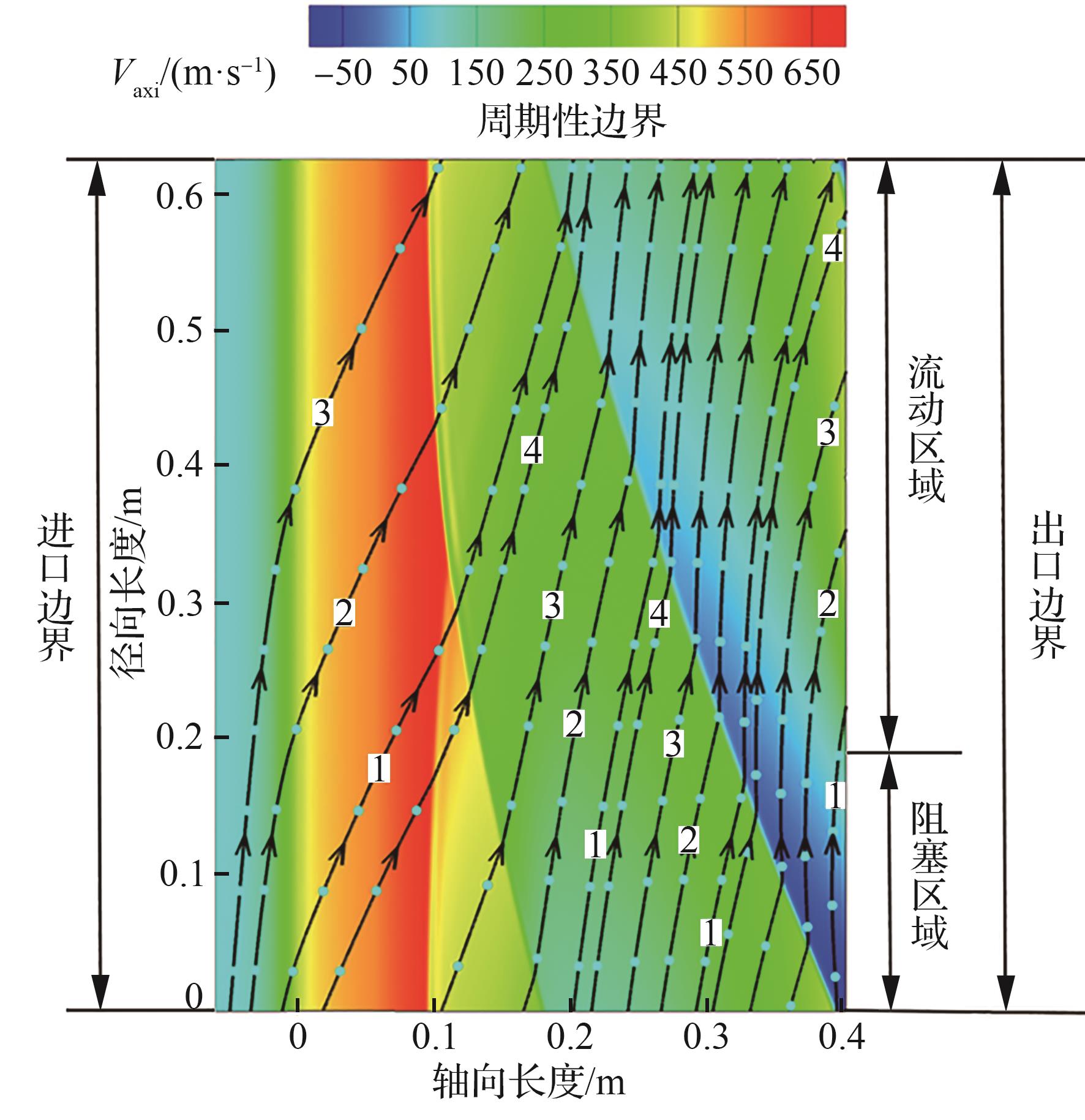
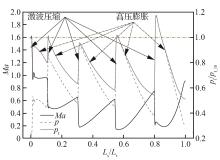
Fig.15
Variations of total pressure, static pressure and Mach number along streamline 1
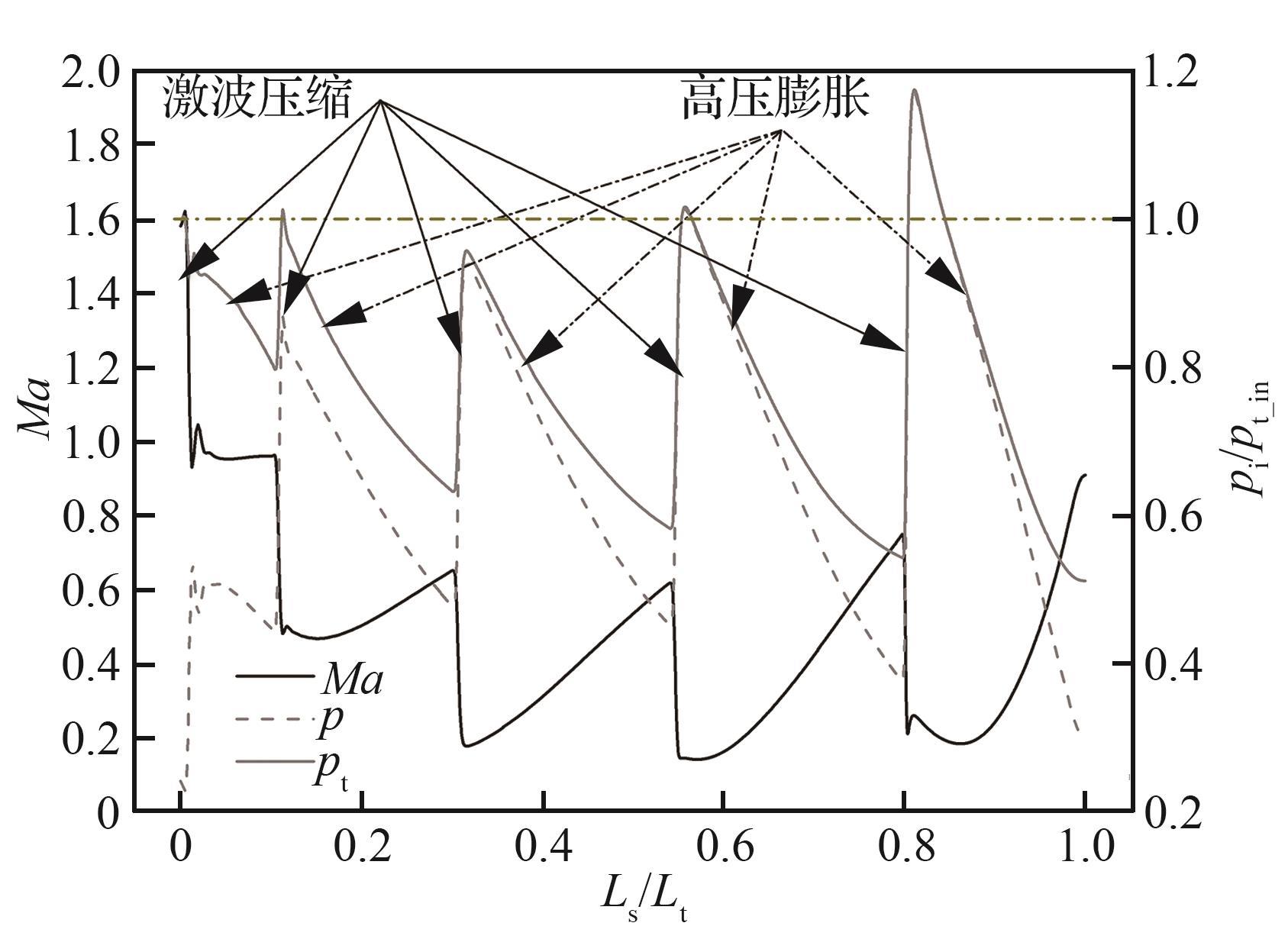
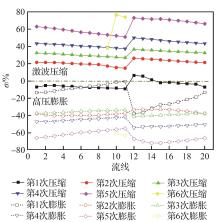
Fig.16
Variation of total pressure compressed by shock wave at different streamlines
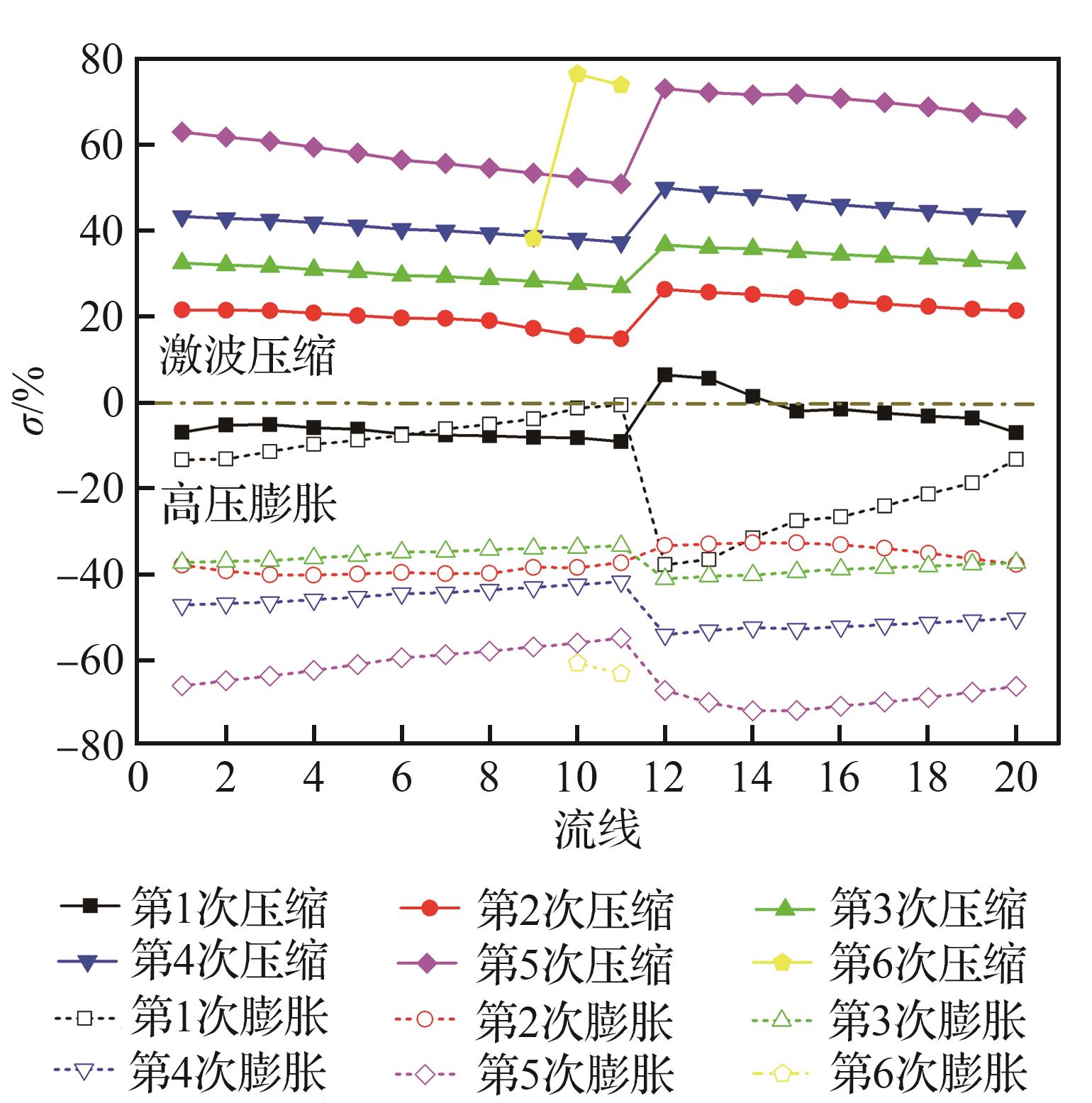
Table 2
Total pressure loss compressed by shock wave at different streamlines
| 流线 | 总压损失/% | ||||||
|---|---|---|---|---|---|---|---|
| 第1次激波作用 | 第2次激波作用 | 第3次激波作用 | 第4次激波作用 | 第5次激波作用 | 第6次激波作用 | 出口 | |
| 1 | -20.42 | -16.47 | -4.96 | -3.96 | -3.1 | × | -48.9 |
| 2 | -18.51 | -17.86 | -5.07 | -4.02 | -3.08 | × | -48.5 |
| 3 | -16.73 | -18.84 | -5.27 | -4.12 | -3.04 | × | -48.0 |
| 4 | -15.74 | -19.49 | -5.33 | -4.18 | -3.04 | × | -47.8 |
| 5 | -15.15 | -19.82 | -5.38 | -4.26 | -3.05 | × | -47.6 |
| 6 | -15.07 | -20.06 | -5.33 | -4.27 | -3.09 | × | -47.8 |
| 7 | -13.85 | -20.46 | -5.48 | -4.35 | -3.22 | × | -47.4 |
| 8 | -12.97 | -20.9 | -5.57 | -4.38 | -3.43 | × | -47.2 |
| 9 | -11.96 | -21.31 | -5.86 | -4.4 | -3.64 | × | -47.2 |
| 10 | -9.68 | -23.01 | -6.25 | -4.44 | -3.82 | 15.7 | -31.5 |
| 11 | -9.74 | -22.59 | -6.59 | -4.45 | -4.01 | 10.7 | -36.7 |
| 12 | -31.45 | -7.11 | -4.48 | -4.17 | 5.99 | × | -41.2 |
| 13 | -31.05 | -7.44 | -4.46 | -4.23 | 2.23 | × | -44.9 |
| 14 | -30.31 | -7.66 | -4.5 | -4.23 | -0.23 | × | -46.9 |
| 15 | -29.61 | -8.36 | -4.49 | -4.14 | -1.62 | × | -48.2 |
| 16 | -28.34 | -9.56 | -4.54 | -4.07 | -2.2 | × | -48.7 |
| 17 | -26.62 | -11.13 | -4.61 | -3.97 | -2.62 | × | -49.0 |
| 18 | -24.58 | -12.89 | -4.71 | -3.93 | -2.92 | × | -49.0 |
| 19 | -1.83 | -35.42 | -4.79 | -3.93 | -3.06 | × | -49.0 |
| 20 | -20.46 | -16.42 | -4.95 | -3.97 | -3.1 | × | -48.9 |
| 平均值 | -46.2 | ||||||
| 定常出口边界 pout/p0=19.1 | -41.3 | ||||||
Fig.17
Variations of characteristic parameters of moving shock wave at different angular frequencies
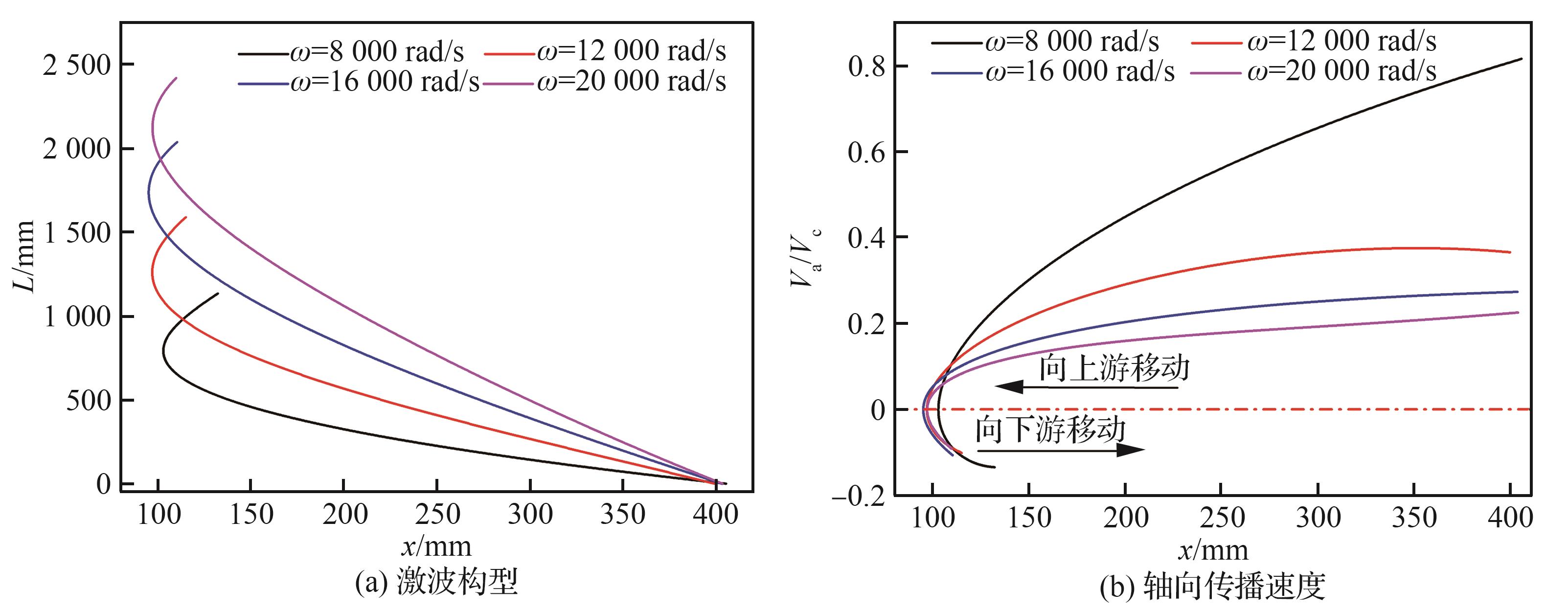
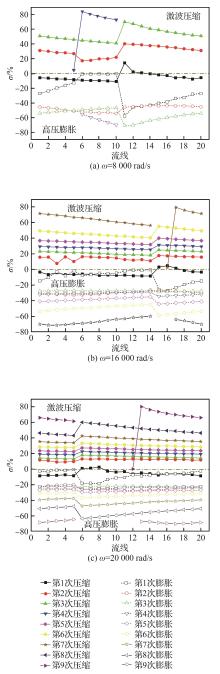
Fig.18
Variation of total pressure compressed by shock wave at different angular frequencies along different streamlines
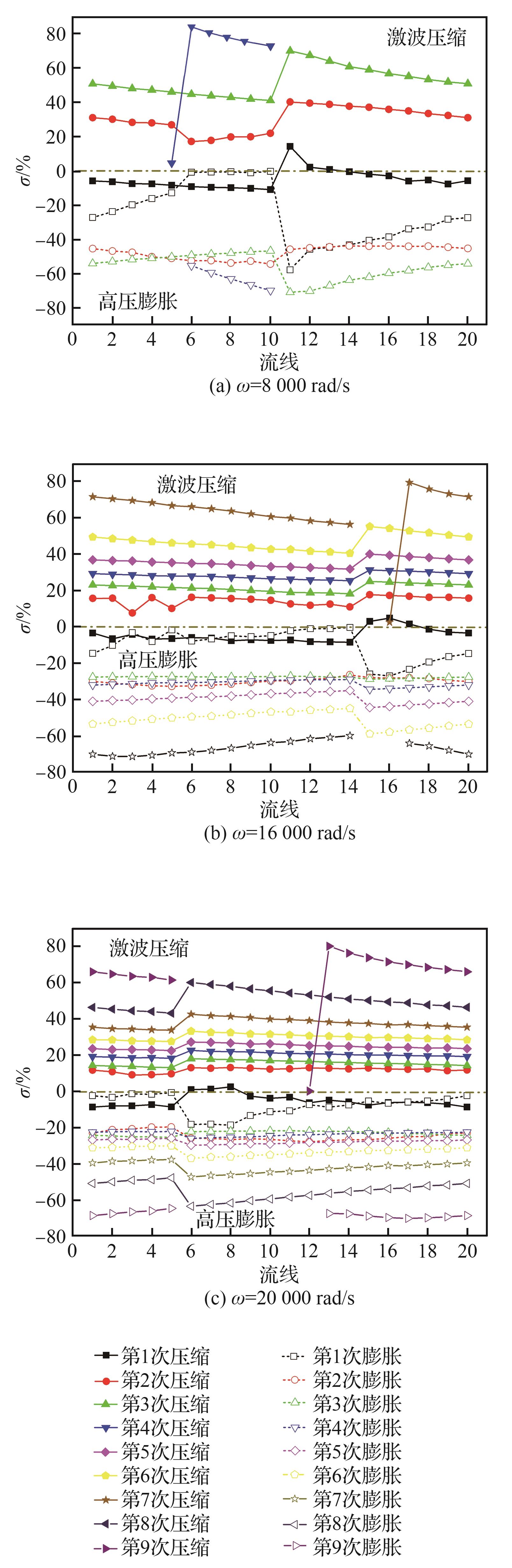
Table 3
Total pressure loss of different streamlines in outlet section of inlet at different angular frequencies
| 流线 | 总压损失/% | |||
|---|---|---|---|---|
| ω=8 000 rad/s | ω=12 000 rad/s | ω=16 000 rad/s | ω=20 000 rad/s | |
| 平均值 | -46.02 | -46.23 | -45.36 | -45.21 |
| 1 | -50.02 | -48.91 | -44.89 | -46.97 |
| 2 | -49.68 | -48.53 | -46.95 | -47.31 |
| 3 | -49.56 | -48.01 | -47.7 | -47.5 |
| 4 | -49.17 | -47.79 | -48.04 | -47.01 |
| 5 | -44.35 | -47.65 | -48.04 | -47.19 |
| 6 | -19.97 | -47.82 | -47.85 | -46.93 |
| 7 | -27.6 | -47.36 | -47.57 | -47.14 |
| 8 | -33.99 | -47.25 | -47.48 | -46.94 |
| 9 | -40.14 | -47.17 | -47.55 | -46.98 |
| 10 | -45.48 | -31.52 | -47.62 | -46.97 |
| 11 | -49.26 | -36.65 | -47.1 | -46.93 |
| 12 | -51.19 | -41.22 | -47.34 | -46.24 |
| 13 | -51.61 | -44.94 | -47.02 | -33.3 |
| 14 | -52.07 | -46.92 | -46.98 | -37.2 |
| 15 | -51.64 | -48.22 | -46.96 | -40.81 |
| 16 | -51.71 | -48.71 | -44.27 | -43.71 |
| 17 | -51.23 | -48.97 | -31.53 | -45.22 |
| 18 | -51.06 | -49.03 | -36.33 | -46.19 |
| 19 | -50.69 | -49.03 | -41.14 | -46.66 |
| 20 | -50 | -48.9 | -44.83 | -46.97 |
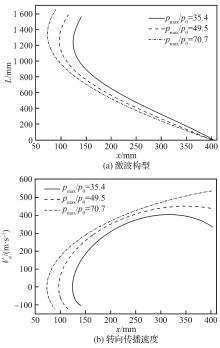
Fig.19
Variations of characteristic parameters of moving shock wave at different peak pressures
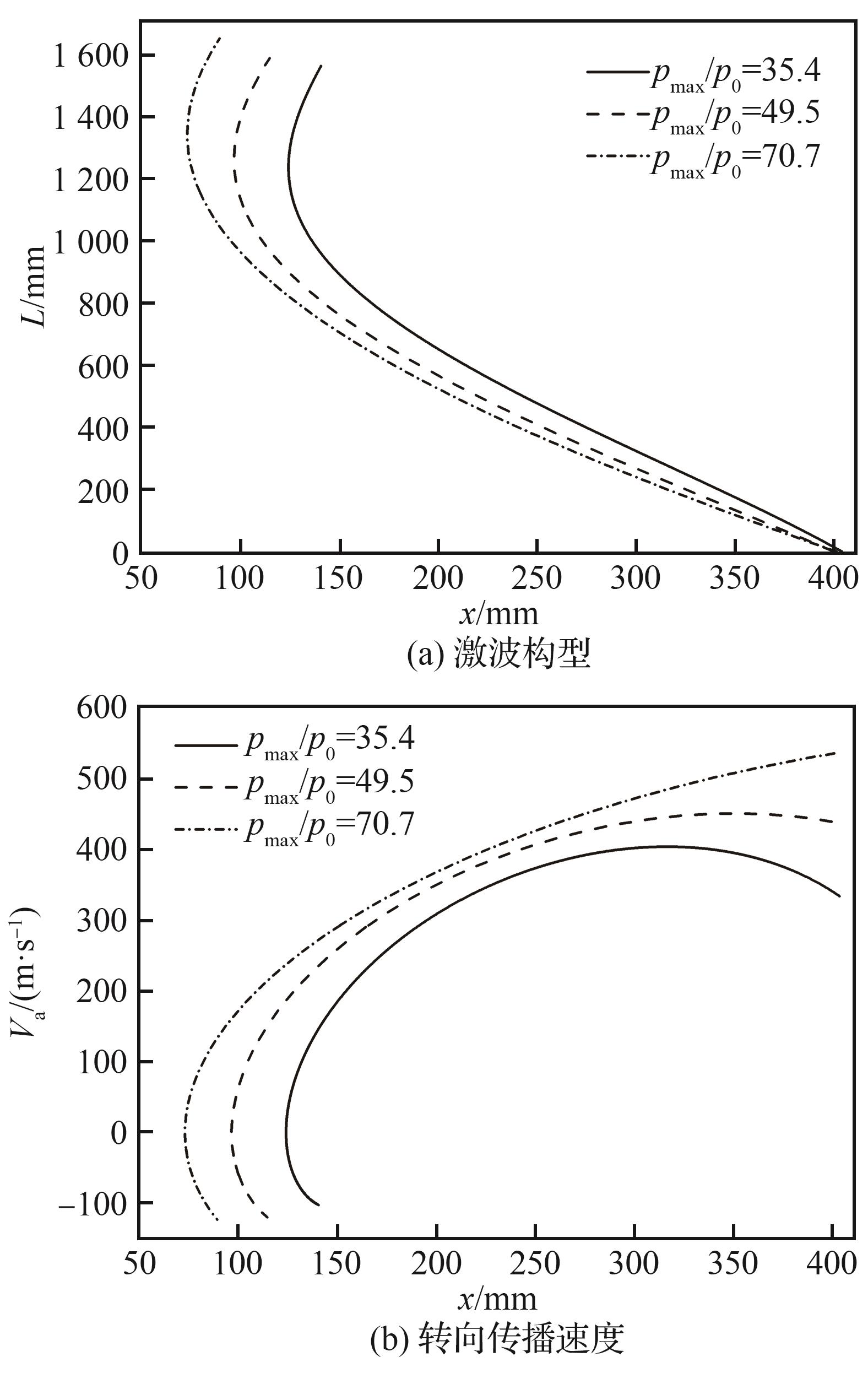
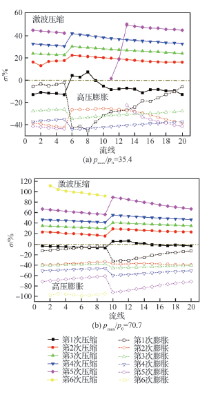
Fig.20
Variation of total pressure compressed by shock wave at different peak pressure along different streamlines
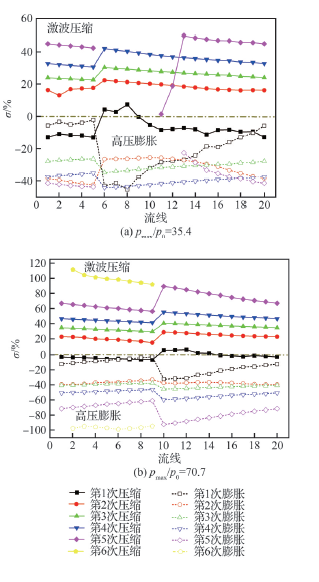
Table 4
Total pressure loss of different streamlines in outlet section of inlet at different peak pressures
| 流线 | 总压损失/% | ||
|---|---|---|---|
| pmax/p0=35.4 | pmax/p0=49.5 | pmax/p0=70.7 | |
| 平均值 | -43.1 | -46.23 | -44.58 |
| 1 | -45.11 | -48.91 | -45.91 |
| 2 | -46.56 | -48.53 | -31.94 |
| 3 | -47.48 | -48.01 | -35.72 |
| 4 | -48.27 | -47.79 | -39.56 |
| 5 | -49.02 | -47.65 | -43.05 |
| 6 | -49.11 | -47.82 | -45 |
| 7 | -49.74 | -47.36 | -46.46 |
| 8 | -49.8 | -47.25 | -46.78 |
| 9 | -50.11 | -47.17 | -46.87 |
| 10 | -50.11 | -31.52 | -46.92 |
| 11 | -48.7 | -36.65 | -46.7 |
| 12 | -31.31 | -41.22 | -46.58 |
| 13 | -22.98 | -44.94 | -46.76 |
| 14 | -30.07 | -46.92 | -46.64 |
| 15 | -35.37 | -48.22 | -46.28 |
| 16 | -37.98 | -48.71 | -46.42 |
| 17 | -39.68 | -48.97 | -46.25 |
| 18 | -42.17 | -49.03 | -45.98 |
| 19 | -43.4 | -49.03 | -45.91 |
| 20 | -45.06 | -48.9 | -45.91 |
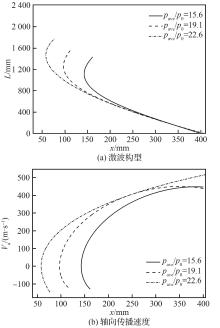
Fig.21
Variation of characteristic parameters of moving shock wave at different time-average pressure
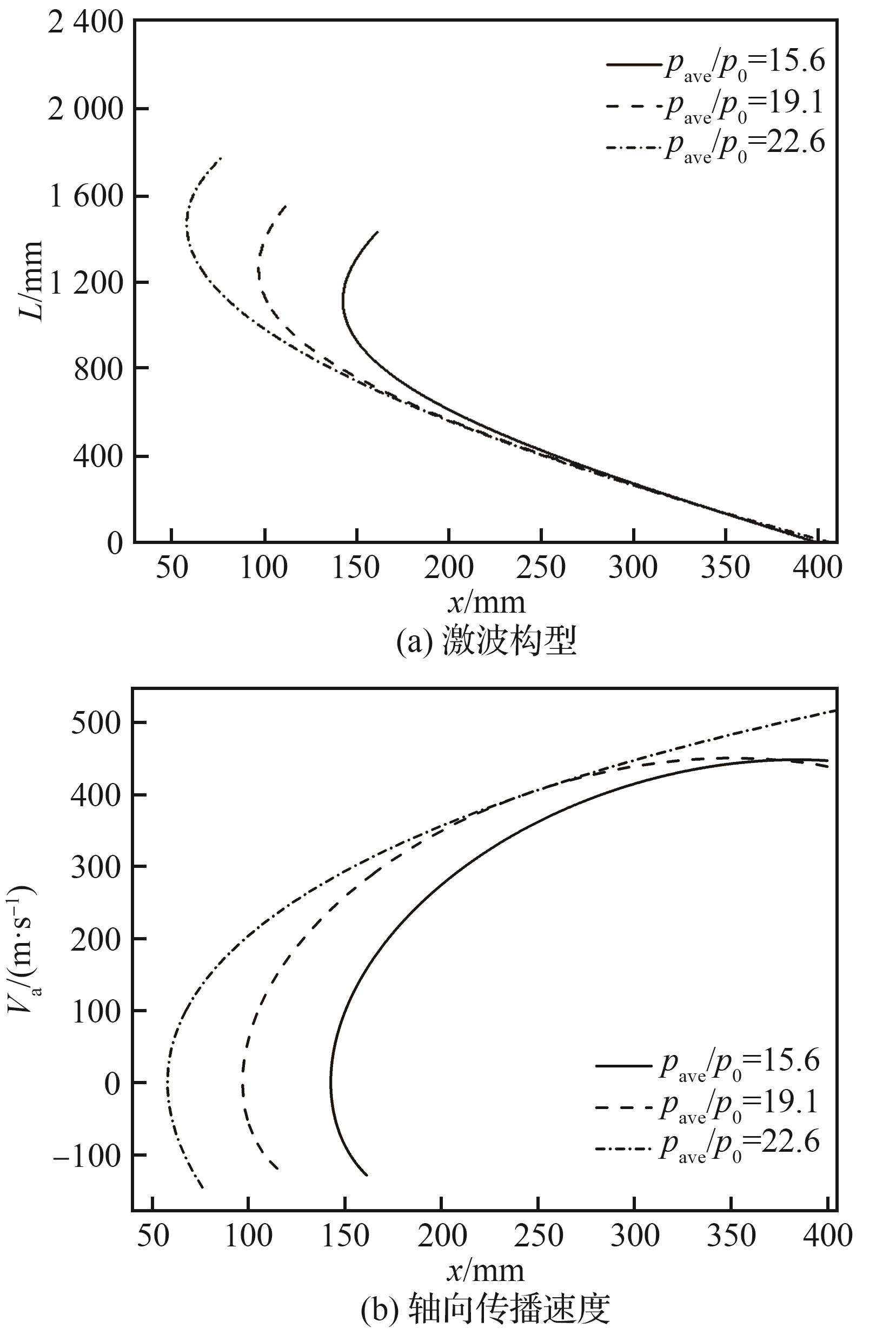
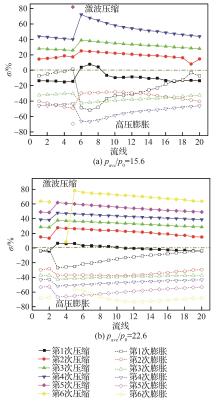
Fig.22
Variation of total pressure compressed by shock wave at different time-average pressure along different streamlines
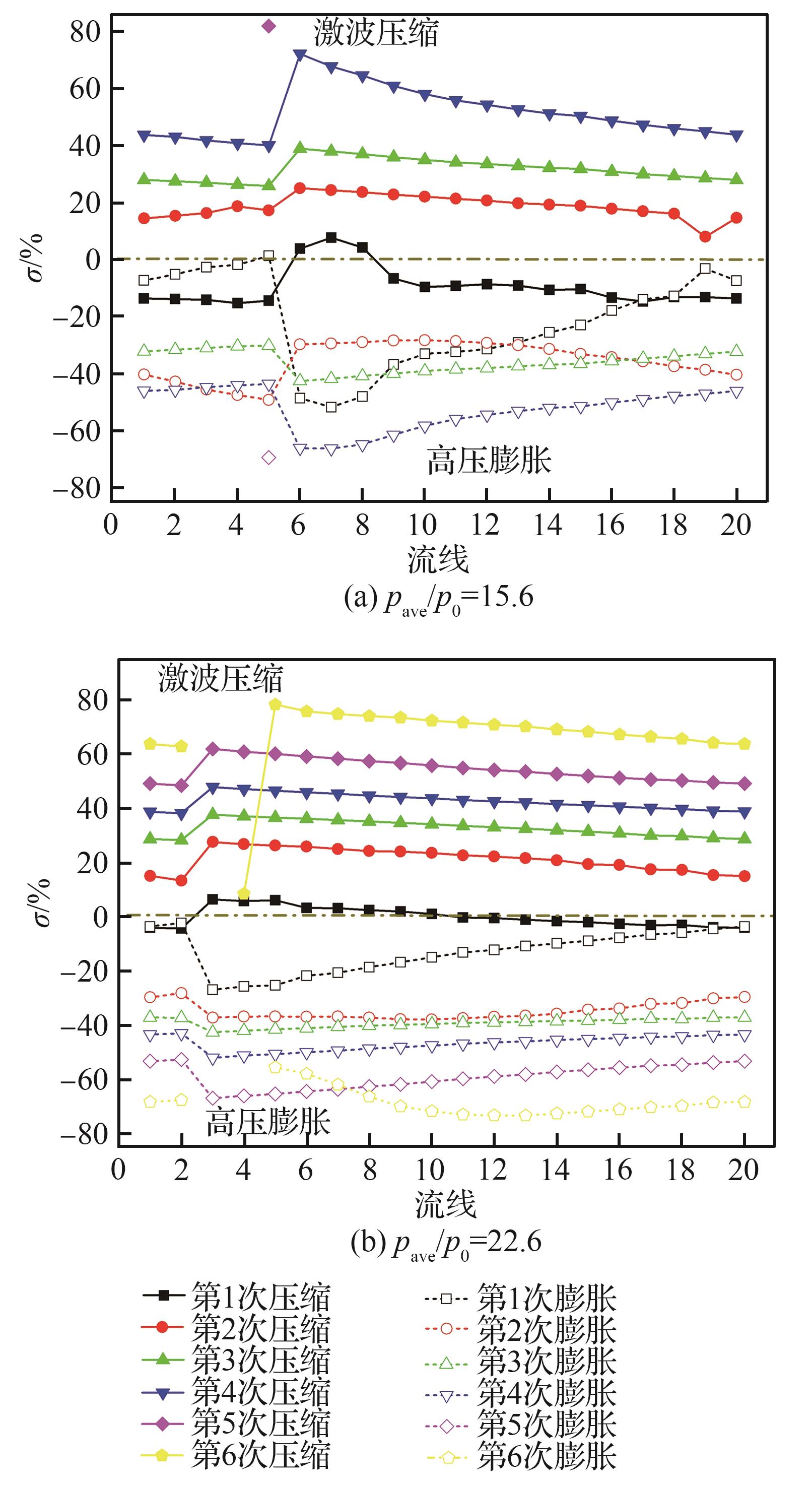
Table 5
Total pressure loss of different streamlines in outlet section of inlet at different time-average pressures
| 流线 | 总压损失/% | ||
|---|---|---|---|
| pave/p0=15.6 | pave/p0=19.1 | pave/p0=22.6 | |
| 1 | -53.25 | -48.91 | -43.74 |
| 2 | -53 | -48.53 | -43.74 |
| 3 | -52.95 | -48.01 | -43.72 |
| 4 | -53.06 | -47.79 | -35.33 |
| 5 | -40.28 | -47.65 | -20.89 |
| 6 | -46.95 | -47.82 | -25.61 |
| 7 | -51.39 | -47.36 | -30.39 |
| 8 | -53.12 | -47.25 | -35.21 |
| 9 | -53.33 | -47.17 | -38.93 |
| 10 | -53.17 | -31.52 | -41.51 |
| 11 | -53.21 | -36.65 | -43.31 |
| 12 | -53.2 | -41.22 | -44.12 |
| 13 | -53.45 | -44.94 | -44.32 |
| 14 | -53.66 | -46.92 | -44.47 |
| 15 | -53.38 | -48.22 | -44.37 |
| 16 | -53.73 | -48.71 | -44.3 |
| 17 | -53.7 | -48.97 | -44.17 |
| 18 | -53.53 | -49.03 | -43.83 |
| 19 | -53.28 | -49.03 | -43.96 |
| 20 | -53.24 | -48.9 | -43.76 |
| 平均值 | -52.24 | -46.23 | -39.98 |
| 定常反压pout/p0=15.6 | -50.11 | ||
| 定常反压pout/p0=22.6 | -32.02 | ||
| 1 | 徐灿, 马虎, 李健, 等. 旋转爆震发动机火焰与压力波传播特性[J]. 航空学报, 2017, 38(10): 121226. |
| XU C, MA H, LI J, et al. Propagation property of flame and pressure wave in rotating detonation engine[J]. Acta Aeronautica et Astronautica Sinca, 2017, 38(10): 121226 (in Chinese). | |
| 2 | GEORGE A ST, RANDALL S, ANAND V, et al. Characterization of initiator dynamics in a rotating detonation combustor[J]. Experimental Thermal and Fluid Science, 2016, 72: 171-181. |
| 3 | LU F K, BRAUN E M. Rotating detonation wave propulsion: Experimental challenges, modeling, and engine concepts[J]. Journal of Propulsion and Power, 2014, 30(5): 1125-1142. |
| 4 | KATTA V R, CHO K Y, HOKE J L, et al. Effect of increasing channel width on the structure of rotating detonation wave[J]. Proceedings of the Combustion Institute, 2019, 37(3): 3575-3583. |
| 5 | 赵明皓, 王可, 王致程, 等. 燃烧室构型对旋转爆震波传播特性的影响[J]. 航空学报, 2022, 43(5): 125372. |
| ZHAO M H, WANG K, WANG Z C, et al. Effect of combustor configurations on propagation characteristics of rotating detonation waves[J]. Acta Aeronautica et Astronautica Sinica, 2022, 43(5): 125372 (in Chinese). | |
| 6 | ISHIHARA K, NISHIMURA J, GOTO K, et al. Study on a long-time operation towards rotating detonation rocket engine flight demonstration[C]∥Proceedings of the 55th AIAA Aerospace Sciences Meeting. Reston: AIAA, 2017. |
| 7 | WEN H C, WANG B. Experimental study of perforated-wall rotating detonation combustors[J]. Combustion and Flame, 2020, 213: 52-62. |
| 8 | WANG Y H, LE J L. A hollow combustor that intensifies rotating detonation[J]. Aerospace Science and Technology, 2019, 85: 113-124. |
| 9 | RANKIN B A, RICHARDSON D R, CASWELL A W, et al. Chemiluminescence imaging of an optically accessible non-premixed rotating detonation engine[J]. Combustion and Flame, 2017, 176: 12-22. |
| 10 | ZHDAN S A, RYBNIKOV A I. Continuous detonation in a supersonic flow of a hydrogen-oxygen mixture[J]. Combustion, Explosion, and Shock Waves, 2014, 50(5): 556-567. |
| 11 | 徐雪阳, 卓长飞, 武晓松, 等. 非预混喷注对旋转爆震发动机影响的数值研究[J]. 航空学报, 2016, 37(4): 1184-1195. |
| XU X Y, ZHUO C F, WU X S, et al. Numerical simulation of injection schemes with separate supply of fuel and oxidizer effects on rotating detonation engine[J]. Acta Aeronautica et Astronautica Sinica, 2016, 37(4): 1184-1195 (in Chinese). | |
| 12 | 贾冰岳, 张义宁, 潘虎, 等. 液态碳氢燃料旋转爆震发动机起爆过程试验研究[J]. 推进技术, 2021, 42(4): 906-914. |
| JIA B Y, ZHANG Y N, PAN H, et al. Experimental study on initiation process of liquid hydrocarbon rotary detonation engine[J]. Journal of Propulsion Technology, 2021, 42(4): 906-914 (in Chinese). | |
| 13 | 熊冰, 王振国, 范晓樯, 等. 隔离段内正激波串受迫振荡特性研究[J]. 推进技术, 2017, 38(1): 1-7. |
| XIONG B, WANG Z G, FAN X Q, et al. Characteristics of forced normal shock-train oscillation in isolator[J]. Journal of Propulsion Technology, 2017, 38(1): 1-7 (in Chinese). | |
| 14 | CAI J H, ZHOU J, LIU S J, et al. Effects of dynamic backpressure on shock train motions in straight isolator[J]. Acta Astronautica, 2017, 141: 237-247. |
| 15 | SU W Y, JI Y X, CHEN Y. Effects of dynamic backpressure on pseudoshock oscillations in scramjet inlet-isolator[J]. Journal of Propulsion and Power, 2016, 32(2): 516-528. |
| 16 | GEERTS J, YU K. Experimental characterization of isolator shock train propagation[C]∥Proceedings of the 18th AIAA/3AF International Space Planes and Hypersonic Systems and Technologies Conference. Reston: AIAA, 2012. |
| 17 | GEERTS J S, YU K H. Shock train/boundary-layer interaction in rectangular isolators[J]. AIAA Journal, 2016, 54(11): 3450-3464. |
| 18 | 曹学斌, 张堃元. 超燃冲压发动机隔离段非对称来流下激波串受迫振荡流动研究[J]. 空气动力学学报, 2011, 29(2): 135-141. |
| CAO X B, ZHANG K Y. Experimental study of forced shock train in isolator under asymmetric incoming flow[J]. Acta Aerodynamica Sinica, 2011, 29(2): 135-141 (in Chinese). | |
| 19 | CAO X B, ZHANG K Y. Experimental study of forced shock train oscillation in isolator under asymmetric in incoming flow[J]. Transactions of Nanjing University of Aeronautics and Astronautics, 2011, 28(1): 73-80. |
| 20 | BRUCE P J K, BABINSKY H. Unsteady shock wave dynamics[J]. Journal of Fluid Mechanics, 2008, 603: 463-473. |
| 21 | BRUCE P J K, BABINSKY H, TARTINVILLE B, et al. Experimental and numerical study of oscillating transonic shock waves in ducts[J]. AIAA Journal, 2011, 49(8): 1710-1720. |
| 22 | 王丁喜, 严传俊. 脉冲爆震发动机进气道气动性能的数值研究[J]. 力学学报, 2005, 37(6): 777-782. |
| WANG D X, YAN C J. Numerical study of the dynamics performance of an inlet for pulse detonation engines[J]. Chinese Journal of Theoretical and Applied Mechanics, 2005, 37(6): 777-782 (in Chinese). | |
| 23 | 郭凯欣, 翁春生, 武郁文. 连续旋转爆轰发动机隔离段流场数值模拟研究[J]. 弹道学报, 2019, 31(2): 35-41, 59. |
| GUO K X, WENG C S, WU Y W. Numerical investigation of flow field in continuous rotating detonation engine isolator[J]. Journal of Ballistics, 2019, 31(2): 35-41, 59 (in Chinese). | |
| 24 | 王卫星, 张仁涛, 李宥晨, 等. 典型工况下旋转爆震发动机进气道流动特性研究[J]. 推进技术, 2021, 42(4): 931-940. |
| WANG W X, ZHANG R T, LI Y C, et al. Flow characteristics of rotating detonation engine inlet under typical operating condition[J]. Journal of Propulsion Technology, 2021, 42(4): 931-940 (in Chinese). | |
| 25 | 王超, 刘卫东, 刘世杰, 等. 吸气式连续旋转爆震与来流相互作用[J].航空学报, 2016, 37(5): 1411-1418. |
| WANG C, LIU W D, LIU S J, et al. Interaction of air-breathing continuous rotating detonation with inflow[J]. Acta Aeronautica et Astronautica Sinica, 2016, 37(5): 1411-1418 (in Chinese). | |
| 26 | FROLOV S M, ZVEGINTSEV V I, IVANOV V S, et al. Hydrogen-fueled detonation ramjet model: Wind tunnel tests at approach air stream Mach number 5.7 and stagnation temperature 1500K[J]. International Journal of Hydrogen Energy, 2018, 43(15): 7515-7524. |
| 27 | LI D, LIANG G Z, ZHANG Y N, et al. Numerical investigation of the effect of inlet total pressure on H2/air non-premixed rotating detonation combustor[C]∥20th IBCAST. Pakistan: IBCAST, 2023. |
| 28 | 王超. 吸气式连续旋转爆震波自持传播机制研究[D]. 长沙: 国防科技大学, 2016: 44-65. |
| WANG C. Study on self-sustaining propagation mechanism of air-breathing continuous rotating detonation wave[D]. Changsha: National University of Defense Technology, 2016: 44-65 (in Chinese). |
| [1] | Fei XUE, Yuqi QIN, Wendong LIU, Yangang WANG. Experiments on stall initial disturbance characteristics of contra-rotating compressor with distorted inflow [J]. Acta Aeronautica et Astronautica Sinica, 2025, 46(2): 130474-130474. |
| [2] | Luoyu RAO, Tao ZHANG, Chongguang SHI, Chengxiang ZHU, Yancheng YOU. Effects of sideslip angle on shock wave interference structure of V-shaped blunt leading edge [J]. Acta Aeronautica et Astronautica Sinica, 2025, 46(2): 130681-130681. |
| [3] | Shaoqiang HAN, Wenping SONG, Zhonghua HAN, Jianhua XU. High-accuracy numerical-simulation of unsteady flow over high-speed coaxial rigid rotors [J]. Acta Aeronautica et Astronautica Sinica, 2024, 45(9): 529064-529064. |
| [4] | Gaojie ZHENG, Xiaoming HE, Dongpo LI, Huijun TAN, Kun WANG, Zhenlong WU, Depeng WANG. Double 90° deflection inlet/volute coupling flow characteristics of tail-powered unmanned aerial vehicle [J]. Acta Aeronautica et Astronautica Sinica, 2024, 45(4): 128782-128782. |
| [5] | Bing WAN, Jun CHEN, Hanchen BAI. Full flow path performance design method for wide range scramjet based on equivalent thermodynamic process [J]. Acta Aeronautica et Astronautica Sinica, 2024, 45(4): 128757-128757. |
| [6] | Yu ZHU, Jianhui CHENG, Cheng CHEN, Hexia HUANG, Huijun TAN. Mechanism of Bump inlet stable working at supersonic speed [J]. Acta Aeronautica et Astronautica Sinica, 2024, 45(24): 130408-130408. |
| [7] | Zhihao ZHU, Xiuming SUI, Jian PU, Long HAO, Wei ZHAO, Qingjun ZHAO. Aerodynamic load of multistage vaneless counterrotating turbine under wake/shock rotor/rotor interactions [J]. Acta Aeronautica et Astronautica Sinica, 2024, 45(24): 630582-630582. |
| [8] | Xingdong LUO, Zihao HOU, Keming WU, Zhen SHEN, Shenrong ZHANG. Separation safety analysis for Stargazer using electromagnetic propulsion system [J]. Acta Aeronautica et Astronautica Sinica, 2024, 45(24): 630481-630481. |
| [9] | Yunxiang FAN, Huanan AI, Mingzhen WANG, Kai CAO, Xuejun LIU, Hongqiang LYU. Unsteady hydrodynamic load reconstruction of seaplane based on deep learning [J]. Acta Aeronautica et Astronautica Sinica, 2024, 45(20): 129882-129882. |
| [10] | Yifan WANG, Haoying CHEN, Haibo ZHANG. Inlet/engine matching of adaptive cycle engine for cruise mission [J]. Acta Aeronautica et Astronautica Sinica, 2024, 45(2): 128637-128637. |
| [11] | Songbai WANG, Yuyang HAO, Yadong WU, Yong CHEN, Huawei YU, Lin DU. Research progress on rotating instability of aeroengine compressor [J]. Acta Aeronautica et Astronautica Sinica, 2024, 45(16): 29851-029851. |
| [12] | Junyang YU, Wenguang FU, Peng SUN, Tao ZHANG, Chunxue WANG, Wei ZHAO. Design and stabilization mechanism of non-axisymmetric fans under inlet distortion conditions [J]. Acta Aeronautica et Astronautica Sinica, 2024, 45(16): 129725-129725. |
| [13] | Binjie MOU, Jinsong JIANG, Kun YANG, Huanbing FU, Dehong MENG, Wei JIN. Acoustic fatigue design method for fighter inlet structure [J]. Acta Aeronautica et Astronautica Sinica, 2024, 45(14): 229603-229603. |
| [14] | Ziyun WANG, Hang YU, Yue ZHANG, Huijun TAN, Yi JIN, Xin LI. Research progress on key issues of adjustable inlet system for aerospace vehicles [J]. Acta Aeronautica et Astronautica Sinica, 2024, 45(11): 529440-529440. |
| [15] | Kailing ZHANG, Siyi LI, Yi DUAN, Chao YAN. Uncertainty quantification of parameters in SST turbulence model for inlet simulation [J]. Acta Aeronautica et Astronautica Sinica, 2023, 44(S2): 729429-729429. |
| Viewed | ||||||
|
Full text |
|
|||||
|
Abstract |
|
|||||
Address: No.238, Baiyan Buiding, Beisihuan Zhonglu Road, Haidian District, Beijing, China
Postal code : 100083
E-mail:hkxb@buaa.edu.cn
Total visits: 6658907 Today visits: 1341All copyright © editorial office of Chinese Journal of Aeronautics
All copyright © editorial office of Chinese Journal of Aeronautics
Total visits: 6658907 Today visits: 1341

 CJA
CJA
