Acta Aeronautica et Astronautica Sinica ›› 2024, Vol. 45 ›› Issue (22): 130272.doi: 10.7527/S1000-6893.2024.30272
• Fluid Mechanics and Flight Mechanics • Previous Articles Next Articles
Chengjian ZHANG1, Dailin LYU1, Chang ZHU1, Jianqiang CHEN2, Jie WU1( )
)
Received:2024-02-01
Revised:2024-03-21
Accepted:2024-03-27
Online:2024-11-25
Published:2024-03-29
Contact:
Jie WU
E-mail:jiewu@hust.edu.cn
Supported by:CLC Number:
Chengjian ZHANG, Dailin LYU, Chang ZHU, Jianqiang CHEN, Jie WU. Hypersonic boundary layer stability experiment of HyTRV lift body[J]. Acta Aeronautica et Astronautica Sinica, 2024, 45(22): 130272.

Fig.1
⌀0.5 m Mach number 6 Ludwieg tube wind tunnel[32] at HUST


Fig.2
Pitot probe instrumented with Kulite sensor


Fig.3
Pressure fluctuation of pitot probe in freestream


Fig.4
Transition partition map of HyTRV[31]


Fig.5
Sketch of HyTRV model


Fig.6
High-speed infrared camera


Fig.7
PSD results of abdominal flow vortex area (R1)


Fig.8
PSD results of abdominal transverse flow area (R2)


Fig.9
PSD results of lumbar transverse flow area (R4)


Fig.10
PSD results for shoulder flow vortex region (R5)


Fig.11
Spectrum results of different Reynolds numbers in R2 region

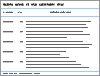
Table 1
Comparison of transition positions of spectrum results at 0° and 2° angles of attack in R2 region
| 来流单位雷诺数/(106 m-1) | 0°攻角转捩位置/mm | 2°攻角转捩位置/mm |
|---|---|---|
| 8.65 | 527.5~547.5 | 607.5~647.5 |
| 11.19 | 487.5~507.5 | 567.5~607.5 |
| 13.74 | 447.5~467.5 | 547.5~567.5 |
| 16.28 | 407.5~447.5 | 527.5~547.5 |

Fig.12
PCB pressure signal correlation coefficient curves in R1 region


Fig.13
PCB pressure signal correlation coefficient curves in R2 region

Table 2
Comparison of propagation velocity of unstable waves in R1 and R2 regions
| 分区 | 传播速度U/(m·s-1) | U/Ue | ||
|---|---|---|---|---|
| 0°攻角 | 2°攻角 | 0°攻角 | 2°攻角 | |
| R1 | 512.82 | 524.00 | 0.586 | 0.599 |
| R2 | 722.90 | 674.10 | 0.826 | 0.771 |

Fig.14
Comparison of windward experiment and numerical infrared results


Fig.15
Comparison of leeside experiment and numerical infrared results

| 1 | SCHNEIDER S P. Hypersonic laminar turbulent transition on circular cones and scramjet forebodies[J]. Progress in Aerospace Sciences, 2004, 40(1): 1-50. |
| 2 | FEDOROV A. Transition and stability of high-speed boundary layers[J]. Annual Review of Fluid Mechanics, 2011, 43(1): 79-95. |
| 3 | LEE C B, CHEN S Y. Recent progress in the study of transition in the hypersonic boundary layer[J]. National Science Review, 2019, 6(1): 155-170. |
| 4 | 陈坚强, 袁先旭, 涂国华, 等. 高超声速边界层转捩的几点认识[J]. 中国科学 (物理学 力学 天文学), 2019, 49(11): 121-134. |
| CHEN J Q, YUAN X X, TU G H, et al. Recent progresses on hypersonic boundary-layer transition[J]. Scientia Sinica (Physica, Mechanica & Astronomica), 2019, 49(11): 121-134 (in Chinese). | |
| 5 | 陈坚强, 涂国华, 张毅锋, 等. 高超声速边界层转捩研究现状与发展趋势[J]. 空气动力学学报, 2017, 35(3): 311-337. |
| CHEN J Q, TU G H, ZHANG Y F, et al. Hypersnonic boundary layer transition: what we know, where shall we go[J]. Acta Aerodynamica Sinica, 2017, 35(3): 311-337 (in Chinese). | |
| 6 | MACK L M. Boundary-layer linear stability theory[J]. Agard Rep, 1984, 709(3): 1-3. |
| 7 | STETSON K F, THOMPSON E R, DONALDSON J C, et al. Laminar boundary layer stability experiments on a cone at Mach 8, part 2: blunt cone: AIAA-1984-0006[R]. Reston: AIAA, 1984. |
| 8 | ZHONG X L, WANG X W. Direct numerical simulation on the receptivity, instability, and transition of hypersonic boundary layers[J]. Annual Review of Fluid Mechanics, 2012, 44: 527-561. |
| 9 | BALAKUMAR P. Receptivity of hypersonic boundary layers to acoustic and vortical disturbances[C]∥45th AIAA Fluid Dynamics Conference. Reston: AIAA, 2015. |
| 10 | 李强, 江涛, 陈苏宇, 等. 激波风洞边界层转捩测量技术及应用[J]. 航空学报, 2019, 40(8): 122740. |
| LI Q, JIANG T, CHEN S Y, et al. Measurement technique and application of boundary layer transition in shock tunnel[J]. Acta Aeronautica et Astronautica Sinica, 2019, 40(8): 122740 (in Chinese). | |
| 11 | 徐家宽, 白俊强, 乔磊, 等. 横流不稳定性转捩预测模型[J]. 航空学报, 2015, 36(6): 1814-1822. |
| XU J K, BAI J Q, QIAO L, et al. Transition model for predicting crossflow instabilities[J]. Acta Aeronautica et Astronautica Sinica, 2015, 36(6): 1814-1822 (in Chinese). | |
| 12 | 赵磊. 高超声速后掠钝板边界层横流定常涡失稳的研究[D]. 天津: 天津大学, 2017. |
| ZHAO L. Study on unsteady vortex instability of cross-flow in hypersonic swept blunt plate boundary layer[D].Tianjin: Tianjin University, 2017 (in Chinese). | |
| 13 | GRONVALL J, JOHNSON H, CANDLER G. Hypersonic three-dimensional boundary layer transition on a cone at angle of attack[C]∥ 41st AIAA Fluid Dynamics Conference and Exhibit. Reston: AIAA, 2011. |
| 14 | DUAN L, CHOUDHARI M M, LI F, et al. Direct numerical simulation of transition in a swept wing boundary layer[C]∥ 43rd Fluid Dynamics Conference. Reston: AIAA, 2013. |
| 15 | XU G L, LIU G, JIANG X. The nonlinear instability of the supersonic crossflow vortex[C]∥ Proceedings of the 44th AIAA Fluid Dynamics Conference. Reston: AIAA, 2014. |
| 16 | PAREDES P, THEOFILIS V. Spatial linear global instability analysis of the HIFiRE-5 elliptic cone model flow[C]∥ 43rd Fluid Dynamics Conference. Reston: AIAA, 2013. |
| 17 | 李晓虎, 张绍龙, 刘建新, 等. 高超声速椭圆锥短轴流向涡的二维全局稳定性分析[J]. 空气动力学学报, 2018, 36(2): 265-272. |
| LI X H, ZHANG S L, LIU J X, et al. Bi-Global instability of streamwise vortices near minor-axis of hypersonic elliptic cone[J]. Acta Aerodynamica Sinica, 2018, 36(2): 265-272 (in Chinese). | |
| 18 | REN J, FU S. Secondary instabilities of Görtler vortices in high-speed boundary layer flows[C]∥ 46th AIAA Fluid Dynamics Conference. Reston: AIAA, 2016. |
| 19 | XU D D, ZHANG Y M, WU X S. Nonlinear evolution and secondary instability of steady and unsteady Görtler vortices induced by free-stream vortical disturbances[J]. Journal of Fluid Mechanics, 2017, 829: 681-730. |
| 20 | CHEN X, HUANG G L, LEE C B. Hypersonic boundary layer transition on a concave wall: stationary Görtler vortices[J]. Journal of Fluid Mechanics, 2019, 865: 1-40. |
| 21 | MACK C J, SCHMID P J. Direct numerical study of hypersonic flow about a swept parabolic body[J]. Computers & Fluids, 2010, 39(10): 1932-1943. |
| 22 | BORG M, KIMMEL R, STANFIELD S. HIFiRE-5 attachment-line and crossflow instability in a quiet hypersonic wind tunnel[C]∥ 41st AIAA Fluid Dynamics Conference and Exhibit. Reston: AIAA, 2011. |
| 23 | JULIANO T, SCHNEIDER S. Instability and transition on the HIFiRE-5 in a Mach 6 quiet tunnel[C]∥ Proceedings of the 40th Fluid Dynamics Conference and Exhibit. Reston: AIAA, 2010. |
| 24 | BERRIDGE D C, MCKIERNAN G, WADHAMS T P, et al. Hypersonic ground tests in support of the boundary layer transition (BOLT) flight experiment[C]∥ 2018 Fluid Dynamics Conference. Reston: AIAA, 2018. |
| 25 | BERRIDGE D C, KOSTAK H, MCKIERNAN G, et al. Hypersonic ground tests with high-frequency instrumentation in support of the boundary layer transition (BOLT) flight experiment[C]∥ AIAA Scitech 2019 Forum. Reston: AIAA, 2019. |
| 26 | 高清, 李建华, 李潜. 升力体高超声速飞行器横向气动特性研究[J]. 实验流体力学, 2015, 29(1): 43-48. |
| GAO Q, LI J H, LI Q. Study on lateral stability of hypersonic lifting-configurations[J]. Journal of Experiments in Fluid Mechanics, 2015, 29(1): 43-48 (in Chinese). | |
| 27 | LIU S S, YUAN X X, LIU Z Y, et al. Design and transition characteristics of a standard model for hypersonic boundary layer transition research[J]. Acta Mechanica Sinica, 2021, 37(11): 1637-1647. |
| 28 | QI H, LI X L, YU C P, et al. Direct numerical simulation of hypersonic boundary layer transition over a lifting-body model HyTRV[J]. Advances in Aerodynamics, 2021, 3(1): 31. |
| 29 | 陈久芬,徐洋,蒋万秋,等. 升力体外形高超声速边界层转捩红外测量实验 [J/OL]. 实验流体力学,(2022-07-11)[2024-08-27]. . |
| CHEN J F, XU Y, JIANG W Q,et al. Infrared thermogram measurement experiment of hypersonic boundary-layer transition of a lifting body[J/OL]. Journal of Experiments in Fluid Mechanics, (2022-07-11)[2024-08-27]. (in Chinese). | |
| 30 | 陈坚强, 涂国华, 万兵兵, 等. HyTRV流场特征与边界层稳定性特征分析[J]. 航空学报, 2021, 42(6): 124317. |
| CHEN J Q, TU G H, WAN B B, et al. Characteristics of flow field and boundary-layer stability of HyTRV[J]. Acta Aeronautica et Astronautica Sinica, 2021, 42(6): 124317 (in Chinese). | |
| 31 | CHEN X, DONG S W, TU G H, et al. Boundary layer transition and linear modal instabilities of hypersonic flow over a lifting body[J]. Journal of Fluid Mechanics, 2022, 938: A8. |
| 32 | 黄冉冉, 张成键, 李创创, 等.华中科技大学Φ0.5 m马赫6 Ludwieg管风洞设计与流场初步校测[J]. 空气动力学学报, 2023, 41(1): 39-48, 85. |
| HUANG R R, ZHANG C J, LI C C, et al. Design and prelim inary freestream calibration of HUST Φ 0.5 m Mach 6 Ludwieg tube wind tunnel [J]. Acta Aerodynamica Sinica, 2023, 41(1): 39-48, 85 (in Chinese). | |
| 33 | CRAIG S A, HUMBLE R A, HOFFERTH J W, et al. Nonlinear behaviour of the Mack mode in a hypersonic boundary layer[J]. Journal of Fluid Mechanics, 2019, 872: 74-99. |
| 34 | MUÑOZ F. Transition Measurement and Stability Analysis in Hypersonic Cone Flows[M]. TU Braunschweig, Niedersächsisches Forschungszentrum für Luftfahrt, 2020. |
| 35 | 李强, 万兵兵, 杨凯, 等. 高超声速尖锥边界层压力脉动和热流脉动特性试验[J]. 航空学报, 2022, 43(2): 124956. |
| LI Q, WAN B B, YANG K, et al. Experimental research on characteristics of pressure and heat flux fluctuation in hypersonic cone boundary layer[J]. Acta Aeronautica et Astronautica Sinica, 2022, 43(2): 124956 (in Chinese). | |
| 36 | 李学良, 李创创, 苏伟, 等. 分布式粗糙元对高超声速边界层不稳定性的影响试验[J]. 航空学报, 2024, 45(2): 128627. |
| LI X L, LI C C, SU W, et al. Experiment of influence of distributed roughness elements on hypersonic boundary layer instability[J]. Acta Aeronautica et Astronautica Sinica, 2024, 45(2): 128627 (in Chinese). | |
| 37 | JULIANO T J, BORG M P, SCHNEIDER S P. Quiet tunnel measurements of HIFiRE-5 boundary-layer transition[J]. AIAA Journal, 2015, 53(4): 832-846. |
| 38 | 赖江, 范召林, 王乾, 等. 高超声速有攻角锥裙直接数值模拟[J]. 航空学报, 2024, 45(2): 128610. |
| LAI J, FAN Z L, WANG Q, et al. Direct numerical simulation of hypersonic cone-flare model at angle of attack[J]. Acta Aeronautica et Astronautica Sinica, 2024, 45(2): 128610 (in Chinese). | |
| 39 | 李昊歌, 杨华, 杨雨欣 等. 高超声速升力体迎风面精细化降热优化设计[J]. 航空学报, 2022, 43(S2): 727728. |
| LI H G, YANG H, YANG Y X, et al. Refinement optimization design for heat reduction on windward surface of hypersonic lifting body[J]. Acta Aeronautica et Astronautica Sinica, 2022, 43(S2): 727728 (in Chinese). | |
| 40 | 刘强, 涂国华, 罗振兵, 等. 延迟高超声速边界层转捩技术研究进展[J]. 航空学报, 2022, 43(7): 025357. |
| LIU Q, TU G H, LUO Z B, et al. Progress in hypersonic boundary layer transition delay control[J]. Acta Aeronautica et Astronautica Sinica, 2022, 43(7): 025357 (in Chinese). |
| [1] | Yifan YANG, Xiao WANG. Enhanced hybrid vortex particle method for aerodynamic analysis of tiltrotor rotor/wing interactions [J]. Acta Aeronautica et Astronautica Sinica, 2025, 46(7): 131040-131040. |
| [2] | Min YANG, Guanjun LIU, Ziyuan ZHOU. Control of lunar landers based on secure reinforcement learning [J]. Acta Aeronautica et Astronautica Sinica, 2025, 46(3): 630553-630553. |
| [3] | Xueliang LI, Chuangchuang LI, Yahan ZHANG, Wei SU, Jie WU. Effect of distributed ablation pattern on hypersonic boundary-layer instability with a flat plate [J]. Acta Aeronautica et Astronautica Sinica, 2025, 46(2): 130464-130464. |
| [4] | Jianjian LIANG, Shoukun WANG, Shaoming HE. Segmented action guidance strategy for autonomous shipborne landing of fixed-wing UAV [J]. Acta Aeronautica et Astronautica Sinica, 2025, 46(13): 531116-531116. |
| [5] | Yifeng ZHANG, Xinguang WANG, Leitao GUO, Yang XU, Qi CHEN. Measurement and analysis of influence of high-speed boundary layer transition on dynamic aerodynamic characteristics of sharp cone [J]. Acta Aeronautica et Astronautica Sinica, 2025, 46(12): 131430-131430. |
| [6] | Zixu WANG, Pan LI, Junbiao SHEN, Zhenhua ZHU, Renliang CHEN. Dynamic conversion corridor of tiltrotor aircraft under accelerating and decelerating conditions [J]. Acta Aeronautica et Astronautica Sinica, 2025, 46(11): 531377-531377. |
| [7] | Zhixiang WANG, Yongjun LEI, Dapeng ZHANG, Huiru CUI. Mixed-integer sequential approximate optimization method for stiffened cylindrical shells in large launch vehicles [J]. Acta Aeronautica et Astronautica Sinica, 2025, 46(10): 230189-230189. |
| [8] | Yuqing QIU, Yan LI, Jinxi LANG, Yuxian LIU, Zhong WANG. Robust adaptive attitude control of high-speed helicopters in transition mode [J]. Acta Aeronautica et Astronautica Sinica, 2024, 45(9): 529927-529927. |
| [9] | Ming HE, Haotian CHEN, Wei HAN, Cheng DENG, Haibin DUAN. Development status and key technologies of cooperative control of bird-inspired UAV swarms [J]. Acta Aeronautica et Astronautica Sinica, 2024, 45(20): 29946-029946. |
| [10] | Xueliang LI, Chuangchuang LI, Wei SU, Jie WU. Experiment of influence of distributed roughness elements on hypersonic boundary layer instability [J]. Acta Aeronautica et Astronautica Sinica, 2024, 45(2): 128627-128627. |
| [11] | Heyong SI, Yaoli WANG, Lihua CAO, Dongchao CHEN. Dynamic behavior of seal-rotor system in a supercritical carbon dioxide turbine during acceleration transition [J]. Acta Aeronautica et Astronautica Sinica, 2024, 45(2): 228652-228652. |
| [12] | Wen SHI, Jialing LE, Ye TIAN. Vitiation effects on scramjet operational characteristics [J]. Acta Aeronautica et Astronautica Sinica, 2024, 45(19): 30027-030027. |
| [13] | Qingdong MENG, Juanmian LEI, Ling ZHOU. Influence of transition characteristics and angle of attack of HyTRV based on transition model [J]. Acta Aeronautica et Astronautica Sinica, 2024, 45(18): 129855-129855. |
| [14] | Shuangxi LIU, Zehuai LIN, Wei LIU, Binbin YAN, Wei HUANG. Transition mode control scheme of tilt rotor UAV based on INDI [J]. Acta Aeronautica et Astronautica Sinica, 2024, 45(17): 529685-529685. |
| [15] | Zhenyu HU, Fengshou XIAO, Jianqiang CHEN, Xianxu YUAN, Yifeng ZHANG, Xinghao XIANG. Prediction of multi-mode hypersonic boundary layer transition based on C-γ-Reθ model [J]. Acta Aeronautica et Astronautica Sinica, 2024, 45(12): 129215-129215. |
| Viewed | ||||||
|
Full text |
|
|||||
|
Abstract |
|
|||||
Address: No.238, Baiyan Buiding, Beisihuan Zhonglu Road, Haidian District, Beijing, China
Postal code : 100083
E-mail:hkxb@buaa.edu.cn
Total visits: 6658907 Today visits: 1341All copyright © editorial office of Chinese Journal of Aeronautics
All copyright © editorial office of Chinese Journal of Aeronautics
Total visits: 6658907 Today visits: 1341

 CJA
CJA
