Acta Aeronautica et Astronautica Sinica ›› 2026, Vol. 47 ›› Issue (3): 631408.doi: 10.7527/S1000-6893.2024.31408
• Target State Collaboration and Intelligent Perception • Previous Articles
Shupan LI1,2, Yan LIANG1,2( ), Huixia ZHANG1,2, Shi YAN1,2, Anning JIANG1,2, Huayu ZHANG1,2
Received:2024-10-15
Revised:2024-11-04
Accepted:2024-11-20
Online:2024-12-10
Published:2024-12-10
Contact:
Yan LIANG
E-mail:liangyan@nwpu.edu.cn
Supported by:CLC Number:
Shupan LI, Yan LIANG, Huixia ZHANG, Shi YAN, Anning JIANG, Huayu ZHANG. Dynamic classification of unmanned aerial vehicles and flying birds based on radar track sequences[J]. Acta Aeronautica et Astronautica Sinica, 2026, 47(3): 631408.
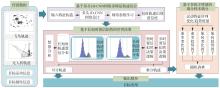
Fig.1
Framework diagram of dynamic classification network of UAVs and flying birds based on radar track sequences
Table 1
Network structure of multi-head 1D-CNN
| 层类型 | 核尺寸 | 步长 | 输出 | |
|---|---|---|---|---|
| 输入层 | Head1:[5×3] Head2:[5×6] Head3:[5×1] | |||
Head1/ Head2/ Head3 | 1D-Conv1_1 | [2×32] | 1 | [5×32] |
| ECA_block1 | [5×32] | |||
| 1D-Conv1_2 | [2×8] | 1 | [5×8] | |
| Concatenate | [5×24] | |||
| ECA_block4 | [5×24] | |||
| 1D-Conv4 | [2×32] | 1 | [5×32] | |
| 1D-Conv5 | [2×8] | 1 | [5×8] | |
| 1D-Conv6 | [2×1] | 1 | [5×2] | |
| 1D-GAP | [5×2] | 1 | 2 | |
| softmax | 2 | |||
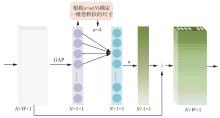
Fig.2
Schematic diagram of ECA-block
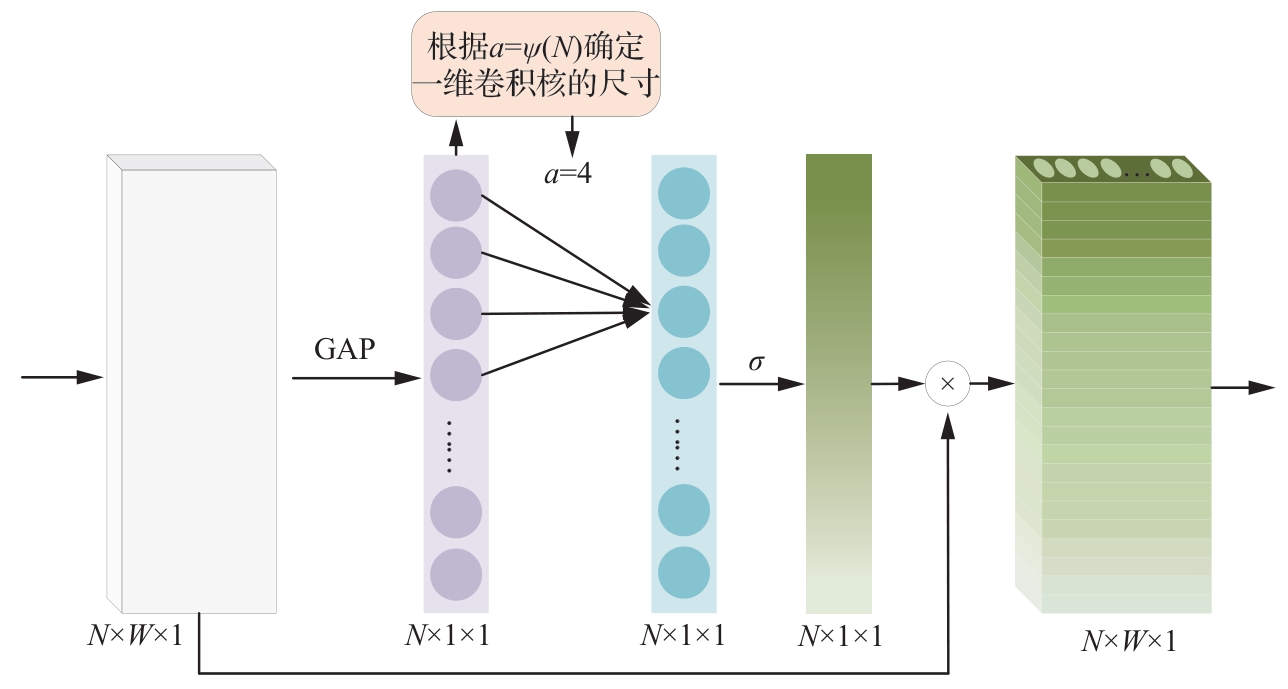
Fig.3
Operation diagram of 1D-GAP
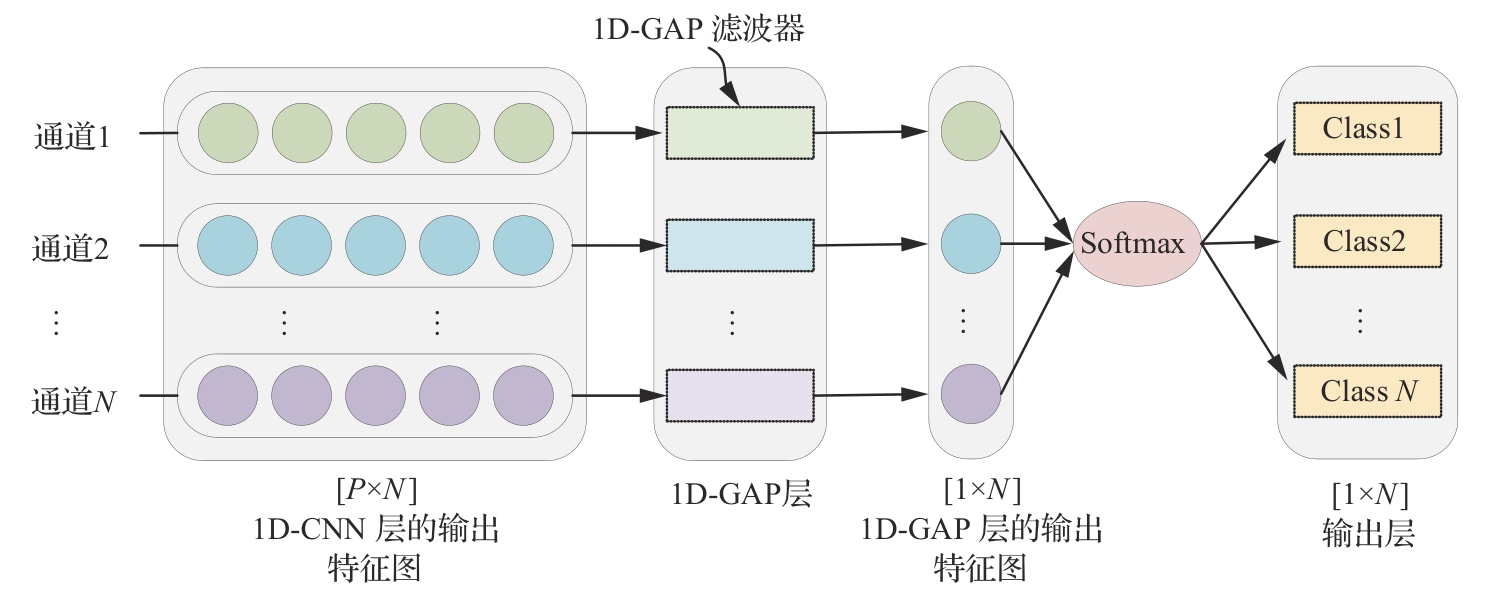
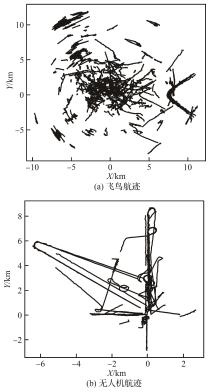
Fig.4
Tracks of flying birds and UAVs
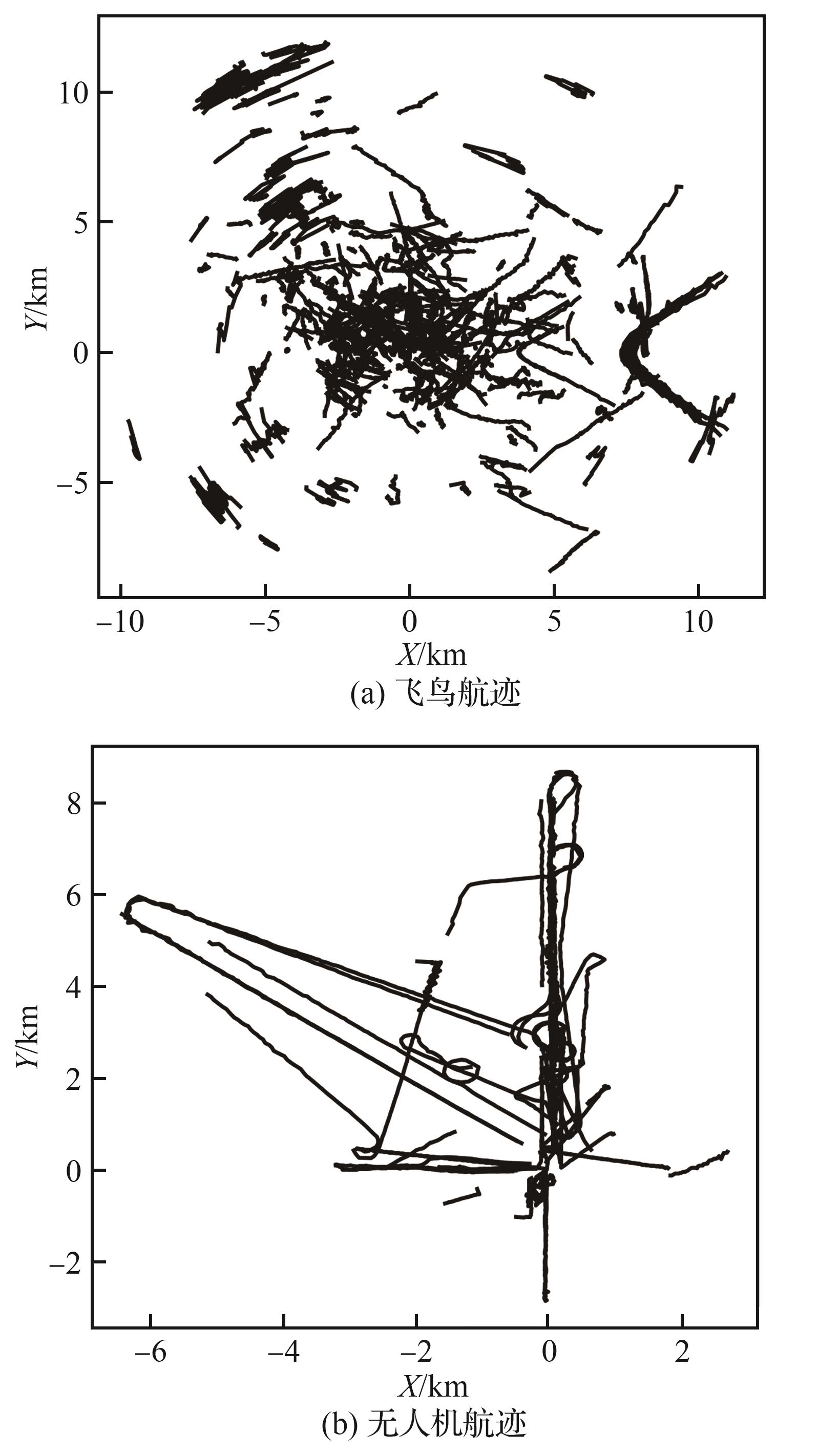
Fig.5
Histogram of velocity related feature distribution for flying birds and UAVs
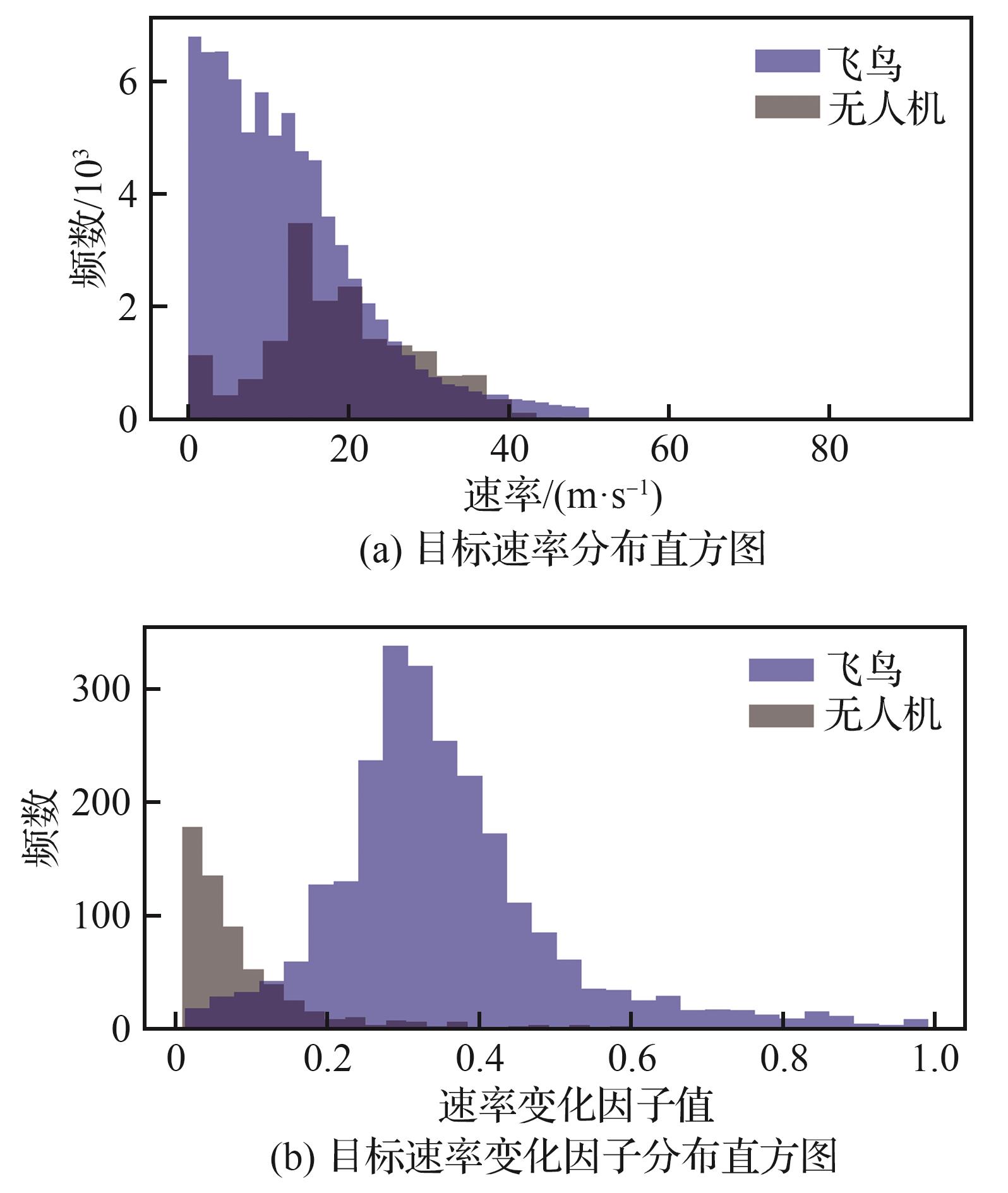
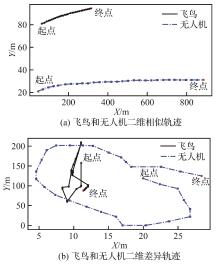
Fig.6
Typical flight trajectories of flying birds and UAVs
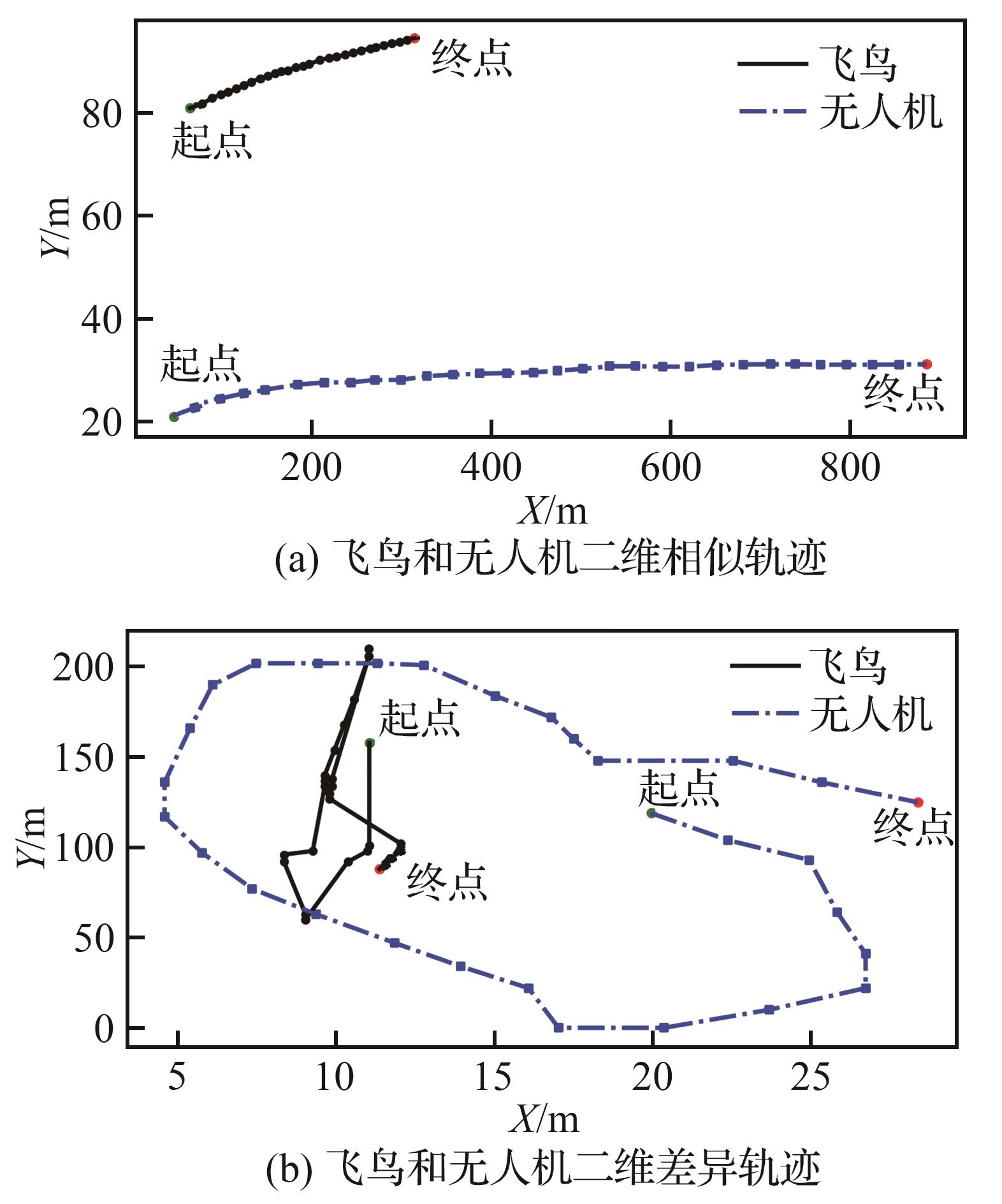
Table 2
Description of birds and UAVs track set
| 数据集 | 飞鸟 | 无人机 |
|---|---|---|
| 样本数量 | [1 860,10] | [229,10] |
| 训练集 | [2 170,30,10] | [472,30,10] |
| 测试集 | [543,30,10] | [119,30,10] |
| 多头1D-CNN训练集 | [56 420,5,10] | [14 118,5,10] |
| 多头1D-CNN测试集 | [12 272,5,10] | [3 094,5,10] |
Table 3
Structural parameters of different models in ablation experiments
| 模型A网络结构 | 模型B网络结构 | 模型C网络结构 | 模型D网络结构 | 模型E网络结构 |
|---|---|---|---|---|
| Input(5,10) | Input:Head1(5,3) Head2(5,6) Head3(5,1) | Input:Head1(5,3) Head2(5,6) | Input:Head1(5,3) Head2(5,6) Head3(5,1) | Input:Head1(5,3) Head2(5,6) Head3(5,1) |
| 1D-Conv1(2,1,32) | 1D-Conv1_1(2,1,32) | 1D-Conv1_1(2,1,32) | 1D-Conv1_1(2,1,32) | 1D-Conv1_1(2,1,32) |
| ECA_block1 | ECA_block1_1 | ECA_block1_1 | ECA_block1_1 | |
| 1D-Conv2(2,1,8) | 1D-Conv1_2(2,1,8) | 1D-Conv1_2(2,1,8) | 1D-Conv1_2(2,1,8) | 1D-Conv1_2(2,1,8) |
| 1D-MaxPooling(/2) | 1D-MaxPooling(/2) | 1D-MaxPooling(/2) | 1D-MaxPooling(/2) | 1D-MaxPooling(/2) |
| Concatenate | Concatenate | Concatenate | Concatenate | |
| ECA_block2 | ECA_block3 | ECA_block4 | ECA_block4 | |
| 1D-Conv3(2,1,32) | 1D-Conv4(2,1,32) | 1D-Conv4(2,1,32) | 1D-Conv4(2,1,32) | 1D-Conv4(2,1,32) |
| 1D-Conv4(2,1,1) | 1D-Conv5(2,1,1) | 1D-Conv5(2,1,1) | 1D-Conv4(2,1,64) | 1D-Conv5(2,1,1) |
| 1D-GAP(2) | 1D-GAP(2) | 1D-GAP(2) | FC(F=64) | 1D-GAP(2) |
| softmax(2) | softmax(2) | softmax(2) | FC(F=2),softmax | softmax(2) |
Table 4
Results of ablation experiments
| 参数 | 模型A | 模型B | 模型C | 模型D | 模型E |
|---|---|---|---|---|---|
| 准确率/% | 92.44 | 92.27 | 92.27 | 92.20 | 93.40 |
| 虚警率/% | 6.37 | 6.86 | 6.96 | 7.83 | 5.92 |
| 漏检率/% | 12.96 | 11.70 | 11.25 | 7.63 | 9.70 |
| 参数量 | 6 456 | 4 610 | 3 331 | 21 382 | 4 622 |
| 测试时间/ms | 0.027 | 0.022 | 0.025 | 0.031 | 0.028 |
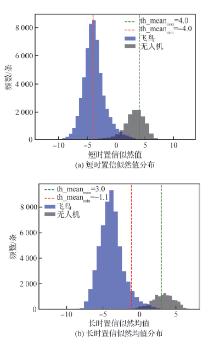
Fig.7
Distribution of short-term confidence likelihood and long-term average confidence likelihood in the training set
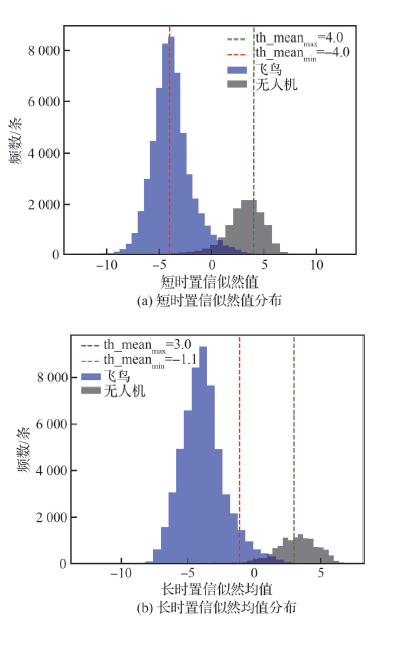
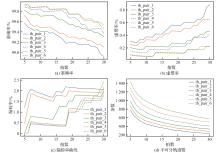
Fig.8
Curves of performance metrics under different short-term confidence likelihood thresholds
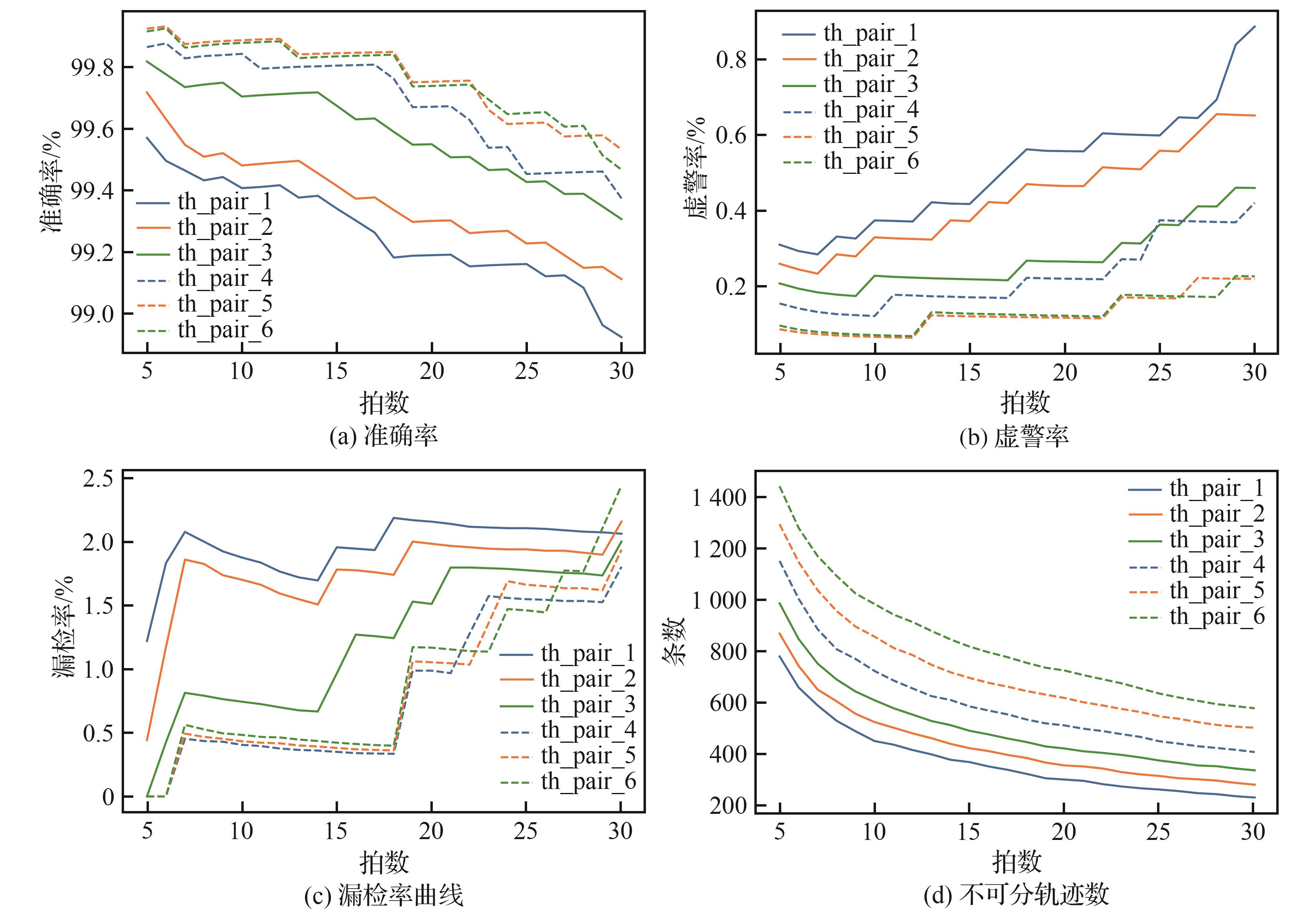
Table 5
Experimental results under different short-term confidence likelihood thresholds
| 最大阈值 | 3.0 | 3.2 | 3.4 | 3.6 | 3.8 | 4.0 |
|---|---|---|---|---|---|---|
| 最小阈值 | -3.0 | -3.2 | -3.4 | -3.6 | -3.8 | -4.0 |
| 准确率/% | 98.92 | 99.11 | 99.31 | 99.37 | 99.53 | 99.47 |
| 虚警率/% | 0.89 | 0.65 | 0.46 | 0.42 | 0.22 | 0.23 |
| 漏检率/% | 2.06 | 2.16 | 2.00 | 1.80 | 1.94 | 2.44 |
| 难分航迹条数 | 228 | 278 | 334 | 405 | 500 | 576 |
| 难分航迹占比/% | 8.63 | 10.52 | 12.64 | 15.33 | 18.92 | 21.80 |
Fig.9
Curves of performance metrics under different long-term average confidence likelihood thresholds
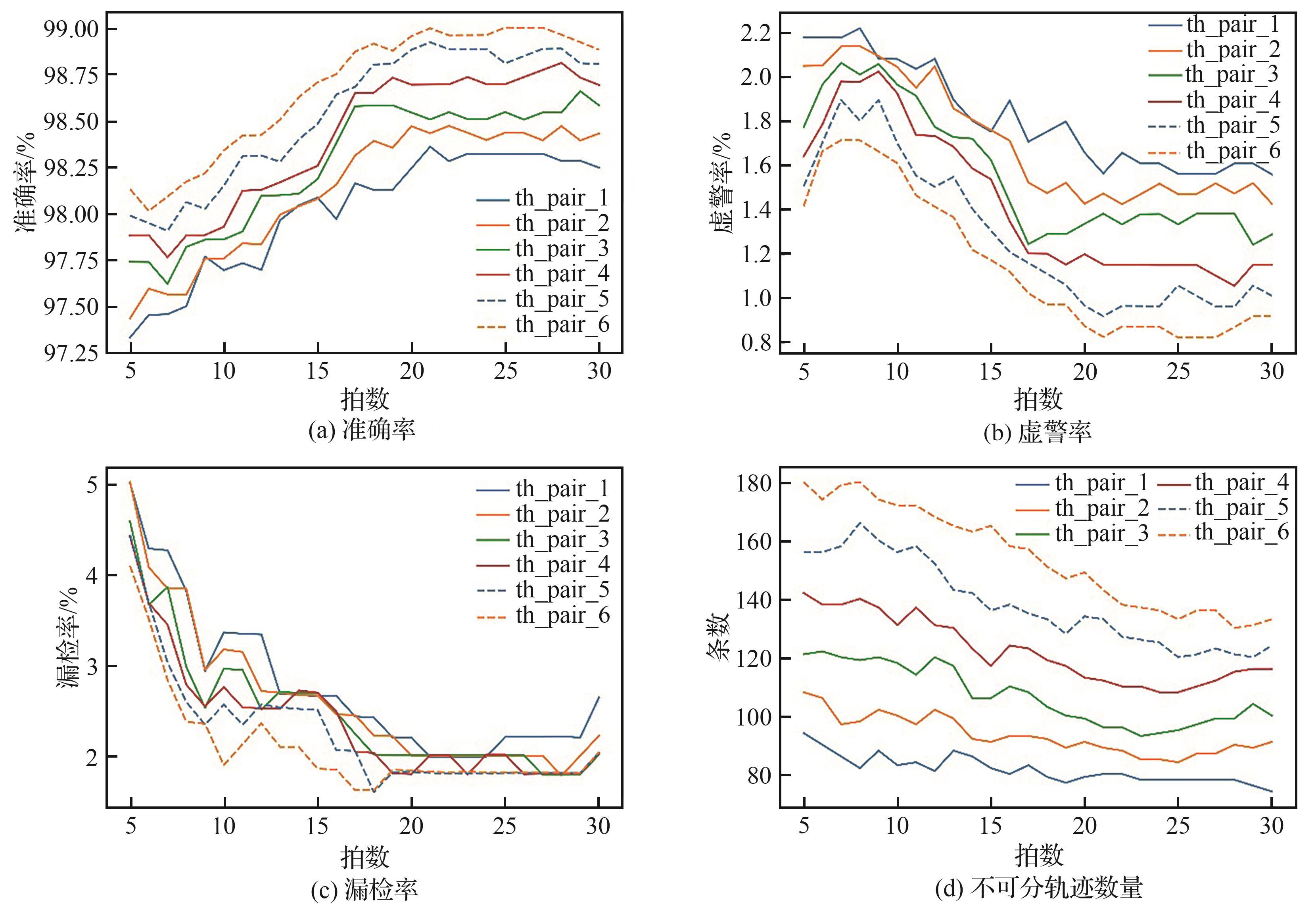
Table 6
Experimental results under different long-term average confidence likelihood thresholds
| 最大阈值 | 0.65 | 0.75 | 0.85 | 0.95 | 1.05 | 1.15 |
|---|---|---|---|---|---|---|
| 最小阈值 | -0.6 | -0.7 | -0.8 | -0.9 | -1.0 | -1.1 |
| 准确率/% | 98.25 | 98.43 | 98.58 | 98.69 | 98.81 | 98.88 |
| 虚警率/% | 1.56 | 1.43 | 1.29 | 1.15 | 1.01 | 0.92 |
| 漏检率/% | 2.64 | 2.22 | 2.01 | 2.03 | 2.04 | 2.04 |
| 难分航迹条数 | 74 | 91 | 100 | 116 | 124 | 133 |
| 难分航迹占比/% | 2.80 | 3.44 | 3.78 | 4.39 | 4.69 | 5.03 |
Table 7
Performance comparison of different algorithms
| 航迹长度 | 算法 | 准确率/% | 虚警率/% | 漏检率/% |
|---|---|---|---|---|
| 5拍 | 文献[ | |||
| LSTM | 79.76 | 16.76 | 36.13 | |
| Transformer | 87.61 | 10.13 | 22.69 | |
| 本文算法 | 93.40 | 5.92 | 9.70 | |
| 30拍 | 文献[ | 85.80 | 12.89 | 20.17 |
| LSTM | 93.35 | 5.53 | 11.77 | |
| Transformer | 93.35 | 5.34 | 12.61 | |
| 本文算法 | 95.02 | 4.60 | 6.72 |
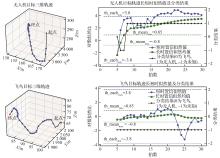
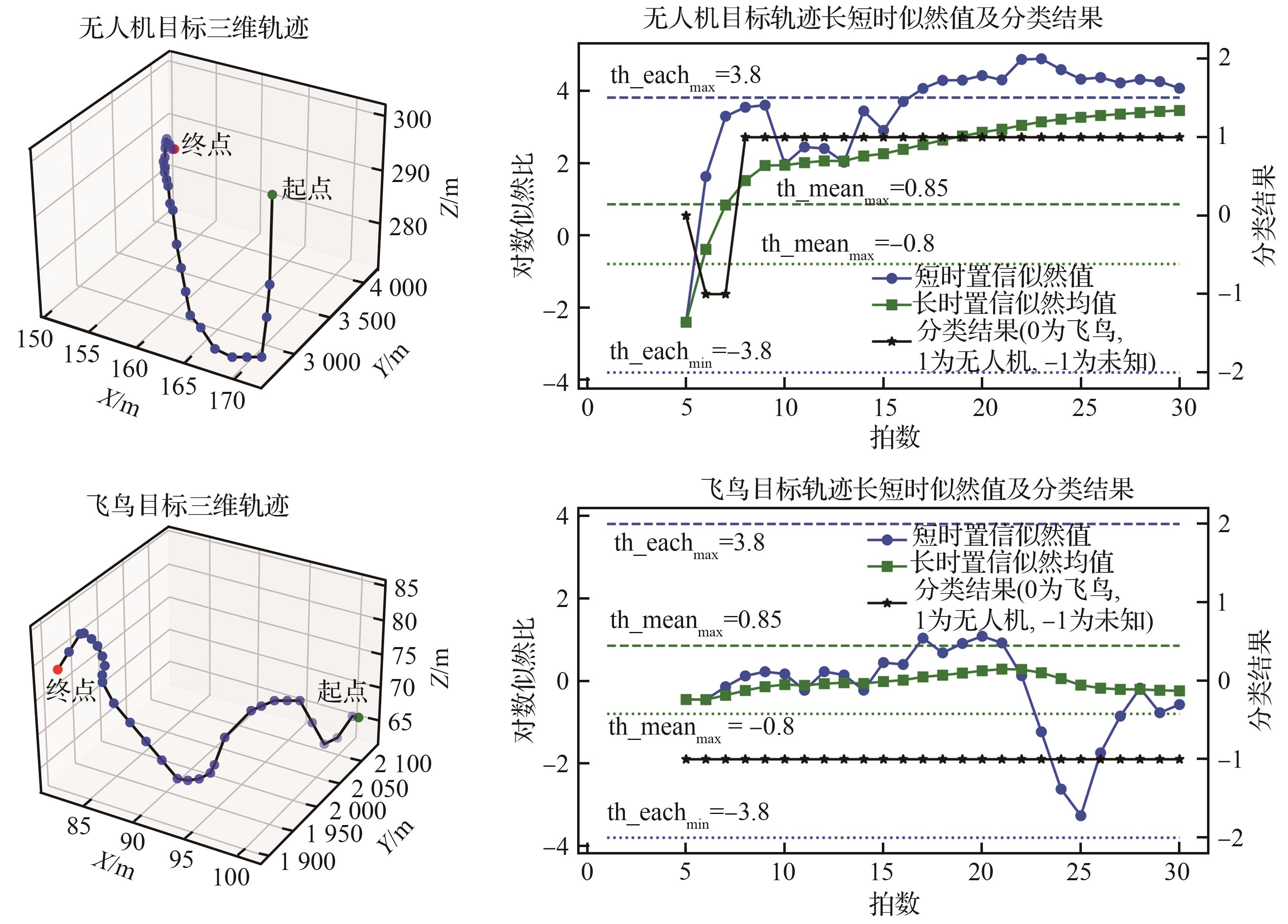
Fig.10
Single trajectory classification results for UAVs and flying birds
| [1] | PATEL J S, FIORANELLI F, ANDERSON D. Review of radar classification and RCS characterisation techniques for small UAVs or drones[J]. IET Radar, Sonar & Navigation, 2018, 12(9): 911-919. |
| [2] | 罗俊海, 王芝燕. 无人机探测与对抗技术发展及应用综述[J]. 控制与决策, 2022, 37(3): 530-544. |
| LUO J H, WANG Z Y. A review of development and application of UAV detection and counter technology[J]. Control and Decision, 2022, 37(3): 530-544 (in Chinese). | |
| [3] | 胡明春, 王建明, 孙俊, 等. 雷达目标识别原理与实验技术[M]. 北京: 国防工业出版社, 2017: 9-12. |
| HU M C, WANG J M, SUN J, et al. Principle and experiments of radar target recognition technology[M]. Beijing: National Defense Industry Press, 2017: 9-12 (in Chinese). | |
| [4] | 陈小龙, 陈唯实, 饶云华, 等. 飞鸟与无人机目标雷达探测与识别技术进展与展望[J]. 雷达学报, 2020, 9(5): 803-827. |
| CHEN X L, CHEN W S, RAO Y H, et al. Progress and prospects of radar target detection and recognition technology for flying birds and unmanned aerial vehicles[J]. Journal of Radars, 2020, 9(5): 803-827 (in Chinese). | |
| [5] | TAHA B, SHOUFAN A. Machine learning-based drone detection and classification: State-of-the-art in research[J]. IEEE Access, 2019, 7: 138669-138682. |
| [6] | 陈唯实, 黄毅峰, 陈小龙, 等. 机场探鸟雷达技术发展与应用综述[J]. 航空学报, 2022, 43(01): 024758. |
| CHEN W S, HUANG Y F, CHEN X L, et al. Development and applications of airport avian radar: Review[J]. Acta Aeronautica et Astronautica Sinica, 2022, 43(1): 024758 (in Chinese). | |
| [7] | 张群, 胡健, 罗迎, 等. 微动目标雷达特征提取、成像与识别研究进展[J]. 雷达学报, 2018, 7(5): 531-547. |
| ZHANG Q, HU J, LUO Y, et al. Research progresses in radar feature extraction, imaging, and recognition of target with micro-motions[J]. Journal of Radars, 2018, 7(5): 531-547 (in Chinese). | |
| [8] | MOLCHANOV P, EGIAZARIAN K, ASTOLA J, et al. Classification of small UAVs and birds by micro-Doppler signatures[C]∥2013 European Radar Conference. Piscataway: IEEE Press, 2013: 172-175. |
| [9] | 陈唯实, 黄毅峰, 卢贤锋. 多传感器融合的无人机探测技术应用综述[J]. 现代雷达, 2020, 42(6): 15-29. |
| CHEN W S, HUANG Y F, LU X F. Survey on application of multi-sensor fusion in UAV detection technology[J]. Modern Radar, 2020, 42(6): 15-29 (in Chinese). | |
| [10] | MOLCHANOV P, HARMANNY R, WIT J D, et al. Classification of small UAVs and birds by micro-Doppler signatures[J]. International Journal of Microwave & Wireless Technologies, 2014, 6(3): 435-444. |
| [11] | RAHMAN S, ROBERTSON D A. Radar micro-Doppler signatures of drones and birds at K-band and W-band[J]. Scientific Reports, 2018, 8: 17396. |
| [12] | 陈唯实, 刘佳, 王青斌, 等. 气象雷达探鸟技术综述[J]. 航空学报, 2023, 44(5): 026781. |
| CHEN W S, LIU J, WANG Q B, et al. Review on technology of bird detection with weather radar[J]. Acta Aeronautica et Astronautica Sinica, 2023, 44(5): 026781 (in Chinese). | |
| [13] | KIM B K, KANG H S, LEE S, et al. Improved drone classification using polarimetric merged-Doppler images[J]. IEEE Geoscience and Remote Sensing Letters, 2021, 18(11): 1946-1950. |
| [14] | RAHMAN S, ROBERTSON D A. Classification of drones and birds using convolutional neural networks applied to radar micro-Doppler spectrogram images[J]. IET Radar, Sonar & Navigation, 2020, 14(5): 653-661. |
| [15] | CHEN X L, ZHANG H, SONG J, et al. Micro-motion classification of flying bird and rotor drones via data augmentation and modified multi-scale CNN[J]. Remote Sensing, 2022, 14(5): 1107. |
| [16] | ZABALZA J, CLEMENTE C, DI CATERINA G, et al. Robust PCA micro-Doppler classification using SVM on embedded systems[J]. IEEE Transactions on Aerospace and Electronic Systems, 2014, 50(3): 2304-2310. |
| [17] | 杨勇, 王雪松, 张斌. 基于时频检测与极化匹配的雷达无人机检测方法[J]. 电子与信息学报, 2021, 43(3): 509-515. |
| YANG Y, WANG X S, ZHANG B. Radar detection of unmanned aerial vehicles based on time-frequency detection and polarization matching[J]. Journal of Electronics & Information Technology, 2021, 43(3): 509-515 (in Chinese). | |
| [18] | TORVIK B, OLSEN K E, GRIFFITHS H. Classification of birds and UAVs based on radar polarimetry[J]. IEEE Geoscience and Remote Sensing Letters, 2016, 13(9): 1305-1309. |
| [19] | KIM B K, KANG H S, PARK S O. Experimental analysis of small drone polarimetry based on micro-Doppler signature[J]. IEEE Geoscience and Remote Sensing Letters, 2017, 14(10): 1670-1674. |
| [20] | KIM B K, KANG H S, LEE S, et al. Improved drone classification using polarimetric merged-Doppler images[J]. IEEE Geoscience and Remote Sensing Letters, 2021, 18(11): 1946-1950. |
| [21] | DUAN J, ZHANG L, WU Y F, et al. Classification of birds and drones by exploiting periodical motions in Doppler spectrum series[J]. Journal of Systems Engineering and Electronics, 2023, 34(1): 19-27. |
| [22] | KOUEMOU G, OPITZ F. Radar target classification in littoral environment with HMMs combined with a track based classifier[C]∥2008 International Conference on Radar. Piscataway: IEEE Press, 2008: 604-609. |
| [23] | KOUEMOU G, NEUMANN C, OPITZ F. Exploitation of track accuracy in fusion technologies for radar target classification using Dempster-Shafer rules[C]∥ 2009 12th International Conference on Information Fusion. Piscataway: IEEE Press, 2009: 217-223. |
| [24] | ZHAN W J, YI J X, WAN X R, et al. Track-feature-based target classification in passive radar for low-altitude airspace surveillance[J]. IEEE Sensors Journal, 2021, 21(8): 10017-10028. |
| [25] | 刘佳, 徐群玉, 陈唯实. 无人机雷达航迹运动特征提取及组合分类方法[J]. 系统工程与电子技术, 2023, 45(10): 3122-3131. |
| LIU J, XU Q Y, CHEN W S. Motion feature extraction and ensembled classification method based on radar tracks for drones[J]. Systems Engineering and Electronics, 2023, 45(10): 3122-3131 (in Chinese). | |
| [26] | 汪浩, 窦贤豪, 田开严, 等. 基于CNN的雷达航迹分类方法[J]. 舰船电子对抗, 2023, 46(5): 70-74. |
| WANG H, DOU X H, TIAN K Y, et al. Radar track classification method based on CNN[J]. Shipboard Electronic Countermeasure, 2023, 46(5): 70-74 (in Chinese). | |
| [27] | 吴琪. 基于多维特征融合的“低慢小” 目标自动识别关键技术研究[D]. 长沙: 国防科技大学, 2019. |
| WU Q. Research on automatic target recognition of LSS targets based on multi-dimensional feature fusion[D]. Changsha: National University of Defense Technology, 2019 (in Chinese). | |
| [28] | XIANG T, LV P, SUN L G, et al. TCM model for improving track sequence classification in real scenarios with multi-feature fusion and transformer block[J]. Knowledge-Based Systems, 2024, 283: 111202. |
| [29] | LIU X F, CHEN Y J, XIONG L Q, et al. Intelligent fault diagnosis methods toward gas turbine: A review[J]. Chinese Journal of Aeronautics, 2024, 37(4): 93-120. |
| [30] | 魏晓良, 潮群, 陶建峰, 等. 基于LSTM和CNN的高速柱塞泵故障诊断[J]. 航空学报, 2021, 42(3): 423876. |
| WEI X L, CHAO Q, TAO J F, et al. Cavitation fault diagnosis method for high-speed plunger pumps based on LSTM and CNN[J]. Acta Aeronautica et Astronautica Sinica, 2021, 42(3): 423876 (in Chinese). | |
| [31] | WANG Q L, WU B G, ZHU P F, et al. ECA-Net: Efficient channel attention for deep convolutional neural networks[C]∥2020 IEEE/CVF Conference on Computer Vision and Pattern Recognition (CVPR). Piscataway: IEEE Press, 2020: 11531-11539. |
| [32] | GONG W F, CHEN H, ZHANG Z H, et al. A novel deep learning method for intelligent fault diagnosis of rotating machinery based on improved CNN-SVM and multichannel data fusion[J]. Sensors, 2019, 19(7): 1693. |
| [33] | 陈晨, 袁绍军, 尹兆磊, 等. 一种分布式发电功率时间序列波动性量化评估方法[J]. 电子与信息学报, 2022, 44(11): 3825-3832. |
| CHEN C, YUAN S J, YIN Z L, et al. A fluctuation quantitative evaluation method for distributed energy power time series[J]. Journal of Electronics & Information Technology, 2022, 44(11): 3825-3832 (in Chinese). | |
| [34] | GONG W F, WANG Y Z, ZHANG M L, et al. A fast anomaly diagnosis approach based on modified CNN and multisensor data fusion[J]. IEEE Transactions on Industrial Electronics, 2022, 69(12): 13636-13646. |
| [35] | BELL M A, RAHMAN S, ROBERTSON D A. Fast classification of drones and birds with an LSTM network applied to 1D phase data[C]∥2023 IEEE International Radar Conference (RADAR). Piscataway: IEEE Press, 2023: 10371144 |
| [1] | . Development Status and Prospects of Multi-Modal Remote Sensing Stereoscopic Information Acquisition [J]. Acta Aeronautica et Astronautica Sinica, 0, (): 1-0. |
| [2] | . Long-Time Coherent Integration Acquisition Technique for Weak DS/FH TT&C Signals of Spacecraft [J]. Acta Aeronautica et Astronautica Sinica, 0, (): 1-0. |
| [3] | Zhenhao CHENG, Xiaogang YANG, Ruitao LU, Tao ZHANG, Siyu WANG. Multi-stage distillation for incremental detection of time-sensitive targets in UAV images [J]. Acta Aeronautica et Astronautica Sinica, 2025, 46(24): 331959-331959. |
| [4] | . A review of intrinsic security threats and the cross-layer defence mechanisms in integrated sensing and communication system [J]. Acta Aeronautica et Astronautica Sinica, 0, (): 1-0. |
| [5] | . A Method for Optimising the Cooperative Coverage of Heterogeneous Field-of- View Using Multiple Interceptors [J]. Acta Aeronautica et Astronautica Sinica, 0, (): 1-0. |
| [6] | Qi LIU, Zhixiang PEI, Le HUI, Mingyi HE, Yuchao DAI. Dual-branch feature aggregation for UAV visual place recognition [J]. Acta Aeronautica et Astronautica Sinica, 2025, 46(23): 632457-632457. |
| [7] | Fei WANG, Yong LIU, Jiawei YAO, Xuanlei ZHU, Xiaoqiang LU, Wenxing GUO, Xuetao ZHANG, Yu GUO. RS-AdaDiff: One-step remote sensing image super-resolution diffusion model with degradation-aware adaptive estimation [J]. Acta Aeronautica et Astronautica Sinica, 2025, 46(23): 632763-632763. |
| [8] | Zhaoru YAO, Hang SUN, Dong REN, Li LIU, Jun WAN. Bidirectional mapping and negative correlation algorithm for aerial image dehazing [J]. Acta Aeronautica et Astronautica Sinica, 2025, 46(23): 631652-631652. |
| [9] | Runmin CONG, Haoyan SUN, Yuxuan LUO, Hao FANG. Generalized few-shot segmentation for remote sensing image based on class relation mining [J]. Acta Aeronautica et Astronautica Sinica, 2025, 46(23): 631694-631694. |
| [10] | Yuning WANG, Shaohui MEI, Mingyang MA, Yongzheng REN, Mengtao CAO, Yan FENG. Spectral band adaptive imaging detection with temporal-spectral dynamic constraints [J]. Acta Aeronautica et Astronautica Sinica, 2025, 46(23): 631963-631963. |
| [11] | Tianqi FAN, Zhengxia ZOU, Zhenwei SHI. Typical remote sensing target detection with data synthesis based on reinforcement learning [J]. Acta Aeronautica et Astronautica Sinica, 2025, 46(23): 631955-631955. |
| [12] | . Pre-Disaster Footprint–Guided Building Damage Change Detection in Spaceborne Remote Sensing Imagery [J]. Acta Aeronautica et Astronautica Sinica, 0, (): 1-0. |
| [13] | . Learning-Based BBA Modeling Approach with Multi-Method Fusion [J]. Acta Aeronautica et Astronautica Sinica, 0, (): 1-0. |
| [14] | . Robust Geometric Filtering via Linear Constraint [J]. Acta Aeronautica et Astronautica Sinica, 0, (): 1-0. |
| [15] | Xiaoping LI, Min YANG, Haoyan LIU, Longjie QIAO, Chengguang LI, Qiongjie ZHANG. Coherence time estimation algorithm and experimental verification for dynamic plasma sheath channel [J]. Acta Aeronautica et Astronautica Sinica, 2025, 46(22): 331613-331613. |
| Viewed | ||||||
|
Full text |
|
|||||
|
Abstract |
|
|||||
Address: No.238, Baiyan Buiding, Beisihuan Zhonglu Road, Haidian District, Beijing, China
Postal code : 100083
E-mail:hkxb@buaa.edu.cn
Total visits: 6658907 Today visits: 1341All copyright © editorial office of Chinese Journal of Aeronautics
All copyright © editorial office of Chinese Journal of Aeronautics
Total visits: 6658907 Today visits: 1341

 CJA
CJA
