Acta Aeronautica et Astronautica Sinica ›› 2026, Vol. 47 ›› Issue (15): 632797.doi: 10.7527/S1000-6893.2025.32797
• Special Topic: Aeroengine Intelligent Control and Health Management • Previous Articles
Zhaolong BAI, Xiaofeng LIU( )
)
Received:2025-09-17
Revised:2025-09-29
Accepted:2025-11-10
Online:2025-11-14
Published:2025-11-13
Contact:
Xiaofeng LIU
E-mail:liuxf@buaa.edu.cn
Supported by:CLC Number:
Zhaolong BAI, Xiaofeng LIU. An improved high-to-low method for component characteristics modification towards curved surface smoothness[J]. Acta Aeronautica et Astronautica Sinica, 2026, 47(15): 632797.
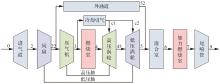
Fig.1
Engine model used
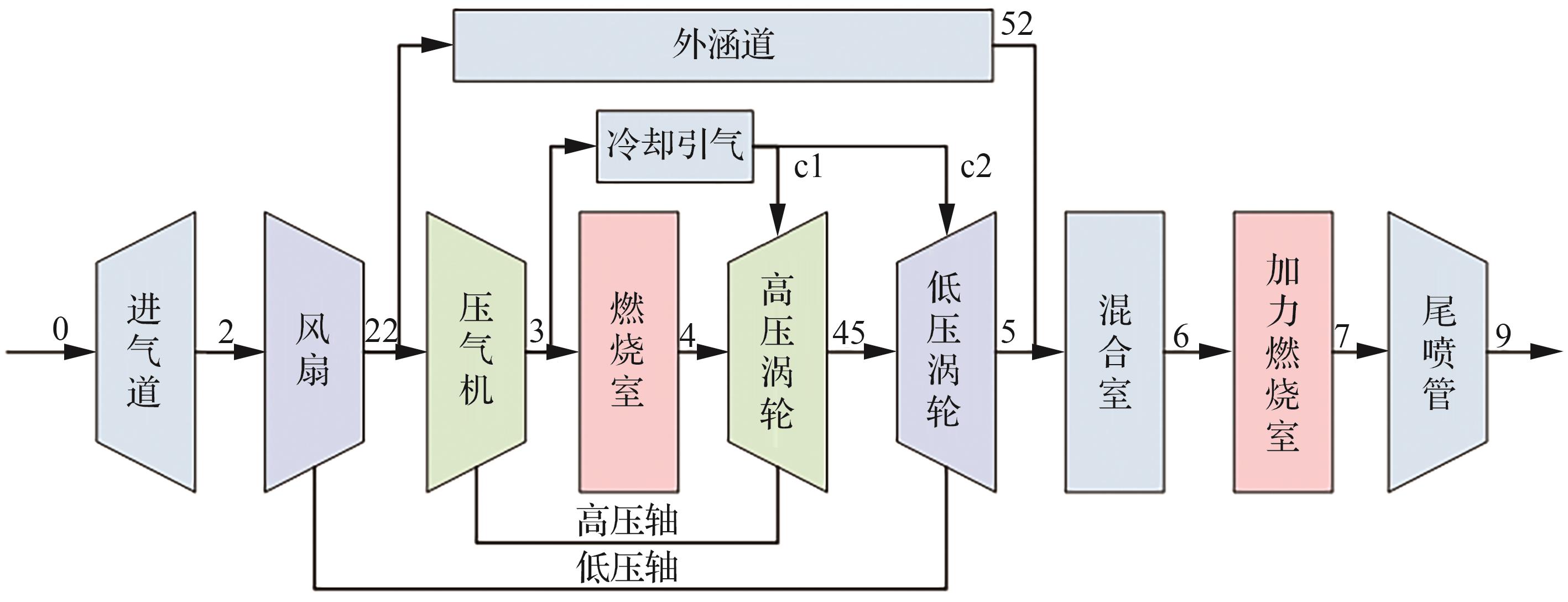

Table 1
Definition of section numbers
| 编号 | 定义 | 编号 | 定义 |
|---|---|---|---|
| 0 | 远前方 | 52 | 外涵道出口 |
| 2 | 风扇入口 | 6 | 混合室出口 |
| 22 | 风扇出口 | 7 | 加力燃烧室出口 |
| 3 | 高压压气机出口 | 9 | 尾喷管出口 |
| 4 | 燃烧室出口 | c1 | 高压涡轮冷却入口 |
| 45 | 高压涡轮出口 | c2 | 低压涡轮冷却入口 |
| 5 | 低压涡轮出口 |
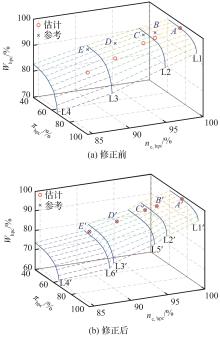
Fig.2
HPC flow characteristic maps before and after modification by high-to-low method
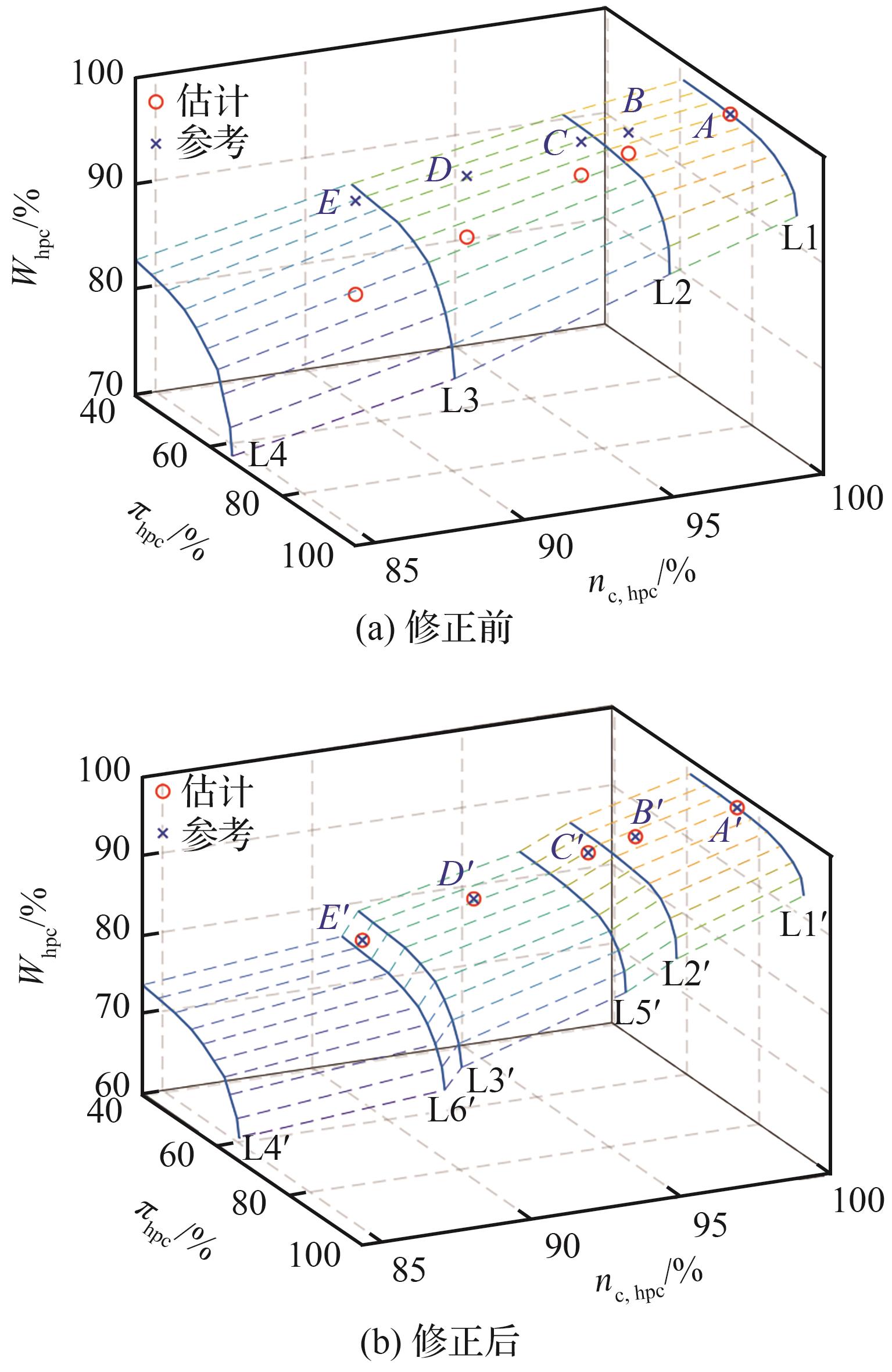
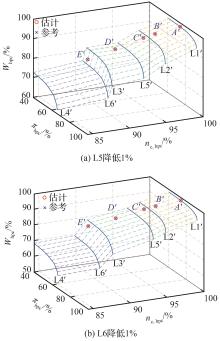
Fig.3
Modification result after reducing conversion speed
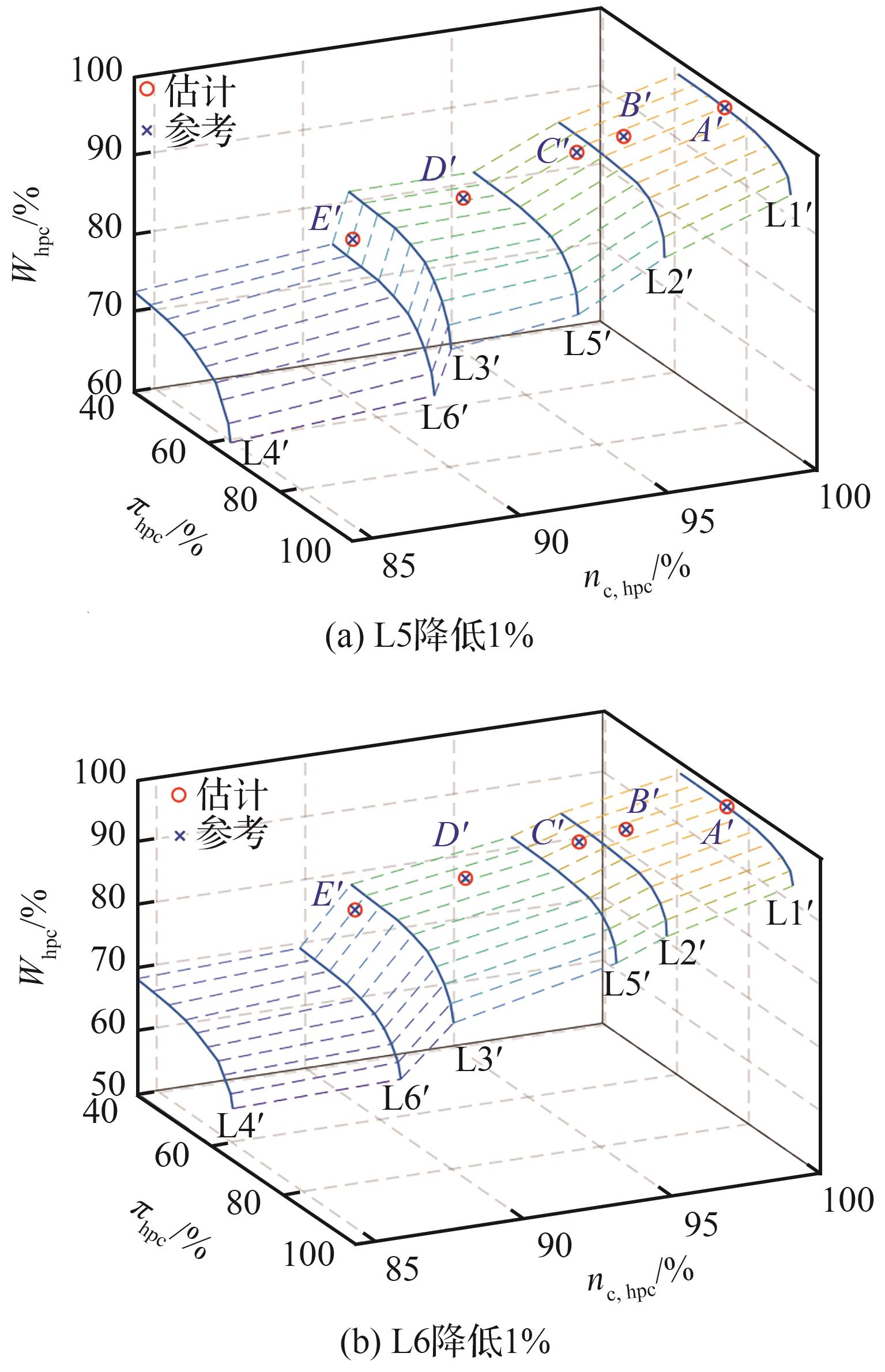
Fig.4
Entire process of modification made with improved high-to-low method
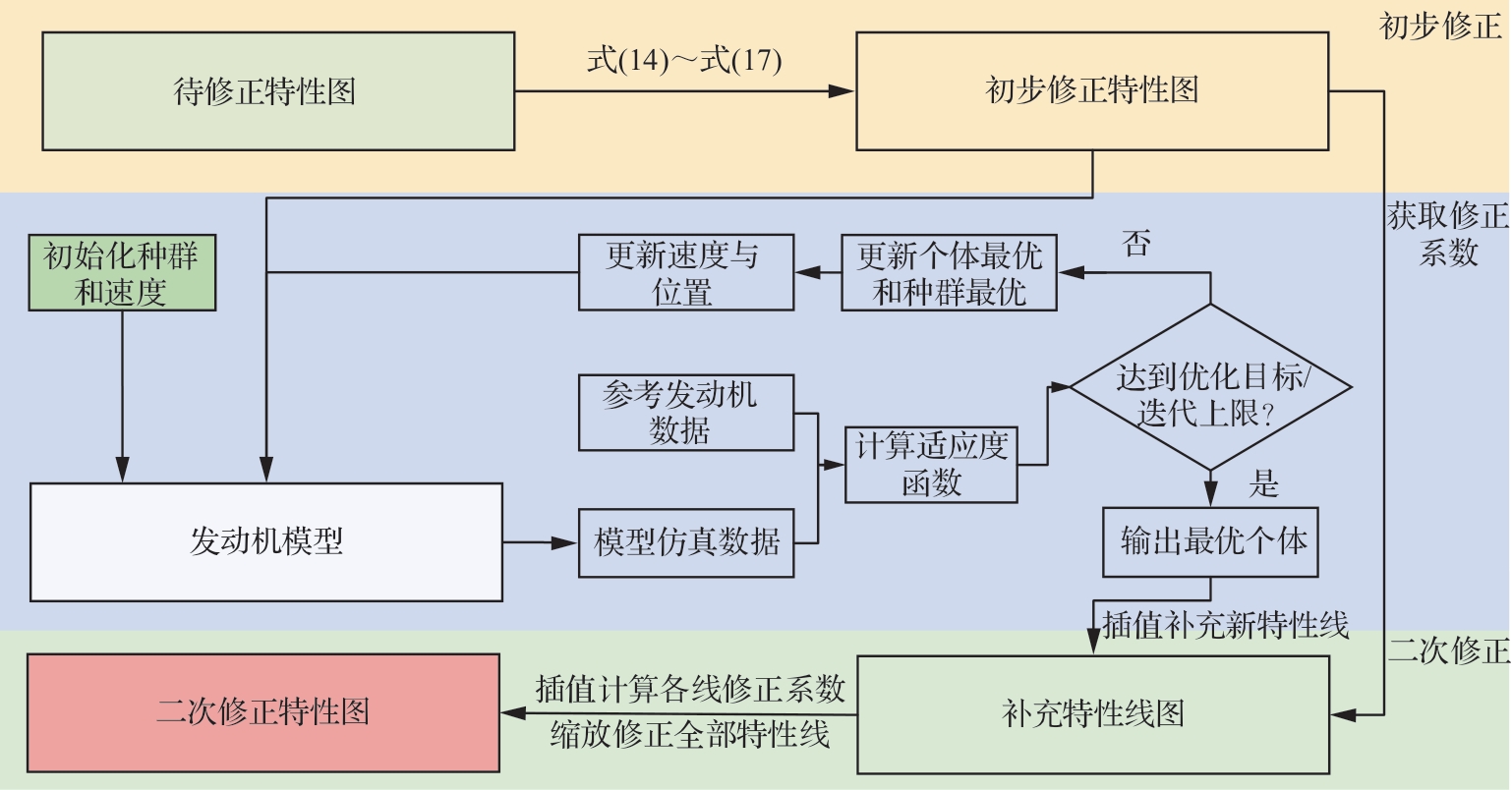
Table 2
Input parameters of operating points
| 工况点 | H/km | Ma | Wf1/(kg·s-1) | Wf2/(kg·s-1) | A8/m2 | A9/m2 |
|---|---|---|---|---|---|---|
| 1 | 0 | 0 | 0.8 | 0 | 0.8 | 0.96 |
| 2 | 0 | 0 | 4.0 | 0 | 0.8 | 0.96 |
| 3 | 0 | 1.2 | 2.0 | 0 | 0.8 | 0.96 |
| 4 | 0 | 1.2 | 5.0 | 0 | 0.8 | 0.96 |
| 5 | 5 | 0.6 | 3.0 | 0 | 0.8 | 0.96 |
| 6 | 10 | 0.8 | 2.0 | 0 | 0.8 | 0.96 |
| 7 | 11 | 1.0 | 2.5 | 0 | 0.8 | 0.96 |
| 8 | 11 | 2.0 | 6.0 | 0 | 0.8 | 0.96 |
| 9 | 0 | 0.4 | 6.32 | 0 | 0.8 | 0.96 |
Table 3
Relative error of target parameters after preliminary modification
| 工况点 | nL | nH | Pt3 | Pt45 | Tt5 | Pt6 | Tt6 | F |
|---|---|---|---|---|---|---|---|---|
| 1 | NAN | NAN | NAN | NAN | NAN | NAN | NAN | NAN |
| 2 | 3.369 | 0.167 | 1.660 | 1.648 | 1.989 | 2.798 | 2.360 | 4.136 |
| 3 | NAN | NAN | NAN | NAN | NAN | NAN | NAN | NAN |
| 4 | NAN | NAN | NAN | NAN | NAN | NAN | NAN | NAN |
| 5 | 1.748 | 0.206 | 1.590 | 1.598 | 1.887 | 2.435 | 2.133 | 3.041 |
| 6 | 0.266 | 0.269 | 0.626 | 0.660 | 0.723 | 0.771 | 0.700 | 0.833 |
| 7 | 2.116 | 0.452 | 1.190 | 1.185 | 1.350 | 1.752 | 1.577 | 1.663 |
| 8 | 10.221 | 0.280 | 2.250 | 2.359 | 2.873 | 4.475 | 3.557 | 2.443 |
| 9(设计点) | 0.000 | 0.000 | 0.000 | 0.000 | 0.000 | 0.000 | 0.000 | 0.000 |
Table 4
Hyperparameter setting of PSO algorithm
| 超参数 | 符号 | 数值 |
|---|---|---|
| 群体大小 | N | 25 |
| 个体维数 | d | 8 |
| 最大迭代次数 | G | 1 000 |
| 优化目标 | Faim | 0.1 |
| 惯性权重 | w | 0.83 |
| 自我学习因子 | c1 | 1.8 |
| 群体学习因子 | c2 | 1.3 |
Table 5
Symbol and search range of correction coefficients
| 修正系数 | 符号 | 搜索范围 |
|---|---|---|
| 风扇流量 | CW,fan | [0.6, 1.6] |
| 风扇效率 | Cη,fan | [0.6, 1.6] |
| 压气机流量 | CW,hpc | [0.6, 1.6] |
| 压气机效率 | Cη,hpc | [0.6, 1.6] |
| 高压涡轮流量 | CW,hpt | [0.9, 1.2] |
| 高压涡轮效率 | Cη,hpt | [0.9, 1.2] |
| 低压涡轮流量 | CW,lpt | [0.9, 1.2] |
| 低压涡轮效率 | Cη,lpt | [0.9, 1.2] |
Table 6
Optimized results of correction coefficients by PSO algorithm
| 工况点 | CW,fan | Cη,fan | CW,hpc | Cη,hpc | CW,hpt | Cη,hpt | CW,lpt | Cη,lpt |
|---|---|---|---|---|---|---|---|---|
| 1 | 0.725 | 1.336 | 0.876 | 1.078 | 1.001 | 0.996 | 1.017 | 1.035 |
| 2 | 0.988 | 1.046 | 0.980 | 1.005 | 1.000 | 1.000 | 1.000 | 1.020 |
| 3 | 0.748 | 1.334 | 0.855 | 1.088 | 1.002 | 0.994 | 1.007 | 1.053 |
| 4 | 0.795 | 1.160 | 0.943 | 1.030 | 1.000 | 0.998 | 1.007 | 1.036 |
| 5 | 1.014 | 1.030 | 0.991 | 1.003 | 1.000 | 1.000 | 1.000 | 1.017 |
| 6 | 1.011 | 1.006 | 1.002 | 1.001 | 1.000 | 1.000 | 1.000 | 1.006 |
| 7 | 0.935 | 0.999 | 1.005 | 0.999 | 1.000 | 1.001 | 1.000 | 0.984 |
| 8 | 0.907 | 1.061 | 0.973 | 1.005 | 1.000 | 0.998 | 1.005 | 1.024 |
| 9(设计点) | 1.000 | 1.000 | 1.000 | 1.000 | 1.000 | 1.000 | 1.000 | 1.000 |
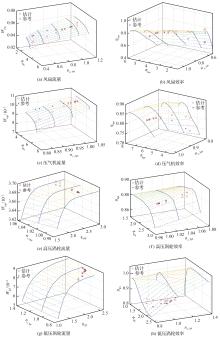
Fig.5
Reference and estimated positions of operation points on characteristic maps
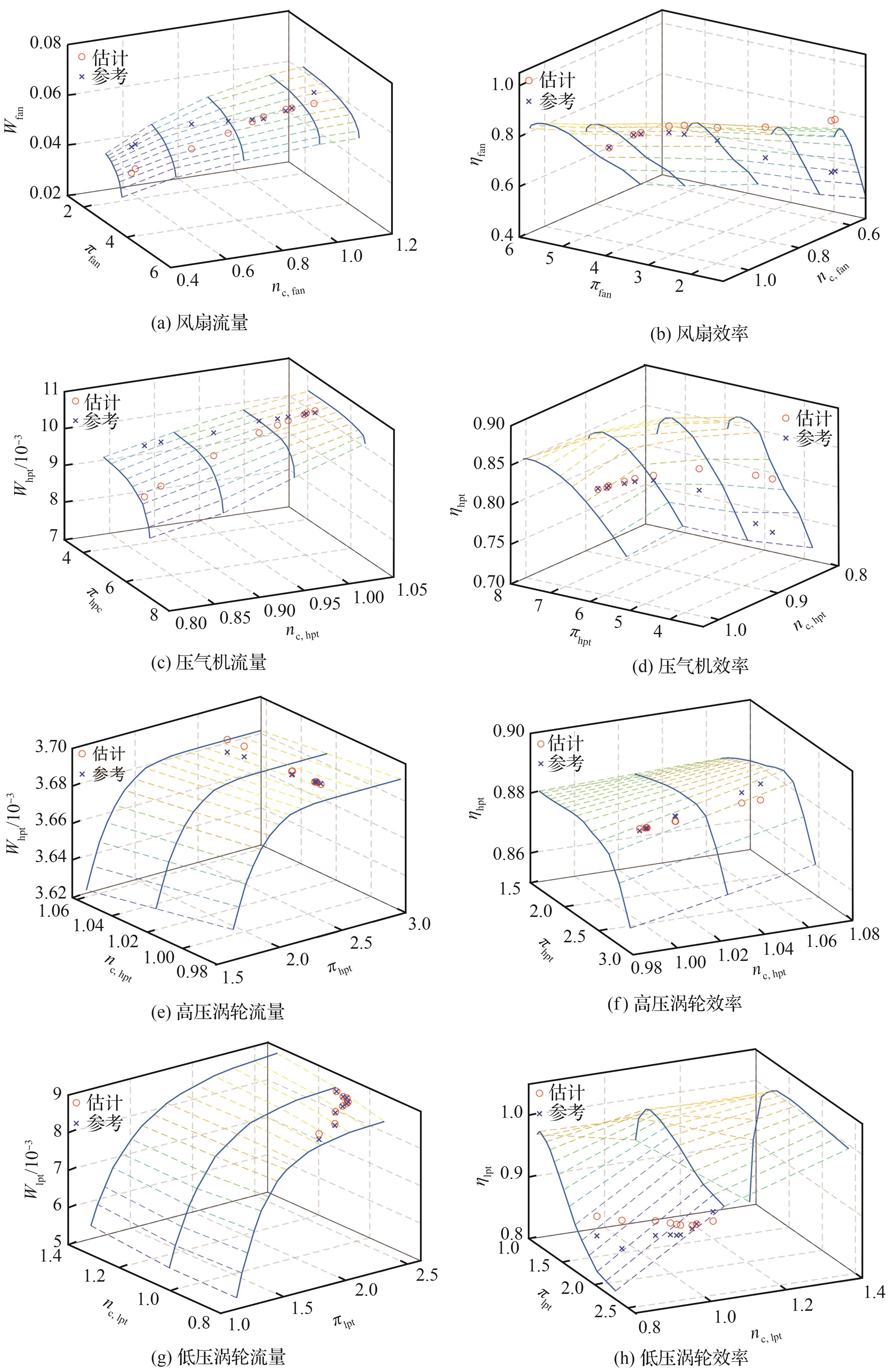
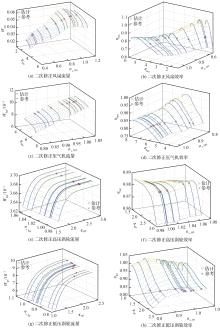
Fig.6
Reference and estimated positions of operation points on characteristic maps after secondary modification by improved high-to-low method
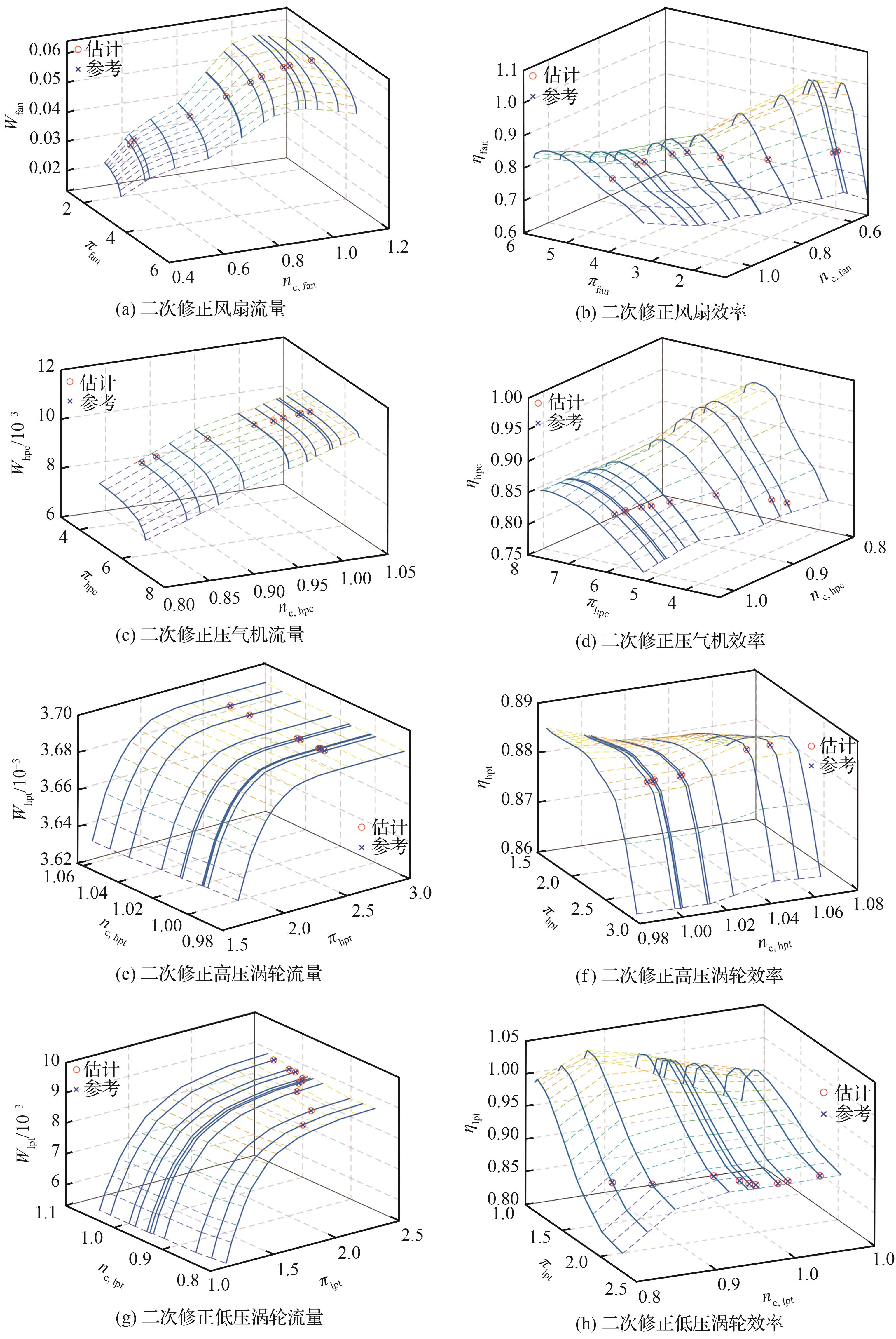
Table 7
Relative error of target parameters after secondary modification by improved high-to-low method
| 工况点 | nL | nH | Pt3 | Pt45 | Tt5 | Pt6 | Tt6 | F |
|---|---|---|---|---|---|---|---|---|
| 1 | 0.122 | 0.016 | 0.046 | 0.032 | 0.073 | 0.034 | 0.052 | 0.199 |
| 2 | 0.002 | 0.115 | 0.059 | 0.000 | 0.031 | 0.095 | 0.082 | 0.141 |
| 3 | 0.131 | 0.167 | 0.088 | 0.170 | 0.011 | 0.114 | 0.053 | 0.275 |
| 4 | 0.079 | 0.081 | 0.144 | 0.260 | 0.107 | 0.067 | 0.040 | 0.082 |
| 5 | 0.021 | 0.033 | 0.002 | 0.009 | 0.011 | 0.023 | 0.020 | 0.029 |
| 6 | 0.027 | 0.020 | 0.001 | 0.006 | 0.004 | 0.010 | 0.009 | 0.011 |
| 7 | 0.042 | 0.053 | 0.002 | 0.021 | 0.004 | 0.008 | 0.008 | 0.008 |
| 8 | 0.021 | 0.003 | 0.135 | 0.227 | 0.076 | 0.032 | 0.021 | 0.020 |
| 9(设计点) | 0.000 | 0.000 | 0.000 | 0.000 | 0.000 | 0.000 | 0.000 | 0.000 |
Fig.7
Reference and estimated positions of operation points on characteristic maps after modification by traditional high-to-low method
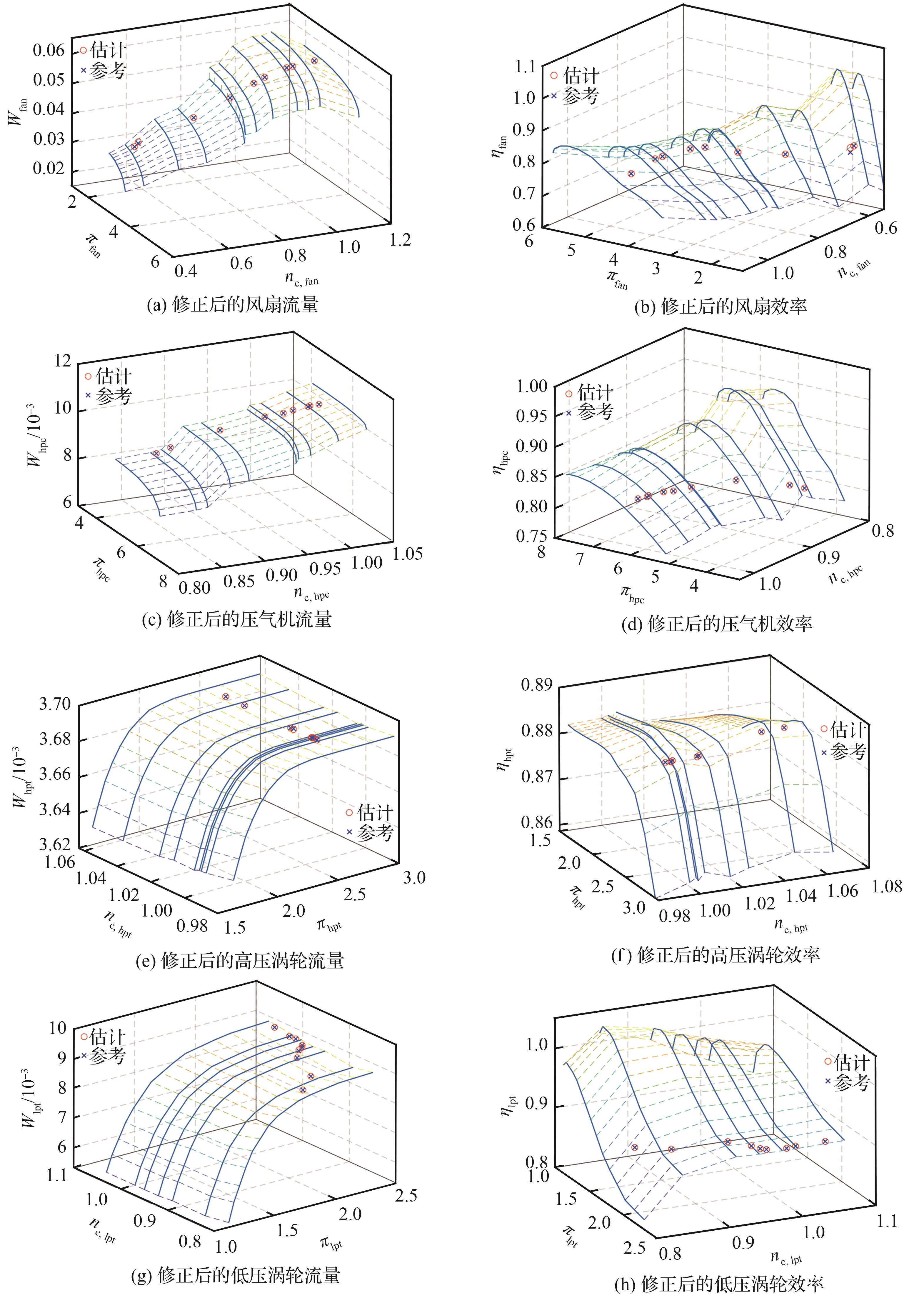
Table 8
Relative errors of target parameters after modification by traditional high-to-low method
| 工况点 | nL | nH | Pt3 | Pt45 | Tt5 | Pt6 | Tt6 | F |
|---|---|---|---|---|---|---|---|---|
| 1 | 0.122 | 0.016 | 0.046 | 0.032 | 0.073 | 0.034 | 0.052 | 0.198 |
| 2 | 0.002 | 0.115 | 0.059 | 0.001 | 0.032 | 0.095 | 0.082 | 0.141 |
| 3 | 0.171 | 0.419 | 0.448 | 0.707 | 0.418 | 0.950 | 0.419 | 2.303 |
| 4 | 0.078 | 0.077 | 0.139 | 0.254 | 0.111 | 0.065 | 0.039 | 0.080 |
| 5 | 0.052 | 0.092 | 0.162 | 0.126 | 0.142 | 0.069 | 0.055 | 0.086 |
| 6 | 0.050 | 0.044 | 0.039 | 0.037 | 0.037 | 0.007 | 0.005 | 0.007 |
| 7 | 0.041 | 0.053 | 0.002 | 0.021 | 0.005 | 0.009 | 0.008 | 0.008 |
| 8 | 0.017 | 0.065 | 0.299 | 0.220 | 0.231 | 0.130 | 0.086 | 0.076 |
| 9(设计点) | 0.000 | 0.000 | 0.000 | 0.001 | 0.000 | 0.000 | 0.000 | 0.000 |
Table 9
Optimized quadratic sub-coefficients obtained by PSO
| 修正系数 | 二次项系数 | 数值 | 修正系数 | 二次项系数 | 数值 |
|---|---|---|---|---|---|
| CW,fan | a | 0.491 | CW,hpt | a | -0.148 |
| b | -0.568 | b | 0.609 | ||
| Cη,fan | a | -0.503 | Cη,hpt | a | -0.395 |
| b | 1.260 | b | 0.334 | ||
| CW,hpc | a | 1.103 | CW,lpt | a | -0.018 |
| b | 1.345 | b | -0.110 | ||
| Cη,hpc | a | -0.536 | Cη,lpt | a | -0.336 |
| b | -1.022 | b | -0.832 |
Table 10
Relative errors of target parameters after modification by fitting quadratic function transformation method
| 工况点 | nL | nH | Pt3 | Pt45 | Tt5 | Pt6 | Tt6 | F |
|---|---|---|---|---|---|---|---|---|
| 1 | 0.794 | 2.981 | 1.600 | 0.218 | 0.839 | 0.303 | 0.455 | 1.748 |
| 2 | 1.088 | 0.241 | 0.446 | 0.162 | 0.468 | 0.566 | 0.461 | 0.837 |
| 3 | 0.294 | 2.865 | 1.384 | 0.970 | 1.347 | 0.755 | 0.328 | 1.821 |
| 4 | 3.279 | 0.482 | 0.184 | 0.452 | 0.116 | 0.684 | 0.415 | 0.826 |
| 5 | 1.463 | 0.179 | 0.700 | 0.404 | 0.681 | 0.811 | 0.687 | 1.013 |
| 6 | 0.342 | 0.216 | 0.517 | 0.224 | 0.441 | 0.494 | 0.446 | 0.534 |
| 7 | 3.636 | 0.777 | 0.504 | 0.843 | 0.701 | 0.842 | 0.744 | 0.806 |
| 8 | 0.075 | 0.031 | 0.787 | 0.829 | 0.362 | 0.730 | 0.493 | 0.427 |
| 9(设计点) | 0.218 | 0.178 | 0.270 | 0.015 | 0.203 | 0.225 | 0.215 | 0.283 |
Fig.8
Comparison of evaluation indicators for various modification methods
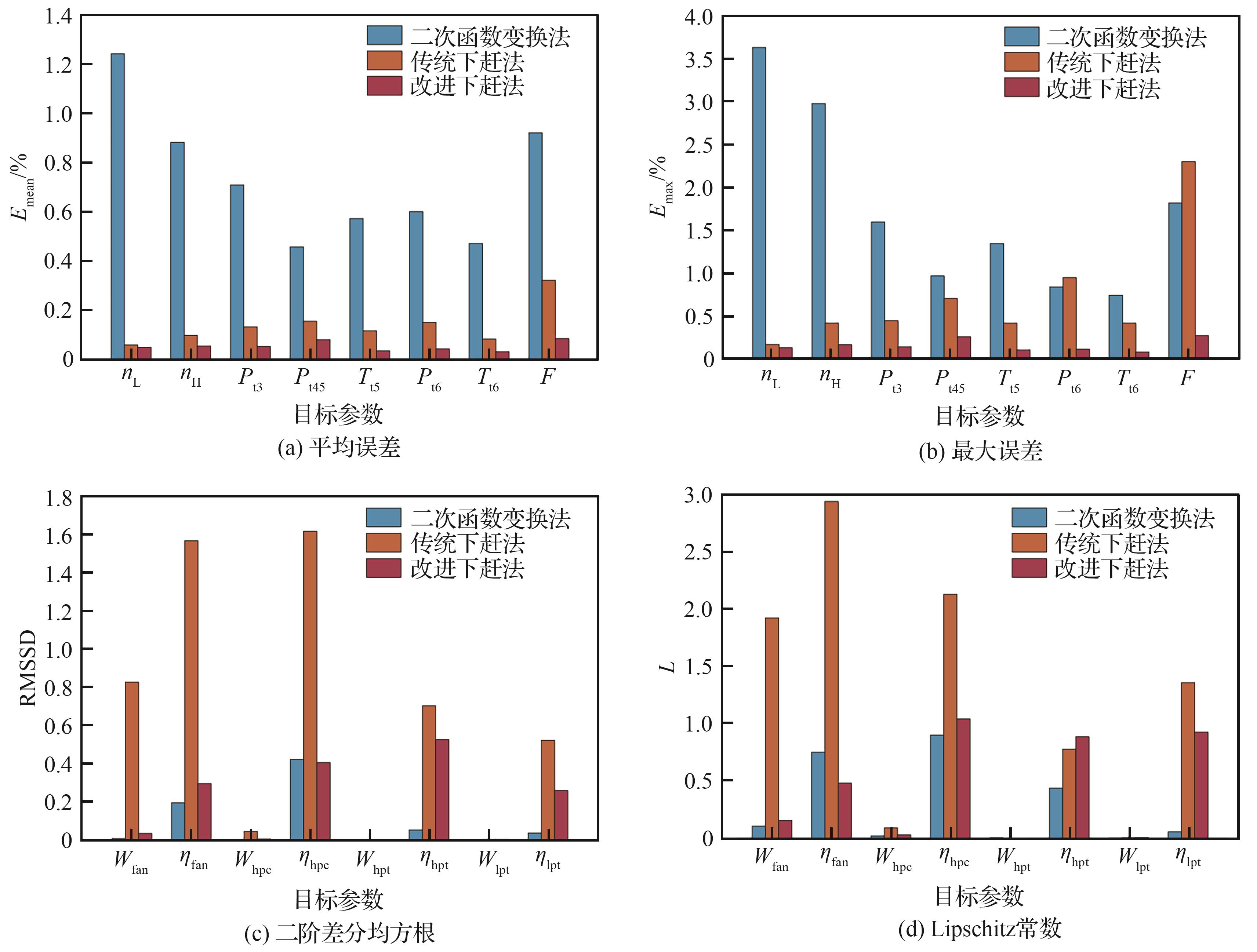
Table 11
Accuracy evaluation indicators after modification by various methods
| 评价指标 | 修正方法 | nL | nH | Pt3 | Pt45 | Tt5 | Pt6 | Tt6 | F |
|---|---|---|---|---|---|---|---|---|---|
| Emean | 二次函数变换法 | 1.243 | 0.883 | 0.710 | 0.458 | 0.573 | 0.601 | 0.472 | 0.922 |
| 传统下赶法 | 0.059 | 0.098 | 0.133 | 0.155 | 0.117 | 0.151 | 0.083 | 0.322 | |
| 改进下赶法 | 0.049 | 0.054 | 0.053 | 0.080 | 0.035 | 0.043 | 0.032 | 0.085 | |
| Emax | 二次函数变换法 | 3.636 | 2.981 | 1.600 | 0.970 | 1.347 | 0.842 | 0.744 | 1.821 |
| 传统下赶法 | 0.171 | 0.419 | 0.448 | 0.707 | 0.418 | 0.950 | 0.419 | 2.303 | |
| 改进下赶法 | 0.131 | 0.167 | 0.144 | 0.260 | 0.107 | 0.114 | 0.082 | 0.275 |
Table 12
Smoothness evaluation indicators after modification by various methods
| 评价指标 | 修正方法 | Wfan | ηfan | Whpc | ηhpc | Whpt | ηhpt | Wlpt | ηlpt |
|---|---|---|---|---|---|---|---|---|---|
| RMSSD | 二次函数变换法 | 0.007 | 0.194 | 0.002 | 0.422 | 0.000 | 0.052 | 0.001 | 0.035 |
| 传统下赶法 | 0.827 | 1.569 | 0.045 | 1.618 | 0.000 | 0.703 | 0.003 | 0.523 | |
| 改进下赶法 | 0.034 | 0.295 | 0.005 | 0.405 | 0.001 | 0.526 | 0.003 | 0.259 | |
| L | 二次函数变换法 | 0.106 | 0.752 | 0.021 | 0.902 | 0.004 | 0.438 | 0.003 | 0.056 |
| 传统下赶法 | 1.927 | 2.944 | 0.091 | 2.133 | 0.000 | 0.778 | 0.005 | 1.361 | |
| 改进下赶法 | 0.156 | 0.482 | 0.030 | 1.043 | 0.001 | 0.887 | 0.006 | 0.929 |
| [1] | 李志虎. 变循环发动机机载实时模型研究[D]. 南京: 南京航空航天大学, 2021: 1. |
| LI Z H. On-board real time model for variable cycle engine[D]. Nanjing: Nanjing University of Aeronautics and Astronautics, 2021: 1 (in Chinese). | |
| [2] | 曾雪瑞, 向露宇, 曾强, 等. 基于差分进化算法的发动机部件特性修正[J]. 工程与试验, 2025, 65(2): 25-29. |
| ZENG X R, XIANG L Y, ZENG Q, et al. Modification of engine component characteristics based on differential evolution algorithm[J]. Engineering & Test, 2025, 65(2): 25-29 (in Chinese). | |
| [3] | TSOUTSANIS E, MESKIN N, BENAMMAR M, et al. A component map tuning method for performance prediction and diagnostics of gas turbine compressors[J]. Applied Energy, 2014, 135: 572-585. |
| [4] | TSOUTSANIS E, KHORASANI K, BENAMMAR M, et al. Transient gas turbine performance diagnostics through nonlinear adaptation of compressor and turbine maps[J]. Journal of Engineering for Gas Turbines and Power, 2015, 137(9): 091201. |
| [5] | YANG Q, LI S, CAO Y. A new component map generation method for gas turbine adaptation performance simulation[J]. Journal of Mechanical Science and Technology, 2017, 31(4): 1947-1957. |
| [6] | LI Y G, GHAFIR M F A, WANG L, et al. Nonlinear multiple points gas turbine off-design performance adaptation using a genetic algorithm[J]. Journal of Engineering for Gas Turbines and Power, 2011, 133(7): 071701. |
| [7] | KANG W D, KIM S T. Model-based performance diagnostics of heavy-duty gas turbines using compressor map adaptation[J]. Applied Energy, 2018, 212: 1345-1359. |
| [8] | KIM S, KIM K, SON C. A new transient performance adaptation method for an aero gas turbine engine[J]. Energy, 2020, 193: 116752. |
| [9] | WANG Y, WANG X, WANG Z, et al. A novel method for aero-engine map calibration using adaptation factor surface[J]. Measurement, 2025, 239: 115394. |
| [10] | 杨欣毅, 沈伟, 王文, 等. 利用多状态试车数据修正发动机部件特性[J]. 航空动力学报, 2012, 27(8): 1785-1791. |
| YANG X Y, SHEN W, WANG W, et al. Aero engine component characteristic map correction using multi state test data[J]. Journal of Aerospace Power, 2012, 27(8): 1785-1791 (in Chinese). | |
| [11] | 潘率诚, 李刚团, 丁朝霞, 等. 基于部件特性的航空发动机性能模型修正[J]. 燃气涡轮试验与研究, 2016, 29(6): 26-29, 33. |
| PAN S C, LI G T, DING Z X, et al. Aero-engine performance model correction based on component performance map[J]. Gas Turbine Experiment and Research, 2016, 29(6): 26-29, 33 (in Chinese). | |
| [12] | 陈义成. 航空发动机模型修正技术研究[D]. 天津: 中国民航大学, 2020: 72-79. |
| CHEN Y C. Research on modification technology of aeroengine model[D]. Tianjin: Civil Aviation University of China, 2020: 72-79 (in Chinese). | |
| [13] | 李明洲, 嵇润民, 黄向华. 基于改进粒子群的航空发动机部件特性修正[J]. 推进技术, 2022, 43(11): 411-419. |
| LI M Z, JI R M, HUANG X H. Aeroengine component characteristic correction based on improved particle swarm optimization[J]. Journal of Propulsion Technology, 2022, 43(11): 411-419 (in Chinese). | |
| [14] | 郭庆, 孙正日, 樊俊峰, 等. 面向健康管理的民航发动机气路基准模型建立与验证[J]. 推进技术, 2025, 46(3): 220-231. |
| GUO Q, SUN Z R, FAN J F, et al. Establishment and verification of a civil aircraft engine air path benchmark model for health management[J]. Journal of Propulsion Technology, 2025, 46(3): 220-231 (in Chinese). | |
| [15] | 钟文城, 汪勇, 宋劼, 等. 一种面向航空发动机数学模型的新型修正方法[J]. 航空动力学报, 2023, 38(11): 2776-2784. |
| ZHONG W C, WANG Y, SONG J, et al. A new correction method for aero-engine mathematical model[J]. Journal of Aerospace Power, 2023, 38(11): 2776-2784 (in Chinese). | |
| [16] | 张书博, 郑前钢, 陈铖, 等. 基于分块交叉信赖域法的航空发动机部件级模型精修方法研究[J]. 推进技术, 2025, 46(1): 212-223. |
| ZHANG S B, ZHENG Q G, CHEN C, et al. Refinement method of aeroengine component level model based on block cross trust region method[J]. Journal of Propulsion Technology, 2025, 46(1): 212-223 (in Chinese). | |
| [17] | 王佳雯, 黄向华, 嵇润民. 基于特性数据的燃气涡轮发动机修正方法[J]. 航空发动机, 2024, 50(3): 114-121. |
| WANG J W, HUANG X H, JI R M. Correction method of component characteristics for gas turbine based on characteristic data[J]. Aeroengine, 2024, 50(3): 114-121 (in Chinese). | |
| [18] | 周超, 李密. 基于试飞数据的民用发动机部件特性修正方法[J]. 科技创新与应用, 2024, 14(5): 52-56. |
| ZHOU C, LI M. Method for correcting the characteristics of civil engine components based on test flight data[J]. Technology Innovation and Application, 2024, 14(5): 52-56 (in Chinese). | |
| [19] | 高扬, 王鑫, 刘振刚. 基于通用仿真框架的航空发动机性能建模研究[J]. 航空工程进展, 2025, 16(1): 117-126. |
| GAO Y, WANG X, LIU Z G. Research on aero-engine performance modeling based on general simulation framework[J]. Advances in Aeronautical Science and Engineering, 2025, 16(1): 117-126 (in Chinese). | |
| [20] | 张淏源. 涡轴发动机模型修正技术研究[D]. 南京: 南京航空航天大学, 2015: 49-57. |
| ZHANG H Y. Research on modeling correction for turboshaft engine[D]. Nanjing: Nanjing University of Aeronautics and Astronautics, 2015: 49-57 (in Chinese). | |
| [21] | 高晶东. 基于试车台数据涡扇发动机稳态性能建模[D]. 天津: 中国民航大学, 2020: 41-46. |
| GAO J D. Modeling of turbofan engine performance at steady state based on test cell data[D]. Tianjin: Civil Aviation University of China, 2020: 41-46 (in Chinese). | |
| [22] | 邹泽龙, 黄金泉, 周鑫, 等. VCE身份证动态模型部件特性快速自动修正方法[J]. 航空动力学报, 2024, 39(9): 504-519. |
| ZOU Z L, HUANG J Q, ZHOU X, et al. Fast automatic correction method for component characteristics of the identification dynamic model of VCE[J]. Journal of Aerospace Power, 2024, 39(9): 504-519 (in Chinese). | |
| [23] | 樊巍, 施洋, 曹铭栋, 等. 一种新的航空发动机总体性能稳态模型修正方法[J]. 燃气涡轮试验与研究, 2020, 33(6): 28-31. |
| FAN W, SHI Y, CAO M-D, et al. A new aero-engine steady-state performance model modification method[J]. Gas Turbine Experiment and Research, 2020, 33(6): 28-31 (in Chinese). | |
| [24] | 金鹏, 鲁峰, 黄金泉. 涡扇发动机部件特性的滤波自动修正更新方法[J]. 推进技术, 2019, 40(12): 2664-2672. |
| JIN P, LU F, HUANG J Q. Automatic filtering-based modification and updating of component characteristics for turbofan engine[J]. Journal of Propulsion Technology, 2019, 40(12): 2664-2672 (in Chinese). | |
| [25] | 陆桑炜. 变循环发动机非线性自适应模型研究[D]. 南京: 南京航空航天大学, 2019: 52-62. |
| LU S W. Research on nonlinear adaptive model of variable cycle engine[D]. Nanjing: Nanjing University of Aeronautics and Astronautics, 2019: 52-62 (in Chinese). | |
| [26] | 董桢, 周文祥, 潘慕绚, 等. 涡轴发动机部件特性修正及更新方法[J]. 航空发动机, 2018, 44(6): 11-16. |
| DONG Z, ZHOU W X, PAN M X, et al. Modification and updating method in component characteristics turboshaft engine[J]. Aeroengine, 2018, 44(6): 11-16 (in Chinese). | |
| [27] | 潘鹏飞, 李秋红, 任冰涛, 等. 基于遗传算法的航空发动机部件特性修正[J]. 北京航空航天大学学报, 2014, 40(5): 690-694. |
| PAN P F, LI Q H, REN B T, et al. Component map correction of aero-engine based on genetic algorithm[J]. Journal of Beijing University of Aeronautics and Astronautics, 2014, 40(5): 690-694 (in Chinese). | |
| [28] | 杨欣毅, 王永华, 贺孝涛, 等. 基于改进量子粒子群的发动机部件特性修正[J]. 航空计算技术, 2012, 42(2): 4-8. |
| YANG X Y, WANG Y H, HE X T, et al. Aeroengine component characteristic correction based on enhanced quantum-behaved particle swarm optimization[J]. Aeronautical Computing Technique, 2012 42(2): 4-8 (in Chinese). | |
| [29] | 骆广琦, 桑增产, 王如根, 等. 航空燃气涡轮发动机数值仿真[M]. 北京: 国防工业出版社, 2007: 49-72. |
| LUO G Q, SANG Z C, WANG R G, et al. Numerical methods for aviation gas turbine engine simulation[M]. Beijing: National Defense Industry Press, 2007: 49-72 (in Chinese). | |
| [30] | 樊思齐. 航空发动机控制[M]. 西安: 西北工业大学出版社, 2008: 134-136. |
| FAN S Q. Aeroengine control[M]. Xi’an: Northwestern Polytechnical University Press, 2008: 134-136 (in Chinese). |
| [1] | Haideng ZHANG, Yun WU, Yingwei TIAN, Nan TANG, Yueren ZUO. Research progress and prospect of swirl/total pressure combined distortion test and evaluation [J]. Acta Aeronautica et Astronautica Sinica, 2026, 47(7): 632790-632790. |
| [2] | Kewen WU, Bin ZHAO, Yanying TAN. Aerial recovery mission planning method for UAV swarm [J]. Acta Aeronautica et Astronautica Sinica, 2026, 47(4): 332208-332208. |
| [3] | Ying WANG, Yang LI, Chaoqian CHENG, Zongxia JIAO. Thermal load analysis for aeroengine oil system with extended flight profile [J]. Acta Aeronautica et Astronautica Sinica, 2026, 47(1): 632005-632005. |
| [4] | Bingbing XU, Kai HAN, Richang DONG, Wenbin GONG, Qianyi REN. A high-speed laser backbone node deployment approach for next-generation GNSS [J]. Acta Aeronautica et Astronautica Sinica, 2025, 46(9): 331124-331124. |
| [5] | Yun ZHANG, Chenguang LIU, Yukun ZHANG, Peng LI. Crack identification of aeroengine compressor blades based on blade tip timing [J]. Acta Aeronautica et Astronautica Sinica, 2025, 46(23): 231823-231823. |
| [6] | Xi LIU, Dianyin HU, Yi WANG, Rongqiao WANG, Gaoxiang CHEN, Weihan KONG. Structural reliability design for aero-engines: Review and prospects [J]. Acta Aeronautica et Astronautica Sinica, 2025, 46(21): 532625-532625. |
| [7] | Han ZHOU, Qian CHEN, Hongyu WANG, Haolan SHI, Pengxuan WEI, Jiacheng LI, Tianhong ZHANG, Hanlin SHENG. A high flux dual variable cycle engine model coupled with instability simulation [J]. Acta Aeronautica et Astronautica Sinica, 2025, 46(14): 131436-131436. |
| [8] | Fang GUO, Wei HAN, Yujie LIU, Jie LIU, Xichao SU, Liangliang CHENG. Scheduling for maintenance and service support of carrier-based aircraft based on variable operation process [J]. Acta Aeronautica et Astronautica Sinica, 2025, 46(13): 531195-531195. |
| [9] | Yangchao HE, Jiong LI, Lei SHAO, Xiangwei BU, Jinlin ZHANG, Boyang JI. Reentry target tracking algorithm based on improved “current” statistical model [J]. Acta Aeronautica et Astronautica Sinica, 2024, 45(S1): 730800-730800. |
| [10] | Guoning QI, Baohai WU, Jiangfeng FU. Comparative analysis on relief grooves of high-speed and high-pressure aeroengine fuel gear pumps [J]. Acta Aeronautica et Astronautica Sinica, 2024, 45(5): 529666-529666. |
| [11] | Xiangdong GE, Fayong WU, Yongquan LIU, Zhongyan AN, Baodong QIAO, Qiang GAO, Tianlong QIN, Xiaoyang ZHOU. Research methods for whole aeroengine vibration and their engineering application [J]. Acta Aeronautica et Astronautica Sinica, 2024, 45(4): 628353-628353. |
| [12] | Lifang CHEN, Yabing SUN, Shuhua ZHOU, Qiang GAO, Baodong QIAO, Dong LI. Fan rotor local balancing method based on real data inversion [J]. Acta Aeronautica et Astronautica Sinica, 2024, 45(4): 628321-628321. |
| [13] | Minghui HU, Jinji GAO, Zhinong JIANG, Weimin WANG, Limin ZOU, Tao ZHOU, Yunfeng FAN, Yue WANG, Jiaxin FENG, Chenyang LI. Research progress on vibration monitoring and fault diagnosis for aero-engine [J]. Acta Aeronautica et Astronautica Sinica, 2024, 45(4): 630194-630194. |
| [14] | Zhiliang HONG, Yu LI, Wenbo HE, Shuiting DING. Influence of bolt preload on slip characteristics at discontinuous rotor interfaces under thermal load [J]. Acta Aeronautica et Astronautica Sinica, 2024, 45(24): 230402-230402. |
| [15] | Songbai WANG, Yuyang HAO, Yadong WU, Yong CHEN, Huawei YU, Lin DU. Research progress on rotating instability of aeroengine compressor [J]. Acta Aeronautica et Astronautica Sinica, 2024, 45(16): 29851-029851. |
| Viewed | ||||||
|
Full text |
|
|||||
|
Abstract |
|
|||||
Address: No.238, Baiyan Buiding, Beisihuan Zhonglu Road, Haidian District, Beijing, China
Postal code : 100083
E-mail:hkxb@buaa.edu.cn
Total visits: 6658907 Today visits: 1341All copyright © editorial office of Chinese Journal of Aeronautics
All copyright © editorial office of Chinese Journal of Aeronautics
Total visits: 6658907 Today visits: 1341

 CJA
CJA
