Acta Aeronautica et Astronautica Sinica ›› 2025, Vol. 46 ›› Issue (8): 631086.doi: 10.7527/S1000-6893.2024.31086
• special column • Previous Articles
Lixiang WEI1,2,3, Jinglei XU1,2,3( ), Kuangshi CHEN1,2,3, Shuai HUANG1,2,3, Jianhui GE1,2,3, Guangtao SONG1,2,3
Received:2024-08-21
Revised:2024-09-12
Accepted:2024-10-15
Online:2024-10-30
Published:2024-10-29
Contact:
Jinglei XU
E-mail:xujl@nuaa.edu.cn
Supported by:CLC Number:
Lixiang WEI, Jinglei XU, Kuangshi CHEN, Shuai HUANG, Jianhui GE, Guangtao SONG. Scheme design and performance study of adjustable vector nozzle for wide-range hypersonic aircraft[J]. Acta Aeronautica et Astronautica Sinica, 2025, 46(8): 631086.
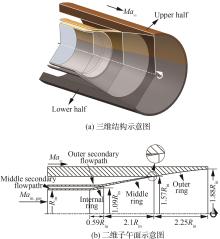
Fig.1
Structural schematic diagram of hypersonic adjustable vector nozzle
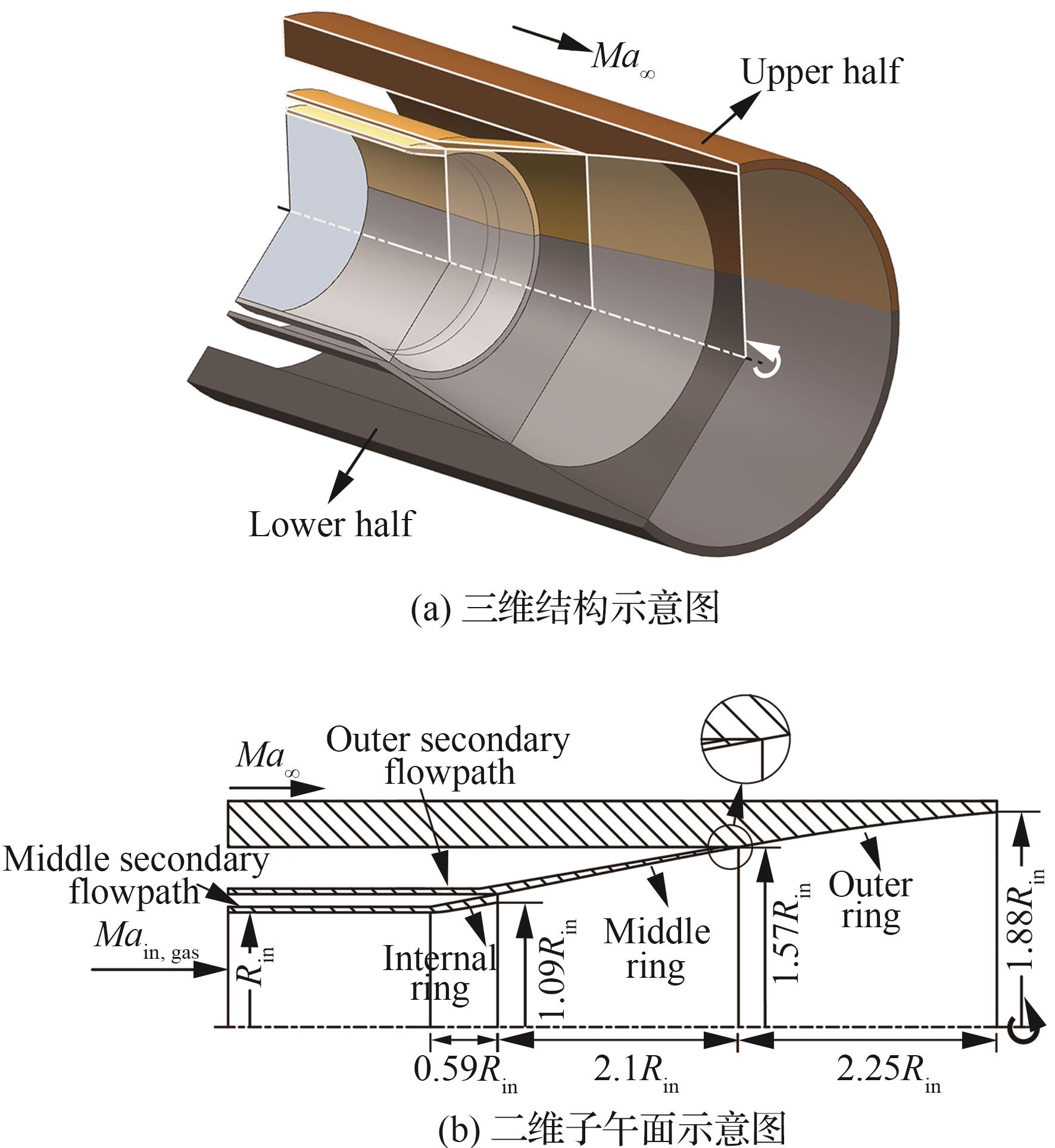

Table 1
Operating conditions of hypersonic adjustable vector nozzle
| 飞行马赫数Ma∞ | 落压比NPR | 进口马赫数Main,gas |
|---|---|---|
| 2 | 7 | 1.83 |
| 3 | 20 | 1.92 |
| 4 | 45 | 1.89 |
| 6 | 110 | 2.02 |
| 7 | 120 | 1.88 |
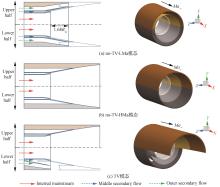
Fig.2
Schematic diagram of different modes of hypersonic adjustable vector nozzle
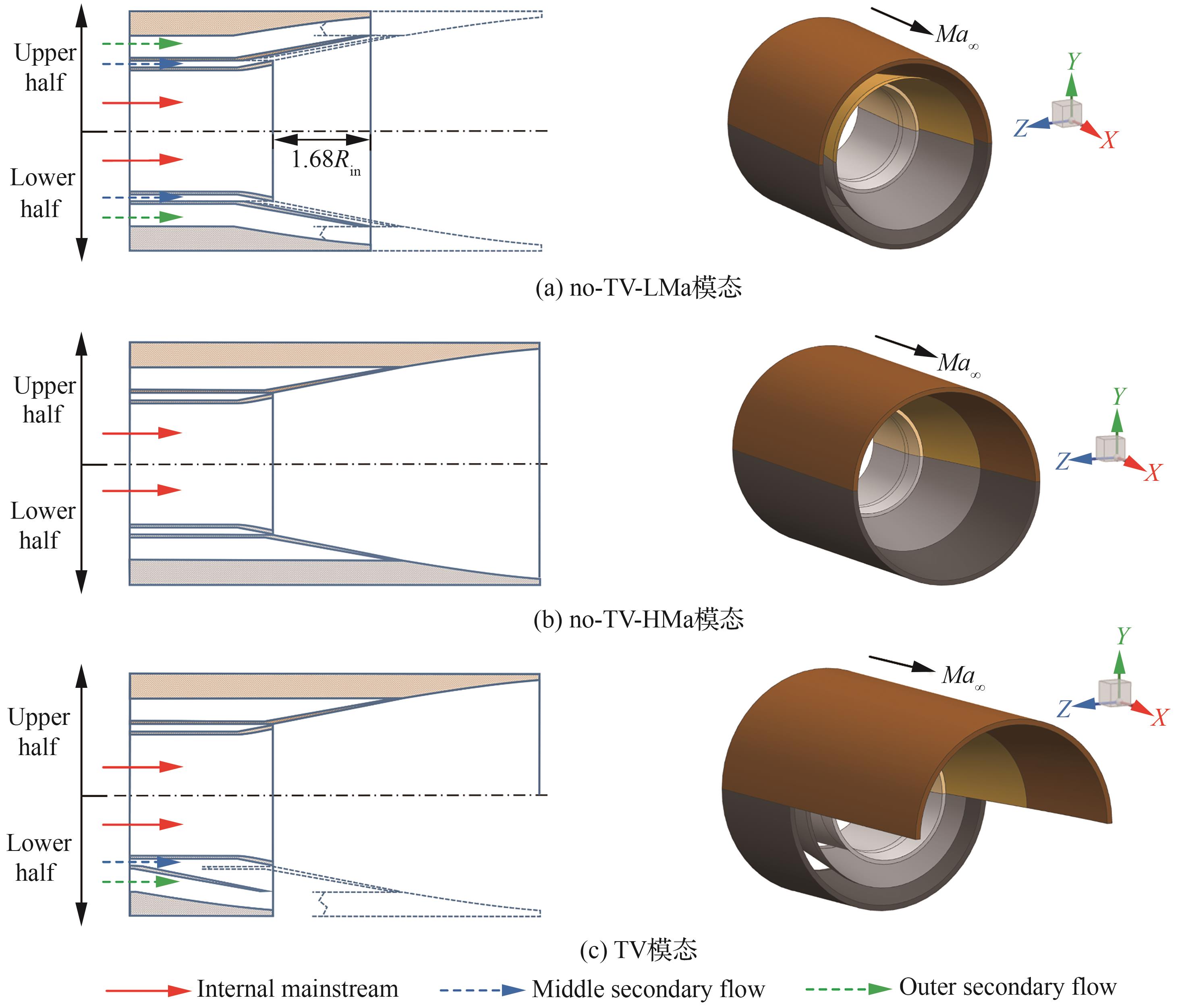
Table 2
Main geometric parameters of Volvo-S1 nozzle
| 参数 | 数值 |
|---|---|
| 喷管长度lvol/mm | 350 |
| 喉部半径rt/mm | 33.54 |
| 喷管出口半径re/mm | 150 |
| 喉部下游圆弧半径rtd/mm | 16.77 |
| 喉部下游圆弧角θtd/(°) | 35.025 |
| 膨胀角θE/(°) | 4.0 |
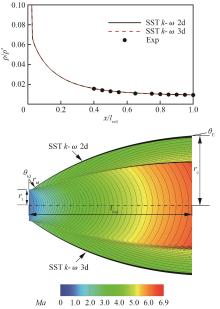
Fig.3
Wall pressure distribution and Mach number contours of Volvo-S1 nozzle
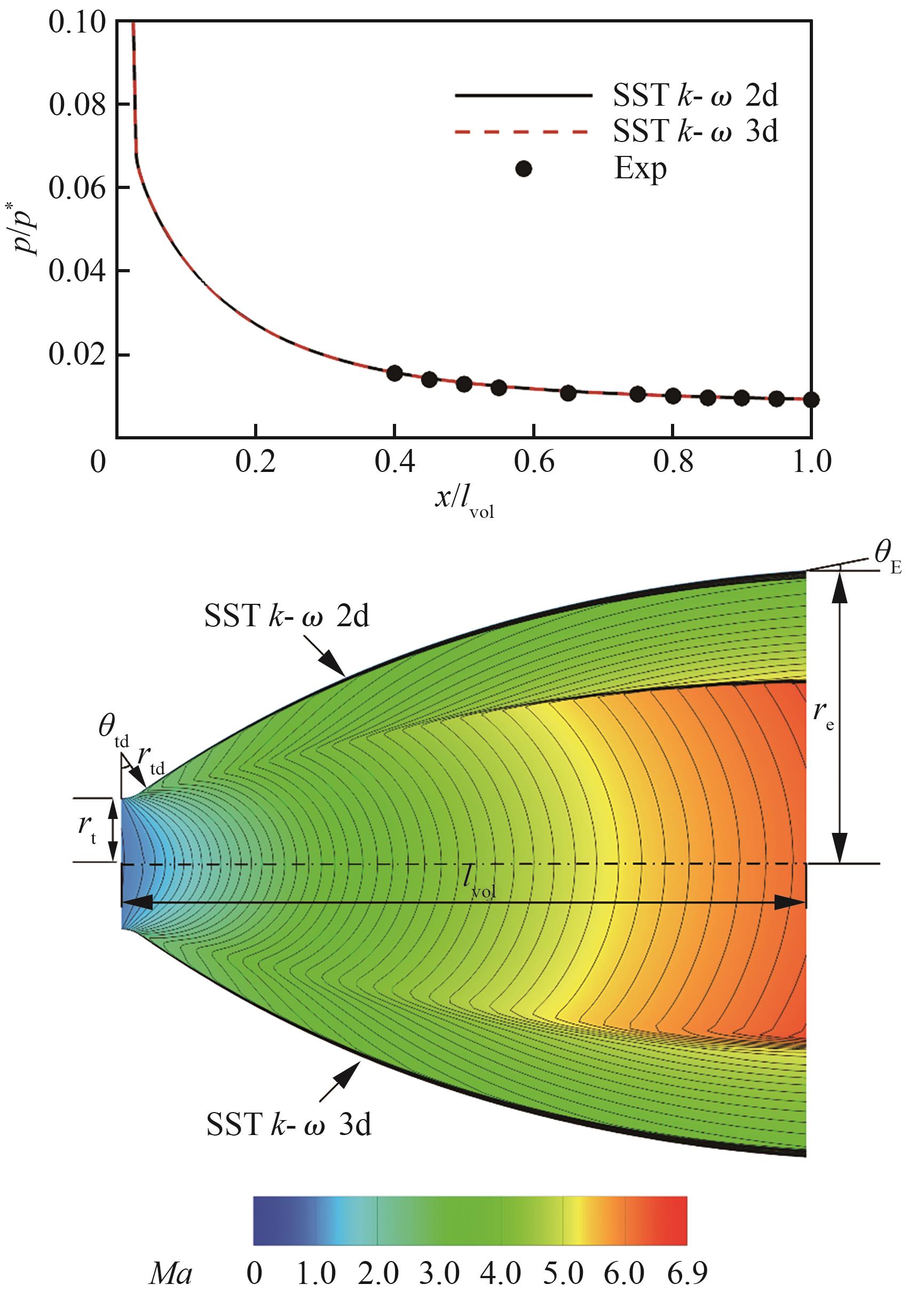
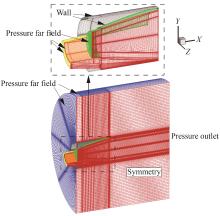
Fig.4
Schematic diagram of medium density grid and boundary conditions
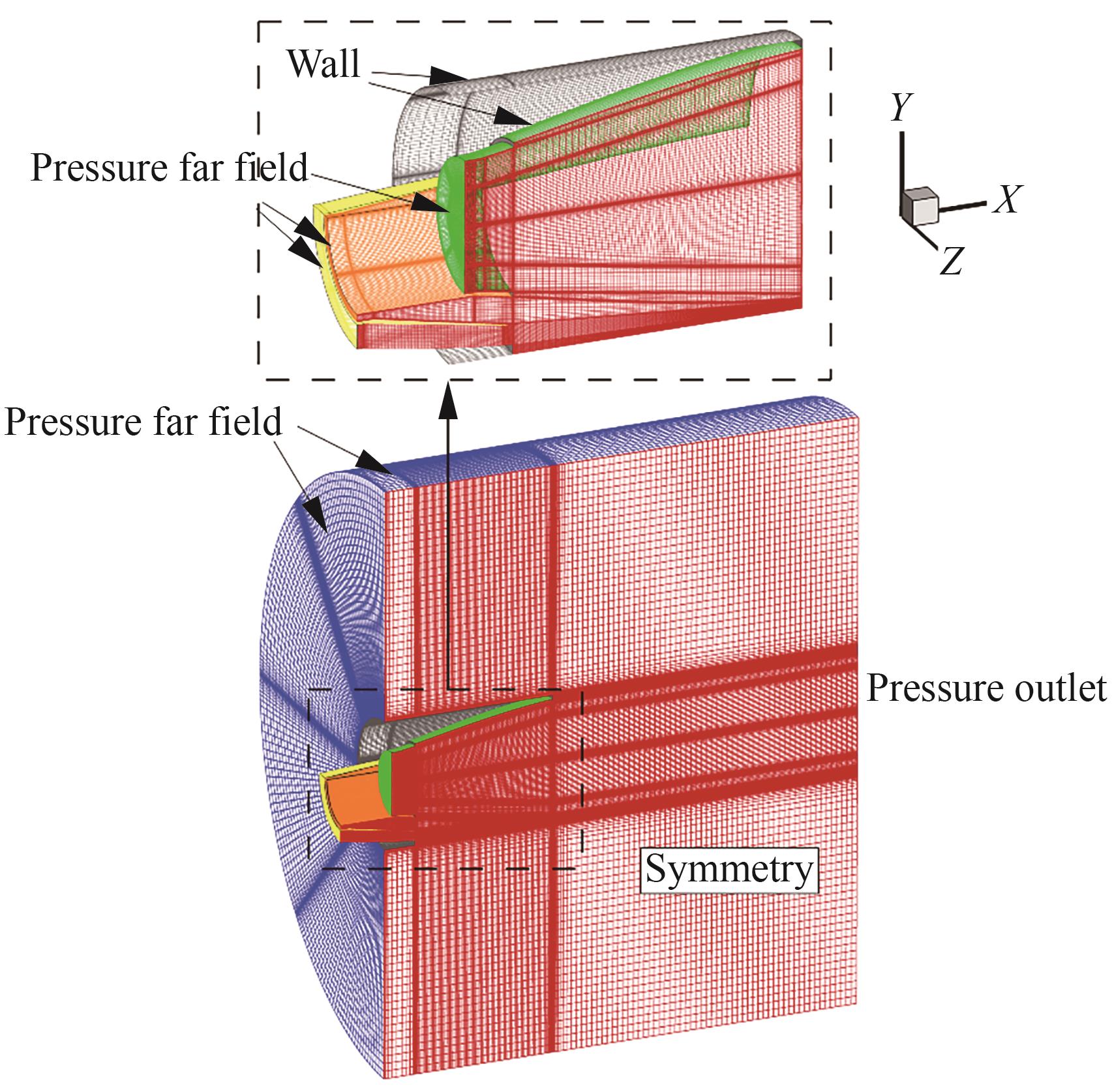
Fig.5
Pressure distribution on the center line of upper wall with different grids
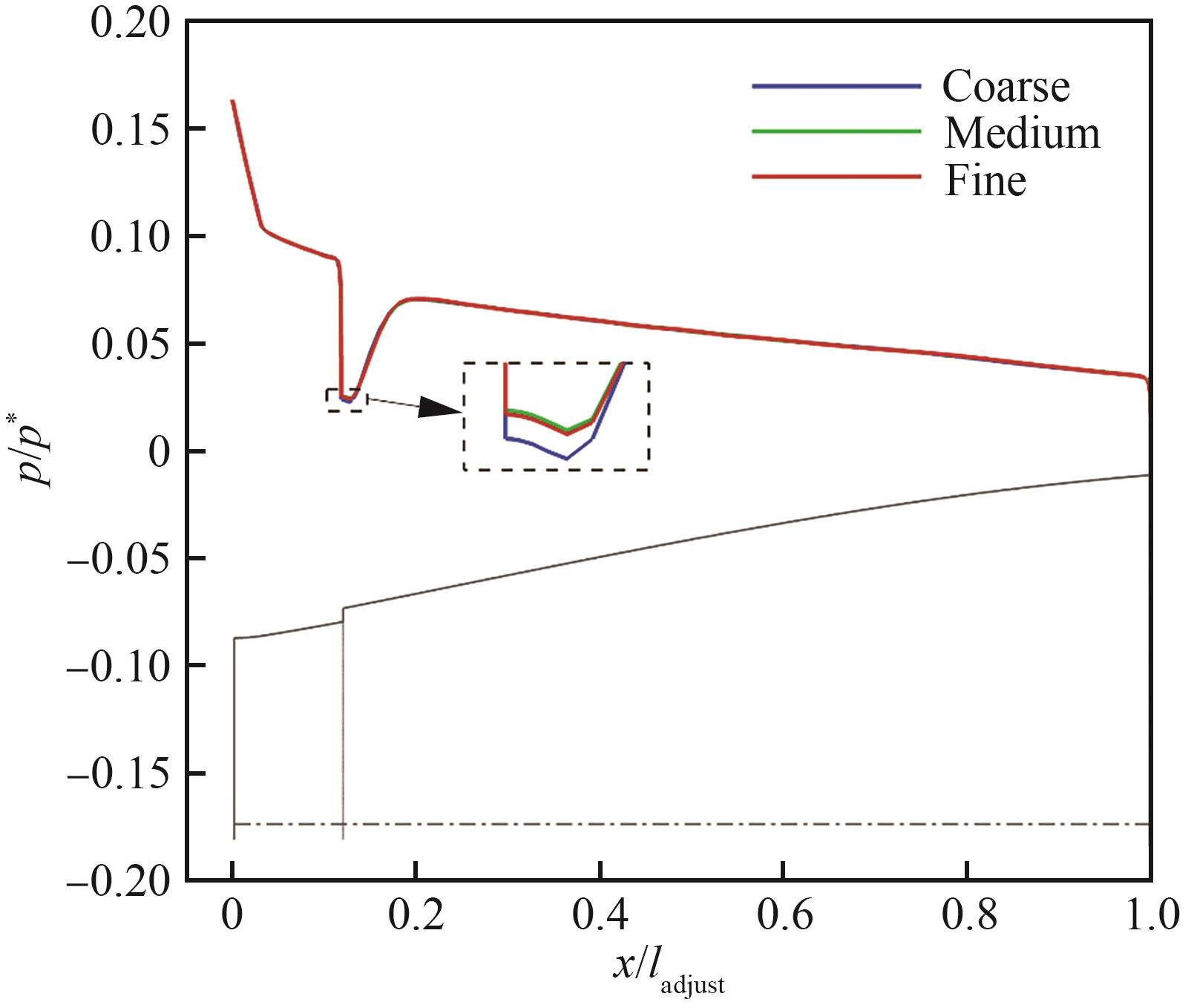
Fig.6
Mach number contours of the fixed geometry nozzle with different NPR
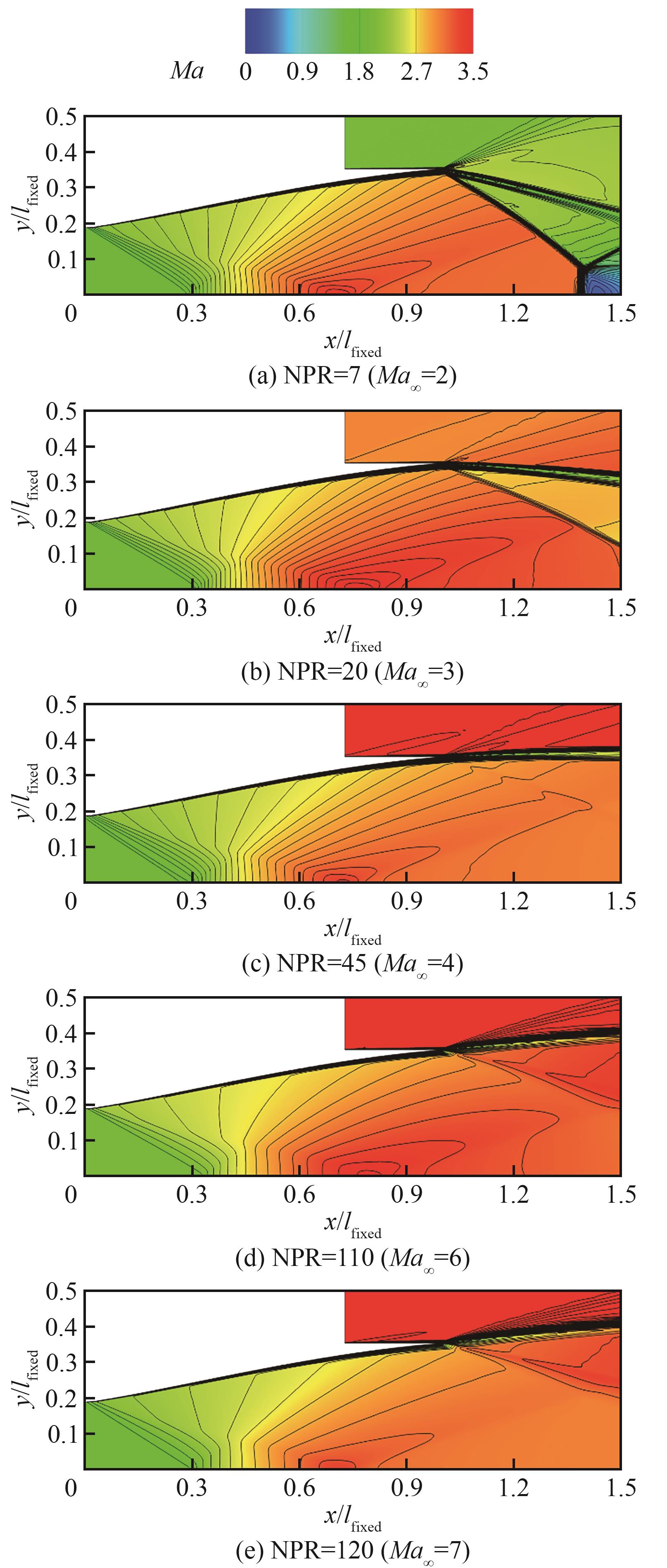
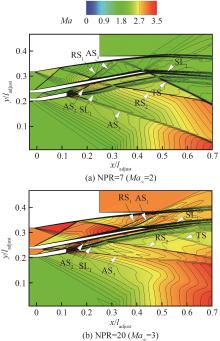
Fig.7
Mach number contours of the center meridian plane of no-TV-LMa mode
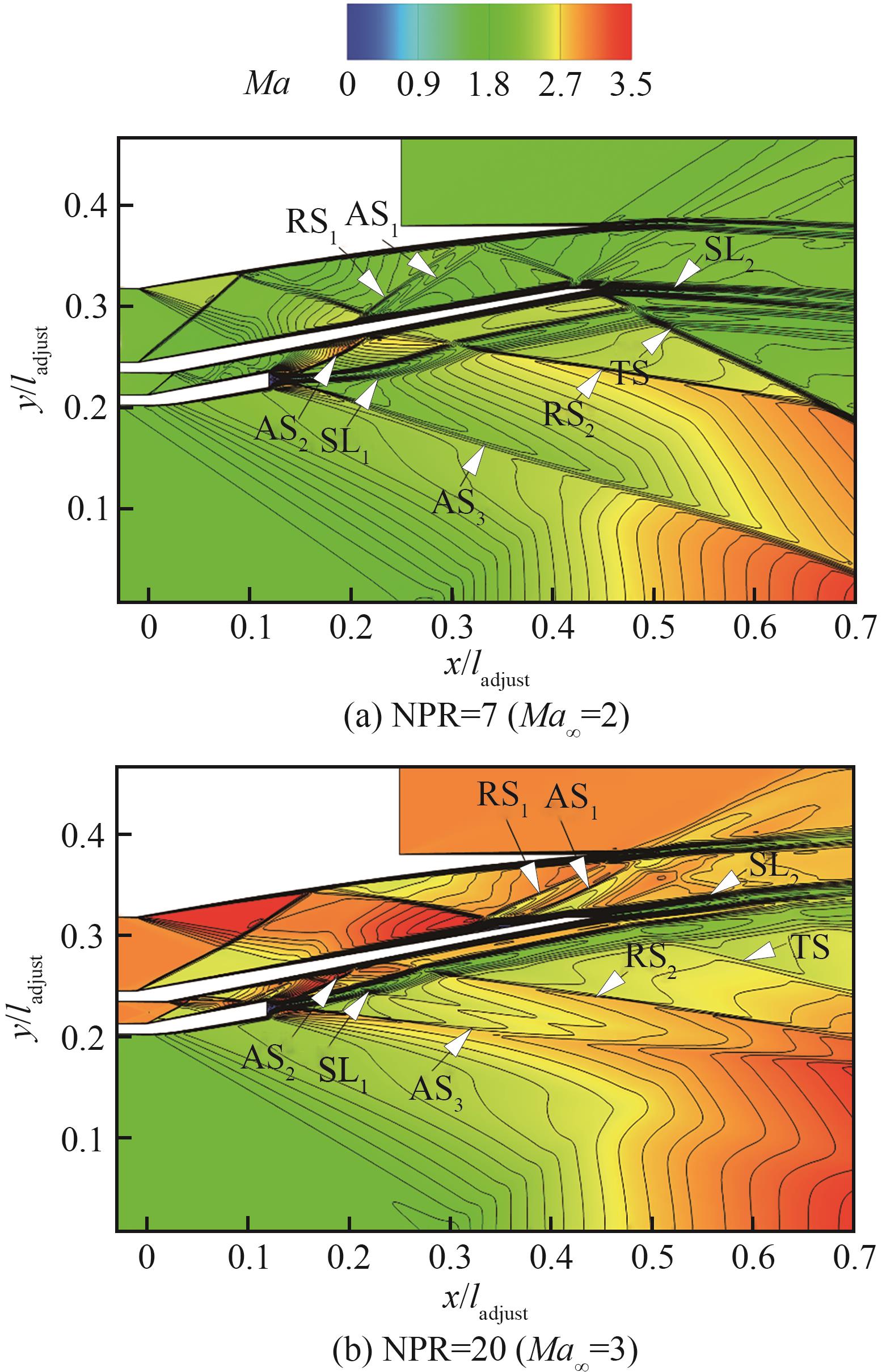
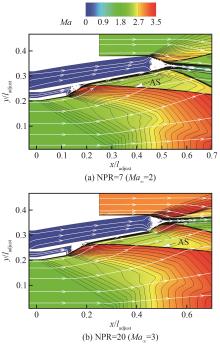
Fig.8
Mach number contours of no-TV-LMa mode with closed secondary flow
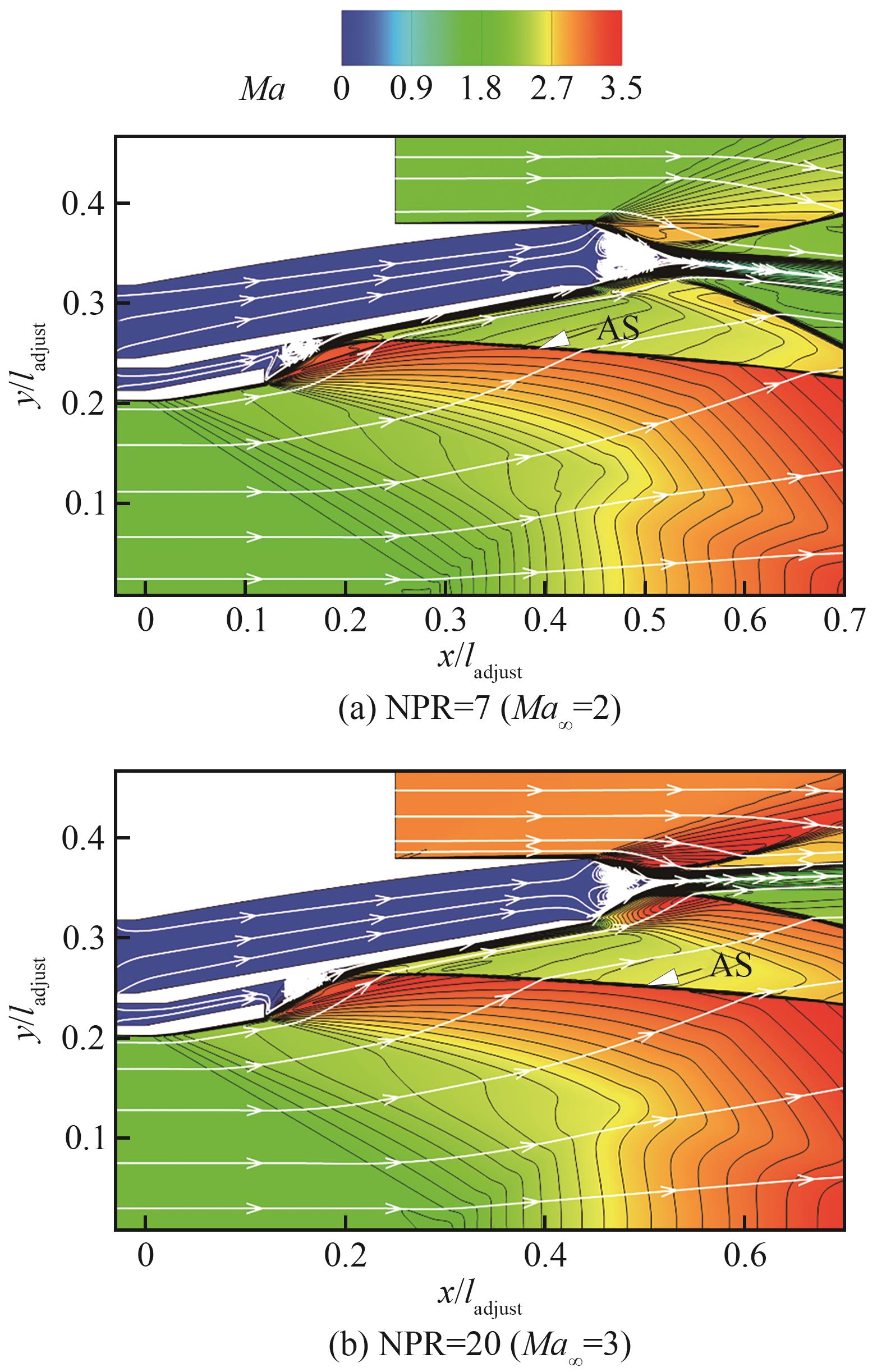
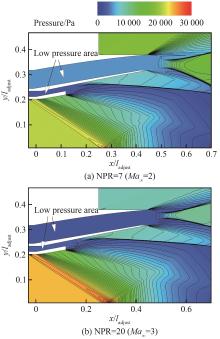
Fig.9
Pressure contours of no-TV-LMa mode with secondary flow closed
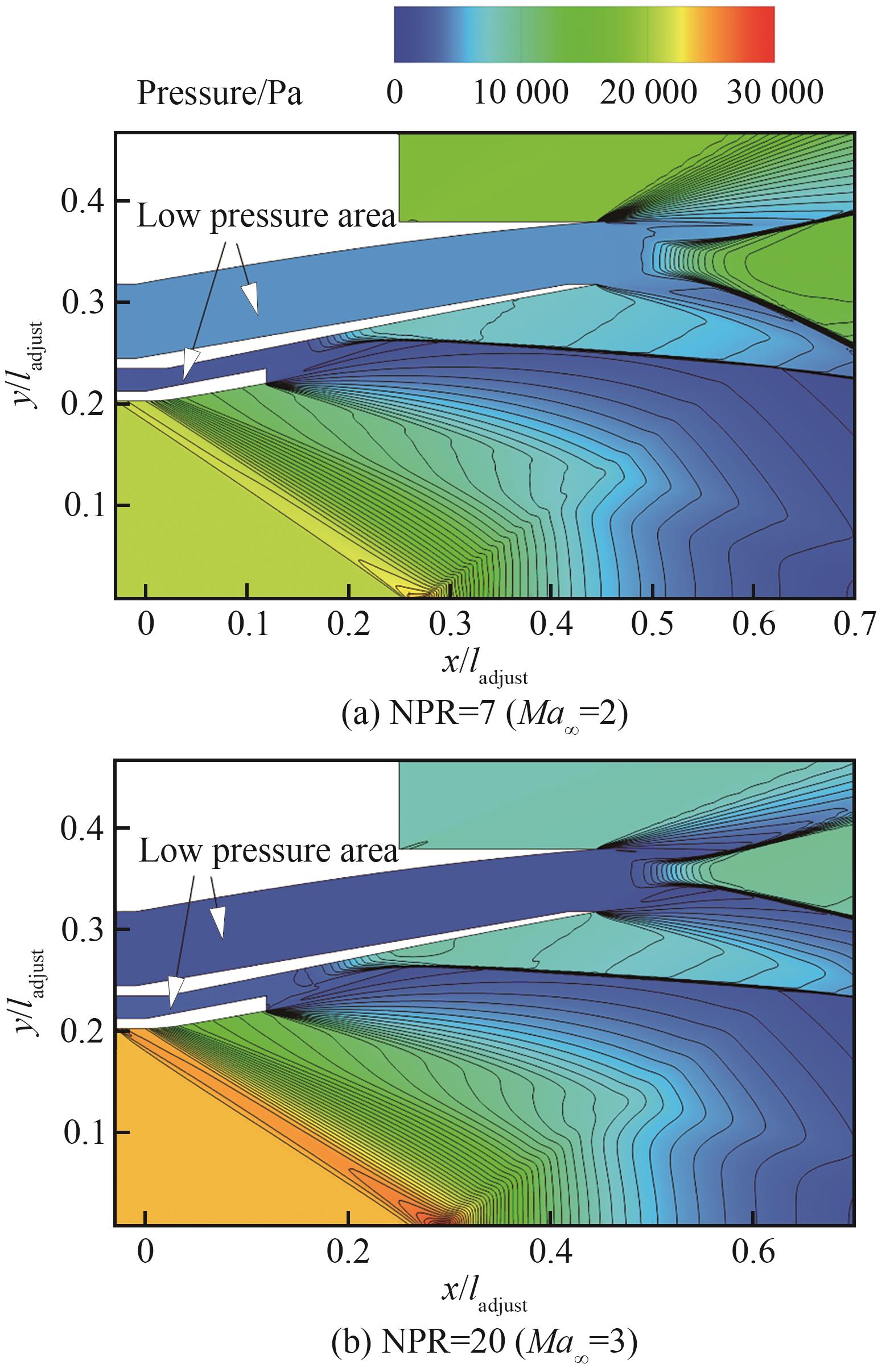
Table 3
Net thrust statistics of outer and middle ring flowpath with closed/open secondary flow
| 通道 | NPR | 次流状态 | 净推力 | 减阻幅度/% | ||
|---|---|---|---|---|---|---|
中环 次流通道 | 7 | 封闭 | -0.080 1 | 34.8 | ||
| 开启 | -0.052 2 | |||||
| 20 | 封闭 | -0.013 8 | 63.5 | |||
| 开启 | -0.005 0 | |||||
外环 次流通道 | 7 | 封闭 | -0.083 9 | 78.5 | ||
| 开启 | -0.018 0 | |||||
| 20 | 封闭 | -0.036 5 | 41.5 | |||
| 开启 | -0.021 4 | |||||
Table 4
Proportional relationship between base drag and axial thrust with closed/open secondary flow
| 通道 | NPR | 次流状态 | 底阻与喷管轴向 推力比值 |
|---|---|---|---|
| 中环次流通道 | 7 | 封闭 | 0.228 8 |
| 开启 | 0.045 1 | ||
| 20 | 封闭 | 0.020 2 | |
| 开启 | 0.003 5 | ||
| 外环次流通道 | 7 | 封闭 | 0.239 8 |
| 开启 | 0.015 6 | ||
| 20 | 封闭 | 0.053 7 | |
| 开启 | 0.015 1 |
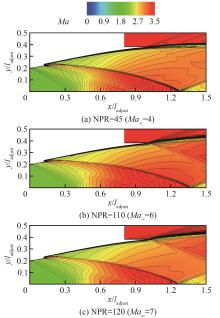
Fig.10
Mach number contours of no-TV-HMa mode
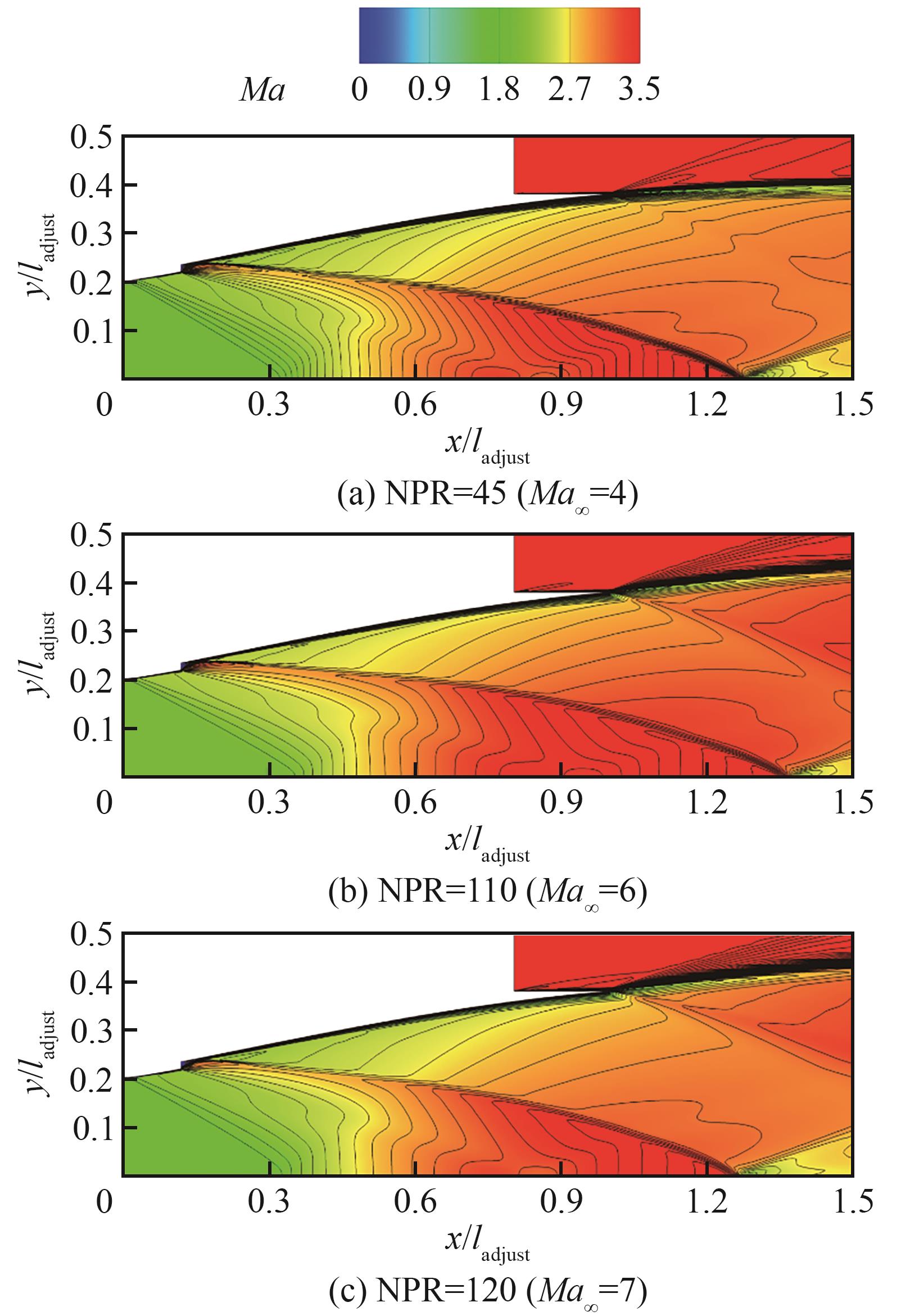
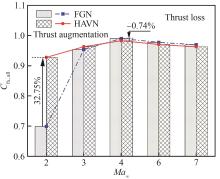
Fig.11
Thrust coefficient within the flight envelope of two nozzles in no-TV mode
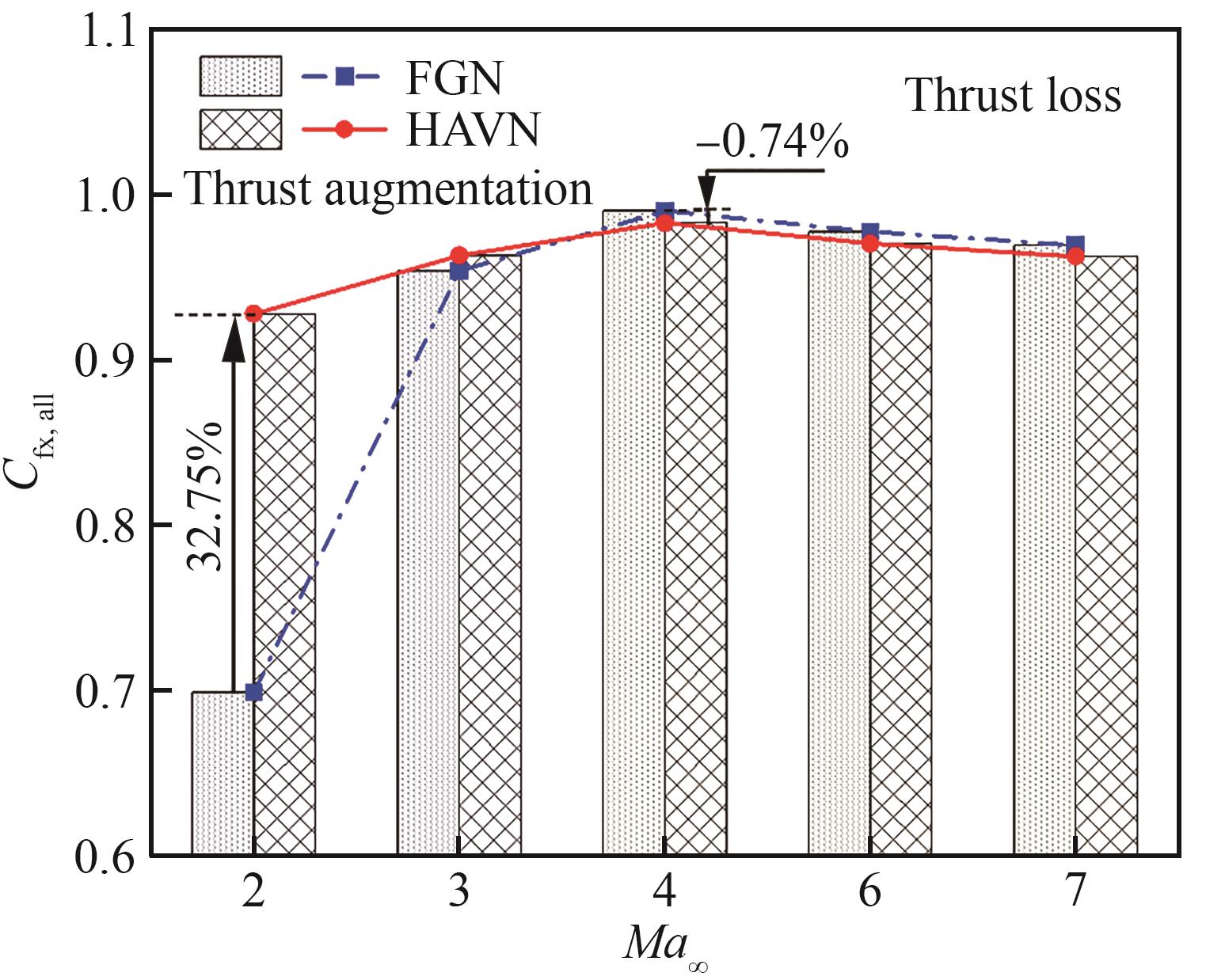
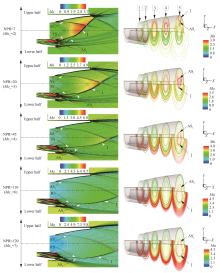
Fig.12
Mach number contours of hypersonic adjustable vector nozzle in TV mode
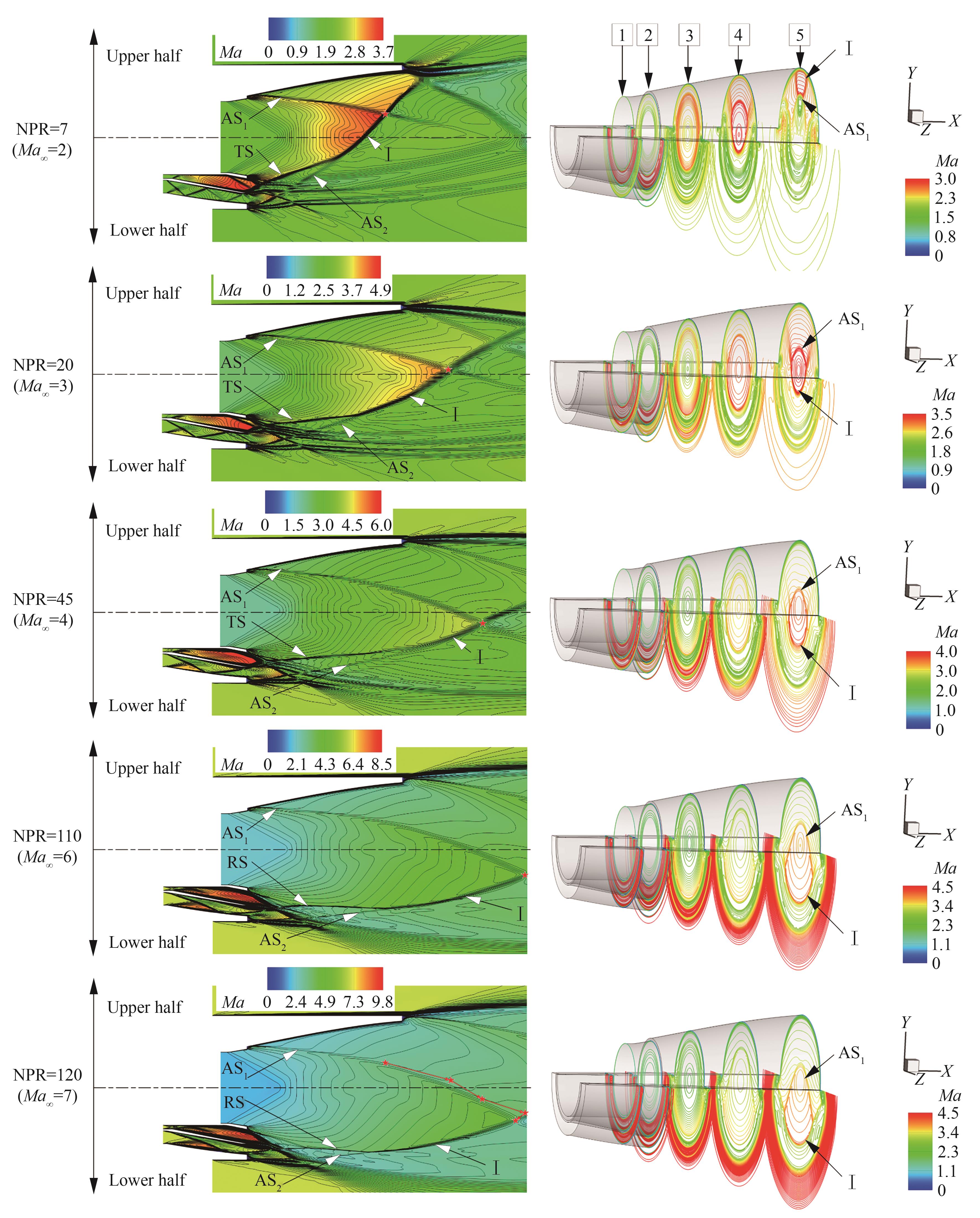
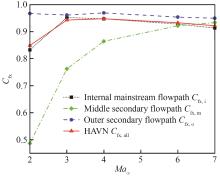
Fig.13
Thrust coefficient of hypersonic vector nozzle and each ring flowpath in TV mode
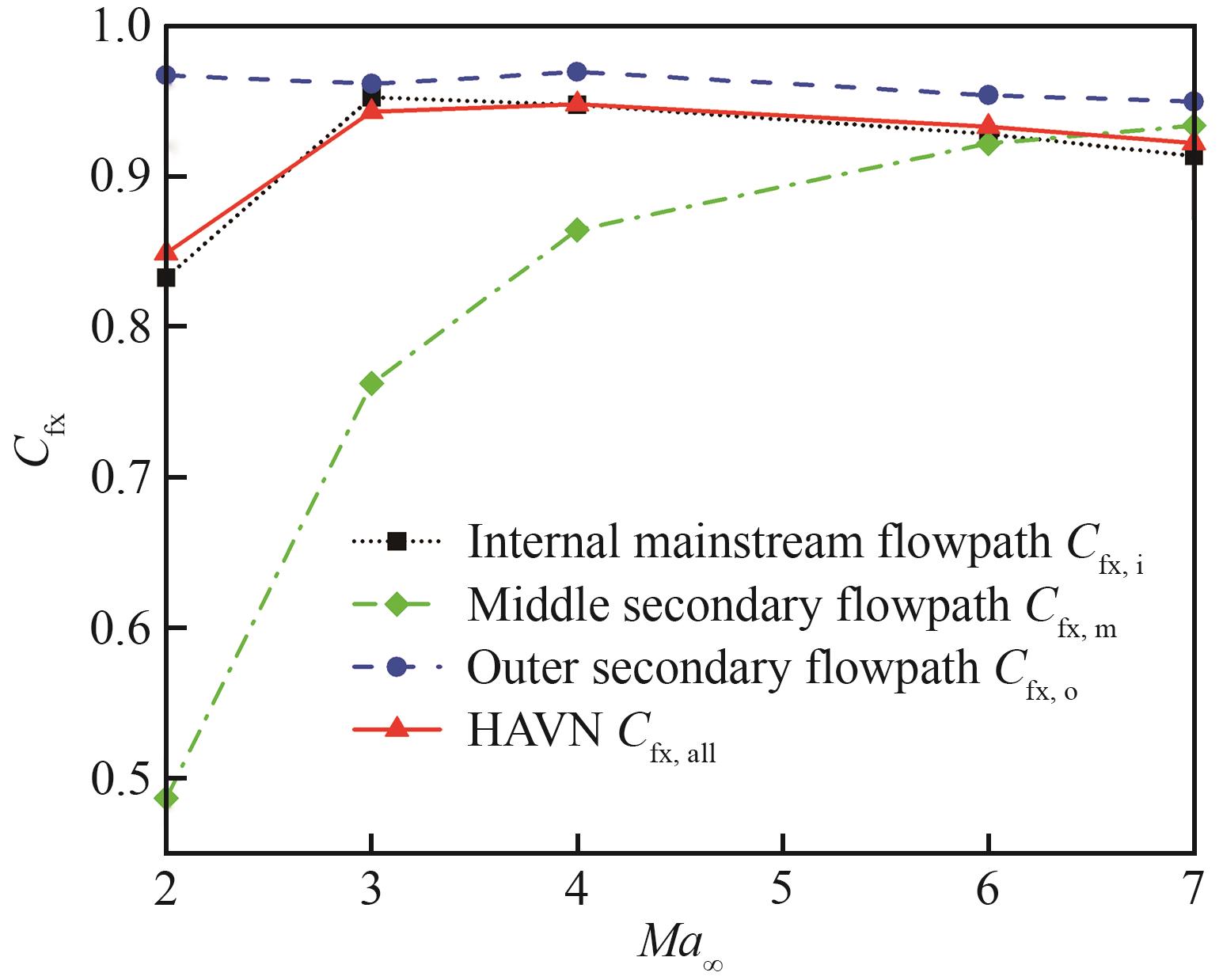
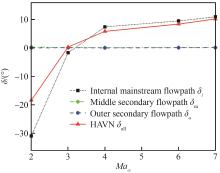
Fig.14
Vector angle of hypersonic vector nozzle and each ring flowpath in TV mode
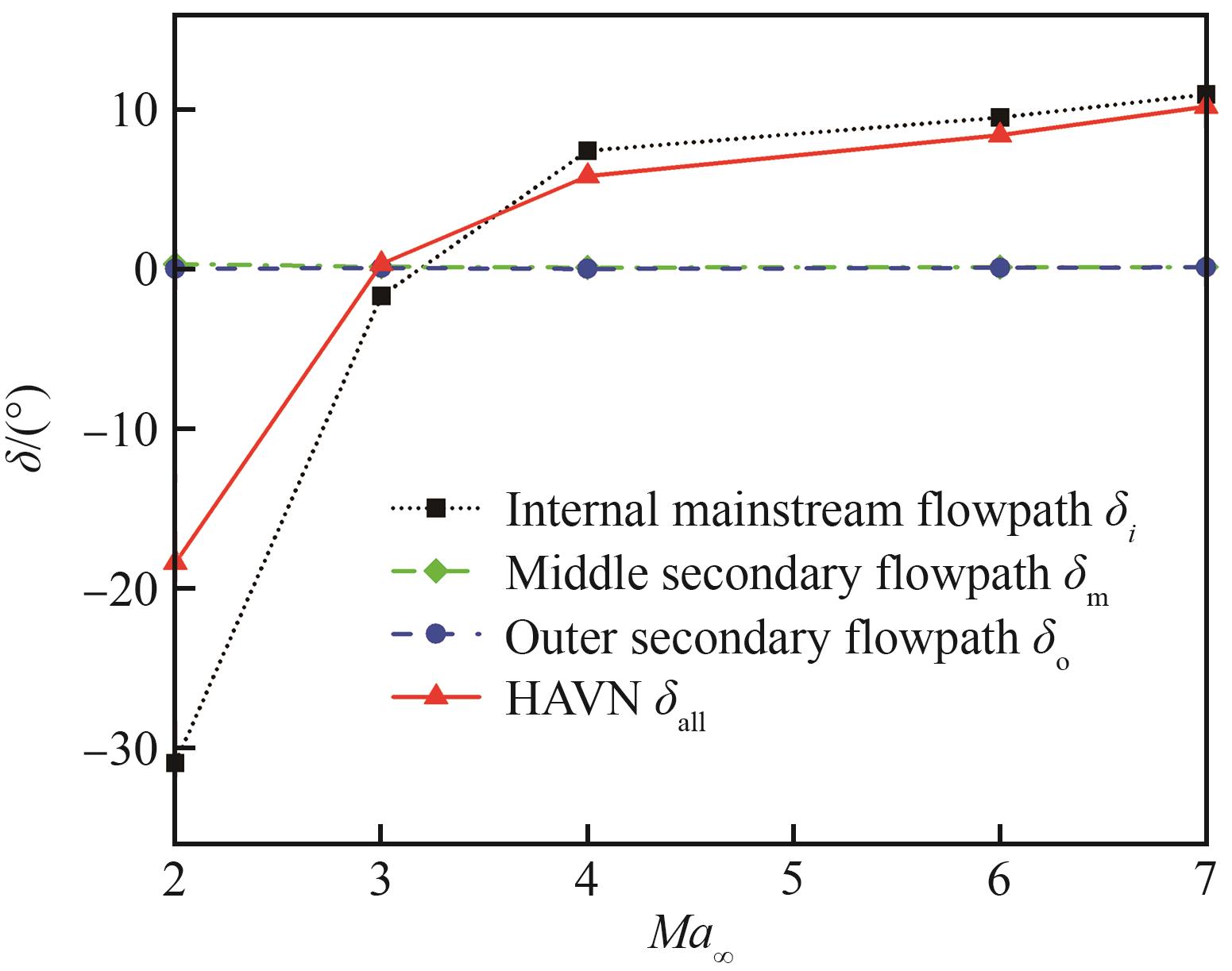
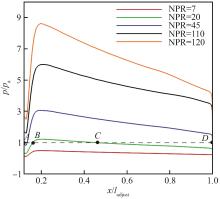
Fig.15
Pressure distribution at the wall center line of middle and outer ring expansion sections of upper half of the nozzle in TV mode
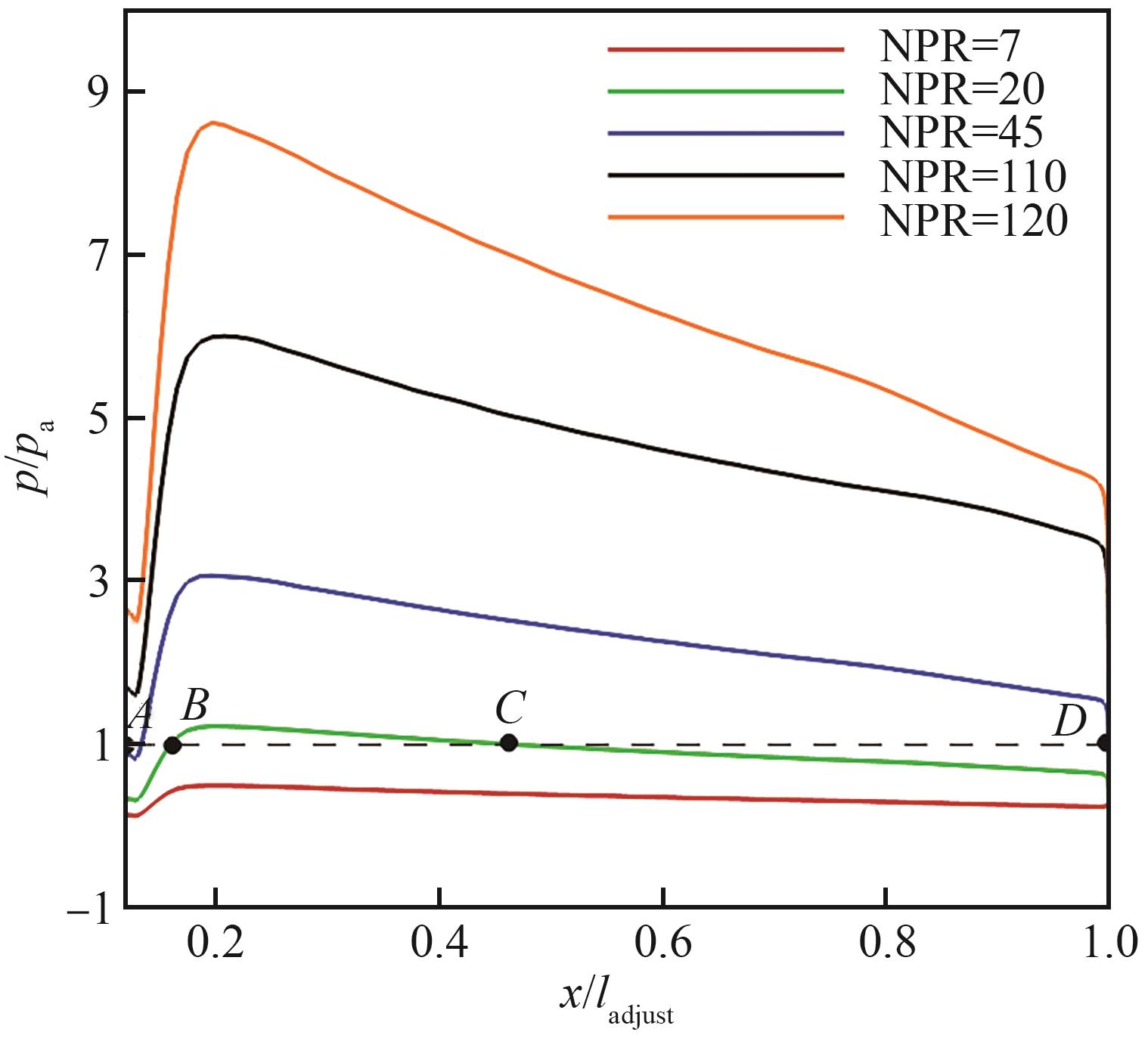
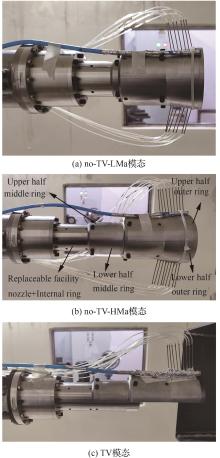
Fig.16
Bench-mounted view of the scaled-down test model of hypersonic adjustable vector nozzle
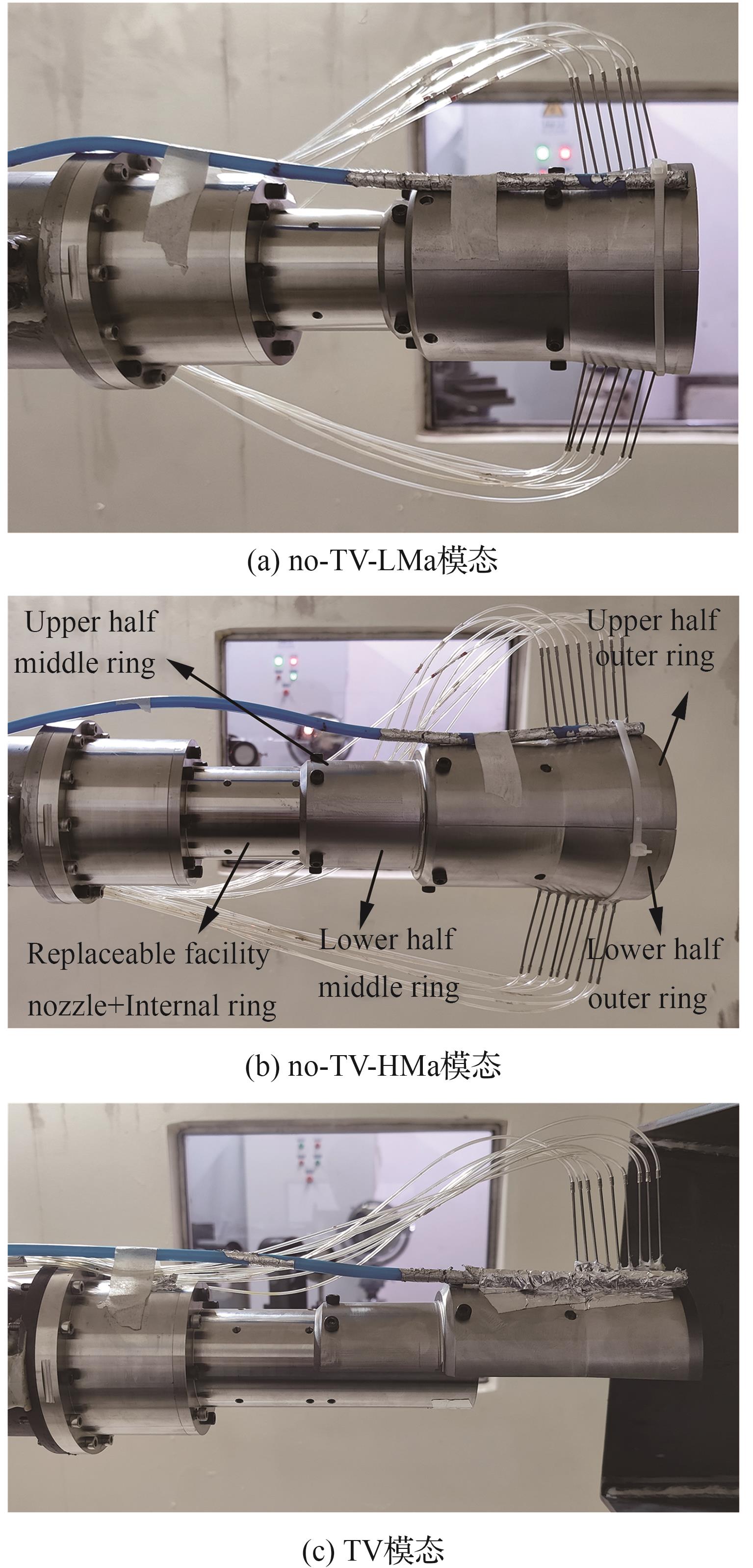
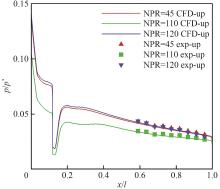
Fig.17
Comparison of experimental and simulated wall pressure in no-TV-HMa mode
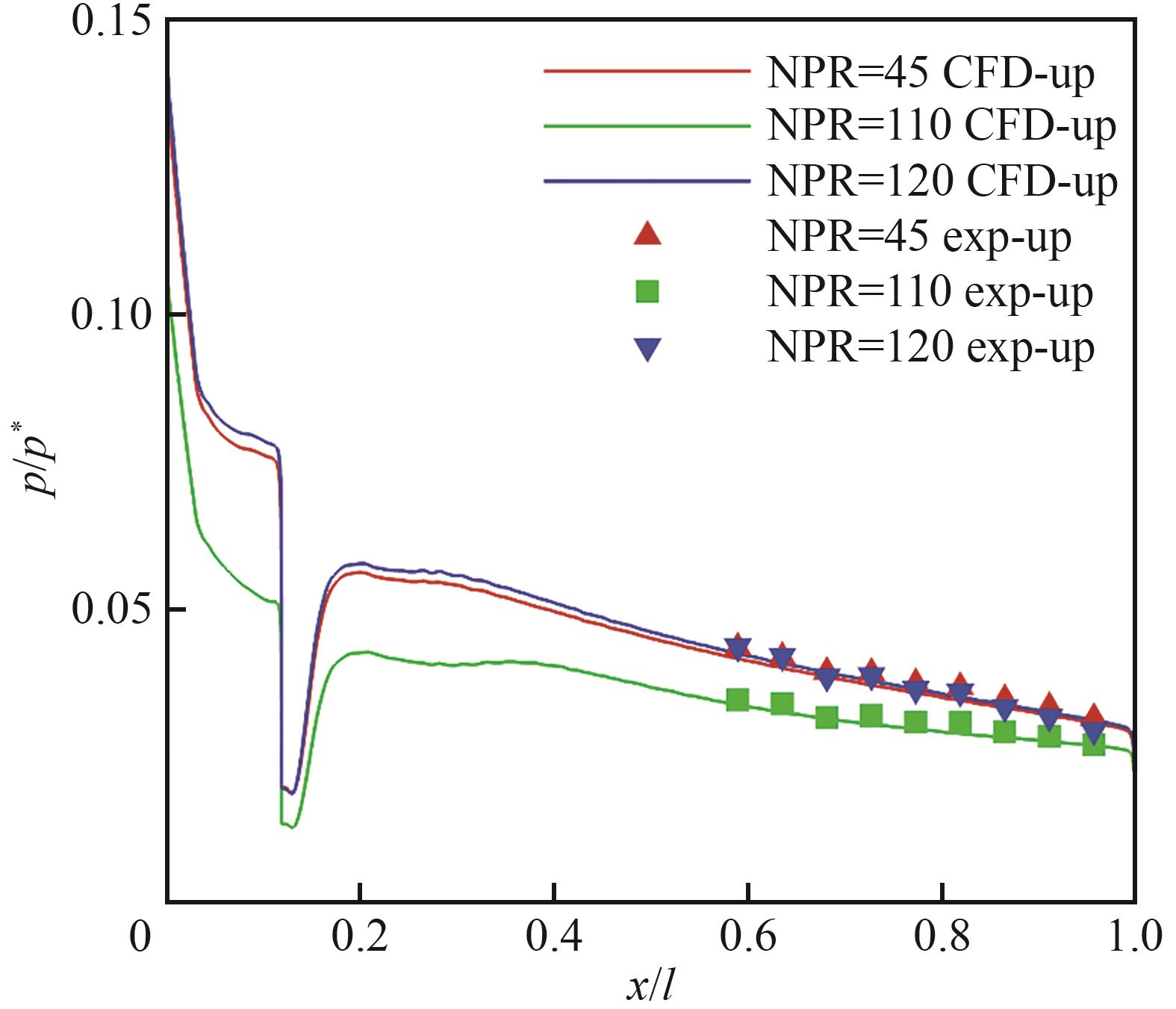
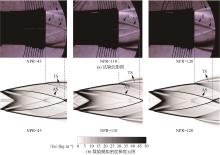
Fig.18
Comparison of experimental ripple shadows and density gradient cloud maps in no-TV-HMa mode
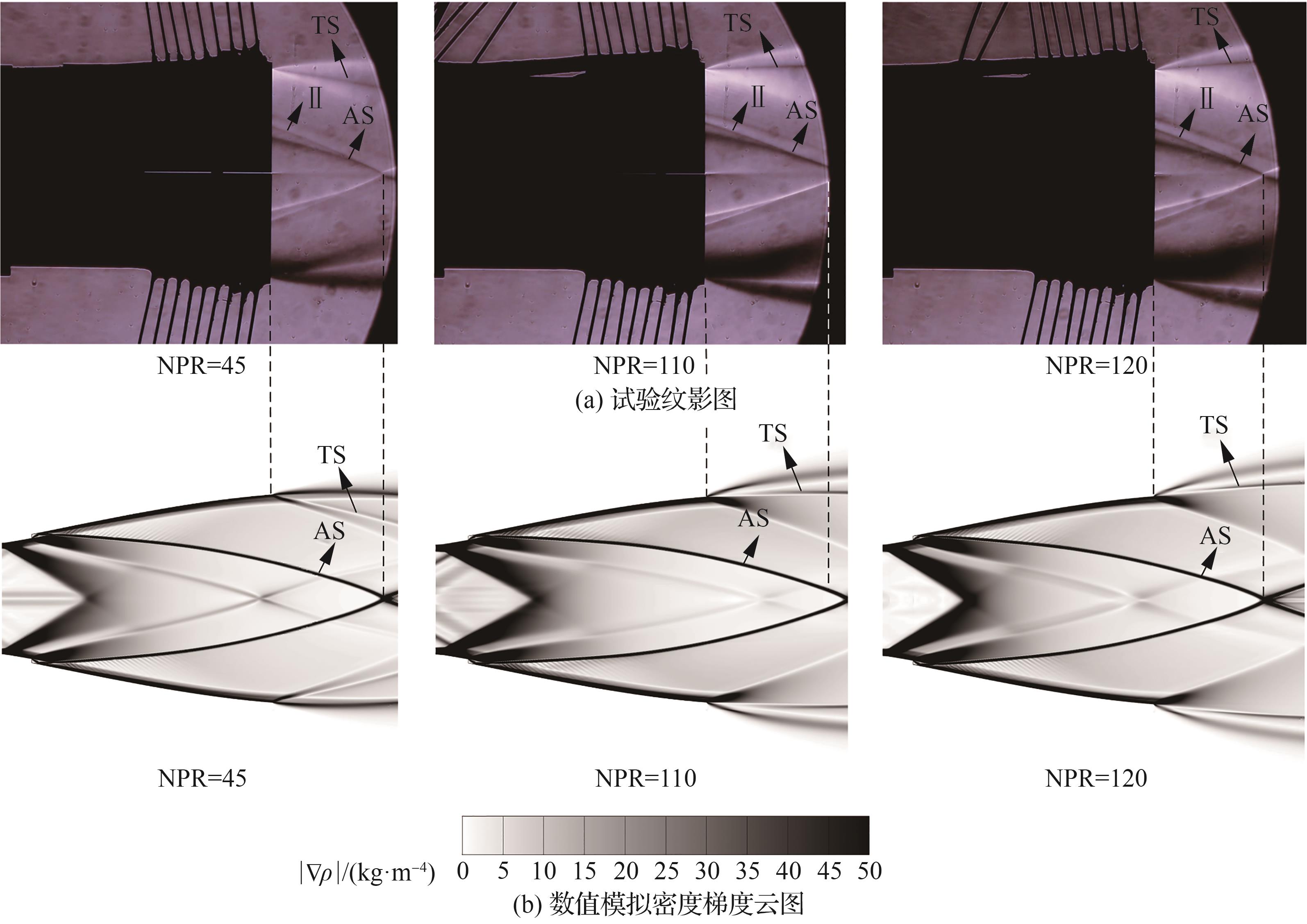
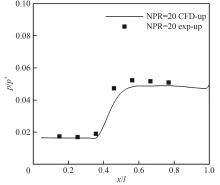
Fig.19
Comparison of experimental and simulated wall pressure in no-TV-LMa mode
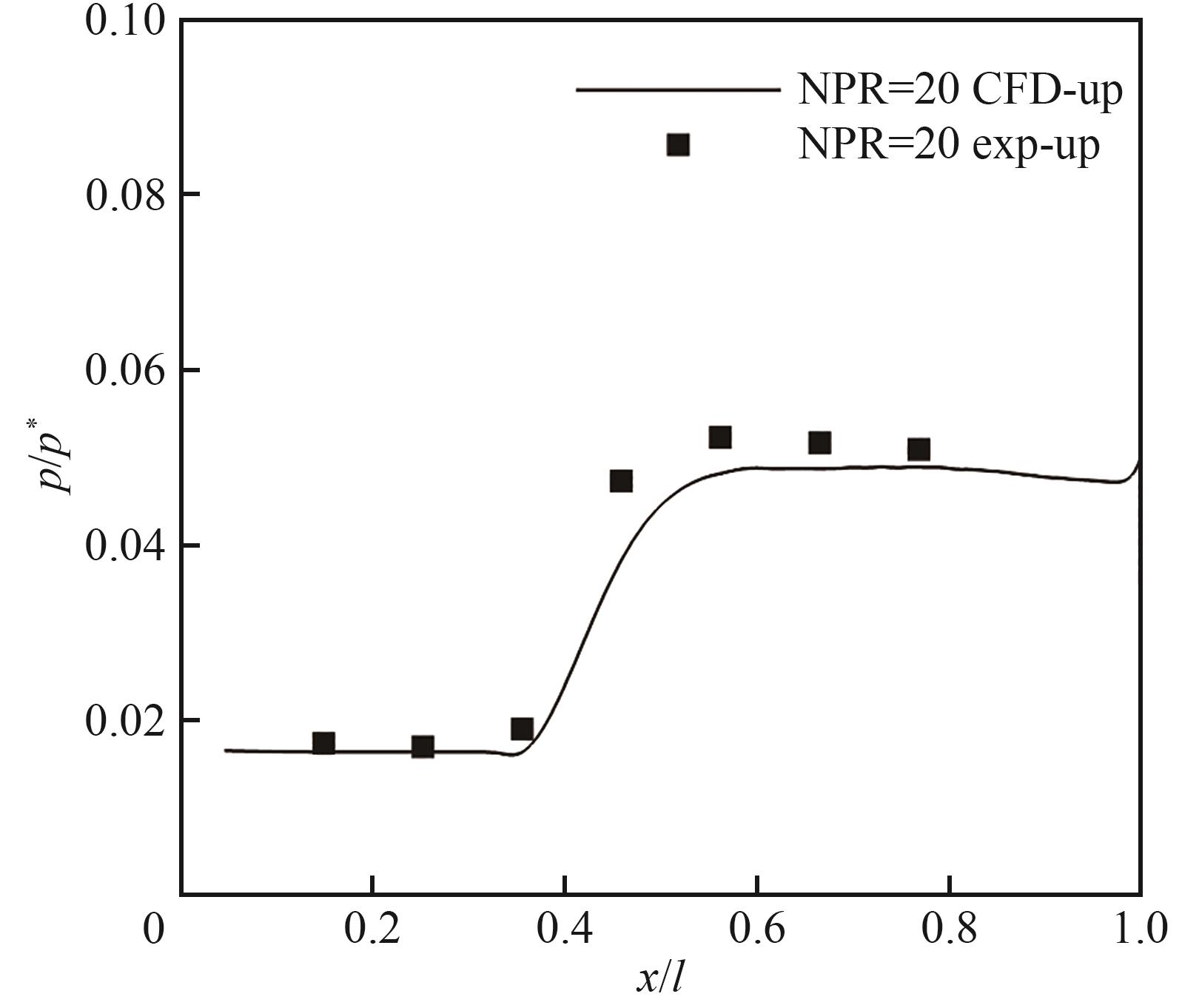
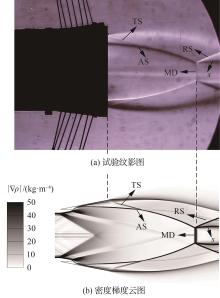
Fig.20
Comparison of experimental ripple shadows and density gradient cloud maps in no-TV-LMa mode
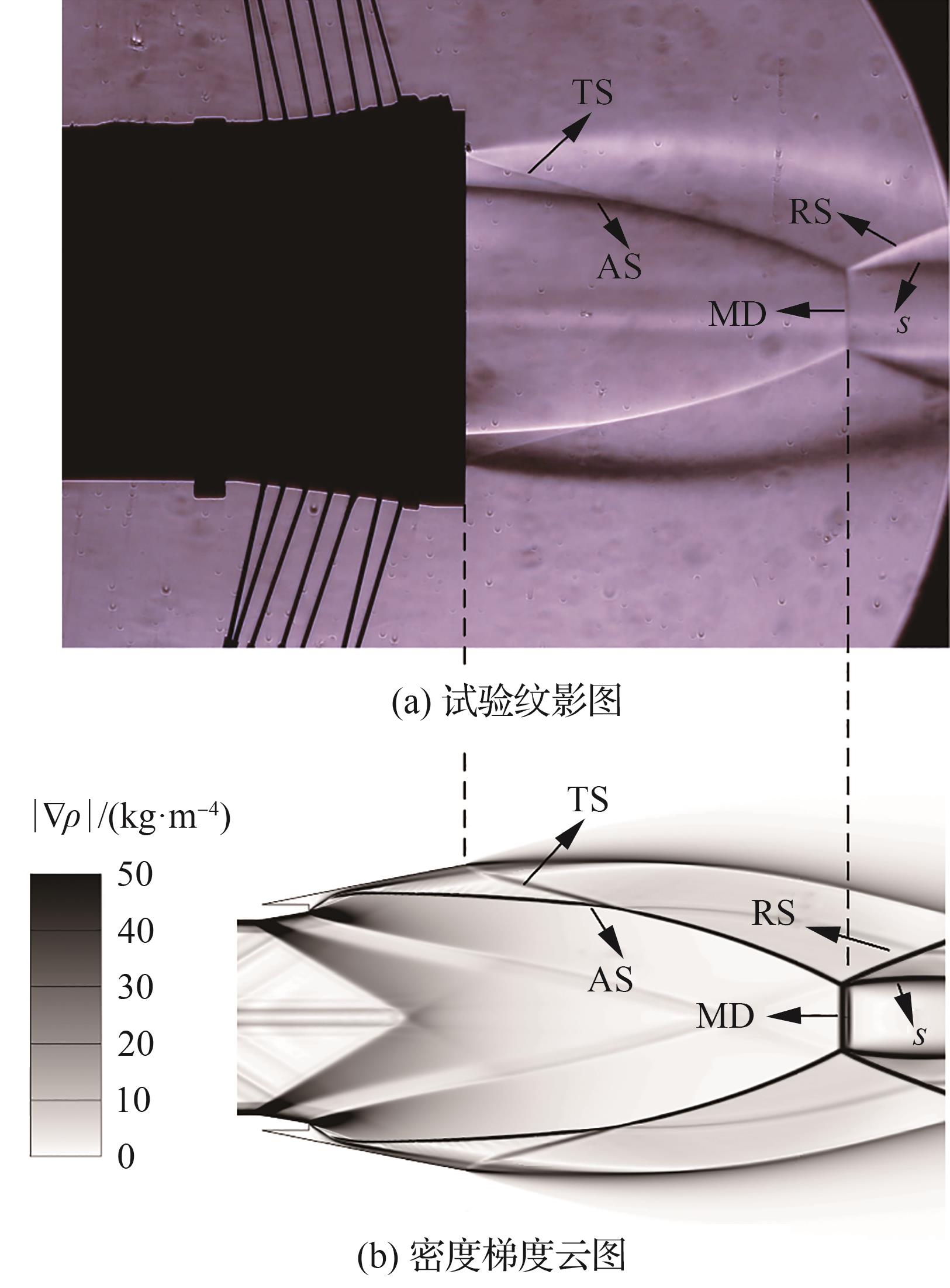
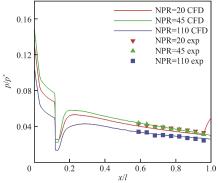
Fig.21
Comparison of experimental and simulated wall pressure in TV mode
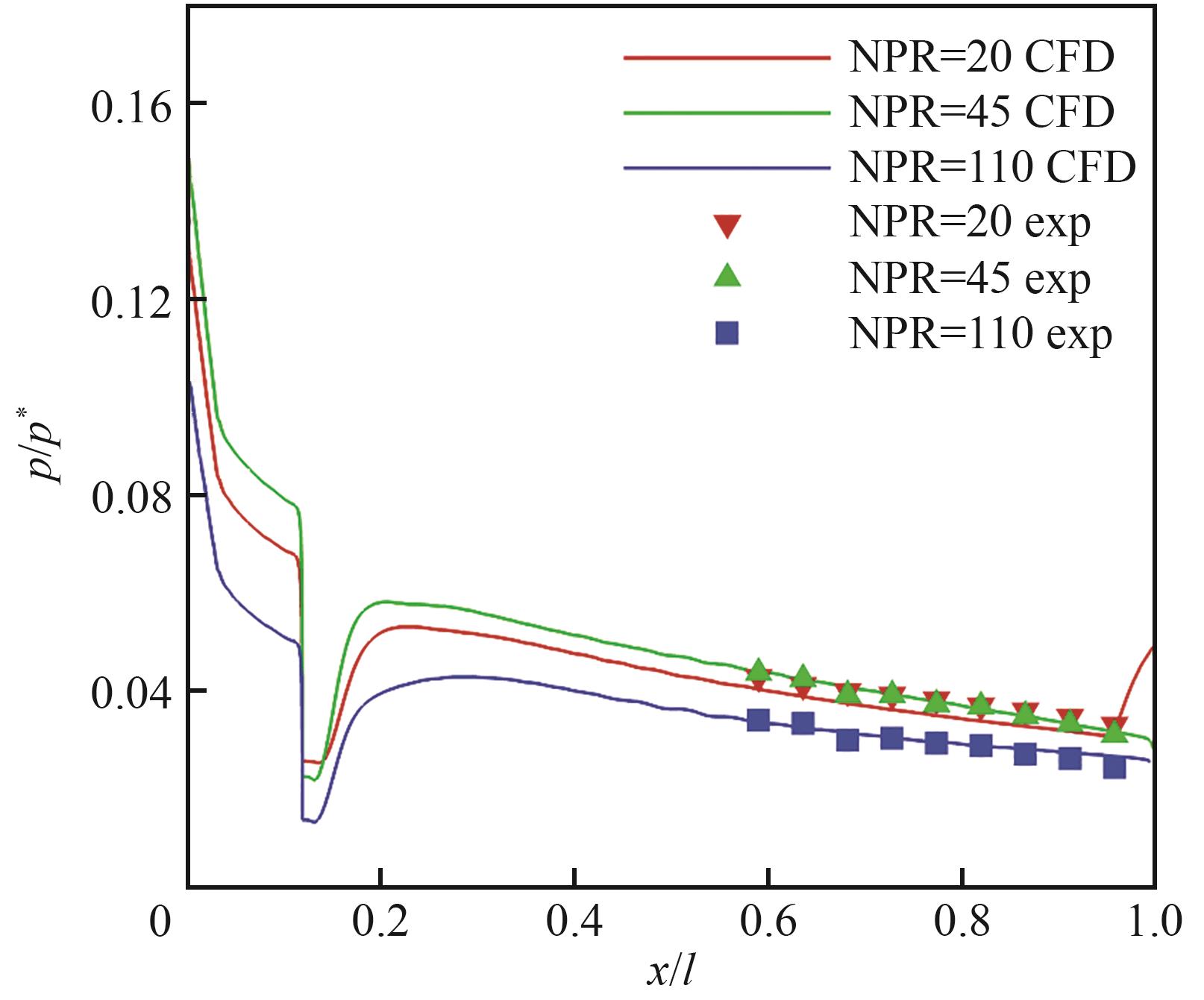
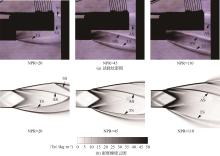
Fig.22
Comparison of experimental ripple shadows and density gradient cloud maps in TV mode
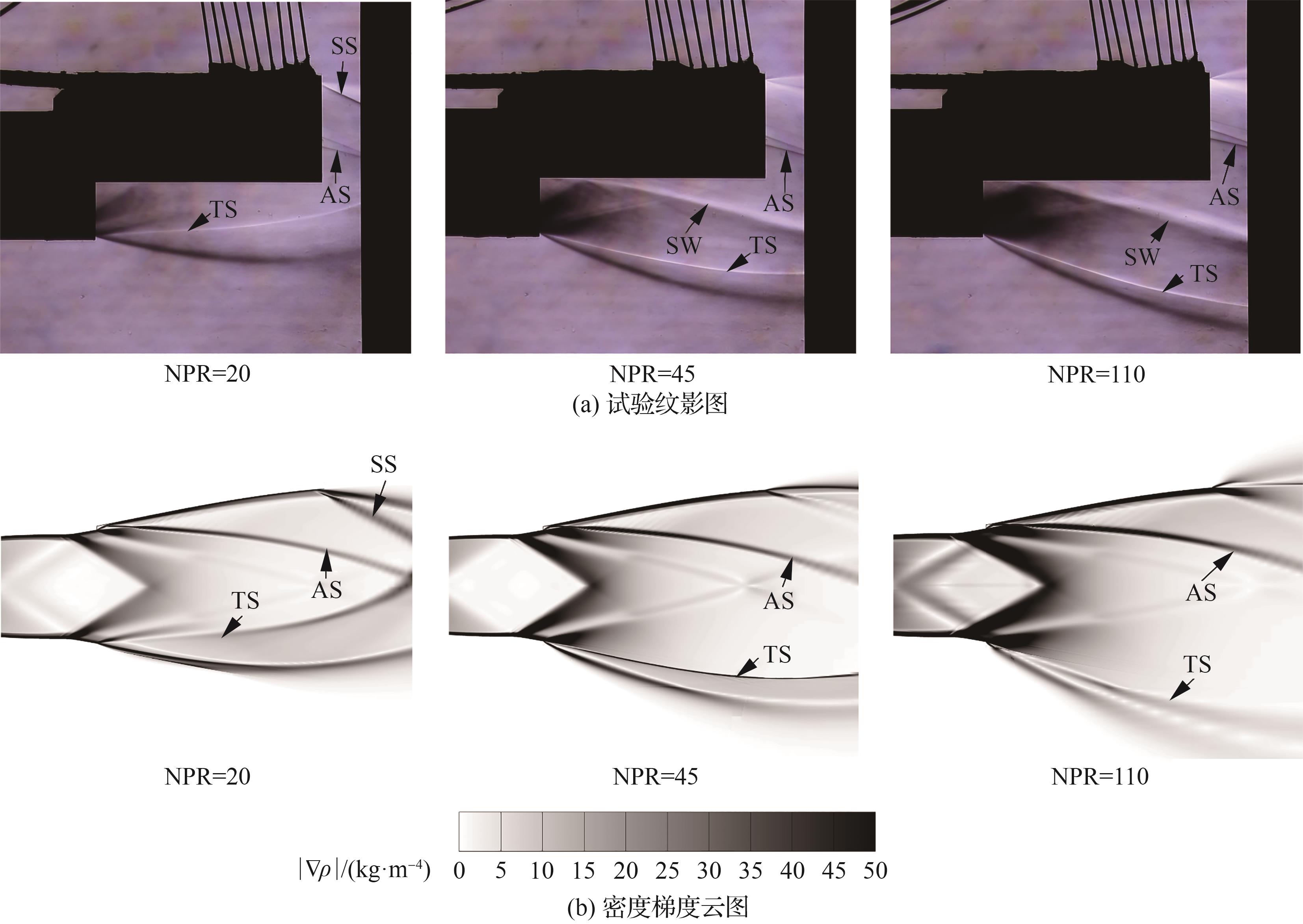
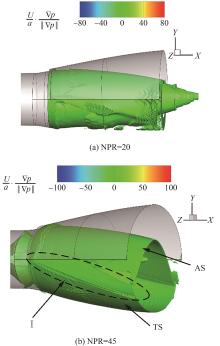
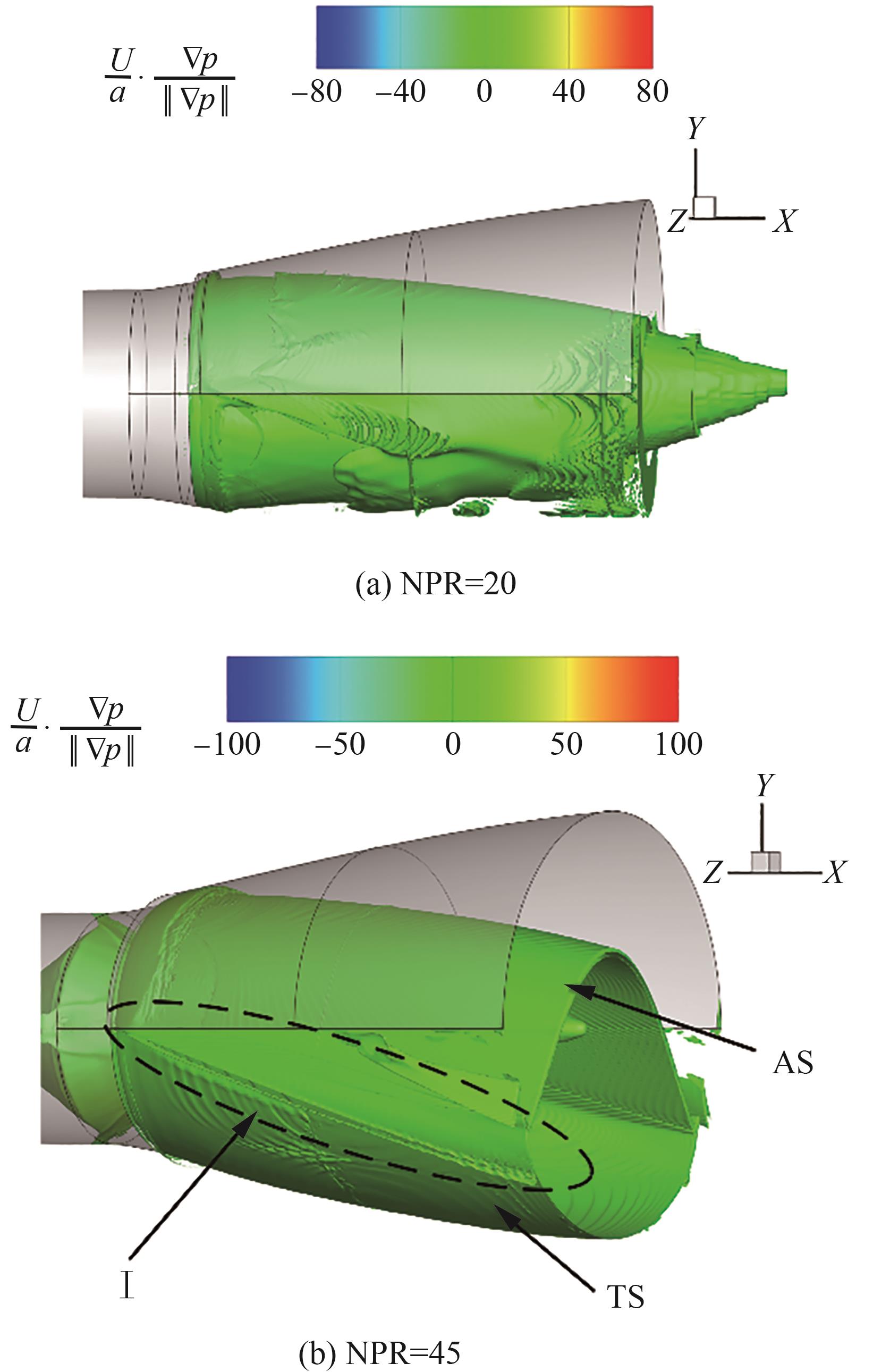
Fig.23
Shock wave contours of TV mode
| 1 | 赵鹏飞, 董长虹. 高超声速飞行器关键技术发展分析[J]. 飞航导弹, 2017(10): 37-44. |
| ZHAO P F, DONG C H. Development and analysis of key technologies of hypersonic vehicle[J]. Aerodynamic Missile Journal, 2017(10): 37-44 (in Chinese). | |
| 2 | 林鹏, 庄福建, 曲林锋, 等. 高超声速飞机尾喷管设计-制造与验证技术发展综述[J]. 航空学报, 2022, 43(6): 526160. |
| LIN P, ZHUANG F J, QU L F, et al. Technological development in hypersonic nozzle design, manufacture and validation: A review[J]. Acta Aeronauticaet Astronautica Sinica, 2022, 43(6): 526160 (in Chinese). | |
| 3 | FOELSCHE R, LEYLEGIAN J, BETTI A, et al. Progress on the development of a freeflight atmospheric scramjet test technique: AIAA-2005-3297[R]. Reston: AIAA, 2005. |
| 4 | 刘文, 郭帅旗, 刘洋, 等. 乘波体设计与优化研究进展-从高超声速至宽速域[J]. 力学学报, 2024, 56(6): 1655-1677. |
| LIU W, GUO S Q, LIU Y, et al. Advances in design and optimization of waverider-From hypersonic to wide-speed range[J]. Chinese Journal of Theoretical and Applied Mechanics, 2024, 56(6): 1655-1677 (in Chinese). | |
| 5 | 程思野, 曾宏刚, 潘鑫, 等. 宽域高超声速飞机气动设计中面临的若干关键问题[C]∥第六届中国航空科学技术大会论文集. 北京: 北京航空航天大学出版社, 2023: 1408-1422. |
| CHENG S Y, ZENG H G, PAN X, et al. Several key issues faced in the aerodynamic design of wide-range hypersonic aircraft[C]∥The 6th China Aeronautical Science and Technology Conference. Beijing: Beihang University Press, 2023: 1408-1422 (in Chinese). | |
| 6 | 王书贤. 几何可调喷管的结构特点及发展[J]. 兵器装备工程学报, 2018, 39(1): 6-13. |
| WANG S X. Review on structural characteristics and development of geometric variable nozzle[J]. Journal of Ordnance Equipment Engineering, 2018, 39(1): 6-13 (in Chinese). | |
| 7 | KOJIMA T, TAGUCHI H, KOBAYASHI H, et al. Design and fabrication of variable nozzle for precooled turbojet engine: AIAA-2009-7312[R]. Reston: AIAA, 2009. |
| 8 | JOHNSON G R, THOMPSON H D, HOFFMAN J D. Design of maximum thrust plug nozzles with variable inlet geometry[J]. Computers & Fluids, 1974, 2(2): 173-190. |
| 9 | DEERE K, ASBURY S. An experimental and computational investigation of a translating throat single expansion-ramp nozzle: AIAA-1996-2540[R]. Reston: AIAA, 1996. |
| 10 | CULLER A J, MCNAMARA J J. Studies on fluid-thermal-structural coupling for aerothermoelasticity in hypersonic flow[J]. AIAA Journal, 2010, 48(8): 1721-1738. |
| 11 | 王常虹, 安昊. 吸气式高超声速飞行器控制技术综述与展望[J]. 飞航导弹, 2021(6): 122-126, 132. |
| WANG C H, AN H. Overview and prospect of control technology for air-breathing hypersonic vehicle[J]. Aerodynamic Missile Journal, 2021(6): 122-126, 132 (in Chinese). | |
| 12 | 陈经纬, 陈康, 尙妮妮, 等. 基于气动力/推力矢量控制的飞行器性能分析[J]. 西北工业大学学报, 2014, 32(6): 877-881. |
| CHEN J W, CHEN K, SHANG N N, et al. Performance analysis of hypersonic vehicles based on aerodynamic/thrust vector control[J]. Journal of Northwestern Polytechnical University, 2014, 32(6): 877-881 (in Chinese). | |
| 13 | 肖中云, 江雄, 牟斌, 等. 流体推力矢量技术研究综述[J]. 实验流体力学, 2017, 31(4): 8-15. |
| XIAO Z Y, JIANG X, MOU B, et al. Advances influidic thrust vectoring technique research[J]. Journal of Experiments in Fluid Mechanics, 2017, 31(4): 8-15 (in Chinese). | |
| 14 | 崔祚, 汪阳生. 飞行器推力矢量喷管研究综述[J]. 飞航导弹, 2021(12): 158-167. |
| CUI Z, WANG Y S. Summary of research on aircraft thrust vector nozzle[J]. Aerodynamic Missile Journal, 2021(12): 158-167 (in Chinese). | |
| 15 | WU K X, KIM T H, KIM H D. Numerical study of fluidic thrust vector control using dual throat nozzle[J]. Journal of Applied Fluid Mechanics, 2021, 14(1): 73-87. |
| 16 | DEERE K. Summary of fluidic thrust vectoring research at NASA langley research center: AIAA-2003-3800[R]. Reston: AIAA, 2003. |
| 17 | 陈伟, 吴晓燕, 唐意东. 推力矢量控制技术在临近空间飞行器上的应用[J]. 飞航导弹, 2013(5): 64-70. |
| CHEN W, WU X Y, TANG Y D. The application of thrust vector control technology in near space vehicles[J]. Aerodynamic Missile Journal, 2013(5): 64-70 (in Chinese). | |
| 18 | DENG R Y, KONG F S, KIM H D. Numerical simulation of fluidic thrust vectoring in an axisymmetric supersonic nozzle[J]. Journal of Mechanical Science and Technology, 2014, 28(12): 4979-4987. |
| 19 | KONG F S, JIN Y Z, KIM H D. Thrust vector control of supersonic nozzle flow using a moving plate[J]. Journal of Mechanical Science and Technology, 2016, 30(3): 1209-1216. |
| 20 | WU Y S, JIANG J, GU C F, et al. Effect of thrust vectoring technology on taking-off performance of hypersonic vehicle[J]. MATEC Web of Conferences, 2015, 31: 02004. |
| 21 | 王浩亮, 秦国政, 王青云, 等. 带矢量喷管的高超声速飞行器的跟踪控制[J]. 中国科学: 物理学, 力学, 天文学, 2013, 43(4): 415-423. |
| WANG H L, QIN G Z, WANG Q Y, et al. Tracking control for a hypersonic air-breathing vehicle with thrust vectoring nozzles[J]. Scientia Sinica Physica, Mechanica & Astronomica, 2013, 43(4): 415-423 (in Chinese). | |
| 22 | WIlCOX D C. Turbulence Modeling for CFD[M]. California: DCW Industries, 1998. |
| 23 | RODI W, SCHEUERER G. Scrutinizing the k-ε turbulence model under adverse pressure gradient conditions[J]. Journal of Fluids Engineering, 1986, 108(2): 174-179. |
| 24 | 曾宇, 汪洪波, 孙明波, 等. SST湍流模型改进研究综述[J]. 航空学报, 2023, 44(9): 27411. |
| ZENG Y, WANG H B, SUN M B, et al. SST turbulence model improvements: Review[J]. Acta Aero-Nauticaet Astronautica Sinica, 2023, 44(9): 27411 (in Chinese). | |
| 25 | ÖSTLUND J, MUHAMMAD-KLINGMANN B. Supersonic flow separation with application to rocket engine nozzles[J]. Applied Mechanics Reviews, 2005, 58(3): 143. |
| 26 | ÖSTLUND J. Flow processes in rocket engine nozzles with focus on flow separation and side-loads: Technical Report-2002-09[R]. Stockholm: Royal Institute of Technology, 2002. |
| [1] | Jianyu XU, Li ZHOU, Zhanxue WANG, Jie SHI, Hao SHI. Calculation method for hypersonic plume infrared radiation based on a fast line-by-line calculation model [J]. Acta Aeronautica et Astronautica Sinica, 2025, 46(8): 630778-630778. |
| [2] | Zonglin JIANG, Guilai HAN, Yunpeng WANG, Yunfeng LIU, Chaokai YUAN, Changtong LUO, Chun WANG, Zongmin HU, Meikuan LIU. Theoretical bases and key technologies of JF-22 hypervelocity wind tunnel [J]. Acta Aeronautica et Astronautica Sinica, 2025, 46(5): 531130-531130. |
| [3] | Xian YI, Jinghao REN, Qingren LAI, Yu LIU, Qiang WANG. Icing characteristics of full-scale multi-element configurations of large aircraft: Computation and experiment [J]. Acta Aeronautica et Astronautica Sinica, 2025, 46(5): 531575-531575. |
| [4] | Feng QU, Qing WANG, Shaowen CHENG, Kaiqiang WANG. Aerodynamic shape optimization design of airframe/propulsion integrated hypersonic aircraft with aerodynamics/trajectory/ control coupling [J]. Acta Aeronautica et Astronautica Sinica, 2025, 46(4): 130874-130874. |
| [5] | Zhiqiang WAN, Shanshan ZHANG, Xiaozhe WANG, Liang MA, Ao XU, Zhigang WU, Chao YANG. Maneuver load analysis and alleviation technology of flexible aircraft: Review [J]. Acta Aeronautica et Astronautica Sinica, 2025, 46(3): 30279-030279. |
| [6] | Jun CHEN, Feng QU, Junjie FU. Design method of hypersonic inward turning inlet based on genetic and gradient hybrid optimization strategy [J]. Acta Aeronautica et Astronautica Sinica, 2025, 46(3): 130808-130808. |
| [7] | Bin LIANG, Junbo ZHAO, Zengliang FU, Jiajian ZHOU, Ping ZHOU, Shiyu ZHANG, Weiqi SUN. Effect of gas mass injection on pitching characteristics of blunt cone [J]. Acta Aeronautica et Astronautica Sinica, 2025, 46(3): 130822-130822. |
| [8] | Zhengwu CHEN, Yubiao JIANG, Xiangyu LU, Qiangbin LI. Aerodynamic noise test of open rotor in wind tunnel [J]. Acta Aeronautica et Astronautica Sinica, 2025, 46(2): 130425-130425. |
| [9] | Kai YANG, Mengfei ZHANG, Chongguang SHI, Yaokun YU, Xiaogang ZHENG, Chengxiang ZHU, Yancheng YOU. Method of three-dimensional curved stream-surface and its application in external waverider [J]. Acta Aeronautica et Astronautica Sinica, 2025, 46(2): 130492-130492. |
| [10] | Xueliang LI, Chuangchuang LI, Yahan ZHANG, Wei SU, Jie WU. Effect of distributed ablation pattern on hypersonic boundary-layer instability with a flat plate [J]. Acta Aeronautica et Astronautica Sinica, 2025, 46(2): 130464-130464. |
| [11] | Yousheng WANG, Liguo SUN, Jinpeng WEI, Wenqian TAN, Yonghao PAN. Optimization of climb trajectory of combined-cycle engine powered aircraft based on improved CSO-Gauss pseudospectral method [J]. Acta Aeronautica et Astronautica Sinica, 2025, 46(2): 230737-230737. |
| [12] | Ming CAI, Limin GAO, Ruiyu LI, Bo OUYANG, Bo LIU. Establishment of standard model of linear cascade wind tunnel for subsonic compressor [J]. Acta Aeronautica et Astronautica Sinica, 2025, 46(2): 130547-130547. |
| [13] | Xiping KOU, Kaichun ZENG, Tao MA, Bo LU, Zhichun YANG. Model vibration mechanism and active control in wind tunnel test: Review [J]. Acta Aeronautica et Astronautica Sinica, 2025, 46(1): 30467-030467. |
| [14] | Yu LIU, Miao ZHAO, Qingsong HE. Influence of surface deformation of inflatable deceleration structure on thermochemical non-equilibrium flow [J]. Acta Aeronautica et Astronautica Sinica, 2025, 46(1): 630727-630727. |
| [15] | Shuai LIANG, Guangle GAO, Xiaolei QU, Yajun LI. Asymptotic control of hypersonic flight vehicle based on error accumulation factor [J]. Acta Aeronautica et Astronautica Sinica, 2024, 45(S1): 730745-730745. |
| Viewed | ||||||
|
Full text |
|
|||||
|
Abstract |
|
|||||
Address: No.238, Baiyan Buiding, Beisihuan Zhonglu Road, Haidian District, Beijing, China
Postal code : 100083
E-mail:hkxb@buaa.edu.cn
Total visits: 6658907 Today visits: 1341All copyright © editorial office of Chinese Journal of Aeronautics
All copyright © editorial office of Chinese Journal of Aeronautics
Total visits: 6658907 Today visits: 1341

 CJA
CJA
