Acta Aeronautica et Astronautica Sinica ›› 2025, Vol. 46 ›› Issue (22): 431729.doi: 10.7527/S1000-6893.2024.31729
• Material Engineering and Mechanical Manufacturing • Previous Articles
Tianzhen LI1, Jingchao WEI2, Yong CAO1( ), Jingyu LIU1, Yongcun LI1, Wenzhi WANG3
Received:2024-12-30
Revised:2025-03-05
Accepted:2025-03-21
Online:2025-04-11
Published:2025-04-10
Contact:
Yong CAO
E-mail:caoyong@tyut.edu.cn
Supported by:CLC Number:
Tianzhen LI, Jingchao WEI, Yong CAO, Jingyu LIU, Yongcun LI, Wenzhi WANG. Mechanism of seawater hydrothermal aging and tensile damage characteristics of composite materials[J]. Acta Aeronautica et Astronautica Sinica, 2025, 46(22): 431729.
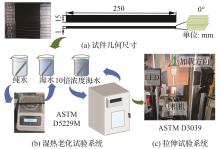
Fig.1
Schematic diagram of experimental process and equipment
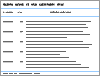
Table 1
Contents between standard solution and test seawater simulation solution for substances
| 试验液体 | 含量/g | |||||||||
|---|---|---|---|---|---|---|---|---|---|---|
| NaCl | MgCl2 | Na2SO4 | CaCl2 | KCl | NaHCO3 | KBr | H3BO3 | SrCl2 | NaF | |
| 标准液[ | 24.530 | 5.200 | 4.090 | 1.160 | 0.695 | 0.201 | 0.101 | 0.027 | 0.025 | 0.003 |
| 模拟液 | 24.842 | 5.091 | 4.094 | 1.303 | 0.694 | 0.195 | 0.010 | 0.026 | 0.018 | 0.003 |
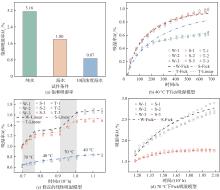
Fig.2
Moisture absorption results and models
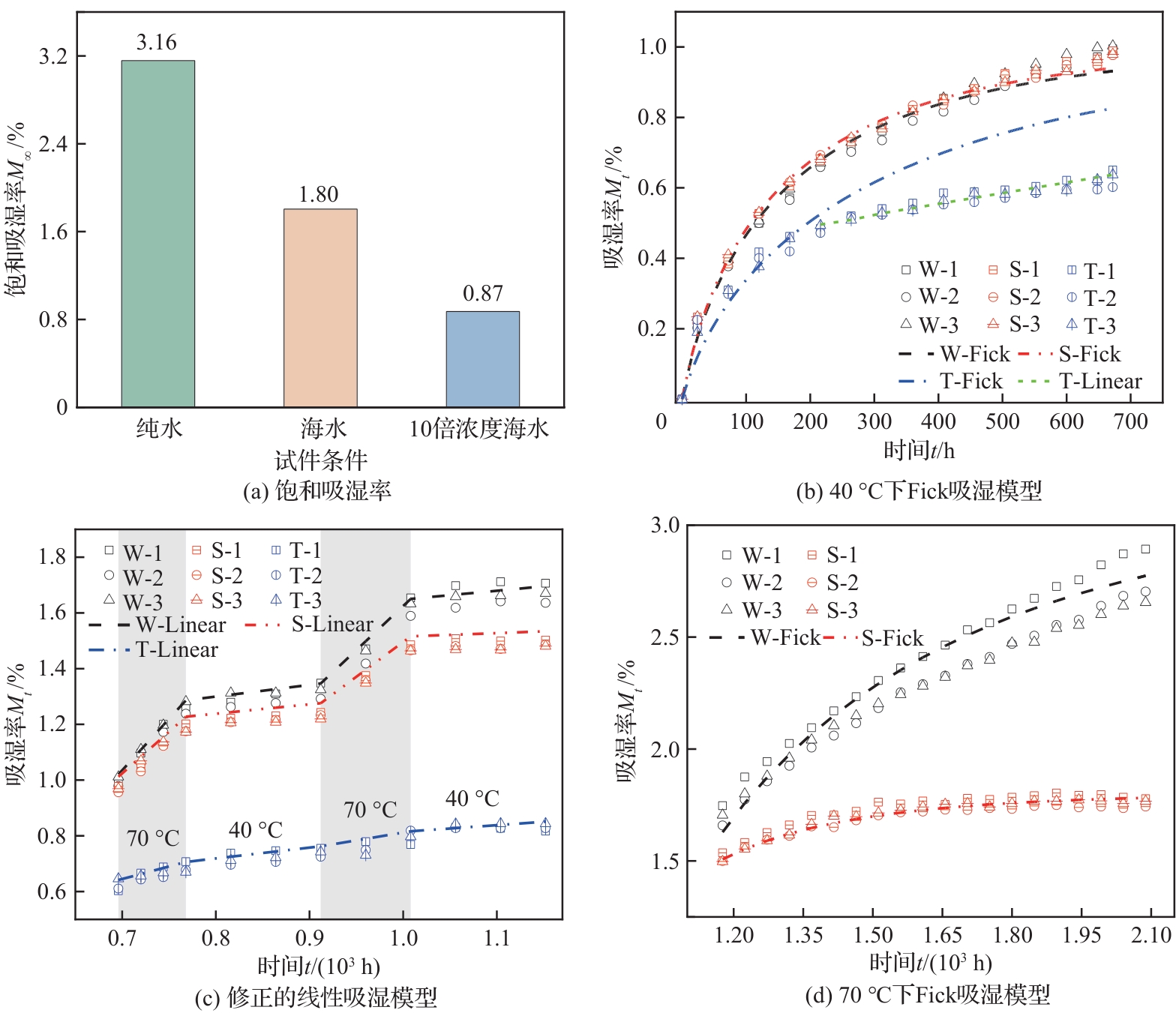
Table 2
Statistics of diffusion coefficients at each stage
| 温度/℃ | 时间/h | 扩散系数/(10-3 mm2·h-1) | ||
|---|---|---|---|---|
| 纯水 | 海水 | 10倍浓度海水 | ||
| 40 | 0~240 | 0.391 | 0.417 | 0.222 |
| 40 | 240~696 | 0.391 | 0.417 | 0.256 |
| 70 | 696~804 | 2.904 | 2.351 | 0.708 |
| 40 | 804~912 | 0.329 | 0.265 | 0.306 |
| 70 | 912~1 020 | 2.485 | 1.963 | 0.441 |
| 40 | 1 020~1 152 | 0.250 | 0.099 | 0.189 |
| 70 | 1 152~2 640 | 3.846 | 9.757 | 0 |
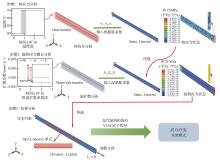
Fig.3
Simulation model retaining hygrothermal stress states based on sub-step coupling strategy
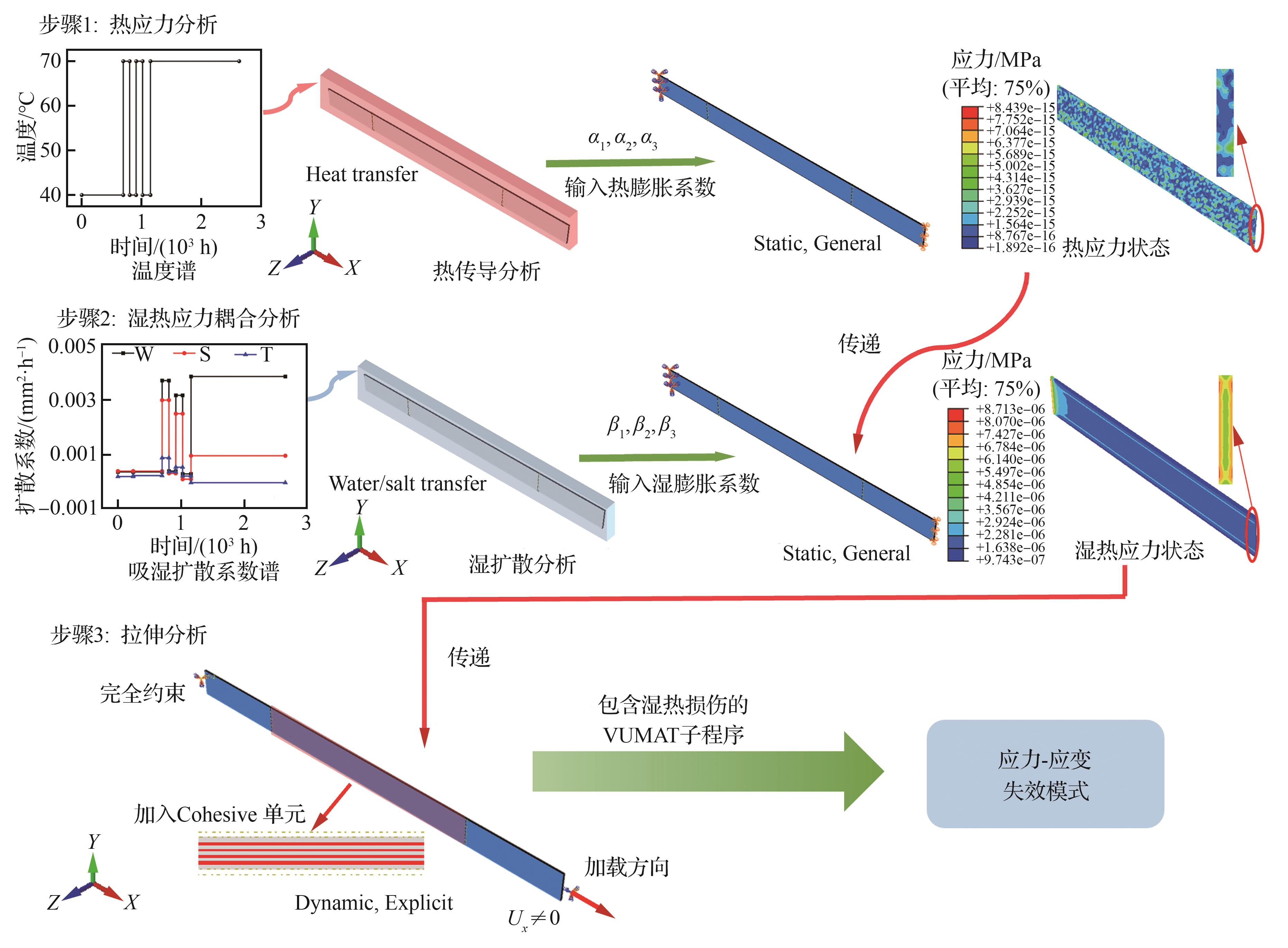
Table 3
Material properties of T300/YB01 composites
| 材料 | 参数 | 取值 |
|---|---|---|
| CFRP | 密度 | ρ=1 600 kg·m-3 |
| 模量 | E1=115 GPa,E2=E3=8.8 GPa,G12=G13=4 GPa,G23=3.8 GPa | |
| 泊松比 | γ12=γ13=0.312,γ23=0.442 | |
| 强度 | XT=1 800 MPa,XC=1 000 MPa,YT=80 MPa,YC=110 MPa,S12=S13=S23=55 MPa | |
| 断裂能 | Gft=133 N·mm-1,Gfc=40 N·mm-1,Gmt=0.6 N·mm-1,Gmc=2.1 N·mm-1 | |
| 加入Cohesive | 模量 | E=5 GPa |
| 强度 | N=S=30 MPa | |
| 断裂能 |
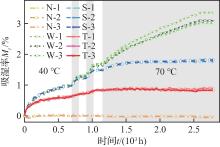
Fig.4
Moisture absorption ratio-time curves
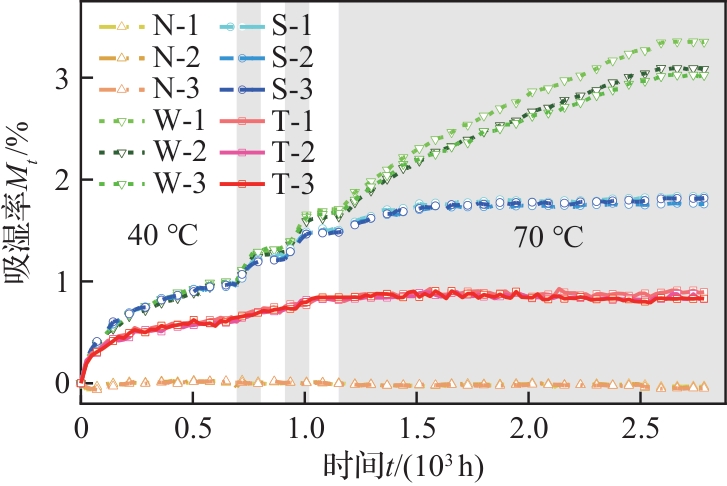
Table 4
Statistics of mechanical properties of specimens
| 试件条件 | 强度极限/MPa | 失效应变/% | 弹性模量/GPa |
|---|---|---|---|
| 自然空气(N) | 2 392.996 | 5.196 | 46.042 |
| 纯水(W) | 2 346.636 | 5.210 | 45.049 |
| 海水(S) | 2 311.747 | 5.167 | 44.771 |
| 10倍浓度海水(T) | 2 316.573 | 5.237 | 44.279 |
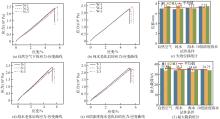
Fig.5
Results of mechanical performance test
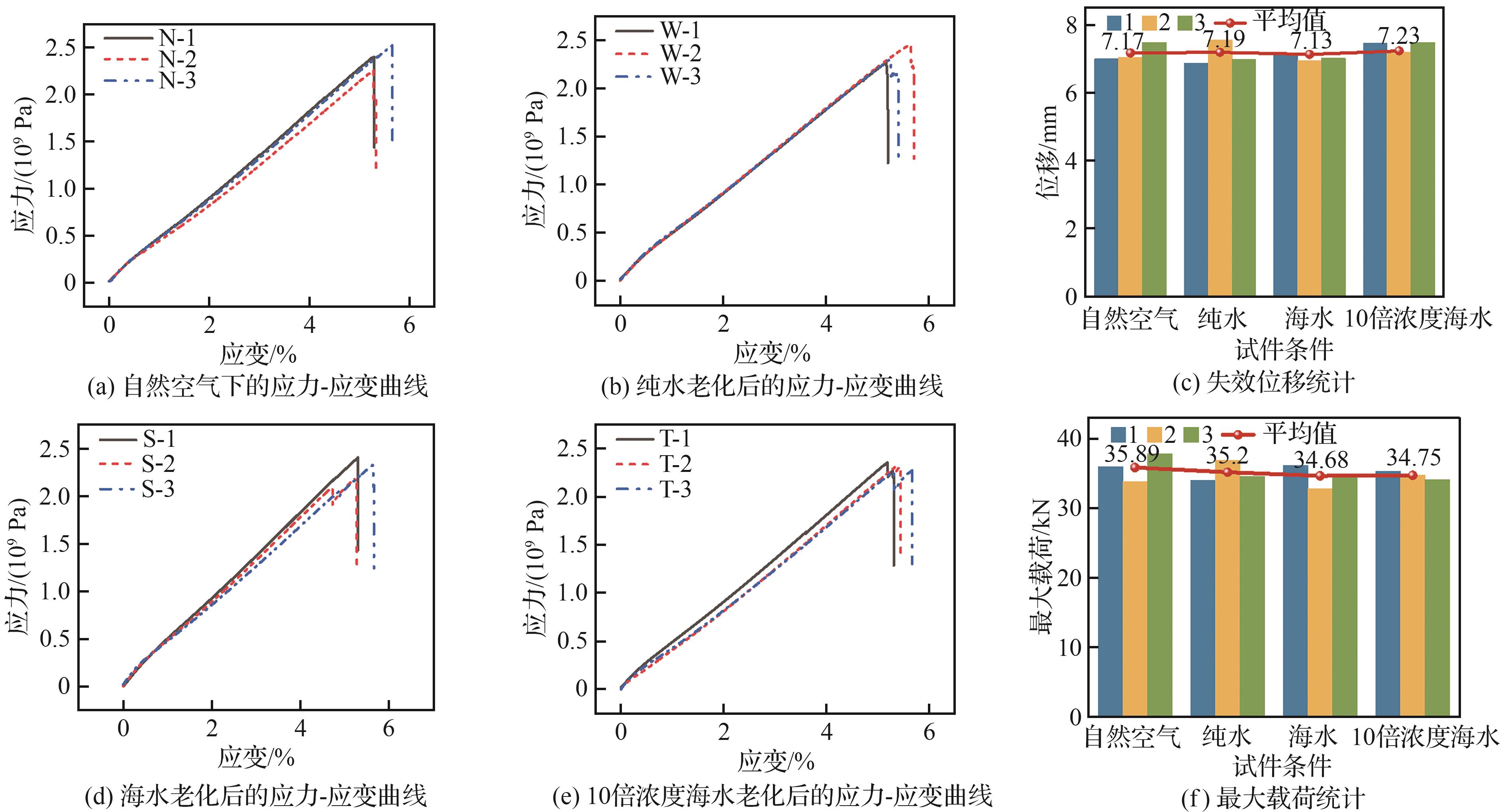
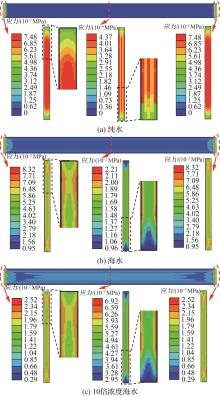
Fig.6
Stress fields for hydrothermal aging
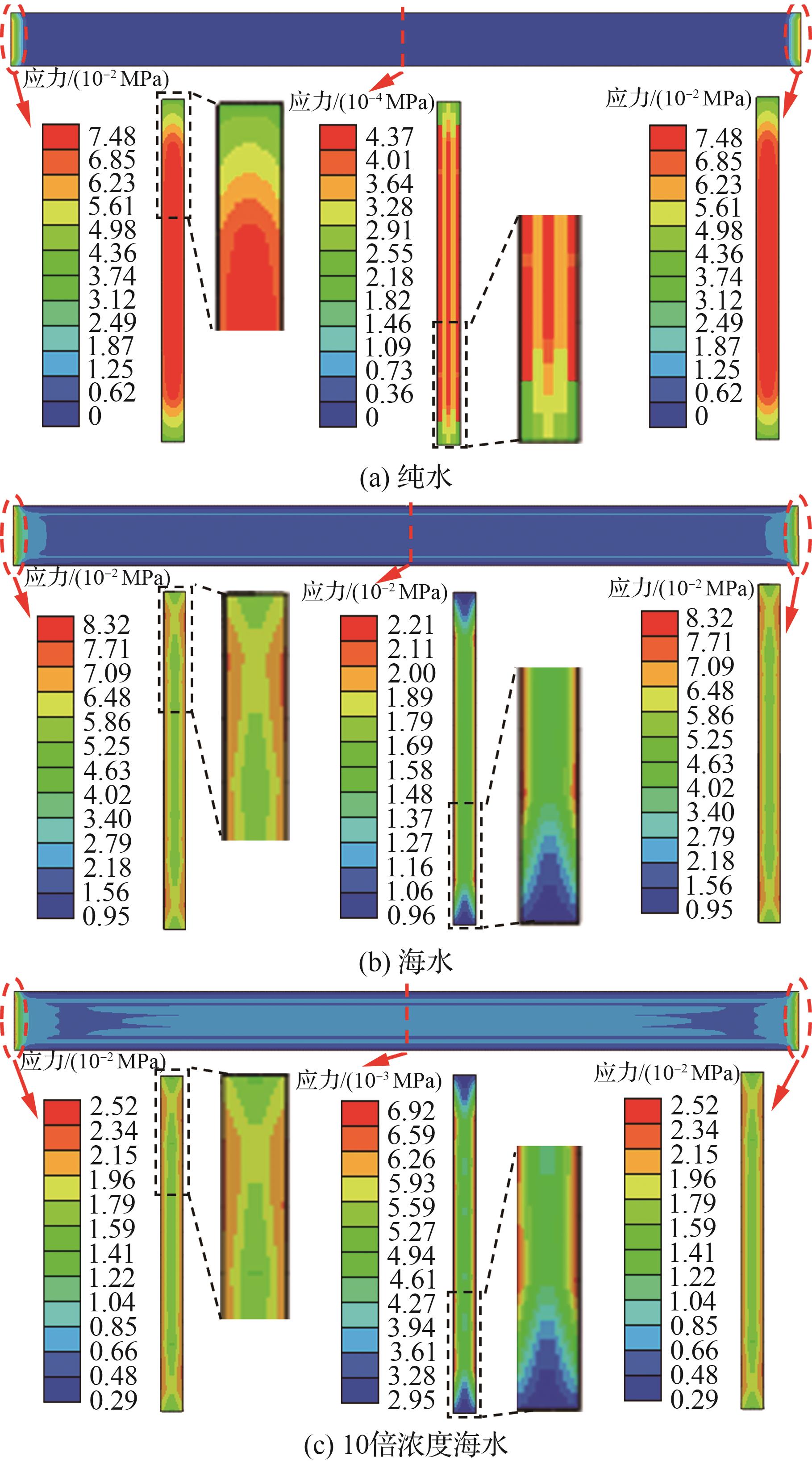
Fig.7
Comparison of stress-strain curves and failure modes between simulation and experimental results
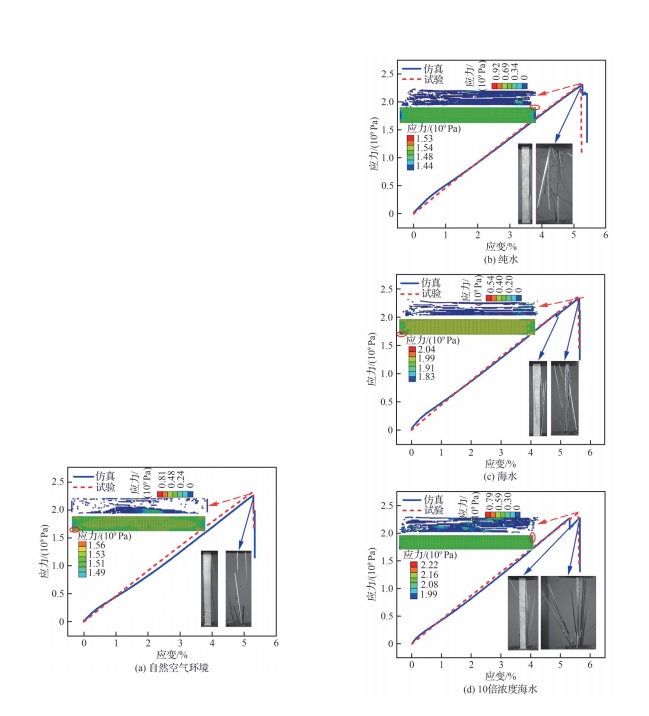
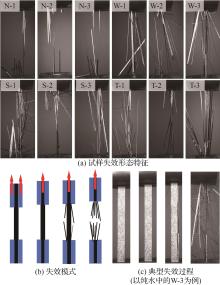
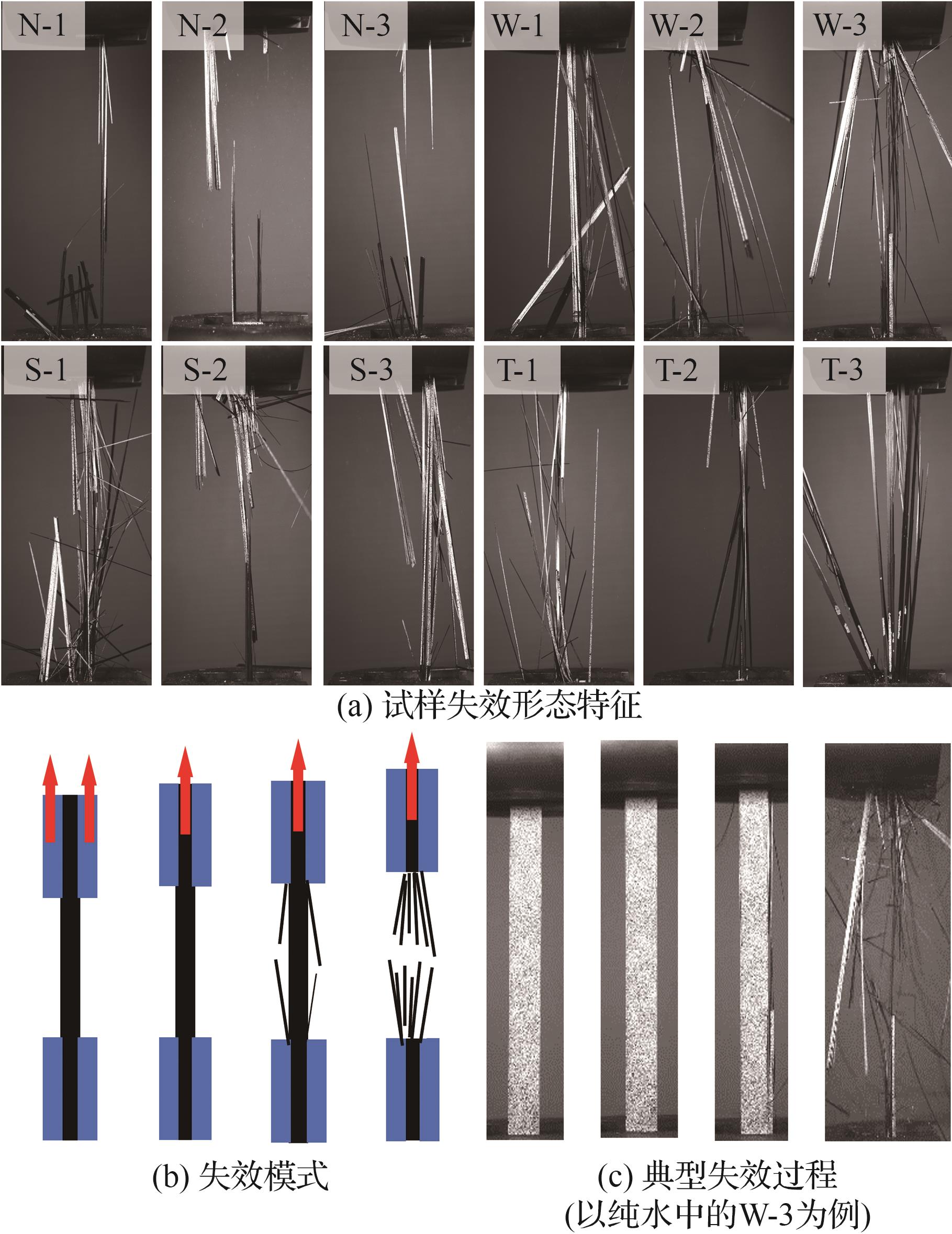
Fig.8
Analysis of failure mode
| [1] | ALAM P, MAMALIS D, ROBERT C, et al. The fatigue of carbon fibre reinforced plastics—A review[J]. Composites Part B: Engineering, 2019, 166: 555-579. |
| [2] | ACETI P, CARMINATI L, BETTINI P, et al. Hygrothermal ageing of composite structures. Part 1: Technical review[J]. Composite Structures, 2023, 319: 117076. |
| [3] | ZHOU Y Q, CAO Y, CAO J C, et al. Fracture toughness and fiber bridging mechanism for mode-Ⅰ interlaminar failure of spread-tow woven composites[J]. Enginee-ring Fracture Mechanics, 2024, 298: 109957. |
| [4] | 张超, 曹勇, 赵振强, 等. 树脂基复合材料在民用航空发动机中的应用与关键技术研究进展[J]. 航空学报, 2024, 45(2): 028556. |
| ZHANG C, CAO Y, ZHAO Z Q, et al. Applications and key challenges of polymer composites in civil aero-engines: State-of-art review[J]. Acta Aeronautica et Astronautica Sinica, 2024, 45(2): 028556 (in Chinese). | |
| [5] | GENG D X, LIU Y H, SHAO Z Y, et al. Delamination formation, evaluation and suppression during drilling of composite laminates: A review[J]. Composite Structures, 2019, 216: 168-186. |
| [6] | MAYANDI K, RAJINI N, AYRILMIS N, et al. An overview of endurance and ageing performance under various environmental conditions of hybrid polymer composites[J]. Journal of Materials Research and Techno-logy, 2020, 9(6): 15962-15988. |
| [7] | 徐晋伟, 邓宗义, 肖文刚, 等. 纤维缠绕成型碳纤维/环氧复合材料人工海水老化行为研究[J]. 纤维复合材料, 2022, 39(3): 42-47. |
| XU J W, DENG Z Y, XIAO W G, et al. Aging behavior of filament wound carbon fiber/epoxy composites in artificial seawater[J]. Fiber Composites, 2022, 39(3): 42-47 (in Chinese). | |
| [8] | 曹勇, 张超. 薄层复合材料冲击损伤行为研究进展[J]. 航空学报, 2022, 43(6): 525323. |
| CAO Y, ZHANG C. Impact damage behavior of thin-ply composites: A review[J]. Acta Aeronautica et Astronautica Sinica, 2022, 43(6): 525323 (in Chinese). | |
| [9] | 丁康康, 陈志强, 姜浩, 等. 典型海洋环境碳纤维增强树脂基复合材料老化规律研究[J]. 装备环境工程, 2024, 21(7): 45-52. |
| DING K K, CHEN Z Q, JIANG H, et al. Aging law of carbon fiber reinforced resin matrix composite in typical marine environments[J]. Equipment Environmental Engineering, 2024, 21(7): 45-52 (in Chinese). | |
| [10] | BAO L R, YEE A F. Moisture diffusion and hygrothermal aging in bismaleimide matrix carbon fiber composites: Part Ⅰ: Uni-weave composites[J]. Composites Science and Technology, 2002, 62(16): 2099-2110. |
| [11] | LI H L, ZHANG K F, FAN X T, et al. Effect of seawater ageing with different temperatures and concentrations on static/dynamic mechanical properties of carbon fiber reinforced polymer composites[J]. Composites Part B: Engineering, 2019, 173: 106910. |
| [12] | DU Y, MA Y E, SUN W B, et al. Effect of hygrothermal aging on moisture diffusion and tensile behavior of CFRP composite laminates[J]. Chinese Journal of Aeronautics, 2023, 36(3): 382-392. |
| [13] | LIU Y C, WANG H, DU J C, et al. Comparative experimental study on mechanical properties of CFRP subjected to seawater and hydrostatic pressure[J]. Compo-sites Science and Technology, 2023, 242: 110193. |
| [14] | HUO H D, WEI J C, CAO Y, et al. Retained hygrothermal state compression damage behavior investigation of carbon fiber reinforced composites[J]. Applied Compo-site Materials, 2024: 1475-1493. |
| [15] | 魏程, 王威力, 李刚, 等. 环氧树脂/玻璃纤维复合材料加速湿热老化机理研究[J]. 纤维复合材料, 2023, 40(2): 58-62. |
| WEI C, WANG W L, LI G, et al. Study on the mechanism of accelerated hydrothermal aging of epoxy/glass fiber composites[J]. Fiber Composites, 2023, 40(2): 58-62 (in Chinese). | |
| [16] | 王威力, 魏程, 田晶. 碳纤维复合材料的湿热老化模型研究[J]. 复合材料科学与工程, 2023(11): 44-48. |
| WANG W L, WEI C, TIAN J. Research on hygrothermal ageing models of carbon fiber composites[J]. Composites Science and Engineering, 2023(11): 44-48 (in Chinese). | |
| [17] | DEVINE M, BAJPAI A, OBANDE W, et al. Seawater ageing of thermoplastic acrylic hybrid matrix composites for marine applications[J]. Composites Part B: Enginee-ring, 2023, 263: 110879. |
| [18] | WANG Y L, ZHU W X, WAN B L, et al. Hygrothermal ageing behavior and mechanism of carbon nanofibers modified flax fiber-reinforced epoxy laminates[J]. Composites Part A: Applied Science and Manufacturing, 2021, 140: 106142. |
| [19] | LIU L L, ZHAO Z H, CHEN W, et al. An experimental investigation on high velocity impact behavior of hygrothermal aged CFRP composites[J]. Composite Structures, 2018, 204: 645-657. |
| [20] | STARKOVA O, GAIDUKOVS S, PLATNIEKS O, et al. Water absorption and hydrothermal ageing of epoxy adhesives reinforced with amino-functionalized graphene oxide nanoparticles[J]. Polymer Degradation and Stability, 2021, 191: 109670. |
| [21] | CAO Y, CAI Y L, ZHAO Z Q, et al. Predicting the tensile and compressive failure behavior of angle-ply spread tow woven composites[J]. Composite Structures, 2020, 234: 111701. |
| [22] | HOU Y W, PANESAR A. The moisture absorption of additively manufactured short carbon fibre reinforced polyamide[J]. Composites Part A: Applied Science and Manufacturing, 2025, 188: 108528. |
| [23] | HASHIN Z. Failure criteria for unidirectional fiber composites[J]. Journal of Applied Mechanics, 1980, 47(2): 329-334. |
| [24] | PUCK A, SCHÜRMANN H. Failure analysis of FRP laminates by means of physically based phenomenological models[J]. Composites Science and Technology, 2002, 62(12/13): 1633-1662. |
| [25] | GHOLAMI M, AFRASIAB H, BAGHESTANI A M, et al. Mechanical and failure analysis of thick composites under hygrothermal conditions by a novel coupled hygro-thermo-mechanical multiscale algorithm[J]. Composites Science and Technology, 2022, 230: 109773. |
| [26] | 张家豪, 韩啸, 张宇翔, 等. 湿热老化后CFRP力学性能的细观表征方法[J]. 机械工程学报, 2025, 61(8): 107-115. |
| ZHANG J H, HAN X, ZHANG Y X, et al. Mesoscale characterisation on the mechanical properties of CFRP after hygrothermal ageing[J]. Journal of Mechanical Engineering, 2025, 61(8): 107-115 (in Chinese). | |
| [27] | 伊文昭, 刘璐璐, 徐凯龙, 等. 考虑湿热老化的单向纤维增强复合材料纵向脱黏行为的数值模拟[J]. 复合材料科学与工程, 2025(2): 46-53. |
| YI W Z, LIU L L, XU K L, et al. Numerical simulation of longitudinal debonding behavior in unidirectional fibre-reinforced composites considering hygrothermal treatment[J]. Composites Science and Engineering, 2025(2): 46-53 (in Chinese). | |
| [28] | 任仲豪, 徐双喜, 李鲤, 等. 复合材料单向层合板循环载荷下刚度退化研究[J/OL]. 华中科技大学学报(自然科学版), 2024: 1-7. (2024-09-29). . |
| REN Z H, XU S X, LI L, et al. Study on stiffness degradation of unidirectional composite laminates under cyclic loading[J/OL]. Journal of Huazhong University of Science and Technology (Natural Science Edition), 2024: 1-7. (2024-09-29). (in Chinese). | |
| [29] | 李海嶙. 海洋服役环境下复合材料干涉连接结构力学行为演化机理研究[D]. 西安: 西北工业大学, 2019: 77-104. |
| LI H L. The evolution mechanism of mechanical properties of composites interference fit bolted joints in marine environment[D]. Xi’an: Northwestern Polytechnical University, 2019: 77-104 (in Chinese). | |
| [30] | 赖家美, 薛肖妹, 彭泽, 等. 经湿热环境处理的改性CFRP的吸湿与低速冲击实验研究[J/OL]. 复合材料学报, 2024: 1-20. (2024-11-11). . |
| LAI J M, XUE X M, PENG Z, et al. Experimental study on hygroscopic absorption and low-velocity impact of CFRP treated in damp and hot environment[J/OL]. Acta Materiae Compositae Sinica, 2024: 1-20. (2024-11-11). (in Chinese). | |
| [31] | MENG M, RIZVI M J, LE H R, et al. Multi-scale mo-delling of moisture diffusion coupled with stress distribution in CFRP laminated composites[J]. Composite Structures, 2016, 138: 295-304. |
| [32] | ROCHA I B C M, VAN DER MEER F P, NIJSSEN R P L, et al. A multiscale and multiphysics numerical framework for modelling of hygrothermal ageing in laminated composites[J]. International Journal for Numerical Methods in Engineering, 2017, 112(4): 360-379. |
| [33] | GHOLAMI M, AFRASIAB H, BAGHESTANI A M, et al. Hygrothermal degradation of elastic properties of fiber reinforced composites: A micro-scale finite element analysis[J]. Composite Structures, 2021, 266: 113819. |
| [34] | SHAH S Z H, LEE J, MEGAT-YUSOFF P S M, et al. Multiscale damage modelling of notched and un-notched 3D woven composites with randomly distributed manufacturing defects[J]. Composite Structures, 2023, 318: 117109. |
| [35] | ZOUGGAR K, GUERRAICHE K, LOUSDAD A. Numerical and predictive analysis of the low-velocity impact response of UD composite plate under a controlled environment[J]. Composite Structures, 2022, 299: 116053. |
| [36] | ASTM. Standard test method for tensile properties of polymer matrix composite materials: [S]. West Conshohocken: American Society for Testing and Materials, 2017. |
| [37] | ASTM. Standard practice for preparation of substitute ocean water: [S]. West Conshohocken: American Society for Testing and Materials, 2021. |
| [38] | ASTM. Standard test method for moisture absorption properties and equilibrium conditioning of polymer matrix composite materials: [S]. West Conshohocken: ASTM, 1998. |
| [39] | ZHANG J Y, QI D X, ZHOU L W, et al. A progressive failure analysis model for composite structures in hygrothermal environments[J]. Composite Structures, 2015, 133: 331-342. |
| [40] | ANDREW J J, DHAKAL H N. Influence of seawater ageing on the physical and mechanical properties of the natural fiber-reinforced composites[M]∥Aging Effects on Natural Fiber-reinforced Polymer Composites. Singapore: Springer Nature Singapore, 2022: 335-355. |
| [41] | 许良, 涂宜鸣, 崔浩, 等. 海水环境下老化周期对T800碳纤维/环氧树脂复合材料的影响[J]. 材料工程, 2022, 50(12): 89-94. |
| XU L, TU Y M, CUI H, et al. Effect of aging cycle on T800carbon fiber/epoxy resin composites in seawater environment[J]. Journal of Materials Engineering, 2022, 50(12): 89-94 (in Chinese). |
| [1] | Tao SUO, Yulong LI. Anti-bird impact design of aircraft structure via bulding block approach [J]. Acta Aeronautica et Astronautica Sinica, 2025, 46(5): 531524-531524. |
| [2] | Jiaxuan HAN, Fan CHEN, Xuguang YANG, Zhenyu WANG, Xiaoming YUE. Experimental study on EDM of CFRP in aerosol medium [J]. Acta Aeronautica et Astronautica Sinica, 2025, 46(4): 430886-430886. |
| [3] | Xuan GUO, Yanjie LIU, Hongquan LIU, Yinli ZHANG. Influence of thickness of curved laminate on mechanical behavior of butt-bolted joints [J]. Acta Aeronautica et Astronautica Sinica, 2024, 45(S1): 730591-730591. |
| [4] | Haolei MOU, Jiang XIE, Zhenyu FENG, Kun CHENG, Yi LIU. Crashworthiness characteristics analysis of typical fuselage section of large transport aircraft [J]. ACTA AERONAUTICAET ASTRONAUTICA SINICA, 2023, 44(9): 227512-227512. |
| [5] | Liping LIU, Yuyang QI, Yueguo LIN, Rui BAO, Jianxin XU, Zhenyu FENG, Guanghui QING. Tensile failure of carbon fiber composite material bonded-rivet hybrid repaired structure [J]. Acta Aeronautica et Astronautica Sinica, 2023, 44(24): 428676-428676. |
| [6] | Tianchun ZOU, Yuezhang JU, Yuxi GUAN, Zegang LI, Hongcheng CHEN. Effect of stacking sequence on fatigue behavior of CFRP⁃Al joint [J]. Acta Aeronautica et Astronautica Sinica, 2023, 44(18): 428264-428264. |
| [7] | Yingke YANG, Dongsheng LI, Liheng SHEN, Rupeng LI, Yunong ZHAI. Pose and shape adjustment method for CFRP fuselage panel based on multi-robot collaboration [J]. Acta Aeronautica et Astronautica Sinica, 2023, 44(14): 428006-428006. |
| [8] | Xiang MI, Wujun CHEN, Yibei ZHANG, Shiping LI, Xiaohui HUANG. Stability performance of stiffening rings on large CFRP thin⁃walled tube trusses [J]. ACTA AERONAUTICAET ASTRONAUTICA SINICA, 2023, 44(12): 227738-227738. |
| [9] | Wei ZHANG, Binwen WANG, Junling FAN, Shaozheng ZHAN, Ting JIAO, Yu YANG. Ultrasonic nondestructive characterization of impact damage and compression after impact for CFRP based on multi-mode imaging [J]. ACTA AERONAUTICAET ASTRONAUTICA SINICA, 2023, 44(1): 426635-426635. |
| [10] | FENG Zhenyu, CHI Qilin, CUI Huaitian, XIE Jiang, MU Haolei. Comparison of ballistic impact behaviors between plain woven and 2.5D woven fabric composite plates [J]. ACTA AERONAUTICAET ASTRONAUTICA SINICA, 2022, 43(5): 425116-425116. |
| [11] | ZHANG Yinuo, QIAO Hongchao, CAO Zhihe, LIANG Jinsheng, ZHAO Jibin. Microstructure characteristics of CFRP deep groove processed by water jet-guided laser processing technology [J]. ACTA AERONAUTICAET ASTRONAUTICA SINICA, 2022, 43(4): 525144-525144. |
| [12] | YANG Zhengwei, ZHAO Zhibin, LI Yin, SONG Yuanjia, KOU Guangjie, LI Lei, CHENG Pengfei. Infrared radiation characteristics of CFRP laminate surface under compressive fatigue load [J]. ACTA AERONAUTICAET ASTRONAUTICA SINICA, 2021, 42(5): 524239-524239. |
| [13] | WANG Andong, BIAN Guixue, ZHANG Yong, CHEN Yueliang, ZHANG Zhuzhu, ZHANG Yangguang. Aging mechanism of G814/3233 composite in marine environment and correlation between accelerated aging and natural aging [J]. ACTA AERONAUTICAET ASTRONAUTICA SINICA, 2021, 42(5): 524260-524260. |
| [14] | GUO Yidong, MA Yu'e, LI Peiyao. Low velocity impact response of additively manufactured titanium alloy micro-truss sandwich panels [J]. ACTA AERONAUTICAET ASTRONAUTICA SINICA, 2021, 42(2): 423820-423820. |
| [15] | QI Zhenchao, XIAO Yexin, ZHANG Ziqin, WANG Xingxing, CHEN Wenliang. Modeling and verification of thermal response in connection area of current-assisted riveting CFRP [J]. ACTA AERONAUTICAET ASTRONAUTICA SINICA, 2021, 42(10): 524535-524535. |
| Viewed | ||||||
|
Full text |
|
|||||
|
Abstract |
|
|||||
Address: No.238, Baiyan Buiding, Beisihuan Zhonglu Road, Haidian District, Beijing, China
Postal code : 100083
E-mail:hkxb@buaa.edu.cn
Total visits: 6658907 Today visits: 1341All copyright © editorial office of Chinese Journal of Aeronautics
All copyright © editorial office of Chinese Journal of Aeronautics
Total visits: 6658907 Today visits: 1341

 CJA
CJA
