Acta Aeronautica et Astronautica Sinica ›› 2026, Vol. 47 ›› Issue (19): 633842.doi: 10.7527/S1000-6893.2026.33842
• The Centennial of the Naming of Hunan University • Previous Articles
Wei HE1,2, Quan ZHANG1,2, Shuzhao LAN1,2, Zechang LI1,2, Jinhong LI3, Jiaqiang LI3,4, Xin LI3( )
Received:2026-05-07
Revised:2026-06-02
Accepted:2026-07-06
Online:2026-08-04
Published:2026-07-24
Contact:
Xin LI
E-mail:lixdoctor@163.com
Supported by:CLC Number:
Wei HE, Quan ZHANG, Shuzhao LAN, Zechang LI, Jinhong LI, Jiaqiang LI, Xin LI. Recent advances in small-sample machine learning methods for fatigue life prediction of additively manufactured metals[J]. Acta Aeronautica et Astronautica Sinica, 2026, 47(19): 633842.
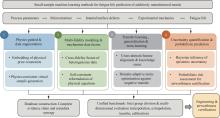
Fig.1
Framework for small-sample fatigue life prediction of AM metallic materials
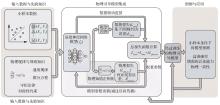
Fig.2
Physics-guided prediction framework
Table 1
Applications of physics-guided and data augmentation methods in fatigue life prediction of additively manufactured metals
| 核心方法 | 解决的关键痛点 | 物理内涵 | 文献 |
|---|---|---|---|
| 概率化物理引导框架 | 小样本过拟合与数据不确定性 | 损失函数集成宏观疲劳公式 | [ |
| 关键缺陷驱动的物理信息预测模型 | 内部缺陷主导的失效难刻画 | 内部缺陷特征作为物理先验 | [ |
| 物理信息神经网络 | 缺乏跨材料的通用评估范式 | 物理先验作为底层归纳偏置 | [ |
| 微观力学分析与机器学习结合 | 裂纹萌生阶段评估困难 | 动态追踪微观力学机制 | [ |
Fig.3
Multi-fidelity framework for fatigue life prediction[108]
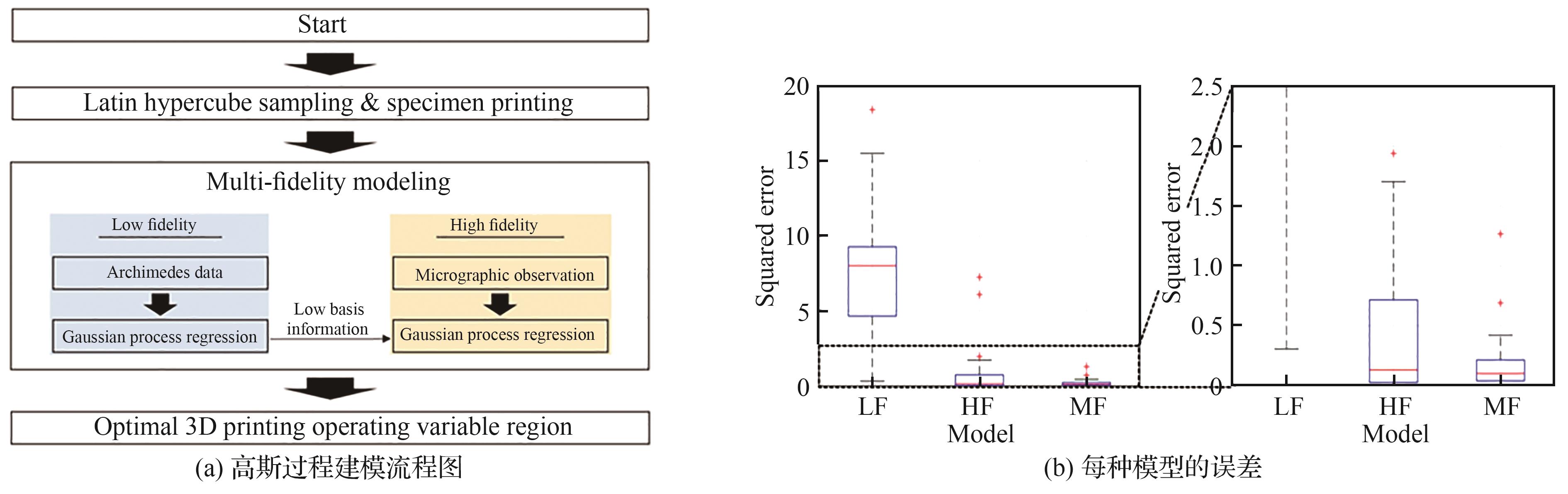
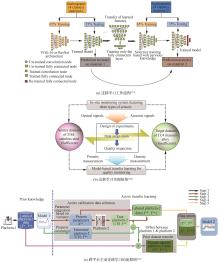
Fig.4
Transfer learning frameworks in fatigue life prediction
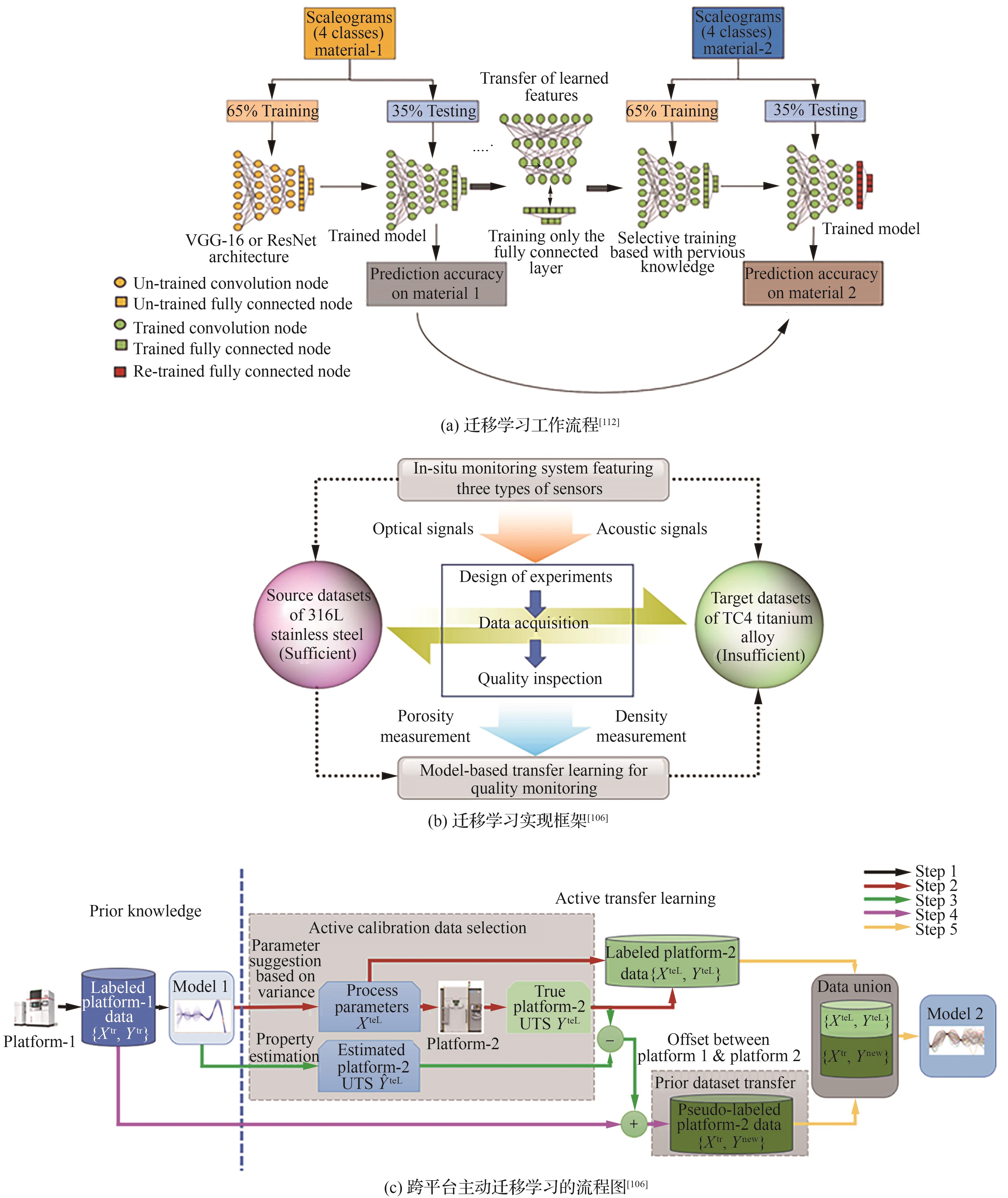
Table 2
Summary of contributions in uncertainty quantification for fatigue life prediction of additively manufactured metals
| 物理内涵 | 核心方法 | 解决的关键痛点 | 文献 |
|---|---|---|---|
| 统计极值理论与体积效应 | 贝叶斯物理信息神经网络 | 跨尺寸寿命预测的分散性 | [ |
| 物理一致性的生成式对抗网络 | 多保真建模 | 极小样本下的数据扩增 | [ |
| 加权等效指标与后验分布比对 | 贝叶斯模型决策 | 工艺敏感性(方向/后处理) | [ |
| 似然函数驱动的认知风险量化 | 贝叶斯物理信息神经网络 | 航空结构件的可靠性评估 | [ |
Table 3
Comparison of fatigue life prediction for additively manufactured metals with small-sample sizes
| 主要算法 | 材料 | 样本量 | 输入特征 | 模型优点 | 文献 |
|---|---|---|---|---|---|
| 缺陷-断裂力学约束物理信息神经网络 | 选择性激光熔化AlSi10Mg | 12 | 载荷参数、关键缺陷尺寸、缺陷位置和缺陷形貌相关特征 | 引入线弹性断裂力学约束,提高预测结果的物理一致性 | [ |
| 秩相关筛选 | 选择性激光熔化Ti-6Al-4V | 29 | 应力幅、XCT缺陷尺寸、缺陷位置、缺陷数量、缺陷形貌相关特征 | 提高单个疲劳样本的信息密度,并解释缺陷对寿命分散性的影响 | [ |
| 支持向量回归 | 电子束粉末床熔融Ti2448 | 34 | 密度、孔隙率、屈服应力和疲劳应力 | 小样本条件下的快速非线性回归和工程参数敏感性分析 | [ |
| 堆叠自编码器深度神经网络 | 激光粉末床熔融AlSi10Mg | 89 | 应力幅、屈服强度、抗拉强度、延伸率、残余应力等特征 | 融合力学性能、残余应力、表面粗糙度和后处理状态等多源特征 | [ |
| Dropout神经网络 | 激光粉末床熔融Ti-6Al-4V | 197 | 表面粗糙度、孔隙尺寸、孔隙投影面积、孔隙统计特征 | 可同时给出寿命估计和预测不确定性 | [ |
| [1] | DEBROY T, WEI H L, ZUBACK J S, et al. Additive manufacturing of metallic components: Process, structure and properties[J]. Progress in Materials Science, 2018, 92: 112-224. |
| [2] | HERZOG D, SEYDA V, WYCISK E, et al. Additive manufacturing of metals[J]. Acta Materialia, 2016, 117: 371-392. |
| [3] | GU D D, MEINERS W, WISSENBACH K, et al. Laser additive manufacturing of metallic components: Materials, processes and mechanisms[J]. International Materials Reviews, 2012, 57(3): 133-164. |
| [4] | THOMPSON S M, BIAN L K, SHAMSAEI N, et al. An overview of direct laser deposition for additive manufacturing Part Ⅰ: Transport phenomena, modeling and diagnostics[J]. Additive Manufacturing, 2015, 8: 36-62. |
| [5] | 王华明. 高性能大型金属构件激光增材制造: 若干材料基础问题[J]. 航空学报, 2014, 35(10): 2690-2698. |
| WANG H M. Materials’ fundamental issues of laser additive manufacturing for high-performance large metallic components[J]. Acta Aeronautica et Astronautica Sinica, 2014, 35(10): 2690-2698 (in Chinese). | |
| [6] | DEMIRAL M, OTKUR M. From mechanics to machine learning in additive manufacturing: A review of deformation, fatigue, and fracture[J]. Technologies, 2026, 14(4): 218. |
| [7] | JAVIDRAD H, KOC B, BAYRAKTAR H, et al. Fatigue performance of metal additive manufacturing: A comprehensive overview[J]. Virtual and Physical Prototyping, 2024, 19(1): e2302556. |
| [8] | GRZESIK W. Influence of surface roughness on fatigue life of machine elements: the development in experimental investigations and simulations[J]. Mechanik, 2019(5-6): 307-313. |
| [9] | BERETTA S, ROMANO S. A comparison of fatigue strength sensitivity to defects for materials manufactured by AM or traditional processes[J]. International Journal of Fatigue, 2017, 94: 178-191. |
| [10] | WU Z K, WU S C, KRUZIC J J, et al. Critical damage events of 3D printed AlSi10Mg alloy via in situ synchrotron X-ray tomography[J]. Acta Materialia, 2025, 282: 120464. |
| [11] | PEGUES J W, SHAO S, SHAMSAEI N, et al. Fatigue of additive manufactured Ti-6Al-4V, Part I: The effects of powder feedstock, manufacturing, and post-process conditions on the resulting microstructure and defects[J]. International Journal of Fatigue, 2020, 132: 105358. |
| [12] | LI P, WARNER D H, FATEMI A, et al. Critical assessment of the fatigue performance of additively manufactured Ti-6Al-4V and perspective for future research[J]. International Journal of Fatigue, 2016, 85: 130-143. |
| [13] | YADOLLAHI A, SHAMSAEI N. Additive manufacturing of fatigue resistant materials: Challenges and opportunities[J]. International Journal of Fatigue, 2017, 98: 14-31. |
| [14] | ROMANO S, BRÜCKNER-FOIT A, BRANDÃO A, et al. Fatigue properties of AlSi10Mg obtained by additive manufacturing: Defect-based modelling and prediction of fatigue strength[J]. Engineering Fracture Mechanics, 2018, 187: 165-189. |
| [15] | BASQUIN O H. The exponential law of endurance tests[J]. Proceedings of the American Society for Testing Materials, 1910, 10: 625-630. |
| [16] | COFFIN L F Jr. A study of the effects of cyclic thermal stresses on a ductile metal[J]. Journal of Fluids Engineering, 1954, 76(6): 931-949. |
| [17] | SCHIJVE J. Fatigue of structures and materials[M]. Dordrecht: Springer Netherlands, 2009: 223-224. |
| [18] | PARIS P, ERDOGAN F. A critical analysis of crack propagation laws[J]. Journal of Basic Engineering, 1963, 85(4): 528-533. |
| [19] | ZHAO S Y, SHI Y X, HUANG C C, et al. Integrating machine learning into additive manufacturing of metallic biomaterials: A comprehensive review[J]. Journal of Functional Biomaterials, 2025, 16(3): 77. |
| [20] | RAMPRASAD R, BATRA R, PILANIA G, et al. Machine learning in materials informatics: Recent applications and prospects[J]. npj Computational Materials, 2017, 3: 54. |
| [21] | AGRAWAL A, CHOUDHARY A. Perspective: Materials informatics and big data: Realization of the “fourth paradigm” of science in materials science[J]. APL Materials, 2016, 4(5): 053208. |
| [22] | WANG H, GAO S L, WANG B T, et al. Recent advances in machine learning-assisted fatigue life prediction of additive manufactured metallic materials: A review[J]. Journal of Materials Science & Technology, 2024, 198: 111-136. |
| [23] | XU Z L, GAO J J, QIN M Q, et al. Hybrid machine learning method for remaining fatigue life prediction of the metallic materials under two-step loading[J]. Journal of Mechanical Engineering, 2025, 61(12): 73-82. |
| [24] | WANG H J, ZHANG J R, LI B, et al. Machine learning-based fatigue life prediction of laser powder bed fusion additively manufactured Hastelloy X via nondestructively detected defects[J]. International Journal of Structural Integrity, 2025, 16(1): 104-126. |
| [25] | 胡雅楠, 余欢, 吴圣川, 等. 基于机器学习的增材制造合金材料力学性能预测研究进展与挑战[J]. 力学学报, 2024, 56(7): 1892-1915. |
| HU Y N, YU H, WU S C, et al. Machine learned mechanical properties prediction of additively manufactured metallic alloys: Progress and challenges[J]. Chinese Journal of Theoretical and Applied Mechanics, 2024, 56(7): 1892-1915 (in Chinese). | |
| [26] | YI M, XUE M, CONG P H, et al. Machine learning for predicting fatigue properties of additively manufactured materials[J]. Chinese Journal of Aeronautics, 2024, 37(4): 1-22. |
| [27] | RAISSI M, PERDIKARIS P, KARNIADAKIS G E. Physics-informed neural networks: A deep learning framework for solving forward and inverse problems involving nonlinear partial differential equations[J]. Journal of Computational Physics, 2019, 378: 686-707. |
| [28] | KARNIADAKIS G E, KEVREKIDIS I G, LU L, et al. Physics-informed machine learning[J]. Nature Reviews Physics, 2021, 3(6): 422-440. |
| [29] | ZAHRAN H, ZINOVEV A, TERENTYEV D. Prediction of fatigue behaviour in fusion and generation Ⅳ reactor materials: Numerical, experimental, and machine learning study[J]. International Journal of Fatigue,2025,180: 108635. |
| [30] | LI H, SUN G Z, TIAN Z, et al. A physics-informed neural network framework based on fatigue indicator parameters for very high cycle fatigue life prediction of an additively manufactured titanium alloy[J]. Fatigue & Fracture of Engineering Materials & Structures, 2024, 47(9): 3171-3188. |
| [31] | LOOKMAN T, BALACHANDRAN P V, XUE D Z, et al. Active learning in materials science with emphasis on adaptive sampling using uncertainties for targeted design[J]. npj Computational Materials, 2019, 5: 21. |
| [32] | BAIG S, JAM A, BERETTA S, et al. Non-destructive detection of critical defects in additive manufacturing[J]. Scientific Reports, 2025, 15: 6740. |
| [33] | 师彬彬, 陈哲涵. 基于图像特征融合的粉末床缺陷检测方法[J]. 航空学报, 2021, 42(10): 524430. |
| SHI B B, CHEN Z H. Defect detection method of powder bed based on image feature fusion[J]. Acta Aeronautica et Astronautica Sinica, 2021, 42(10): 524430 (in Chinese). | |
| [34] | NGO A, HERNANDEZ K, OLATUNDE A E, et al. Image-based fracture surface defect characterization methods for additively manufactured Ti-6Al-4V tested in fatigue[J]. JOM, 2024, 76(9): 4813-4824. |
| [35] | SAFDAR M, XIE J R, KO H, et al. Transferability analysis of data-driven additive manufacturing knowledge: A case study between powder bed fusion and directed energy deposition[C]∥ ASME 2023 International Design Engineering Technical Conferences and Computers and Information in Engineering Conference.New York: ASME, 2023. |
| [36] | FAGERSAND H M, MORIN D, MATHISEN K M, et al. Transferability of temperature evolution of dissimilar wire-arc additively manufactured components by machine learning[J]. Materials, 2024, 17(3): 742. |
| [37] | WANG A B, GAN L, ZHANG P, et al. Cross-parameter fatigue life prediction: A domain-adaptive meta-learning approach for AM alloys[J]. Engineering Fracture Mechanics, 2026, 335: 111916. |
| [38] | ZHENG Q J, WAKIN M B, GOCKEL J, et al. Cross-platform laser powder bed fusion process-property modeling with active transfer learning[J]. Journal of Manufacturing Processes, 2025, 149: 955-963. |
| [39] | GUO S H, ZAMIELA C, BIAN L K. Knowledge-transfer-enabled porosity prediction for new part geometry in laser metal deposition[J]. Journal of Manufacturing Processes, 2023, 103: 64-77. |
| [40] | ZHANG A M, JIANG Z M, CHENG L, et al. Few-shot learning-based generalization detection for challenging part contour in laser powder bed fusion[J]. Optics and Lasers in Engineering, 2025, 195: 109274. |
| [41] | LIU Q, CHEN W L, YAKUBOV V, et al. Interpretable machine learning approach for exploring process-structure-property relationships in metal additive manufacturing[J]. Additive Manufacturing, 2024, 85: 104187. |
| [42] | WHITNEY B C, SPANGENBERGER A G, RODGERS T M, et al. Part-scale microstructure prediction for laser powder bed fusion Ti-6Al-4V using a hybrid mechanistic and machine learning model[J]. Additive Manufacturing, 2024, 94: 104500. |
| [43] | DONG G Y, WONG J C, LESTANDI L, et al. A part-scale, feature-based surrogate model for residual stresses in the laser powder bed fusion process[J]. Journal of Materials Processing Technology, 2022, 304: 117541. |
| [44] | RIENSCHE A R, BEVANS B D, KING G, et al. Predicting melt pool depth and primary dendritic arm spacing in laser powder bed fusion additive manufacturing using physics-based machine learning[J]. Materials & Design, 2024, 237: 112540. |
| [45] | YE J H, SAUNDERS R N, ELWANY A. Surrogate-based model chains for establishing process-structure-property linkages with quantified uncertainties in metal additive manufacturing[J]. Manufacturing Letters, 2023, 35: 750-759. |
| [46] | XIA Y, GUO W L. Fatigue quality assessment of additive manufactured Ti-6Al-4V alloy by unified three-dimensional fatigue fracture method[J]. International Journal of Fatigue, 2026, 208: 109530. |
| [47] | BAIG S, JAM A, BERETTA S, et al. Fatigue-defect criticality in laser powder bed fused aluminum alloys[J]. Theoretical and Applied Fracture Mechanics, 2025, 140: 105201. |
| [48] | LIU Y Y, HAN X, XIE L Y, et al. A defect-based model for fatigue life prediction of additively manufactured Ti-6Al-4V alloys[J]. International Journal of Fatigue, 2026, 209: 109638. |
| [49] | DU J H, YANG X F, ZHU T Y, et al. A universal high-cycle fatigue life prediction of additive manufacturing medium-entropy alloys via machine learning and nondestructive tests[J]. International Journal of Fatigue, 2026, 204: 109360. |
| [50] | ZHANG Z A, XU Z P. Fatigue database of additively manufactured alloys[J]. Scientific Data, 2023, 10: 249. |
| [51] | LI S L, WANG G, DI Y L, et al. A physics-informed neural network framework to predict 3D temperature field without labeled data in process of laser metal deposition[J]. Engineering Applications of Artificial Intelligence, 2023, 120: 105908. |
| [52] | LIAO S H, XUE T J, JEONG J, et al. Hybrid thermal modeling of additive manufacturing processes using physics-informed neural networks for temperature prediction and parameter identification[J]. Computational Mechanics, 2023, 72(3): 499-512. |
| [53] | SAJADI P, RAHMANI DEHAGHANI M, TANG Y F, et al. Physics-informed online learning for temperature prediction in metal AM[J]. Materials, 2024, 17(13): 3306. |
| [54] | SHARMA R, GUO Y B. Thermo-mechanical physics-informed deep learning for prediction of thermal stress evolution in laser metal deposition[J]. Engineering Applications of Artificial Intelligence, 2025, 157: 111554. |
| [55] | FAEGH M, SANVELLY R R, ARABPOOR R, et al. Physics-informed neural networks for thermal modeling transferable across paths, print parameters, and beam profiles[J]. Additive Manufacturing, 2026, 116: 105060. |
| [56] | HARTMANN S, MURUA O, ARRIZUBIETA J I, et al. Digital twin of the laser-DED process based on a multiscale approach[J]. Simulation Modelling Practice and Theory, 2024, 132: 102881. |
| [57] | PENG X J, CHEN Z D, ZHANG A M, et al. Digital twin temperature field prediction of laser powder bed fusion through proper orthogonal decomposition with radial basis function[J]. Materials Today Communications, 2024, 38: 107883. |
| [58] | ZHAO M Z, WEI H L, MAO Y M, et al. Predictions of additive manufacturing process parameters and molten pool dimensions with a physics-informed deep learning model[J]. Engineering, 2023, 23: 181-195. |
| [59] | SHARMA R, RAISSI M, GUO Y B. Physics-informed deep learning of gas flow-melt pool multi-physical dynamics during powder bed fusion[J]. CIRP Annals, 2023, 72(1): 161-164. |
| [60] | KIM J, YANG Z, LU Y. A physics-guided deep generative model for predicting melt pool behavior in laser powder bed fusion additive manufacturing[J]. Journal of Intelligent Manufacturing, 2025, 36(8): 5715-5735. |
| [61] | LIU S Q, LI R N, ZHOU J Y, et al. Physics-based data augmentation enables accurate machine learning prediction of melt pool geometry[J]. Applied Sciences, 2025, 15(15): 8587. |
| [62] | CHOI J Y, XUE T J, LIAO S H, et al. Accelerating phase-field simulation of three-dimensional microstructure evolution in laser powder bed fusion with composable machine learning predictions[J]. Additive Manufacturing, 2024, 79: 103938. |
| [63] | SENTHILNATHAN A, NATH P, MAHADEVAN S, et al. Surrogate modeling of microstructure prediction in additive manufacturing[J]. Computational Materials Science, 2025, 247: 113536. |
| [64] | PAN L Y, LI G F, ZHANG X, et al. Multi-task physics-constrained dictionary learning for efficient estimation of porosity distribution in laser powder bed fusion of copper[J]. Journal of Manufacturing Processes, 2025, 145: 286-299. |
| [65] | MORCOS P, VELA B, ACEMI C, et al. Data-augmented modeling in laser powder bed fusion: A Bayesian approach[J]. Additive Manufacturing, 2024, 96: 104545. |
| [66] | ZHANG R Y, STRICKLAND J, HOU X D, et al. Rapid residual stress simulation and distortion mitigation in laser additive manufacturing through machine learning[J]. Additive Manufacturing, 2025, 102: 104721. |
| [67] | ABHISHEK S, KUMAR S A, RAO S. Multi-scale modelling for optimization of process parameters of laser powder bed fusion processed Inconel 718 surrogate part[J]. Engineering Failure Analysis, 2024, 155: 107713. |
| [68] | RIENSCHE A, BEVANS B, CARRINGTON A Jr, et al. DynamicPrint: A physics-guided feedforward model predictive process control approach for defect mitigation in laser powder bed fusion additive manufacturing[J]. Additive Manufacturing, 2025, 97: 104592. |
| [69] | CHERNYAVSKY D, KONONENKO D Y, HUFENBACH J K, et al. Bayesian optimization for laser powder bed fusion of defect-free AA2024[J]. Additive Manufacturing, 2025, 114: 105022. |
| [70] | ZHANG Y H, FU Y, CHENG L. A scientific deep learning framework integrating process stochasticity with high-fidelity simulation for millisecond-scale melt pool prediction for L-PBF process[J]. Additive Manufacturing, 2026, 121: 105138. |
| [71] | SHEN T, ZHANG W, LI B. Machine learning-enabled predictions of as-built relative density and high-cycle fatigue life of Ti6Al4V alloy additively manufactured by laser powder bed fusion[J]. Materials Today Communications, 2023, 37: 107286. |
| [72] | CHEN J, LIU Y M. Fatigue property prediction of additively manufactured Ti-6Al-4V using probabilistic physics-guided learning[J]. Additive Manufacturing, 2021, 39: 101876. |
| [73] | CENTOLA A. Machine learning methods to predict the fatigue life of selectively laser melted Ti6Al4V components[D]. Turin: Politecnico di Torino, 2023. |
| [74] | MUHAMMAD M, FRYE P, SIMSIRIWONG J, et al. An investigation into the effects of cyclic strain rate on the high cycle and very high cycle fatigue behaviors of wrought and additively manufactured Inconel 718[J]. International Journal of Fatigue, 2021, 144: 106038. |
| [75] | SCHMIEDEL A, BURKHARDT C, HENKEL S, et al. Very high cycle fatigue investigations on the fatigue strength of additive manufactured and conventionally wrought inconel 718 at 873 K[J]. Metals, 2021, 11(11): 1682. |
| [76] | ZHAN Z X, LI H. Machine learning based fatigue life prediction with effects of additive manufacturing process parameters for printed SS 316L[J]. International Journal of Fatigue, 2021, 142: 105941. |
| [77] | MALEKI E, BAGHERIFARD S, RAZAVI N, et al. On the efficiency of machine learning for fatigue assessment of post-processed additively manufactured AlSi10Mg[J]. International Journal of Fatigue, 2022, 160: 106841. |
| [78] | HILLS M A, BECKER T H. Machine learning-based prediction of fatigue strength in additively manufactured Ti-6Al-4V parts: A sensitivity analysis of input features[J]. Journal of Materials Engineering and Performance, 2025, 34(15): 16801-16821. |
| [79] | HU Y N, SHE Y F, WU S C, et al. Critical physics-informed fatigue life prediction of laser 3D printed AlSi10Mg alloys with mass internal defects[J]. International Journal of Mechanical Sciences, 2024, 284: 109730. |
| [80] | MUHAMMAD M, YASIN M S, SOMAN S, et al. A fracture mechanics based semi-probabilistic fatigue lifing approach for additively manufactured Ti-6Al-4V[J]. Theoretical and Applied Fracture Mechanics, 2026, 141: 105297. |
| [81] | INCE A. Physics-informed deep neural network framework for prediction of fatigue crack growth in LPBF-manufactured metallic alloys[J]. International Journal of Fatigue, 2026, 208: 109522. |
| [82] | ZHAN Z X, LI H. A novel approach based on the elastoplastic fatigue damage and machine learning models for life prediction of aerospace alloy parts fabricated by additive manufacturing[J]. International Journal of Fatigue, 2021, 145: 106089. |
| [83] | KISHORE P, MONDAL A, TRIVEDI A, et al. A microstructure sensitive machine learning-based approach for predicting fatigue life of additively manufactured parts[J]. International Journal of Fatigue, 2025, 192: 108724. |
| [84] | TIWARI K, TRIVEDI A, REDDY G B, et al. Crystal plasticity modeling and data-driven approach for fatigue life estimation of additively manufactured Ti-6Al-4V alloy[J]. International Journal of Plasticity, 2025, 189: 104319. |
| [85] | TANG W Q, LUO Z X, LI D Y, et al. Predicting fatigue failure induced by lack-of-fusion defects in additive manufacturing: A synergistic multiscale simulation-deep learning framework[J]. Additive Manufacturing, 2026, 115: 105047. |
| [86] | SANAEI N, FATEMI A. Defects in additive manufactured metals and their effect on fatigue performance: A state-of-the-art review[J]. Progress in Materials Science, 2021, 117: 100724. |
| [87] | CUNHA F G, SANTOS T G, XAVIER J. In situ monitoring of additive manufacturing using digital image correlation: A review[J]. Materials, 2021, 14(6): 1511. |
| [88] | LE V D, PESSARD E, MOREL F, et al. Fatigue behaviour of additively manufactured Ti-6Al-4V alloy: The role of defects on scatter and statistical size effect[J]. International Journal of Fatigue, 2020, 140: 105811. |
| [89] | HOU Y X, HU Z, WAUTERS T, et al. Combined effect of random porosity and surface defect on fatigue lifetime of additively manufactured micro-sized Ti6Al4V components: An investigation based on numerical analysis and machine learning approach[J]. Theoretical and Applied Fracture Mechanics, 2024, 131: 104451. |
| [90] | DOH J, RAJU N, RAGHAVAN N, et al. Bayesian inference-based decision of fatigue life model for metal additive manufacturing considering effects of build orientation and post-processing[J]. International Journal of Fatigue, 2022, 155: 106535. |
| [91] | YAREN M F, JOHN E, SUSMEL L. Effects of manufacturing direction, heat-treatment and surface operations on fatigue life in additively manufactured metals: An analysis based on statistics and artificial intelligence[J]. Proceedings of the Institution of Mechanical Engineers, Part C: Journal of Mechanical Engineering Science, 2025, 239(11): 4194-4214. |
| [92] | CENTOLA A, CIAMPAGLIA A, PAOLINO D S, et al. Probabilistic machine learning for preventing fatigue failures in Additively Manufactured SS316L[J]. Engineering Failure Analysis, 2025, 168: 109081. |
| [93] | FENG F, ZHU T, YANG B, et al. Probabilistic fatigue life prediction in additive manufacturing materials with a physics-informed neural network framework[J]. Expert Systems with Applications, 2025, 275: 127098. |
| [94] | ZHAO Q, CAO J, WANG B D, et al. A Bayesian physics-informed neural network model for probabilistic fatigue life assessment considering the size effect in additively manufactured materials[J]. International Journal of Fatigue, 2026, 208: 109526. |
| [95] | YE J, VAUGHAN M W, RODRIGUEZ R, et al. Uncertainty-aware process-property mapping in laser directed energy deposition of 316L stainless steel[J]. Journal of Manufacturing Processes, 2026, 157: 425-442. |
| [96] | PARK J E, LEE K H, KIM S J, et al. An integrated framework for deriving a probabilistic process window for the laser powder bed fusion of 25CrMo4 via uncertainty quantification[J]. Journal of Manufacturing Processes, 2025, 155: 1278-1291. |
| [97] | PHAM T Q D, HOANG T V, TRAN X V, et al. A framework for the robust optimization under uncertainty in additive manufacturing[J]. Journal of Manufacturing Processes, 2023, 103: 53-63. |
| [98] | WANG Q L, YAO G W, HOU M X. Fatigue life prediction and uncertainty quantification of aerospace metals: A Bayesian physics-informed neural network model[J]. Reliability Engineering & System Safety, 2026, 266: 111724. |
| [99] | DI MAGGIO L G, GASTALDI C, RENZO D A, et al. A robust methodology for dataset preparation and algorithm performance assessment in machine learning prediction of the fatigue life of additive manufactured components[J]. Engineering with Computers, 2025, 41(5): 2937-2952. |
| [100] | ALFRED S O, AMIRI M. A data-informed knowledge discovery framework to predict fatigue properties of additively manufactured Ti-6Al-4V, IN718 and AlSi10Mg alloys using fatigue databases[J]. Progress in Additive Manufacturing, 2025, 10(9): 6183-6210. |
| [101] | MCGOWAN E, GAWADE V, GUO W. A physics-informed convolutional neural network with custom loss functions for porosity prediction in laser metal deposition[J]. Sensors, 2022, 22(2): 494. |
| [102] | LI Y F, MOJUMDER S, LU Y, et al. Statistical parameterized physics-based machine learning digital shadow models for laser powder bed fusion process[J]. Additive Manufacturing, 2024, 87: 104214. |
| [103] | CHEN M F, GUO W. DCGAN-CNN with physical constraints for porosity prediction in laser metal deposition with unbalanced data[J]. Manufacturing Letters, 2023, 35: 1146-1154. |
| [104] | ZHOU S W, HENRICH M, WEI Z C, et al. A general physics-informed neural network framework for fatigue life prediction of metallic materials[J]. Engineering Fracture Mechanics, 2025, 322: 111136. |
| [105] | LI X H, POLYDORIDES N. Time-efficient surrogate models of thermal modeling in laser powder bed fusion[J]. Additive Manufacturing, 2022, 59: 103122. |
| [106] | CHENG J H, HUO Y, FERNANDEZ-ZELAIA P, et al. A Gaussian process-based extended Goldak heat source model for finite element simulation of laser powder bed fusion additive manufacturing process[J]. Computational Materials Science, 2024, 244: 113185. |
| [107] | O’BRIEN N, SINGH S, BEUTH J. Fast-response machine learning surrogate model of spatter transport in a laser powder bed fusion machine[J]. Additive Manufacturing, 2025, 113: 105013. |
| [108] | SONG Y U, SONG B U, JUNG M K, et al. Multi-fidelity Gaussian process modeling of a thin-walled structure for laser powder bed fusion (LPBF) process window[J]. Journal of Manufacturing Processes, 2024, 127: 107-114. |
| [109] | MONTALBANO T, NIMER S, DAFFRON M, et al. Machine learning enabled discovery of new L-PBF processing domains for Ti-6Al-4V[J]. Additive Manufacturing, 2025, 98: 104632. |
| [110] | BEVANS B D, CARRINGTON A, RIENSCHE A, et al. Digital twins for rapid in-situ qualification of part quality in laser powder bed fusion additive manufacturing[J]. Additive Manufacturing, 2024, 93: 104415. |
| [111] | WANG L Y, ZHU S P, WU B R, et al. Multi-fidelity physics-informed machine learning framework for fatigue life prediction of additive manufactured materials[J]. Computer Methods in Applied Mechanics and Engineering, 2025, 439: 117924. |
| [112] | LI J C, HU J X, ZHOU Q, et al. Transfer learning-based quality monitoring of laser powder bed fusion across materials[J]. Expert Systems with Applications, 2024, 252: 124150. |
| [113] | FISCHER F G, ZIMMERMANN M G, PRAETZSCH N, et al. Monitoring of the powder bed quality in metal additive manufacturing using deep transfer learning[J]. Materials & Design, 2022, 222: 111029. |
| [114] | ZHENG F L, PENG K, ZHU Y Y, et al. Intelligent monitoring of porosity in laser melting deposition based on deep transfer learning[J]. Additive Manufacturing, 2025, 109: 104905. |
| [115] | XIE J R, SAFDAR M, CHEN L Q, et al. Audio-visual cross-modality knowledge transfer for machine learning-based in-situ monitoring in laser additive manufacturing[J]. Additive Manufacturing, 2025, 101: 104692. |
| [116] | BAHARI-SAMBRAN F, OROZCO-CABALLERO A, CARREÑO F, et al. Predictive processing maps for laser-powder bed fusion using transfer learning and melt pool geometry[J]. Advances in Industrial and Manufacturing Engineering, 2025, 11: 100168. |
| [117] | ZHOU S Z, TIAN W M. Privacy-preserving process-defect modelling for metal-based additive manufacturing processes: A federated learning-based case study[J]. Manufacturing Letters, 2025, 44: 1016-1025. |
| [118] | PANDIYAN V, DRISSI-DAOUDI R, SHEVCHIK S, et al. Deep transfer learning of additive manufacturing mechanisms across materials in metal-based laser powder bed fusion process[J]. Journal of Materials Processing Technology, 2022, 303: 117531. |
| [119] | SKIADOPOULOS M, KIFER D, SHOKOUHI P. A transfer learning approach to the prediction of porosity in additively manufactured metallic components[J]. NDT & E International, 2026, 157: 103531. |
| [120] | ZHANG A M, CHEN Z D, WANG H S, et al. LPBF-tailored forgetting-resistant incremental learning for defect recognition in open-scenario additive manufacturing[J]. Additive Manufacturing Frontiers, 2026, 5(2): 200300. |
| [121] | LIANG Z H, SONG J W, LI F F, et al. Bayesian model updating and model validation for fatigue life prediction of additively manufactured aluminum alloys[J]. International Journal of Fatigue, 2026, 207: 109501. |
| [122] | CHEN S N, BAI Y T, ZHOU X H, et al. A deep learning dataset for metal multiaxial fatigue life prediction[J]. Scientific Data, 2024, 11: 1027. |
| [123] | LEY B E, NGO A Q, LEWANDOWSKI J J. Dataset on fatigue results and fatigue fracture initiation site characterization in stress-relieved PBF-LB/M Ti-6Al-4V four-point bend and axial specimens: Part Ⅰ (high power, variable scan velocities)[J]. Data, 2026, 11(4): 81. |
| [124] | SALVATI E, TOGNAN A, LAURENTI L, et al. A defect-based physics-informed machine learning framework for fatigue finite life prediction in additive manufacturing[J]. Materials & Design, 2022, 222: 111089. |
| [125] | HORŇAS J, BĚHAL J, HOMOLA P, et al. Modelling fatigue life prediction of additively manufactured Ti-6Al-4V samples using machine learning approach[J]. International Journal of Fatigue, 2023, 169: 107483. |
| [126] | GAO S L, YUE X Z, WANG H. Predictability of different machine learning approaches on the fatigue life of additive-manufactured porous titanium structure[J]. Metals, 2024, 14(3): 320. |
| [127] | MOON S, MA R M, ATTARDO R, et al. Impact of surface and pore characteristics on fatigue life of laser powder bed fusion Ti-6Al-4V alloy described by neural network models[J]. Scientific Reports, 2021, 11: 20424. |
| [128] | DAGDELEN J, DUNN A, LEE S, et al. Structured information extraction from scientific text with large language models[J]. Nature Communications, 2024, 15: 1418. |
| [129] | LYU X R, REN X D. Microstructure reconstruction of 2D/3D random materials via diffusion-based deep generative models[J]. Scientific Reports, 2024, 14: 5041. |
| [1] | Wenbo SUN, Xuzhao DUAN, Ruiyang XU, Yu’e MA, Weihong ZHANG. Fatigue fracture behavior of additively manufactured titanium alloy superstructures under compressive loading [J]. Acta Aeronautica et Astronautica Sinica, 2026, 47(8): 432553-432553. |
| [2] | Zhi HAN, Yusi WANG, Wenyao ZHANG, Bing LI, Yuan CHEN. Progress in modeling of additive manufacturing for continuous fiber-reinforced composites [J]. Acta Aeronautica et Astronautica Sinica, 2026, 47(5): 432311-432311. |
| [3] | Chaoyu CHENG, Dian XU, Chengjie GUO, Jinbao LI, Rui LI. Free vibration solution of functionally graded plates with arbitrary quadrilateral cutouts based on symplectic superposition method and transfer learning [J]. Acta Aeronautica et Astronautica Sinica, 2026, 47(5): 232453-232453. |
| [4] | Tong GAO, Shilong SU, Zhuang LI, Shijie XU, Jihong ZHU, Shaoping ZHANG, Weihong ZHANG. Research progress on optimization design method for thin-walled load-bearing structure with lattice and stiffeners [J]. Acta Aeronautica et Astronautica Sinica, 2026, 47(15): 433063-433063. |
| [5] | Wei TIAN, Yanfei LIU, Shaoping ZHANG, Wangyang ZHANG, Dongzhe ZHANG, Huiming GUO, Zuojun LI. Research progress and application of lattice materials in aero-engines [J]. Acta Aeronautica et Astronautica Sinica, 2026, 47(11): 432073-432073. |
| [6] | Rongzu LI, Li LIU, Dun YANG. Optimal design of hydrogen-powered UAV based on multi-source domain fusion surrogate model [J]. Acta Aeronautica et Astronautica Sinica, 2025, 46(9): 630979-630979. |
| [7] | Yang JIAO, Yuting LU, Ba XU, Jian OUYANG. Transfer prediction of satellite traffic based on spatiotemporal correlation [J]. Acta Aeronautica et Astronautica Sinica, 2025, 46(4): 330938-330938. |
| [8] | Lei HUANG, Cong GUO, Xiaobo ZHANG, Liangchen SUN, Yinghui ZUO, Bo WANG, Kuo TIAN. Aircraft structural health management method based on flight parameter-load-life digital twin models [J]. Acta Aeronautica et Astronautica Sinica, 2025, 46(21): 532382-532382. |
| [9] | Yunwen FENG, Yuhang CUI, Qian HE, Xiaofeng XUE, Jun LU. Reliability evaluation of full-scale structural test based on ISMA-Stacking ensemble modeling and Bayesian fusion [J]. Acta Aeronautica et Astronautica Sinica, 2025, 46(21): 532365-532365. |
| [10] | Xi LIU, Dianyin HU, Yi WANG, Rongqiao WANG, Gaoxiang CHEN, Weihan KONG. Structural reliability design for aero-engines: Review and prospects [J]. Acta Aeronautica et Astronautica Sinica, 2025, 46(21): 532625-532625. |
| [11] | Yutong WANG, Xiao LUO, Hongyang LIU, Chao SONG, Ying ZHAO, Zhu ZHOU. Sonic boom prediction of supersonic passenger aircraft based on multi-fidelity deep neural network [J]. Acta Aeronautica et Astronautica Sinica, 2025, 46(20): 531936-531936. |
| [12] | Chengjie GUO, Dian XU, Jinbao LI, Chaoyu CHENG, Shuochang GUO, Rui LI. Stress characterization of high-temperature digital image correlation experiments based on a data fusion-knowledge transfer method [J]. Acta Aeronautica et Astronautica Sinica, 2025, 46(19): 531574-531574. |
| [13] | Pengfei WANG, Lifang ZENG, Xueming SHAO, Jun LI. Multi-source data fusion modeling method for aerodynamic load of aircraft wing based on pre-training and fine-tuning [J]. Acta Aeronautica et Astronautica Sinica, 2025, 46(19): 532297-532297. |
| [14] | Jun DU, Ao CUI, Zhiqiang LI, Zhihao WAN. Influence of droplet transition mode on deposition morphology in droplet-arc hybrid additive manufacturing [J]. Acta Aeronautica et Astronautica Sinica, 2025, 46(17): 431710-431710. |
| [15] | Zichao LIU, Jiang WANG, Peng WANG, Defu LIN, Zhichuan HE. Time-constrained multi-missile cooperative guidance law [J]. Acta Aeronautica et Astronautica Sinica, 2024, 45(S1): 730607-730607. |
| Viewed | ||||||
|
Full text |
|
|||||
|
Abstract |
|
|||||
Address: No.238, Baiyan Buiding, Beisihuan Zhonglu Road, Haidian District, Beijing, China
Postal code : 100083
E-mail:hkxb@buaa.edu.cn
Total visits: 6658907 Today visits: 1341All copyright © editorial office of Chinese Journal of Aeronautics
All copyright © editorial office of Chinese Journal of Aeronautics
Total visits: 6658907 Today visits: 1341

 CJA

