Acta Aeronautica et Astronautica Sinica ›› 2026, Vol. 47 ›› Issue (10): 533015.doi: 10.7527/S1000-6893.2026.33015
• Special Issue: Intelligent Processing and Analysis of Aerospace Remote Sensing Images • Previous Articles
Hongqiang WANG1,2, Yuqing LAN1( ), Fuzhan YUE2, Zhenghuan XIA2, Tao ZHANG2
Received:2025-10-31
Revised:2025-12-02
Accepted:2026-01-28
Online:2026-02-27
Published:2026-02-27
Contact:
Yuqing LAN
E-mail:lanyuqing@buaa.edu.cn
Supported by:CLC Number:
Hongqiang WANG, Yuqing LAN, Fuzhan YUE, Zhenghuan XIA, Tao ZHANG. Multi-source SAR image classification method based on domain adaptation[J]. Acta Aeronautica et Astronautica Sinica, 2026, 47(10): 533015.
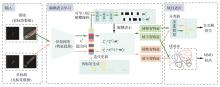
Fig.1
Schematic diagram of multi-source SAR target recognition model based on feature decoupling and domain adaptation
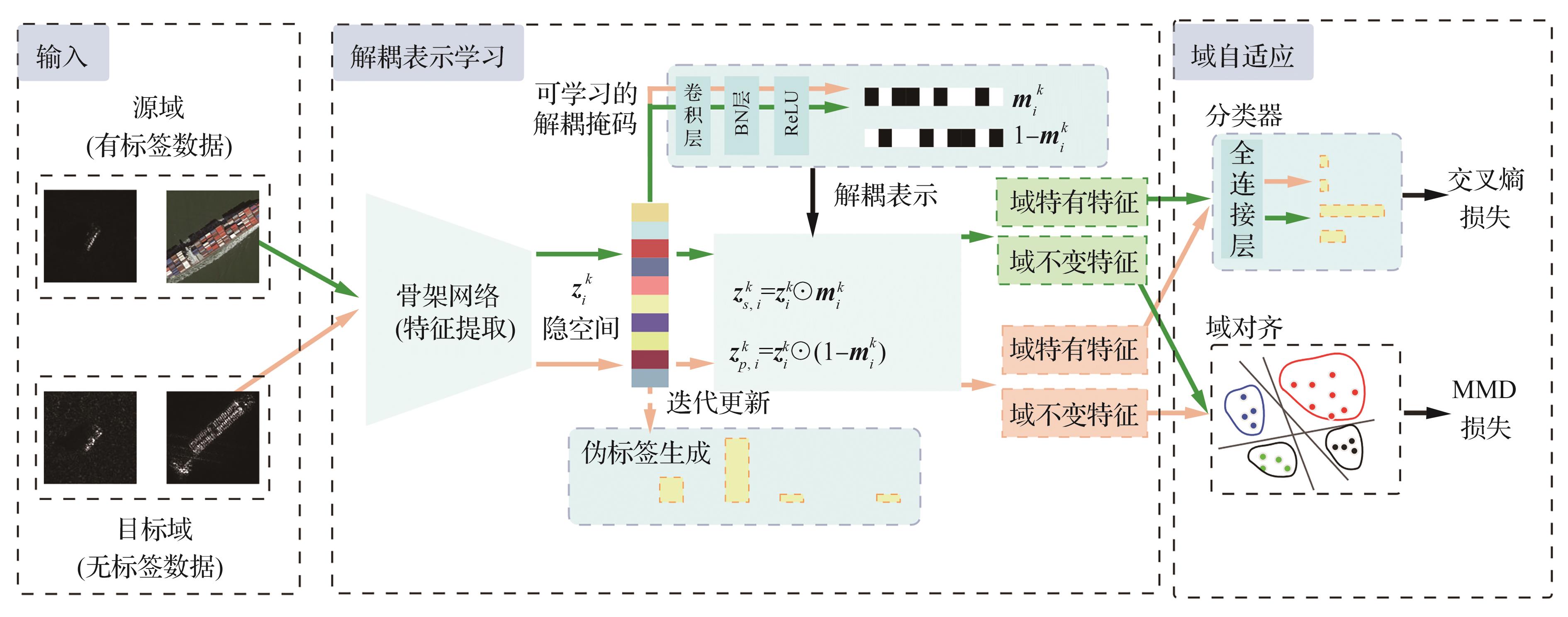
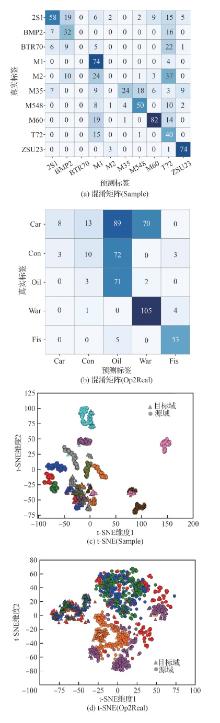
Fig.2
Prediction results under non-domain-adaption

Table 1
Comparative experimental results of existing domain adaptation methods
| 方法 | Sample数据集 准确率/% | Op2Real数据集 准确率/% |
|---|---|---|
| DAN[ | 82.53±1.02 | 61.85±1.97 |
| DSAN[ | 88.34±0.32 | 72.84±3.07 |
| CDAN[ | 84.48±0.54 | 64.95±3.90 |
| DANN[ | 84.36±1.91 | 64.40±1.55 |
| ILA-DA[ | 86.83±6.62 | 67.69±3.45 |
| DeepCoral[ | 72.67±2.21 | 56.81±1.26 |
| MRAN[ | 83.39±0.83 | 70.27±2.70 |
| CoSCA[ | 92.10±0.77 | 66.56±1.82 |
| 本文方法 | 96.10±1.14 | 78.02±1.45 |
Table 2
Ablation experiment results of each module
| 数据集 | LMMD | LWGCE | 特征解耦 | 准确率/% |
|---|---|---|---|---|
| Sample | √ | 86.64 | ||
| √ | √ | 90.72 | ||
| √ | √ | 96.47 | ||
| √ | √ | √ | 97.40 | |
| Op2Real | √ | 73.60 | ||
| √ | √ | 76.35 | ||
| √ | √ | 76.61 | ||
| √ | √ | √ | 79.95 |
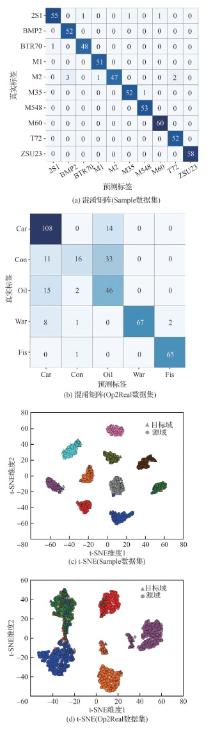
Fig.3
Prediction results under domain adaptation condition
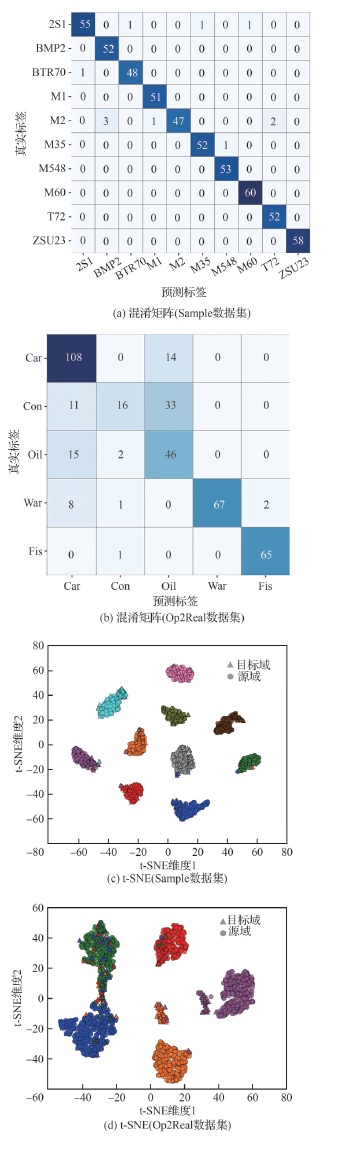
Table 3
Impact of parameter q on model accuracy
| 数据集 | q | 准确率/% |
|---|---|---|
| Sample | 0.1 | 95.55 |
| 0.3 | 98.70 | |
| 0.5 | 96.47 | |
| 0.7 | 97.22 | |
| 0.9 | 95.73 | |
| Op2Real | 0.1 | 79.43 |
| 0.3 | 79.17 | |
| 0.5 | 79.17 | |
| 0.7 | 77.38 | |
| 0.9 | 77.20 |
Table 4
Results of label noise suppression experiment
| 损失函数 | Sample数据集 | Op2Real数据集 | ||||
|---|---|---|---|---|---|---|
| 噪声率/% | 0 | 10 | 20 | 0 | 10 | 20 |
| CE/% | 97.59 | 94.81 | 92.21 | 82.01 | 77.12 | 76.09 |
| LWGCE/% | 97.03 | 97.59 | 96.10 | 84.58 | 83.80 | 80.46 |
Table 5
Results of feature alignment experiment
| 数据集 | 对齐特征 | 准确率/% | |
|---|---|---|---|
| 域不变特征 | 全部特征 | ||
| Sample | √ | 97.40 | |
| √ | 92.58 | ||
| Op2Real | √ | 79.95 | |
| √ | 74.81 | ||
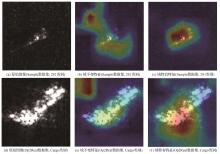
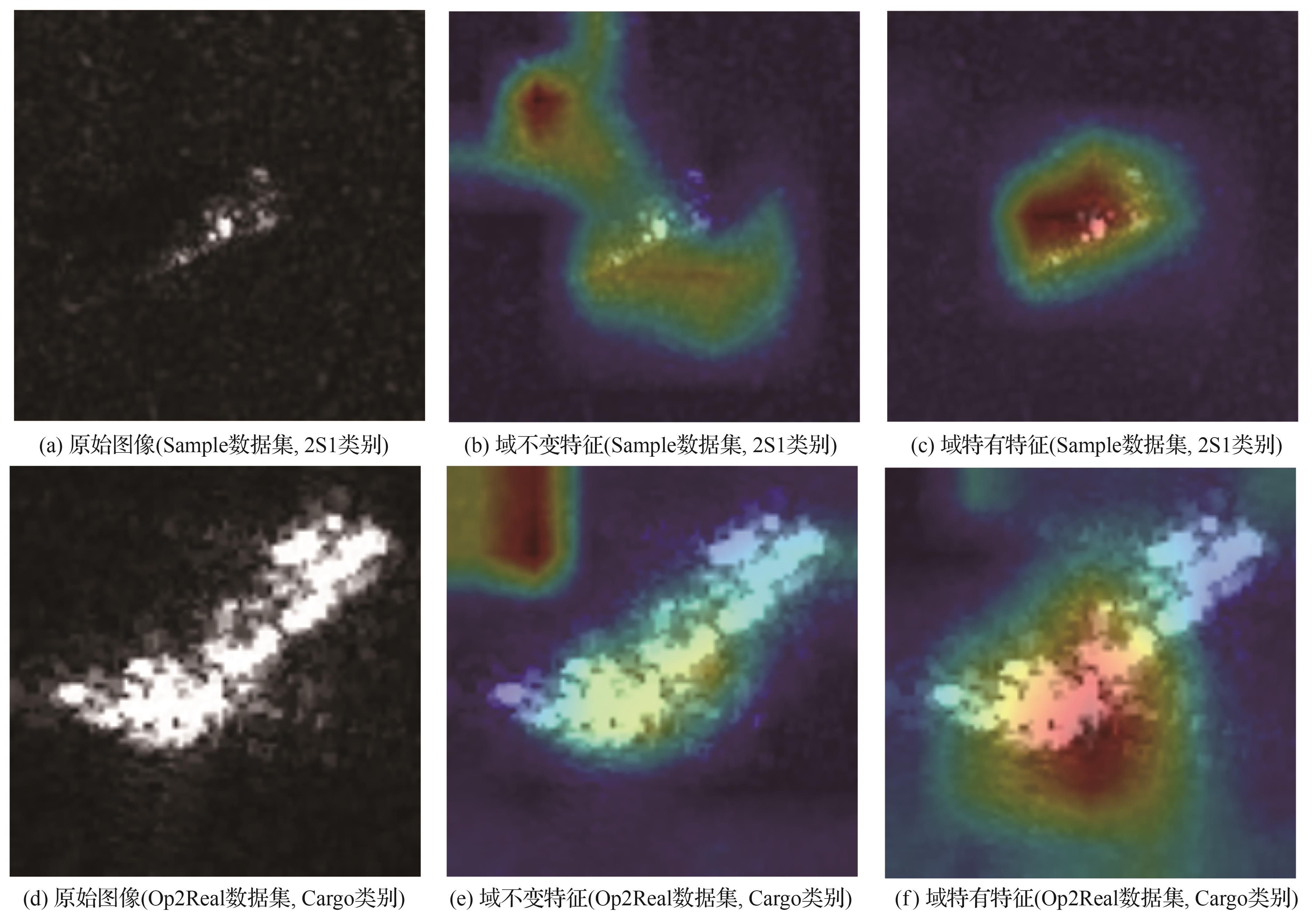
Fig.4
Grad-CAM visualization results
| [1] | ZHANG J, LIU J, PAN B, et al. Domain adaptation based on correlation subspace dynamic distribution alignment for remote sensing image scene classification[J]. IEEE Transactions on Geoscience and Remote Sensing, 2020, 58(11): 7920-7930. |
| [2] | 吕小玲, 仇晓兰, 俞文明, 等. 基于无监督域适应的仿真辅助SAR目标分类方法及模型可解释性分析[J]. 雷达学报, 2022, 11(1): 168-182. |
| LYU X L, QIU X L, YU W M, et al. Simulation-assisted SAR target classification based on unsupervised domain adaptation and model interpretability analysis[J]. Journal of Radars, 2022, 11(1): 168-182 (in Chinese). | |
| [3] | TIRANDAZ Z, AKBARIZADEH G. A two-phase algorithm based on kurtosis curvelet energy and unsupervised spectral regression for segmentation of SAR images[J]. IEEE Journal of Selected Topics in Applied Earth Observations and Remote Sensing, 2016, 9(3): 1244-1264. |
| [4] | LIN H P, SONG S L, YANG J. Ship classification based on MSHOG feature and task-driven dictionary learning with structured incoherent constraints in SAR images[J]. Remote Sensing, 2018, 10(2): 190. |
| [5] | 胡思茹, 马福民, 秦天奇, 等. 基于多特征组合的红外舰船目标识别技术[J]. 舰船电子工程, 2022, 42(2): 185-189. |
| HU S R, MA F M, QIN T Q, et al. Infrared ship target recognition technology based on multi feature combination[J]. Ship Electronic Engineering, 2022, 42(2): 185-189 (in Chinese). | |
| [6] | OUCHI K. Current status on vessel detection andclassification by synthetic aperture radar for maritimesecurity and safety[C]∥38th Symposium on Remote Sensingfor Environmental Sciences. 2016: 3-5. |
| [7] | ZHANG X, HUO C L, XU N, et al. Multitask learning for ship detection from synthetic aperture radar images[J]. IEEE Journal of Selected Topics in Applied Earth Observations and Remote Sensing, 2021, 14: 8048-8062. |
| [8] | 张翼鹏, 卢东东, 仇晓兰, 等. 基于散射点拓扑和双分支卷积神经网络的SAR图像小样本舰船分类[J]. 雷达学报, 2024, 13(2): 411-427. |
| ZHANG Y P, LU D D, QIU X L, et al. Few-shot ship classification of SAR images via scattering point topology and dual-branch convolutional neural network[J]. Journal of Radars, 2024, 13(2): 411-427 (in Chinese). | |
| [9] | WANG H P, CHEN S Z, XU F, et al. Application of deep-learning algorithms to MSTAR data[C]∥2015 IEEE International Geoscience and Remote Sensing Symposium (IGARSS). Piscataway: IEEE Press, 2015: 3743-3745. |
| [10] | HUANG Z L, DATCU M, PAN Z X, et al. Deep SAR-net: learning objects from signals[J]. ISPRS Journal of Photogrammetry and Remote Sensing, 2020, 161: 179-193. |
| [11] | CHEN J K, QIU X L, DING C B, et al. SAR image classification based on spiking neural network through spike-time dependent plasticity and gradient descent[J]. ISPRS Journal of Photogrammetry and Remote Sensing, 2022, 188: 109-124. |
| [12] | LI Y, DU L, WEI D. Multiscale CNN based on component analysis for SAR ATR[J]. IEEE Transactions on Geoscience and Remote Sensing, 2022, 60: 5211212. |
| [13] | SHI Y, DU L, LI C, et al. Unsupervised domain adaptation for SAR target classification based on domain-and class-level alignment: From simulated to real data[J]. ISPRS Journal of Photogrammetry and Remote Sensing, 2024, 207: 1-13. |
| [14] | LONG M S, ZHU H, WANG J M, et al. Deep transfer learning with joint adaptation networks[C]∥Proceedings of the 34th International Conference on Machine Learning. 2017: 2208-2217. |
| [15] | ZHU Y C, ZHUANG F Z, WANG J D, et al. Deep subdomain adaptation network for image classification[J]. IEEE Transactions on Neural Networks and Learning Systems, 2021, 32(4): 1713-1722. |
| [16] | LONG M S, CAO Z J, WANG J M, et al. Conditional adversarial domain adaptation[C]∥Proceedings of the 32nd International Conference on Neural Information Processing Systems. 2018. |
| [17] | DU Z K, LI J J, SU H Z, et al. Cross-domain gradient discrepancy minimization for unsupervised domain adaptation[C]∥2021 IEEE/CVF Conference on Computer Vision and Pattern Recognition (CVPR). Piscataway: IEEE Press, 2021: 3936-3945. |
| [18] | GHIFARY M, KLEIJN W B, ZHANG M J, et al. Deep reconstruction-classification networks for unsupervised domain adaptation[C]∥Computer Vision-ECCV 2016. Cham: Springer, 2016: 597-613. |
| [19] | BOUSMALIS K, TRIGEORGIS G, SILBERMAN N, et al. Domain separation networks[C]∥30th Conference on Neural Information Processing Systems (NIPS 2016). 2016. |
| [20] | SANKARANARAYANAN S, BALAJI Y, CASTILLO C D, et al. Generate to adapt: aligning domains using generative adversarial networks[C]∥2018 IEEE/CVF Conference on Computer Vision and Pattern Recognition. Piscataway: IEEE Press, 2018: 8503-8512. |
| [21] | WANG S S, XIAO Q, WANG K Y, et al. Mutual-weighted feature disentanglement for unsupervised domain adaptation[J]. Multimedia Systems, 2024, 30(6): 308. |
| [22] | ZHOU L H, YE M, LI X P, et al. Disentanglement then reconstruction: Unsupervised domain adaptation by twice distribution alignments[J]. Expert Systems with Applications, 2024, 237: 121498. |
| [23] | CAI R Y, JIN M, WEN Q S, et al. From entanglement to alignment: representation space decomposition for unsupervised time series domain adaptation[EB/OL]. (2025-08-06)[2025-10-01]: . |
| [24] | YU X, TSENG H H, YOO S, et al. INSURE: An information theory inspired disentanglement and purification model for domain generalization[J]. IEEE Transactions on Image Processing, 2024, 33: 3508-3519. |
| [25] | GAO F, PI D C, CHEN J F. Balanced and robust unsupervised open set domain adaptation via joint adversarial alignment and unknown class isolation[J]. Expert Systems with Applications, 2024, 238: 122127. |
| [26] | LI Y, ZHANG S S, LIU Y N, et al. Loose to compact feature alignment for domain adaptive object detection[J]. Pattern Recognition Letters, 2024, 181: 92-98. |
| [27] | LEWIS B, SCARNATI T, SUDKAMP E, et al. A SAR dataset for ATR development: The synthetic and measured paired labeled experiment (SAMPLE)[C]∥Algorithms for Synthetic Aperture Radar Imagery XXVI. 2019. |
| [28] | SHI Y, DU L, GUO Y C, et al. Unsupervised domain adaptation for ship classification via progressive feature alignment: from optical to SAR images[J]. IEEE Transactions on Geoscience and Remote Sensing, 2024, 62: 5222517. |
| [29] | HOU X Y, AO W, SONG Q, et al. FUSAR-Ship: building a high-resolution SAR-AIS matchup dataset of Gaofen-3 for ship detection and recognition[J]. Science China Information Sciences, 2020, 63: 140303. |
| [30] | GANIN Y, LEMPITSKY V. Unsupervised domain adaptation by backpropagation[C]∥Proceedings of the 32nd International Conference on Machine Learning. 2015: 1180-1189. |
| [31] | SHARMA A, KALLURI T, CHANDRAKER M. Instance level affinity-based transfer for unsupervised domain adaptation[C]∥2021 IEEE/CVF Conference on Computer Vision and Pattern Recognition (CVPR). Piscataway: IEEE Press, 2021: 5357-5367. |
| [32] | SUN B C, SAENKO K. Deep CORAL: Correlation alignment for deep domain adaptation[M]. Cham: Springer, 2016: 443-450. |
| [33] | ZHU Y C, ZHUANG F Z, WANG J D, et al. Multi-representation adaptation network for cross-domain image classification[J]. Neural Networks, 2019, 119: 214-221. |
| [34] | DAI S Y, CHENG Y, ZHANG Y Z, et al. Contrastively smoothed class alignment for unsupervised domain adaptation[C]∥Computer Vision-ACCV 2020. Cham: Springer, 2021: 268-283. |
| [35] | ZHANG Z L, SABUNCU M R. Generalized cross entropy loss for training deep neural networks with noisy labels[C]∥Proceedings of the 32nd International Conference on Neural Information Processing Systems. 2018. |
| [36] | SELVARAJU R R, COGSWELL M, DAS A, et al. Grad-CAM: Visual explanations from deep networks via gradient-based localization[J]. International Journal of Computer Vision, 2020, 128(2): 336-359. |
| [1] | Jianing JIN, Ling WANG, Rui GONG, Daiyin ZHU. 3D imaging of passive squint InISAR using target-borne illuminator of opportunity [J]. Acta Aeronautica et Astronautica Sinica, 2025, 46(8): 330982-330982. |
| [2] | Jinhu LÜ, Zongfu WANG, Kexin LIU, Jianglong YU, Deyuan LIU. New progress in cluster collaborative detection and guidance based on bi/multi-static SAR [J]. Acta Aeronautica et Astronautica Sinica, 2025, 46(6): 531548-531548. |
| [3] | Jing HE, Gewei TAN. High resolution imaging of moving targets based on ALPFT parameter estimation [J]. Acta Aeronautica et Astronautica Sinica, 2025, 46(1): 330502-330502. |
| [4] | Li YAN, Jie ZHANG, Jiadong WANG. [J]. Acta Aeronautica et Astronautica Sinica, 2024, 45(S1): 730559-730559. |
| [5] | Zheng YE, Daiyin ZHU, Di WU. SAR image registration algorithm based on echo information of overlapping subaperture [J]. ACTA AERONAUTICAET ASTRONAUTICA SINICA, 2023, 44(8): 327254-327254. |
| [6] | Gongye YU, Weidong CAI, Minghui HU, Wencai LIU, Bo MA. Intelligent migration diagnosis of mechanical faults driven by hybrid fault mechanism and domain adaptation [J]. ACTA AERONAUTICAET ASTRONAUTICA SINICA, 2023, 44(2): 426800-426800. |
| [7] | Penghui JI, Shiqi XING, Dahai DAI, Bo Pang, Dejun FENG. A SAR scene deceptive jamming method based on range convolution and azimuth multiplication modulation [J]. Acta Aeronautica et Astronautica Sinica, 2023, 44(18): 328235-328235. |
| [8] | Lianzi WANG, Ling WANG, Daiyin ZHU. An ISAR autofocus imaging algorithm based on FCN and transfer learing [J]. Acta Aeronautica et Astronautica Sinica, 2023, 44(17): 328172-328172. |
| [9] | BAO Yue, CHEN Junyu, SHI Tianyue, MAO Xinhua. Error model-aided autofocus for airborne high resolution wide swath DBF-SAR [J]. ACTA AERONAUTICAET ASTRONAUTICA SINICA, 2021, 42(6): 324502-324502. |
| [10] | SONG Chuang, ZHAO Jiajia, WANG Kang, LIANG Xinkai. A survey of few shot learning based on intelligent perception [J]. ACTA AERONAUTICAET ASTRONAUTICA SINICA, 2020, 41(S1): 723756-723756. |
| [11] | LU Jingyue, ZHANG Lei, MENG Zhichao, SHENG Jialian. Unambiguous imaging for forward-looking synthetic aperture radar on curve trajectory [J]. ACTA AERONAUTICAET ASTRONAUTICA SINICA, 2019, 40(7): 322745-322745. |
| [12] | ZHU Xiaoxiu, HU Wenhua, MA Juntao, GUO Baofeng, XUE Dongfang. ISAR autofocusing imaging with sparse apertures and time-varying bistatic angle [J]. ACTA AERONAUTICAET ASTRONAUTICA SINICA, 2018, 39(8): 322059-322059. |
| [13] | TANG Zhengzhao, DONG Chunxi, CHANG Xin, LIU Mingming, ZHAO Guoqing. ISAR micro-Doppler scatter-wave jamming method based on towed jammer [J]. ACTA AERONAUTICAET ASTRONAUTICA SINICA, 2018, 39(7): 322007-322007. |
| [14] | WAN Jun, ZHOU Yu, ZHANG Linrang, CHEN Zhanye. A fast SAR-GMTI focusing method based on time reversal and reduced-order Keystone [J]. ACTA AERONAUTICAET ASTRONAUTICA SINICA, 2018, 39(6): 321862-321862. |
| [15] | YANG Mingdong, YU Xiang, ZHU Daiyin. High-precision space-variant motion compensation with multi-level processing for airborne SAR based on subswath [J]. ACTA AERONAUTICAET ASTRONAUTICA SINICA, 2018, 39(2): 321557-321557. |
| Viewed | ||||||
|
Full text |
|
|||||
|
Abstract |
|
|||||
Address: No.238, Baiyan Buiding, Beisihuan Zhonglu Road, Haidian District, Beijing, China
Postal code : 100083
E-mail:hkxb@buaa.edu.cn
Total visits: 6658907 Today visits: 1341All copyright © editorial office of Chinese Journal of Aeronautics
All copyright © editorial office of Chinese Journal of Aeronautics
Total visits: 6658907 Today visits: 1341

 CJA
CJA
