王征, 赵守智( ), 李昊田, 孙征, 邵静, 侯丞
收稿日期:2025-06-10
修回日期:2025-07-09
接受日期:2025-09-10
出版日期:2025-09-25
发布日期:2025-09-24
通讯作者:
赵守智
E-mail:zhaoshouzhi@ciae.ac.cn
基金资助:
Zheng WANG, Shouzhi ZHAO(), Haotian LI, Zheng SUN, Jing SHAO, Cheng HOU
Received:2025-06-10
Revised:2025-07-09
Accepted:2025-09-10
Online:2025-09-25
Published:2025-09-24
Contact:
Shouzhi ZHAO
E-mail:zhaoshouzhi@ciae.ac.cn
Supported by:摘要:
地外天体表面的冰层及其下方的海洋环境已成为探索生命迹象和宜居性的关键目标。穿冰探测器作为突破冰层、抵达冰下海洋的核心工具,在未来的原位探测中具有不可替代的作用,成为深空探测的重要发展方向。系统综述了深空穿冰探测器的发展现状。首先梳理了太阳系内火星极区冰盖、木卫二及土卫二等冰卫星的冰下海洋环境探测进展。其次总结了地球应用的穿冰技术(冰芯钻机、热水钻机、盘管钻机及融冰器)的特点与深空任务适配性。重点分析了美国、德国、奥地利及中国在深空穿冰探测器领域的典型方案与研究进展。同时,探讨了穿冰探测器面临的关键技术挑战,如冰层高效穿透、障碍物探测、姿态控制、能源供应、信息传输及行星保护等问题。未来需通过多技术融合与创新,推动穿冰探测器实现地外冰下海洋的直接探测,为揭示生命起源和天体演化提供支撑。
中图分类号:
王征, 赵守智, 李昊田, 孙征, 邵静, 侯丞. 深空探测用穿冰探测器发展现状[J]. 航空学报, 2026, 47(5): 332398.
Zheng WANG, Shouzhi ZHAO, Haotian LI, Zheng SUN, Jing SHAO, Cheng HOU. Development status of ice-penetrating probes for deep space exploration[J]. Acta Aeronautica et Astronautica Sinica, 2026, 47(5): 332398.

图 1
火星北极冰盖(“天问一号”拍摄)[15]


图 2
火星南极冰盖(“火星快车号”拍摄)[16]


图 3
木卫二结构模型[19]


图 4
土卫二表面的水冰喷射现象(卡西尼号拍摄)[24]


图 5
海卫一照片(旅行者二号拍摄)[25]


图 6
CHINARE/JARE型深冰芯钻机[34]


图 7
热水钻机工作原理[33]


图 8
盘管钻机的工作原理[36]


图 9
闭式循环水加热融冰器工作原理[37]


图 10
“Philberth”探测器[39]


图 11
钟摆稳定融冰探测器2种构型示意图[41]


图 12
CRREL制造的钟摆稳定探测器结构[42]


图 13
RECAS的结构示意图[44]


图 14
吸水加压融冰器结构示意图与工作原理[46]

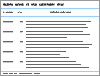
表1
地球上应用的电加热融冰探测器参数
| 探测器名称 | 直径/cm | 长度/cm | 功率/kW | 融冰速度/(m·h-1) | 垂直姿态控制 | 文献 |
|---|---|---|---|---|---|---|
| Philberth探测器 | 10.8 | 292(Probe1) 255(Porbe2) | 3.7 | 2 | 水银环腔 | [ |
| CRREL钟摆稳定探测器 | 12.7 | 250 | 15 | 6(-28 ℃) | 钟摆原理 | [ |
| SIRG-Hansen探测器 | 主体:12.7 突出端:16.5 | 345 | 5.4(4.05端部, 1.35上部) | 钟摆原理 | [ | |
| SUSI Ⅱ | 10 | 225 | 3.4 | 2.93 | 钟摆原理 | [ |
| SUSI Ⅲ | 14 | 360 | 9 | 控制分区加热 | [ | |
| RECAS原型 | 18 | 727.5 | 9.96(6.32端头) | 2.11(下) 3.6(上) | [ |
表2
不同穿冰探测器的优缺点对比[36]
| 穿冰器类型 | 优点 | 缺点 |
|---|---|---|
| 冰芯钻机 | 可获得高质量的冰芯 可形成半永久钻孔 钻孔直径均匀 | 速度慢,成本高 钻孔会受到热干扰 需要大量的钻井液 |
| 热水钻机 | 穿冰速率较快,可快速钻探至1~2 km深度 传感器可以固定在原位可以获取短冰芯 | 孔在2~3 d内会重新冻结 已部署的传感器无法回收用于校准检查或重新部署 钻孔会受到显著的热干扰 钻孔直径不固定需要大量燃料 |
| 盘管钻机 | 穿冰速率快,可快速钻至3~4 km深度 钻孔直径均匀 热干扰最小 传感器可以在孔内重新定位或回收进行定期校准 可以获取短冰芯、岩芯和冻结沉积物芯 | 必须密封稀疏透气的积雪层 对于某些实验来说,孔太小 需要一定量的钻井液 |
| 融冰器 | 系统极简单,便携 能动部件少,可靠性高 可实现无污染钻探和取样 | 融冰速率慢 向冰层中热传输损耗大,能量利用率低 对冰层热扰动大融孔易冻结 |

图 15
Cryobot 任务的概念图像[52]


图 16
CHIRPS示意图[54]


图 17
火星探测用Cryobot示意图[53]


图 18
集成反应堆的着陆器结构[55]


图 19
着陆器上的反应堆结构示意图[55]


图 20
集成反应堆的融冰探测器概念[56]


图 21
SIPR探测器工作原理[60]

表3
2种Tunnelbot参数对比
| 参数 | 反应堆Tunnelbot | GPHS Tunnelbot |
|---|---|---|
| 科学载荷 | 生物探测仪器(~30 kg),适配48 cm Tunnelbot内径 | 生物探测仪器(~30 kg),适配22 cm Tunnelbot内径 |
| 20 km冰层穿透时间 | ~3年 | ~3年 |
| 着陆质量 | ~1 350 kg(包含30%裕度) | ~750 kg,(包含30%裕度) |
| 发射火箭 | SLS Block 1B(LEO-100 t) | SLS Block 1(LEO-70 t) |
| 尺寸 | 外径51.76 cm,长526.22 cm | 外径25 cm,长5.7 m |
| 技术成熟度 | 3~5(生物探测和取样,能源,热、中继器和系绳) | 3~5(生物探测和取样,能源,热、中继器和系绳) |
| 融冰热 | ~43 kW(基于Kilopower反应堆) | ~12 kW(58个GPHS模块) |
| 电源系统 | ~400 W,采用斯特林发电机(大部分电功率用于 驱动泵回路) | 电池供电和~50 W电(通过热电偶转换或动力转换)利用专用的 GPHS 热量(比反应堆驱动的版本少很多,使用可变压力热管) |

图 22
反应堆Tunnellbot结构[61]


图 23
GPHS Tunnelbot结构[61]


图 24
中继通讯器[61]


图 25
VALKYRIE示意图[67]


图 26
用于 10~100 m 冰层下穿任务的DLP示意图[68]


图 27
PROMETHEUS示意图[70]


图 28
THOR示意图[72]


图 29
木卫二SLUSH结构示意图[73]


图 30
脉冲蠕动式穿冰器初步设计方案[74]


图 31
总体结构示意图[75]


图 32
SWIM的示意图[76]


图 33
EnEx-IceMole结构[79]


图 34
Teredo IceShuttle结构示意图[80]


图 35
Leng 型AUV[81]


图 36
TRIPLE-IceCraft 结构示意图[82]


图 37
TRIPLE-IceCraft 释放nanoAUV 示意图[84]


图 38
融冰试验装置示意图[86]

表4
4组实验的实验结果
| 实验序号 | 密度/(kg·cm-3) | 加热功率/W | 下降速率/(cm·h-1) | 压力/Pa | 平均冰温/℃ |
|---|---|---|---|---|---|
| 1:真空、致密冰 | 917 | 60 | 3.4 | ≈2×10⁻³ | ≈-55 |
| 2:常压、致密冰 | 917 | 25,60 | -,23 | 1×10⁵ | ≈-25 |
| 3:真空、疏松雪 | 248 | 25 | 4.8 | (2.5~3.5)×10-3 | ≈-50 |
| 4:常压、疏松雪 | 219 | 25 | 45 | 1×10⁵ | ≈-25 |

图 39
热钻原型及内部结构[93]


图 40
一种可部署AUV的穿冰探测器设想[96]


图 41
ESA/NASA提出的冰层穿透器部署过程[102]


图 42
射频信号在冰层(-15 ℃)中传输时的衰减[54]

| [1] | BOARD S S. Origins, worlds, and life: A decadal strategy for planetary science and astrobiology 2023-2032[M]. Washington, D.C.: National Academies Press, 2023: 339-361. |
| [2] | 王赤, 时蓬, 宋婷婷, 等. 远航2050: 欧洲空间科学规划及启示[J]. 科技导报, 2022, 40(4): 6-15. |
| WANG C, SHI P, SONG T T, et al. Voyage 2050: ESA science’s long-term plane and enlightenment[J]. Science & Technology Review, 2022, 40(4): 6-15 (in Chinese). | |
| [3] | 中国科学院, 国家航天局, 中国载人航天工程办公室. 国家空间科学中长期发展规划(2024-2050)[ EB/OL]. (2024-10-15)[2025-06-10]. . |
| Chinese Academy of Sciences, China National Space Administration, China Manned Space Engineering Office. Medium to long-term development plan for national space science (2024-2050) [EB/OL]. (2024-10-15)[2025-06-10]. (in Chinese). | |
| [4] | KELTY J R. An in situ sampling thermal probe for studying global ice sheets[R]. Lincoln: University of Nebraska, 1995. |
| [5] | DI PIPPO S, MUGNUOLO R, VIELMO P, et al. The exploitation of Europa ice and water basins: An assessment on required technological developments, on system design approaches and on relevant expected benefits to space and Earth based activities[J]. Planetary and Space Science, 1999, 47(6-7): 921-933. |
| [6] | ULAMEC S, BIELE J, FUNKE O, et al. Access to glacial and subglacial environments in the Solar System by melting probe technology[J]. Reviews in Environmental Science and Bio/Technology, 2007, 6(1): 71-94. |
| [7] | LI S Y. Evidence of water on Mars and the consequences of its release[J]. Academic Journal of Environment & Earth Science, 2023, 5(8): 10-15. |
| [8] | CARR M H, BELTON M J S, CHAPMAN C R, et al. Evidence for a subsurface ocean on Europa[J]. Nature, 1998, 391(6665): 363-365. |
| [9] | 李春来, 刘建军, 严韦, 等. 小行星探测科学目标进展与展望[J]. 深空探测学报, 2019, 6(5): 424-436. |
| LI C L, LIU J J, YAN W, et al. Overview of scientific objectives for minor planets exploration[J]. Journal of Deep Space Exploration, 2019, 6(5): 424-436 (in Chinese). | |
| [10] | 刘正豪, 刘洋, 刘佳, 等. 火星水冰分布特征和研究进展[J]. 地球科学, 2024, 49(6): 2253-2276. |
| LIU Z H, LIU Y, LIU J, et al. Distribution characteristics and research progress of water-ice on Mars[J]. Earth Science, 2024, 49(6): 2253-2276 (in Chinese). | |
| [11] | FRANCES E G B. Water ice at mid-latitudes on Mars [M]. Oxford: Oxford University Press, 2022: 137-150. |
| [12] | SHARMA S, ROPPEL R D, MURPHY A E, et al. Diverse organic-mineral associations in Jezero crater, Mars[J]. Nature, 2023, 619(7971): 724-732. |
| [13] | EGEA-GONZÁLEZ I, LOIS P C, JIMÉNEZ-DÍAZ A, et al. The stability of a liquid-water body below the south polar cap of Mars[J]. Icarus, 2022, 383: 115073. |
| [14] | DIEZ A. Liquid water on Mars[J]. Science, 2018, 361(6401): 448. |
| [15] | 中国科学院国家天文台. 火星-科学数据[DB/OL]. (2022-07-25) [2025-06-10]. |
| National Astronomical Observatories of the Chinese Academy of Sciences. Mars-science data[DB/OL]. (2022-07-25) [2025-06-10]. (in Chinese). | |
| [16] | GOOD A. Study looks more closely at Mars’ underground water signals[EB/OL]. (2021-06-24) [2025-06-10]. . |
| [17] | KIVELSON M G, KHURANA K K, RUSSELL C T, et al. Galileo magnetometer measurements: A stronger case for a subsurface ocean at Europa[J]. Science, 2000, 289(5483): 1340-1343. |
| [18] | STEVENSON D. Europa’s ocean: The case strengthens[J]. Science, 2000, 289(5483): 1305-1307. |
| [19] | PROPULSION LABORATORY JET. Science Objectives of NASA’s Europa Clipper Mission[EB/OL]. (2024-10-11) [2025-06-10]. . |
| [20] | SPARKS W B, HAND K P, MCGRATH M A, et al. Probing for evidence of plumes on Europa with hst/stis[J]. The Astrophysical Journal, 2016, 829(2): 121. |
| [21] | JIA X Z, KIVELSON M G, KHURANA K K, et al. Evidence of a plume on Europa from Galileo magnetic and plasma wave signatures[J]. Nature Astronomy, 2018, 2(6): 459-464. |
| [22] | BILLINGS S E, KATTENHORN S A. The great thickness debate: Ice shell thickness models for Europa and comparisons with estimates based on flexure at ridges[J]. Icarus, 2005, 177(2): 397-412. |
| [23] | HOWELL S M. The likely thickness of Europa’s icy shell[J]. The Planetary Science Journal, 2021, 2(4): 129. |
| [24] | Jet Propulsion Laboratory. Complex organics bubble up from Enceladus[EB/OL]. (2018-06-27)[2025-06-10]. . |
| [25] | National Aeronautics and Space Administration. Global Color Mosaic of Triton [EB/OL]. (1998-06-04)[2025-06-10]. . |
| [26] | FLETCHER L N, CAVALIÉ T, GRASSI D, et al. Jupiter science enabled by ESA’s Jupiter icy moons explorer[J]. Space Science Reviews, 2023, 219(7): 53. |
| [27] | VAN HOOLST T, TOBIE G, VALLAT C, et al. Geophysical characterization of the interiors of Ganymede, Callisto and Europa by ESA’s JUpiter ICy moons explorer[J]. Space Science Reviews, 2024, 220(5): 54. |
| [28] | ROBERTS J H, MCKINNON W B, ELDER C M, et al. Exploring the interior of Europa with the Europa clipper[J]. Space Science Reviews, 2023, 219(6): 46. |
| [29] | DAUBAR I J, HAYES A G, COLLINS G C, et al. Planned geological investigations of the Europa clipper mission[J]. Space Science Reviews, 2024, 220(1): 18. |
| [30] | PAPPALARDO R T, BURATTI B J, KORTH H, et al. Science overview of the Europa clipper mission[J]. Space Science Reviews, 2024, 220(4): 40. |
| [31] | FOX D. Tiny animal carcasses found in buried Antarctic lake[J]. Nature, 2019, 565(7740): 405-406. |
| [32] | CHRISTNER B C, PRISCU J C, ACHBERGER A M, et al. A microbial ecosystem beneath the West Antarctic ice sheet[J]. Nature, 2014, 512(7514): 310-313. |
| [33] | 张楠, 王亮, Talalay Pavel, 等. 极地冰钻关键技术研究进展[J]. 探矿工程(岩土钻掘工程), 2020, 47(2): 1-16. |
| ZHANG N, WANG L, TALALAY P, et al. Advances in research on key technology for ice drilling in the polar regions[J]. Exploration Engineering (Rock & Soil Drilling and Tunneling), 2020, 47(2): 1-16 (in Chinese). | |
| [34] | 范晓鹏, 张楠, 胡正毅, 等. 中国南极昆仑站深冰芯科学钻探工程进展[J]. 钻探工程, 2021, 48(9): 1-9. |
| FAN X P, ZHANG N, HU Z Y, et al. Progress of the deep ice core scientific drilling project of China at Kunlun Station in Antarctica[J]. Drilling Engineering, 2021, 48(9): 1-9 (in Chinese). | |
| [35] | RACK F R. Enabling clean access into Subglacial Lake Whillans: Development and use of the WISSARD hot water drill system[J]. Philosophical Transactions Series A, Mathematical, Physical, and Engineering Sciences, 2016, 374(2059): 20140305. |
| [36] | GARY DC, KOCI B. A fast mechanical access drill for polar glaciology, paleoclimatology, geology, tectonics, and biology[J]. Memoirs of National Institute of Polar Research, 2002, 56: 5-37. |
| [37] | KASSER P. Ein leichter thermischer eisbohrer als hilfsgerät zur installation von ablationsstangen auf gletschern[J]. Geofisica Pura E Applicata, 1960, 45(1): 97-114. |
| [38] | Aamot W C. The Philberth probe for investigating polar ice caps:SR-119[R]. Hanover: US Army Materiel Command, 1967. |
| [39] | AAMOT H W C. Instruments and methods instrumented probes for deep glacial investigations[J]. Journal of Glaciology, 1968, 7(50): 321-328. |
| [40] | Philberth. Philberth thermal probe deep drilling method by EGIG in 1968 at station Jarl-Joset, Central Greenland[R]. Lincoln: University of Nebraska, 1976. |
| [41] | AAMOT H W C. Pendulum steering for thermal probes in glaciers[J]. Journal of Glaciology, 1967, 6(48): 935-938. |
| [42] | AAMOT H W C. Development of a vertically stabilized thermal probe for studies in and below ice sheets[J]. Journal of Engineering for Industry, 1970, 92(2): 263-268. |
| [43] | HANSEN. An in-Situ sampling thermal probe[R]. Lincoln: University of Nebraska-Lincoln, 1984. |
| [44] | TALALAY P G, ZAGORODNOV V S, MARKOV A N, et al. Recoverable autonomous sonde (RECAS) for environmental exploration of Antarctic subglacial lakes: General concept[J]. Annals of Glaciology, 2014, 55(65): 23-30. |
| [45] | SUN Y H, PAVEL T, LI Y S, et al. Exploring antarctic subglacial lakes with RECoverable autonomous sonde (RECAS): Design and first field tests[J]. Science China Technological Sciences, 2024, 67(6): 1866-1878. |
| [46] | ZELENCHUK A V, KRYLENKOV V A. Probes for the study of icy and subglacial environment of planets[J]. Ice and Snow, 2019, 59(1): 123-134. |
| [47] | PAIGE D A, WOOD S E, VASAVADA AR. Drill/borescope system for the mars polar pathfinder[C]∥Workshop on Advanced Technologies for Planetary Instruments. Washington D.C.: NASA, 1993. |
| [48] | FOMIN S A, CHEN S M. Optimization of the heating surface shape in the contact melting problem[C]∥Third International Conference on Inverse Design Concepts and Optimization in Engineering Sciences (ICIDES-Ⅲ). Washington D.C.: 1991: 253-261. |
| [49] | HORNE M F. Thermal probe design for Europa sample acquisition[J]. Acta Astronautica, 2018, 142: 29-36. |
| [50] | TARAU C, LEE K L, ANDERSON WG, et al. Thermal concept for planetary ice melting probe[C]∥International Conference on Environmental Systems. Reston: AIAA, 2020. |
| [51] | CAROLYN R M, STEPHAN R A, VOYTEK M A, et al. NASA science technology development programs for ocean words exploration[C]∥18th Biennial International Conference. Denver: ASCE Earth and Space, 2022. |
| [52] | National Aeronautics and Space Administration. Digging deeper to find life on ocean worlds [EB/OL]. (2023-12-05) [2025-06-10]. . |
| [53] | ZIMMERMAN W, BONITZ R, FELDMAN J. Cryobot: An ice penetrating robotic vehicle for Mars and Europa[C]∥2001 IEEE Aerospace Conference Proceedings. Piscataway: IEEE Press, 2002: 311-323. |
| [54] | ZIMMERMAN W. A radioisotope powered cryobot for penetrating the Europan ice shell[J]. AIP Conference Proceedings, 2001, 552(1): 707-715. |
| [55] | ELLIOTT J O. Mission concept for a nuclear reactor-powered Mars cryobot lander[J]. AIP Conference Proceedings, 2003, 654(1): 353-360. |
| [56] | ELLIOTT J O, CARSEY F D. Deep subsurface exploration of planetary ice enabled by nuclear power[C]∥ 2004 IEEE Aerospace Conference Proceedings. Piscataway: IEEE Press, 2004: 2978-2987. |
| [57] | POSTON D. Exploring the ocean of Europa: Reactor or RHU?[J]. AIP Conference Proceedings, 2000, 504(1): 1175-1181. |
| [58] | CARSEY F D, BEEGLE L W, NAKAGAWA R, et al. Palmer Quest: A feasible nuclear fission “Vision mission” to the Mars polar caps[R]. Washington D.C.: NASA, 2005. |
| [59] | CARDELL G, HECHT M H, CARSRY F D, et al. The subsurface ice probe (SIRP): A low power thermal probe for the Martian polar layer deposits[R]. USA: NASA, 2004. |
| [60] | HECHT M, FRANK C. Subsurface ice probe[R]. Pasadena: Jet Propulsion Laboratory, 2005. |
| [61] | OLESON S, MICHAEL N J, ANDREW D, et al. Compass final report: Europa Tunnelbot(TP-2019-220054)[R]. Cleveland: Glenn Research Center, 2019. |
| [62] | STONE W C, HOGAN B, SIEGEL V, et al. Progress towards an optically powered cryobot[J]. Annals of Glaciology, 2014, 55(65): 2-13. |
| [63] | PRADHAN O, SANDEEP S, GASIEWSKI A J, et al. Design of a forward looking synthetic aperture radar for an autonomous cryobot for subsurface exploration of Europa[C]∥2017 XXXIInd General Assembly and Scientific Symposium of the International Union of Radio Science (URSI GASS). Piscataway: IEEE Press, 2017: 1-4. |
| [64] | STONE W C, HOGAN B P, SIEGEL V, et al. Valkyrie: Field campaign results for laser-powered cryobot[C]∥Astrobiology Science Conference. Chicago: Lunar and Planetary Institute, 2015. |
| [65] | CLARK E B, BRAMALL N E, CHRISTNER B, et al. An intelligent algorithm for autonomous scientific sampling with the VALKYRIE cryobot[J]. International Journal of Astrobiology, 2018, 17(3): 247-257. |
| [66] | PRADHAN O, GASIEWSKI A J. Endfire synthetic aperture radar for a cryobot for exploration of icy moons and terrestrial glaciers[J]. IEEE Transactions on Geoscience and Remote Sensing, 2021, 60: 1000114. |
| [67] | Aerospace Stone. A prototype laser-powered cryobot for clean subglacial access and sampling [EB/OL]. (2023-12-04) [2025-06-10]. . |
| [68] | Aerospace Stone. Archimedes: A really cool high impact method for exploring down into Europan subsurface [EB/OL]. (2024-02-07) [2025-06-10]. . |
| [69] | STONE AEROSPACE. PROMETHEUS: Nuclear-powered robotic mechanism technology for hot-water exploration of under-ice space [EB/OL]. (2023-12-04) [2025-06-10]. . |
| [70] | RICHMOND K, HOGAN B P, LOPEZ A, et al. PROMETHEUS: Progress toward an integrated cryobot for ocean world access[C]∥AGU Fall Meeting. Washington, D.C: American Geophysical Union, 2022. |
| [71] | Aerospace Stone. PARTI-Pucks: Puck-based data transmission using adaptive radio modems for through-ice communications[EB/OL]. (2023-12-04) [2025-06-10]. . |
| [72] | Aerospace Stone. Thor: Thermal high-voltage ocean-penetrator research platform [EB/OL]. (2023-12-04) [2025-06-10]. . |
| [73] | ZACNY K, COSTA T, REHNMARK F, et al. Slush: Search for life using submerisble heated drill[C]∥49th Lunar and Planetary Science Conference. Houston: Lunar and Planetary Institute, 2018. |
| [74] | HOCKMAN B, FERMANDO M H. Feasibility study of a pulsed-power peristaltic melt probe[R]. Pasadena: Jet Propulsion Laboratory, 2021. |
| [75] | WILCOX B H, CARLTON J A, JENKINS J M, et al. A deep subsurface ice probe for Europa[C]∥2017 IEEE Aerospace Conference. Piscataway: IEEE Press, 2017. |
| [76] | HALL L. SWIM-Sensing with independent micro-swimmers [EB/OL]. (2022-02-19) [2025-06-10]. . |
| [77] | DACHWALD B, MIKUCKI J, TULACZYK S, et al. IceMole: A maneuverable probe for clean in situ analysis and sampling of subsurface ice and subglacial aquatic ecosystems[J]. Annals of Glaciology, 2014, 55(65): 14-22. |
| [78] | KOWALSKI J, LINDER P, ZIERKE S, et al. Navigation technology for exploration of glacier ice with maneuverable melting probes[J]. Cold Regions Science and Technology, 2016, 123: 53-70. |
| [79] | BAADER F, BOXBERG M S, CHEN Q, et al. Field-test performance of an ice-melting probe in a terrestrial analogue environment[J]. Icarus, 2024, 409: 115852. |
| [80] | DLR. Systemblatt IceShuttle Teredo[R]. Bremen: German Research Center for Artificial Intelligence, 2016. |
| [81] | German Research Center for Artificial Intelligence. Leng-exploration AUV for long-distance-missions [EB/OL]. (2024-08-19) [2025-06-10]. . |
| [82] | HEINEN D, JAN A, GIANG DM, et al. Testing the retrievable melting probe TRIPLE-IceCraft in a terrestrial analog in the EKSTRÖM ice shelf in antarctica[R]. Aachen: RWTH Aachen University, 2023. |
| [83] | STELZIG M, AUDEHM J, BURGMAN B, et al. Melting and forefield reconnaissance technologies within TRIPLE-accessing subglacial water reservoirs for future missions to Ocean Worlds[R]. Erlangen: Germany Institute of Microwaves and Photonics, 2021. |
| [84] | NITSCH M, SEBASTIAN M. The TRIPLE-nanoAUV: An autonomous underwater vehicle to explore the oceans of icy moon[R]. Aachen: Institute of Automatic Control, 2023. |
| [85] | German Space Agency. Triple systems [EB/OL]. (2024-05-27) [2025-06-10]. . |
| [86] | TREFFER M, KÖMLE N I, KARGL G, et al. Preliminary studies concerning subsurface probes for the exploration of icy planetary bodies[J]. Planetary and Space Science, 2006, 54(6): 621-634. |
| [87] | KÖMLE N I, MELAIE T, GUNTER K, et al. Development of melting probes for exploring ice sheets and permafrost layers[J]. Journal of Glaciology and Geocryology, 2004, 26: 310-318. |
| [88] | KAUFMANN E, KARGL G, KÖMLE N I. Alternative methods to penetrate ice layers[C]∥International Workshop on Space Robotics. Cologne: Deutsches zentrum für Luftund Raumfahrt, 2009: 19-33. |
| [89] | KAUFMANN E, KARGL G, KÖMLE N I, et al. Melting and sublimation of planetary ices under low pressure conditions: Laboratory experiments with a melting probe prototype[J]. Earth, Moon, and Planets, 2009, 105(1): 11-29. |
| [90] | KÖMLE N I, TIEFENBACHER P, WEISS P, et al. Melting probes revisited–Ice penetration experiments under Mars surface pressure conditions[J]. Icarus, 2018, 308: 117-127. |
| [91] | KÖMLE N I, KARGL G, STELLER M. Melting probes as a means to explore planetary glacies and ice caps[C]∥Second European workshop on Exo/Astrobiology. Noordwijk: ESA Publications Division, 2002. |
| [92] | WEISS P, YUNG K L, NG T C, et al. Study of a thermal drill head for the exploration of subsurface planetary ice layers[J]. Planetary and Space Science, 2008, 56(9): 1280-1292. |
| [93] | WEISS P, YUNG K L, KÖMLE N I, et al. Thermal drill sampling system onboard high-velocity impactors for exploring the subsurface of Europa[J]. Advances in Space Research, 2011, 48(4): 743-754. |
| [94] | LI Y Z, TALALAY P G, FAN X P, et al. New approaches to modeling the critical refreezing length of a Philberth melt probe for ice sheet exploration[J]. Polar Science, 2023, 35: 100926. |
| [95] | 彭时林, 周元龙, 于海滨, 等. 可携带AUV的穿冰探测器及其布放回收AUV的方法: CN114296127A[P]. 2025-05-27. |
| PENG S L, ZHOU Y L, YU H B, et al. An AUV-carrying cryobot and its method for deploying and retrieving AUV: CN114296127A [P]. 2025-05-27 (in Chinese). | |
| [96] | 彭时林, 周元龙, 于海滨, 等. 可装载AUV适用于南极和外星球冰下水域探测的穿冰探测器: CN114296128A[P]. 2025-05-27. |
| PENG S L, ZHOU Y L, YU H B, et al. An ice-penetrating cryobot capable of carrying AUVs for subglacial water exploration in Antarctica and on extraterrestrial planets: CN114296128A [P]. 2025-05-27 (in Chinese). | |
| [97] | 于海滨, 周元龙, 彭时林, 等. 可装载AUV适用于深冰下水域探测的穿冰探测器: 202111660666.6[P]. 2022-04-08. |
| YU H B, ZHOU Y L, PENG S L, et al. An AUV-carrying cryobot capable of deep subglacial water exploration: 202111660666.6 [P]. 2022-04-08 (in Chinese). | |
| [98] | 孔海鹏, 彭时林, 于海滨, 等. 适用于深冰下水域探测的穿冰探测器及其子AUV的布放回收方法: CN116908917A[P]. 2023-10-20. |
| KONG H P, PENG S L, YU H B, et al. An ice-penetrating cryobot for deep subglacial water exploration and its deployment/retrieval methods for deployable AUV: CN116908917A [P]. 2023-10-20 (in Chinese). | |
| [99] | 陈晓, 李奎, 郝记华, 等. 冰卫星宜居性探测任务构想[J]. 中国空间科学技术(中英文), 2025, 45(3): 175-184. |
| CHEN X, LI K, HAO J H, et al. Conception on the habitability exploration mission of the icy moon[J]. Chinese Space Science and Technology, 2025, 45(3): 175-184 (in Chinese). | |
| [100] | ARAKAWA M. Direct measurements of heat flux and surface strain on Europa by penetrater[C]∥Forum on Jupiter Icy Moons Orbiter. Pasadena: Jet Propulsion Laboratory, 2003. |
| [101] | GOWEN R, ALAN S, RICHARD A. Looking for Astrobiological signatures with penetrators on Europa[R]. London: Mullard Space Science Laboratory, 2009. |
| [102] | GOWEN R A, SMITH A, FORTES A D, et al. Penetrators for in situ subsurface investigations of Europa[J]. Advances in Space Research, 2011, 48(4): 725-742. |
| [103] | GREELEY R, DOUGHERTY M, PAPPALARDO R. Europa Jupiter system mission(EJSM):D-67959[R]. Pasadena: Jet Propulsion Laboratory, 2010. |
| [104] | JONSSON J, SUNDQVIST J, NGUYEN H, et al. Instrumentation and vehicle platform of a miniaturized submersible for exploration of terrestrial and extraterrestrial aqueous environments[J]. Acta Astronautica, 2012, 79: 203-211. |
| [105] | University of Kent. Physics-challenge[EB/OL]. (2020-05-07)[2025-06-10]. . |
| [106] | EHRENFREUND P, WORMS J C, ATHENA C. COSPAR Policy on planetary protection[R]. Paris: COSPAR, 2024. |
| [1] | 贾贺, 蒋伟, 包文龙, 徐欣, 荣伟, 余莉. 行星探测用柔性降落伞跨/超声速气动特性及耦合机理[J]. 航空学报, 2025, 46(1): 630369-630369. |
| [2] | 谭永华. 大推力液氧甲烷火箭发动机技术研究进展[J]. 航空学报, 2024, 45(11): 529690-529690. |
| [3] | 徐国栋, 张丹蕾, 徐振东. 脉冲星特征频率信号的到达时间处理方法[J]. 航空学报, 2023, 44(3): 526185-526185. |
| [4] | 辛鹏飞, 李德伦, 刘鑫, 张沛, 陈磊, 刘宾. 小型星表探测机器人发展现状与趋势[J]. 航空学报, 2021, 42(1): 523897-523897. |
| [5] | 解维华, 韩国凯, 孟松鹤, 杨强, 金华. 返回舱/空间探测器热防护结构发展现状与趋势[J]. 航空学报, 2019, 40(8): 22792-022792. |
| [6] | 黄晗, 李建桥, 党兆龙, 吴宝广, 邹猛. 基于相似理论的星球车牵引通过性模型[J]. 航空学报, 2016, 37(6): 1974-1982. |
| [7] | 崔平远, 徐瑞, 朱圣英, 赵凡宇. 深空探测器自主技术发展现状与趋势[J]. 航空学报, 2014, 35(1): 13-28. |
| 阅读次数 | ||||||
|
全文 |
|
|||||
|
摘要 |
|
|||||
版权所有 © 航空学报编辑部
版权所有 © 2011航空学报杂志社
主管单位:中国科学技术协会 主办单位:中国航空学会 北京航空航天大学

 CJA
CJA
