Acta Aeronautica et Astronautica Sinica ›› 2026, Vol. 47 ›› Issue (8): 432623.doi: 10.7527/S1000-6893.2025.32623
• Material Engineering and Mechanical Manufacturing • Previous Articles
Yong TAO1,2( ), Xiaotong WANG2, Yazui LIU2, Haitao LIU1, Yufan ZHANG3, Lei XUE4, Ruijun GUO5, Fan REN6, Hongxing WEI1
Received:2025-07-24
Revised:2025-08-14
Accepted:2025-10-09
Online:2025-12-09
Published:2025-12-08
Contact:
Yong TAO
E-mail:taoy@buaa.edu.cn
Supported by:CLC Number:
Yong TAO, Xiaotong WANG, Yazui LIU, Haitao LIU, Yufan ZHANG, Lei XUE, Ruijun GUO, Fan REN, Hongxing WEI. Intelligent parameter recommendation method for dual-robot drilling and riveting with knowledge-rule fusion and dynamic confidence quantification[J]. Acta Aeronautica et Astronautica Sinica, 2026, 47(8): 432623.
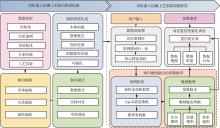
Fig.1
Framework of intelligent parameter recommendation for dual-robot drilling and riveting
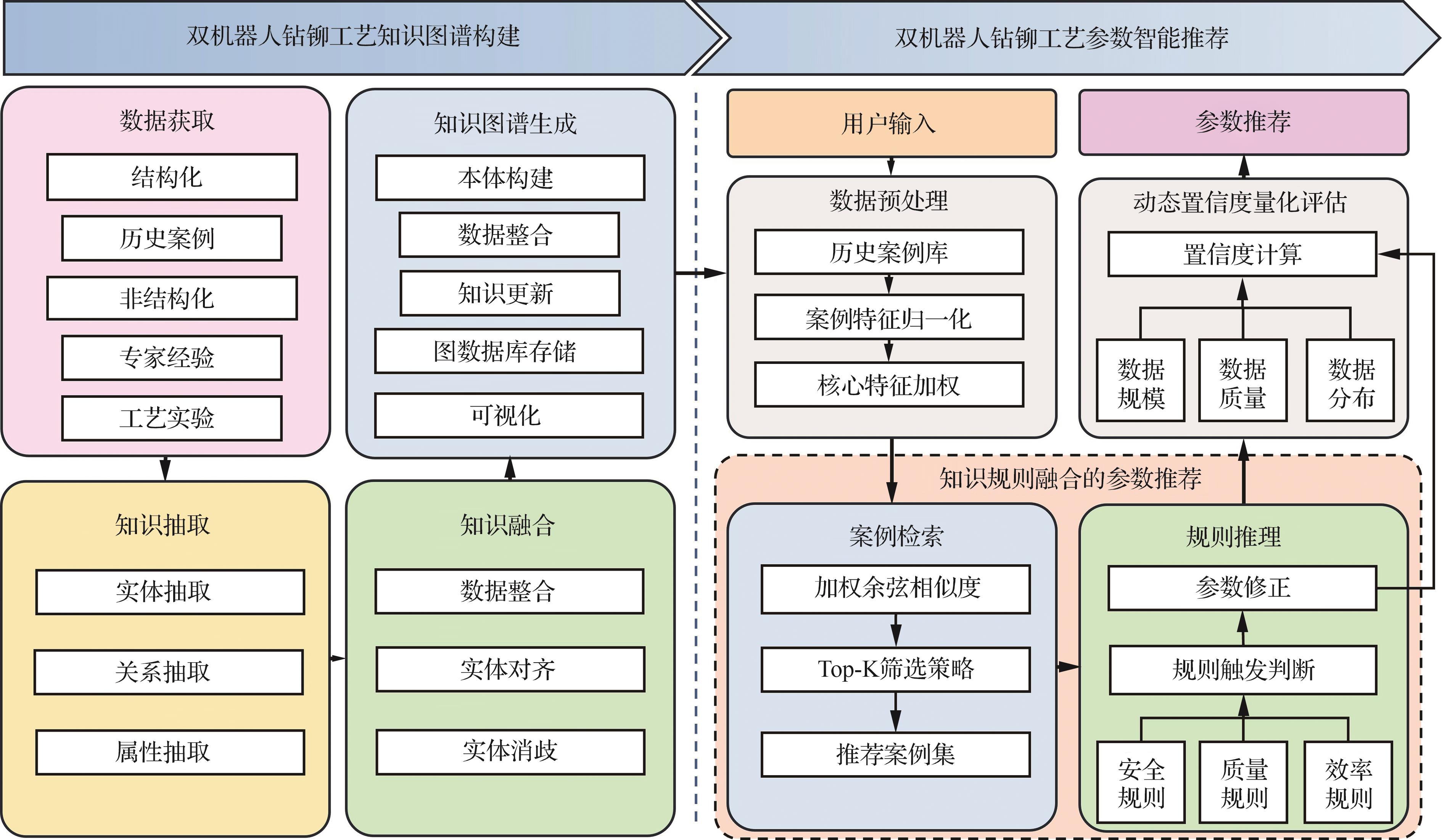
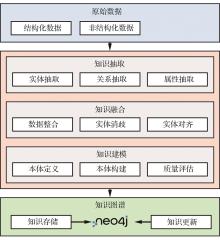
Fig.2
Construction process of knowledge graph for dual-robot drilling and riveting process
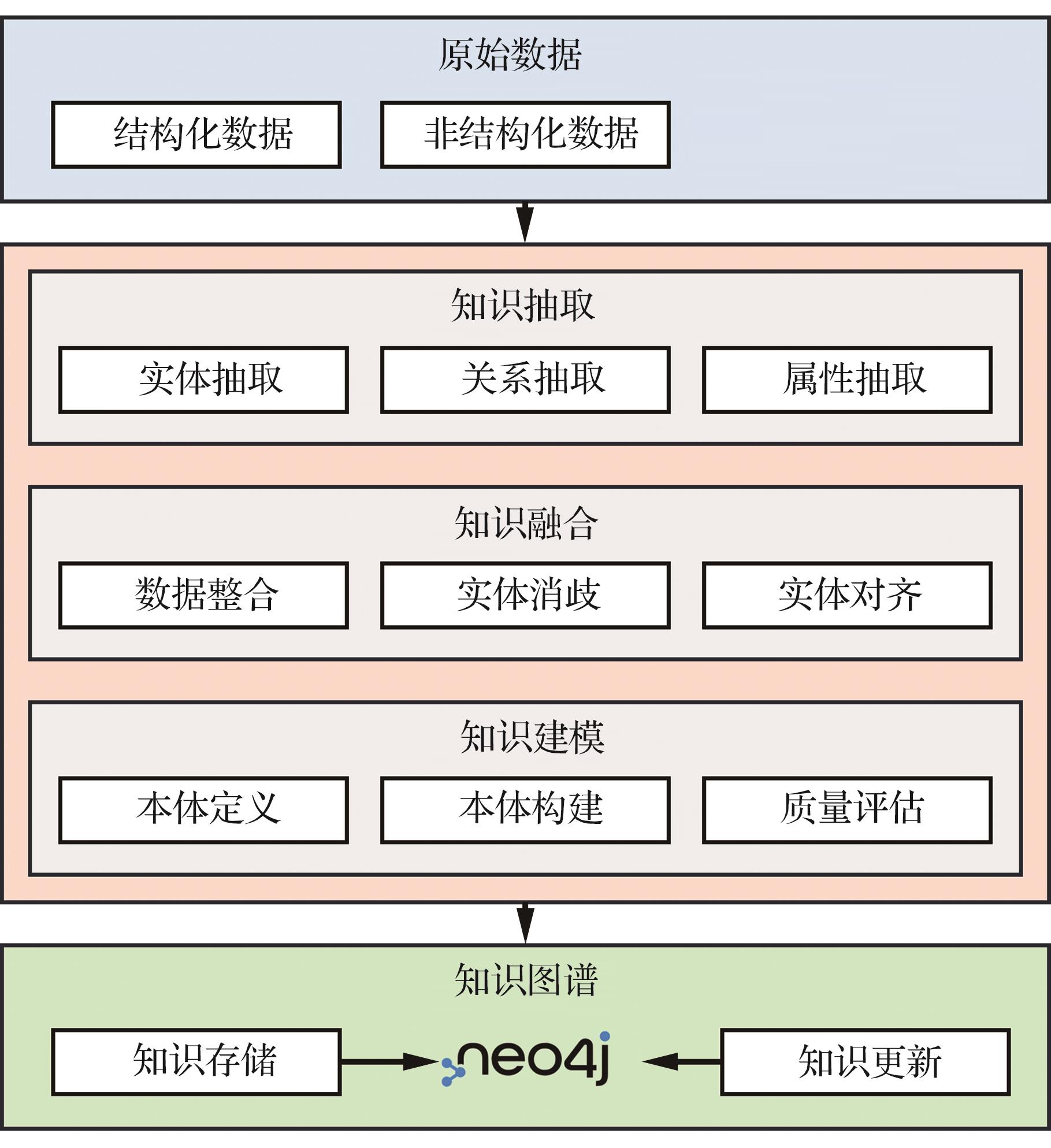

Table 1
Definition of entity relationships
| 关系 | 关系类型 | 关系定义 |
|---|---|---|
| 是ID | 实体-子实体 | 各实体身份的唯一标识符 |
| 有关系 | 实体-子实体 | 实体与子实体间的组成关系及各实体包含的参数 |
有 是 | 实体-实体 | 实体间的包含关系,二者互为对应 |
| 满足要求 | 层-实体 | 不同层内实体包含的质量要求,二者互为对应 |
| 使用机器人 | 层-层 | 链接实例层与工具层,包括机器人实体与刀具实体 |
| 使用刀具 | ||
| 有加工工件 | 层-层 | 链接实例层与工件层 |
| 使用钻孔工艺 | 层-层 | 链接实例层与工艺层,包括钻孔实体与铆接实体 |
| 使用铆接工艺 | ||
| 有钻铆质量 | 层-层 | 链接实例层与特征层 |
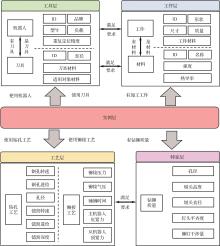
Fig.3
Construction of ontology model for dual-robot drilling and riveting process
Table 2
Tripartite table based on ontology model
| 实体 | 关系/属性 | 实体/数值 |
|---|---|---|
| 机器人 | 是ID 有名称 有品牌 有型号 有负载 有重复定位精度 | 机器人1 IRB 120 ABB IRB 120 3 kg 0.01 mm |
| 机器人组合 | 是ID 有机器人 | 机器人组合1 机器人1、机器人2 |
| 工具 | 是ID 有直径 有刀具材料 有适用材料 | 刀具1 5 mm 硬质合金 铝合金 |
| 工件 | 是ID 有材料 有质量 有形状 有长 有宽 有厚度 有复杂度 | 工件1 材料1 200 kg 平面1 2 000 mm 2 000 mm 20 mm 0.2 |
| 材料 | 是ID 有牌号 有强度 有热导率 | 材料1 2060 T8E 572 MPa 140 |
| 钻孔工艺 | 是ID 有孔径 有制孔转速 有制孔进给 有锪窝转速 有锪窝进给 有深度 | 钻孔工艺1 5 mm 3 000 r/min 125 mm/s 1 000 r/min 100 mm·s-1 5 mm |
| 铆接工艺 | 是ID 有铆钉型号 有顶铁气压 有铆接压力 有锤铆时间 有压紧力 有顶紧力 | 铆接工艺1 KE5-5 0.22 kN 0.4 MPa 3 s 450 N 350 N |
| 钻铆质量 | 是ID 有墩头高度 有墩头直径 有铆钉干涉量 有钉头平齐度 | 钻铆质量1 2 mm 7 mm 0.05 mm 0.03 mm |
| 动作 | 是ID 使用机器人 使用工具 使用钻孔工艺 使用铆接工艺 有工件 有结果 | 钻铆执行1 机器人组合1 刀具1 钻孔工艺1 铆接工艺1 工件1 钻铆质量1 |
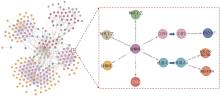
Fig.4
Knowledge graph for dual-robot drilling and riveting process
Table 3
Key characteristic parameters
| 参数 | 特征/单位 |
|---|---|
| X1 | 墩头高度/mm |
| X2 | 墩头直径/mm |
| X3 | 铆接干涉量/mm |
| X4 | 钉头平齐度/mm |
| X5 | 材料强度/MPa |
| X6 | 工件质量/kg |
Fig.5
Experimental result of sensitivity analysis on weight matrix
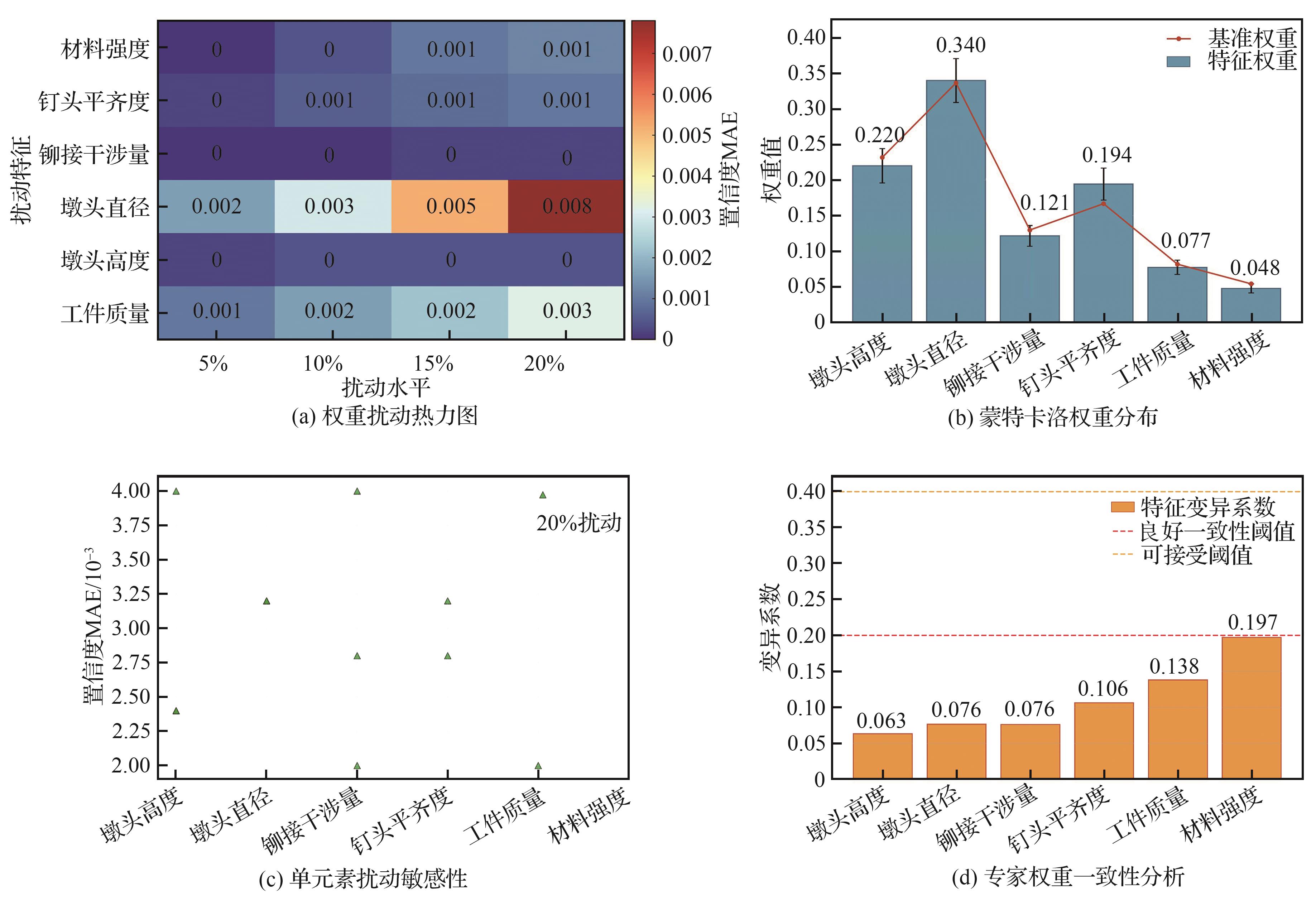
Table 4
Dual-robot drilling and riveting process rules
| 规则分类 | 规则编号 | 触发条件 | 推荐措施 |
|---|---|---|---|
| 安全规则 | IC-01 | 连续3次干涉量>0.08 mm | 更换高刚性刀具(抗弯≥2 000 MPa),分步钻削工艺 |
| RH-01 | 墩头高度>上限(2.05 mm) | 铆接力×0.95 | |
| RG-01 | 工件质量>550 kg | 报警:更换更高负载机型 | |
| … | … | … | |
| 质量规则 | IC-02 | 叠层厚度差ΔH>0.1 mm | 转速=基准转速×(1+0.075ΔH) |
| SF-01 | 平齐度<0.05 mm | 进给速度×0.9 | |
| SF-02 | 平齐度<0.05 mm | 振动幅度>3 μm时更换高负载机器人组 | |
| SF-03 | 毛刺高度>0.04 mm | 铆接力×0.9 | |
| … | … | … | |
| 效率规则 | MA-01 | 材料=钛合金 | 基准转速=4 000+孔径×500,铆接力≤1.2 kN,陶瓷刀具 |
| SF-04 | 毛刺高度>0.04 mm | 进行刀具磨损检测 | |
| … | … | … |
Table 5
Search boundary setting of parameters
| 参数 | 描述 | 初值 | 下界 | 上界 |
|---|---|---|---|---|
| 安全规则权重 | 1.5 | 1.2 | 2.0 | |
| 质量规则权重 | 1.2 | 1.0 | 1.8 | |
| 效率规则权重 | 1.0 | 0.8 | 1.3 | |
| 案例上限 | 15 | 8 | 15 | |
| 分布阈值 | 0.2 | 0.05 | 0.3 |
Table 6
Optimal parameter configuration
| 参数 | 描述 | 最优值 |
|---|---|---|
| 安全规则权重 | 1.59 | |
| 质量规则权重 | 1.08 | |
| 效率规则权重 | 0.88 | |
| 案例上限 | 8 | |
| 分布阈值 | 0.15 |
Fig.6
Dynamic confidence assessment process
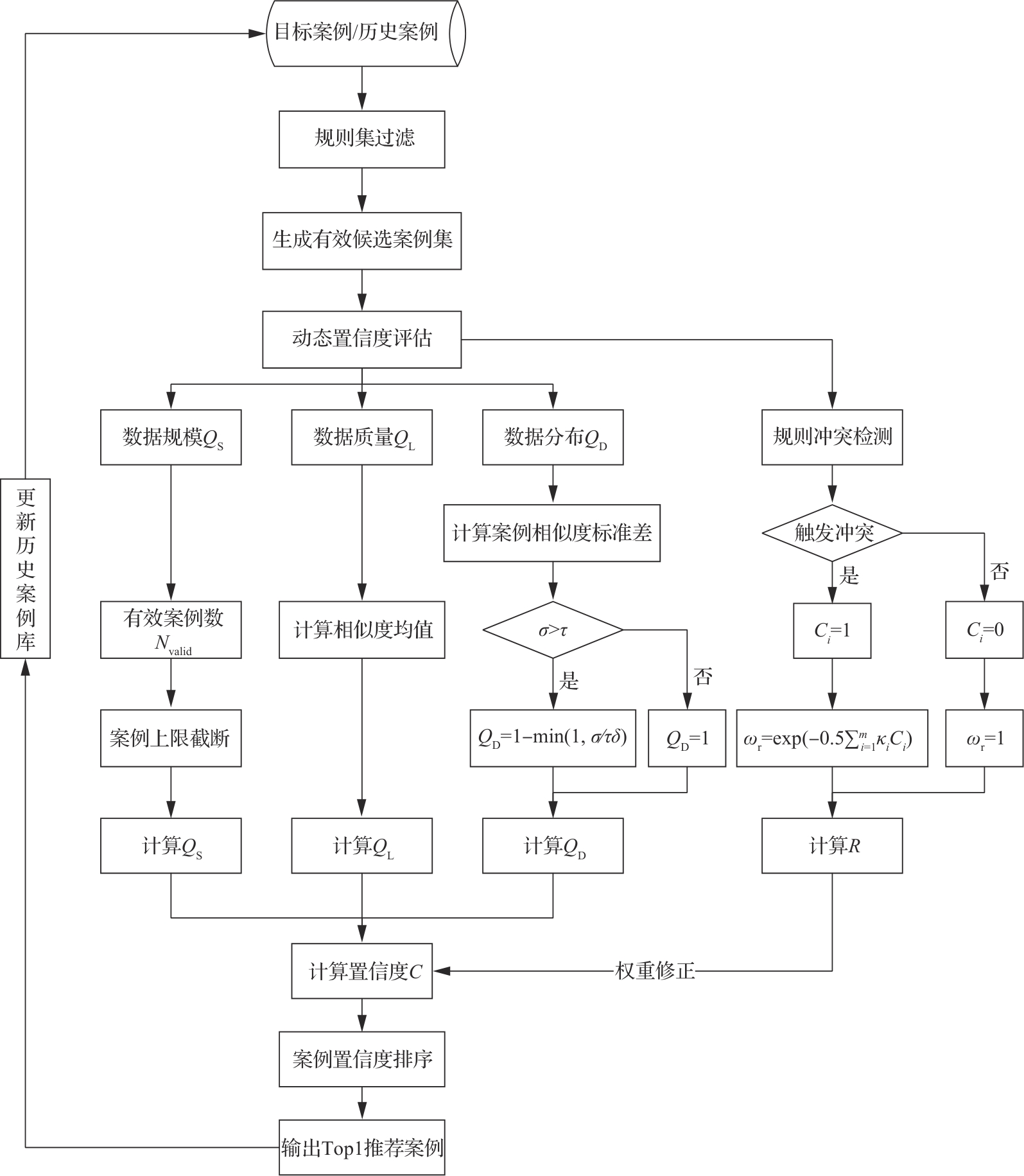
Fig.7
Visualization interface of parameter recommendation system for dual-robot drilling and riveting process
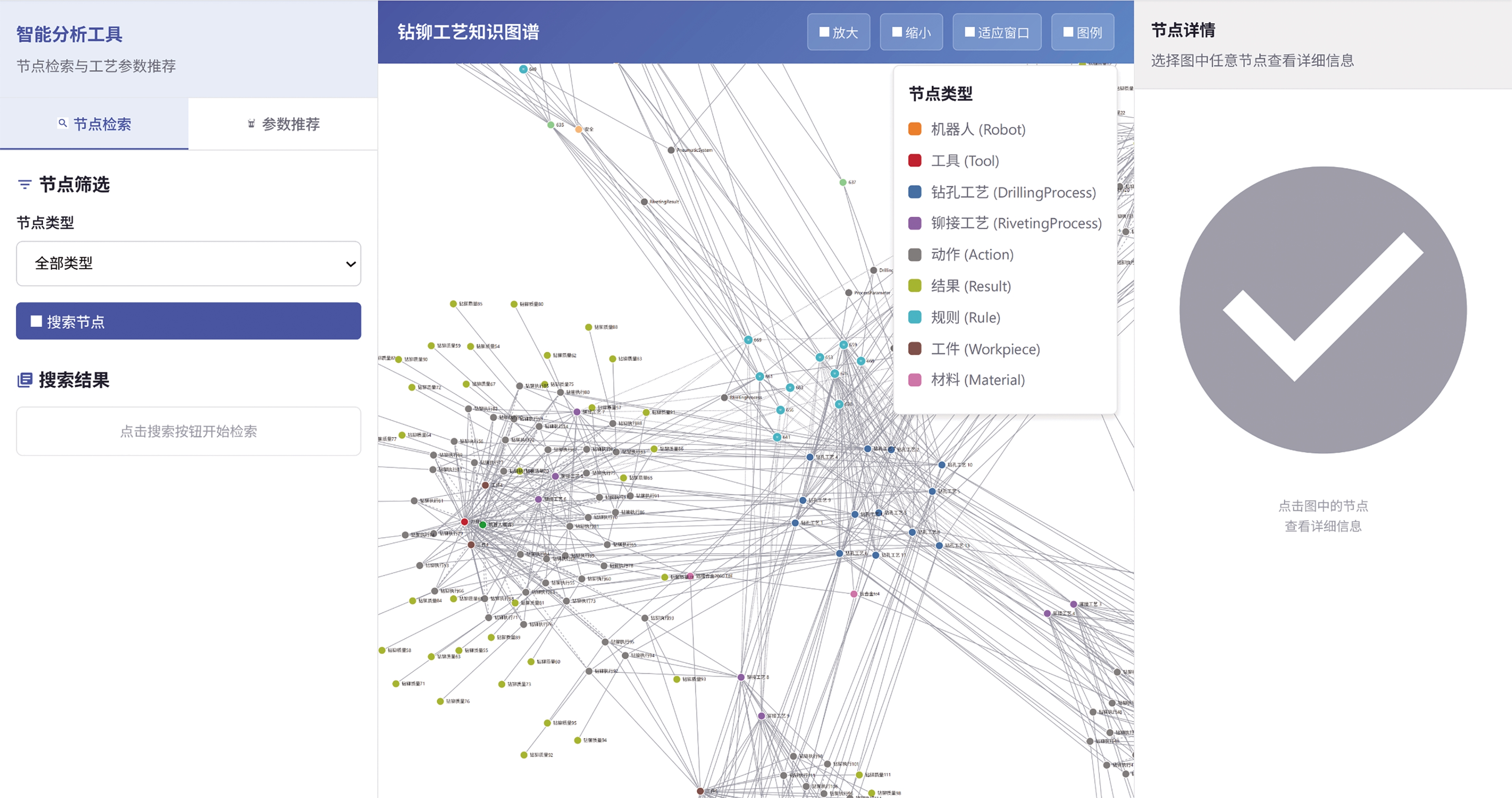
Fig.8
Node query of parameter recommendation system for dual-robot drilling and riveting process
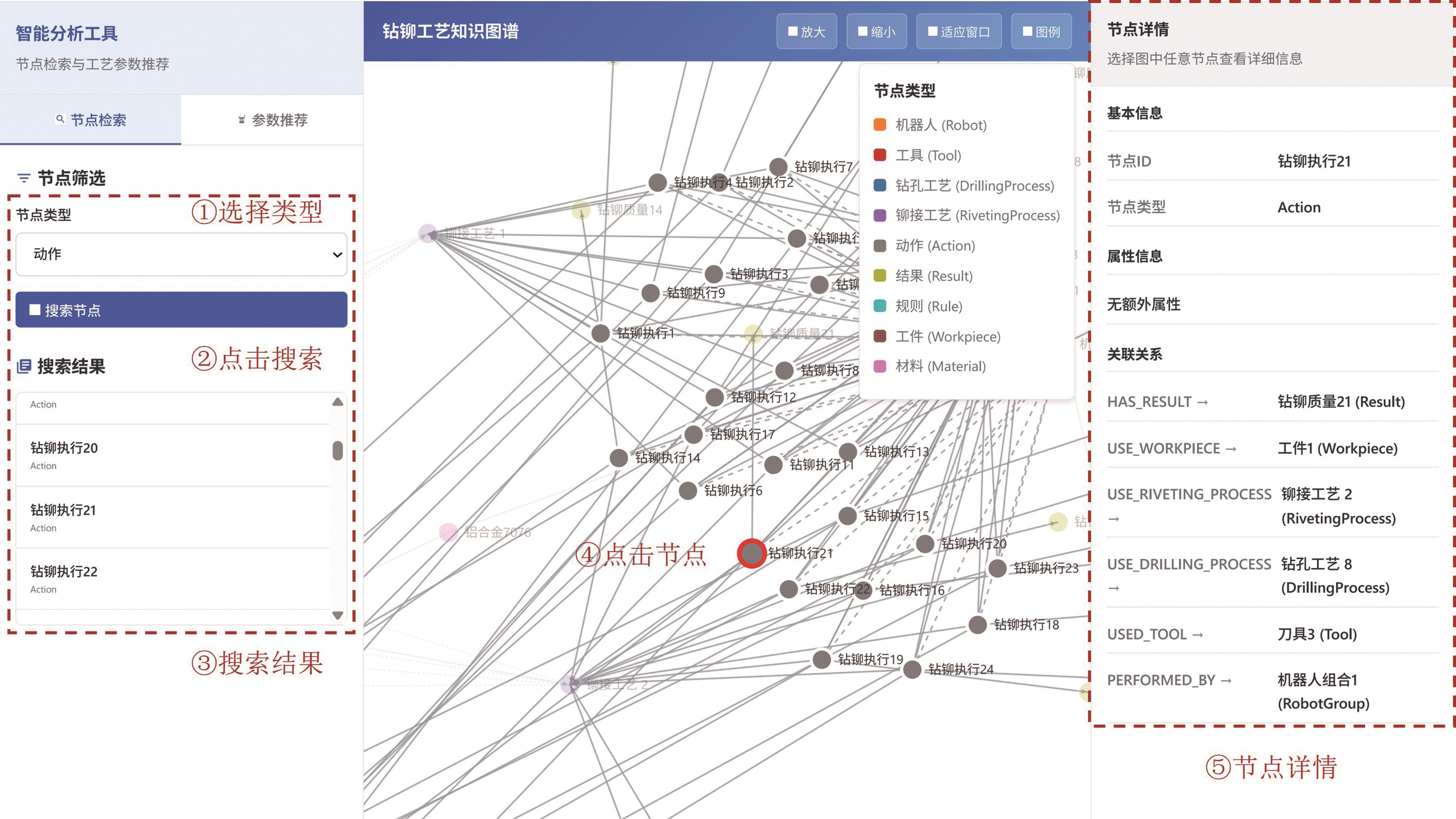
Table 7
Quality requirements for workpiece process(Case 1)
| 参数 | 工艺要求 |
|---|---|
| 材料 | 铝锂合金2060 T8E |
| 工件质量/kg | 100 |
| 孔径/mm | 5 |
| 墩头高度/mm | 2 |
| 墩头直径/mm | 7 |
| 铆接干涉量/mm | 0.05 |
| 钉头平齐度/mm | 0.03 |
Table 8
Similar cases of dual-robot drilling and riveting parameters
| 参数 | 案例1 | 案例2 | 案例3 | 案例4 | 案例5 |
|---|---|---|---|---|---|
| 钻孔进给/(mm·min-1) | 100 | 125 | 225 | 125 | 260 |
| 制孔转速/(r·min-1) | 4 300 | 4 000 | 4 500 | 3 000 | 5 000 |
| 锪窝转速/(r·min-1) | 1 360 | 1 000 | 1 600 | 1 000 | 1 800 |
| 锪窝进给/(mm·min-1) | 140 | 110 | 180 | 100 | 240 |
| 铆接压力/kN | 0.4 | 0.4 | 0.4 | 0.4 | 0.4 |
| 铆接气压/MPa | 0.2 | 0.2 | 0.2 | 0.2 | 0.2 |
| 锤铆时间/s | 2 | 2 | 2 | 2 | 2 |
| 压紧力/N | 450 | 450 | 450 | 450 | 450 |
| 顶紧力/N | 350 | 350 | 350 | 350 | 350 |
| 刀具 | 刀具3 | 刀具3 | 刀具3 | 刀具3 | 刀具3 |
| 机器人组合 | KR500+IRB8700 | KR500+IRB8700 | KR500+IRB8700 | KR500+IRB8700 | KR500+IRB8700 |
| 相似度 | 0.90 | 0.88 | 0.90 | 0.89 | 0.87 |
Fig.9
Parameter recommendation for dual-robot drilling and riveting process
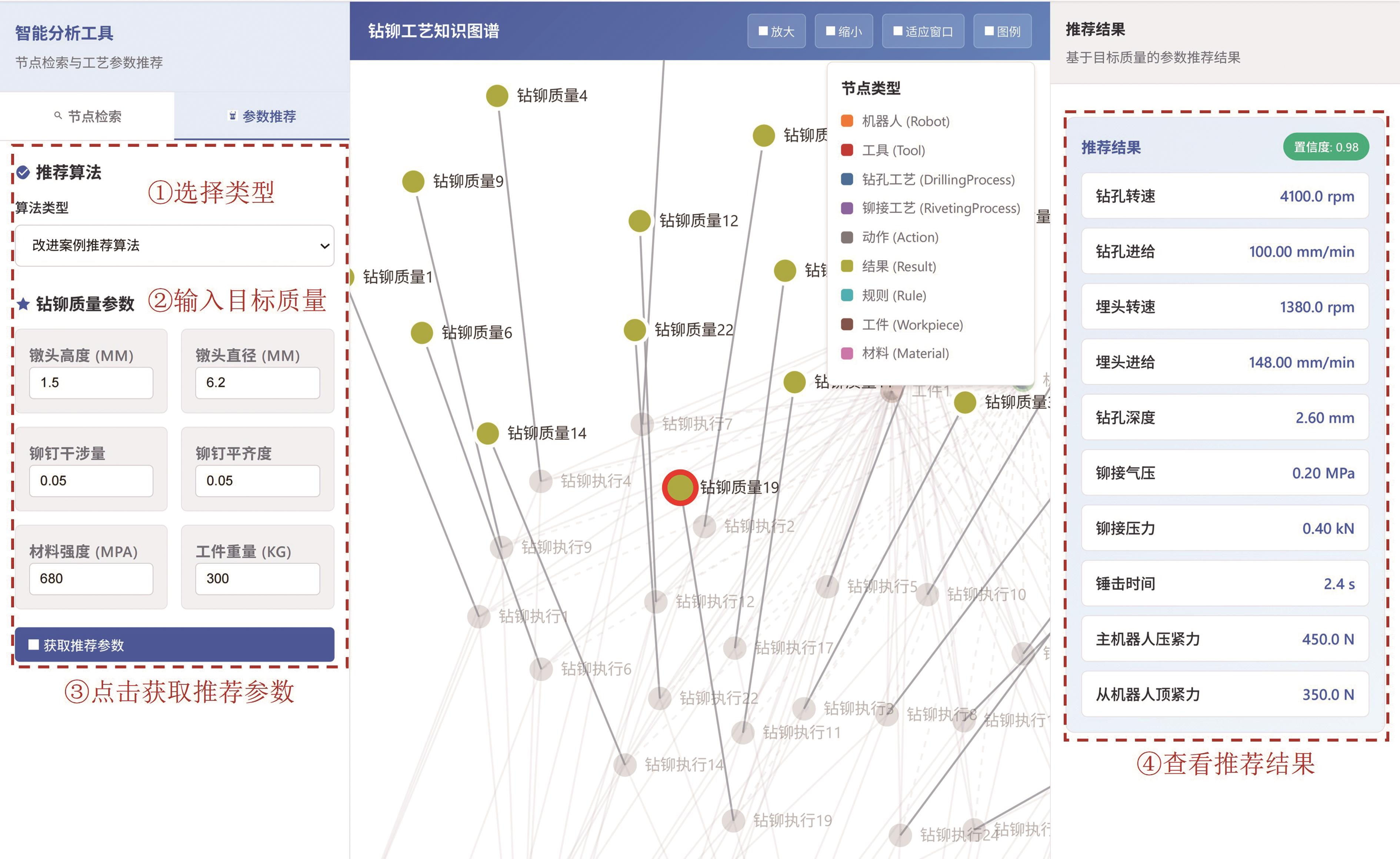
Table 9
Recommended process parameters(Case 1)
| 参数 | 原始推荐 | PCA 推荐 | 改进推荐 | 真实参数 | |
|---|---|---|---|---|---|
| 钻孔进给/(mm·min-1) | 150 | 164 | 100 | 150 | |
| 制孔转速/(r·min-1) | 4 500 | 3 600 | 4 300 | 4 000 | |
| 锪窝转速/(r·min-1) | 1 800 | 1 300 | 1 420 | 1 500 | |
| 锪窝进给/(mm·min-1) | 110 | 143 | 148 | 110 | |
| 铆接压力/kN | 0.4 | 0.5 | 0.4 | 0.4 | |
| 铆接气压/MPa | 0.2 | 0.2 | 0.2 | 0.2 | |
| 锤铆时间/s | 2.0 | 1.9 | 2.4 | 2.5 | |
| 压紧力/N | 400 | 470 | 450 | 500 | |
| 顶紧力/N | 400 | 270 | 350 | 300 | |
| 刀具 | 刀具3 | 刀具3 | 刀具3 | ||
| 机器人组合 | KR500 IRB8700 | KR500 IRB8700 | KR500 IRB8700 | ||
| 案例相似度 | 0.82 | 0.86 | 0.89 | ||
| 综合置信度 | 0.89 | 0.88 | 0.92 | ||
Table 10
Quality requirements for workpiece process(Case 2)
| 参数 | 工艺要求 |
|---|---|
| 材料 | 钛合金TC4 |
| 工件质量/kg | 120 |
| 孔径/mm | 5 |
| 墩头高度/mm | 2.20 |
| 墩头直径/mm | 6.20 |
| 铆接干涉量/mm | 0.10 |
| 钉头平齐度/mm | 0.07 |
Table 11
Rule constrained adjustment of recommended process parameters(Case 2)
| 参数 | 基线推荐 | PCA推荐 | 加权推荐 | 规则修正 |
|---|---|---|---|---|
| 钻孔进给/(mm·min-1) | 未 找 到 相 似 案 例 | 184 | 162 | 150 |
| 制孔转速/(r·min-1) | 3 994 | 4 500 | 6 500 | |
| 锪窝转速/(r·min-1) | 1 539 | 1 520 | 1 500 | |
| 锪窝进给/(mm·min-1) | 169 | 100 | 110 | |
| 铆接压力/kN | 0.6 | 0.4 | 0.4 | |
| 铆接气压/MPa | 0.2 | 0.2 | 0.2 | |
| 锤铆时间/s | 2.3 | 2.2 | 2.5 | |
| 压紧力/N | 500 | 450 | 450 | |
| 顶紧力/N | 260 | 350 | 350 | |
| 刀具 | 刀具3 | 刀具3 | 更换陶瓷刀具 | |
| 机器人组合 | KR300+KR300 | KR300+KR300 | KR300+KR300 | |
| 案例相似度 | 0.64 | 0.74 | 0.82 | |
| 综合置信度 | 0.78 | 0.81 | 0.84 |
Table 12
Recommended process parameter under new working condition
| 参数 | 推荐参数 | 历史最优参数 |
|---|---|---|
| 材料 | 7075 T6 | 2060 T8E |
| 工件质量/kg | 103 | 100 |
| 墩头高度/mm | 2.50 | 2 |
| 墩头直径/mm | 7.50 | 7 |
| 铆接干涉量/mm | 0.05 | 0.05 |
| 钉头平齐度/mm | 0.05 | 0.03 |
| 孔径/mm | 5 | 5 |
| 钻孔进给/(mm·min-1) | 125 | 100 |
| 制孔转速/(r·min-1) | 4 720 | 4 300 |
| 锪窝转速/(r·min-1) | 1 200 | 1 360 |
| 锪窝进给/(mm·min-1) | 110 | 140 |
| 铆接压力/kN | 0.4 | 0.4 |
| 铆接气压/MPa | 0.35 | 0.2 |
| 锤铆时间/s | 1.75 | 2 |
| 压紧力/N | 500 | 450 |
| 顶紧力/N | 350 | 350 |
| 刀具 | 刀具3 | 刀具3 |
| 机器人组合 | KR300+KR300 | KR300+KR300 |
| 案例相似度 | 0.91 | |
| 综合置信度 | 0.93 |
Fig.10
Experiment of dual-robot drilling and riveting
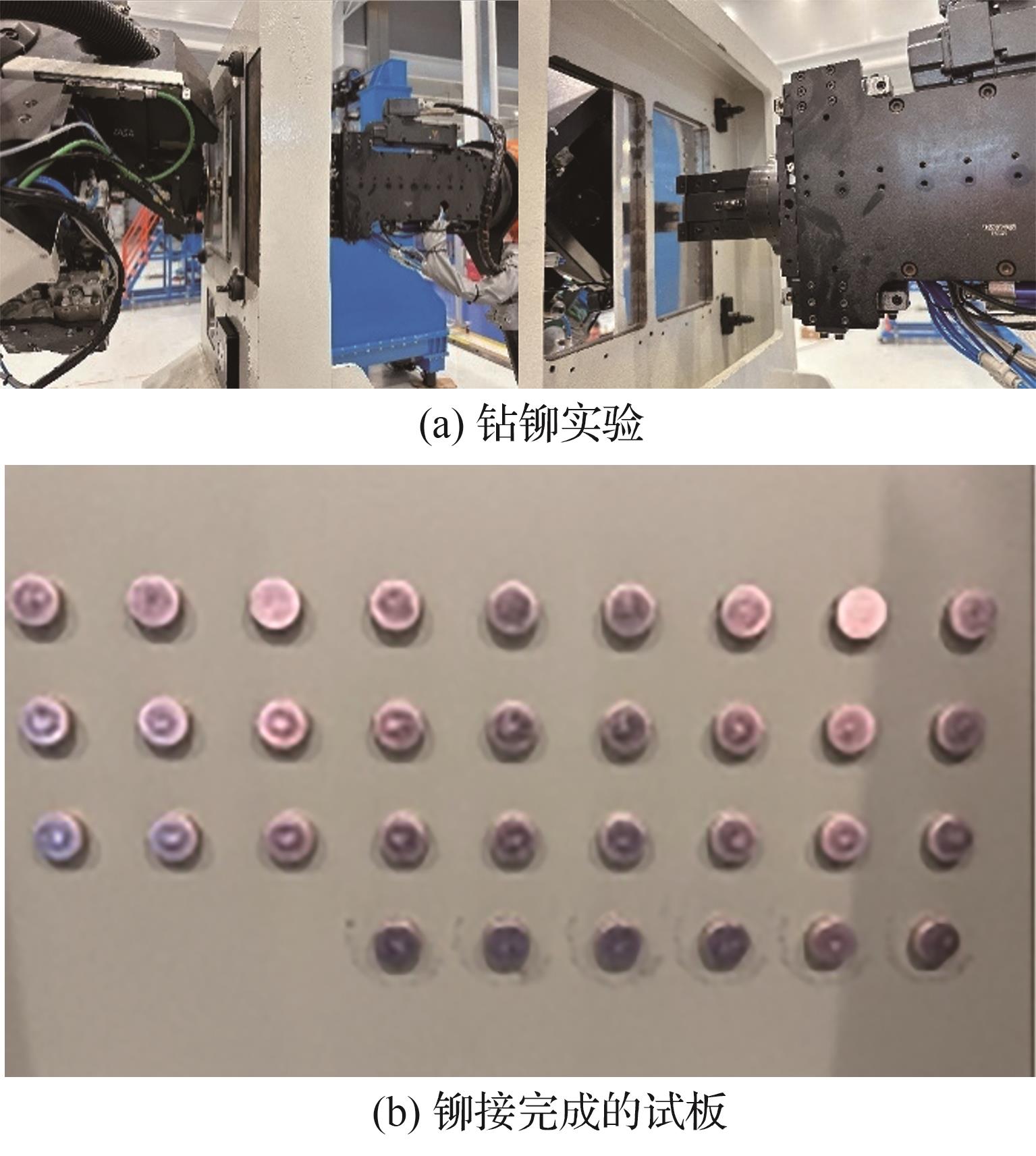
Table 13
Experiment measurement result of dual-robot drilling and riveting
| 序号 | 墩头高度/mm | 墩头直径/mm | 铆接干涉量/mm | 钉头平齐度/mm |
|---|---|---|---|---|
| 1 | 2.35 | 7.67 | 0.05 | 0.03 |
| 2 | 2.51 | 7.28 | 0.04 | 0.06 |
| 3 | 2.71 | 7.31 | 0.03 | 0.03 |
| 4 | 2.58 | 7.26 | 0.03 | 0.04 |
| 5 | 2.63 | 7.28 | 0.05 | 0.05 |
| 6 | 2.19 | 7.31 | 0.05 | 0.02 |
| 7 | 2.38 | 7.60 | 0.04 | 0.03 |
| 8 | 2.61 | 7.30 | 0.03 | 0.03 |
| 9 | 2.67 | 7.31 | 0.05 | 0.06 |
| 10 | 2.59 | 7.20 | 0.04 | 0.06 |
| 11 | 2.35 | 7.67 | 0.05 | 0.03 |
| 12 | 2.51 | 7.28 | 0.03 | 0.02 |
| 13 | 2.71 | 7.31 | 0.05 | 0.01 |
| 14 | 2.58 | 7.26 | 0.06 | 0.03 |
| 15 | 2.63 | 7.28 | 0.07 | 0.04 |
| 16 | 2.63 | 7.31 | 0.07 | 0.02 |
| 17 | 2.19 | 7.60 | 0.08 | 0.04 |
| 18 | 2.38 | 7.30 | 0.07 | 0.02 |
| 19 | 2.61 | 7.30 | 0.14 | 0.04 |
| 20 | 2.67 | 7.20 | 0.09 | 0.04 |
| 21 | 2.63 | 7.03 | 0.06 | 0.01 |
| 22 | 2.94 | 7.00 | 0.07 | 0.04 |
| 23 | 2.81 | 7.00 | 0.08 | 0.03 |
| 24 | 2.56 | 7.45 | 0.06 | 0.04 |
| 25 | 2.66 | 6.93 | 0.08 | 0.03 |
| 26 | 2.38 | 7.05 | 0.08 | 0.03 |
| 27 | 2.32 | 7.50 | 0.07 | 0.04 |
| 28 | 2.79 | 7.12 | 0.09 | 0.04 |
| 29 | 2.66 | 7.04 | 0.09 | 0.03 |
| 30 | 2.31 | 6.92 | 0.09 | 0.02 |
| 平均值 | 2.55 | 7.27 | 0.06 | 0.03 |
| 标准差 | 0.178 | 0.201 | 0.026 | 0.013 |
| [1] | MEI B, LIANG Z, XIE Y, et al. Positioning accuracy enhancement of a robotic assembly system for thin-walled aerostructure assembly [J]. Journal of Industrial Information Integration, 2023, 35: 100518. |
| [2] | CHRISTIAN H, GUDRUN F, NIKOLAUS S, et al. Production planning optimisation for composite aerospace manufacturing [J]. International Journal of Production Research,2018, 57(18): 5857-5873. |
| [3] | ANDREY K, MIKHAIL T, MIKHAIL K. Multivariate manufacturing process planning for aircraft airframe production based on weighted criteria analysis [J]. The International Journal of Advanced Manufacturing Technology, 2021, 117: 2263-8. |
| [4] | KO H, WITHERELL P, LU Y, et al. Machine learning and knowledge graph based design rule construction for additive manufacturing[J]. Additive Manufacturing, 2021, 37: 101620. |
| [5] | SERGIO I, RAQUEL T L. An approach for proactive mobile recommendations based on user-defined rules [J]. Expert Systems with Applications, 2024, 242: 122714. |
| [6] | SUBRAMANYA N, KUMAR A R S, VIKAS Y, et al. Manufacturing process planning in aerospace systems [J]. IOP Conference Series: Materials Scienceand Engineering, 2022, 1258 (1): 12027. |
| [7] | ZHANG C, ZHOU G, HU J, et al. Deep learning enabled intelligent process planning for digital twin manufacturing cell [J]. Knowledge-Based Systems, 2020, 191: 105247. |
| [8] | XIA L, LIANG Y, LENG J, et al. Maintenance planning recommendation of complex industrial equipment based on knowledge graph and graph neural network [J]. Reliability Engineering & System Safety, 2023, 232: 109068. |
| [9] | WU S, SUN F, ZHANG W, et al. Graph neural networks in recommender systems: a survey [J]. ACM Computing Surveys, 2022, 55(5): 1-37. |
| [10] | TIAN L, ZHOU X, WU Y, et al. Knowledge graph and knowledge reasoning: a systematic review [J]. Journal of Electronic Science and Technology, 2022, 20(2): 100159. |
| [11] | CHEN X, JIA S, XIANG Y. A review: knowledge reasoning over knowledge graph [J]. Expert Systemswith Applications, 2020, 141: 122948. |
| [12] | GUO L, YAN F, LI T, et al. An automatic method for constructing machining process knowledge base from knowledge graph [J]. Robotics and Computer-Integrated Manufacturing, 2022, 73: 102222. |
| [13] | LIU M, LI X, LI J, et al. A knowledge graph-based data representation approach for IIoT-enabled cognitive manufacturing [J]. Advanced Engineering Informatics, 2022, 51: 101515. |
| [14] | HUANG Z, GUO X, LIU Y, et al. A smart conflict resolution model using multi-layer knowledge graph for conceptual design [J]. Advanced Engineering Informatics, 2023, 55: 108887. |
| [15] | SU C, JIANG Q, HAN Y, et al. Knowledge graph-driven decision support for manufacturing process: a graph neural network-based knowledge reasoning approach [J]. Advanced Engineering Informatics, 2025, 64: 103098. |
| [16] | LI X, ZHANG S, HUANG R, et al. Structural modeling of heterogeneous CAM model based on process knowledge graph [J]. Journal of Computer-Aided Design & Computer Graphics, 2018, 30(7): 1342-1355. |
| [17] | WEN P, MA Y, WANG R. Systematic knowledge modeling and extraction methods for manufacturing process planning based on knowledge graph [J]. Advanced Engineering Informatics, 2023, 58: 102172. |
| [18] | XIAO B, ZHAO Z, XU B, et al. A novel method for intelligent reasoning of machining step sequencesbased on deep reinforcement learning [J]. Journal of Manufacturing Systems, 2025, 80: 626-642. |
| [19] | HU Y, ADRIANE C, WEN G, et al. What can knwledge bring to machine learning? —a survey of low-shot learning for structured data [J]. ACM Transactions on Intelligent Systems and Technology, 2022, 13(3): 1-45. |
| [20] | LIU S, STEBNER A P, KAPPES B B, et al. Machine learning for knowledge transfer across multiple metals additive manufacturing printers [J]. Additive Manufacturing, 2021, 39: 101877. |
| [21] | JOAO M, LUIS G T, ANDRÉ C R, et al. A novel jigless process applied to a robotic cell for aircraft structural assembly [J]. The International Journal of Advanced Manufacturing Technology, 2020, 109: 1177-1187. |
| [22] | GUO S, AGARWAL M, COOPER C, et al. Machine learning for metal additive manufacturing: towards a physics-informed data-driven paradigm [J]. Journal of Manufacturing Systems, 2022, 62: 145-163. |
| [23] | 陈勇刚, 刘康妮, 王帅. 基于BiGRU-Attention改进的航空设备故障知识图谱构建 [J]. 航空学报, 2024, 45(18): 229916. |
| CHEN Y G, LIU K N, WANG S. Fault knowledge graph construction for aviation equipment based on BiGRU-Attention improvement [J]. Acta Aeronautica et Astronautica Sinica, 2024, 45(18): 229916 (in Chinese). | |
| [24] | 聂同攀, 曾继炎, 程玉杰, 等. 面向飞机电源系统故障诊断的知识图谱构建技术及应用 [J]. 航空学报, 2022, 43(8): 625499. |
| NIE T P, ZENG J Y, CHENG Y J, et al. Knowledge graph construction technology and its application in aircraft power system fault diagnosis [J]. Acta Aeronautica et Astronautica Sinica, 2022,43(8): 625499 (in Chinese). | |
| [25] | CASTRESE D M, ANDREA R, AGNESE P, et al. An interactive graph-based tool to support the designing of human-robot collaborative workplaces [J]. International Journal on Interactive Design and Manufacturing, 2023, 18: 6255-6270. |
| [26] | 肖彪, 徐宝德, 彭仕鑫, 等. 基于知识图谱的复杂薄壁零件机械加工工艺知识建模研究 [J]. 航空制造技术, 2024, 67(11): 76-86. |
| XIAO B, XU B D, PENG S X, et al. Study on machining knowledge modeling of complex thin-walled parts based on knowledge graph [J]. Aeronautical Manufacturing Technology, 2024, 67(11): 76-86 (in Chinese). | |
| [27] | GUO L, LI X, YAN F, et al. A method for constructing a machining knowledge graph using an improved transformer [J]. Expert Systems with Applications, 2024, 237: 121448. |
| [28] | XIONG C, XIAO J, LI Z, et al. Knowledge graph network-driven process reasoning for laser metal additive manufacturing based on relation mining [J]. Applied Intelligence, 2024, 54(22): 11472-11483. |
| [29] | HUANG Z C, GUO X, CHONG J,et al. mKGMPP: a multi-layer knowledge graph integration framework and its inference method for manufacturing process planning [J]. Advanced Engineering Informatics, 2025, 65: 103266. |
| [30] | ZHENG P, XIA L, LI C, et al. Towards self-X cognitive manufacturing network: an industrial knowledge graph-based multi-agent reinforcement learning approach [J]. Journal of Manufacturing Systems, 2021, 61: 16-26. |
| [31] | ZHOU B, HUA B, GU X, et al. An end-to-end tabular information-oriented causality event evolutionary knowledge graph for manufacturing documents [J]. Advanced Engineering Informatics, 2021, 50: 101441. |
| [32] | HUA Y, WANG R, WANG Z, et al. Knowledge graph with deep reinforcement learning for intelligent generation of machining process design [J]. Journal of Engineering Design, 2024, 36(11): 2072-2106. |
| [33] | SU C, HAN Y, JIANG Q, et al. Optimizing manufacturing process with knowledge graph-based adaptive neural network: approach to industry 5.0 consumer electronics [J]. IEEE Transactions on Consumer Electronics, 2025, 71(2): 4164-4178. |
| [34] | TIWARY N, MOHD N S A, FAUZI F, et al. Max explainability score-A quantitative metric for explainability evaluation in knowledge graph-based recommendations [J]. Computers and Electrical Engineering, 2024, 116: 109190. |
| [35] | WANG L, CHENG H, WANG R, et al. Machining scheme selection of features based on process knowledge graph and improved cosine similarity matching[J]. Machines, 2025, 13(3): 188. |
| [1] | Zuoxu WANG, Xin WANG, Shuang MENG, Lianyu ZHENG. A knowledge-user behavior-driven aircraft assembly tooling design knowledge recommendation approach [J]. Acta Aeronautica et Astronautica Sinica, 2025, 46(9): 431417-431417. |
| [2] | Yonggang CHEN, Kangni LIU, Shuai WANG. Fault knowledge graph construction for aviation equipment based on BiGRU⁃Attention improvement [J]. Acta Aeronautica et Astronautica Sinica, 2024, 45(18): 229916-229916. |
| [3] | CAO Ming, WANG Peng, ZUO Hongfu, ZENG Haijun, SUN Jianzhong, YANG Weidong, WEI Fang, CHEN Xuefeng. Current status, challenges and opportunities of civil aero-engine diagnostics & health management Ⅱ: Comprehensive off-board diagnosis, life management and intelligent condition based MRO [J]. ACTA AERONAUTICAET ASTRONAUTICA SINICA, 2022, 43(9): 625574-625574. |
| [4] | NIE Tongpan, ZENG Jiyan, CHENG Yujie, MA Liang. Knowledge graph construction technology and its application in aircraft power system fault diagnosis [J]. ACTA AERONAUTICAET ASTRONAUTICA SINICA, 2022, 43(8): 625499-625499. |
| [5] | CHEN Ao, XIE Yongchun, WANG Yong, LI Linfeng. Deep graph reasoning method for satellite component detection [J]. ACTA AERONAUTICAET ASTRONAUTICA SINICA, 2021, 42(11): 525045-525045. |
| [6] | XI Ping, ZHANG Baoyuan, NING Tao. Intelligent Product Design Based on Open Knowledge Representation [J]. ACTA AERONAUTICAET ASTRONAUTICA SINICA, 2012, 33(9): 1746-1754. |
| Viewed | ||||||
|
Full text |
|
|||||
|
Abstract |
|
|||||
Address: No.238, Baiyan Buiding, Beisihuan Zhonglu Road, Haidian District, Beijing, China
Postal code : 100083
E-mail:hkxb@buaa.edu.cn
Total visits: 6658907 Today visits: 1341All copyright © editorial office of Chinese Journal of Aeronautics
All copyright © editorial office of Chinese Journal of Aeronautics
Total visits: 6658907 Today visits: 1341

 CJA
CJA
