Acta Aeronautica et Astronautica Sinica ›› 2026, Vol. 47 ›› Issue (8): 432553.doi: 10.7527/S1000-6893.2025.32553
• Material Engineering and Mechanical Manufacturing • Previous Articles
Wenbo SUN1, Xuzhao DUAN2, Ruiyang XU3, Yu’e MA2,4( ), Weihong ZHANG1
Received:2025-07-11
Revised:2025-07-28
Accepted:2025-08-20
Online:2025-08-29
Published:2025-08-28
Contact:
Yu’e MA
E-mail:ma.yu.e@nwpu.edu.cn
Supported by:CLC Number:
Wenbo SUN, Xuzhao DUAN, Ruiyang XU, Yu’e MA, Weihong ZHANG. Fatigue fracture behavior of additively manufactured titanium alloy superstructures under compressive loading[J]. Acta Aeronautica et Astronautica Sinica, 2026, 47(8): 432553.
Fig.1
S-N curves with R=0.1 from Goodman model
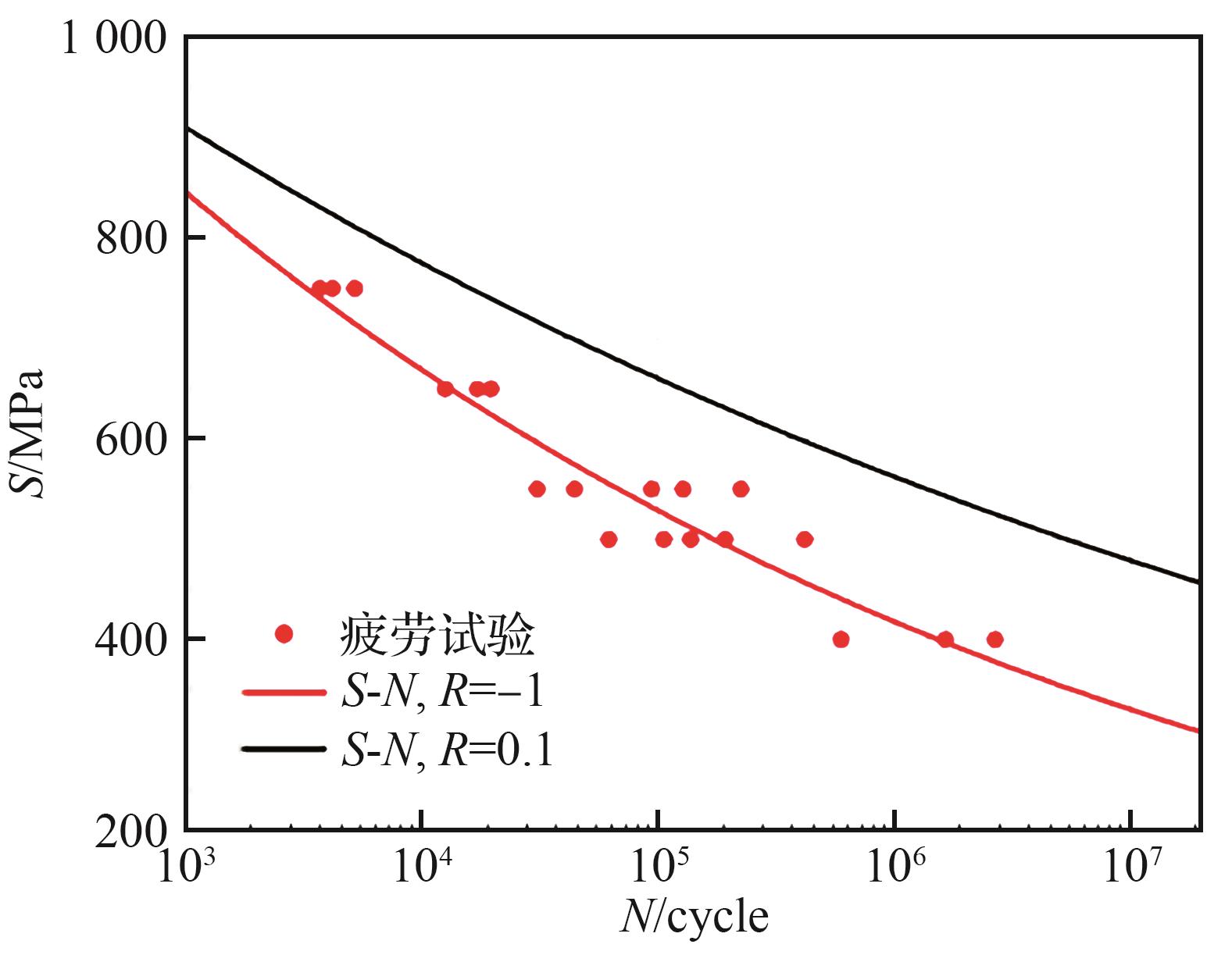
Fig.2
Arithmetic average height Ra and ten-point average height Rz
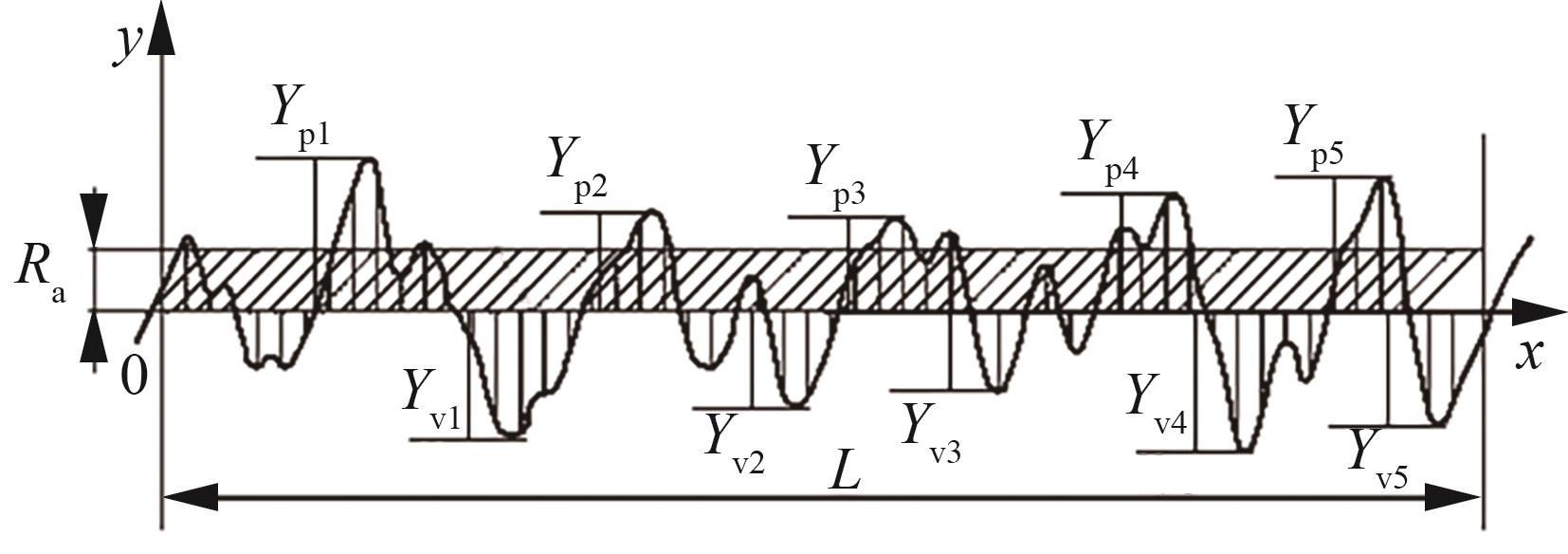
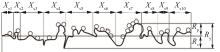
Fig.3
Rv, Rp, and Ry calculation diagram
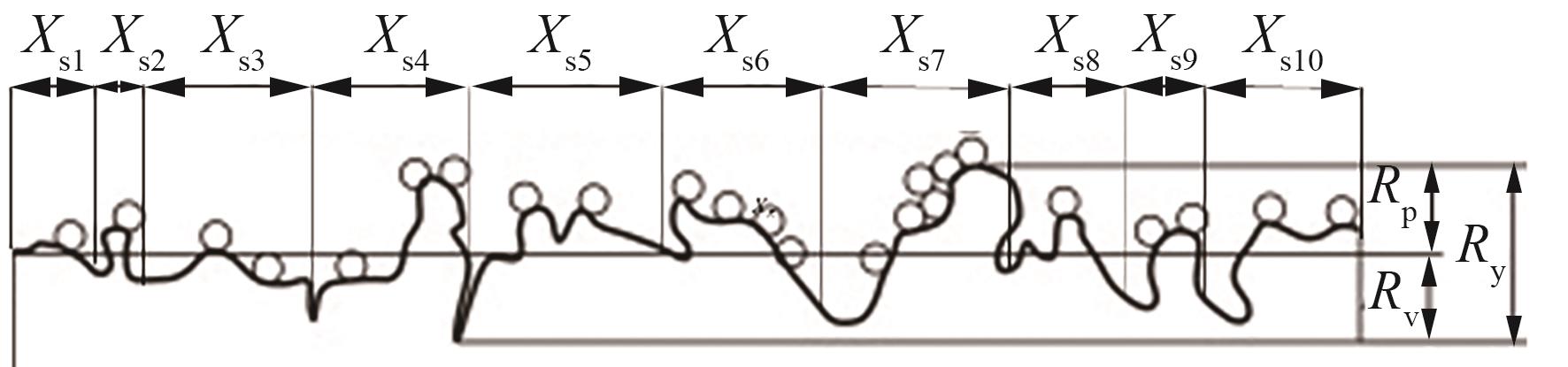
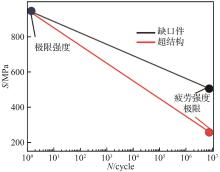
Fig.4
Notched specimen S-N curves
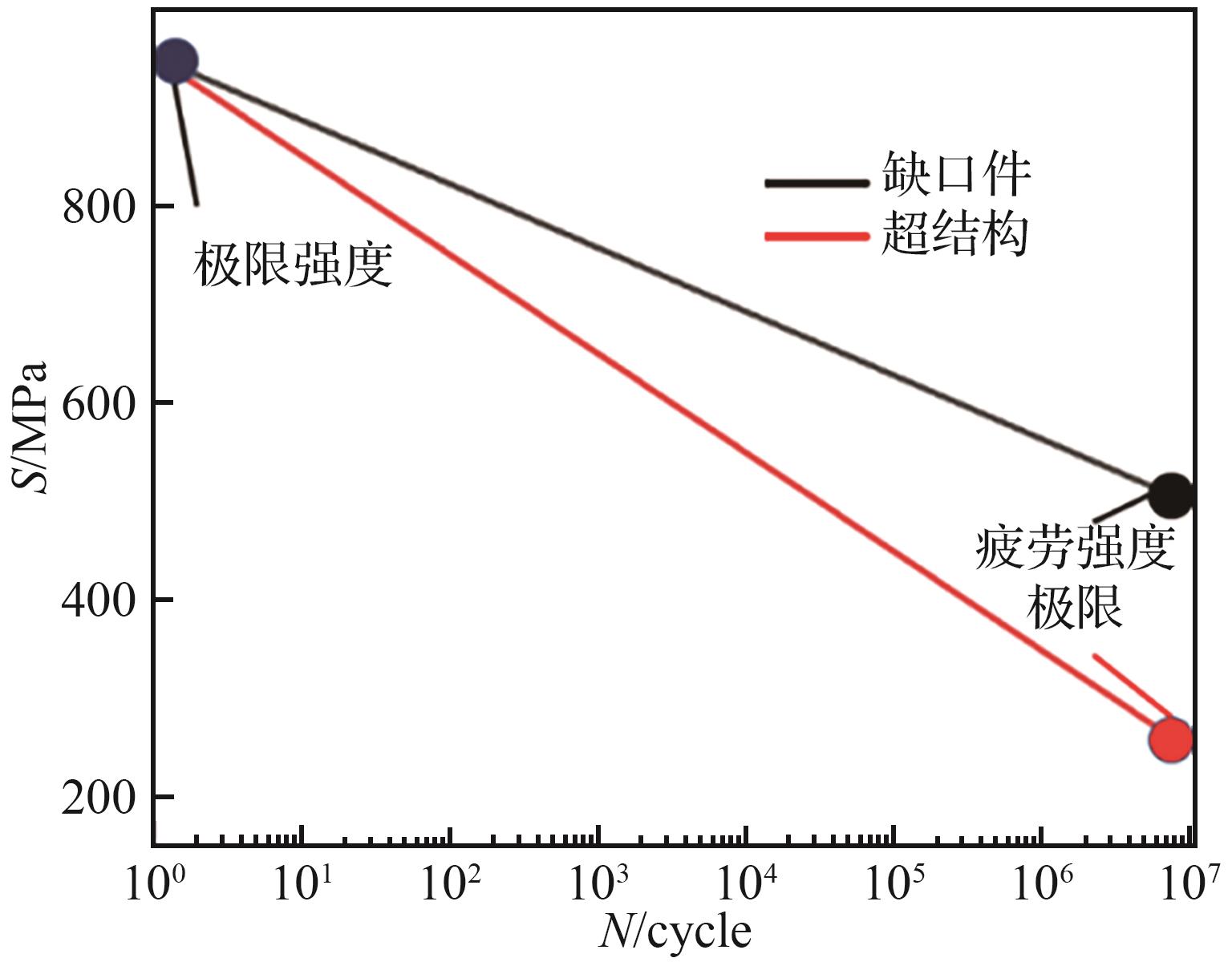

Table 1
Chemical composition of TC4 alloy
| 元素 | Ti | Al | V | Fe | C | H | O | N |
|---|---|---|---|---|---|---|---|---|
| 含量/wt% | 质量平衡 | 5.50~6.75 | 3.50~4.50 |
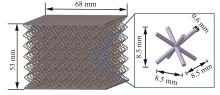
Fig.5
Compressive fatigue superstructure test piece and its parameters
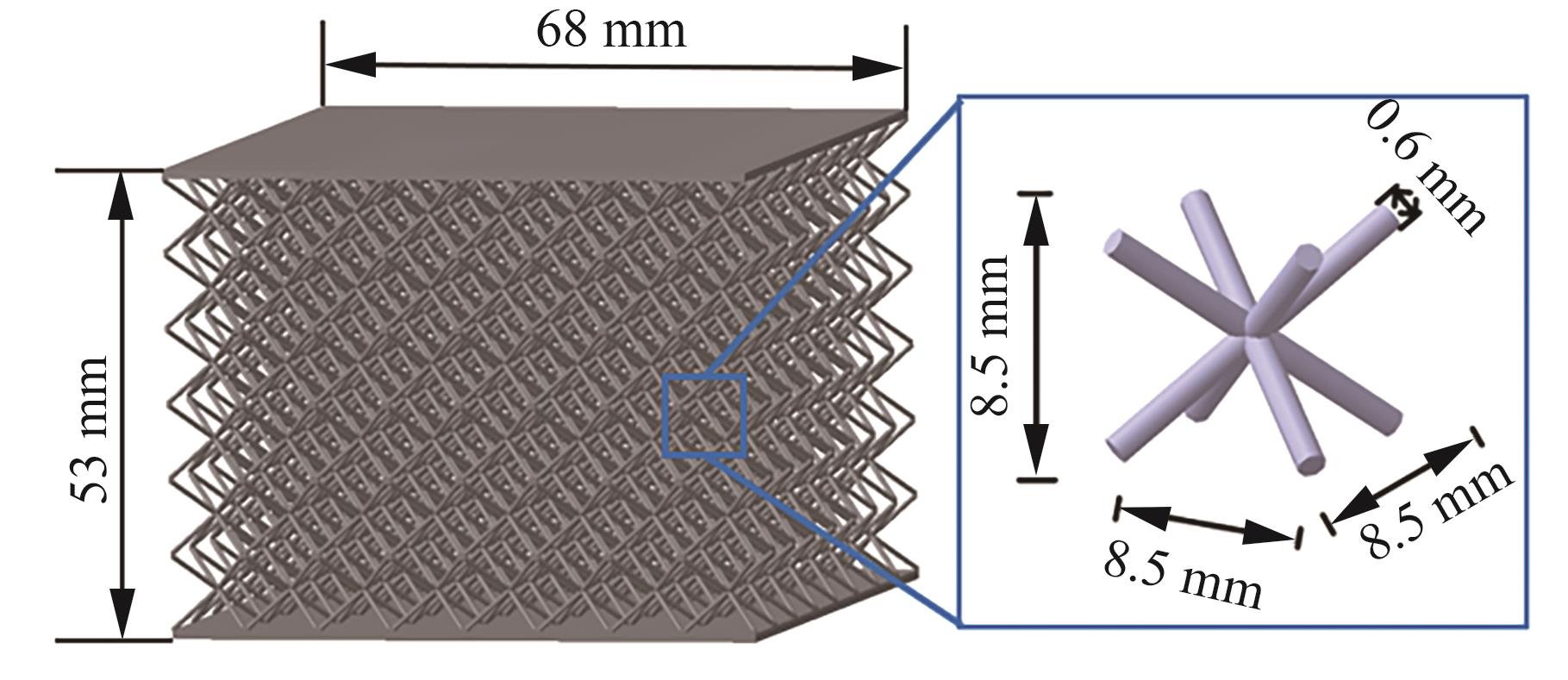
Fig.6
Schematic diagram of compression test setup
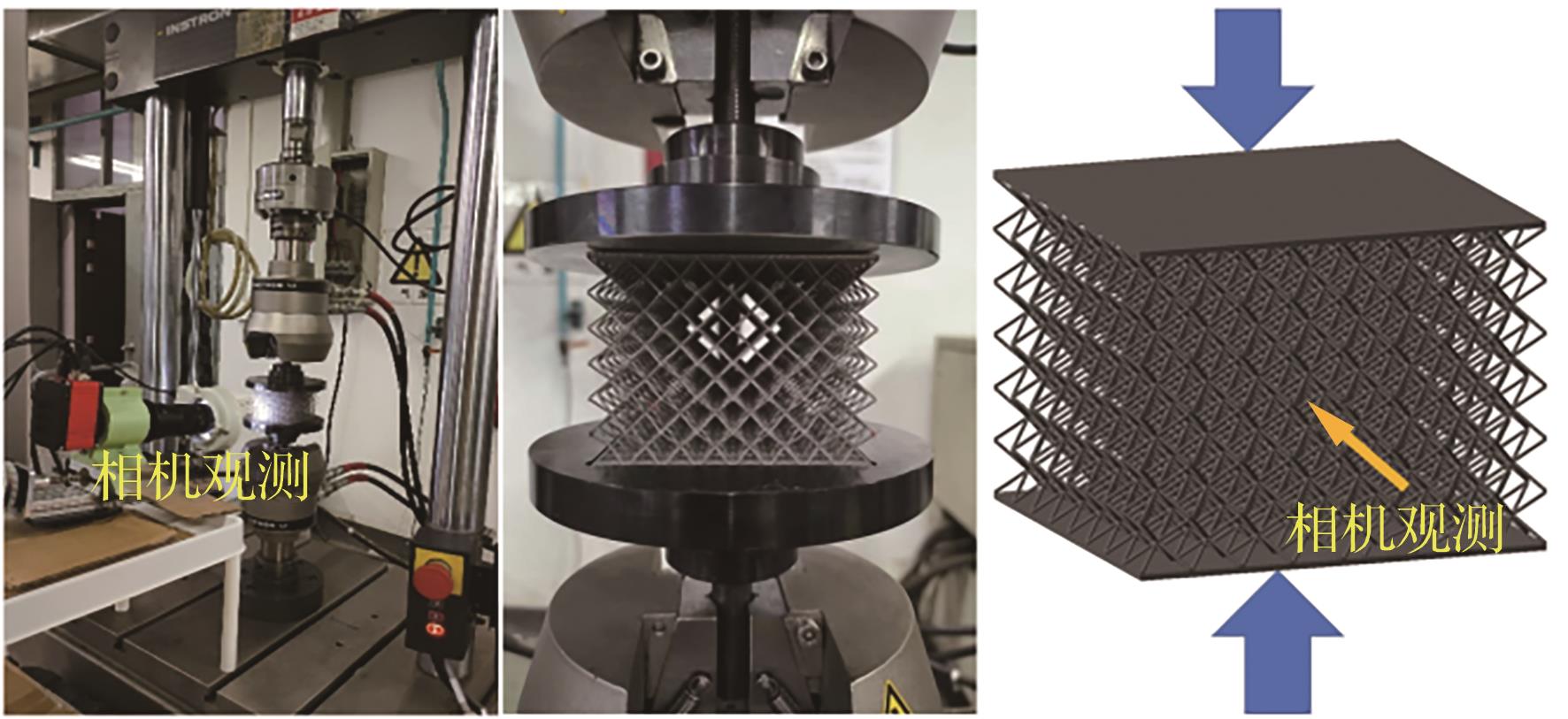
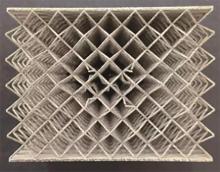
Fig.7
Buckling and fracture of central cell body
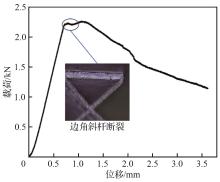
Fig.8
Load-displacement curve of superstructure under compression load
Table 2
Compressive fatigue test results of superstructures
| 试验件编号 | 载荷/N | 接触名义 应力/MPa | 疲劳寿命/ cycle |
|---|---|---|---|
| 80-1 | 1 760 | 42.13 | 30 081 |
| 80-2 | 30 189 | ||
| 80-3 | 36 632 | ||
| 70-1 | 1 540 | 36.86 | 74 025 |
| 70-2 | 74 706 | ||
| 70-3 | 88 922 | ||
| 60-1 | 1 320 | 31.59 | 162 931 |
| 60-2 | 128 538 | ||
| 60-3 | 161 703 | ||
| 50-1 | 1 100 | 26.33 | 423 112 |
| 50-2 | 483 200 | ||
| 50-3 | 451 756 | ||
| 40-1 | 880 | 21.06 | 1 359 887 |
| 40-2 | 1 214 438 | ||
| 40-3 | 1 509 745 |
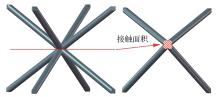
Fig.9
Schematic of contact area
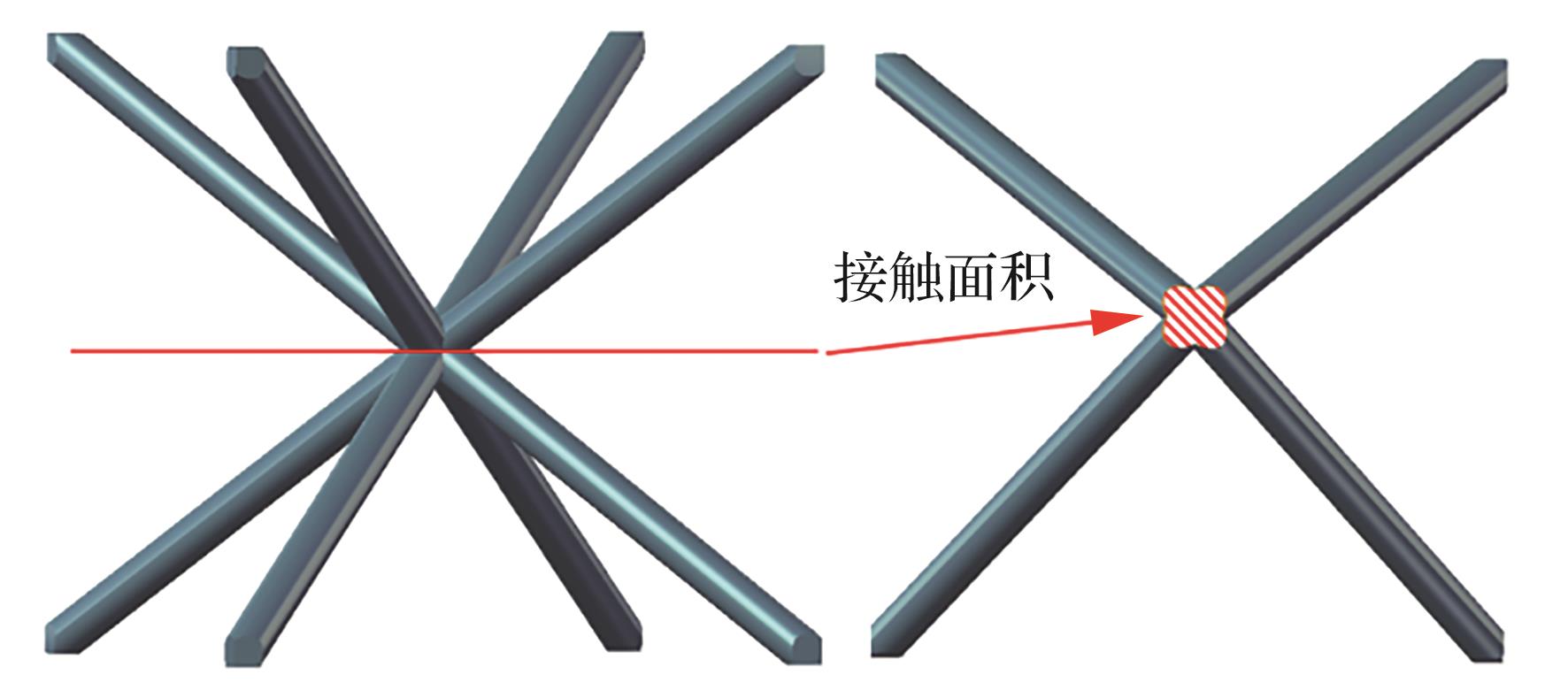
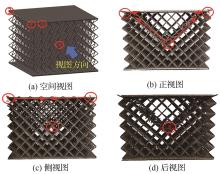
Fig.10
Compressive fatigue fracture path of superstructures under low loads
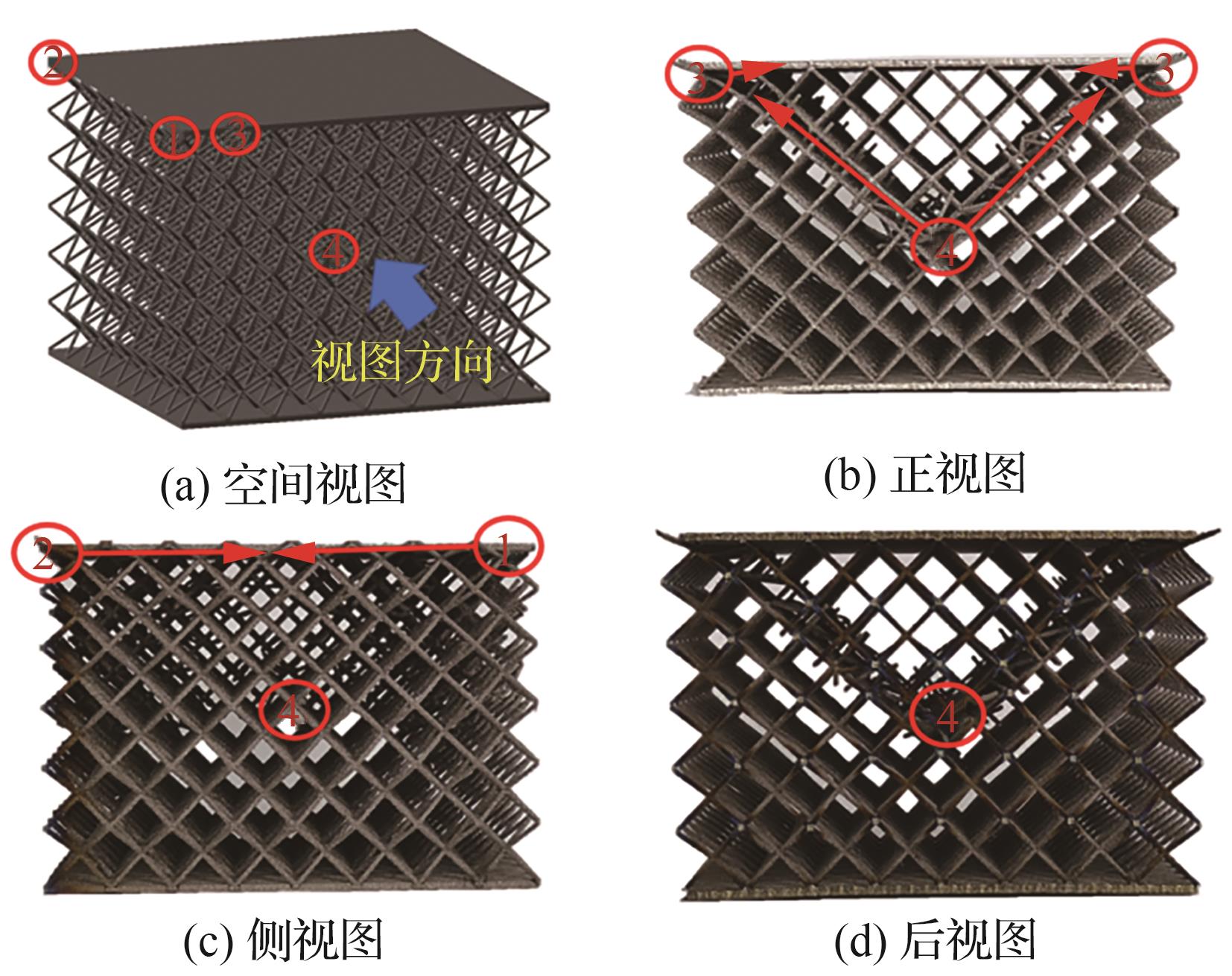
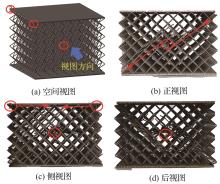
Fig.11
Compressive fatigue fracture path of superstructures under high loads
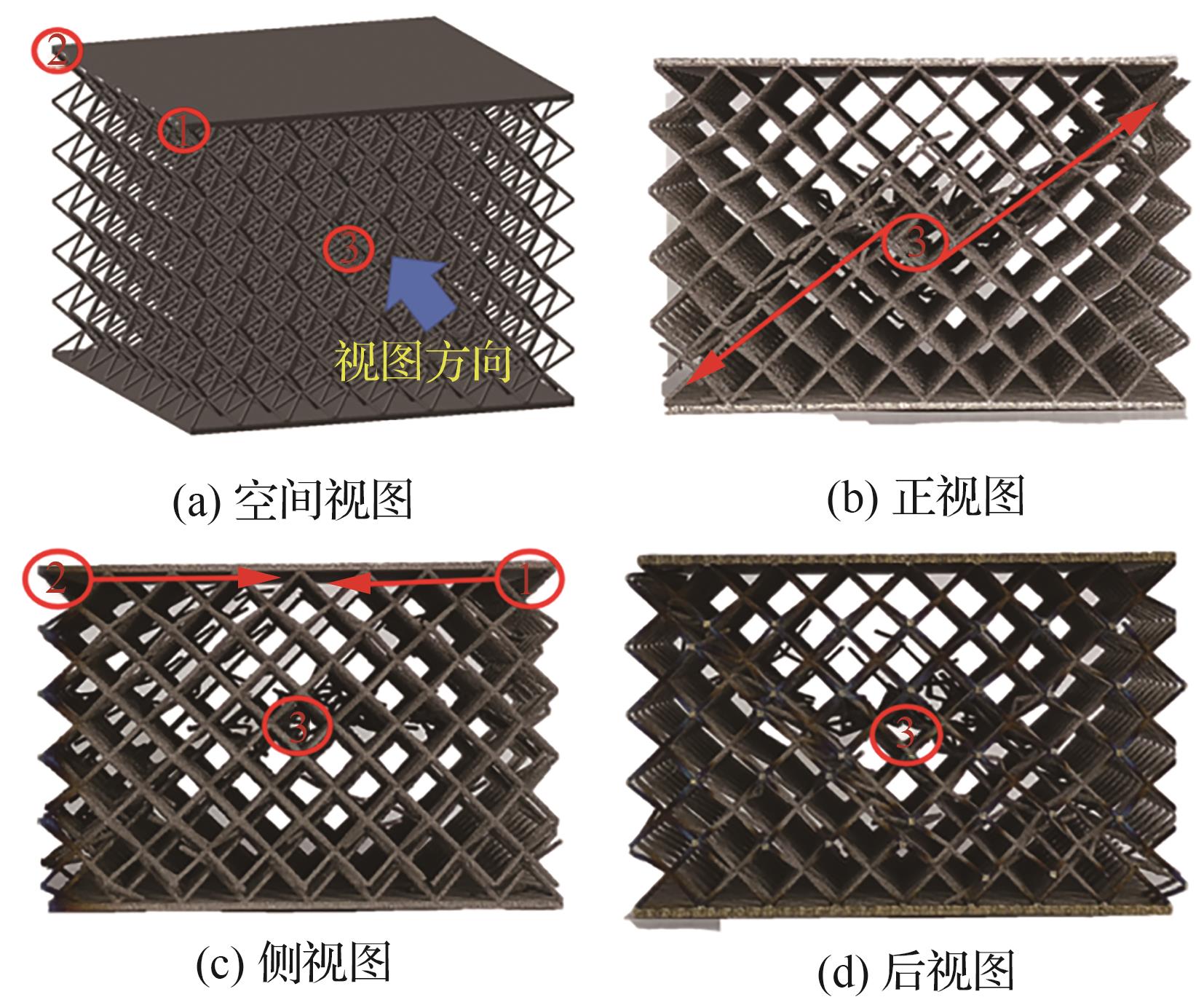
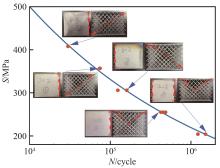
Fig.12
Fracture path under different loading
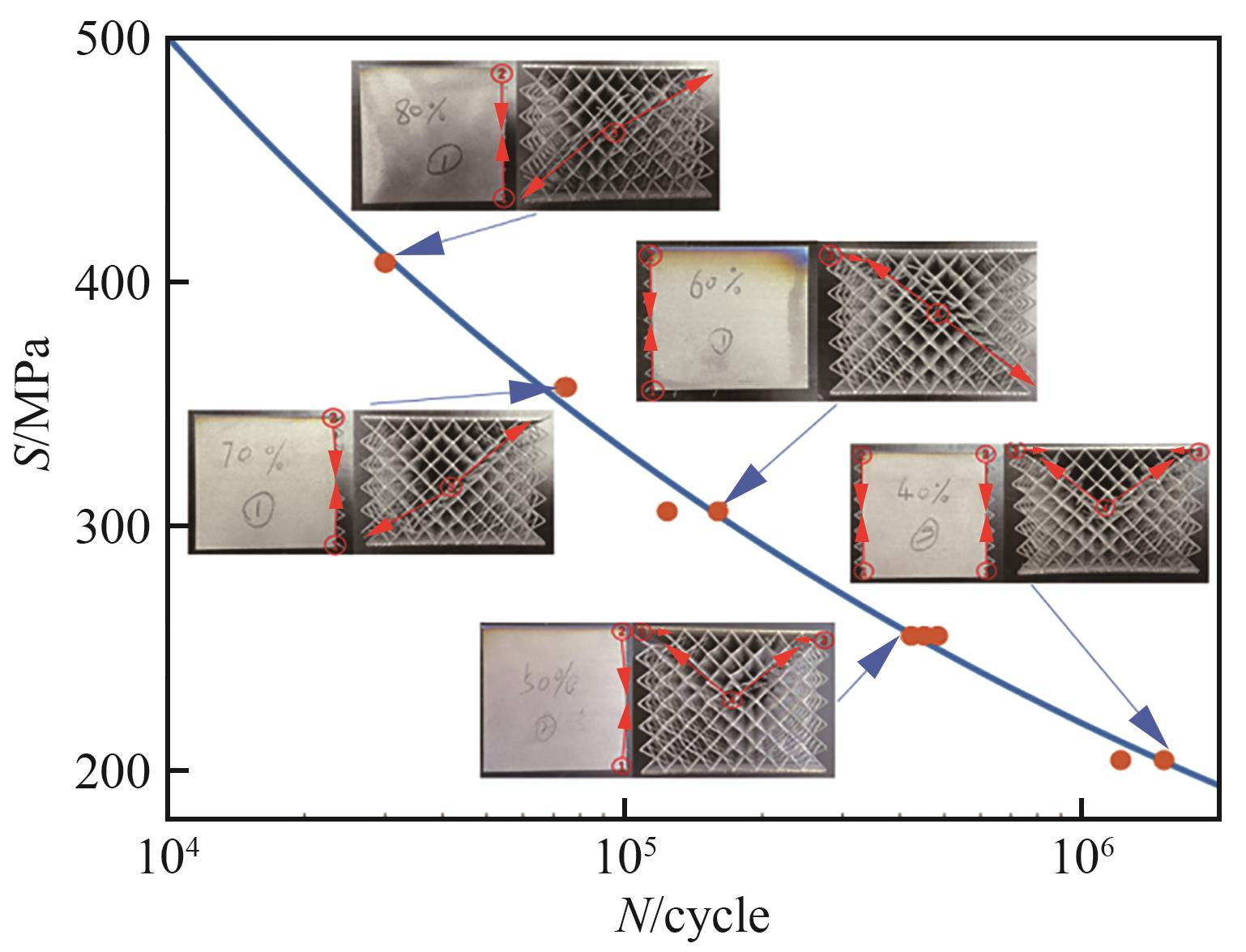
Table 3
Surface roughness parameters and stress concentration coefficient
| 路径 | |||||||
|---|---|---|---|---|---|---|---|
| 1 | 36.65 | 224 | 120 | 148.0 | 333 | 67.87 | 2.73 |
| 2 | 27.39 | 219 | 118 | 149.0 | 313 | 59.63 | 2.62 |
| 3 | 19.71 | 182 | 68 | 133.6 | 278 | 46.19 | 2.57 |
| 4 | 18.35 | 182 | 65 | 137.0 | 263 | 47.69 | 2.48 |
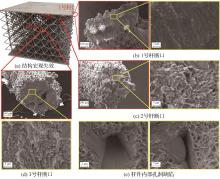
Fig.13
Compressive fatigue fracture of superstructure
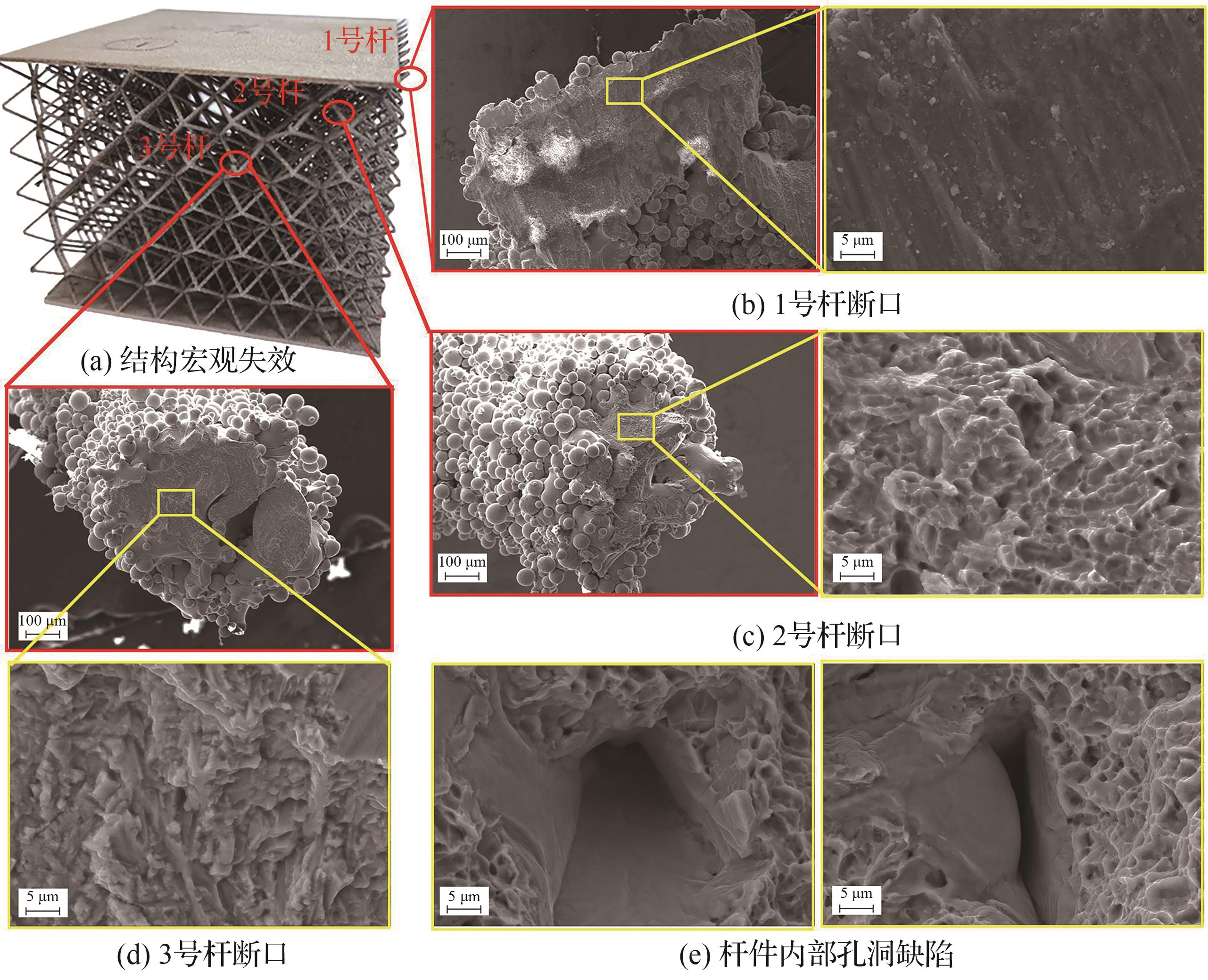
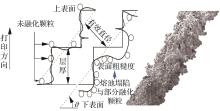
Fig.14
Surface roughness characteristics and real morphology of superstructure members
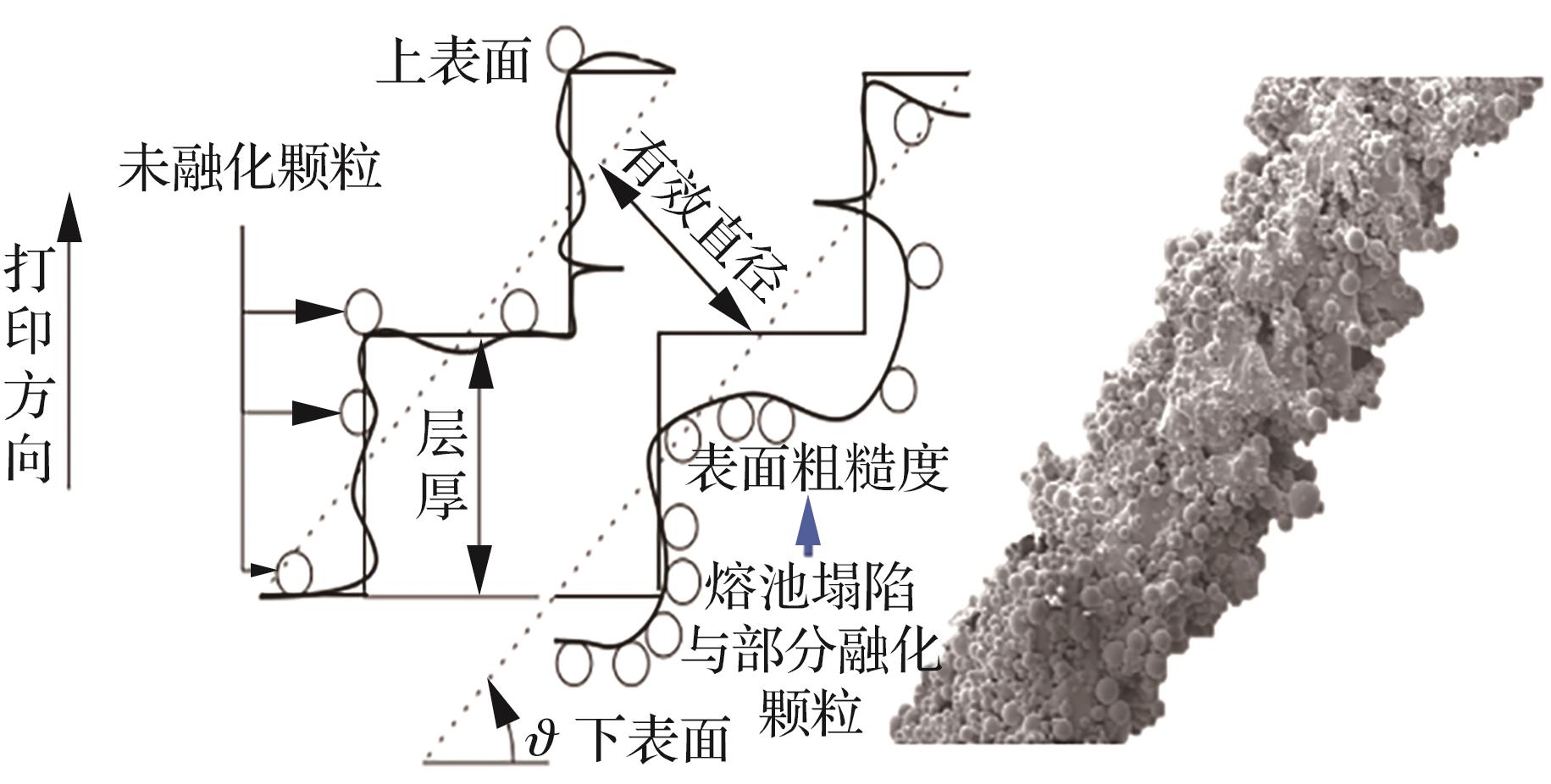
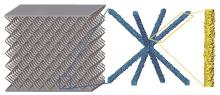
Fig.15
Surface topography after 3D reconstruction from CT scanning of compressed structures
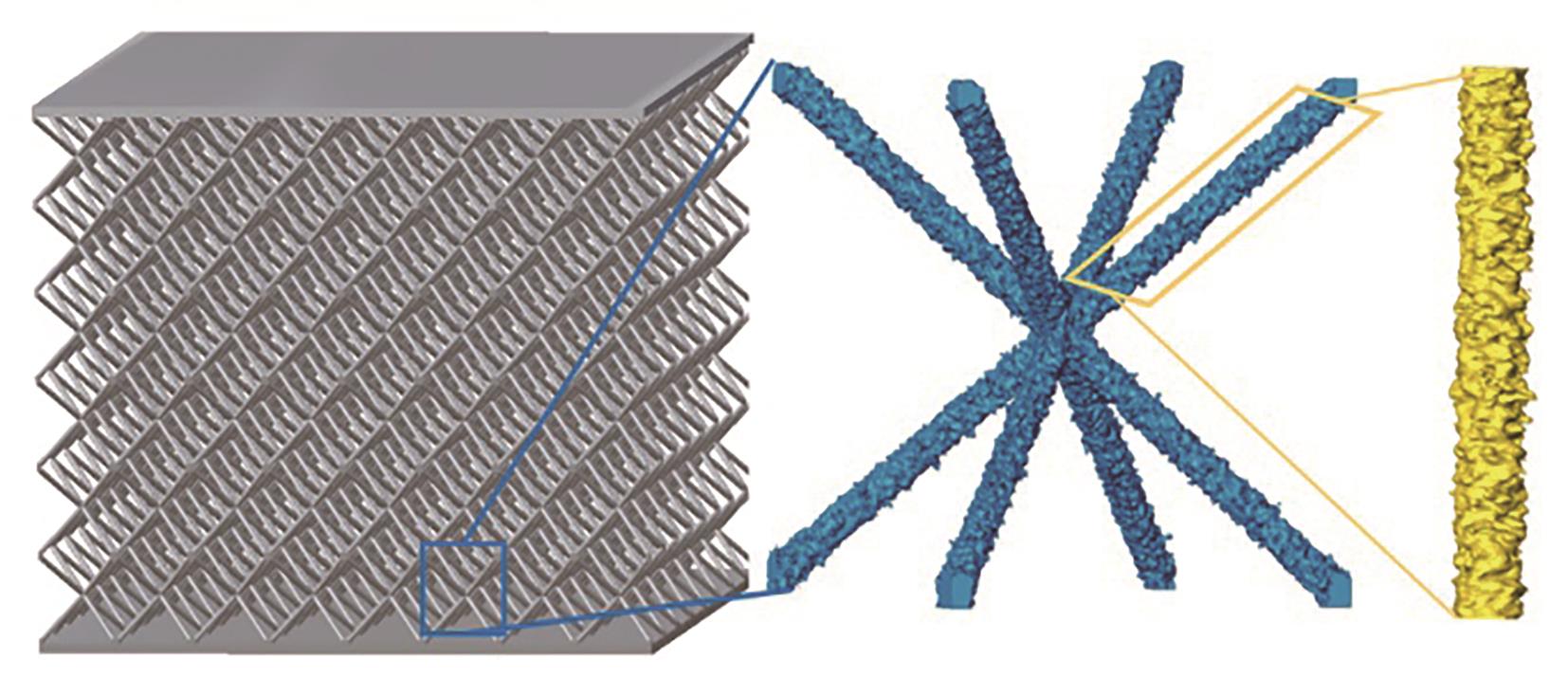
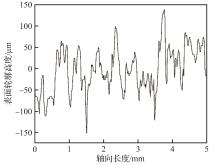
Fig.16
Rough surface profile curve of single rod of compressive superstructure
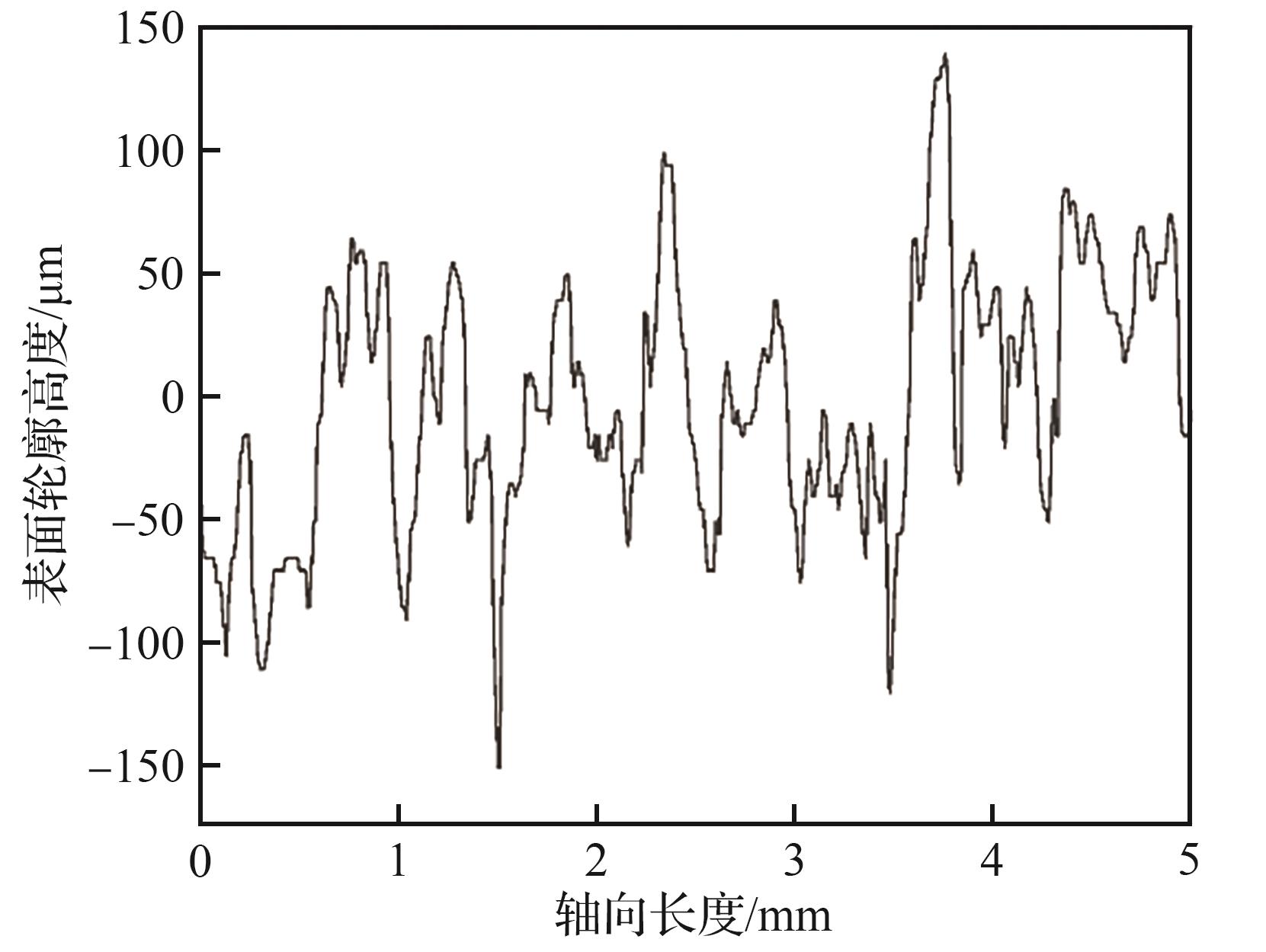

Fig.17
Effective bearing area


Fig.18
3-D reconstruction of unit-cell morphology
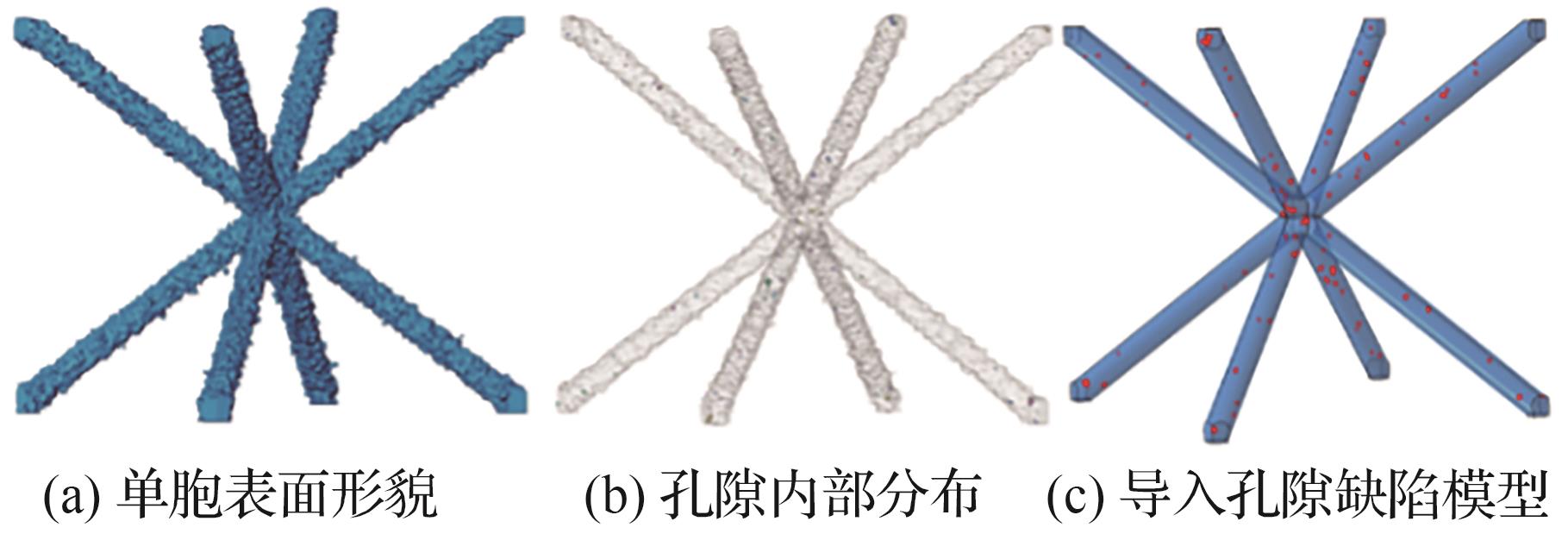
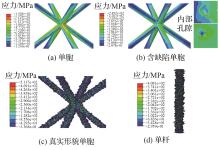
Fig.19
Stress distribution in different types of models
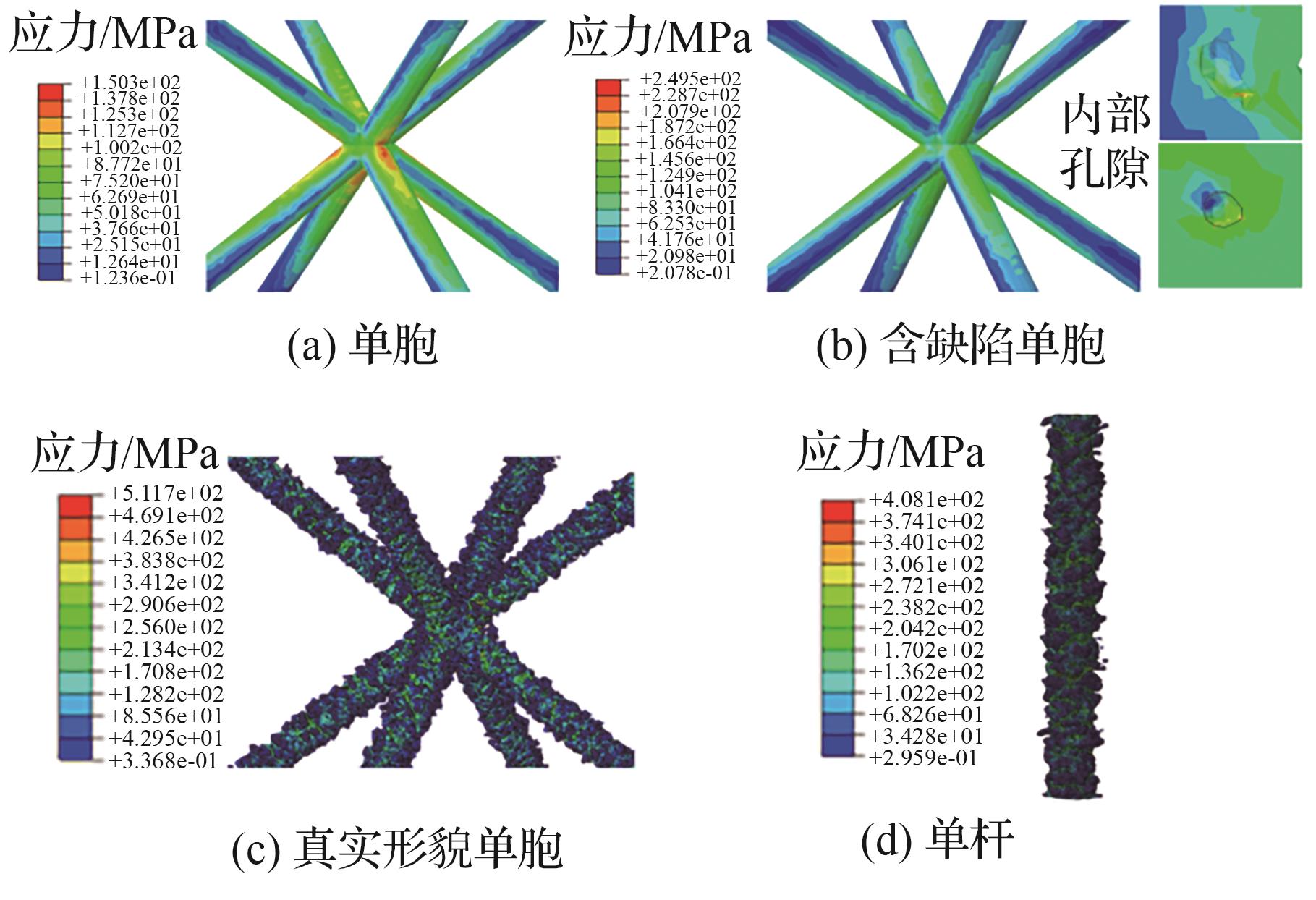
Table 4
Fatigue life test data of Ti-6Al-4V standard fatigue test piece
| N/(103 cycle) | |
|---|---|
| 500 | 137,62,106,184,295,194,216,273,190,182 |
| 550 | 31,44,94,127,224,60,83,94,71,65 |
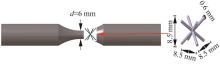
Fig.20
Ti-6Al-4V fatigue specimen with compressive superstructural unit cell
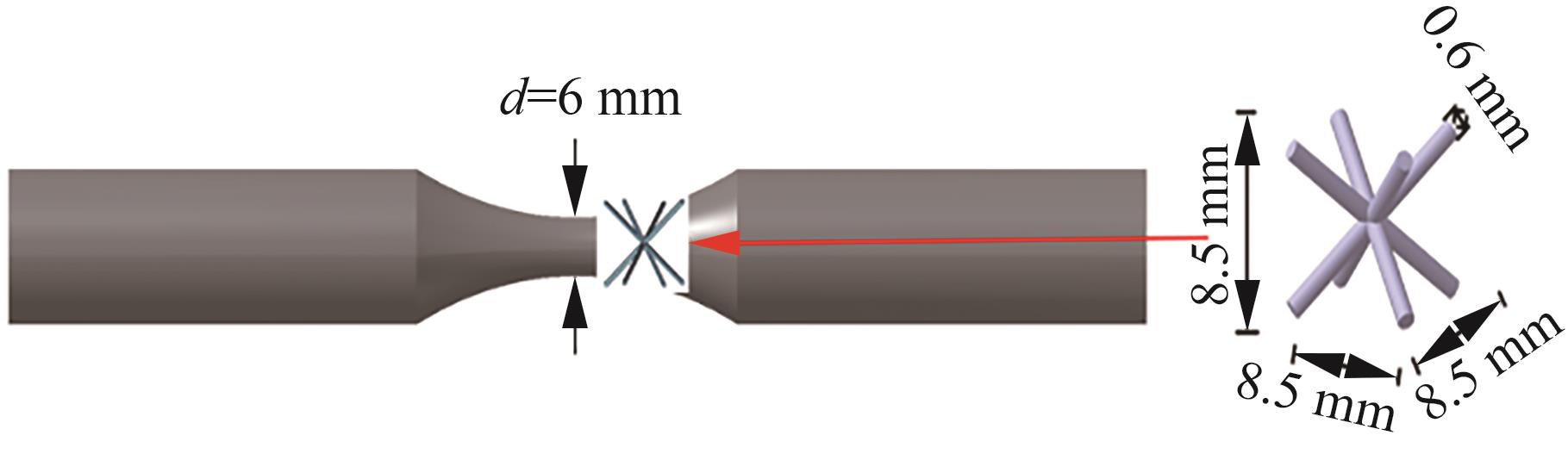
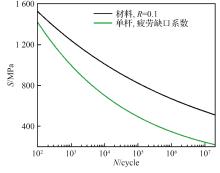
Fig.21
Correction of S-N curves for a single bar
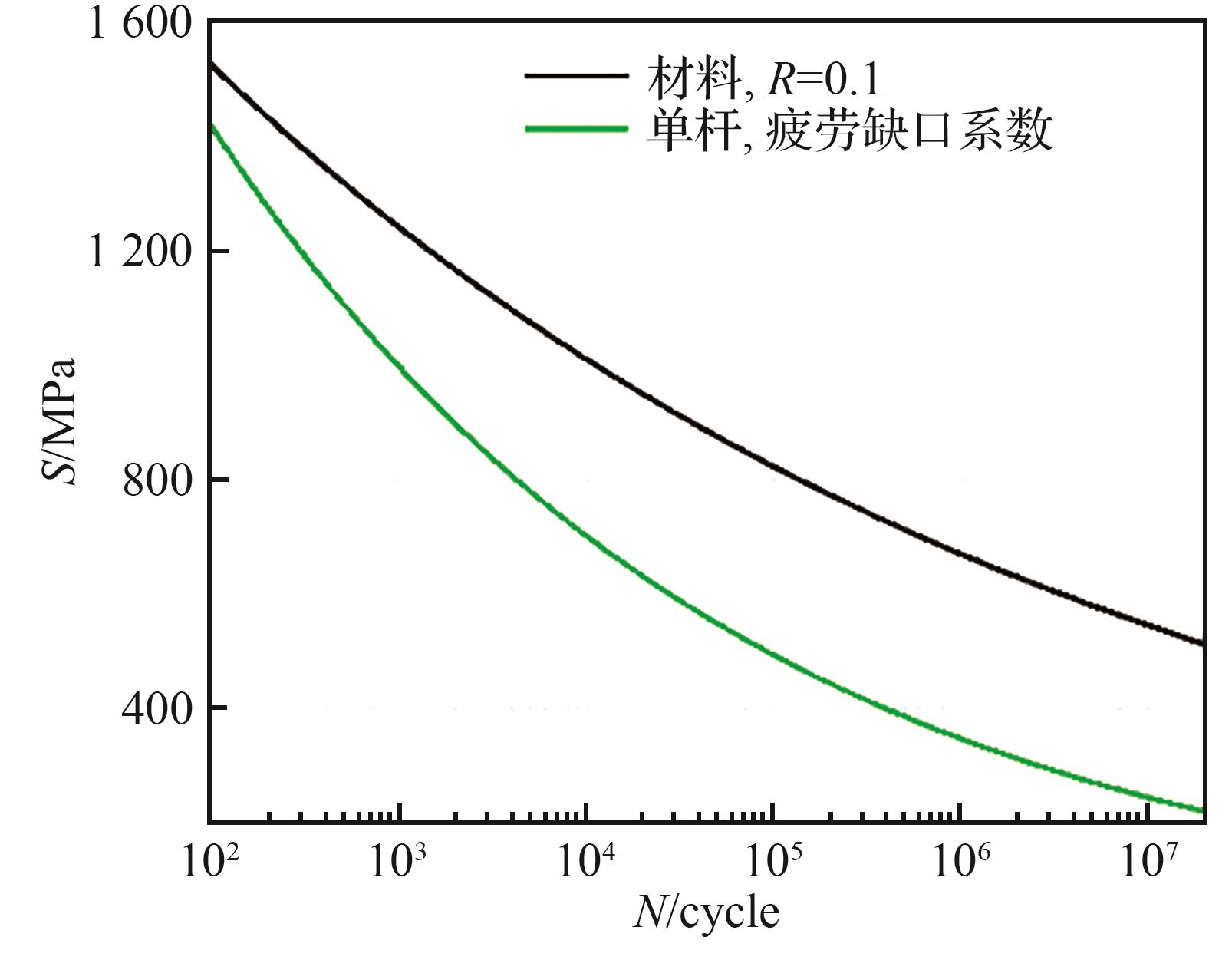
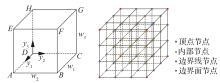
Fig.22
Schematic diagram of boundary condition imposed by unit cell[35]
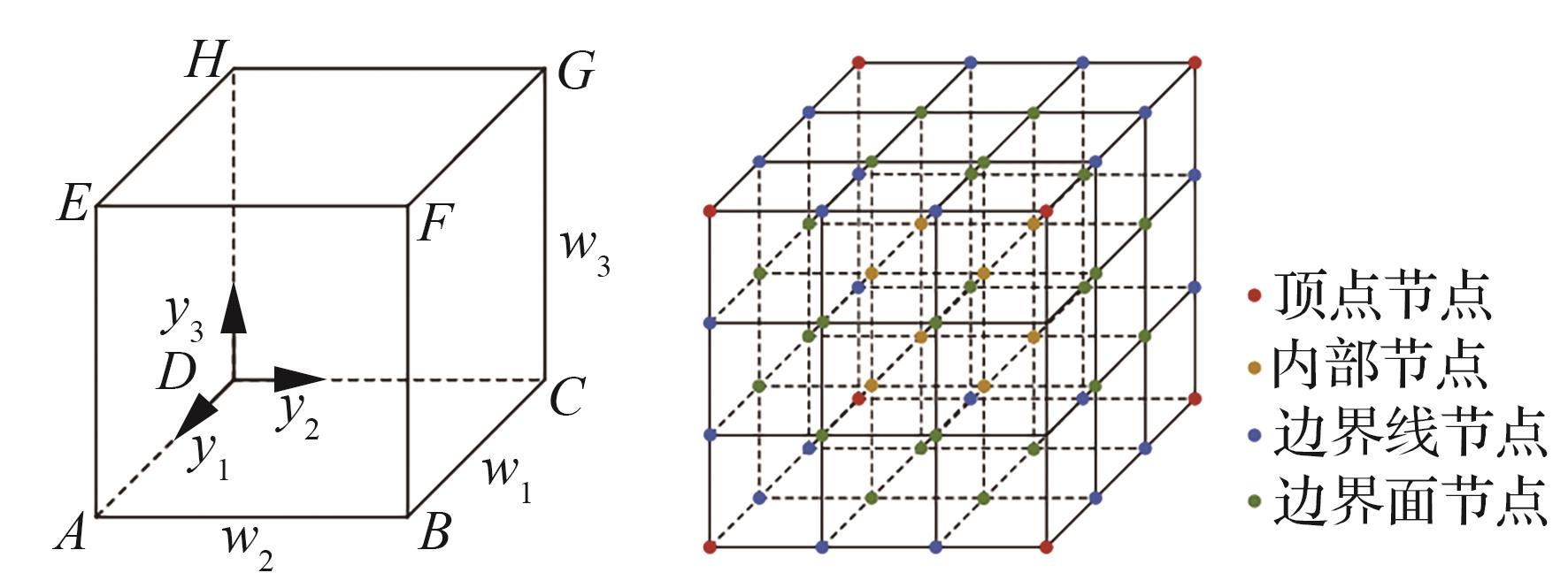
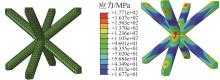
Fig.23
Model and stress distribution at 10% relative density
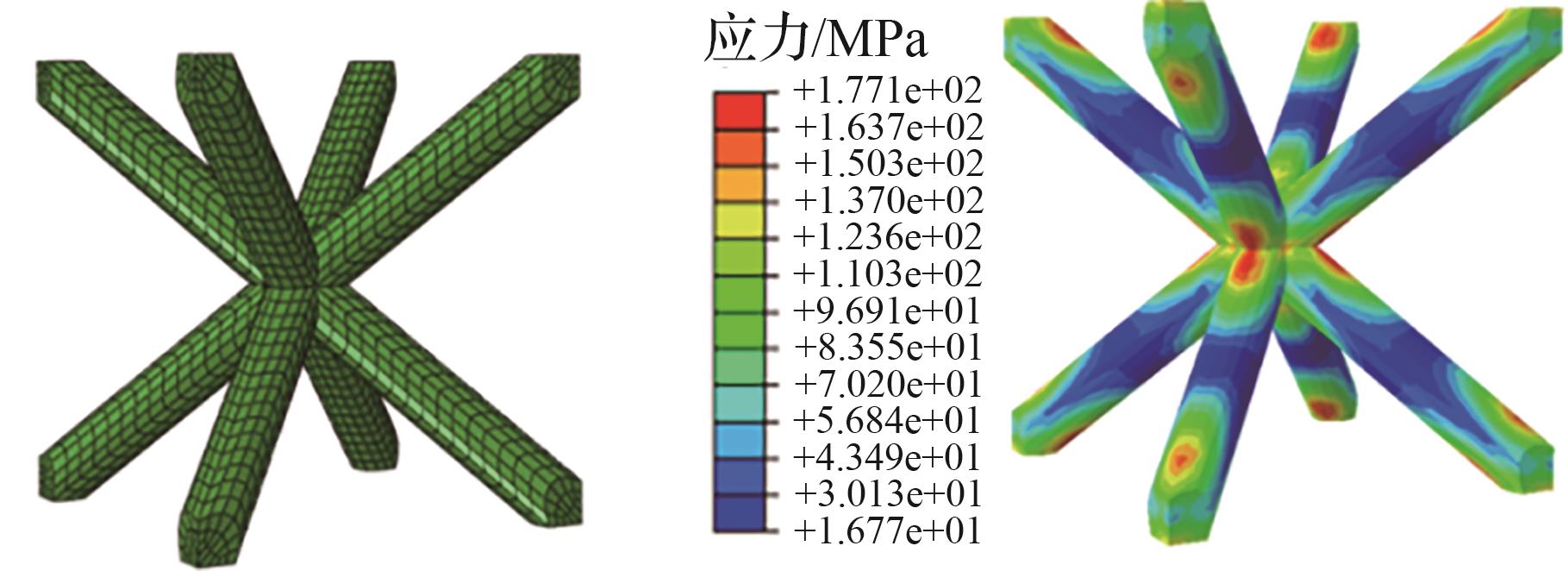
Table 5
Stress concentration coefficients of BCC unit cells at different relative densities
| 相对密度/% | 接触面积/(10-6 m2) | 杆径/mm | 结构应力 集中系数 |
|---|---|---|---|
| 2.5 | 0.652 8 | 0.299 | 14.73 |
| 5.0 | 1.323 0 | 0.427 | 10.96 |
| 7.5 | 2.038 0 | 0.530 | 8.51 |
| 10.0 | 2.771 0 | 0.618 | 7.04 |
| 12.5 | 3.535 0 | 0.698 | 6.01 |
| 15.0 | 4.168 0 | 0.758 | 5.25 |
| 20.0 | 5.944 0 | 0.905 | 4.36 |
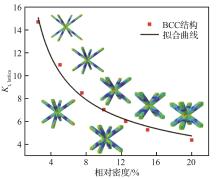
Fig.24
Superstructural stress concentration coefficient at different relative densities
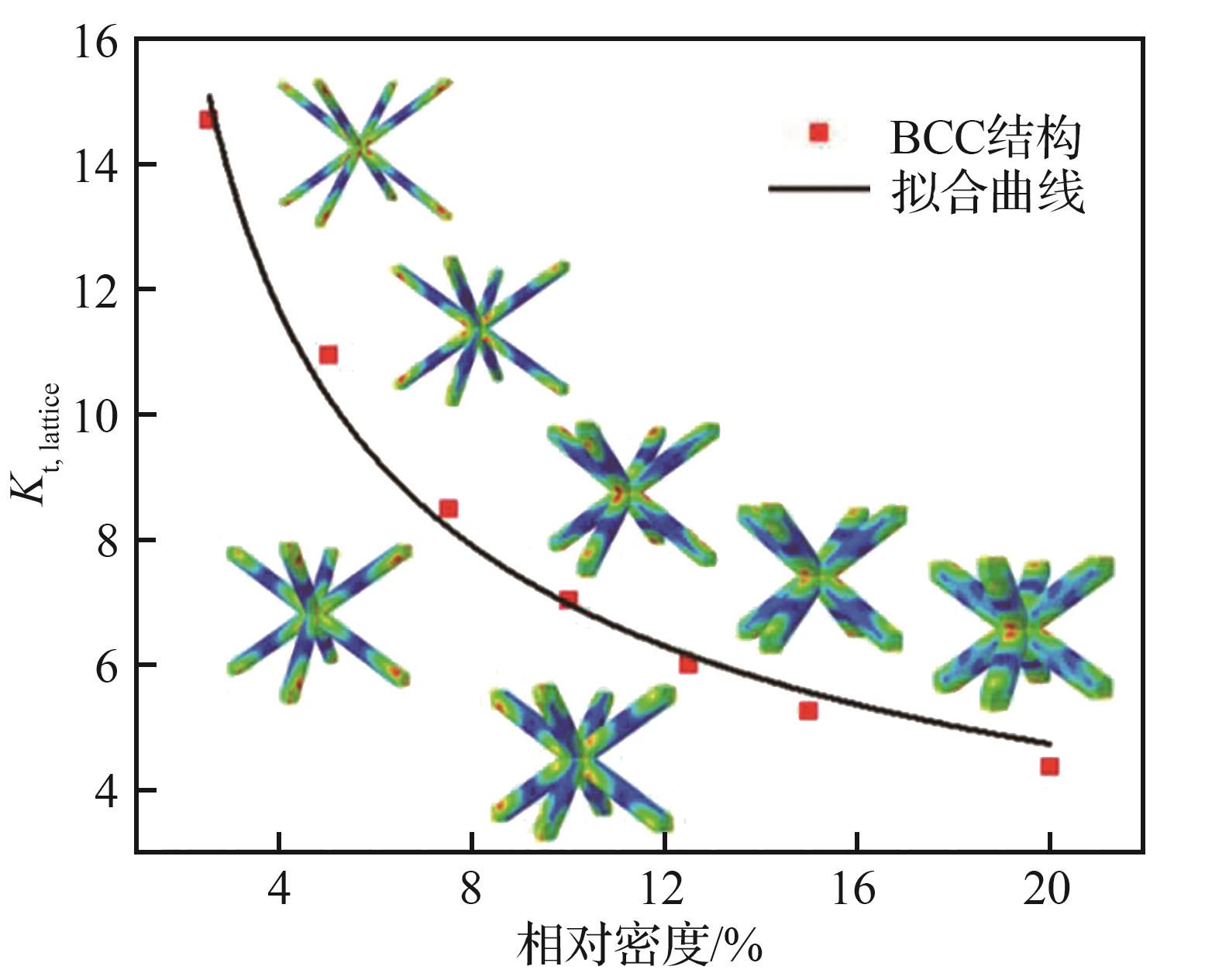
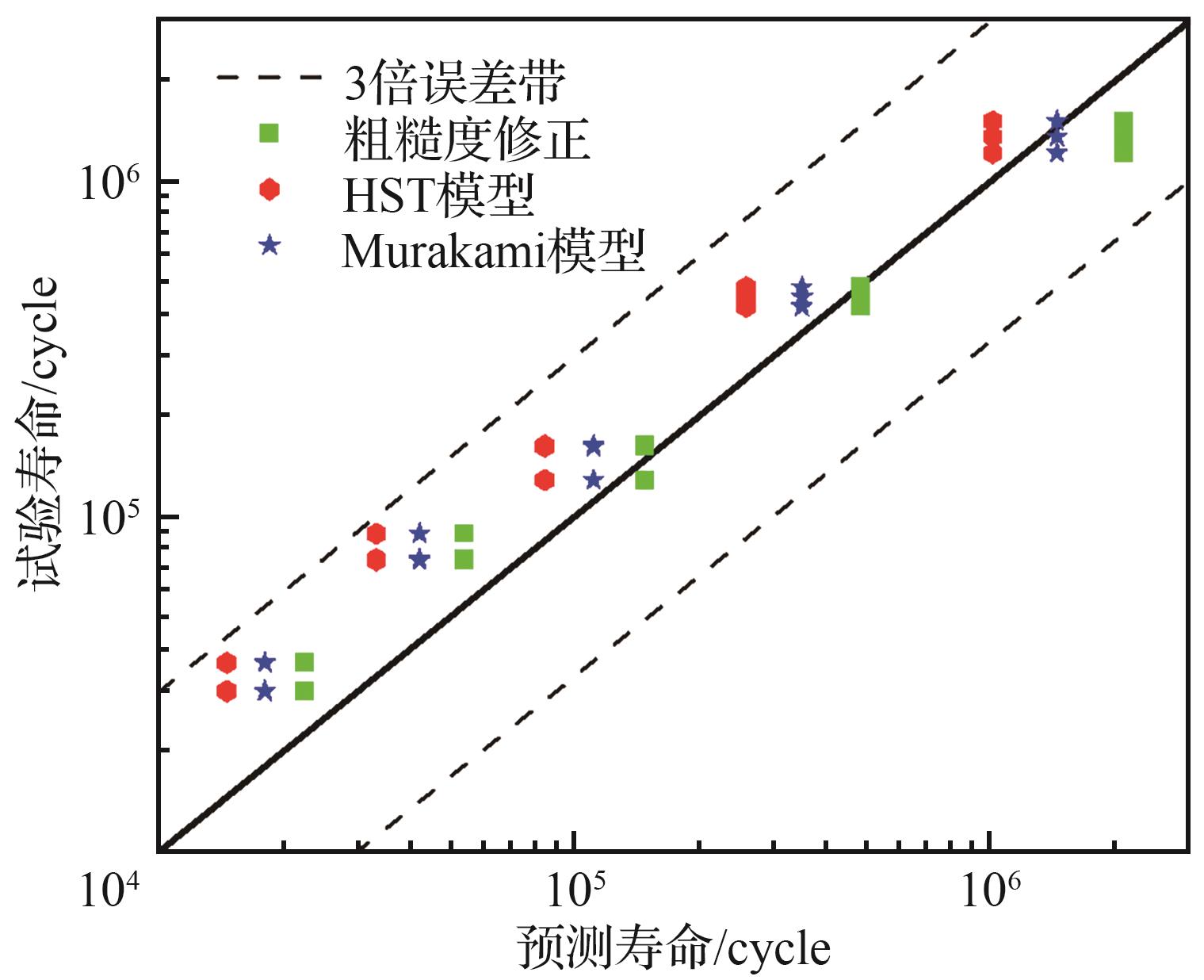
Fig.25
Fatigue life results of superstructure predicted by various models
| [1] | 韩剑, 孙士勇, 牛斌, 等. 树脂基复合材料点阵结构的制造技术研究进展[J]. 航空学报, 2023, 44(9): 628255. |
| HAN J, SUN S Y, NIU B, et al. Progress in manufacturing technologies of resin-based composite lattice structures[J]. Acta Aeronautica et Astronautica Sinica, 2023, 44(9): 628255 (in Chinese). | |
| [2] | DONG G Y, TANG Y L, ZHAO Y F. A survey of modeling of lattice structures fabricated by additive manufacturing[J]. Journal of Mechanical Design, 2017, 139(10): 100906. |
| [3] | TANG Y L, ZHAO Y F. A survey of the design methods for additive manufacturing to improve functional performance[J]. Rapid Prototyping Journal, 2016, 22(3): 569-590. |
| [4] | LIU R, CHEN W H, ZHAO J X. A review on factors affecting the mechanical properties of additively-manufactured lattice structures[J]. Journal of Materials Engineering and Performance, 2024, 33(10): 4685-4711. |
| [5] | 任晓雨, 肖丽英, 郝智秀. 类桁架点阵多孔材料的研究进展[J]. 机械设计与制造, 2020(8): 288-291, 295. |
| REN X Y, XIAO L Y, HAO Z X. A review of lattice structure[J]. Machinery Design & Manufacture, 2020(8): 288-291, 295 (in Chinese). | |
| [6] | URIBE-LAM E, TREVIÑO-QUINTANILLA C D, CUAN-URQUIZO E, et al. Use of additive manufacturing for the fabrication of cellular and lattice materials: A review[J]. Materials and Manufacturing Processes, 2021, 36(3): 257-280. |
| [7] | 顾冬冬, 张红梅, 陈洪宇, 等. 航空航天高性能金属材料构件激光增材制造[J]. 中国激光, 2020, 47(5): 24-47. |
| GU D D, ZHANG H M, CHEN H Y, et al. Laser additive manufacturing of high-performance metallic aerospace components[J]. Chinese Journal of Lasers, 2020, 47(5): 24-47 (in Chinese). | |
| [8] | FEI C W, LI C, LIN J Y, et al. Structural design of aeroengine radiators: State of the art and perspectives[J]. Propulsion and Power Research, 2024, 13(3): 319-334. |
| [9] | SALVATI E, TOGNAN A, LAURENTI L, et al. A defect-based physics-informed machine learning framework for fatigue finite life prediction in additive manufacturing[J]. Materials & Design, 2022, 222: 111089. |
| [10] | PISATI M, CORNEO M G, BERETTA S, et al. Numerical and experimental investigation of cumulative fatigue damage under random dynamic cyclic loads of lattice structures manufactured by laser powder bed fusion[J]. Metals, 2021, 11(9): 1395. |
| [11] | 王天帅, 贺小帆, 王金宇, 等. 基于双峰对数正态分布模型的DED-TA15钛合金DFR值估计方法[J]. 航空学报, 2022, 43(3): 225013. |
| WANG T S, HE X F, WANG J Y, et al. Estimation method for DFR value of DED-TA15 titanium alloy based on bimodal lognormal distribution[J]. Acta Aeronautica et Astronautica Sinica, 2022, 43(3): 225013 (in Chinese). | |
| [12] | AMANI Y, DANCETTE S, DELROISSE P, et al. Compression behavior of lattice structures produced by selective laser melting: X-ray tomography based experimental and finite element approaches[J]. Acta Materialia, 2018, 159: 395-407. |
| [13] | MELANCON D, BAGHERI Z S, JOHNSTON R B, et al. Mechanical characterization of structurally porous biomaterials built via additive manufacturing: Experiments, predictive models, and design maps for load-bearing bone replacement implants[J]. Acta Biomaterialia, 2017, 63: 350-368. |
| [14] | PORTELA C M, GREER J R, KOCHMANN D M. Impact of node geometry on the effective stiffness of non-slender three-dimensional truss lattice architectures[J]. Extreme Mechanics Letters, 2018, 22: 138-148. |
| [15] | ZHANG J M, LI J H, WU S C, et al. High-cycle and very-high-cycle fatigue lifetime prediction of additively manufactured AlSi10Mg via crystal plasticity finite element method[J]. International Journal of Fatigue, 2022, 155: 106577. |
| [16] | LIU L, KAMM P, GARCÍA-MORENO F, et al. Elastic and failure response of imperfect three-dimensional metallic lattices: The role of geometric defects induced by selective laser melting[J]. Journal of the Mechanics and Physics of Solids, 2017, 107: 160-184. |
| [17] | REN D C, LI S J, WANG H, et al. Fatigue behavior of Ti-6Al-4V cellular structures fabricated by additive manufacturing technique[J]. Journal of Materials Science & Technology, 2019, 35(2): 285-294. |
| [18] | DALLAGO M, FONTANARI V, TORRESANI E, et al. Fatigue and biological properties of Ti-6Al-4V ELI cellular structures with variously arranged cubic cells made by selective laser melting[J]. Journal of the Mechanical Behavior of Biomedical Materials, 2018, 78: 381-394. |
| [19] | WU M W, CHEN J K, LIN B H, et al. Compressive fatigue properties of additive-manufactured Ti-6Al-4V cellular material with different porosities[J]. Materials Science and Engineering: A, 2020, 790: 139695. |
| [20] | ZARGARIAN A, ESFAHANIAN M, KADKHODAPOUR J, et al. On the fatigue behavior of additive manufactured lattice structures[J]. Theoretical and Applied Fracture Mechanics, 2019, 100: 225-232. |
| [21] | YANG Y, CASTANY P, BERTRAND E, et al. Stress release-induced interfacial twin boundary ω phase formation in a β type Ti-based single crystal displaying stress-induced α" martensitic transformation[J]. Acta Materialia, 2018, 149: 97-107. |
| [22] | SUN W B, MA Y E, HUANG W, et al. Effects of build direction on tensile and fatigue performance of selective laser melting Ti6Al4V titanium alloy[J]. International Journal of Fatigue, 2020, 130: 105260. |
| [23] | KUMAR P, RAMAMURTY U. Microstructural optimization through heat treatment for enhancing the fracture toughness and fatigue crack growth resistance of selective laser melted Ti6Al4V alloy[J]. Acta Materialia, 2019, 169: 45-59. |
| [24] | PYKA G, KERCKHOFS G, PAPANTONIOU I, et al. Surface roughness and morphology customization of additive manufactured open porous Ti6Al4V structures[J]. Materials, 2013, 6(10): 4737-4757. |
| [25] | ZHANG J Y. Surface roughness characterization for stress concentration factor predictions: A Bayesian learning approach[J]. Journal of Engineering Research and Reports, 2021: 59-70. |
| [26] | 姚卫星. 结构疲劳寿命分析[M]. 北京: 科学出版社, 2019. |
| YAO W X. Fatigue life estimation of structures[M]. Beijing: Science Press, 2019 (in Chinese). | |
| [27] | KHOUKHI D EL, MOREL F, SAINTIER N, et al. Experimental investigation of the size effect in high cycle fatigue: Role of the defect population in cast aluminium alloys[J]. International Journal of Fatigue, 2019, 129: 105222. |
| [28] | HU Y N, WU S C, WU Z K, et al. A new approach to correlate the defect population with the fatigue life of selective laser melted Ti-6Al-4V alloy[J]. International Journal of Fatigue, 2020, 136: 105584. |
| [29] | RAGHAVENDRA S, MOLINARI A, CAO A N, et al. Quasi-static compression and compression-compression fatigue behavior of regular and irregular cellular biomaterials[J]. Fatigue & Fracture of Engineering Materials & Structures, 2021, 44(5): 1178-1194. |
| [30] | PERSENOT T, BURR A, MARTIN G, et al. Effect of build orientation on the fatigue properties of as-built Electron Beam Melted Ti-6Al-4V alloy[J]. International Journal of Fatigue, 2019, 118: 65-76. |
| [31] | LIU F L, HE C, CHEN Y, et al. Effects of defects on tensile and fatigue behaviors of selective laser melted titanium alloy in very high cycle regime[J]. International Journal of Fatigue, 2020, 140: 105795. |
| [32] | PESSARD E, LAVIALLE M, LAHEURTE P, et al. High-cycle fatigue behavior of a laser powder bed fusion additive manufactured Ti-6Al-4V titanium: Effect of pores and tested volume size[J]. International Journal of Fatigue, 2021, 149: 106206. |
| [33] | 奚蔚, 姚卫星. 一种考虑尺寸效应的缺口件疲劳寿命预测方法[J]. 南京航空航天大学学报, 2013, 45(4): 497-502. |
| XI W, YAO W X. Method for fatigue life prediction of notched specimen considering size effect[J]. Journal of Nanjing University of Aeronautics & Astronautics, 2013, 45(4): 497-502 (in Chinese). | |
| [34] | HEDAYATI R, HOSSEINI-TOUDESHKY H, SADIGHI M, et al. Computational prediction of the fatigue behavior of additively manufactured porous metallic biomaterials[J]. International Journal of Fatigue, 2016, 84: 67-79. |
| [35] | 王创. 基于轻质点阵的多尺度结构协同优化设计方法[D]. 西安: 西北工业大学, 2021. |
| WANG C. Concurrent design and optimization for multi-scale structures with lattice materials[D]. Xi’an: Northwestern Polytechnical University, 2021 (in Chinese). |
| [1] | Chengyu LIU, Yu’e MA, Pengcheng CHEN. Manifold adaptive method for thermo-mechanical coupled fatigue phase-field model [J]. Acta Aeronautica et Astronautica Sinica, 2026, 47(6): 232552-232552. |
| [2] | Zhi HAN, Yusi WANG, Wenyao ZHANG, Bing LI, Yuan CHEN. Progress in modeling of additive manufacturing for continuous fiber-reinforced composites [J]. Acta Aeronautica et Astronautica Sinica, 2026, 47(5): 432311-432311. |
| [3] | Yan SHI, Han LIU, Tongtong ZHAO, Jixiang DAI, Jianjun SHA. Multi-field modeling and simulation of reactive infiltration process of ceramic matrix composites [J]. Acta Aeronautica et Astronautica Sinica, 2025, 46(3): 430722-430722. |
| [4] | Lei HUANG, Cong GUO, Xiaobo ZHANG, Liangchen SUN, Yinghui ZUO, Bo WANG, Kuo TIAN. Aircraft structural health management method based on flight parameter-load-life digital twin models [J]. Acta Aeronautica et Astronautica Sinica, 2025, 46(21): 532382-532382. |
| [5] | Lin TANG, Xuanshi MENG, Ruidi LIU, Xingshi GU, Xian YI. Structural modeling and elastic modulus prediction of aircraft wing ice [J]. Acta Aeronautica et Astronautica Sinica, 2025, 46(20): 531895-531895. |
| [6] | Jun DU, Ao CUI, Zhiqiang LI, Zhihao WAN. Influence of droplet transition mode on deposition morphology in droplet-arc hybrid additive manufacturing [J]. Acta Aeronautica et Astronautica Sinica, 2025, 46(17): 431710-431710. |
| [7] | Rongxiang CHENG, Guosheng DUAN, Yueying ZHANG, Heyu WEI, Baolin WU. Effect of texture on fatigue properties of AZ31B under stress-controlled conditions [J]. Acta Aeronautica et Astronautica Sinica, 2025, 46(12): 431401-431401. |
| [8] | Rui SI, Yong CHEN. Application trends of additive manufacturing technology for civil aircraft [J]. Acta Aeronautica et Astronautica Sinica, 2024, 45(5): 529677-529677. |
| [9] | Fuze ZHANG. Determination of the calendar life of the whole aircraft and the relevant issues [J]. Acta Aeronautica et Astronautica Sinica, 2024, 45(3): 229863-229863. |
| [10] | Yuefeng YING, Qihao CHEN, Weidong WANG, Xinyu MAO. Effect of ultrasonic vibration of welding wire on weld formation and pore in gas metal arc welding of aluminum alloy [J]. Acta Aeronautica et Astronautica Sinica, 2024, 45(2): 428711-428711. |
| [11] | Zeyu SONG, Junpeng XUE, Zhichao XU, Wenbo LU, Min WANG, Ran JIA, Changzhi YU. Three-dimensional measurement method of geometric morphology in laser metal deposition forming process using ultraviolet structured light [J]. Acta Aeronautica et Astronautica Sinica, 2024, 45(18): 429722-429722. |
| [12] | Zhijie YU, Yupei GUO, Hanbin SUN, Jingnan ZHANG, Xiasheng SUN. Recent progress in structural integrity of novel materials and advanced techniques [J]. Acta Aeronautica et Astronautica Sinica, 2024, 45(18): 29888-029888. |
| [13] | Hongwei LI, Xuelin LEI, Chengcheng ZHANG, Chaozong TANG, Shenglong KANG, Yalong CHEN, Lyuyi CHENG, Xiancheng ZHANG. Optimization of process parameters for multi⁃annular convex hull rotating cold expansion and extrusion reinforcement of GH4169 high⁃temperature alloy hole structures [J]. Acta Aeronautica et Astronautica Sinica, 2024, 45(16): 429692-429692. |
| [14] | Yi LI, Zhenzhong WANG, Yuhang XIAO, Pengfei ZHANG. Review of laser⁃metal additive manufacturing + X hybrid technology [J]. Acta Aeronautica et Astronautica Sinica, 2024, 45(13): 629349-629349. |
| [15] | Jing SHU, Wenhe LIAO, Kan ZHENG, Song DONG, Lianjun SUN. Review on rotary ultrasonic machining of carbon fiber composites [J]. Acta Aeronautica et Astronautica Sinica, 2024, 45(13): 628939-628939. |
| Viewed | ||||||
|
Full text |
|
|||||
|
Abstract |
|
|||||
Address: No.238, Baiyan Buiding, Beisihuan Zhonglu Road, Haidian District, Beijing, China
Postal code : 100083
E-mail:hkxb@buaa.edu.cn
Total visits: 6658907 Today visits: 1341All copyright © editorial office of Chinese Journal of Aeronautics
All copyright © editorial office of Chinese Journal of Aeronautics
Total visits: 6658907 Today visits: 1341

 CJA
CJA
