Acta Aeronautica et Astronautica Sinica ›› 2026, Vol. 47 ›› Issue (5): 332398.doi: 10.7527/S1000-6893.2025.32398
• Electronics and Electrical Engineering and Control • Previous Articles
Zheng WANG, Shouzhi ZHAO( ), Haotian LI, Zheng SUN, Jing SHAO, Cheng HOU
Received:2025-06-10
Revised:2025-07-09
Accepted:2025-09-10
Online:2025-09-25
Published:2025-09-24
Contact:
Shouzhi ZHAO
E-mail:zhaoshouzhi@ciae.ac.cn
Supported by:CLC Number:
Zheng WANG, Shouzhi ZHAO, Haotian LI, Zheng SUN, Jing SHAO, Cheng HOU. Development status of ice-penetrating probes for deep space exploration[J]. Acta Aeronautica et Astronautica Sinica, 2026, 47(5): 332398.

Fig.1
Mars north pole ice cap (photographed by Tianwen-1)[15]


Fig.2
Mars south pole ice cap (photographed by Mars Express)[16]


Fig.3
Structural model of Europa[19]


Fig.4
Phenomenon of water-ice jets on surface of Enceladus (photographed by Cassini spacecraft)[24]


Fig.5
Photo of Triton (photographed by Voyager 2)[25]


Fig.6
CHINARE/JARE type deep ice core drill[34]


Fig.7
Working principle of the hot water drill[33]


Fig.8
Working principle of the coiled tubing drill[36]


Fig.9
Working principle of the closed-cycle water-heated ice-melter[37]


Fig.10
“Philberth”probe[39]


Fig.11
Schematic diagrams of two configurations of the pendulum-stabilized ice-melting detector[41]


Fig.12
Schematic diagram of the pendulum-stabilized detector manufactured by CRREL[42]


Fig.13
Schematic diagram of structure of RECAS[44]


Fig.14
Schematic diagram and working principle of water-absorbing and pressure-applying ice-melting probe[46]

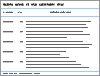
Table 1
Parameters of electrically heated ice-melting detector applied on Earth
| 探测器名称 | 直径/cm | 长度/cm | 功率/kW | 融冰速度/(m·h-1) | 垂直姿态控制 | 文献 |
|---|---|---|---|---|---|---|
| Philberth探测器 | 10.8 | 292(Probe1) 255(Porbe2) | 3.7 | 2 | 水银环腔 | [ |
| CRREL钟摆稳定探测器 | 12.7 | 250 | 15 | 6(-28 ℃) | 钟摆原理 | [ |
| SIRG-Hansen探测器 | 主体:12.7 突出端:16.5 | 345 | 5.4(4.05端部, 1.35上部) | 钟摆原理 | [ | |
| SUSI Ⅱ | 10 | 225 | 3.4 | 2.93 | 钟摆原理 | [ |
| SUSI Ⅲ | 14 | 360 | 9 | 控制分区加热 | [ | |
| RECAS原型 | 18 | 727.5 | 9.96(6.32端头) | 2.11(下) 3.6(上) | [ |
Table 2
Comparison of advantages and disadvantages of different ice-penetrating detectors[36]
| 穿冰器类型 | 优点 | 缺点 |
|---|---|---|
| 冰芯钻机 | 可获得高质量的冰芯 可形成半永久钻孔 钻孔直径均匀 | 速度慢,成本高 钻孔会受到热干扰 需要大量的钻井液 |
| 热水钻机 | 穿冰速率较快,可快速钻探至1~2 km深度 传感器可以固定在原位可以获取短冰芯 | 孔在2~3 d内会重新冻结 已部署的传感器无法回收用于校准检查或重新部署 钻孔会受到显著的热干扰 钻孔直径不固定需要大量燃料 |
| 盘管钻机 | 穿冰速率快,可快速钻至3~4 km深度 钻孔直径均匀 热干扰最小 传感器可以在孔内重新定位或回收进行定期校准 可以获取短冰芯、岩芯和冻结沉积物芯 | 必须密封稀疏透气的积雪层 对于某些实验来说,孔太小 需要一定量的钻井液 |
| 融冰器 | 系统极简单,便携 能动部件少,可靠性高 可实现无污染钻探和取样 | 融冰速率慢 向冰层中热传输损耗大,能量利用率低 对冰层热扰动大融孔易冻结 |

Fig.15
Conceptual image of Cryobot mission[52]


Fig.16
Schematic diagram of CHIRPS[54]


Fig.17
Schematic diagram of Cryobot for Mars exploration[53]


Fig.18
Structure of lander integrated with a reactor[55]


Fig.19
Schematic diagram of structure of reactor system on the lander[55]


Fig.20
Concept of an ice-melting detector integrated with a reactor[56]


Fig.21
Working principle of SIPR detector[60]

Table 3
Comparison of parameters of two types of Tunnelbots
| 参数 | 反应堆Tunnelbot | GPHS Tunnelbot |
|---|---|---|
| 科学载荷 | 生物探测仪器(~30 kg),适配48 cm Tunnelbot内径 | 生物探测仪器(~30 kg),适配22 cm Tunnelbot内径 |
| 20 km冰层穿透时间 | ~3年 | ~3年 |
| 着陆质量 | ~1 350 kg(包含30%裕度) | ~750 kg,(包含30%裕度) |
| 发射火箭 | SLS Block 1B(LEO-100 t) | SLS Block 1(LEO-70 t) |
| 尺寸 | 外径51.76 cm,长526.22 cm | 外径25 cm,长5.7 m |
| 技术成熟度 | 3~5(生物探测和取样,能源,热、中继器和系绳) | 3~5(生物探测和取样,能源,热、中继器和系绳) |
| 融冰热 | ~43 kW(基于Kilopower反应堆) | ~12 kW(58个GPHS模块) |
| 电源系统 | ~400 W,采用斯特林发电机(大部分电功率用于 驱动泵回路) | 电池供电和~50 W电(通过热电偶转换或动力转换)利用专用的 GPHS 热量(比反应堆驱动的版本少很多,使用可变压力热管) |

Fig.22
Structure of reactor Tunnelbot[61]


Fig.23
Structure of GPHS Tunnelbot[61]


Fig.24
Schematic diagram of repeater[61]


Fig.25
Schematic diagram of VALKYRIE[67]


Fig.26
Schematic diagram of DLP for sub-ice penetration missions in ice layers of 10~100 m[68]


Fig.27
Schematic diagram of PROMETHEUS[70]


Fig.28
Schematic diagram of THOR [72]


Fig.29
Schematic diagram of Europa SLUSH[73]


Fig.30
Pulsed-power peristaltic melt probe[74]


Fig.31
Schematic diagram of the overall structure[75]


Fig.32
Graphic depiction of SWIM-sensing with independent micro-swimmers[76]


Fig.33
Schematic diagram of EnEx-IceMole structure[79]


Fig.34
Schematic diagram of Teredo IceShuttle structure[80]


Fig.35
Leng-AUV[81]


Fig.36
Schematic diagram of TRIPLE-IceCraft structure[82]


Fig.37
Schematic diagram of TRIPLE-IceCraft launching the nanoAUV[84]


Fig.38
Schematic diagram of ice-melting test device[86]

Table 4
Experimental results of four groups of experiments
| 实验序号 | 密度/(kg·cm-3) | 加热功率/W | 下降速率/(cm·h-1) | 压力/Pa | 平均冰温/℃ |
|---|---|---|---|---|---|
| 1:真空、致密冰 | 917 | 60 | 3.4 | ≈2×10⁻³ | ≈-55 |
| 2:常压、致密冰 | 917 | 25,60 | -,23 | 1×10⁵ | ≈-25 |
| 3:真空、疏松雪 | 248 | 25 | 4.8 | (2.5~3.5)×10-3 | ≈-50 |
| 4:常压、疏松雪 | 219 | 25 | 45 | 1×10⁵ | ≈-25 |

Fig.39
Thermal drill prototype and its internal components[93]


Fig.40
Concept of an ice-penetrating probe capable of deploying an AUV[96]


Fig.41
Deployment process of the ice penetrator proposed by ESA/NASA[102]


Fig.42
Attenuation of RF signals during transmission through ice(-15 ℃)[54]

| [1] | BOARD S S. Origins, worlds, and life: A decadal strategy for planetary science and astrobiology 2023-2032[M]. Washington, D.C.: National Academies Press, 2023: 339-361. |
| [2] | 王赤, 时蓬, 宋婷婷, 等. 远航2050: 欧洲空间科学规划及启示[J]. 科技导报, 2022, 40(4): 6-15. |
| WANG C, SHI P, SONG T T, et al. Voyage 2050: ESA science’s long-term plane and enlightenment[J]. Science & Technology Review, 2022, 40(4): 6-15 (in Chinese). | |
| [3] | 中国科学院, 国家航天局, 中国载人航天工程办公室. 国家空间科学中长期发展规划(2024-2050)[ EB/OL]. (2024-10-15)[2025-06-10]. . |
| Chinese Academy of Sciences, China National Space Administration, China Manned Space Engineering Office. Medium to long-term development plan for national space science (2024-2050) [EB/OL]. (2024-10-15)[2025-06-10]. (in Chinese). | |
| [4] | KELTY J R. An in situ sampling thermal probe for studying global ice sheets[R]. Lincoln: University of Nebraska, 1995. |
| [5] | DI PIPPO S, MUGNUOLO R, VIELMO P, et al. The exploitation of Europa ice and water basins: An assessment on required technological developments, on system design approaches and on relevant expected benefits to space and Earth based activities[J]. Planetary and Space Science, 1999, 47(6-7): 921-933. |
| [6] | ULAMEC S, BIELE J, FUNKE O, et al. Access to glacial and subglacial environments in the Solar System by melting probe technology[J]. Reviews in Environmental Science and Bio/Technology, 2007, 6(1): 71-94. |
| [7] | LI S Y. Evidence of water on Mars and the consequences of its release[J]. Academic Journal of Environment & Earth Science, 2023, 5(8): 10-15. |
| [8] | CARR M H, BELTON M J S, CHAPMAN C R, et al. Evidence for a subsurface ocean on Europa[J]. Nature, 1998, 391(6665): 363-365. |
| [9] | 李春来, 刘建军, 严韦, 等. 小行星探测科学目标进展与展望[J]. 深空探测学报, 2019, 6(5): 424-436. |
| LI C L, LIU J J, YAN W, et al. Overview of scientific objectives for minor planets exploration[J]. Journal of Deep Space Exploration, 2019, 6(5): 424-436 (in Chinese). | |
| [10] | 刘正豪, 刘洋, 刘佳, 等. 火星水冰分布特征和研究进展[J]. 地球科学, 2024, 49(6): 2253-2276. |
| LIU Z H, LIU Y, LIU J, et al. Distribution characteristics and research progress of water-ice on Mars[J]. Earth Science, 2024, 49(6): 2253-2276 (in Chinese). | |
| [11] | FRANCES E G B. Water ice at mid-latitudes on Mars [M]. Oxford: Oxford University Press, 2022: 137-150. |
| [12] | SHARMA S, ROPPEL R D, MURPHY A E, et al. Diverse organic-mineral associations in Jezero crater, Mars[J]. Nature, 2023, 619(7971): 724-732. |
| [13] | EGEA-GONZÁLEZ I, LOIS P C, JIMÉNEZ-DÍAZ A, et al. The stability of a liquid-water body below the south polar cap of Mars[J]. Icarus, 2022, 383: 115073. |
| [14] | DIEZ A. Liquid water on Mars[J]. Science, 2018, 361(6401): 448. |
| [15] | 中国科学院国家天文台. 火星-科学数据[DB/OL]. (2022-07-25) [2025-06-10]. |
| National Astronomical Observatories of the Chinese Academy of Sciences. Mars-science data[DB/OL]. (2022-07-25) [2025-06-10]. (in Chinese). | |
| [16] | GOOD A. Study looks more closely at Mars’ underground water signals[EB/OL]. (2021-06-24) [2025-06-10]. . |
| [17] | KIVELSON M G, KHURANA K K, RUSSELL C T, et al. Galileo magnetometer measurements: A stronger case for a subsurface ocean at Europa[J]. Science, 2000, 289(5483): 1340-1343. |
| [18] | STEVENSON D. Europa’s ocean: The case strengthens[J]. Science, 2000, 289(5483): 1305-1307. |
| [19] | PROPULSION LABORATORY JET. Science Objectives of NASA’s Europa Clipper Mission[EB/OL]. (2024-10-11) [2025-06-10]. . |
| [20] | SPARKS W B, HAND K P, MCGRATH M A, et al. Probing for evidence of plumes on Europa with hst/stis[J]. The Astrophysical Journal, 2016, 829(2): 121. |
| [21] | JIA X Z, KIVELSON M G, KHURANA K K, et al. Evidence of a plume on Europa from Galileo magnetic and plasma wave signatures[J]. Nature Astronomy, 2018, 2(6): 459-464. |
| [22] | BILLINGS S E, KATTENHORN S A. The great thickness debate: Ice shell thickness models for Europa and comparisons with estimates based on flexure at ridges[J]. Icarus, 2005, 177(2): 397-412. |
| [23] | HOWELL S M. The likely thickness of Europa’s icy shell[J]. The Planetary Science Journal, 2021, 2(4): 129. |
| [24] | Jet Propulsion Laboratory. Complex organics bubble up from Enceladus[EB/OL]. (2018-06-27)[2025-06-10]. . |
| [25] | National Aeronautics and Space Administration. Global Color Mosaic of Triton [EB/OL]. (1998-06-04)[2025-06-10]. . |
| [26] | FLETCHER L N, CAVALIÉ T, GRASSI D, et al. Jupiter science enabled by ESA’s Jupiter icy moons explorer[J]. Space Science Reviews, 2023, 219(7): 53. |
| [27] | VAN HOOLST T, TOBIE G, VALLAT C, et al. Geophysical characterization of the interiors of Ganymede, Callisto and Europa by ESA’s JUpiter ICy moons explorer[J]. Space Science Reviews, 2024, 220(5): 54. |
| [28] | ROBERTS J H, MCKINNON W B, ELDER C M, et al. Exploring the interior of Europa with the Europa clipper[J]. Space Science Reviews, 2023, 219(6): 46. |
| [29] | DAUBAR I J, HAYES A G, COLLINS G C, et al. Planned geological investigations of the Europa clipper mission[J]. Space Science Reviews, 2024, 220(1): 18. |
| [30] | PAPPALARDO R T, BURATTI B J, KORTH H, et al. Science overview of the Europa clipper mission[J]. Space Science Reviews, 2024, 220(4): 40. |
| [31] | FOX D. Tiny animal carcasses found in buried Antarctic lake[J]. Nature, 2019, 565(7740): 405-406. |
| [32] | CHRISTNER B C, PRISCU J C, ACHBERGER A M, et al. A microbial ecosystem beneath the West Antarctic ice sheet[J]. Nature, 2014, 512(7514): 310-313. |
| [33] | 张楠, 王亮, Talalay Pavel, 等. 极地冰钻关键技术研究进展[J]. 探矿工程(岩土钻掘工程), 2020, 47(2): 1-16. |
| ZHANG N, WANG L, TALALAY P, et al. Advances in research on key technology for ice drilling in the polar regions[J]. Exploration Engineering (Rock & Soil Drilling and Tunneling), 2020, 47(2): 1-16 (in Chinese). | |
| [34] | 范晓鹏, 张楠, 胡正毅, 等. 中国南极昆仑站深冰芯科学钻探工程进展[J]. 钻探工程, 2021, 48(9): 1-9. |
| FAN X P, ZHANG N, HU Z Y, et al. Progress of the deep ice core scientific drilling project of China at Kunlun Station in Antarctica[J]. Drilling Engineering, 2021, 48(9): 1-9 (in Chinese). | |
| [35] | RACK F R. Enabling clean access into Subglacial Lake Whillans: Development and use of the WISSARD hot water drill system[J]. Philosophical Transactions Series A, Mathematical, Physical, and Engineering Sciences, 2016, 374(2059): 20140305. |
| [36] | GARY DC, KOCI B. A fast mechanical access drill for polar glaciology, paleoclimatology, geology, tectonics, and biology[J]. Memoirs of National Institute of Polar Research, 2002, 56: 5-37. |
| [37] | KASSER P. Ein leichter thermischer eisbohrer als hilfsgerät zur installation von ablationsstangen auf gletschern[J]. Geofisica Pura E Applicata, 1960, 45(1): 97-114. |
| [38] | Aamot W C. The Philberth probe for investigating polar ice caps:SR-119[R]. Hanover: US Army Materiel Command, 1967. |
| [39] | AAMOT H W C. Instruments and methods instrumented probes for deep glacial investigations[J]. Journal of Glaciology, 1968, 7(50): 321-328. |
| [40] | Philberth. Philberth thermal probe deep drilling method by EGIG in 1968 at station Jarl-Joset, Central Greenland[R]. Lincoln: University of Nebraska, 1976. |
| [41] | AAMOT H W C. Pendulum steering for thermal probes in glaciers[J]. Journal of Glaciology, 1967, 6(48): 935-938. |
| [42] | AAMOT H W C. Development of a vertically stabilized thermal probe for studies in and below ice sheets[J]. Journal of Engineering for Industry, 1970, 92(2): 263-268. |
| [43] | HANSEN. An in-Situ sampling thermal probe[R]. Lincoln: University of Nebraska-Lincoln, 1984. |
| [44] | TALALAY P G, ZAGORODNOV V S, MARKOV A N, et al. Recoverable autonomous sonde (RECAS) for environmental exploration of Antarctic subglacial lakes: General concept[J]. Annals of Glaciology, 2014, 55(65): 23-30. |
| [45] | SUN Y H, PAVEL T, LI Y S, et al. Exploring antarctic subglacial lakes with RECoverable autonomous sonde (RECAS): Design and first field tests[J]. Science China Technological Sciences, 2024, 67(6): 1866-1878. |
| [46] | ZELENCHUK A V, KRYLENKOV V A. Probes for the study of icy and subglacial environment of planets[J]. Ice and Snow, 2019, 59(1): 123-134. |
| [47] | PAIGE D A, WOOD S E, VASAVADA AR. Drill/borescope system for the mars polar pathfinder[C]∥Workshop on Advanced Technologies for Planetary Instruments. Washington D.C.: NASA, 1993. |
| [48] | FOMIN S A, CHEN S M. Optimization of the heating surface shape in the contact melting problem[C]∥Third International Conference on Inverse Design Concepts and Optimization in Engineering Sciences (ICIDES-Ⅲ). Washington D.C.: 1991: 253-261. |
| [49] | HORNE M F. Thermal probe design for Europa sample acquisition[J]. Acta Astronautica, 2018, 142: 29-36. |
| [50] | TARAU C, LEE K L, ANDERSON WG, et al. Thermal concept for planetary ice melting probe[C]∥International Conference on Environmental Systems. Reston: AIAA, 2020. |
| [51] | CAROLYN R M, STEPHAN R A, VOYTEK M A, et al. NASA science technology development programs for ocean words exploration[C]∥18th Biennial International Conference. Denver: ASCE Earth and Space, 2022. |
| [52] | National Aeronautics and Space Administration. Digging deeper to find life on ocean worlds [EB/OL]. (2023-12-05) [2025-06-10]. . |
| [53] | ZIMMERMAN W, BONITZ R, FELDMAN J. Cryobot: An ice penetrating robotic vehicle for Mars and Europa[C]∥2001 IEEE Aerospace Conference Proceedings. Piscataway: IEEE Press, 2002: 311-323. |
| [54] | ZIMMERMAN W. A radioisotope powered cryobot for penetrating the Europan ice shell[J]. AIP Conference Proceedings, 2001, 552(1): 707-715. |
| [55] | ELLIOTT J O. Mission concept for a nuclear reactor-powered Mars cryobot lander[J]. AIP Conference Proceedings, 2003, 654(1): 353-360. |
| [56] | ELLIOTT J O, CARSEY F D. Deep subsurface exploration of planetary ice enabled by nuclear power[C]∥ 2004 IEEE Aerospace Conference Proceedings. Piscataway: IEEE Press, 2004: 2978-2987. |
| [57] | POSTON D. Exploring the ocean of Europa: Reactor or RHU?[J]. AIP Conference Proceedings, 2000, 504(1): 1175-1181. |
| [58] | CARSEY F D, BEEGLE L W, NAKAGAWA R, et al. Palmer Quest: A feasible nuclear fission “Vision mission” to the Mars polar caps[R]. Washington D.C.: NASA, 2005. |
| [59] | CARDELL G, HECHT M H, CARSRY F D, et al. The subsurface ice probe (SIRP): A low power thermal probe for the Martian polar layer deposits[R]. USA: NASA, 2004. |
| [60] | HECHT M, FRANK C. Subsurface ice probe[R]. Pasadena: Jet Propulsion Laboratory, 2005. |
| [61] | OLESON S, MICHAEL N J, ANDREW D, et al. Compass final report: Europa Tunnelbot(TP-2019-220054)[R]. Cleveland: Glenn Research Center, 2019. |
| [62] | STONE W C, HOGAN B, SIEGEL V, et al. Progress towards an optically powered cryobot[J]. Annals of Glaciology, 2014, 55(65): 2-13. |
| [63] | PRADHAN O, SANDEEP S, GASIEWSKI A J, et al. Design of a forward looking synthetic aperture radar for an autonomous cryobot for subsurface exploration of Europa[C]∥2017 XXXIInd General Assembly and Scientific Symposium of the International Union of Radio Science (URSI GASS). Piscataway: IEEE Press, 2017: 1-4. |
| [64] | STONE W C, HOGAN B P, SIEGEL V, et al. Valkyrie: Field campaign results for laser-powered cryobot[C]∥Astrobiology Science Conference. Chicago: Lunar and Planetary Institute, 2015. |
| [65] | CLARK E B, BRAMALL N E, CHRISTNER B, et al. An intelligent algorithm for autonomous scientific sampling with the VALKYRIE cryobot[J]. International Journal of Astrobiology, 2018, 17(3): 247-257. |
| [66] | PRADHAN O, GASIEWSKI A J. Endfire synthetic aperture radar for a cryobot for exploration of icy moons and terrestrial glaciers[J]. IEEE Transactions on Geoscience and Remote Sensing, 2021, 60: 1000114. |
| [67] | Aerospace Stone. A prototype laser-powered cryobot for clean subglacial access and sampling [EB/OL]. (2023-12-04) [2025-06-10]. . |
| [68] | Aerospace Stone. Archimedes: A really cool high impact method for exploring down into Europan subsurface [EB/OL]. (2024-02-07) [2025-06-10]. . |
| [69] | STONE AEROSPACE. PROMETHEUS: Nuclear-powered robotic mechanism technology for hot-water exploration of under-ice space [EB/OL]. (2023-12-04) [2025-06-10]. . |
| [70] | RICHMOND K, HOGAN B P, LOPEZ A, et al. PROMETHEUS: Progress toward an integrated cryobot for ocean world access[C]∥AGU Fall Meeting. Washington, D.C: American Geophysical Union, 2022. |
| [71] | Aerospace Stone. PARTI-Pucks: Puck-based data transmission using adaptive radio modems for through-ice communications[EB/OL]. (2023-12-04) [2025-06-10]. . |
| [72] | Aerospace Stone. Thor: Thermal high-voltage ocean-penetrator research platform [EB/OL]. (2023-12-04) [2025-06-10]. . |
| [73] | ZACNY K, COSTA T, REHNMARK F, et al. Slush: Search for life using submerisble heated drill[C]∥49th Lunar and Planetary Science Conference. Houston: Lunar and Planetary Institute, 2018. |
| [74] | HOCKMAN B, FERMANDO M H. Feasibility study of a pulsed-power peristaltic melt probe[R]. Pasadena: Jet Propulsion Laboratory, 2021. |
| [75] | WILCOX B H, CARLTON J A, JENKINS J M, et al. A deep subsurface ice probe for Europa[C]∥2017 IEEE Aerospace Conference. Piscataway: IEEE Press, 2017. |
| [76] | HALL L. SWIM-Sensing with independent micro-swimmers [EB/OL]. (2022-02-19) [2025-06-10]. . |
| [77] | DACHWALD B, MIKUCKI J, TULACZYK S, et al. IceMole: A maneuverable probe for clean in situ analysis and sampling of subsurface ice and subglacial aquatic ecosystems[J]. Annals of Glaciology, 2014, 55(65): 14-22. |
| [78] | KOWALSKI J, LINDER P, ZIERKE S, et al. Navigation technology for exploration of glacier ice with maneuverable melting probes[J]. Cold Regions Science and Technology, 2016, 123: 53-70. |
| [79] | BAADER F, BOXBERG M S, CHEN Q, et al. Field-test performance of an ice-melting probe in a terrestrial analogue environment[J]. Icarus, 2024, 409: 115852. |
| [80] | DLR. Systemblatt IceShuttle Teredo[R]. Bremen: German Research Center for Artificial Intelligence, 2016. |
| [81] | German Research Center for Artificial Intelligence. Leng-exploration AUV for long-distance-missions [EB/OL]. (2024-08-19) [2025-06-10]. . |
| [82] | HEINEN D, JAN A, GIANG DM, et al. Testing the retrievable melting probe TRIPLE-IceCraft in a terrestrial analog in the EKSTRÖM ice shelf in antarctica[R]. Aachen: RWTH Aachen University, 2023. |
| [83] | STELZIG M, AUDEHM J, BURGMAN B, et al. Melting and forefield reconnaissance technologies within TRIPLE-accessing subglacial water reservoirs for future missions to Ocean Worlds[R]. Erlangen: Germany Institute of Microwaves and Photonics, 2021. |
| [84] | NITSCH M, SEBASTIAN M. The TRIPLE-nanoAUV: An autonomous underwater vehicle to explore the oceans of icy moon[R]. Aachen: Institute of Automatic Control, 2023. |
| [85] | German Space Agency. Triple systems [EB/OL]. (2024-05-27) [2025-06-10]. . |
| [86] | TREFFER M, KÖMLE N I, KARGL G, et al. Preliminary studies concerning subsurface probes for the exploration of icy planetary bodies[J]. Planetary and Space Science, 2006, 54(6): 621-634. |
| [87] | KÖMLE N I, MELAIE T, GUNTER K, et al. Development of melting probes for exploring ice sheets and permafrost layers[J]. Journal of Glaciology and Geocryology, 2004, 26: 310-318. |
| [88] | KAUFMANN E, KARGL G, KÖMLE N I. Alternative methods to penetrate ice layers[C]∥International Workshop on Space Robotics. Cologne: Deutsches zentrum für Luftund Raumfahrt, 2009: 19-33. |
| [89] | KAUFMANN E, KARGL G, KÖMLE N I, et al. Melting and sublimation of planetary ices under low pressure conditions: Laboratory experiments with a melting probe prototype[J]. Earth, Moon, and Planets, 2009, 105(1): 11-29. |
| [90] | KÖMLE N I, TIEFENBACHER P, WEISS P, et al. Melting probes revisited–Ice penetration experiments under Mars surface pressure conditions[J]. Icarus, 2018, 308: 117-127. |
| [91] | KÖMLE N I, KARGL G, STELLER M. Melting probes as a means to explore planetary glacies and ice caps[C]∥Second European workshop on Exo/Astrobiology. Noordwijk: ESA Publications Division, 2002. |
| [92] | WEISS P, YUNG K L, NG T C, et al. Study of a thermal drill head for the exploration of subsurface planetary ice layers[J]. Planetary and Space Science, 2008, 56(9): 1280-1292. |
| [93] | WEISS P, YUNG K L, KÖMLE N I, et al. Thermal drill sampling system onboard high-velocity impactors for exploring the subsurface of Europa[J]. Advances in Space Research, 2011, 48(4): 743-754. |
| [94] | LI Y Z, TALALAY P G, FAN X P, et al. New approaches to modeling the critical refreezing length of a Philberth melt probe for ice sheet exploration[J]. Polar Science, 2023, 35: 100926. |
| [95] | 彭时林, 周元龙, 于海滨, 等. 可携带AUV的穿冰探测器及其布放回收AUV的方法: CN114296127A[P]. 2025-05-27. |
| PENG S L, ZHOU Y L, YU H B, et al. An AUV-carrying cryobot and its method for deploying and retrieving AUV: CN114296127A [P]. 2025-05-27 (in Chinese). | |
| [96] | 彭时林, 周元龙, 于海滨, 等. 可装载AUV适用于南极和外星球冰下水域探测的穿冰探测器: CN114296128A[P]. 2025-05-27. |
| PENG S L, ZHOU Y L, YU H B, et al. An ice-penetrating cryobot capable of carrying AUVs for subglacial water exploration in Antarctica and on extraterrestrial planets: CN114296128A [P]. 2025-05-27 (in Chinese). | |
| [97] | 于海滨, 周元龙, 彭时林, 等. 可装载AUV适用于深冰下水域探测的穿冰探测器: 202111660666.6[P]. 2022-04-08. |
| YU H B, ZHOU Y L, PENG S L, et al. An AUV-carrying cryobot capable of deep subglacial water exploration: 202111660666.6 [P]. 2022-04-08 (in Chinese). | |
| [98] | 孔海鹏, 彭时林, 于海滨, 等. 适用于深冰下水域探测的穿冰探测器及其子AUV的布放回收方法: CN116908917A[P]. 2023-10-20. |
| KONG H P, PENG S L, YU H B, et al. An ice-penetrating cryobot for deep subglacial water exploration and its deployment/retrieval methods for deployable AUV: CN116908917A [P]. 2023-10-20 (in Chinese). | |
| [99] | 陈晓, 李奎, 郝记华, 等. 冰卫星宜居性探测任务构想[J]. 中国空间科学技术(中英文), 2025, 45(3): 175-184. |
| CHEN X, LI K, HAO J H, et al. Conception on the habitability exploration mission of the icy moon[J]. Chinese Space Science and Technology, 2025, 45(3): 175-184 (in Chinese). | |
| [100] | ARAKAWA M. Direct measurements of heat flux and surface strain on Europa by penetrater[C]∥Forum on Jupiter Icy Moons Orbiter. Pasadena: Jet Propulsion Laboratory, 2003. |
| [101] | GOWEN R, ALAN S, RICHARD A. Looking for Astrobiological signatures with penetrators on Europa[R]. London: Mullard Space Science Laboratory, 2009. |
| [102] | GOWEN R A, SMITH A, FORTES A D, et al. Penetrators for in situ subsurface investigations of Europa[J]. Advances in Space Research, 2011, 48(4): 725-742. |
| [103] | GREELEY R, DOUGHERTY M, PAPPALARDO R. Europa Jupiter system mission(EJSM):D-67959[R]. Pasadena: Jet Propulsion Laboratory, 2010. |
| [104] | JONSSON J, SUNDQVIST J, NGUYEN H, et al. Instrumentation and vehicle platform of a miniaturized submersible for exploration of terrestrial and extraterrestrial aqueous environments[J]. Acta Astronautica, 2012, 79: 203-211. |
| [105] | University of Kent. Physics-challenge[EB/OL]. (2020-05-07)[2025-06-10]. . |
| [106] | EHRENFREUND P, WORMS J C, ATHENA C. COSPAR Policy on planetary protection[R]. Paris: COSPAR, 2024. |
| [1] | He JIA, Wei JIANG, Wenlong BAO, Xin XU, Wei RONG, Li YU. Transonic/supersonic aerodynamic characteristics and fluid-structure interaction mechanism of flexible parachutes for planetary exploration [J]. Acta Aeronautica et Astronautica Sinica, 2025, 46(1): 630369-630369. |
| [2] | Yonghua TAN. Research progress in high thrust liquid oxygen methane rocket engine technology [J]. Acta Aeronautica et Astronautica Sinica, 2024, 45(11): 529690-529690. |
| [3] | Guodong XU, Danlei ZHANG, Zhendong XU. Arrival time processing method of pulsar characteristic frequency signals [J]. ACTA AERONAUTICAET ASTRONAUTICA SINICA, 2023, 44(3): 526185-526185. |
| [4] | XIN Pengfei, LI Delun, LIU Xin, ZHANG Pei, CHEN Lei, LIU Bin. Development of small-scale planet surface exploration robots: Status quo and trend [J]. ACTA AERONAUTICAET ASTRONAUTICA SINICA, 2021, 42(1): 523897-523897. |
| [5] | XIE Weihua, HAN Guokai, MENG Songhe, YANG Qiang, JIN Hua. Development status and trend of thermal protection structure for return capsules and space probes [J]. ACTA AERONAUTICAET ASTRONAUTICA SINICA, 2019, 40(8): 22792-022792. |
| [6] | HUANG Han, LI Jianqiao, DANG Zhaolong, WU Baoguang, ZOU Meng. Planetary rover's tractive performance model based on similarity theory [J]. ACTA AERONAUTICAET ASTRONAUTICA SINICA, 2016, 37(6): 1974-1982. |
| [7] | CUI Pingyuan, XU Rui, ZHU Shengying, ZHAO Fanyu. State of the Art and Development Trends of On-board Autonomy Technology for Deep Space Explorer [J]. ACTA AERONAUTICAET ASTRONAUTICA SINICA, 2014, 35(1): 13-28. |
| Viewed | ||||||
|
Full text |
|
|||||
|
Abstract |
|
|||||
Address: No.238, Baiyan Buiding, Beisihuan Zhonglu Road, Haidian District, Beijing, China
Postal code : 100083
E-mail:hkxb@buaa.edu.cn
Total visits: 6658907 Today visits: 1341All copyright © editorial office of Chinese Journal of Aeronautics
All copyright © editorial office of Chinese Journal of Aeronautics
Total visits: 6658907 Today visits: 1341

 CJA
CJA
