Acta Aeronautica et Astronautica Sinica ›› 2025, Vol. 46 ›› Issue (18): 131843.doi: 10.7527/S1000-6893.2025.31843
• Fluid Mechanics and Flight Mechanics • Previous Articles Next Articles
Yisha HUANG1, Xiaoyu WANG1, Lei QIN2( ), Guangyu ZHANG1, Ronghui CHENG3, Xiaofeng SUN1,2
Received:2025-01-26
Revised:2025-02-24
Accepted:2025-04-02
Online:2025-09-25
Published:2025-04-17
Contact:
Lei QIN
E-mail:leiqin@buaa.edu.cn
Supported by:CLC Number:
Yisha HUANG, Xiaoyu WANG, Lei QIN, Guangyu ZHANG, Ronghui CHENG, Xiaofeng SUN. Three-dimensional thermoacoustic instability analysis in a multi-nozzle combustor[J]. Acta Aeronautica et Astronautica Sinica, 2025, 46(18): 131843.
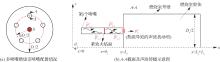
Fig.1
Sketch of multi-nozzle combustion chamber
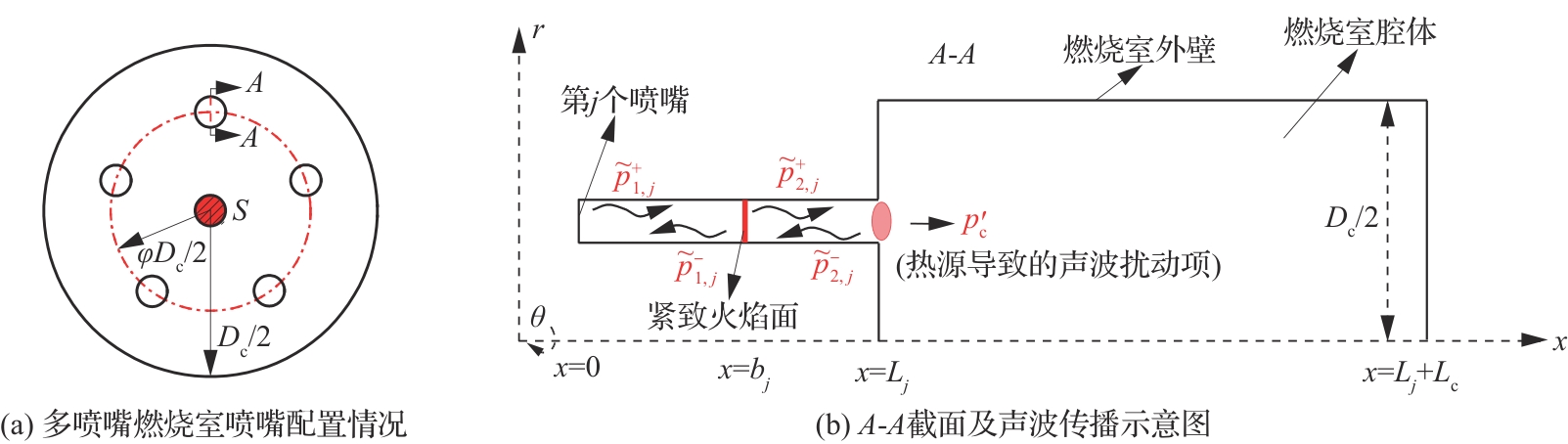
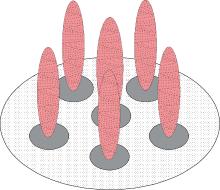
Fig.2
Configuration of uniform nozzles
Table 1
Geometrical and physical parameters of the multi-nozzle combustor
| 参数 | 数值 |
|---|---|
| 燃烧室腔体的轴向距离 | 2.0 |
| 燃烧室腔体的直径 | 0.45 |
| 喷嘴轴向长度 | 0.27(可变) |
| 喷嘴径向位置 | 0.6 |
| 喷嘴横截面积 | 0.001 2 |
| 已燃区域平均温度 | 1 519.15(可变) |
| 已燃区域平均声速 | 1 104.93(可变) |
| 已燃区域平均密度 | 1.60(可变) |
| 已燃区域平均压力 | 1 470 000 |
| 未燃区域平均温度 | 673.15 |
| 未燃区域平均声速 | 575 |
| 未燃区域平均密度 | 6.22 |
| 未燃区域平均压力 | 1 470 000 |
| 喷嘴进口边界声压反射系数 | -1(可变) |
| 增益系数 | 0.5 |
| 延迟时间 | 可变 |
| 周向一阶模态周期 | 0.000 7 |
| 径向一阶模态周期 | 0.000 33 |
| 轴向一阶模态周期 | 0.003 6 |
| 周向一阶模态波长 | 0.400 |
| 径向一阶模态波长 | 0.192 |
| 轴向一阶模态波长 | 2.082 |
Table 2
Corresponding mean sound speed and mean density under different mean temperatures
| 燃烧室平均温度/K | 平均声速/(m∙s-1) | 平均密度/(kg∙m-3) |
|---|---|---|
| 1 519.15 | 1 104.93 | 1.60 |
| 1 416.65 | 1 067.01 | 1.72 |
| 1 341.65 | 1 038.38 | 1.81 |
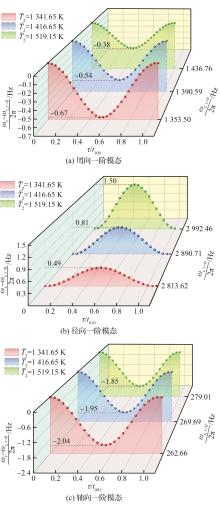
Fig.3
Frequency versus time delay under different mean temperatures in chamber
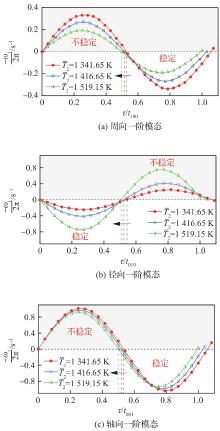
Fig.4
Growth rate versus time delay under different mean temperatures in chamber
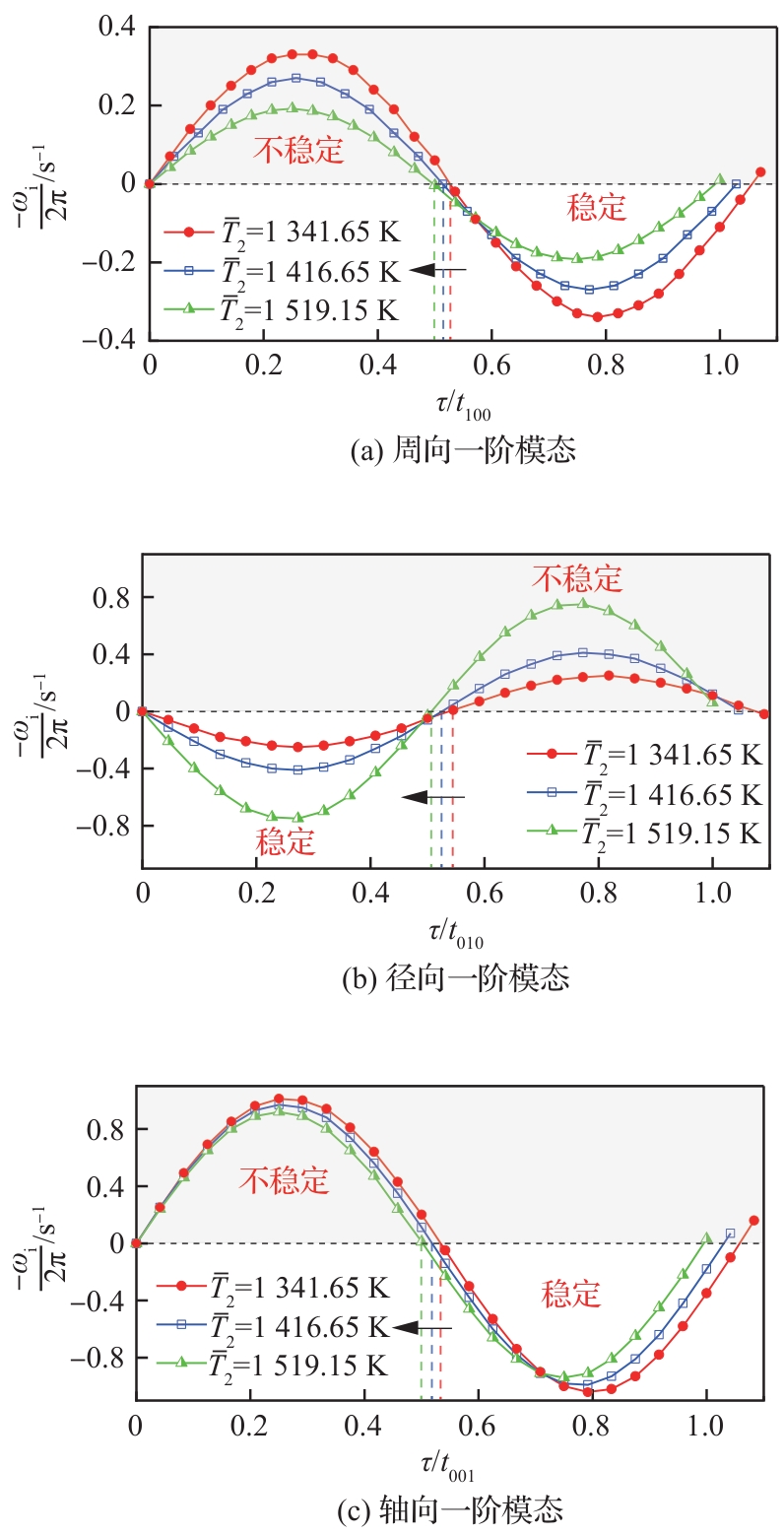
Table 3
Absolute and relative frequency variations under different mean temperatures
| 模态 | 频率/Hz(1 341.65 K) | 频率/Hz(1 416.65 K) | 频率/Hz(1 519.15 K) | 绝对变化 | 相对变化 | ||
|---|---|---|---|---|---|---|---|
| 周向一阶 | 1 352.83 | 1 390.05 | 1 436.38 | 37.22 | 46.33 | 2.75 | 3.33 |
| 径向一阶 | 2 814.11 | 2 891.52 | 2 993.96 | 77.41 | 102.44 | 2.75 | 3.54 |
| 轴向一阶 | 260.62 | 267.74 | 277.16 | 7.54 | 9.42 | 2.89 | 3.52 |
Table 4
Absolute and relative growth rate variations under different mean temperatures
| 模态 | 增长率/s-1(1 341.65 K) | 增长率/s-1(1 416.65 K) | 增长率/s-1(1 519.15 K) | 绝对变化 | 相对变化 | ||
|---|---|---|---|---|---|---|---|
| 周向一阶 | 0.34 | 0.27 | 0.19 | 0.07 | 0.08 | 20.59 | 29.63 |
| 径向一阶 | 0.25 | 0.41 | 0.75 | 0.16 | 0.34 | 64.00 | 82.93 |
| 轴向一阶 | 1.03 | 0.98 | 0.93 | 0.05 | 0.05 | 4.85 | 5.10 |
Table 5
Values of X(T¯c) related to the first-order axial/circumferential/radial mode
| 模态 | 波数 | 系数 |
|---|---|---|
| 周向一阶 | 8.18 | 8.30 |
| 径向一阶 | 17.03 | 29.63 |
| 轴向一阶 | 1.57 | 3.06 |
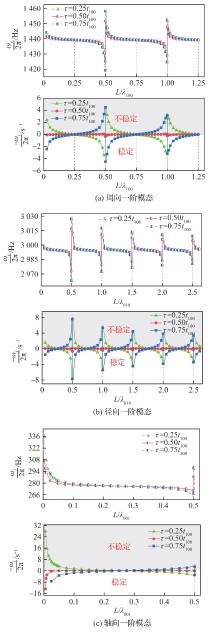
Fig.5
Frequency and growth rate versus axial length of nozzles
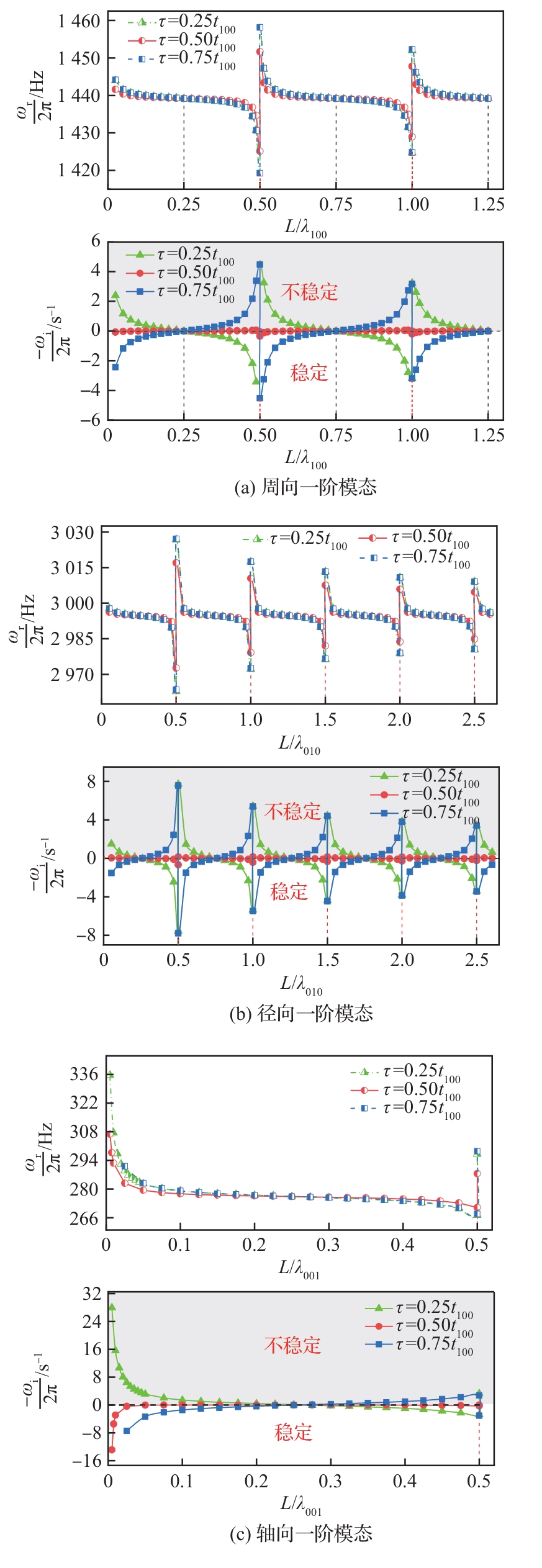
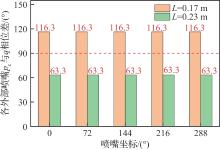
Fig.6
Azimuthal distribution diagram of phase difference between acoustic pressure and unsteady heat release rate for the first-order azimuthal mode
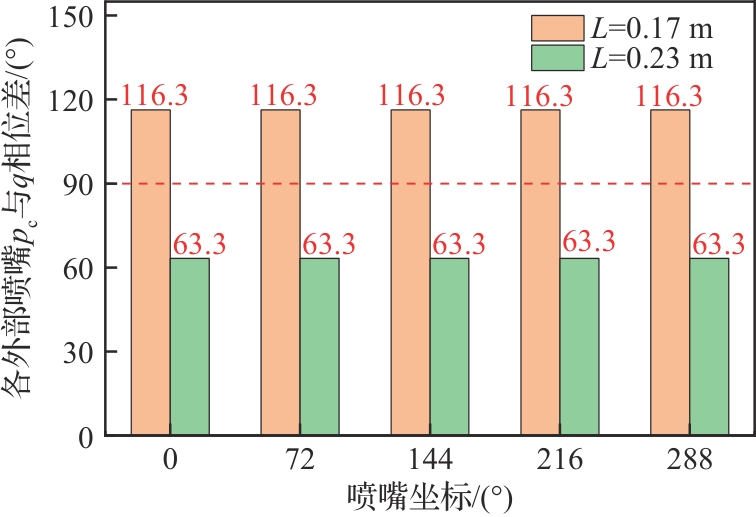
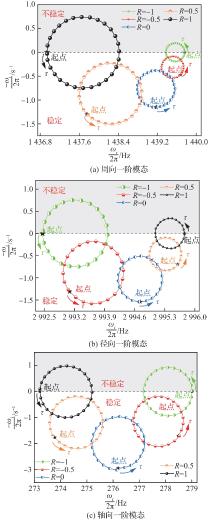
Fig.7
Frequency and growth rate versus time delay in complex plane
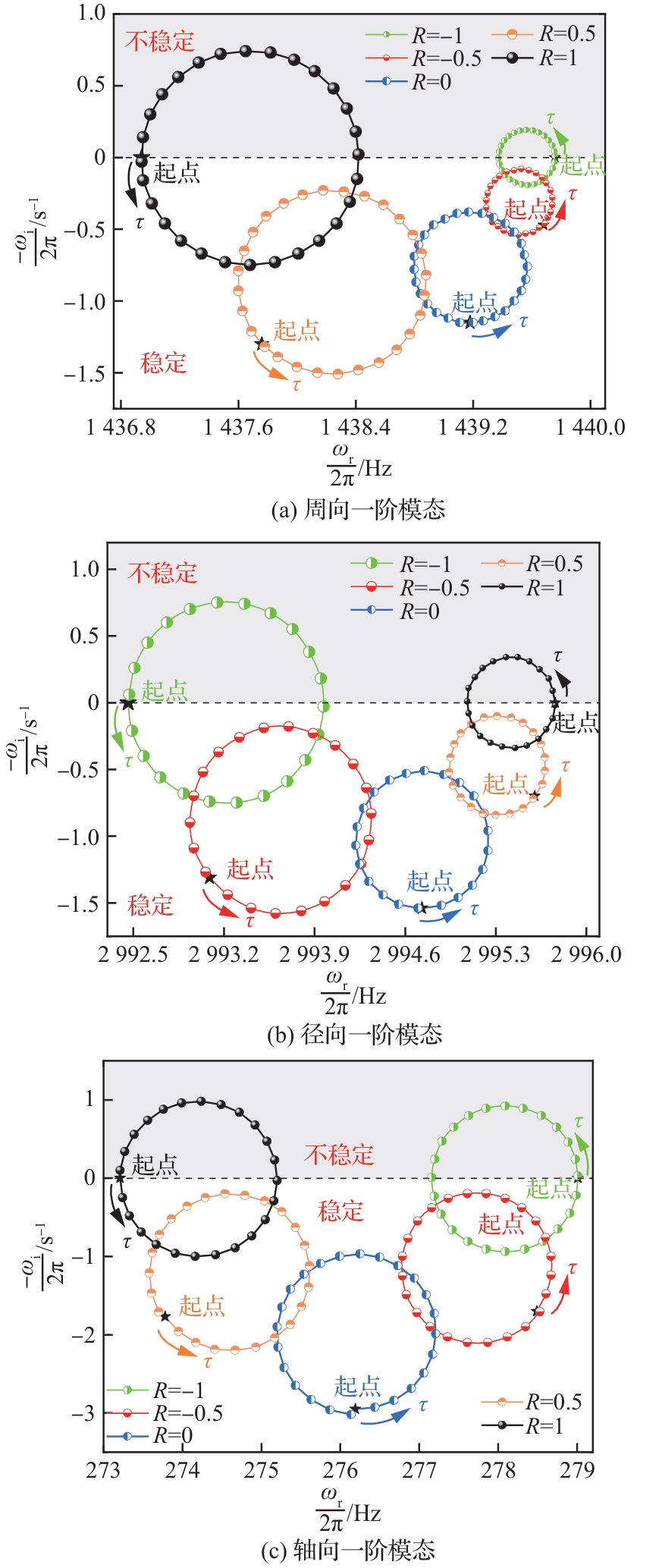
Table 6
Calculated and theoretical values of circular diameters
| 模态 | 圆轨迹直径 | 圆轨迹直径 | 理论比值 | |
|---|---|---|---|---|
| 周向一阶 | 0.384 | 1.49 | 0.257 7 | 0.259 6 |
| 径向一阶 | 1.5 | 0.68 | 2.205 9 | 2.255 1 |
| 轴向一阶 | 1.86 | 1.98 | 0.939 4 | 0.881 8 |
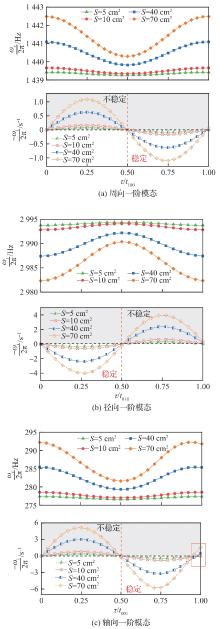
Fig.8
Frequency and growth rate versus time delay under different nozzle cross-sectional areas
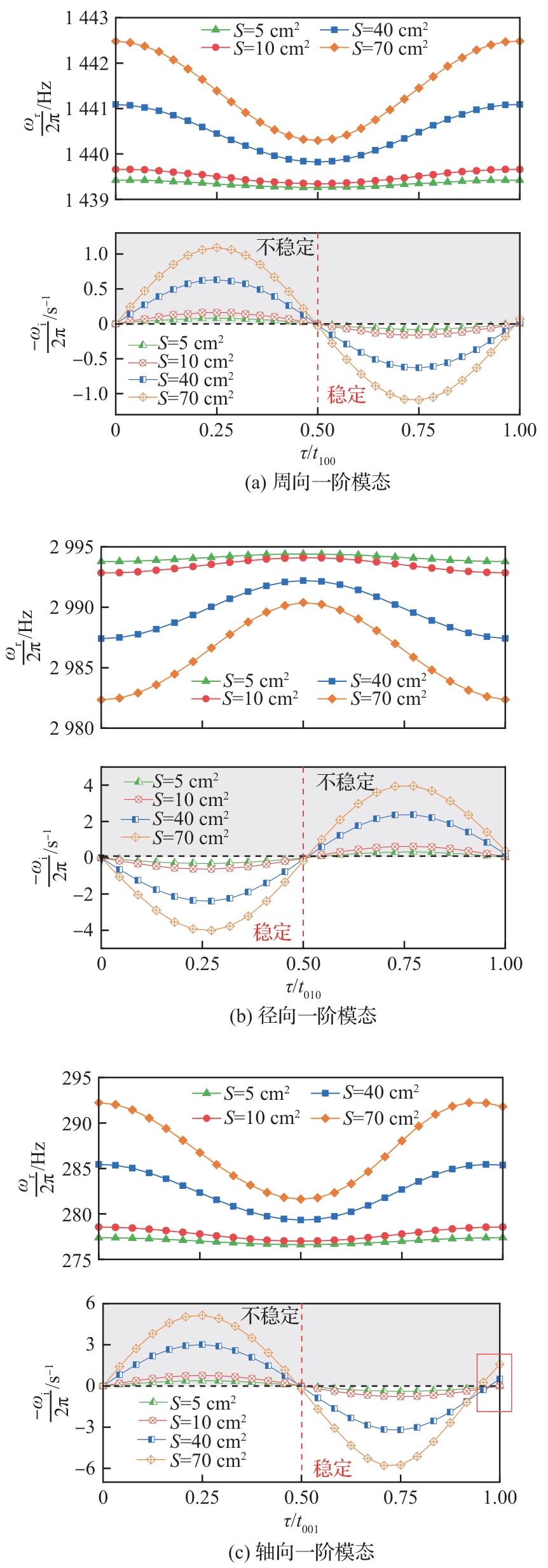
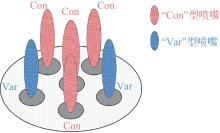
Fig.9
Configuration of non-uniform nozzles
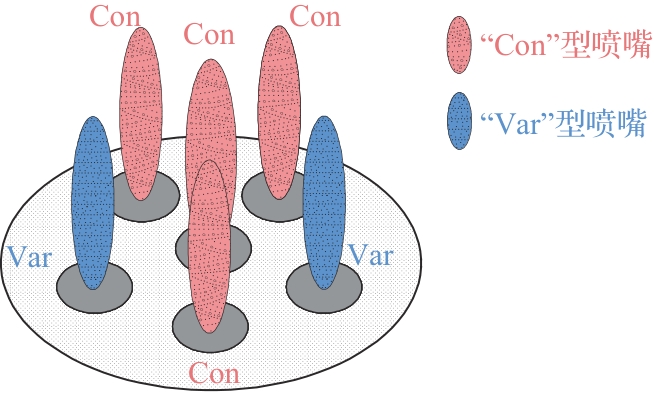
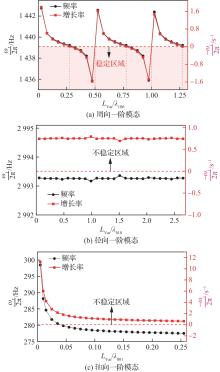
Fig.10
Frequency and growth rate versus axial length of Var nozzles
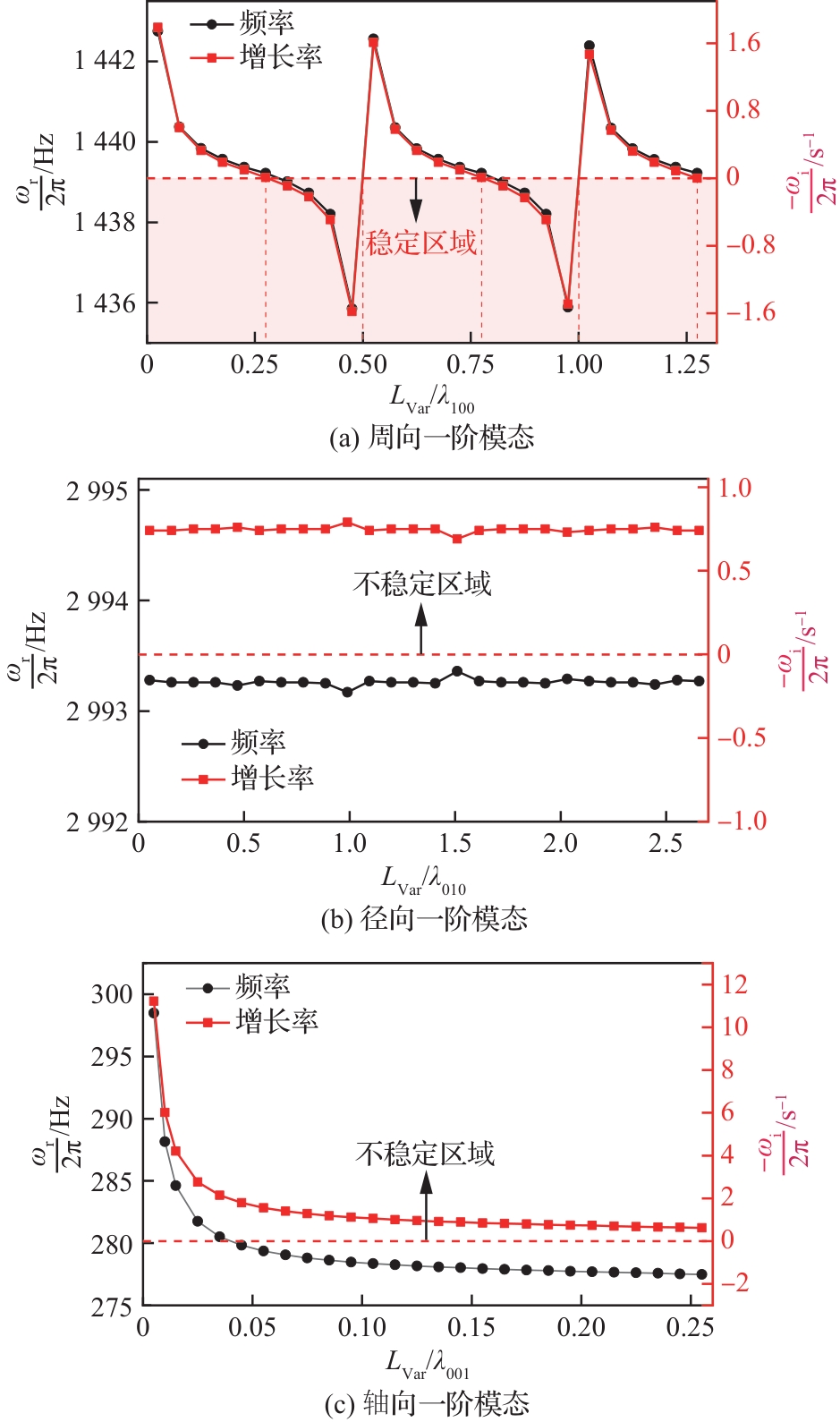
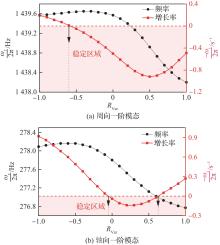
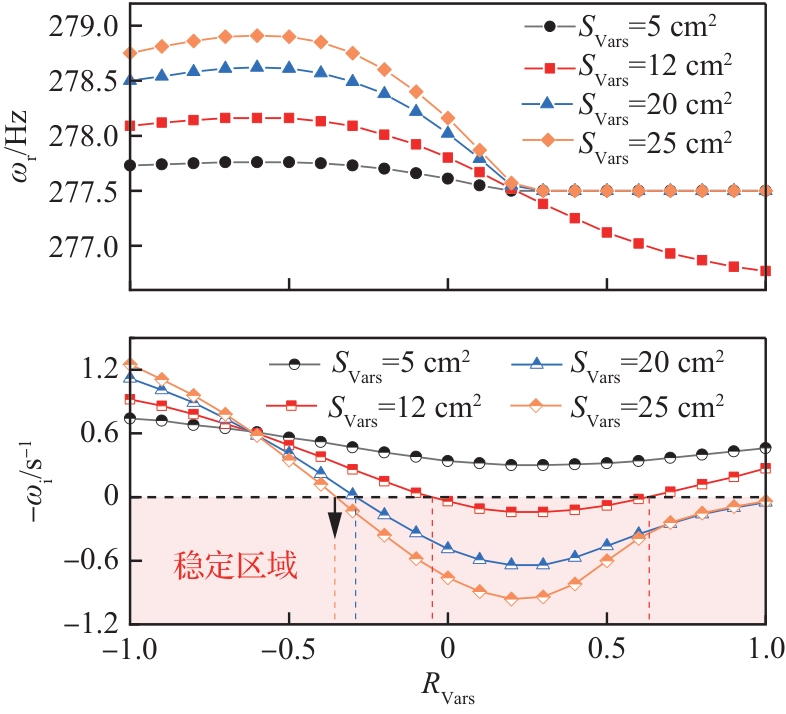
Fig.11
Frequency and growth rate versus RVar of Var nozzles
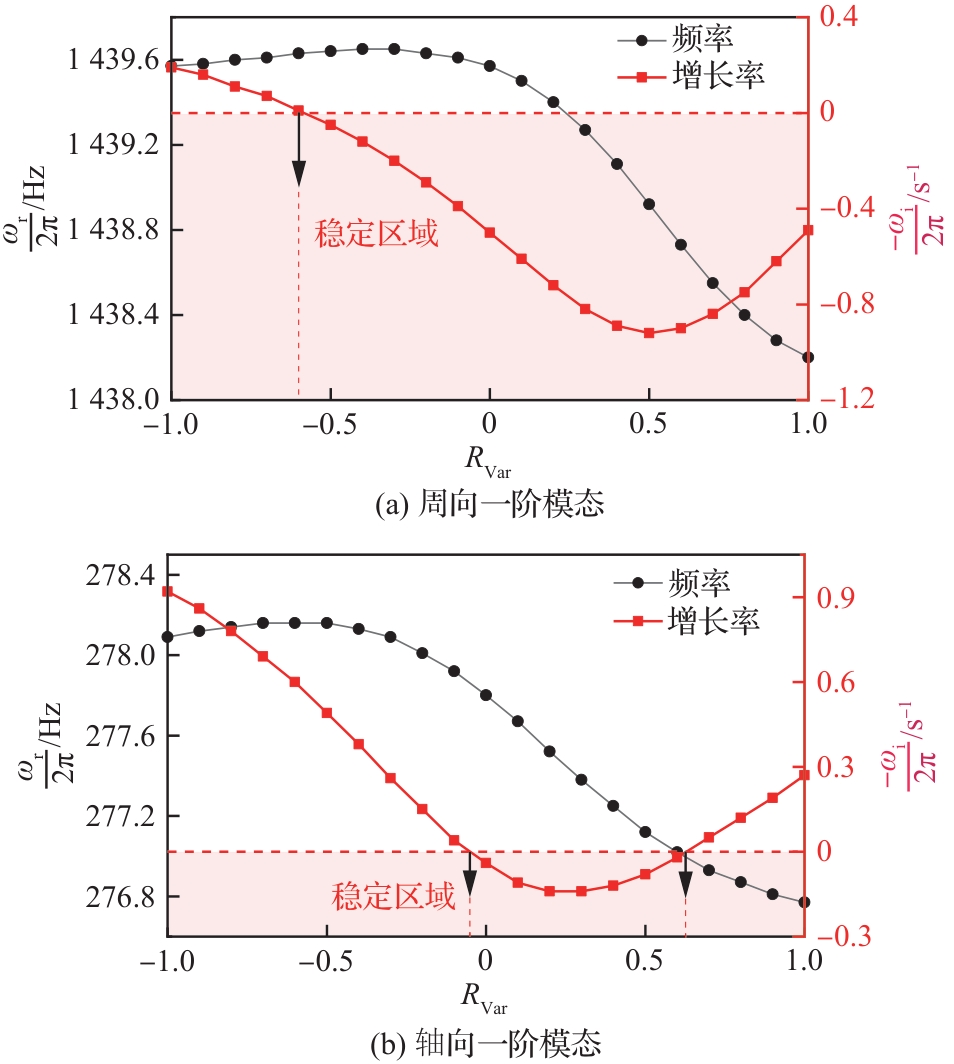
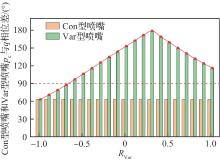
Fig.12
Phase difference between acoustic pressure and unsteady heat release rate of the first-order azimuthal mode versus of Var nozzles
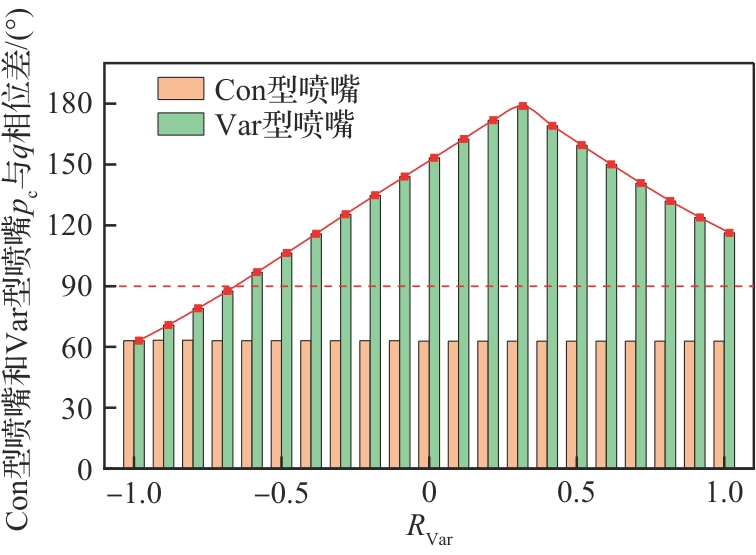
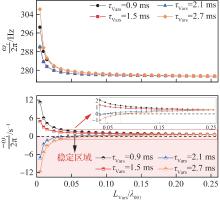
Fig.13
Frequency and growth rate of the first-order axial mode versus axial length LVars and time delay τVars of Var nozzles
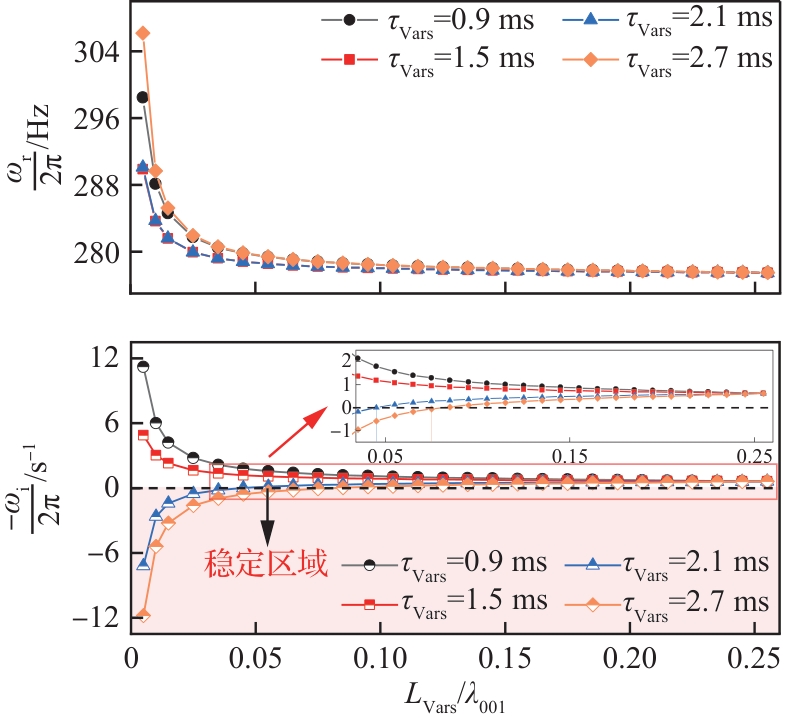
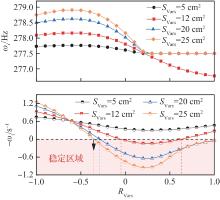
Fig.14
Frequency and growth rate of the first-order axial mode versus nozzle cross-sectional areas SVars and RVars of Var nozzles
| [1] | LIEUWEN T C, YANG V. Combustion instabilities in gas turbine engines: Operational experience, fundamental mechanisms and modeling[R]. Reston: AIAA, 2005. |
| [2] | 李磊, 孙晓峰. 推进动力系统燃烧不稳定性产生的机理、预测及控制方法[J]. 推进技术, 2010, 31(6): 710-720. |
| LI L, SUN X F. Mechanism, prediction and control method of combustion instability in propulsion system[J]. Journal of Propulsion Technology, 2010, 31(6):710-720 (in Chinese). | |
| [3] | 孙晓峰, 张光宇, 王晓宇, 等. 航空发动机燃烧不稳定性预测及控制研究进展[J]. 航空学报, 2023, 44(14): 628733. |
| SUN X F, ZHANG G Y, WANG X Y, et al. Research progress in aero-engine combustion instability prediction and control[J]. Acta Aeronautica et Astronautica Sinica, 2023, 44(14): 628733 (in Chinese). | |
| [4] | 柳伟杰. 燃气轮机燃烧室多喷嘴预混燃烧特性研究[D]. 上海: 上海交通大学, 2017: 1-10. |
| LIU W J. Study on the characteristics of premixed multi-nozzle combustion in a gas turbine model combustor[D]. Shanghai: Shanghai Jiao Tong University, 2017: 1-10 (in Chinese). | |
| [5] | 丁阳, 石永锋, 郝建刚. 6FA燃机DLN2.6燃烧系统燃烧特性分析[J]. 中国电力, 2019, 52(12): 165-170. |
| DING Y, SHI Y F, HAO J G. Analysis on combustion characteristics of GE 6FA DLN2.6 combustion system[J]. Electric Power, 2019, 52(12): 165-170 (in Chinese). | |
| [6] | OH J, KIM M, YOON Y. The tuning methodology of a GE 7FA+e DLN-2.6 gas turbine combustor[J]. Applied Thermal Engineering, 2012, 36: 14-20. |
| [7] | BIGONGIARI A, HECKL M A. A Green’s function approach to the rapid prediction of thermoacoustic instabilities in combustors[J]. Journal of Fluid Mechanics, 2016, 798: 970-996. |
| [8] | DOWLING A P. The calculation of thermoacoustic oscillations[J]. Journal of Sound and Vibration, 1995, 180(4): 557-581. |
| [9] | YOU D, SUN X F, YANG V. A three-dimensional linear acoustic analysis of gas turbine combustion instability[C]∥41st Aerospace Sciences Meeting and Exhibit. Reston: AIAA, 2003. |
| [10] | YANG D, LAERA D, MORGANS A S. A systematic study of nonlinear coupling of thermoacoustic modes in annular combustors[J]. Journal of Sound and Vibration, 2019, 456: 137-161. |
| [11] | ZINN B T, LORES M E. Application of the Galerkin method in the solution of non-linear axial combustion instability problems in liquid rockets[J]. Combustion Science and Technology, 1971, 4(1): 269-278. |
| [12] | KANDALA S S, MADURI A, VYASARAYANI C P. Galerkin approximations for thermoacoustic instability in a Rijke’s tube[J]. Procedia IUTAM, 2017, 22: 168-175. |
| [13] | ORCHINI A, MOECK J P. Weakly nonlinear analysis of thermoacoustic oscillations in can-annular combustors[J]. Journal of Fluid Mechanics, 2024, 980: A52. |
| [14] | MARIAPPAN S, SUJITH R I. Modelling nonlinear thermoacoustic instability in an electrically heated Rijke tube[J]. Journal of Fluid Mechanics, 2011, 680: 511-533. |
| [15] | BAUERHEIM M, PARMENTIER J F, SALAS P, et al. An analytical model for azimuthal thermoacoustic modes in an annular chamber fed by an annular plenum[J]. Combustion and Flame, 2014, 161(5): 1374-1389. |
| [16] | ACHARYA V, LIEUWEN T. Effects of transverse nozzle location on high-frequency transverse combustion instabilities in can combustors[C]∥Spring Technical Meeting of the Eastern States Section of the Combustion Institute 2018. Red Hook: Curran Associates, Inc., 2018: 678-688. |
| [17] | ACHARYA V, LIEUWEN T. Optimum multinozzle configuration for minimizing the Rayleigh integral during high-frequency transverse instabilities[J]. Journal of Engineering for Gas Turbines and Power, 2022, 144(3): 031002. |
| [18] | YOON M. Thermoacoustics of multi-burner combustors with plenum and chamber cross-talk[J]. Journal of Sound and Vibration, 2022, 520: 116623. |
| [19] | HECKL M A, HOWE M S. Stability analysis of the Rijke tube with a Green’s function approach[J]. Journal of Sound and Vibration, 2007, 305(4-5): 672-688. |
| [20] | WANG X Y, HECKL M. 3-D thermoacoustic instability analysis based on Green’s function approach[J]. Journal of Sound and Vibration, 2022, 537: 116816. |
| [21] | QIN L, WANG X Y, ZHANG G Y, et al. Control of azimuthal combustion instability through the injector mounting surface of annular combustors[J]. AIAA Journal, 2023, 61(9): 3795-3809. |
| [22] | CROCCO L. Aspects of combustion stability in liquid propellant rocket motors part I: Fundamentals. low frequency instability with monopropellants[J]. Journal of the American Rocket Society, 1951, 21(6): 163-178. |
| [23] | CANDEL S, DUROX D, SCHULLER T, et al. Dynamics of swirling flames[J]. Annual Review of Fluid Mechanics, 2014, 46: 147-173. |
| [24] | LÜCKOFF F, KAISER T L, PASCHEREIT C O, et al. Mean field coupling mechanisms explaining the impact of the precessing vortex core on the flame transfer function[J]. Combustion and Flame, 2021, 223: 254-266. |
| [25] | LIGHTHILL M J. On sound generated aerodynamically I. General theory[J]. Proceedings of the Royal Society A, 1952, 211(1107): 564-587. |
| [26] | FFOWCS WILLIAMS J E, HAWKINGS D L. Sound generation by turbulence and surfaces in arbitrary motion[J]. Philosophical Transactions of the Royal Society A, 1969, 264(1151): 321-342. |
| [27] | OH J S, KIM M K, HEO P W, et al. GE 7FA+e DLN2.6 gas turbine combustor: part ii design of lab scale dump combustor[J]. Journal of the Korean Society of Propulsion Engineers, 2008, 12(5): 51-59. |
| [28] | ZHEN H S, CHOY Y S, LEUNG C W, et al. Effects of nozzle length on flame and emission behaviors of multi-fuel-jet inverse diffusion flame burner[J]. Applied Energy, 2011, 88(9): 2917-2924. |
| [29] | RAYLEIGH. The explanation of certain acoustical phenomena[J]. Nature, 1878, 18(455): 319-321. |
| [1] | Da MO, Yuzhen LIN, Xiao HAN, Hongyu MA, Yixiong LIU. Research progress and future prospect of hydrogen micromix combustion technology [J]. Acta Aeronautica et Astronautica Sinica, 2024, 45(7): 28994-028994. |
| [2] | Sitong LI, Lu XIA, Lin ZHOU, Ke ZHAO. Integrated aerodynamic and high frequency electromagnetic stealth design of airfoil considering coating [J]. Acta Aeronautica et Astronautica Sinica, 2024, 45(17): 529874-529874. |
| [3] | Xiao MENG, Dan MA, Hongjun LIN, Chao CHEN. Prescribed performance control of thermoacoustic instability in aero-engine combustion chambers [J]. Acta Aeronautica et Astronautica Sinica, 2023, 44(17): 128182-128182. |
| [4] | Lin BI, Sen ZOU, Zhigong TANG, Xianxu YUAN, Chao WU. Linear stability of microchannel flow considering rarefaction effects [J]. Acta Aeronautica et Astronautica Sinica, 2023, 44(15): 528964-528964. |
| [5] | Xiaofeng SUN, Guangyu ZHANG, Xiaoyu WANG, Lei LI, Xiangyang DENG, Ronghui CHENG. Research progress in aero-engine combustion instability prediction and control [J]. Acta Aeronautica et Astronautica Sinica, 2023, 44(14): 628733-628733. |
| [6] | FAN Yuehua, DUAN Yee, ZHOU Naizhen, YANG Pan. Friction numerical calculation precision in high Mach number laminar flow [J]. ACTA AERONAUTICAET ASTRONAUTICA SINICA, 2021, 42(9): 625737-625737. |
| [7] | WANG Yupeng, PEI Lianjie, LI Qiulong, ZHENG Jianjun, FENG Jianmin, WANG Fan. Full-scale aircraft strength test technology of next generation fighter [J]. ACTA AERONAUTICAET ASTRONAUTICA SINICA, 2020, 41(6): 523482-523482. |
| [8] | JU Lian, BAI Junqiang, GUO Bin, CUI Xiaochun, LI Xinglong. Effect of geometry parameters on flow field quality in a transonic slotted wind tunnel [J]. ACTA AERONAUTICAET ASTRONAUTICA SINICA, 2016, 37(5): 1440-1453. |
| [9] | DENG Yifan, LI Chaobing, WANG Zhigang. An iterative guidance algorithm using orbital elements as terminal constraints for spacecraft orbit transfer [J]. ACTA AERONAUTICAET ASTRONAUTICA SINICA, 2015, 36(6): 1975-1982. |
| [10] | LI Xiao-dong;GAO Jun-hui. Numerical Simulation of Sound Generation and Radiation from a 2D Parallel Shear Layer [J]. ACTA AERONAUTICAET ASTRONAUTICA SINICA, 2003, 24(1): 6-9. |
| [11] | Liu Qiusheng;Shen Mengyu;Wang Baoguo Pu Cunbin. NUMERICAL SIMULATION OF 3 D UNSTEADY TRANSONIC FLOWS OVER ROTARY WINGS [J]. ACTA AERONAUTICAET ASTRONAUTICA SINICA, 1996, 17(5): 71-74. |
| [12] | Gao Mantong;Shan Huizu. BOUNDARY ELEMENT METHOD OF ELECTRIC FIELD PROBLEM ASSOCIATED WITH CORROSION [J]. ACTA AERONAUTICAET ASTRONAUTICA SINICA, 1990, 11(7): 376-382. |
| Viewed | ||||||
|
Full text |
|
|||||
|
Abstract |
|
|||||
Address: No.238, Baiyan Buiding, Beisihuan Zhonglu Road, Haidian District, Beijing, China
Postal code : 100083
E-mail:hkxb@buaa.edu.cn
Total visits: 6658907 Today visits: 1341All copyright © editorial office of Chinese Journal of Aeronautics
All copyright © editorial office of Chinese Journal of Aeronautics
Total visits: 6658907 Today visits: 1341

 CJA
CJA
