Acta Aeronautica et Astronautica Sinica ›› 2025, Vol. 46 ›› Issue (15): 231583.doi: 10.7527/S1000-6893.2025.31583
• Solid Mechanics and Vehicle Conceptual Design • Previous Articles
Qianqian ZHOU, Hongli JI( ), Chongcong TAO, Yipeng WU, Chao ZHANG, Jinhao QIU
Received:2024-11-28
Revised:2025-01-09
Accepted:2025-02-24
Online:2025-02-28
Published:2025-02-28
Contact:
Hongli JI
E-mail:jihongli@nuaa.edu.cn
Supported by:CLC Number:
Qianqian ZHOU, Hongli JI, Chongcong TAO, Yipeng WU, Chao ZHANG, Jinhao QIU. Vibration damping and noise reduction of MFC intelligent rotor based on frequency-domain dual LMS method[J]. Acta Aeronautica et Astronautica Sinica, 2025, 46(15): 231583.
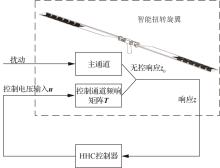
Fig.1
Principle block diagram of intelligent twist rotor vibration/noise control
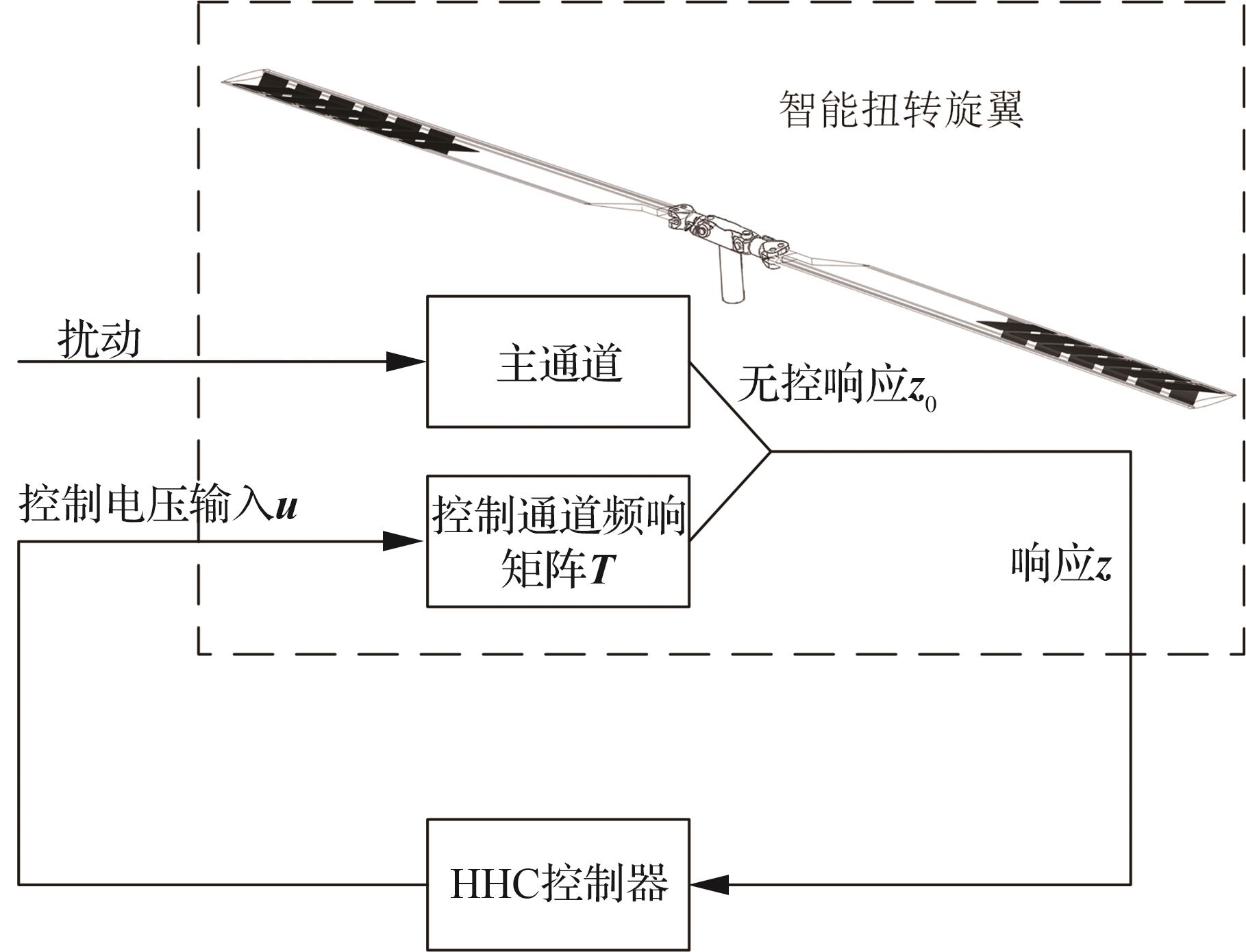
Fig.2
Saturation function
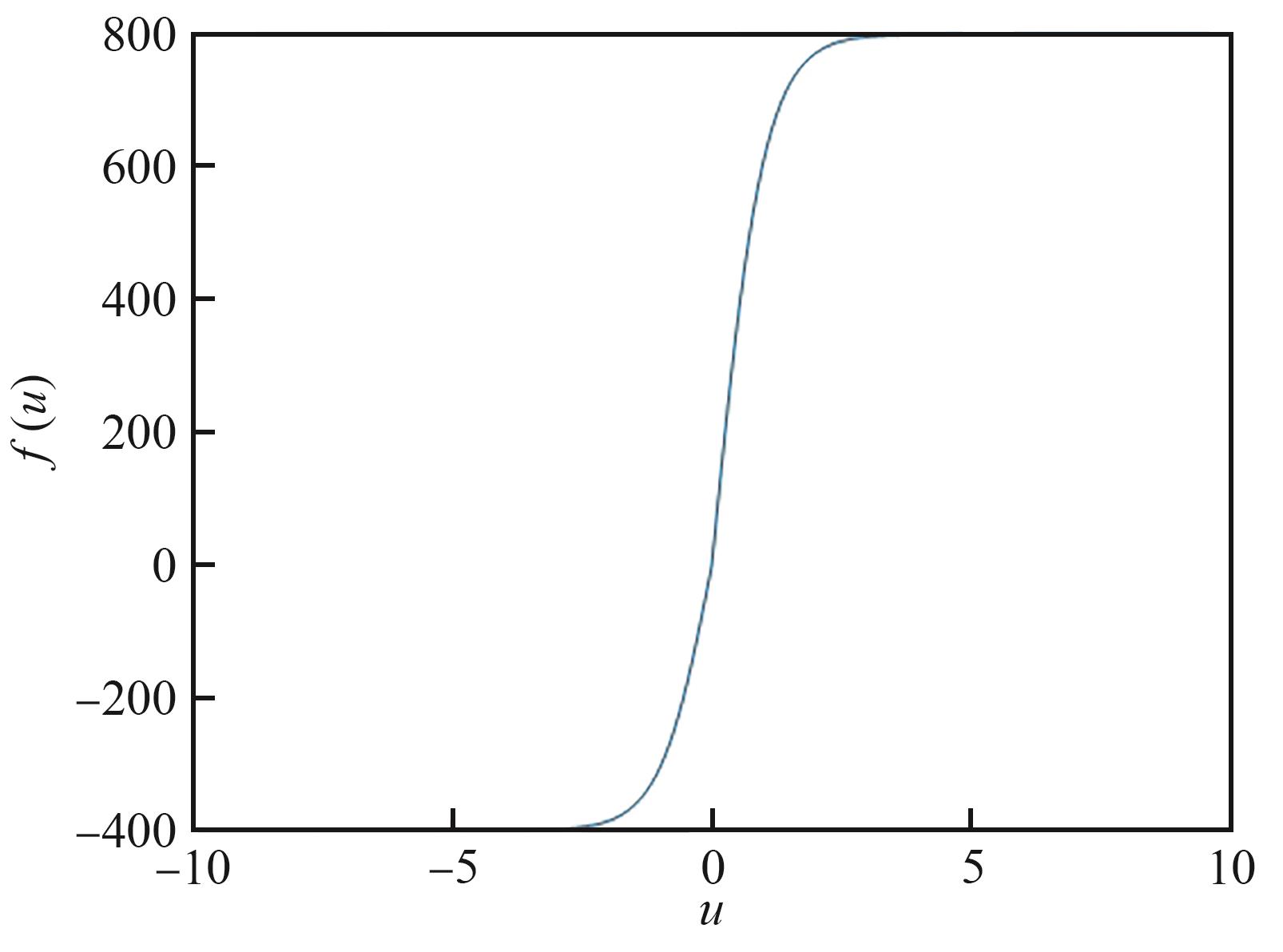
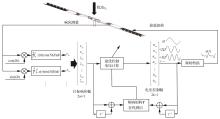
Fig.3
Implementation block diagram of HHC algorithm based on intelligent twisted rotor
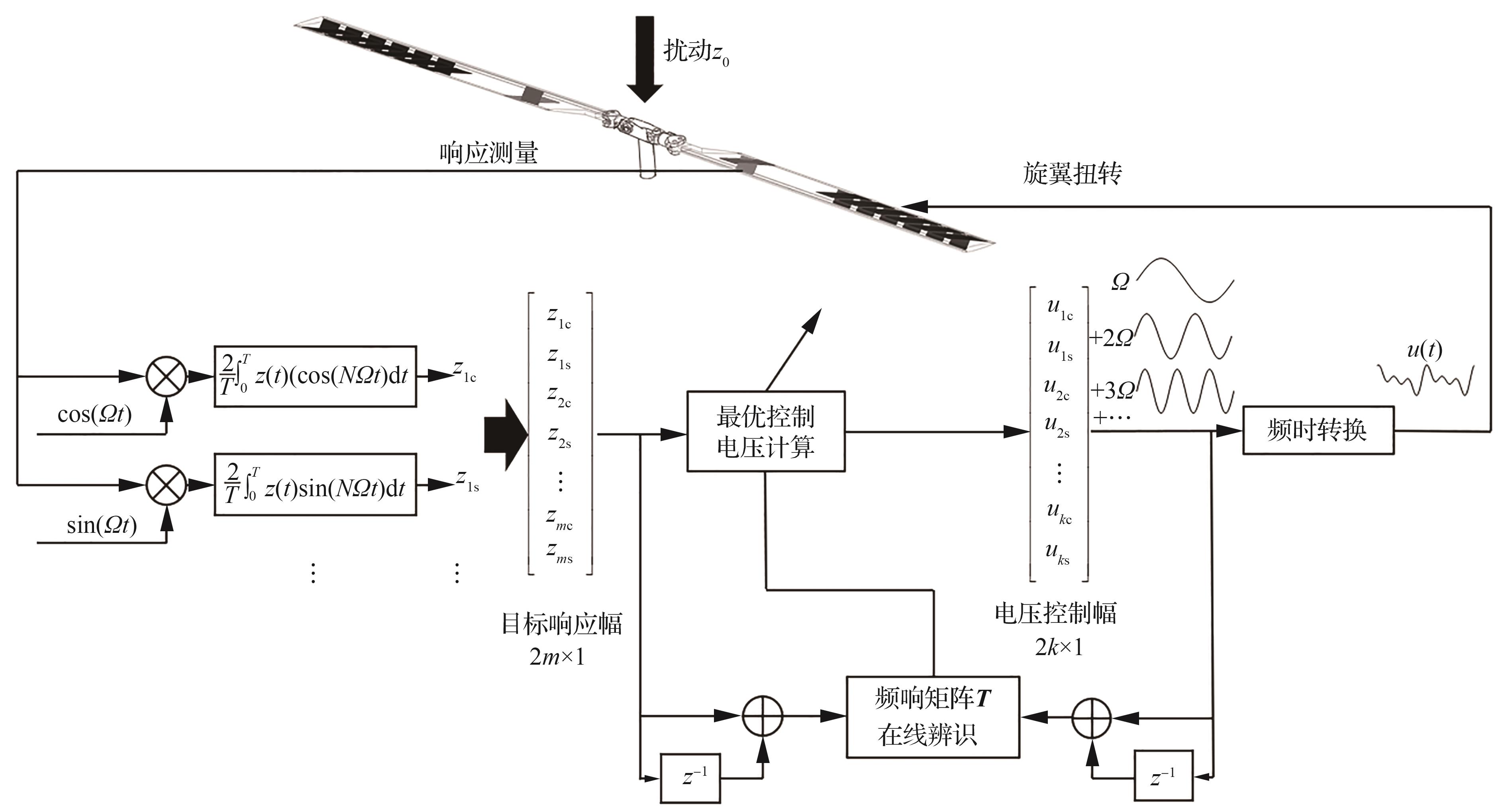
Table 1
Summary of the proposed algorithm
| 算法流程 | 乘法 | 加法 |
|---|---|---|
| 总计 | ||
| 0 | ||
| 0 |
Table 2
Comparison of computational complexity per iteration
| 算法 | 总计算量 | 单目标单谐波控制(m=1、k=1)时计算量 |
|---|---|---|
| D-K | 726 | |
| D-R | 414 | |
| 所提算法 | 64 |

Fig.4
Arrangement of driver and sensor positions


Fig.5
Physical diagram of intelligent twisting blade

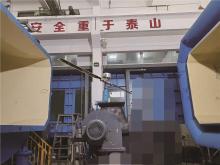
Fig.6
Wind tunnel test rig for intelligent twisting rotor
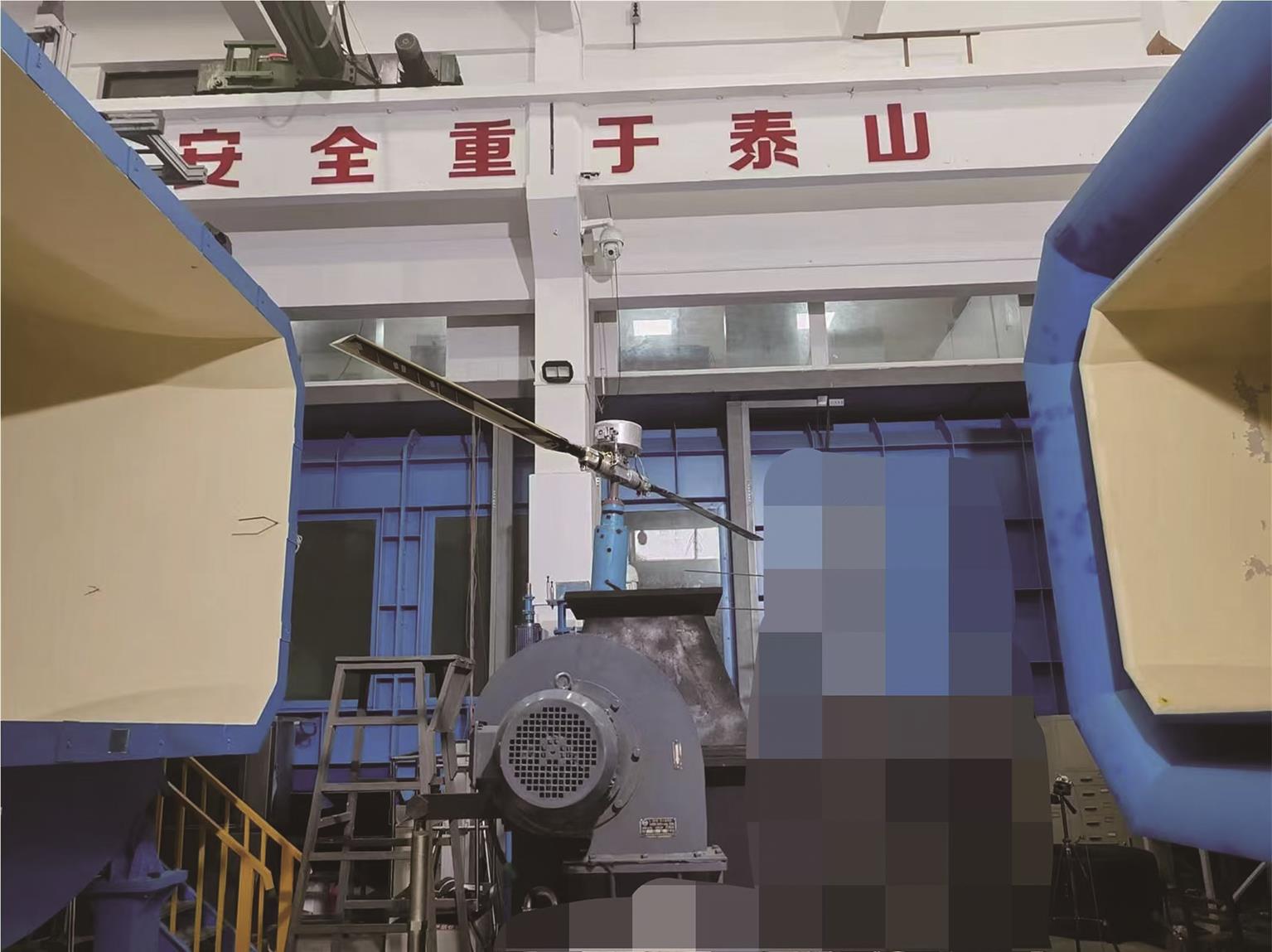
Fig.7
Schematic diagram of experimental platform
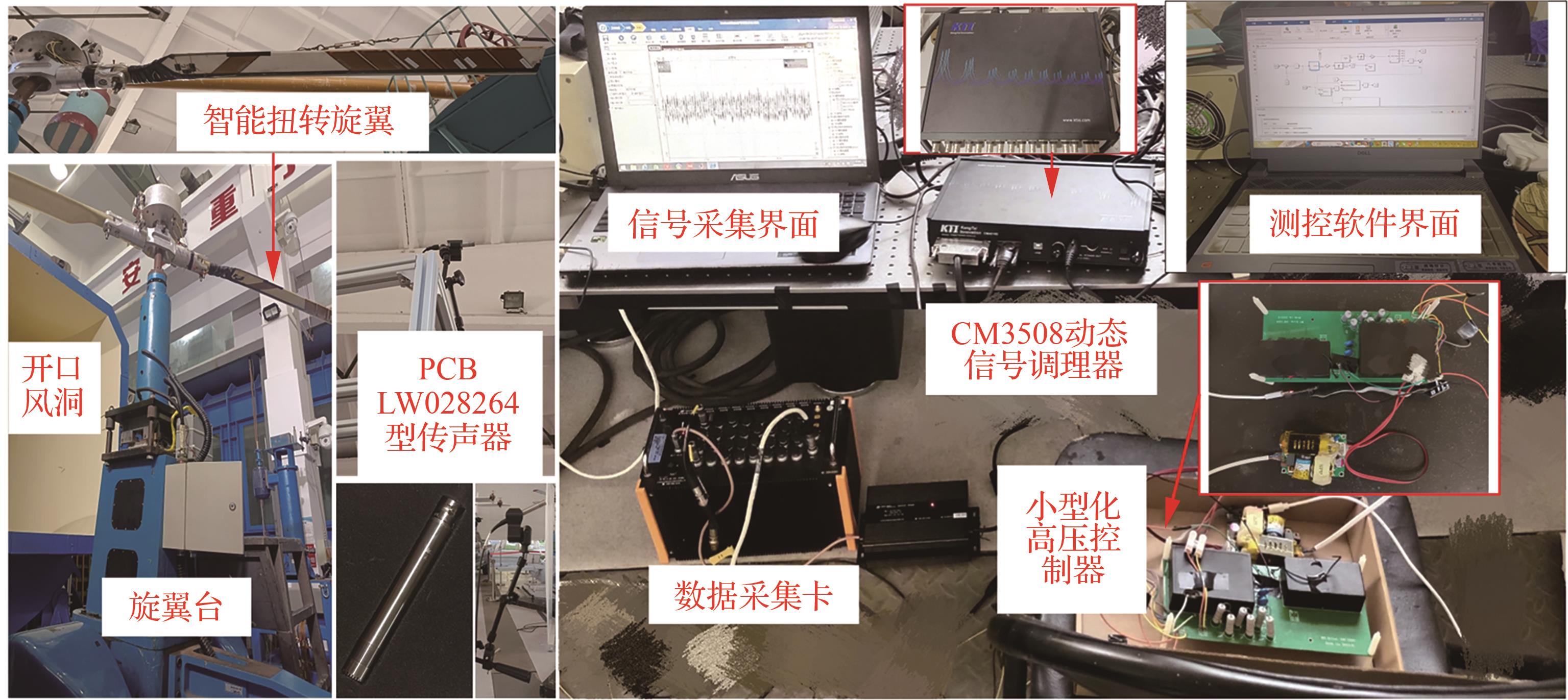
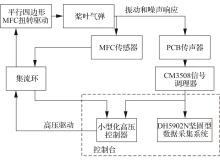
Fig.8
Schematic diagram of active vibration and noise control measurement and control system for intelligent twisting rotor
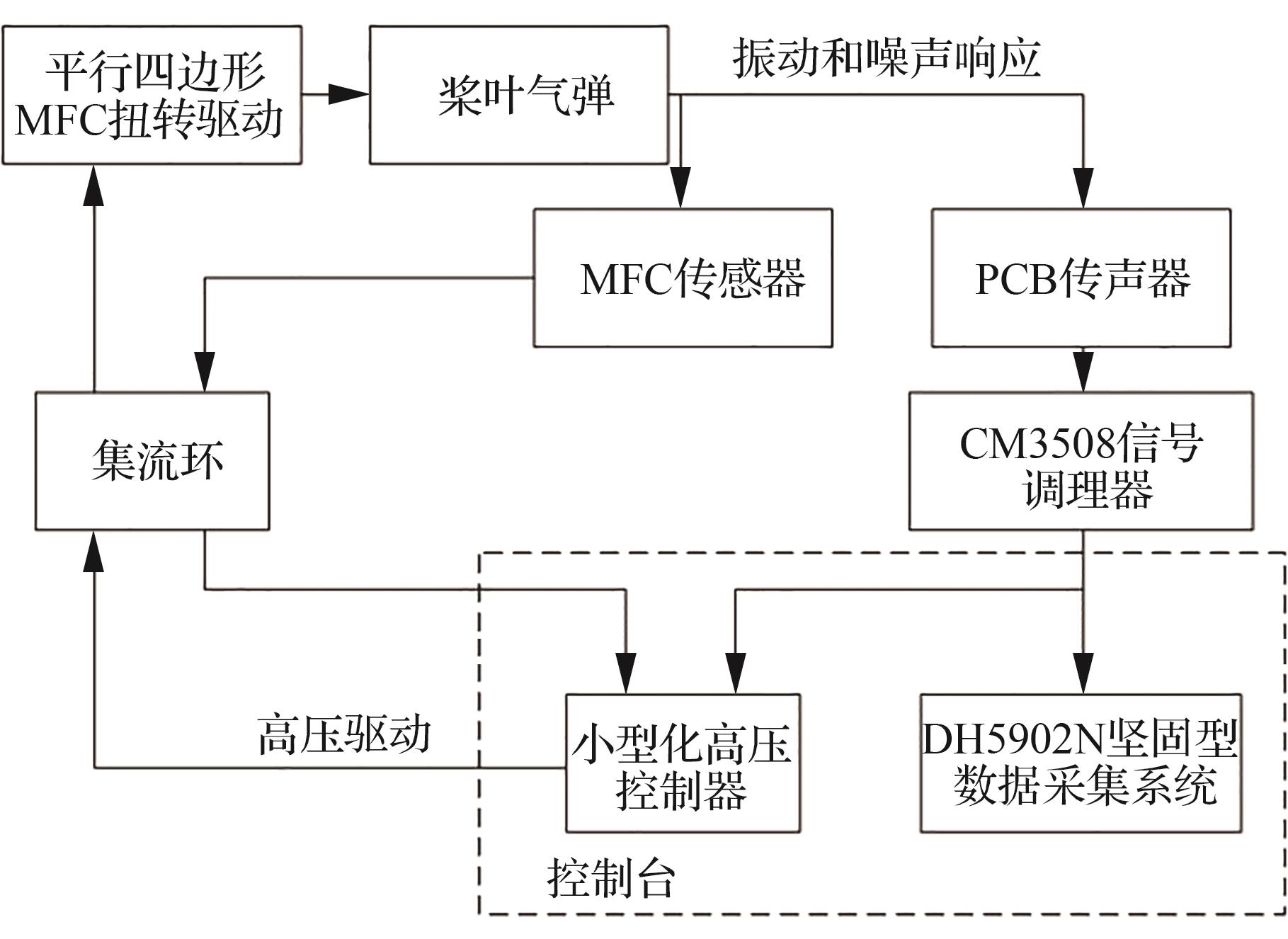
Fig.9
Simulink experimental model of dual LMS frequency domain adaptive algorithm
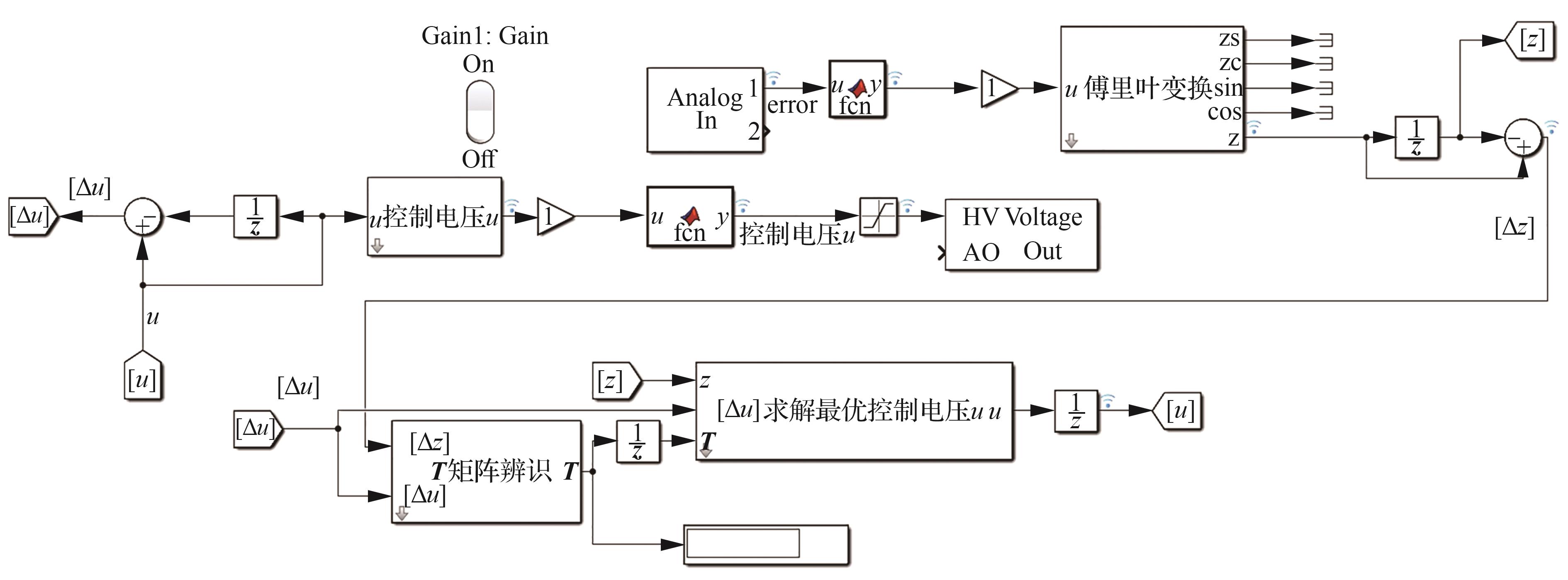
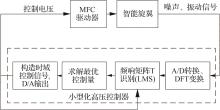
Fig.10
Flowchart of active vibration and noise control system for rotor
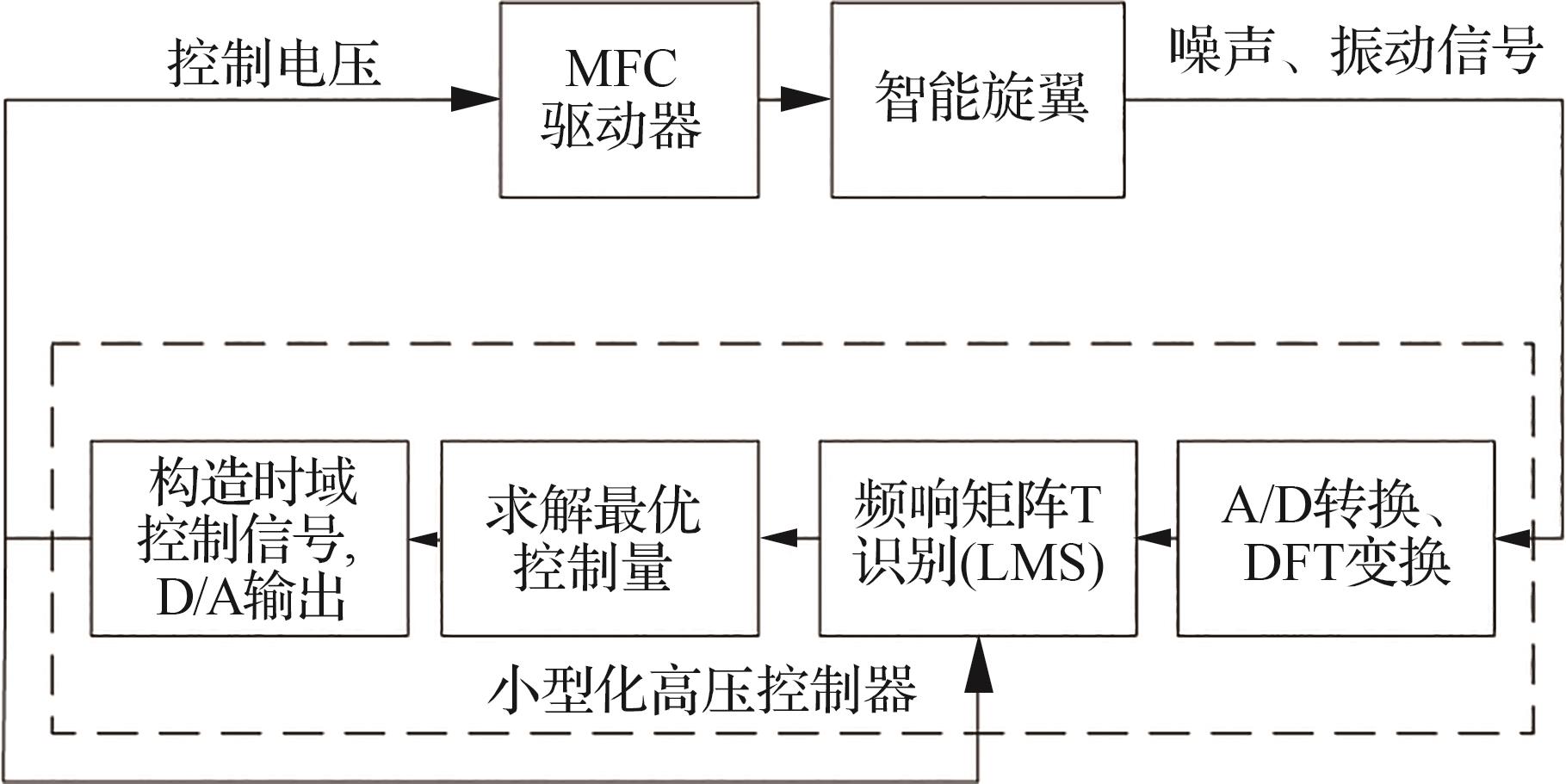
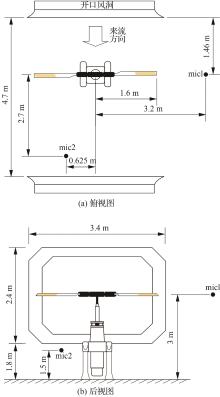
Fig.11
Schematic diagram of microphone arrangement in wind tunnel test
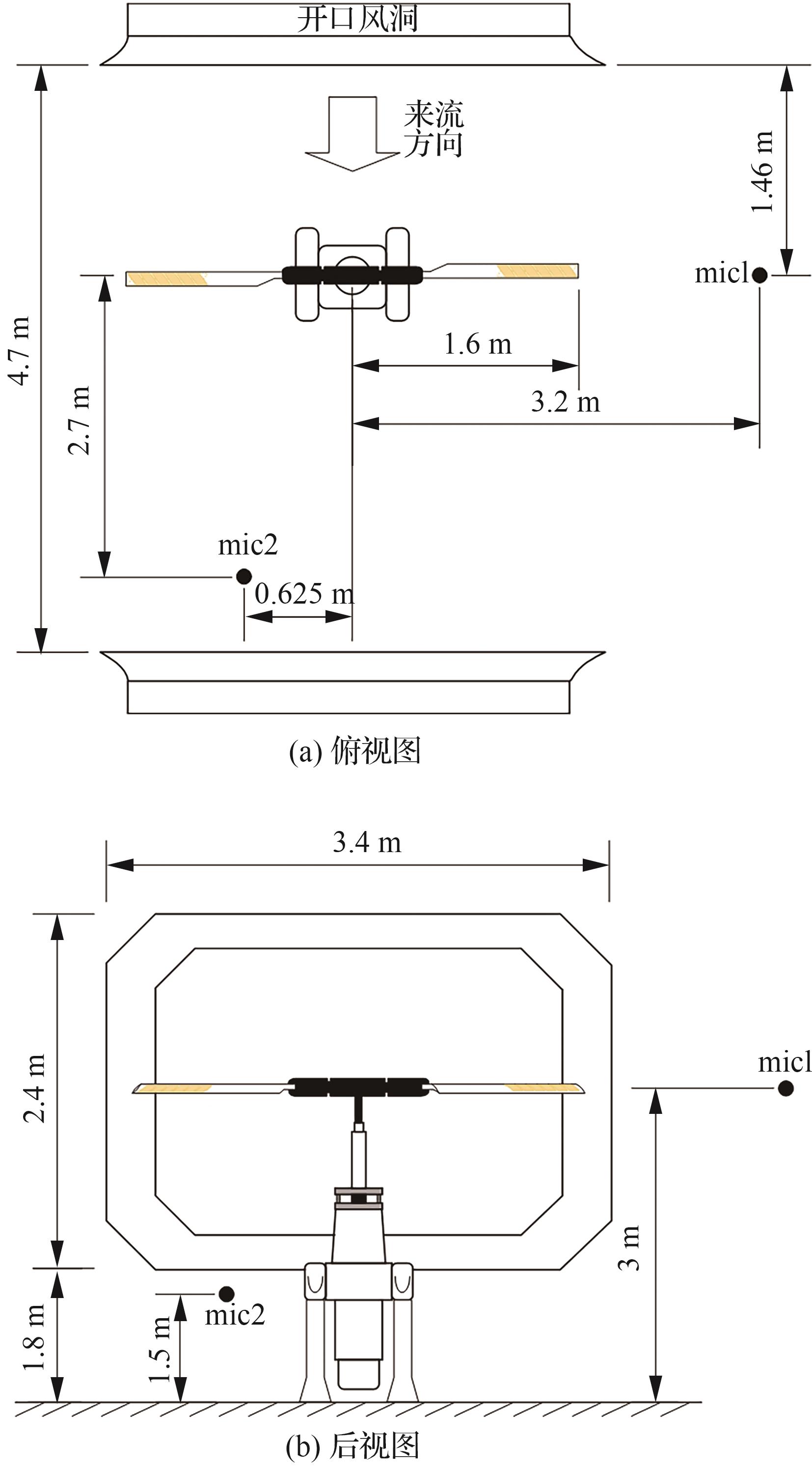
Table 3
Vibration active control status
| 实验状态 | 旋翼转速/(r·min-1) | 风速/ (m·s-1) | 工况 |
|---|---|---|---|
| 悬停(旋翼轴角度0°) | 150 | 5 | 1 |
| 10 | 2 | ||
| 180 | 5 | 3 | |
| 10 | 4 | ||
| 210 | 5 | 5 | |
| 10 | 6 | ||
低速前飞 (旋翼轴前倾角度8°) | 150 | 5 | 7 |
| 10 | 8 | ||
| 180 | 5 | 8 | |
| 10 | 10 |
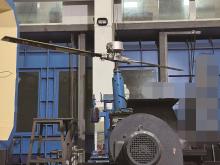
Fig.12
Wind tunnel test setup for low-speed forward flight condition
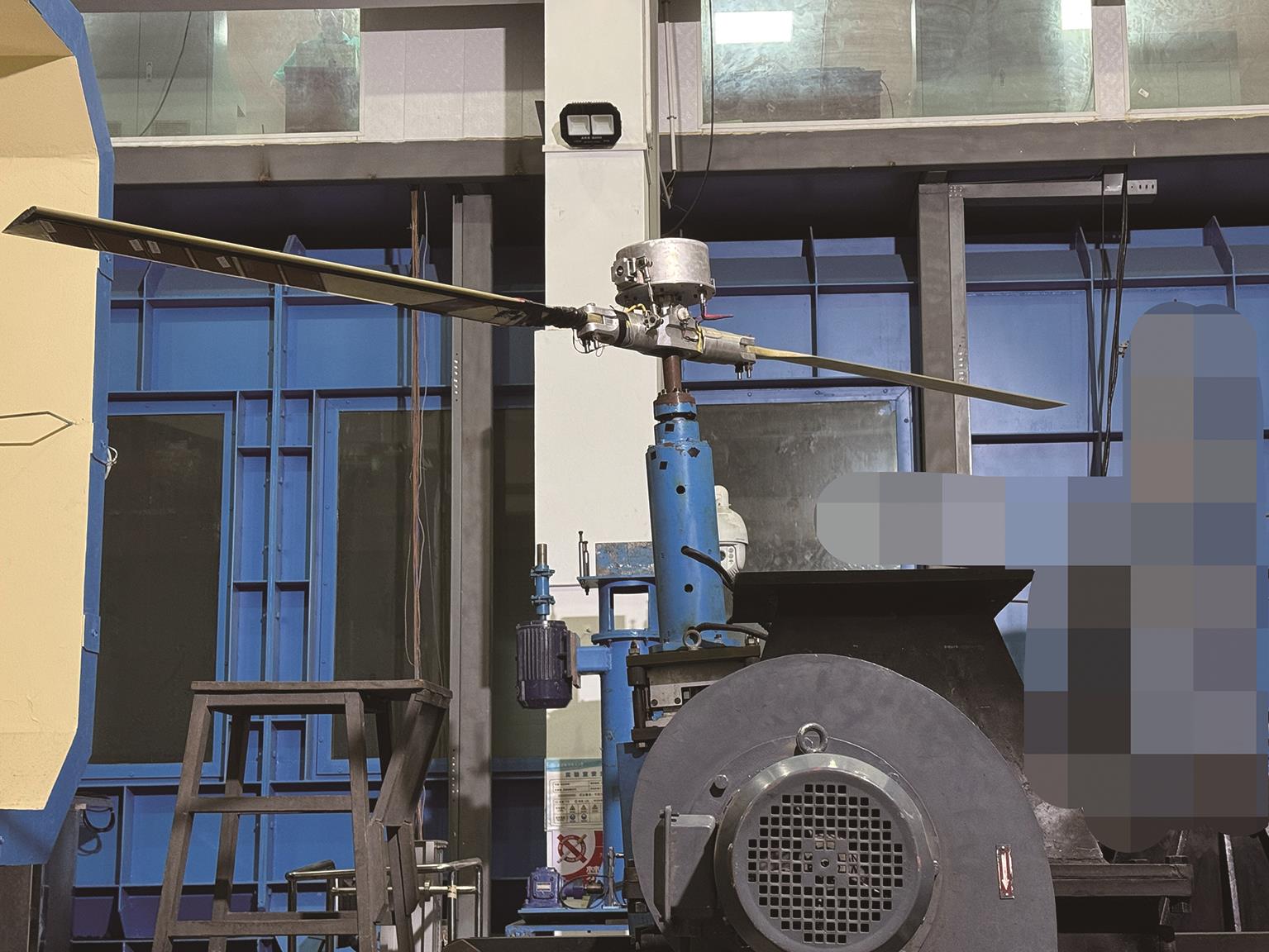
Fig.13
Control effect at hovering, rotor speed 150 r/min, and wind speed 5 m/s
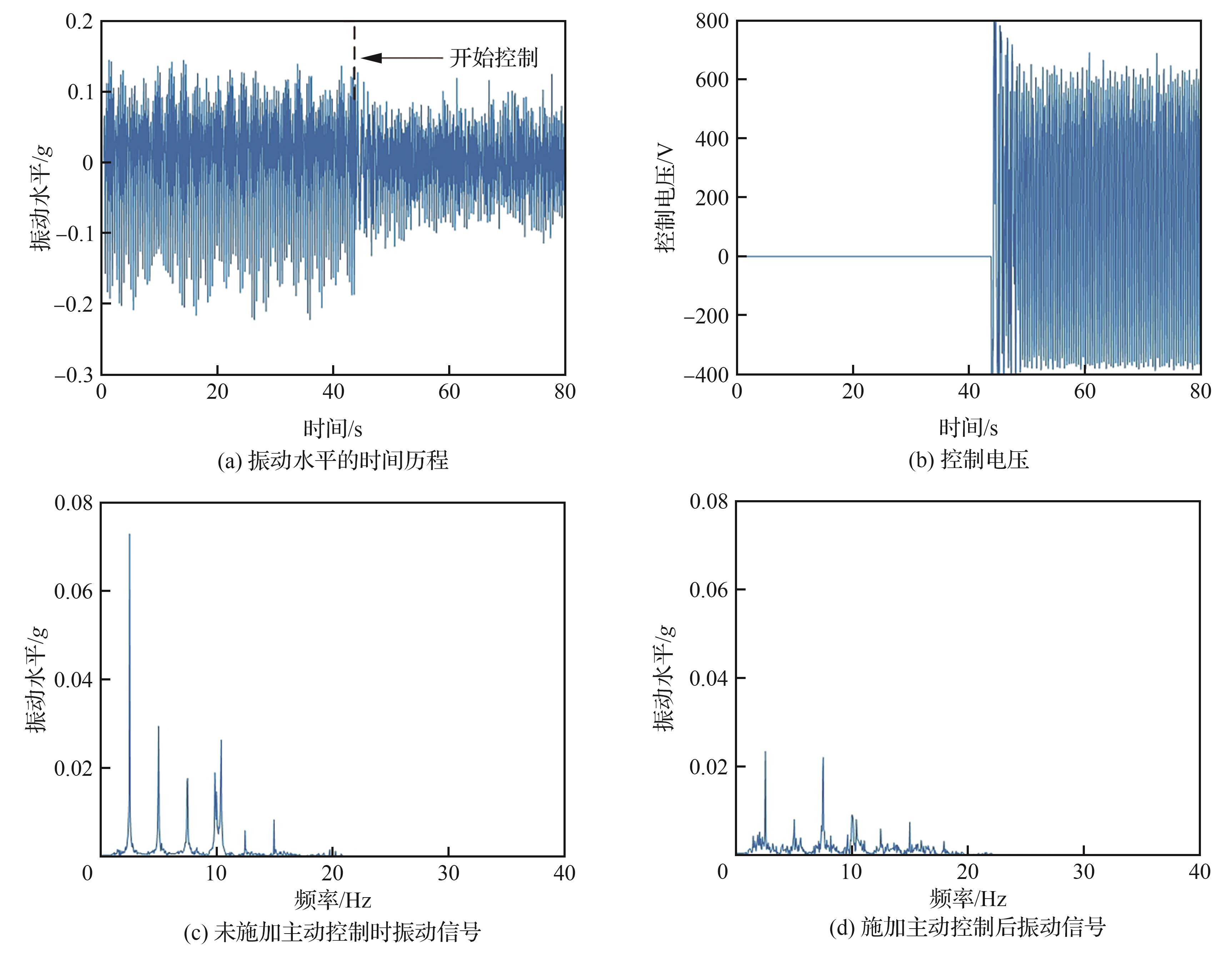
Fig.14
Control effect at hovering, rotor speed 180 r/min, and wind speed 10 m/s
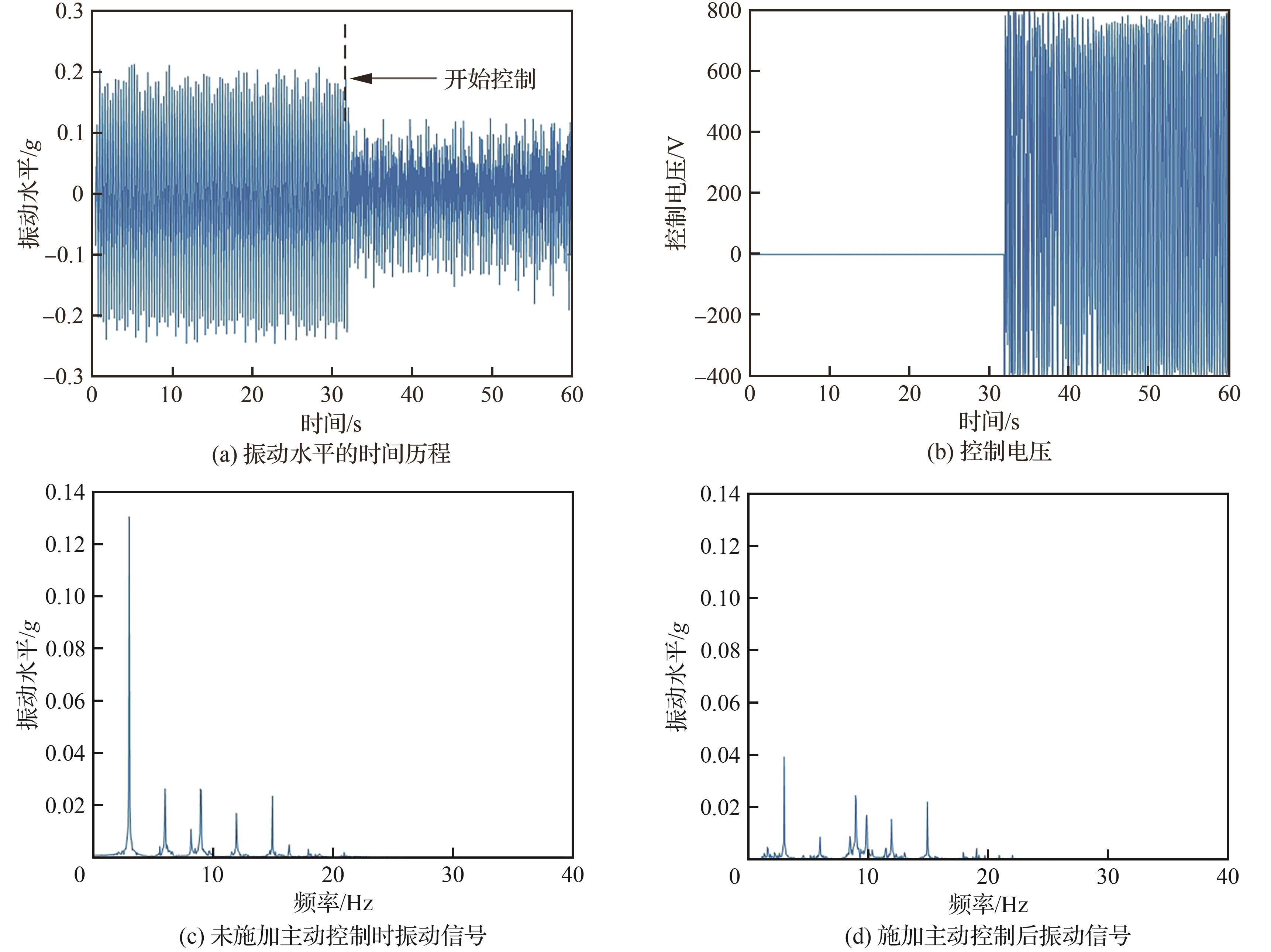
Fig.15
Control effect at hovering, rotor speed 210 r/min, and wind speed 5 m/s
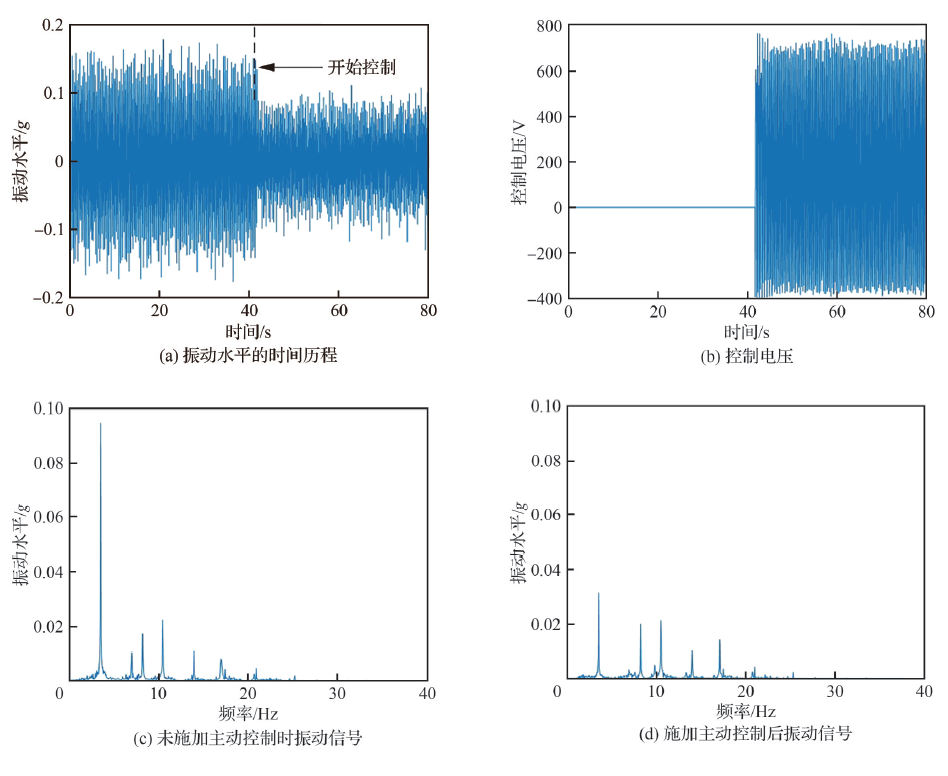
Table 4
Multi-harmonic control effect
| 工况 | 1/rev振动水平 | 2/rev振动水平 | ||||
|---|---|---|---|---|---|---|
| 未控制 | 施加控制 | 振动降低/% | 未控制 | 施加控制 | 振动降低/% | |
| 1 | 0.073g | 0.031g | 66.8 | 0.024g | 0.007g | 77.9 |
| 2 | 0.138g | 0.048g | 69.4 | 0.042g | 0.012g | 75.14 |
| 3 | 0.101g | 0.031g | 69.02 | 0.008g | 0.005g | 41.9 |
| 4 | 0.130g | 0.038g | 70.67 | 0.026g | 0.009g | 66.25 |
| 5 | 0.094g | 0.031g | 66.93 | 0.010g | 0.004g | 56.61 |
| 6 | 0.103g | 0.035g | 65.63 | 0.016g | 0.007g | 52.63 |
| 7 | 0.063g | 0.026g | 58.57 | 0.024g | 0.008g | 66.52 |
| 8 | 0.082g | 0.036g | 55.31 | 0.030g | 0.011g | 64.21 |
| 8 | 0.058g | 0.024g | 58.85 | 0.006g | 0.005g | 26.54 |
| 10 | 0.076g | 0.031g | 59.02 | 0.016g | 0.005g | 72.13 |
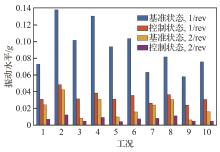
Fig.16
Multi-harmonic vibration control effect
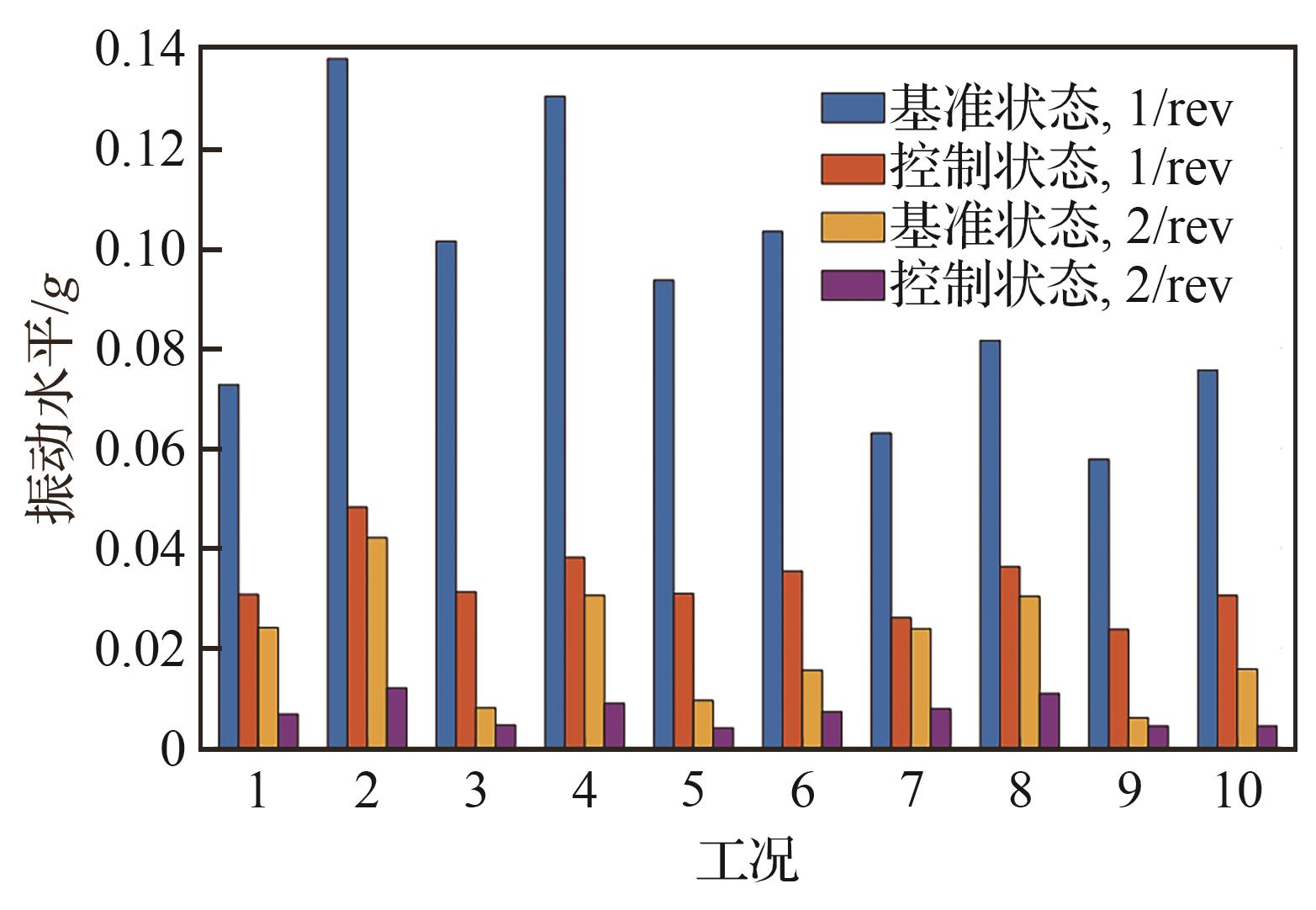
Table 5
Time-domain vibration control effectiveness
| 工况 | 控制前RMS | 控制后RMS | 振动降低/% |
|---|---|---|---|
| 1 | 0.071 7g | 0.039 0g | 45.76 |
| 2 | 0.120 1g | 0.062 9g | 47.66 |
| 3 | 0.080 7g | 0.045 3g | 43.89 |
| 4 | 0.106 7g | 0.051 2g | 51.98 |
| 5 | 0.078 8g | 0.039 5g | 49.86 |
| 6 | 0.082 1g | 0.040 7g | 58.55 |
| 7 | 0.065 0g | 0.038 6g | 40.57 |
| 8 | 0.081 9g | 0.049 0g | 40.24 |
| 9 | 0.050 5g | 0.036 7g | 27.24 |
| 10 | 0.066 6g | 0.043 6g | 34.53 |
Fig.17
Time-domain vibration control effect
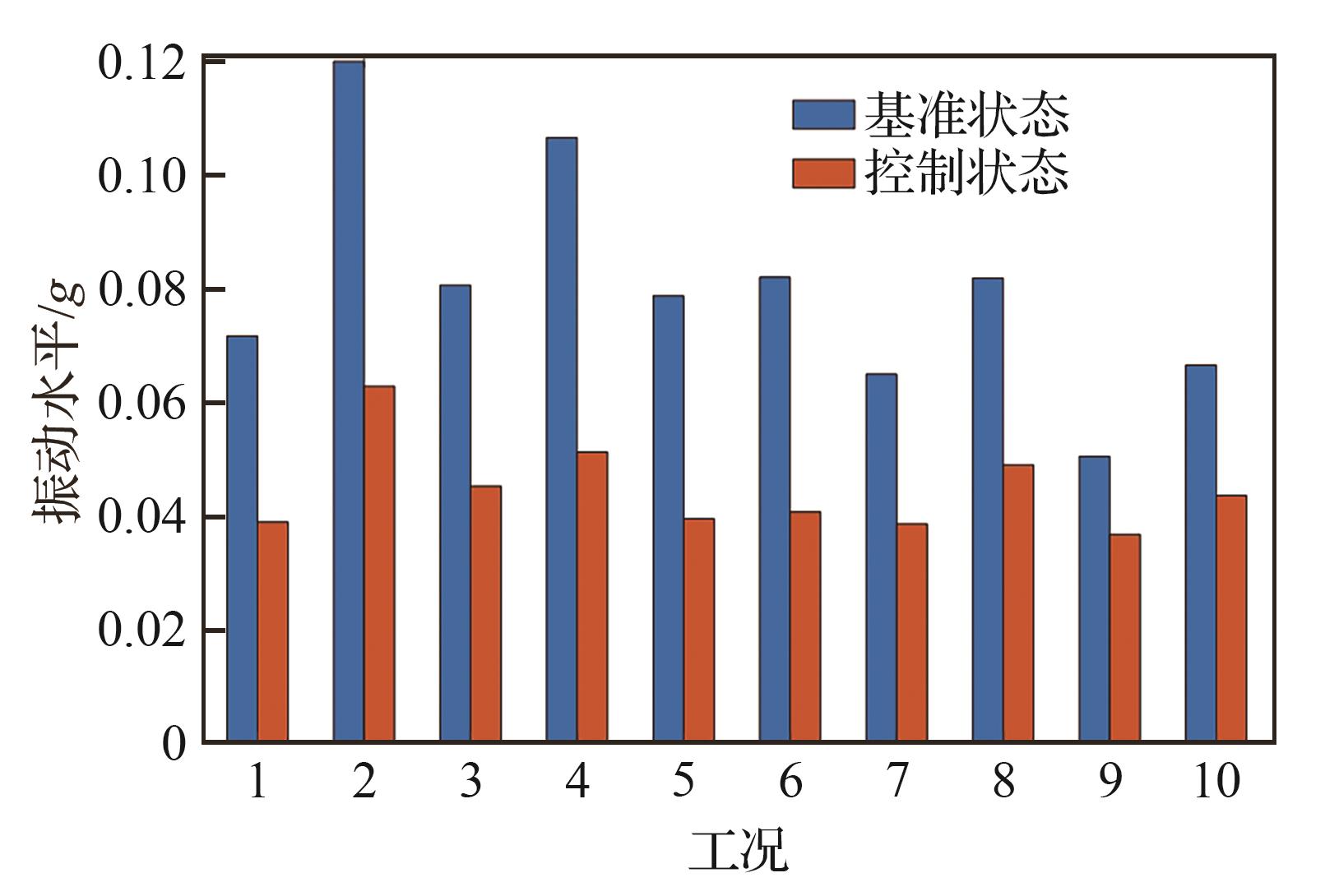
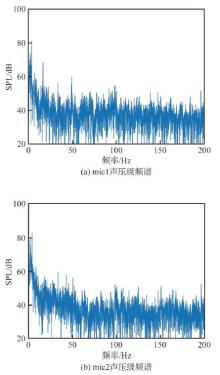
Fig.18
Sound pressure level spectrum of wind tunnel background noise
Fig.19
Sound pressure level spectrum at hovering, rotor speed 210 r/min, and wind speed 10 m/s
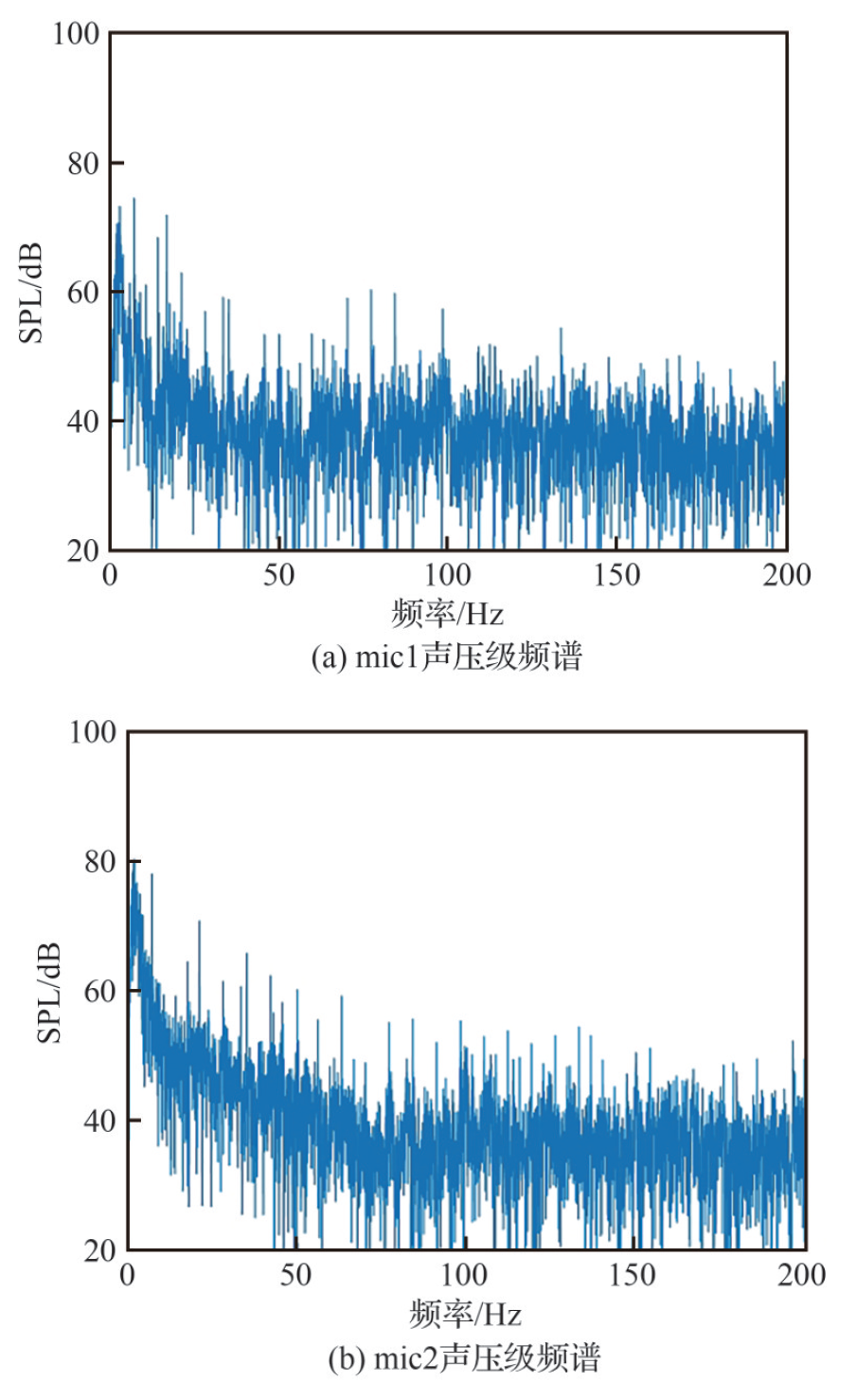
Fig.20
Sound pressure level spectrum after applying control
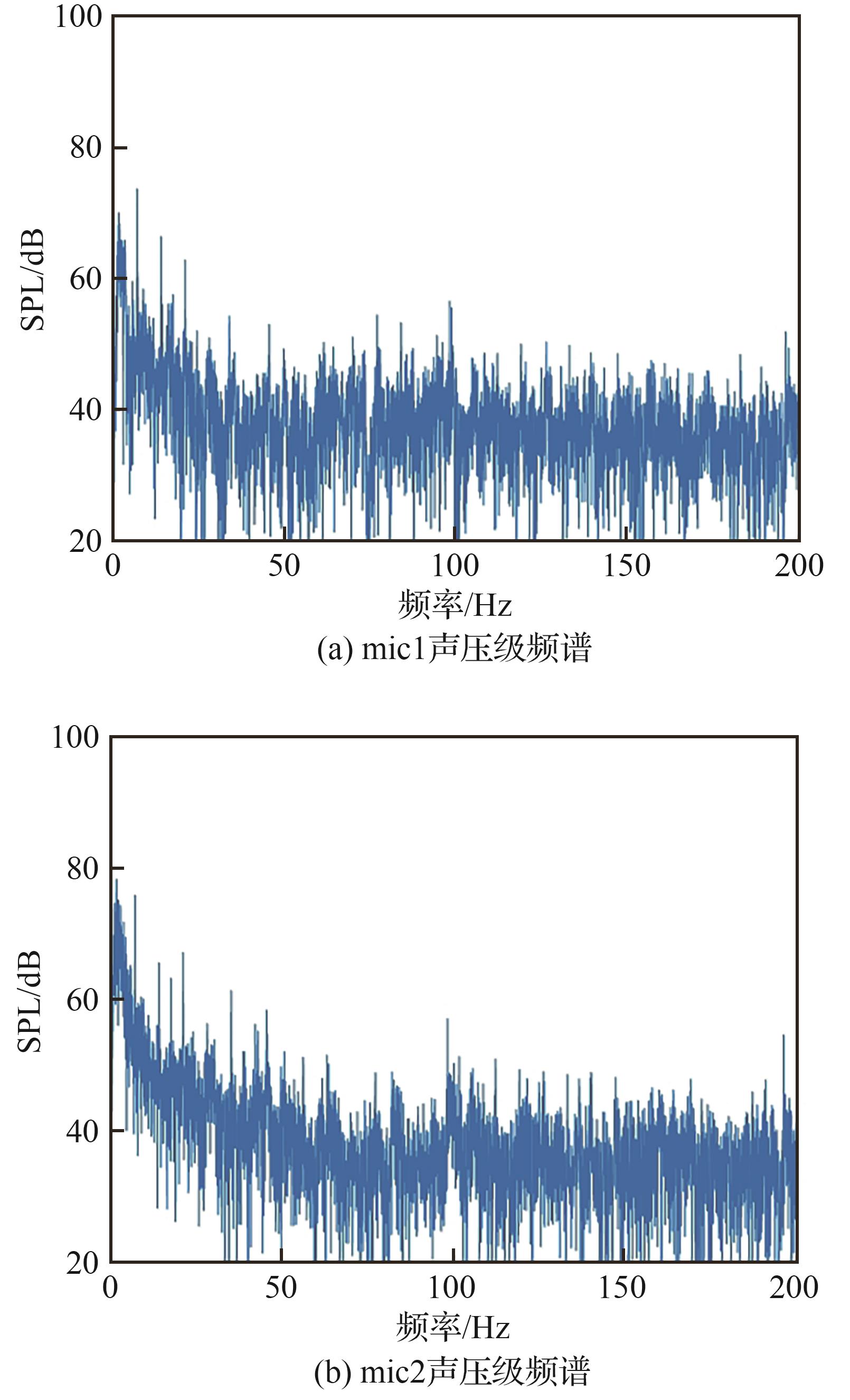
Fig.21
Control voltage
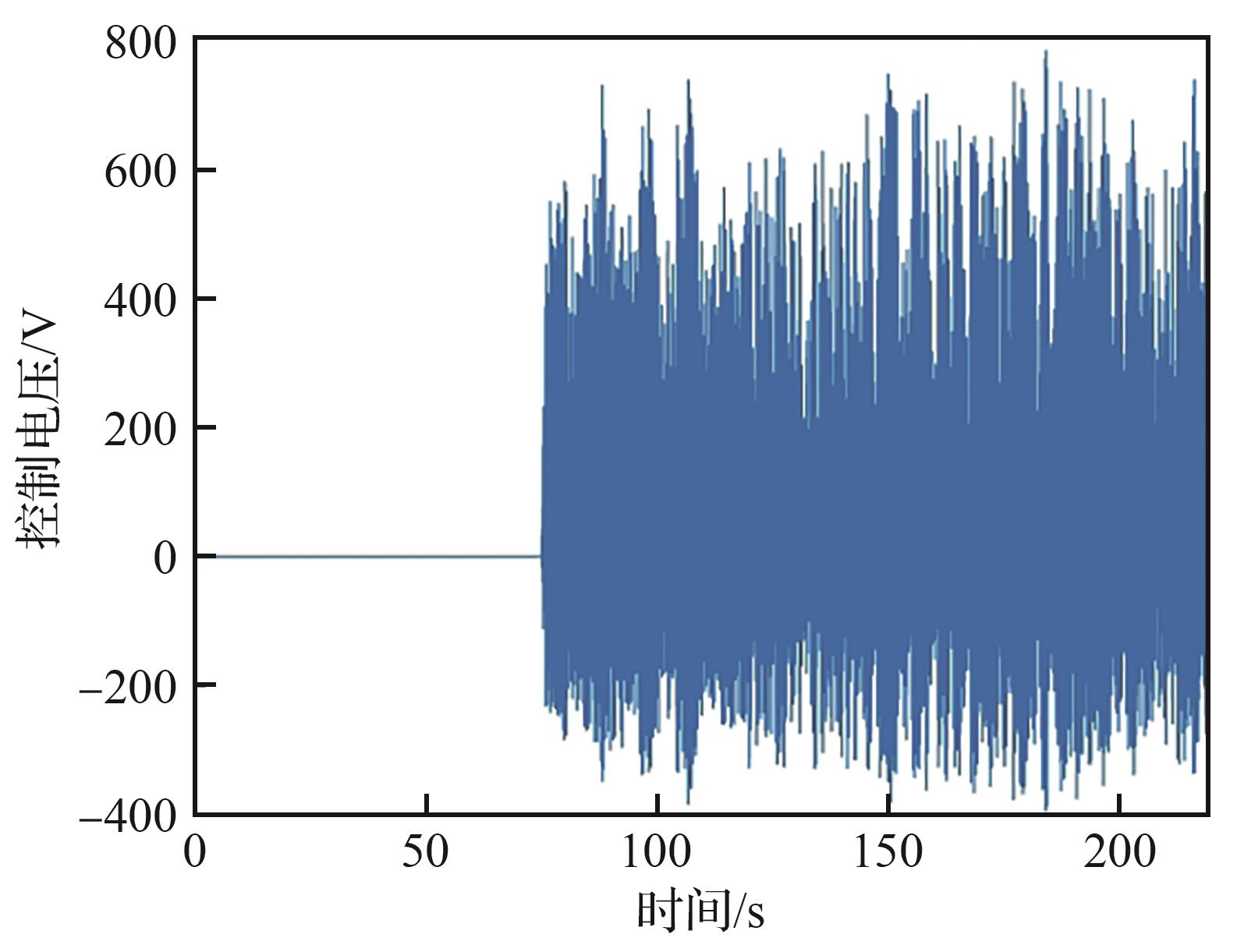
Fig.22
Change in sound pressure level before and after control
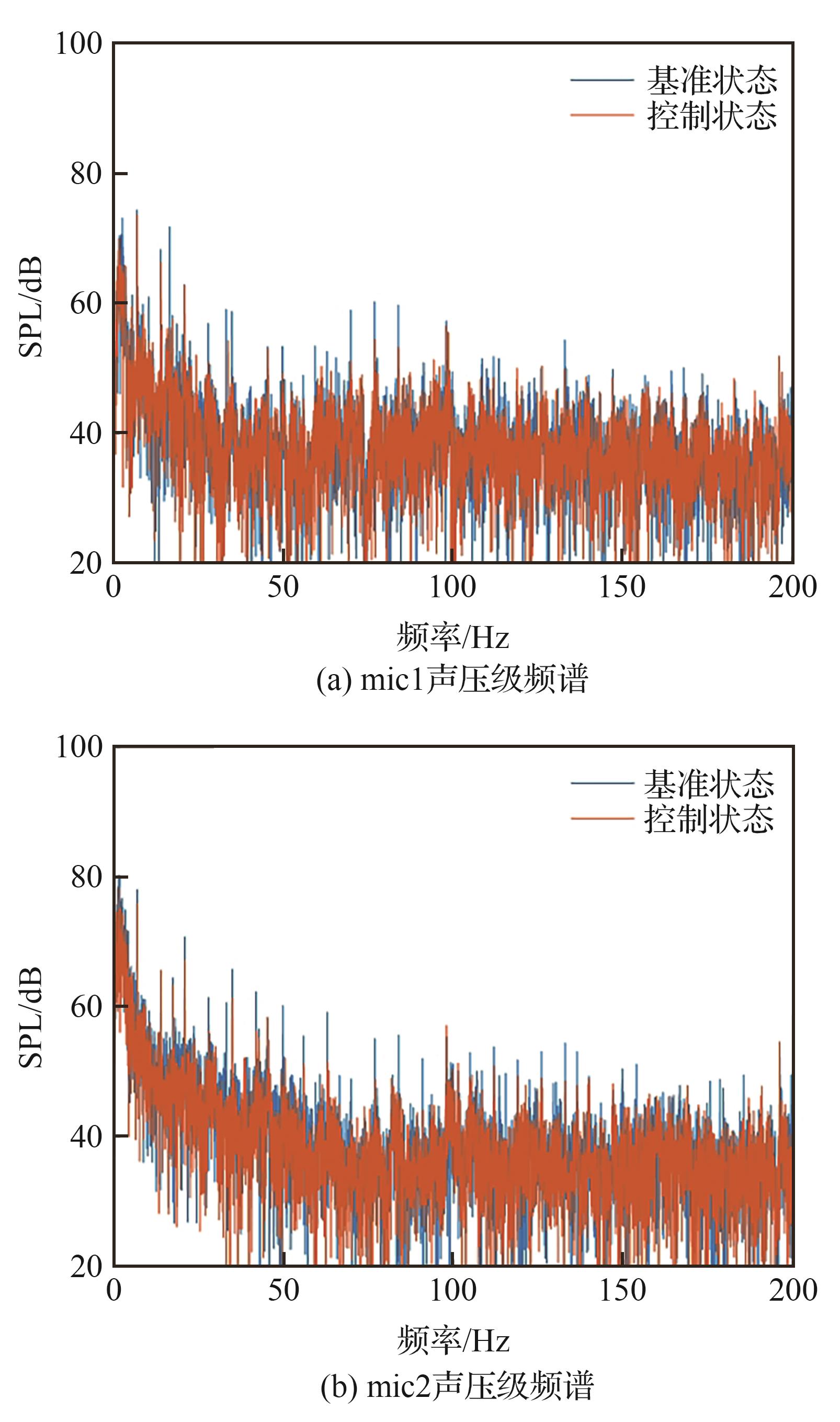
Table 6
Frequency-specific active noise control effectiveness
| 传声器 | 噪声频率 成分/BPF | 控制前声 压级/dB | 控制后声 压级/dB | 噪声降低/ dB |
|---|---|---|---|---|
| mic1 | 1 | 74.39 | 73.67 | 0.72 |
| 2 | 68.30 | 66.40 | 1.90 | |
| 3 | 62.87 | 62.82 | 0.05 | |
| 4 | 56.90 | 50.97 | 5.93 | |
| 5 | 58.74 | 48.73 | 10.01 | |
| 8 | 48.91 | 45.31 | 3.60 | |
| 9 | 52.60 | 45.15 | 7.45 | |
| 10 | 58.96 | 49.18 | 9.79 | |
| 11 | 60.25 | 54.47 | 5.78 | |
| 12 | 59.71 | 52.59 | 7.12 | |
| 13 | 48.82 | 46.55 | 2.27 | |
| 16 | 51.82 | 48.31 | 3.50 | |
| 19 | 54.36 | 49.84 | 4.52 | |
| 24 | 50.07 | 45.60 | 4.47 | |
| mic2 | 1 | 78.02 | 75.93 | 2.09 |
| 3 | 70.76 | 67.18 | 3.57 | |
| 4 | 61.44 | 56.35 | 5.08 | |
| 5 | 65.77 | 61.38 | 4.39 | |
| 6 | 62.31 | 55.77 | 6.54 | |
| 8 | 55.51 | 51.20 | 4.31 | |
| 9 | 59.16 | 51.53 | 7.63 | |
| 10 | 48.88 | 42.69 | 6.19 | |
| 11 | 55.09 | 48.85 | 6.24 | |
| 12 | 55.62 | 46.65 | 8.96 | |
| 13 | 52.02 | 44.12 | 7.90 | |
| 15 | 52.92 | 49.49 | 3.43 | |
| 16 | 53.82 | 50.93 | 2.89 | |
| 17 | 51.82 | 49.33 | 2.49 | |
| 18 | 53.09 | 49.03 | 4.06 | |
| 19 | 54.41 | 48.60 | 5.82 | |
| 20 | 49.30 | 48.94 | 0.37 | |
| 22 | 51.15 | 44.61 | 6.54 |
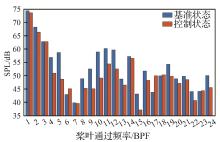
Fig.23
Order spectrum of noise sound pressure level at mic1 before and after applying control
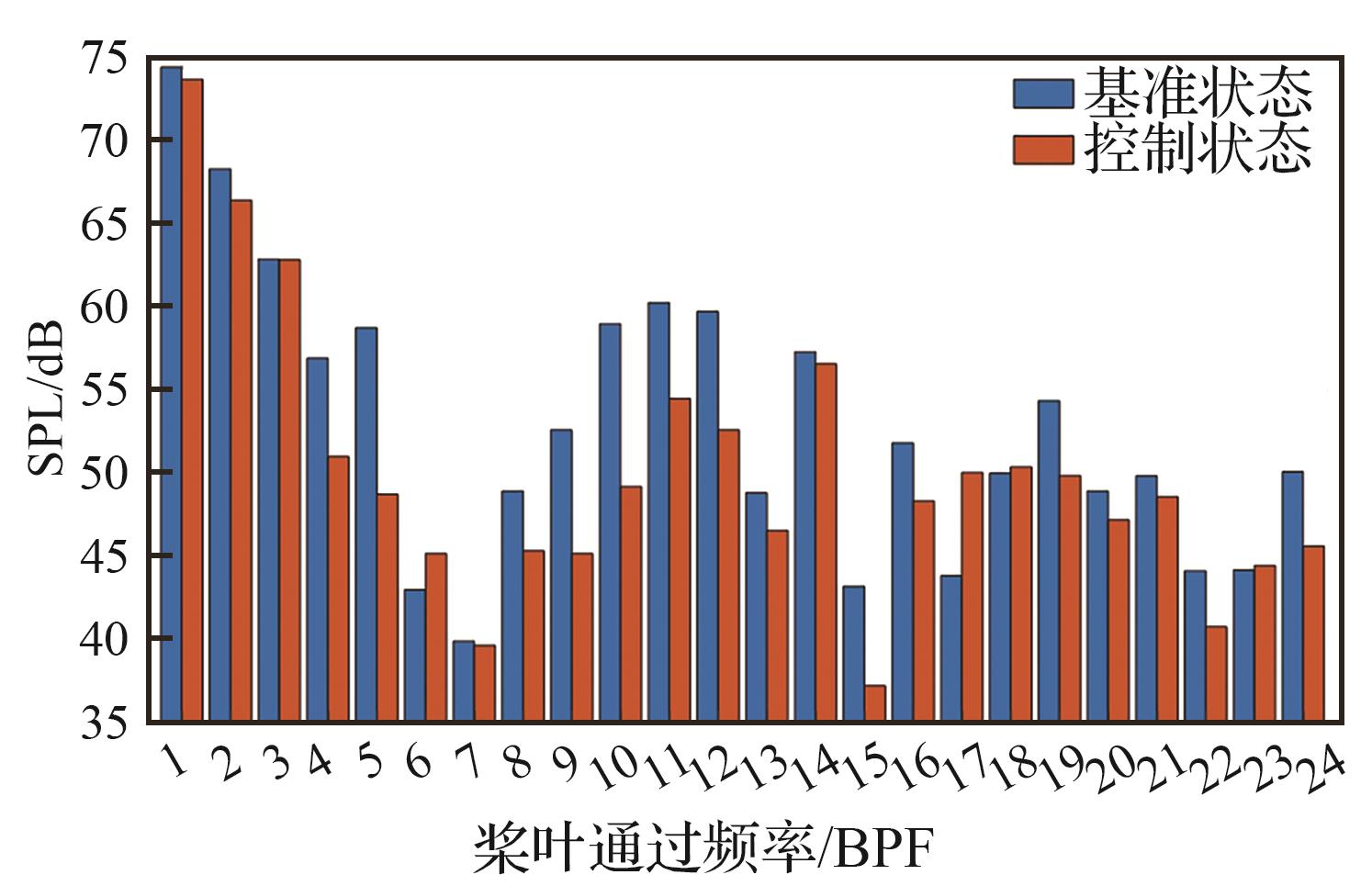
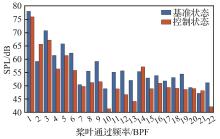
Fig.24
Order spectrum of noise sound pressure level at mic2 before and after applying control
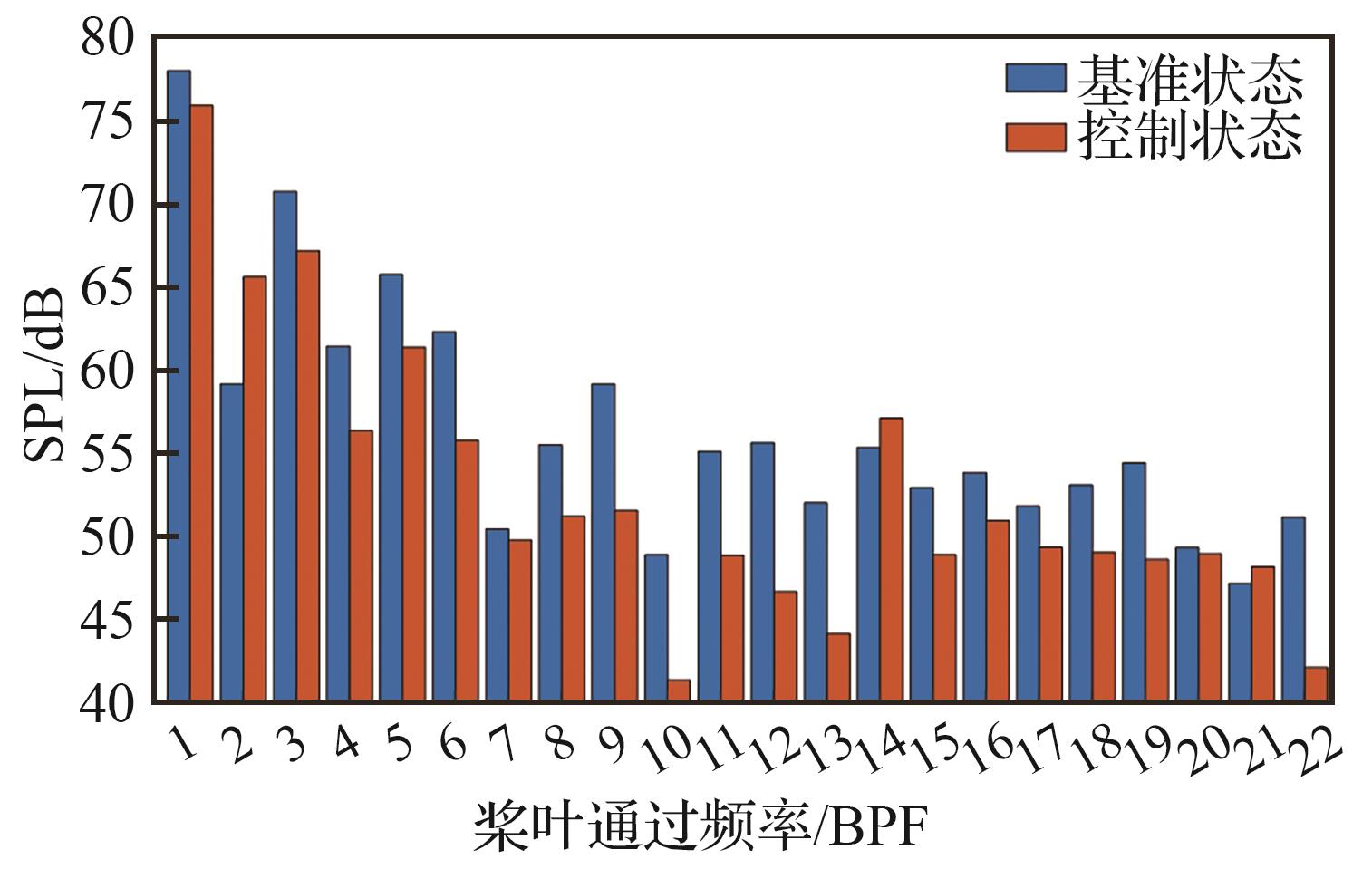
Table 7
Overall active noise control effect
| 传声器 | 控制前声压级/dB | 控制后声压级/dB | 噪声降低/dB |
|---|---|---|---|
| mic1 | 82.562 4 | 80.045 2 | 2.517 2 |
| mic2 | 89.009 4 | 85.863 7 | 3.145 7 |
| [1] | 王咏梅. 全球民用直升机市场研究与分析[J]. 江苏科技信息, 2020, 37(17): 34-37. |
| WANG Y M. Research and analysis on global civil helicopter market[J]. Jiangsu Science & Technology Information, 2020, 37(17): 34-37 (in Chinese). | |
| [2] | 杨婧, 詹月玫, 洪彬. 世界军用直升机装备现状及发展规划[J]. 直升机技术, 2020(3): 68-72. |
| YANG J, ZHAN Y M, HONG B. Development status and plans of world military helicopter industry[J]. Helicopter Technique, 2020(3): 68-72 (in Chinese). | |
| [3] | 田翔, 沈亚娟, 马小艳. 旋翼主动控制技术研究[J]. 中国科技信息, 2019(3): 37-44. |
| TIAN X, SHEN Y J, MA X Y. Research on active control technology of rotor[J]. China Science and Technology Information, 2019(3): 37-44 (in Chinese) | |
| [4] | EDWARDS B, COX C, BOOTH E R JR. Revolutionary concepts for helicopter noise reduction: SILENT Program: NASA/CR-2002-2111650[R]. Washington, D.C.: NASA, 2002. |
| [5] | KESSLER C. Active rotor control for helicopters: Motivation and survey on higher harmonic control[J]. CEAS Aeronautical Journal, 2011, 1(1): 3-22. |
| [6] | 冯剑波, 陆洋. 直升机旋翼桨涡干扰噪声主动控制技术综述[J]. 噪声与振动控制, 2018, 38(3): 1-9. |
| FENG J B, LU Y. Review of active control techniques of blade vortex interaction noise for helicopter rotor[J]. Noise and Vibration Control, 2018, 38(3): 1-9 (in Chinese). | |
| [7] | FRIEDMANN P P. On-blade control of rotor vibration, noise, and performance: Just around the corner? The 33rd Alexander Nikolsky Honorary Lecture[J]. Journal of the American Helicopter Society, 2014, 59(4): 1-37. |
| [8] | KESSLER C. Active rotor control for helicopters: Individual blade control and swashplateless rotor designs[J]. CEAS Aeronautical Journal, 2011, 1(1): 23-54. |
| [9] | DIETERICH O, RABOURDIN A, MAURICE J B, et al. Blue Pulse™: Active rotor control by trailing edge flaps at airbus helicopters—New EC145 demonstrator and flight test results[C]∥Proceedings of the 70th Annual Forum of the American Helicopter Society. 2014: 679-702. |
| [10] | 王潇, 杨一凡, 张硕. 直升机振动主动控制方法研究综述[J]. 电光与控制, 2024, 31(5): 1-10. |
| WANG X, YANG Y F, ZHANG S. A review of active vibration control methods for helicopters[J]. Electronics Optics & Control, 2024, 31(5): 1-10 (in Chinese). | |
| [11] | BENT A A, HAGOOD N W. Piezoelectric fiber composites with interdigitated electrodes[J]. Journal of Intelligent Material Systems and Structures, 1997, 8(11): 903-919. |
| [12] | VAN DER WALL B G, LIM J W, RIEMENSCHNEIDER J, et al. New smart twisting active rotor (STAR): Pretest predictions[J]. CEAS Aeronautical Journal, 2024, 15(3): 721-750. |
| [13] | THAKKAR D, GANGULI R. Active twist control of smart helicopter rotor-A survey[J]. Journal of Aerospace Sciences and Technologies, 2023, 57(4): 429-448. |
| [14] | CHOPRA I. Review of state of art of smart structures and integrated systems[J]. AIAA Journal, 2002, 40(11): 2145-2187. |
| [15] | WILBUR M L, WILKIE W K. Active-twist rotor control applications for UAVs[C]∥Transformational Science and Technology for the Current and Future Force: World Scientific. 2006: 185-192. |
| [16] | WILKIE W K, BRYANT R G, HIGH J W, et al. Low-cost piezocomposite actuator for structural control applications[C]∥Smart Structures and Materials 2000: Industrial and Commercial Applications of Smart Structures Technologies. 2000: 323-334. |
| [17] | HAMED Y S, KANDIL A, MACHADO J T. Utilizing macro fiber composite to control rotating blade vibrations[J]. Symmetry, 2020, 12(12): 1984. |
| [18] | PAWAR P M, JUNG S N. Single-crystal-material-based induced-shear actuation for vibration reduction of helicopters with composite rotor system[J]. Smart Materials and Structures, 2008, 17(6): 065009. |
| [19] | PAWAR P M, JUNG S N. Active twist control methodology for vibration reduction of a helicopter with dissimilar rotor system[J]. Smart Materials and Structures, 2009, 18(3): 035013. |
| [20] | JOHNSON W, UNITED S. Self-tuning regulators for multicyclic control of helicopter vibration[M]. Washington, D.C.: Scientific and Technical Information Branch, NASA, 1982. |
| [21] | RAKOTOMAMONJY T, VU B D. Identification and optimal control methodology for an active twist rotor[J]. IFAC Proceedings Volumes, 2010, 43(15): 452-457. |
| [22] | BRILLANTE C, MORANDINI M, MANTEGAZZA P. Periodic controllers for vibration reduction using actively twisted blades[J]. The Aeronautical Journal, 2016, 120(1233): 1763-1784. |
| [23] | MITURA A, GAWRYLUK J. Experimental and finite element analysis of PPF controller effectiveness in composite beam vibration suppression[J]. Eksploatacja i Niezawodność-Maintenance and Reliability, 2022, 24(3): 468-477. |
| [24] | GUO Y B, YU Y X, LI L, et al. Modeling and vibration control of a rotating flexible plate actuated by MFC[J]. Composite Structures, 2024, 331: 117907. |
| [25] | KIM D H, HONG S, JUNG S N. Multicyclic vibration control of a helicopter rotor with active twist actuation[J]. International Journal of Aeronautical and Space Sciences, 2022, 23(2): 303-314. |
| [26] | FOGARTY D E, WILBUR M, SEKULA M. A compu tational study of BVI noise reduction using active twist control[C]∥American Helicopter Society 66th Annual Forum and Technology Display. 2010, 1: 660-668. |
| [27] | FOGARTY D E, WILBUR M, SEKULA M. The effect of non-harmonic active twist actuation on BVI noise[C]∥AHS International 67th Annual Forum and Technology Display. 2011, 1: 37-46. |
| [28] | ANOBILE A, BERNARDINI G, GENNARETTI M. Active twist rotor controller identification for blade-vortex interaction noise alleviation[C]∥19th AIAA/CEAS Aeroacoustics Conference. Reston: AIAA, 2013. |
| [29] | ANOBILE A, BERNARDINI G, GENNARETTI M. Investigation on a high-frequency controller for rotor BVI noise alleviation[J]. International Journal of Acoustics and Vibration, 2016, 21(3): 239-248. |
| [30] | ANOBILE A, BERNARDINI G, TESTA C, et al. Synthesis of a rotor BVI noise active controller through an efficient aerodynamics/aeroacoustics solver[C]∥20th AIAA/CEAS Aeroacoustics Conference. Reston: AIAA, 2014. |
| [31] | KEATS W W, L. W M, H. M P, et al. Aeroelastic analysis of the NASA/ARMY/MIT active twist rotor[C]∥American Helicopter Society 55th Annual Forum. 1999. |
| [32] | CESNIK C E S, SHIN S J, WILKIE W K, et al. Modeling, design, and testing of the NASA/Army/MIT active twist rotor prototype blade[C]∥Proceedings of the American Helicopter Society 55th Annual Forum. 1999. |
| [33] | WILBUR M L, YEAGER W T, WILKIE W K, et al. Hover testing of the NASA/ARMY/MIT active twist rotor prototype blade[C]∥56th American Helicopter Society Annual Forum. 2000. |
| [34] | WILBUR M L, MIRICK P H, YEAGER W T, et al. Vibratory loads reduction testing of the NASA/Army/MIT active twist rotor[J]. Journal of the American Helicopter Society, 2002, 47(2): 123-133. |
| [35] | WILBUR M L, YEAGER W T, SEKULA M K. Further examination of the vibratory loads reduction results from the NASA/Army/MIT active twist rotor test[C]∥58th American Helicopter Society Annual Forum. 2002. |
| [36] | SHIN S, CESNIK C E S, HALL S R. Closed-loop control test of the NASA/army/MIT active twist rotor for vibration reduction[J]. Journal of the American Helicopter Society, 2005, 50(2): 178-194. |
| [37] | BERNHARD A P F, WONG J. Wind-tunnel evaluation of a Sikorsky active rotor controller implemented on the NASA/ARMY/MIT active twist rotor[J]. Journal of the American Helicopter Society, 2005, 50(1): 65-81. |
| [38] | YEAGER W, WILBUR M, NIXON M. Review of recent rotorcraft experimental investigations in the langley transonic dynamics tunnel[C]∥44th AIAA/ASME/ASCE/AHS/ASC Structures, Structural Dynamics, and Materials Conference. Reston: AIAA, 2003. |
| [39] | SHIN S J, CESNIK C E S, HALL S R. System identification technique for active helicopter rotors[J]. Journal of Intelligent Material Systems and Structures, 2005, 16(11-12): 1025-1038. |
| [40] | SHIN S, CESNIK C, HALL S. Control of integral twist-actuated helicopter blades for vibration reduction[C]∥AHS International, 58th Annual Forum Proceedings. 2002: 2122-2133. |
| [41] | SHIN S, CESNIK C. Helicopter performance and vibration enhancement by twist-actuated blades[C]∥44th AIAA/ASME/ASCE/AHS/ASC Structures, Structural Dynamics, and Materials Conference. Reston: AIAA, 2003. |
| [42] | 陈钰, 宗群, 张秀云, 等. 直升机旋翼振动主动控制方法研究进展[J]. 哈尔滨工业大学学报, 2023, 55(8): 1-17. |
| CHEN Y, ZONG Q, ZHANG X Y, et al. Research progress of active vibration control methods for helicopter rotor[J]. Journal of Harbin Institute of Technology, 2023, 55(8): 1-17 (in Chinese). | |
| [43] | SHAW J. Higher harmonic blade pitch control: A system for helicopter vibration reduction [D]. Cambridge: Massachusetts Institute of Technology, 1980. |
| [44] | RUBINACCI R, MERAGLIA S, LOVERA M. Continuous time adaptive higher harmonic control[C]∥Proceedings of the 2022 CEAS EuroGNC Conference. 2022: 1-10. |
| [45] | PRECHTL E F. Design and implementation of a piezoelectric servo-flap actuation system for helicopter rotor individual blade control[D]. Cambridge: Massachusetts Institute of Technology, 2000: 177-186. |
| [46] | BOOTH E R, WILBUR M L. Acoustic aspects of active-twist rotor control[J]. Journal of the American Helicopter Society, 2004, 49(1): 3-10. |
| [47] | JACKLIN S A. Comparison of five system identification algorithms for rotorcraft higher harmonic control: NASA/TP-1998-207687[R]. Moffett Field: Ames Research Center, National Aeronautics and Space Administration, 1998. |
| [48] | PATT D, LIU L, CHANDRASEKAR J, et al. Higher-harmonic-control algorithm for helicopter vibration reduction revisited[J]. Journal of Guidance, Control, and Dynamics, 2005, 28(5): 918-930. |
| [1] | Jinchao MA, Yang LU, Liangquan WANG, Kuihui SONG. Active control test of tiltrotor near-field aeroacoustics based on higher harmonic control [J]. Acta Aeronautica et Astronautica Sinica, 2024, 45(9): 528602-528602. |
| [2] | Chunhui ZHAO, Anmeng LIU, Yang LYU, Quan PAN. A survey of resilient self-localization for UAV [J]. Acta Aeronautica et Astronautica Sinica, 2024, 45(8): 28839-028839. |
| [3] | ZHOU Yitao, YANG Yang, WU Zhigang, YANG Chao. Flight test for gust alleviation on a high aspect ratio UAV platform [J]. ACTA AERONAUTICAET ASTRONAUTICA SINICA, 2022, 43(6): 526126-526126. |
| [4] | LI Hangxing, HU Dike, WU Shaoqing. Optimization design of dynamic vibration absorbers for vibration and noise reduction of composite fairing [J]. ACTA AERONAUTICAET ASTRONAUTICA SINICA, 2022, 43(5): 225249-225249. |
| [5] | YANG Chao, QIU Qisheng, ZHOU Yitao, WU Zhigang. Review of aircraft gust alleviation technology [J]. ACTA AERONAUTICAET ASTRONAUTICA SINICA, 2022, 43(10): 527350-527350. |
| [6] | LIU Hao, WANG Wei, JIN Wei, NIU Wenchao, YANG Zhichun. Experiments of RFxLMS control for vertical tail buffeting [J]. ACTA AERONAUTICAET ASTRONAUTICA SINICA, 2021, 42(2): 224090-224090. |
| [7] | YANG Qi, LIU Wei, YANG Xiaoliang, LI Hao. Multidisplinary interactions numerical simulation for active control of delta wing rock [J]. ACTA AERONAUTICAET ASTRONAUTICA SINICA, 2021, 42(12): 124685-124685. |
| [8] | JIN Wei, YANG Zhichun, MENG Dehong, CHEN Yan, HUANG Hu, WANG Yongjun, HE Shi, CHEN Yuanfang. Strength desigh and test of advanced fighter all-moving twin V-tail buffet [J]. ACTA AERONAUTICAET ASTRONAUTICA SINICA, 2020, 41(6): 523473-523473. |
| [9] | WU Ke, ZHANG Huazhen, LAN Lan, ZHOU Yang. Shape active control of a CFRP reflector and placement optimization of actuator [J]. ACTA AERONAUTICAET ASTRONAUTICA SINICA, 2019, 40(7): 222751-222751. |
| [10] | WANG Wentao, LIU Zhengjiang, LI Xinmin. Variable sliding mode sliding mode controller for centrifugal harmonic force generator [J]. ACTA AERONAUTICAET ASTRONAUTICA SINICA, 2019, 40(12): 323210-323210. |
| [11] | NI Tongbing, ZHAO Qijun, MA Li. Active control mechanism of rotor BVI noise based on IBC method [J]. ACTA AERONAUTICAET ASTRONAUTICA SINICA, 2017, 38(7): 120744-120744. |
| [12] | ZHU Ziqiang, JU Shengjun, WU Zongcheng. Laminar flow active/passive control technology [J]. ACTA AERONAUTICAET ASTRONAUTICA SINICA, 2016, 37(7): 2065-2090. |
| [13] | YANG Zhichun, TIAN Wei, GU Yingsong, HE Shun. Advance in the study on wing aeroelasticity with concentrated nonlinearity [J]. ACTA AERONAUTICAET ASTRONAUTICA SINICA, 2016, 37(7): 2013-2044. |
| [14] | YANG Chao, HUANG Chao, WU Zhigang, TANG Changhong. Progress and challenges for aeroservoelasticity research [J]. ACTA AERONAUTICAET ASTRONAUTICA SINICA, 2015, 36(4): 1011-1033. |
| [15] | WANG Yiding, Guo Liang, TONG Mingbo, Zhang Jie. Active control and nonlinear numerical simulation for oscillating pressure of high-speed aircraft cavity [J]. ACTA AERONAUTICAET ASTRONAUTICA SINICA, 2015, 36(1): 213-222. |
| Viewed | ||||||
|
Full text |
|
|||||
|
Abstract |
|
|||||
Address: No.238, Baiyan Buiding, Beisihuan Zhonglu Road, Haidian District, Beijing, China
Postal code : 100083
E-mail:hkxb@buaa.edu.cn
Total visits: 6658907 Today visits: 1341All copyright © editorial office of Chinese Journal of Aeronautics
All copyright © editorial office of Chinese Journal of Aeronautics
Total visits: 6658907 Today visits: 1341

 CJA
CJA
