Acta Aeronautica et Astronautica Sinica ›› 2025, Vol. 46 ›› Issue (12): 131425.doi: 10.7527/S1000-6893.2025.31425
• Fluid Mechanics and Flight Mechanics • Previous Articles
Zhongyu DU, Pengcheng DU, Fangfei NING( )
)
Received:2024-10-21
Revised:2024-11-11
Accepted:2025-01-10
Online:2025-02-10
Published:2025-02-10
Contact:
Fangfei NING
E-mail:fangfei.ning@buaa.edu.cn
Supported by:CLC Number:
Zhongyu DU, Pengcheng DU, Fangfei NING. A high-precision aerodynamic load transfer method for fluid-solid coupling simulation[J]. Acta Aeronautica et Astronautica Sinica, 2025, 46(12): 131425.
Fig.1
Time-staggered procedure of FSI simulation
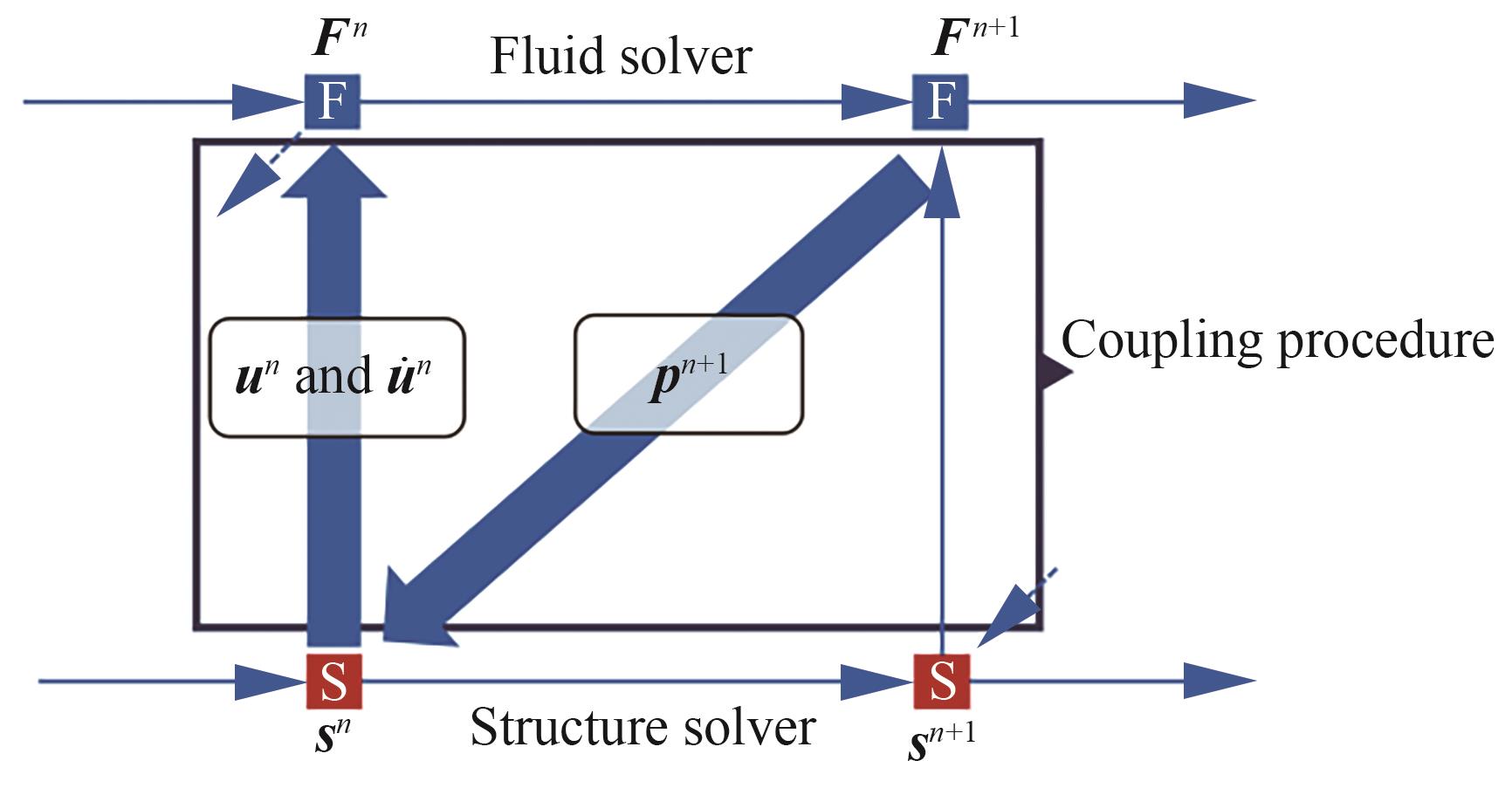
Fig.2
Common refinement of meshes
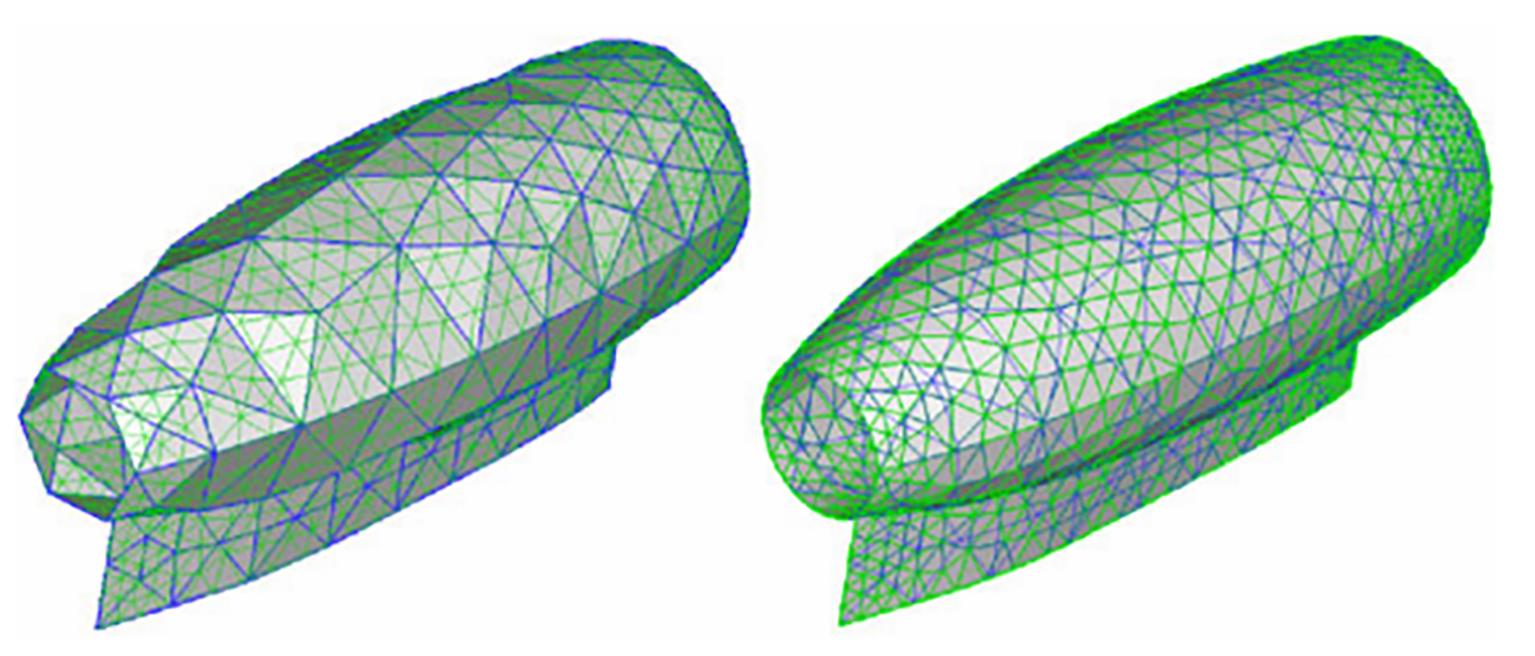
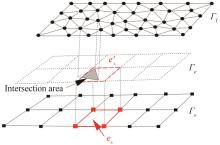
Fig.3
Generalized two-dimensional coordinate projection
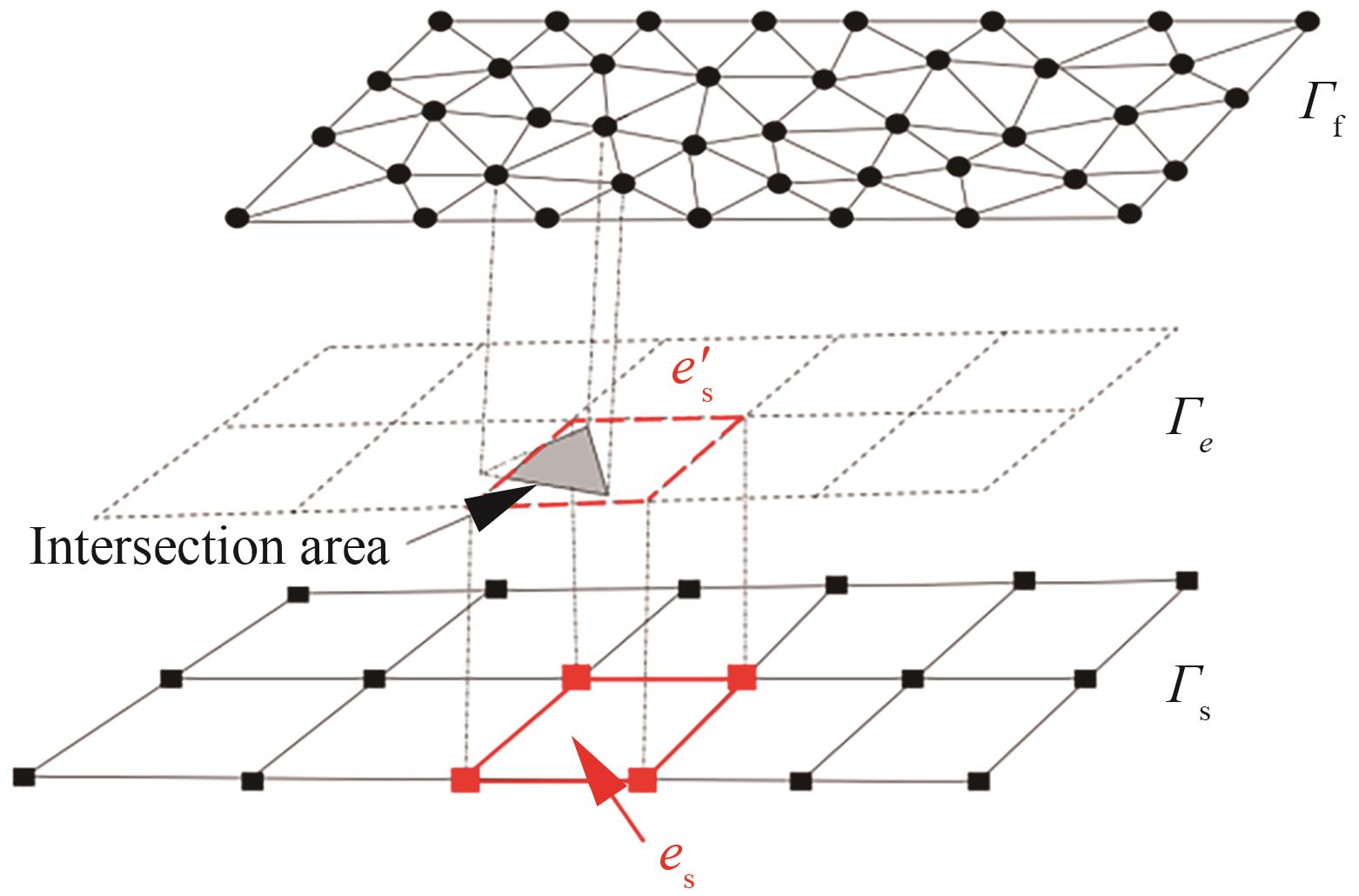
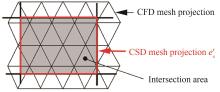
Fig.4
Intersections of fluid and solid projection grids
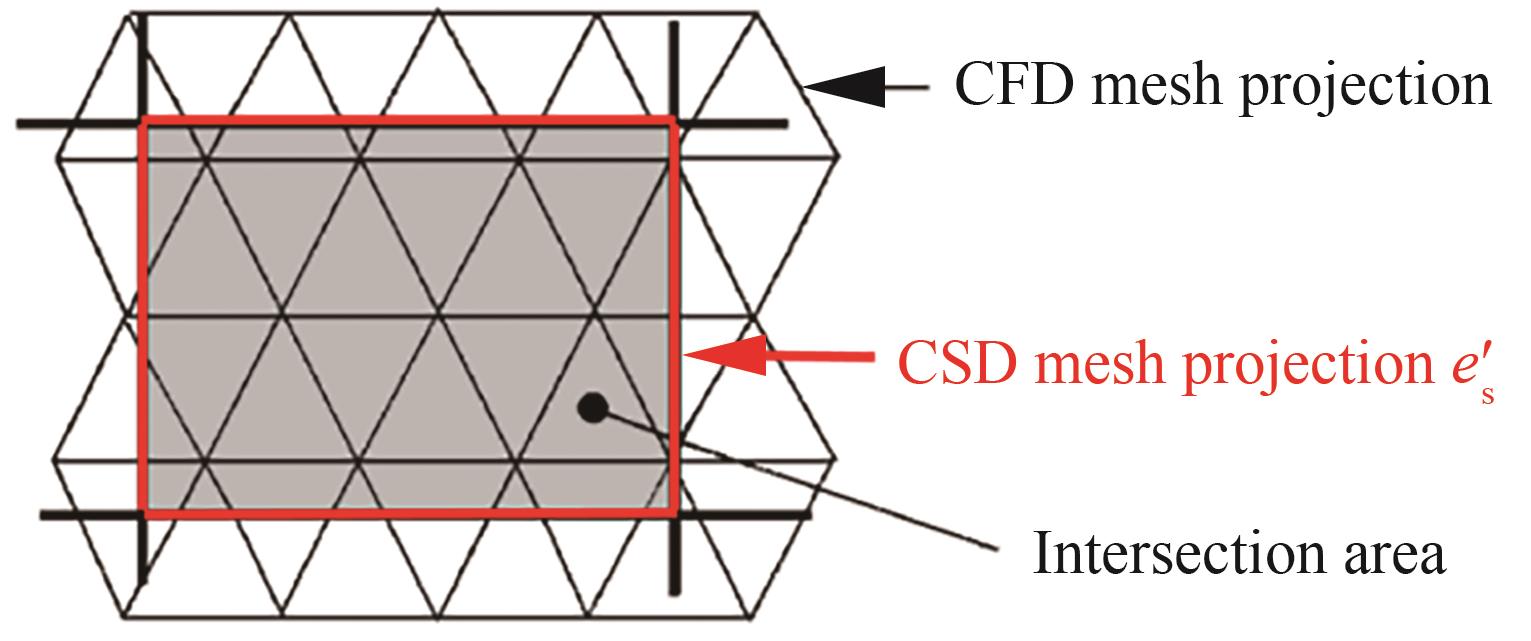
Fig.5
Sutherland-Hodgman clipping algorithm
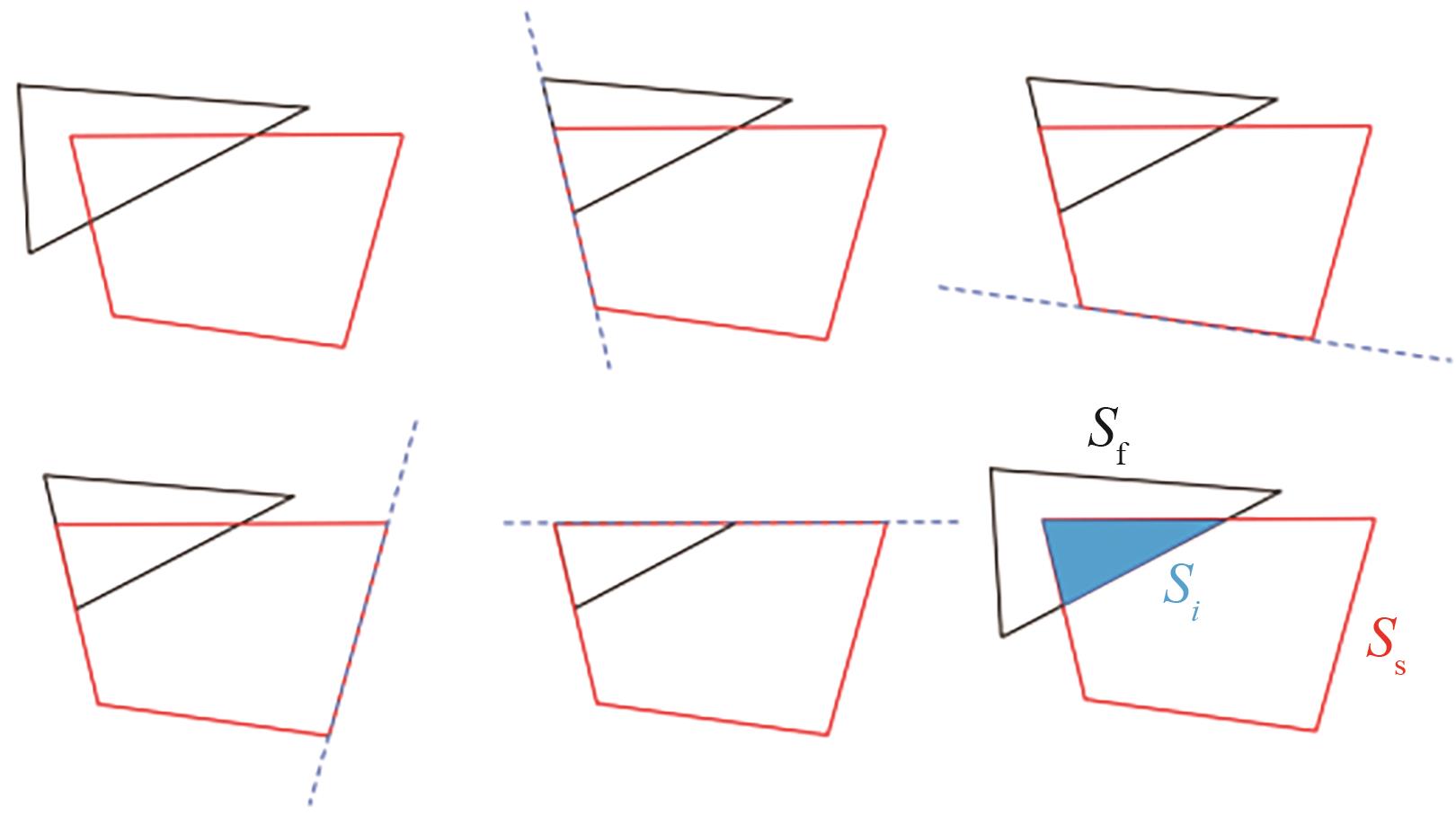
Fig.6
Solutions of cyclic transfers of Runge function up to 64 iterations
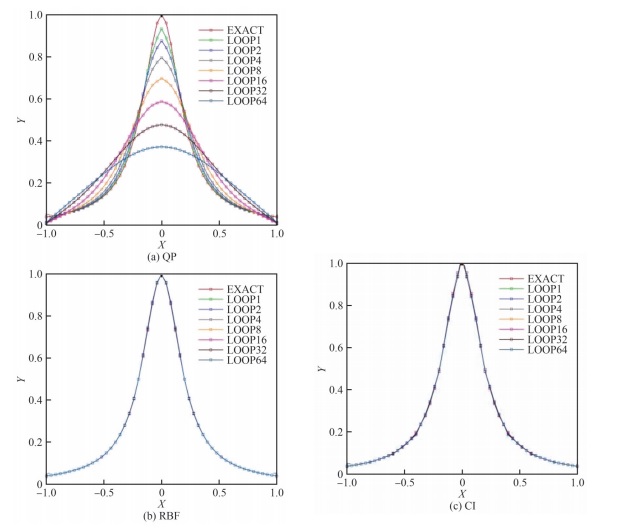
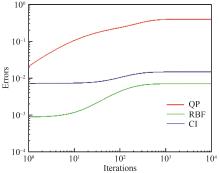
Fig.7
Errors in cyclic transfer of Runge function
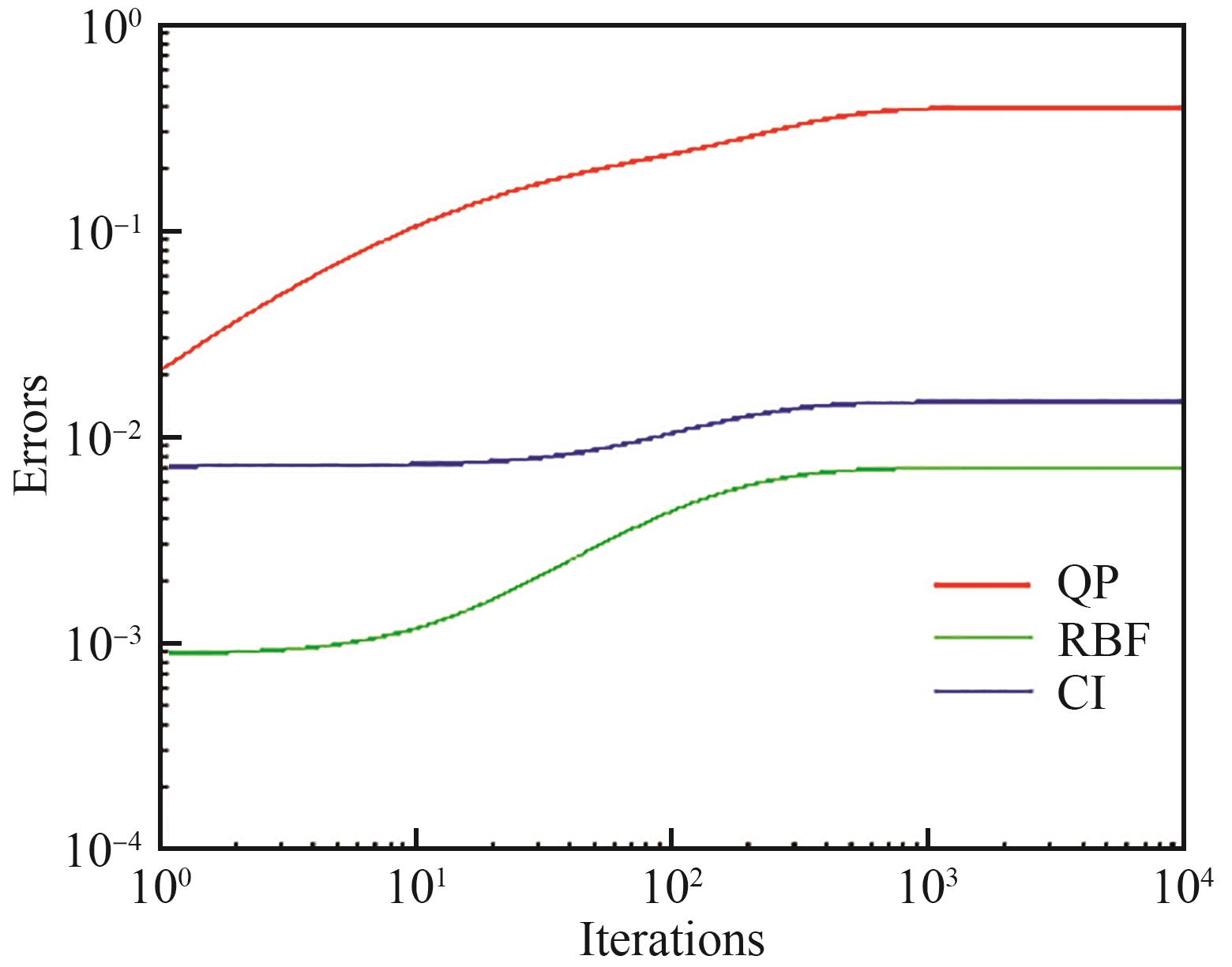
Fig.8
Triangular meshes for fluid and solid domains
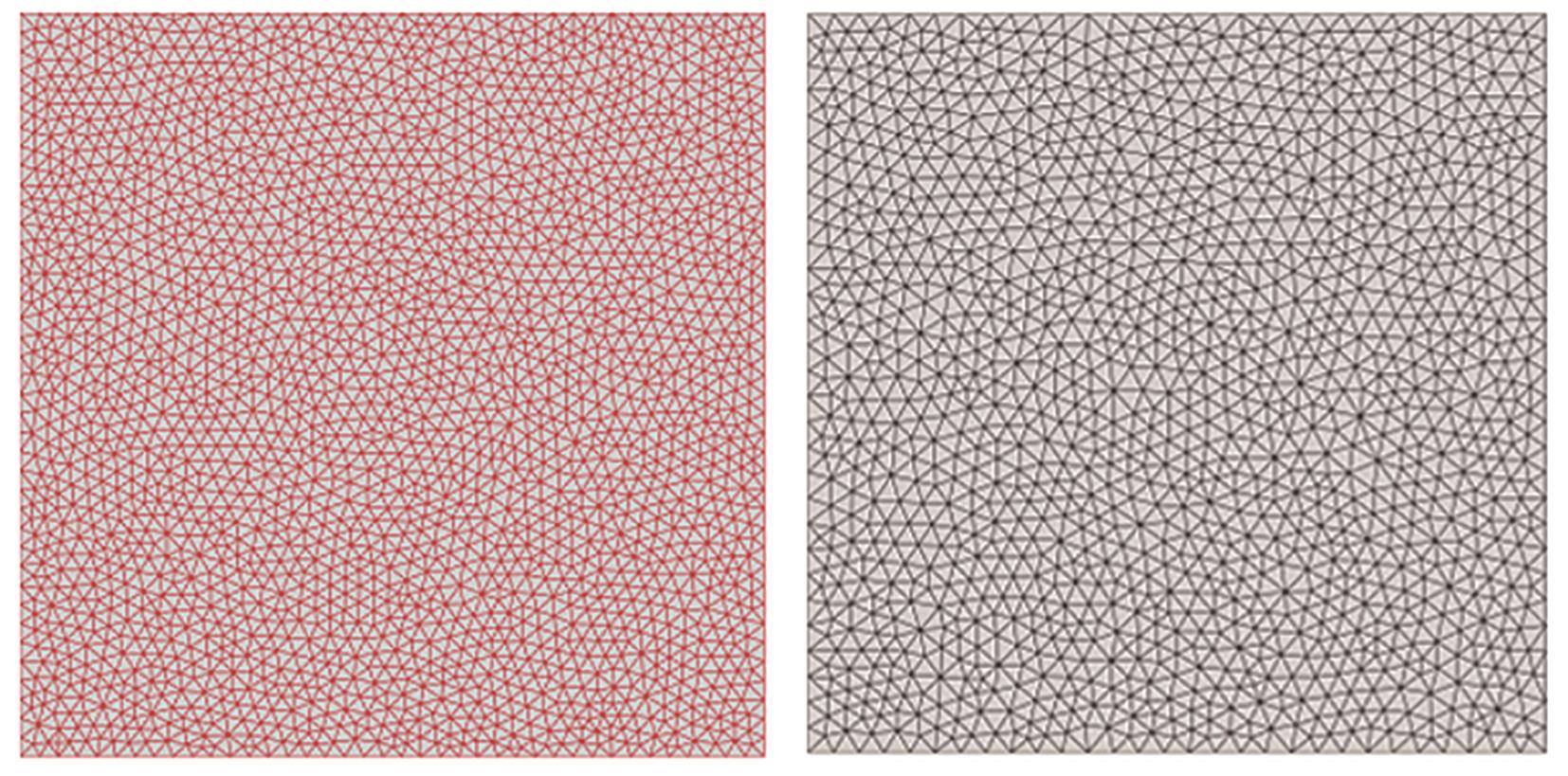
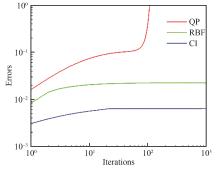
Fig.9
Errors in cyclic transfers of 2D discontinuous function
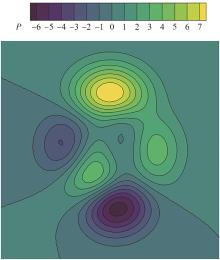
Fig.10
High order distribution functions
Fig.11
Contours of functions on fluid mesh after 64 iterations
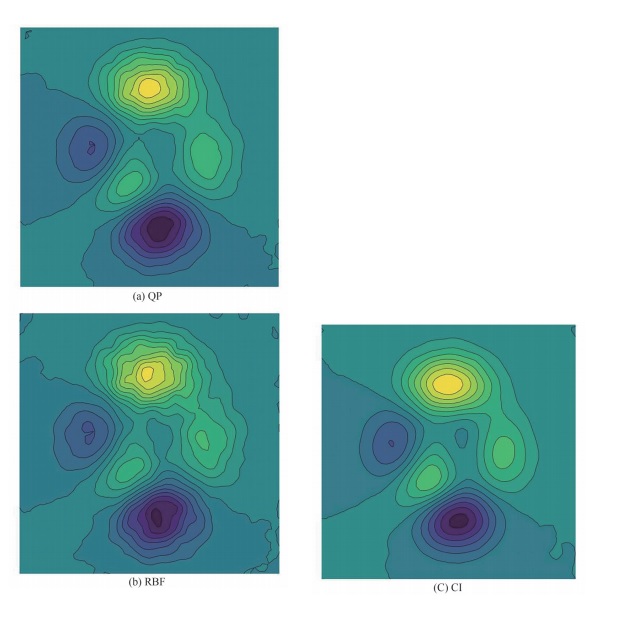
Fig.12
Errors in cyclic transfers of high order functions
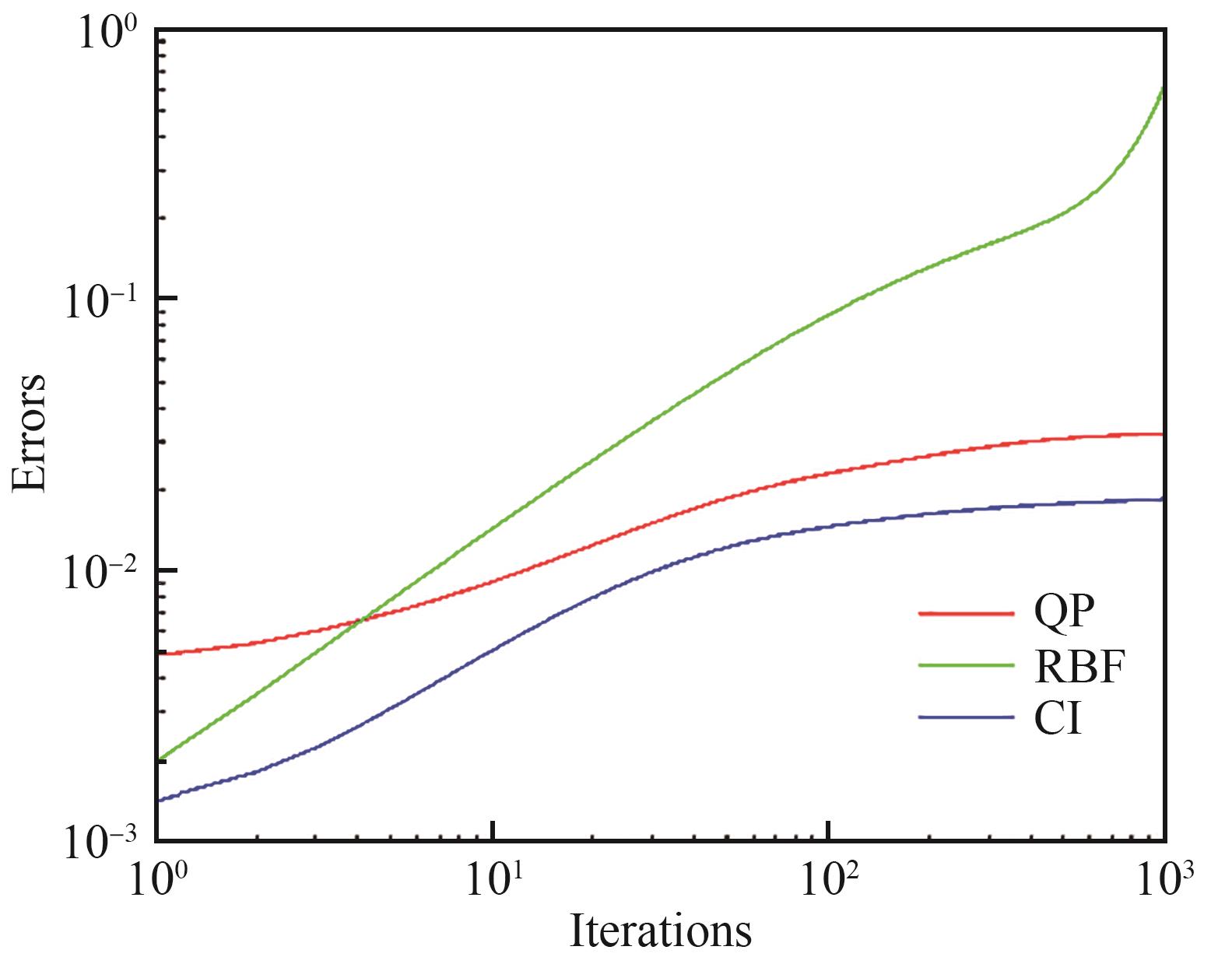
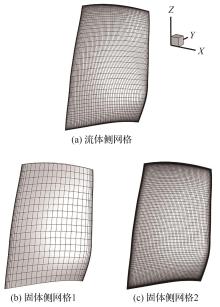
Fig.13
Blade surface meshes of CFD and FEM
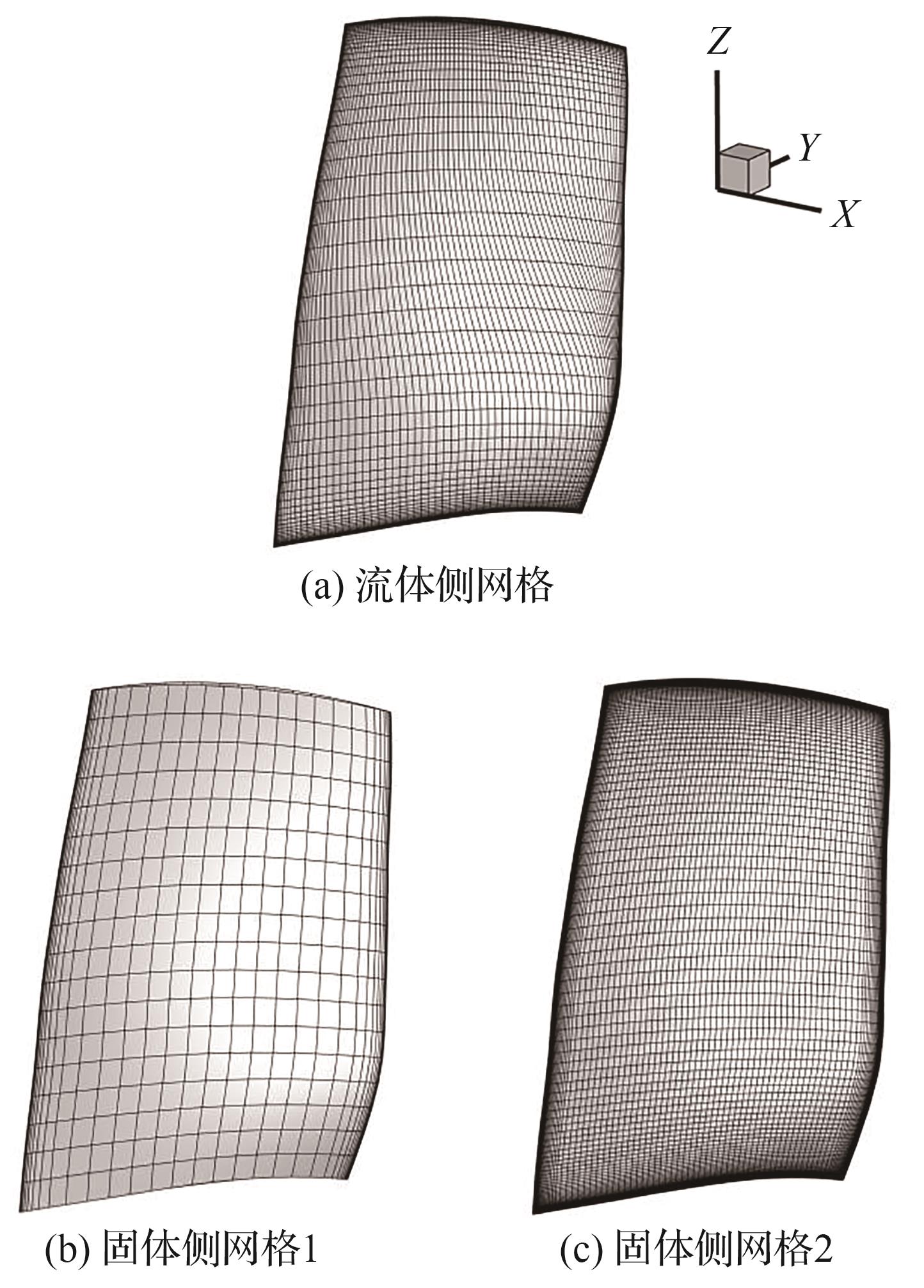
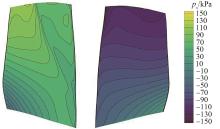
Fig.14
Axial pressure distributions on section and pressure sides of blade in fluid domains
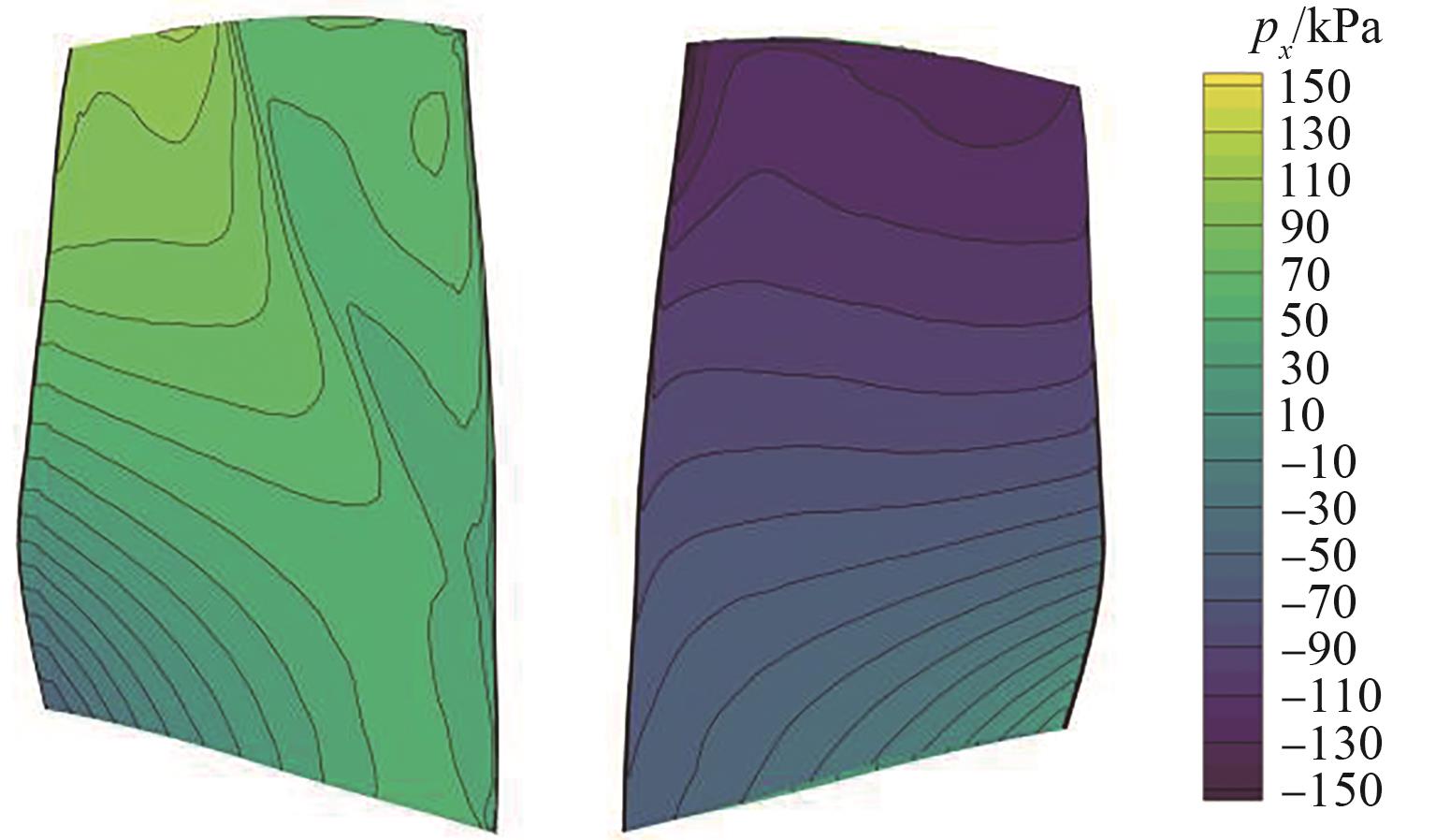
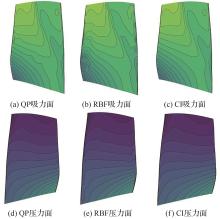
Fig.15
Axial pressure distributions on section and pressure sides of blade in FEM mesh 1
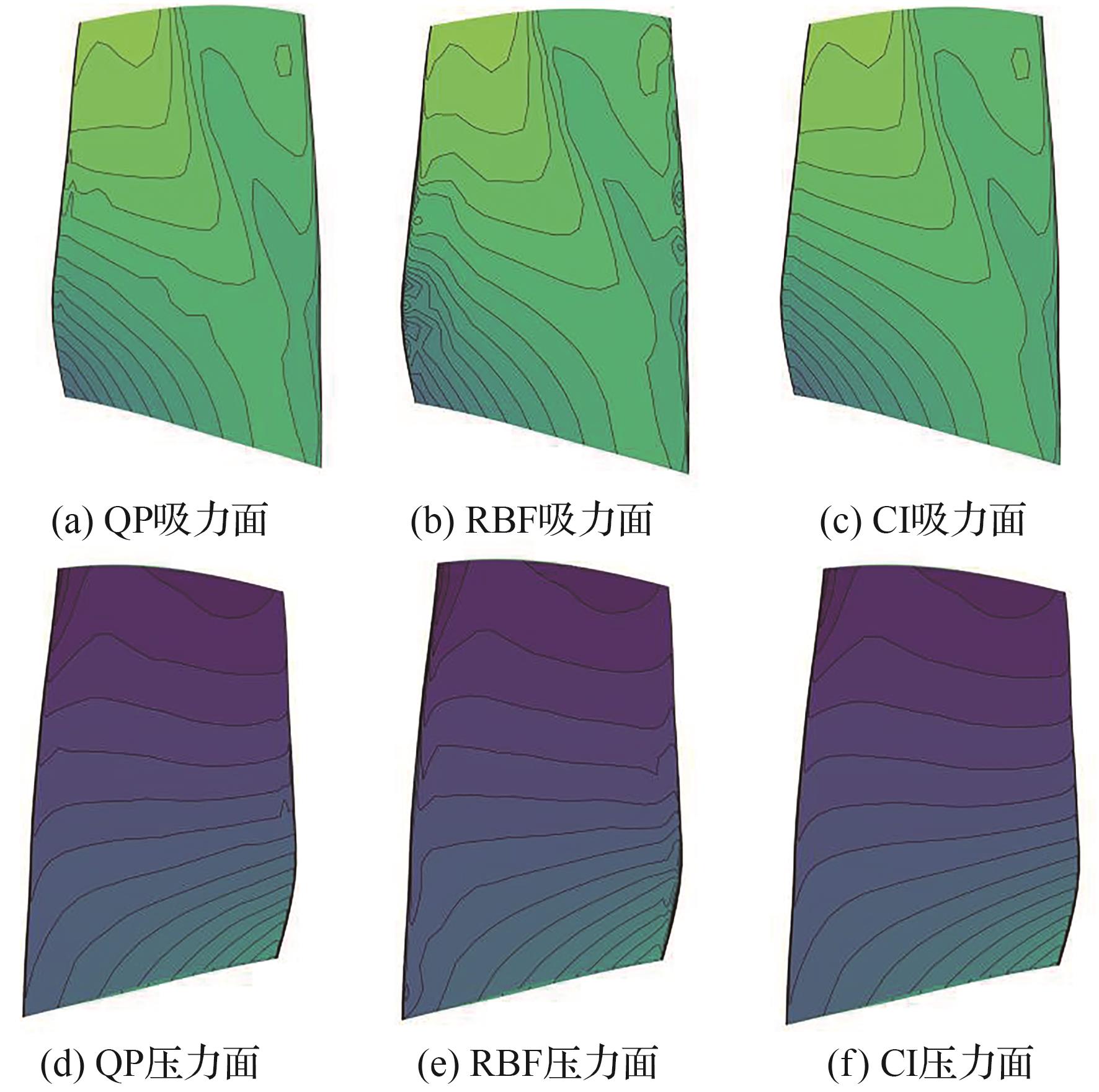
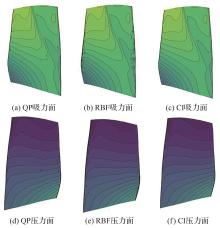
Fig.16
Axial pressure distributions on section and pressure sides of blade in FEM mesh 2
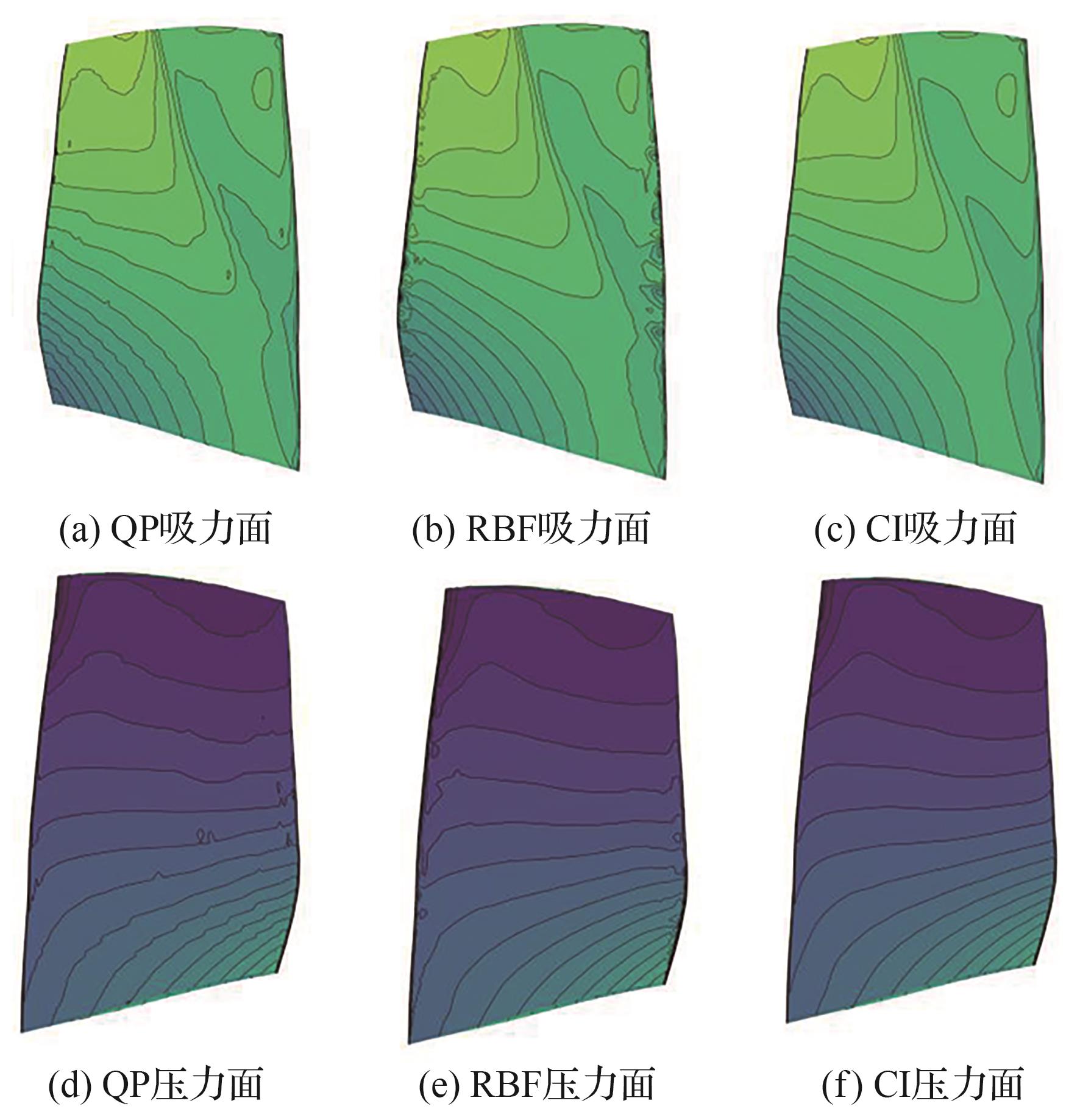

Table 1
Comparison of force and momentum in solid side by different methods (Rotor67, FEM mesh 1)
| 参数 | CFD | QP | Error of QP/% | RBF | Error of RBF/% | CI | Error of CI/% |
|---|---|---|---|---|---|---|---|
| -299.80 | -300.20 | 0.134 | -304.46 | 1.55 | -299.80 | 0 | |
| 210.66 | 211.84 | 0.559 | 212.45 | 0.850 | 210.66 | 0 | |
| -38.160 | -38.634 | 1.24 | -39.589 | 3.74 | -38.160 | 0 | |
| 38.104 | 38.246 | 0.371 | 38.387 | 0.743 | 38.089 | -0.038 9 | |
| -62.344 | -62.389 | 0.072 9 | -63.072 | 1.17 | -62.315 | -0.046 6 | |
| -0.386 27 | -0.370 54 | -4.07 | -0.680 96 | 76.3 | -0.385 71 | -0.146 |
Table 2
Comparison of force and momentum in solid side by different methods (Rotor67, FEM mesh 2)
| 参数 | CFD | QP | Error of QP/% | RBF | Error of RBF/% | CI | Error of CI/% |
|---|---|---|---|---|---|---|---|
| -299.80 | -299.41 | -0.131 | -299.36 | -0.146 | -299.80 | 0 | |
| 210.66 | 210.19 | -0.222 | 209.34 | -0.625 | 210.66 | 0 | |
| -38.160 | -37.926 | -0.613 | -37.424 | -1.93 | -38.160 | 0 | |
| 38.104 | 38.035 | -0.182 | 37.932 | -0.451 | 38.097 | -0.018 1 | |
| -62.344 | -62.266 | -0.141 | -62.161 | -0.293 | -62.333 | -0.016 6 | |
| -0.386 27 | -0.402 93 | 4.31 | -0.635 26 | 64.5 | -0.385 55 | -0.186 |
Table 3
Data transfer time for different methods
| 算例 | CPU时间/s | ||
|---|---|---|---|
| QP | RBF | CI | |
| 网格1 | 4.84 | 3.75 | 0.76 |
| 网格2 | 127.07 | 49.41 | 14.32 |
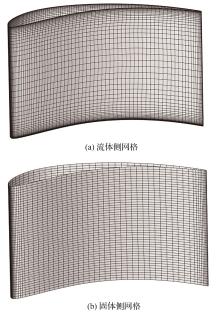
Fig.17
Blade surface mesh of CFD and FEM
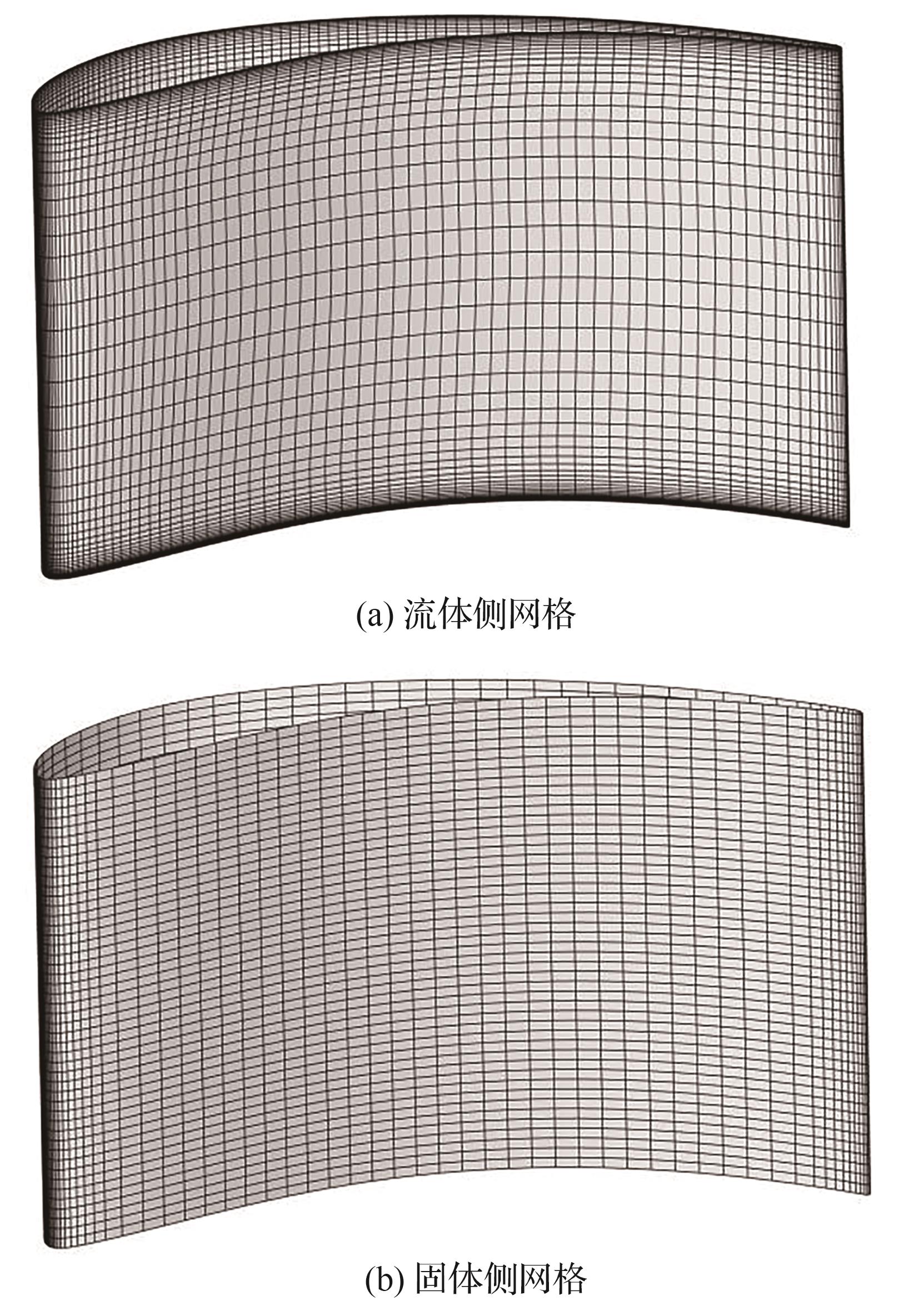
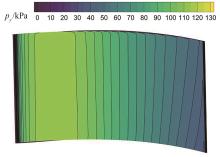
Fig.18
Pressure distributions on pressure side of blade y-direction in fluid domains
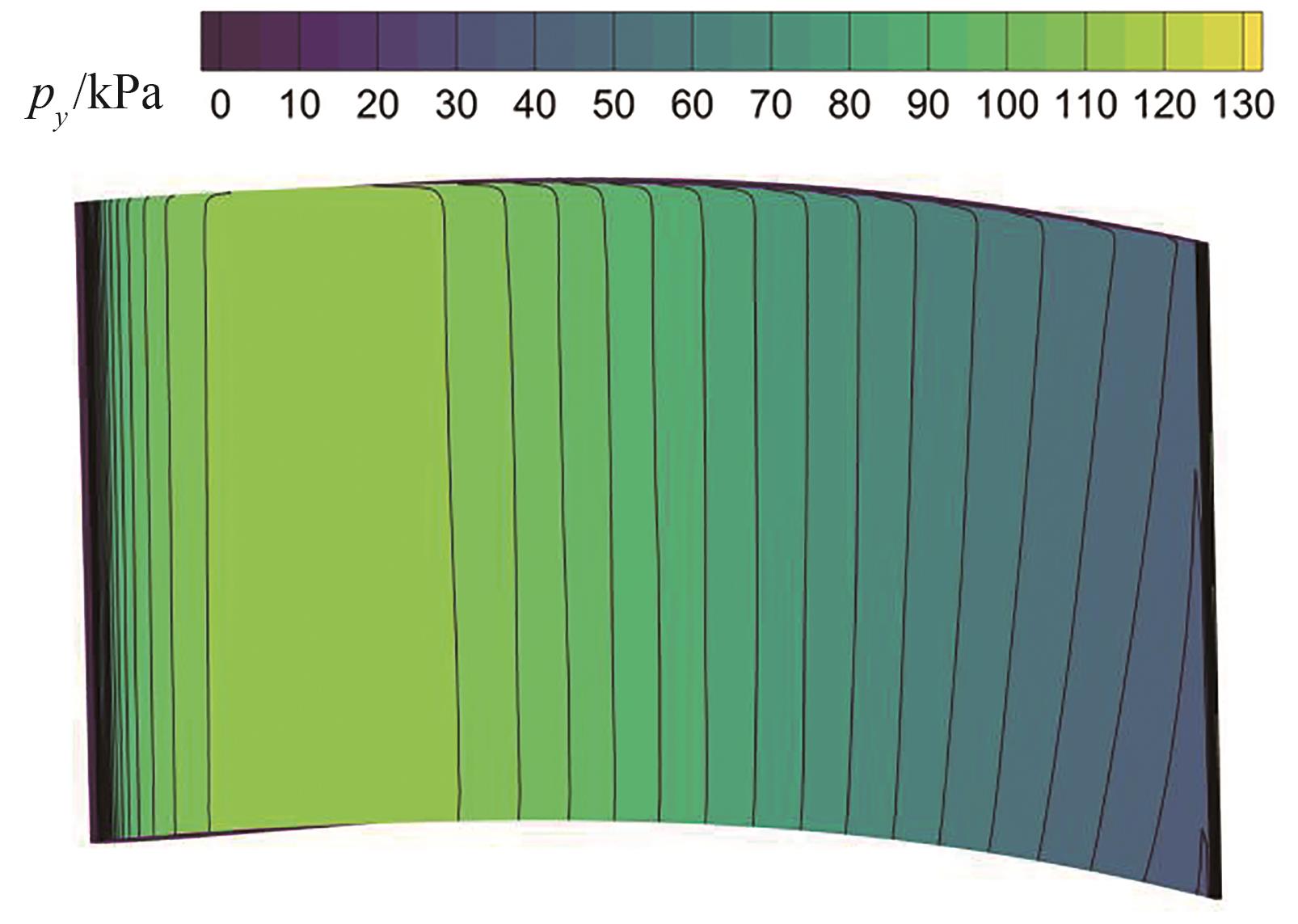
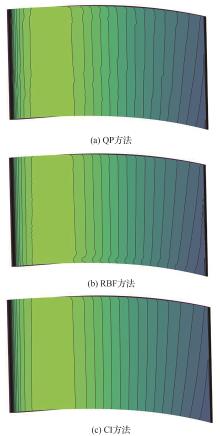
Fig.19
Pressure distributions on pressure side of blade y-direction in FEM mesh
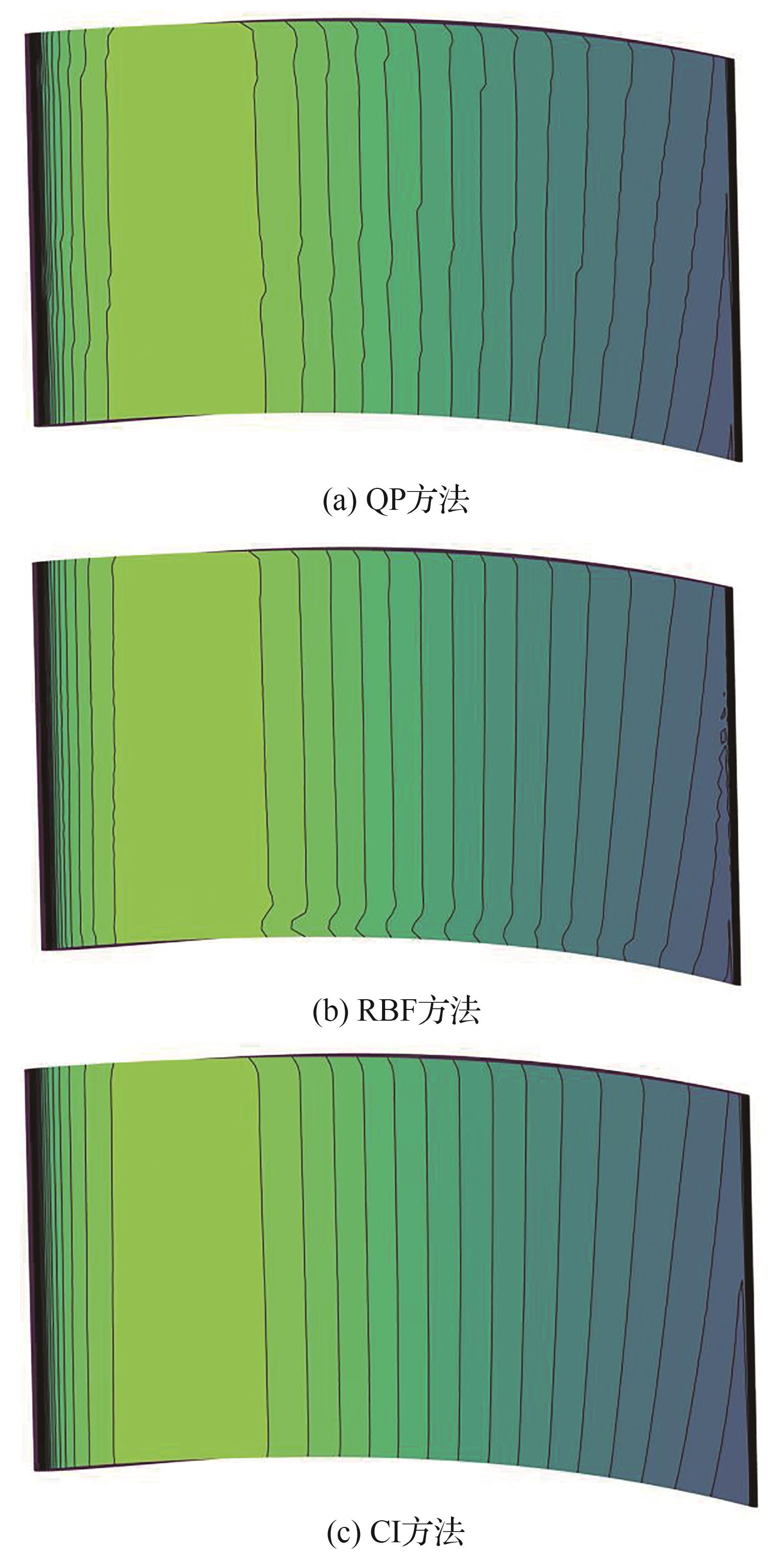
Table 4
Comparison of force and momentum in solid side by different methods (STCF4)
| 参数 | CFD | QP | Error of QP/% | RBF | Error of RBF/% | CI | Error of CI/% |
|---|---|---|---|---|---|---|---|
| 118.97 | 119.26 | 0.243 | 118.84 | -0.111 | 118.97 | 0 | |
| 59.166 | 59.103 | -0.108 | 58.758 | -0.646 | 59.167 | 0 | |
| 0.039 220 | 0.038 948 | -0.693 | 0.035 064 | -10.6 | 0.039 220 | 0 | |
| 10.572 | 10.557 | -0.141 | 10.503 | -0.651 | 10.572 | 0.001 00 | |
| 21.218 | 21.268 | 0.237 | 21.197 | -0.097 6 | 21.218 | 0.001 00 | |
| -7.052 1 | -7.067 1 | 0.212 | -7.030 7 | -0.304 | -7.052 7 | 0.008 25 |
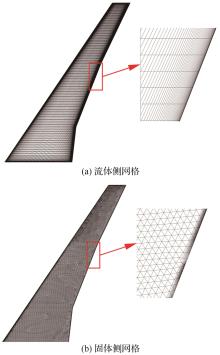
Fig.20
Hirenasd wing surface meshes of CFD and FEM
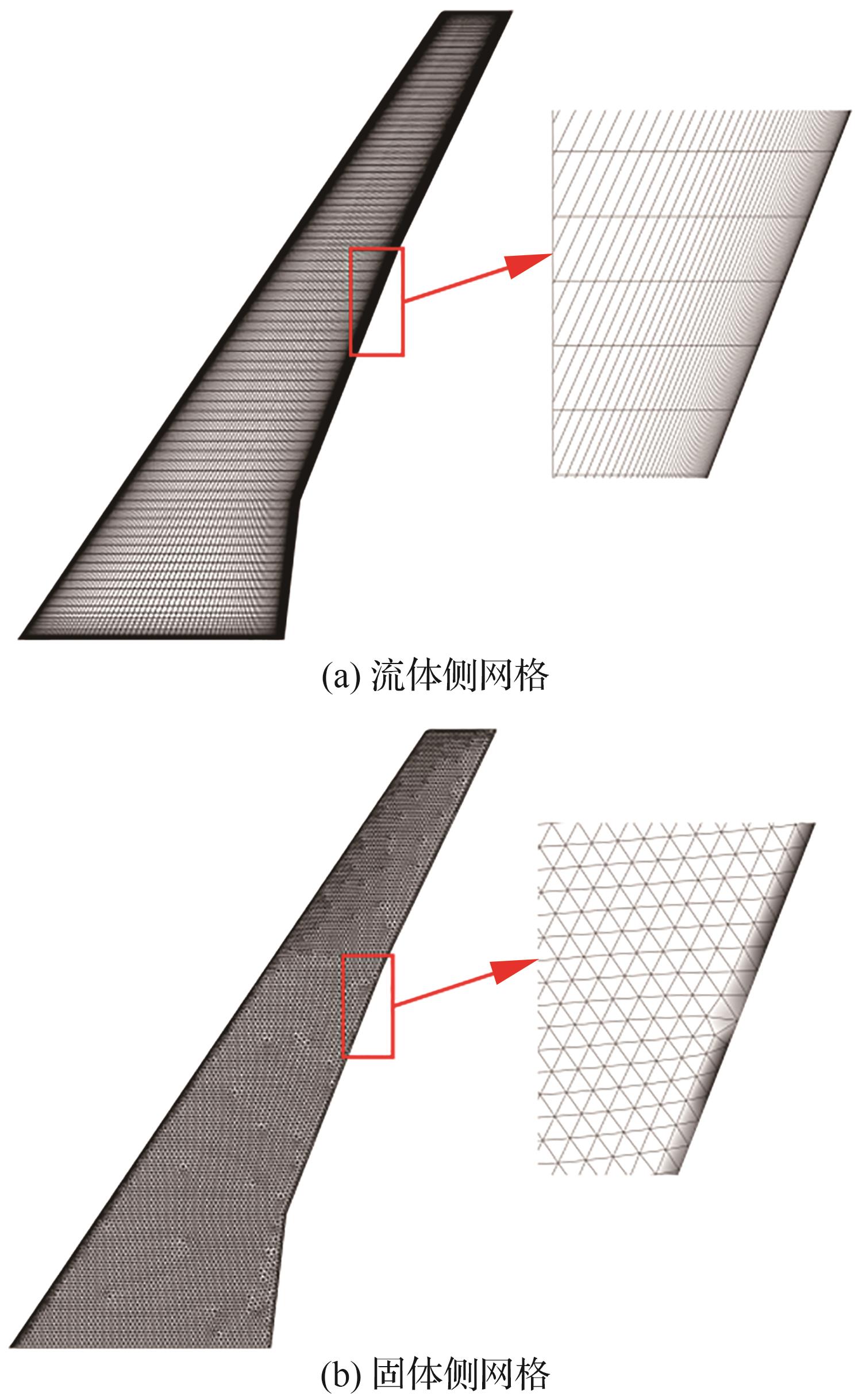
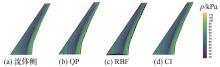
Fig.21
Pressure distribution on upper surface of wing
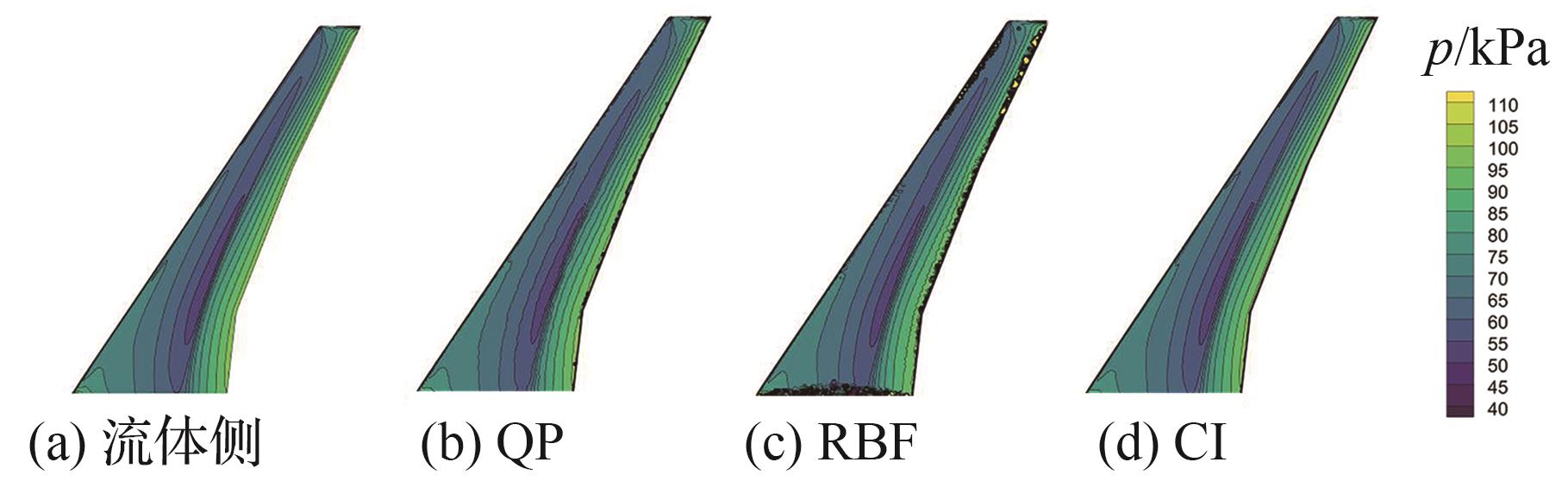
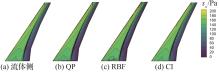
Fig.22
Viscous force distribution on upper surface of wing
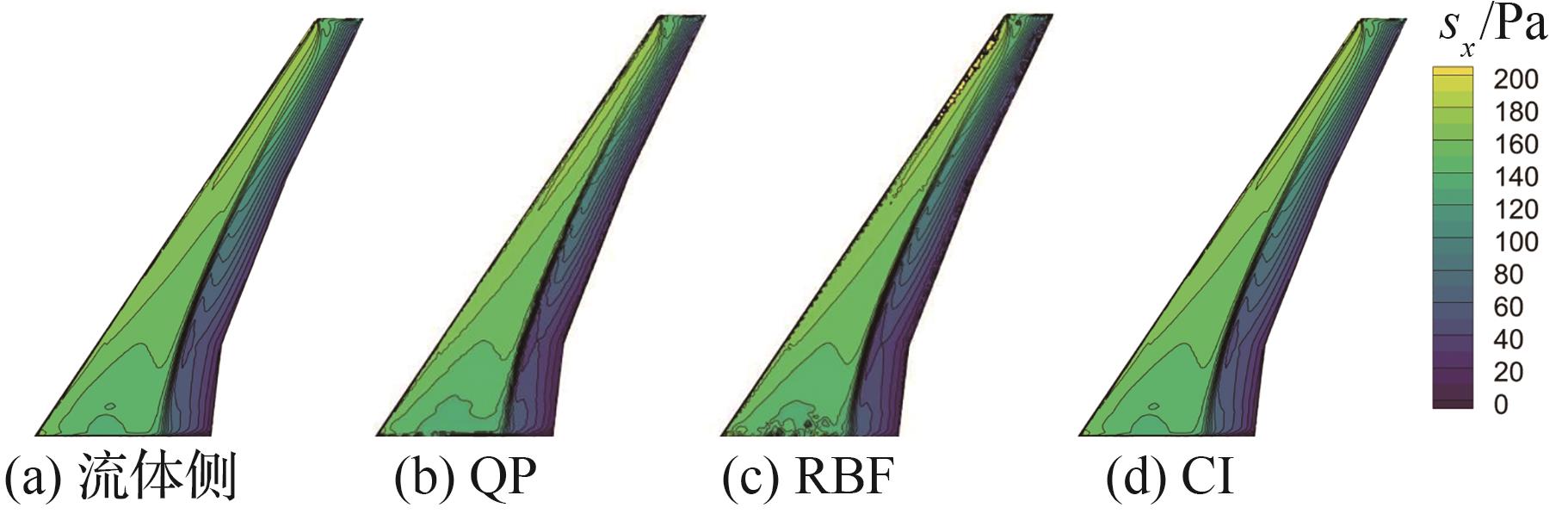
Table 5
Comparison of force and momentum in solid side by different methods (Hirenasd wing)
| 参数 | CFD | QP | Error of QP/% | RBF | Error of RBF/% | CI | Error of CI/% |
|---|---|---|---|---|---|---|---|
| 102.70 | 754.75 | 635 | 805.12 | 684 | 102.70 | 0 | |
| -2 299.3 | -2 736.4 | 19.0 | -2 767.7 | 20.4 | -2 299.3 | 0 | |
| 5 710.1 | 5 877.5 | 2.93 | 6 119.5 | 7.17 | 5 710.1 | 0 | |
| 3 331.9 | 3 368.2 | 1.09 | 3 553.0 | 6.64 | 3 332.0 | 0.003 14 | |
| 3 083.9 | 3 155.7 | 2.33 | 3 345.5 | 8.48 | 3 084.7 | 0.025 9 | |
| -486.92 | -654.47 | 34.4 | -655.87 | 34.7 | -487.5 | 0.119 |
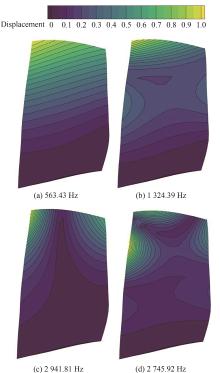
Fig.23
Total modal deformation of the 1st four frequency of Rotor67
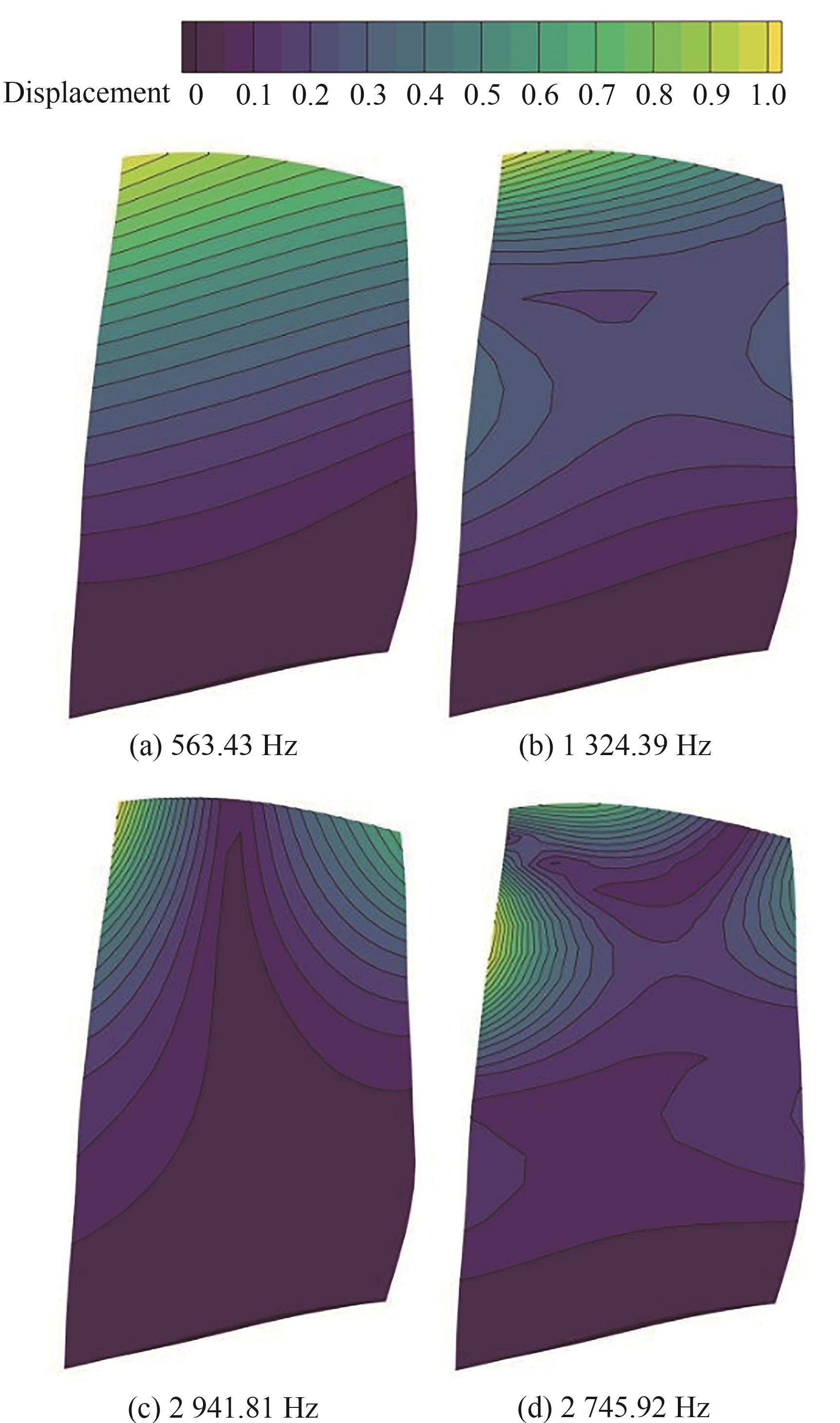
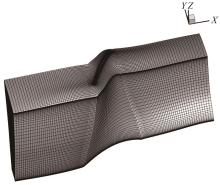
Fig.24
Fluid mesh of Rotor67
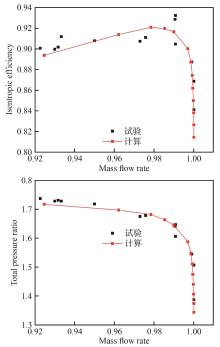
Fig.25
Predicted speedline of NASA Rotor 67
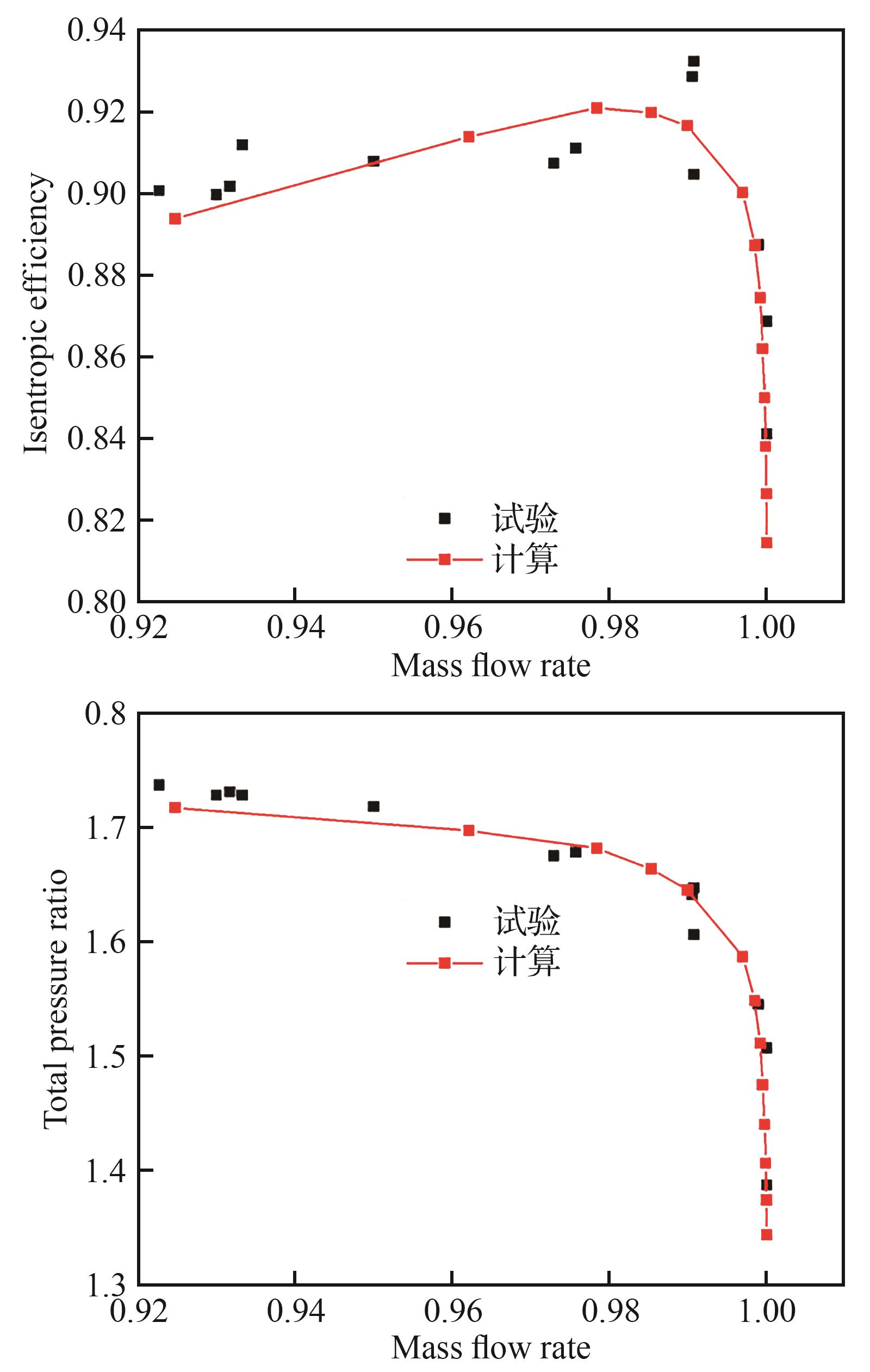
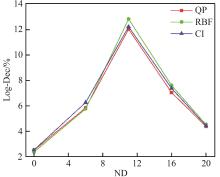
Fig.26
Log-Dec of the 1st bending mode for Rotor67
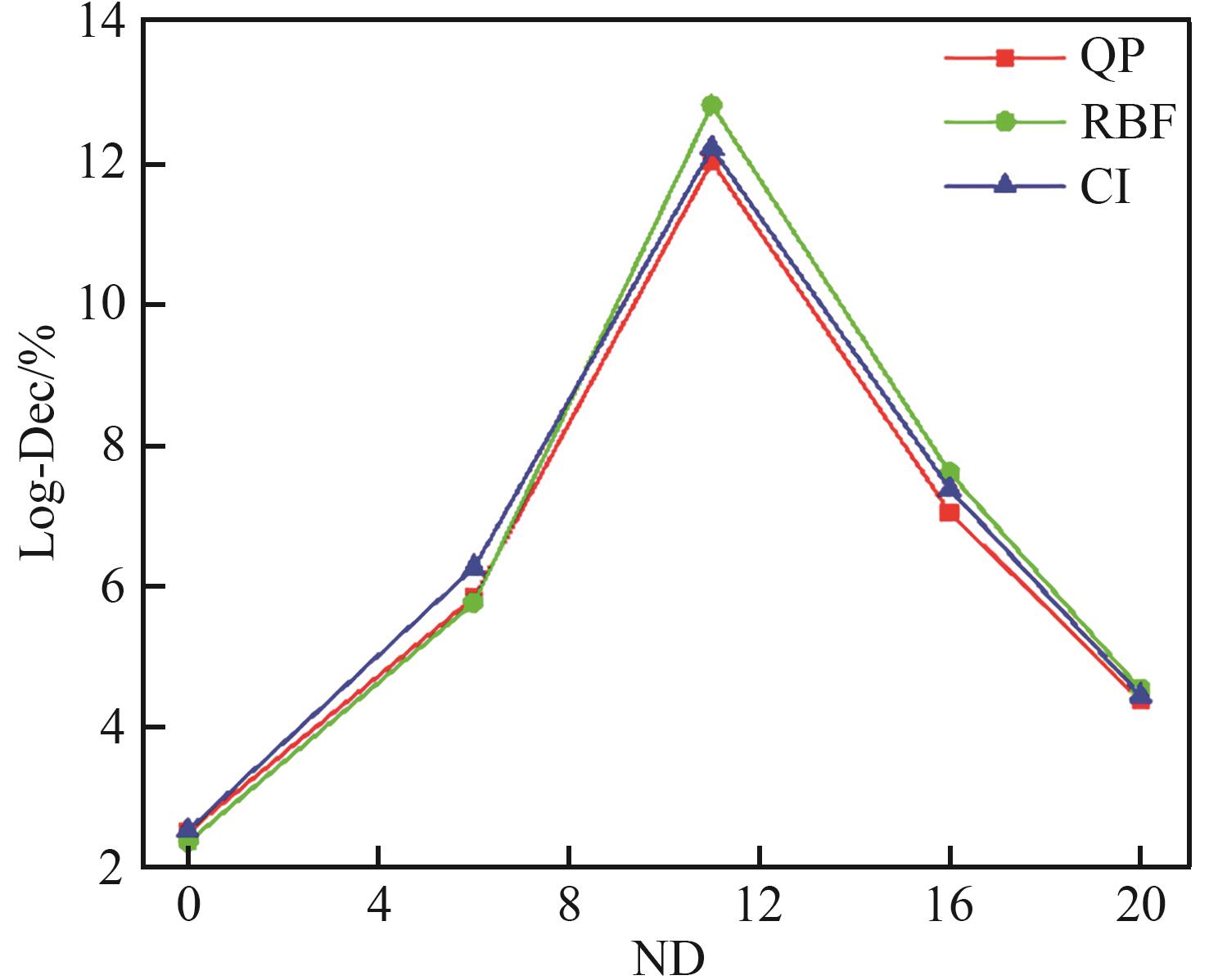
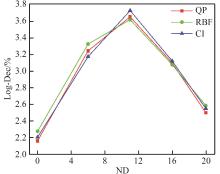
Fig.27
Log-Dec of the 1st torsion mode for Rotor67
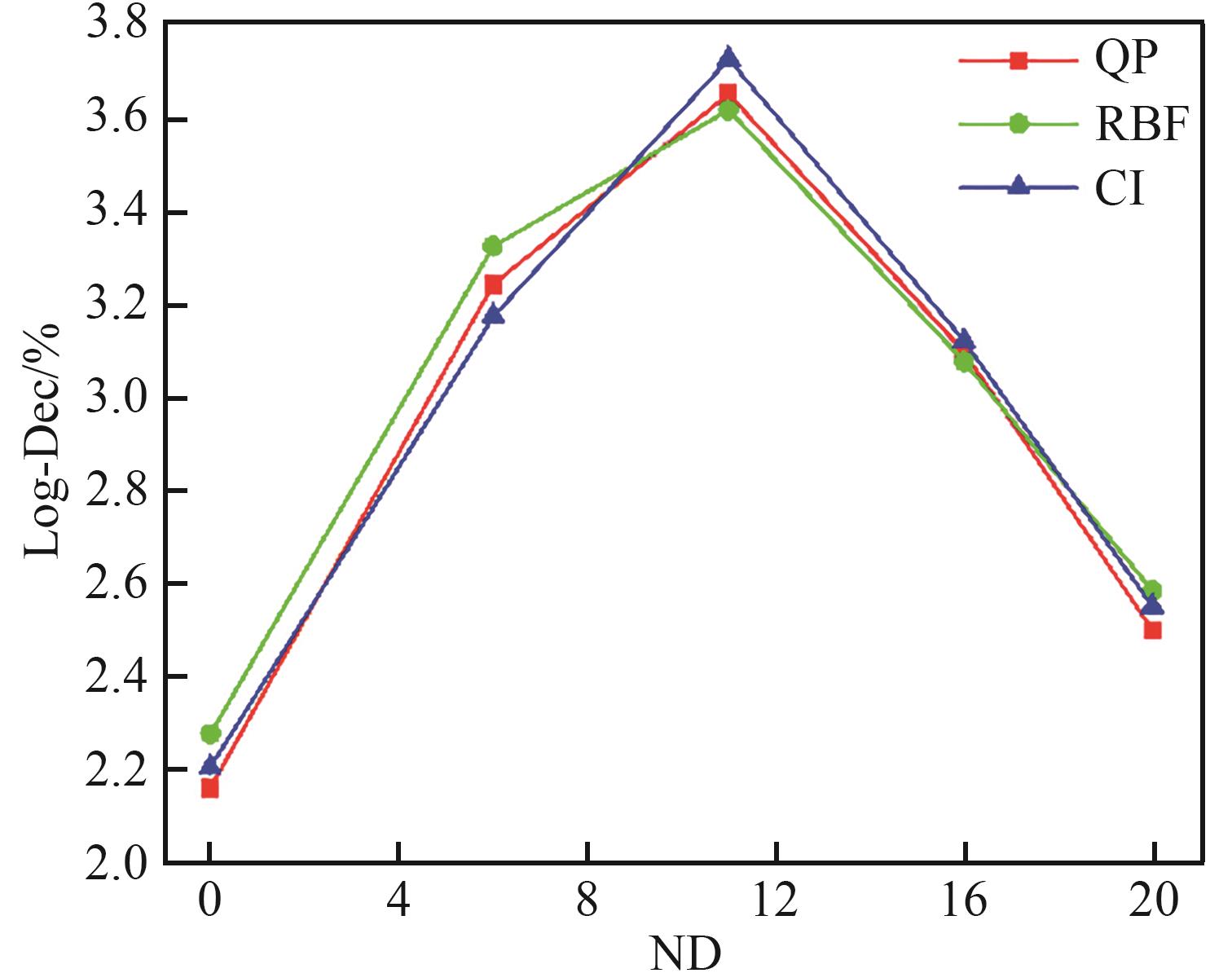
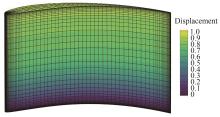
Fig.28
Total modal deformation and FEM mesh of STCF4
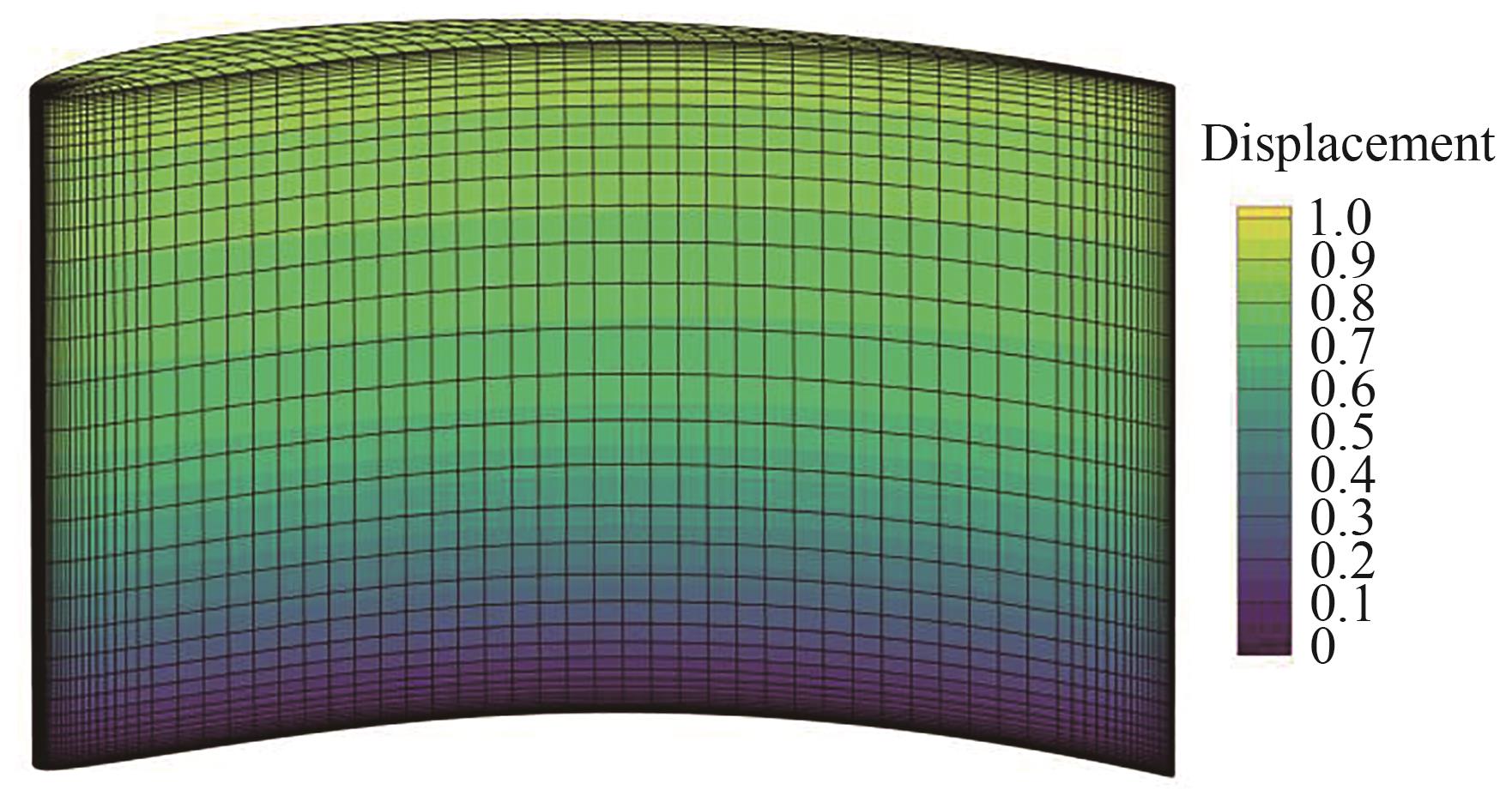
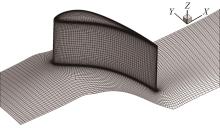
Fig.29
Fluid mesh of STCF4
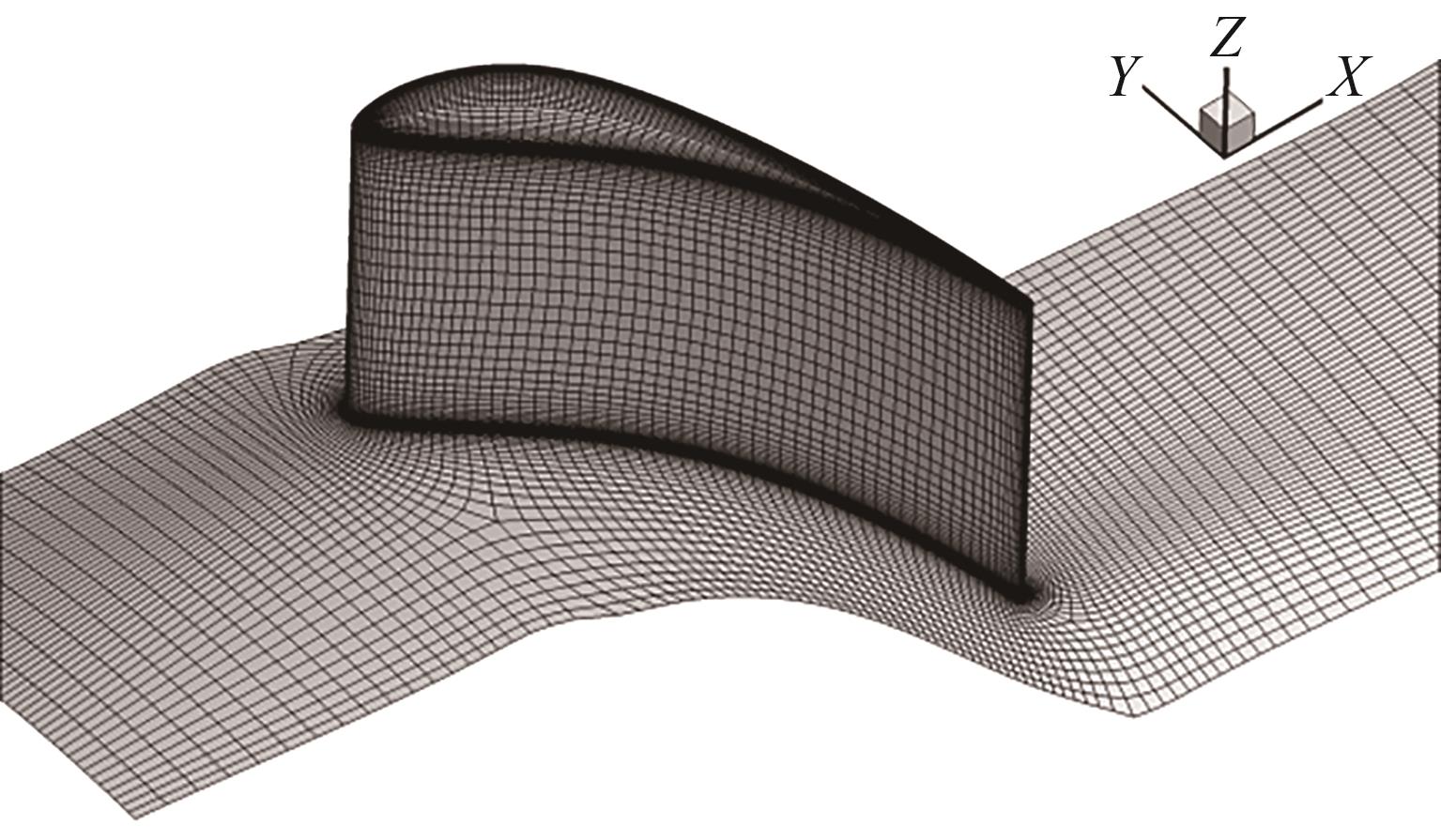
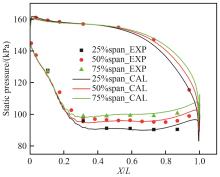
Fig.30
Pressure distributions on STCF4 blade surface
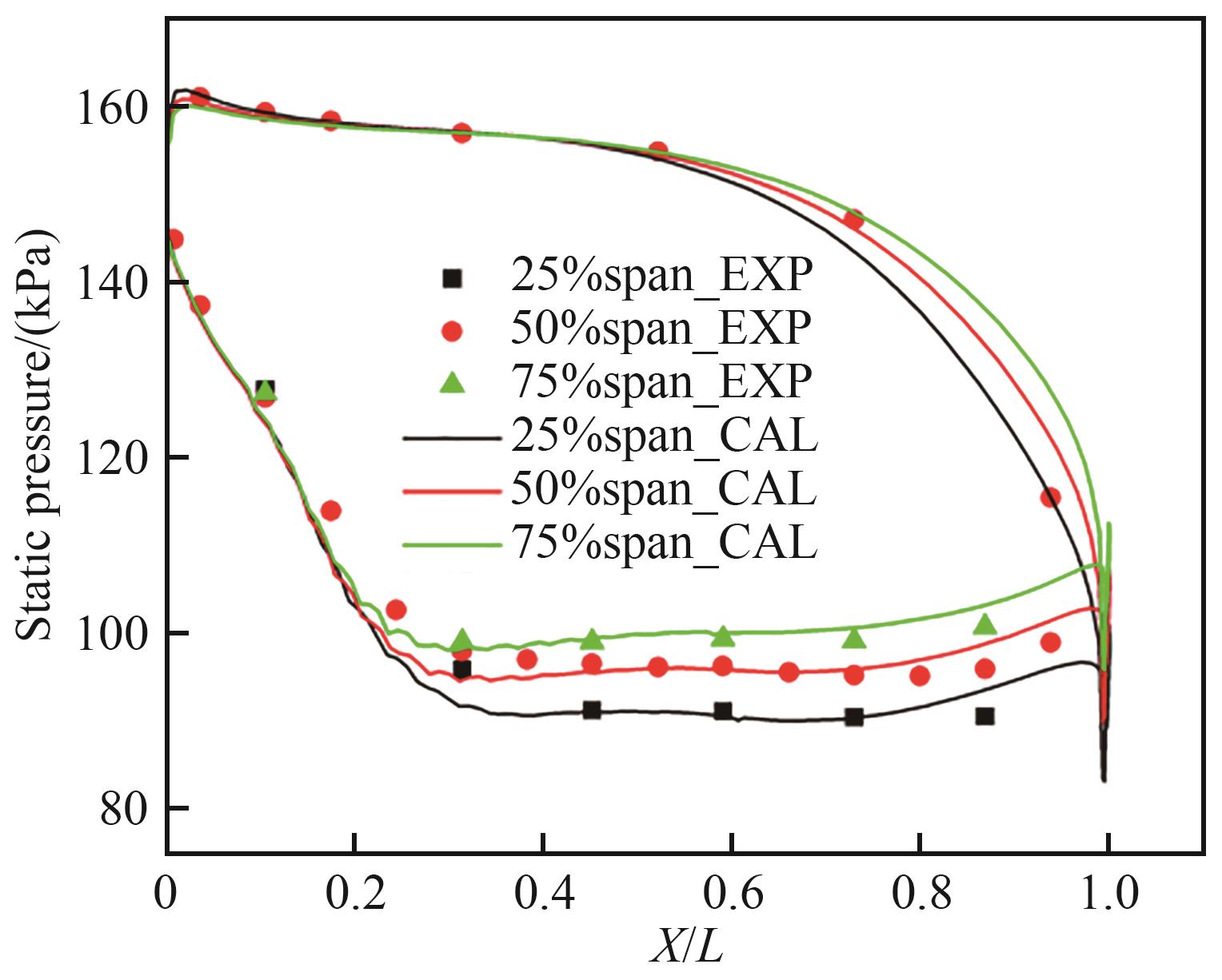
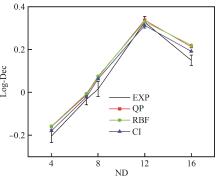
Fig.31
Log-Dec of different methods for STCF4
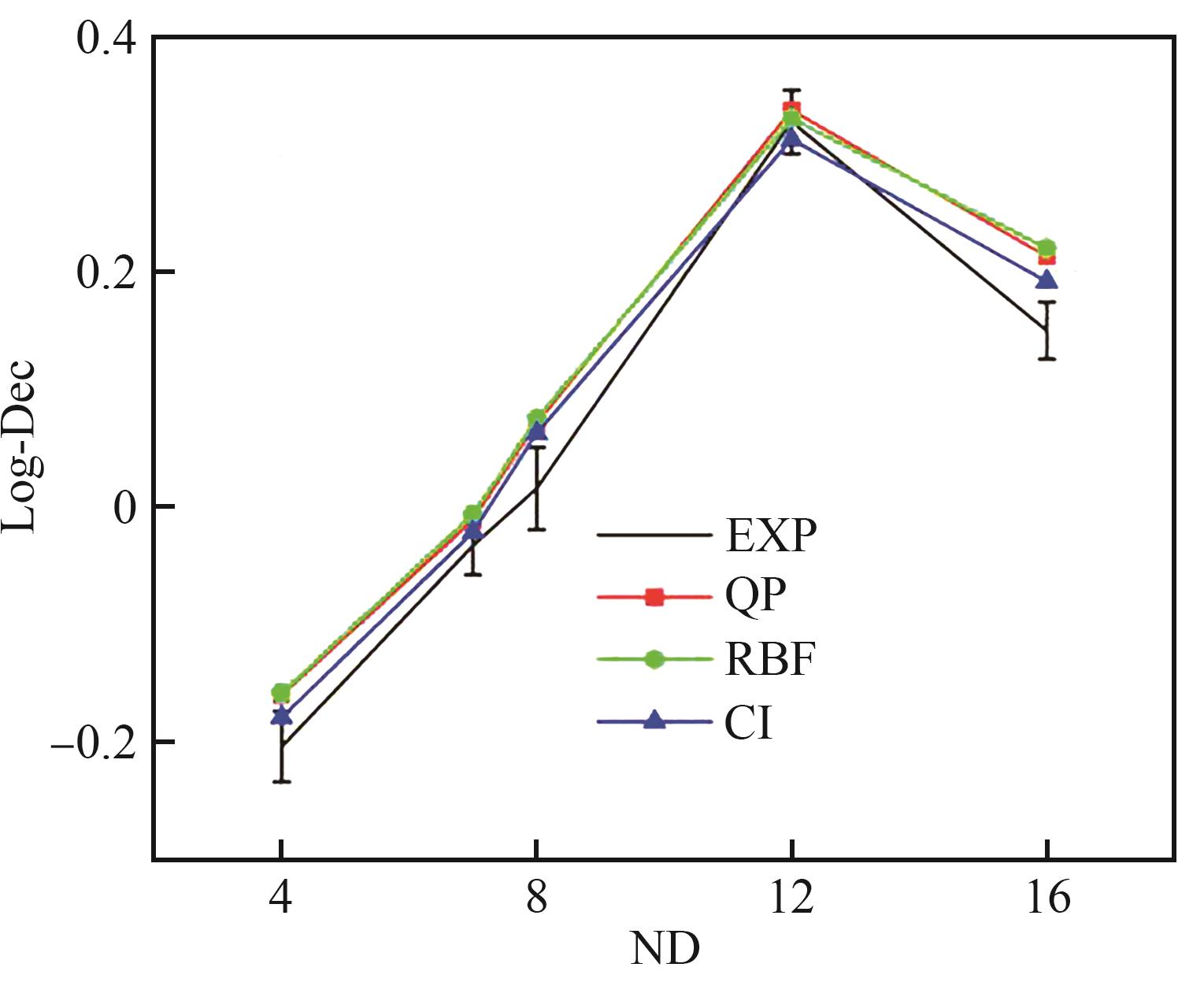
Fig.32
Fluid mesh of Hirenasd wing
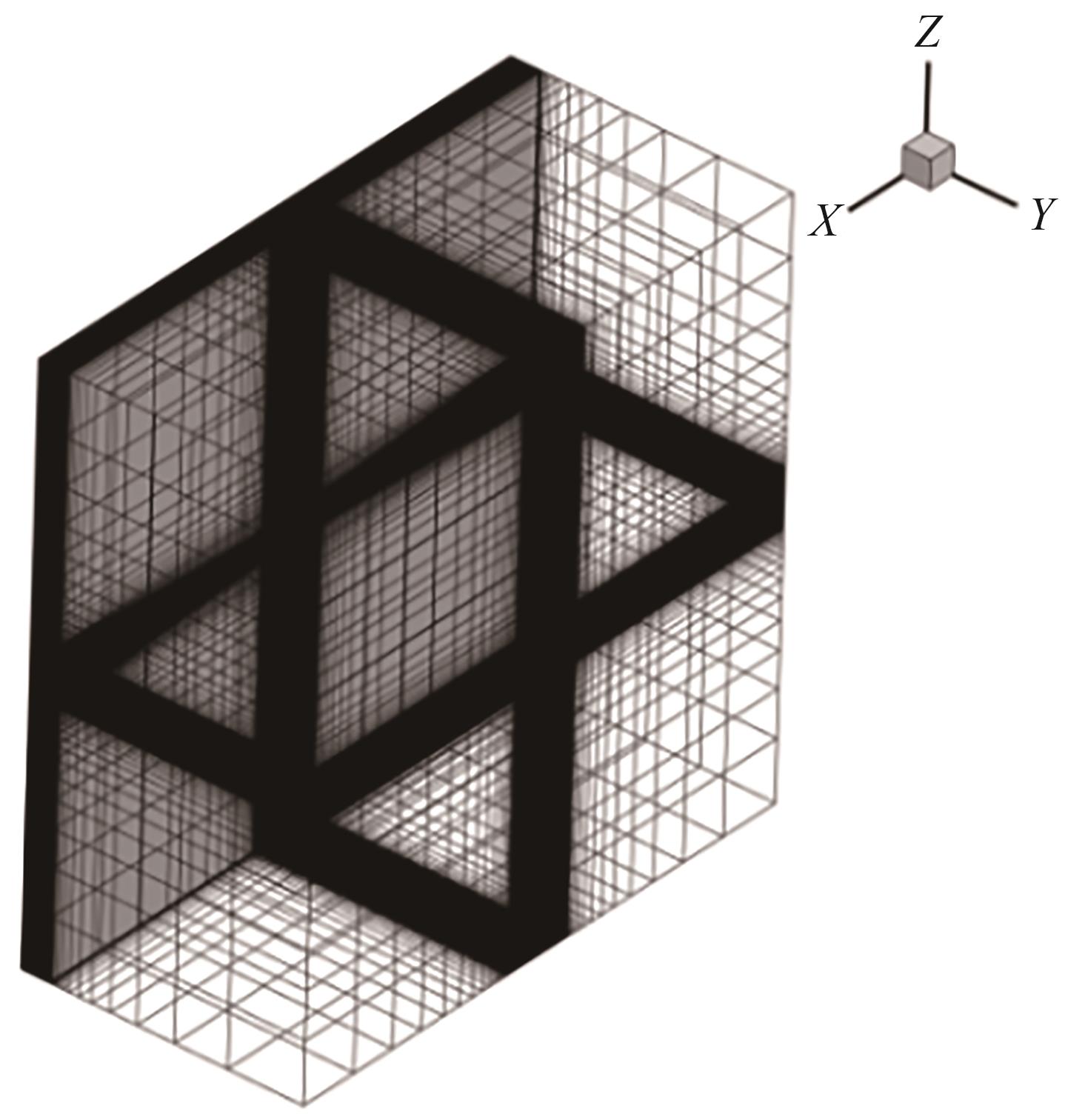
Table 6
The 1st six frequencies of Hirenasd wing
| 模态 | 固有频率/Hz | |
|---|---|---|
| 本文 | 文献[ | |
| 1 | 26.5 | 26.5 |
| 2 | 86.0 | 86.0 |
| 3 | 157.0 | 156.9 |
| 4 | 189.5 | 189.3 |
| 5 | 272.9 | 272.9 |
| 6 | 322.2 | 321.8 |
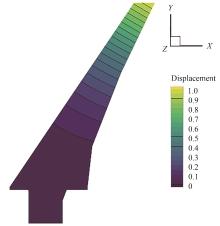
Fig.33
The 1st bending mode of Hirenasd wing
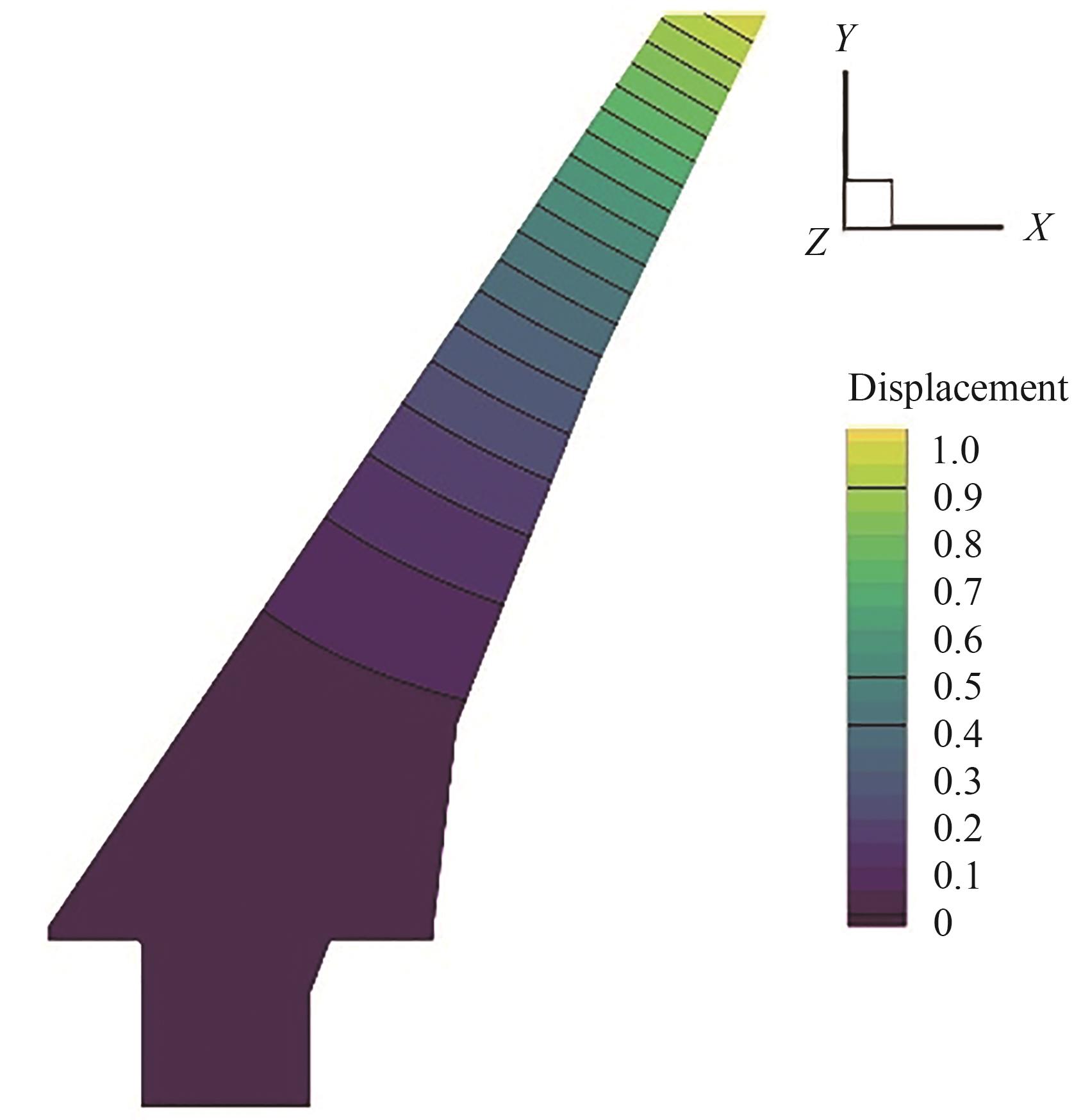
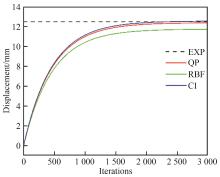
Fig.34
Deformation of leading edge on Hirenasd wing tip
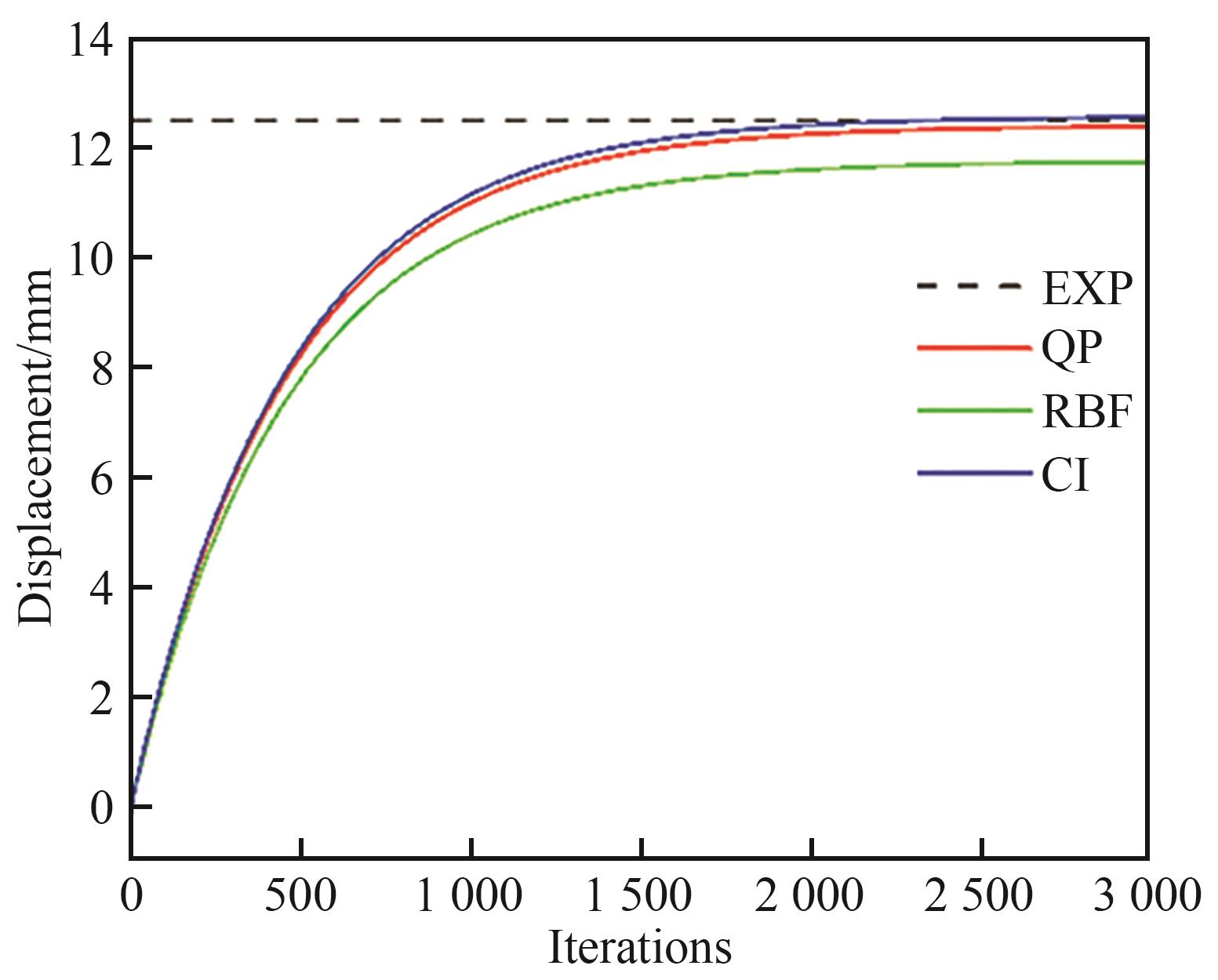
Table 7
Lift and drag coefficients of Hirenasd wing
| 参数 | QP | RBF | CI | 文献[ |
|---|---|---|---|---|
| 0.333 3 | 0.332 6 | 0.334 2 | 0.336 6 | |
| 0.014 7 | 0.014 8 | 0.014 7 | 0.014 7 |
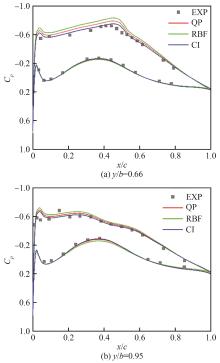
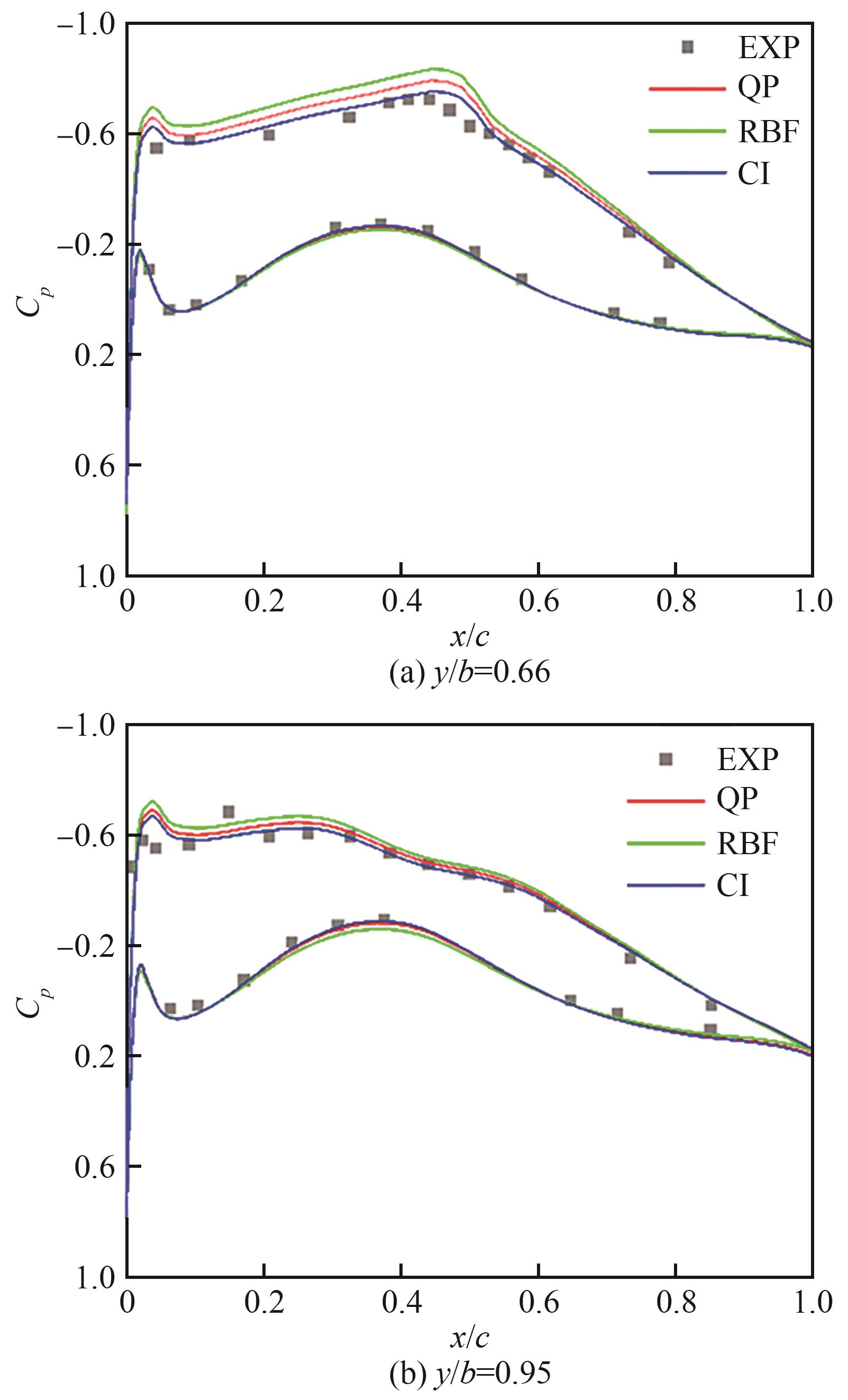
Fig.35
Comparison of experiment and calculated results with different methods of pressure coefficient at different positions
| [1] | 宋兆泓. 航空发动机典型故障分析[M]. 北京: 北京航空航天大学出版社, 1993: 59-60. |
| SONG Z H. Typical fault analysis of aero-engine[M]. Beijing: Beijing University of Aeronautics & Astronautics Press, 1993: 59-60 (in Chinese). | |
| [2] | SAIZ G. Turbomachinery aeroelasticity using a time-linearised multi blade-row approach[D]. London: University of London, 2008: 28. |
| [3] | 李其汉, 王延荣, 王建军. 航空发动机叶片高循环疲劳失效研究[J]. 航空发动机, 2003, 29(4): 16-18, 41. |
| LI Q H, WANG Y R, WANG J J. Investigation of high cycle fatigue failures for the aero engine blades[J]. Aeroengine, 2003, 29(4): 16-18, 41 (in Chinese). | |
| [4] | ZHANG Z J, ZINGG D W. Efficient monolithic solution algorithm for high-fidelity aerostructural analysis and optimization[J]. AIAA Journal, 2017, 56(3): 1251-1265. |
| [5] | BLOM F J. A monolithical fluid-structure interaction algorithm applied to the piston problem[J]. Computer Methods in Applied Mechanics and Engineering, 1998, 167(3-4): 369-391. |
| [6] | 邢景棠, 周盛, 崔尔杰. 流固耦合力学概述[J]. 力学进展, 1997, 27(1): 19-38. |
| XING J T, ZHOU S, CUI E J. A survey on the fluid solid interaction mechanics[J]. Advances in Mechanics, 1997, 27(1): 19-38 (in Chinese). | |
| [7] | PIPERNO S, FARHAT C. Design of efficient partitioned procedures for the transient solution of aeroelastic problems[J]. Revue Européenne Des Éléments Finis, 2000, 9(6-7): 655-680. |
| [8] | 徐可宁, 王延荣. 压气机转子叶片的气动弹性数值模拟[J]. 航空动力学报, 2010, 25(10): 2206-2210. |
| XU K N, WANG Y R. Numerical simulation of aeroelastic response in compressor rotor blades[J]. Journal of Aerospace Power, 2010, 25(10): 2206-2210 (in Chinese). | |
| [9] | 陶海亮, 朱阳历, 郭宝亭, 等. 压气机叶片流固耦合数值计算[J]. 航空动力学报, 2012, 27(5): 1054-1060. |
| TAO H L, ZHU Y L, GUO B T, et al. Numerical simulation of aeroelastic response in compressor based on fluid-structure coupling[J]. Journal of Aerospace Power, 2012, 27(5): 1054-1060 (in Chinese). | |
| [10] | BENDIKSEN O O. Modern developments in computational aeroelasticity[J]. Proceedings of the Institution of Mechanical Engineers, Part G: Journal of Aerospace Engineering, 2004, 218(3): 157-177. |
| [11] | FARHAT C, LESOINNE M. On the accuracy, stability, and performance of the solution of three-dimensional nonlinear transient aeroelastic problems by partitioned procedures[C]∥37th Structure, Structural Dynamics and Materials Conference. Reston: AIAA, 1996. |
| [12] | FARHAT C, LESOINNE M, MAMAN N. Mixed explicit/implicit time integration of coupled aeroelastic problems: Three-field formulation, geometric conservation and distributed solution[J]. International Journal for Numerical Methods in Fluids, 1995, 21(10): 807-835. |
| [13] | FARHAT C, RALLU A, WANG K, et al. Robust and provably second-order explicit-explicit and implicit-explicit staggered time-integrators for highly non-linear compressible fluid-structure interaction problems[J]. International Journal for Numerical Methods in Engineering, 2010, 84(1): 73-107. |
| [14] | GEUZAINE P, GRANDMONT C, FARHAT C. Design and analysis of ALE schemes with provable second-order time-accuracy for inviscid and viscous flow simulations[J]. Journal of Computational Physics, 2003, 191(1): 206-227. |
| [15] | GERBEAU J F, VIDRASCU M. A quasi-Newton algorithm based on a reduced model for fluid-structure interaction problems in blood flows[J]. ESAIM: Mathematical Modelling and Numerical Analysis, 37(4): 631-647. |
| [16] | VAN BRUMMELEN E H, MICHLER C, DE BORST R. Interface-GMRES(R) acceleration of subiteration for fluid-structure-interaction problems: Report DACS-05-001[R]. Delft: Aerospace Materials & Manufacturing, 2005. |
| [17] | KÜTTLER U, WALL W A. Fixed-point fluid-structure interaction solvers with dynamic relaxation[J]. Computational Mechanics, 2008, 43(1): 61-72. |
| [18] | FARHAT C, LESOINNE M, LE TALLEC P. Load and motion transfer algorithms for fluid/structure interaction problems with non-matching discrete interfaces: Momentum and energy conservation, optimal discretization and application to aeroelasticity[J]. Computer Methods in Applied Mechanics and Engineering, 1998, 157(1-2): 95-114. |
| [19] | SCHUSTER A, REIMER L, NEUMANN J. A mesh-free parallel moving least-squares-based interpolation method for the application in aeroelastic simulations with the flow simulator[M]∥New Results in Numerical and Experimental Fluid Mechanics X. Cham: Springer International Publishing, 2016: 573-583. |
| [20] | DE BOER A, VAN ZUIJLEN A H, BIJL H. Review of coupling methods for non-matching meshes[J]. Computer Methods in Applied Mechanics and Engineering, 2007, 196(8): 1515-1525. |
| [21] | 安效民, 徐敏, 曾宪昂, 等. 计算气动弹性力学中的界面映射方法研究[J]. 计算力学学报, 2008, 25(6): 887-892. |
| AN X M, XU M, ZENG X A, et al. A new interface mapping method for aeroelasticity[J]. Chinese Journal of Computational Mechanics, 2008, 25(6): 887-892 (in Chinese). | |
| [22] | HARDER R L, DESMARAIS R N. Interpolation using surface splines[J]. Journal of Aircraft, 1972, 9(2): 189-191. |
| [23] | APPA K. Finite-surface spline[J]. Journal of Aircraft, 1989, 26(5): 495-496. |
| [24] | JEAN D. Splines minimizing rotation-invariant semi-norms in Sobolev spaces[C]∥Constructive Theory of Functions of Several Variables. Berlin, Heidelberg: Springer Berlin Heidelberg, 1977: 85-100. |
| [25] | HARDY R L. Multiquadric equations of topography and other irregular surfaces[J]. Journal of Geophysical Research, 1971, 76(8): 1905-1915. |
| [26] | 李维, 李敏, 皮懋宁. 流固耦合响应中插值方法的研究[C]∥全国振动工程及应用学术会议. 2006. |
| LI W, LI M, PI M N. Research on interpolation methods in fluid-structure coupling response[C]∥National Academic Conference on Vibration Engineering and Applications. 2006 (in Chinese). | |
| [27] | SMITH M J, CESNIK C E S, HODGES D H. Evaluation of some data transfer algorithms for noncontiguous meshes[J]. Journal of Aerospace Engineering, 2000, 13(2): 52-58. |
| [28] | BECKERT A, WENDLAND H. Multivariate interpolation for fluid-structure-interaction problems using radial basis functions[J]. Aerospace Science and Technology, 2001, 5(2): 125-134. |
| [29] | BUHMANN M D, DE MARCHI S, PERRACCHIONE E. Analysis of a new class of rational RBF expansions[J]. IMA Journal of Numerical Analysis, 2020, 40(3): 1972-1993. |
| [30] | RENDALL T C S, ALLEN C B. Unified fluid-structure interpolation and mesh motion using radial basis functions[J]. International Journal for Numerical Methods in Engineering, 2008, 74(10): 1519-1559. |
| [31] | GOURA G S L, BADCOCK K J, WOODGATE M A, et al. A data exchange method for fluid-structure interaction problems[J]. The Aeronautical Journal, 2001, 105(1046): 215-221. |
| [32] | FARRELL P E, PIGGOTT M D, PAIN C C, et al. Conservative interpolation between unstructured meshes via supermesh construction[J]. Computer Methods in Applied Mechanics and Engineering, 2009, 198(33-36): 2632-2642. |
| [33] | 徐春光, 董海波, 刘君. 基于单元相交的混合网格精确守恒插值方法[J]. 爆炸与冲击, 2016, 36(3): 305-312. |
| XU C G, DONG H B, LIU J. An accurate conservative interpolation method for the mixed grid based on the intersection of grid cells[J]. Explosion and Shock Waves, 2016, 36(3): 305-312 (in Chinese). | |
| [34] | JIAO X M, HEATH M T. Common-refinement-based data transfer between non-matching meshes in multiphysics simulations[J]. International Journal for Numerical Methods in Engineering, 2004, 61(14): 2402-2427. |
| [35] | JIAO X M, HEATH M T. Overlaying surface meshes, part i: Algorithms[J]. International Journal of Computational Geometry & Applications, 2004, 14(6): 379-402. |
| [36] | SUTHERLAND I E, HODGMAN G W. Reentrant polygon clipping[J]. Communications of the ACM, 1974, 17(1): 32-42. |
| [37] | STRAZISAR A J, WOOD J R, HATHAWAY M D, et al. Laser anemometer measurements in a transonic axial-flow fan rotor: NASA-TP-2879[R]. Washington, D.C.: NASA, 1989. |
| [38] | BOLCS A, FRANSSON T H. Aeroelasticity in turbomachines-comparison of theoretical and experimental cascade results[C]∥Communication du Laboratoire de Thermique Appliquée et de Turbomachines N°13 l’Ecole Polytechnique Fédérale de Lausanne. 1986. |
| [39] | RITTER M. Static and forced motion aeroelastic simulations of the HIRENASD wind tunnel model[C]∥53rd AIAA/ASME/ASCE/AHS/ASC Structures, Structural Dynamics and Materials Conference. Reston: AIAA, 2012. |
| [40] | CHWALOWSKI P, FLORANCE J P, HEEG J, et al. Preliminary computational analysis of the (HIRENASD) configuration in preparation for the aeroelastic prediction workshop[C]∥International Forum on Aeroelasticity and Structural Dynamics. 2011: 108. |
| [1] | LIU Zhikan, LIU Shenshen, LIU Xiao, ZENG Lei, DAI Guangyue. RBF data transfer based on physical gradient modification [J]. ACTA AERONAUTICAET ASTRONAUTICA SINICA, 2021, 42(7): 124506-124506. |
| [2] | HU Wen'gang, LIN Changliang, WANG Gang, MEN Kunfa. Multi-Euler domain coupling method in bird strike with flat tail [J]. ACTA AERONAUTICAET ASTRONAUTICA SINICA, 2020, 41(1): 222860-222860. |
| [3] | HUANG Jiangtao, ZHOU Zhu, LIU Gang, GAO Zhenghong, HUANG Yong, WANG Yuntao. Numerical study of aero-structural multidisciplinary lagged coupled adjoint system for aircraft [J]. ACTA AERONAUTICAET ASTRONAUTICA SINICA, 2018, 39(5): 121731-121731. |
| [4] | ZHANG Fan, ZHENG Jinyang, MA Li. Dynamic response of aircraft tire bursting debris under internal pressure [J]. ACTA AERONAUTICAET ASTRONAUTICA SINICA, 2017, 38(8): 221032-221032. |
| [5] | GUI Yewei, LIU Lei, DAI Guangyue, ZHANG Litong. Research status of hypersonic vehicle fluid-thermal-solid coupling and software development [J]. ACTA AERONAUTICAET ASTRONAUTICA SINICA, 2017, 38(7): 20844-20844. |
| [6] | LI Wei, MA Baofeng. A modified loosely-coupled algorithm for calculation of wing rock [J]. ACTA AERONAUTICAET ASTRONAUTICA SINICA, 2015, 36(6): 1805-1813. |
| [7] | LANG Daxue, SU Hua. Performance Analysis of Surface Texture Padded Finger Seal [J]. ACTA AERONAUTICAET ASTRONAUTICA SINICA, 2012, 33(8): 1540-1546. |
| [8] | He Linshu. KEY PROBLEMS IN SOFTWARE DESIGN OF JBYQC [J]. ACTA AERONAUTICAET ASTRONAUTICA SINICA, 1990, 11(8): 387-388. |
| Viewed | ||||||
|
Full text |
|
|||||
|
Abstract |
|
|||||
Address: No.238, Baiyan Buiding, Beisihuan Zhonglu Road, Haidian District, Beijing, China
Postal code : 100083
E-mail:hkxb@buaa.edu.cn
Total visits: 6658907 Today visits: 1341All copyright © editorial office of Chinese Journal of Aeronautics
All copyright © editorial office of Chinese Journal of Aeronautics
Total visits: 6658907 Today visits: 1341

 CJA
CJA
