Acta Aeronautica et Astronautica Sinica ›› 2025, Vol. 46 ›› Issue (9): 630964.doi: 10.7527/S1000-6893.2024.30964
• special column • Previous Articles
Xiangyu YU( ), Wen LI, Jie YAN, Shizhe LIANG
Received:2024-07-18
Revised:2024-08-28
Accepted:2024-10-18
Online:2024-11-04
Published:2024-11-04
Contact:
Xiangyu YU
E-mail:yuxiangyu@126.com
CLC Number:
Xiangyu YU, Wen LI, Jie YAN, Shizhe LIANG. Simulation research on thermal management system of fuel cell for liquid hydrogen powered UAV[J]. Acta Aeronautica et Astronautica Sinica, 2025, 46(9): 630964.
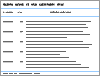
Table 1
Overall parameters of aircraft platform
| 参数 | 数值 |
|---|---|
| 液氢携带量/kg | 150 |
| 巡航高度/m | 10 000 |
| 燃料电池发电功率/kW | 0.5~50 |
| 液氢储罐容积/m3 | 3 |

Fig.1
Configuration diagram of thermal management system for fuel cell of liquid hydrogen UAV


Fig.2
Schematic diagram of tank pressure control


Fig.3
Schematic diagram of fuel cell coolant outlet temperature control

Table 2
Standard atmospheric temperature, pressure, density[26]
| 序号 | 高度/m | 温度/K | 压力/kPa | 密度/(kg·m-3) |
|---|---|---|---|---|
| 1 | -500 | 291.4 | 107.470 | 1.284 9 |
| 2 | 0 | 288.15 | 101.325 | 1.225 0 |
| 3 | 1 000 | 281.65 | 89.876 | 1.111 7 |
| 4 | 2 000 | 275.15 | 79.501 | 1.006 6 |
| 5 | 3 000 | 268.66 | 70.121 | 0.909 3 |
| 6 | 4 000 | 262.17 | 61.660 | 0.819 4 |
| 7 | 5 000 | 255.68 | 54.048 | 0.736 4 |
| 8 | 6 000 | 249.19 | 47.217 | 0.660 1 |
| 9 | 7 000 | 242.70 | 41.105 | 0.590 0 |
| 10 | 8 000 | 236.22 | 35.651 | 0.525 8 |
| 11 | 9 000 | 229.73 | 30.800 | 0.467 1 |
| 12 | 10 000 | 223.25 | 26.499 | 0.413 5 |
| 13 | 11 000 | 216.77 | 22.699 | 0.364 8 |
| 14 | 12 000 | 216.65 | 19.399 | 0.311 9 |
Table 3
Dynamic viscosity, thermal conductivity, and Prandtl number of air[27]
| 序号 | 温度/K | 动力黏度/(Pa·s) | 导热系数/(W·(m·K)-1) | 普朗特数 |
|---|---|---|---|---|
| 1 | 223.15 | 0.000 014 6 | 0.020 4 | 0.728 |
| 2 | 233.15 | 0.000 015 2 | 0.021 2 | 0.728 |
| 3 | 243.15 | 0.000 015 7 | 0.022 0 | 0.723 |
| 4 | 253.15 | 0.000 016 2 | 0.022 8 | 0.716 |
| 5 | 263.15 | 0.000 016 7 | 0.023 6 | 0.712 |
| 6 | 273.15 | 0.000 017 2 | 0.024 4 | 0.707 |
| 7 | 283.15 | 0.000 017 6 | 0.025 1 | 0.705 |
| 8 | 293.15 | 0.000 018 1 | 0.025 9 | 0.703 |
| 9 | 303.15 | 0.000 018 6 | 0.026 7 | 0.701 |
| 10 | 313.15 | 0.000 019 1 | 0.027 6 | 0.699 |
| 11 | 323.15 | 0.000 019 6 | 0.028 3 | 0.698 |
| 12 | 333.15 | 0.000 020 1 | 0.029 0 | 0.696 |
| 13 | 343.15 | 0.000 020 6 | 0.029 6 | 0.694 |
| 14 | 353.15 | 0.000 021 1 | 0.030 5 | 0.692 |
| 15 | 363.15 | 0.000 021 5 | 0.031 3 | 0.690 |
Table 4
Physical property parameters of saturated hydrogen
| 序号 | 压力/MPa | 温度/K | 密度/(kg·m-3) | 液态比焓/(kJ·kg-1) | 气态比焓/(kJ·kg-1) |
|---|---|---|---|---|---|
| 1 | 0.1 | 20.324 | 1.316 4 | -0.446 79 | 448.47 |
| 2 | 0.2 | 22.910 | 2.482 6 | 27.665 00 | 459.62 |
| 3 | 0.3 | 24.683 | 3.646 4 | 49.884 00 | 463.16 |
| 4 | 0.4 | 26.076 | 4.840 5 | 69.476 00 | 463.01 |
| 5 | 0.5 | 27.243 | 6.086 6 | 87.667 00 | 460.44 |
| 6 | 0.6 | 28.255 | 7.405 7 | 105.120 00 | 455.94 |
| 7 | 0.7 | 29.154 | 8.823 2 | 122.270 00 | 449.67 |
| 8 | 0.8 | 29.967 | 10.374 0 | 139.540 00 | 441.58 |
| 9 | 0.9 | 30.709 | 12.111 0 | 157.360 00 | 431.40 |
| 10 | 1.0 | 31.393 | 14.128 0 | 176.360 00 | 418.49 |
| 11 | 1.1 | 32.027 | 16.618 0 | 197.740 00 | 401.44 |
| 12 | 1.2 | 32.616 | 20.136 0 | 224.800 00 | 376.14 |

Fig.4
Hydrogen density


Fig.5
Dynamic viscosity of hydrogen


Fig.6
Prandtl number of hydrogen


Fig.7
Thermal conductivity of hydrogen


Fig.8
Specific heat of hydrogen at constant pressure


Fig.9
Schematic diagram of fuel cell model


Fig.10
Power efficiency relationship curve


Fig.11
Schematic diagram of gas-liquid heat exchanger model

Table 5
Parameters of gas-liquid heat exchanger
| 名称 | 总流通截面积/m2 | 传热面积/m2 | 效能(爬升终点) |
|---|---|---|---|
| 空气换热器(EX3) | 0.018(气) | 1.475 | 0.854 |
| 0.002 26(液) | |||
| 氢气预热器(EX2) | 0.000 030 2(气) | 0.247 | 0.936 |
| 0.001 09(液) | |||
| 氢气冷却器(EX4) | 0.000 241(气) | 1.975 | 0.931 |
| 0.001 09(液) |

Fig.12
Schematic diagram of liquid hydrogen evaporator model


Fig.13
Schematic diagram of liquid hydrogen storage tank model


Fig.14
Block diagram of thermal management system simulation program


Fig.15
Typical flight profile of unmanned aerial vehicles


Fig.16
Temperature of fuel cell coolant


Fig.17
Air heat exchanger coolant temperature (EX3)


Fig.18
Hydrogen preheater coolant temperature (EX2)


Fig.19
Hydrogen cooler coolant temperature (EX4)


Fig.20
Liquid hydrogen evaporator coolant temperature (EX1)


Fig.21
Hydrogen consumption during flight


Fig.22
Fuel cell hydrogen flow rate and cooling hydrogen flow rate


Fig.23
Tank pressure, hydrogen evaporation, and hydrogen consumption during flight


Fig.24
Average heat load of coolant in each heat exchanger


Fig.25
Exit temperature of fuel cell stack under different cooling conditions during climbing phase


Fig.26
Outlet temperature of fuel cell stack with different air intake areas


Fig.27
Outlet temperatures of fuel cells and air heat exchangers with different cooling fluids


Fig.28
Outlet temperature of air heat exchanger with different quality of ethylene glycol aqueous solution


Fig.29
Quality of liquid hydrogen consumption during climbing phase

Table 6
Liquid hydrogen consumption during climbing stage
| 序号 | 水 | 乙二醇水溶液 | ||
|---|---|---|---|---|
| 冷却液质量/kg | 液氢消耗质量/kg | 冷却液质量/kg | 液氢消耗质量/kg | |
| 1 | 3.229 | 17.468 | 3.429 | 19.106 |
| 2 | 16.145 | 17.209 | 17.145 | 18.837 |
| 3 | 32.290 | 16.862 | 34.290 | 18.467 |
| 4 | 48.435 | 16.520 | 51.435 | 18.126 |
| 5 | 64.580 | 16.171 | 68.580 | 17.775 |

Fig.30
Non-dimensional liquid hydrogen consumption during climb phase

| 1 | 朱超磊, 金钰, 王靖娴, 等. 2022年国外军用无人机装备技术发展综述[J]. 战术导弹技术, 2023(3): 11-25, 31. |
| ZHU C L, JIN Y, WANG J X, et al. Overview of the development of foreign military UAV systems and technology in 2022[J]. Tactical Missile Technology, 2023(3): 11-25, 31 (in Chinese). | |
| 2 | 裴锦华. 民用无人机产业发展动态及其在网络通信领域中的应用[J]. 电信工程技术与标准化, 2017, 30(4): 1-6. |
| PEI J H. Development trends of civil UAV industry and its applications in network & communication field[J]. Telecom Engineering Technics and Standardization, 2017, 30(4): 1-6 (in Chinese). | |
| 3 | 任媛媛, 高一栋, 焦慕卿. 无人机发展应用及反无手段研究[J]. 火控雷达技术, 2022, 51(1): 27-32, 39. |
| REN Y Y, GAO Y D, JIAO M Q. Research on development and application of UAVs and counter-UAV means[J]. Fire Control Radar Technology, 2022, 51(1): 27-32, 39 (in Chinese). | |
| 4 | 刘铁军. 从十三届珠海航展看中国无人机发展特点及趋势[J]. 中国航天, 2022(4): 8-11. |
| LIU T J. Characteristics and trend of UAV development in China from the 13th Zhuhai airshow[J]. Aerospace China, 2022(4): 8-11 (in Chinese). | |
| 5 | 祝彬, 陈笑南, 范桃英. 国外超高空长航时无人机发展分析[J]. 中国航天, 2013(11): 28-32. |
| ZHU B, CHEN X N, FAN T Y. Development analysis of foreign ultra-high altitude long-endurance UAV[J]. Aerospace China, 2013(11): 28-32 (in Chinese). | |
| 6 | 刘莉, 杜孟尧, 张晓辉, 等. 太阳能/氢能无人机总体设计与能源管理策略研究[J]. 航空学报, 2016, 37(1): 144-162. |
| LIU L, DU M Y, ZHANG X H, et al. Conceptual design and energy management strategy for UAV with hybrid solar and hydrogen energy[J]. Acta Aeronautica et Astronautica Sinica, 2016, 37(1): 144-162 (in Chinese). | |
| 7 | 高彦峰, 宋琦, 谢高峰, 等. 临近空间无人机液氢供能系统技术分析[J]. 航空工程进展, 2024, 15(2): 11-24. |
| GAO Y F, SONG Q, XIE G F, et al. Analysis of liquid hydrogen power systems for near space unmanned aerial vehicles[J]. Advances in Aeronautical Science and Engineering, 2024, 15(2): 11-24 (in Chinese). | |
| 8 | 李广佳, 陈柽, 贾永清, 等. 临近空间氢动力无人机技术发展与应用分析[C]∥2015第二届中国航空科学技术大会. 北京: 中国航空学会, 2015: 572-576. |
| LI G J, CHEN C, JIA Y Q, et al. Analysis of technology progress and applications of the near space hydrogen powered unmanned aircraft [C]∥2015 2nd China Aviation Science and Technology Conference. Beijing: China Society of Aeronautics and Astronautics, 2015: 572-576 (in Chinese). | |
| 9 | 徐晨华. 美国非太阳能动力超长航时无人机发展综述[J]. 飞航导弹, 2018(8): 35-41. |
| XU C H. Review on the development of non-solar-powered ultra-long endurance UAV in the United States[J]. Aerodynamic Missile Journal, 2018(8): 35-41 (in Chinese). | |
| 10 | MARQUARDT J, KELLER J, MILLS G, et al. An overview of Ball Aerospace cryogen storage and delivery systems[J]. IOP Conference Series: Materials Science and Engineering, 2015, 101: 012086. |
| 11 | 刘莉, 曹潇, 张晓辉, 等. 轻小型太阳能/氢能无人机发展综述[J]. 航空学报, 2020, 41(3): 623474. |
| LIU L, CAO X, ZHANG X H, et al. Review of development of light and small scale solar/hydrogen powered unmanned aerial vehicles[J]. Acta Aeronautica et Astronautica Sinica, 2020, 41(3): 623474 (in Chinese). | |
| 12 | 张永杰, 王鸿深, 崔博, 等. 氢能客机低温液氢储罐的装机环境适应性分析研究进展[J]. 航空学报, 2025, 46(9): 629870. |
| ZHANG Y J, WANG H S, CUI B, et al. Research progress in the analysis of installed environment adaptability of cryogenic liquid hydrogen tanks for hydrogen-powered aircraft[J]. 2025, 46(9): 629870. | |
| 13 | HARTMANN C, NØLAND J K, NILSSEN R, et al. Dual use of liquid hydrogen in a next-generation PEMFC-powered regional aircraft with superconducting propulsion[J]. IEEE Transactions on Transportation Electrification, 2022, 8(4): 4760-4778. |
| 14 | SILVA F F DA, FERNANDES J F P, COSTA BRANCO P J DA. Barriers and challenges going from conventional to cryogenic superconducting propulsion for hybrid and all-electric aircrafts[J]. Energies, 2021, 14(21): 6861. |
| 15 | DEZHIN D S, DEZHINA I N. Development of the future aircraft propulsion system based on HTS electrical equipment with liquid hydrogen cooling[J]. IEEE Transactions on Applied Superconductivity, 2022, 32(4): 3601105. |
| 16 | 宋东彬, 闫炬壮, 杨文将, 等. 面向电动航空的高温超导电机技术研究发展[J]. 航空学报, 2023, 44(9): 027469. |
| SONG D B, YAN J Z, YANG W J, et al. Technology development of high temperature superconducting machine for electric aviation[J]. Acta Aeronautica et Astronautica Sinica, 2023, 44(9): 027469 (in Chinese). | |
| 17 | 张新榃, 于航, 彭俊毅, 等. 氢能源民用飞机技术路线与总体概念设计方法研究[J]. 推进技术, 2024, 45(3): 2210088. |
| ZHANG X T, YU H, PENG J Y, et al. Technical route research and concept design of hydrogen aircraft[J]. Journal of Propulsion Technology, 2024, 45(3): 2210088 (in Chinese). | |
| 18 | 杨志刚, 王曼, 张志雄, 等. 商用飞机新能源动力发展路径分析与展望[J]. 推进技术, 2024, 45(3): 2210087. |
| YANG Z G, WANG M, ZHANG Z X, et al. Analysis and prospect of new energy power development path of commercial aircraft[J]. Journal of Propulsion Technology, 2024, 45(3): 2210087 (in Chinese). | |
| 19 | 陈思彤, 李微微, 王学科, 等. 相变材料用于质子交换膜燃料电池的热管理[J]. 化工学报, 2016, 67(S1): 1-6. |
| CHEN S T, LI W W, WANG X K, et al. Thermal management using phase change materials for proton exchange membrane fuel cells[J]. CIESC Journal, 2016, 67(S1): 1-6 (in Chinese). | |
| 20 | 马富康, 苏铁熊, 赵振峰, 等. 对置活塞二冲程柴油机热平衡和余热可用能分析[J]. 中北大学学报(自然科学版), 2017, 38(4): 433-438, 445. |
| MA F K, SU T X, ZHAO Z F, et al. Analysis of thermal balance and waste heat exergy for opposed-piston two-stroke diesel engine[J]. Journal of North University of China (Natural Science Edition), 2017, 38(4): 433-438, 445 (in Chinese). | |
| 21 | 孙爱洲, 王鹏, 李子非, 等. 某柴油机排气能量热力学计算分析[J]. 现代车用动力, 2017(3) :29-33. |
| SUN A Z, WANG P, LI Z F, et al. Thermodynamic calculation and analysis on exhaust energy of diesel engine [J]. Modern vehicle power, 2017(3): 29-33 (in Chinese). | |
| 22 | 耿毫伟, 李红信, 靳晨曦, 等. 氢燃料电池热管理系统仿真分析[J]. 汽车实用技术, 2023, 48(20): 15-19. |
| GENG H W, LI H X, JIN C X, et al. Simulation analysis of fuel cell thermal management system[J]. Automobile Applied Technology, 2023, 48(20): 15-19 (in Chinese). | |
| 23 | 袁磊, 吕婷婷, 李康, 等. 一种机车用氢燃料电池热管理系统[J]. 铁道机车与动车, 2024(1): 35-37, 44, 6. |
| YUAN L, LYU T T, LI K, et al. A hydrogen fuel cell thermal management system for locomotives[J]. Railway Locomotive and Motor Car, 2024(1): 35-37, 44, 6 (in Chinese). | |
| 24 | 王星, 孙俊, 张振东, 等. 燃料电池热管理系统的动态仿真及控制[J]. 电池, 2023, 53(6): 600-604. |
| WANG X, SUN J, ZHANG Z D, et al. Dynamic simulation and control of fuel cell thermal management system[J]. Battery Bimonthly, 2023, 53(6): 600-604 (in Chinese). | |
| 25 | 向乾, 张晓辉, 王正平, 等. 适用无人机的小型燃料电池控制方法[J]. 航空学报, 2021, 42(3): 623960. |
| XIANG Q, ZHANG X H, WANG Z P, et al. Control method of small fuel cells for UAVs[J]. Acta Aeronautica et Astronautica Sinica, 2021, 42(3): 623960 (in Chinese). | |
| 26 | 寿荣中, 何慧珊. 飞行器环境控制[M]. 北京: 北京航空航天大学出版社, 2004. |
| SHOU R Z, HE H S. Aircraft environmental control[M]. Beijing: Beihang University Press, 2004 (in Chinese). | |
| 27 | 杨世铭, 陶文铨. 传热学(第四版)[M]. 北京: 高等教育出版社, 2007. |
| YANG S M, TAO W Q. Heat transfer[M]. 4th ed. Beijing: Higher Education Press, 2007 (in Chinese). |
| [1] | Yongjie ZHANG, Hongchen WANG, Bo CUI, Jingpiao ZHOU. Research progress in installation environment adaptability of cryogenic liquid hydrogen tanks for hydrogen-powered aircraft [J]. Acta Aeronautica et Astronautica Sinica, 2025, 46(9): 629870-629870. |
| [2] | Qihao DENG, Junming YAN, Ben CHEN. Operational characteristics of PEMFC anode system based on hydrogen gas recirculation [J]. Acta Aeronautica et Astronautica Sinica, 2025, 46(9): 630847-630847. |
| [3] | Pengqian YANG, Yutong CHEN, Junhui LIU, Jiehao YANG, Jiayuan SHAN, Shijun SUN. Aerodynamic and operational characteristics analysis for tandem wing cargo UAV at high angle of attack [J]. Acta Aeronautica et Astronautica Sinica, 2025, 46(9): 131056-131056. |
| [4] | Kaifang WAN, Zhilin WU, Yunhui WU, Haozhi QIANG, Yibo WU, Bo LI. Cooperative location of multiple UAVs with deep reinforcement learning in GPS-denied environment [J]. Acta Aeronautica et Astronautica Sinica, 2025, 46(8): 331024-331024. |
| [5] | Lingfeng JIANG, Xinkai LI, Hai ZHANG, Hanwei LI, Hongli ZHANG. Mapless navigation of UAVs in dynamic environments based on an improved TD3 algorithm [J]. Acta Aeronautica et Astronautica Sinica, 2025, 46(8): 331035-331035. |
| [6] | Jinwu XIANG, Kai MA, Zi KAN, Daochun LI, Kexin ZHENG, Hanxuan CHEN. Review of key technologies for hydrogen powered unmanned aerial vehicles [J]. Acta Aeronautica et Astronautica Sinica, 2025, 46(5): 531603-531603. |
| [7] | Qishuai DING, Bangjun LEI, Zhengping WU. A lightweight single object tracking algorithm for UAVs based on Siamese network [J]. Acta Aeronautica et Astronautica Sinica, 2025, 46(4): 330925-330925. |
| [8] | Shiyu YANG, Haiyu YU, Yuanfang LIN, Xingang LIANG. Performance analysis and optimization of fuel thermal management system with expendable heat sink [J]. Acta Aeronautica et Astronautica Sinica, 2025, 46(4): 130897-130897. |
| [9] | Nuo MA, Shechun WEI, Junhui MENG, Qingyang LIU, Yusheng LEI. Flow field characteristics and dynamics of internal supply chamber separating from UAV considering effect of deceleration parachutes [J]. Acta Aeronautica et Astronautica Sinica, 2025, 46(3): 130755-130755. |
| [10] | Yiquan WU, Kang TONG. Research advances on deep learning-based small object detection in UAV aerial images [J]. Acta Aeronautica et Astronautica Sinica, 2025, 46(3): 30848-030848. |
| [11] | Ji MA, Xiangyong CHEN, Guanghui WEN, Long CHENG, Jianlong QIU. Predefined time tracking control of unmanned aerial vehicles under stochastic switching topology [J]. Acta Aeronautica et Astronautica Sinica, 2024, 45(S1): 730793-730793. |
| [12] | Ting LIU, Guoxin ZHOU, Yang XU, Delin LUO, Zhengyu GUO, Mengjie YANG. Optimised Harris hawks multi-UAV dynamic target search with fused infographics [J]. Acta Aeronautica et Astronautica Sinica, 2024, 45(S1): 730773-730773. |
| [13] | Haifeng WANG, Kunpeng LIU, Hongxin JIANG, Chenxi DU. Aerodynamic optimization method of propeller multi⁃design points and variable pitch angle strategy [J]. Acta Aeronautica et Astronautica Sinica, 2024, 45(9): 528831-528831. |
| [14] | Jing ZHAO, Dan SONG. Integrity monitoring method for GNSS/IMU integrated navigation system of UAV [J]. Acta Aeronautica et Astronautica Sinica, 2024, 45(7): 328943-328943. |
| [15] | Chuanyun WANG, Yang SU, Linlin WANG, Tian WANG, Jingjing WANG, Qian GAO. Multi-object continuous robust tracking algorithm for anti-UAV swarm [J]. Acta Aeronautica et Astronautica Sinica, 2024, 45(7): 329017-329017. |
| Viewed | ||||||
|
Full text |
|
|||||
|
Abstract |
|
|||||
Address: No.238, Baiyan Buiding, Beisihuan Zhonglu Road, Haidian District, Beijing, China
Postal code : 100083
E-mail:hkxb@buaa.edu.cn
Total visits: 6658907 Today visits: 1341All copyright © editorial office of Chinese Journal of Aeronautics
All copyright © editorial office of Chinese Journal of Aeronautics
Total visits: 6658907 Today visits: 1341

 CJA
CJA
