Acta Aeronautica et Astronautica Sinica ›› 2026, Vol. 47 ›› Issue (5): 332079.doi: 10.7527/S1000-6893.2025.32079
• Electronics and Electrical Engineering and Control • Previous Articles
Ruiqi WANG1, Guoxing YI1( ), Weinan XIE1, Zhennan WEI1, Shengwei DONG2
Received:2025-04-07
Revised:2025-04-28
Accepted:2025-05-27
Online:2025-06-16
Published:2025-06-05
Contact:
Guoxing YI
E-mail:ygx@hit.end.cn;ygx@hit.edu.cn
Supported by:CLC Number:
Ruiqi WANG, Guoxing YI, Weinan XIE, Zhennan WEI, Shengwei DONG. Identification and compensation method for assembly errors in fully differential frequency-modulated hemispherical resonator gyroscope[J]. Acta Aeronautica et Astronautica Sinica, 2026, 47(5): 332079.
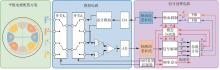
Fig.1
Single-channel time-division multiplexing control scheme for HRG
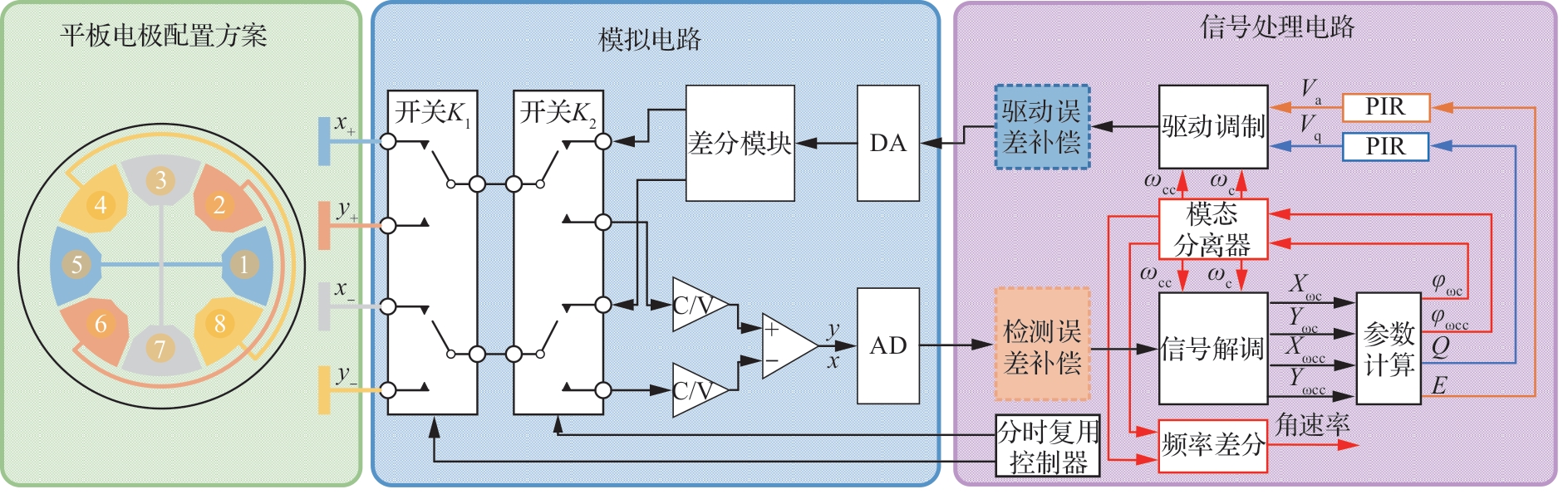
Fig.2
Structural schematic of HRG
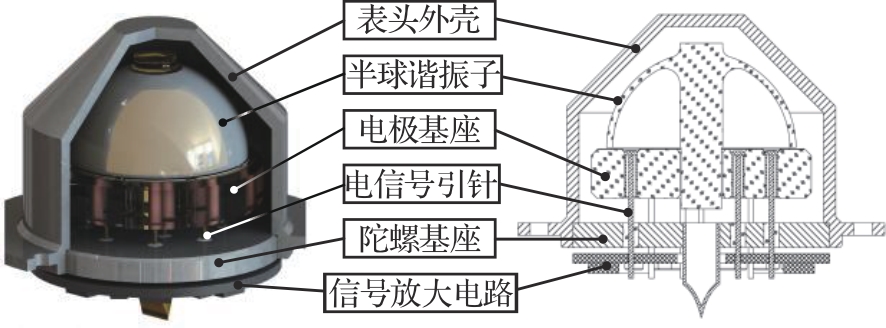
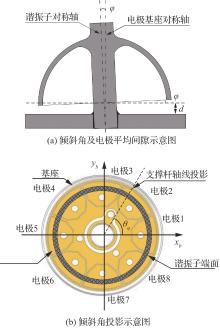
Fig.3
Schematic diagram of resonator installation tilt
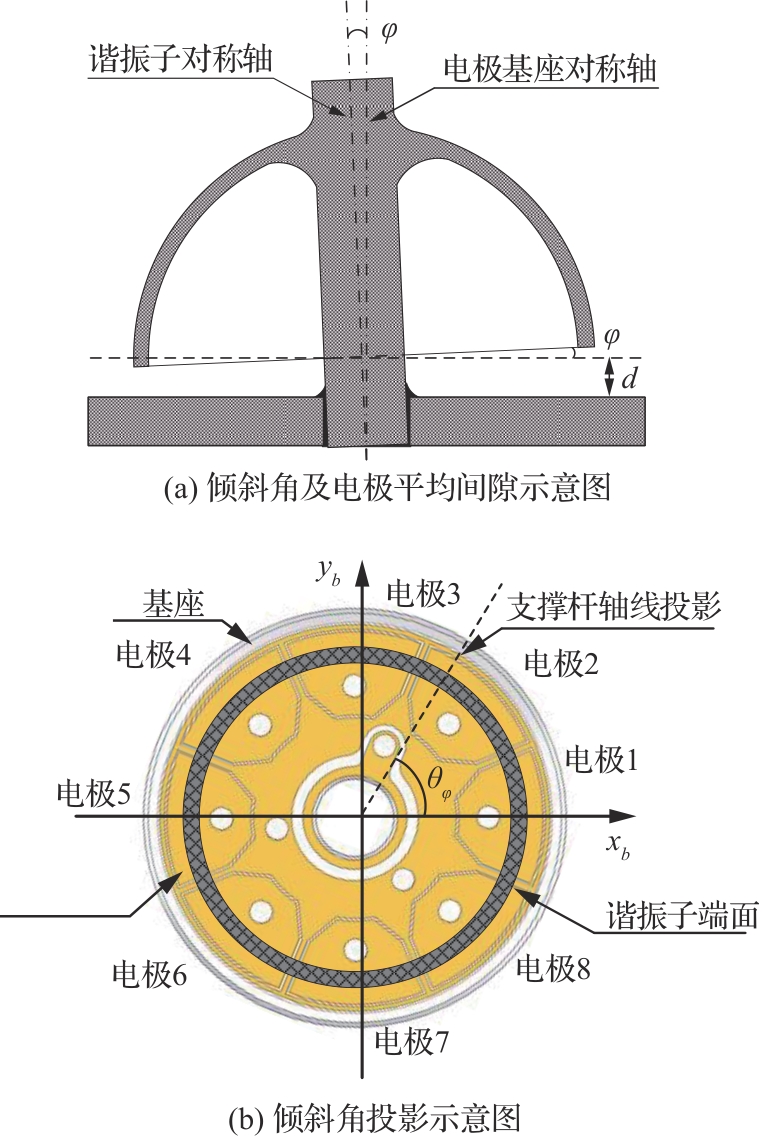
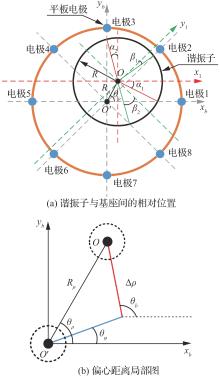
Fig.4
Schematic diagram of resonator installation eccentricity
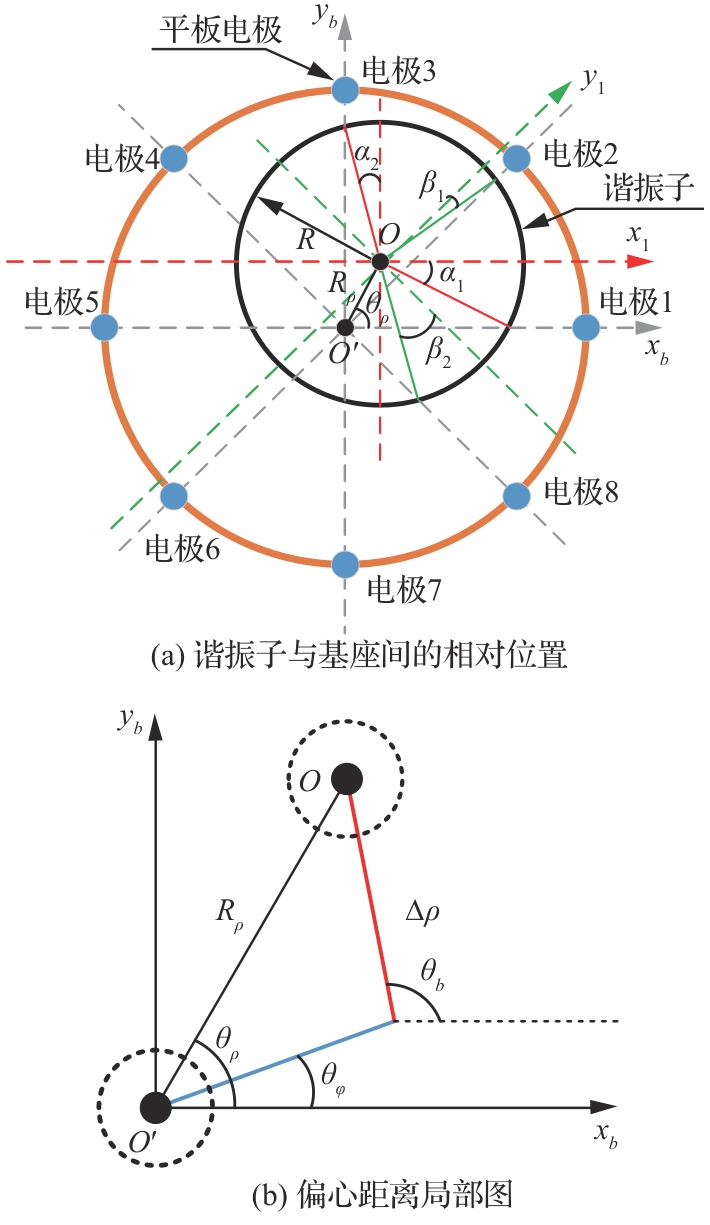
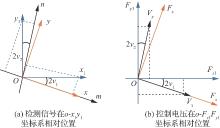
Fig.5
Relative position of signals in coordinate system
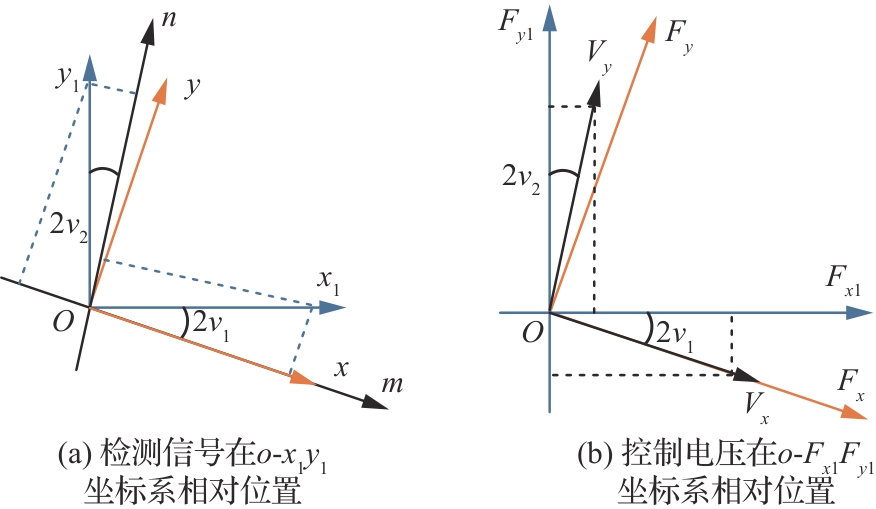
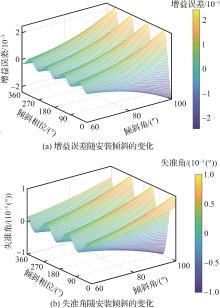
Fig.6
Effect of installation tilt on channel coupling errors
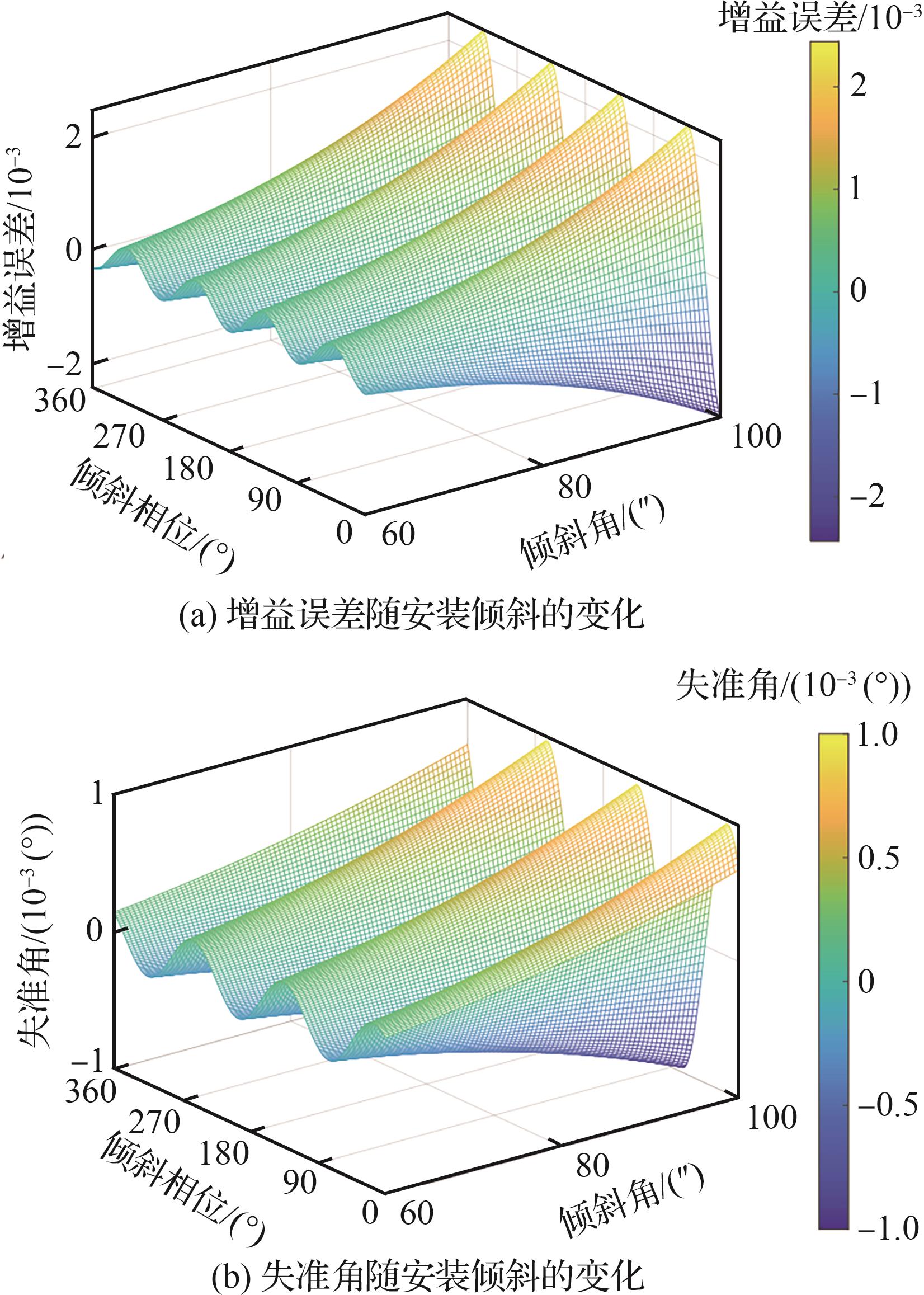
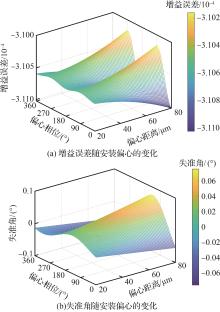
Fig.7
Effect of installation eccentricity on channel coupling errors
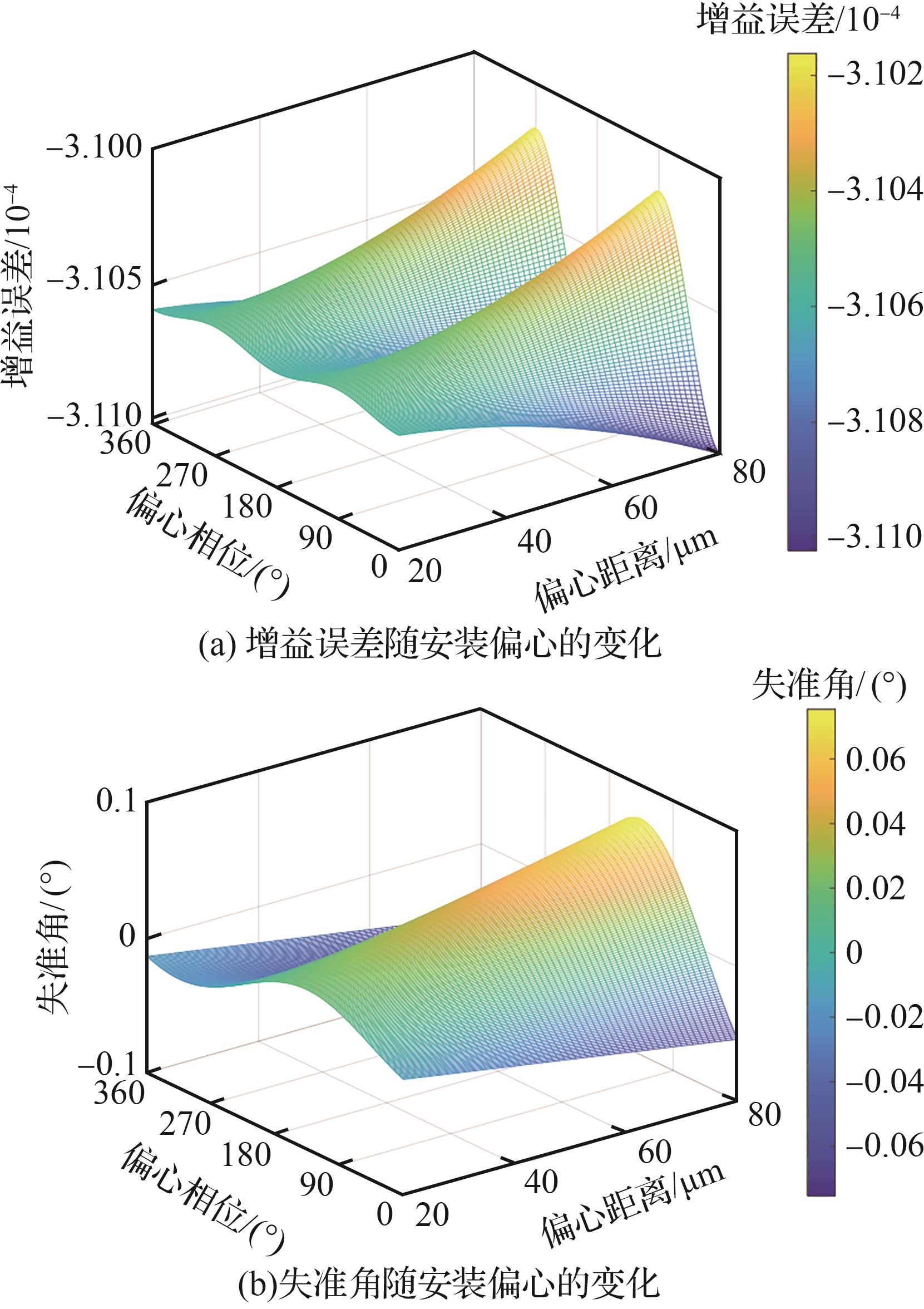

Table 1
Structure and electrical parameters of HRG
| 参数 | 数值 | 参数 | 数值 |
|---|---|---|---|
| R1/mm | 10.4 | R2/mm | 11.13 |
| f0/Hz | 7 500 | θω /(°) | 17 |
| ∆f/Hz | 0.001 | m0/g | 2.5 |
| τ/s | 500 | 0 | |
| k | -0.554 0 | a0/V | 5 |
| Vdc /V | 200 | d/μm | 25 |
| φ/(") | 80 | θφ /(°) | 0 |
| Δρ/μm | 50 μm | θb /(°) | 45 |
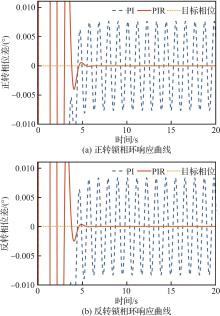
Fig.8
Performance of PI and PIR controllers in phase tracking
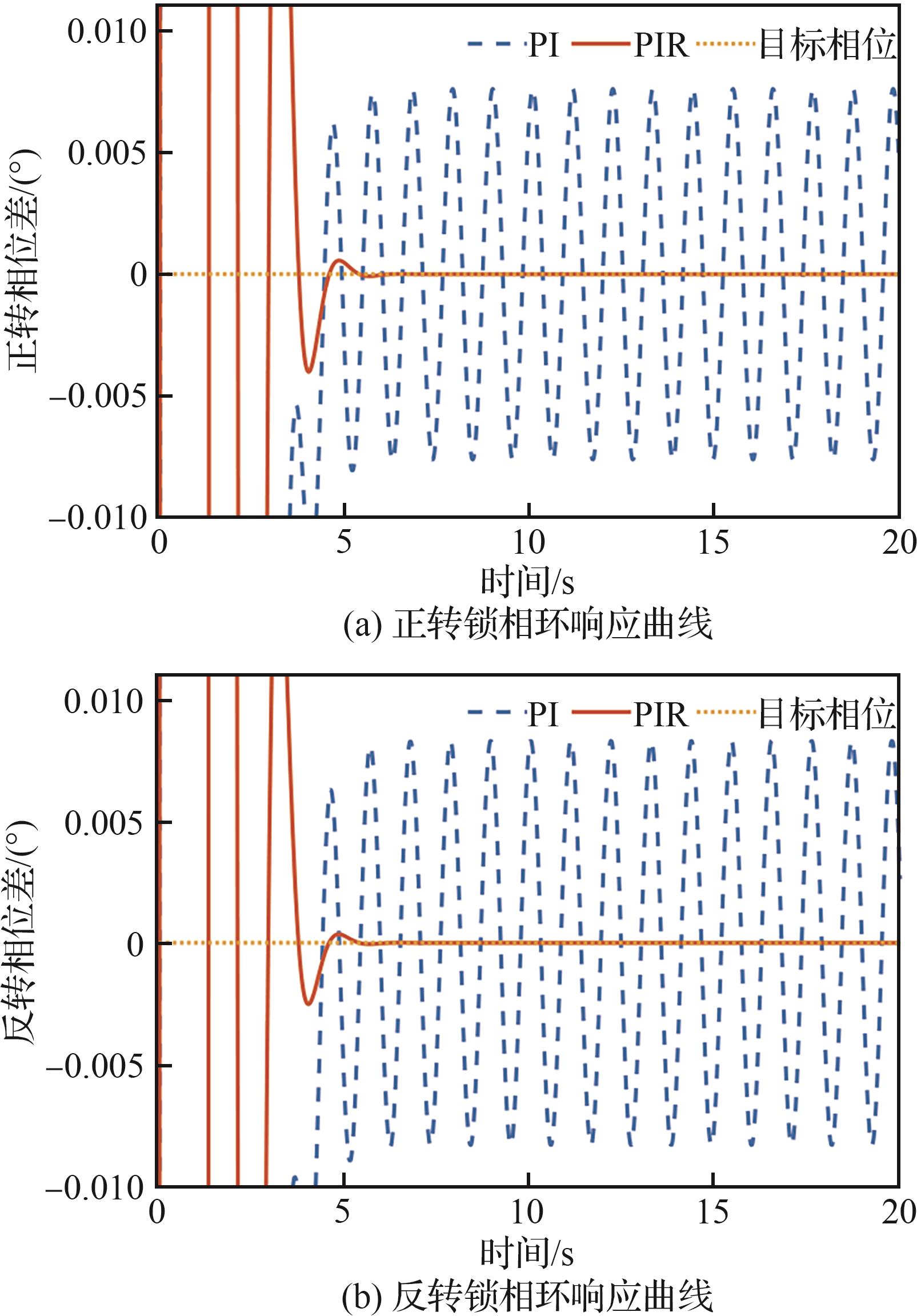
Fig.9
Effect of assembly errors on gyroscope output
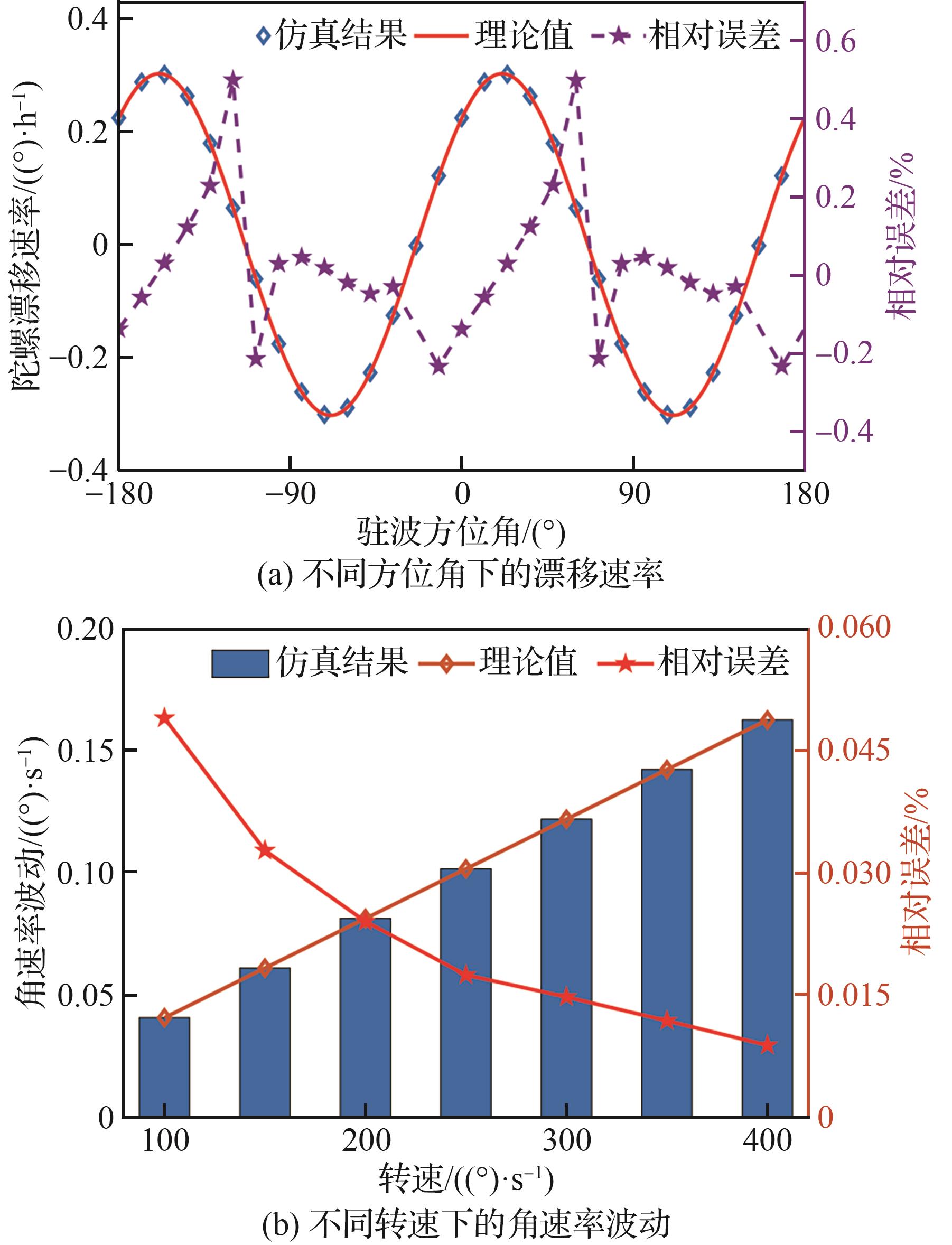
Table 2
Identification results of gain error at different rotational speeds
| 转速/((°)·s-1) | 增益误差/10-4 | 辨识结果/10-4 | 辨识误差/10-7 | 相对误差/% |
|---|---|---|---|---|
| ±200 | 9.90 | 9.894 154 | 5.85 | 0.059 0 |
| ±250 | 9.90 | 9.894 137 | 5.86 | 0.059 2 |
| ±300 | 9.90 | 9.894 154 | 5.85 | 0.059 0 |
| ±350 | 9.90 | 9.894 141 | 5.86 | 0.059 2 |
| ±400 | 9.90 | 9.894 105 | 5.89 | 0.059 5 |
Table 3
Identification results of misalignment angle at different rotational speeds
| 转速/((°)·s-1) | 失准角/(°) | 辨识结果/(°) | 辨识误差/10-5 (°) | 相对误差/% |
|---|---|---|---|---|
| ±200 | -0.031 0 | -0.031 015 5 | -1.55 | 0.050 0 |
| ±250 | -0.031 0 | -0.031 015 1 | -1.51 | 0.048 8 |
| ±300 | -0.031 0 | -0.031 015 4 | -1.54 | 0.049 7 |
| ±350 | -0.031 0 | -0.031 015 3 | -1.53 | 0.049 2 |
| ±400 | -0.031 0 | -0.031 014 8 | -1.48 | 0.047 9 |
Fig.10
Compensation effect of assembly errors
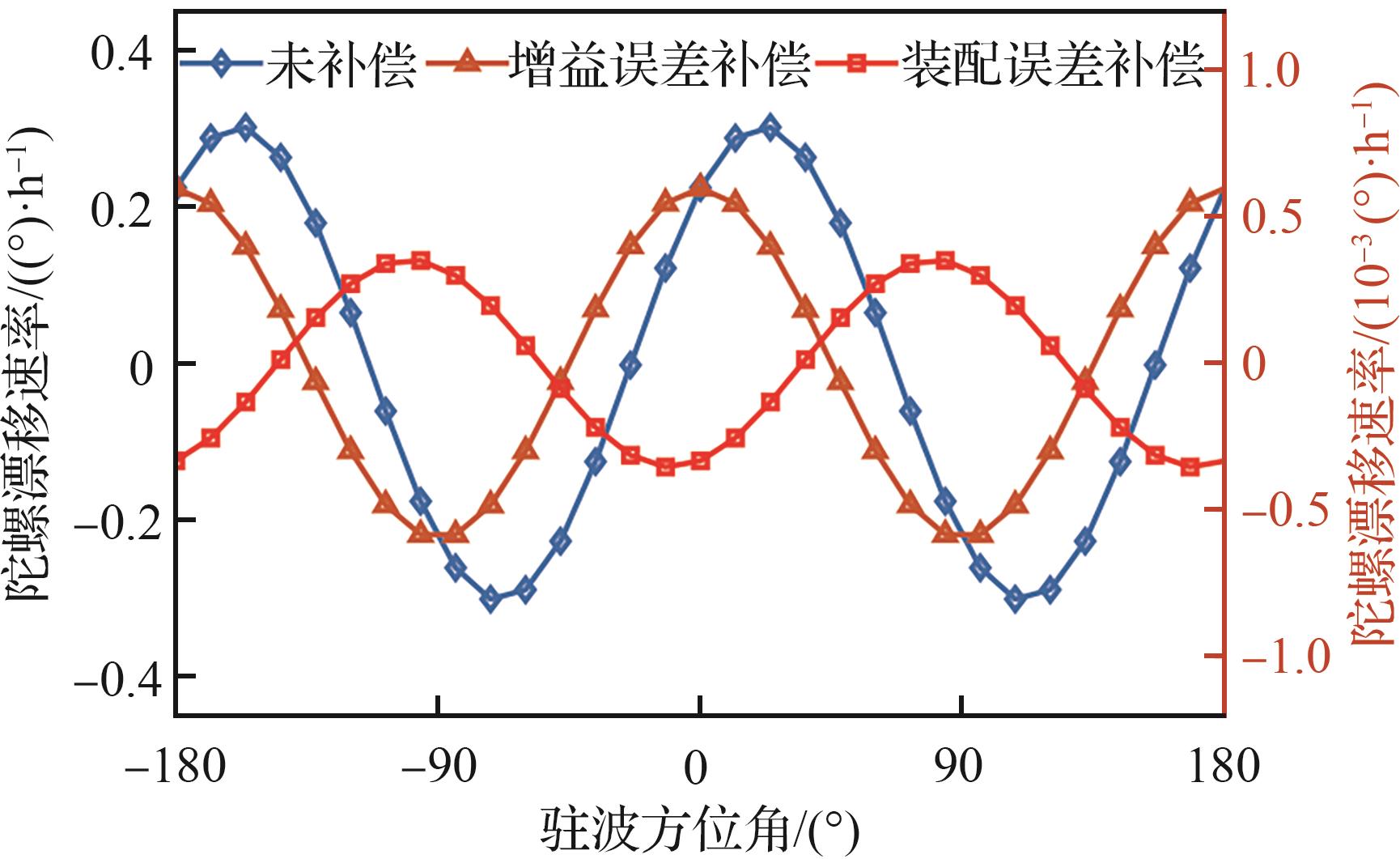
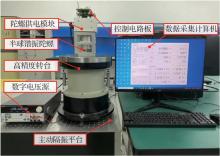
Fig.11
HRG control system and experimental equipment
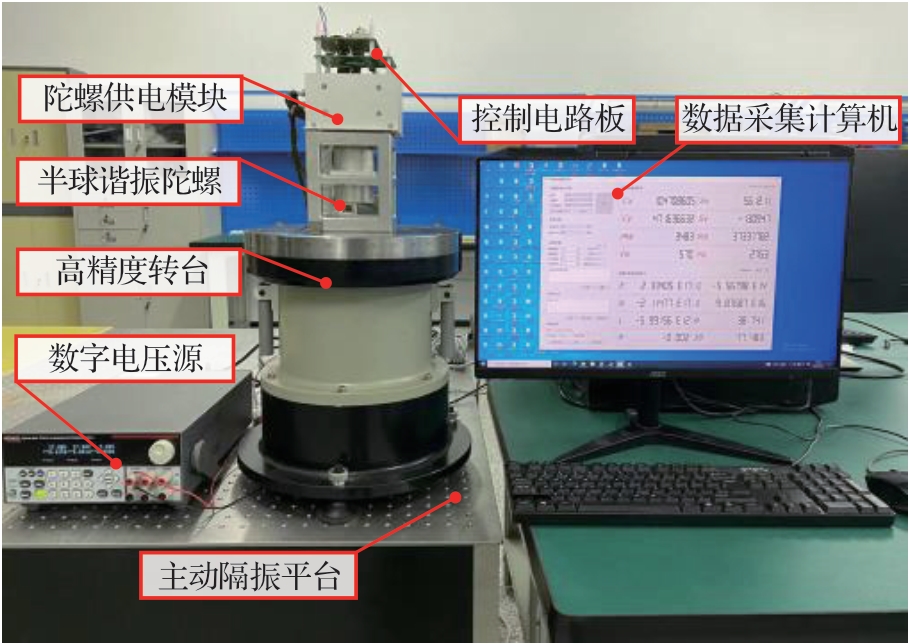
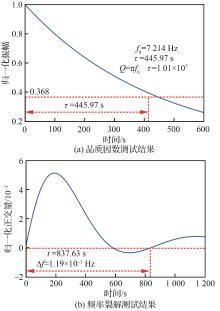
Fig.12
Vibration performance test results of hemispherical resonator
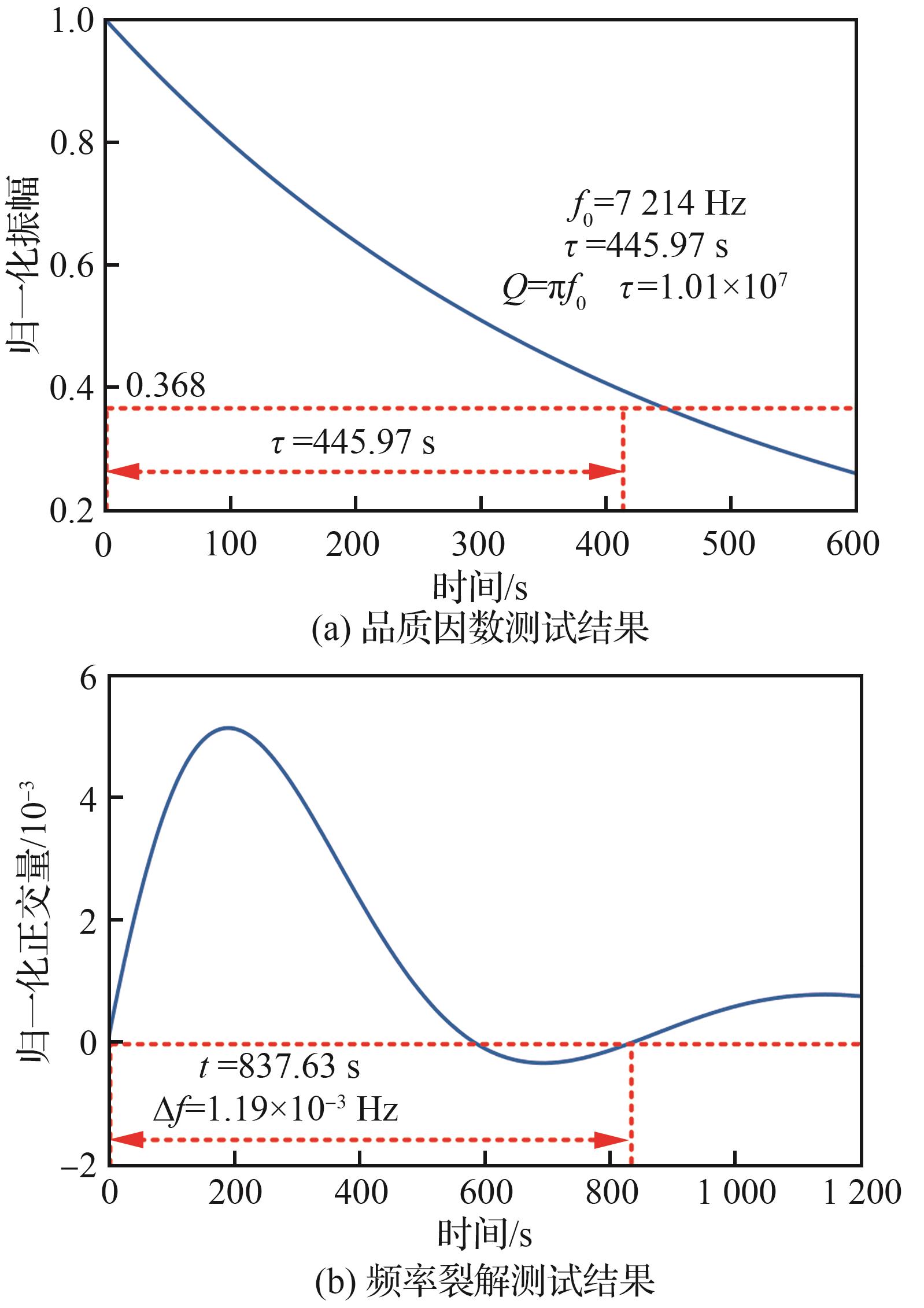
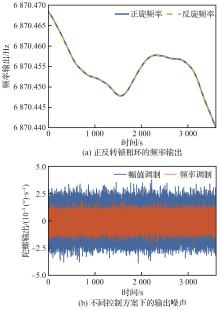
Fig.13
Output characteristics of frequency-modulated HRG
Table 4
Identification results of gain error before and after compensation
| 转速/((°)·s-1) | 补偿前 辨识结果 | 补偿后 辨识结果 | 误差 减小率/% |
|---|---|---|---|
| ±200 | -0.002 334 | -1.519×10⁻⁵ | 99.349 |
| ±250 | -0.002 341 | 7.559×10⁻⁸ | 99.997 |
| ±300 | -0.002 329 | 9.972×10⁻⁶ | 99.572 |
| ±350 | -0.002 335 | 6.910×10⁻⁷ | 99.970 |
| ±400 | -0.002 339 | 5.405×10⁻⁶ | 99.769 |
| 平均值 | -0.002 336 | -6.236×10⁻⁶ | 99.731 |
Table 5
Identification results of misalignment angle before and after compensation
| 转速/((°)·s-1) | 补偿前辨识结果/(°) | 补偿后辨识结果/(°) | 误差 减小率/% |
|---|---|---|---|
| ±200 | 0.037 50 | 8.975×10⁻⁵ | 99.761 |
| ±250 | 0.037 59 | 1.606×10⁻⁴ | 99.573 |
| ±300 | 0.037 18 | -3.626×10⁻⁴ | 99.025 |
| ±350 | 0.037 39 | 5.169×10⁻⁶ | 99.986 |
| ±400 | 0.036 95 | -4.338×10⁻⁴ | 98.826 |
| 平均值 | 0.037 32 | -1.082×10⁻⁴ | 99.434 |
Table 6
Comparative analysis of identification results
| 误差参数 | 本方法 | 文献[ | 文献[ |
|---|---|---|---|
| 增益误差 | -0.002 336 | -0.002 340 | -0.002 334 |
| 失准角/(°) | 0.037 32 | 0.037 34 | 0.037 29 |
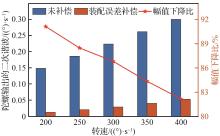
Fig.14
Second harmonic of gyroscope output at different rotational speeds
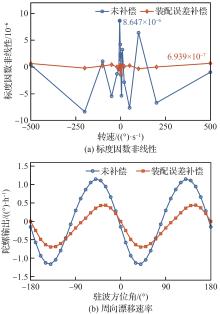
Fig.15
Performance characteristics of gyroscope before and after assembly error compensation
Table 7
Summary of structural parameters
| 陀螺编号 | 谐振频率/Hz | 频率裂解/Hz | 品质因数 |
|---|---|---|---|
| 1 | 7 060 | 9.04×10⁻⁴ | 1.18×10⁷ |
| 2 | 8 168 | 1.85×10⁻³ | 1.59×10⁷ |
| 3 | 7 072 | 4.43×10⁻⁴ | 1.46×10⁷ |
Table 8
Performance comparison before and after compensation
| 陀螺编号 | 陀螺参数 | 补偿前 | 补偿后 |
|---|---|---|---|
| 1 | 增益误差 | -0.001 95 | 1.20×10⁻⁵ |
| 失准角/(°) | 0.014 5 | -8.88×10⁻⁶ | |
| 标度因数非线性/10-6 | 7.100 | 0.847 | |
| 周向漂移稳定性/((°)·h-1) | 0.262 | 0.138 | |
| 2 | 增益误差 | 0.001 98 | 6.52×10⁻⁷ |
| 失准角/(°) | 0.017 3 | -3.20×10⁻⁵ | |
| 标度因数非线性/10-6 | 8.966 | 1.016 | |
| 周向漂移稳定性/((°)·h-1) | 0.517 | 0.342 | |
| 3 | 增益误差 | 0.002 84 | -6.08×10⁻⁶ |
| 失准角/(°) | 0.013 3 | -3.66×10⁻⁵ | |
| 标度因数非线性/10-6 | 8.278 | 1.571 | |
| 周向漂移稳定性/((°)·h-1) | 0.785 | 0.508 |
| [1] | DELHAYE F. HRG by SAFRAN: The game-changing technology[C]∥2018 IEEE International Symposium on Inertial Sensors and Systems (INERTIAL). Piscataway: IEEE Press, 2018: 1-4. |
| [2] | 徐泽远, 伊国兴, 魏振楠, 等. 一种半球谐振陀螺谐振子动力学建模方法[J]. 航空学报, 2018, 39(3): 221624. |
| XU Z Y, YI G X, WEI Z N, et al. A dynamic modeling method for resonator of hemispherical resonator gyro[J]. Acta Aeronautica et Astronautica Sinica, 2018, 39(3): 221624 (in Chinese). | |
| [3] | ROZELLE D M. The hemispherical resonator gyro: From wineglass to the planets[J]. Advances in the Astronautical Sciences, 2013, 134: 1157-1178. |
| [4] | DELEAUX B, LENOIR Y. The world smallest, most accurate and reliable pure inertial navigator: ONYX™[C]∥2018 DGON Inertial Sensors and Systems (ISS). Piscataway: IEEE Press, 2018. |
| [5] | DELHAYE F, DE LEPREVIER C. SkyNaute by Safran-How the HRG technological breakthrough benefits to a disruptive IRS (Inertial Reference System) for commercial aircraft[C]∥2019 DGON Inertial Sensors and Systems (ISS). Piscataway: IEEE Press, 2019. |
| [6] | DELHAYE F, GIRAULT J P. SpaceNaute®: HRG technological breakthrough for advanced space launcher inertial reference system[C]∥2018 25th Saint Petersburg International Conference on Integrated Navigation Systems (ICINS). Piscataway: IEEE Press, 2018. |
| [7] | TSUKAMOTO T, TANAKA S. Fully-differential single resonator FM/whole angle gyroscope using CW/CCW mode separator[C]∥2017 IEEE 30th International Conference on Micro Electro Mechanical Systems (MEMS). Piscataway: IEEE Press, 2017: 1118-1121. |
| [8] | TSUKAMOTO T, TANAKA S. FM/rate integrating MEMS gyroscope using independently controlled CW/CCW mode oscillations on a single resonator[C]∥2017 IEEE International Symposium on Inertial Sensors and Systems (INERTIAL). Piscataway: IEEE Press, 2017. |
| [9] | TSUKAMOTO T, TANAKA S. Virtually rotated MEMS whole angle gyroscope using independently controlled CW/CCW oscillations[C]∥2018 IEEE International Symposium on Inertial Sensors and Systems (INERTIAL). Piscataway: IEEE Press, 2018. |
| [10] | TSUKAMOTO T, TANAKA S. Automated frequency and quality factor mismatch compensation method for MEMS rate integrating gyroscope[C]∥2019 20th International Conference on Solid-State Sensors, Actuators and Microsystems & Eurosensors XXXIII (TRANSDUCERS & EUROSENSORS XXXIII). Piscataway: IEEE Press, 2019: 1831-1834. |
| [11] | 杨颖慧, 刘靖, 卜峰, 等. 基于全角模式下硅微轴对称陀螺调频控制技术[J]. 仪表技术与传感器, 2021(6): 21-25. |
| YANG Y H, LIU J, BU F, et al. Frequency modulation control technology of whole-angle mode based on silicon micromechanical axisymmetric gyroscopes[J]. Instrument Technique and Sensor, 2021(6): 21-25 (in Chinese). | |
| [12] | 王瑞祺, 伊国兴, 陈家沛, 等. 基于频率解调的半球谐振陀螺控制技术研究及其实现方法[C]∥惯性技术发展动态发展方向研讨会文集——新型惯性元件与先进导航技术. 北京:中国惯性技术学会,2023: 427-434. |
| WANG R Q, YI G X, CHEN J P, et al. Frequency-demodulation-based control technology and implementation method for hemispherical resonator gyroscope[C]∥Proceedings of the Symposium on Inertial Technology Trends and Developments-Emerging Inertial Sensors and Advanced Navigation Technologies. Beijing: Chinese Society of Inertial Technology, 2023: 427-434 (in Chinese). | |
| [13] | 关泽源, 魏振楠, 孙一为, 等. 基于频率解调的半球谐振陀螺控制系统设计[J]. 压电与声光, 2023, 45(4): 494-498. |
| GUAN Z Y, WEI Z N, SUN Y W, et al. Design of hemispherical resonator gyro control system based on frequency demodulation[J]. Piezoelectrics & Acoustooptics, 2023, 45(4): 494-498 (in Chinese). | |
| [14] | SUN Y W, WEI Z N, YI G X, et al. A rate integrating hemispherical resonant gyro angular rate output method based on frequency demodulation[C]∥2023 2nd International Symposium on Sensor Technology and Control (ISSTC). Piscataway: IEEE Press, 2023: 119-123. |
| [15] | ZHAO Y, SHI Q, XIA G M, et al. Low-noise quality factor tuning in nondegenerate MEMS gyroscope without dedicated tuning electrode[J]. IEEE Transactions on Industrial Electronics, 2024, 71(4): 4230-4240. |
| [16] | HU Z X, GALLACHER B. Extended Kalman filtering based parameter estimation and drift compensation for a MEMS rate integrating gyroscope[J]. Sensors and Actuators A: Physical, 2016, 250: 96-105. |
| [17] | TAHERI-TEHRANI P, CHALLONER A D, HORSLEY D A. Micromechanical rate integrating gyroscope with angle-dependent bias compensation using a self-precession method[J]. IEEE Sensors Journal, 2018, 18(9): 3533-3543. |
| [18] | XU R D, GAO Z X, NAN F B, et al. Single-channel control for hemispherical resonator gyro based on time division multiplexing and demultiplexing[J]. IEEE Sensors Journal, 2021, 21(19): 21342-21348. |
| [19] | WU H B, ZHENG X D, WANG X T, et al. Effects of both the drive-and sense-mode circuit phase delay on MEMS gyroscope performance and real-time suppression of the residual fluctuation phase error[J]. Journal of Micromechanics and Microengineering, 2021, 31(5): 055006. |
| [20] | YAN K C, WANG X X, ZOU K, et al. Self-excitation enabled decoupling, calibration, and compensation of errors for whole-angle hemispherical resonator gyroscope[J]. IEEE Transactions on Instrumentation and Measurement, 2023, 73: 1001613. |
| [21] | LI Q S, XIAO D B, XU Y, et al. Nonlinearity reduction in disk resonator gyroscopes based on the vibration amplification effect[J]. IEEE Transactions on Industrial Electronics, 2020, 67(8): 6946-6954. |
| [22] | SUN J K, YU S, ZHANG Y M, et al. 0.79 ppm scale-factor nonlinearity whole-angle microshell gyroscope realized by real-time calibration of capacitive displacement detection[J]. Microsystems & Nanoengineering, 2021, 7: 79. |
| [23] | WANG R Q, YI G X, XIE W N, et al. High-precision identification and compensation of nonlinear error in hemispherical resonator gyro[J]. Measurement, 2024, 237: 114945. |
| [24] | WANG R Q, YI G X, XIE W N, et al. Modeling, identification and compensation for assembly error of whole-angle mode hemispherical resonator gyro[J]. Measurement, 2022, 204: 112064. |
| [25] | WANG Q, XIE W N, XI B Q, et al. Rate integrating hemispherical resonator gyroscope detection error analysis and compensation[J]. IEEE Sensors Journal, 2023, 23(7): 7068-7076. |
| [26] | SUN Y W, YI G X, WEI Z N, et al. Identification and compensation method for unbalance error in signal detection chain of rate-integrating hemispherical resonator gyro[J]. Measurement, 2025, 240: 115599. |
| [27] | SUN J K, YU S, XI X, et al. Investigation of angle drift induced by actuation electrode errors for whole-angle micro-shell resonator gyroscope[J]. IEEE Sensors Journal, 2022, 22(4): 3105-3112. |
| [28] | CHEN W Y, DING X K, QIN Z C, et al. Identification and compensation of gain mismatches for whole-angle microhemispherical resonator gyroscope based on modal reversal[J]. IEEE Sensors Journal, 2024, 24(1): 144-157. |
| [29] | CHEN W Y, DING X K, QIN Z C, et al. Modeling, characterization, and compensation of detection and actuation coupling errors for whole-angle micro hemispherical resonant gyroscope[J]. IEEE Transactions on Instrumentation and Measurement, 2024, 73: 7505314. |
| [30] | PAN Y, TANG X Y, LI J Y, et al. Fast identification and compensation for actuation electrode errors of rate integrating gyroscopes[J]. IEEE Sensors Journal, 2024, 24(22): 36433-36442. |
| [31] | ZHANG C, WANG L X, SHEN Q, et al. A fusion algorithm for HRG output errors based on improved support function and MDTW[J]. Measurement, 2024, 228: 114300. |
| [32] | FONTANELLA R, ACCARDO D, MORIELLO R S LO, et al. MEMS gyros temperature calibration through artificial neural networks[J]. Sensors and Actuators A: Physical, 2018, 279: 553-565. |
| [33] | MI J, WANG Q, HAN X T. Low-cost MEMS gyroscope performance improvement under unknown disturbances through deep learning-based array[J]. Sensors and Actuators A: Physical, 2024, 368: 115086. |
| [34] | 吴宗收, 汪立新, 李新三, 等. 一种改进PSO-ARMA半球谐振陀螺温度误差建模方法[J]. 北京航空航天大学学报, 2022, 48(6): 1050-1056. |
| WU Z S, WANG L X, LI X S, et al. An improved PSO-ARMA method for temperature error modeling of hemispherical resonator gyroscope[J]. Journal of Beijing University of Aeronautics and Astronautics, 2022, 48(6): 1050-1056 (in Chinese). | |
| [35] | YUAN L S, ZENG Q S, WANG C H, et al. High precision assembly and welding method for flat-electrode hemispherical resonator gyro[J]. IEEE Transactions on Instrumentation and Measurement, 2023, 72: 7505010. |
| [36] | 李巍, 任顺清, 王常虹. 半球谐振陀螺仪谐振子品质因数不均匀引起的误差分析[J]. 航空学报, 2013, 34(1): 121-129. |
| LI W, REN S Q, WANG C H. Analysis for impact of resonator’s Q-factor nonuniformity on the error of hemispherical resonator gyro[J]. Acta Aeronautica et Astronautica Sinica, 2013, 34(1): 121-129 (in Chinese). | |
| [37] | HUO Y, WEI Z N, WANG N, et al. High-precision identification and balance method for the first-to-third harmonics of mass defects of fused quartz hemispherical resonator[J]. IEEE Transactions on Instrumentation and Measurement, 2025, 74: 9509018. |
| [38] | CHEN Y M, ZENG K, XI X, et al. Identification and trimming of the eccentric mass in shell resonators[J]. International Journal of Mechanical Sciences, 2024, 279: 109504. |
| [39] | XIE R H, WANG C H, LI B H, et al. Analysis, identification, and compensation of damping asymmetry for whole-angle mode hemispherical resonator gyro[J]. IEEE Transactions on Instrumentation and Measurement, 2025, 74: 1005912. |
| [40] | 胡强, 岳亚洲, 曹诗音, 等. 半球谐振陀螺四次谐波质量调平方法[J]. 中国惯性技术学报, 2023, 31(6): 601-610. |
| HU Q, YUE Y Z, CAO S Y, et al. A method for balancing the fourth harmonic mass of hemispherical resonator gyro[J]. Journal of Chinese Inertial Technology, 2023, 31(6): 601-610 (in Chinese). |
| [1] | SU Jinzhan, FANG Zongde, CUI Yanmei. Tooth Contact Analysis on Face Gears with Arcuate Tooth [J]. ACTA AERONAUTICAET ASTRONAUTICA SINICA, 2011, 32(3): 546-551. |
| Viewed | ||||||
|
Full text |
|
|||||
|
Abstract |
|
|||||
Address: No.238, Baiyan Buiding, Beisihuan Zhonglu Road, Haidian District, Beijing, China
Postal code : 100083
E-mail:hkxb@buaa.edu.cn
Total visits: 6658907 Today visits: 1341All copyright © editorial office of Chinese Journal of Aeronautics
All copyright © editorial office of Chinese Journal of Aeronautics
Total visits: 6658907 Today visits: 1341

 CJA
CJA
