Acta Aeronautica et Astronautica Sinica ›› 2026, Vol. 47 ›› Issue (2): 232160.doi: 10.7527/S1000-6893.2025.32160
• Solid Mechanics and Vehicle Conceptual Design • Previous Articles Next Articles
Guangxu DONG1( ), Yongwei SHI1, Yajun LUO2, Xinong ZHANG2, Enwei CHEN1, Haozheng WEI1, Pin CHEN1
Received:2025-04-25
Revised:2025-06-26
Accepted:2025-07-01
Online:2025-07-21
Published:2025-07-15
Contact:
Guangxu DONG
E-mail:d865290612@163.com
Supported by:CLC Number:
Guangxu DONG, Yongwei SHI, Yajun LUO, Xinong ZHANG, Enwei CHEN, Haozheng WEI, Pin CHEN. Low-frequency vibration isolation of magnetic torsional negative stiffness using magnetic charge superposition enhancement[J]. Acta Aeronautica et Astronautica Sinica, 2026, 47(2): 232160.

Fig.1
Model of torsional isolator with high magnetic torsional negative stiffness


Fig.2
Planar spiral torsion spring


Fig.3
Schematic diagram of high magnetic torsional negative stiffness spring


Fig.4
Dimensions of magnetic tile


Fig.5
Magnetic charge distribution of two magnetic arrays


Fig.6
Finite element model of high magnetic torsional negative stiffness spring


Fig.7
Distribution of magnetic induction lines of outer magnetic tiles


Fig.8
Schematic diagram of magnetic field calculation of outer magnetic tiles


Fig.9
Tangential and radial magnetic flux density of two arrays at R1 and R2

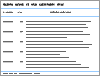
Table 1
Parameters of magnetic tiles
| 参数 | HMTS1 | HMTS2 | HMTS3 |
|---|---|---|---|
| r/mm | 12 | 12 | 12 |
| l1/mm | 12 | 12 | 12 |
| gap/mm | 4 | 4 | 3 |
| l2/mm | 13 | 13 | 13 |
| α/(°) | 22 | 22 | 14 |
| β/(°) | 14 | 14 | 14 |
| h1/mm | 35 | 25 | 33 |
| h2/mm | 35 | 25 | 33 |

Fig.10
Magnetic torque versus angular displacement of high magnetic torsional negative stiffness spring

Table 2
Fitting coefficients of magnetic torsional negative stiffness
| 弹簧 | k1/[(N·m)·rad-1] | k3/[(N·m)·rad-3] | k5/[(N·m)·rad-5] | k7/[(N·m)·rad-7] |
|---|---|---|---|---|
| HMTS1 | -99.4 | 1 470.0 | 1 661 | -2.834×10⁴ |
| HMTS2 | -66.0 | 967.3 | 1 277 | -1.958×10⁴ |
| HMTS3 | -99.5 | 3 746.0 | -5.845×10⁴ | 3.684×10⁵ |

Fig.11
Mechanical characteristics of high magnetic torsional negative stiffness springs


Fig.12
Mechanical characteristics of two magnetic arrays

Table 3
Stiffness fitting coefficients of different magnetic arrays
| 阵列 | k1/[(N·m)·rad-1] | k3/[(N·m)·rad-3] | k5/[(N·m)·rad-5] | k7/[(N·m)·rad-7] |
|---|---|---|---|---|
| 磁荷叠加阵列-sup | -99.4 | 1 470 | 1 661 | -2.834×10⁴ |
| 传统阵列-tra | -29.6 | 1 998 | -1.897×10⁴ | 3.794×10⁴ |

Fig.13
Dimensions of planar spiral torsion spring


Fig.14
Finite element modeling of planar spiral torsion spring

Table 4
Dimensions of planar spiral torsion spring
| 参数 | 数值 |
|---|---|
| 螺旋杆长度L/mm | 255.84 |
| 螺旋杆宽度b/mm | 6.5 |
| 螺旋杆厚度h/mm | 3.0 |

Fig.15
Torque versus angular displacement of planar spiral torsion spring


Fig.16
Schematic diagram of vibration isolation


Fig.17
Transmissibility of vibration isolators equipped with different magnetic arrays (I=0.013 7 kg·m2, m0=0.01, c=0.1 N·s/m)


Fig.18
Impact of viscous damping and amplitude of disturbance on transmissibility of Isolator 1
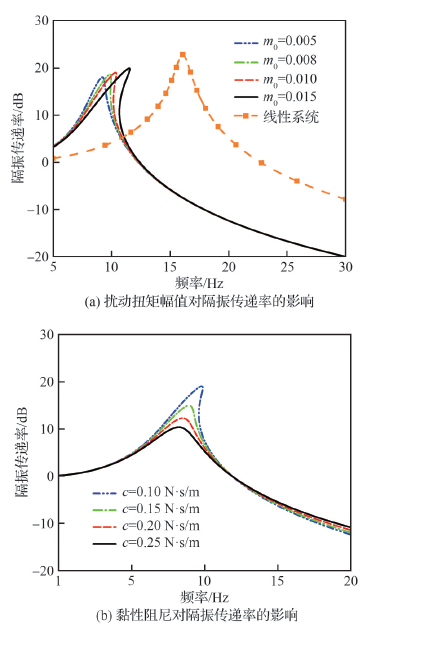

Fig.19
Impact of viscous damping and amplitude of disturbance on transmissibility of Isolator 2


Fig.20
Impact of viscous damping and amplitude of disturbance on transmissibility of Isolator 3


Fig.21
Comparison of the isolation performance between Isolators 1, 2 and 3(m0=0.01, c=0.1 N·s/m)


Fig.22
Schematic diagram of experimental setup


Fig.23
Experimental platform

Table 5
Materials of experimental apparatus
| 试验装置 | 材料 |
|---|---|
| 输入轴 | 铝合金 |
| 输出轴 | |
| 隔振器框架 | |
| 隔振实验平台 | |
| 瓦形磁体 | N52 |
| 平面涡卷弹簧 | 铍青铜 |
| 负载 | 不锈钢 |
Table 6
Parameters of the isolator
| 参数 | 数值 |
|---|---|
| 内磁瓦内半径/mm | 12 |
| 内磁瓦外半径/mm | 24 |
| 内磁瓦角度/(°) | 22 |
| 内磁瓦高度/mm | 35 |
| 外磁瓦1内半径/mm | 28 |
| 外磁瓦2内半径/mm | |
| 外磁瓦1外半径/mm | 41 |
| 外磁瓦2外半径/mm | |
| 外磁瓦1角度/(°) | 14 |
| 外磁瓦2角度/(°) | 28 |
| 外磁瓦1高度/mm | 35 |
| 外磁瓦2高度/mm | |
| 磁体剩磁强度/T | 1.43 |
| 平面涡卷扭簧杆长/mm | 255.84 |
| 平面涡卷扭簧杆宽/mm | 6.5 |
| 平面涡卷扭簧杆厚/mm | 2.1 |
| 负载转动惯量/(kg·m2) | 0.013 7 |

Fig.24
Actual magnetization direction of magnetic tile


Fig.25
Fixtures of inner and outer magnetic tiles


Fig.26
Seven magnetic arrays formed with inner and outer magnetic tiles

Table 7
Fitting coefficients of magnetic torque of different magnetic arrays
| 阵列 | k1/[(N·m)·rad-1] | k3 /[(N·m)·rad-3] | k5/[(N·m)·rad-5] | k7/[(N·m)·rad-7] |
|---|---|---|---|---|
| 阵列1 | -27.59 | 1 080.0 | -4.901×10⁴ | -6.505×10⁵ |
| 阵列2 | -25.97 | 342.5 | -3 455 | 5 642 |
| 阵列3 | -20.24 | 268.5 | -3 311 | 9.153×10⁵ |
| 阵列4 | -32.34 | 199.6 | 688.4 | 1.558×10⁴ |
| 阵列5 | -24.11 | 594.4 | 5.563×10⁴ | 1.061×10⁶ |
| 阵列6 | -37.03 | 196.1 | 2.067×10⁴ | -3.147×10⁵ |
| 阵列7 | -54.57 | 593.8 | -8 400 | -281.8 |

Fig.27
Isolation transmissibility test results of the linear system


Fig.28
Isolation transmissibility test results of the isolator with different magnetic arrays


Fig.29
Comparative analysis of experimental results of isolator with different magnetic arrays

| [1] | 金柱. 碰摩双转子系统弯扭耦合振动特性分析[D]. 南京: 南京航空航天大学, 2023: 13-18. |
| JIN Z. Analysis of bending-torsional coupling vibration characteristics of rub-impact dual-rotor system[D]. Nanjing: Nanjing University of Aeronautics and Astronautics, 2023: 13-18 (in Chinese). | |
| [2] | WANG Y, ZHENG Q G, FU D W, et al. Study on adaptive torsional vibration suppression methods for helicopter/turboshaft engine system with variable rotor speed[J]. Asian Journal of Control, 2021, 23(3): 1490-1502. |
| [3] | 赵亮亮, 吴强, 刘夫云, 等. 某载货汽车变速器怠速异响分析及诊断研究[J]. 机械传动, 2021, 45(7): 128-134. |
| ZHAO L L, WU Q, LIU F Y, et al. Research of analysis and diagnosis of abnormal noise at idle speed of a truck transmission[J]. Journal of Mechanical Transmission, 2021, 45(7): 128-134 (in Chinese). | |
| [4] | 仪凌霄, 潘斯宁, 刘志成, 等. 含间隙非线性的工业机器人关节振动特性分析[J]. 机床与液压, 2023, 51(21): 71-77. |
| YI L X, PAN S N, LIU Z C, et al. Analysis on joint vibration characteristics of industrial robot with clearance nonlinear[J]. Machine Tool & Hydraulics, 2023, 51(21): 71-77 (in Chinese). | |
| [5] | 潘雄, 张春生, 王熙辰, 等. 基于部分解调提前反馈的光纤陀螺振动误差抑制技术[J]. 振动与冲击, 2015, 34(15): 60-65, 97. |
| PAN X, ZHANG C S, WANG X C, et al. Vibration error suppression technique for a fiber optic gyroscope based on partial demodulation and feedback in advance[J]. Journal of Vibration and Shock, 2015, 34(15): 60-65, 97 (in Chinese). | |
| [6] | 吴明亮, 赵晨名, 张来喜. 准零刚度振动控制系统的研究进展[J]. 南京理工大学学报, 2021, 45(1): 18-26. |
| WU M L, ZHAO C M, ZHANG L X. Research progress of quasi-zero stiffness vibration control system[J]. Journal of Nanjing University of Science and Technology, 2021, 45(1): 18-26 (in Chinese). | |
| [7] | 孙秀婷, 钱佳伟, 齐志凤, 等. 非线性隔振及时滞消振方法研究进展[J]. 力学进展, 2023, 53(2): 308-356. |
| SUN X T, QIAN J W, QI Z F, et al. Review on research progress of nonlinear vibration isolation and time-delayed suppression method[J]. Advances in Mechanics, 2023, 53(2): 308-356 (in Chinese). | |
| [8] | ZHOU J X, XU D L, BISHOP S. A torsion quasi-zero stiffness vibration isolator[J]. Journal of Sound and Vibration, 2015, 338: 121-133. |
| [9] | WANG K, ZHOU J X, XU D L. Sensitivity analysis of parametric errors on the performance of a torsion quasi-zero-stiffness vibration isolator[J]. International Journal of Mechanical Sciences, 2017, 134: 336-346. |
| [10] | 项昌乐, 李华, 刘辉. 正负刚度并联半主动扭振减振器减振特性的研究[J]. 汽车工程, 2015, 37(4): 430-434, 459. |
| XIANG C L, LI H, LIU H. A study on the damping characteristics of semi-active torsional damper with combined positive and negative stiffness in parallel[J]. Automotive Engineering, 2015, 37(4): 430-434, 459 (in Chinese). | |
| [11] | 王晓杰, 刘辉, 郦文平, 等. 准零刚度扭转隔振器振动传递特性研究[J]. 机械工程学报, 2018, 54(21): 49-56. |
| WANG X J, LIU H, LI W P, et al. Vibration transmission characteristics of a quasi-zero stiffness torsional isolator[J]. Journal of Mechanical Engineering, 2018, 54(21): 49-56 (in Chinese). | |
| [12] | ZHANG C, HE J S, ZHOU G Q, et al. Compliant quasi-zero-stiffness isolator for low-frequency torsional vibration isolation[J]. Mechanism and Machine Theory, 2023, 181: 105213. |
| [13] | PAN D K, TAN S F, ZHANG Z M, et al. The metastructures actuated by rotational motion with quasi-zero stiffness, negative stiffness, and bistability[J]. Thin-Walled Structures, 2025, 207: 112700. |
| [14] | YU K F, CHEN Y W, YU C Y, et al. Origami-inspire quasi-zero stiffness structure for flexible low-frequency vibration isolation[J]. International Journal of Mechanical Sciences, 2024, 276: 109377. |
| [15] | HAN H S, TANG L H, WU J N, et al. Origami-inspired isolators with quasi-zero stiffness for coupled axial-torsional vibration[J]. Aerospace Science and Technology, 2023, 140: 108438. |
| [16] | SUN Z Y, YUE X H, LI A, et al. A tensegrity-based torsional vibration isolator with broad quasi-zero-stiffness region[J]. Mechanical Systems and Signal Processing, 2025, 224: 112215. |
| [17] | ZHENG Y S, ZHANG X N, LUO Y J, et al. Analytical study of a quasi-zero stiffness coupling using a torsion magnetic spring with negative stiffness[J]. Mechanical Systems and Signal Processing, 2018, 100: 135-151. |
| [18] | 张春松, 李学勇, 张硕, 等. 适应负载变化的准零刚度扭转隔振器设计与分析[J]. 振动与冲击, 2022, 41(23): 307-314. |
| ZHANG C S, LI X Y, ZHANG S, et al. Design and analysis of quasi-zero stiffness torsional vibration isolator adapting to load changes[J]. Journal of Vibration and Shock, 2022, 41(23): 307-314 (in Chinese). | |
| [19] | XU J W, YANG X F, LI W, et al. Design of quasi-zero stiffness joint actuator and research on vibration isolation performance[J]. Journal of Sound and Vibration, 2020, 479: 115367. |
| [20] | WANG Q, ZHOU J X, WANG K, et al. A torsion quasi-zero stiffness harvester-absorber system[J]. Acta Mechanica Sinica, 2024, 41(9): 524252. |
| [21] | WU J L, ZENG L Z, HAN B, et al. Analysis and design of a novel arrayed magnetic spring with high negative stiffness for low-frequency vibration isolation[J]. International Journal of Mechanical Sciences, 2022, 216: 106980. |
| [22] | ZHAO Y M, CUI J N, ZOU L M. Magnetic ring array with high-amplitude negative stiffness for high performance micro-vibration isolation[J]. Journal of Vibration and Control, 2023, 29(11/12): 2609-2622. |
| [23] | ZHANG Y, LIU Q H, LEI Y G, et al. Halbach high negative stiffness isolator: Modeling and experiments[J]. Mechanical Systems and Signal Processing, 2023, 188: 110014. |
| [24] | ZHANG Y, LIU Q H, LEI Y G, et al. Circular Halbach negative stiffness isolating from torsional vibration: Design, modeling and experiments[J]. Mechanical Systems and Signal Processing, 2023, 202: 110711. |
| [25] | FURLANI E P. Permanent magnet and electromechanical devices: Materials, analysis, and applications[M]. Amsterdam: Elsevier, 2001. |
| [1] | Mao FAN, Liang TANG, Xin GUAN, Kebei ZHANG. Ultra-agile ultra-stable and ultra-pointing platform with additional connection [J]. ACTA AERONAUTICAET ASTRONAUTICA SINICA, 2023, 44(11): 225864-225864. |
| [2] | WU Qianqian, CUI Ning, LIU Bilong, YUE Honghao, LIU Rongqiang. Dynamic model and control strategy of multi-dimentional maglev vibration isolation system [J]. ACTA AERONAUTICAET ASTRONAUTICA SINICA, 2019, 40(6): 222522-222522. |
| [3] | DONG Guangxu, LUO Yajun, YAN Bo, ZHANG Xinong. Study on a low frequency vibration isolator based on combined positive and negative stiffness [J]. ACTA AERONAUTICAET ASTRONAUTICA SINICA, 2016, 37(7): 2189-2199. |
| [4] | ZHANG Yao, XU Shijie. Dual-stage Vibration Isolation of Optical Payloads for Satellites [J]. ACTA AERONAUTICAET ASTRONAUTICA SINICA, 2012, 33(9): 1643-1654. |
| [5] | Hu Haiyan. DESIGNING ELASTIC CONSTRAINTS IN A VIBRATION ISOLATION SYSTEM FROM THE VIEWPOINT OF NONLINEAR DYNAMICS [J]. ACTA AERONAUTICAET ASTRONAUTICA SINICA, 1996, 17(5): 18-22. |
| [6] | Gu Qitai. ROBUST CONTROL OF AN ACTIVE VIBRATION ISOLATION SYSTEM FOR HELICOPTERS [J]. ACTA AERONAUTICAET ASTRONAUTICA SINICA, 1989, 10(1): 48-54. |
| Viewed | ||||||
|
Full text |
|
|||||
|
Abstract |
|
|||||
Address: No.238, Baiyan Buiding, Beisihuan Zhonglu Road, Haidian District, Beijing, China
Postal code : 100083
E-mail:hkxb@buaa.edu.cn
Total visits: 6658907 Today visits: 1341All copyright © editorial office of Chinese Journal of Aeronautics
All copyright © editorial office of Chinese Journal of Aeronautics
Total visits: 6658907 Today visits: 1341

 CJA
CJA
