Acta Aeronautica et Astronautica Sinica ›› 2026, Vol. 47 ›› Issue (12): 132822.doi: 10.7527/S1000-6893.2025.32822
• Fluid Mechanics and Flight Mechanics • Previous Articles
Yujia FENG1, Zhenhua SUN1,2( )
)
Received:2025-09-24
Revised:2025-11-17
Accepted:2025-12-30
Online:2026-01-16
Published:2026-01-15
Contact:
Zhenhua SUN
E-mail:rainszh@163.com
Supported by:CLC Number:
Yujia FENG, Zhenhua SUN. Rheological properties of boron-loaded gel fuel[J]. Acta Aeronautica et Astronautica Sinica, 2026, 47(12): 132822.
Fig.1
JP-10 gel fuel with 50wt% boron content
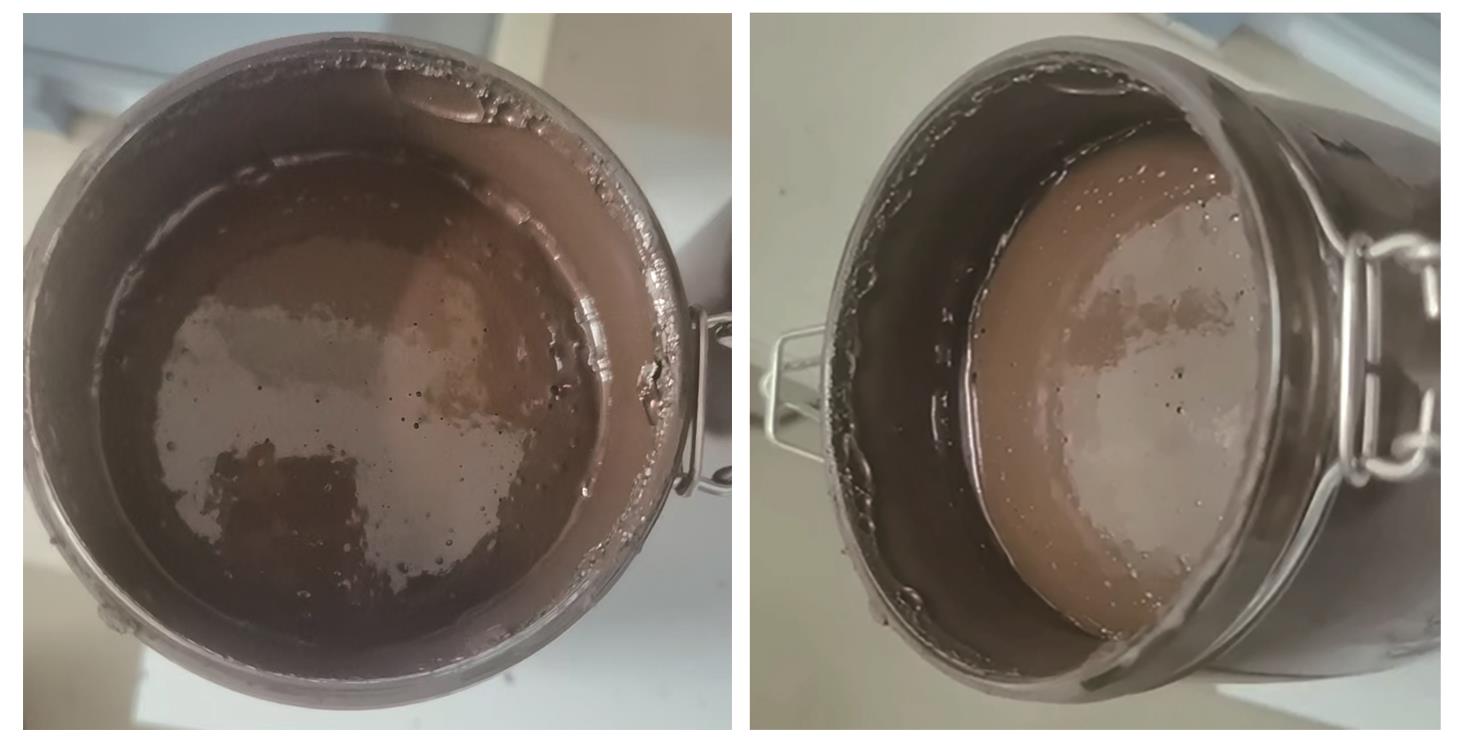
Fig.2
Experimental instrument
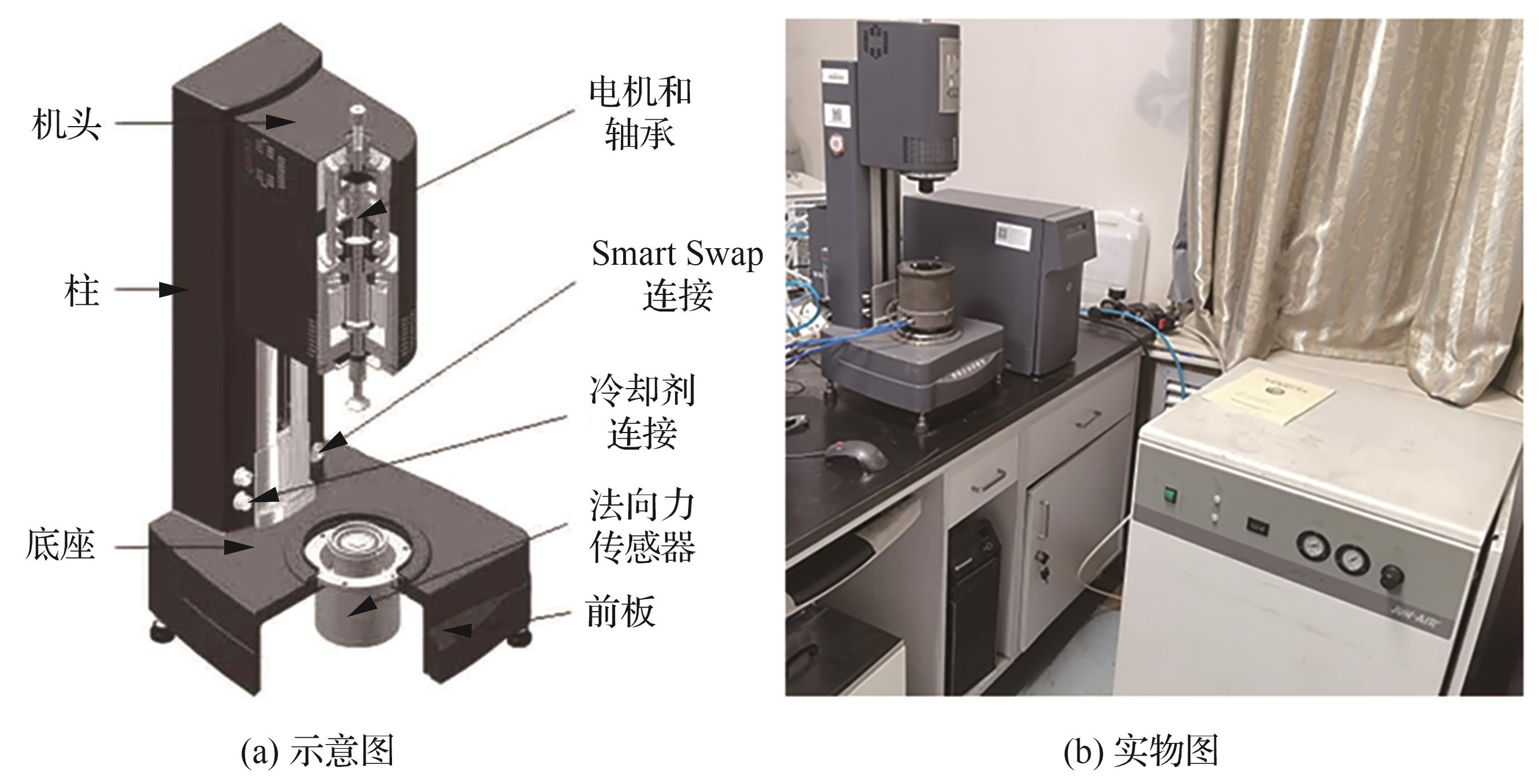

Table 1
Experiment plans
实验 编号 | 剪切速率 | 温度 | 试样预处理方法 |
|---|---|---|---|
| 1 | 自0.1 s-1在500 s内增加至4 355 s-1 | 25 ℃ | 常温密封储存24 h |
| 2 | 自1 s-1在150 s内增加至4 355 s-1 | 25 ℃ | 常温密封储存24 h |
| 3 | 恒定剪切速率1 000 s-1,持续120 s | 25 ℃ | 常温密封储存24 h |
| 4 | |||
| 5 | |||
| 6 | 恒定剪切速率4 000 s-1,持续120 s | 25 ℃ | 常温密封储存24 h |
| 7 | |||
| 8 | |||
| 9 | 恒定剪切速率1 000 s-1,持续1 200 s | 25 ℃ | 常温密封储存24 h |
| 10 | 恒定剪切速率4 000 s-1,持续1 200 s | 25 ℃ | 常温密封储存24 h |
| 11 | 自0.1 s-1在150 s内增加至4 355 s-1 | 25 ℃ | 经实验3预剪切后,静置60 s |
| 12 | 自0.1 s-1在150 s内增加至4 355 s-1 | 25 ℃ | 经实验4预剪切后,静置360 s |
| 13 | 自0.1 s-1在150 s内增加至4 355 s-1 | 25 ℃ | 经实验5预剪切后,静置600 s |
| 14 | 自0.1 s-1在150 s内增加至4 355 s-1 | 25 ℃ | 经实验6预剪切后,静置60 s |
| 15 | 自0.1 s-1在150 s内增加至4 355 s-1 | 25 ℃ | 经实验7预剪切后,静置360 s |
| 16 | 自0.1 s-1在150 s内增加至4 355 s-1 | 25 ℃ | 经实验8预剪切后,静置600 s |
| 17 | 恒定剪切速率4 000 s-1,持续1 200 s | -6.5 ℃匀速升温至60 ℃ | 常温密封储存24 h |
| 18 | 恒定剪切速率4 000 s-1,持续1 200 s | 60 ℃匀速降温至5 ℃ | 常温密封储存24 h |
| 19 | 自0.1 s-1在150 s内增加至4 355 s-1 | 0 ℃ | 常温密封储存24 h后,加热至60 ℃维持600 s,冷却至0 ℃ |
| 20 | 自0.1 s-1在150 s内增加至4 355 s-1 | 25 ℃ | 常温密封储存24 h后,加热至60 ℃维持600 s,冷却至25 ℃ |
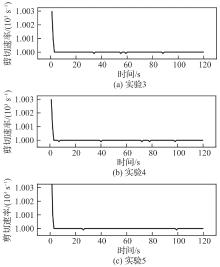
Fig.3
Curves of shear rate versus time (Experiment 3 to Experiment 5)
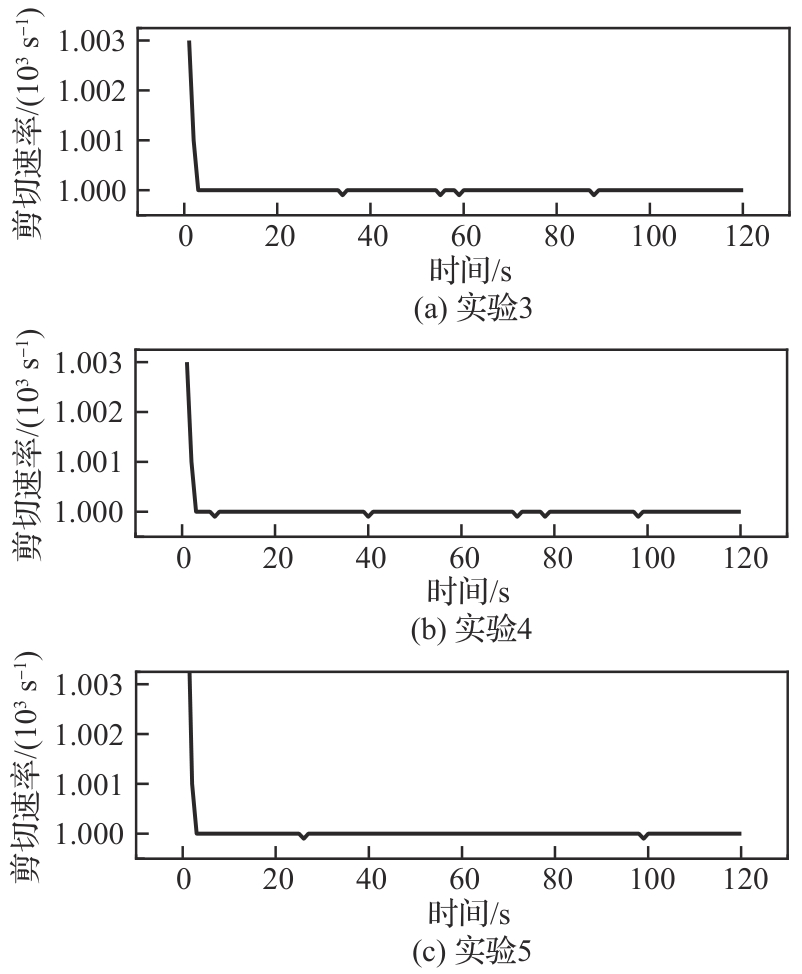
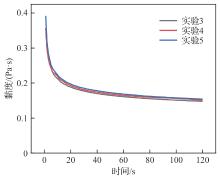
Fig.4
Viscosity-time curves of gel fuel at a shear rate of 1 000 s⁻¹
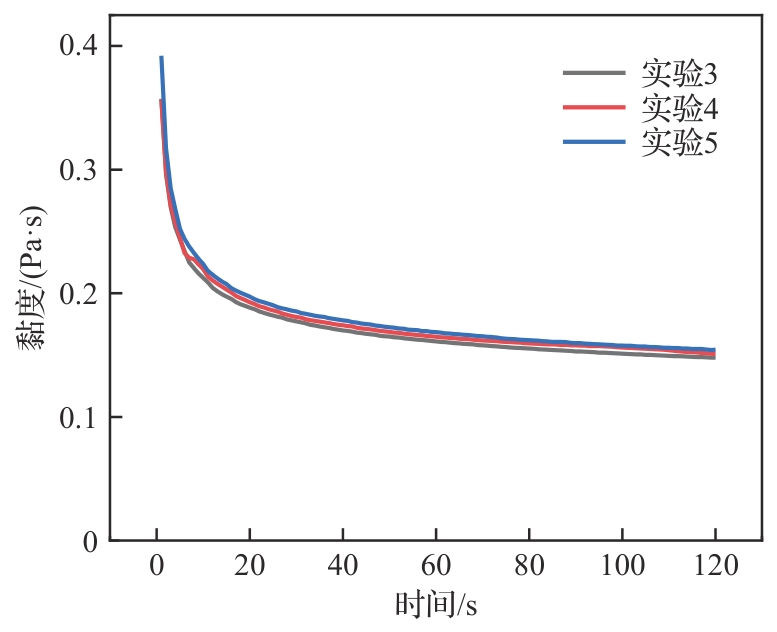
Table 2
Logarithmic function fitting parameters for gel fuel viscosity versus time
| 实验编号 | 参数a1 | 参数b1 | R2 |
|---|---|---|---|
| 3 | -0.031 9 | 0.292 9 | 0.925 3 |
| 4 | -0.031 6 | 0.296 0 | 0.929 6 |
| 5 | -0.034 6 | 0.311 3 | 0.910 4 |
Table 3
Power function fitting parameters for gel fuel viscosity versus time
| 实验编号 | 参数a2 | 参数b2 | R2 |
|---|---|---|---|
| 3 | 0.310 5 | -0.159 3 | 0.972 6 |
| 4 | 0.313 1 | -0.155 0 | 0.974 1 |
| 5 | 0.330 2 | -0.163 5 | 0.963 5 |
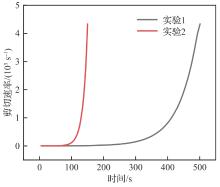
Fig.5
Curves of shear rate versus time (Experiment 1 and Experiment 2)
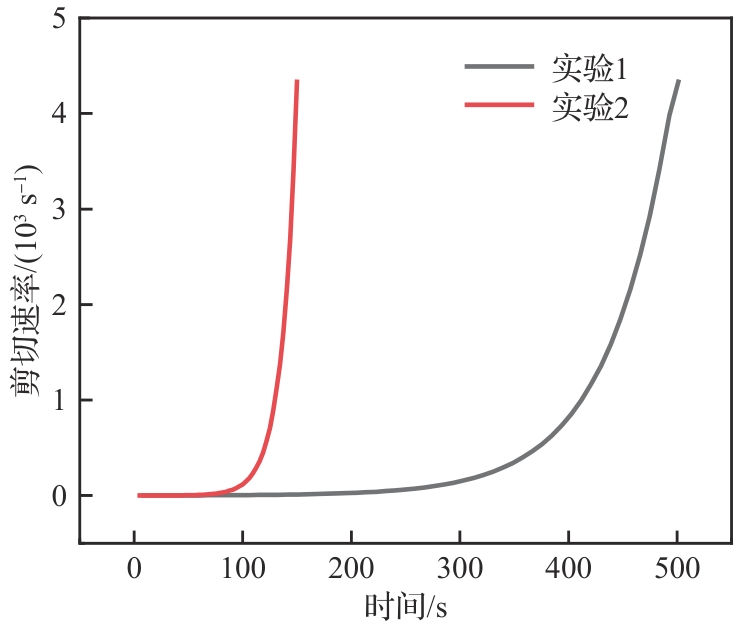
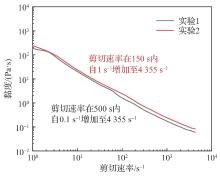
Fig.6
Double-logarithmic coordinate curves of gel fuel viscosity versus shear rate
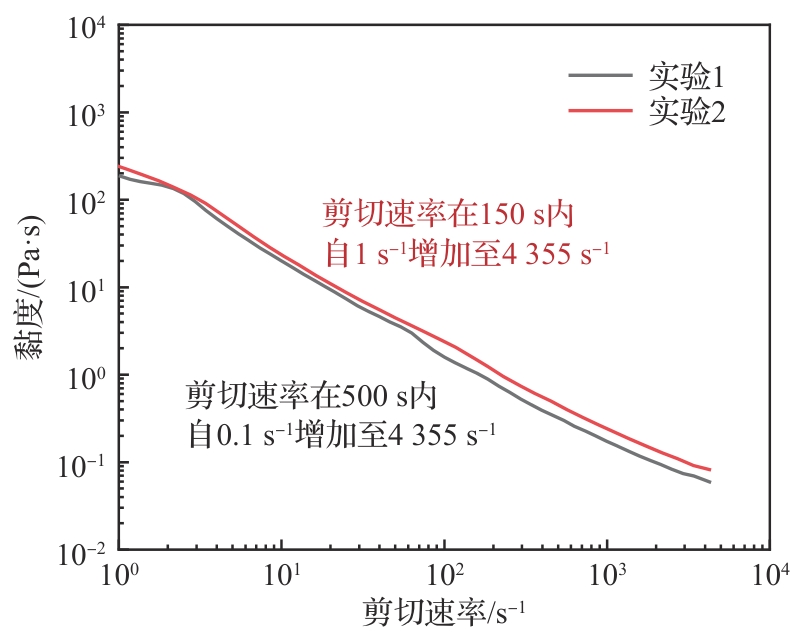
Table 4
Gel fuel viscosity of Experiment 1 and Experiment 2 at different shear rates
| 剪切速率/s-1 | 凝胶燃料黏度/(Pa·s) | |
|---|---|---|
| 实验1 | 实验2 | |
| 100 | 1.588 | 2.402 |
| 1 000 | 0.173 | 0.243 |
| 4 355 | 0.059 | 0.081 |
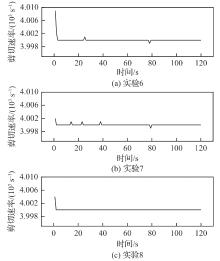
Fig.7
Curves of shear rate versus time (Experiment 6 to Experiment 8)
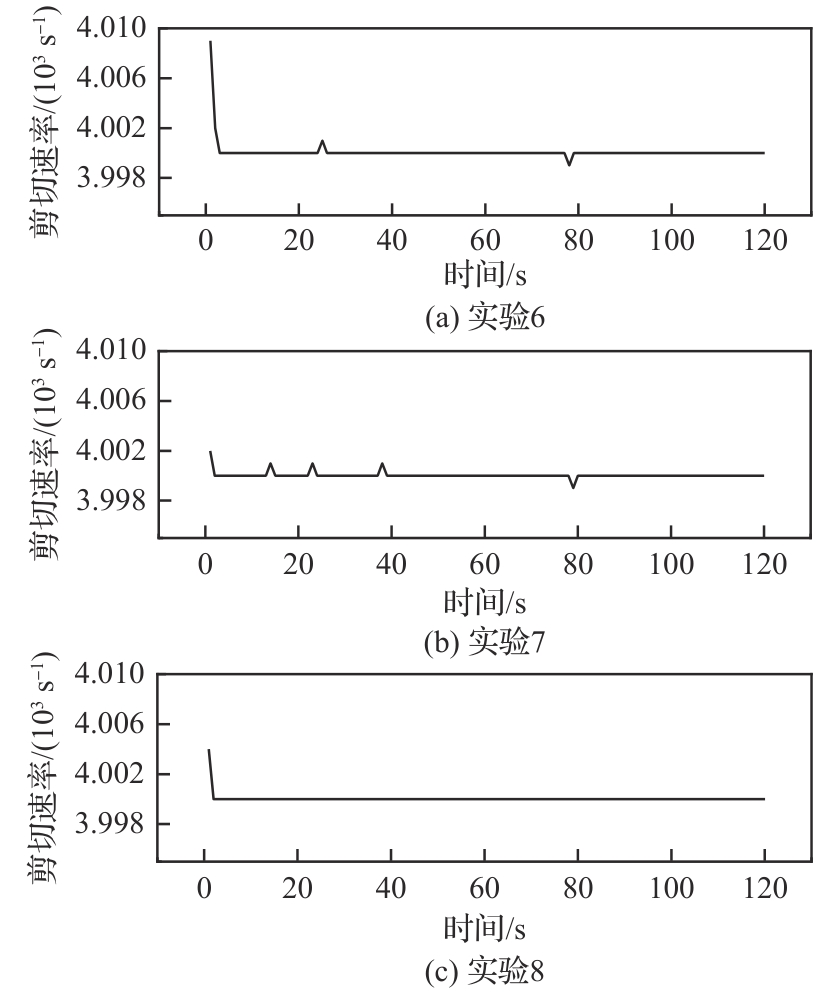
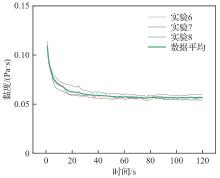
Fig.8
Viscosity-time curves of gel fuel at a shear rate of 4 000 s⁻1
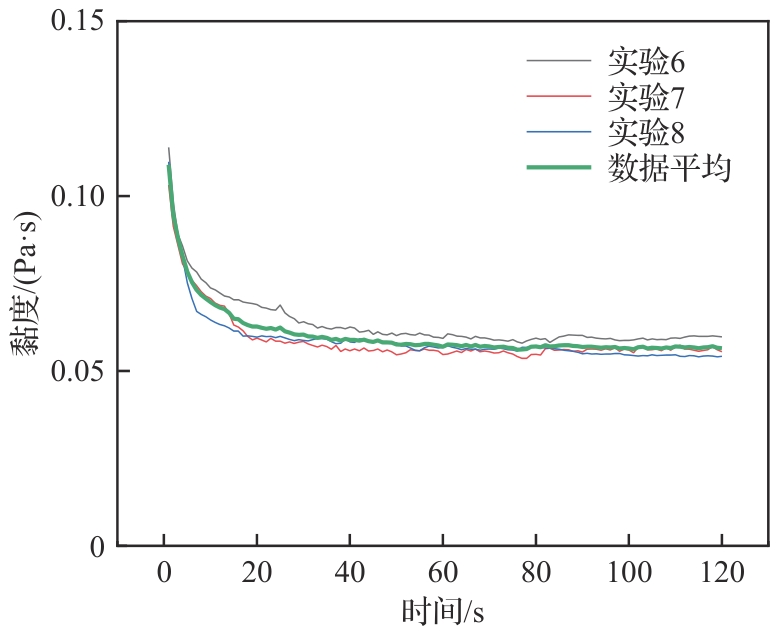
Table 5
Power function fitting parameters for gel fuel viscosity versus time data
| 实验编号 | 参数a2 | 参数b2 | R2 |
|---|---|---|---|
| 6 | 0.094 2 | -0.105 4 | 0.922 7 |
| 7 | 0.084 6 | -0.097 4 | 0.798 8 |
| 8 | 0.083 2 | -0.093 2 | 0.817 6 |
Table 6
Data fitting parameters based on structural dynamics model
| 实验编号 | 参数k1 | 参数k2 | 参数k3 |
|---|---|---|---|
| 3 | 0.131 | 0.415 4 | 8.442 |
| 4 | 0.134 | 0.379 7 | 8.985 |
| 5 | 0.137 | 0.407 9 | 7.686 |
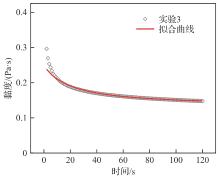
Fig.9
Scatter plot and data fitting curves of gel fuel viscosity versus time at a shear rate of 1 000 s⁻¹ (fitted based on Eq.(6))
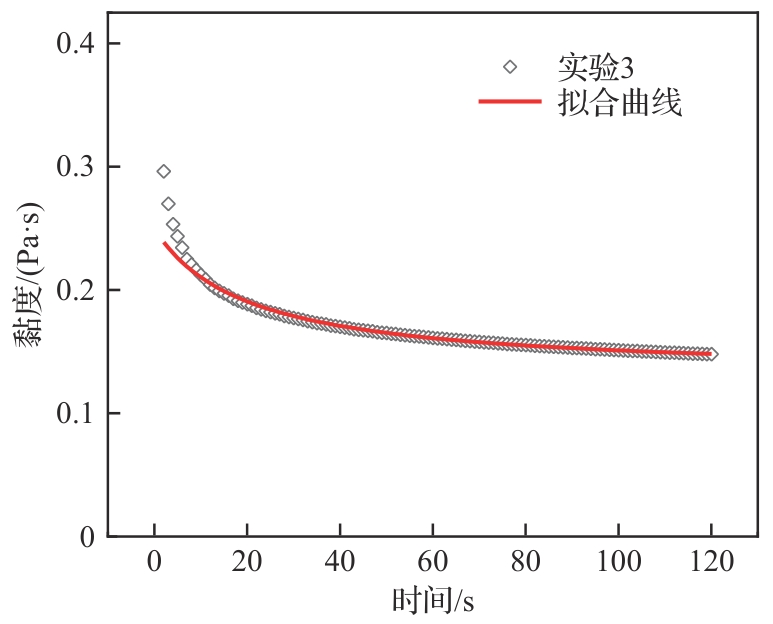
Table 7
Power function fitting parameters based on 1 000 s⁻¹ shear ultimate viscosity
| 实验编号 | 参数a2 | 参数b2 | 参数η∞,t | R2 |
|---|---|---|---|---|
| 3 | 0.252 8 | -0.392 7 | 0.110 | 0.999 2 |
| 4 | 0.246 9 | -0.357 7 | 0.108 | 0.998 7 |
| 5 | 0.267 0 | -0.377 4 | 0.111 | 0.999 5 |
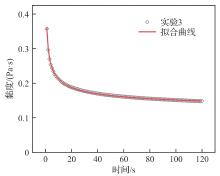
Fig.10
Scatter plot and data fitting curves of gel fuel viscosity versus time at a shear rate of 1 000 s⁻¹ (fitted based on Eq.(7))
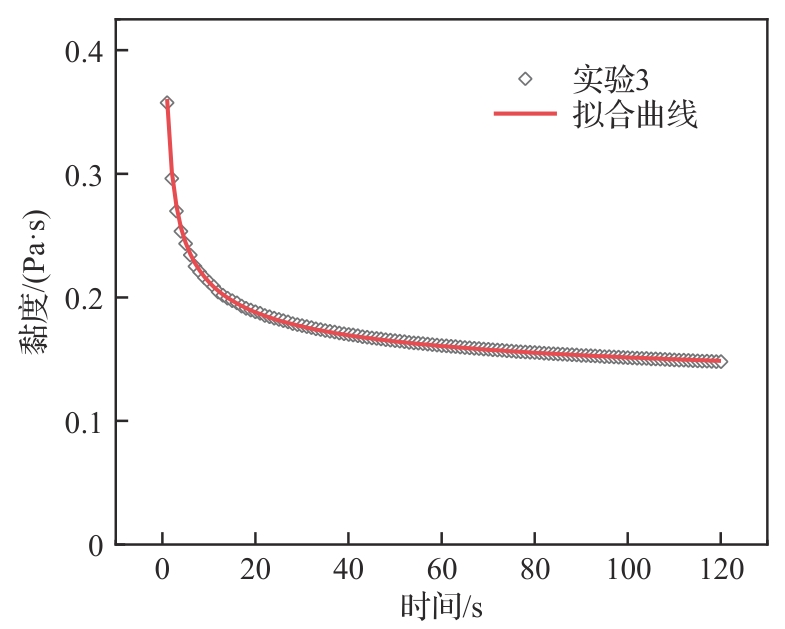
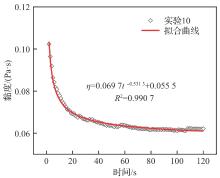
Fig.11
Scatter plot and fitting curves of fuel viscosity versus time at a shear rate of 4 000 s⁻¹
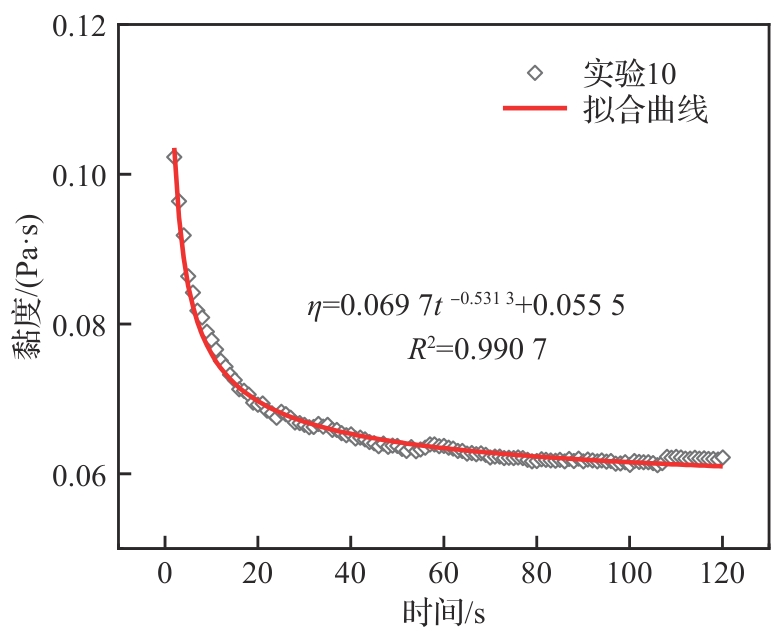
Table 8
Gel fuel viscosity at different shear rates after pre-shearing treatment
| 剪切速率/s-1 | 黏度/(Pa·s) | ||||||
|---|---|---|---|---|---|---|---|
| 实验2 | 实验11 | 实验12 | 实验13 | 实验14 | 实验15 | 实验16 | |
| 1.1 | 199.400 0 | 29.080 0 | 42.850 0 | 49.900 0 | 21.300 0 | 25.020 0 | 44.820 0 |
| 118.0 | 1.964 0 | 0.642 10 | 0.692 10 | 0.685 90 | 0.617 50 | 0.570 30 | 0.581 80 |
| 1 114.0 | 0.236 2 | 0.139 30 | 0.150 60 | 0.146 20 | 0.115 80 | 0.102 00 | 0.098 20 |
| 4 355.0 | 0.079 89 | 0.077 75 | 0.079 02 | 0.080 35 | 0.062 82 | 0.064 48 | 0.068 68 |
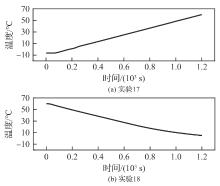
Fig.12
Curves of temperature versus time
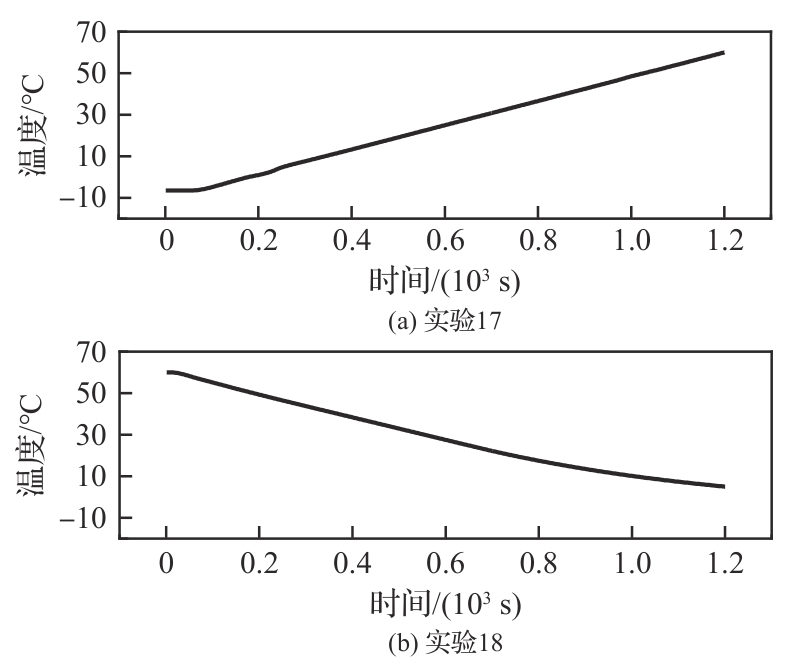
Fig.13
Viscosity-temperature curves of gel fuel at a shear rate of 4 000 s-1
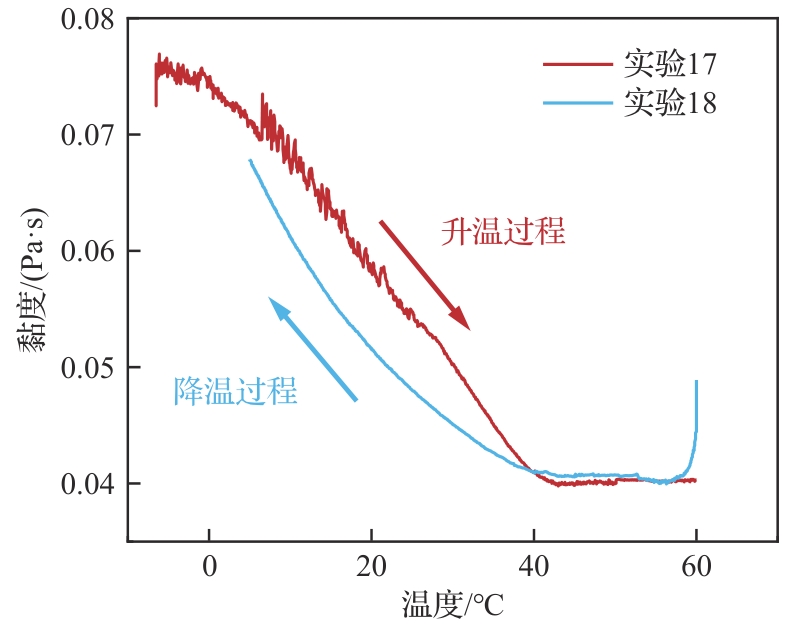
Fig.14
Viscosity-temperature curve of gel fuel at a shear rate of 2 500 s-1
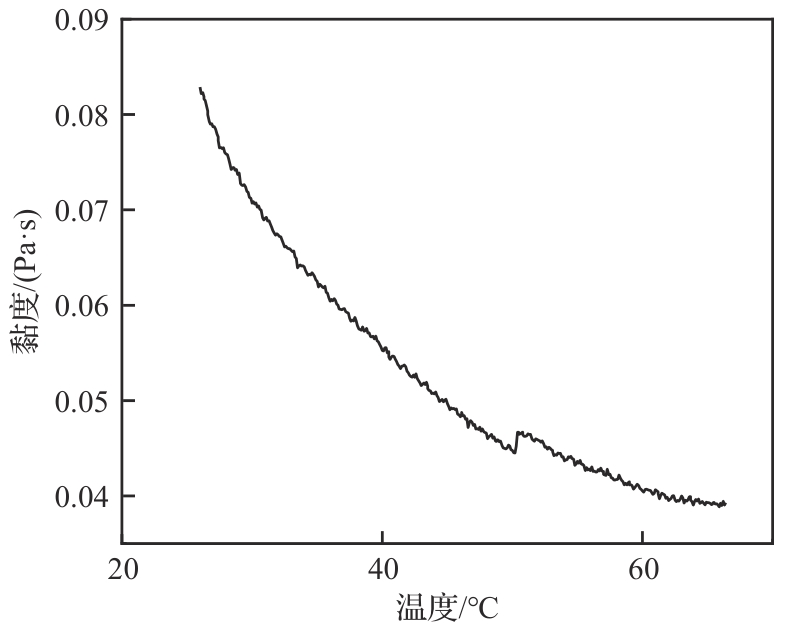
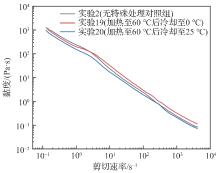
Fig.15
Curves of gel fuel viscosity versus shear rate after temperature cycling
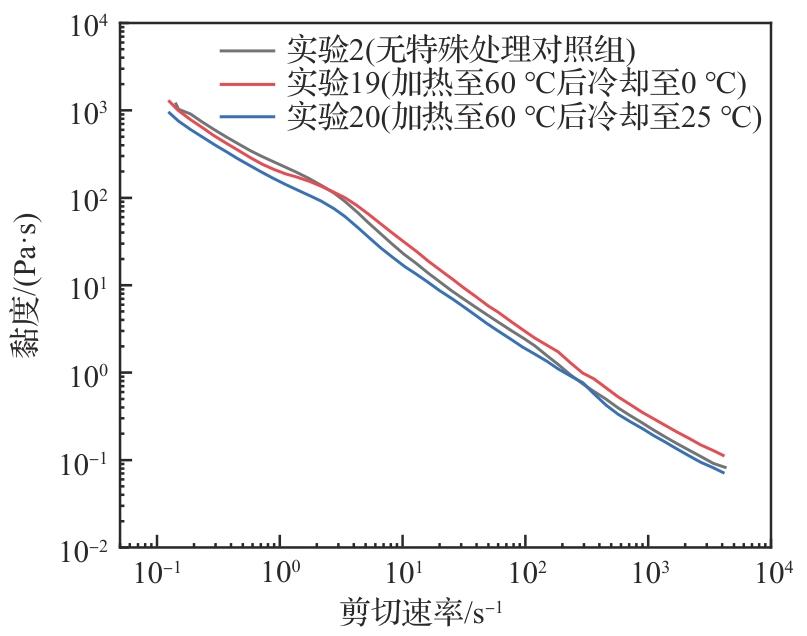
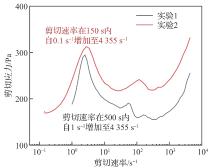
Fig.16
Curves of shear stress versus shear rate at different shear rate increasing rates
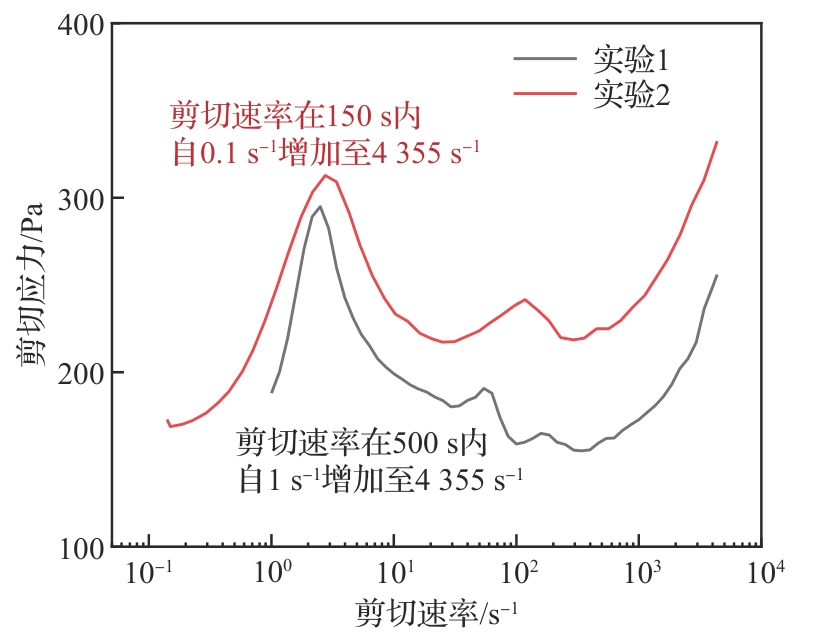
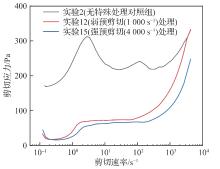
Fig.17
Curves of shear stress versus shear rate before and after pre-shear treatment
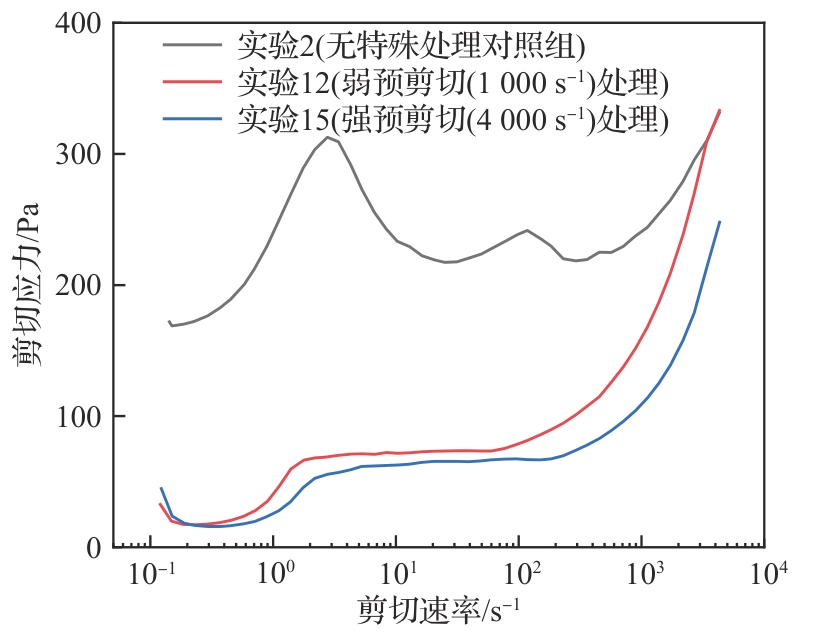
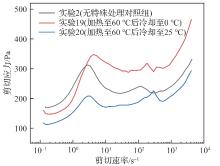
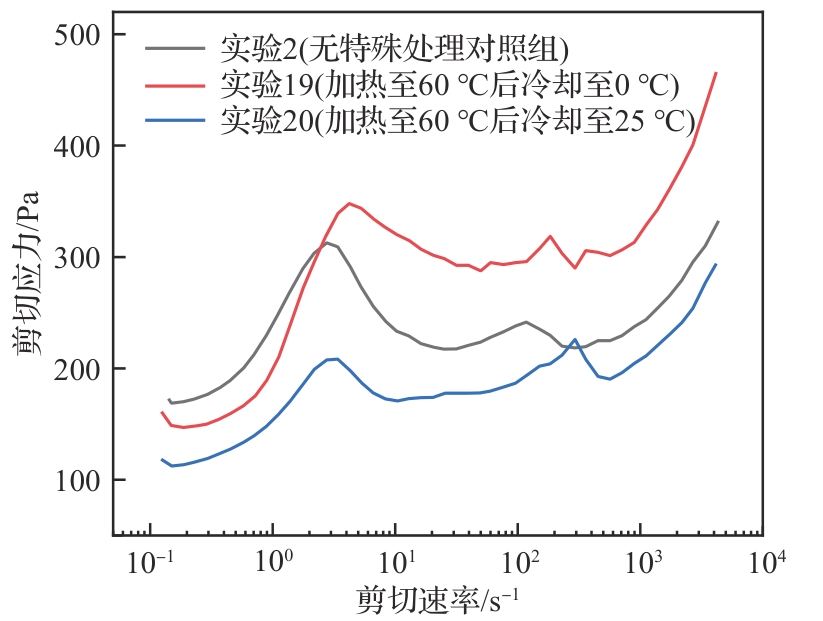
Fig.18
Curves of shear stress versus shear rate before and after temperature cycling
| [1] | 马聪慧, 沈欣, 秦飞, 等. 新型弹用动力技术发展综述[J]. 航空兵器, 2025, 32(1): 73-80. |
| MA C H, SHEN X, QIN F, et al. Comprehensive review of emerging missile propulsion technologies[J]. Aero Weaponry, 2025, 32(1): 73-80 (in Chinese). | |
| [2] | HUANG L Y, GONG M Q, ZHANG J R, et al. High-energy-density metallized gel propellant by hydrogen-bonded polymer-small molecules for enhanced stability and shear-thinning performance[J]. Acta Astronautica, 2024, 214: 356-365. |
| [3] | 靳雨树, 徐旭, 杨庆春. 含能碳氢燃料燃烧特性及发动机应用研究进展[J]. 航空学报, 2023, 44(5): 026690. |
| JIN Y S, XU X, YANG Q C. Research progress in combustion characteristics and engine applications of energetic hydrocarbon fuels[J]. Acta Aeronautica et Astronautica Sinica, 2023, 44(5): 026690 (in Chinese). | |
| [4] | MADHUMITHA R, KARMAKAR S. Boron-loaded gel fuel as potential fuel for ramjet and scramjet engines-recent advancements[J]. FirePhysChem, 2024, 4(3): 185-200. |
| [5] | 冯昱嘉, 孙振华, 王坤, 等. 含硼凝胶冲压发动机技术研究进展[J]. 航空学报, 2025, 46(14): 031256. |
| FENG Y J, SUN Z H, WANG K, et al. Advances in boron-loaded gel ramjet technologies[J]. Acta Aeronautica et Astronautica Sinica, 2025, 46(14): 031256 (in Chinese). | |
| [6] | SOLOMON Y, NATAN B. Burning of organic-gellant-based gel fuel droplets in atmospheric pressure[C]∥The 42nd Israel Annual Conference on Aerospace Sciences. Haifa: Israel Institute of Technology, 2002: 1-10. |
| [7] | SOLOMON Y, NATAN B. Experimental investigation of the combustion of organic-gellant-based gel fuel droplets[J]. Combustion Science and Technology, 2006, 178(6): 1185-1199. |
| [8] | SOLOMON Y, GRINSTEIN D, NATAN B. Active boron dispersion and ignition in gel droplet[J]. International Journal of Energetic Materials and Chemical Propulsion, 2016, 15(3): 197-213. |
| [9] | SOLOMON Y, GRINSTEIN D, NATAN B. Pyrotechnic dispersion and ignition of boron particles in gels: AIAA-2016-4595[R]. Reston: AIAA, 2016. |
| [10] | SOLOMON Y, GRINSTEIN D, NATAN B. Dispersion of boron particles from a burning gel droplet[J]. Journal of Propulsion and Power, 2018, 34(6): 1586-1595. |
| [11] | MADHUMITHA R, KUMARI S, OJHA P K, et al. Effect of particle loading on the burning characteristics of boron-laden gel fuel droplet[J]. International Journal of Energetic Materials and Chemical Propulsion, 2022, 21(6): 21-46. |
| [12] | MADHUMITHA R, MIGLANI A, KARMAKAR S. Impact of aluminium and titanium additives on ignition and combustion in boron-loaded gelled jet A-1 fuel[J]. Combustion Science and Technology, 2025, 197(17): 4924-4948. |
| [13] | MADHUMITHA R, PRABHUDEVA P, KARMAKAR S. Effect of magnesium on ignition and combustion of boron-loaded gelled jet A-1 fuel[J]. International Journal of Energetic Materials and Chemical Propulsion, 2024, 23(4): 61-74. |
| [14] | 杨大力. 含金属颗粒煤油凝胶喷雾燃烧过程研究[D]. 长沙: 国防科技大学, 2020. |
| YANG D L. Investigation on the spray combusion process of kerosene gel containing metal particles[D]. Changsha: National University of Defense Technology, 2020 (in Chinese). | |
| [15] | 杨大力, 夏智勋, 胡建新, 等. 金属基凝胶推进剂单滴蒸发燃烧试验[C]∥中国工程热物理学会2014年年会. 北京: 中国工程热物理学会, 2014: 1-9. |
| YANG D L, XIA Z X, HU J X, et al. Experiment on single drop evaporative combustion of metalized gel propellant[C]∥2014 Chinese Society of Engineering Thermophysics Annual Meeting. Beijing: Chinese Society of Engineering Thermophysics, 2014: 1-9 (in Chinese). | |
| [16] | 杨大力, 夏智勋, 胡建新, 等. 煤油凝胶单液滴燃烧特性试验[J]. 航空学报, 2016, 37(3): 847-853. |
| YANG D L, XIA Z X, HU J X, et al. Experimental study on ignition and combustion characteristics of single kerosene gel droplet[J]. Acta Aeronautica et Astronautica Sinica, 2016, 37(3): 847-853 (in Chinese). | |
| [17] | YANG D L, XIA Z X, HUANG L Y, et al. Synthesis of metallized kerosene gel and its characterization for propulsion applications[J]. Fuel, 2020, 262: 116684. |
| [18] | 肖云雷. 含硼凝胶冲压发动机内部燃烧过程与燃烧组织方法研究[D]. 长沙: 国防科技大学, 2019. |
| XIAO Y L. Research on the combustion process and combustion technology of boron-based gel fuel ramjet[D]. Changsha: National University of Defense Technology, 2019 (in Chinese). | |
| [19] | XIAO Y L, XIA Z X, HUANG L Y, et al. Atomization of gel fuels with solid particle addition utilizing an air atomizing nozzle[J]. Energies, 2018, 11(11): 2959. |
| [20] | XIAO Y L, XIA Z X, HUANG L Y, et al. Experimental investigation of the effects of chamber length and boron content on boron-based gel fuel ramjet performance[J]. Acta Astronautica, 2019, 160: 101-105. |
| [21] | CHEN Y, XUE K, LIU Y, et al. Preparation and properties of high-energy-density aluminum/boron-containing gelled fuels[J]. Chinese Journal of Chemical Engineering, 2024, 65: 230-242. |
| [22] | JIN Y S, XU X, YANG Q C, et al. Combustion behavior of hydrocarbon/boron gel-fueled scramjet[J]. AIAA Journal, 2022, 60(6): 3834-3843. |
| [23] | 靳雨树, 李智欣, 徐旭, 等. 含硼碳氢燃料在超燃冲压发动机中的燃烧试验研究[J]. 推进技术, 2023, 44(3): 2203109. |
| JIN Y S, LI Z X, XU X, et al. Experimental study on combustion of boron containing hydrocarbon fuel in scramjet[J]. Journal of Propulsion Technology, 2023, 44(3): 2203109 (in Chinese). | |
| [24] | JEJURKAR S Y, YADAV G, MISHRA D P. Characterization of impinging jet sprays of gelled propellants loaded with nanoparticles in the impact wave regime[J]. Fuel, 2018, 228: 10-22. |
| [25] | 曹钦柳. 煤油凝胶流动与燃烧机理及其火箭发动机点火特性研究[D]. 南京: 南京理工大学, 2021. |
| CAO Q L. Research on flow and combustion mechanisms of gel fuel and ignition characteristics of gel rocket motor[D]. Nanjing: Nanjing University of Science Technology, 2021 (in Chinese). |
| [1] | Yujia FENG, Zhenhua SUN, Kun WANG, Jiaqi GUO. Advances in boron-loaded gel ramjet technologies [J]. Acta Aeronautica et Astronautica Sinica, 2025, 46(14): 31256-031256. |
| [2] | Junjie FU, Feng QU, Di SUN. Integrated design of waverider forebody and inward-turning inlet considering viscous effect under given flowfield distribution [J]. Acta Aeronautica et Astronautica Sinica, 2025, 46(14): 131451-131451. |
| [3] | Wen YANG, Xinxi ZHANG, Xiangyu WANG, Chuanyang LIU, Yunbo ZHANG. Effect of liquid viscosity on droplet spreading after off⁃axis impact on rotating wall [J]. Acta Aeronautica et Astronautica Sinica, 2024, 45(16): 129847-129847. |
| [4] | Yatian ZHAO, Zhiyuan SHAO, Chao YAN, Xinghao XIANG. Comparative analysis of Reynolds stress and eddy viscosity models in separation flow prediction [J]. ACTA AERONAUTICAET ASTRONAUTICA SINICA, 2023, 44(11): 127619-127619. |
| [5] | WANG Xinguang, MAO Meiliang, HE Kun, CHEN Qi, WAN Zhao. Application of wall function to supersonic turbulence simulation [J]. ACTA AERONAUTICAET ASTRONAUTICA SINICA, 2022, 43(9): 126153-126153. |
| [6] | ZHANG Haoyuan, SUN Dong, QIU Bo, ZHU Yandan, WANG Anling. Influence of turbulent kinetic energy on shock wave/boundary layer interaction [J]. ACTA AERONAUTICAET ASTRONAUTICA SINICA, 2022, 43(7): 125504-125504. |
| [7] | WU Hangkong, WANG Dingxi, HUANG Xiuquan, XU Shenren. Influence of “frozen viscosity assumption” on solution and gradient accuracy of adjoint system [J]. ACTA AERONAUTICAET ASTRONAUTICA SINICA, 2022, 43(7): 125512-125512. |
| [8] | SHU Bowen, DU Yiming, GAO Zhenghong, XIA Lu, CHEN Shusheng. Numerical simulation of Reynolds stress model of typical aerospace separated flow [J]. ACTA AERONAUTICAET ASTRONAUTICA SINICA, 2022, 43(11): 526385-526385. |
| [9] | YANG Lijun, LIU Luhao, FU Qingfei. Research progress in atomization characteristics of non-Newtonian fluid jet [J]. ACTA AERONAUTICAET ASTRONAUTICA SINICA, 2021, 42(12): 624974-624974. |
| [10] | ZHU Chengxiang, ZHENG Haoming, YOU Yancheng. Direct numerical simulation of impinging jet with non-Newtonian shear thinning properties at high ambient pressure [J]. ACTA AERONAUTICAET ASTRONAUTICA SINICA, 2019, 40(6): 122783-122783. |
| [11] | ZHU Chengxiang, WU Meng, CHEN Rongqian, YOU Yancheng. Direct numerical simulation of sheet breakup formed by two impinging jets with non-Newtonian shear thinning properties [J]. ACTA AERONAUTICAET ASTRONAUTICA SINICA, 2018, 39(5): 121982-121982. |
| [12] | ZHU Chengxiang, CHEN Rongqian, YOU Yancheng. Direct numerical simulation of impinging jet breakup with non-Newtonian properties at low Weber number [J]. ACTA AERONAUTICAET ASTRONAUTICA SINICA, 2017, 38(8): 120764-120764. |
| [13] | ZHU Chengxiang, YOU Yancheng. Direct numerical simulation of a non-Newtonian liquid jet in crossflow [J]. ACTA AERONAUTICAET ASTRONAUTICA SINICA, 2016, 37(9): 2659-2668. |
| [14] | DONG Haitao, LIU Dingsong. Implicit scheme for viscosity item of Navier-Stokes equations with pseudo-viscosity method [J]. ACTA AERONAUTICAET ASTRONAUTICA SINICA, 2015, 36(7): 2186-2196. |
| [15] | XIAO Hong, SHANG Yuhe, WU Di, SHI Yangyang. Nonlinear coupled constitutive relations and its validation for rarefied gas flows [J]. ACTA AERONAUTICAET ASTRONAUTICA SINICA, 2015, 36(7): 2091-2104. |
| Viewed | ||||||
|
Full text |
|
|||||
|
Abstract |
|
|||||
Address: No.238, Baiyan Buiding, Beisihuan Zhonglu Road, Haidian District, Beijing, China
Postal code : 100083
E-mail:hkxb@buaa.edu.cn
Total visits: 6658907 Today visits: 1341All copyright © editorial office of Chinese Journal of Aeronautics
All copyright © editorial office of Chinese Journal of Aeronautics
Total visits: 6658907 Today visits: 1341

 CJA
CJA
