Acta Aeronautica et Astronautica Sinica ›› 2025, Vol. 46 ›› Issue (11): 531213.doi: 10.7527/S1000-6893.2024.31213
• Reviews • Previous Articles
Chuanyan FENG1,2, Shuang LIU2, Xiaoru WANYAN2, Menglong DING1, Daochun LI1,2, Yaoming ZHOU1,2( )
)
Received:2024-09-18
Revised:2024-10-25
Accepted:2024-12-12
Online:2024-12-24
Published:2024-12-23
Contact:
Yaoming ZHOU
E-mail:zhouyaoming@buaa.edu.cn
Supported by:CLC Number:
Chuanyan FENG, Shuang LIU, Xiaoru WANYAN, Menglong DING, Daochun LI, Yaoming ZHOU. Research progress on key technologies for human factors design of unmanned aircraft systems[J]. Acta Aeronautica et Astronautica Sinica, 2025, 46(11): 531213.

Fig.1
Duties of unmanned aircraft systems operator[23]

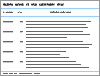
Table 1
Summary of unique human factors challenges for unmanned aircraft systems[6-7,13,22-24]
| 人因挑战 | 描述 |
|---|---|
| 自然感官线索减少或缺失 | 无人机操作员依赖于机载传感器提供的感官信息,缺乏传统驾驶舱内外环境所具备的视听、嗅觉等直接感官输入,这限制了其情境意识维持以及导航、避撞、监控等任务执行。 |
| 通信链路带宽限制/延迟或情境信息获取不充分等 | 无人机操作员接收到的信息质量受无人机与地面站之间通信链路带宽的限制。此外,通信延迟以及无人机周围视觉环境的获取困难等也为达成最佳绩效带来了挑战。 |
| 自动化依赖 | 与传统的有人机系统能够自由切换自动驾驶和手动控制不同,无人机系统的设计本质上是让操作员远离无人机,依赖自动化系统进行基本的飞行控制,因此可能无法提供完全的飞行员手动控制选项。 |
| 过渡:移交、控制权转移和链路切换 | 无人机的控制权可在相邻地面站控制台或地理上分隔的地面站之间进行转移。然而,每次转移都可能面临匹配模式错误、控制设置不一致或沟通失败等问题。 |
| 地面站的物理特性 | 与传统的有人机驾驶舱不同,地面站更类似于控制中心或办公室,其空间相对宽敞,可以增加额外的信息显示,而无需将相关信息提前整合到有限的驾驶舱内。此外,除了考虑与飞行员驾驶舱相似的物理环境(如温度、照明等)和人机界面外,还需关注同事和维修等其他人员的影响。 |
| 基于消费类产品交互的广泛使用 | 地面站可使用商业消费类键盘、鼠标等办公室接口设备,但采用不同供应商的接口可能出现一致性和集成方面的问题。 |
| 无人机作业的非常规特性 | 单调、枯燥的长航时飞行可带来无人机操作员疲劳等问题。此外,缓慢的飞行模式及爬升/下降速度可能给空中交通管制员(Air Traffic Control,ATC)带来挑战。 |
| 单个无人机操作员同时控制多架无人飞行器(“一对多”) | 在无人机飞行作业中,单个操作员同时控制多架无人机的情况日益普遍。这虽然扩大了任务范围,但也带来了工作负荷和人与系统综合效能等方面的独特挑战。 |
Table 2
Example of unmanned aircraft systems automation leveling[28]
| 自动化等级 | 人工介入程度 | ||
|---|---|---|---|
| AL-0 | 通讯、导航与监视 | 航行情报和气象服务 | 系统维护 |
| AL-1 | 高 | 高 | 高 |
| AL-2 | 中 | 高 | 高 |
| AL-3 | 低 | 中 | 高 |
| AL-4 | 低 | 低 | 低 |
| AL-5 | 低 | 低 | 低 |

Fig.2
Examples of staffing and collaborative operational scenarios in the low-altitude economy


Fig.3
Subregional summaries of unmanned aircraft systems human factors-related standards

Table 3
Results of human factors-related standards for unmanned aircraft systems
| 领域 | 发布组织或机构 | 类型 | 名称及对应章节或内容 |
|---|---|---|---|
| 国际 | 国际民航组织(International Civil Aviation Organization,ICAO) | 通告(Circular) | ICAO Cir 328《Unmanned Aircraft Systems (UAS)》 7.4 Unusual Human Factors |
| 国际标准化组织(International Organization for Standardization,ISO) | ISO国际航空标准化技术委员会无人机系统分技术委员会(ISO/TC 20/SC 16) | ISO 21384-2:2021《Unmanned aircraft systems—Part 2: UAS components》 12.3.3 Human factors engineering and ergonomics design;ISO 21384-3:2023《Unmanned aircraft systems—Part 3: Operational procedures》 9.6 Personnel qualification and management;ISO 23665: 2023《Unmanned aircraft systems—Training for personnel involved in UAS operations》 A.4.10 Human factors1 | |
| 中国 | 国家市场监督管理总局/国家标准化管理委员会 | 国家标准(GB) | GB/T 38931-2020《民用轻小型无人机系统安全性通用要求》 4.2 基本原则,5.6 使用与保障危险分析;GB/T 44167-2024《大型货运无人机系统通用要求》 8.2 一般要求;GB/T 44169-2024《民用大中型固定翼无人机地面站系统通用要求》 2.3.4.1 总要求;GB/T 43367-2023《民用大中型无人直升机系统通用要求》 8.8 人机交互 |
| 中国民用航空局(Civil Aviation Administration of China,CAAC) | 民航规章(China Civil Aviation Regulation,CAAR) | CCAR-92《民用无人驾驶航空器运行安全管理规则》 第92.685条 飞行机组成员要求 | |
| 咨询通告(Advisory Circular,AC) | AC-92-AA-2024-01《民用无人驾驶航空器系统适航安全评定指南》 5.3.8 一机多控测试;AC-61-FS-2018-20R2《民用无人机驾驶员管理规定》人员资质 | ||
| 信息通告(Information Bulletin,IB) | IB-TM-2022-05《民用轻小型无人驾驶航空器物流配送试运行审定指南》 7.1 人机界面要求 | ||
| CAAC | 民用航空行业标准(MH) | MH/T 2013-2022《民用无人驾驶航空器系统分布式操作运行等级划分》 4 分布式操作自动化程度划分 | |
| 工业和信息化部 | 航空行业标准(HB) | HB 8595-2021《民用轻小型无人机系统便携式地面控制单元通用要求》 4.12 人机工程;HB 8567-2019《轻小型无人直升机系统通用要求》 4.10 人机交互 | |
| 国家国防科技工业局 | HB | HB 20099-2012《航空装备控制器人机工程设计准则》、HB 20097-2012《航空装备信息显示人机工程设计准则》和HB 20098-2012《航空装备交互与管理人机工程准则》,适用无人机及地面配套设施的设计;2 | |
| 中央军委装备发展部、中国人民解放军总装备部 | 国军标(GJB) | GJB 4108A-2022《军用小型无人机系统部队试验规程》4.13 人机工程试验;GJB 5433-2005《无人机系统通用要求标准》11.3.2 要求 | |
| 美国 | 联邦航空局(Federal Aviation Administration,FAA) | 联邦规章(Code of Federal Regulations,CFR) | 14 CFR Part 107《Small Unmanned Aircraft Systems》 |
| 美国材料与试验协会(American Society for Testing and Materials,ASTM) | 学会标准 | ASTM-F3563-22《Standard Specification for Design and Construction of Large Fixed Wing Unmanned Aircraft Systems》 | |
| 欧洲 | 欧洲航空安全局(European Union Aviation Safety Agency,EASA) | 欧盟(European Union,EU)规章 | EU规章2019/947、2019/945 |
| 各欧洲国家标准学会 | 学会标准 | 德国标准化学会(Deutsches Institut für Normung,DIN)航空航天系列-无人机系统、英国标准学会英国标准学会(British Standards Institution,BSI)采纳的ISO标准 |

Fig.4
Human-AI teaming in unmanned aircraft systems


Fig.5
Key HSI process validation at typical HRL[44-46]

| [1] | 郭辰阳, 敖万忠, 吕宜宏. 低空经济与通用航空、无人机、UAM的关系分析[J]. 财经界, 2023(28): 30-32. |
| GUO C Y, AO W Z, LYU Y H. Analysis on the relationship between low-altitude economy and general aviation, UAV and UAM[J]. Money China, 2023(28): 30-32 (in Chinese). | |
| [2] | 李超. 垂直起降-2024年中国低空经济前景研究报告[R]. 上海: 艾瑞研究院, 2024. |
| LI C. Vertical takeoff and landing-2024 china low altitude economy prospect research report[R]. Shanghai: iResearch Institute, 2024 (in Chinese). | |
| [3] | 赛迪研究院. 中国低空经济发展研究报告(2024)[R]. 北京: 赛迪研究院, 2024. |
| Ccid Research Institute. China low altitude economy development research report (2024)[R]. Beijing: Ccid Research Institute,2024 (in Chinese). | |
| [4] | Cooke N J, Rowe L J, Bennett W. Remotely Piloted Aircraft Systems[M]. Montreal: ICAO, 2016. |
| [5] | GUPTA S G, GHONGE M, JAWANDHIYA P M. Review of unmanned aircraft system (UAS)[J]. International Journal of Advanced Research in Computer Engineering & Technology (IJARCET),2013, 2(4): 1646-1658. |
| [6] | Hobbs A N. Remotely piloted aircraft systems[M/OL]∥Human factors in aviation and aerospace. Amsterdam: Elsevier, 2023: 399-419 [2024-09-18]. . DOI:10.1016/B978-0-12-420139-2.00007-1 . |
| [7] | McCarley J S, Wickens C D. human factors implications of UAVs in the national airspace[J].Vasa, 2005, 1-63. |
| [8] | 王颖, 王谋, 印春峰. 中国低空经济发展热现象下的冷思考[J]. 中国工程咨询, 2024(3): 48-52. |
| WANG Y, WANG M, YIN C F. Cold thinking under the hot phenomenon of low-altitude economic development in China[J]. China Engineering Consultants, 2024(3): 48-52 (in Chinese). | |
| [9] | Johnson C. The hidden human factors in unmanned aerial vehicles[J]∥Proceedings of the 2007 International Systems Safety Society Conference. Glasgow: University of Glasgow,2007. |
| [10] | Dolgov I, Hottman S B. 11 Human factors in unmanned aircraft systems[M]∥Introduction to unmanned aircraft systems. Boca Raton: CRC Press, 2012. |
| [11] | WILLIAMS K. A summary of unmanned aircraft accident/incident data: Human factors implications: DOT/FAA/AM-04/24[R]. Washington, D.C.: Office of Aerospace Medicine, 2004. |
| [12] | COOKE N J. Human factors of remotely operated vehicles[J]. Proceedings of the Human Factors and Ergonomics Society Annual Meeting, 2006, 50(1): 166-169. |
| [13] | McCarley J S, Wickens C D. Human factors concerns in UAV flight[R]. Chicago: Chicago University of Illinois at Urbana-Champaign Institute of Aviation, 2004. |
| [14] | 蒋浩, 高鑫. 人因工程在无人机中的应用及展望[J]. 航空科学技术, 2019, 30(5): 9-13. |
| JIANG H, GAO X. Application and prospect of human factor engineering in unmanned aerial vehicle[J]. Aeronautical Science & Technology, 2019, 30(5): 9-13 (in Chinese). | |
| [15] | 丁国杰, 徐安, 揭永琴, 等. 2024上海低空经济发展白皮书[R]. 上海: 上海交通大学, 2024. |
| DING G J, XU A, JIE Y Q, et al. White paper on low altitude economic development in Shanghai 2024[R]. Shanghai: Shanghai Jiaotong University, 2024 (in Chinese). | |
| [16] | 中国无人机产业创新联盟, 腾讯智慧交通, 腾讯研究院. 2024年中国eVTOL产业发展报告[R]. 深圳: 腾讯研究院, 2024. |
| China UAV Industry Innovation Alliance, Tencent Intelligent Transportation, Tencent Research Institute. China eVTOL industry development report 2024[R]. Shenzhen: Tencent Research Institute, 2024 (in Chinese). | |
| [17] | 许为, 葛列众. 智能时代的工程心理学[J]. 心理科学进展, 2020, 28(9): 1409-1425. |
| XU W, GE L Z. Engineering psychology in the era of artificial intelligence[J]. Advances in Psychological Science, 2020, 28(9): 1409-1425 (in Chinese). | |
| [18] | 王娜. 舰员仅为伯克级的一半DDG 1000 如何做到?[J]. 舰船知识, 2014(10): 50-55. |
| WANG N. With a crew half the size of the Burke class DDG 1000, how did it happen?[J]. Ship Knowledge, 2014(10): 50-55 (in Chinese). | |
| [19] | BARNHART R K, MARSHALL D M, SHAPPEE E J. Introduction to unmanned aircraft systems[M]. 3rd ed. Boca Raton: CRC Press, 2021. |
| [20] | ISO 21384-4. Unmanned aircraft systems—Part 4 Vocabulary[R]. Montreal: ICAO, 2020. |
| [21] | Feng C Y, Hou J W, Liu S, et al. Key technology for human-system integration of unmanned aircraft systems in urbariair transportation[J]. Drones, 2025, 9(1): 18. |
| [22] | HOBBS A N, LYALL B. Human factors guidelines for unmanned aircraft system ground control stations[R]. Washington, D.C.: NASA, 2015. |
| [23] | HOBBS A, LYALL B. Human factors guidelines for unmanned aircraft systems[J]. Ergonomics in Design: the Quarterly of Human Factors Applications, 2016, 24(3): 23-28. |
| [24] | ORDOUKHANIAN E, MADNI A M. Human-systems integration challenges in resilient multi-UAV operation. Advances in human factors in robots and unmanned systems: Vol. 595.[M]∥Cham: Springer International Publishing, 2018: 131-138. |
| [25] | CONNOR O, PEDERSEN H, COOKE N, et al. 1. CERI human factors of UAVs: 2004 and 2005 workshop overviews[M]∥Human factors of remotely operated vehicles. Amsterdam: Elsevier, 2006: 3-20. |
| [26] | ZHANG X, JIA G, CHEN Z. The literature review of human factors research on unmanned aerial vehicle-what Chinese researcher need to do next? [M]∥ Cross-Cultural Design. Methods, Tools, and Users:Vol. 10911. Cham: Springer International Publishing. |
| [27] | BORING R L, ROTH E, STRAETER O, et al. Is human reliability relevant to human factors?[J]. Proceedings of the Human Factors and Ergonomics Society Annual Meeting, 2009, 53(10): 610-614. |
| [28] | 中国民用航空局. 民用无人驾驶航空器系统分布式操作运行等级划分[R]. 北京: 中国民用航空局, 2022. |
| Civil Aviation Administration of China. Grading of distributed operation level for civil unmanned aircraft system[R]. Beijing: Civil Aviation Administration of China, 2022 (in Chinese). | |
| [29] | LIM Y, GARDI A, SABATINI R, et al. Avionics human-machine interfaces and interactions for manned and unmanned aircraft[J]. Progress in Aerospace Sciences, 2018, 102: 1-46. |
| [30] | RASH C, LEDUC P, MANNING S. 9. human factors in U.S. military unmanned aerial vehicle accidents[M]∥ Human Factors of Remotely Operated Vehicles. Amsterdam: Elsevier, 2006: 117-131. |
| [31] | NISSER T, WESTIN C. Human factors challenges in unmanned aerial vehicles (uavs): A literature review[R]. Ljungbyhed: Lund University School of Aviation, 2006. |
| [32] | FEIGH K, PRITCHETT A. Function allocation between human and automation and between air and ground[M]∥Unmanned Aircraft Systems. Hoboken: John Wiley & Sons, 2016: 319. |
| [33] | 冯传宴, 完颜笑如, 刘双, 等. 负荷条件下注意力分配策略对情境意识的影响[J]. 航空学报, 2020, 41(3): 123307. |
| FENG C Y, WANYAN X R, LIU S, et al. Influence of different attention allocation strategies under workloads on situation awareness[J]. Acta Aeronautica et Astronautica Sinica, 2020, 41(3): 123307 (in Chinese). | |
| [34] | CUMMINGS M, ZACHARIAS G. Aircraft pilot and operator interfaces[M]∥Unmanned aircraft systems. Hoboken: John Wiley & Sons, 2016: 335. |
| [35] | Karyotakis M, Braithwaite G. Human factors and human performance in UAS operations. The case of UAS pilots in UAM operations[M]∥Engineering Psychology and Cognitive Ergonomics: Vol. 14018. Cham: Springer Nature Switzerland, 2023: 253-278. |
| [36] | RUFF H A, DRAPER M H, LU L G, et al. Haptic feedback as a supplemental method of alerting UAV operators to the onset of turbulence[J]. Proceedings of the Human Factors and Ergonomics Society Annual Meeting, 2000, 44(13): 41-44. |
| [37] | 航空工业上海航空电器有限公司. HH-100航空商用无人运输系统验证机成功首飞[EB/OL]∥Weixin Official Accounts Platform. (2024-06)[2024-09-18]. . |
| AVIC Shanghai Aviation Electric Co. Successful first flight of HH-100 aerospace commercial unmanned transportation system demonstrator [EB/OL]∥Weixin Official Accounts Platform.(2024-06)[2024-09-18]. (in Chinese). | |
| [38] | SUAS NEWS. Multi-cam drone video footage for security, inspections & public safety[EB/OL]. . |
| [39] | MARSHALLD. Coordination with manned aircraft and air traffic control[M]∥Unmanned aircraft systems. Hoboken: John Wiley & Sons, 2017: 327. |
| [40] | 冯传宴, 李志忠. 人因工程与系统工程的集成第一部分: 工业实践经验回顾[J]. 载人航天, 2023, 29(3): 415-426. |
| FENG C Y, LI Z Z. Integration of human factors and systems engineering part I: review of industrial practice experience[J]. Manned Spaceflight, 2023, 29(3): 415-426 (in Chinese). | |
| [41] | CALHOUN G L, GOODRICH M A, DOUGHERTY J R, et al. Human-autonomy collaboration and coordination toward multi-RPA missions[M]∥Remotely Piloted Aircraft Systems: A Human Systems Integration Perspective. Hoboken: John Willey & Sons, 2016: 109-136. |
| [42] | MCCAULEY M, MATSANGAS P. Human systems integration and automation issues in small unmanned aerial vehicles[R]. Monterey: Naval Postgraduate Schllo, 2004 |
| [43] | 向锦武, 董希旺, 丁文锐, 等. 复杂环境下无人集群系统自主协同关键技术[J]. 航空学报, 2022, 43(10): 527570. |
| XIANG J W, DONG X W, DING W R, et al. Key technologies for autonomous cooperation of unmanned swarm systems in complex environments[J]. Acta Aeronautica et Astronautica Sinica, 2022, 43(10): 527570 (in Chinese). | |
| [44] | WRITER S. Simulation Technology for Unmanned Systems[EB/OL]. (2024-08-08)[2024-09-18]. . |
| [45] | PUBLIC DOMAIN MEDIA. Maj. Kevin Gambold monitors and pilots an MQ-1 Predator[EB/OL]. (2008-10-01)[2024-09-18]. |
| [46] | CENCIOTTI D. Top military aviation stories of 2011: drones up and downs, stealth projects exposed and Libya’s 7-month-long war[EB/OL]. (2011-12-18)[2024-09-18].. |
| [47] | FENG C Y, LIU S, WANYAN X R, et al. A human-system integration framework and its application for special vehicle interface design under typical human readiness levels[J]. iScience, 2024, 27(3): 109095. |
| [48] | 冯传宴, 李志忠. 人因工程与系统工程的集成 第三部分: 技术路线总结和解决方案探索[J]. 载人航天, 2023, 29(5): 700-710. |
| FENG C Y, LI Z Z. Integration of human factors and systems engineering Part Ⅲ: Summary of technical route and exploration of solution[J]. Manned Spaceflight, 2023, 29(5): 700-710 (in Chinese). | |
| [49] | Human Factors and Ergonomics Society. ANSI/HFES 400-2021 human readiness level scale in the system development process[R]. Washington, D.C.: Human Factors and Ergonomics Society, 2021. |
| [1] | . Assessing Handling Qualities of SVO-eVTOL through EMG and Eye Data [J]. Acta Aeronautica et Astronautica Sinica, 0, (): 0-0. |
| [2] | FENG Chuanyan, WANYAN Xiaoru, LIU Shuang, CHEN Hao, ZHUANG Damin, WANG Xin. Influence of different attention allocation strategies under workloads on situation awareness [J]. ACTA AERONAUTICAET ASTRONAUTICA SINICA, 2020, 41(3): 123307-123307. |
| [3] | ZHANG Jie, PANG Liping, WANYAN Xiaoru, CHEN Hao, WANG Xin, LIANG Jin. Method for operator mental workload assessment based on power spectral density of EEG [J]. ACTA AERONAUTICAET ASTRONAUTICA SINICA, 2020, 41(10): 123618-123618. |
| [4] | WANG Wei, ZHAO Minrui, GAO Hongni, ZHU Shuai, QU Jue. Human-computer interaction: Intention recognition based on EEG and eye tracking [J]. ACTA AERONAUTICAET ASTRONAUTICA SINICA, 2021, 42(2): 324290-324290. |
| Viewed | ||||||
|
Full text |
|
|||||
|
Abstract |
|
|||||
Address: No.238, Baiyan Buiding, Beisihuan Zhonglu Road, Haidian District, Beijing, China
Postal code : 100083
E-mail:hkxb@buaa.edu.cn
Total visits: 6658907 Today visits: 1341All copyright © editorial office of Chinese Journal of Aeronautics
All copyright © editorial office of Chinese Journal of Aeronautics
Total visits: 6658907 Today visits: 1341

 CJA
CJA
