Acta Aeronautica et Astronautica Sinica ›› 2026, Vol. 47 ›› Issue (2): 132158.doi: 10.7527/S1000-6893.2025.32158
• Fluid Mechanics and Flight Mechanics • Previous Articles Next Articles
Xuhong JIN1,2, Ziwei LI1, Weilong SHI1, Yihao LIU1( )
)
Received:2025-04-24
Revised:2025-05-12
Accepted:2025-06-05
Online:2025-06-23
Published:2025-06-20
Contact:
Yihao LIU
E-mail:1587993007@qq.com
Supported by:CLC Number:
Xuhong JIN, Ziwei LI, Weilong SHI, Yihao LIU. Mechanic principle and concept scheme for flying in upper atmosphere for a long time[J]. Acta Aeronautica et Astronautica Sinica, 2026, 47(2): 132158.
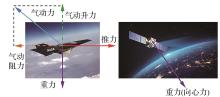
Fig.1
Mechanic principle of cruising at a uniform speed in near space and orbiting for a long time in outer space


Fig.2
Mechanic principle of long-time flying in upper atmosphere


Fig.3
Preliminary aerodynamic configuration of an aircraft flying in upper atmosphere for a long time


Table 1
Freestream parameters
| 参数 | H/km | 占比/mol% | n∞/(1016 m-3) | T∞/K | ||
|---|---|---|---|---|---|---|
| N2 | O2 | O | ||||
| 数值 | 180 | 48.3 | 3.5 | 48.2 | 1.40 | 790.07 |

Fig.4
Verification of grid size and time step


Fig.5
Contours of compression ratio p/p∞

Table 2
Aerodynamic drag of designed aircraft flying in upper atmosphere
| 飞行器部件 | σ=0.8 | σ=0.5 | ||
|---|---|---|---|---|
阻力/ mN | 阻力 占比/% | 阻力/ mN | 阻力 占比/% | |
| 本体外轮廓 | 5.43 | 5.72 | 3.40 | 4.22 |
| 进气道内流 | 47.06 | 49.65 | 46.17 | 57.35 |
| 太阳能电池翼 | 42.29 | 44.62 | 30.94 | 38.43 |
| 整个飞行器 | 94.78 | 100.00 | 80.51 | 100.00 |

Fig.6
Schematic of cross section at x=1.2 m inside inlet

Table 3
Inlet performance of designed aircraft flying in upper atmosphere
| 参数 | σ=0.8 | σ=0.5 |
|---|---|---|
| 平均压力/(10-2 Pa) | 1.66 | 2.32 |
| 平均压缩比 | 108.39 | 151.75 |
| 质量流率/(10-6 kg·s-1) | 2.07 | 2.77 |
| 收集效率/% | 54.05 | 72.27 |

Fig.7
Air pressure contours inside inlet for σ=0.5


Fig.8
Three aerodynamic configurations with only solar panel size changed

Table 4
Ionization efficiencies and thrust-to-power ratios for different configurations when achieving thrust-drag balance
| 参数 | a2b4w3 | a2b4w4 | a2.5b4.5w4 |
|---|---|---|---|
| 总阻力/mN | 72.21 | 80.51 | 83.99 |
| 电离效率/% | 64.87 | 72.27 | 75.39 |
| 太阳翼面积/m2 | 18 | 24 | 28 |
| 推功比/(mN·kW-1) | 26.74 | 22.36 | 20.00 |
Table 5
Ionization efficiency and thrust-to-power ratio of electric thruster when achieving thrust-drag balance
| 参数 | σ=0.8 | σ=0.5 |
|---|---|---|
| 推功比/(mN·kW-1) | 26.33 | 22.36 |
| 电离效率/% | 114.36 | 72.27 |
| [1] | 沈清, 黄飞, 程晓丽, 等. 飞行器上层大气层空气动力特性探讨[J]. 气体物理, 2021, 6(1): 1-9. |
| SHEN Q, HUANG F, CHENG X L, et al. On characteristics of upper atmosphere aerodynamics of flying vehicles[J]. Physics of Gases, 2021, 6(1): 1-9 (in Chinese). | |
| [2] | CHEN Z, HUANG F, JIN X H, et al. A novel lightweight aerodynamic design for the wings of hypersonic vehicles cruising in the upper atmosphere[J]. Aerospace Science and Technology, 2021, 109: 106418. |
| [3] | MOSTAZA PRIETO D, GRAZIANO B P, ROBERTS P C E. Spacecraft drag modelling[J]. Progress in Aerospace Sciences, 2014, 64: 56-65. |
| [4] | CRISP N H, ROBERTS P C E, LIVADIOTTI S, et al. The benefits of very low earth orbit for earth observation missions[J]. Progress in Aerospace Sciences, 2020, 117: 100619. |
| [5] | 靳旭红, 黄飞, 张俊, 等. 上层大气层飞行器研究进展及气动技术挑战[J]. 航空学报, 2024, 45(22): 6-21. |
| JIN X H, HUANG F, ZHANG J, et al. Spacecraft in upper atmosphere: Research development and aerodynamic challenges[J]. Acta Aeronautica et Astronautica Sinica, 2024, 45(22): 6-21 (in Chinese). | |
| [6] | 金紫涵, 温昶煊, 乔栋. 卫星解体碎片云对低轨星座的碰撞影响分析[J]. 航空学报, 2024, 45(): 211-220. |
| JIN Z H, WEN C X, QIAO D. Impact analysis of satellite debris cloud on low-orbit constellation[J]. Acta Aeronautica et Astronautica Sinica, 2024, 45(S1): 211-220 (in Chinese). | |
| [7] | CRISP N H, ROBERTS P C E, LIVADIOTTI S, et al. In-orbit aerodynamic coefficient measurements using SOAR (satellite for orbital aerodynamics research)[J]. Acta Astronautica, 2021, 180: 85-99. |
| [8] | 苏鹏辉, 靳旭红, 姚雨竹, 等. 吸气式电推进系统进气道性能数值研究与可行性分析[J]. 航空学报, 2025, 46(16): 131569. |
| SU P H, JIN X H, YAO Y Z, et al. Numerical study and feasibility analysis of inlet performance of air-breathing electric propulsion system[J]. Acta Aeronautica et Astronautica Sinica, 2025, 46(16): 131569 (in Chinese). | |
| [9] | 张俊, 蒋亦凡, 陈松, 等. 超低轨卫星气动阻力计算与减阻设计研究综述[J]. 航空学报, 2024, 45(21): 159-180. |
| ZHANG J, JIANG Y F, CHEN S, et al. Overview of aerodynamic drag calculation and reduction design for very low Earth orbit satellites[J]. Acta Aeronautica et Astronautica Sinica, 2024, 45(21): 159-180 (in Chinese). | |
| [10] | LIVADIOTTI S, CRISP N H, ROBERTS P C E, et al. A review of gas-surface interaction models for orbital aerodynamics applications[J]. Progress in Aerospace Sciences, 2020, 119: 100675. |
| [11] | PADILLA J F, BOYD I D. Assessment of gas-surface interaction models for computation of rarefied hypersonic flow[J]. Journal of Thermophysics and Heat Transfer, 2009, 23(1): 96-105. |
| [12] | LIANG T F, LI Q, YE W J. Performance evaluation of Maxwell and Cercignani-Lampis gas-wall interaction models in the modeling of thermally driven rarefied gas transport[J]. Physical Review E, Statistical, Nonlinear, and Soft Matter Physics, 2013, 88(1): 013009. |
| [13] | DENG J C, ZHANG J, LIANG T F, et al. A modified Cercignani-Lampis model with independent momentum and thermal accommodation coefficients for gas molecules scattering on surfaces[J]. Physics of Fluids, 2022, 34(10): 107108. |
| [14] | JIN X H, CHENG X L, HUANG Y Q, et al. Numerical analysis of inlet flows at different altitudes in the upper atmosphere[J]. Physics of Fluids, 2023, 35(9): 093605. |
| [15] | 陶瑞灵, 王智慧. 上层大气层气固相互作用的分子动力学研究[J]. 力学学报, 2025, 57(1): 65-78. |
| TAO R L, WANG Z H. Molecular dynamics study of gas-surface interactions in upper atmosphere[J]. Chinese Journal of Theoretical and Applied Mechanics, 2025, 57(1): 65-78 (in Chinese). | |
| [16] | NISHIYAMA K. Air breathing ion engine concept[C]∥54th International Astronautical Congress of the International Astronautical Federation. Reston: AIAA, 2003. |
| [17] | ANDREUSSI T, FERRATO E, PAISSONI C A, et al. The AETHER project: Development of air-breathing electric propulsion for VLEO missions[J]. CEAS Space Journal, 2022, 14(4): 717-740. |
| [18] | SINGH L A, WALKER M L R. A review of research in low earth orbit propellant collection[J]. Progress in Aerospace Sciences, 2015, 75: 15-25. |
| [19] | TAGAWA M, YOKOTA K, NISHIYAMA K, et al. Experimental study of air breathing ion engine using laser detonation beam source[J]. Journal of Propulsion and Power, 2013, 29(3): 501-506. |
| [20] | ROMANO F, ESPINOSA-OROZCO J, PFEIFFER M, et al. Intake design for an atmosphere-breathing electric propulsion system (ABEP)[J]. Acta Astronautica, 2021, 187: 225-235. |
| [21] | JACKSON S W, MARSHALL R. Conceptual design of an air-breathing electric thruster for CubeSat applications[J]. Journal of Spacecraft and Rockets, 2017, 55(3): 632-639. |
| [22] | LI Y W, CHEN X, LI D M, et al. Design and analysis of vacuum air-intake device used in air-breathing electric propulsion[J]. Vacuum, 2015, 120: 89-95. |
| [23] | WU J J, ZHENG P, ZHANG Y, et al. Recent development of intake devices for atmosphere-breathing electric propulsion system[J]. Progress in Aerospace Sciences, 2022, 133: 100848. |
| [24] | JIN X H, SU P H, CHEN Z, et al. Numerical and experimental investigation of rarefied hypersonic flow in a nozzle[J]. Physics of Fluids, 2024, 36(11): 116131. |
| [25] | JIN X H, MIAO W B, CHENG X L, et al. Monte Carlo simulation of inlet flows in atmosphere-breathing electric propulsion[J]. AIAA Journal, 2024, 62(2): 518-529. |
| [26] | 靳旭红, 程晓丽, 沈清, 等. 吸气式电推进系统进气道气体流动数值分析[J]. 中国科学: 物理学 力学 天文学, 2024, 54(3): 150-161. |
| JIN X H, CHENG X L, SHEN Q, et al. Numerical analysis of inlet flows in an atmosphere-breathing electric propulsion system[J]. Scientia Sinica (Physica, Mechanica & Astronomica), 2024, 54(3): 150-161 (in Chinese). | |
| [27] | 周靖云, 靳旭红, 程晓丽, 等. 气固相互作用对吸气式电推进系统进气道性能的影响[J]. 清华大学学报(自然科学版), 2024, 64(9): 1536-1546. |
| ZHOU J Y, JIN X H, CHENG X L, et al. Effects of gas-surface interaction on the inlet performance of an atmosphere-breathing electric propulsion system[J]. Journal of Tsinghua University (Science and Technology), 2024, 64(9): 1536-1546 (in Chinese). | |
| [28] | JIN X H, CHENG X L, HUANG Y Q, et al. Numerical analysis of inlet flows in atmosphere-breathing electric propulsion systems with different sizes[J]. Aerospace Science and Technology, 2025, 158: 109897. |
| [29] | JIANG Y F, ZHANG J, TIAN P, et al. Aerodynamic drag analysis and reduction strategy for satellites in very low Earth orbit[J]. Aerospace Science and Technology, 2023, 132: 108077. |
| [30] | 蒋亦凡, 李帅辉, 李志辉, 等. 超低轨道卫星气动特性分析与优化设计[J]. 力学学报, 2025, 57(3): 616-626. |
| JIANG Y F, LI S H, LI Z H, et al. Analysis and optimization of aerodynamic characteristics for very low earth orbit satellites[J]. Chinese Journal of Theoretical and Applied Mechanics, 2025, 57(3): 616-626 (in Chinese). | |
| [31] | 李俊红, 黄飞, 靳旭红, 等. 上层大气层飞行器气动布局优化设计[J]. 航空学报, 2024, 45(22): 72-81. |
| LI J H, HUANG F, JIN X H, et al. Aerodynamic layout optimization design of upper atmosphere aircraft[J]. Acta Aeronautica et Astronautica Sinica, 2024, 45(22): 72-81 (in Chinese). | |
| [32] | 靳旭红, 黄飞, 程晓丽, 等. 超低轨航天器气动特性快速预测的试验粒子Monte Carlo方法[J]. 航空学报, 2017, 38(5): 120625. |
| JIN X H, HUANG F, CHENG X L, et al. Test particle Monte Carlo method for rapid prediction of aerodynamic properties of spacecraft in lower LEO[J]. Acta Aeronautica et Astronautica Sinica, 2017, 38(5): 120625 (in Chinese). | |
| [33] | JIN X H, HUANG F, CHENG X L, et al. Monte Carlo simulation for aerodynamic coefficients of satellites in low-Earth orbit[J]. Acta Astronautica, 2019, 160: 222-229. |
| [34] | BIRD G A. Approach to translational equilibrium in a rigid sphere gas[J]. Physics of Fluids, 1963, 6(10): 1518-1519. |
| [35] | BIRD G A. Molecular gas dynamics and the direct simulation of gas flows[M]. Oxford: Oxford University Press, 1994: 340-346. |
| [36] | BIRD G A. Monte Carlo simulation of gas flows[J]. Annual Review of Fluid Mechanics, 1978, 10: 11-31. |
| [37] | PLIMPTON S J, MOORE S G, BORNER A, et al. Direct simulation Monte Carlo on petaflop supercomputers and beyond[J]. Physics of Fluids, 2019, 31(8): 086101. |
| [38] | BORGNAKKE C, LARSEN P S. Statistical collision model for Monte Carlo simulation of polyatomic gas mixture[J]. Journal of Computational Physics, 1975, 18(4): 405-420. |
| [39] | JIN X H, HUANG F, MIAO W B, et al. Effects of the boundary-layer thickness at the cavity entrance on rarefied hypersonic flows over a rectangular cavity[J]. Physics of Fluids, 2021, 33(3): 036116. |
| [40] | JIN X H, CHENG X L, WANG Q, et al. Numerical analysis of rarefied hypersonic flows over inclined cavities[J]. International Journal of Heat and Mass Transfer, 2023, 214: 124401. |
| [41] | GALLIS M A, KOEHLER T P, TORCZYNSKI J R, et al. Direct simulation Monte Carlo investigation of the Richtmyer-Meshkov instability[J]. Physics of Fluids, 2015, 27(8): 084105. |
| [42] | GALLIS M A, BITTER N P, KOEHLER T P, et al. Molecular-level simulations of turbulence and its decay[J]. Physical Review Letters, 2017, 118(6): 064501. |
| [43] | LEOMANNI M, GARULLI A, GIANNITRAPANI A, et al. Propulsion options for very low Earth orbit microsatellites[J]. Acta Astronautica, 2017, 133: 444-454. |
| [44] | ANDREUSSI T, FERRATO E, GIANNETTI V. A review of air-breathing electric propulsion: From mission studies to technology verification[J]. Journal of Electric Propulsion, 2022, 1(1): 31. |
| [45] | GARRIGUES L. Computational study of Hall-effect thruster with ambient atmospheric gas as propellant[J]. Journal of Propulsion and Power, 2012, 28(2): 344-354. |
| [46] | GURCIULLO A, FABRIS A L, CAPPELLI M A. Ion plume investigation of a Hall effect thruster operating with Xe/N2 and Xe/air mixtures[J]. Journal of Physics D: Applied Physics, 2019, 52(46): 464003. |
| [1] | Penghui SU, Yihao LIU, Xuhong JIN, Xiaoli CHENG. Numerical investigation of inlet performance of an atmosphere-breathing electric propulsion system and its feasibility analysis [J]. Acta Aeronautica et Astronautica Sinica, 2025, 46(16): 131569-131569. |
| [2] | Xuhong JIN, Fei HUANG, Jun ZHANG, Xuede WANG, Xiaoli CHENG, Qing SHEN. Spacecraft in upper atmosphere: Research development and aerodynamic challenges [J]. Acta Aeronautica et Astronautica Sinica, 2024, 45(22): 30254-030254. |
| [3] | Junhong LI, Fei HUANG, Xuhong JIN, Wenbo MIAO, Xiaoli CHENG. Aerodynamic layout optimization design of upper atmosphere aircraft [J]. Acta Aeronautica et Astronautica Sinica, 2024, 45(22): 130164-130164. |
| [4] | Yanting LIU, Jihui OU, Yufeng HAN, Jie CHEN. Effects of rectangular micro-scale structures on hypersonic rarefied shear flow [J]. Acta Aeronautica et Astronautica Sinica, 2023, 44(16): 127956-127956. |
| Viewed | ||||||
|
Full text |
|
|||||
|
Abstract |
|
|||||
Address: No.238, Baiyan Buiding, Beisihuan Zhonglu Road, Haidian District, Beijing, China
Postal code : 100083
E-mail:hkxb@buaa.edu.cn
Total visits: 6658907 Today visits: 1341All copyright © editorial office of Chinese Journal of Aeronautics
All copyright © editorial office of Chinese Journal of Aeronautics
Total visits: 6658907 Today visits: 1341

 CJA
CJA
