Acta Aeronautica et Astronautica Sinica ›› 2026, Vol. 47 ›› Issue (1): 631907.doi: 10.7527/S1000-6893.2025.31907
• Special Topic: The 27th Annual Meeting of the China Association for Science and Technology • Previous Articles Next Articles
Yujie YUAN1, Jiashuai LI1, Xinyi ZHAO2, Yantao WANG3( )
)
Received:2025-02-27
Revised:2025-03-28
Accepted:2025-05-12
Online:2025-06-06
Published:2025-06-05
Contact:
Yantao WANG
Supported by:CLC Number:
Yujie YUAN, Jiashuai LI, Xinyi ZHAO, Yantao WANG. eVTOL scheduling schemes for dynamic demand and variable intervals[J]. Acta Aeronautica et Astronautica Sinica, 2026, 47(1): 631907.
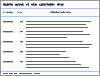
Table 1
Variable definition and types
| 符号/单位 | 定义 |
|---|---|
| 区域内起降场总数 | |
| 起降场i与j所在地区道路拥堵系数之和 | |
| eVTOL i 经过起降场数量 | |
| eVTOL i 的展弦比 | |
| 起降场i可被服务的旅客数量 | |
| /(m·s-2) | eVTOL i 加速度 |
| 数量 | |
| /元 | eVTOL 运行成本 |
| 起降场i与j所在地区办公人口数量总和 | |
| 寄生阻力系数 | |
| 升力系数 | |
| 起降场i与j所在地区需求量总和 | |
| /km | i与j距离 |
| CNS 系统偏差 | |
| /km | eVTOL i 最大航程 |
| /(kW·h) | 能量 |
| e | 起降场可容纳同时起降eVTOL数量 |
| 个体 i的适应度 | |
| 优值系数 | |
| /N | eVTOL i 受力大小 |
| 起降场i 旅客数量随时间变化函数 | |
| /(m·s-2) | 重力加速度 |
| /m | 高度 |
| /m | eVTOL间安全距离 |
| 纬度 | |
| 经度 | |
| /(元·km-1) | 每千米维护成本 |
| /kg | eVTOL i 质量 |
| 在起降场 i 充电的eVTOL数量 | |
| eVTOL i 到达前, 已在(t-μ, t)时间段内抵达起降场 j 的eVTOL数量 | |
| 时隙数量 | |
| 奥斯瓦尔德效率因子 | |
| /(元·(kW·h)-1) | 电价 |
| /人 | eVTOL i抵达前起降场j已发送的旅客数量 |
| 个体i 被选择的概率 | |
| /人 | 起降场i 与 j 的旅客需求数量 |
| /kW | 充电功率 |
| /kW | 放电功率 |
| 参数为λ的泊松分布 | |
| /元 | eVTOL i 的购置费用 |
| /人 | eVTOL i 的载客容量 |
| eVTOLs间碰撞风险的概率 | |
| /元 | 第i阶阶梯电价 |
| 决策变量当eVTOL i 需要在起降场 j 充电时为1,否则为0 | |
| /m2 | eVTOL i 螺旋桨面积 |
| /架 | 不满足与eVTOL i间起降安全时间间隔的飞机数量 |
| /人 | eVTOL i 在起降场 j 服务旅客数量 |
| /s | 时隙长度 |
| 起降场i与j所在地区景区人流量总和 | |
| 起降场i与j所在地区交通枢纽客流量总和 | |
| /h | 时间长度 |
| /(kW·h) | 第i阶阶梯电价的耗电范围 |
| 时刻 | |
| 起降场i与j之间票价 | |
| /(km·h-1) | eVTOL速度 |
| /架 | 起降场i 可容纳eVTOL同时起降数量 |
| /m2 | eVTOL i 机翼面积 |
| /m | eVTOL i 翼展 |
| /m | eVTOL飞过的地面或空中距离 |
| /(°) | 爬升角 |
| /% | 安全预留电量百分比 |
| /% | eVTOL在高峰时刻最少需要满足总需求的百分比 |
| /% | 动力系统效率 |
| /(°) | 进近角 |
| /(°) | 离港角 |
| /(h) | 旅客最大容忍等待时间 |
| 需求i占总需求量的权重 | |
| /(kg·m-3) | 干空气密度 |
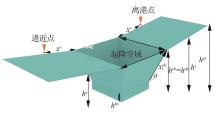
Fig.1
Vertical takeoff and landing procedure schematic diagram[16]
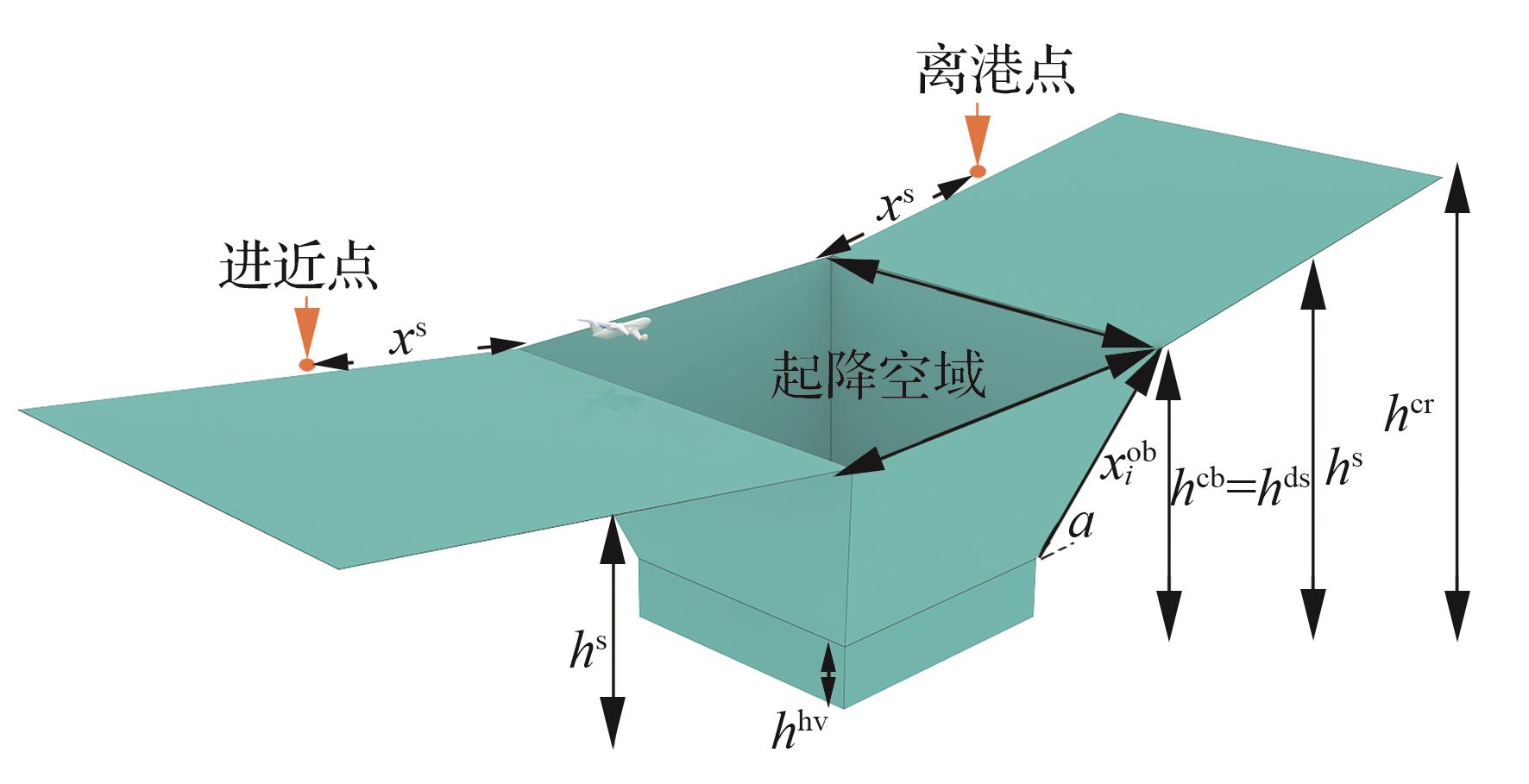
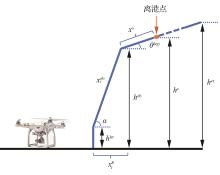
Fig.2
Schematic diagram of vertical takeoff procedure[16]
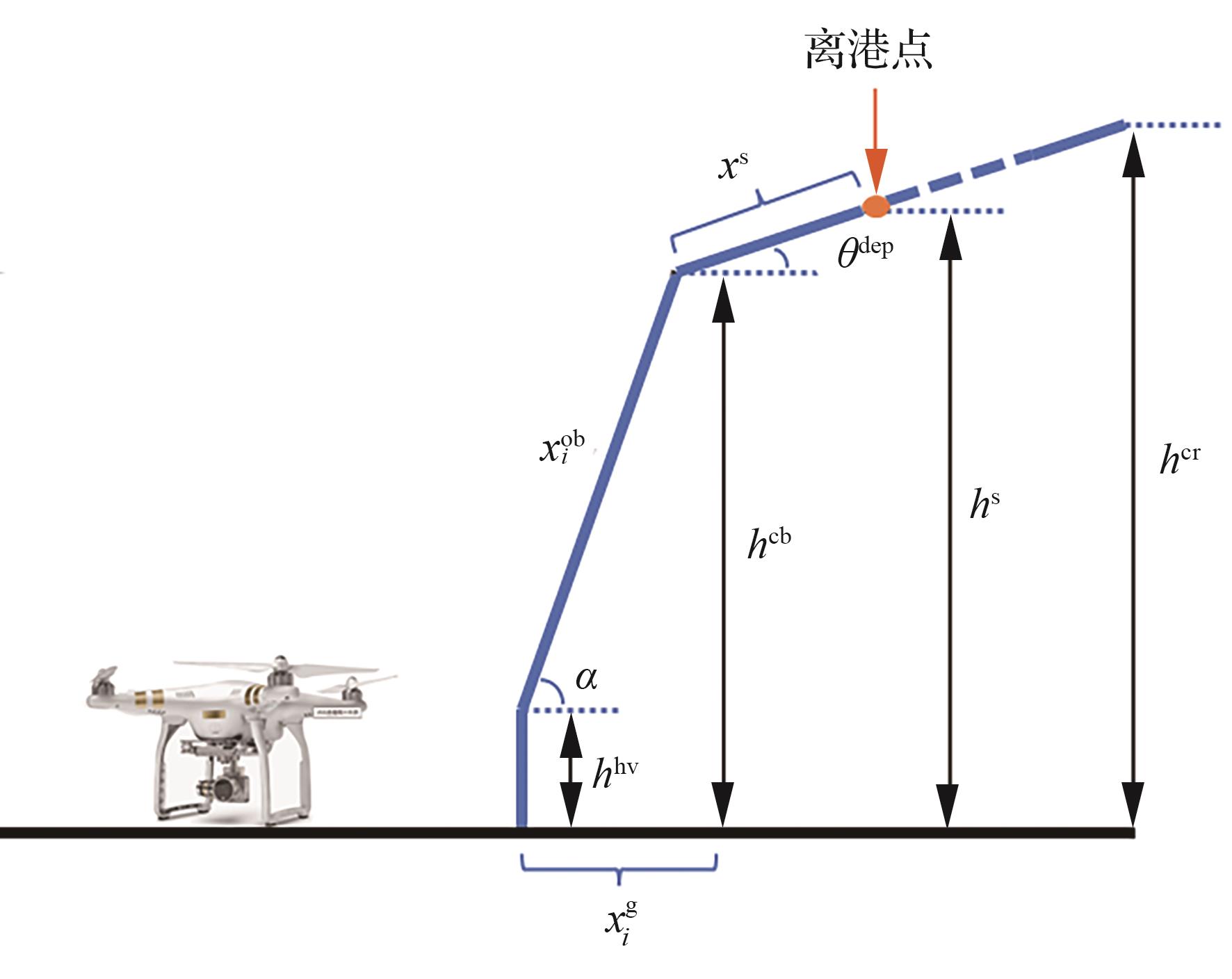
Fig.3
Relationship between cost and scheduling optimization parts
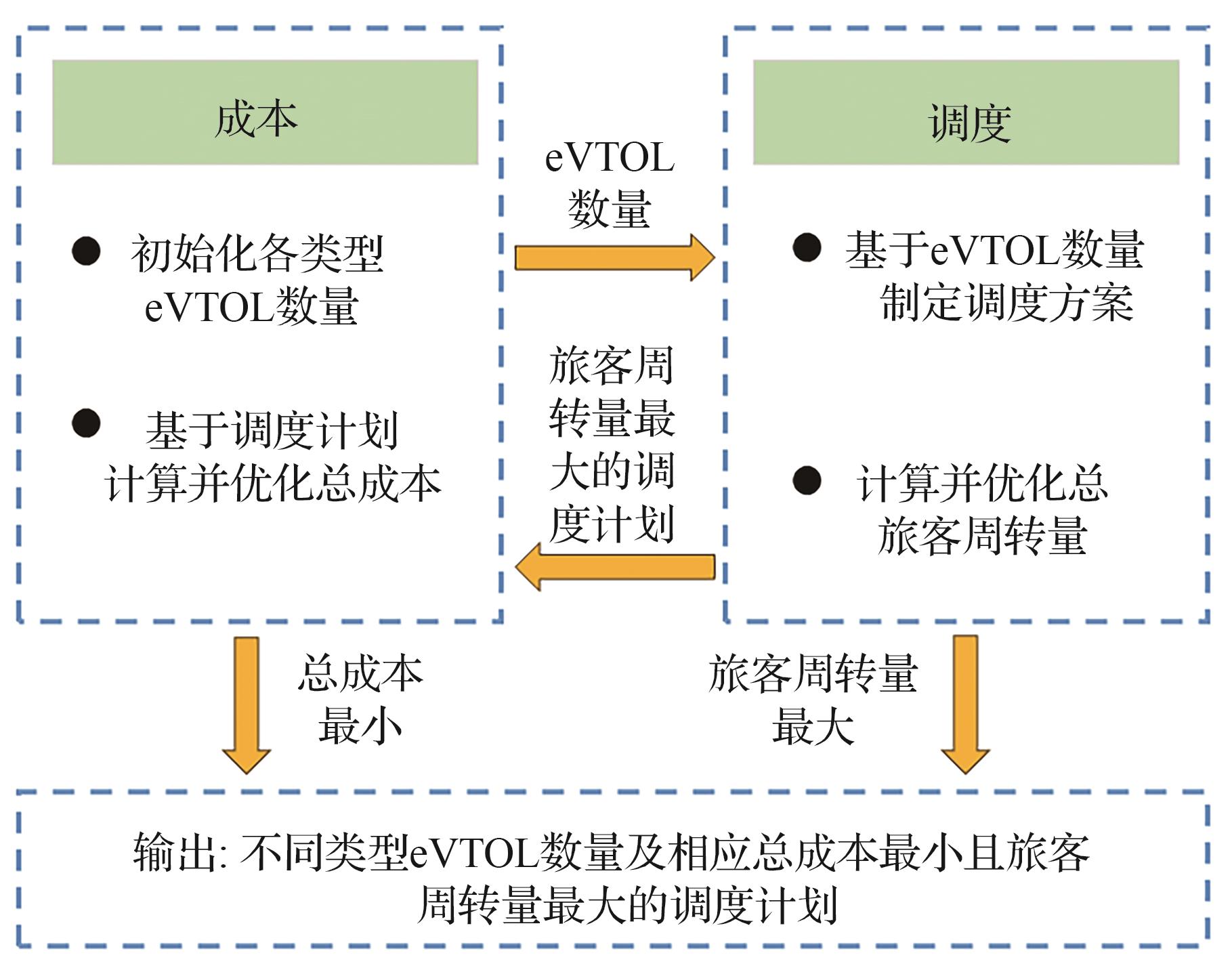
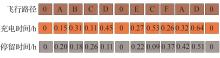
Fig.4
Encoding diagram of three characters in scheduling algorithm
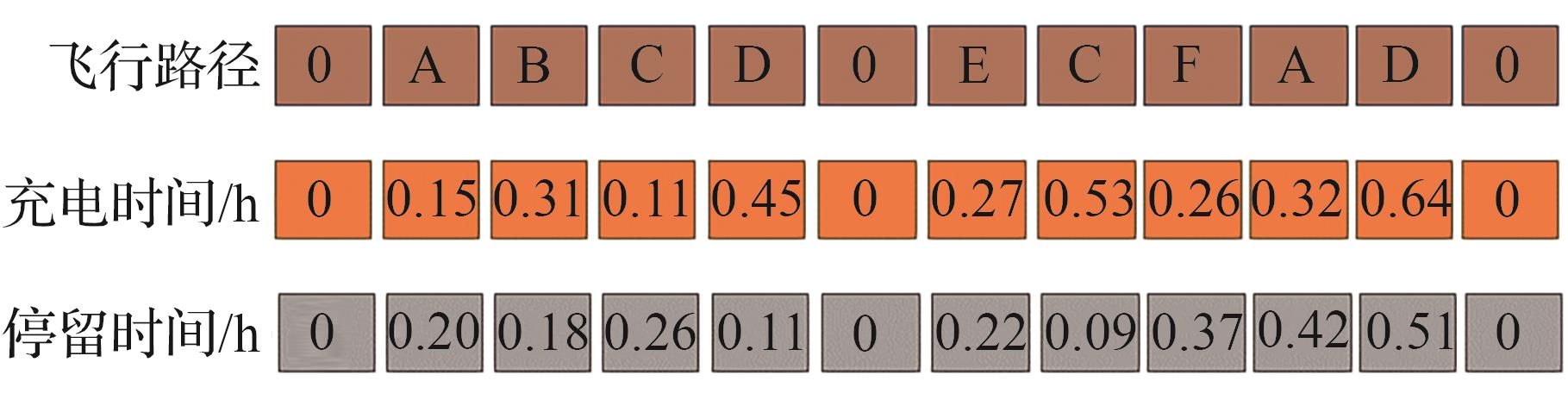
Table 2
Algorithm parameters of schedule and cost optimization algorithm
| 算法 | 参数 | 数值 |
|---|---|---|
| 成本优化算法 | 迭代次数 | 50 |
| eVTOL配置的样本量 | 10 | |
| 惯性权重 | 0.8 | |
| 个体学习因子 | 1.7 | |
| 社会学习因子 | 1.5 | |
| 调度优化算法 | 迭代次数/次 | 50 |
| 航班计划样本量/架 | 10 | |
| 惯性权重 | 0.5 | |
| 个体学习因子 | 1 | |
| 社会学习因子 | 1.2 |
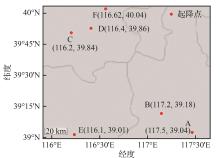
Fig.5
Location of vertiports
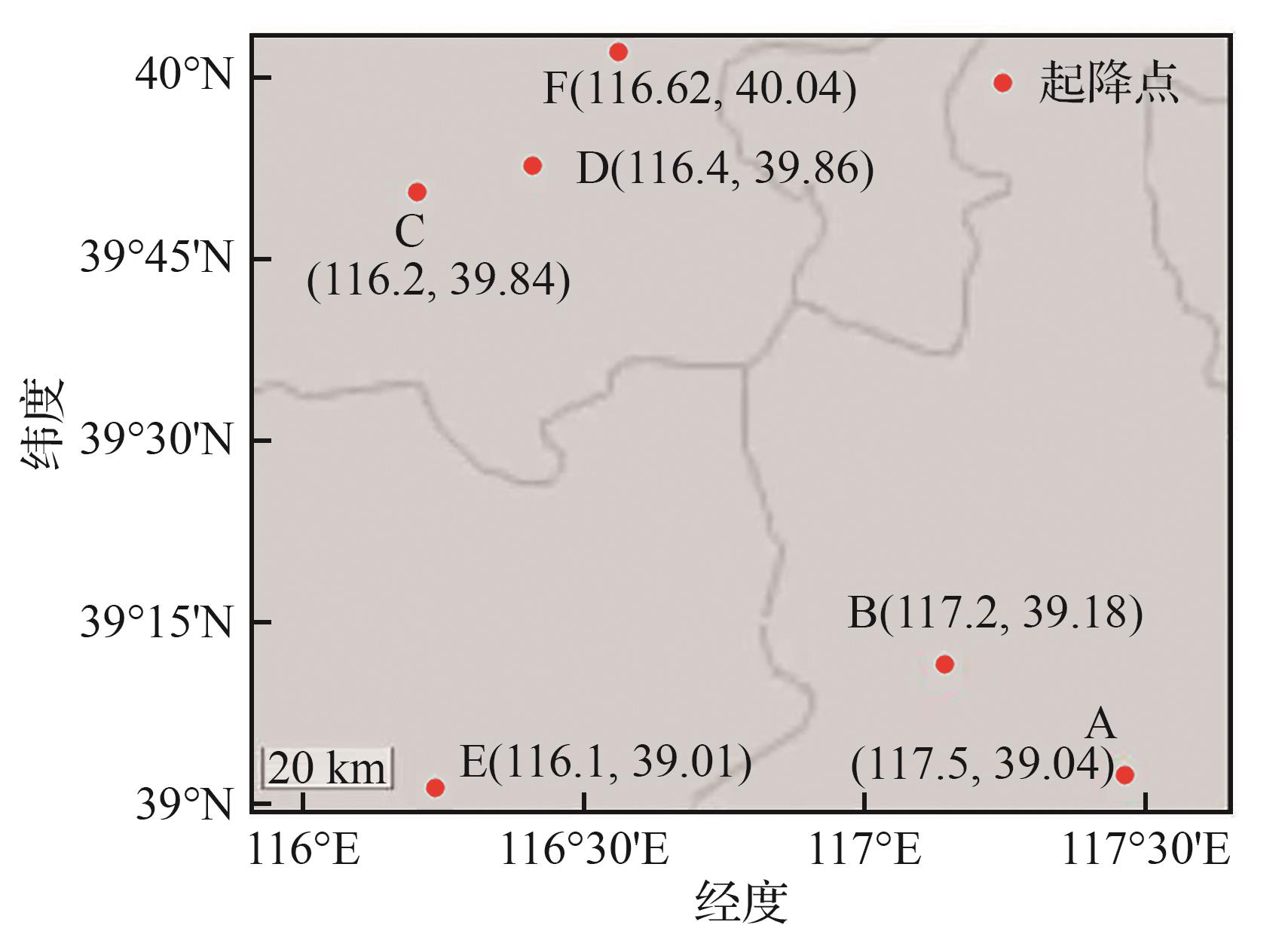
Table 3
Distance between vertiports
| 起降场 | A | B | C | D | E | F |
|---|---|---|---|---|---|---|
| A | 0 | 30.20 | 142.74 | 132.05 | 134.44 | 120.98 |
| B | 30.20 | 0 | 112.89 | 102.93 | 107.59 | 96.79 |
| C | 142.74 | 112.89 | 0 | 17.39 | 40.12 | 92.69 |
| D | 132.05 | 102.93 | 17.39 | 0 | 24.64 | 99.04 |
| E | 134.44 | 107.59 | 40.12 | 24.64 | 0 | 121.26 |
| F | 120.98 | 96.79 | 92.69 | 99.04 | 121.26 | 0 |
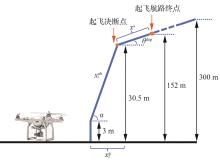
Fig.6
Location of takeoff decision point and takeoff route endpoint[16]
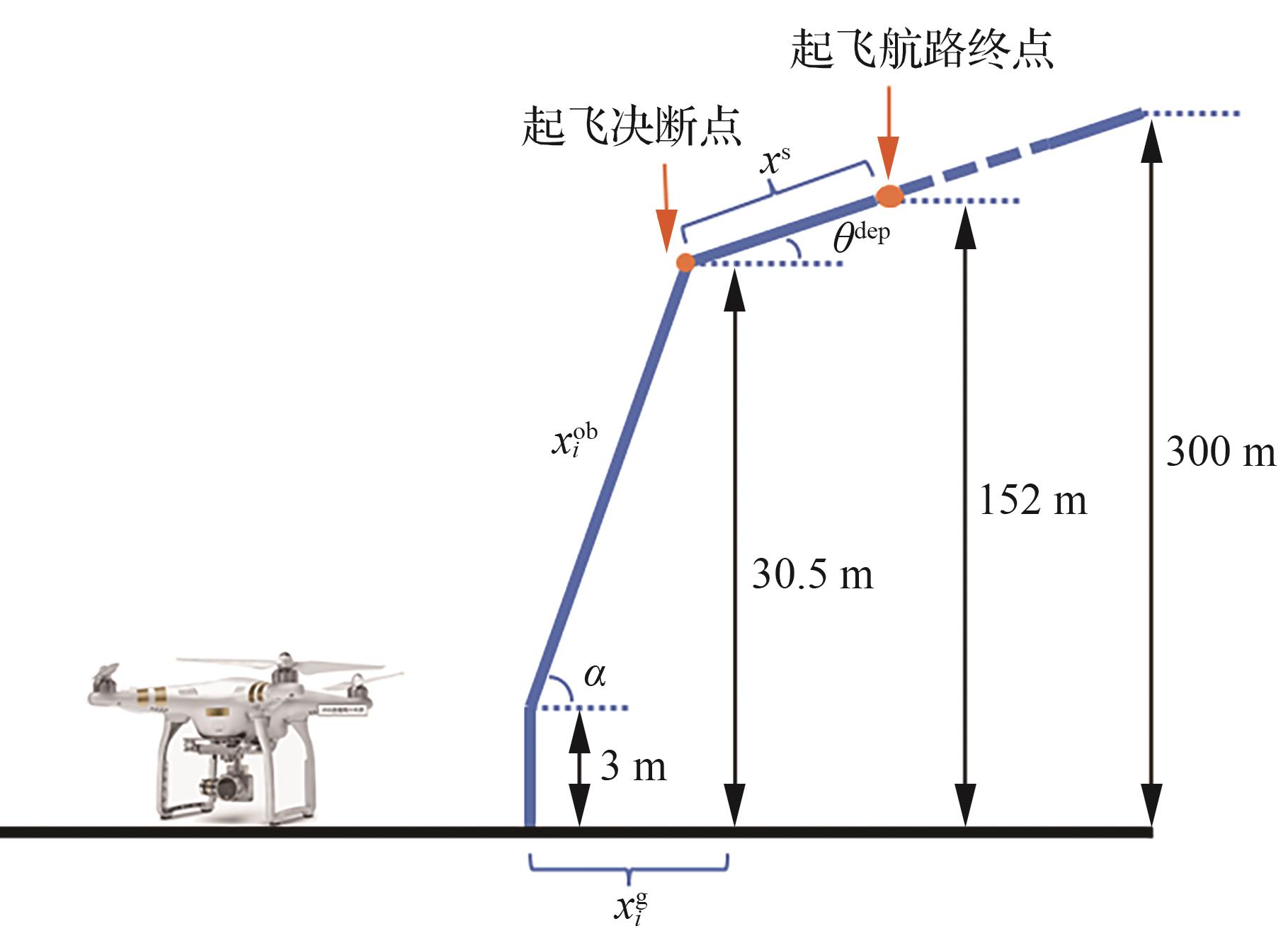
Table 4
Takeoff and landing procedure parameters[16]
| 变量 | 数值 |
|---|---|
| /m | 30.5 |
| /m | 300~1 000 |
| /m | 30.5 |
| /m | 3 |
| /m | 152 |
| α/(°) | 81 |
| /(°) | 7.125 |
| /(°) | 7.125 |
Table 5
Altitude assignment to different eVTOLs
| eVTOL 型号 | 高度层/m | 飞行方向 |
|---|---|---|
| Geely Aerofugia AE200 | 750~1 000 | 字母代码靠前飞往靠后(A-F) |
| 500~750 | 字母代码靠后飞往靠前(F-A) | |
| EHang 216-S | 400~500 | 字母代码靠前飞往靠后(A-F) |
| 300~400 | 字母代码靠后飞往靠前(F-A) |
Table 6
Parameters of different eVTOL[23-24]
| 参数 | EHang 216-S | Geely Aerofugia AE200 |
|---|---|---|
| 电池容量 /(kW·h) | 140 | 250 |
| 购置价格 /元 | 1×10⁶ | 2×10⁶ |
| 升力系数 | 1.5 | 1.5 |
| 机翼展弦比 | 7.0 | 7.0 |
| 翼展 /m | 6.05 | 14.5 |
| 机翼面积 /m2 | 22.94 | 60.10 |
| 螺旋桨面积 /m2 | 62.83 | 435.50 |
| 最大起飞重量 /kg | 220 | 2 500 |
| 优值系数 | 0.75 | 0.75 |
| 最大巡航高度 /m | 500 | 1 000 |
| 巡航速度 /(km·h-1) | 130 | 264 |
| 奥斯瓦尔德效率因子 | 0.85 | 0.85 |
| 乘客最大容量 /人 | 2 | 5 |
| 最大航程 /km | 80 | 200 |
| 推进系统效率 | 0.85 | 0.85 |
Fig.7
Curves of passenger demand over time between location of vertiports
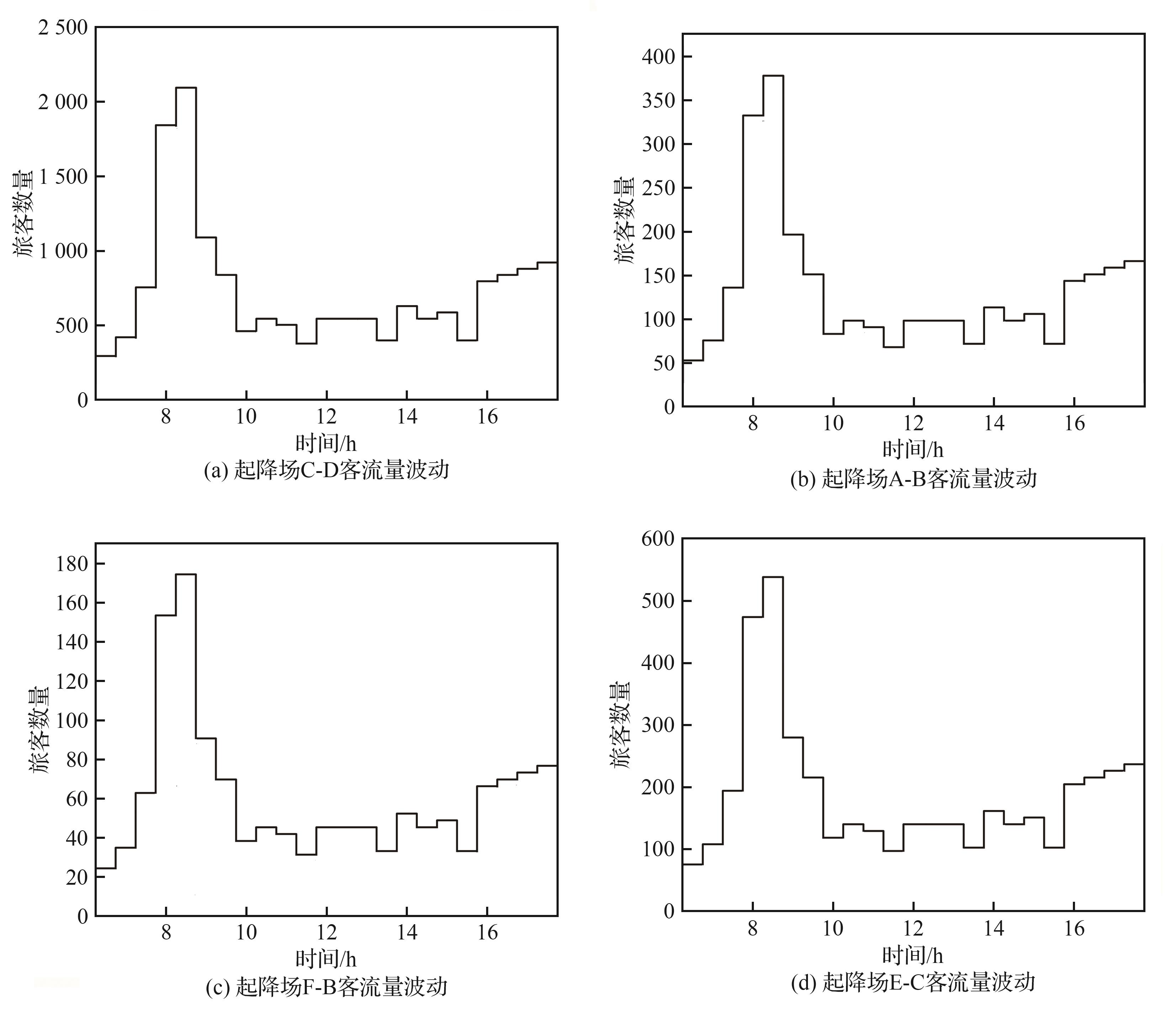
Table 7
Passenger demand between different vertiports
| 起降场 | A | B | C | D | E | F |
|---|---|---|---|---|---|---|
| A | 0 | 3×10³ | 3.7×10³ | 3.6×10³ | 1.4×10³ | 800 |
| B | 3×10³ | 0 | 4.2×10³ | 4×10³ | 3.4×10³ | 1.9×10³ |
| C | 3.7×10³ | 4.2×10³ | 0 | 1.7×10⁴ | 1.1×10³ | 4.3×10³ |
| D | 3.6×10³ | 4×10³ | 1.7×10⁴ | 0 | 1.2×10³ | 3.9×10³ |
| E | 1.4×10³ | 3.4×10³ | 1.1×10⁴ | 1.2×10⁴ | 0 | 1.4×10³ |
| F | 800 | 1.9×10³ | 4.3×10³ | 3.9×10³ | 1.4×10³ | 0 |
Table 8
Cost and served demand of different eVTOL configurations
| 配置方案 | 第1天运行成本/ (108 元) | 寿命周期内总成本/ (1010 元) | 第1天运行周转量/ 103 | 寿命内总周转量/ 108 | 人均成本/元 |
|---|---|---|---|---|---|
| 170 EHang 216, 177 Geely Aerofugia AE200 | 5.98 | 3.44 | 2.3 | 1.24 | 277.53 |
| 264 EHang 216, 268 Geely Aerofugia AE200 | 9.64 | 5.55 | 3.3 | 1.81 | 306.62 |
Fig.8
Part of eVTOL schedule
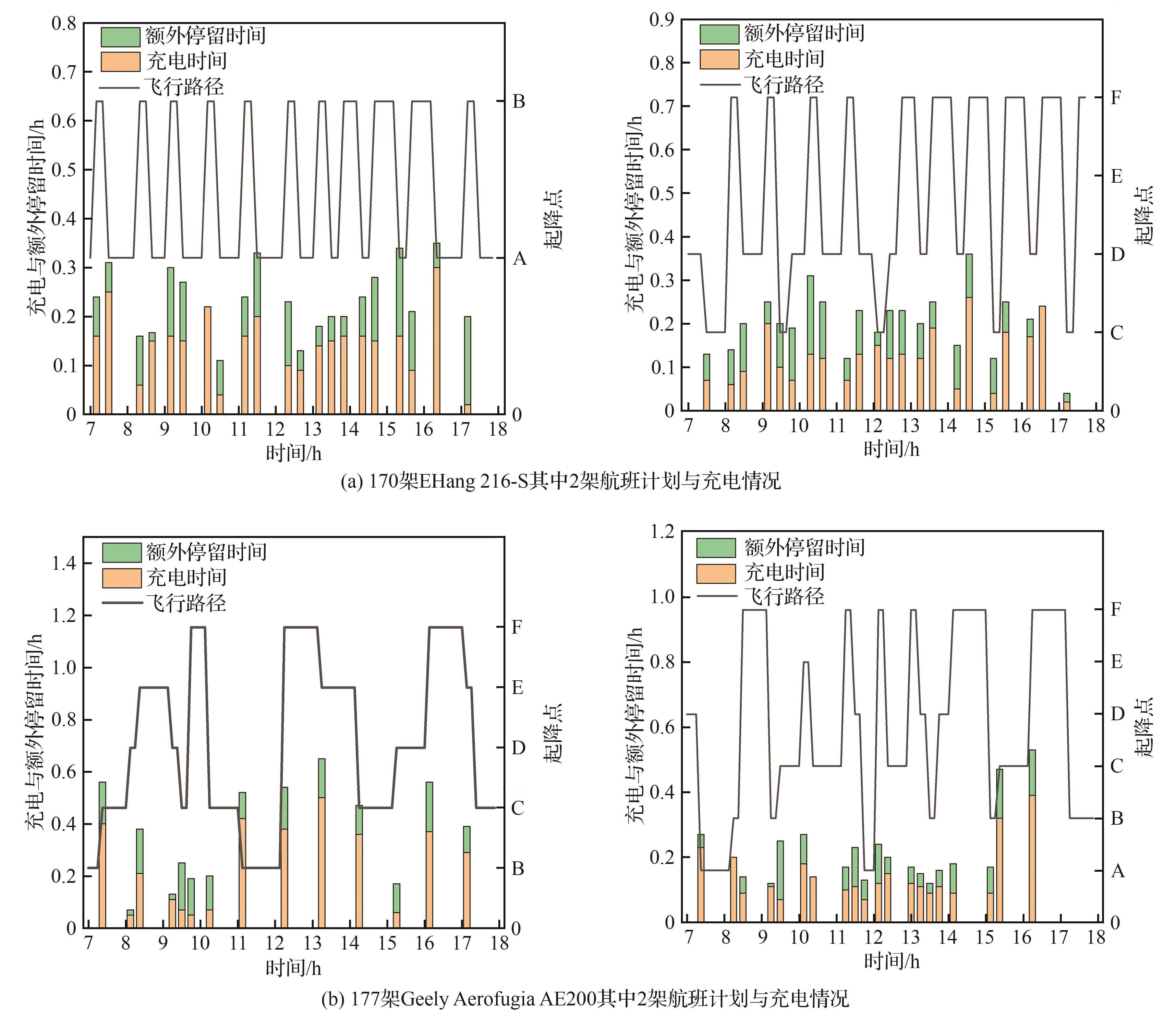
Table 9
Charging demand of various vertiports
| 起降场 | 总电量需求/(105 kW·h) | 充电成本/(104 元) |
|---|---|---|
| A | 1.4 | 6.8 |
| B | 9.5 | 52 |
| C | 27 | 180 |
| D | 24 | 150 |
| E | 10 | 59 |
| F | 27 | 170 |
Table 10
Number of eVTOLs and total cost needed under different safety time intervals
| 安全时间间隔/s | EHang 216-S 数量/架 | Geely Aerofugia AE200数量/架 | 寿命内总成本/(1010 元) | 寿命内总周转量/108 | 人均成本/元 |
|---|---|---|---|---|---|
| 60 | 166 | 208 | 3.696 1 | 1.39 | 266.66 |
| 180 | 149 | 180 | 3.689 9 | 1.36 | 270.48 |
| 360 | 170 | 177 | 3.443 3 | 1.24 | 277.53 |
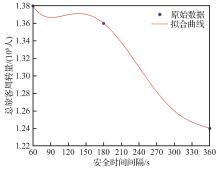
Fig.9
Relationship between total passenger turnover and safety time intervals
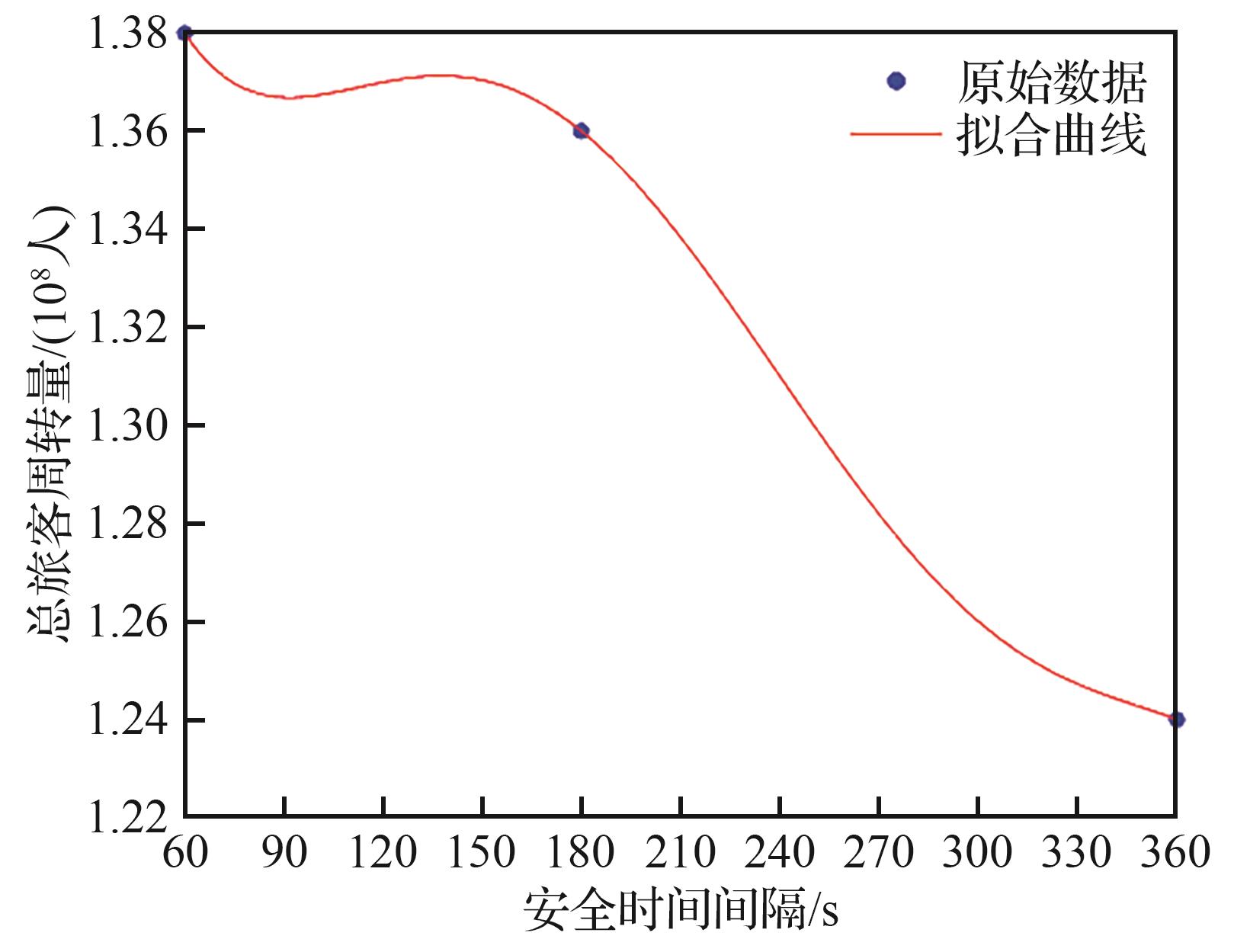
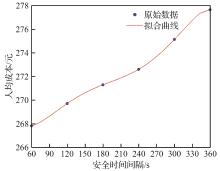
Fig.10
Relationship between cost per capita and safety time intervals
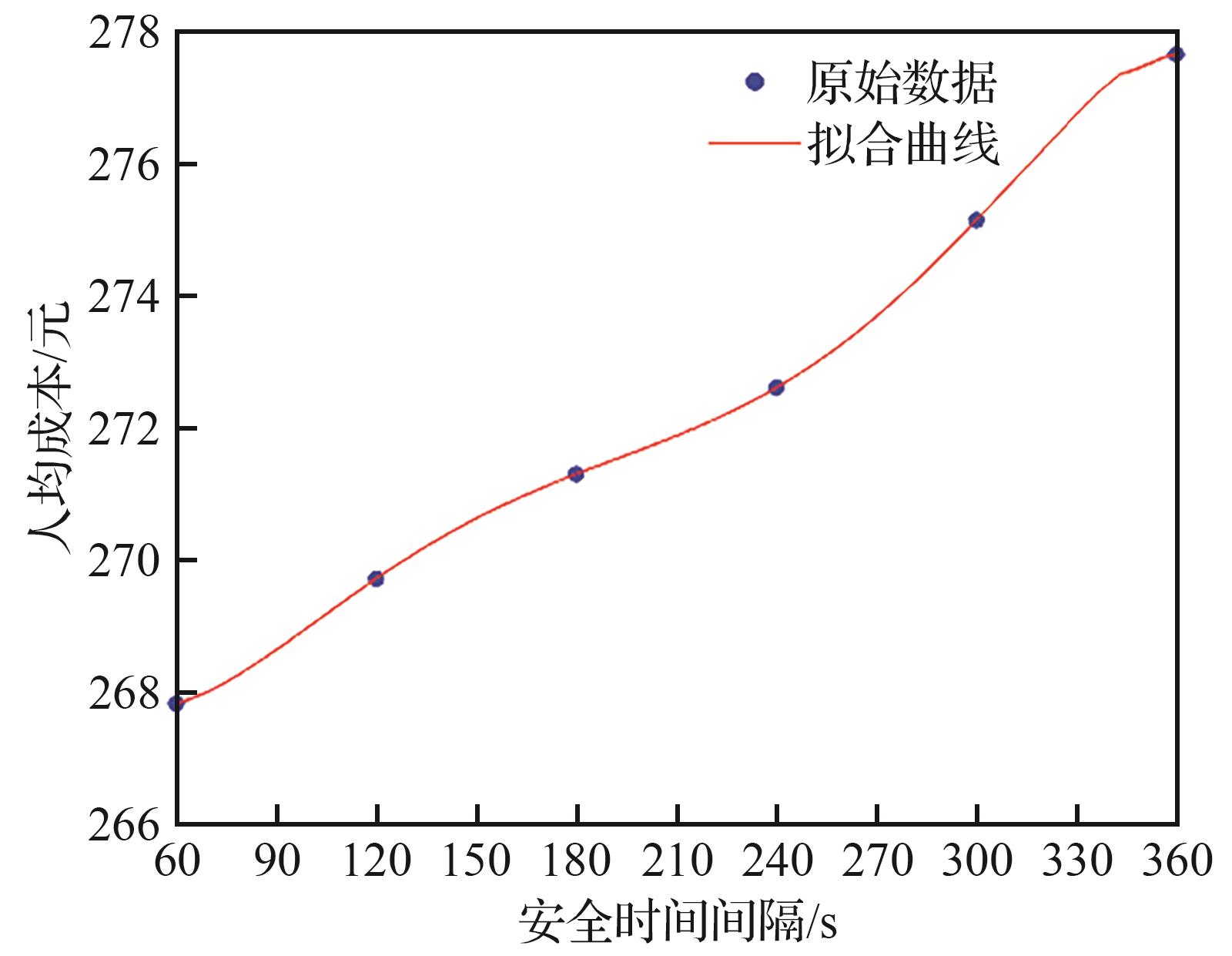
Table 11
Restrictions considered in different models and their corresponding results
| 模型 | 约束条件 | 结果 | ||||||||
|---|---|---|---|---|---|---|---|---|---|---|
| eVTOL 性能 | 动态 需求 | 安全 约束 | 非线性 能耗 | 异构 机队 | 电量 约束 | 空域 限制区 | 成本/ (1010 元) | 旅客周 转量 /108 | 算法运行 时间/(103 s) | |
| 单目标 | √[ | √[ | √[ | √[ | 3.4 | 0.78 | ||||
| 多目标 | √[ | √[ | √[ | √[ | 2.8 | 1.67 | 1.1 | |||
| √[ | √[ | √[ | √[ | 3.14 | 3.2 | |||||
| 该方法 | √ | √ | √ | √ | √ | √ | √ | 3.44 | 1.24 | 1.2 |
| [1] |
|
| [2] |
|
| [3] |
|
| [4] |
|
| [5] |
|
| [6] |
|
| [7] |
|
| [8] |
|
| [9] |
|
| [10] |
|
| [11] |
|
| [12] |
|
| [13] |
|
| [14] |
|
| [15] |
|
| [16] |
|
| [17] |
|
| [18] |
|
| [19] |
王莉莉, 张兆宁, 刘计民. 规定安全间隔的CNS性能环境研究[J]. 数学的实践与认识, 2011, 41(19): 22-29.
|
|
|
|
| [20] |
王兴隆, 王友杰. 面向城市低空的多机型eVTOL安全间隔评估[J]. 航空学报, 2025, 46(1): 330604.
|
|
|
|
| [21] |
中国民用航空局. 中华人民共和国基本飞行规则 [EB/OL].(2001-07-27)[2025-09-12].
|
|
Civil Aviation Administration of China. Basic flight rules of the people’s republic of China[EB/OL].(2001-07-27)[2025-09-12]. in Chinese).
|
|
| [22] |
中国民用航空局. 国家空域基本分类方法[EB/OL].(2023-12-21)[2023-12-21].
|
|
Civil Aviation Administration of China. Basic classification method for national airspace[EB/OL]. (2023-12-21)[2023-12-21].(in Chinese)
|
|
| [23] |
中国民用航空局. 关于就吉利沃飞长空A E200-100型电动垂直起降航空器型号合格审定项目专用条件征求意见的通知 [EB/OL]. (2023-12-01)[2024-11-28].
|
|
Civil Aviation Administration of China. Notice on soliciting opinions on the special conditions for the type approval project of Geely Aerofugia A E200-100 electric vertical takeoff and landing aircraft [EB/OL].(2023-12-01)[2024-11-28]. in Chinese).
|
|
| [24] |
Vertical Flight Society. EHang EH216-S[EB/OL]. (2022-03-04)[2024-11-28]
|
| [25] |
|
| [26] |
北京市发展和改革委员会. 北京市居民生活用电电价表 [EB/OL]. (2023-08-31)[2024-11-28].
|
|
Beijing Municipal Commission of Development and Reform. Beijing municipal commission of development and reform electricity tariff schedule for residential use in Beijing[EB/OL]. (2023-08-31)[2024-11-28]. in Chinese).
|
|
| [27] |
|
| [28] |
|
| [29] |
|
| [1] | Xiaohua HAN, Wei HAN, Shimeng LU, Na LI, Fang GUO, Bing WAN, Xichao SU. Mission planning for ship-helicopter group wave launch and recovery oriented to mission time windows [J]. Acta Aeronautica et Astronautica Sinica, 2025, 46(13): 531773-531773. |
| [2] | LIU Jixin, JIANG Hao, DONG Xinfang, LAN Sijie, WANG Haozhe. Dynamic collaborative sequencing method for arrival flights based on air traffic density [J]. ACTA AERONAUTICAET ASTRONAUTICA SINICA, 2020, 41(7): 323717-323717. |
| [3] | MA Yuanyuan, HU Minghua, YIN Jia'nan, TIAN Wen. Collaborative sequencing and scheduling method for arrival and departure traffic flow in multi-airport terminal area [J]. ACTA AERONAUTICAET ASTRONAUTICA SINICA, 2017, 38(2): 320222-320234. |
| [4] | MA Yuanyuan, HU Minghua, ZHANG Honghai, YIN Jia'nan, WU Fan. Optimized method for collaborative arrival sequencing and scheduling in metroplex terminal area [J]. ACTA AERONAUTICAET ASTRONAUTICA SINICA, 2015, 36(7): 2279-2290. |
| [5] | TANG Yong, HU Minghua, HUANG Rongshun, WU Honggang, YIN Jia'nan, XU Zili. Aircraft taxi routes planning based on free time windows and multi-agent for A-SMGCS [J]. ACTA AERONAUTICAET ASTRONAUTICA SINICA, 2015, 36(5): 1627-1638. |
| [6] | YIN Jia'nan, HU Minghua, ZHANG Honghai, MA Yuanyuan, WU Fan. Optimized method for multi-runway spatio-temporal resource scheduling in the mode of independent departures [J]. ACTA AERONAUTICAET ASTRONAUTICA SINICA, 2015, 36(5): 1574-1584. |
| [7] | YIN Jia'nan, HU Minghua, PENG Ying, TANG Yong, MA Yuanyuan. Optimized Method for Multi-runway Spatio-temporal Resource Scheduling in Mode of Dependent Approaches [J]. ACTA AERONAUTICAET ASTRONAUTICA SINICA, 2014, 35(11): 3064-3073. |
| [8] | YIN Jia'nan, HU Minghua, ZHANG Honghai, MA Yuanyuan. Optimization Approach for Collaborative Operating Modes of Multi-runway Systems [J]. ACTA AERONAUTICAET ASTRONAUTICA SINICA, 2014, 35(3): 795-806. |
| [9] | ZHOU Kun, XIA Hongshan. Optimization Model and Algorithm for Aircraft Scheduling Problem Based on Cooperative Multi-task Assignment [J]. ACTA AERONAUTICAET ASTRONAUTICA SINICA, 2011, 32(12): 2293-2302. |
| Viewed | ||||||
|
Full text |
|
|||||
|
Abstract |
|
|||||
Address: No.238, Baiyan Buiding, Beisihuan Zhonglu Road, Haidian District, Beijing, China
Postal code : 100083
E-mail:hkxb@buaa.edu.cn
Total visits: 6658907 Today visits: 1341All copyright © editorial office of Chinese Journal of Aeronautics
All copyright © editorial office of Chinese Journal of Aeronautics
Total visits: 6658907 Today visits: 1341

 CJA
CJA
