

 CJA
CJA
随着低空经济的蓬勃发展,小型固定翼无人机凭借长续航与低噪声优势,已成为林业、消防、巡检等领域[1-3]的重要工具。无人机的可靠着陆回收是保障其重复使用与持续作业能力的关键,也是提升任务自主性的研究热点[4-5]。相较于巡航、盘旋等任务阶段,自主着陆过程涉及高空至低空、平飞至拉平等模态切换,通常依赖复杂飞控系统或人工经验操作[6-7]以确保安全。鉴于传统自驾仪在不同着陆场景及低空风扰下泛化能力有限,利用历史飞行数据库辅助[8-10]自主着陆成为提升着陆可靠性与安全性的有效途径。
相较于空中其他复杂的任务过程,自主着陆任务具有明确的阶段约束[11-12]和飞行数据可复用[13]的特点。自主着陆过程中无人机需在有限的时间与高度区间内完成不同阶段的位姿控制与模态切换[14],即从着陆窗口起始状态出发,最终在目标落区触地并滑跑停止。若以空中段为观测对象,每次着陆试验的终止条件由时间和空间共同约束,而非单纯时间触发。此外,由于着陆窗口表征状态集合而非固定点,导致每次试验的初始状态亦存在变化。这种非严格一致性使得传统迭代学习策略[15-17]难以直接利用着陆过程的历史轨迹数据。
现有研究[18-22]针对非严格一致初始状态及不确定性条件下的迭代学习控制已开展较多探索。例如在不依赖精确模型的前提下,利用扩展状态观测器(ESO)处理系统非重复不确定性,设计数据驱动的控制器[20],并融合多批次控制输入信息提升跟踪精度;面向虚拟管道内无人机系统,设计迭代学习控制器[21],并实现期望轨迹跟踪;针对非重复性轨迹,设计数据驱动的补偿型学习控制器[22]。然而,部分方案控制器结构复杂,需依赖大量状态变量输入且参数整定工作繁重,难以满足低空经济应用中多架次无人机着陆对轻量化、易部署控制器的需求。
受此启发,本文提出一种基于历史轨迹驱动的迭代学习自主着陆控制方法。该方法面向已搭载成熟自驾仪的小型固定翼无人机,首先采集并筛选先前试验中的着陆轨迹数据;随后对历史轨迹进行规整处理,在保留其几何特征的同时实现时间长度对齐;最终依据规整后的历史轨迹数据设计迭代更新律,在迭代轴上实现对期望着陆轨迹的修正。该方法不仅有效突破了轨迹非一致性的约束,还能显著降低跟踪误差,从而提升整个着陆过程的安全裕度。本文主要贡献点如下所示:
1) 针对自主着陆场景,提出一种历史轨迹驱动的迭代学习方法,该方法既放宽了传统迭代学习对轨迹长度严格一致的约束要求,又容许存在有界的初始状态误差,并能够确保迭代过程的收敛性。
2) 所提方法保留了传统自驾仪的主体架构,兼具可靠性和安全性的同时,又仅需调节少量学习系数。迭代过程建立在外环期望轨迹的修正之上,既保障了飞行安全,又避免了传统方法中为达预期性能而频繁调节自驾仪复杂参数的繁琐过程。
3) 所提的历史轨迹驱动的学习策略,继承并改进自传统迭代学习的框架,实现对数据需求轻量化。通过挖掘和复用先前飞行架次中的历史轨迹信息,降低了对先验知识和数据积累的依赖,适用于计算资源受限、模型信息不全的小型固定翼无人机自主着陆场景。
1 动力学建模与表征
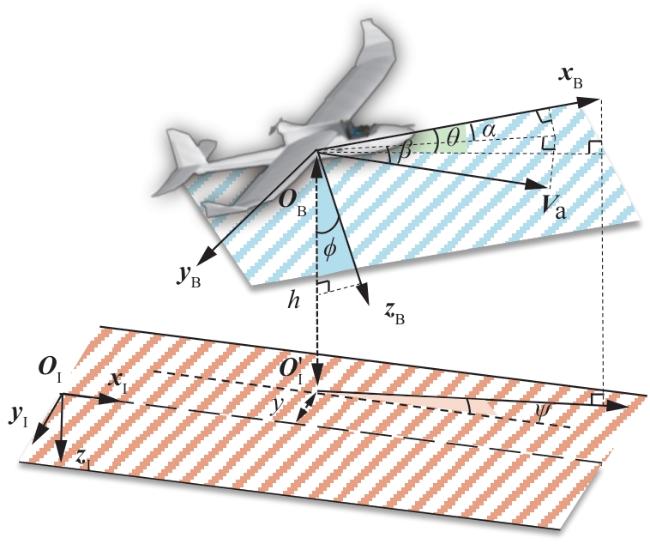
在自主着陆任务过程中,固定翼无人机起落架触地前可近似视为处于机翼水平无侧滑飞行状态,故其动力学模型可解耦为纵向与横侧向2个子系统,从而简化控制设计。同时,考虑到机载视觉引导着陆的实际场景约束,因此本文重点针对相对高度与横侧距这2个关键状态量的期望信号,设计历史轨迹驱动的迭代学习方法进行持续优化与修正,以提升着陆精度与安全冗余度。
1.1 动力学建模
式中: 为无人机相对于跑道的高度; 为俯仰角,且在俯仰角 较小时, 和 为小扰动非线性项; 为俯仰角速率; 为升降舵; 和 均为线性化常系数。
记系统状态为 ,系统输出为 ,系统方程为 ,可以将式(1) 改写为
式中: 和 为维数对应的输入和输出矩阵。
若将闭环系统视为整体,并引入高度期望信号的修正量 作为开环前馈控制,则得到纵向模型为
式中: ; 为线性比例-积分-微分(PID)控制器。
类似地,记无人机相对于跑道的横侧向距离为 ,则横侧向动力学方程为
式中: 和 分别为滚转角和偏航角,当滚转角 和偏航角较小时, 和 可视为小扰动非线性项; 为重力加速度常数; 为副翼指令; 为方向舵指令; 和 均为线性化常系数。
记系统状态为 ,系统方程为 ,可以将式(4) 改写为
式中: 为维数对应的输出矩阵; 为横侧距的期望; 为线性PID控制器。引入横侧距期望的修正量 作为新的开环系统控制输入,则得到横侧向模型为
式中: 。
1.2 离散化表征
式中: 为离散时刻;上标 表示迭代次数。
同理,可得横侧向的离散化模型为
式中: 和 分别表示离散化后的 和 。
式中, 为Lipschitz常数。
式中: 和 为等效控制器系数; 为控制序列长度。
2 学习算法设计与分析
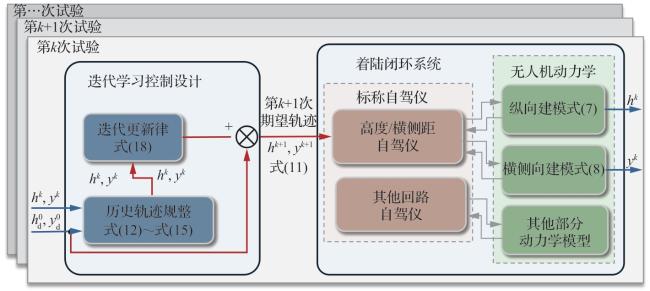
本节提出一种适用于自主着陆场景的历史轨迹驱动的学习算法。首先,通过分析着陆任务中飞行轨迹存在的重复性特征,阐明利用历史轨迹进行学习的合理性与潜力。接着,针对自主着陆过程中非严格一致的轨迹跟踪问题,筛选并利用处于安全容许范围内的历史飞行轨迹,并应用非线性规整算法将其与初始期望轨迹进行匹配对齐,从而提取可靠的飞行经验;最后,设计基于历史轨迹信息的迭代学习更新律,并对其收敛性能进行分析。
设计的迭代学习控制架构如图2所示,记规整后的高度和横侧距为 和 ;跟踪误差为 和 ;迭代律 和 分别为高度与横侧距期望轨迹的修正量;记初始的高度期望和横侧距期望分别为 和 ,则第 次试验的高度期望 和 横侧距期望为
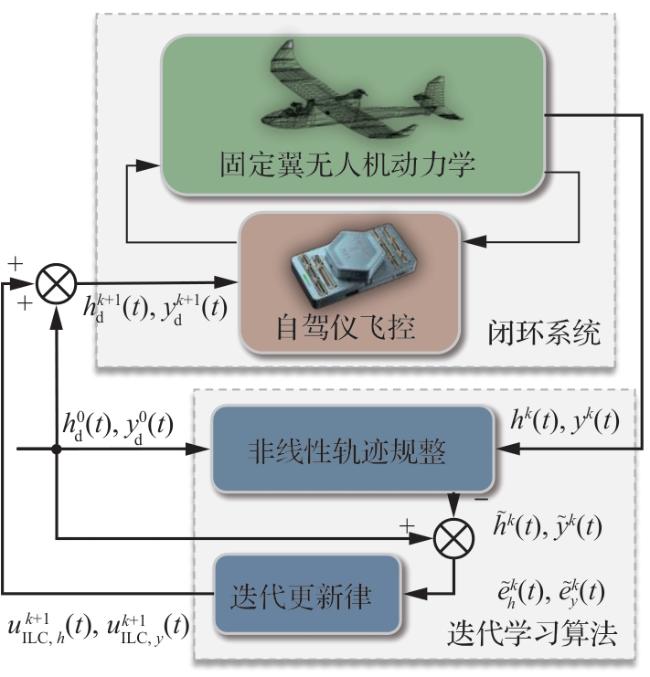
此外,采用图2所示的迭代架构不影响底层控制器的稳定性,且能够最大限度兼容现有系统,从而将迭代过程构建于成熟闭环控制系统之上,以确保飞行安全。
2.1 着陆任务重复性分析
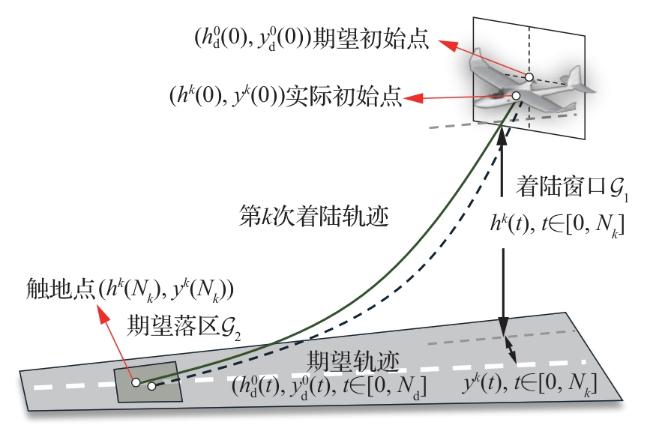
在受模型不确定性(如载荷变化)和外部干扰(如低空风扰)影响时,单一的着陆轨迹往往存在初始状态误差变化及轨迹长度非严格一致的特点。如图3所示,第 次试验的轨迹长度为 ,而期望的高度和横侧距轨迹的序列长度为 ,二者长度可能是不一致的;实际着陆轨迹的初始点为 ,也往往不同于期望轨迹的初始点 。
因此,对于满足相同 和 的自主着陆可视为重复性的过程。同时,在进行历史轨迹数据筛选时,容许着陆轨迹的初始状态和轨迹长度非严格一致,但需要飞行全程处于安全着陆虚拟管道 内。
2.2 历史轨迹对齐算法
本小节介绍基于动态时间规整的历史轨迹对齐方法[19],其不仅能够规整轨迹长度,还能够有效保持轨迹在局部阶段的相似度。例如对于着陆轨迹,其不同阶段(如下滑、拉平)的轨迹特征存在显著差异,动态时间规整方法相较线性拉伸,能够更好地捕捉并匹配这些差异化的局部特征。对第 次试验的高度序列和横侧距序列 进行轨迹规整的目的,是使其能够尽可能按照高度和横侧距的期望轨迹 进行伸缩。
以高度序列为例(横侧距序列的算法与之相同),首先建立路径矩阵 ,矩阵中处于第 行,第 列的元素 表示 与 的曼哈顿距离。为了得到实际轨迹与期望轨迹间的映射关系,需要寻找规整路径 :
式中: 为规整路径 的第 个路径点。
寻找规整路径 的过程可视为动态规划(Dynamic programming)的问题,用 表示在 处的最小距离累积和,则有
除此以外, 需要满足如下所示条件与性质。
1) 边界条件(Boundary condition):路径 始终从 矩阵的左下角 出发,在右上角 结束。
2) 连续性(Continuity):在位于当前路径点 时,下一路径点 必须满足 和 ,以保证路径遍历连续时刻。
3) 单调性(Monotonicity):路径点 的下标只能不变或增加,以确保规整路径是随时间单调变化的。
为了保证规整路径 具有唯一性,还需满足以下约束条件:
4) 唯一性(Uniqueness):当路径存在多个前进方向时,尽量沿着 的方向前进,即当 时,总是选择 作为下一路径点。
5) 消除条件(Eliminate condition):回溯时需要去掉多余点,以保证 中每一个元素在 中有且仅有一个匹配结果。
在应用上述唯一性条件和消除条件后,最终得到的规整路径为
式中: 。那么规整后的 与 的映射关系可以表示为
综上所示,以高度序列为例(横侧距序列的算法流程与之类似,故不再重复),可以给出历史轨迹的规整算法流程如算法1所示。
| | |
|---|---|
| 输入: | 实际高度序列 |
| 期望高度序列 | |
| 输出: | 规整高度序列 |
| 1. | 初始化路径矩阵 和规整路径 |
| 2. | for |
| 3. | 满足连续性和单调性 |
| 4. | 更新并计算最小距离累积和 |
| 5. | end |
| 6. | 应用唯一性和消除条件 |
| 7. | 回溯并得到规整序列 |
2.3 迭代更新律设计
本小节给出利用规整后历史轨迹,设计相对高度和横侧距迭代更新律的方法。首先,定义第 次试验的跟踪误差 和 为
式中: 和 分别为期望的高度和横侧距; 和 分别为规整后的实际高度和横侧距。
那么, 和 可以设计为如式(18) 所示的P型迭代律形式
式中: 和 分别为高度和横侧距迭代更新律的学习系数。
2.4 收敛性分析
为便于迭代收敛性的分析,先以高度迭代律为例,依次定义状态误差 、迭代律误差 以及规整状态误差 写为
式中: 为期望输出对应的期望状态; 为满足式(17) 的期望迭代律; 为经长度截断/增补处理后的第 次试验系统状态为
那么,如下就有/无初始状态误差2种情况,分别给出如下2个定理及其对应的引理[19],以分析在迭代律式(18) 作用下的系统收敛性。
联立式(7) 和式(21) 可得
在迭代律式(18) 等号两边同时减去 可得
联立式(22) 和式(23) 则有
由假设1和假设2可知
对式(24) 等号两边同时取 范数可得
式中: 。接着联立离散系统模型式(7) 和式(21) 可得
对式(27) 等号两边同时取 范数则有
式中: 。
对式(28) 进行迭代递归可得到
假设每次迭代的初值误差为0,即
那么,并将式(29) 代入式(26) 可得
式中: 。
选取 ,先在不等式(31) 两边乘以 ,再求关于离散时刻 的上确界,可得
式中: 。
若可找到学习系数 和指数函数 使得 ,则 为压缩映射,故而有
联立式(22) ,式(29) 和式(33) 可知,随着迭代次数的增加,最终跟踪误差将收敛至0,即有
那么随着迭代次数的增加,能够保证规整后的轨迹跟踪误差收敛至0,即有
将式(37) 代入式(31) 可得
根据式(32) ,当 时,同理可得
由式(39) 可知,若 时有 ,则需要满足
联立式(37) 和式(40) ,并令 ,可得
那么当 时,若存在 满足
则能够使得跟踪误差满足
3 算法验证与结果分析
3.1 验证环境及参数
表1 环境参数配置Table 1 Configurations of environmental parameters |
| 分类 | 允许设置参数 |
|---|---|
| 风扰 | 水平风向,水平风速,垂直风速,湍流均方根(RMS) |
| 载荷 | 初始质量,质心偏移,电池容量,载荷类型 |
在迭代过程中,采用了相同的载荷配置,同时,考虑到小型固定翼无人机的质量较轻,易受风扰影响,故设置水平风速大小为0.514 m/s,风扰方向随机分布在以60°为间隔的方向上。同时设置无人机着陆窗口 中心的离地相对高度为50 m,相对跑道中线横侧距为1 m,无人机已经完成着陆任务的进近阶段,抵达着陆窗口后即转入下滑阶段。记第 次实验,在初始时刻 时,相对高度和横侧距分别为 和 。假设迭代过程中存在初始高度和横侧距误差,即满足均匀(Uniformly)分布
式中: 和 为均匀分布的边界。
此外,由于第 次试验的实际输出轨迹序列长度为 ,为了定量刻画与检验序列长度变化对迭代过程的影响,可以将实际轨迹与期望轨迹的长度关系表征为
式中:为了模拟迭代过程中轨迹长度偏差随跟踪误差的减小而减小, 在迭代前200次取 ,之后在前400次取 ,最终减小至 直至仿真验证结束。
采用迭代律式(18) ,并设置学习系数为
为了便于结果呈现,在进入迭代过程前首先进行100次试验,接着经过400次迭代试验,确保迭代过程收敛,最终继续进行100试验,以供进行学习前、学习中以及学习后的分析对比。
3.2 验证结果与分析
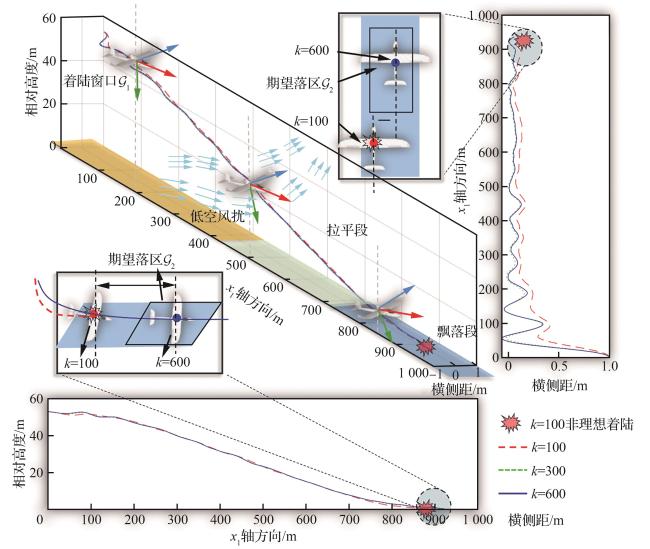
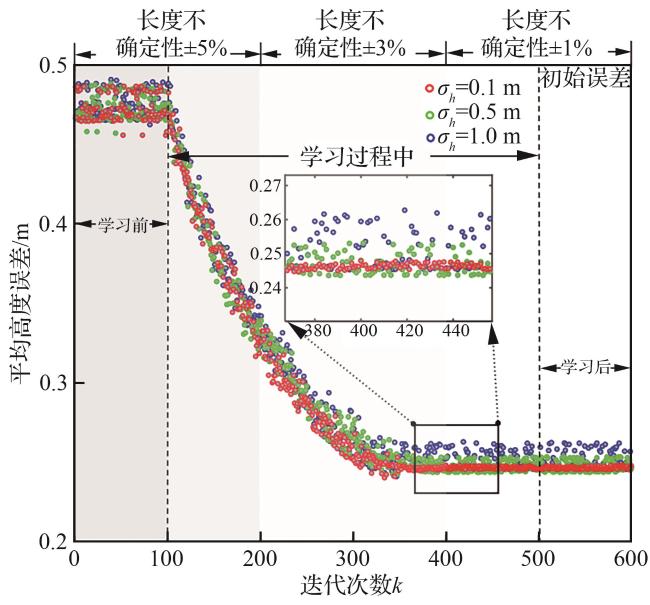
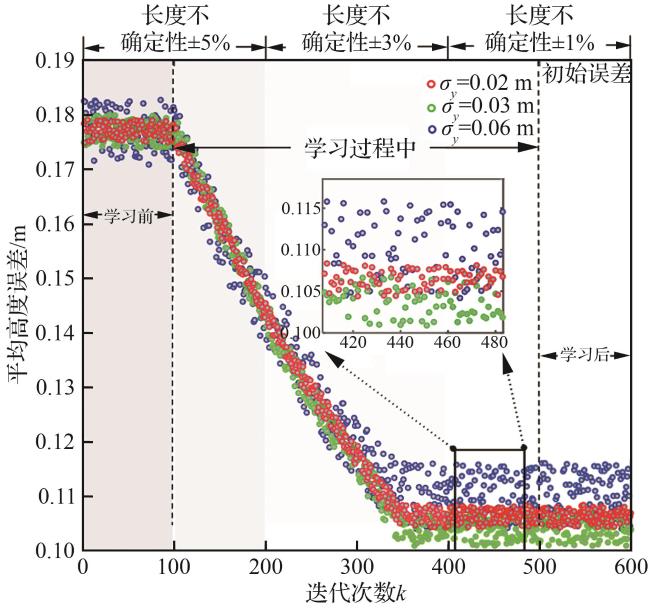
学习算法的收敛性结果如图6和图7所示。2个图中展示了不同初始误差和轨迹长度不确定性对收敛性的影响:圆点表示每次迭代试验的平均跟踪误差,不同颜色区分初始误差大小,背景灰度深浅表征长度不确定性程度。观察可知,在模拟了轨迹长度不确定性从 减小逐步至 的情况下,应用学习算法后,高度与横侧距误差均随迭代次数增加而收敛。例如,高度平均误差从0.47 m降至0.25 m,横侧距平均误差从0.16 m降至0.10 m,均降低了50%以上。此外,初始误差越大,平均误差越大,即反映在图中的散点的离散程度也越高。上述结果也与定理2和引理2的理论分析一致,表明在迭代更新律作用下,误差最终收敛,且收敛边界与初始误差的边界 和 正相关。


此外,由于本文所提出的学习框架兼具闭环反馈控制与开环前馈学习修正的双重机制。对于阵风等环境中不可重复的扰动成分,一方面,自驾仪既有的闭环反馈控制本身具备一定的鲁棒性,能够对其产生抑制效果;另一方面,所提的迭代学习框架具备一定的对非重复有界扰动的适应能力,从而增强着陆过程的安全冗余度。
4 结 论
针对固定翼无人机多架次自主着陆控制问题,提出一种基于历史轨迹数据驱动的迭代学习控制方法。该方法挖掘自主着陆历史轨迹的重复特性,以突破传统迭代学习对轨迹长度严格一致的约束,同时兼具对初始状态误差的鲁棒性。通过非线性轨迹规整方法保留历史轨迹模态特征并实现长度对齐,进而设计基于对齐轨迹的迭代更新律,并给出其收敛性理论分析。高保真仿真验证结果表明,所提方法有效降低了着陆轨迹跟踪误差,提升了多架次着陆场景的安全裕度。
未来研究将聚焦于将学习方法移植至机载飞控芯片,实现历史轨迹数据的自主采集与分析,并依托硬件平台开展实物飞行试验,推动方法的实用化与工程化。