周芳1, 王庆勇1, 秦宇奇1, 张博涛2, 王掩刚1( )
)
收稿日期:2024-09-10
修回日期:2024-10-15
接受日期:2024-12-05
出版日期:2024-12-18
发布日期:2024-12-18
通讯作者:
王掩刚
E-mail:wyg704@nwpu.edu.cn
基金资助:
Fang ZHOU1, Qingyong WANG1, Yuqi QIN1, Botao ZHANG2, Yangang WANG1()
Received:2024-09-10
Revised:2024-10-15
Accepted:2024-12-05
Online:2024-12-18
Published:2024-12-18
Contact:
Yangang WANG
E-mail:wyg704@nwpu.edu.cn
Supported by:摘要:
随着分布式推进系统与飞行器在结构和气动方面耦合深度的加强,平衡计算精度与效率的叶片源项模型在分布式布局的内外流耦合分析、优化中的作用日益重要。系统地梳理了现有的针对压气机、风扇、螺旋桨等叶片源项模型的基本逻辑、实现路径以及应用成效,为开展分布式推进系统内外流耦合分析过程中的叶片源项模型选择提供支持。首先,回顾总结了基于激励盘模型的描述型和迭代型体积力方法的应用与发展,讨论了Hough-Ordway模型及其改进思路,分析了势流-黏流耦合和基于叶素动量理论(BEMT)耦合的迭代计算策略;其次,梳理了基于Marble体积力模型的分析模式和提取模式体积力模型的应用与发展,讨论了分析模式下的Gong模型、Hall模型以及基于其改进的Gong-Thollet模型和Hall-Thollet模型;随后,探讨了基于流线曲率法或雷诺平均Navier-Stoke(RANS)方程计算结果的Turbine Engine Analysis Compressor Code(TEACC)、Kiwada及Chima等提取模式的体积力模型。最后,对所收集整理的叶片源项模型进行了对比分析,给出了应用叶片源项模型进行旋转式叶轮机械数值分析过程中的具体建议,为进行平衡计算精度和效率的内外流一体化分析提供参考。
中图分类号:
周芳, 王庆勇, 秦宇奇, 张博涛, 王掩刚. 叶片源项模型的研究回顾与进展[J]. 航空学报, 2025, 46(10): 31178.
Fang ZHOU, Qingyong WANG, Yuqi QIN, Botao ZHANG, Yangang WANG. Review and progress of research on blade source term model[J]. Acta Aeronautica et Astronautica Sinica, 2025, 46(10): 31178.

图 1
CFD中模拟风扇的各种建模方法优缺点[9]


图 2
修正体积力模型计算结果的对比[16]


图 3
耦合方法与RANS方法的对比[18]


图 4
叶片二维截面上的受力分析[52]


图 5
BEMT-RANS计算流程

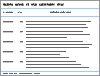
表 1
螺旋桨推力计算结果与试验数据比较的相对误差[52]
| 转速/(r∙min-1) | 1 500 | 2 000 | 2 500 | |
|---|---|---|---|---|
| 相对误差/% | JAVAFOIL | 49 | 47 | 44 |
| XROTOR | 6 | 3 | 6 | |
| XFOIL | -1 | -6 | -7 |

图 6
不同方法计算叶片表面压力系数分布对比[57]

表 2
叶尖损失模型对比结果[68]
| 建模方法 | 推力/N | 功率/kW | 效率 |
|---|---|---|---|
| RANS高保真 | 1 390 | 164.4 | 0.863 |
| 未进行叶尖损失修正的RANS/BEMT | 1 748 (+25.7%) | 199.1 (+21.1%) | 0.896 (+3.8%) |
| RANS/BEMT 结合Glauert 叶尖损失修正 | 1 574 (+13.3%) | 184.3 (+12.1%) | 0.872 (+1.8%) |
| RANS/BEMT结合Glauert + Shen叶尖损失修正 | 1 514 (+9.0%) | 176.8 (+7.5%) | 0.874 (+1.27%) |
表 3
基于激励盘的叶片源项模型总结
| 方法 | 优点 | 缺点 | 应用对象 | 适用性 |
|---|---|---|---|---|
| 描述型体积力 | 高效 | 精度低、弱耦合、无法应用于复杂来流工况 | 螺旋桨、涵道螺旋桨 | 低速来流、均匀来流、 轻载荷 |
| 势流-黏流耦合迭代 | 较为高效、较强耦合、较高精度 | 需进行压缩性修正 | 螺旋桨、对转螺旋桨、 涵道螺旋桨 | 低速来流、轻载荷、螺旋 桨/风扇设计与优化 |
| BEMT-RANS耦合迭代 | 较为高效、较强耦合、较高精度 | 叶片受力系数不易计算、叶尖损失模型尚不确定、数值稳定性问题 | 螺旋桨、对转螺旋桨、 涵道螺旋桨、风力机 | 低速来流、螺旋桨/风扇设 计与优化 |

图 7
体积力模型[76]


图 8
喘振过程中压气机各截面静压变化对比[83]


图 9
Gong模型与无压力梯度Gong模型的对比[88]


图 10
Hall模型的描述[77]


图 11
不同体积力模型计算结果对比[91]


图 12
Hall-Thollet模型的描述[92]


图 13
Hall模型与Hall-Thollet修正模型的对比[92]


图 14
TEACC模型[98]


图 15
不同分布形式下熵增的对比[105]

表 4
基于体积力模型的叶片源项模型总结
| 方法 | 优点 | 缺点 | 应用对象 | 适用性 |
|---|---|---|---|---|
| Gong模型[ | 计算成本较低、 建模复杂程度较低 | 未考虑叶片阻塞效应、数值稳定性问题、繁琐的校准工作 | 低速压气机、 风扇 | 低速来流、轻/中/重载荷、 进气畸变 |
| Gong-Thollet模型[ | 考虑叶片阻塞与压缩性修正、简化的校准流程 | 低速/跨声速压 气机、风扇 | 低速来流、轻/中/重载荷、 进气畸变 | |
| Hall模型[ | 无需进行校准、 建模复杂程度较低 | 未考虑叶片阻塞效应以及 压缩性修正 | 低速压气机、 风扇 | 低速来流、轻/中/重载荷、 边界层吸入 |
| Hall-Thollet模型[ | 考虑叶片阻塞与压缩性修正 | 低速/跨声速压 气机、风扇 | 低速/跨声速来流、轻/中/重载荷、风扇/压气机设计与优化,进气畸变 | |
TEACC 模型[ | 计算效率高、 建模复杂程度较低 | 源项与来流参数关联程度低 | 低速压气机、 风扇 | 低速来流、轻/中/重载荷、 进气畸变 |
Kiwada 模型[ | 计算准确度较高 | 建模复杂程度较高、 无法处理复杂来流工况 | 低速压气机、 风扇 | 低速来流、轻/中/重载荷、 进气畸变 |
| Chima模型[ | 计算准确度高、 可以处理激波间断、 适用于复杂来流工况 | 建模复杂程度高、 先决计算成本高、 计算效率低 | 高速/低速压气 机、风扇 | 高速/低速来流、轻/中/ 重载荷、进气畸变 |

图 16
源项模型对比与总结

| 1 | NASA. Strategic implementation plan: 2017 update[R]. Washington, D.C.: NASA, 2017. |
| 2 | KIM H D, PERRY A T, ANSELL P J. A review of distributed electric propulsion concepts for air vehicle technology[C]∥2018 AIAA/IEEE Electric Aircraft Technologies Symposium (EATS). Piscataway: IEEE Press, 2018: 1-21. |
| 3 | 达兴亚, 范召林, 熊能, 等. 分布式边界层吸入推进系统的建模与分析[J]. 航空学报, 2018, 39(7): 122048. |
| DA X Y, FAN Z L, XIONG N, et al. Modeling and analysis of distributed boundary layer ingesting propulsion system[J]. Acta Aeronautica et Astronautica Sinica, 2018, 39(7): 122048 (in Chinese). | |
| 4 | 张阳, 周洲, 郭佳豪. 分布式涵道风扇喷流对后置机翼的气动性能影响[J]. 航空学报, 2021, 42(9): 224977. |
| ZHANG Y, ZHOU Z, GUO J H. Effects of distributed electric propulsion jet on aerodynamic performance of rear wing[J]. Acta Aeronautica et Astronautica Sinica, 2021, 42(9): 224977 (in Chinese). | |
| 5 | GOHARDANI A S, DOULGERIS G, SINGH R. Challenges of future aircraft propulsion: A review of distributed propulsion technology and its potential application for the all electric commercial aircraft[J]. Progress in Aerospace Sciences, 2011, 47(5): 369-391. |
| 6 | 黄俊. 分布式电推进飞机设计技术综述[J]. 航空学报, 2021, 42(3): 624037. |
| HUANG J. Survey on design technology of distributed electric propulsion aircraft[J]. Acta Aeronautica et Astronautica Sinica, 2021, 42(3): 624037 (in Chinese). | |
| 7 | SCHILTGEN B T, FREEMAN J. Aeropropulsive interaction and thermal system integration within the ECO-150: a turboelectric distributed propulsion airliner with conventional electric machines[C]∥16th AIAA Aviation Technology, Integration, and Operations Conference. Reston: AIAA, 2016. |
| 8 | ZACHARIADIS A, HALL C A. Application of a navier-stokes solver to the study of open rotor aerodynamics[J]. Journal of Turbomachinery, 2011, 133(3): 031025. |
| 9 | SATO S, SPOTTS N, GAO X F. Validation of fan source term model constructed without blade geometry[C]∥AIAA SciTech 2019 Forum. Reston: AIAA, 2019. |
| 10 | JOO W G, HYNES T P. The simulation of turbomachinery blade rows in asymmetric flow using actuator disks[J]. Journal of Turbomachinery, 1997, 119(4): 723-732. |
| 11 | RANKINE W M J. On the mechanical principles of the action of propellers[J]. Transactions of the Institute of Naval Architects, 1865, 6: 13-39. |
| 12 | FROUDE R E. On the part played in propulsion by differences of fluid pressure [J]. Transactions of the Institute of Naval Architects, 1889, 30: 390-405. |
| 13 | BETZ A. Eine erweiterung der schraubenstrahl theorie [J]. Zeitschrift für Flugtechnik und Motorluftschiffahrt, 1920, 11: 105-110. |
| 14 | GLAUERT H. Airplane propellers[M]∥Aerodynamic Theory. Berlin, Heidelberg: Springer, 1935: 169-360. |
| 15 | LI S L, LIU C G, CHU X M, et al. Ship maneuverability modeling and numerical prediction using CFD with body force propeller[J]. Ocean Engineering, 2022, 264: 112454. |
| 16 | CAI B A, MAO X F, XU Q, et al. Simulation of the interaction between ship and ducted propeller with a modified body force method[J]. Ocean Engineering, 2022, 249: 110950. |
| 17 | WANG H T, XIANG X B, XIANG G, et al. An improved body force method for simulation of self-propulsion AUV with ducted propeller[J]. Ocean Engineering, 2023, 281: 114731. |
| 18 | JIN Z H, WANG P, DONG H C, et al. Numerical prediction of ducted propeller performance based on a BEM-RANS coupling method[J]. Ocean Engineering, 2023, 271: 113761. |
| 19 | 朱翀. 风力机尾流流场的数值模拟[D]. 南京: 南京航空航天大学, 2012. |
| ZHU C. Numerical simulation of wind turbine wake flow field[D]. Nanjing: Nanjing University of Aeronautics and Astronautics, 2012 (in Chinese). | |
| 20 | 段旭鹏, 孙卫平, 魏猛, 等. 基于OpenFOAM的水陆两栖飞机水面高速滑行研究[J]. 航空学报, 2019, 40(1): 522330. |
| DUAN X P, SUN W P, WEI M, et al. Numerical simulation of amphibious aircraft taxiing at high speed on water using OpenFOAM[J]. Acta Aeronautica et Astronautica Sinica, 2019, 40(1): 522330 (in Chinese). | |
| 21 | FU H, MICHAEL T J, CARRICA P M. A method to perform self-propulsion computations with a simplified body-force propeller model[C]∥Proceedings of the Twenty-Fifth International Ocean and Polar Engineering Conference, 2015: 968-988. |
| 22 | KINACI O K, DELEN C, BITIRGEN R, et al. Free-running tests for DTC self-propulsion─An investigation of lateral forces due to the rudder and the propeller[J]. Applied Ocean Research, 2021, 116: 102877. |
| 23 | MARBLE F E. Three-dimensional flow in turbomachines, aerodynamics of turbines and compressors [M]. Princeton: Princeton University Press, 1964, 83-166. |
| 24 | 杨晨. 燃气轮机整机通流模型及其模拟技术研究[D]. 西安: 西北工业大学, 2020. |
| YANG C. Research on throughflow model and simulation methodology for full gas turbine engines[D]. Xi’an: Northwestern Polytechnical University, 2020 (in Chinese). | |
| 25 | HE C, MA Y F, LIU X H, et al. Aerodynamic instabilities of swept airfoil design in transonic axial-flow compressors[J]. AIAA Journal, 2018, 56(5): 1878-1893. |
| 26 | SUN X F, LIU X H, HOU R W, et al. A general theory of flow-instability inception in turbomachinery[J]. AIAA Journal, 2013, 51(7): 1675-1687. |
| 27 | 屠宝锋. 风扇/压气机动态失速过程和多尺度非定常气动稳定性研究[D]. 南京: 南京航空航天大学, 2009. |
| TU B F. Dynamic stall inception and multi-scale unsteady aerodynamic stability investigation of fan/compressor[D]. Nanjing: Nanjing University of Aeronautics and Astronautics, 2009 (in Chinese). | |
| 28 | GONG Y F, TAN C S, GORDON K A, et al. A computational model for short-wavelength stall inception and development in multistage compressors[J]. Journal of Turbomachinery, 1999, 121(4): 726-734. |
| 29 | HALE A, O’BRIEN W. A three-dimensional Turbine Engine Analysis Compressor Code (TEACC) for steady-state inlet distortion[J]. Journal of Turbomachinery, 1998, 120(3): 422-430. |
| 30 | GONG Y F. A computational model for rotating stall and inlet distortions in multistage compressors[D]. Cambridge: Massachusetts Institute of Technology, 1999. |
| 31 | CHIMA R V. A three-dimensional unsteady CFD model of compressor stability[C]∥Proceedings of the ASME Turbo Expo 2006: Power for Land, Sea, and Air. New York: ASME, 2008: 1157-1168. |
| 32 | KIWADA G. Development of a body force description for compressor stability assessment[D]. Cambridge: Massachusetts Institute of Technology, 2008: 20-40. |
| 33 | HOUGH G, ORDWAY D. The generalized actuator disk[C]∥Second Southeastern Conference on Theoretical and Applied Mechanics, 1964: 1-36. |
| 34 | REISSNER H. On the vortex theory of the screw propeller[J]. Journal of the Aeronautical Sciences, 1937, 5(1): 1-7. |
| 35 | ZHANG Z R. Verification and validation for RANS simulation of KCS container ship without/with propeller[J]. Journal of Hydrodynamics, Ser B, 2010, 22(5): 889-896. |
| 36 | 吴召华, 陈作钢, 代燚. 基于体积力法的船体自航性能数值预报[J]. 上海交通大学学报, 2013, 47(6): 943-949. |
| WU Z H, CHEN Z G, DAI Y. Numerical prediction of self-propulsion with a body-force propeller model[J]. Journal of Shanghai Jiao Tong University, 2013, 47(6): 943-949 (in Chinese). | |
| 37 | LEE S H, PAIK K J, HWANG H S, et al. A study on ship performance in waves using a RANS solver, part 1: Comparison of power prediction methods in regular waves[J]. Ocean Engineering, 2021, 227: 108900. |
| 38 | ORTOLANI F, DUBBIOSO G. Experimental investigation of blade and propeller loads: Steady turning motion[J]. Applied Ocean Research, 2019, 91: 101874. |
| 39 | LIU H R, ZHAO X Y, ZHOU F, et al. Aero-propulsion analysis of distributed ducted-fan propulsion based on lifting-line driven body-force model[J]. Chinese Journal of Aeronautics, 2024, 38(2): 103126. |
| 40 | YU J W, YAO C B, LIU L W, et al. Assessment of full-scale KCS free running simulation with body-force models[J]. Ocean Engineering, 2021, 237: 109570. |
| 41 | VILLA D, VIVIANI M, TANI G, et al. Numerical evaluation of rudder performance behind a propeller in bollard pull condition[J]. Journal of Marine Science and Application, 2018, 17(2): 153-164. |
| 42 | VILLA D, FRANCESCHI A, VIVIANI M. Numerical analysis of the rudder-propeller interaction[J]. Journal of Marine Science and Engineering, 2020, 8(12): 990. |
| 43 | STERN F, KIM H T, PATEL V C, et al. A viscous-flow approach to the computation of propeller-hull interaction[J]. Journal of Ship Research, 1988, 32(4): 246-262. |
| 44 | KERWIN J, LEE C. Prediction of steady and unsteady marine propeller performance by numerical lifting-surface theory[J]. The Japan Society of Naval Architects and Marine Engineers, 1978, 86: 1-30. |
| 45 | GUO C Y, WANG X, WANG C H, et al. Research on calculation methods of ship model self-propulsion prediction[J]. Ocean Engineering, 2020, 203: 107232. |
| 46 | ZHANG D H. A method for computing stern flows with an operating propeller[J]. Royal Institute of Naval Architects Transactions, 1992, 134: 235-250. |
| 47 | LEE S K, CHEN H C. A coupled RANS/VLM approach for multi-component propulsor analysis[C]∥SNAME 10th Propeller and Shafting Symposium, 2003: 85-103. |
| 48 | SIMONSEN C, STERN F. RANS maneuvering simulation of Esso Osaka with rudder and a body-force propeller[J]. Journal of Ship Research, 2017, 49(2): 98-120. |
| 49 | VILLA D, GAGGERO S, BRIZZOLARA S. Ship self propulsion with different CFD methods: From actuator disk to viscous inviscid unsteady coupled solvers[C]∥10th International Conference on Hydrodynamics, 2012: 1-9. |
| 50 | GAGGERO S, VILLA D, VIVIANI M. An extensive analysis of numerical ship self-propulsion prediction via a coupled BEM/RANS approach[J]. Applied Ocean Research, 2017, 66: 55-78. |
| 51 | RAJAGOPALAN R. Three dimensional analysis of a rotor in forward flight[C]∥20th Fluid Dynamics, Plasma Dynamics and Lasers Conference. Reston: AIAA, 1989. |
| 52 | BERGMANN O, GÖTTEN F, BRAUN C, et al. Comparison and evaluation of blade element methods against RANS simulations and test data[J]. CEAS Aeronautical Journal, 2022, 13(2): 535-557. |
| 53 | BENINI E. Significance of blade element theory in performance prediction of marine propellers[J]. Ocean Engineering, 2004, 31(8-9): 957-974. |
| 54 | ROSEN A, GUR O. Novel approach to axisymmetric actuator disk modeling[J]. AIAA Journal, 2008, 46(11): 2914-2925. |
| 55 | BONTEMPO R, MANNA M. Analysis and evaluation of the momentum theory errors as applied to propellers[J]. AIAA Journal, 2016, 54(12): 3840-3848. |
| 56 | SPINNER S, TROST M, SCHNELL R. An overview of high fidelity CFD engine modeling[C]∥AIAA SciTech 2022 Forum. Reston: AIAA, 2022. |
| 57 | SPINNER S, KELLER D, SCHNELL R, et al. A blade element theory based actuator disk methodology for modeling of fan engines in RANS simulations[C]∥AIAA Aviation 2020 Forum. Reston: AIAA, 2020. |
| 58 | FENG D K, YU J W, HE R, et al. Improved body force propulsion model for ship propeller simulation[J]. Applied Ocean Research, 2020, 104: 102328. |
| 59 | TOKGOZ E, KURODA K, WIN Y N, et al. A new method to predict the propeller body-force distribution for modeling the propeller in viscous CFD code without potential flow code[J]. Journal of the Japan Society of Naval Architects and Ocean Engineers, 2014, 19: 1-7. |
| 60 | WIN Y N, TOKGOZ E, WU P C, et al. Computation of propeller-hull interaction using simple body-force distribution model around series 60 CB = 0.6[J]. Journal of the Japan Society of Naval Architects and Ocean Engineers, 2013, 18: 17-27. |
| 61 | WINDEN B, KAWAMURA T, HUANG Z. Comparative self propulsion simulations of the JBC bulk carrier[C]∥Proceedings of the Japan Society of Naval Architects and Ocean Engineers, 2015: 239-242. |
| 62 | LI Z H, YU J W, FENG D K, et al. Research on the improved body-force method based on viscous flow[C]∥ASME 2019 38th International Conference on Ocean, Offshore and Arctic Engineering. New York: ASME, 2019. |
| 63 | PRANDTL L, BETZ A. Vier abhandlungen zur hydrodynamik und aerodynamik[M]. Göttingen: Göttingen University Press, 1927: 88-92. |
| 64 | WILSON R E, LISSAMAN P B S. Applied aerodynamics of wind power machines, national technical information service: PB-238595[R]. Eugene: University of Oregon, 1974. |
| 65 | WILSON R E, LISSAMAN P B S, WALKER S N, Aerodynamic performance of wind turbines: PB-259089[R]. Eugene: University of Oregon, 1976. |
| 66 | SHEN W Z, MIKKELSEN R, SØRENSEN J N, et al. Tip loss corrections for wind turbine computations[J]. Wind Energy, 2005, 8(4): 457-475. |
| 67 | SHEN W Z, SØRENSEN J N, MIKKELSEN R. Tip loss correction for actuator/Navier-Stokes computations [J]. Journal of Solar Energy Engineering, 2005, 127(1): 209-213. |
| 68 | PANTEL H, FALISSARD F, DUFOUR G. Assessment of Reynolds-averaged Navier-Stokes/blade element theory body force method for propeller modeling[J]. AIAA Journal, 2024, 62(2): 758-775. |
| 69 | ZHONG W, WANG T G, ZHU W J, et al. Evaluation of tip loss corrections to AD/NS simulations of wind turbine aerodynamic performance[J]. Applied Sciences, 2019, 9(22): 4919. |
| 70 | SØRENSEN J N, MYKEN A. Unsteady actuator disc model for horizontal axis wind turbines[J]. Journal of Wind Engineering and Industrial Aerodynamics, 1992, 39(1-3): 139-149. |
| 71 | WANG M Z, WAN D C, WANG J H. An improved BEMT model based on agent actuating disk with application to ship self-propulsion simulation[J]. Ocean Engineering, 2022, 266: 112787. |
| 72 | SØRENSEN J N, SHEN W Z, MUNDUATE X. Analysis of wake states by a full-field actuator disc model[J]. Wind Energy, 1998, 1(2): 73-88. |
| 73 | MARTINEZ L, LEONARDI S, CHURCHFIELD M, et al. A comparison of actuator disk and actuator line wind turbine models and best practices for their use[C]∥50th AIAA Aerospace Sciences Meeting Including the New Horizons Forum and Aerospace Exposition. Reston: AIAA, 2012. |
| 74 | STOKKERMANS T C A, VAN ARNHEM N, SINNIGE T, et al. Validation and comparison of RANS propeller modeling methods for tip-mounted applications[J]. AIAA Journal, 2019, 57(2): 566-580. |
| 75 | ORTUN B. A coupled RANS/Lifting-Line analysis for modelling the aerodynamics of distributed propulsion [C]∥AHS Technical Conference on Aeromechanics Design for Transformative Vertical Flight, 2018: 1-8. |
| 76 | PETERS A. Ultra-short nacelles for low fan pressure ratio propulsors[D]. Cambridge: Massachusetts Institute of Technology, 2014. |
| 77 | HALL D K, GREITZER E M, TAN C S. Analysis of fan stage conceptual design attributes for boundary layer ingestion[J]. Journal of Turbomachinery, 2017, 139(7): 071012. |
| 78 | DAY I J. Stall inception in axial flow compressors[J]. Journal of Turbomachinery, 1993, 115(1): 1-9. |
| 79 | KOFF S G, GREITZER E M. Axisymmetrically stalled flow performance for multistage axial compressors[J]. Journal of Turbomachinery, 1986, 108(2): 216-223. |
| 80 | XU L. Assessing viscous body forces for unsteady calculations[J]. Journal of Turbomachinery, 2003, 125(3): 425-432. |
| 81 | HSIAO E, NAIMI M, LEWIS J P, et al. Actuator duct model of turbomachinery components for powered-nacelle Navier-Stokes calculations[J]. Journal of Propulsion and Power, 2001, 17(4): 919-927. |
| 82 | DEFOE J, NARKAJ A, SPAKOVSZKY Z. A body-force based methodology for predicting multiple-pure-tone noise: validation[C]∥16th AIAA/CEAS Aeroacoustics Conference. Reston: AIAA, 2010. |
| 83 | 曾翰轩, 范腾博, 温孟阳, 等. 基于三维体积力模型的离心压气机喘振预测方法[J]. 航空动力学报, 2024, 39(2): 182-192. |
| ZENG H X, FAN T B, WEN M Y, et al. Surge prediction of radial compressors based on three-dimensional body-force method[J]. Journal of Aerospace Power, 2024, 39(2): 182-192 (in Chinese). | |
| 84 | ZENG H X, ZHENG X Q, VAHDATI M. A method of stall and surge prediction in axial compressors based on three-dimensional body-force model[J]. Journal of Engineering for Gas Turbines and Power, 2022, 144(3): 031021. |
| 85 | SIMON J F. Contribution to through flow modelling for axial flow turbomachines[D]. Liege: University of Liege, 2007. |
| 86 | KOTTAPALLI A P. Development of a body force model for centrifugal compressors[D]. Cambridge: Massachusetts Institute of Technology, 2013. |
| 87 | THOLLET W, DUFOUR G, CARBONNEAU X, et al. Body-force modeling for aerodynamic analysis of air intake–fan interactions[J]. International Journal of Numerical Methods for Heat & Fluid Flow, 2016, 26(7): 2048-2065. |
| 88 | THOLLET W, DUFOUR G, CARBONNEAU X, et al. Assessment of body force methodologies for the analysis of intake-fan aerodynamic interactions[C]∥ASME Turbo Expo 2016: Turbomachinery Technical Conference and Exposition. New York: ASME, 2016. |
| 89 | MAGRINI A. Body force model implementation of transonic rotor for fan/airframe simulations[J]. Aerospace, 2022, 9(11): 725. |
| 90 | ANDREA M, ERNESTO B. Study of geometric parameters for the design of short intakes with fan modelling[J]. Chinese Journal of Aeronautics, 2022, 35(11): 18-32. |
| 91 | XIE T B, URANGA A. Development and validation of non-axisymmetric body-force propulsor model[C]∥AIAA Propulsion and Energy 2020 Forum. Reston: AIAA, 2020. |
| 92 | THOLLET W. Body force modeling of fan-airframe interactions[D]. Toulouse: University of Toulouse, 2017. |
| 93 | DOSNE C, BARRIER R, BOURASSEAU S, et al. A first assessment of adjoint body-force modeling capabilities for fan design[C]∥AIAA SciTech 2024 Forum. Reston: AIAA, 2024. |
| 94 | MAGRINI A, BUOSI D, BENINI E. Sensitivity analysis of nacelle intake high-incidence aerodynamics including a body force fan model[C]∥AIAA SciTech 2021 Forum. Reston: AIAA, 2021. |
| 95 | MAGRINI A, BENINI E, BUOSI D. Design of short intakes for ultra-high bypass engines: Preliminary exploration at fixed incidence[C]∥AIAA SciTech 2022 Forum. Reston: AIAA, 2022. |
| 96 | MAGRINI A, BUOSI D, BENINI E. Assessment of engine modelling on the installed aerodynamics of an ultra-high bypass turbofan[C]∥AIAA SciTech 2022 Forum. Reston: AIAA, 2022. |
| 97 | HALE A L, CHALK J, KLEPPER J, et al. Turbine engine analysis compressor code-TEACC. II-Multi-stage compressors and inlet distortion[C]∥17th Applied Aerodynamics Conference. Reston: AIAA, 1999. |
| 98 | HALE A L, DAVIS M, SIRBAUGH J. A numerical simulation capability for analysis of aircraft inlet-engine compatibility[J]. Journal of Engineering for Gas Turbines and Power, 2006, 128(3): 473-481. |
| 99 | 郭晋, 胡骏, 屠宝锋. 多级轴流压气机彻体力模型: 理论方法及简化应用[J]. 航空动力学报, 2018, 33(8): 1954-1963. |
| GUO J, HU J, TU B F. Body force model for multistage axial compressor: Theoretical method and simplified application[J]. Journal of Aerospace Power, 2018, 33(8): 1954-1963 (in Chinese). | |
| 100 | 尹超, 胡骏, 郭晋, 等. 进气畸变对压气机性能影响的三维彻体力模型[J]. 航空动力学报, 2015, 30(9): 2241-2250. |
| YIN C, HU J, GUO J, et al. Three-dimensional body-force model for effect on compressor performance of inlet distortion[J]. Journal of Aerospace Power, 2015, 30(9): 2241-2250 (in Chinese). | |
| 101 | 郭晋. 多级轴流压气机非设计状态性能及稳定性三维计算模型研究[D]. 南京: 南京航空航天大学, 2019. |
| GUO J. Three-dimensional computational model investigation on performance and stability of multistage axial flow compressors in off-design state[D]. Nanjing: Nanjing University of Aeronautics and Astronautics, 2019 (in Chinese). | |
| 102 | 周游天, 李军, 彭生红, 等. 插板进气畸变与压气机的耦合数值模拟[J]. 航空动力学报, 2017, 32(3): 568-576. |
| ZHOU Y T, LI J, PENG S H, et al. Numerical simulation of flat baffle inlet distortion coupled with compressor[J]. Journal of Aerospace Power, 2017, 32(3): 568-576 (in Chinese). | |
| 103 | 谢豪, 李军, 周游天, 等. 基于体积力模型的高速压气机仿真研究[J]. 工程热物理学报, 2019, 40(6): 1262-1267. |
| XIE H, LI J, ZHOU Y T, et al. Simulation of high speed compressor based on body-force model[J]. Journal of Engineering Thermophysics, 2019, 40(6): 1262-1267 (in Chinese). | |
| 104 | KERNER J. An assessment of body force representations for compressor stall simulation[D]. Cambridge: Massachusetts Institute of Technology, 2010. |
| 105 | 邱佳慧, 杨晨, 赵红亮, 等. 基于体积力模型的跨声压气机进气畸变数值模拟[J]. 航空动力学报, 2024, 39(8): 447-457. |
| QIU J H, YANG C, ZHAO H L, et al. Numerical simulation of transonic compressor with inlet distortion based on body-force model[J]. Journal of Aerospace Power, 2024, 39(8): 447-457 (in Chinese). | |
| 106 | 杨阳. 压气机三维粘性彻体力稳定性分析模型及应用研究[D]. 西安: 西北工业大学, 2016. |
| YANG Y. Investigation on three-dimensional viscous bulk body force model and its application[D]. Xi’an: Northwestern Polytechnical University, 2016 (in Chinese). | |
| 107 | 安玉戈, 刘火星. 压气机进气畸变数值模拟技术研究[J]. 航空学报, 2012, 33(9): 1624-1632. |
| AN Y G, LIU H X. Numerical simulation of compressor with inlet distortion[J]. Acta Aeronautica et Astronautica Sinica, 2012, 33(9): 1624-1632 (in Chinese). | |
| 108 | QIU J H, YANG C, ZHANG W Q, et al. Body-force modeling considering induced upstream effects for a transonic compressor with total temperature distortion[J]. Chinese Journal of Aeronautics, 2024, 37(6): 7-19. |
| 109 | 万科, 朱芳, 金东海, 等. 周向平均方法在某风扇/增压级分析中的应用[J]. 航空学报, 2014, 35(1): 132-140. |
| WAN K, ZHU F, JIN D H, et al. Application of circumferentially averaged method in fan/booster[J]. Acta Aeronautica et Astronautica Sinica, 2014, 35(1): 132-140 (in Chinese). | |
| 110 | 金东海, 梁栋, 刘晓恒, 等. 航空发动机整机周向平均稳态仿真方法[J]. 航空动力学报, 2022, 37(11): 2598-2616. |
| JIN D H, LIANG D, LIU X H, et al. Steady state simulation method of whole aero-engine based on circumferentially averaged method[J]. Journal of Aerospace Power, 2022, 37(11): 2598-2616 (in Chinese). |
| [1] | 张东飞, 高军辉. GPU加速高阶谱差分方法在风扇噪声中的应用[J]. 航空学报, 2024, 45(8): 128941-128941. |
| [2] | 刘汉儒, 陈南树, 刘宇, 胡之颉. 多孔介质流动控制及气动降噪研究进展[J]. 航空学报, 2023, 44(16): 27923-027923. |
| [3] | 刘晓恒, 周成华, 宋满祥, 金东海, 桂幸民. 基于通流方法的某涡喷发动机整机数值仿真[J]. 航空学报, 2020, 41(1): 123199-123199. |
| [4] | 段旭鹏, 孙卫平, 魏猛, 杨永. 基于OpenFOAM的水陆两栖飞机水面高速滑行研究[J]. 航空学报, 2019, 40(1): 522330-522330. |
| [5] | 许建华, 李凯, 宋文萍, 杨旭东. 低雷诺数下协同射流关键参数对翼型气动性能的影响[J]. 航空学报, 2018, 39(8): 122018-122018. |
| [6] | 达兴亚, 范召林, 熊能, 吴军强, 赵忠良. 分布式边界层吸入推进系统的建模与分析[J]. 航空学报, 2018, 39(7): 122048-122048. |
| [7] | 杨金广, 王春雪, 王大磊, 邵伏永, 杨晨, 吴虎. 基于时间推进的通流计算方法:现状及展望[J]. 航空学报, 2017, 38(9): 520996-520996. |
| [8] | 许坤波, 乔渭阳, 常心悦, 银涛, 霍施宇. 基于组合传声器阵列方法的风扇宽频噪声[J]. 航空学报, 2017, 38(12): 121324-121324. |
| [9] | 许坤波, 乔渭阳, 霍施宇, 程颢颐, 仝帆. 基于旋转轴向阵列的风扇宽频噪声实验[J]. 航空学报, 2017, 38(11): 121132-121132. |
| [10] | 许坤波, 乔渭阳, 王良峰, 仝帆. 轴流风扇宽频噪声声功率实验研究[J]. 航空学报, 2015, 36(9): 2939-2946. |
| [11] | 胡国暾, 杜林, 孙晓峰. 基于浸入式边界法的叶栅颤振数值模拟[J]. 航空学报, 2015, 36(7): 2269-2278. |
| [12] | 王良锋, 乔渭阳, 纪良, 仝帆. 基于流场/声场混合模型的叶轮机械单音噪声研究[J]. 航空学报, 2014, 35(9): 2481-2490. |
| [13] | 胡国暾, 杜林, 孙晓峰. 基于浸入式边界法的振荡转子叶片数值模拟[J]. 航空学报, 2014, 35(8): 2112-2125. |
| [14] | 杨金广, 吴虎. 双方程k-ω SST湍流模型的显式耦合求解及其在叶轮机械中的应用[J]. 航空学报, 2014, 35(1): 116-124. |
| [15] | 安玉戈, 刘火星. 压气机进气畸变数值模拟技术研究[J]. 航空学报, 2012, 33(9): 1624-1632. |
| 阅读次数 | ||||||
|
全文 |
|
|||||
|
摘要 |
|
|||||
版权所有 © 航空学报编辑部
版权所有 © 2011航空学报杂志社
主管单位:中国科学技术协会 主办单位:中国航空学会 北京航空航天大学

 CJA
CJA
