樊羽恒, 顾蕴松( ), 周宇航, 张勇, 杨子涵
收稿日期:2025-12-09
修回日期:2026-03-06
接受日期:2026-03-26
出版日期:2026-05-09
发布日期:2026-04-14
通讯作者:
顾蕴松
E-mail:yunsonggu@nuaa.edu.cn
基金资助:
Yuheng FAN, Yunsong GU(), Yuhang ZHOU, Yong ZHANG, Zihan YANG
Received:2025-12-09
Revised:2026-03-06
Accepted:2026-03-26
Online:2026-05-09
Published:2026-04-14
Contact:
Yunsong GU
E-mail:yunsonggu@nuaa.edu.cn
Supported by:摘要:
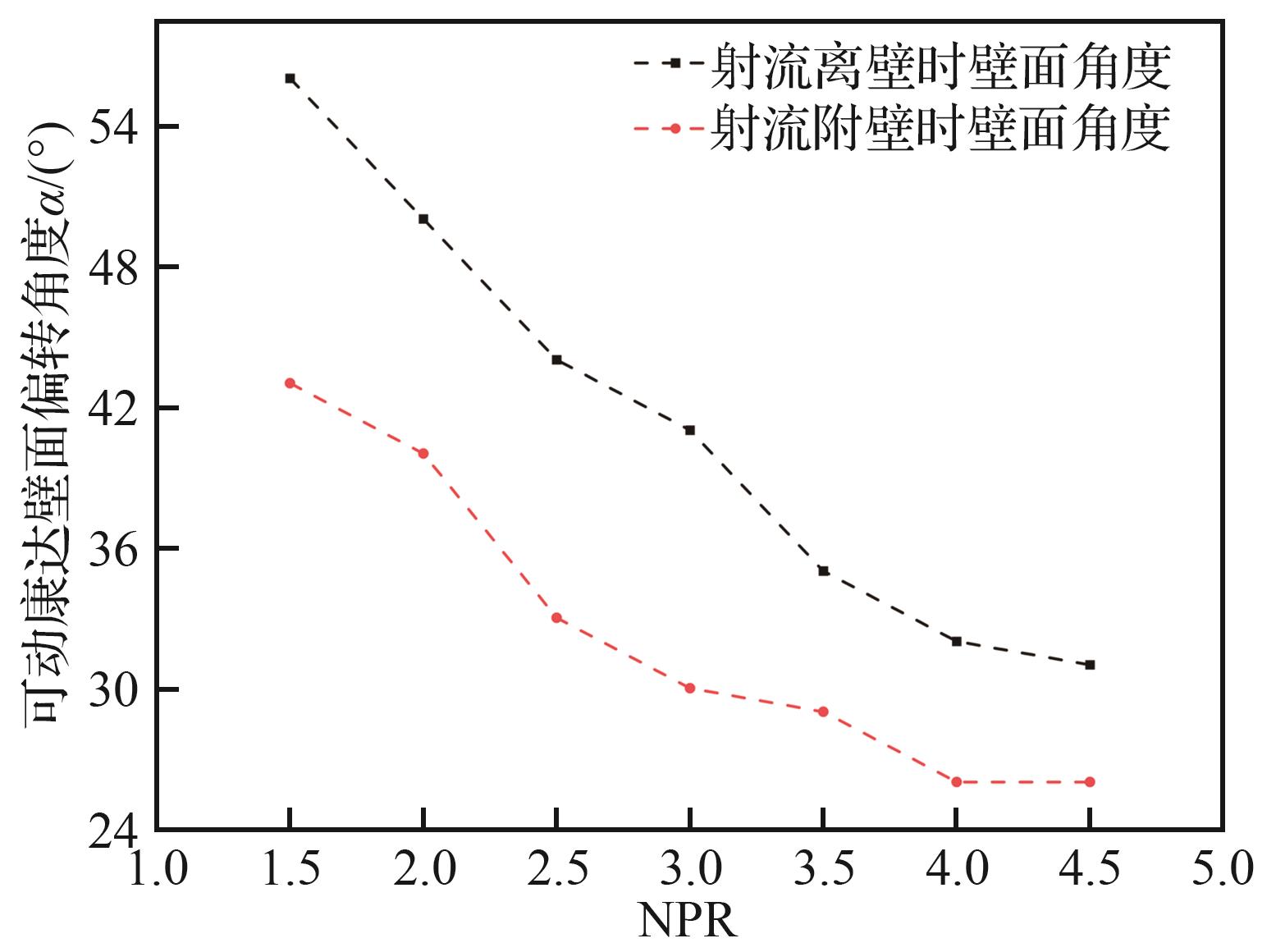
传统机械式推力矢量喷管结构复杂、射流偏转角度大;流体式推力矢量结构简单,但存在射流偏转角度小、矢量角控制迟滞与突跳等问题。提出一种具有可动康达壁面致偏的二元射流控制装置,采用不同长度的可动康达壁面诱导射流进行大角度偏转。通过开展对推力力矢量角度变化规律与流动结构分析的试验研究,给出了射流在不同壁面长度与射流出口高度之比K下的偏转控制特性;结合纹影流动显示技术,给出了射流在高速、不同落压比(NPR)下的偏转特性。试验研究结果表明,在可动康达壁面偏转去、回程过程中,射流都会经历附壁、非稳定波动和离壁3种状态。壁面长度会影响射流离壁与附壁的最大偏转角度,K=20时存在3°迟滞,射流可达到最大偏转角度56°;随K值减小,迟滞逐渐消失,K=5时无迟滞,射流可达到42°偏转角度。在高速情况下,NPR=4.5时,射流在壁面诱导仍可以实现31°的偏转角度。
中图分类号:
樊羽恒, 顾蕴松, 周宇航, 张勇, 杨子涵. 基于可动康达壁面致偏的二元射流控制特性[J]. 航空学报, 2026, 47(20): 133215.
Yuheng FAN, Yunsong GU, Yuhang ZHOU, Yong ZHANG, Zihan YANG. Control characteristics of a two-dimensional jet based on movable Coanda wall deflection[J]. Acta Aeronautica et Astronautica Sinica, 2026, 47(20): 133215.
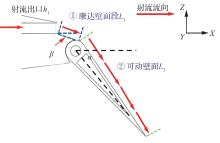
图 1
机械致偏射流试验模型
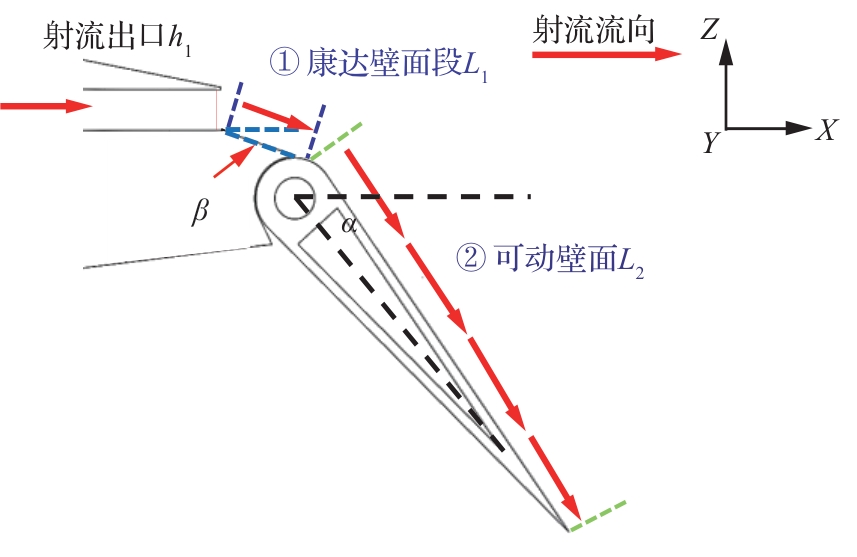
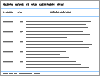
表1
模型参数
| 参数 | 数值 |
|---|---|
| 涵道风扇直径/mm | 40 |
| 射流出口高度h1/mm | 5 |
| 康达壁面角度 | 18 |
| 康达壁面长度L1/mm | 10 |
| 可动康达壁面长度L2/mm | 25, 50, 100 |
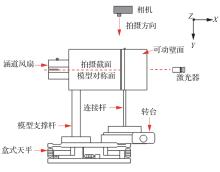
图 2
天平测力、烟流流动显示及PIV试验平台
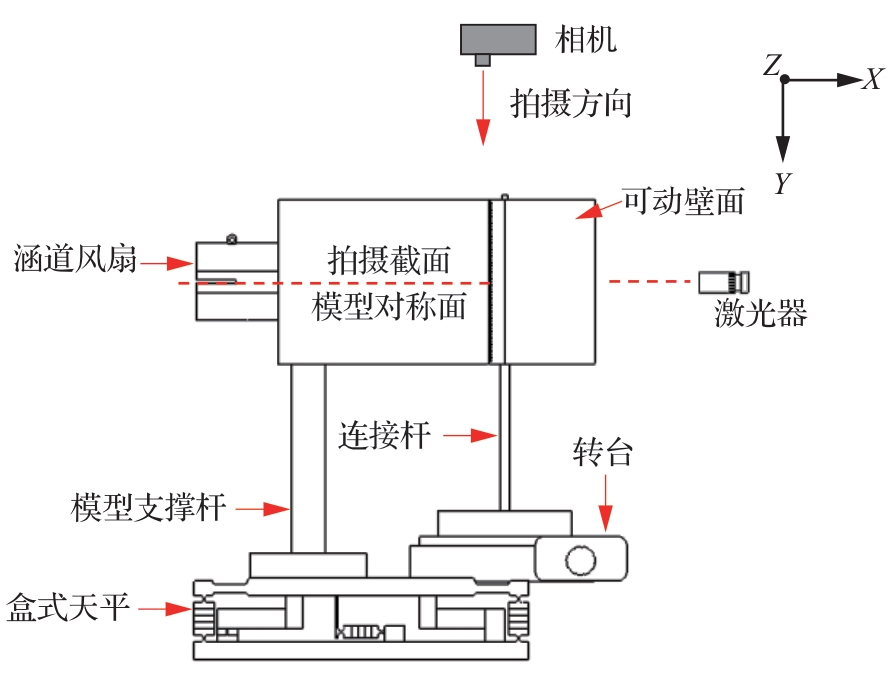
图 3
六分量盒式天平结构示意图
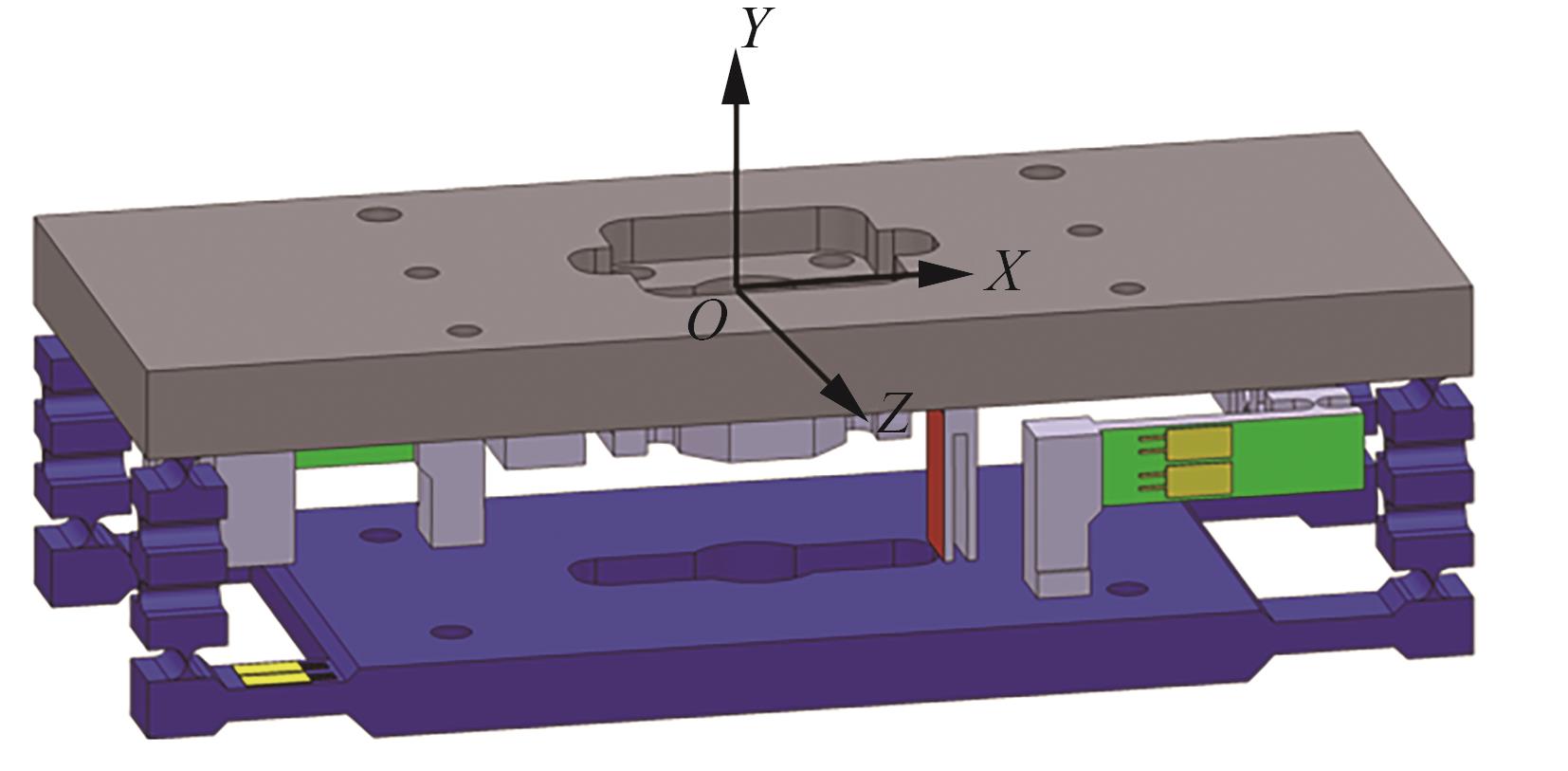
表2
六分量盒式天平静校准性能
| 参数 | 设计载荷 | 准度/% | 精度/% |
|---|---|---|---|
| FX /kg | 3 | 0.307 | 0.206 |
| FY /kg | 10 | 0.432 | 0.187 |
| FZ /kg | 3 | 0.400 | 0.109 |
| MX /(kg·m) | 1 | 0.298 | 0.222 |
| MY /(kg·m) | 1 | 0.458 | 0.235 |
| MZ /(kg·m) | 2 | 0.299 | 0.165 |
图 4
PIV系统组成
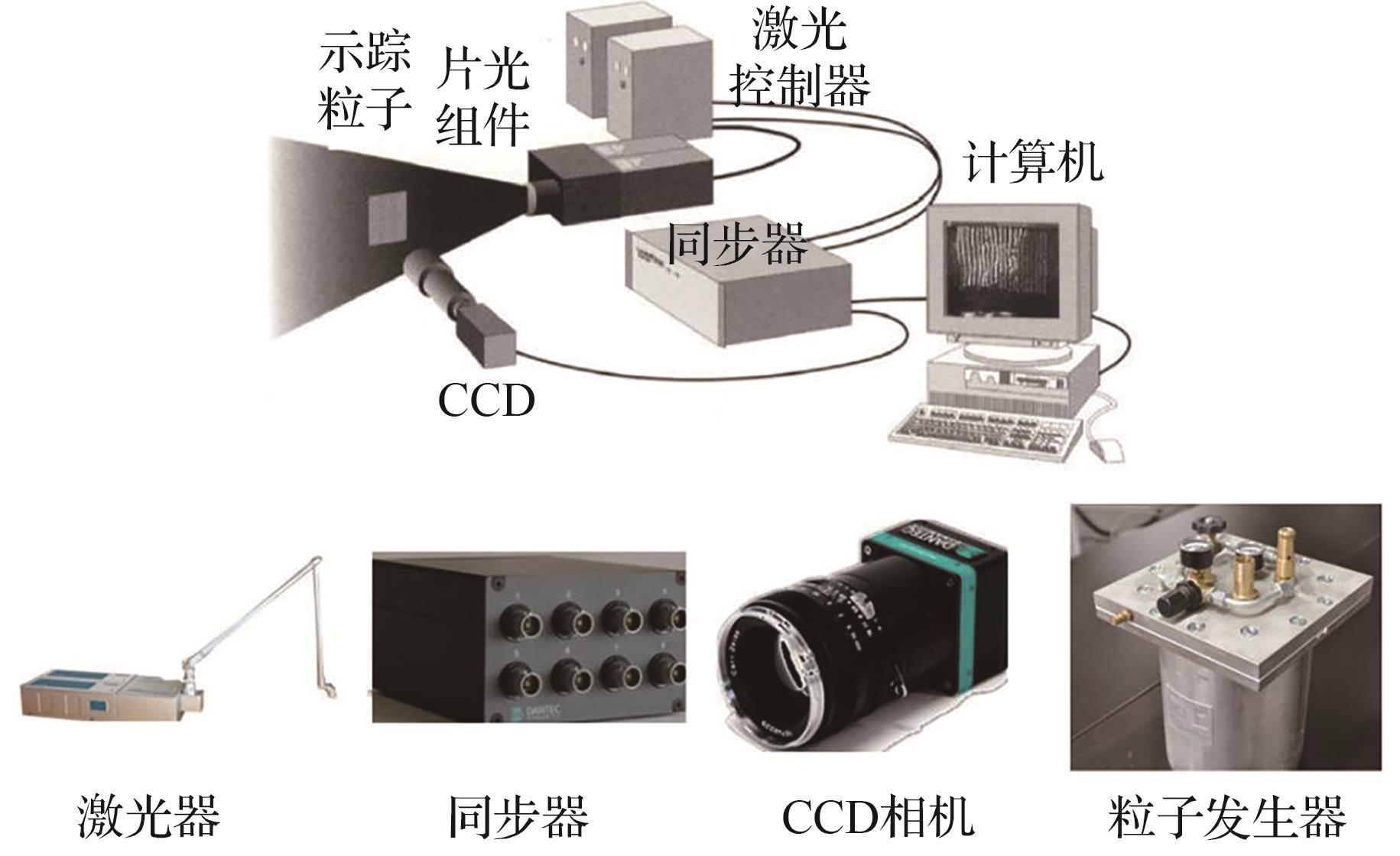
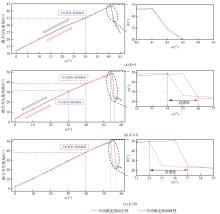
图 5
K=5,10,20时,可动康达壁面偏转去程及回程推力力矢量角度曲线
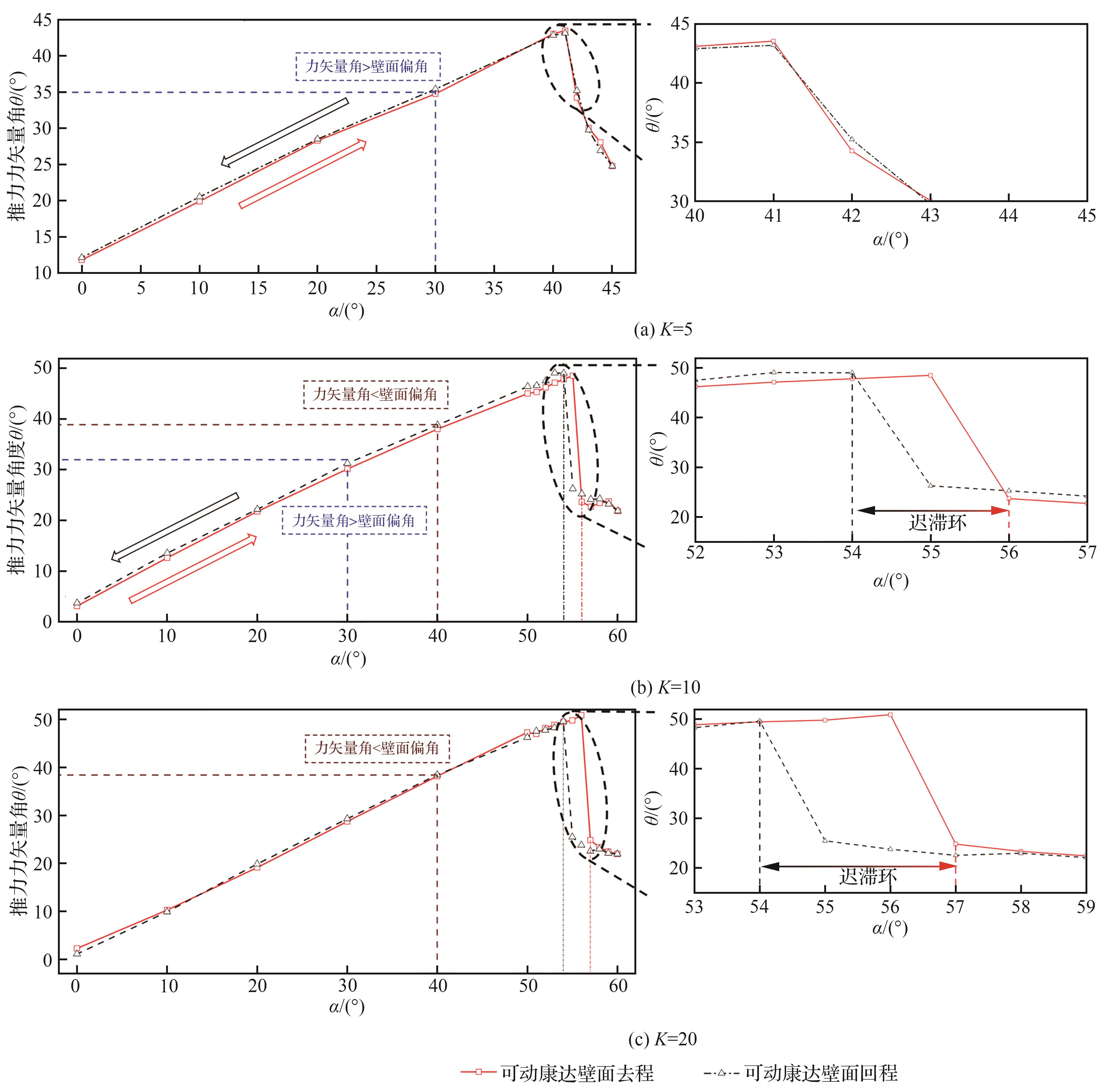
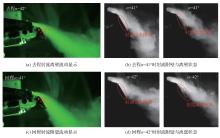
图 6
K=5时流动显示及射流附壁与离壁状态
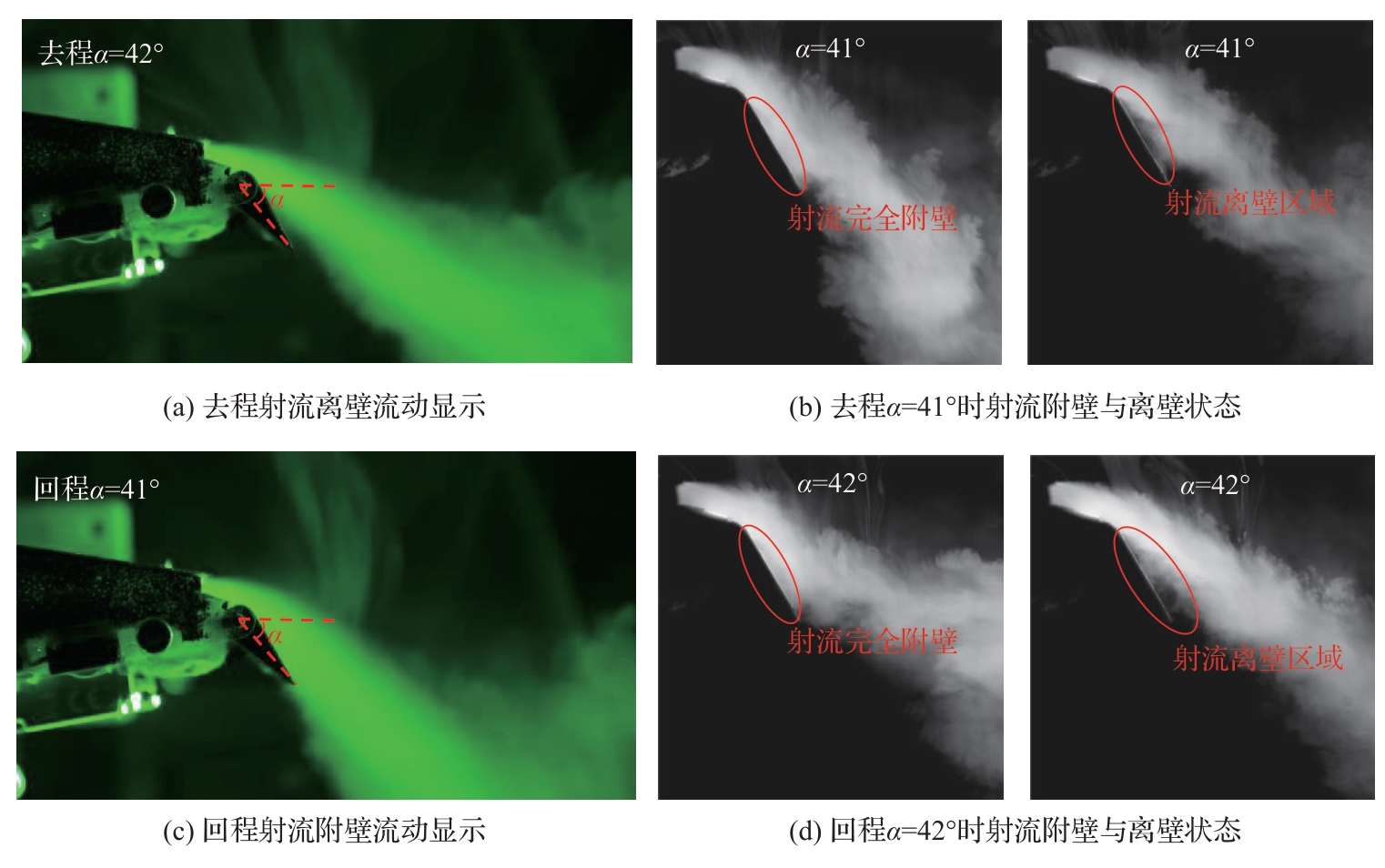
图 7
K=10时流动显示及射流附壁与离壁状态
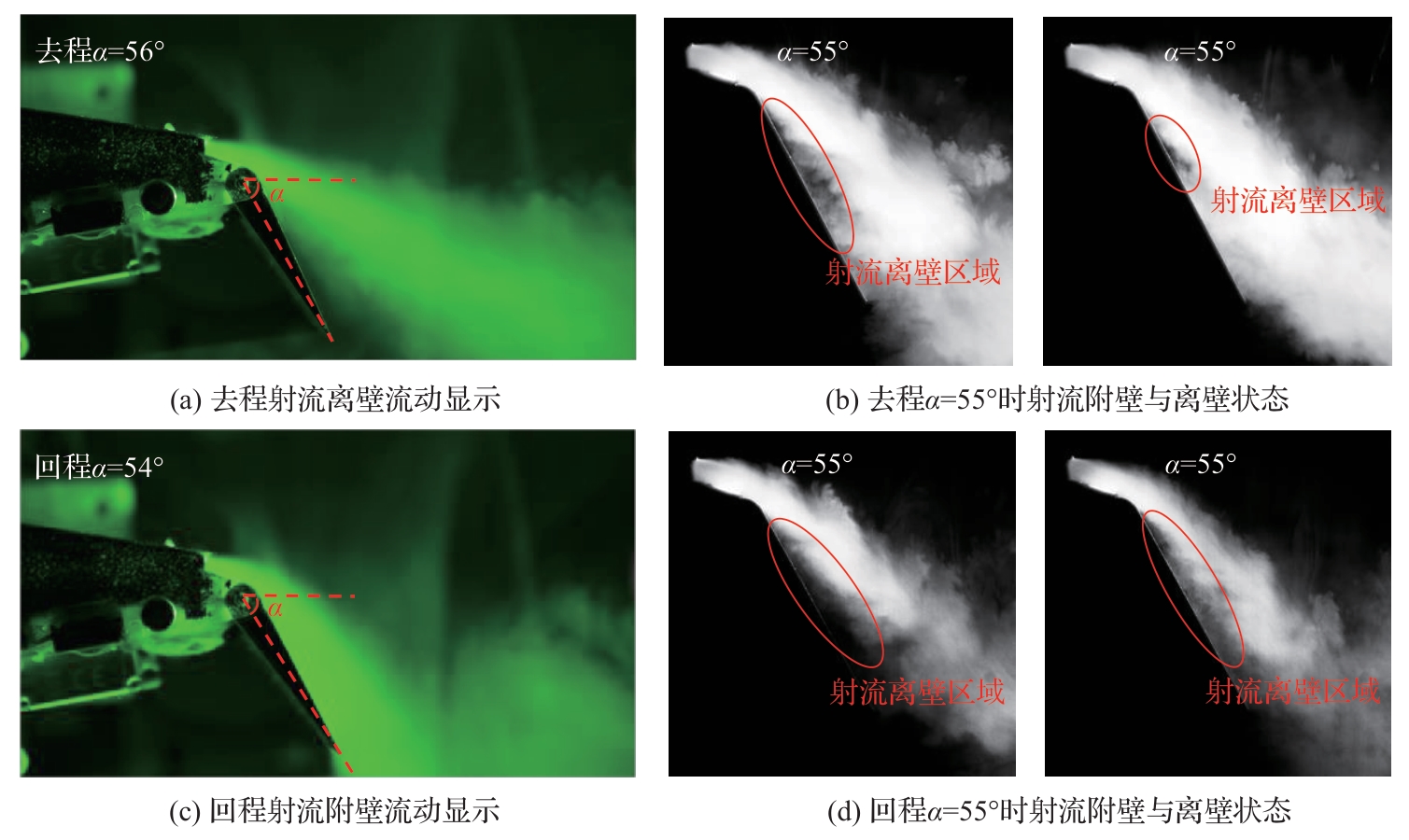
图 8
K=20时流动显示及射流附壁与离壁状态
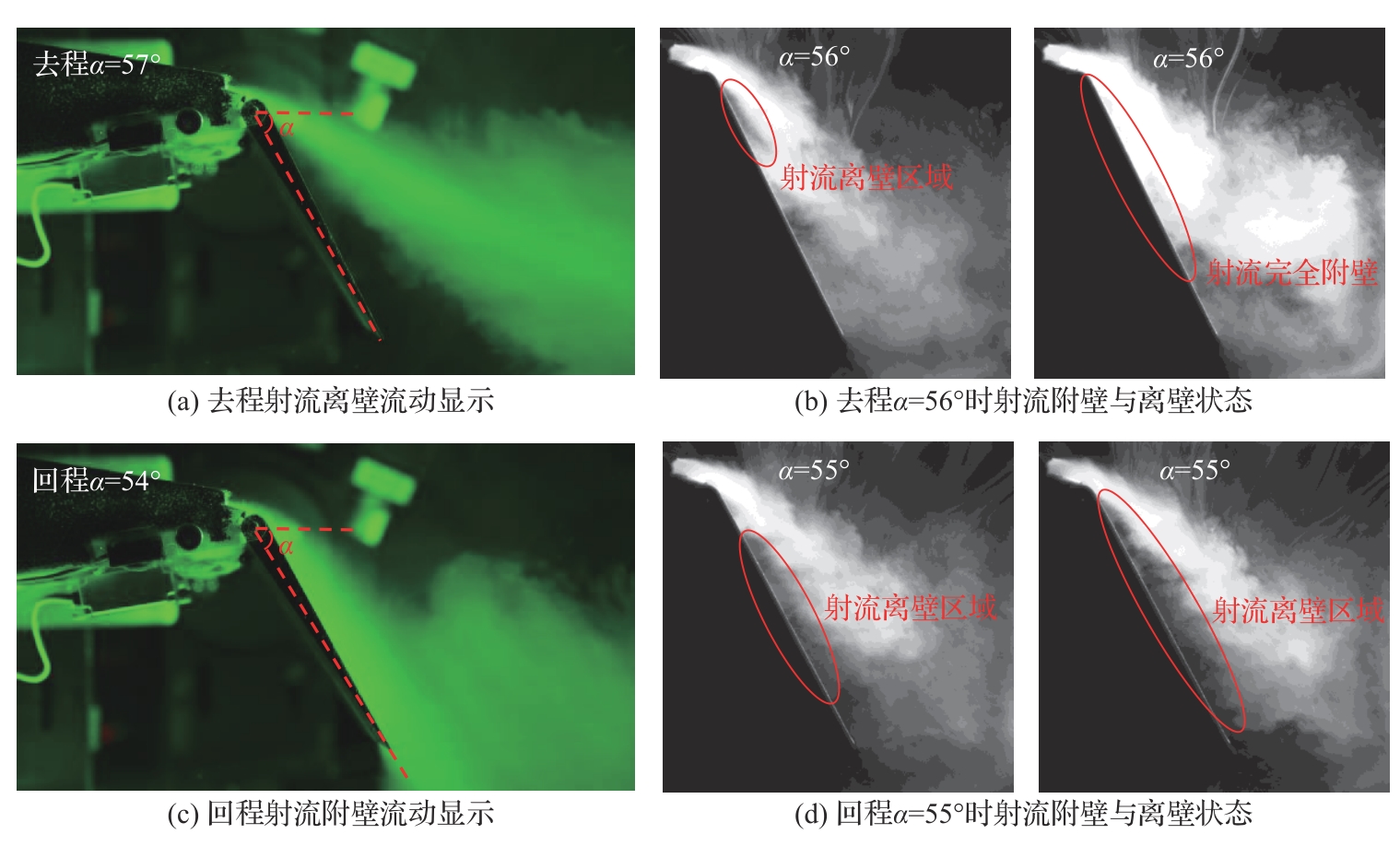
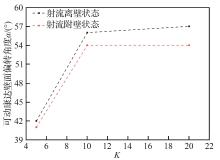
图 9
K=5,10,20时射流离壁与附壁角度变化
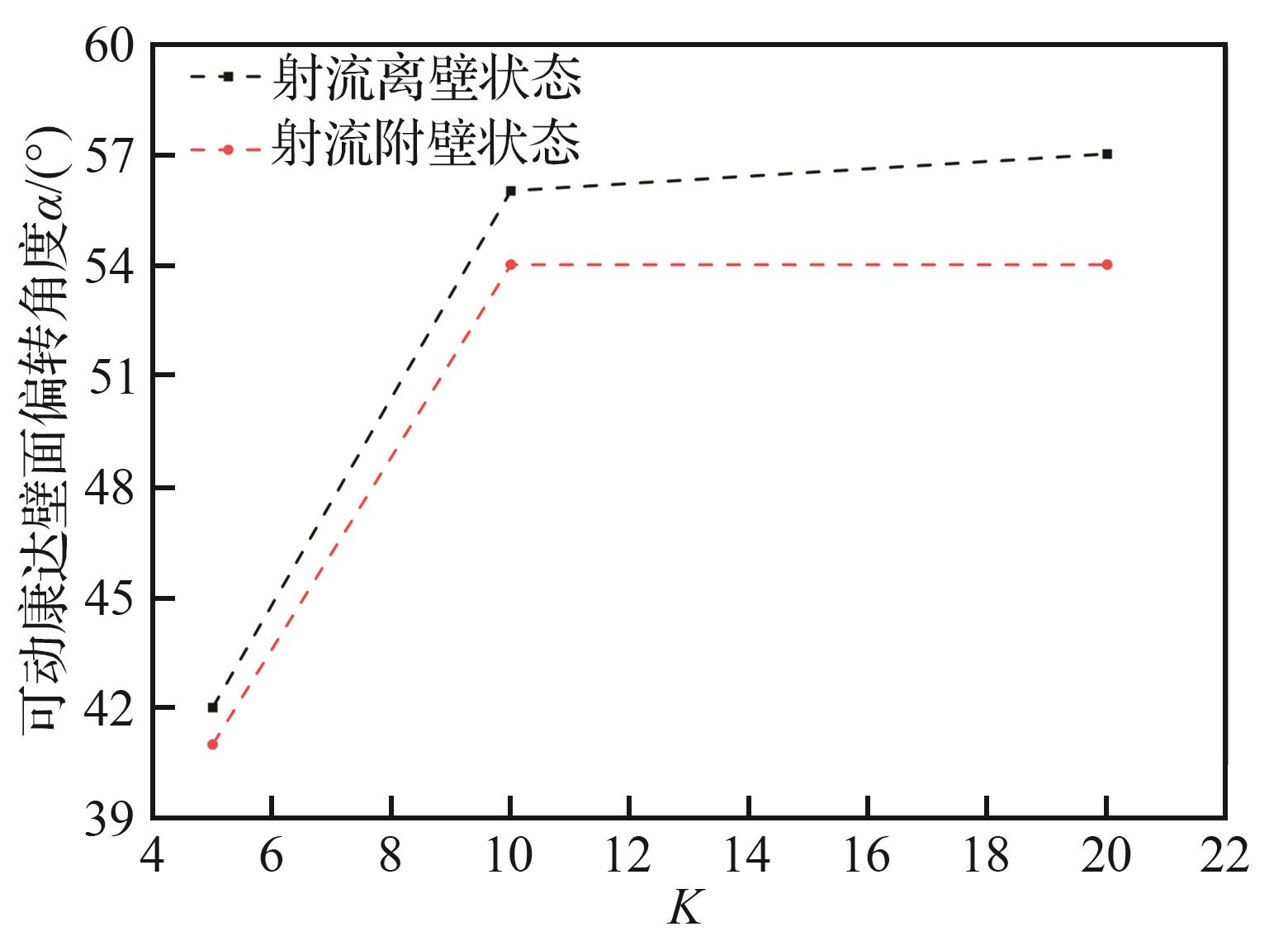
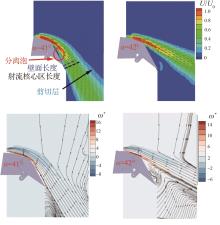
图 10
K=5时射流随可动康达壁面偏转离壁前后速度与涡量分布
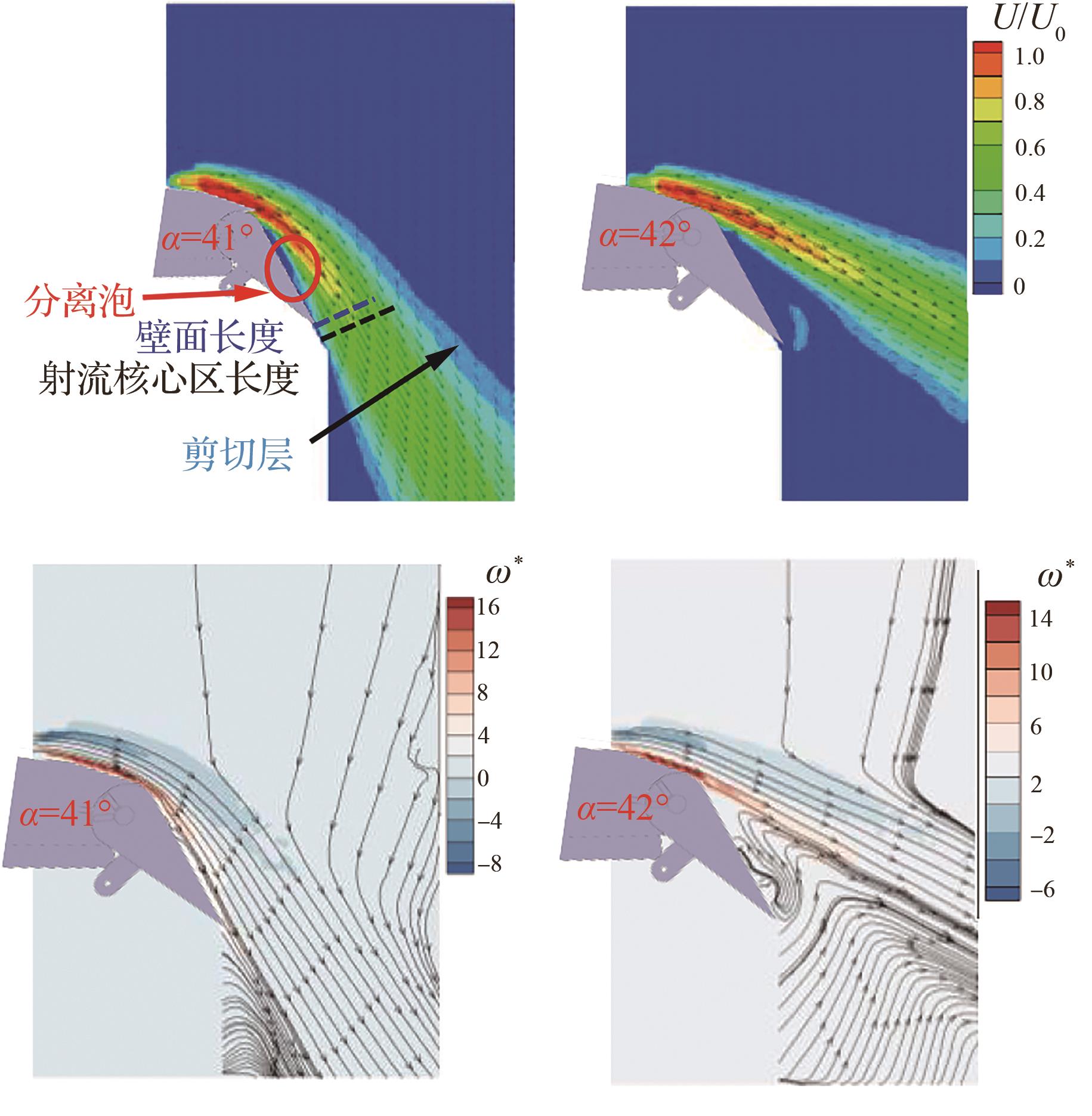
图 11
K=10时射流随可动康达壁面偏转离壁前后速度与涡量分布
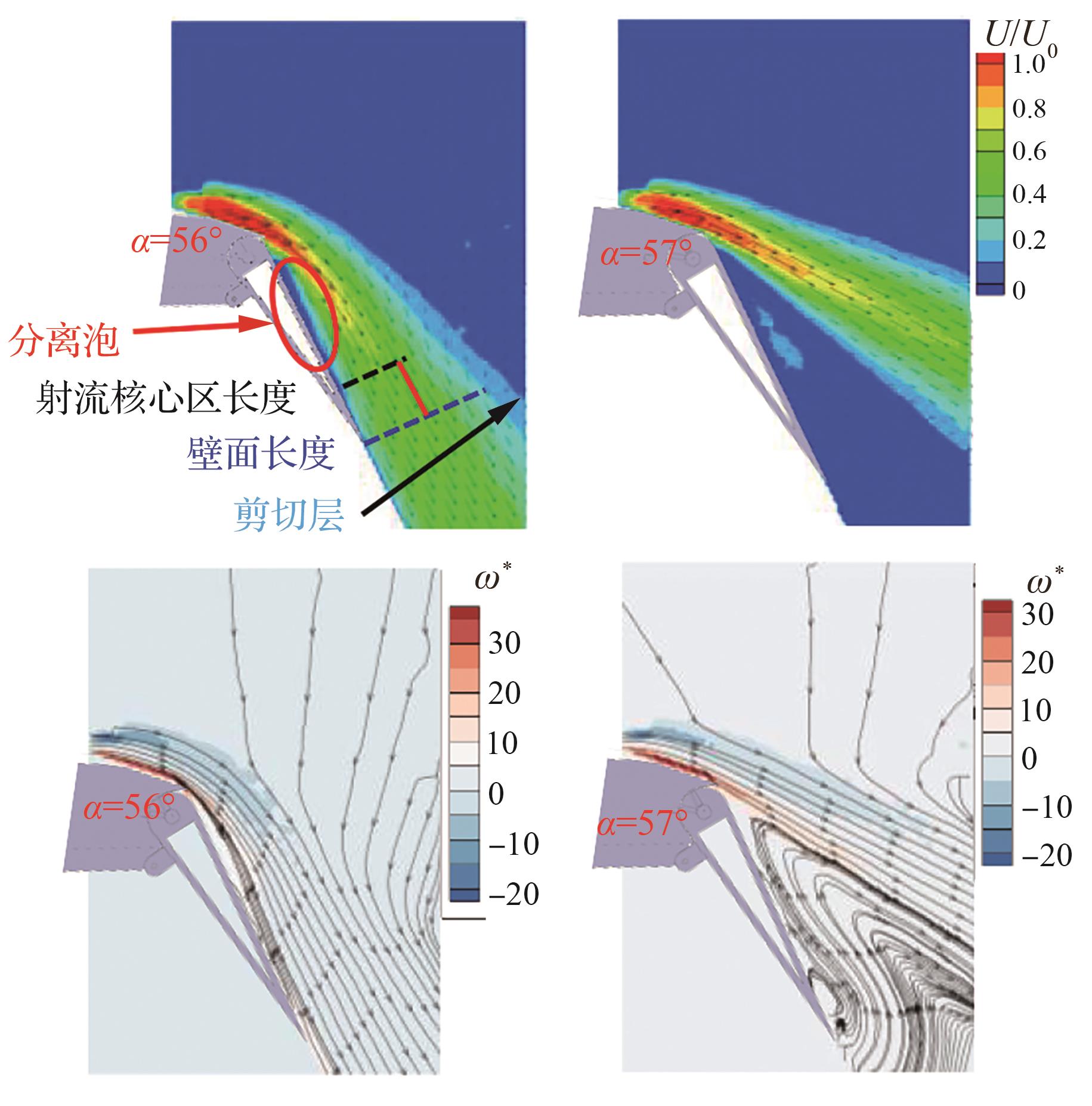
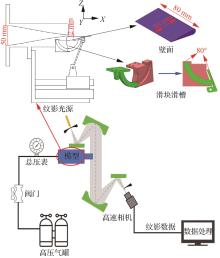
图 12
机械致偏高速射流模型及纹影拍摄试验平台
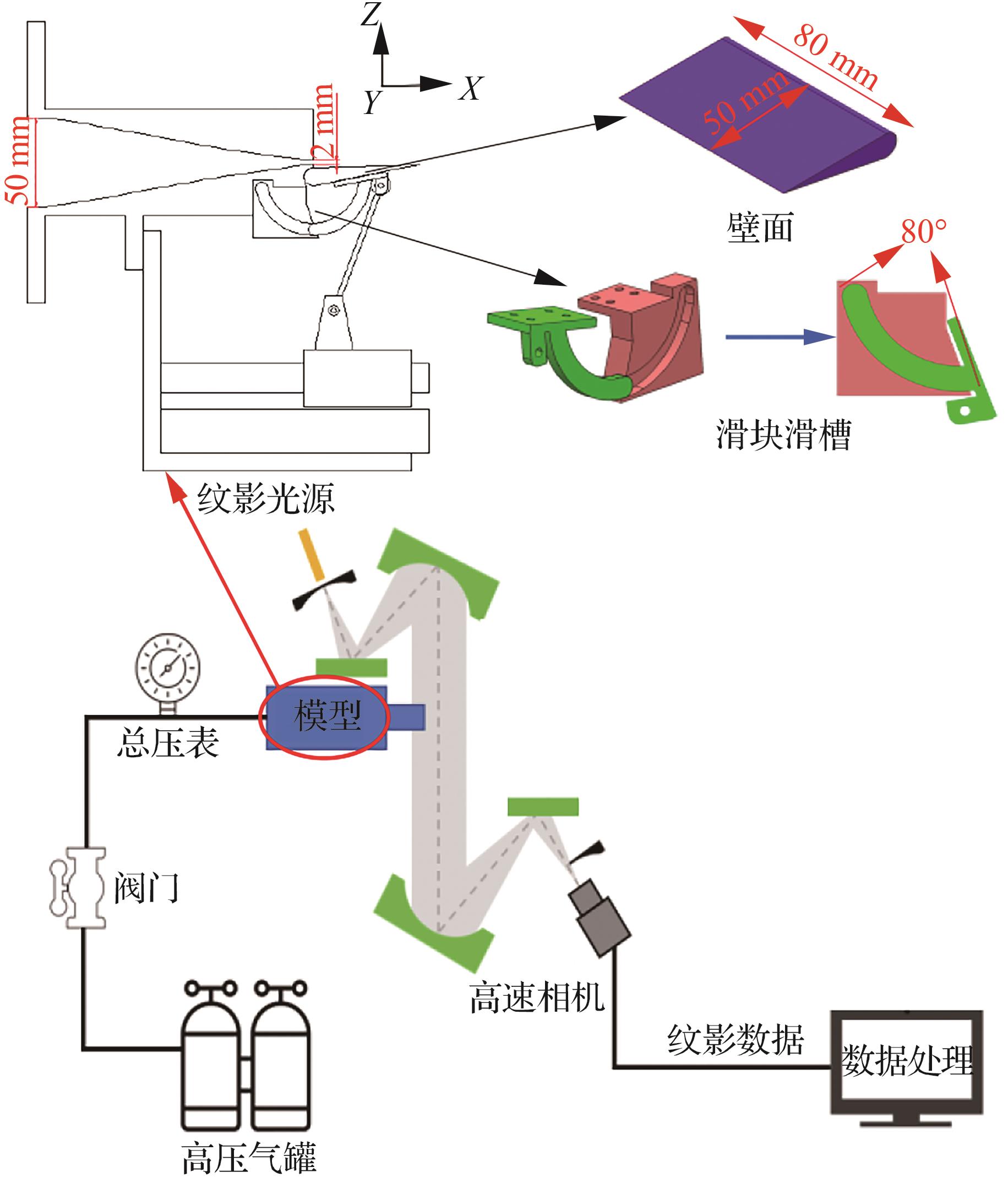
表3
不同落压比下完全膨胀后出口速度
| 进出口落压比(NPR) | 完全膨胀出口速度V射流/(m·s-1) |
|---|---|
| 1.5 | 256.8 |
| 2.0 | 329.1 |
| 2.5 | 373.6 |
| 3.0 | 403.1 |
| 3.5 | 424.9 |
| 4.0 | 442.2 |
| 4.5 | 456.4 |
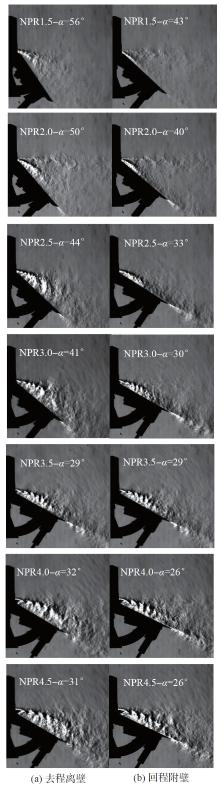
图 13
不同落压比下去程离壁和回程附壁射流纹影流动显示
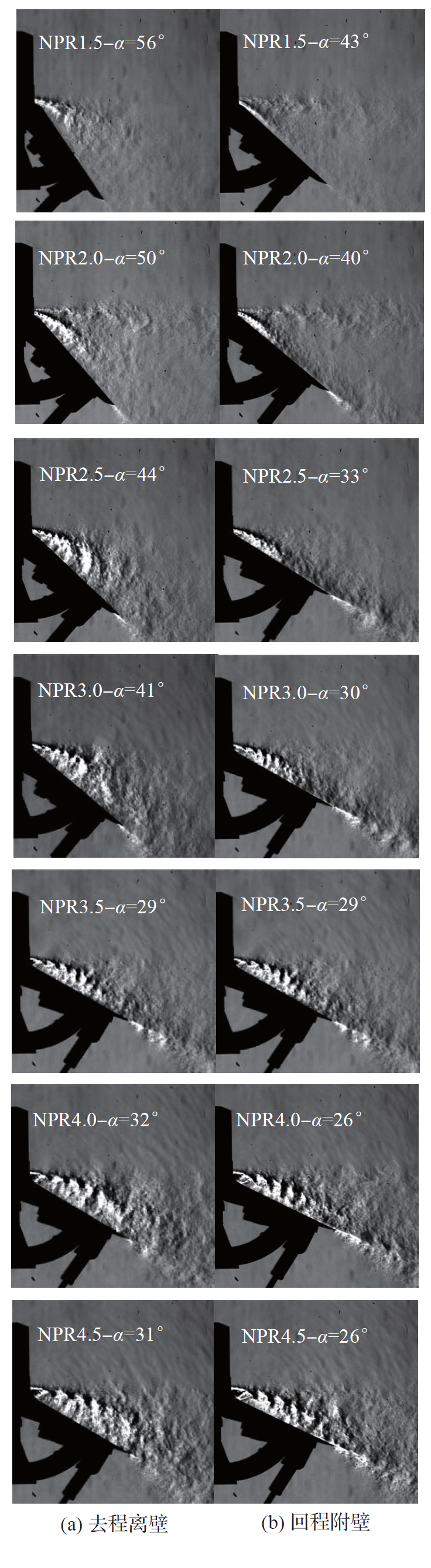
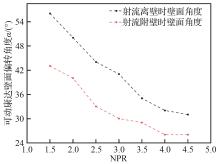
图 14
不同NPR下射流离壁与附壁时可动康达壁面偏转角度α
| [1] | WAITHE K, DEERE K. An experimental and computational investigation of multiple injection ports in a convergent-divergent nozzle for fluidic thrust vectoring[C]∥ 21st AIAA Applied Aerodynamics Conference. Reston: AIAA, 2003. |
| [2] | 崔祚, 汪阳生. 飞行器推力矢量喷管研究综述[J]. 飞航导弹, 2021(12): 158-167. |
| CUI Z, WANG Y S. Summary of research on aircraftthrust vector nozzle[J]. Aerodynamic Missile Journal, 2021(12): 158-167 (in Chinese). | |
| [3] | 陶增元, 李军, 程邦勤. 飞机推进系统关键技术: 推力矢量技术[J]. 空军工程大学学报(自然科学版), 2000, 1(2): 86-90. |
| TAO Z Y, LI J, CHENG B Q. Thrust vector technique, the vital technology of aircraft propulsion system[J]. Journal of Air Force Engineering University (Natural Science Edition), 2000, 1(2): 86-90 (in Chinese). | |
| [4] | 方昌德. 飞机推力矢量技术发展综述[J]. 航空科学技术, 1998, 9(2): 10-12. |
| FANG C D. Developing status of thrust vectoring control technology[J]. Aeronautical Science and Technology, 1998, 9(2): 10-12 (in Chinese). | |
| [5] | RUSBARSKY G. F-15 STOL and maneuver technology demonstrator flight test progress report[C]∥Orbital Debris Conference: Technical Issues and Future Directions. Reston: AIAA, 1990. |
| [6] | BURSEY R, DICKINSON R. Flight test results of the F-15 SMTD thrust vectoring/thrust reversing exhaust nozzle[C]∥26th Joint Propulsion Conference. Reston: AIAA, 1990. |
| [7] | CLOUGH B. Short take-off and landing maneuver technology demonstrator (STOL/MTD) lessons learned-Integrated flight/propulsion control (IFPC)[C]∥Aircraft Design, Systems and Operations Conference. Reston: AIAA, 1990. |
| [8] | MOORHOUSE D J, LAUGHREY J A. Results and lessons learned from the STOL & maneuver demonstration program[J]. SAE Technical Paper Series, 1991, 1: 912005. |
| [9] | 梁春华, 张仁, 沈迪刚. 国外航空发动机推力矢量喷管技术的发展研究[J]. 航空发动机, 1998, 24(1): 49-55. |
| LIANG C H, ZHANG R, SHEN D G. Development and research on thrust vector nozzle technology of aero-engine abroad[J]. Aeroengine, 1998, 24(1): 49-55 (in Chinese). | |
| [10] | ORME J S, SIMS R L. Selected performance measurements of the F-15 active axisymmetric thrust-vectoring nozzle: H-2339[R]. Reston: AIAA, 1999. |
| [11] | ORME J, HATHAWAY R, FERGUSON M. Initial flight test evaluation of the F-15 active axisymmetric vectoring nozzle performance[C]∥34th AIAA/ASME/SAE/ASEE Joint Propulsion Conference and Exhibit. Reston: AIAA, 1998. |
| [12] | ASBURY S C, CAPONE F J. High-alpha vectoring characteristics of the F-18/HARV[J]. Journal of Propulsion and Power, 1994, 10(1): 116-121. |
| [13] | 吕雪燕, 罗艳春, 姜晓莲. 推力矢量技术的应用及影响[J]. 科技资讯, 2012, 10(5): 118. |
| LYU X Y, LUO Y C, JIANG X L. Application and influence of thrust vector technology[J]. Science & Technology Information, 2012, 10(5): 118 (in Chinese). | |
| [14] | DEERE K A. Summary of fluidic thrust vectoring research conducted at NASA Langley Research Center[C]∥21st AIAA Applied Aerodynamics Conference. Reston: AIAA, 2003. |
| [15] | DEERE K, BERRIER B, FLAMM J, et al. A computational study of a dual throat fluidic thrust vectoring nozzle concept[C]∥41st AIAA/ASME/SAE/ASEE Joint Propulsion Conference & Exhibit. Reston: AIAA, 2005. |
| [16] | DEERE K, BERRIER B, FLAMM J, et al. Computational study of fluidic thrust vectoring using separation control in a nozzle[C]∥21st AIAA Applied Aerodynamics Conference. Reston: AIAA, 2003. |
| [17] | MILLER D, YAGLE P, HAMSTRA J. Fluidic throat skewing for thrust vectoring in fixed-geometry nozzles[C]∥37th Aerospace Sciences Meeting and Exhibit. Reston: AIAA, 1999. |
| [18] | 徐惊雷, 黄帅, 潘睿丰, 等. 气动推力矢量喷管研究近况和发展趋势[J]. 航空学报, 2025, 46(8): 631216. |
| XU J L, HUANG S, PAN R F, et al. Research on fluidic thrust vectoring nozzle: Recent developments and future trends[J]. Acta Aeronautica et Astronautica Sinica, 2025, 46(8): 631216 (in Chinese). | |
| [19] | 王全, 王强. 激波诱导二元矢量喷管内流特性数值研究[J]. 航空动力学报, 2006, 21(4): 681-685. |
| WANG Q, WANG Q. Computational analysis on static internal flow field of shock vector controlled vectoring exhaust nozzles[J]. Journal of Aerospace Power, 2006, 21(4): 681-685 (in Chinese). | |
| [20] | 罗静, 王强, 额日其太. 两种流体控制方案矢量喷管内流场计算及分析[J]. 北京航空航天大学学报, 2004, 30(7): 597-601. |
| LUO J, WANG Q, ERI Q T. Computational analysis of two fluidic thrust vectoring concepts on nozzle flow field[J]. Journal of Beijing University of Aeronautics and Astronautics, 2004, 30(7): 597-601 (in Chinese). | |
| [21] | 王强, 付尧明, 额日其太. 流体注入的轴对称矢量喷管三维流场计算[J]. 推进技术, 2002, 23(6): 441-444. |
| WANG Q, FU Y M, ERI Q T. Computation of three dimensional nozzle flow field with fluidic injection[J]. Journal of Propulsion Technology, 2002, 23(6): 441-444 (in Chinese). | |
| [22] | 史经纬, 王占学, 刘增文, 等. 二次流喷口形状对激波矢量控制喷管推力矢量特性影响[J]. 航空动力学报, 2013, 28(12): 2678-2684. |
| SHI J W, WANG Z X, LIU Z W, et al. Effects of secondary injection forms on thrust vector performance of shock vector controlling nozzle[J]. Journal of Aerospace Power, 2013, 28(12): 2678-2684 (in Chinese). | |
| [23] | 史经纬, 王占学, 周莉, 等. 激波矢量喷管二次流喷口形态影响研究[J]. 工程热物理学报, 2014, 35(11): 2173-2177. |
| SHI J W, WANG Z X, ZHOU L, et al. Influence of secondary injection configuration on performance of shock vector nozzle[J]. Journal of Engineering Thermophysics,2014, 35(11): 2173-2177 (in Chinese). | |
| [24] | 史经纬. 固定几何气动矢量喷管流动机理及性能评估技术研究[D]. 西安: 西北工业大学, 2015:177. |
| SHI J W. Investigation on flow mechanism and performance estimation of fixed-geometric thrust vectoring nozzle[D]. Xi’an: Northwestern Polytechnical University, 2015:177 (in Chinese). | |
| [25] | SHI J W, WANG Z X, ZHANG X B, et al. Investigation on a hybrid SVC nozzle and coupling performance estimation with aero-engine[C]∥53rd AIAA/SAE/ASEE Joint Propulsion Conference. Reston: AIAA, 2017. |
| [26] | 汪明生, 杨建军. 逆流推力矢量喷管的非定常内流性能研究[J]. 航空动力学报, 2009, 24(1): 75-82. |
| WANG M S, YANG J J. Unsteady internal performance study of counterflow vectoring thrust nozzle[J]. Journal of Aerospace Power, 2009, 24(1): 75-82 (in Chinese). | |
| [27] | 杨建军. 逆流控制的推力矢量喷管气动特性研究[D]. 南京: 南京航空航天大学, 2007:130. |
| YANG J J. Research on aerodynamic characteristics of counterflow thrust vectoring nozzle[D]. Nanjing: Nanjing University of Aeronautics and Astronautics, 2007:130 (in Chinese). | |
| [28] | STRYKOWSKI P J, KROTHAPALLI A, FORLITI D J. Counterflow thrust vectoring of supersonic jets[J]. AIAA Journal, 1996, 34(11): 2306-2314. |
| [29] | MASON M, CROWTHER W. Fluidic thrust vectoring for low observable air vehicles[C]∥2nd AIAA Flow Control Conference. Reston: AIAA, 2004. |
| [30] | SAGHAFI F, BANAZADEH A. Co-flow fluidic thrust vectoring requirements for longitudinal and lateral trim purposes[C]∥42nd AIAA/ASME/SAE/ASEE Joint Propulsion Conference & Exhibit. Reston: AIAA, 2006. |
| [31] | 顾蕴松, 李斌斌, 程克明. 基于主动流动控制的射流矢量偏转技术[J]. 实验力学, 2012, 27(1): 87-92. |
| GU Y S, LI B B, CHENG K M. On the jet vector deflection based on active flow control technique[J]. Journal of Experimental Mechanics, 2012, 27(1): 87-92 (in Chinese). | |
| [32] | 肖中云, 顾蕴松, 江雄, 等. 一种基于引射效应的流体推力矢量新技术[J]. 航空学报, 2012, 33(11): 1967-1974. |
| XIAO Z Y, GU Y S, JIANG X, et al. A new fluidic thrust vectoring technique based on ejecting mixing effects[J]. Acta Aeronautica et Astronautica Sinica, 2012, 33(11): 1967-1974 (in Chinese). | |
| [33] | SHI N X, GU Y S, WU T T, et al. An optimized pressure-based method for thrust vectoring angle estimation[J]. Aerospace, 2023, 10(12): 978. |
| [34] | SHI N X, GU Y S, ZHOU Y H, et al. Mechanism of hysteresis and uncontrolled deflection in jet vectoring control based on Coanda effect[J]. Physics of Fluids, 2022, 34(8): 084107. |
| [35] | LIU J F, LUO Z B, DENG X, et al. Dual synthetic jets actuator and its applications—PartⅡ : Novel fluidic thrust-vectoring method based on dual synthetic jets actuator[J]. Actuators, 2022, 11(8): 209. |
| [36] | JONES G, VIKEN S, WASHBURN A, et al. An active flow circulation controlled flap concept for general aviation aircraft applications[C]∥1st Flow Control Conference. Reston: AIAA, 2002. |
| [37] | ENGLAR R J, HUSON G G. Development of advanced circulation control wing high-lift airfoils[J]. Journal of Aircraft, 1984, 21(7): 476-483. |
| [38] | ENGLAR R J. Low-speed aerodynamic characteristics of a small, fixed trailing-edge circulation control wing configuration fitted to a supercritical airfoil: ASED-81/08 [R]. Bethesda: David Taylor Naval Ship R & D Center, 1981. |
| [39] | ENGLAR R J. Development of an advanced no-moving parts high-lift airfoil[C]∥ICAS/AIAA Aircraft Systems and Technology Conference. Reston: AIAA, 1982. |
| [40] | ENGLAR R J, SMITH M J, KELLEY S M, et al. Application of circulation control to advanced subsonic transport aircraft—Part Ⅰ : Airfoil development[J]. Journal of Aircraft, 1994, 31(5): 1160-1168. |
| [41] | ENGLAR R J, SMITH M J, KELLEY S M, et al. Application of circulation control to advanced subsonic transport aircraft—Part Ⅱ : Transport application[J]. Journal of Aircraft, 1994, 31(5): 1169-1177. |
| [42] | ENGLAR R J, APPLEGATE C A. Circulation control—A bibliography of DTNSRDC research and selectedoutside references: AD-A146966[R]. Bethesda: David Taylor Naval Ship R&D Center, 1984. |
| [43] | BURNAZZI M, RADESPIEL R. Design and analysis of a droop nose for Coanda flap applications[J]. Journal of Aircraft, 2014, 51(5): 1567-1579. |
| [44] | NIU J P, LEI J M, LU T Y. Numerical research on the effect of variable droop leading-edge on oscillating NACA 0012 airfoil dynamic stall[J]. Aerospace Science and Technology, 2018, 72: 476-485. |
| [45] | SODJA J, MARTINEZ M J, SIMPSON J C, et al. Experimental evaluation of the morphing leading edge concept[C]∥23rd AIAA/AHS Adaptive Structures Conference. Reston: AIAA, 2015. |
| [46] | VASISTA S, RIEMENSCHNEIDER J, VAN DE KAMP B, et al. Evaluation of a compliant droop-nose morphing wing tip via experimental tests[J]. Journal of Aircraft, 2016, 54(2): 519-534. |
| [47] | JENSCH C, PFINGSTEN K C, RADESPIEL R. Numerical investigation of leading edge blowing and optimization of the slot geometry for a circulation control airfoil[C]∥New Results in Numerical and Experimental Fluid Mechanics. 2010: 183-190. |
| [48] | 孙卫平, 杨康智, 秦何军. 大型水陆两栖飞机吹气襟翼设计与分析验证[J]. 航空动力学报, 2016, 31(4): 903-909. |
| SUN W P, YANG K Z, QIN H J. Design and test of a jet flap for a large amphibian[J]. Journal of Aerospace Power, 2016, 31(4): 903-909 (in Chinese). | |
| [49] | 温庆, 杨康智, 彭新春, 等. 内吹式襟翼边界层控制技术研究[J]. 气动研究与试验, 2024, 2(5): 52-57. |
| WEN Q, YANG K Z, PENG X C, et al. Research on the boundary layer control of inner-blown flaps[J]. Aerodynamic Research & Experiment, 2024, 2(5): 52-57 (in Chinese). | |
| [50] | 何萌, 张刘, 赵垒, 等. 前缘下垂结合内吹式襟翼失速特性研究[J]. 航空工程进展, 2022, 13(3): 96-107. |
| HE M, ZHANG L, ZHAO L, et al. Research on stall characteristics of droop leading edge combined with internal-blowing flaps[J]. Advances in Aeronautical Science and Engineering, 2022, 13(3): 96-107 (in Chinese). |
| [1] | 孙士珺, 解潇, 马凯夫, 申丽辉. 面向增强下游高速进气道流量捕获的涡流发生器调控机理及设计[J]. 航空学报, 2026, 47(6): 132575-132575. |
| [2] | 马志明, 张鑫. 低雷诺数下基于等离子体激励的大展弦比机翼绕流流场控制[J]. 航空学报, 2026, 47(5): 132359-132359. |
| [3] | 孔亚康, 宗豪华, 汪诚, 李金平, 苏志, 吴云, 贾敏, 梁华. 多相位调制的电弧矩阵控制超声速凹腔流场[J]. 航空学报, 2026, 47(5): 132504-132504. |
| [4] | 刘营, 罗振兵, 刘源园, 邓雄, 梁欣宇. 双膜三腔合成射流激励器旋涡演化机理[J]. 航空学报, 2026, 47(20): 133208-133208. |
| [5] | 刘延芳, 王洪悦, 鄂羽佳, 齐乃明. 迈向智能驱动的高超声速飞行器边界层主动质量引射减阻降热研究新范式[J]. 航空学报, 2026, 47(2): 132171-132171. |
| [6] | 朱训涵, 丁振伟, 谢玮, 罗振兵, 周岩. 主动射流调控第Ⅳ类激波干扰与流场快速重构[J]. 航空学报, 2026, 47(16): 133188-133188. |
| [7] | 林文涛, 史经纬, 惠中豪, 是介, 周莉, 王占学. 激波矢量S弯喷管红外辐射特性[J]. 航空学报, 2026, 47(16): 133169-133169. |
| [8] | 陈孜昂, 黄河峡, 秦源, 许耀宇, 贾兵. Bump进气道超额定小流量失稳特性[J]. 航空学报, 2026, 47(14): 132889-132889. |
| [9] | 罗振兵, 王春强, 郭芷妍, 龚建宇, 赵志杰. 基于无源合成双射流的百公斤级飞行器短距起降增升首飞验证[J]. 航空学报, 2026, 47(13): 533291-533291. |
| [10] | 刘景飞, 黄龙太, 鞠安然, 徐传宝, 和润生, 王子卓. 水上飞机缩比模型带滑流影响的吹气控制试验[J]. 航空学报, 2026, 47(13): 133120-133120. |
| [11] | 耿玺, 董鹏昌, 孙琪杰, 孙志坤, 朱赫, 钱晓辉, 程克明, 史志伟. AC-DBD等离子体控制的飞行减阻试验[J]. 航空学报, 2026, 47(13): 533206-533206. |
| [12] | 杨天宇, 苏志, 梁华, 宗豪华, 吴云. 脉冲直流等离子体激励抑制流动分离试验[J]. 航空学报, 2026, 47(13): 533178-533178. |
| [13] | 黄卿釤, 顾蕴松, 周宇航, 樊羽恒, 赵冬凯. 基于分布式射流舵的机翼偏航控制技术[J]. 航空学报, 2026, 47(13): 533214-533214. |
| [14] | 骆俊衡, 郭庆阳, 王林, 刘冰, 李世斌. 高速空气舵横-逆向双射流耦合流动控制及降热特性[J]. 航空学报, 2026, 47(13): 533348-533348. |
| [15] | 冯诗佩, 姚伟光, 张辉. 近壁条件下圆球绕流电磁力控制数值模拟[J]. 航空学报, 2026, 47(13): 533507-533507. |
| 阅读次数 | ||||||
|
全文 |
|
|||||
|
摘要 |
|
|||||
版权所有 © 航空学报编辑部
版权所有 © 2011航空学报杂志社
主管单位:中国科学技术协会 主办单位:中国航空学会 北京航空航天大学

 CJA

