Acta Aeronautica et Astronautica Sinica ›› 2025, Vol. 46 ›› Issue (24): 331959.doi: 10.7527/S1000-6893.2025.31959
• Electronics and Electrical Engineering and Control • Previous Articles
Zhenhao CHENG, Xiaogang YANG( ), Ruitao LU, Tao ZHANG, Siyu WANG
Received:2025-03-10
Revised:2025-05-23
Accepted:2025-06-23
Online:2025-07-04
Published:2025-07-03
Contact:
Xiaogang YANG
E-mail:doctoryxg@163.com
Supported by:CLC Number:
Zhenhao CHENG, Xiaogang YANG, Ruitao LU, Tao ZHANG, Siyu WANG. Multi-stage distillation for incremental detection of time-sensitive targets in UAV images[J]. Acta Aeronautica et Astronautica Sinica, 2025, 46(24): 331959.
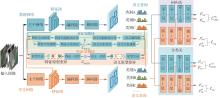
Fig.1
Overall structure of the proposed algorithm

Table 1
Comparison of commonly used distance metrics
| 距离度量 | 原理 | 优势 | 局限性 |
|---|---|---|---|
| 欧氏距离 | 计算2点间直线距离 | 计算简单直观,低维数据能快速衡量向量差异 | 未考虑特征分布,高维空间中数据稀疏,难以反映真实类间差异 |
| 余弦相似度 | 计算向量夹角余弦值,衡量方向相似性 | 对数据尺度不敏感,专注方向差异,适合比较向量方向一致性 | 忽略向量模长,方向相同但模长差异大时易误判 |
| KL散度 | 衡量2个概率分布差异,计算近似分布时损失的信息 | 擅长度量概率分布差异,知识蒸馏中用于学习教师模型分布 | 对分布假设严格,可能丢失特征不确定性和多样性,在复杂场景下的表现较差 |
| 曼哈顿距离 | 计算各维度绝对差值之和(标准坐标系上的轴距总和) | 计算高效、对异常值不敏感,适合网格数据或降低极端值影响的场景 | 未考虑维度相关性,高维复杂数据中难捕捉真实差异,单一维度大差异影响显著 |
| Wasserstein 距离 | 衡量两概率分布的最传输成本,通过最优传输路径计算分布差异 | 考虑特征分布结构,高维处理有效,对分布变化敏感,高斯建模计算高效 | 计算复杂度相对较高,在大规模数据上计算耗时较长 |
Table 2
Comparison results of distance metrics for SIMD dataset in 10+5 incremental scenarios
| Distance metrics | AP/% | AP50/% | AP75/% | APS/% | APM/% | APL/% | Upper Bound/% | AbsGap/% | RelGap/% |
|---|---|---|---|---|---|---|---|---|---|
| 欧氏距离 | 65.3 | 78.2 | 75.1 | 15.6 | 58.9 | 70.8 | 70.2 | 4.9 | 6.9 |
| 余弦相似度 | 56.4 | 68.3 | 64.9 | 4.3 | 49.1 | 61.5 | 61.9 | 5.5 | 8.8 |
| KL散度 | 62.1 | 74.5 | 71.3 | 11.2 | 55.4 | 68.3 | 68.8 | 6.7 | 9.7 |
| 曼哈顿距离 | 58.2 | 71.9 | 68.7 | 8.5 | 52.7 | 65.2 | 64.3 | 6.1 | 9.5 |
| Wasserstein距离 | 69.2 | 80.7 | 77.5 | 20.4 | 61.2 | 72.1 | 72.5 | 3.3 | 4.5 |
Table 3
Comparison results of distance metrics for MAR20 dataset in 12+8 incremental scenarios
| Distance metrics | AP/% | AP50/% | AP75/% | APS/% | APM/% | APL/% | Upper Bound/% | AbsGap/% | RelGap/% |
|---|---|---|---|---|---|---|---|---|---|
| 欧氏距离 | 56.8 | 69.3 | 66.1 | 9.8 | 49.2 | 52.5 | 61.2 | 4.4 | 7.2 |
| 余弦相似度 | 48.1 | 59.7 | 55.4 | 2.3 | 38.5 | 49.1 | 54.6 | 6.5 | 11.9 |
| KL散度 | 53.2 | 65.8 | 62.3 | 6.7 | 45.1 | 51.3 | 58.4 | 5.2 | 8.9 |
| 曼哈顿距离 | 50.4 | 62.1 | 58.9 | 4.1 | 41.3 | 52.7 | 55.3 | 4.9 | 8.8 |
| Wasserstein距离 | 58.3 | 71.8 | 68.2 | 10.2 | 51.4 | 56.1 | 62.5 | 4.2 | 6.7 |
Table 4
Incremental results of SIMD dataset under different incremental scenarios
| Scenarios | Methods | AP/% | AP50/% | AP75/% | APS/% | APM/% | APL/% | Upper Bound/% | AbsGap/% | RelGap/% |
|---|---|---|---|---|---|---|---|---|---|---|
| 8类+7类 | Faster ILOD | 54.2 | 72.4 | 63.2 | 6.7 | 46.3 | 57.3 | 60.3 | 6.1 | 10.1 |
| iOD | 56.8 | 74.1 | 64.4 | 8.2 | 48.5 | 59.7 | 61.1 | 4.3 | 7.1 | |
| ERD | 58.1 | 75.9 | 66.9 | 8.8 | 49.1 | 63.6 | 62.4 | 4.3 | 6.9 | |
| ABR-IOD | 57.7 | 74.5 | 64.9 | 8.4 | 48.9 | 61.4 | 61.6 | 3.9 | 6.3 | |
| ECOD | 61.2 | 78.3 | 71.9 | 10.3 | 49.4 | 68.1 | 63.8 | 2.6 | 4.1 | |
| Efficient-IOD | 66.7 | 79.6 | 77.8 | 19.2 | 59.3 | 70.9 | 69.6 | 2.9 | 4.2 | |
| Ours | 70.8 | 82.4 | 79.4 | 21.2 | 62.3 | 73.3 | 72.5 | 1.7 | 2.3 | |
| 10类+5类 | Faster ILOD | 49.6 | 67.1 | 59.2 | 5.2 | 43.3 | 53.9 | 60.3 | 10.7 | 17.7 |
| iOD | 52.2 | 68.8 | 60.5 | 7.5 | 45.1 | 56.2 | 61.1 | 8.9 | 14.6 | |
| ERD | 54.5 | 70.4 | 62.2 | 8.4 | 46.7 | 59.1 | 62.4 | 7.9 | 12.7 | |
| ABR-IOD | 52.9 | 69.7 | 59.9 | 7.7 | 46.4 | 58.4 | 61.6 | 8.7 | 14.1 | |
| ECOD | 60.7 | 77.4 | 72.2 | 10.1 | 49.8 | 67.3 | 63.8 | 3.1 | 4.9 | |
| Efficient-IOD | 63.7 | 77.6 | 75.6 | 18.3 | 50.6 | 68.1 | 69.6 | 5.9 | 8.5 | |
| Ours | 69.2 | 80.7 | 77.5 | 20.4 | 61.2 | 72.1 | 72.5 | 3.3 | 4.5 | |
| 12类+3类 | Faster ILOD | 46.2 | 64.4 | 56.7 | 4.8 | 41.2 | 51.4 | 60.3 | 14.1 | 23.4 |
| iOD | 48.3 | 65.1 | 57.6 | 6.7 | 43.5 | 54.7 | 61.1 | 12.8 | 20.9 | |
| ERD | 51.8 | 66.7 | 62.1 | 10.6 | 49.5 | 56.4 | 62.4 | 10.6 | 16.9 | |
| ABR-IOD | 50.1 | 66.5 | 57.4 | 7.2 | 44.8 | 57.1 | 61.6 | 11.5 | 18.7 | |
| ECOD | 58.3 | 70.2 | 68.3 | 11.3 | 45.3 | 64.5 | 63.8 | 5.5 | 8.6 | |
| Efficient-IOD | 60.9 | 75.4 | 67.6 | 11.7 | 45.8 | 64.2 | 69.6 | 8.7 | 12.5 | |
| Ours | 67.9 | 80.1 | 76.6 | 19.8 | 60.4 | 70.8 | 72.5 | 4.6 | 6.3 |
Table 5
Incremental results of MAR20 dataset under different incremental scenarios
| Scenarios | 方法 | AP/% | AP50/% | AP75/% | APS/% | APM/% | APL/% | Upper Bound/% | AbsGap/% | RelGap/% |
|---|---|---|---|---|---|---|---|---|---|---|
| 10类+10类 | Faster ILOD | 40.2 | 55.3 | 52.3 | 3.9 | 38.6 | 44.7 | 48.3 | 8.1 | 16.8 |
| iOD | 42.3 | 58.1 | 54.2 | 4.4 | 41.3 | 47.9 | 50.2 | 7.9 | 15.7 | |
| ERD | 46.8 | 62.3 | 56.8 | 14.1 | 43.7 | 50.5 | 54.3 | 7.5 | 13.8 | |
| ABR-IOD | 47.6 | 64.5 | 57.7 | 5.5 | 44.5 | 51.2 | 53.8 | 6.2 | 11.5 | |
| ECOD | 48.9 | 67.2 | 60.8 | 4.8 | 45.8 | 53.4 | 54.5 | 5.6 | 10.3 | |
| Efficient-IOD | 53.7 | 70.8 | 67.4 | 10.6 | 50.9 | 52.3 | 57.2 | 3.5 | 6.1 | |
| Ours | 60.2 | 73.9 | 70.3 | 12.7 | 53.3 | 56.8 | 62.5 | 2.3 | 3.6 | |
| 12类+8类 | Faster ILOD | 38.8 | 53.3 | 51.2 | 3.3 | 37.2 | 42.7 | 48.3 | 9.5 | 19.7 |
| iOD | 40.9 | 56.4 | 53.4 | 4.1 | 40.1 | 45.9 | 50.2 | 9.3 | 18.5 | |
| ERD | 42.2 | 59.8 | 56.3 | 5.2 | 42.3 | 48.9 | 54.3 | 12.1 | 22.2 | |
| ABR-IOD | 44.7 | 61.5 | 53.7 | 3.5 | 41.5 | 49.1 | 53.8 | 9.1 | 17.1 | |
| ECOD | 47.5 | 62.8 | 58.2 | 2.7 | 44.8 | 51.5 | 54.5 | 7.0 | 12.8 | |
| Efficient-IOD | 50.7 | 69.4 | 63.4 | 5.6 | 46.6 | 55.9 | 57.2 | 6.5 | 11.4 | |
| Ours | 58.3 | 71.8 | 68.2 | 10.2 | 51.4 | 56.1 | 62.5 | 4.2 | 6.7 | |
| 15类+5类 | Faster ILOD | 36.4 | 52.1 | 49.2 | 2.6 | 36.3 | 41.9 | 48.3 | 11.9 | 24.6 |
| iOD | 39.3 | 55.7 | 52.4 | 3.8 | 39.4 | 45.1 | 50.2 | 10.9 | 21.7 | |
| ERD | 40.7 | 56.4 | 54.8 | 4.9 | 41.7 | 48.3 | 54.3 | 13.6 | 33.4 | |
| ABR-IOD | 41.1 | 57.5 | 49.2 | 4.1 | 40.2 | 48.7 | 53.8 | 12.7 | 23.6 | |
| ECOD | 46.3 | 62.2 | 56.1 | 2.8 | 44.6 | 52.5 | 54.5 | 8.2 | 15.1 | |
| Efficient-IOD | 49.3 | 65.9 | 60.4 | 4.6 | 42.9 | 53.7 | 57.2 | 7.9 | 13.8 | |
| Ours | 57.7 | 70.6 | 67.5 | 9.8 | 50.2 | 55.3 | 62.5 | 4.8 | 7.6 |
Fig.2
Results of different algorithms on the SIMD dataset
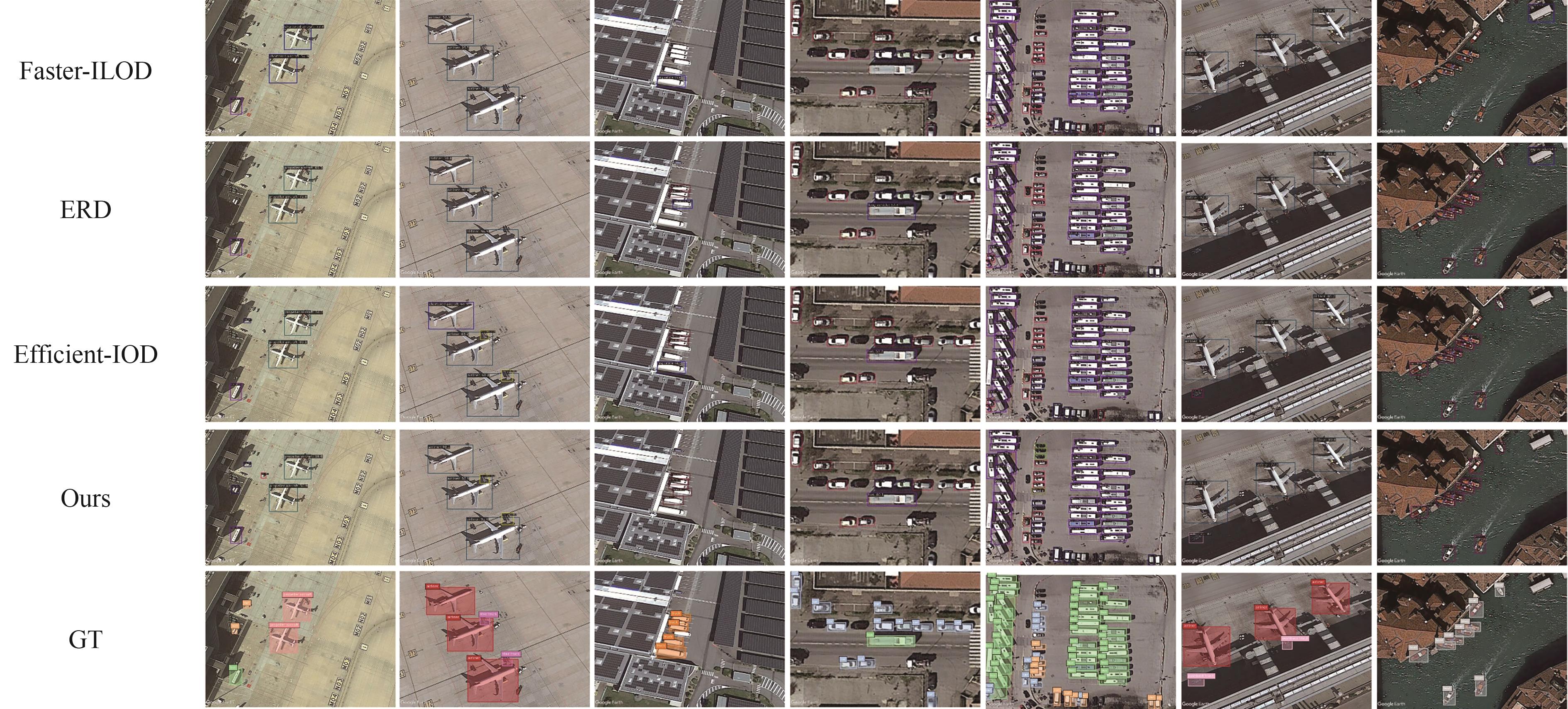
Fig.3
Results of different algorithms on MAR20 dataset
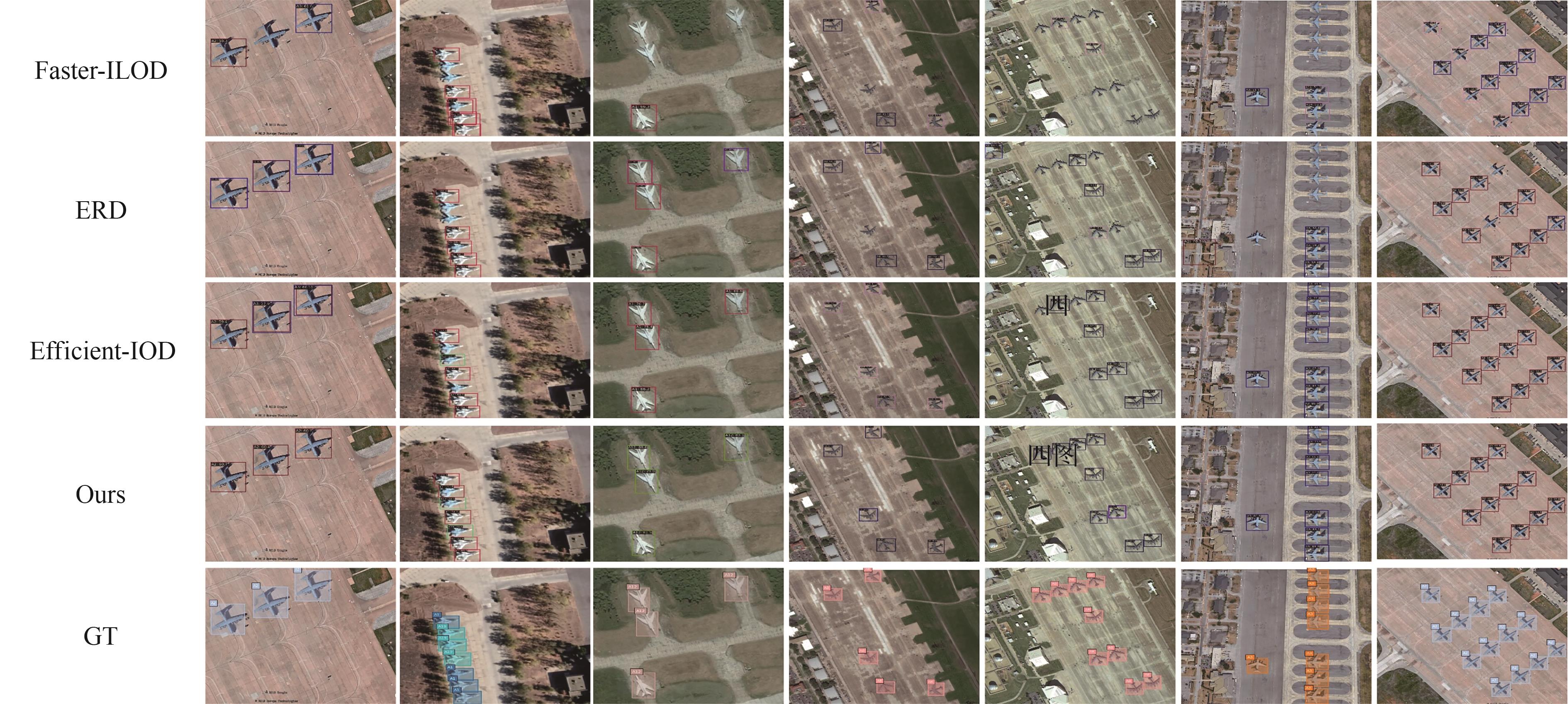
Table 6
Incremental results of SIMD under 7+4+4 incremental scenario
| 方法 | Step1 | Step2 | ||||
|---|---|---|---|---|---|---|
| AP/% | AP50/% | RelGap/% | AP/% | AP50/% | RelGap/% | |
| Faster ILOD | 54.4 | 72.6 | 9.7 | 51.2 | 68.8 | 15.1 |
| iOD | 56.1 | 74.3 | 8.2 | 52.6 | 70.3 | 13.9 |
| ERD | 59.2 | 76.4 | 5.1 | 55.1 | 72.4 | 11.7 |
| ABR-IOD | 58.7 | 75.5 | 4.7 | 53.6 | 70.9 | 12.9 |
| ECOD | 61.9 | 79.1 | 3.1 | 58.9 | 77.8 | 7.6 |
| Efficient-IOD | 67.4 | 80.2 | 3.2 | 65.4 | 78.2 | 6.1 |
| Ours | 71.5 | 83.8 | 1.3 | 69.3 | 80.6 | 4.4 |
Table 7
Incremental results of MAR20 under 10+5+5 incremental scenario
| 方法 | Step1 | Step2 | ||||
|---|---|---|---|---|---|---|
| AP/% | AP50/% | RelGap/% | AP/% | AP50/% | RelGap/% | |
| Faster ILOD | 42.7 | 58.2 | 11.6 | 40.4 | 55.6 | 16.3 |
| iOD | 44.3 | 60.4 | 11.8 | 41.8 | 58.4 | 16.7 |
| ERD | 49.2 | 63.9 | 9.4 | 45.9 | 61.6 | 15.4 |
| ABR-IOD | 48.6 | 62.3 | 9.7 | 45.3 | 59.2 | 15.7 |
| ECOD | 50.4 | 66.8 | 7.5 | 47.2 | 63.7 | 13.3 |
| Efficient-IOD | 54.7 | 70.1 | 4.3 | 52.5 | 66.4 | 8.3 |
| Ours | 61.2 | 74.8 | 2.1 | 59.3 | 72.7 | 5.1 |
Table 8
Ablation results of SIMD dataset under 6+3+3+3 incremental scenario
| WICD | PGICD | CAD | Step1 | Step2 | Step3 | |||||||||
|---|---|---|---|---|---|---|---|---|---|---|---|---|---|---|
| AP/% | AP50/% | AP75/% | RelGap/% | AP/% | AP50/% | AP75/% | RelGap/% | AP/% | AP50/% | AP75/% | RelGap/% | |||
| 61.3 | 71.2 | 69.6 | 15.4 | 58.4 | 69.4 | 67.3 | 22.5 | 56.2 | 66.7 | 64.5 | 26.1 | |||
| ✓ | 66.1 | 75.5 | 73.8 | 8.8 | 63.6 | 74.1 | 71.8 | 12.2 | 61.6 | 71.3 | 69.8 | 15.0 | ||
| ✓ | ✓ | 69.2 | 79.8 | 75.6 | 4.6 | 66.5 | 75.9 | 72.3 | 8.3 | 64.8 | 74.2 | 71.1 | 10.6 | |
| ✓ | ✓ | 69.5 | 80.6 | 77.3 | 4.1 | 66.9 | 76.6 | 75.5 | 7.7 | 65.3 | 75.2 | 73.5 | 9.9 | |
| ✓ | ✓ | 70.2 | 82.1 | 78.3 | 3.1 | 67.8 | 79.2 | 76.1 | 6.5 | 67.1 | 77.2 | 74.1 | 7.4 | |
| ✓ | ✓ | ✓ | 71.8 | 84.9 | 79.6 | 1.0 | 69.7 | 81.3 | 77.9 | 3.9 | 68.9 | 80.2 | 76.5 | 4.9 |
Table 9
Ablation results of MAR20 dataset under 5+5+5+5 incremental scenario
| WICD | PGICD | CAD | Step1 | Step2 | Step3 | |||||||||
|---|---|---|---|---|---|---|---|---|---|---|---|---|---|---|
| AP/% | AP50/% | AP75/% | RelGap/% | AP/% | AP50/% | AP75/% | RelGap/% | AP/% | AP50/% | AP75/% | RelGap/% | |||
| 47.2 | 65.4 | 60.8 | 24.4 | 43.3 | 60.4 | 57.8 | 30.1 | 40.2 | 55.3 | 54.4 | 35.7 | |||
| ✓ | 50..5 | 69.2 | 64.3 | 19.2 | 48.8 | 66.7 | 61.6 | 21.9 | 46.7 | 62.8 | 59.6 | 25.3 | ||
| ✓ | ✓ | 55.3 | 70.8 | 66.2 | 11.5 | 54.7 | 68.3 | 64.5 | 12.5 | 52.8 | 65.1 | 63.2 | 15.5 | |
| ✓ | ✓ | 56.1 | 72.4 | 67.4 | 10.2 | 55.3 | 69.4 | 65.2 | 11.5 | 53.7 | 67.2 | 64.3 | 14.1 | |
| ✓ | ✓ | 56.9 | 73.5 | 67.9 | 8.9 | 55.5 | 70.2 | 67.2 | 11.2 | 54.3 | 68.1 | 66.1 | 13.1 | |
| ✓ | ✓ | ✓ | 60.9 | 77.2 | 71.8 | 2.6 | 59.1 | 75.2 | 70.1 | 5.4 | 58.3 | 72.8 | 69.3 | 6.7 |

Fig.4
Results of SIMD dataset after adding different modules


Fig.5
Results of MAR20 dataset after adding different modules

| [1] | ZHANG X R, ZHANG T Y, WANG G C, et al. Remote sensing object detection meets deep learning: A metareview of challenges and advances[J]. IEEE Geoscience and Remote Sensing Magazine, 2023, 11(4): 8-44. |
| [2] | 赵其昌, 吴一全, 苑玉彬. 光学遥感图像舰船目标检测与识别方法研究进展[J]. 航空学报, 2024, 45(8): 029025. |
| ZHAO Q C, WU Y Q, YUAN Y B. Progress of ship detection and recognition methods in optical remote sensing images[J]. Acta Aeronautica et Astronautica Sinica, 2024, 45(8): 029025 (in Chinese). | |
| [3] | 刘延芳, 佘佳宇, 袁秋帆, 等. 无人机遥感图像实时小目标检测方法[J]. 航空学报, 2024, 45(14): 630119. |
| LIU Y F, SHE J Y, YUAN Q F, et al. Real-time small target detection networks for UAV remote sensing[J]. Acta Aeronautica et Astronautica Sinica, 2024, 45(14): 630119 (in Chinese). | |
| [4] | 肖欣林, 施伟超, 郑向涛, 等. 基于多模型协同的舰船目标检测[J]. 航空学报, 2024, 45(14): 630241. |
| XIAO X L, SHI W C, ZHENG X T, et al. Multiple models collaboration for ship detection[J]. Acta Aeronautica et Astronautica Sinica, 2024, 45(14): 630241 (in Chinese). | |
| [5] | LI Z, WANG Y C, ZHANG N, et al. Deep learning-based object detection techniques for remote sensing images: A survey[J]. Remote Sensing, 2022, 14(10): 2385. |
| [6] | ZHOU D W, WANG Q W, QI Z H, et al. Class-incremental learning: A survey[J]. IEEE Transactions on Pattern Analysis and Machine Intelligence, 2024, 46(12): 9851-9873. |
| [7] | MASANA M, LIU X L, TWARDOWSKI B, et al. Class-incremental learning: Survey and performance evaluation on image classification[J]. IEEE Transactions on Pattern Analysis and Machine Intelligence, 2023, 45(5): 5513-5533. |
| [8] | MA B T, CONG Y, REN Y. IOSL: Incremental open set learning[J]. IEEE Transactions on Circuits and Systems for Video Technology, 2024, 34(4): 2235-2248. |
| [9] | KANG M X, ZHANG J P, ZHANG J M, et al. Alleviating catastrophic forgetting of incremental object detection via within-class and between-class knowledge distillation[C]∥ 2023 IEEE/CVF International Conference on Computer Vision (ICCV). Piscataway: IEEE Press, 2023: 18848-18858. |
| [10] | 方维维, 陈爱方, 孟娜, 等. 基于知识蒸馏的目标检测模型增量深度学习方法[J]. 工程科学与技术, 2022, 54(6): 59-66. |
| FANG W W, CHEN A F, MENG N, et al. Incremental deep learning method for object detection model based on knowledge distillation[J]. Advanced Engineering Sciences, 2022, 54(6): 59-66 (in Chinese). | |
| [11] | KIM J, CHO H, KIM J, et al. SDDGR: Stable diffusion-based deep generative replay for class incremental object detection[C]∥ 2024 IEEE/CVF Conference on Computer Vision and Pattern Recognition (CVPR). Piscataway: IEEE Press, 2024: 28772-28781. |
| [12] | KIM J, KU Y, KIM J, et al. VLM-PL: Advanced pseudo labeling approach for class incremental object detection via vision-language model[C]∥ 2024 IEEE/CVF Conference on Computer Vision and Pattern Recognition Workshops (CVPRW). Piscataway: IEEE Press, 2024: 4170-4181. |
| [13] | PENG C, ZHAO K, LOVELL B C. Faster ILOD: Incremental learning for object detectors based on faster RCNN[J]. Pattern Recognition Letters, 2020, 140: 109-115. |
| [14] | FENG T, WANG M, YUAN H J. Overcoming catastrophic forgetting in incremental object detection via elastic response distillation[C]∥ 2022 IEEE/CVF Conference on Computer Vision and Pattern Recognition (CVPR). Piscataway: IEEE Press, 2022: 9417-9426. |
| [15] | LIU Y Y, CONG Y, GOSWAMI D, et al. Augmented box replay: Overcoming foreground shift for incremental object detection[C]∥ 2023 IEEE/CVF International Conference on Computer Vision (ICCV). Piscataway: IEEE Press, 2023: 11333-11343. |
| [16] | LIU Y Y, SCHIELE B, VEDALDI A, et al. Continual detection transformer for incremental object detection[C]∥ 2023 IEEE/CVF Conference on Computer Vision and Pattern Recognition (CVPR). Piscataway: IEEE Press, 2023: 23799-23808. |
| [17] | LI W Z, ZHOU J W, LI X, et al. InfRS: Incremental few-shot object detection in remote sensing images[J]. IEEE Transactions on Geoscience and Remote Sensing, 2024, 62: 5644314. |
| [18] | 张涛, 杨小冈, 卢孝强, 等. Dense RFB和LSTM遥感图像舰船目标检测[J]. 遥感学报, 2022, 26(9): 1859-1871. |
| ZHANG T, YANG X G, LU X Q, et al. Ship detection in remote sensing image based on dense RFB and LSTM[J]. National Remote Sensing Bulletin, 2022, 26(9): 1859-1871 (in Chinese). | |
| [19] | JOSEPH K J, RAJASEGARAN J, KHAN S, et al. Incremental object detection via meta-learning[J]. IEEE Transactions on Pattern Analysis and Machine Intelligence, 2022, 44(12): 9209-9216. |
| [20] | BAI L, SONG H, FENG T, et al. Revisiting class-incremental object detection: An efficient approach via intrinsic characteristics alignment and task decoupling[J]. Expert Systems with Applications, 2024, 257: 125057. |
| [21] | MO Q J, GAO Y P, FU S H, et al. Bridge past and future: Overcoming information asymmetry in incremental object detection[C]∥ Computer Vision-ECCV 2024. Cham: Springer Nature Switzerland, 2024: 463-480. |
| [22] | LU X N, DIAO W H, LI J X, et al. Few-shot incremental object detection in aerial imagery via dual-frequency prompt[J]. IEEE Transactions on Geoscience and Remote Sensing, 2024, 62: 5624017. |
| [23] | YU Q Z, ZHU K, WANG W, et al. Incremental object detection with image-level labels[J]. IEEE Transactions on Artificial Intelligence, 2024, 5(5): 2331-2341. |
| [24] | DONG N, ZHANG Y Q, DING M L, et al. Incremental-DETR: Incremental few-shot object detection via self-supervised learning[J].Proceedings of the AAAI Conference on Artificial Intelligence, 2023, 37(1): 543-551. |
| [25] | LI J Y, CAO Z J, GAN Q, et al. Class-incremental SAR obeject detection via adaptive distributed response distillation[C]∥ IGARSS 2024-2024 IEEE International Geoscience and Remote Sensing Symposium. Piscataway: IEEE Press, 2024: 9922-9925. |
| [26] | DONG N, ZHANG Y, DING M, et al. Bridging non-co-occurrence with unlabeled in-the-wild data for incremental object detection[C]∥ Proceedings of the 35th International Conference on Neural Information Processing Systems, New York:ACM, 2021:30492-30503. |
| [27] | LI D, TASCI S, GHOSH S, et al. RILOD: Near real-time incremental learning for object detection at the edge[C]∥ Proceedings of the 4th ACM/IEEE Symposium on Edge Computing. New York:ACM, 2019: 113-126. |
| [28] | CERMELLI F, GERACI A, FONTANEL D, et al. Modeling missing annotations for incremental learning in object detection[C]∥ 2022 IEEE/CVF Conference on Computer Vision and Pattern Recognition Workshops (CVPRW). Piscataway: IEEE Press, 2022: 3699-3709. |
| [29] | WANG Y J, CHEN L Q, ZHAO T M, et al. High-dimension prototype is a better incremental object detection learner[C]∥ The Thirteenth International Conference on Learning Representations, 2025: 1-17. |
| [30] | WANG J B, CHEN Y M, ZHENG Z H, et al. CrossKD: Cross-head knowledge distillation for object detection[C]∥ 2024 IEEE/CVF Conference on Computer Vision and Pattern Recognition (CVPR). Piscataway: IEEE Press, 2024: 16520-16530. |
| [31] | HAROON M, SHAHZAD M, FRAZ M M. Multisized object detection using spaceborne optical imagery[J]. IEEE Journal of Selected Topics in Applied Earth Observations and Remote Sensing, 2020, 13: 3032-3046. |
| [32] | 禹文奇,程塨,王美君,等.MAR20:遥感图像军用飞机目标识别数据集[J].遥感学报,2023,27(12):2688-2696. |
| YU W Q, CHENG G, WANG M J, et al. MAR20: A benchmark for military aircraft recognition in remote sensing images[J]. National Remote Sensing Bulletin, 2023, 27(12): 2688-2696 (in Chinese). | |
| [33] | LIU L Y, KUANG Z H, CHEN Y M, et al. IncDet: In defense of elastic weight consolidation for incremental object detection[J]. IEEE Transactions on Neural Networks and Learning Systems, 2021, 32(6): 2306-2319. |
| [34] | MENEZES A G, DE MOURA G, ALVES C, et al. Continual object detection: A review of definitions, strategies, and challenges[J]. Neural Networks, 2023, 161: 476-493. |
| [1] | Runmin CONG, Haoyan SUN, Yuxuan LUO, Hao FANG. Generalized few-shot segmentation for remote sensing image based on class relation mining [J]. Acta Aeronautica et Astronautica Sinica, 2025, 46(23): 631694-631694. |
| Viewed | ||||||
|
Full text |
|
|||||
|
Abstract |
|
|||||
Address: No.238, Baiyan Buiding, Beisihuan Zhonglu Road, Haidian District, Beijing, China
Postal code : 100083
E-mail:hkxb@buaa.edu.cn
Total visits: 6658907 Today visits: 1341All copyright © editorial office of Chinese Journal of Aeronautics
All copyright © editorial office of Chinese Journal of Aeronautics
Total visits: 6658907 Today visits: 1341

 CJA
CJA
