Acta Aeronautica et Astronautica Sinica ›› 2025, Vol. 46 ›› Issue (13): 531773.doi: 10.7527/S1000-6893.2025.31773
• Articles • Previous Articles
Xiaohua HAN1, Wei HAN1, Shimeng LU1, Na LI2, Fang GUO1, Bing WAN1, Xichao SU1( )
)
Received:2025-01-06
Revised:2025-03-27
Accepted:2025-04-29
Online:2025-05-12
Published:2025-05-08
Contact:
Xichao SU
E-mail:suxich@126.com
CLC Number:
Xiaohua HAN, Wei HAN, Shimeng LU, Na LI, Fang GUO, Bing WAN, Xichao SU. Mission planning for ship-helicopter group wave launch and recovery oriented to mission time windows[J]. Acta Aeronautica et Astronautica Sinica, 2025, 46(13): 531773.

Fig.1
Two-wave centralized operation of single-shift group aircraft


Fig.2
Four-wave continuous operation of two-shift group aircraft

Fig.3
Four-wave flexible operation of three-shift group aircraft
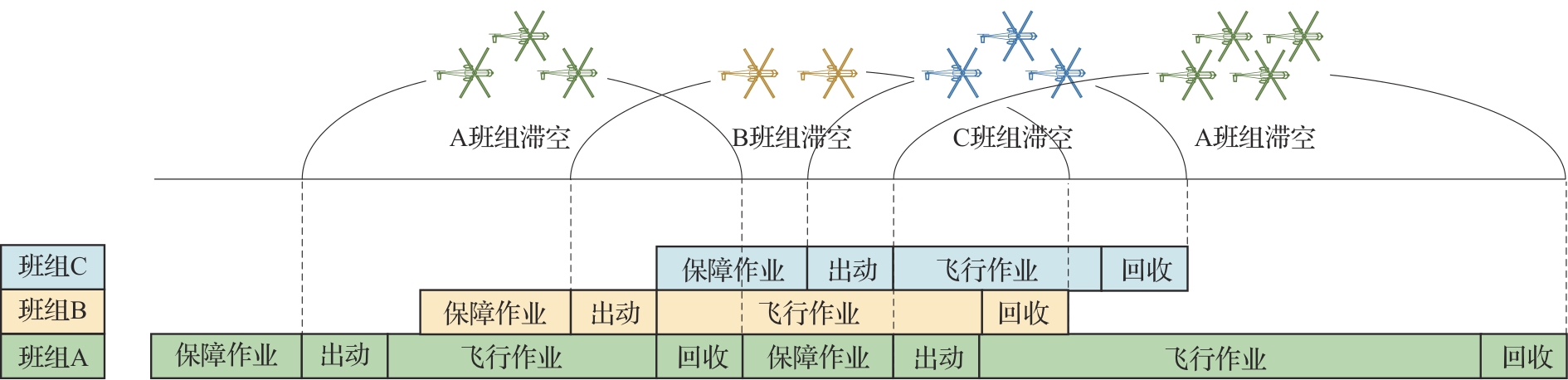
Fig.4
Amphibious ship deck operation process
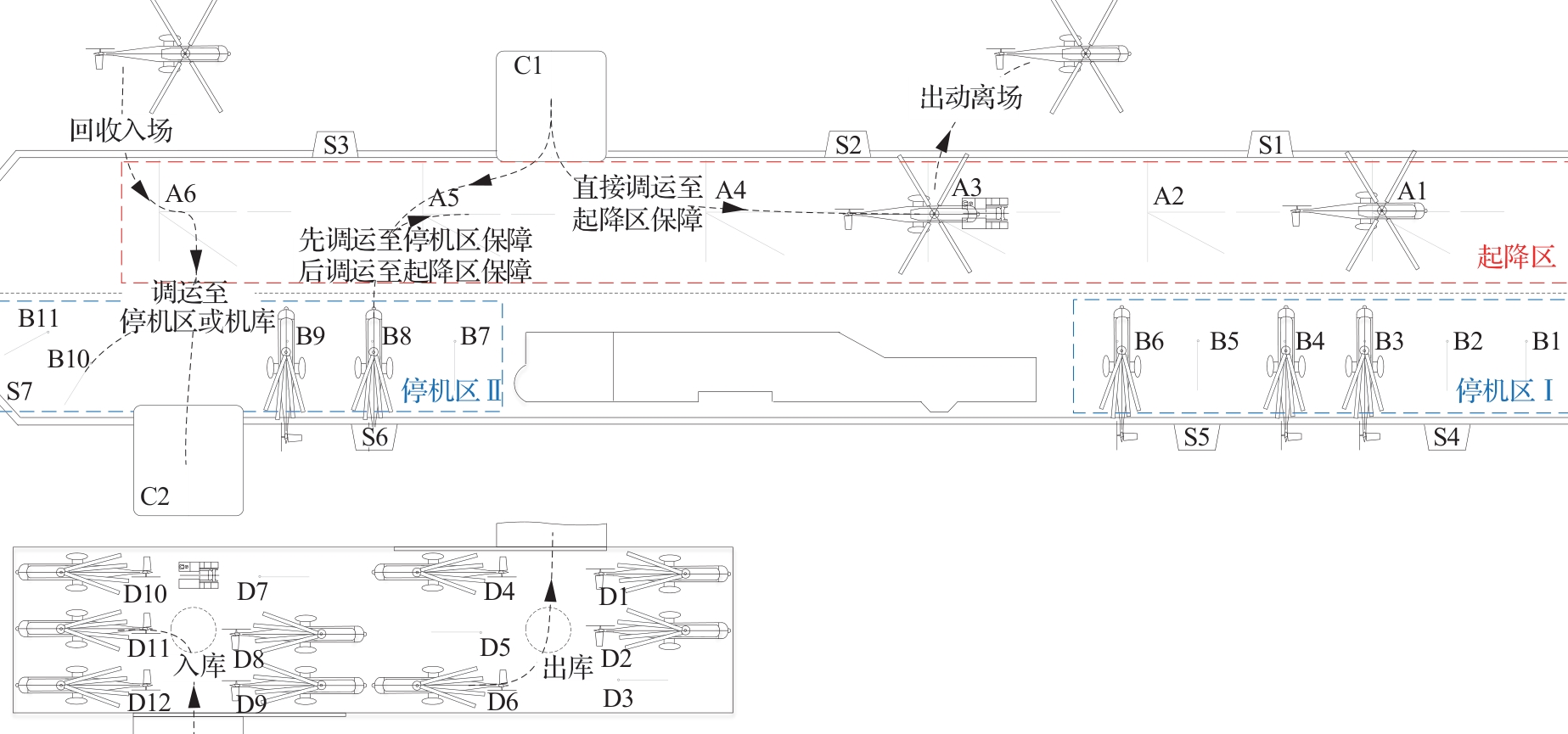
Fig.5
Initial position of aircrafts
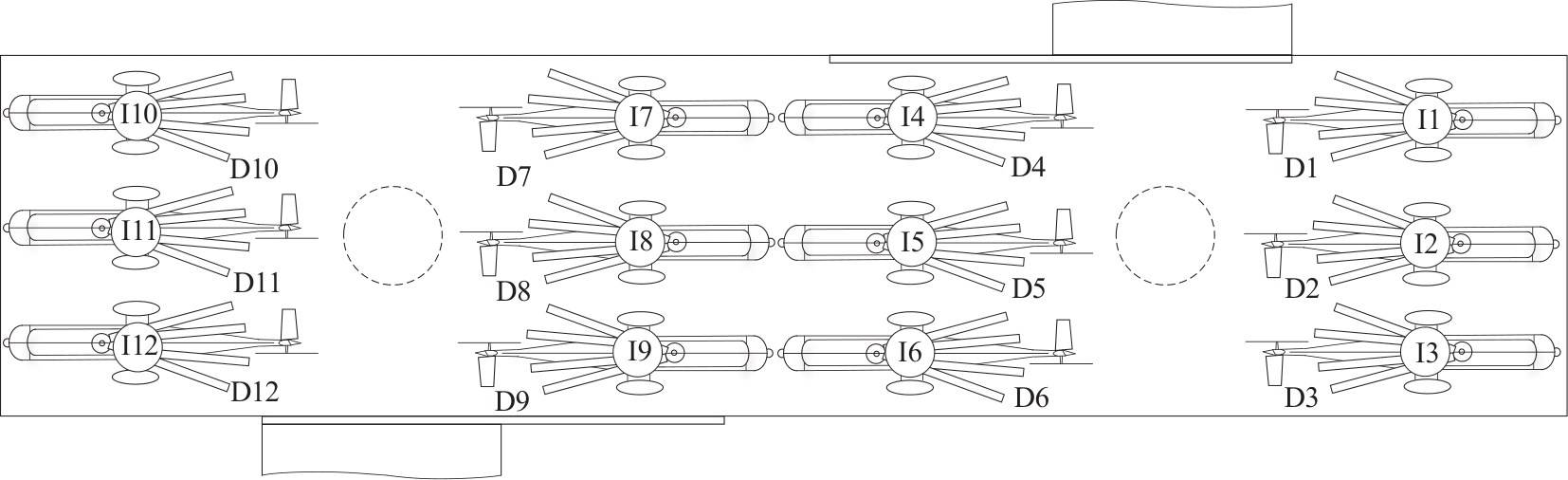
Table 1
Support process information
| 工序号 | 工期/min | 设备 | 专业 | 紧后工序号 |
|---|---|---|---|---|
| 1 | 0 | 3~5,9,13,11 | ||
| 2 | 10 | 机械 | 15 | |
| 3 | 6 | 机械 | 15 | |
| 4 | 5 | 供电站 | 特设/机械 | 2,6~8,10,12 |
| 5 | 6 | 航电 | 15 | |
| 6 | 9 | 供电站 | 航电 | 15 |
| 7 | 9 | 供电站 | 特设/航电 | 15 |
| 8 | 7 | 特设 | 15 | |
| 9 | 6 | 特设 | 15 | |
| 10 | 8 | 供电站 | 特设 | 15 |
| 11 | 4/7 | 加油站 | 机械 | 14 |
| 12 | 6 | 航电 | 15 | |
| 13 | 4 | 军械 | 15 | |
| 14 | 10/0 | 军械 | 6,7,10,12 | |
| 15 | 0 |
Table 2
Task case information
| 任务样式 | 波次编号 | 任务最早开始时间/min | 任务最晚开始时间/min | 任务执行时间 | 编组 |
|---|---|---|---|---|---|
| 集中作业 | 1 | 50 | 100 | 65 | I1~I12 |
| 2 | 200 | 240 | 50 | I1~I12 | |
| 连续作业 | 1 | 50 | 70 | 63 | I1~I6 |
| 2 | 100 | 115 | 70 | I7~I12 | |
| 3 | 165 | 170 | 60 | I1~I6 | |
| 4 | 220 | 230 | 50 | I7~I12 | |
| 灵活作业 | 1 | 47 | 55 | 55 | I1~I3 |
| 2 | 70 | 82 | 48 | I4~I7 | |
| 3 | 93 | 100 | 52 | I8~I12 | |
| 4 | 150 | 190 | 40 | I1~I6 |
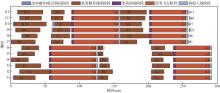
Fig.6
Gantt chart for centralized operation cases
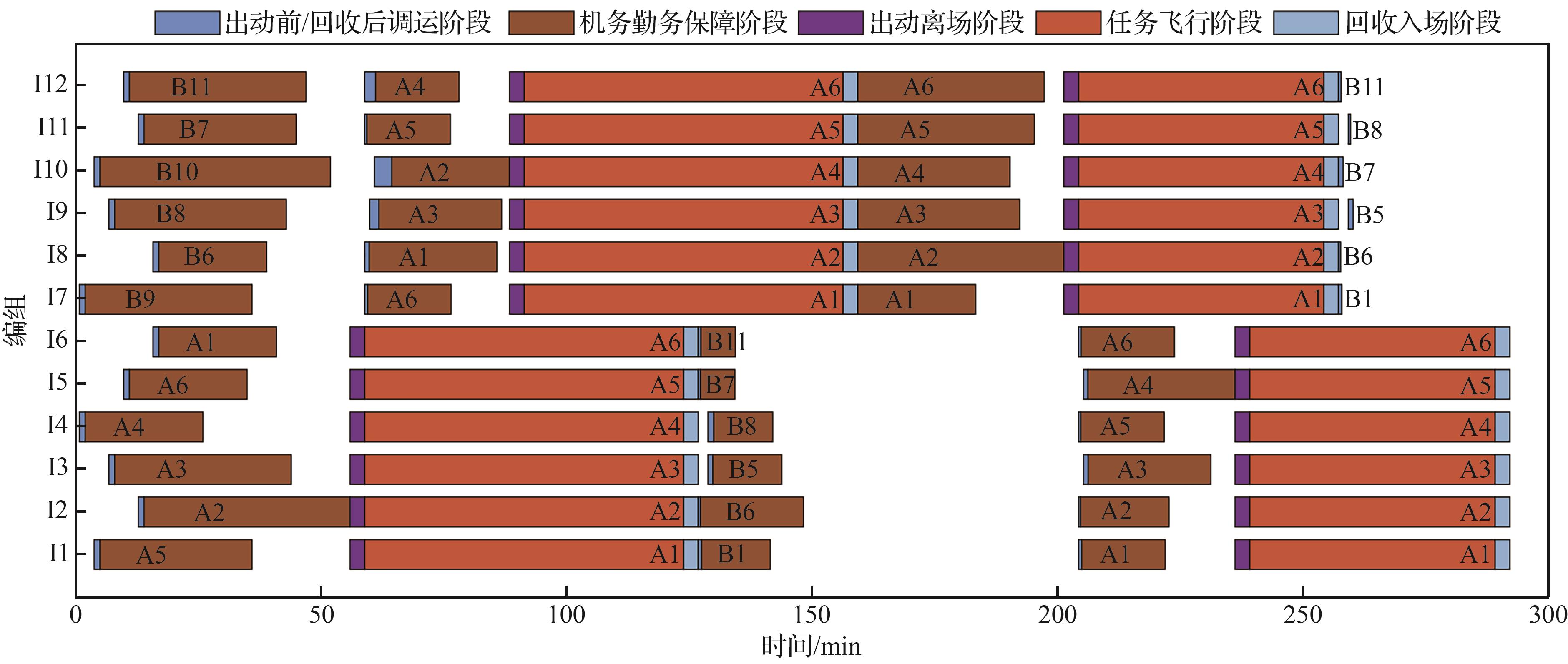
Fig.7
Gantt chart for continuous operation cases
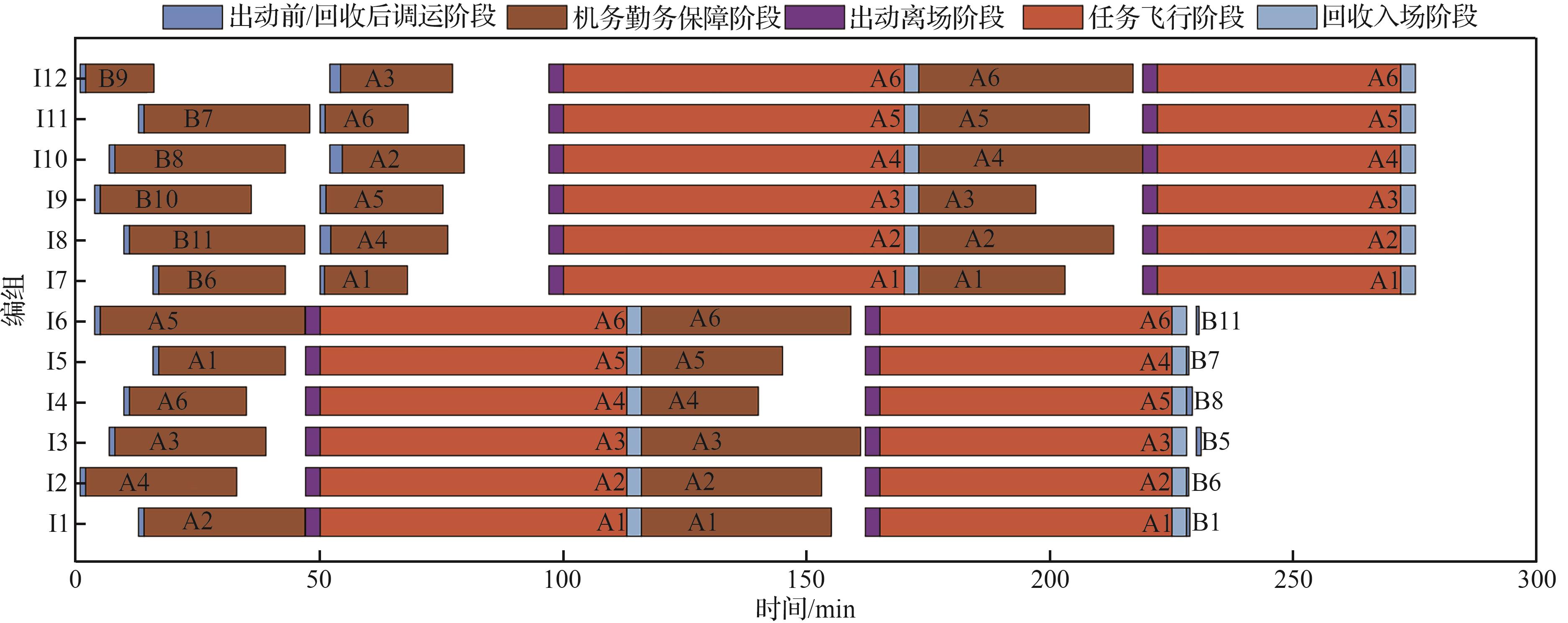
Fig.8
Gantt chart for flexible operation cases
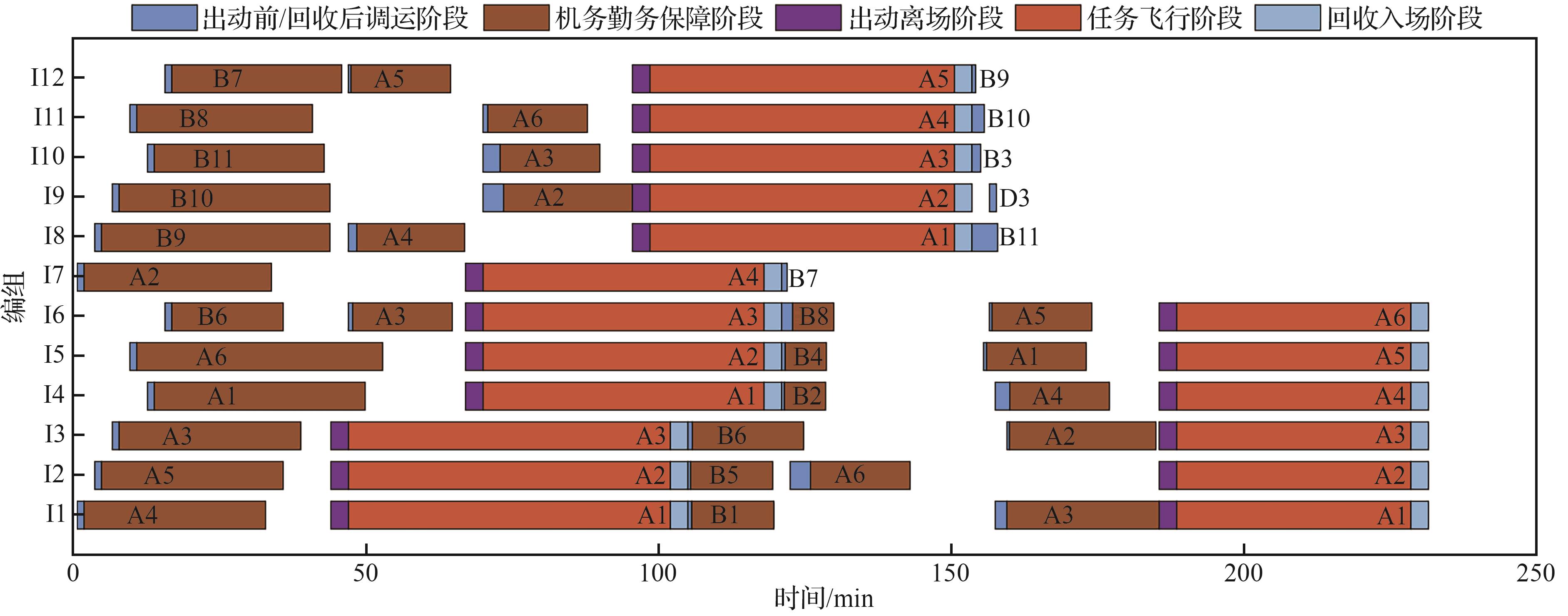
Fig.9
Gantt chart for personnel scheduling
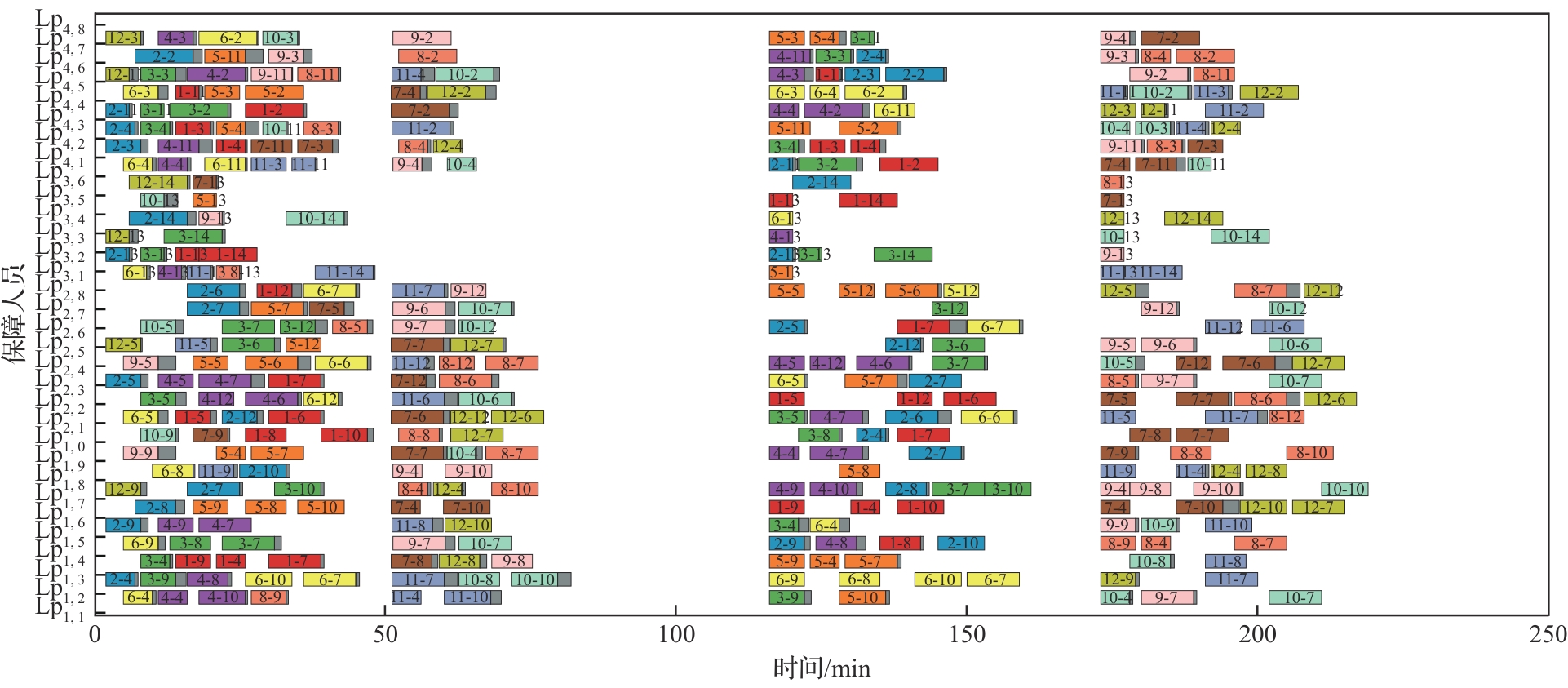
Fig.10
Gantt chart for support equipment scheduling
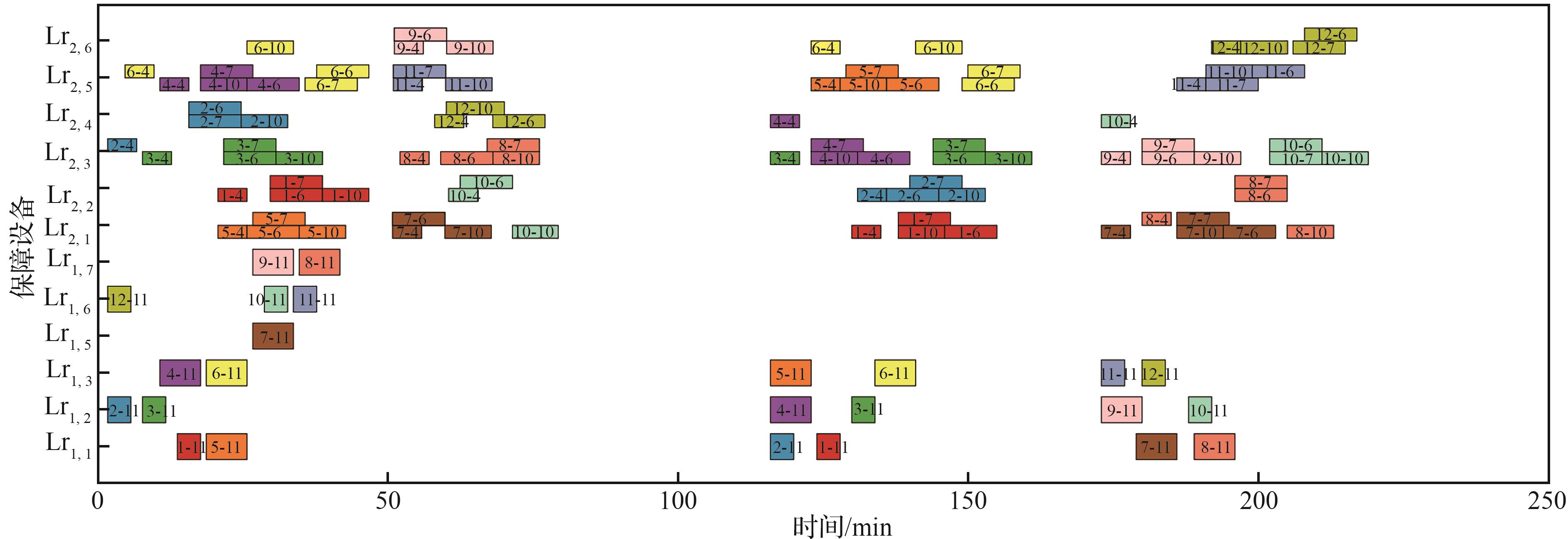
Table 3
Algorithm comparison
| 算法 | 指标 | 集中作业 | 连续作业 | 灵活作业 |
|---|---|---|---|---|
| HEMCPSO | Best. | 0.411 6 | 0.353 2 | 0.393 1 |
| Ave. | 0.412 3 | 0.357 6 | 0.394 9 | |
| Std. | 0.001 1 | 0.001 4 | 0.001 3 | |
| IPSO | Best. | 0.411 2 | 0.357 4 | 0.393 1 |
| Ave. | 0.413 3 | 0.365 6 | 0.395 2 | |
| Std. | 0.001 2 | 0.001 3 | 0.001 2 | |
| CSO | Best. | 0.410 8 | 0.353 7 | 0.392 9 |
| Ave. | 0.414 6 | 0.360 4 | 0.395 9 | |
| Std. | 0.001 6 | 0.002 1 | 0.001 8 | |
| DPMOGA | Best. | 0.411 7 | 0.362 8 | 0.393 2 |
| Ave. | 0.417 3 | 0.365 5 | 0.396 3 | |
| Std. | 0.001 5 | 0.001 4 | 0.001 4 | |
| G-NSA | Best. | 0.410 5 | 0.356 8 | 0.392 4 |
| Ave. | 0.414 9 | 0.358 5 | 0.395 9 | |
| Std. | 0.001 3 | 0.001 3 | 0.001 6 | |
| DPFGSA | Best. | 0.415 3 | 0.365 6 | 0.393 4 |
| Ave. | 0.416 6 | 0.366 8 | 0.396 1 | |
| Std. | 0.001 2 | 0.001 4 | 0.001 4 |
Fig.11
Algorithm convergence curves
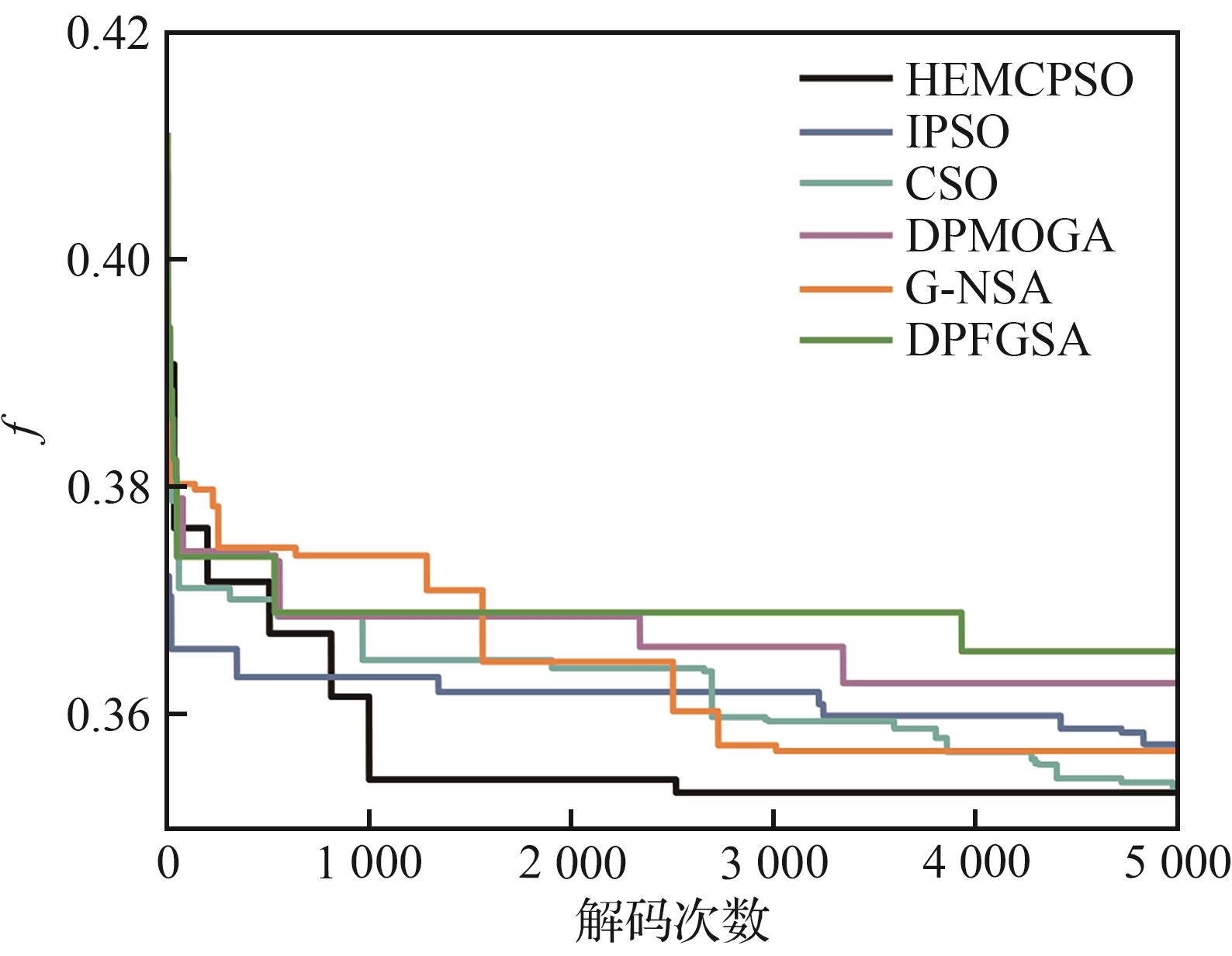
Table 4
Experimental result
| 任务编组数量 | 编组内直升机数量 | 波次数量 | 算法单次求解时间/s | 编组平均甲板作业时间/min | 编组最短任务飞行时间/min |
|---|---|---|---|---|---|
| 2 | 4 | 3 | 0.65 | 40.5 | 45.4 |
| 2 | 4 | 4 | 0.69 | 38.7 | 46.0 |
| 2 | 4 | 5 | 0.73 | 37.7 | 46.2 |
| 2 | 4 | 6 | 0.81 | 37.1 | 46.7 |
| 2 | 5 | 3 | 0.82 | 41.8 | 45.2 |
| 2 | 5 | 4 | 0.98 | 40.4 | 46.0 |
| 2 | 5 | 5 | 1.13 | 39.2 | 46.6 |
| 2 | 6 | 3 | 0.96 | 45.6 | 56.2 |
| 2 | 6 | 4 | 1.15 | 43.7 | 56.3 |
| 3 | 4 | 4 | 0.85 | 54.8 | 28.6 |
| 3 | 4 | 5 | 1.01 | 54.3 | 29.2 |
| 3 | 4 | 6 | 1.17 | 53.4 | 30.2 |
| 3 | 5 | 4 | 1.01 | 61.3 | 35.7 |
| 3 | 5 | 5 | 1.20 | 60.9 | 37.2 |
| 3 | 6 | 4 | 1.22 | 68.2 | 39.3 |
| 4 | 4 | 5 | 1.14 | 77.3 | 35.6 |
| 4 | 4 | 6 | 1.21 | 76.9 | 36.7 |
| 4 | 5 | 5 | 1.24 | 71.9 | 40.2 |
| [1] | RYAN J C, CUMMINGS M L. A systems analysis of the introduction of unmanned aircraft into aircraft carrier operations[J]. IEEE Transactions on Human-Machine Systems, 2016, 46(2): 209-220. |
| [2] | 冯强, 曾声奎, 康锐. 基于MAS的舰载机动态调度模型[J]. 航空学报, 2009, 30(11): 2119-2125. |
| FENG Q, ZENG S K, KANG R. A MAS-based model for dynamic scheduling of carrier aircraft[J]. Acta Aeronautica et Astronautica Sinica, 2009, 30(11): 2119-2125 (in Chinese). | |
| [3] | 杨放青, 王超, 姜滨, 等. 舰载机出动回收调度策略生成方法[J]. 北京理工大学学报, 2018, 38(10): 1030-1036. |
| YANG F Q, WANG C, JIANG B, et al. A method of policy automated generation for carrier aircraft sortie and recovery scheduling[J]. Transactions of Beijing Institute of Technology, 2018, 38(10): 1030-1036 (in Chinese). | |
| [4] | 李耀宇, 朱一凡, 杨峰, 等. 基于逆向强化学习的舰载机甲板调度优化方案生成方法[J]. 国防科技大学学报, 2013, 35(4): 171-175. |
| LI Y Y, ZHU Y F, YANG F, et al. Inverse reinforcement learning based optimal schedule generation approach for carrier aircraft on flight deck[J]. Journal of National University of Defense Technology, 2013, 35(4): 171-175 (in Chinese). | |
| [5] | MICHINI B, HOW J. A human-interactive course of action planner for aircraft carrier deck operations[C]∥Infotech@Aerospace 2011. Reston: AIAA, 2011. |
| [6] | 邵莹惠. 航母甲板舰载机出动回收作业任务规划方法研究[D]. 武汉: 华中科技大学, 2019. |
| SHAO Y H. Research on mission planning method of carrier aircraft recovery operation on aircraft carrier deck[D]. Wuhan: Huazhong University of Science and Technology, 2019 (in Chinese). | |
| [7] | 罗文达. 航母甲板任务规划方法研究[D]. 武汉: 华中科技大学, 2017. |
| LUO W D. Research on mission planning method of aircraft carrier deck[D]. Wuhan: Huazhong University of Science and Technology, 2017 (in Chinese). | |
| [8] | QI C, WANG D. Dynamic aircraft carrier flight deck task planning based on HTN[J]. IFAC-PapersOnLine, 2016, 49(12): 1608-1613. |
| [9] | 卞大鹏, 代丽红, 李晶晶, 等. 基于层次任务网络的舰载机任务规划[J]. 中国舰船研究, 2016, 11(5): 35-41. |
| BIAN D P, DAI L H, LI J J, et al. Hierarchical task network-based carrier aircraft task planning[J]. Chinese Journal of Ship Research, 2016, 11(5): 35-41 (in Chinese). | |
| [10] | 张豪, 郑茂, 初秀民, 等. 舰载机高强度作业流程仿真研究[J]. 舰船科学技术, 2019, 41(11): 147-153. |
| ZHANG H, ZHENG M, CHU X M, et al. Carrier-based aircraft surge operation simulation based on linear index policies[J]. Ship Science and Technology, 2019, 41(11): 147-153 (in Chinese). | |
| [11] | 张洪涛, 崔珊珊, 刘广, 等. 机群保障资源配置建模与优化研究[J]. 系统工程理论与实践, 2015, 35(4): 1019-1026. |
| ZHANG H T, CUI S S, LIU G, et al. Resource scheduling for air fleet operations[J]. Systems Engineering-Theory & Practice, 2015, 35(4): 1019-1026 (in Chinese). | |
| [12] | RYAN J C, BANERJEE A G, CUMMINGS M L, et al. Comparing the performance of expert user heuristics and an integer linear program in aircraft carrier deck operations[J]. IEEE Transactions on Cybernetics, 2014, 44(6): 761-773. |
| [13] | DASTIDAR R G, FRAZZOLI E. A queueing network based approach to distributed aircraft carrier deck scheduling[C]∥Infotech@Aerospace 2011. Reston: AIAA, 2011: 1514. |
| [14] | WANG X W, DENG Z L, LI H X, al et, Safe dispatch corridor : Towards efficient trajectory planning for carrier aircraft traction system on flight deck[J]. IEEE Transactions on Aerospace and Electronic Systems, 2025, 61(2): 1997-2010. |
| [15] | WANG X W, LI B, SU X C, et al. Autonomous dispatch trajectory planning on flight deck: A search-resampling-optimization framework[J]. Engineering Applications of Artificial Intelligence, 2023, 119: 105792. |
| [16] | 韩维, 刘子玄, 苏析超, 等. 结合启发式与最优控制的舰载机甲板路径规划算法[J]. 系统工程与电子技术, 2023, 45(4): 1098-1110. |
| HAN W, LIU Z X, SU X C, et al. Deck path planning algorithm of carrier-based aircraft based on heuristic and optimal control[J]. Systems Engineering and Electronics, 2023, 45(4): 1098-1110 (in Chinese). | |
| [17] | WANG X W, LIU J, SU X C, et al. A review on carrier aircraft dispatch path planning and control on deck[J]. Chinese Journal of Aeronautics, 2020, 33(12): 3039-3057. |
| [18] | LIU J, HAN W, WANG X W, et al. Research on cooperative trajectory planning and tracking problem for multiple carrier aircraft on the deck[J]. IEEE Systems Journal, 2020, 14(2): 3027-3038. |
| [19] | 郭放, 韩维, 刘玉杰, 等. 基于可变作业流程的舰载机机务勤务保障作业调度[J]. 航空学报, 2025, 46(13): 531195. |
| GUO F, HAN W, LIU Y J,et al. Scheduling for maintenance and service support of carrier aircraft based on variable operation process[J]. Acta Aeronautica et Astronautica Sinica, 2025, 46(13): 531195. | |
| [20] | 刘广, 王华, 林友芳, 等. 舰载机保障作业自适应批量匹配决策方法[J]. 航空学报, 2025, 46(1): 330615. |
| LIU G, WANG H, LIN Y F, et al. Adaptive batch task matching decision for shipborne aircraft support operations[J]. Acta Aeronautica et Astronautica Sinica, 2025, 46(1): 330615 (in Chinese). | |
| [21] | 韩维, 崔荣伟, 苏析超, 等. 基于双种群模糊引力搜索算法的舰载机甲板作业调度[J]. 控制与决策, 2021, 36(11): 2751-2759. |
| HAN W, CUI R W, SU X C, et al. Flight deck operations scheduling based on dual population fuzzy gravitational search algorithm[J]. Control and Decision, 2021, 36(11): 2751-2759 (in Chinese). | |
| [22] | CUI R W, HAN W, SU X C, et al. A dual population multi-operator genetic algorithm for flight deck operations scheduling problem[J]. Journal of Systems Engineering and Electronics, 2021, 32(2): 331-346. |
| [23] | 万兵, 苏析超, 郭放, 等. 不确定性工时下甲板作业的前摄性鲁棒调度[J]. 航空学报, 2022, 43(12): 325971. |
| WAN B, SU X C, GUO F, et al. Proactive robust scheduling of aircraft carrier flight deck operations with uncertain activity durations[J]. Acta Aeronautica et Astronautica Sinica, 2022, 43(12): 325971 (in Chinese). | |
| [24] | 刘哲, 马俊飞, 陈佳峰, 等. 基于改进灰狼算法的舰载机弹药保障调度优化[J]. 系统工程与电子技术, 2024, 46(4): 1264-1272. |
| LIU Z, MA J F, CHEN J F, et al. Carrier-based aircraft ammunition support scheduling optimization based on improved grey wolf optimizer algorithm[J]. Systems Engineering and Electronics, 2024, 46(4): 1264-1272 (in Chinese). | |
| [25] | 张少辉, 刘舜, 李亚飞, 等. 航空母舰舰载机弹药保障作业调度优化算法[J]. 航空学报, 2023, 44(20): 228485. |
| ZHANG S H, LIU S, LI Y F, et al. Optimization algorithm for ammunition support operation scheduling of carrier-borne aircraft[J]. Acta Aeronautica et Astronautica Sinica, 2023, 44(20): 228485 (in Chinese). | |
| [26] | GUO F, HAN W, SU X C, et al. A bi-population immune algorithm for weapon transportation support scheduling problem with pickup and delivery on aircraft carrier deck[J]. Defence Technology, 2023, 22: 119-134. |
| [27] | 陶俊权, 苏析超, 韩维, 等. 基于EDA算法的航母弹药调度优化研究[J]. 兵器装备工程学报, 2022, 43(5): 125-131. |
| TAO J Q, SU X C, HAN W, et al. Study of aircraft carrier ammunition scheduling optimization based on EDA algorithm[J]. Journal of Ordnance Equipment Engineering, 2022, 43(5): 125-131 (in Chinese). | |
| [28] | DENG Z L, LIU X B, DOU Y Q, et al. Autonomous sortie scheduling for carrier aircraft fleet under towing mode[J]. Defence Technology, 2025, 43: 1-12. |
| [29] | 刘玉杰, 崔凯凯, 韩维, 等. 基于IPSO的舰载机出动离场规划研究[J]. 系统工程与电子技术, 2024, 46(4): 1337-1345. |
| LIU Y J, CUI K K, HAN W, et al. Research on departure planning of carrier aircraft based on IPSO[J]. Systems Engineering and Electronics, 2024, 46(4): 1337-1345 (in Chinese). | |
| [30] | 刘子玄, 万兵, 苏析超, 等. 基于HA算法的舰载机出动作业调度方法[J]. 系统工程与电子技术, 2024, 46(5): 1691-1702. |
| LIU Z X, WAN B, SU X C, et al. Sortie scheduling method of carrier aircraft based on HA algorithm[J]. Systems Engineering and Electronics, 2024, 46(5): 1691-1702 (in Chinese). | |
| [31] | LIU Z X, HAN W, WU Y, et al. Automated sortie scheduling optimization for fixed-wing unmanned carrier aircraft and unmanned carrier helicopter mixed fleet based on offshore platform[J]. Drones, 2022, 6(12): 375. |
| [32] | 万兵, 韩维, 苏析超, 等. 基于CE-PF算法的舰载机离场调度优化问题[J]. 北京航空航天大学学报, 2022, 48(5): 771-785. |
| WAN B, HAN W, SU X C, et al. Carrier-based aircraft departure scheduling optimization based on CE-PF algorithm[J]. Journal of Beijing University of Aeronautics and Astronautics, 2022, 48(5): 771-785 (in Chinese). | |
| [33] | 韩维, 韩啸华, 苏析超, 等. 两栖攻击舰舰载直升机群出动作业一体化调度研究[J]. 北京航空航天大学学报, doi: 10.13700/j.bh.1001-5965.2024.0085 . |
| HAN W, HAN X H, SU X C,et al. Research on integrated scheduling of shipboard helicopters sortie operation on amphibious assault ship[J]. Journal of Beijing University of Aeronautics and Astronautics, doi: 10.13700/j.bh.1001-5965.2024.0085 (in Chinese). | |
| [34] | HAN W, WANG Y L, SU X C, et al. A multi-objective optimization problem research for amphibious operational mission of shipboard helicopters[J]. Chinese Journal of Aeronautics, 2023, 36(9): 256-279. |
| [35] | 郝桐, 黄斌, 何巍. 两栖攻击舰直升机出动回收流程分析[J]. 船舶工程, 2020, 42(5): 11-16, 40. |
| HAO T, HUANG B, HE W. Analysis of dispatch recovery process of helicopter on LHD[J]. Ship Engineering, 2020, 42(5): 11-16, 40 (in Chinese). | |
| [36] | Cheng R, JIN Y C, A competitive swarm optimizer for large scale optimization[J]. IEEE Transactions on Cybernetics, 2015, 45(2): 191-205. |
| [1] | Luqiao WANG, Lu WANG, Huiying ZHUANG, Lei WU, Qingshan LI, Hengyu TIAN. A hierarchical constraint-based method for arranging aircraft mission instruction sequences [J]. Acta Aeronautica et Astronautica Sinica, 2024, 45(20): 630445-630445. |
| [2] | Jiacheng ZHANG, Yuehe ZHU, Yazhong LUO. Space target rendezvous sequence planning via pointer networks [J]. Acta Aeronautica et Astronautica Sinica, 2023, 44(15): 528698-528698. |
| [3] | YANG Jianan, HOU Xiaolei, HU Yu Hen, LIU Yong, PAN Quan, FENG Qian. Heuristic enhanced reinforcement learning method for large-scale multi-debris active removal mission planning [J]. ACTA AERONAUTICAET ASTRONAUTICA SINICA, 2021, 42(4): 524354-524354. |
| [4] | WU Jianfa, WANG Honglun, HUANG Yu. Research development of solar powered UAV mission planning technology in large-scale time and space spans [J]. ACTA AERONAUTICAET ASTRONAUTICA SINICA, 2020, 41(3): 623414-623414. |
| [5] | ZHAO Lin, WANG Shuo, HAO Yong, LIU Yuan, CHAI Yi. Mission planning for agile satellite based on the mapping relationship between ground missions and spatial attitudes [J]. ACTA AERONAUTICAET ASTRONAUTICA SINICA, 2018, 39(10): 322066-322066. |
| [6] | MU Shuai, BU Huijiao, ZHANG Jin, LUO Yazhong. Re-planning method for space station pop-up missions [J]. ACTA AERONAUTICAET ASTRONAUTICA SINICA, 2017, 38(7): 320793-320793. |
| [7] | SHEN Lincheng, CHEN Jing, WANG Nan. Overview of Air Vehicle Mission Planning Techniques [J]. ACTA AERONAUTICAET ASTRONAUTICA SINICA, 2014, 35(3): 593-606. |
| [8] | Cui Naigang;Wei Changzhu;Guo Jifeng. Flight Time Margin of Missile Cooperative Engagement [J]. ACTA AERONAUTICAET ASTRONAUTICA SINICA, 2010, 31(7): 1351-1359. |
| [9] | Ren Yipeng;Tian Zhongwei;Wu Ziniu. Some Aerodynamics Problems of Airship [J]. ACTA AERONAUTICAET ASTRONAUTICA SINICA, 2010, 31(3): 431-443. |
| Viewed | ||||||
|
Full text |
|
|||||
|
Abstract |
|
|||||
Address: No.238, Baiyan Buiding, Beisihuan Zhonglu Road, Haidian District, Beijing, China
Postal code : 100083
E-mail:hkxb@buaa.edu.cn
Total visits: 6658907 Today visits: 1341All copyright © editorial office of Chinese Journal of Aeronautics
All copyright © editorial office of Chinese Journal of Aeronautics
Total visits: 6658907 Today visits: 1341

 CJA
CJA
