Acta Aeronautica et Astronautica Sinica ›› 2025, Vol. 46 ›› Issue (16): 231628.doi: 10.7527/S1000-6893.2025.31628
• Solid Mechanics and Vehicle Conceptual Design • Previous Articles
Xin WANG1, Xiayang ZHANG1, Qijun ZHAO1( ), Jinwu XIANG2
Received:2024-12-09
Revised:2025-01-02
Accepted:2025-02-11
Online:2025-02-19
Published:2025-02-18
Contact:
Qijun ZHAO
E-mail:zhaoqijun@nuaa.edu.cn
Supported by:CLC Number:
Xin WANG, Xiayang ZHANG, Qijun ZHAO, Jinwu XIANG. Aeroelastic loads of rotor during collective pitch ramp increase in hovering state based on VVPM/GEBT coupling method[J]. Acta Aeronautica et Astronautica Sinica, 2025, 46(16): 231628.
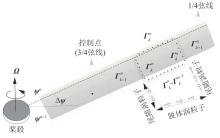
Fig.1
Schematic diagram of bound vortex of blade and new vortex calculation model
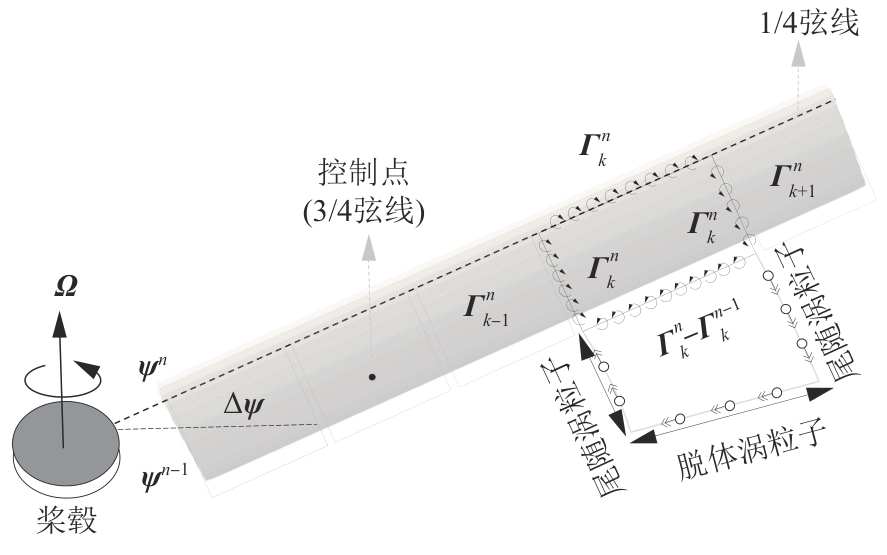
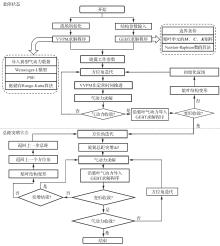
Fig.2
Flowchart of VVPM/GEBT coupling calculation

Table 1
Basic parameters of C-T rotor
| 旋翼参数 | 数值 |
|---|---|
| 桨叶片数 | 2 |
| 桨叶弦长/m | 0.152 4 |
| 桨叶半径/m | 1.066 8 |
| 桨叶线性负扭/(°) | 0 |
| 翼型 | NACA0012 |
| 旋翼转速/(r·min-1) | 1 857 |
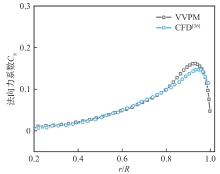
Fig.3
Comparison of normal force coefficients of blade for C-T rotor in extended direction
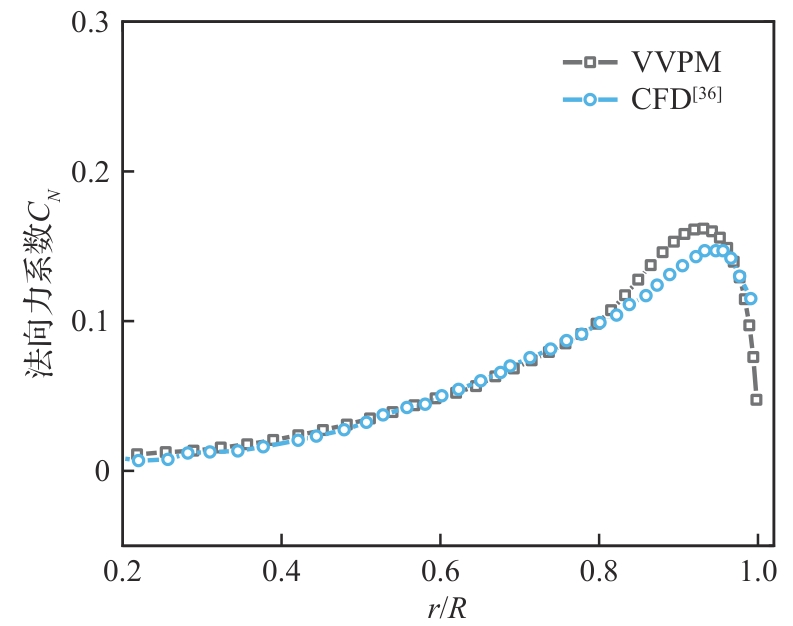
Table 2
Basic parameters of BO105 rotor
| 旋翼参数 | 数值 |
|---|---|
| 桨叶片数 | 4 |
| 桨叶弦长/m | 0.27 |
| 桨叶半径/m | 4.9 |
| 桨叶线性负扭/(°) | -8 |
| 翼型 | NACA23012 |
| 旋翼转速/(r·min-1) | 425 |
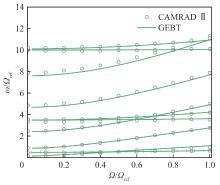
Fig.4
Resonance graph of BO105 rotor
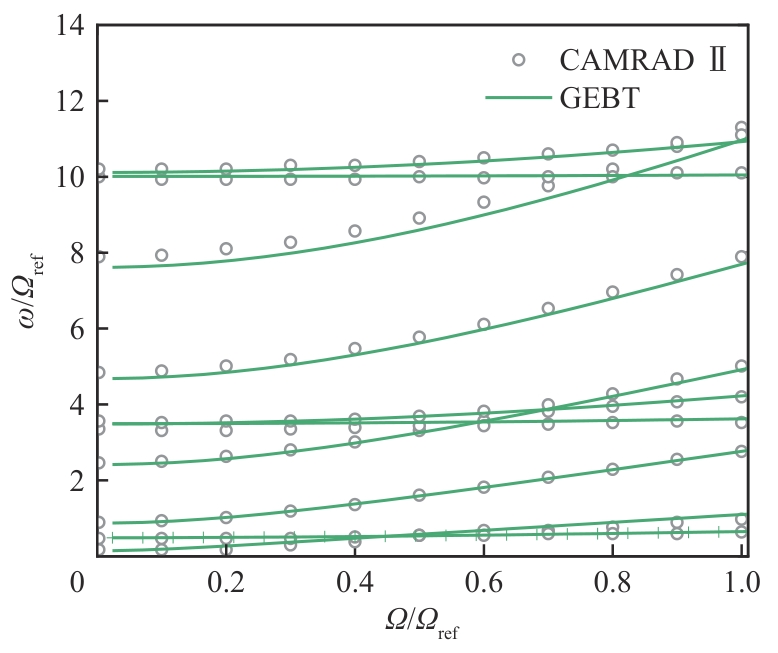
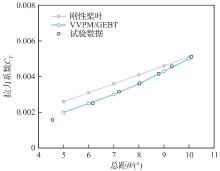
Fig.5
Verification of thrust coefficients of BO105 rotor
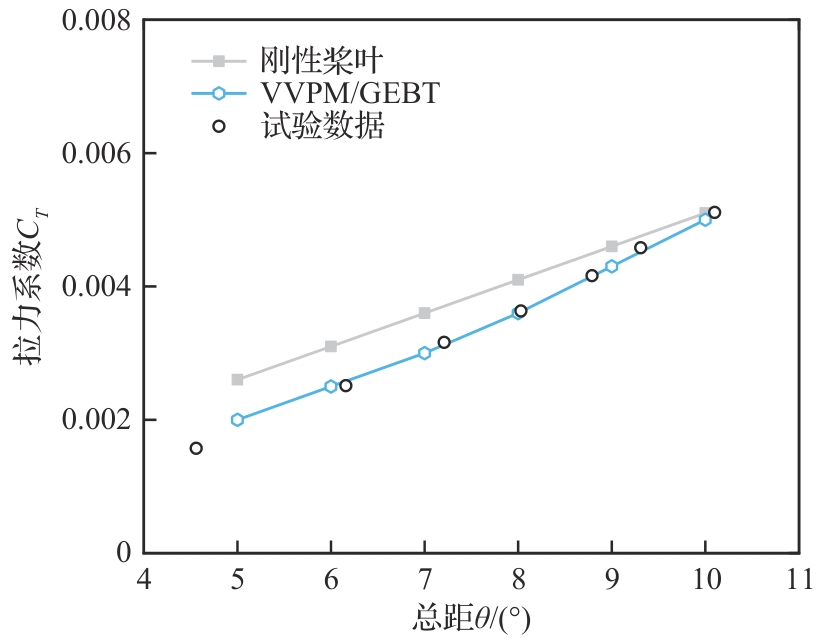
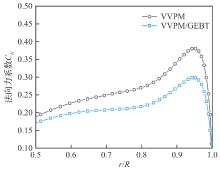
Fig.6
Comparison of normal force coefficients of rigid/elastic blade in extended direction
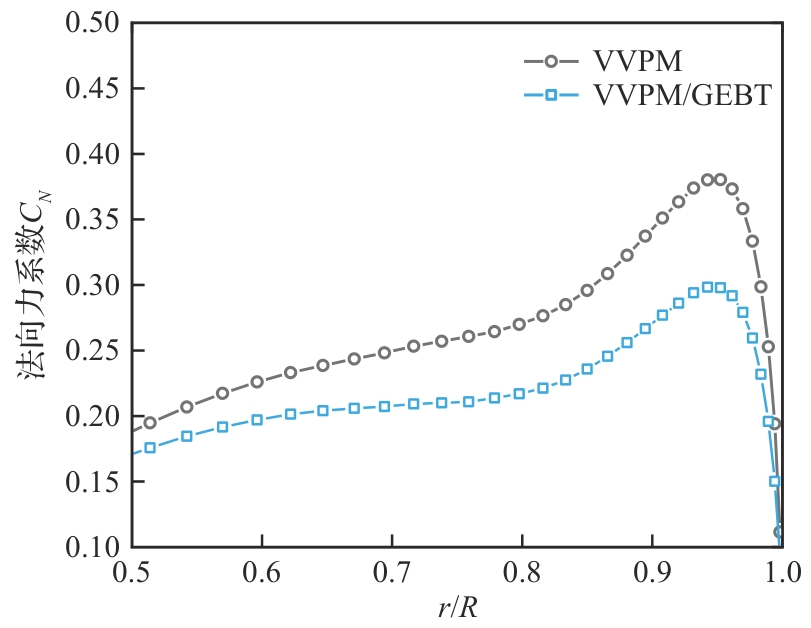
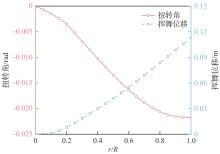
Fig.7
Deformation of elastic blade in extended direction
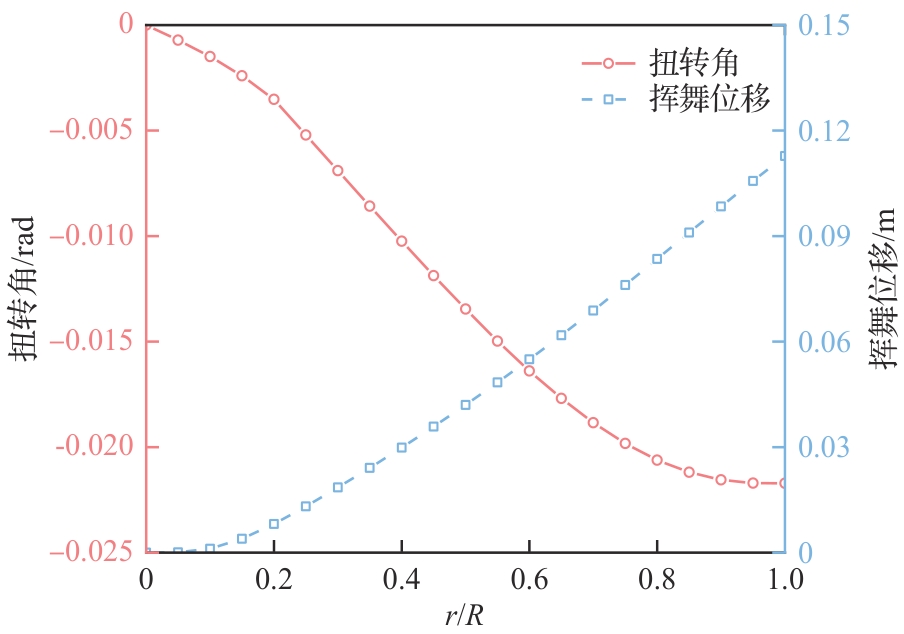
Table 3
Basic parameters of test rotor
| 旋翼参数 | 数值 |
|---|---|
| 桨叶片数 | 2 |
| 桨叶弦长/m | 0.054 |
| 桨叶半径/m | 0.54 |
| 桨叶线性负扭/(°) | 0 |
| 桨叶根切/m | 0.12 |
| 翼型 | NACA23012 |
| 旋翼转速/(r·min-1) | 1 200 |
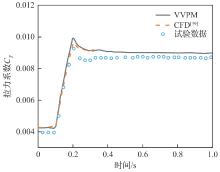
Fig.8
Verification of response of thrust coefficient when collective pitch ramp increases
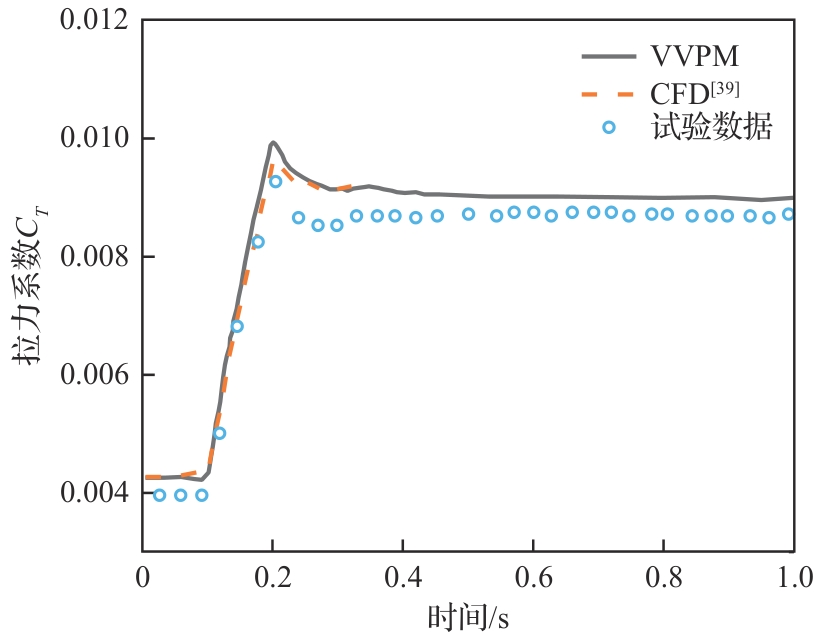
Fig.9
Verification of thrust coefficient in different collective pitch increase rates
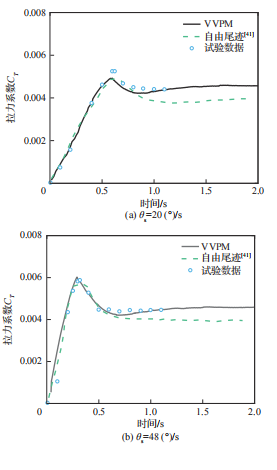
Fig.10
Variation of aerodynamic force of blade in extended direction when collective pitch ramp increases
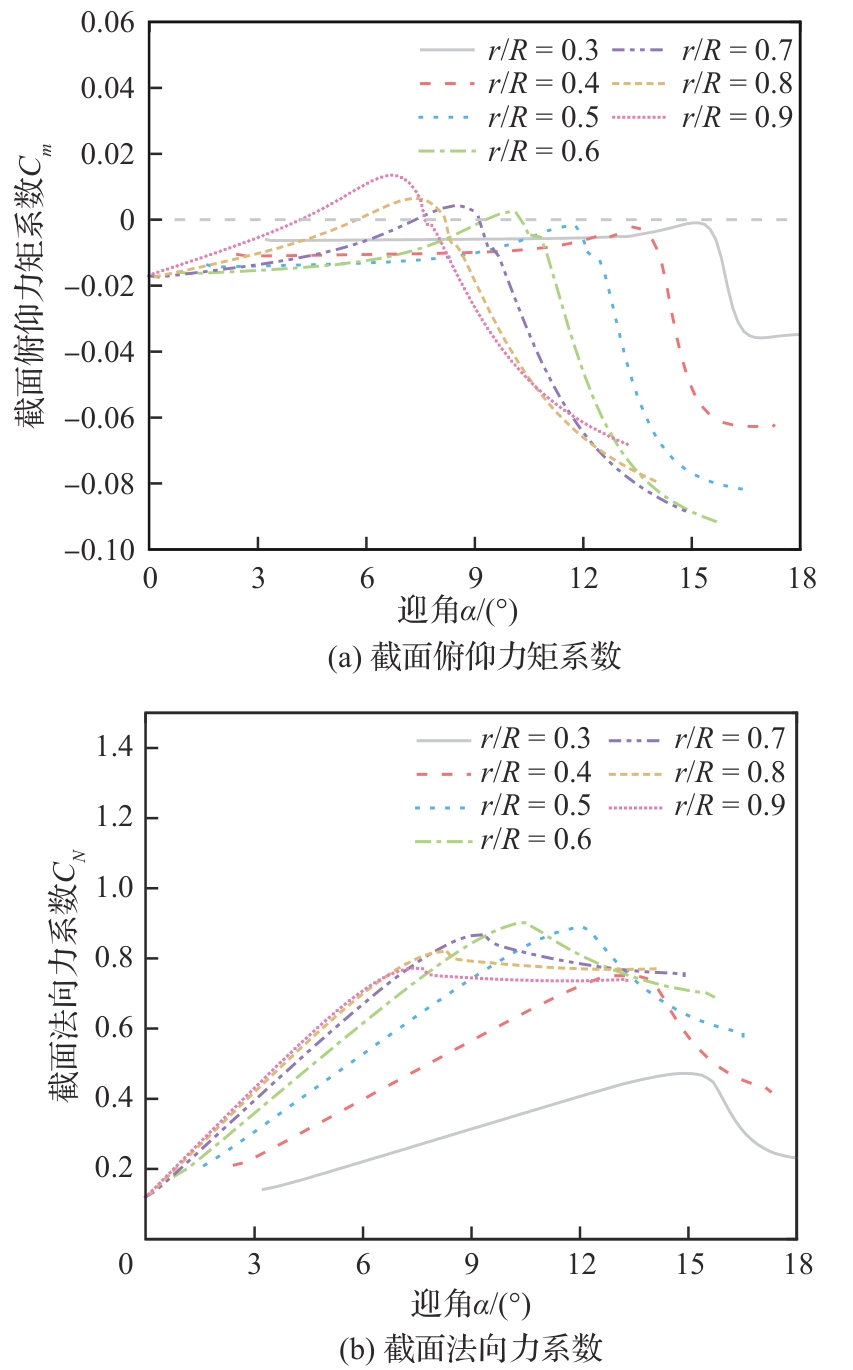
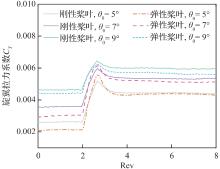
Fig.11
Variation of rotor thrust coefficient in different initial collective pitches
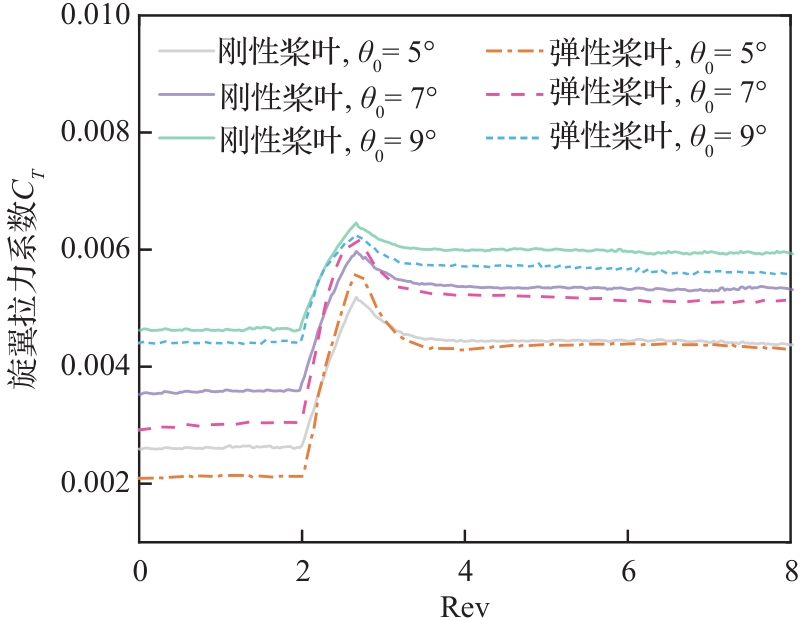
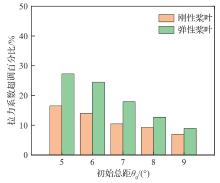
Fig.12
Comparison of thrust overshoot percentage of rigid/elastic rotor in different initial collective pitches
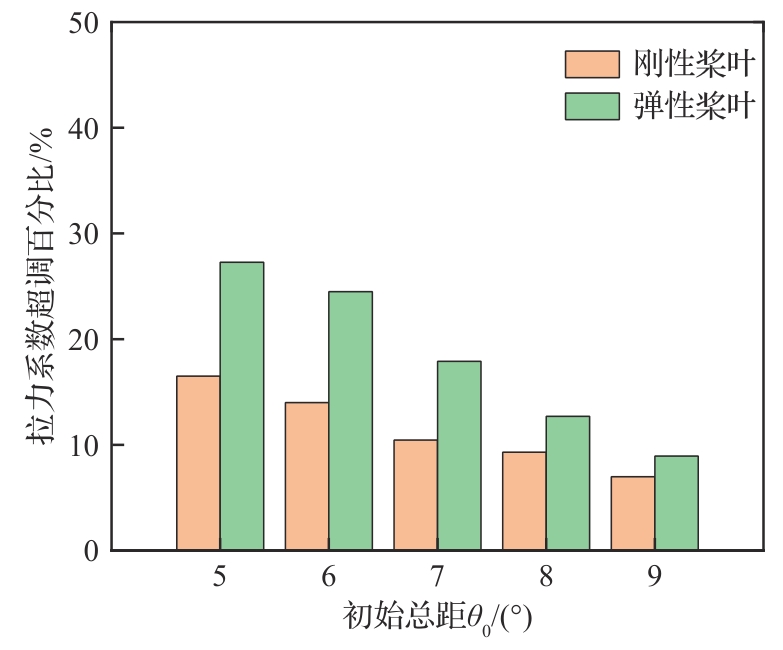
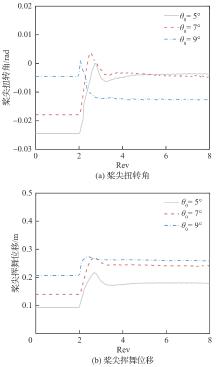
Fig.13
Variation of torsion angle and flap displacement of blade tip in different initial collective pitches
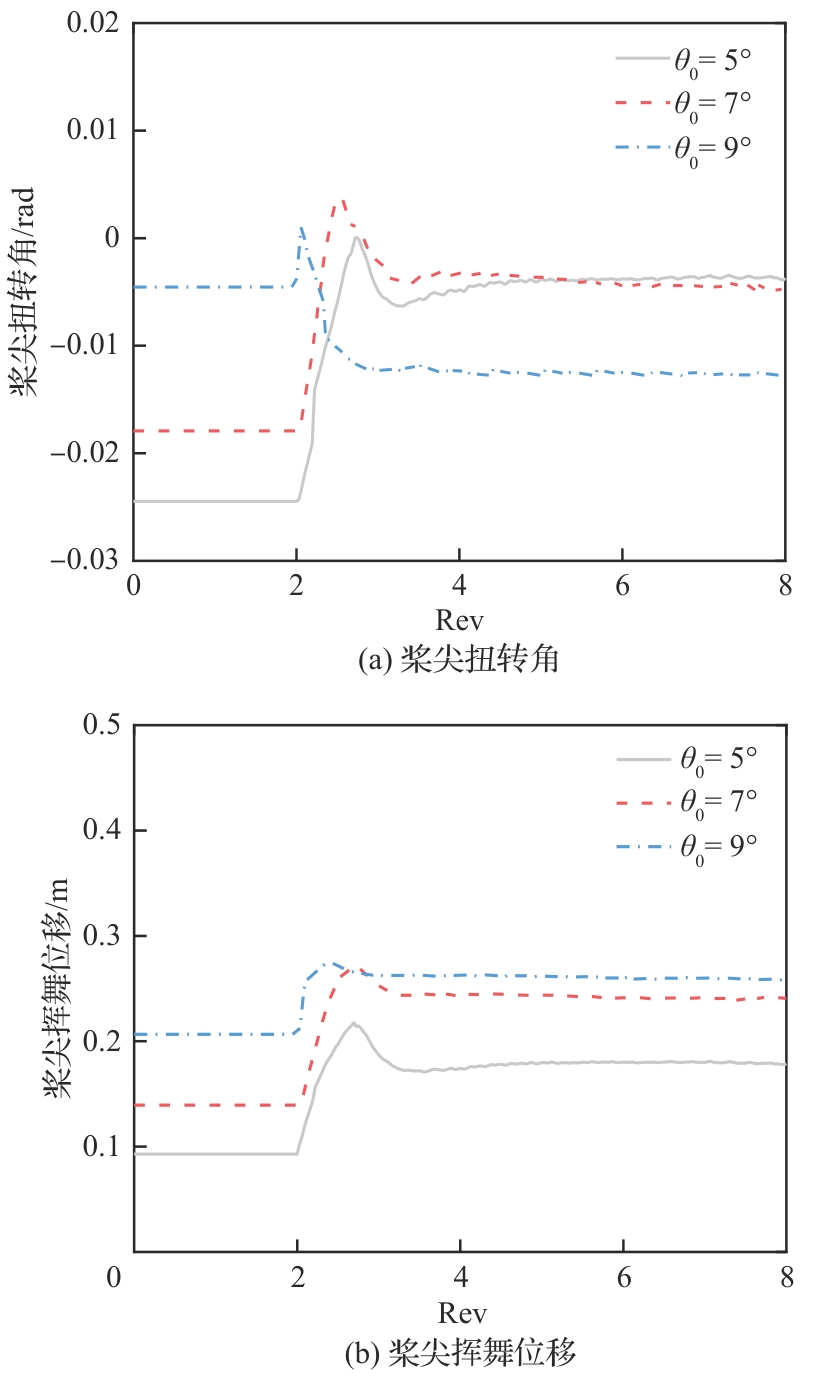
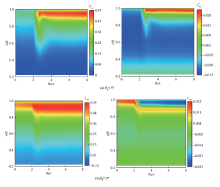
Fig.14
Variation of normal force coefficient/pitching moment coefficient in different extended positions
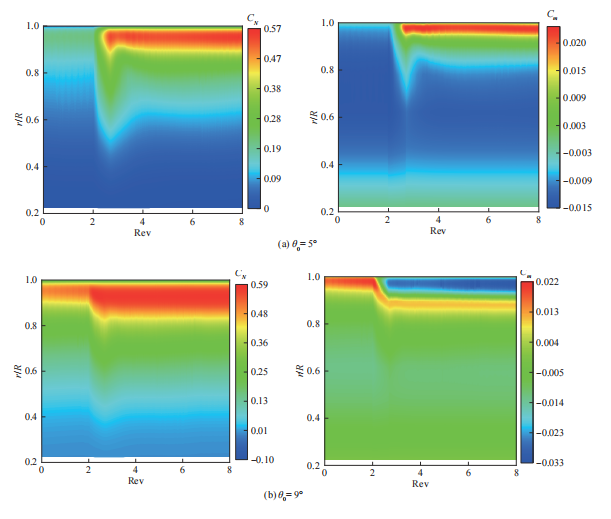
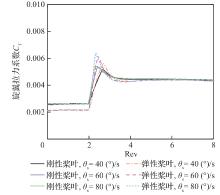
Fig.15
Variation of rotor thrust coefficient in different collective pitch increase rates
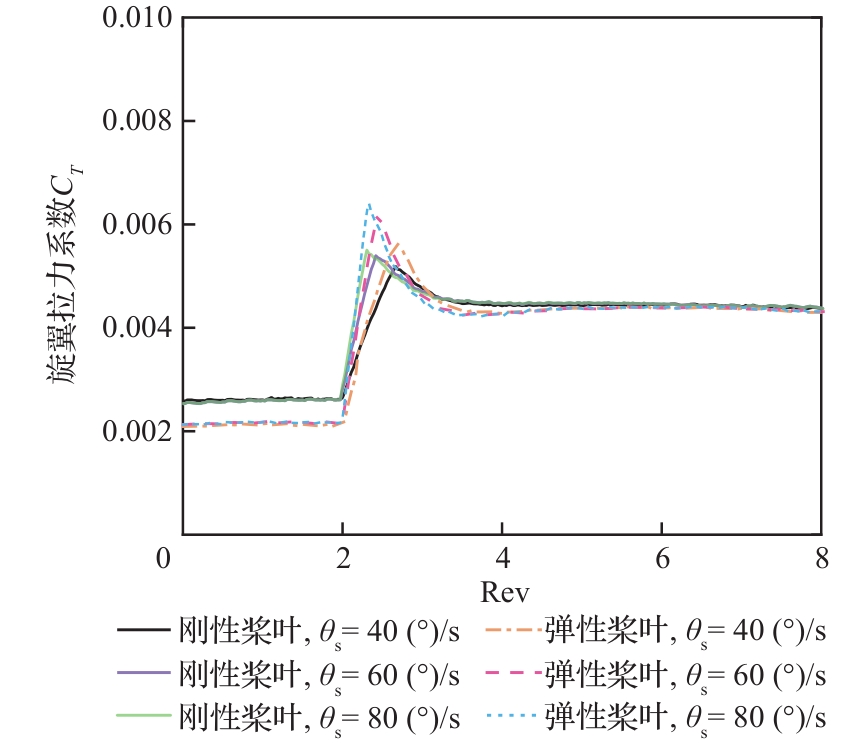
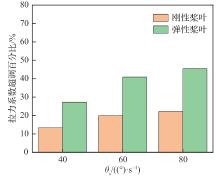
Fig.16
Thrust overshoot percentage of rigid/elastic rotor in different collective pitch increase rates
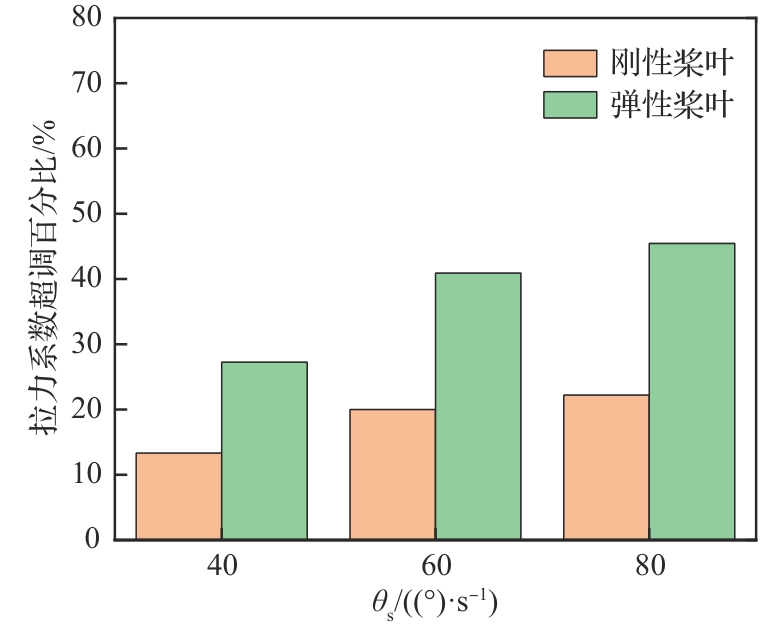
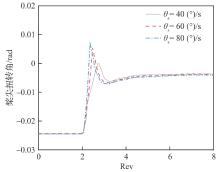
Fig.17
Variation of torsion angle of blade tip in different collective pitch increase rates
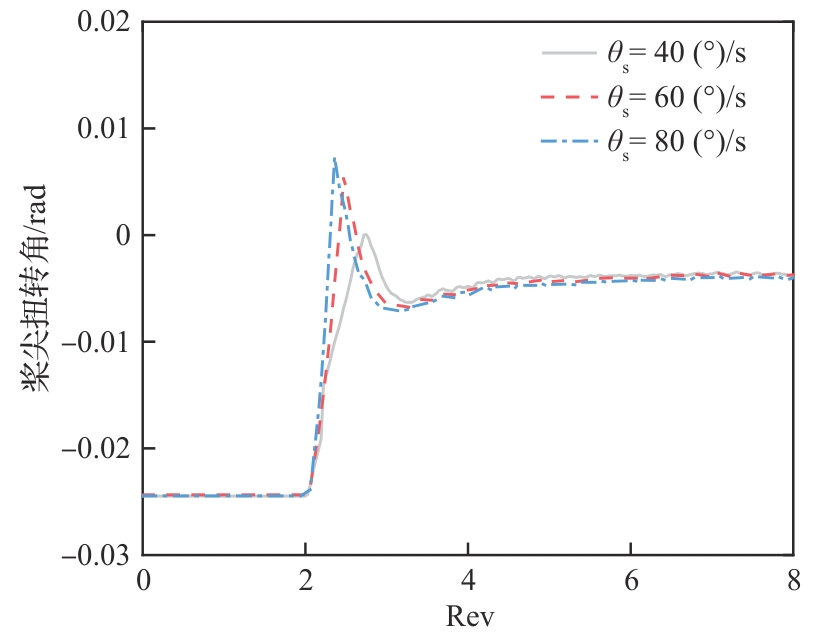
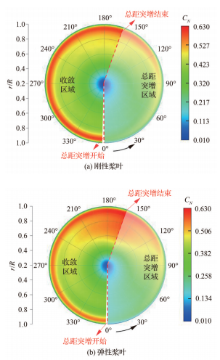
Fig.18
Distribution of blade profile normal force coefficient along rotor disc during collective pitch ramp increase (θ0=5°, θs=60 (°)/s)
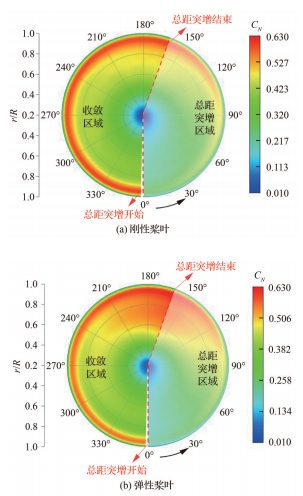
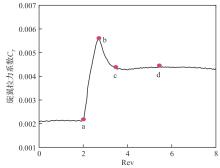
Fig.19
Variation of thrust coefficient for elastic rotor when θ0=5°, θs=40 (°)/s, θm=4°
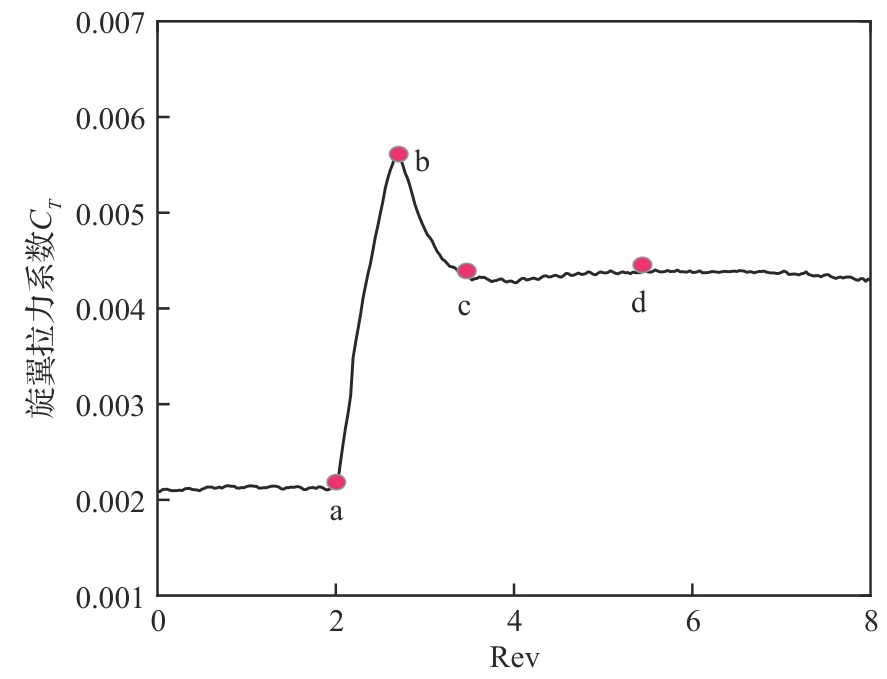
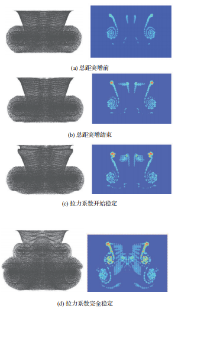
Fig.20
Rotor wake and vorticity contour maps at different stages
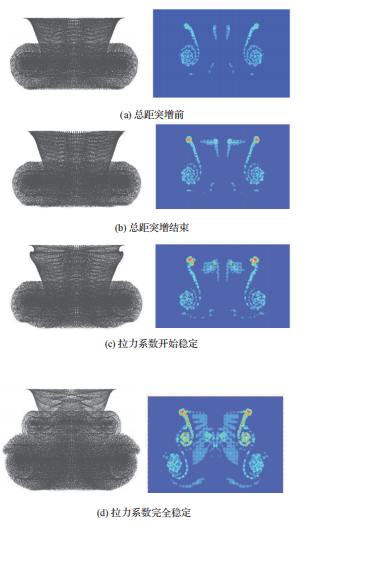
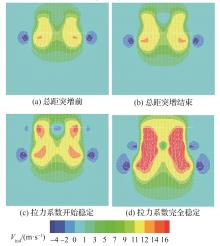
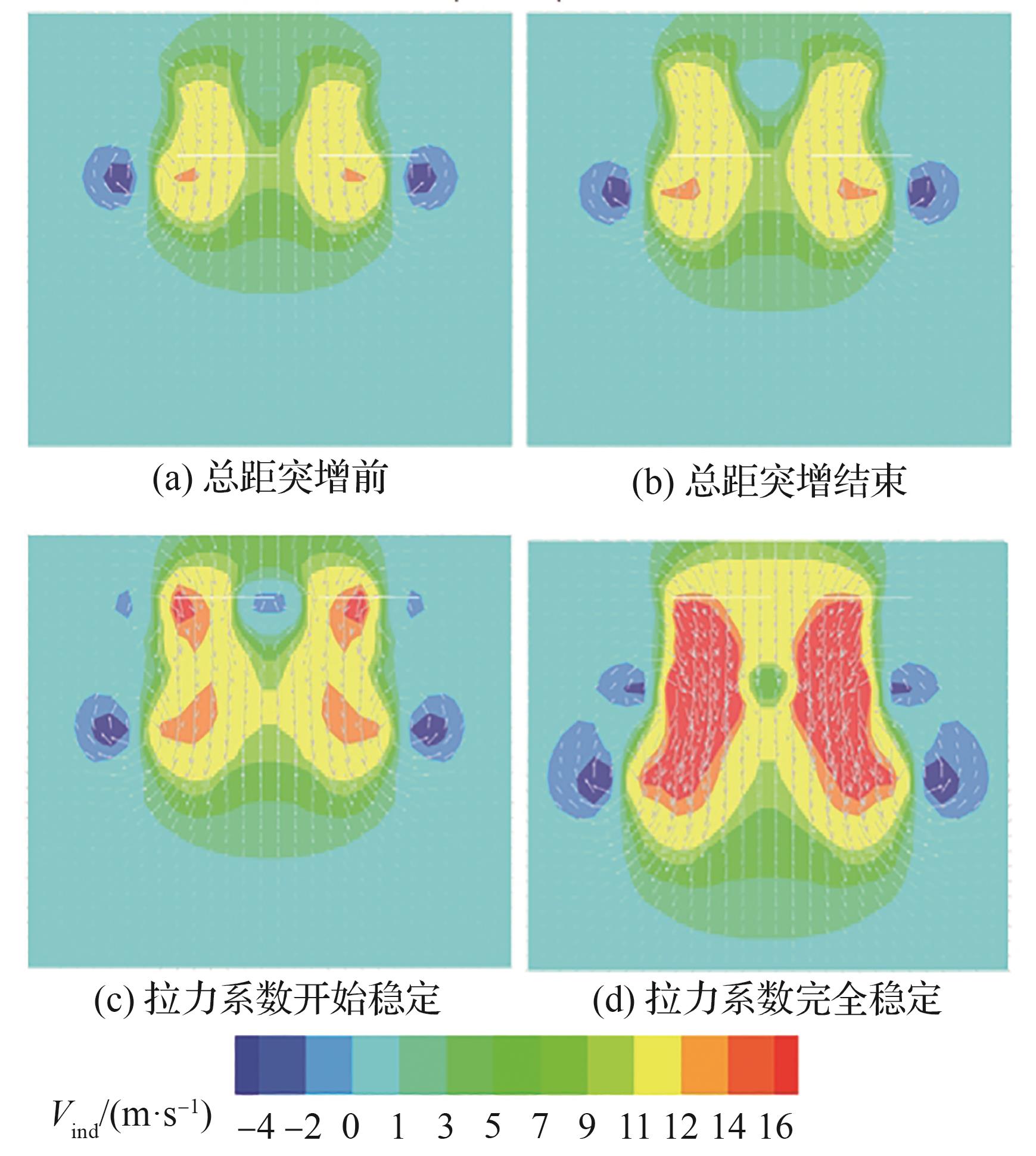
Fig.21
Variation of rotor induced velocity in different stages
| [1] | PITT D M, PETERS D A. Theoretical prediction of dynamic-inflow derivatives: ERF-1980-047[R]. 1980. |
| [2] | ZHOU X, ZHANG X Y, WANG B, et al. Aerodynamic and structural characteristics of helicopter rotor in circling flight[J]. Chinese Journal of Aeronautics, 2023, 36(12): 282-296. |
| [3] | 王俊超, 谭剑锋, 李建波, 等. 基于自由尾迹方法的自转旋翼气动特性研究[J]. 航空学报, 2015, 36(11): 3540-3548. |
| WANG J C, TAN J F, LI J B, et al. Investigation of autorotating rotor aerodynamic characteristics based on free wake method[J]. Acta Aeronautica et Astronautica Sinica, 2015, 36(11): 3540-3548 (in Chinese). | |
| [4] | BHAGWAT M J, LEISHMAN J G. Generalized viscous vortex model for application to free-vortex wake algorithms[C]∥Proceedings of the Annual Forum of the American Helicopter Society. American Helicopter Society, 2002: 2042-2057. |
| [5] | KOMERATH N M, SMITH M J, TUNG C. A review of rotor wake physics and modeling[J]. Journal of the American Helicopter Society, 2011, 56(2): 22006. |
| [6] | NARDUCCI R. Hover performance assessment of several tip shapes using OVERFLOW: AIAA-2015-1243[R]. Reston: AIAA, 2015. |
| [7] | JAIN R. Hover predictions for the S-76 rotor with tip shape variation using CREATE-AV Helios: AIAA-2015-1244[R]. Reston: AIAA, 2015. |
| [8] | GHARAKHANI A, GHONIEM A F. Three-dimensional vortex simulation of time dependent incompressible internal viscous flows[J]. Journal of Computational Physics, 1997, 134(1): 75-95. |
| [9] | PLOUMHANS P, WINCKELMANS G S, SALMON J K, et al. Vortex methods for direct numerical simulation of three-dimensional bluff body flows: Application to the sphere at Re=300, 500, and 1 000[J]. Journal of Computational Physics, 2002, 178(2): 427-463. |
| [10] | HE C J, ZHAO J G. Modeling rotor wake dynamics with viscous vortex particle method[J]. AIAA Journal, 2009, 47(4): 902-915. |
| [11] | LAKKIS I, GHONIEM A. A high resolution spatially adaptive vortex method for separating flows. Part I: Two-dimensional domains[J]. Journal of Computational Physics, 2009, 228(2): 491-515. |
| [12] | STOCK M J, GHARAKHANI A. Solution-responsive particle size adaptivity in Lagrangian vortex particle methods[C]∥ASME 2021 Fluids Engineering Division Summer Meeting. New York: ASME, 2021. |
| [13] | ALVAREZ E J, NING A. Development of a vortex particle code for the modeling of wake interaction in distributed propulsion: AIAA-2018-3646[R]. Reston: AIAA, 2018. |
| [14] | CHENG H, GREENGARD L, ROKHLIN V. A fast adaptive multipole algorithm in three dimensions[J]. Journal of Computational Physics, 1999, 155(2): 468-498. |
| [15] | SINGH P, FRIEDMANN P P. Application of vortex methods to coaxial rotor wake and load calculations in hover[J]. Journal of Aircraft, 2018, 55(1): 373-381. |
| [16] | TAN J, SUN Y, BARAKOS G N. Unsteady loads for coaxial rotors in forward flight computed using a vortex particle method[J]. The Aeronautical Journal, 2018, 122(1251): 693-714. |
| [17] | ALVAREZ E J, NING A. High-fidelity modeling of multirotor aerodynamic interactions for aircraft design[J]. AIAA Journal, 2020, 58(10): 4385-4400. |
| [18] | HE C J, RAJMOHAN N. Modeling the aerodynamic interaction of multiple rotor vehicles and compound rotorcraft with viscous vortex particle method[C]∥American Helicopter Society 72nd Annual Forum. American Helicopter Society International, Inc., 2016. |
| [19] | 谭剑锋, 王浩文, 吴超, 等. 基于非定常面元/黏性涡粒子混合法的旋翼/平尾非定常气动干扰[J]. 航空学报, 2014, 35(3): 643-656. |
| TAN J F, WANG H W, WU C, et al. Rotor/empennage unsteady aerodynamic interaction with unsteady panel/viscous vortex particle hybrid method[J]. Acta Aeronautica et Astronautica Sinica, 2014, 35(3): 643-656 (in Chinese). | |
| [20] | HODGES D H. Nonlinear composite beam theory[M]. Reston: AIAA, 2006. |
| [21] | YU W B, BLAIR M. GEBT: A general-purpose nonlinear analysis tool for composite beams[J]. Composite Structures, 2012, 94(9): 2677-2689. |
| [22] | WU J, MA Y J, WANG Z D, et al. Structurally coupled characteristics of rotor blade using new rigid-flexible dynamic model based on geometrically exact formulation[J]. Chinese Journal of Aeronautics, 2022, 35(6): 186-197. |
| [23] | CHEN J G, SHEN X, LIU P Y, et al. Design tool for aeroelastic analysis of wind turbine blades based on geometrically exact beam theory and lifting surface method: AIAA-2017-0450[R]. Reston: AIAA, 2017. |
| [24] | FACCIO C J, CARDOZO Jr, , MONTEIRO V, Jr, et al. Modeling wind turbine blades by geometrically-exact beam and shell elements: A comparative approach[J]. Engineering Structures, 2019, 180: 357-378. |
| [25] | WANG L, LIU X W, RENEVIER N, et al. Nonlinear aeroelastic modelling for wind turbine blades based on blade element momentum theory and geometrically exact beam theory[J]. Energy, 2014, 76: 487-501. |
| [26] | SHANG L N, XIA P Q, HODGES D H. Aeroelastic response analysis of composite blades based on geometrically exact beam theory[J]. Journal of the American Helicopter Society, 2019, 64(2): 1-14. |
| [27] | CHANDRASEKARAN R, HODGES D H. Performance advantages and resonance analysis of a variable speed rotor using geometrically exact beam formulations[J]. Journal of the American Helicopter Society, 2022, 67(4): 1-21. |
| [28] | 王华龙, 张夏阳, 赵国庆, 等. 基于CFD/CSD耦合的TEF旋翼气弹特性高精度模拟[J]. 航空学报, 2024, 45(18): 229904. |
| WANG H L, ZHANG X Y, ZHAO G Q, et al. High-precision simulation of aeroelastic characteristics of TEF rotor based on CFD/CSD coupling[J]. Acta Aeronautica et Astronautica Sinica, 2024, 45(18): 229904 (in Chinese). | |
| [29] | 张凯, 招启军, 马砾, 等. 基于CFD/CSD耦合方法的旋翼降转速气动特性[J]. 航空动力学报, 2024, 39(12): 20230074. |
| ZHANG K, ZHAO Q J, MA L, et al. Slowed rotor aerodynamic characteristics using CFD/CSD coupling method[J]. Journal of Aerospace Power, 2024, 39(12): 20230074 (in Chinese). | |
| [30] | ABHISHEK A, CHOPRA I. Prediction and validation of UTTAS pull-up maneuver using CFD/CSD coupling: AIAA-2011-1774[R]. Reston: AIAA, 2011. |
| [31] | 王博. 基于全本征方程的无铰式旋翼气动弹性分析方法[D]. 南京: 南京航空航天大学, 2015. |
| WANG B. Analytical method on aeroelasticity of hingeless rotor using fully intrinsic equations[D]. Nanjing: Nanjing University of Aeronautics and Astronautics, 2015 (in Chinese). | |
| [32] | 李攀. 旋翼非定常自由尾迹及高置信度直升机飞行力学建模研究[D]. 南京: 南京航空航天大学, 2010. |
| LI P. Rotor unsteady free-vortex wake model and investigation on high-fidelity modeling of helicopter flight dynamics[D]. Nanjing: Nanjing University of Aeronautics and Astronautics, 2010 (in Chinese). | |
| [33] | SINGH P, FRIEDMANN P P. A computational fluid dynamics-based viscous vortex particle method for coaxial rotor interaction calculations in hover[J]. Journal of the American Helicopter Society, 2018, 63(4): 1-13. |
| [34] | WILLIAMSON J H. Low-storage Runge-Kutta schemes[J]. Journal of Computational Physics, 1980, 35(1): 48-56. |
| [35] | WANG Q, YU W B. Geometrically nonlinear analysis of composite beams using Wiener-Milenković parameters[J]. Journal of Renewable and Sustainable Energy, 2017, 9(3): 033306. |
| [36] | 朱秋娴. 基于非定常动量源方法的倾转旋翼机气动分析及性能优化[D]. 南京: 南京航空航天大学, 2016. |
| ZHU Q X. Aerodynamic analysis and optimal design of tilt-rotor aircraft based on an unsteady momentum source method[D]. Nanjing: Nanjing University of Aeronautics and Astronautics, 2016 (in Chinese). | |
| [37] | KOMP D, KUMAR S, HAJEK M, et al. Effect of active camber morphing on rotor performance and control loads[J]. Aerospace Science and Technology, 2021, 108: 106311. |
| [38] | LI P, CHEN R L. Rotor unsteady aerodynamics model using an efficient free-vortex method[J]. Aircraft Engineering and Aerospace Technology, 2012, 84(5): 311-320. |
| [39] | WOODGATE M A, SHI Y J, FITZGIBBON T A, et al. Simulation of step input in collective pitch for hovering rotor[J]. Aerospace Science and Technology, 2021, 110: 106425. |
| [40] | CARPENTER P J, FRIDOVICH B. Effect of a rapid blade-pitch increase on the thrust and induced-velocity response of a full-scale helicopter rotor: NACA-TN-3044[R]. Washington, D.C.: NACA, 1953. |
| [41] | 邓景辉, 谭剑锋, 张呈林. 基于时间步进自由尾迹的旋翼总距突增气动响应分析[J]. 空气动力学学报, 2011, 29(2): 217-221. |
| DENG J H, TAN J F, ZHANG C L. Analysis of rotor dynamic response during ramp increased collective pitch by time-step free wake[J]. Acta Aerodynamica Sinica, 2011, 29(2): 217-221 (in Chinese). |
| [1] | Weiguo ZHANG, Min TANG, Jie WU, Xianmin PENG, Guichuan ZHANG, Bowen NIE, Liangquan WANG, Chaoqun LI. Overview of wind tunnel test research on tiltrotor aircraft [J]. Acta Aeronautica et Astronautica Sinica, 2024, 45(9): 530114-530114. |
| [2] | TAN Jianfeng. Influence of helicopter rotor on tail rotor unsteady aerodynamic loads [J]. ACTA AERONAUTICAET ASTRONAUTICA SINICA, 2015, 36(10): 3228-3240. |
| [3] | TAN Jianfeng, WANG Haowen, WU Chao, LIN Changliang. Rotor/Empennage Unsteady Aerodynamic Interaction with Unsteady Panel/Viscous Vortex Particle Hybrid Method [J]. ACTA AERONAUTICAET ASTRONAUTICA SINICA, 2014, 35(3): 643-656. |
| Viewed | ||||||
|
Full text |
|
|||||
|
Abstract |
|
|||||
Address: No.238, Baiyan Buiding, Beisihuan Zhonglu Road, Haidian District, Beijing, China
Postal code : 100083
E-mail:hkxb@buaa.edu.cn
Total visits: 6658907 Today visits: 1341All copyright © editorial office of Chinese Journal of Aeronautics
All copyright © editorial office of Chinese Journal of Aeronautics
Total visits: 6658907 Today visits: 1341

 CJA
CJA
