Acta Aeronautica et Astronautica Sinica ›› 2025, Vol. 46 ›› Issue (14): 131512.doi: 10.7527/S1000-6893.2024.31512
• Fluid Mechanics and Flight Mechanics • Previous Articles
Zijie ZHOU1, Zhenbing LUO1( ), Xiong DENG1, Yan ZHOU1, Zheng GUO1, Jianyuan ZHANG2, Zhijie ZHAO1
Received:2024-11-08
Revised:2024-12-02
Accepted:2024-12-24
Online:2024-12-31
Published:2024-12-30
Contact:
Zhenbing LUO
E-mail:luozhenbing@163. com
Supported by:CLC Number:
Zijie ZHOU, Zhenbing LUO, Xiong DENG, Yan ZHOU, Zheng GUO, Jianyuan ZHANG, Zhijie ZHAO. Flow separation control of simple flaps based on dual synthetic jets[J]. Acta Aeronautica et Astronautica Sinica, 2025, 46(14): 131512.
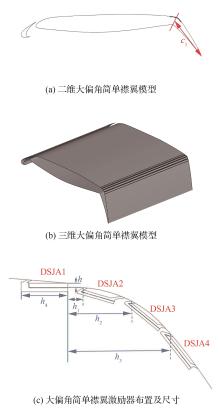
Fig.1
Schematic diagram of arrangement scheme model and DSJAs arrangement scheme

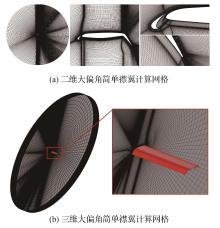
Fig.2
Schematic of computational mesh
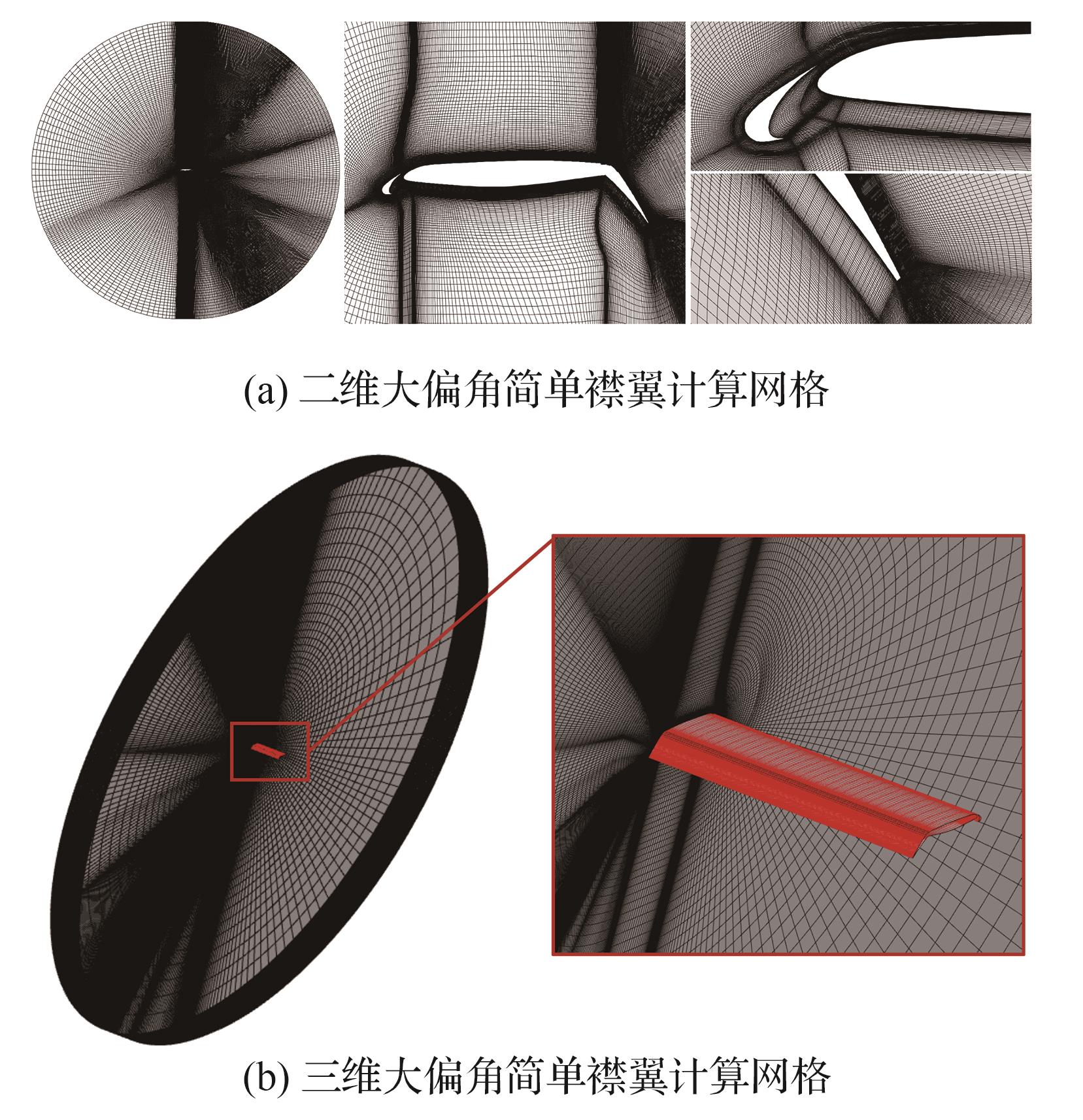
Fig.3
Comparison between numerical simulation and test results of lift coefficient and drag coefficient
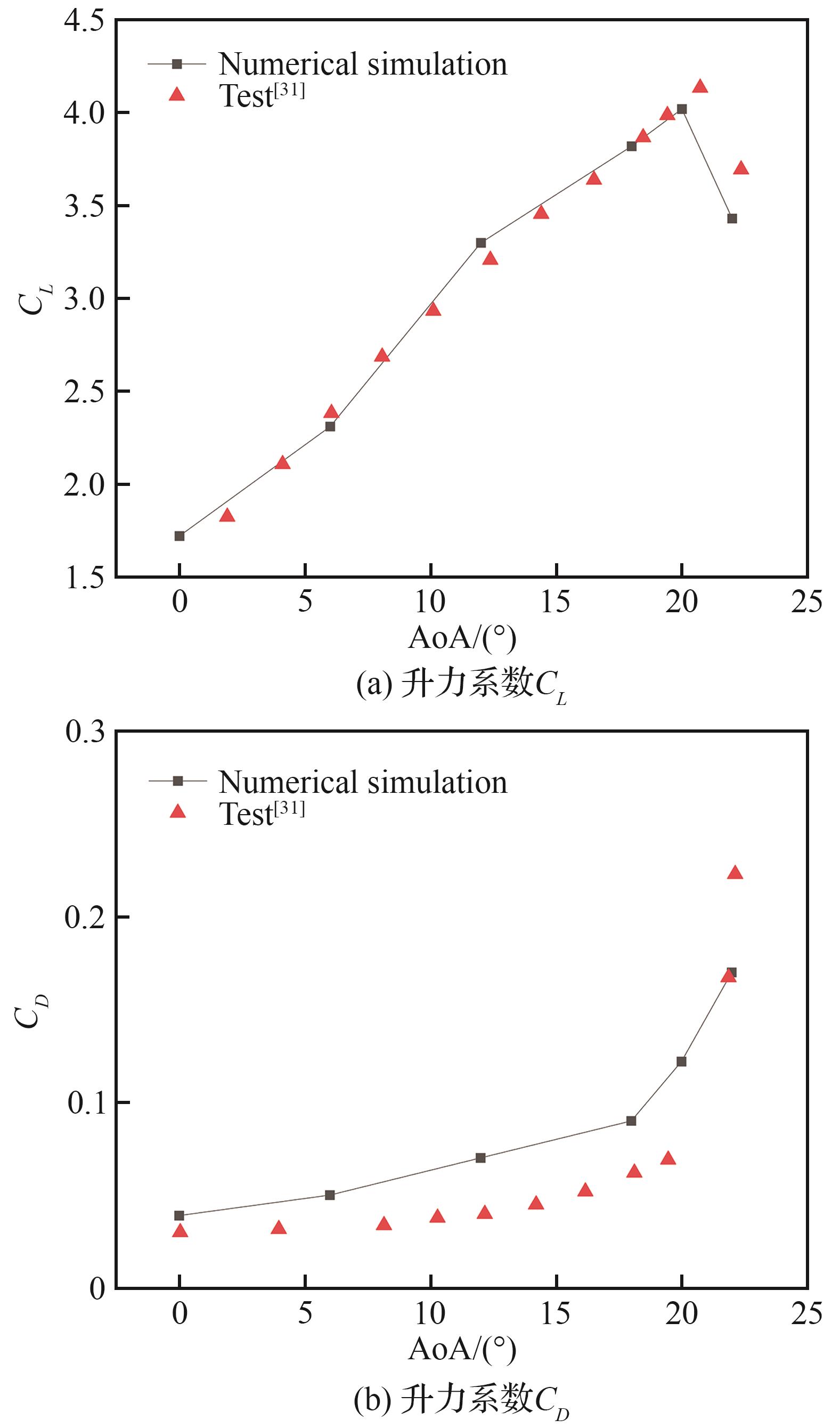

Table 1
Grid independence verification
| 网格数/104 | 升力系数CL | 阻力系数CD | 力距系数Cm |
|---|---|---|---|
| 28 | 1.621 0 | 0.199 1 | 0.386 8 |
| 38 | 1.653 6 | 0.203 1 | 0.394 0 |
| 48 | 1.654 8 | 0.205 3 | 0.397 7 |
Table 2
Time step size independence verification
| 时间步长 | CL | CD | Cm |
|---|---|---|---|
| 0.000 100 | 1.645 2 | 0.200 8 | 0.391 4 |
| 0.000 125 | 1.653 6 | 0.203 1 | 0.394 0 |
| 0.000 150 | 1.655 8 | 0.204 7 | 0.395 1 |
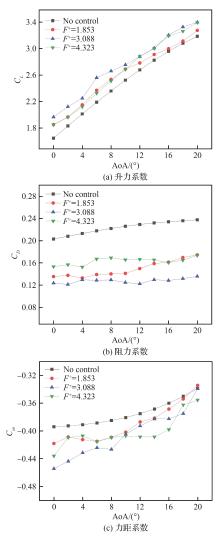
Fig.4
Comparison of aerodynamic coefficients of different nondimensional driving frequency
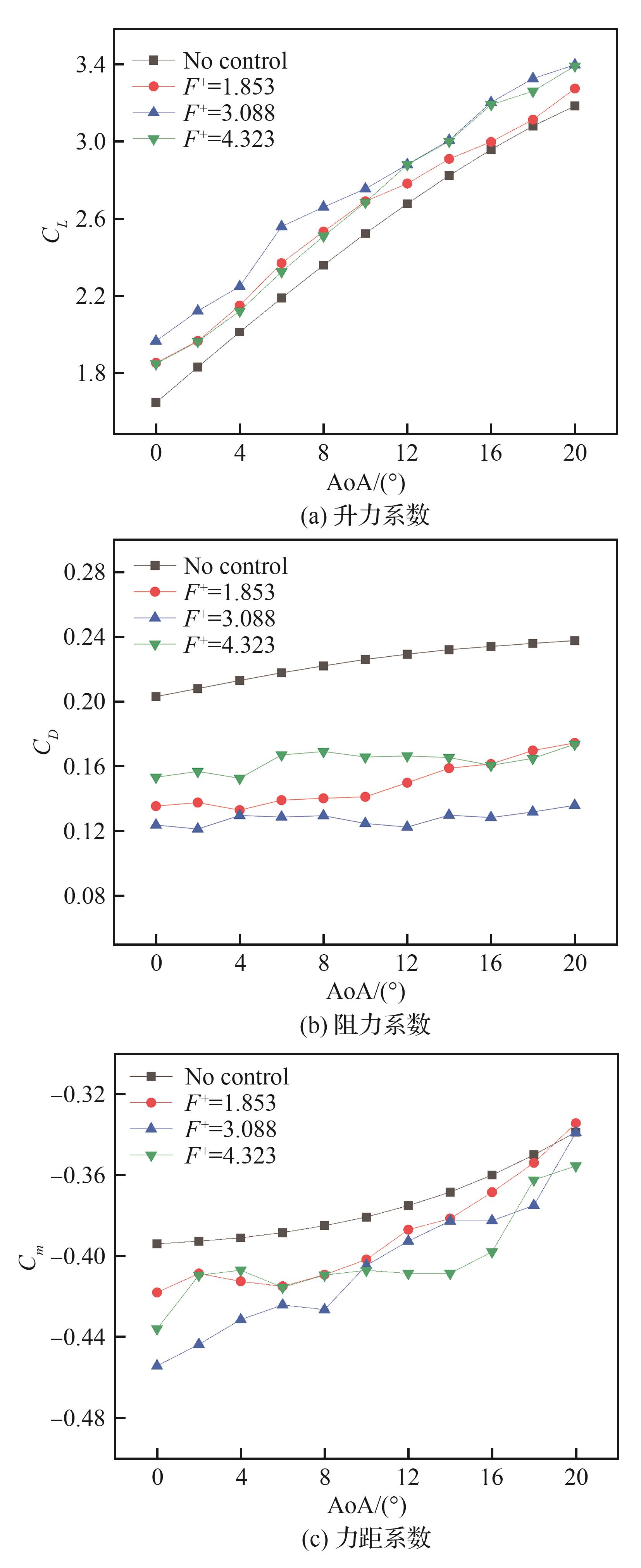
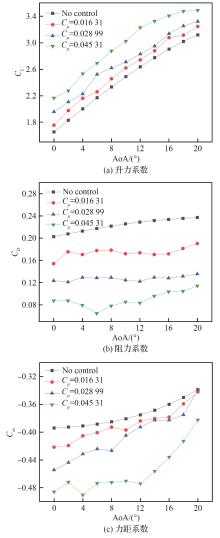
Fig.5
Comparison of aerodynamic coefficients of different nondimensional momentum coefficients
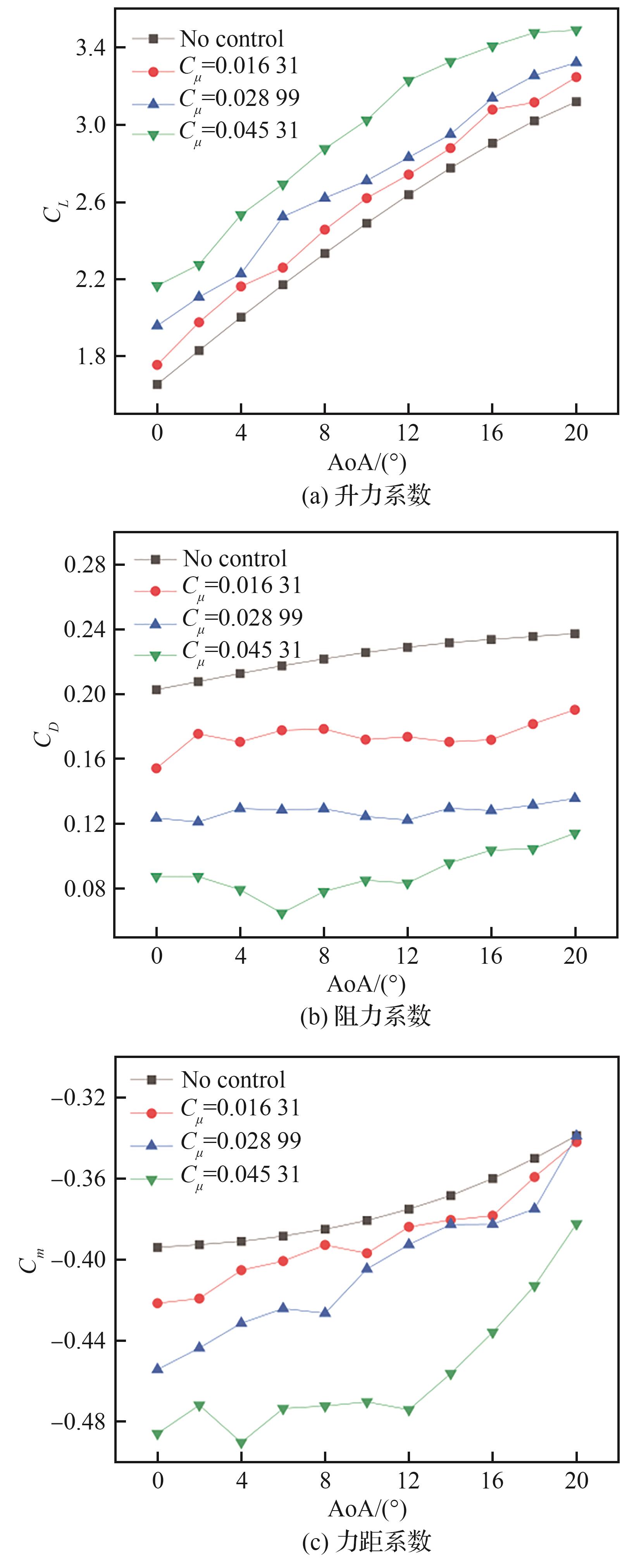
Fig.6
Comparison between 2D velocity contour map and 3D sectional velocity contour map (AoA=6°)
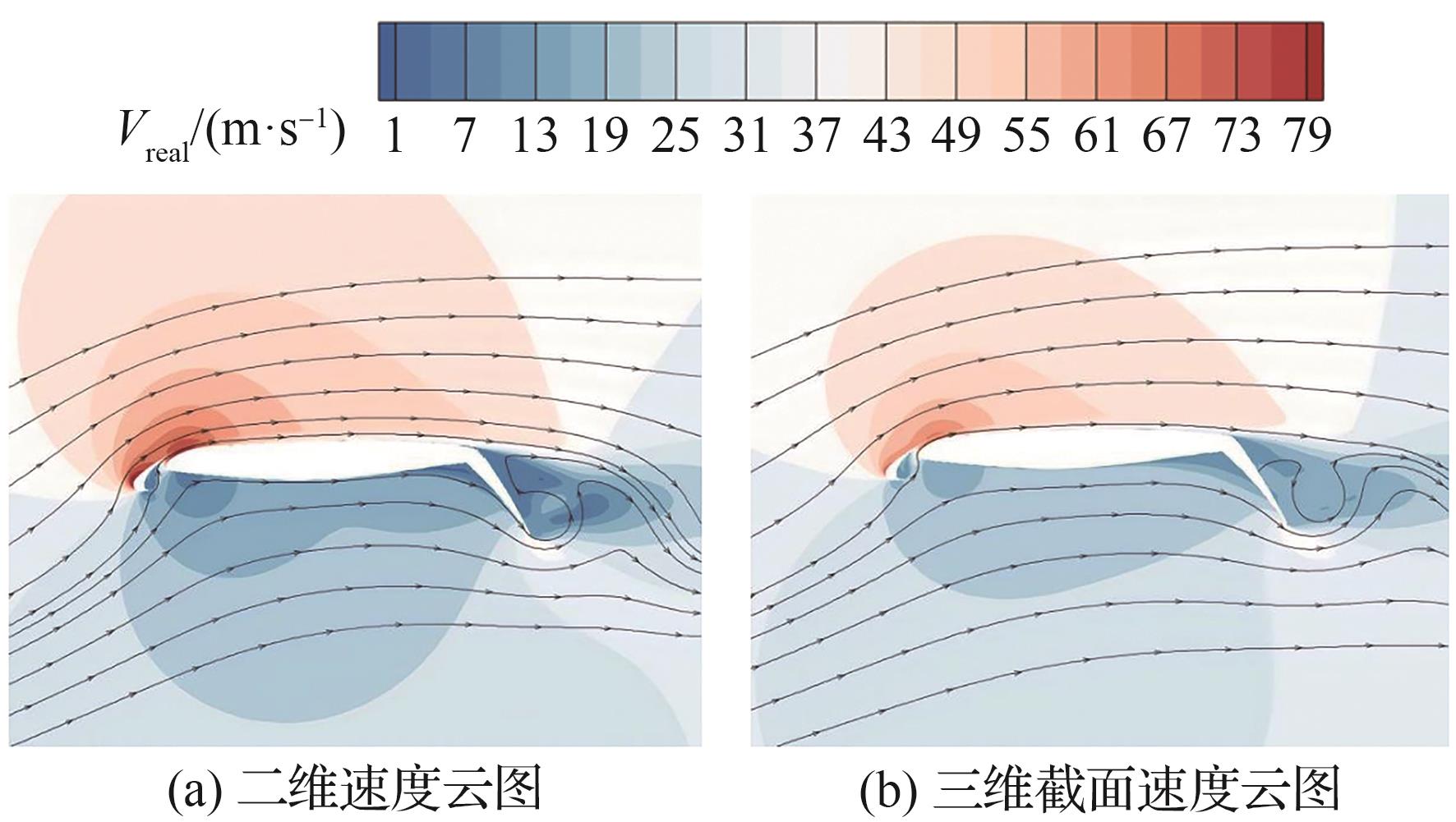
Fig.7
Velocity contour map and streamlines of 2D simple flap over one cycle (AoA=12°)

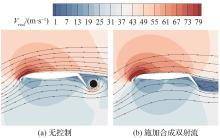
Fig.8
Demonstration of 2D wake vortex control effects (Z=0.4 m,AoA=12°)

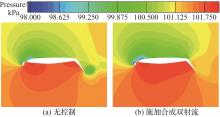
Fig.9
Pressure contour map of mean flow field before and after control (Z=0.4 m,AoA=12°)
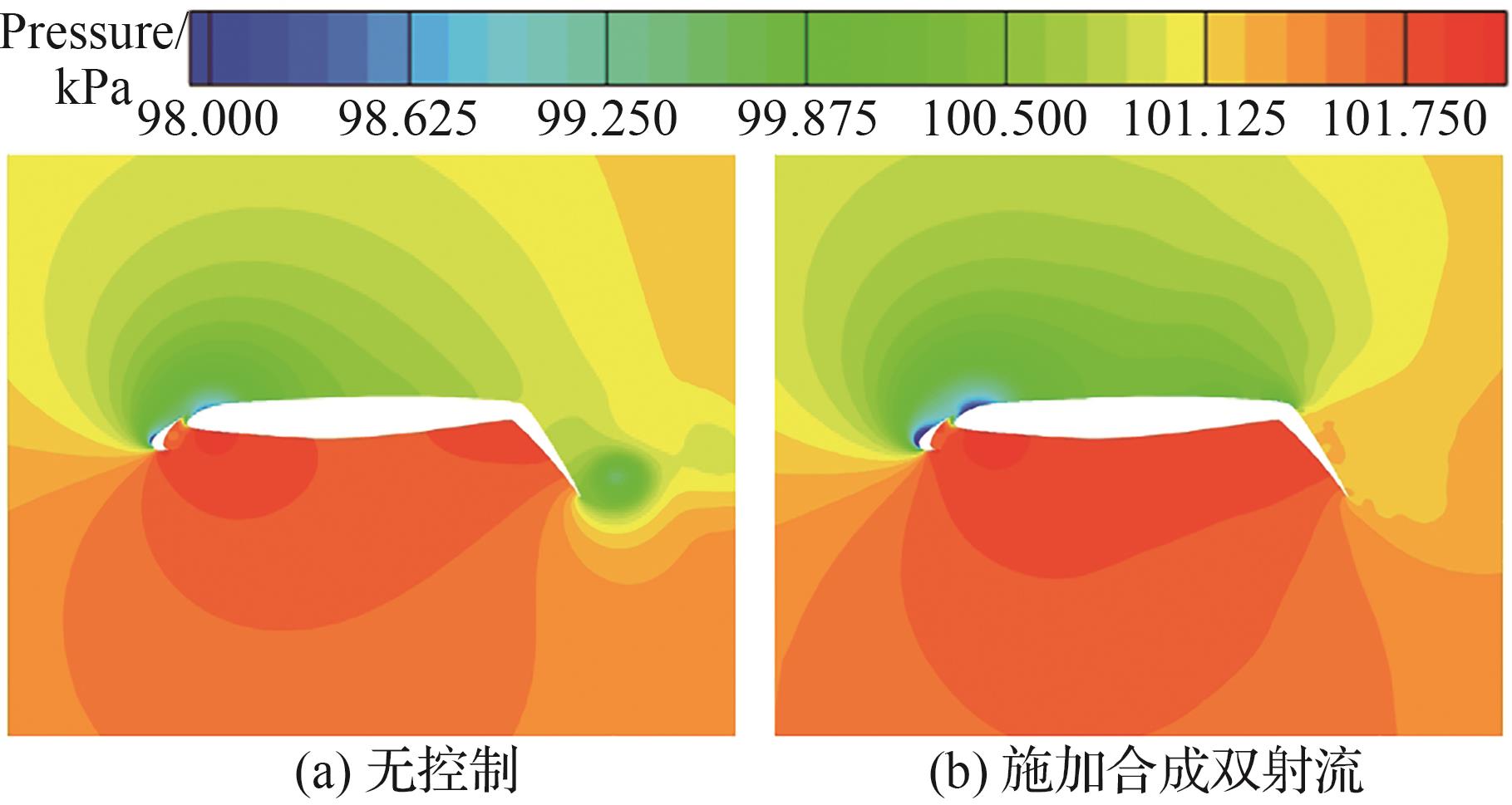
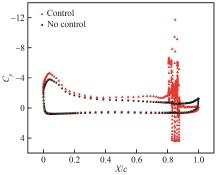
Fig.10
Pressure coefficient Cp on airfoil surface before and after control (Z=0.4 m,AoA=12°)
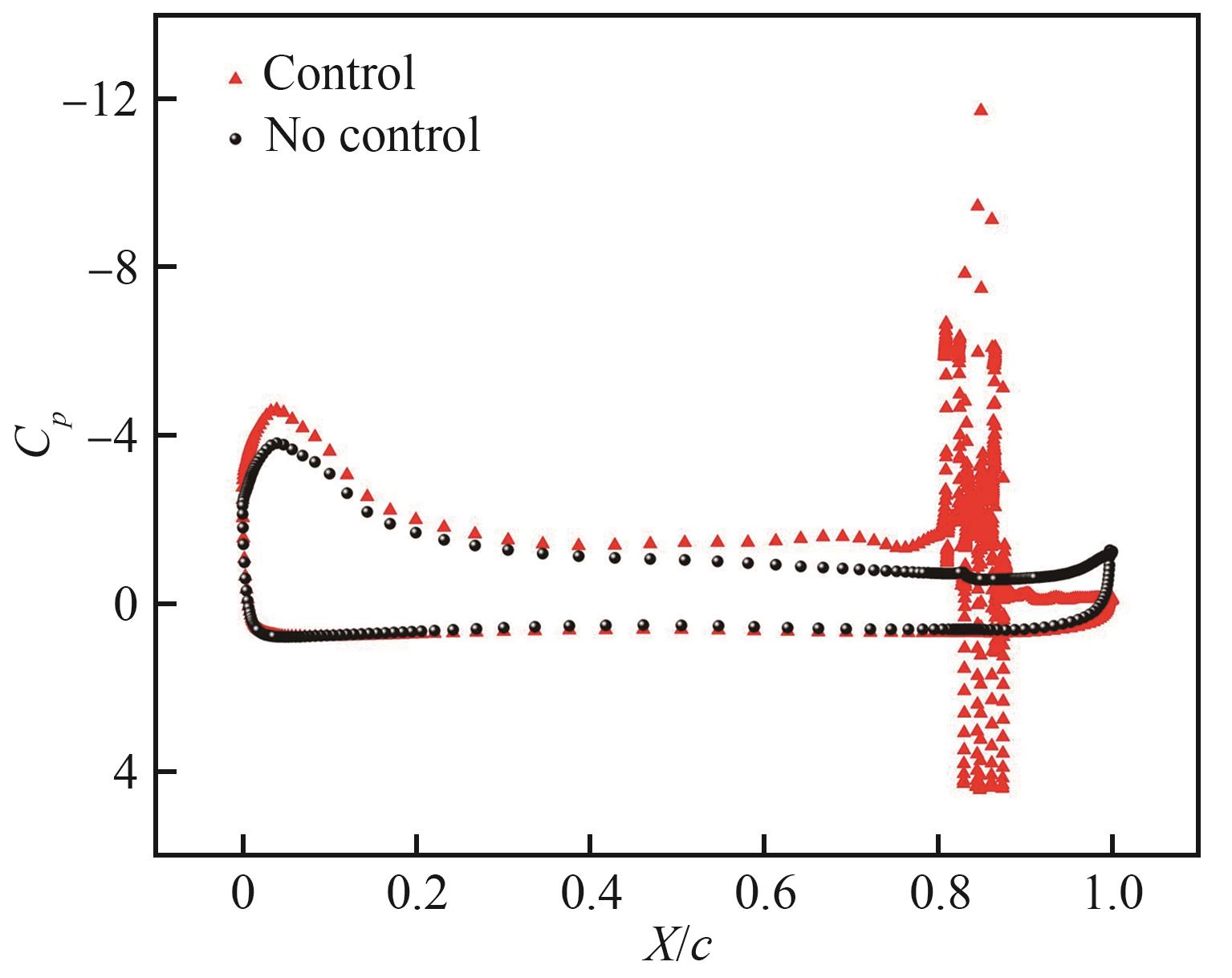
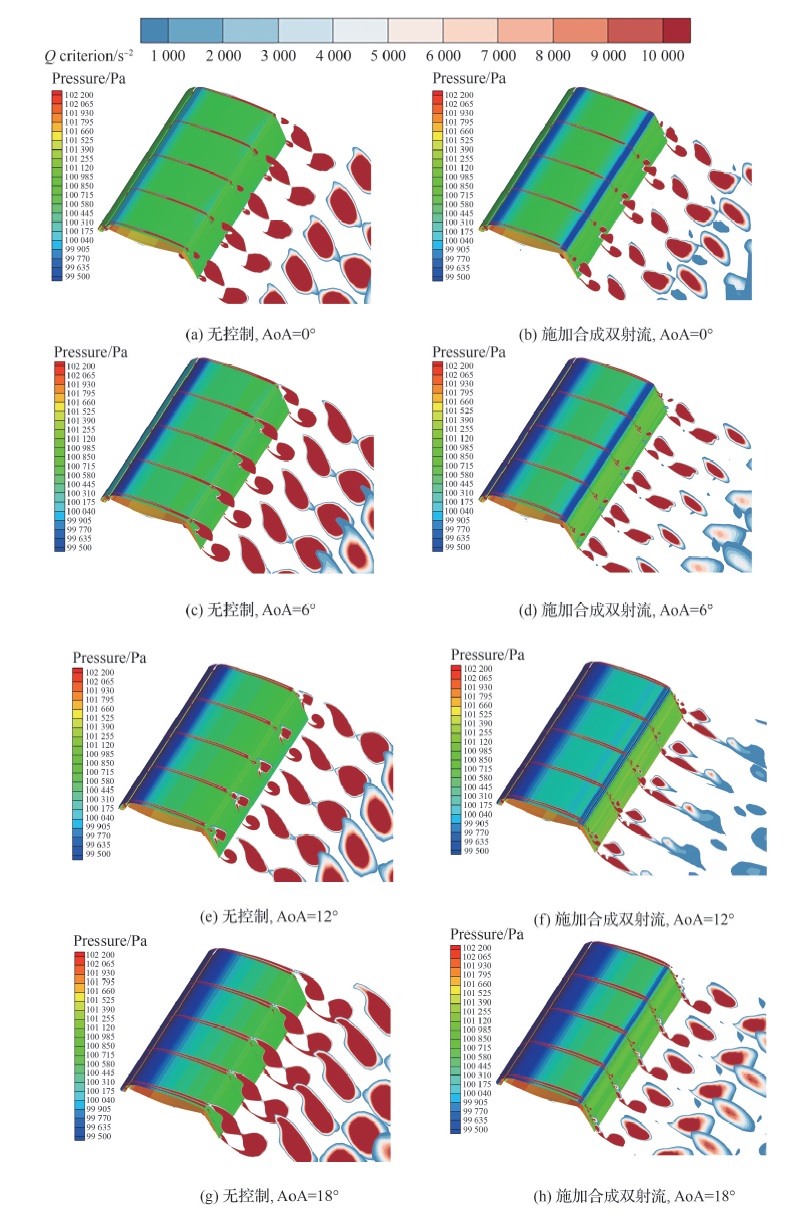
Fig.11
Comparison of vortex strength contour maps of simple flap before and after control
| [1] | 海军装备部飞机办公室, 中国航空工业发展研究中心. 国外舰载机技术发展: 气动、起降、材料、反潜、直升机预警[M]. 北京: 航空工业出版社, 2008. |
| Aircraft Office of the Naval Equipment Department, China Aviation Industry Development Research Center. Development of foreign carrier-based aircraft technology: Aerodynamics, take-off and landing, materials, anti-submarine, helicopter early warning[M]. Beijing: Aviation Industry Press, 2008 (in Chinese). | |
| [2] | SEIFERT A, BACHAR T, KOSS D, et al. Oscillatory blowing: A tool to delay boundary-layer separation[J]. AIAA Journal, 1993, 31(11): 2052-2060. |
| [3] | 王万波, 姜裕标, 黄勇, 等. 脉冲吹气对无缝襟翼翼型气动性能的影响[J]. 航空学报, 2018, 39(11): 122129. |
| WANG W B, JIANG Y B, HUANG Y, et al. Influence of pulse blowing on slotless flap airfoil aerodynamic characteristics[J]. Acta Aeronautica et Astronautica Sinica, 2018, 39(11): 122129 (in Chinese). | |
| [4] | 史子颉, 许和勇, 郭润杰, 等. 协同射流在垂直尾翼流动控制中的应用研究[J]. 航空工程进展, 2022, 13(1): 28-41. |
| SHI Z J, XU H Y, GUO R J, et al. Application research of flow control using co-flow jet on a vertical tail[J]. Advances in Aeronautical Science and Engineering, 2022, 13(1): 28-41 (in Chinese). | |
| [5] | HUANG L, MAESTRELLO L, BRYANT T. Separation control over an airfoil at high angles of attack by soundemanating from the surface[C]∥19th AIAA, Fluid Dynamics, Plasma Dynamics, and Lasers Conference. Reston: AIAA, 1987: 1261. |
| [6] | CHABPHET P, SANTICHATSAK S, THALANG T N, et al. High-lift mechanism motion generation synthesis using a metaheuristic[C]∥Proceedings of Innovation Aviation & Aerospace Industry-International Conference 2020.Basel: MDPI, 2019: 5. |
| [7] | XU H Y, QIAO C L, YANG H Q, et al. Active circulation control on the blunt trailing edge wind turbine airfoil[J]. AIAA Journal, 2018, 56(2): 554-570. |
| [8] | FENG L H, SHI T Y, LIU Y G. Lift enhancement of an airfoil and an unmanned aerial vehicle by plasma gurney flaps[J]. AIAA Journal, 2017, 55(5): 1622-1632. |
| [9] | HOHOLIS G, STEIJL R, BADCOCK K. Circulation control as a roll effector for unmanned combat aerial vehicles[J]. Journal of Aircraft, 2016, 53(6): 1875-1889. |
| [10] | 林泳辰, 徐惊雷, 韩杰星, 等. 气动推力矢量无舵面飞翼的飞行实验[J]. 航空动力学报, 2019, 34(3): 701-707. |
| LIN Y C, XU J L, HAN J X, et al. Flight test of a fluidic thrust vectoring flying wing without rudder[J]. Journal of Aerospace Power, 2019, 34(3): 701-707 (in Chinese). | |
| [11] | 曹永飞, 顾蕴松, 韩杰星. 流体推力矢量技术验证机研制及飞行试验研究[J]. 空气动力学学报, 2019, 37(4): 593-599. |
| CAO Y F, GU Y S, HAN J X. Development and flight testing of a fluidic thrust vectoring demonstrator[J]. Acta Aerodynamica Sinica, 2019, 37(4): 593-599 (in Chinese). | |
| [12] | 赵志杰, 罗振兵, 刘杰夫, 等. 基于分布式合成双射流的飞行器无舵面三轴姿态控制飞行试验[J]. 力学学报, 2022, 54(5): 1220-1228. |
| ZHAO Z J, LUO Z B, LIU J F, et al. Flight test of aircraft three-axis attitude control without rudders based on distributed dual synthetic jets[J]. Chinese Journal of Theoretical and Applied Mechanics, 2022, 54(5): 1220-1228 (in Chinese). | |
| [13] | 张刘, 黄勇, 陈辅政, 等. 基于环量控制的无尾飞翼俯仰和滚转两轴无舵面姿态控制飞行试验[J]. 航空学报, 2023, 44(18): 128224. |
| ZHANG L, HUANG Y, CHEN F Z, et al. Rudderless attitude control flight test based on circulation control of tailless flying wing in pitch and roll axes[J]. Acta Aeronautica et Astronautica Sinica, 2023, 44(18): 128224 (in Chinese). | |
| [14] | KORBACHER G K. Aerodynamics of powered high-lift systems[J]. Annual Review of Fluid Mechanics, 1974, 6: 319-358. |
| [15] | LI J, GONG Z B, ZHANG H, et al. Numerical investigation of powered high-lift model with externally blown flap[J]. Journal of Aircraft, 2017, 54(4): 1539-1551. |
| [16] | WICK A, HOOKER J, BARBERIE F, et al. Powered lift CFD predictions of a transonic cruising STOL military transport[C]∥51st AIAA Aerospace Sciences Meeting Including the New Horizons Forum and Aerospace Exposition. Reston: AIAA, 2013: 1098. |
| [17] | REN F, HU H B, TANG H. Active flow control using machine learning: A brief review[J]. Journal of Hydrodynamics, 2020, 32(2): 247-253. |
| [18] | CHEN W L, HUANG Y W, CHEN C L, et al. Review of active control of circular cylinder flow[J]. Ocean Engineering, 2022, 258: 111840. |
| [19] | SMITH B L, GLEZER A. The formation and evolution of synthetic jets[J]. Physics of Fluids, 1998, 10(9): 2281-2297. |
| [20] | 罗振兵, 夏智勋, 邓雄, 等. 合成双射流及其流动控制技术研究进展[J]. 空气动力学学报, 2017, 35(2): 252-264, 251. |
| LUO Z B, XIA Z X, DENG X, et al. Research progress of dual synthetic jets and its flow control technology[J]. Acta Aerodynamica Sinica, 2017, 35(2): 252-264, 251 (in Chinese). | |
| [21] | SEIFERT A, DARABI A, WYGANSKI I. Delay of airfoil stall by periodic excitation[J]. Journal of Aircraft, 1996, 33(4): 691-698. |
| [22] | 张攀峰, 王晋军. 孔口倾斜角对合成射流控制翼型流动分离的影响[J]. 兵工学报, 2009, 30(12): 1658-1662. |
| ZHANG P F, WANG J J. Effect of orifice inclined angle on flow control of the stalled airfoil with synthetic jet actuator[J]. Acta Armamentarii, 2009, 30(12): 1658-1662 (in Chinese). | |
| [23] | 张攀峰, 王晋军. 合成射流控制NACA0015翼型大攻角流动分离[J]. 北京航空航天大学学报, 2008, 34(4): 443-446. |
| ZHANG P F, WANG J J. Numerical simulation on flow control of stalled NACA0015 airfoil with synthetic jet actuator in recirculation region[J]. Journal of Beijing University of Aeronautics and Astronautics, 2008, 34(4): 443-446 (in Chinese). | |
| [24] | 刘峰, 邹建锋, 郑耀. 合成射流物理参数对控制翼型流动分离的影响[J]. 浙江大学学报(工学版), 2013, 47(1): 146-153. |
| LIU F, ZOU J F, ZHENG Y. Effect of synthetic jets physical parameters on flow separation control over airfoil[J]. Journal of Zhejiang University (Engineering Science), 2013, 47(1): 146-153 (in Chinese). | |
| [25] | 李斌斌, 姚勇, 顾蕴松, 等. 合成射流低速射流矢量偏转控制的PIV实验研究[J]. 空气动力学学报, 2018, 36(1): 22-25, 30. |
| LI B B, YAO Y, GU Y S, et al. PIV experiments on vector deflection control of lowspeed synthetic jet[J]. Acta Aerodynamica Sinica, 2018, 36(1): 22-25, 30 (in Chinese). | |
| [26] | 史志伟, 张海涛. 合成射流控制翼型分离的流动显示与PIV测量[J]. 实验流体力学, 2008, 22(3): 49-53. |
| SHI Z W, ZHANG H T. Flow visualization and PIV measurement of airfoil separated flow control based on synthetic jet[J]. Journal of Experiments in Fluid Mechanics, 2008, 22(3): 49-53 (in Chinese). | |
| [27] | 王雷, 李哲, 冯立好. 合成射流激励器能量转换效率的参数影响规律及优化研究[J]. 实验流体力学, 2023, 37(4): 87-95. |
| WANG L, LI Z, FENG L H. Parameter influence and optimization of energy conversion efficiency of synthetic jet actuators[J]. Journal of Experiments in Fluid Mechanics, 2023, 37(4): 87-95 (in Chinese). | |
| [28] | 刘小波, 张伟伟, 蒋跃文, 等. 尾缘合成射流影响翼型非定常气动特性的数值研究[J]. 空气动力学学报, 2012, 30(5): 606-612. |
| LIU X B, ZHANG W W, JIANG Y W, et al. Numerical study on unsteady aerodynamic characteristics of an airfoil with a synthetic jet set in trailing edge[J]. Acta Aerodynamica Sinica, 2012, 30(5): 606-612 (in Chinese). | |
| [29] | LUO Z B, XIA Z X, LIU B. New generation of synthetic jet actuators[J]. AIAA Journal, 2006, 44(10): 2418-2420. |
| [30] | SWANSON R C, RUMSEY C L. Computation of circulation control airfoil flows[J]. Computers & Fluids, 2009, 38(10): 1925-1942. |
| [31] | RUMSEY C, GATSKI T, YING S S, et al. Prediction of high-lift flows using turbulent closure models[C]∥15th Applied Aerodynamics Conference. Reston: AIAA, 1997: 2260. |
| [32] | 刘睿, 白俊强, 邱亚松, 等. 内吹式襟翼几何参数影响研究与优化设计[J]. 西北工业大学学报, 2020, 38(1): 58-67. |
| LIU R, BAI J Q, QIU Y S, et al. Effects of geometrical parameters of internal blown flap and its optimal design[J]. Journal of Northwestern Polytechnical University, 2020, 38(1): 58-67 (in Chinese). | |
| [33] | 王万波, 姜裕标, 黄勇, 等. 大型飞机襟翼吹气增升风洞试验[J]. 航空学报, 2023, 44(13): 127870. |
| WANG W B, JIANG Y B, HUANG Y, et al. Lift enhancement wind tunnel test with flap blowing for large aircraft[J]. Acta Aeronautica et Astronautica Sinica, 2023, 44(13): 127870 (in Chinese). | |
| [34] | 张鉴源, 罗振兵, 彭文强, 等. 基于合成双射流的襟翼舵效增强技术研究[J]. 实验流体力学, 2023, 37(4): 76-86. |
| ZHANG J Y, LUO Z B, PENG W Q, et al. Investigation on performance enhancement of flap based on dual synthetic jets[J]. Journal of Experiments in Fluid Mechanics, 2023, 37(4): 76-86 (in Chinese). | |
| [35] | JEONG J, HUSSAIN F. On the identification of a vortex[J]. Journal of Fluid Mechanics, 1995, 285: 69-94. |
| [1] | Zhenbing LUO, Hao WANG, Zhijie ZHAO. Theory of dual synthetic jets and its empowerment of advancements in aeronautical technology [J]. Acta Aeronautica et Astronautica Sinica, 2025, 46(5): 531821-531821. |
| [2] | Hao WANG, Zhenbing LUO, Xiong DENG, Yan ZHOU, Jianyuan ZHANG, Zhijie ZHAO. Airfoil gust load alleviation based on dual synthetic jets [J]. Acta Aeronautica et Astronautica Sinica, 2024, 45(16): 129660-129660. |
| [3] | Yinxin ZHU, Wenqiang PENG, Zhenbing LUO, Ying KANG, Zhijie ZHAO, Pan CHENG, Jiefu LIU. Influence of full⁃span dual synthetic jets on high⁃turning compressor cascade [J]. ACTA AERONAUTICAET ASTRONAUTICA SINICA, 2023, 44(12): 127734-127734. |
| [4] | YANG Xiaowei, GE Yaowen, DENG Wenxiang, YAO Jianyong, ZHOU Ning. Active fault-tolerant control for hydraulic actuating cylinders of aeroengine guide vane control mechanisms [J]. ACTA AERONAUTICAET ASTRONAUTICA SINICA, 2022, 43(9): 625464-625464. |
| [5] | LI Guojun, BAI Junqiang, TANG Changhong, LIU Nan, QIAO Lei. Characteristics of laminar separation flutter of two-dimensional airfoils at low Reynolds numbers [J]. ACTA AERONAUTICAET ASTRONAUTICA SINICA, 2017, 38(11): 121280-121280. |
| [6] | TONG Fan, QIAO Weiyang, WANG Liangfeng, JI Liang, WANG Xunnian. Noise reduction mechanism of bionic airfoil trailing edge serrations [J]. ACTA AERONAUTICAET ASTRONAUTICA SINICA, 2015, 36(9): 2911-2922. |
| [7] | DENG Xiong, XIA Zhixun, LUO Zhenbing, LI Yujie. Experimental investigation on the vectoring characteristic of dual synthetic jets actuator with asymmetric exits [J]. ACTA AERONAUTICAET ASTRONAUTICA SINICA, 2015, 36(2): 510-517. |
| [8] | LIU Zhou, YANG Yunjun, ZHOU Weijiang, GONG Anlong. Study of Unsteady Separation Flow Around Airfoil at High Angle of Attack Using Hybrid RANS-LES Method [J]. ACTA AERONAUTICAET ASTRONAUTICA SINICA, 2014, 35(2): 372-380. |
| [9] | YU Lei, SONG Wenping, HAN Zhonghua, YAN Li. Aeroacoustic Noise Prediction Using Hybrid RANS/LES Method and FW-H Equation [J]. ACTA AERONAUTICAET ASTRONAUTICA SINICA, 2013, 34(8): 1795-1805. |
| [10] | ZHANG Jiazhong, LI Kailun, CHEN Liying. Nonlinear Dynamics of Static Stall of Airfoil and Its Control [J]. ACTA AERONAUTICAET ASTRONAUTICA SINICA, 2011, 32(12): 2163-2173. |
| Viewed | ||||||
|
Full text |
|
|||||
|
Abstract |
|
|||||
Address: No.238, Baiyan Buiding, Beisihuan Zhonglu Road, Haidian District, Beijing, China
Postal code : 100083
E-mail:hkxb@buaa.edu.cn
Total visits: 6658907 Today visits: 1341All copyright © editorial office of Chinese Journal of Aeronautics
All copyright © editorial office of Chinese Journal of Aeronautics
Total visits: 6658907 Today visits: 1341

 CJA
CJA
